
6
Astronomy from the Moon
ASTRONOMY AND THE SPACE EXPLORATION INITIATIVE
According to current plans for the manned space program, humanity 's return to the moon is not expected to take place until sometime in the first decade of the 21st century; substantial scientific facilities will not be established until even further in the future. Therefore this chapter does not recommend specific projects. Rather, discussion focuses on the moon as a site for astronomical telescopes and the science that may be best done with lunar telescopes. The committee's principal conclusion is that the moon is potentially an excellent site for some astronomical observations. The committee believes that a lunar astronomy program should complement the earth-orbiting satellite program, that both technology and science should proceed in a step-by-step fashion, and that NASA should devote an appropriate fraction of the funding for its Space Exploration Initiative to scientific endeavors, including astronomy. The committee outlines an evolutionary program that will develop necessary technologies and increase the scientific return from a lunar program.
A number of conferences have been held under NASA's auspices on the topic of lunar observatories (Burns and Mendell, 1988; Mumma and Smith, 1990). The reader is referred to these conference proceedings for many stimulating ideas. In the discussion that follows, the term “telescopes” is used in the general sense to include interferometers and astronomical instruments at all wavelengths, and equipment for the detection of cosmic rays.
THE MOON AS AN OBSERVATORY SITE
Physical Characteristics
The moon is a slowly rotating spacecraft, 3,476 km in diameter, that always presents the same face to the earth. The moon lacks a significant atmosphere but has a rocky surface covered with dust. Its surface gravity is about one-sixth that of the earth. Table 6.1 describes a typical infrastructure and compares it to other remote observing sites. Table 6.2 lists some of the advantages and disadvantages of the moon as an observatory.
The moon has most of the advantages of any observatory in space. The absence of a lunar atmosphere and ionosphere permits observations over the entire electromagnetic spectrum with a resolution that is limited only by the characteristic size of the telescope. The lunar environment also lends itself to the construction of large, precise structures. The low lunar gravity and the absence of wind make possible telescope mirrors and support structures lighter than those constructed on the earth. The lunar night provides thermal stability, important for maintaining the precise alignment of a large telescope or the separations and orientations of an array of smaller ones. During the lunar night, telescopes can attain the low temperatures, less than 70 K, needed to improve infrared sensitivity. A major advantage of the moon compared with orbital observatory sites is the large, rigid lunar surface on which could be built arrays of telescopes extending over many kilometers to form interferometers.
The disadvantages of the moon compared with a remote site on the earth or in earth orbit include the limited mass that can be sent to the moon, the stringent requirements imposed on the design of instruments that must survive the rigors of space travel, and the need for assembly and operation of complex equipment with only a few workers. A rocket that can send 1,000 kg to low earth orbit, or 400 kg to high earth orbit, can send only 290 kg to the moon. Although lunar gravity is weaker than the earth's, supporting a few tons of telescope is a difficult task not faced by the designer of an orbiting telescope. Cosmic rays and the solar wind impinge directly on the lunar surface, unmoderated by a magnetosphere. Contamination of optical and mechanical components by lunar dust is a potential problem.
Detailed study will be required to determine whether, for any particular instrument, operation from high earth orbit offers advantages relative to operation on the moon. In the very distant future, mining or manufacturing operations on the moon might create an infrastructure that could make the moon an attractive site for many astronomical facilities.
A Human Presence
The presence of astronauts offers both advantages and disadvantages for astronomy. Astronauts are able to install and repair astronomical facilities, albeit on a restricted work schedule and with dexterity limited by spacesuits. The direct
TABLE 6.1 Infrastructure at Remote Observing Sites
|
Operation Phase |
Date |
Science Mass (kg yr−1) |
Power Available (megawatt) |
Workers on Site |
|
Antarctica |
1990 |
5 × 10⁵ |
0.35 |
100 (summer) 20 (winter) |
|
Space Stationa |
2000 |
1 × 10⁵ |
0.1 |
8 |
|
High earth orbitb |
2000 |
4 × 10⁴ |
0.1 |
10 (assembly) 0 (operations) |
|
Lunar emplacementc |
2004 |
2 × 10³ |
0.1 |
4 |
|
Lunar consolidationc |
2010 |
7 × 10³ |
0.5 |
8 |
|
Lunar utilizationc |
2015 |
3 × 10³ |
1 |
12 |
|
a Assumes two science payloads per year with a heavy lift vehicle. b Assumes two science payloads per year using a heavy lift vehicle and assembly in low earth orbit, followed by boost to high earth orbit. cReport of the 90-Day Study (NASA, 1989). |
||||
TABLE 6.2 Environmental Attributes of the Moon
|
Lunar Feature |
Advantages |
Disadvantages |
|
No atmosphere |
Access to all wavelengths No atmospheric distortion of images No wind loading of telescopes |
No protection from cosmic rays No moderation of thermal effects |
|
No ionosphere |
No long-wave radio cutoff |
Line-of-sight transmission |
|
Size |
Large, disconnected structures can be built Momentum from pointed telescopes is absorbed Seismically quiet compared to the earth |
|
|
Solid surface |
Radiation and thermal shielding Raw construction materials |
Possible dust contamination |
|
Lunar gravity |
Lightweight structures possible |
Telescopes require support |
|
Slow, synchronous rotation |
Two weeks of thermal stability Long integration times Far side isolated from terrestrial interference |
300 K diurnal temperature change Very slow aperture synthesis No solar power at night |
|
Distance from the earth |
Long baseline for radio interferometry |
Expensive transportation |
|
Human presence |
Construction, operation, repair, refurbishment |
Expense, safety requirements, environmental degradation |
involvement of people in astronomical facilities mandates safety requirements that have, in the past, proven to be expensive. Several experiments done during Apollo missions showed that contamination problems due to the presence of humans may be acute on the moon. Previous experience suggests that scientific facilities should be designed so that humans are called on to provide only limited, but critical, services.
SCIENCE FROM A LUNAR OBSERVATORY
Some measurements for which the moon may offer significant advantages compared with terrestrial or earth-orbiting instruments are discussed in this section. The concepts described below are illustrative; other promising possibilities may be developed as plans for a lunar base mature.
Observations with Single Telescopes
The early operation of a modest-sized (1-m-class) telescope would provide vital information concerning the design of future, more complicated, lunar telescopes, while providing unique scientific information. A small pointed telescope could observe individual objects or carry out wide-angle surveys, perhaps in the ultraviolet or infrared. A transit telescope with only a few moving parts could produce an imaging survey from the ultraviolet to the infrared over a large area of the sky using the slow rotation of the moon for scanning. The telescope would provide a high-resolution map of the universe at faint magnitudes.
A large-diameter telescope (16-m class) operating at infrared, optical, and ultraviolet wavelengths could have enormous scientific potential. As discussed in Space Science in the 21stCentury (NRC, 1988), such an instrument could detect earth-like planets around nearby stars and perhaps detect O3 at 10 µm or O2 at 1 µm in their atmospheres. Oxygen molecules are believed to be universally related to the presence of life in an atmosphere like our own. This very large telescope could also study the formation and evolution of galaxies by taking images and spectra of galaxies at large redshifts. The question of what is the best location, a lunar base or high earth orbit, is particularly problematic for such a telescope. As for other cases, the answer will depend on technological developments in the next decade and on the infrastructure that will become available to support orbiting and lunar observatories.
Interferometry at Visible and Near-infrared Wavelengths
The techniques of interferometry can be used to link widely separated telescopes on the lunar surface to produce the spatial resolution of a single large telescope many kilometers in size. With an array of telescopes spread over a 10-km baseline, distortion-free images can be obtained for faint sources with
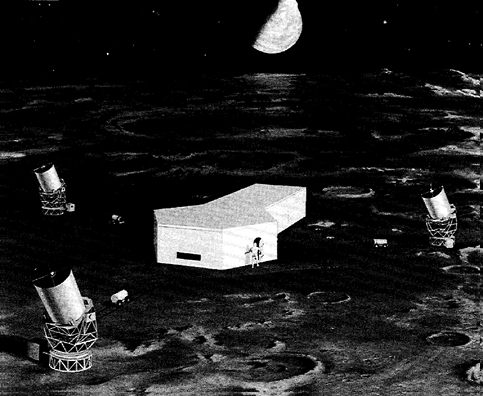
FIGURE 6.1 An artist's conception of an interferometer consisting of three telescopes operating at optical and infrared wavelengths on the moon. Light from the three telescopes is combined in the central building.
5- to 100-millionths-of-an-arcsecond resolution in the visible and near-infrared wavelengths, 0.2 to 5 µm. Astrometric observations could be made with high precision over this wavelength region.
Five passively cooled, 1.5-m telescopes operating together in this wavelength region could revolutionize many research topics in astronomy by combining high sensitivity with unprecedented spatial resolution (Figure 6.1). Such an instrument could map protoplanetary disks around young stars in the constellation of Taurus with a resolution better than 0.004 of the earth-sun separation, more than enough resolution to find gaps in the disks indicative of the presence of forming planets, to detect planets around stars out to a few thousand light-years by astrometric motions, to measure distances and motions of stars and star-forming regions in nearby galaxies, and to resolve the environment around the energy sources of quasars.
The full power of such an instrument would be difficult to realize on the earth because of the effects of the terrestrial atmosphere, and difficult to achieve in orbit because of the precise separations and orientations that would
have to be maintained between component telescopes spread out over many kilometers. Several small, modular telescopes operating in concert could return fundamentally new astrophysical results relatively early in the life of a lunar base.
Interferometry at Submillimeter Wavelengths
The wavelengths between 100 µm and 1000 µm (1 mm) offer the key to many problems concerning the formation and evolution of stars and galaxies. Observations with infrared and radio techniques will determine the densities and temperatures in the protostellar nebulae of nearby star-forming regions and in distant star-burst galaxies, leading to a more detailed physical understanding of where and how stars form. The spectral line of ionized carbon at 158 µm is a fundamental cooling transition for star-burst and primordial galaxies and would be visible with a lunar observatory out to redshifts well beyond 3. An array of small, modular submillimeter telescopes spread over the lunar surface would allow thousandth-of-an-arcsecond imaging, adequate to search for evidence of planets forming in the disks surrounding nearby stars or to probe the energy sources of luminous infrared galaxies.
Radio Observations
The far side of the moon could provide a uniquely quiet environment for a large radio telescope after the initial development of a lunar base. It is important to preserve this area as a radio-free region in which especially sensitive scientific experiments could be performed.
High-Energy Astrophysics
The lunar surface might be suitable for the construction of x-ray and gamma-ray facilities that require large, stable structures, such as long-focal-length grazing-incidence telescopes, shadow cameras with large separations between mask and detector, or large detector arrays. Gamma-ray detectors could take additional advantage of the lunar soil for shielding against backgrounds from stray energetic particles and radiation.
AN EVOLUTIONARY PROGRAM OF TECHNOLOGICAL AND SCIENTIFIC DEVELOPMENT
The unique aspects of the lunar environment may lead to qualitatively new types of astronomical instruments and measurements, ones that are both technically and intellectually different from those possible with ground-based or orbiting telescopes. Current ideas and instruments give us only approximate
guidance on what questions to ask. The lunar program should proceed as a step-by-step program with milestones of increasing scientific and technical scope. An early start on advanced technology development is essential.
As an example, consider one approach to the goal of a large multi-wavelength interferometer on the moon. The program could start by building interferometers on the earth and progress to earth-orbiting interferometers— equipment initiatives individually recommended in Chapter 1. Then, as the surface of the moon becomes accessible for astronomical facilities, small telescopes might first be installed and then, as experience is gained with the lunar environment, modest-sized interferometers could be constructed.
Such a step-by-step program applies equally to other types of telescopes and would have a number of advantages. The technology would be developed in a systematic way and realistically tested on astronomical sources at each step. For the specific example of the interferometer, different ideas for delay lines and beam combiners could be evaluated and the best technique chosen for the final multielement array. The scientific concepts would develop together in concert with the technology and could guide the choice of a suitable final instrument. Since no astronomical object has yet been observed with even thousandth-of-an-arcsecond resolution at optical wavelengths, entirely new phenomena are expected at the millionth-of-an-arcsecond level. Outstanding researchers would be attracted to the lunar initiative if they could foresee interim scientific results being obtained. Students could be involved in the intermediate stages of such a phased program. The opportunities for technological spinoff will be greater if there are intermediate goals that bring scientists and industry together frequently to make instruments that will be used for measurements of immediate scientific interest.
SPECIFIC TECHNOLOGY INITIATIVES
Many new technologies will be required for a lunar base. For example, robotic assembly of precision structures will be important for the construction of large telescopes. The ability to send scientific payloads to the moon independent of the system that transports humans may be critical for the long-term viability of such a program. These and other technological issues must be investigated thoroughly in this decade [see, for example, Human Exploration of Space: A Review of NASA's 90-Day Study and Alternatives (NRC, 1990b)].
Advanced technology development is needed to achieve the science described above. Ground-based and free-flying interferometric instruments need to be started within the decade of the 1990s in order to provide a basis for deciding whether it will be appropriate to place a major interferometric instrument on the moon. A large telescope operating from ultraviolet to infrared wavelengths, and placed either in earth orbit or on the moon, would be an instrument with immense power. Building such an instrument will require advances in making
and supporting lightweight mirrors. It is necessary to begin required technology development soon. A submillimeter astronomy program in earth orbit is an appropriate preparation for an eventual lunar telescope. These technologies are also discussed in Chapter 1 in connection with the prioritized list of new technology initiatives for future NASA missions that may, or may not, be carried out on the moon.
THE IMPACT OF THE LUNAR PROGRAM
In large space projects, there is sometimes a temptation to move on to the next challenging program before exploiting fully the scientific potential of existing facilities. Some experiences of the research community with the Space Shuttle and the Space Station give cause for concern about possible future effects of a lunar initiative on NASA's scientific research efforts. A lunar base can be developed in a way that does not disrupt ongoing and planned programs. The Strategic Plan (NASA, 1988, 1989) for NASA's Office of Space Science and Applications (OSSA) describes a carefully balanced and scientifically important research program, many aspects of which have been reviewed and endorsed by this and other relevant National Research Council committees.
-
The committee recommends that NASA formulate its plans for a lunar initiative in a way that protects the base program in astrophysics from disruptions caused by problems in the Space Exploration Initiative. 1 The scientific potential of the ongoing and planned earth-orbiting observatories should be exploited before committing resources from the science budget to major lunar facilities that will not be operational until at least 2010. Initial funding for advanced technology development and for scientific missions that are precursors to lunar facilities should come from the Space Exploration Initiative.
One of the key goals of the Space Exploration Initiative is to help interest young people in careers in science and engineering and thereby enhance the nation's capabilities in these areas. Astronomy can play an important role in inspiring a new generation of scientists if an adequate and stable fraction of the funding for the Space Exploration Initiative is dedicated to the development and execution of peer-reviewed scientific initiatives.
WHERE SHOULD THE PROGRAM BE IN 10 YEARS?
The Space Exploration Initiative is a multidecade program. The astronomical aspects of this program need a long-range plan that takes advantage
|
1 |
This recommendation was also forcefully made in the report of the National Academy's Committee on Space Policy chaired by H.G. Stever (NAS-NAE, 1988). |
of the unique properties of the moon and that follows an evolutionary path with appropriate milestones in planning, assessment of the lunar environment, development of technology and instruments, and scientific accomplishments. In keeping with the cycle of decennial surveys, it is reasonable to ask: where should the program be by the year 2001, at the time of the next decennial survey of astronomy and astrophysics?
By mid-decade, NASA should have completed analyses that will indicate which observations are best done from the moon. The analyses should consider the infrastructures, costs, risks, and environments of different sites, as well as possible benefits from advances in technology.
Key parameters of the lunar environment must be determined and site survey programs initiated. Flight hardware should be in development, or already in operation, by the end of the 1990s in order to answer questions that require in situ measurements. The earliest opportunity to obtain critical observations will he with the first Lunar Observer satellite. Any additional automated site survey missions should be under development by the middle of the 1990s.
The technology development programs in lightweight telescope construction, interferometry, and submillimeter techniques should be well under way. The first orbital precursor missions should be providing scientific data and technical experience as part of the Space Exploration Initiative. Possible programs that could be supported under this program include Delta-class satellites that would explore the feasibility of near-visible wavelength interferometry from space, of submillimeter astronomy with lightweight panels and cryogenic receivers, or of arrays of low-frequency dipole antennas. Programs in these or other appropriate disciplines in astronomy should be selected by peer review.
Preliminary studies have identified a few astronomical lunar facilities, such as a small (1-m-class) transit or pointed telescope, that might be appropriate early in a lunar program. At least one small project for the early phase of a lunar base should be selected by an open competition prior to the next decennial survey.
CONCLUSIONS AND RECOMMENDATIONS
The committee is convinced that the moon is potentially an excellent site for certain astronomical observatories that are capable of making fundamental discoveries. Operation from the moon may represent a significant advance over terrestrial or orbiting telescopes for interferometry at wavelengths ranging from the submillimeter to the optical.
-
The committee recommends that an appropriate fraction of the funding for a lunar initiative be devoted to fundamental scientific projects that will have a wide appeal, to supporting scientific missions as they progress from small ground-based instruments, to modest orbital experiments, and finally, to the placement of
-
facilities on the moon. The advanced technology should be tested by obtaining scientific results at each stage of development.
-
NASA should initiate science and technology development so that facilities can be deployed as soon as possible in the lunar program. The NASA office responsible for space exploration and technology should support the long-term development of technologies suitable for possible lunar observatories.
-
Site survey observations from the Lunar Observer(s), possibly with soft landed experiments such as a small transit telescope, should be a high priority for a lunar program. The requirements for astronomical observations should be carefully considered in the selection of the site for a lunar base.
Multiwavelength (ultraviolet to infrared) observations with a large (16-m-class) telescope and infrared observations with a large, cold infrared telescope in a polar crater, or radio observations from the far side of the moon could offer unprecedented capabilities for astronomy. These projects are, however, formidable technical challenges.
-
NASA should develop the technology necessary for constructing large telescopes and should investigate which of these facilities are best placed in earth orbit and which are best placed on the moon.
-
NASA, along with other governmental and international agencies, should strive to have the far side of the moon declared a radio-quiet zone.


