
Specific Analysis of the Themes of the Strategic Plan
This chapter provides the committee’s review of each Theme described in the Strategic Plan. The general issues discussed in Chapter 2—notably the points concerning establishment of a National Program Office, prioritization of activities, metrics for evaluating progress, and implementation of program elements—are further addressed below in the specific contexts of the seven Themes. As emphasized in Chapter 2, the committee recognizes that a strategic plan differs from a more focused implementation plan, and that detailed descriptions of specific programs for achieving the broad goals of the FOARAM Act cannot be developed in the Strategic Plan. Nonetheless, the committee concludes that some of the Themes provide insufficient information regarding the design of effective mechanisms for successful implementation. Thus, the committee offers recommendations for each Theme to guide implementation efforts.
The committee analyzes each of the seven Themes by, first, summarizing the relevant mandate (Program Element) from the FOARAM Act and, then, discussing how effectively the goals of the Program Element are addressed by the Theme in the Strategic Plan. Recommendations are offered when the committee concludes that the Strategic Plan needs further development.
Our committee recognizes that considerable time has elapsed between completion of the Strategic Plan and initiation of the review process. During this period, new literature has appeared, some of which needs to be analyzed and integrated into the Strategic Plan. We offer several suggestions for these up-dates in our critiques of the different Themes.
Overall, the committee concludes that the Strategic Plan is a well-researched, logically developed, and well-written document.1 With appropriate modification, the committee believes that it will serve to make a compelling case for the implementation of a program on ocean acidification research and monitoring that satisfies the mandates given in the FOARAM Act.
THEME 1: MONITORING OF OCEAN CHEMISTRY AND BIOLOGICAL IMPACTS
The FOARAM Act (page 9) mandates “[m]onitoring of ocean chemistry and biological impacts associated with ocean acidification at selected coastal and open-ocean monitoring stations, including satellite-based monitoring to characterize (A) marine ecosystems; (B) changes in marine productivity; and (C) changes in surface ocean chemistry.” To this end, the IWGOA Strategic Plan’s Theme 1 addresses how the U.S. scientific community will go about monitoring changes in ocean chemistry and its biological impacts. The committee finds that the focus of Theme 1 overlaps considerably with that of Theme 2 (“Research to understand the species-specific physiological responses … impacts on marine food webs … and … ecosystem responses to ocean acidification.”), such that close attention to developing integrated and complementary efforts across these two Themes is warranted. Likewise, the critical role of advances in technology for monitoring efforts, as pointed out in Theme 4, makes improved integration of Themes 1 and 4 appropriate.
The treatment of the relevant FOARAM Act Program Element specific to Theme 1 is well-presented and comprehensive, especially in the arena of chemistry and efforts to monitor pH and carbon-related variables (see below). These monitoring efforts are very important and it is critical that they be expanded rapidly, because for many coastal waters no baseline information exists. The monitoring activities outlined in Theme 1 will provide the first descriptions of the carbonate chemistry and its variability of these coastal waters. These measurements are important because they will form the baseline against which future changes will be measured and provide information about the coastal environment that supports many U.S. fishery resources.
Because the rationale for these monitoring efforts is not presented in detail until Theme 2, a nonexpert reader would not fully grasp the importance and reasons for monitoring from the description presented in
_________________________
1 Note: The report does not offer recommendations that involve syntax and grammar. The Strategic Plan is generally well-written and we feel that the revision process will enable the Strategic Plan’s authors to remedy any shortfalls in expositional writing that may currently exist.
Theme 1. To make the Strategic Plan more effective in conveying the need for monitoring and for adequate support for these efforts, the rationale for the chemical monitoring effort along U.S. coasts needs to be better described in Theme 1 or the order of Themes 1 and 2 needs to be reversed. For instance, the importance of early detection of changes in pH is notable, because such ‘early warning’ information would be needed for ecological and socioeconomic analyses. And, as in the case of other types of studies outlined in the Strategic Plan, monitoring activities require prioritization; no clear process for establishing priorities is given in Theme 1.
The committee commends the IWGOA for providing relevant examples of how ocean acidification monitoring can be built into existing research programs at relatively low cost. The CLIVAR/Repeat Hydrography program and the time-series programs at Hawaii and Bermuda are highlighted. These programs provide what are probably the best available examples of efforts for monitoring seawater carbonate chemistry over time. However, the limitations in temporal and spatial sampling seen in existing studies reflect the need for a greatly expanded monitoring program, one whose success is likely to depend on new technology (e.g., improved in situ sensors). The time-series programs provide the additional advantage of biological monitoring being integrated with the chemical studies. The National Science Foundation (NSF) Long-Term Ecological Research program is another example of an existing activity that could be augmented to include chemical and biological monitoring related to ocean acidification.
Theme 1 of the Strategic Plan provides a good description of the chemical parameters that need to be measured and points out that particulate inorganic carbon (PIC), particulate organic carbon (POC) and dissolved organic carbon (DOC) need to also be included in the suite of parameters that are monitored. The Strategic Plan could be strengthened by better distinguishing the different objectives of monitoring the chemical parameters and by stating how the technologies and sampling protocols should be selected to best achieve these different objectives.
One objective is the detection of long-term trends in a data record against a background of substantial short-term variability. Achieving such a goal requires high instrument and measurement precision and an adequate length of data record. Ideally, in situ sensors could play a central role in long-term monitoring efforts because this type of instrumentation could be placed at a large number of sites around the globe to obtain records of pH-related variables at different depths with high temporal resolution. However, until in situ sensors have the needed precision, accuracy, and long-term stability, the collection and analysis of discrete samples will be vital to ensure that the carbonate chemistry data sets will have the accuracy required to detect trends in carbonate chemistry in response to ocean acidification. The Strategic Plan’s emphasis on in situ sensors
is warranted over the longer term, but the current sensors available for such monitoring have significant limitations (e.g., in terms of continual calibration during long-term periods of data collection). The committee is encouraged, however, by reports that development of in situ sensors with adequate precision, stability, and depth-capabilities is progressing rapidly, in part through effective collaborations between academic, governmental and industrial organizations. Here, the development of CTD sensors serves as a model for such collaborations. The development of adequate sensors and their deployment at numerous sites would represent a major breakthrough in monitoring efforts. Lastly, whatever technology and methods of data collection happen to be used, the long-term utility of data sets will depend on consistent, accurate calibration protocols, to ensure comparability of data over time (see Dickson et al., 2007).
A second objective is to measure short-term variability at appropriate temporal and spatial scales, to understand the range of values organisms are exposed to and to complement in situ biological observations to study organisms’ responses to such changes. Examples of this type of monitoring include changes in pH and carbonate chemistry due to physical processes such as upwelling events, as well as biological processes such as diurnal cycles in photosynthesis and respiration. For these purposes, in situ sensors are highly attractive because they offer the ability to sample more frequently in space and time.
A significant weakness in the presentation of Theme 1 is the lack of detail about proposed biological monitoring. This shortfall is due in part to the fact that much remains to be learned about which biological processes are most sensitive to changes in carbonate chemistry, how ocean acidification will impact different organisms across their life cycles, and, ultimately, how these diverse interspecific and life stage-specific sensitivities will play out through species interactions at the ecosystem level. This research need is in part captured by those goals in the Strategic Plan that state the need to “develop biological monitoring protocols.” There is a growing recognition in the scientific community that a universal set of biological parameters may not exist, but rather that the optimal biological parameters to characterize the effects of ocean acidification may be specific to particular habitats or even organisms.
Consequently, the committee agrees with the following statement in the Strategic Plan: “The National Ocean Acidification Program will need to incorporate a process for identifying issues to be addressed by biological indicators (Theme 2) and guidelines for developing the indicators and vetting their performance (e.g., Jackson et al., 2000; Theme 4).” The committee further believes that a determination of what is monitored, how it is measured, and the usefulness of these measures in detecting biological responses to ocean acidification will be a rapidly evolving aspect of the Ocean Acidification Program. Thus, the committee believes it is important that the Plan
describe a process for reevaluating the inventory of biological measurements chosen for monitoring purposes (for example, building from the experience of the process studies detailed in Theme 2).
In developing a strategy for creating an ocean acidification observing network, it is important to maintain a broad perspective of not only how the chemical and biological monitoring advances the scientific needs, but also the suite of socioeconomic issues that may result from the diverse effects of ocean acidification on marine ecosystems (presented in Theme 5). As mentioned throughout this committee’s report, such an interdisciplinary approach should be incorporated at the very early stages of the evolving U.S. Ocean Acidification Program, to ensure that development of effective policies (e.g., in “adaptation;” see Theme 5) are commensurate with research on ocean acidification’s impacts, and that the program helps familiarize the public at large about the potential impacts of ocean acidification on U.S. economic interests (an issue treated in Theme 6).
The Strategic Plan does not provide much information on the physical locations of monitoring sites nor the frequency of monitoring at the chosen locations. Criteria for decision making on choices of monitoring sites and frequencies of monitoring will be crucial to the success of the overall monitoring effort. Although some decision on monitoring locations may be based on practical considerations, such as the existence of laboratory and ship facilities in an area, it is critical that the goals of the FOARAM Act serve as guides for implementing a broad monitoring program. Thus, for example, the coastal sites to be monitored should include waters where commercially important shellfish occur either naturally or in mariculture facilities. Monitoring in these regions would help in integrating monitoring efforts with socioeconomic concerns. Frequency of monitoring is also a critical element in the design of a monitoring program. Continuous monitoring may be needed in situations where intermittent upwelling of low pH waters threatens shellfish mariculture operations. Additionally, although various coastal regions will experience differing impacts, it appears conjectural in the discussion of Theme 1 to state at the onset of the program that one region is more threatened than another. Some regions are strongly predicted to be at risk, but at present there are too few data to support predictions regarding the degree of vulnerability for most coastal areas.2 Nonetheless, the discussion in Theme 1 could emphasize important observing sites located in U.S. territorial waters (perhaps using
_________________________
2 Vulnerability is a function of exposure, sensitivity, and adaptive capacity (i.e., the capacity to cope with or recover from an environmental stressor). Resource managers are urged to assess the vulnerability of the systems they are charged with managing and information that can inform such vulnerability assessments will be critical for adaptation planning (NRC, 2010). Such vulnerability assessments can also assist in planning research and monitoring activities.
a more detailed map than Figure 5 of the Strategic Plan), that are relevant to vital marine resources and to U.S. economic interests.
Finally, as is the case for all Themes—and as is discussed in depth in Chapter 2—there is a lack of information concerning prioritization of the different activities that are proposed and the metrics that would be used to evaluate how effectively different research and monitoring activities are moving toward realization of the program goals.
In summary: To convey more effectively the rationale for chemical and biological monitoring, the Strategic Plan needs to describe at the beginning the potential consequences of ocean acidification and the importance of monitoring for tracking ocean acidification-related changes in marine chemistry and biology. In addition, an explicit description of the various purposes for monitoring the chemical parameters would improve the Strategic Plan. The role of evolving technology, notably for in situ measurements, must be taken into account to ensure that the most powerful new methods are integrated into monitoring programs. Thus, integration of Themes 1 and 4 is important. Because the biological parameters to be monitored will likely evolve with an increasing understanding of the impacts, it is important that the Strategic Plan describe a process for reevaluating the inventory of biological measurements chosen for monitoring purposes. Themes 1 and 2 therefore should be integrated. Lastly, monitoring should also include the socioeconomic information needed to address the societal challenges related to ocean acidification (Theme 5).
THEME 2: RESEARCH TO UNDERSTAND RESPONSES TO OCEAN ACIDIFICATION
The FOARAM Act mandates “[r]esearch to understand the species specific physiological responses of marine organisms to ocean acidification, impacts on marine food webs of ocean acidification, and to develop environmental and ecological indices that track marine ecosystem responses to ocean acidification.” This broad Program Element of the Act encompasses the wide impacts of ocean acidification and the tasks described herein are closely related to activities essential for achieving goals presented in many of the other Themes in the Strategic Plan. Thus, in the analysis below we focus not only on the extent to which the Strategic Plan addresses its primary Element of the FOARAM Act, but also on how well it integrates Theme 2 with the other relevant Themes.
The goals in this section of the Strategic Plan are consistent with the requirements of the FOARAM Act, as well as the many previous reports that were used as resources for developing the Plan. Given the complexities of organismal physiology and ecosystem structure and function,
Theme 2 of the Strategic Plan necessarily deals with many research challenges and thus includes many recommendations and research goals. The chapter is comprehensive and covers a broad array of ocean acidification impacts across scales of ecology (species to ecosystems) and time (including geological), as well as the research techniques required to address the diverse questions comprising this complex Theme.
The Strategic Plan has done a good job of summarizing the state of knowledge within a rapidly growing field. However, since the Strategic Plan was written, the original literature on ocean acidification has grown considerably. It therefore is necessary to revise the text and the list of references accordingly, to ensure that recommendations and goals are based on the most current information available in the literature. As follows, the committee makes a series of suggestions concerning literature references to reflect new developments that could be used to update and strengthen Theme 2:
• Consider including more references that represent international research.
• Reconsider use of references that are out-of-date and, therefore, may present conclusions that have been supplanted by more recent work (e.g., McNeil et al., 2004); in this case, a recent reference by Shaw et al. (2012) is more appropriate.
• Reconsider the balance of references related to impacts of ocean acidification, such that calcification receives appropriate but not undue emphasis. As indicated in Chapter 1, recent studies have demonstrated the wide-ranging effects of ocean acidification on organismal function, including unanticipated effects on behavior, olfaction, and neurotransmitter action in marine fish (Simpson et al., 2011; Briffa et al., 2012; Nilsson et al., 2012). A widely occurring consequence of ocean acidification involves energy costs involved in regulation of pH values of body fluids (Pörtner et al., 2010). In many, if not most animals, costs of pH regulation may rise as ocean pH decreases. An increasing number of studies are focusing on this energetic cost of pH regulation and it deserves greater attention in this Theme. Interaction of ocean acidification with other global change-related stresses needs to be mentioned (see Pörtner et al., 2010). Pörtner et al. (2010) has introduced a conceptual model that suggests that elevated CO2 (and reduced O2) can reduce the thermal tolerance of species exactly at a time when they are being challenged by thermal stress.
• Huesemann et al. (2002) and Millero et al. (2009) on page 21 of the Strategic Plan do not seem to support the statements made.
• The discussions on natural CO2 seeps and Free Ocean CO2 Enrichment (FOCE) are out of date; updating and addition of recent references would improve this discussion. Figure 6 does not represent ocean acidifi-
cation; rather, a figure from Fabricius et al. (2011), an important reference that is missing from the document, would be much better (see example Figure 3.1 below).
The overall approach in Theme 2 concerning biological adaptation could be developed in a more focused manner and key terms could be defined to reduce ambiguity. In the latter context, the various uses of the terms “adaptation” and “adapt” need to be defined. All organisms will exhibit some capacity to adapt, but there is a need to understand the time frame (individual lifetime versus multiple generations) and the limits of this capacity (both rates and magnitude; for review, see Somero, 2012). A clear distinction needs to be stated between the capacity to “acclimatize/acclimate,” which refers to phenotypic changes during an organism’s life-
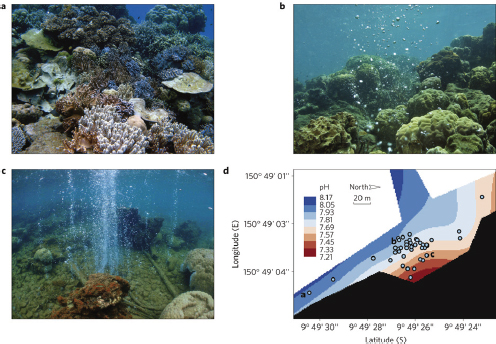
FIGURE 3.1 Volcanic CO2 seeps of Milne Bay, Papua New Guinea, showing seascapes at a, control site (‘low pCO2’: pH~8.1), b, moderate seeps (‘high pCO2’: pH 7.8–8.0), and c, the most intense vents (pH <7.7), showing progressive loss of diversity and structural complexity with increasing pCO2. d, Map of the main seep site along the western shore of Upa-Upasina; color contours indicate seawater pH, and the letters indicate the approximate locations of seascapes as shown in a-c. SOURCE: Reprinted with permission from Macmillan Publishers Ltd.: Nature Climate Change, Fabricius et al. (2011).
time, and “adaptation” which in the evolutionary sense involves genetic changes. The potential for acclimatization may be critical in conferring short-term tolerance to ocean acidification during a species’ lifetime (e.g., during diurnal or seasonal fluctuations in pH found in tide pools and kelp forests). Likewise, acclimatization to factors such as temperature and oxygen content that may co-vary with pH may be critically important. However, the ultimate success of a species in coping with ocean acidification over longer multigenerational time scales may demand genetic adaptation. Species with shorter generation times are likely to have greater abilities to evolve adaptive changes than species with long generation times, assuming adequate genetic variation exists. Related to the latter, currently little is known about differences between species or among populations of a single species in tolerance of reduced pH; this area of research merits vigorous study to identify the potential adaptive capacities of different marine species in the face of ocean acidification.
The analysis in Theme 2 would benefit from a broader consideration of the types of nonbiological chemical effects relevant to biogeochemical cycles and ecosystem function. Although the FOARAM Act’s mandate for Theme 2 is focused chiefly on organismal and ecological effects of ocean acidification, many of these effects are closely coupled with the influences of ocean acidification on nonliving processes. Thus, one notable gap within this Theme is the lack of attention given to the chemical effects of acidification. Besides a discussion of the influence on element availability to phytoplankton, there is very little presented in Theme 2 about how acidification might affect chemical properties of detrital particles, or processes like sorption or flocculation, which are very important in coastal and open-ocean waters. Sorption of many elements and compounds on natural particles is greatly affected by pH (Millero, 2009). Trace metal speciation, bioavailability and toxicity are influenced by pH. These effects of ocean acidification, which remain poorly understood, could influence the physiologies of individual organisms and the broader ecological responses to falling pH. Thus, the analysis needs to also include the types of chemical effects mentioned above, that is, the characteristics of detrital material important in nutrient cycling and diets (especially of species associated with the detrital particles), the physical processes of flocculation/disaggregation and their effects on marine particle dynamics.
The IWGOA is commended for its recommendations to include paleo-studies and data synthesis. Theme 2 notes that paleo-studies can yield important insights about conditions that caused ocean acidification in the geologic past, and the associated marine biological responses. This section could benefit from a brief mention of past ocean acidification events and their causes, with references to the key publications. It should also mention the value of Earth system modeling in understanding past ocean
acidification events. Data synthesis speaks to the importance of using the best, standardized methods in research so that valid comparisons can be made among studies.
Understanding the broad biological effects of ocean acidification, including the influences of other environmental factors like temperature on acidification’s impacts, will strongly benefit from promotion of investigations into ocean acidification’s effects on community and ecosystem structure and function. Studies done in the laboratory or in the field using mesocosms may be inadequate for making predictions of effects of acidification on natural ecosystems and communities. In large measure, a primary shortcoming of controlled (laboratory or mesocosm) studies is that, by focusing on only pH (and pH-related variables in the carbonate system), the influences of other factors like rising temperature and eutrophication that can influence responses to acidification may be missed. Whereas it is commonly difficult to tease apart effects of, say, falling pH and rising temperature, field studies of natural ecosystems that examine the full spectrum of environmental changes are needed to generate realistic understandings of global change and to support predictions of future shifts in community and ecosystem structure, many of which may have important socioeconomic consequences. The understanding and monitoring of ecosystem responses to ocean acidification are still in their infancy, and the Strategic Plan includes an appropriate emphasis on expansion of this research topic
An additional balancing of research approaches is required when decisions are made about the types and numbers of different species to be studied. The Strategic Plan recognizes this point when it contrasts emphasis on breadth versus depth of focus (i.e., the distinction between studies of “an expanding list of species rather than focusing resources on in depth studies of a narrow group of species”). In reality these two approaches are driven by different questions. “In-depth” analyses of single species are needed to elucidate the basic physiological and molecular mechanisms involved in stress from and adaptation to acidification. This mechanistic analysis is critical for elucidating the exact nature of physiological perturbation from acidification and other stressors related to global change. Examination of an “expanded list of species” will of course be needed to evaluate interspecific differences in effects of ocean acidification, to allow predictions of effects at the community and ecosystem levels of biological organization to be developed. In particular, comparative studies will be important to examine the difference in responses among closely related species. For example, wide differences in capacities to regulate pH at sites of calcification were found among reef-building corals, thereby allowing some, but not all species potentially to reduce the effects of acidification (McCulloch et al., 2012). Different forms of calcium carbonate structural materials
(calcite, aragonite and magnesium-rich calcite, in order of increasing sensitivity to low pH) are used by different organisms. Therefore, to evaluate the differential sensitivities of calcium carbonate-utilizing species to ocean acidification, comparative studies should take into account the types of carbonate employed by different phytoplankton and animals. Because these two lines of investigation—mechanistic and comparative—are both necessary and, ideally, complementary, there is a need to judiciously allocate resources to both types of study and define priorities.
In the context of research scope and priorities, the committee believes that there is an imbalance in the emphasis given to different types of physiological processes and the effects that ocean acidification may have on these biological processes. As pointed out above in the context of imbalance in the literature citations, there is an overemphasis on calcifying organisms. This overemphasis reflects the past research focus on calcification, which is by now the most studied of the impacts of ocean acidification. Although calcification is a critically sensitive physiological process for many taxa, many other key physiological processes (e.g., nitrogen fixation, photosynthesis, respiration, and behavior) are affected by ocean acidification in ways that affect non-calcifiers as well as calcifiers (Gattuso and Hansson, 2011). A more balanced program that incorporates studies on the lesser known effects of ocean acidification thus is needed.
As mentioned above, it is important to evaluate the effects of ocean acidification at all levels of biological organization, and the Strategic Plan concurs with this perspective. The recommendation to study ‘other factors’ in addition to physiological processes could also be expanded to emphasize the need for information that will enable a scaling-up from single species to population and community levels. The value of measuring organisms’ responses to ocean acidification, especially when studies incorporate effects of other factors and environmental stressors, is greatly increased when they provide key parameters for population and community models. Although physiological and behavioral studies can yield insights into the state of health of individual organisms, it is critical to incorporate analyses of rates of growth, survival, and reproduction of individuals, as well as analyses of effects on predation and competition, because data from these measurements can potentially be translated to rates of biomass production and demographic status for populations. Such measures can be essential for developing ecosystem models, including models focused on fisheries-related issues of socioeconomic importance.
This Theme does a comprehensive job of outlining sets of 3- to 5-year and 10-year goals for the National Ocean Acidification Program. The discussion of goals reflects a good summary of proposals found in previous reports and papers. To be consistent with previous reports, however, some of the 10-year goals need to be addressed sooner in the Program. As
mentioned in Chapter 2, this Theme would benefit from a prioritization process to assess the most important goals to advance.
In summary: The discussion of calcification and other physiological processes in the Species-Specific Physiological Responses section would benefit from a more balanced representation of the multiple physiological processes that could be affected by acidification. This section thus needs to be expanded to recommend studies on the impacts of ocean acidification and other simultaneous environmental changes on organism performance and its key physiological underpinnings, rather than overemphasizing research on calcification processes. The Strategic Plan needs to include a description of research goals that (1) ensure that research addresses key knowledge gaps, (2) investigate the potential for physiological acclimatization and examine evolutionary mechanisms for adaptation to maintain or increase ecosystem resilience, (3) study how effects of ocean acidification interact with those of other stressors, and (4) examine how changes at the organism level will alter ecosystem structure and function. These goals will likely promote the integration of experimental and observational results (Themes 1 and 2) with physiological and ecological models (see Theme 3).
The FOARAM Act includes ‘modeling’ as a Program Element, “to predict changes in the ocean carbon cycle as a function of carbon dioxide and atmosphere-induced changes in temperature, ocean circulation, biogeochemistry, ecosystem and terrestrial input, and modeling to determine impacts on marine ecosystems and individual marine organisms.”
The introduction to Theme 3 (page 27 of the Strategic Plan) provides a summary of the current status of the field of modeling and highlights some challenges, along with an appreciation of its current and future evolution. This section presents a fair amount of information, although it is not always sufficiently supported by literature references. The section falls short, however, in describing how these model developments will contribute to reaching the main objectives outlined in this particular Program Element of the FOARAM Act and, more generally, how modeling studies can help to achieve the broader objectives of the FOARAM Act. In the latter context, there is inadequate integration of modeling with the other Themes in the Plan.
To strengthen the Strategic Plan, the committee believes that Theme 3 could be improved if it identified how models can contribute to ocean
acidification research at present and with what level of certainty (see Box 3.1).
The scope of modeling activities listed in the Strategic Plan is broad, ranging from process-based understanding (level of the individual cell to organisms) to broader-scale biogeochemical functions (e.g., primary production, carbonate production, etc.) to impact assessments including socioeconomic analyses. Similarly, the Strategic Plan discusses model studies that span phenomena over large scales in time and space. Scale appears as a central issue to modeling in both biological and physical domains. The structure of this section would be improved by categorizing along scales specific to the target processes or questions. Furthermore,
BOX 3.1
How Models Can Contribute to Ocean Acidification Research
Modeling studies serve in a range of ways to advance ocean acidification research. Modeling can be a tool for using in situ observations and experimental results to develop predictive algorithms that can be used to test hypotheses in an iterative and integrative fashion. Modeling is iterative because models evolve in response to new observational data. Modeling can also be used to synthesis and integrate data to bridge scales, in several different contexts: scales can be biological (e.g., from the scale of the single cell to the organism, the population, and the community), physical, (e.g., from the localized time series station to the ocean basin and beyond), and temporal (e.g., models can be run to simulate interannual variability or to look across centuries). Modeling allows for hypothesis testing over a broad range of phenomena and helps to formulate “What if?” questions and scenarios that project future consequences of changes in ocean pH. To allow for continuous improvements in the models, modeling requires close coordination with ongoing observational activities. For example, biogeochemical models are best integrated closely with observational networks: the rapid integration of measurements into operational modeling systems will ultimately provide the basis for near-real time environmental assessments and the development of early ‘warning’ systems (e.g., detection of strong coastal upwelling events that might be detrimental to shellfish farming). In addition, models allow the estimation of unknown or unmeasured processes. Incorporating ocean acidification into biogeochemical models (a short-term goal of the Strategic Plan and end-to-end models1 (a mid- to long-term goal of the Strategic Plan), need to be part of assessments aimed at the quantification of ecosystem and socioeconomic impacts. Models also can assist with the evaluation of impacts in the context of mitigation strategies or to help design more cost-effective monitoring strategies.
_________________
1 End-to-end models combine into a single modeling framework separate models representing processes across all trophic levels, from the lower end of single-celled primary producers up to top predators.
the goals of Theme 3 are mainly expressed in terms of model development and less in terms of scientific objectives (which are the ‘drivers’ of model development). This limits the extent to which the modeling efforts of Theme 3 can be linked to goals found in other Themes. For example, no specific mention is made of how the improved understanding of processes and mechanisms (as part of understanding the impacts of ocean acidification) will be incorporated into improving models. Because this timely transfer of knowledge may prove difficult, the strategic plan needs to give specific consideration to how this can be facilitated, in particular when developing the implementation plan. The development and implementation of major oceanic processes (e.g., carbonate production and dissolution, nitrogen cycling, carbon assimilation) and biological processes (e.g., growth and recruitment along life stages) as a function of seawater carbonate chemistry all have clear relevance to other Themes. Thus, better integration of modeling with relevant sections in other Themes of the Strategic Plan is needed. For example, how will the monitoring activities in Theme 1 benefit from—and provide assistance to—modeling? What are the likely contributions of modeling to the evaluation of local mitigation and adaptation measures, an important issue within the socioeconomic framework of Theme 5?
Theme 3 also identifies important shortcomings in current biogeochemical models and identifies areas where model improvement is crucial in the context of impact assessments. However, it does not discuss the uncertainties inherent to model results, which would place the potential contributions and limitations of models into a more complete perspective. In addition, model development, in particular increasing model complexity, can benefit from model-data evaluation. The Strategic Plan could be improved by discussing how the use of multiple models can enhance modeling efforts. Currently, multi-model studies are the present day “best practice” in carbon cycle research (e.g., Orr et al., 2001). Steinacher et al. (2010) illustrate how the insights provided by several models can be combined to improve future projections. Multi-model projections will further allow a first appreciation of uncertainties linked to the assessment of impacts on biogeochemistry, as well as on marine resources (Stock et al., 2011).
Modeling could contribute to the FOARAM Act and specifically to the requirement to ‘enhance monitoring and detection capacities,’ by developing an integrated approach combining continuous environmental data acquisition and operational modeling systems. At the scale of regional systems, this could evolve, in the long term, toward an early ‘warning’ system. For example, the shellfish industry would likely benefit through the development of models that allow rapid detection and short-term forecasting of strong upwelling events that bring low pH water to shallow, near-shore
regions. Such low pH water below the surface mixed layer results from respiration of organic matter and associated CO2 release, which can be exacerbated due to coastal eutrophication.
Some of the statements in Theme 3 appear to reflect an incomplete analysis of models used for ocean acidification and carbon cycle research. For example, our committee was surprised to see that the short term goals include a statement to “expand implementation of alkalinity as a tracer and incorporation of PIC and remineralization formulations in BOGCMs.” Ocean-Carbon Cycle Model Intercomparison Project (OCMIP) models have already been including the carbonate cycle and several present-day state-of-the-art models also include prognostic total alkalinity and a parameterization of the marine carbonate cycle taking into account several forms of calcium carbonate (e.g., Gangsto et al., 2011).
The issues of time frame (short- versus long-term studies) and prioritization of efforts are not adequately developed in some cases. For example, the development of an integrated description of processes occurring at the land-ocean boundary is stated as a long-term objective (10 years). However, there are no intermediate steps identified over the first 3 to 5 year period toward achieving that goal. How is the coupling of land and ocean processes envisioned to occur and how should efforts to study these processes be prioritized? In particular, which modeling approaches could be proposed to tackle the diversity and complexity of coastal systems?
In summary: The introduction would benefit from a fuller description of how modeling will contribute to the objectives of the Strategic Plan. In particular, it could explain how model studies can contribute to advancing each goal outlined in the FOARAM Act. In addition, the Strategic Plan could contribute to a more effective research program if it highlighted the need for integration of model studies with other research activities, such as observation and monitoring. The Strategic Plan needs to be expanded to include a discussion about the challenges related to modeling; limitations and uncertainties of model results; and the key issues related to model skill.
THEME 4: TECHNOLOGY DEVELOPMENT AND STANDARDIZATION OF MEASUREMENTS
The FOARAM Act (page 9) mandates a Program Element to be developed with a focus on “[t]echnology development and standardization of carbonate chemistry measurements on moorings and autonomous floats” in the IWGOA Strategic Plan.
Theme 4 has an appropriate focus in terms of this mandate of the FOARAM Act. After a general discussion of issues related to improve-
ments in technology and standardization of measurement protocols, this section lists a variety of goals—separated into short-term and long-term categories—that aim to address these concerns. Whereas these goals are in accord with the requirements for this particular Program Element of the Act, as with much of the Strategic Plan, there is not a clear statement of priorities (see Chapter 2 of this report for further discussion).
Ocean acidification research encompasses a wide variety of approaches including environmental observations and laboratory manipulations, and it requires technology for the measurement of a wide variety of parameters, both chemical and biological. Theme 4 discusses such technology and methods development, and also emphasizes the need for effective standardization of measurements. The IWGOA is to be commended for stressing so effectively the critically important need to develop standardized methods for the broad research community studying ocean acidification. The presentation in Theme 4 draws on a variety of previously published reports to emphasize two primary concerns: comparability of measurement approaches and availability of improved technology for such measurements.
Overall, the text of Theme 4 makes many good points about the need for a focused, high quality plan for ocean acidification measurements, including the need for documentation, reference materials, training, and regional centers of expertise. However, the diverse topics treated in this Theme are not pulled together in an effective way to fashion a clear strategy. We offer several explicit suggestions for improving this component of the Strategic Plan. Many of our concerns reflect similar problems found in other Themes, and are due, in part, to the limited integration across Themes in the Plan. For example, the objectives of Themes 1, 2, and 3 cannot be fulfilled due to deficiencies that need to be addressed in Theme 4. The opening paragraphs of this section would be improved by referring to priorities from other Themes that require either technological development or methods of standardization, or both. A short preface and some reorganization of content would make this a stronger section with clear links to the national ocean acidification strategy. Considering the fundamental importance of the inorganic carbon system for both the monitoring of ocean acidification and for studies of biological and ecological consequences, the Strategic Plan could benefit from a short primer for readers to review the basic concepts. More importantly, in this section the IWGOA has the opportunity to stress the fundamental dependence of high quality research on the advances in technology development.
Of great importance to this Theme are two fundamental questions: “What should be measured?” and “What is the needed accuracy/precision of these measurements?” These questions are of core relevance in any effort to address comparability of ocean acidification measurements
across various methodologies and for guiding the improvement of technology for such measurements. The Strategic Plan lacks adequate detail on these central issues. Thus, it does not include an exhaustive list of what needs to be measured or an adequate discussion of the varying requirements for accuracy and precision in different types of contexts. Consequently, the Theme’s discussions of how to improve the comparability of measurement approaches are somewhat vague.
In the context of needed levels of accuracy and precision in a given type of study, this Theme seems to provide the impression that all measurements require a state-of-the art level of uncertainty. While that degree of sophistication may be ideal, it may often be unnecessary considering the cost and training required for some measurements. Instead, a more nuanced approach could be to modulate the acceptable level of uncertainty (or error) for measurements in relation to particular research goals and funding. For example, carbonate system parameters may need to be measured with more or less accuracy and precision depending on the use of those data for hydrographic, biological, or other studies. Open ocean methods for high precision measurements of CO2 chemistry (i.e., Dickson et al., 2007) may not be necessary for similar measures in perturbation experiments or in highly variable environments. This distinction has already been emphasized in our analysis of Theme 1.
The committee finds that integration among Themes in the Plan could be improved if recommendations from this section concerning measurement standards (and to a lesser extent technology development) were linked more clearly to Themes 1-3. Thus, measurements discussed as related to monitoring in Theme 1 would be associated with recommendations for standards for the specified measurements in Theme 4. The Strategic Plan would also benefit from a more explicit explanation of core chemical, and if possible, biological measurements or a process by which such core measurements will be identified. Discussion in Theme 4 needs to also consider the relevance of these chemical and biological measurements (especially biological) as input for ecosystem models, thereby providing a link to core issues in Theme 3.
The discussion of technology development is somewhat less complete than the discussion of the set of necessary measurements (and their precision) required for gathering ocean acidification data. The text and long-term goals identify a need for improved, autonomous CO2 system measurement technology of various kinds, but make little concrete mention of other technology needs. The Strategic Plan notes the well-known difficulties involved in ensuring development and commercialization of new instruments, but without really providing any new insights into how to address this effectively. The Plan does mention some Federal mechanisms that are in place: NOPP (the National Oceanographic Partnership
Program); the NOAA Alliance for Coastal Technologies (ACT); the NSF Oceanographic and Interdisciplinary Coordination Program; and the various Federal Small Business Innovation Research (SBIR) programs. However, no effort has been made to indicate how these entities could work together to achieve the goals established in this Plan. The Strategic Plan thus could be strengthened by providing a roadmap that suggests effective ways for different organizations, including Federal government programs and private industry, to work in a coordinated fashion to develop improved technologies and evolve mechanisms to make these technologies accessible to the wide community of investigators in ocean acidification research and monitoring efforts.
Theme 4 also includes two other key concepts: the establishment of Centers of (measurement) Expertise and Community Research Facilities for ocean acidification perturbation studies. Such communal facilities, properly managed and operated, could provide a substantial boost to U.S. research needs by providing expertise, laboratory facilities with state-of-the-art equipment, and training to the community of ocean acidification researchers that will be needed. As new technology is developed, centers would play an important role in introducing users to this new apparatus. An example of such a development is the evolution of free ocean CO2 enrichment (FOCE) technology, which is being used to investigate ocean acidification in a variety of marine habitats, including coral reefs and kelp forests. It would be useful to more thoroughly specify how many of these facilities are required (including, perhaps, a broad regional distribution) and to indicate how they could be funded and managed to benefit the U.S. ocean acidification research community. The role of these Centers in integrating U.S. ocean acidification research and monitoring with other parallel international efforts needs to be emphasized as well. Issues of standardization, comparability, and quality of data are of critical relevance in global scale research as well as within the U.S. ocean acidification program.
In summary: To make Theme 4 of the Strategic Plan a more effective vehicle for communicating the Theme’s goals and how and by whom they will be implemented, more detail is needed. In the committee’s view, principal gaps in this Theme include issues of specific goals of measurements (What is to be measured—and why?—and with what accuracy?); priorities (Which goals are most important and which are of secondary significance?); and costs (What are the likely costs, and how can the goals be met with the available funds through appropriate prioritization efforts and cooperation among agencies and international entities?). This third concern is particularly important when considering the role that different federal agencies might play in ensuring that the various goals will be met.
An additional concern relates to the need for a stronger emphasis in the Strategic Plan on development of new technologies for chemical and biological monitoring efforts. We have pointed out the significance of development of in situ sensors for monitoring ocean chemistry over space, time and depth. Needs for effective in situ detectors for tracking biological changes also exist; development of this technology lags well behind development of chemical sensors. As in the case of chemical sensors, development of effective in situ instrumentation for biological monitoring could benefit from collaborations between researchers in academic and governmental programs and engineering partners in industry. Improved technology for biological studies also may be required for mechanistic physiological experimentation. For example, new tools and techniques may be needed for measuring changes in pH at the systemic, cellular, and subcellular levels in marine species that require instrumentation not available off the shelf from manufacturers of biomedical equipment. Finally, in common with many of the other Themes in the Strategic Plan, there is little mention of appropriate metrics for evaluating progress (see Chapter 2 of this report for detailed discussion).
In recognition that the effects of ocean acidification may include profound influences on human society as well as on marine ecosystems, the FOARAM Act specifies in its list of Program Elements that an “[a]ssessment of socioeconomic impacts of ocean acidification and development of adaptation and mitigation strategies to conserve marine organisms and marine ecosystems” be undertaken. This summary statement concisely expresses the socioeconomic requirements given in the FOARAM Act: “The purposes of this Act are to provide for … (3) assessment and consideration of regional and national ecosystem and socioeconomic impacts of increased ocean acidification; and (4) research on adaptation strategies and techniques for effectively conserving marine ecosystems as they cope with increased ocean acidification. In Section 6 of the Act, it is further stated that the NOAA Secretary may adopt a plan that supports “critical research projects that explore the effects of ocean acidification on ecosystems and the socioeconomic impacts of increased ocean acidification that are relevant to the goals and priorities of the strategic research plan.”
These socioeconomic issues are especially challenging in view of several factors, notably (1) the difficulties in extrapolating from often poorly understood ecological changes to impacts on human populations and their economies, (2) uncertainties about optimal adaptation strategies to buffer society against effects of ocean acidification, and (3) the complex
environmental changes in the ocean and the political and economic realities that such efforts would encounter.
The introduction to this Theme is well written and, in keeping with the FOARAM mandate, this section rightly highlights the linkages between increasing acidification and potential impacts on the provision of ecosystem goods and services that include, for example, fisheries production, recreation, and conservation of marine organisms and ecosystems. The introduction also correctly points out the importance of recognizing the projected rate of changes in ocean chemistry, and the potential severity of the socioeconomic impacts that might result as a consequence. However, the introduction makes very little reference to the need to develop “adaptation and mitigation strategies to conserve marine organisms and marine ecosystems” as specified in the FOARAM Act. The introduction would also benefit from discussing how ocean acidification takes place in the context of other human induced changes in the ocean, such as climate change, overfishing, and marine pollution.
The committee also supports the idea presented in this Theme that socioeconomic outcomes are one possible method of prioritizing the natural science research on ocean acidification (e.g., by emphasizing research on the impacts on commercially important species or species listed under the Endangered Species Act). The discussion, however, could be strengthened by providing an example of the process that could be used for priority setting, such as a ‘value of information’ study (e.g., Costello et al., 1998).
The issue of prioritization also arises in another critical context, where the committee believes re-evaluation and improvements of the Strategic Plan are warranted. In the introduction to Theme 5, it is stated that, “[t]o some extent, socioeconomic research must follow research in the natural sciences.” For the reasons discussed below, we find this statement to be incorrect or at the very least potentially misleading. The statement can potentially be misconstrued to mean that initiating socioeconomic research at this time is not necessary or less urgent. The committee disagrees with such an interpretation because investments in long-term data collection and studies that will be used in measuring impacts need to begin now. Specifically, to improve modeling, impact, and adaptation studies in the future, social scientists need to be incentivized to develop time series and data networks that can then link the natural sciences questions with the social and economic sciences questions. This presents another rationale for strong integration across Themes 3, 5, and 7. The committee believes that it would be unwise to wait for impacts to happen, or for the probability of them occurring to reach some threshold, before starting this research. For example, the U.S. could currently be increasing its investments in socioeconomic research to assess the benefits to the nation from ocean
recreational activities and conservation of marine species. In addition, studies on the demand and supply of shellfish and other commercially harvested species are needed. Such research would provide valuable insights regardless of the magnitude or timing of the ocean acidification impacts on those resources.
The introduction to this Theme does not mention the importance of social science (e.g., political science, economics, anthropology) and interdisciplinary research (e.g., conservation biology, sustainability science) in the development and evaluation of management strategies (e.g., policies, regulations) to meet National Ocean Policy objectives. In other words, the focus of the section is centered on quantifying socioeconomic impacts rather than on the design of institutions and regulations that facilitate adaptation to ocean acidification (e.g., Kling and Sanchirico, 2009; Sanchirico, 2009), on the potential for technology solutions, and on conservation strategies more broadly. Ocean acidification at the global scale can only be mitigated through policies that address lowering CO2 emissions. Given the well-known difficulties in finding policy options to lower CO2 emissions, the committee limits its review and discussion under this theme to research related to impacts, adaptation, and conservation.
A focus on adaptation is critical for ensuring that well-informed analyses are carried out to create policies that are effective in coping with the effects of acidification. There is a possibility that current governance and regulatory environments may provide incentives that lead to maladaptive responses, such as is the case with disaster relief packages or other subsidies that maintain overcapacity in commercial fisheries. Another example is the regulatory structure around fishery management that creates incentives for fishermen to specialize in certain species (e.g., purchasing of specific gear and construction of processing facilities), when in fact we might want to think about developing incentives to create a nimble fishing industry that can respond to the coming changes as a means to lessen potential damages. In the development of programs for adapting to acidification, it will be important to take an interdisciplinary approach that incorporates insights from marine conservation and conservation biology more generally and considers the role of other environmental stressors. Such an integrated analysis could provide an important link to Theme 2 (e.g., under “Food Webs and Ecosystems”).
Furthermore, the social sciences could provide valuable information on not only the economic, ecological, and social benefits and costs of ocean acidification, but also the risks of different mitigation techniques. There are multiple geo-engineering methods being considered, but presently they do not offer an adaptive response to ocean acidification (Matthews et al., 2009). That is, geo-engineering strategies commonly focus only on reducing global warming and fail to take acidification into account. The
only mitigation techniques discussed in this section of the Strategic Plan are reductions in greenhouse gas emissions and policies that improve the overall health of ecosystems by reducing other stressors (e.g., reduction in fishing catch, habitat restoration, and improvement in water quality).
Since the draft of the Strategic Plan was written, relevant additional studies have appeared that begin to estimate socioeconomic impacts of ocean acidification, for example, by estimating impacts on industries such as global shellfish production (Narita et al., 2012) and the U.S. mollusk fishery (Moore, 2011). Both of these studies highlight the need for additional socioeconomic research on the economics of shellfish demand and production under changing ocean conditions. For example, Narita et al. (2012) discuss the importance of measuring the economic impacts on consumers and producers that might occur if rising income levels in China and elsewhere lead to an increase in demand for shellfish.
While it is true that the number of socioeconomic studies on the impacts of ocean acidification is limited, the Strategic Plan could mention the existing social science and interdisciplinary literature more completely and allude to research frontiers and relevant evolving programs. For example, the National Science Foundation is funding a considerable amount of research on decision-making under uncertainty, which has relevance for developing mitigation and adaptation strategies given the uncertain future outcomes of ocean acidification. Another related body of literature is the work in marine ecology, marine conservation, and economics on measuring the ecological and socioeconomic impacts of marine reserves (e.g., Fox et al., 2012 and citations therein), which represent one potentially important conservation tool in the ocean acidification adaptation toolbox.
Whereas the goals presented in Theme 5 are consistent with the FOARAM Act, their wording does not easily translate into measurable metrics that could be used to assess the progress of the forthcoming implementation plan (e.g., the use of verbs such as ‘support’, ‘encourage’, and ‘foster’). In addition, the way the goals are ordered (short- vs. long-term) is inconsistent with how rigorous research on decision-support tools is undertaken (e.g., Levin et al., 2009). As the Strategic Plan currently states, scoping discussions with stakeholders and decision-makers (e.g., to understand what questions the integrated models need to address) are long-term goals, while the development of integrated models that will be used in decision-support tools is a short-term goal. Without engaging stakeholders and decision makers in the scoping study, however, there is no guarantee that the integrated models will be useful in a decision-support context. Therefore, reordering the goals in terms of short-term and long-term efforts is needed.
Several other components of the analysis presented in Theme 5
require clarification, expansion, and/or correction. We briefly discuss these below and offer suggestions for improving the manners in which these issues are discussed.
Stakeholder groups. Key to the success of socioeconomic efforts tied to ocean acidification is identification of, and then, effective interactions with the relevant stakeholder groups. This issue is brought up in Theme 5, but requires further development. The subsection on identifying stakeholder groups needs to be explicitly tied to the National Program Office and the actions described in Theme 6.
Mitigation. The section highlights how gross domestic product (GDP) is a useful summary statistic of economic impacts. That is correct for market goods and services, but GDP is woefully inadequate for measuring the totality of ocean acidification impacts given that many of them occur outside of markets (e.g., conservation of marine species). If Theme 5 is to have this discussion, it needs to be expanded to discuss the role of green accounting, which factors environmental costs into the overall financial consequences of economic activities (e.g., Boyd and Banzhaf, 2007).
The subsection on mitigation also needs to discuss how Marine Protected Areas (MPAs) and Long Term Ecological Research (LTER) programs can be used to measure the socioeconomic and ecosystem impacts of ocean acidification, and if there is a potential to use information from MPAs and LTERs in the development of strategies. The discussion of mitigation also ought to consider the potential for research around the socioeconomic and ecological costs and benefits of geo-engineering.
Human Adaptation. The discussion could be enhanced by a set of socioeconomic research questions that need to be addressed. For instance, as discussed above, there is a need to undertake research to understand whether the current regulatory frameworks are creating incentives for maladaptive behavior. To help readers understand the breadth of important research that is needed on developing adaptation strategies, additional examples beyond hatchery operations would be valuable (e.g., conservation of marine species).
In summary: A reaffirmation about the interdependence and the time-frames of basic natural science and social science and interdisciplinary research is needed. An explicit statement in the Strategic Plan is needed that explains that social science research should not be delayed until natural science research has brought problems into focus. Social science research, informed by natural science, can help the nation to better prepare for the effects of ocean acidification. Furthermore, as emphasized above, prioritization of the program’s natural science goals can be informed by societal and socioeconomic research needs. The social science research agenda on ocean acidification needs to be expanded to highlight
the important and critical roles of this research for not only measuring impacts but also for assessing mitigation and adaptation policies and regulations. The contributions of research in associated disciplines (for example, conservation biology and decision making in the face of uncertainty) need to be incorporated into the broader analysis given in this Theme.
THEME 6: EDUCATION, OUTREACH, AND ENGAGEMENT STRATEGY ON OCEAN ACIDIFICATION
Theme 6 is one of two additions (along with Theme 7) that the IWGOA made to the five Program Elements given in the FOARAM Act. However, even though the FOARAM Act did not include an explicit Program Element focused on the issues treated in Theme 6, the Act does state on pages 3 and 4 that there is a need to “facilitate communication and outreach opportunities with nongovernmental organizations and members of the stakeholder community with interests in marine resources.” The committee views this requirement as an important component of a National Ocean Acidification program for several reasons. As stated on page 6 of the Strategic Plan, the two additional Themes are “inherent to the successful implementation of the plan,” (i.e., they are critical to attaining the FOARAM-mandated objectives of the first 5 Themes). On page 47 of the Strategic Plan, the need for Theme 6 is stated as follows: “Progress on an ocean acidification implementation plan hinges on garnering support from key stakeholder groups. That support requires an understanding of ocean acidification that can be achieved by outreach and engagement.”
Overall, the committee believes that the analysis given in Theme 6 does an excellent job of emphasizing what needs to be done in “education, outreach, and engagement strategy” in the face of the challenges in communicating science to a broad public audience. The existing players in education and outreach are listed (but with a few key omissions; see below) and a strategy is outlined for identifying important new linkages and collaborations, both nationally and internationally. The development of programs will be iterative and monitored over time and will involve a pivotal role for the National Program Office (see below). Therefore, attaining the goals of Theme 6 seems possible if adequate funding is available. It will be important to engage the social scientists as part of implementing the education and outreach component. Here, private foundation support might be crucial for supplementing governmental funding.
The development of Theme 6 strikes the committee as having a good balance between a presentation of basic strategies, which is the key role of the Strategic Plan, and offering suggestions for specific implementations. This is a difficult balance to achieve, but this section of the Strategic Plan
has done a commendable job of presenting some concrete implementation materials as well as outlining a good complement of basic strategies.
The challenges in reaching the goals of Theme 6 are succinctly summarized in the Strategic Plan,3 where it is emphasized that, “… interest in, and appreciation for, science in the United States is extremely low.” Much of the remainder of the discussion in Theme 6 outlines strategies for overcoming the challenges inherent in effectively communicating a topic that the public will almost certainly find difficult to understand. Unlike the changes in temperature, shifts in rainfall patterns/intensities, and increasing storm intensity that may accompany global change, decreases in oceanic pH are difficult to see or feel directly. Moreover, discussions of acidity that appropriately utilize the pH scale preferred by marine chemists are apt to befuddle a lay audience. Thus, the challenges in educating and involving the broader public in ocean acidification-related issues and activities are substantial. One approach for catching the broader community’s attention may be to familiarize the public, as well as Congress and relevant federal and state agencies, with the socioeconomic consequences of ocean acidification (see Theme 5). This type of education could allow the effects of ocean acidification to be appreciated as having immediate human relevance, including economic consequences.
The National Ocean Acidification Program via the National Program Office is slated to play a major role in addressing the tasks described in Theme 6. It seems beneficial to develop and integrate education and outreach effort at the Program level to reduce redundancy and to engage education professionals and social scientists. The Program Office can serve as a centralized clearing house for communication in the arena of education and outreach, and serve as a principal point of contact for up-to-date, scientifically valid information. For example, a centralized web portal managed by the Program Office is proposed.4 This asset could be of broad importance in education/outreach efforts and serve as a credible source of information for anyone interested in ocean acidification. It could be an especially effective vehicle for providing educational content and for evaluating the success of different educational and outreach efforts (e.g., by including a “What works and what does not work?” type of blog, where educators, journalists, and others could share experiences or ideas). Ongoing evaluation of the education and outreach programs will be critical for ensuring that they provide materials that are accurate, up-to-date, and accessible to a wide spectrum of audiences with diverse backgrounds, and that they take advantage of the evolving manners in which information is exchanged (e.g., via social media). Lastly, a centralized web portal
_________________________
3 IWGOA, pg. 47.
4 IWGOA, pg. 48-49.
should include links to other scientifically credible websites that present the science of ocean acidification and global change science more broadly.
The committee believes it is appropriate to include in the Strategic Plan (within Theme 6) a brief discussion regarding the attention that needs to be given by educators to the way in which CO2-induced changes in acidity are discussed. Use of the terms acid and acidity in discussions of ocean acidification can be misleading. Except in cases such as natural CO2 vents like those near Ischia, Italy, the entry of CO2 into the ocean does not actually make the ocean acidic in the sense used by chemists. It will be necessary—but truly challenging—to familiarize the public with the pH scale for expressing how a change in the amount (concentration) of the acidifying factor in question, the hydrogen ion (proton; H+), is affected by adding CO2 to seawater.
One important omission exists in Theme 6: Communicating information to news/wire services (U.S. and international) is not discussed. This is one important way of getting the word out to a broad audience, and the National Program Office’s web portal could play a key role in this endeavor. The committee suggests that this omission be addressed by the Strategic Plan, to ensure that information on ocean acidification is communicated in as broad and an effective way as possible.
Coordination and integration with other existing education/outreach programs is a central focus of Theme 6. This is an important goal, in view of the variety of target audiences and the diversity of governmental and nongovernmental entities that will be involved in communicating ocean acidification issues in both the U.S. and abroad. Box 10 in the Strategic Plan, which provides a list of “programs and organizations with existing education and outreach initiatives,” represents a helpful and extensive list of programs and organizations involved in global change issues, including ocean acidification. The committee believes a major omission from this particular list is the effort being made by public aquariums, museums, and zoos to provide high quality, publically accessible environmental education. For example, U.S. zoos and aquaria receive over 175 million visitors annually, and the Association of Zoos and Aquariums reports that 94% of those visitors feel that such organizations teach children about how people can protect animals and the habitats they depend on (AZA website, 10/2012). They have already been coordinating efforts on climate change education.5 These outreach efforts need to be recognized and the National Ocean Acidification Program could approach this climate change collaboration for its outreach effort. The Strategic Plan’s section on Engaging Stakeholders or Linking to Existing Programs and Organizations
_________________________
could be updated with a reference to the EPOCA Reference User Group6 and the California Current Acidification Network.7 These two programs could serve as models and ways to leverage efforts within the National Ocean Acidification Program.
Theme 6 emphasizes the international nature of education and outreach, and the proposed efforts therein to develop international collaborations all seem reasonable, although lacking in detail. Box 10 lists eight international programs (along with supporting scientific organizations and NGOs) with potential to make strong contributions in this arena. Public aquaria, museums, and zoos in other nations would be appropriate additions to consider as potential international partnering organizations.
Whatever the partnering organizations happen to be—and the Strategic Plan indicates that this will be an evolving group whose numbers and responsibilities will change as needs for ocean acidification education and outreach change—the fact that the proposed National Program Office will coordinate collaboration efforts is an important aspect of the Plan. This sort of centralized coordination and communication will work against redundancy and help the various participants in the United States and abroad learn from one another. An important aspect of outreach and education is to ensure knowledge transfer to the applied arena where policy issues related to mitigation and adaptation are developed. A centralized and highly credible source of information is likely to be extremely valuable in this context.
In summary: The committee commends the IWGOA for adding education and outreach as a separate Theme of the Strategic Plan and for presenting a well-balanced discussion of the needs and goals for ocean acidification education. The committee noted two omissions that merit attention: A discussion of (1) outreach efforts to the news media and (2) ways to engage public aquaria, museums, and zoos, which enjoy a high level of credibility with the public and could be a major asset in ocean acidification education and outreach.
THEME 7: DATA MANAGEMENT AND INTEGRATION
Although “Data Management and Integration” is not a specific Program Element in the FOARAM Act, the Act states that a Joint Subcommittee on Ocean Science and Technology (JSOST) [now SOST] of the National Science and Technology Council (NSTC) shall coordinate Federal activities on ocean acidification. One of SOST’s duties is to “establish or
_________________________
6http://www.epoca-project.eu/index.php/what-do-we-do/outreach/rug.html.
designate an Ocean Acidification Information Exchange to make information on ocean acidification that is developed through or used by the interagency ocean acidification program accessible through electronic means, including information that would be useful to policymakers, researchers, and other stakeholders in mitigating or adapting to the impacts of ocean acidification.” Thus, SOST is tasked with developing a strategic plan for federal research and monitoring on ocean acidification that will provide, among other things, a description of planned data collection and database development activities. IWGOA is to be commended for adding this Theme to the Strategic Plan, as it treats a number of critical functions.
The Plan addresses the main requirements of the above legislation with a breadth of coverage that is quite comprehensive. Key topics such as data access frameworks, web portals, availability of data, sensor information, metadata and archival data are all addressed. However, while the general scope is appropriate, there is insufficient detail in addressing some of the important elements associated with the FOARAM Act’s mandate. We discuss these limitations and offer suggestions for strengthening the Strategic Plan below.
The committee finds that Theme 7 does not explicitly address what information or data will be made available to policymakers and other stakeholders, in addition to the traditional data archives used by researchers. The FOARAM Act requests an “information exchange,” not just a data archive. Creative procedures will need to be developed for extracting and sharing data once it is compiled.
Nothing in the FOARAM Act defines the explicit roles of NOAA, NSF or NASA in contributing to the tasks related to data management and integration; the Strategic Plan also does not address this issue. Considering the likely difficulty in integrating agency activities, attention to clarifying these roles is needed. A successful ocean acidification research program will require a data delivery system that allows everyone access to sufficient metadata to enable accurate integration of disparate data and essential documentation.
Much of Theme 7 addresses archiving of traditional physical and chemical environmental data, an activity that the scientific community is familiar with. However, the National Ocean Acidification Program will be addressing the effects of ocean acidification on biology, chemistry, and socioeconomic issues; thus, datasets will need to be included and made available from disparate research on, for example, animal behavior, mechanisms and rates of natural processes, and human impacts and responses. Natural science studies may involve monitoring efforts of natural systems or data gathering from perturbation experiments. Experimental manipulation experiments may be performed in the laboratory, in mesocosms, or in the field. Results may involve experimental data as well as modeling
activities. Similar considerations apply to data gathered in socioeconomic studies. Currently, methods for archiving and serving these diverse types of data are not well developed in the Strategic Plan, nor is a process outlined for developing such methods. The Strategic Plan would benefit from outlining a process that can address these questions of methodology and that would bring together natural and social scientists regularly to confer about scale and time frames for data collection and data management.
Consistent definitions for measurement variables are needed. Many variables are measured in perturbation experiments, and data are generated for parameters and processes from the molecular scale to the mesocosm scale. In particular, management of molecular data is not addressed in the Strategic Plan, yet the amount of information generated is huge. Many databases already exist (e.g., http://www.ebi.ac.uk/panda/Publications/mbd1.html), but unambiguous definitions of many other ocean acidification variables are necessary. It might be beneficial and more efficient to embed ocean acidification data management within an existing data management activity. Whether and how the data management is developed requires additional detail in the Strategic Plan. In any case, the curators of the data collection should work in close collaboration with members of the scientific research community in identifying, adopting and/or developing the requisite data management policies and procedures. This coordination is needed across the different Federal agencies involved in the U.S. ocean acidification program, e.g., NOAA, NASA, and the NSF, and with international entities (see below).
The Plan rightly highlights the fact that metadata needs must be identified early on. Work has started along these lines as part of a recent, multi-agency initiative (Newton, 2012), and an associated report on data management has been issued (CIMOAD, 2012). Although the Plan discusses data archiving and metadata collection, it leaves out a third and extremely important part of the data management triad: the uncertainty of the data. Methods for archiving and accessing uncertainty estimates associated with the data are needed, not simply a statement of analytical error.
Pivotal to the success of a program for effective archiving and distribution of data is the timely availability of data. This critical issue is not adequately addressed in the Plan. Major efforts have been made to compile published data on biological responses to ocean acidification (e.g., Nisumaa et al., 2010), and such compilations have proven to be a valuable tool for meta-analyses (Kroeker et al., 2010; Liu et al., 2010). However, key data sets are missing from this compilation, despite recovery efforts by program managers.
In summary: Examples of the different types of ocean acidification-related data sets to be managed and integrated need to be stated explicitly in
Theme 7. The goal to address the requirements and inherent challenges for managing diverse types of data sets needs to be added. New and creative procedures will most likely be needed for handling and disseminating these forms of data. In addition, the Strategic Plan needs to indicate how uncertainty estimates will be incorporated, both in the extracted information as well as in the archived data. The importance of understanding and reporting data uncertainty is compounded when generating synthesis products (as described previously in Theme 2). The Strategic Plan could be improved by pointing out the need for a mechanism by which explicit, strict requirements for data deposition will be developed and enforced, to ensure that data sets are made available to the broader ocean acidification community in a timely manner. Any new ocean acidification research program needs to strictly enforce rules concerning data submission. Because of the broad international effort to study ocean acidification, programs for data archiving, management and distribution need to be as consistent as possible across international boundaries. This is essential for ensuring that data sets are utilized in an optimal manner, notably in the types of meta-analyses in natural science and socioeconomic analyses that are certain to be of growing importance in the future. Lastly, contributing to international efforts that facilitate effective and consistent mechanisms for archiving and distribution of ocean acidification data would be an important goal to add to the Strategic Plan. International efforts, like national efforts, need to work to make ocean acidification data publicly accessible even prior to publication.
IN CONCLUSION
The committee concludes its analysis of the IWGOA Strategic Plan for Federal Research and Monitoring of Ocean Acidification by reiterating our judgment that the Plan has done a generally excellent job of addressing the several Program Elements in the FOARAM Act that serve as the principal mandates for developing a comprehensive National Program on Ocean Acidification. The committee intends to offer helpful suggestions that will lead to improvements of the Strategic Plan and, thereby, to a more effective National Program for addressing the numerous issues contained under the wide umbrella of ocean acidification.
Because these issues span such a broad range of phenomena, including the inorganic chemistry of seawater, diverse types of biological effects, and potentially large socioeconomic consequences that will require effective adaptation, the National Program meets a critical need for facilitating the integration among the separate disciplines of the natural and the social sciences required to study ocean acidification. Integration among different fields of study will allow appropriate transfers of knowledge
across disciplines and help ensure that the discoveries of the natural sciences (chemistry, oceanography and biology) will serve the needs of social scientists who address the economic consequences of acidification and the policy makers who will be instrumental in funding programs in mitigation and adaptation. Conversely, social scientists’ needs for key types of information to allow effective research and policy formulation should inform and guide, as appropriate, efforts in the natural sciences. Communication and integration among disciplines therefore are key to the success of the National Program.
Throughout the many types of scientific efforts needed for effective and comprehensive study of ocean acidification, there is a common need for informed prioritization of what is to be done. Criteria need to be established for prioritizing different lines of studies, and decisions on priorities should be done in a continuing and iterative manner, based on degree of success of ongoing programs and the discovery of new information that may reshape the program’s priorities. Consequently, a common need exists in all lines of investigation of ocean acidification for metrics to evaluate a program’s success. The need for metrics is, in fact, inseparable from the need for continued reexamination of priorities among different programs of study and readjustment of priorities as new insights are obtained.
Finally, as stressed throughout our analysis of the Strategic Plan, the scope of the National Program in Ocean Acidification necessitates the establishment of a National Program Office. There is urgency in developing a mechanism for establishing this Office, so that it can be functional from the very start of the National Program. Key decisions that are likely to influence the focus and long-term success of the Program will be made in the earliest stages of planning. Thus, among the several critical roles of the National Program Office is the development of strategies for implementing the efforts that will be required to achieve the goals presented in the Strategic Plan. Implementation will require many decisions on (1) the types of research to be pursued (prioritization), (2) how these different research endeavors can best be achieved through efforts of the different collaborating agencies of the Program (coordination), and (3) how successfully research activities are reaching the Strategic Plan’s goals (metrics for evaluation). The need for effective and cost-efficient cross-disciplinary coordination of research efforts requires a central Program Office that can facilitate interagency cooperation and maintain an ongoing exchange of information that allows the results of the diverse research efforts to be most effectively communicated among different national and international groups studying ocean acidification. A National Program Office can also help to facilitate the distribution of information to Congress and to the public at large. In a limited funding environment it will be essential to
inform Congress in a convincing manner of the need for broad studies of ocean acidification. Support by the public will be essential for this effort. Thus, the inclusion in the Strategic Plan of a strong program for education and outreach is wise. Through these wide-ranging activities, the National Program Office can help to implement a powerful and integrated scientific program on ocean acidification and assist in the transfer of information and technology from the program’s research and monitoring efforts to the groups that will be responsible for developing effective programs for enabling society to adapt to the as yet largely unknown consequences of ocean acidification.


