
2. Background and Purpose of the Symposium: Historical Perspective
Farouk El-Baz Boston University, United States
To help people improve their lives, it is essential to contribute to the research processes and practices.
Many examples exist demonstrating how the sharing of scientific data has improved people’s lives and living standards. For example, these include better health and food safety data, but such improvements are not yet widely available in the developing world.
American and European researchers, and very recently researchers in the Middle East, have undertaken initiatives to promote data sharing with the developing world, for example, the sharing of remotely sensed environmental data. Also, there are similar examples from the United Nations organizations, such as the World Health Organization (WHO) and the World Meteorological Organization (WMO). These certainly have been very good developments, but they are insufficient.
I will give some examples from my country of origin, Egypt. In 1990 the Egyptian minister of agriculture asked, “We have heard about satellite images that can measure the area of land used for a specific purpose. Is this true?” He continued: “I have asked three agencies in Egypt a simple question: How much land in Egypt is under agriculture? When I received the results, however, these varied from 7.2 million acres to 5.5 million acres. How am I going to plan if I do not know whether it is 5.5 million or 7.2 million acres?” So, my team superimposed the satellite images of the same area in 1972 and in 1990, and showed the minister the amount of land that was used for agriculture on both dates. We also discovered something that was even more important: how much of that land has been transferred into urban areas in the 18 years since 1972 (i.e., the encroachment of urban areas over agriculture), which is even more dangerous. The Ministry of Agriculture began using that data. They trained their own people, and my team worked with them on proper procedures.
Then in 2009, this group of Egyptian researchers who knew how to use the data raised a warning to the Egyptian government. They said that in the past 20 years, the average loss of fertile land to urban growth in Egypt equaled 30,000 acres per year, which is obviously a very large number. If this were to continue unabated, then the agricultural land in Egypt would disappear in 183 years. The government then took very dedicated steps to change this situation. The researchers were able to raise the warning because of data and knowledge sharing. The images they used in this analysis were from the series of Landsat satellites that were started by the U.S. National Aeronautics and Space Administration (NASA) in 1972, and those satellites continue to produce images with even better resolutions to this day.
There is another critical point here, however: the data were shared freely and the Egyptian researchers were able to continue this work by themselves. This benefit was due to the fact that the scientific community worked with NASA (and more recently, the U.S. Geological Survey) for years. In 2008, NASA agreed that this satellite image data would be freely available, and from the time the use of the Landsat data has increased a hundred-fold.1
The barriers to sharing of data are many and, in my experience, can be stronger in developing countries. One barrier is a national attitude of protectionism. Many researchers in less-developed countries will say, “We have worked on this data. This is information about us. Why would we make it available to people everywhere?” A second barrier is the cost. Those same researchers would say, “We spent a lot of money on research and development on this system. After spending all of this money, why should we share it with others?” A third barrier is national security. There are many types of data behind a secure door,
_____________________
1 For a presentation about the Landsat data use, see Chapter 17 by Curtis Woodcock.
because the data appear to be related to national security. Yes, there are certain things that should be classified, but these should be limited and should include only the data that really relate to national security rather than just based on the indiscriminate perception of their importance to national security.
When data have been developed well, and then made available, this can make a huge difference in the lives of people or the economy of a developing country. For example, radar images from space were developed by NASA’s Jet Propulsion Laboratory, and the radar imager flew on the space shuttle for the first time in November 1981. My team applied the new technology to locating ancient water resources in Egypt. The images that were brought back confirmed that radar waves could penetrate through desert sand, because it is fine grained and dry. Because of that, these images gave us a view of the land surface beneath the sand. That was the first time we could actually prove that there were channels of former rivers that are now dry and covered by sand. The radar gave us a map of all of those channels. When my team drew the maps of the channels, we knew that water was moving from one elevation to a lower one. We assumed that we would find groundwater sites, because water collected there in the past. Some of that water would evaporate and some of it would seep through the rock and be locked up as groundwater. That was our speculation, and it made sense to us, geologically and topographically.
Based on these findings, my research team picked a place in the southern part of Egypt and began to talk to the people there, including the Ministry of Agriculture. It took me 13 years to convince the minister to test drill. He finally approved two wells, and there was a great deal of clean water from around 20,000 years ago, where ancient rivers flowed over a sandstone substrate. Sandstone does not have much salt; the water is cleaner and sweeter than that of the Nile River. It comes out of the ground cool and clean, as if it has been refrigerated. As a result of that discovery, there are now 200,000 acres of land that are viable for agriculture. In that location they have now drilled over 1,000 wells, and are producing much of the wheat that is used for bread making in southern Egypt.
This is an example of something that happened when a group of scientists shared and studied data, and it has made a huge difference in the economy and knowledge base of Egypt. I also published an article on a proposed development corridor that is parallel to the Nile River. The data, including topographic maps, geological data, and space images became readily available on the Internet, which made it easy for others to utilize them. Egyptian geologists and geographers began to pick pieces of my proposal to use as research topics.
Similarly, data from NASA’s Shuttle Radar Topography Mission (SRTM) provide very good feedback about the topography of an area. Using topographic data, researchers can see all kinds of places, including former rivers, channels, and more of the potential lakes where water collected in the past. My team did that for the area of Darfur in Sudan. We shared the data with the Ministry of Water of Sudan and the people in Darfur. This information is truly important, because the disaster in Darfur started with conflict over scarce water resources. This new information gave hope to the people of Darfur that they could have more water. Some of the places where there were no wells now have the potential of plentiful water.
In another example, the U.S. government, through the National Academies and the Civilian Research and Development Foundation (CRDF Global), made many scientific journals freely available to all universities in Iraq, and in 2009 the Iraqi government took over the funding responsibility. Computers and other infrastructure have been provided, so that the journals can be easily accessed. After the project began, the publication rate of Iraqi scientists increased significantly, based simply upon the fact that the researchers were able to read the literature and see the data that were available to them. As a result, they were able to figure out what they could contribute. The increase in the publication rate was immediately visible and recognizable.
In my view, therefore, scientists ought to continue to campaign and lobby governments to make more data freely and easily available, and only classify documents that raise legitimate national security concerns. As the three examples that I have described illustrate, the sharing of scientific data can produce a great deal of good, particularly in the developing world.
3. Why Is International Scientific Data Sharing Important?
Atta-ur-Rahman UNESCO Science Laureate, Pakistan2
It is a great privilege and an honor for me to be talking to you today. I will be speaking about the world in which we live: the digital age, an age where truth is often stranger than fiction. I will also talk about the knowledge explosion and the new challenges and opportunities that this is offering. I will try to address how countries in the developing world need to transition from largely low-value-added agricultural economies to knowledge economies. A key factor is how they work together, how they share data, and how they collaborate on a regime of openness that crosses geographical boundaries. Then I will focus on Pakistan and what we have been able to accomplish in these areas.
We live at a time in which distances have become much less meaningful. The opportunities of networking have created huge new vistas for cooperation. Information and communication technologies (ICTs) have been driving growth, whether it is commerce, telemedicine, governance, or geographic information system (GIS) mapping. I am a professor of organic chemistry, and I have 12 superconducting nuclear magnetic resonance spectrometers in my center, from where I am speaking now. These can be controlled remotely. Sometimes, when we need to fine-tune them, we no longer we need to come here; we can operate them from a distance.
The blind are today able to see with their tongues. How do they do that? They have a little device on their glasses, and this takes the optical signals, which are then converted into electrical signals by a device in their pocket. These electrical signals are then transmitted to a lollipop-like device in the tongue, and this then sends the signals to the brain. They can distinguish between a knife and a fork, and distinguish lift buttons. We now have paralyzed people able to move wheelchairs with thought control. They wear a skull cap, and then encephalographic signals and blood pressure changes are sensed. They think about, for example, moving their wheelchair to another location, and it does that. Stem cells are transforming the way medicine is going to be practiced in the future. I could go on and on. All this is connected to research, and research is connected to data and the free availability of data.
In the world that we live in now, the key requirements for socioeconomic development are as follows:
• Human capital, with the necessary knowledge and skills.
• Technology.
• A society where innovation and entrepreneurship can flourish.
• Mechanisms for all this to be put into place, through data sharing, knowledge generation, and application.
ICTs are reducing the gap between the richer and poorer countries. The ICTs are offering opportunities to developing countries that did not exist before.
What are the challenges? Many of the advanced countries have diminishing numbers of young people who are opting for careers in science or in education. In the developing countries, however, we have a different set of issues, starting with the serious lack of vision among the leadership—they do not realize the importance of knowledge in the process of socioeconomic development.
In a world where innovation drives progress, it has become easier to catch up, given the political will. We have the case of China, for instance. Never before in the history of humankind have so many people’s
_____________________
2 Presentation given by videoconference.
lives been transformed so quickly—a billion-plus—as has happened in China. This is an example at the country level. At an institutional level, the Massachusetts Institute of Technology (MIT) highlights what one high-quality institution can accomplish. From MIT alone, some 4,000 companies have sprung up, with annual sales of $240 billion and employment of more than 1 million people. All these companies would constitute the 18th largest economy in the world3.
What are the constraints, from the point of view of a developing country, on using and sharing knowledge, and progressing toward knowledge economies? As I said before, it is mainly the lack of vision, strategy, and an action plan on how to transition to knowledge economies. The efforts of most developing countries are diffused, as the countries attempt to do too little in too many areas. The result is that the impact is not there. Also, they are unable to use the data that may be available because they lack:
• A critical mass of quality researchers.
• A robust ICT infrastructure.
• Adequate funding for research and libraries.
• Compelling incentives for academics to publish.
We also find that there is a new wave, which is fairly big and growing, of open-access journals. Governments, institutions, or authors can either subsidize the journals or pay in advance and get their articles published and be viewed by millions, instead of a few thousand or even just a few hundred who may subscribe to those journals. Similarly, there are open-access books—complete books or chapters. Even lectures are becoming open access, as with MIT, as described by Dr. Vest in Chapter 1. Of course, we have the issue of quality, as in all publications. It is important that we publish only in those journals that are properly peer reviewed, so that quality is not compromised.
Take again the example of the MIT open-course initiative. I think this is an excellent initiative from which the Pakistanis have benefited considerably. We created the MIT mirror Web site within Pakistan, and all of MIT’s open-access materials became quickly downloadable to all students in the country. I wish that other universities would follow suit and make some of their materials available. Apple iTunes U is another excellent initiative, where we can go to the Web sites of many universities in Europe or the United States and listen to some excellent lectures. There are many other similar initiatives, and all of these are then providing new opportunities.
We live in a world where the only constant is change. The challenge is change management. Do we guide this change, or do we get buried under it?
Let me now talk about Pakistan. I was appointed as the minister for science and technology and, later, the federal minister responsible for higher education. For about 9 years, from 2000 to 2008, I was involved in trying to boost science and technology and higher education in Pakistan.
I managed to convince the government that if they are serious about progress and about transitioning to a knowledge economy, then they have to invest. We persuaded the government to give us a 6,000 percent increase in the budget for science and technology and a 2,400 percent increase in the budget of higher education. I know it sounds too good to be true, but it is. This allowed us to undertake a variety of different reforms, in which access to data and its use was critically important in all that we did. The first step was to prepare a national strategy and action plan. Where are we going? In 20 years, will we be building ships, specializing in computer chips, or a world-class manufacturer of pharmaceuticals? What is the roadmap for development—a national vision, strategy, and action plan?
The cabinet asked me to prepare a comprehensive plan to transition to a knowledge economy. Then we
_____________________
3 Available at http://web.mit.edu/newsoffice/founders/Founders2.pdf
looked at different sectors and specific programs and projects that would be conducted in all these sectors, and came forward with a very clear strategy. I had 12 colleagues with Ph.D.s in economics to help me establish priorities. We scientists often think that our own subject is the most important in the world; for a reality check, we got external inputs. As a result, we set up a number of committees. There were interactions with thousands of scientists and engineers and economists within the country and across the world—our own diaspora, other specialists, government planners, people in different ministries, people in the provincial and federal governments, and people involved in different organizations. After doing a strengths, weaknesses, opportunities, and threats analysis and identifying the specific strategy, we came forward with a very clear and crisp action plan.
One of the instructions that I had given was that I do not want a long wish list, because the last thing that we want is to have long lists of things that cannot be done. I said, just prioritize and give me half a dozen or, at the most, a dozen top priorities in each sector that will have maximum impact on the process of socioeconomic development. This involved identification of the technology gap, the policy gap, the innovation gap, and then a strategy for how to fill those gaps. These were the key questions we tried to answer:
• What specifically is to be done in each area?
• Who are going to be the players?
• In what time frame?
• What are the human resource requirements?
• What are the costs?
• What is the international rate of return and the impact on the national economy?
The 300-page plan was approved by the cabinet a few years later. This then linked up everything to a national strategic action plan.
The second constraint for using data and for benefiting from it is the lack of a critical mass of high-quality researchers, the people who are going to be using this data and employing it for publications or for a variety of different purposes. For this, we had to invest massively in the process of human resource development, so that we would develop the national abilities in different fields.
In Pakistan, we have a population of about 160 million, of which 85 million are below the age of 19 years. Here is a country where 54 percent of the population is a young population. This presents both a challenge and an opportunity. How do we educate these large numbers of young people? How do we provide schools, colleges, and universities, as well as jobs, after they graduate? It is a huge challenge. It is an opportunity also, because if you tap into this pool, then something wonderful can happen.
But how do we utilize this pool of people? First, we have to excite young minds about the wonders of science. In fact, I write articles every Sunday in our leading national newspaper, titled, “The Wondrous World of Science.” I have done that for the last 2 years, where I am basically saying, “Hey, science is fun. It is not about a 9-to-5 job. You are going to be paid to have a love affair with science, if I may put it that way. You are really going to enjoy life, because it is exciting. There are so many exciting things that are happening around it. Just feel the buzz and be a part of this buzz.” We have to excite young minds about the wonders of science.
We then have to select the brightest. In this pool of 85 million, surely there are hundreds of thousands of geniuses. Can we pick them out and polish them and then train them at top institutions abroad and let the light of knowledge then pour from them? For that to happen, we have to attract them back from abroad, not by legal bonds, but by creating an enabling environment, which involves good salaries; access to research funding, literature, and instrumentation; and the creation of clusters. Just having a certain
number of colleagues with whom they can talk and discuss their problems is important. If you are working in biotechnology or in information technology or in some other area, it is important to have a clustering of good people.
Perhaps the most dramatic step we took was to persuade the government to completely change the salary structures and make the salaries of professors in universities five times the salaries of federal ministers in the government. We introduced a new tenure-track system; however, we linked this to performance. There is no point in paying weak people high salaries. That would be just a waste of money. We told them that they will be on contract for 3 years, and then they will be renewed for another 3 years, after initial assessment by peers. They have to be evaluated again after 6 years, by an international panel of experts before their position is made permanent. The tax structure was also reduced from 35 percent to 5 percent.
We then started identifying the brightest through a national examination, and sending many of those abroad. Nearly 11,000 fellowships were awarded during that time. The world’s largest Fulbright Scholar Program was initiated, half funded by our government and half by the U.S. Agency for International Development. Each returning scholar was offered a grant of up to $100,000. When they return, however, they often come back to barren environments. It is critically important that we give them a red-carpet welcome and provide them with the opportunities to start productive work as fast as possible. They could apply for a research grant, but one condition was that there should be a foreign collaborating academic as a Co-Principal Investigator. In fact, they can apply for a research grant a year before they are to return. This has also led to many linkages with their own universities. They were guaranteed jobs in advance: A year before they returned, they had jobs to come back to. It was all very well thought out. It was a billion dollar program of foreign scholarships in various fields of science and engineering, social sciences, et cetera.
Figure 3-1 shows how the money was spent: The largest part of the distribution was for human resource development, and the rest was for infrastructure, research, and access to instrumentation.
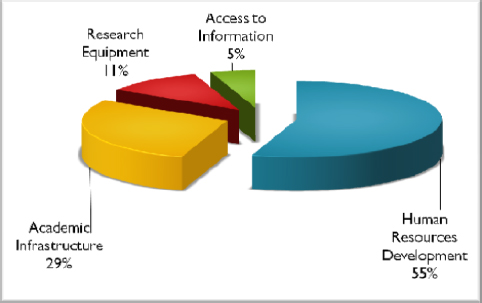
FIGURE 3-1 Distribution of approved project cost.
SOURCE: From the speaker’s presentation at the symposium.
First, we invested in the development of human resources, but then we needed to build the knowledge highways. We need to have the infrastructure on which data can be shared and data can travel. These are in many ways far more important than the motor highways we are used to. I was also the minister for information technology and telecommunications. We did a number of things to widen these highways and to make them efficient. For instance, we placed a satellite in space, Pakistan’s educational satellite, PAKSAT-1, which has footprints over parts of Africa and Asia, and the Middle East. We also established
a virtual university with its own recording studios and used our satellite for communication purposes. Moreover, we rapidly spread the Internet. In 2000, only 29 cities in Pakistan had access to the Internet. This increased to 2,000 towns, cities, and villages that had Internet facilities in 2003. Fiber optic was rapidly expanded from 40 cities to 1,000 cities between 2000 and 2005. Internet usage exploded and continues to do so. The costs of bandwidth were brought down from $87.00 U.S. dollars per month for a 2 Mb line to only $900 per month, and they are among the cheapest in the world today.
Mobile telephony has also expanded. From 300,000 mobile phones, the number suddenly exploded to 110 million-plus mobile phones, as a result of some of the steps that we took. This became the foundation for the establishment of the Pakistan Education and Research Network, which connected all universities together with high-speed Internet access. That has been further expanded with a 1-gigabit connectivity to every university, which is then connected to 10-gigabit loops around major cities.
A very robust system of knowledge highways developed. The next constraint was the question of content and useful, meaningful data that researchers can use. In response, we established the digital library.4 If you walked into a library 10 years ago in Pakistan, you would have found perhaps half a dozen of the latest international journals. Today, as shown in Figure 3-2, every university in the public sector and most universities in the private sector have free access to 25,000 journals and to some 60,000 textbooks from more than 220 international publishers. These are keyword searchable and downloadable. When I say free, I mean that the government, and specifically, the higher education ministry, pays for this vast repository of knowledge. They are also available to students, not just from the universities, but also from their homes, so that if they are working until late in the evening, they can access these databases.
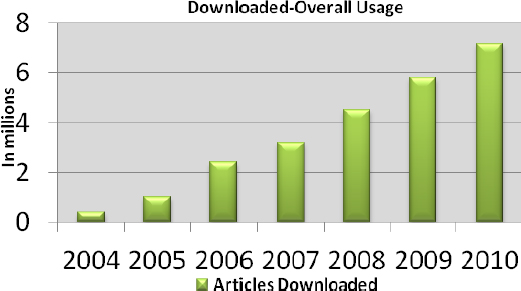
FIGURE 3-2 Articles downloaded
SOURCE:: From the speaker’s presentation at the symposium. Credit: Higher Education Commission for Pakistan’s National Digital Library Program
There are 75,000 e-contents, whether it is Springer or McGraw-Hill or the ISI Web of Science. We also introduced a search engine, SciFinder Scholar. We worked with the University of Lund in Sweden to develop a one-window search engine so that users do not have to go to different Web sites; they can just search all these journals or books through one window. That has worked very well for the last 6 or 7 years. The usage statistics grew very quickly, and they continue to increase.
One excellent teleconferencing facility that we built is the one that I am speaking from now. Such facilities are available in every public-sector university. Here in Karachi University, we have five such
_____________________
4 Available at www.digitallibrary.edu.pk.
facilities. We started a series of lectures and courses, which are developed by top professors from across the world and are benefiting other developing countries as well, such as Sri Lanka, Thailand, and other countries. They are delivered through these videoconferencing facilities. The professors then supervise the exams, which are held by the local partner in the department. They also supervise the marking of papers. Then the universities recognize these as part of their programs’ credit requirements. This is allowing us to link up both with the best of the best in the West and with our own top people in Pakistan, and share faculty and resources with one another.
Pakistan’s telemedicine program was also based on an initiative that I had started in 2001, when we sent selected doctors to the United States. When a massive earthquake occurred in the north of the country, the telemedicine program proved invaluable, because we could deploy remote services to the affected regions in a timely fashion. More than 4,000 teleconsultations have been held and this continues to grow. These repositories of knowledge (i.e., the databases and the literature) are all freely available in Pakistan.
One problem that we had to address was controlling the improper use of data. With access to data and publications growing, the menace of plagiarism has to be controlled. We set up a national plagiarism policy and distributed the required software. This is available in all universities and research institutions, and all theses and research papers are carefully checked before the universities process them.
What has been the impact of all this provision of data, this development of human resources that share the data, and this access to knowledge? Between 2003 and 2009, we had a tripling of students enrolled in higher education. This continues to grow, but is still very low. Only about 5.2 percent of our youth between the ages of 17 and 23 have access to higher education. It should be about 15 or 20 percent. In South Korea it is almost 90 percent. The enrollment has to grow in Pakistan, but there are challenges. The number was well below 2 percent when I took over. The number of public-sector universities also grew from 59 in 2000 to 127 universities in 2009. There are 132 today, in both the public and private sectors.
One of the most remarkable things is that there was a 600 percent increase in ISI-abstracted publications in the 5-year period between 2004 and 2009. There was more than a 1,000 percent increase in citations—after removing self-citations—in The Thomson Reuters Science Citation Index5. There also was fast growth of papers published.
As shown in Table 3-1, the Ph.D. output also grew phenomenally, although it still is very low for a country the size of Pakistan. In the 55 years between 1947 and 2002, Pakistan produced about 3,200 Ph.D. degrees, and in the subsequent 7 years, about as many Ph.D. degrees were produced, a little more than 3,000.
_____________________
5 Available at http://thomsonreuters.com/products_services/science/science_products/a-z/science_citation_index/.
TABLE 3-1 Ph.D. Output in Pakistan
| Discipline | 1947 – 2002 [55 years] | 2003 – 2009 [7 years] |
| Number | Number | |
| Agriculture & Veterinary Sciences | 363 | 450 |
| Biological & Medical Sciences | 589 | 601 |
| Engineering & Technology | 14 | 131 |
| Business Education | 11 | 58 |
| Physical Sciences | 688 | 677 |
| Social Sciences | 899 | 739 |
| Arts & Humanities | 663 | 377 |
| Honorary | 54 | 4 |
| Total | 3,281 | 3,037 |
SOURCE: From the speaker’s presentation at the symposium. Credit: Higher Education Commission for Pakistan’s National Digital Library
However, numbers without quality can do more damage than good. We introduced a system in which all doctoral theses had to be reviewed by at least two or three experts in technologically advanced countries, and only when there was unanimity of opinion that the work was of high quality could the thesis be processed further. We now have several universities in Pakistan that are among the top 300 in the world, including the National University of Science and Technology.
Nature, one of the world’s leading science journals, has published a number of editorials on what Pakistan did. The first of these was on November 27, 2007, which was titled “The Paradox of Pakistan.” In this strange country, which is torn by terrorism and bombings and all sorts of difficulties, there also is a wonderful program in higher education, science, and technology. On August 28, 2008, when President Musharraf had left, the editorial was entitled “After Musharraf.” It said that we must not go back to the same Stone Age that existed previously. Something exciting has happened in Pakistan, and it must be continued.
The last Nature article was on September 22, 2010, which talked about what we had done. I was humbled and somewhat amused when it called me “a force of nature.” I also won the highest civil award from the government of Austria for these changes and the TWAS Prize, which was given to me for institution building. The Royal Society of London, of which I am a fellow, has come forward with a book on what is happening in the Islamic world. It is entitled A New Golden Age. It talks about Pakistan and says that it is the best practice model to be followed by other developing countries.
The future of our country lies in our youth. It is only through the unleashing of their creative potential that we can hope to move forward. We picked 12 students who appeared to have high aptitudes in local high school examinations, and sent them to international Olympiads in mathematics, physics, chemistry, and biology. One of them came back with a silver medal and two came back with bronze medals. This was only after a couple of months of preparation. There is a huge potential that we have in countries such as Pakistan, but it will only be possible to tap into it if we realize that our real wealth lies in our children.
When I came to Pakistan after 9 years at Cambridge University, I dreamed that I would try to set up a center in Pakistan that would be so good that students from the West would come to study here. In my center here in Karachi, we have 350 students doing Ph.D.s in organic chemistry, biochemistry, pharmacology, and other related areas. In the last 5 years, we have had 120 German students who have come to study chemistry and science.
4. DISCUSSION BY THE SYMPOSIUM PARTICIPANTS
PARTICIPANT: What kind of planning is Pakistan doing for the next decade?
DR. ATTA-UR-RAHMAN: In my speech, I mentioned that I was asked by the government to prepare a national roadmap. We prepared a 15-year roadmap for Pakistan. The plan was divided into three 5-year periods, for planning purposes, so that we can generate employment, transition to a higher value-added economy, and use our most important resource, our youth, for future development. We have had some serious problems in the last two and a half years, with the new government facing many financial constraints and freezing some of these programs, but the new education policy, which was approved by the present government, promises a fourfold increase in the budget for higher education and science-related disciplines. If that materializes, I hope that things will start changing again rapidly.
PARTICIPANT: One of the things that seismologists hear from their colleagues in Africa and South America is that the mineral exploration industry often hires their best students, who then do not go into academia. That is quite surprising to us in the United States, because here it is regarded as a good synergy that industry and academia work together, and it contributes to the strength of academic programs. I am wondering what is your view about this sort of back-and-forth of students going into industry?
DR. ATTA-UR-RAHMAN: The problem in Pakistan and many other developing countries is that we do not have strong private-sector research and development partnerships. Most of our institutions do not have research facilities. What worries us is not students being taken away by local industry. I totally agree that we need to have synergy and interaction, but they are being taken abroad, and we are losing a valuable treasure that we have. For that, we have to create the enabling structure that I talked about—the research facilities, the salaries, and so on. They do not have to work in any government institution, as long as they come back and work in Pakistan. It could be in the private sector. So our problem is a different one. For innovation to flourish in a country like Pakistan and other developing countries, you need to have a number of things in place. This includes ease of doing business, access to venture capital, intellectual property right regimes, presence of technology parks, legal infrastructure, and the provision of greater incentives for private-sector research and development so that innovation can take off. All these measures have to come together before the development, innovation, and entrepreneurship can take place. That is still largely missing in Pakistan and in most other developing countries.
PARTICIPANT: I would like to address one of the points you made regarding the volume of publications emerging from the developing world as a share of the world total. You mentioned that it had risen from, I think, 21 percent to 32 percent. This assumes that the actual database of publications that is being counted is a constant, and it is not. Since 2005, the Thomson Reuters Web of Knowledge has quite dramatically changed the volume of publications that it accesses from developing countries, which is a very important change. For example, the number of South African journals that are indexed has gone up nearly threefold. The same is true of Brazil. I took the liberty of looking at the numbers for Pakistan during your talk; there were only two Pakistani journals on the Science Citation Index in 2005. That rose to 14 in 2010. So without detracting from the achievements of ourselves in the developing world, we need to be sure that we benchmark correctly.
DR. ATTA-UR-RAHMAN: What I was talking about was not the number of scientific journals that are published from these countries. The two journals that you are talking about are the two journals from
Pakistan that are included in ISI Web of Science and have an impact factor. There are, I think, about four or five journals. I was talking about international publications in international journals from the developing world.
The data that you talked about also needs to be tweaked a little, because although there is an increase, this increase is largely because China is counted as a developing country. If you take away China, then I think you will not find that there would be much of a change in the rest of the developing world. This data was taken from the United Nations Educational, Scientific and Cultural Organization (UNESCO) 2010 World Science Report, which has grouped the developing countries together, including China.
PARTICIPANT: There has been some news recently about the Pakistani government’s interest in devolving some of the responsibility from the central government to the provinces for higher education and other research activities. Could you comment on that?
DR. ATTA-UR-RAHMAN: This has been an impending disaster in Pakistan in the last few weeks. What has happened is that because the Higher Education Commission was an honest and merit-based organization, it would not bow to political pressure. The Commission found that about 50 of our parliamentarians had forged degrees, and it reported it. Another 250 parliamentarians’ degrees were in the process of being investigated. Certain young people in the government then decided to cut this organization to pieces. I took a very strong stand and wrote a number of articles in national newspapers. I went to the Supreme Court last week, and the decision from the Supreme Court of Pakistan was that the Higher Education Commission is protected under the constitution. This is where it stands now. I understand that there are reverberations. The government is thinking of changing the law, so there may be more to come.
PARTICIPANT: This is one illustration of the fact that if governments are not working for the good of the people, they can create all kinds of problems. We have to watch for that, but things are changing drastically. I just came back from Egypt. I have been talking to groups of young revolutionaries. Indeed, their outlook is very positive. They know exactly what the corruption within the government was like and what the results were. They are looking forward to new ways of doing things, both with the government and by themselves. The one thing they asked me to convey to the world is that they are ready and willing to work with anybody, especially in science and technology. They need help and they are willing to work harder than anyone else.


