
THE EFFECT OF EXPOSURE TO THE ATOMIC BOMBS ON PREGNANCY TERMINATION IN HIROSHIMA AND NAGASAKI
By
J.V.NEEL AND W.J.SCHULL
DEPARTMENTOF HUMAN GENETICS UNIVERSITYOF MICHIGAN
in collaboration with
|
R.C.ANDERSON W.H.BORGES R.C.BREWER S.KITAMURA |
M.KODANI D.J.MCDONALD N.E.MORTON M.SUZUKI K.TAKESHIMA |
W.J.WEDEMEYER J.W.WOOD S.W.WRIGHT J.N.YAMAZAKI |
ATOMIC BOMB CASUALTY COMMISSION
HIROSHIMA, JAPAN
Publication No. 461
NATIONAL ACADEMYOF SCIENCES—NATIONAL RESEARCH COUNCIL
WASHINGTON 25, D.C.
1956
TABLE OF CONTENTS
LIST OF TABLES
Chapter II
|
TABLE 2.1 |
Per Cent of All Registrations (Including Those Involving Parental Consanguinity) with At Least One Parent Heavily Exposed (Radiation Categories 4, 5) |
Chapter III
|
TABLE 3.1 |
Population Figures by Nationality for Foreigners Resident in Nagasaki City between 1864 and 1870 |
|||
|
TABLE 3.2 |
The “Foreign” and Total Population of Nagasaki City, and the “Foreign” Population of Nagasaki Prefecture, 1897–1923 |
|||
|
TABLE 3.3 |
The Ethnic Composition of the Foreign Component of Nagasaki City, for the Years 1910 and 1930 |
|||
|
TABLE 3.4 |
The Age Composition and Ethnic Status of the Total Foreign Population of Nagasaki in 1920, as well as of the Four Principal Ethnic Groups in This Population |
Chapter IV
|
TABLE 4.1 |
Frequency of Occurrence of Certain Symptoms in Persons Alive 20 or More Days Following the Atomic Bombings, as Related to Distance from the Hypocenter |
|||
|
TABLE 4.2 |
The Effectiveness of Shielding in Protecting against Radiation Sickness in Hiroshima |
|||
|
TABLE 4.3 |
Distribution by Distance and Shielding of Husbands of Wives Registering Pregnancies with the Genetics Program: Hiroshima |
|||
|
TABLE 4.4 |
Distribution by Distance and Shielding of Wives Registering Pregnancies with the Genetics Program: Hiroshima |
|||
|
TABLE 4.5 |
Distribution by Distance and Shielding of Husbands of Wives Registering Pregnancies with the Genetics Program: Nagasaki |
|||
|
TABLE 4.6 |
Distribution by Distance and Shielding of Wives Registering Pregnancies with the Genetics Program: Nagasaki |
|||
|
TABLE 4.7 |
The Definition of “Exposure Categories” to be Employed in This Analysis. |
|||
|
TABLE 4.8 |
Distribution of Registered Births by Parental Exposure |
|||
|
TABLE 4.9 |
The Findings of the Joint Commission in Hiroshima with Regard to the Occurrence of Epilation, Petechiae, and Leucopenia in Persons Falling into Various Exposure Categories |
|||
|
TABLE 4.10 |
The Exposure Categories Defined by the Joint Commission, to be Applied to the Interpretation of Table 4.9 |
|||
|
TABLE 4.11 |
The Distribution of Leucocyte Values in Hiroshima Japanese Who Failed to Develop Epilation, Petechiae, or Gingivitis Following the Bombing, in Relation to Distance from Hypocenter and Type of Shielding |
|||
|
TABLE 4.12 |
Proportions of Parents Exposed in the 1,800–2,500 Meter Ring Who Reported Various Types of Shielding |
|
TABLE 5.3 |
Mean Maternal Age by City and Parental Exposure |
|||
|
TABLE 5.4 |
Analysis of Variance: Mother's Age by City and Parental Exposure |
|||
|
TABLE 5.5 |
The Distribution of Mean Squares for Maternal Age by City, Sex of Infant, and Parental Exposure |
|||
|
TABLE 5.6 |
Mean Parity by City and Parental Exposure |
|||
|
TABLE 5.7 |
Analysis of Variance: Parity by City and Parental Exposure |
|||
|
TABLE 5.8 |
The Distribution of Mean Squares for Parity by City, Sex of Infant, and Parental Exposure |
|||
|
TABLE 5.9 |
Economic Status by City and Parental Exposure |
|||
|
TABLE 5.10 |
Chi-Square Analysis of the Distribution of Economic Statuses by City and Parental Exposure |
|||
|
TABLE 5.11 |
Frequency of Positive Serology by Parental Exposure, City, and Group: “Zero” Parents Only |
|||
|
TABLE 5.12 |
Chi-Square Analysis of the Frequency of Positive Serologies by City and Parental Exposure |
|||
|
TABLE 5.13 |
Frequency of Mothers Reporting One or More Induced Abortions by Parental Exposure, City, and Time |
|||
|
TABLE 5.14 |
Chi-Square Analysis of the Frequency of Mothers Reporting One or More Induced Abortions by Parental Exposure, City, and Time |
|||
|
TABLE 5.15 |
Frequency of “Dilatation and Curettage” by Parental Exposure and City: Zero Terminations |
|||
|
TABLE 5.16 |
Chi-Square Analysis of the Frequency of “Dilatation and Curettage” by Parental Exposure and City: Zero Terminations |
|||
|
TABLE 5.17 |
Mean Number of Registered Pregnancies per Mother by Parental Exposure and City |
|||
|
TABLE 5.18 |
Incidence of Leukemia in the Hiroshima Survivors of the Atomic Bombing as Related to Distance from the Hypocenter and the Presence of Severe Radiation Complaints (After Moloney and Kastenbaum, 1955) |
|||
|
TABLE 5.19 |
The Frequency of Malformations by Year among the Offspring of Parents Neither of Whom Was Exposed to the Atomic Bombs |
|||
|
TABLE 5.20 |
The Frequency of Stillbirths by Year among the Offspring of Parents Neither of Whom Was Exposed to the Atomic Bombs |
Chapter VI
|
TABLE 6.1 |
The Number of Infants Rejected from the Study, Tabulated by Reason for Rejection |
|||
|
TABLE 6.2 |
An Accounting of the Number of Observations Considered at Representative Stages in the Analysis of the “At-Birth” Data, and the Number of Rejected Observations with the Cause of Rejection |
|||
|
TABLE 6.3 |
An Accounting of the Number of Observations Considered at Representative Stages in the Analysis of the “9-Months” Data and the Number of Rejected Observations with the Cause of Rejection |
Chapter VII
|
TABLE 7.1 |
The Frequency of Male Births by Parental Exposure and City |
|||
|
TABLE 7.2 |
Chi-Square Analysis of the Frequency of Male Births by City and Parental Exposure |
|||
|
TABLE 7.3 |
Selected Comparisons Regarding the Effect of Irradiation on Sex Ratio |
|||
|
TABLE 7.4 |
National Statistics of Livebirths, 1935–1952 |
|||
|
TABLE 7.5 |
The Frequency of Male Births among Infants Born After April, 1946 but Prior to June, 1948, by Parental Exposure |
|||
|
TABLE 7.6 |
Chi-Square Analysis of the Frequency of Male Births among Infants Born After April, 1946 but Prior to June, 1948 |
|
TABLE 7.7 |
The Frequency of Male Births by Parental Exposure and City, 1954– 1955 |
|||
|
TABLE 7.8 |
Chi-square Analysis of the Frequency of Male Births during the Years 1948–1955 by Time of Birth, City, and Parental Exposure |
Chapter VIII
|
TABLE 8.1 |
An Alphabetical Listing of Those Malformations Observed in This Study which Occurring Alone or in Combination with One Another Were Graded as Major Congenital Defect |
|||
|
TABLE 8.2 |
The Types and Frequency of Various Major Congenital Malformations Observed at the Tokyo Red Cross Maternity Hospital during the Years 1922 through 1940 |
|||
|
TABLE 8.3 |
A Comparison, for Hiroshima and Nagasaki, of the Findings as Regards Major Congenital Malformation in Infants Examined at Approximately Age 9 Months, and in Those Same Infants When Examined Shortly After Birth |
|||
|
TABLE 8.4 |
The Effect of Maternal Age at Fixed Parity on the Frequency of Malformed Infants |
|||
|
TABLE 8.5 |
The Effect of Maternal Parity at Fixed Age on the Frequency of Malformed Infants |
|||
|
TABLE 8.6 |
The Frequency of Malformed Infants by Parental Exposure, Sex of Infant, and City |
|||
|
TABLE 8.7 |
The Frequency of Malformed Infants by Parental Exposure, City, and Maternal Age |
|||
|
TABLE 8.8 |
Chi-Square Analysis of the Frequency of Congenitally Malformed Infants by Sex, City, and Parental Exposure |
|||
|
TABLE 8.9 |
Chi-Square Analysis of the Frequency of Congenitally Malformed Infants by City, Maternal Age, and Parental Exposure |
|||
|
TABLE 8.10 |
The Distribution of Frequency of Malformed Infants Classified by Mother's Age and Exposure Only |
|||
|
TABLE 8.11 |
Chi-Square Analysis of the Effect of Mother's Exposure on the Frequency of Malformed Infants at Each of Five Different Age Levels |
|||
|
TABLE 8.12 |
The Distribution by Maternal Exposure and Parity of Malformed Infants Born to Mothers of Ages 15–20 |
|||
|
TABLE 8.13 |
The Distribution of Frequency of Malformed Infants Classified by Mother's Age and Father's Exposure Only |
|||
|
TABLE 8.14 |
The Frequency of Malformed Infants among All Infants Re-examined at 9 Months of Age, by City and Parental Exposure |
|||
|
TABLE 8.15 |
Chi-Square Analysis of the Frequency of Malformed Infants at 9 Months of Age by City and Parental Exposure |
|||
|
TABLE 8.16 |
The Distribution by Maternal Exposure of the Seven Most Common Major Congenital Malformations in the Japanese, Exclusive of Congenital Heart Disease |
Chapter IX
|
TABLE 9.1 |
Congenital Syphilis among Living Infants Born in Nagasaki in 1951: Incidence and Relation to Maternal Age (After Wright, S.W. et al., 1952) |
|||
|
TABLE 9.2 |
The Effect of Maternal Age at Fixed Parity on the Frequency of Stillborn Infants |
|||
|
TABLE 9.3 |
The Effect of Maternal Parity at Fixed Age on the Frequency of Stillborn Infants |
|||
|
TABLE 9.4 |
Frequency of Stillbirths by Sex, Parental Exposure and City |
|
TABLE 9.5 |
Chi-Square Analysis of the Frequency of Stillbirths by Sex, Parental Exposure and City |
|||
|
TABLE 9.6 |
The Frequency of Stillbirths by Parental Exposure, City and Parity |
|||
|
TABLE 9.7 |
Chi-Square Analysis of the Frequency of Stillbirths by Parental Exposure, City and Parity |
|||
|
TABLE 9.8 |
The Frequency of Stillbirths among Firstborn Infants by City and Paternal Exposure |
|||
|
TABLE 9.9 |
The Frequency of Stillbirths among Firstborn Infants by Paternal Exposure and Maternal Age |
Chapter X
|
TABLE 10.1 |
Mean Birthweight by Parental Exposure, Sex and City |
|||
|
TABLE 10.2 |
Analysis of Variance of Birthweight by Parental Exposure and City |
|||
|
TABLE 10.3 |
The Distribution by Parental Exposure of the Weighted Mean Squares of Deviations |
|||
|
TABLE 10.4 |
Analysis of Covariance of Birthweights: Males, Hiroshima |
|||
|
TABLE 10.5 |
Tests of the Significance and Homogeneity of the Regressions of Birthweight on Maternal Age and Parity: Males, Hiroshima |
|||
|
TABLE 10.6 |
Analysis of Variance on the Adjusted Birthweight Means: Males, Hiroshima |
|||
|
TABLE 10.7 |
The Adjusted Birthweight Means: Males, Hiroshima |
|||
|
TABLE 10.8 |
The Residual Mean Squares from the Individual Cell Regressions: Males, Hiroshima |
|||
|
TABLE 10.9 |
Analysis of Covariance of Birthweights: Females, Hiroshima |
|||
|
TABLE 10.10 |
Tests of the Significance and Homogeneity of the Regressions of Birthweight on Maternal Age and Parity: Females, Hiroshima |
|||
|
TABLE 10.11 |
Analysis of Variance on the Adjusted Birthweight Means: Females, Hiroshima |
|||
|
TABLE 10.12 |
The Adjusted Birthweight Means: Females, Hiroshima |
|||
|
TABLE 10.13 |
The Residual Mean Squares from the Individual Cell Regressions: Females, Hiroshima |
|||
|
TABLE 10.14 |
Analysis of Covariance of Birthweights: Males, Nagasaki |
|||
|
TABLE 10.15 |
Tests of the Significance and Homogeneity of the Regressions of Birthweight on Maternal Age and Parity: Males, Nagasaki |
|||
|
TABLE 10.16 |
Analysis of Variance on the Adjusted Birthweight Means: Males, Nagasaki |
|||
|
TABLE 10.17 |
The Adjusted Birthweight Means: Males, Nagasaki |
|||
|
TABLE 10.18 |
The Residual Mean Squares from the Individual Cell Regressions: Males, Nagasaki |
|||
|
TABLE 10.19 |
Analysis of Covariance of Birthweights: Females, Nagasaki |
|||
|
TABLE 10.20 |
Tests of the Significance and Homogeneity of the Regressions of Birthweight on Maternal Age and Parity: Females, Nagasaki |
|||
|
TABLE 10.21 |
Analysis of Variance on the Adjusted Birthweight Means: Females, Nagasaki |
|||
|
TABLE 10.22 |
The Adjusted Birthweight Means: Females, Nagasaki |
|||
|
TABLE 10.23 |
The Residual Mean Squares from the Individual Cell Regressions: Females, Nagasaki |
|||
|
TABLE 10.24 |
A Summary of the Salient Findings of the Covariance Analysis |
|||
|
TABLE 10.25 |
The Distribution by Parental Exposure of the Residual Mean Squares After Removal of Variation Due to Year of Birth of the Infant: Males, Hiroshima |
|||
|
TABLE 10.26 |
The Distribution by Parental Exposure of the Residual Mean Squares After Removal of Variation Due to Year of Birth of the Infant: Females, Hiroshima |
|
TABLE 10.27 |
The Distribution by Parental Exposure of the Residual Mean Squares After Removal of Variation Due to Year of Birth of the Infant: Males, Nagasaki |
|||
|
TABLE 10.28 |
The Distribution by Parental Exposure of the Residual Mean Squares After Removal of Variation Due to Year of Birth of the Infant: Females, Nagasaki |
Chapter XI
|
TABLE 11.1 |
The Effect of Maternal Age at Fixed Parity on the Frequency of Neonatal Deaths |
|||
|
TABLE 11.2 |
The Effect of Parity at Fixed Maternal Age on the Frequency of Neonatal Deaths |
|||
|
TABLE 11.3 |
The Frequency of Neonatal Deaths by Parental Exposure, City and Sex of Infant |
|||
|
TABLE 11.4 |
The Frequency of Neonatal Deaths by Parental Exposure, City and Parity |
|||
|
TABLE 11.5 |
Chi-Square Analysis of the Frequency of Neonatal Deaths by Parental Exposure, City and Sex |
|||
|
TABLE 11.6 |
Chi-Square Analysis of the Frequency of Neonatal Deaths by Parental Exposure, City and Parity |
|||
|
TABLE 11.7 |
The Frequency of Deaths between Birth and Nine Months of Age by Parental Exposure and City |
|||
|
TABLE 11.8 |
Analysis of the Frequency of Deaths between Birth and Nine Months of Age, by Parental Exposure and City |
Chapter XII
|
TABLE 12.1 |
Distribution of Mean Weight in Decagrams at 9 Months of Age by City, Sex and Parental Exposure |
|||
|
TABLE 12.2 |
Distribution of Mean Height in Millimeters at 9 Months of Age by City, Sex and Parental Exposure |
|||
|
TABLE 12.3 |
Distribution of Mean Head Girth in Millimeters at 9 Months of Age by City, Sex and Parental Exposure |
|||
|
TABLE 12.4 |
Distribution of Mean Chest Girth in Millimeters at 9 Months of Age by City, Sex and Parental Exposure |
|||
|
TABLE 12.5 |
Analysis of Dispersion (All Exposure Cells). (a) Sums of Squares and Cross Products of Deviations for the Two-Factor Interactions, (b) Mean Squares for Individual Analyses of Variance |
|||
|
TABLE 12.6 |
Analysis of Dispersion (All Exposure Cells). (a) Sums of Squares and Cross Products of Deviations for Main Effects and Additivity. (b) Mean Squares for Individual Analyses of Variance (on Main Effects and Additivity). (c) Analysis of Dispersion Test, Wilks' (Using Bartlett's Approximation) |
|||
|
TABLE 12.7 |
Estimates of Constants and Their Variances for Tests of Equality |
|||
|
TABLE 12.8 |
A Summary of the Significance of Tests Comparing All Possible Pairs of Exposure for Each Parent with Respect to the Variables w, x, y, and z |
|||
|
TABLE 12.9 |
Analysis of Dispersion (Only Those Cells Where Both Parents Were Exposed), (a) Sums of Squares and Cross Products of Deviations for the Two-Factor Interactions, (b) Mean Squares for Individual Analyses of Variance (on Two-Factor Interactions) |
|||
|
TABLE 12.10 |
Analysis of Dispersion (Only Those Cells Where Both Parents Were Exposed), (a) Sums of Squares and Products of Deviations for Main Effects and Additivity. (b) Mean Squares for Individual Analyses of Variance for Main Effects and Additivity |
|
TABLE 12.11 |
Estimates of Constants and Their Variances for Test of Equality |
|||
|
TABLE 12.12 |
Mean Product Matrices: Males, Hiroshima |
|||
|
TABLE 12.13 |
Mean Product Matrices: Females, Hiroshima |
|||
|
TABLE 12.14 |
Mean Product Matrices: Males, Nagasaki |
|||
|
TABLE 12.15 |
Mean Product Matrices: Females, Nagasaki |
|||
|
TABLE 12.16 |
Tests of the Homogeneity of the Variances of the Anthropometric Measurements Over All Exposure Cells, and Subdivisions Thereof, for Specified Sex and City |
|||
|
TABLE 12.17 |
Tests of the Homogeneity of the Variances of the Anthropometric Measurements Over All Exposure Cells, and Subdivisions Thereof, for Specified Sex and City |
|||
|
TABLE 12.18 |
Test of the Generalized Variances on the Anthropometric Measurements by Specified Sex and City |
|||
|
TABLE 12.19 |
Analysis of Dispersion, with Age at Examination Included as a Way of Classification (All Exposure Cells), (a) Sums of Squares and Cross Products of Deviations for the Two-Factor Interactions, (b) Mean Squares for Individual Analyses of Variance |
|||
|
TABLE 12.20 |
Analysis of Dispersion with Age at Examination Included as a Way of Classification, (a) Sums of Squares and Products of Deviations for Main Effects and Additivity. (b) Mean Squares for Individual Analyses of Variance for Main Effects and Additivity |
|||
|
TABLE 12.21 |
Estimates of Constants and Their Variances for Tests of Equality |
|||
|
TABLE 12.22 |
A Summary of the Significance Tests Comparing All Possible Pairs of Exposure for Each Parent with Respect to the Variables x, y, w, and z, after Allowance Is Made for Age at Examination |
Chapter XIII
|
TABLE 13.1 |
A. The Randomness of the Distribution of Autopsied Infants by Sex of Infant and Parental Exposure. B. Chi-Square Analysis of the Frequency of Autopsy by Sex of Infant and Parental Exposure |
|||
|
TABLE 13.2 |
Mean Maternal Age of Infants Stillborn or Dying during the First Six Days of Life by Sex of Infant, Parental Exposure and the Occurrence of Autopsy |
|||
|
TABLE 13.3 |
The Distribution of Economic Status among Autopsied and Non-Autopsied Infants |
|||
|
TABLE 13.4 |
The Distribution of Positive Serologies by Parental Exposure among Autopsied and Non-Autopsied Infants |
|||
|
TABLE 13.5 |
The Distribution by Parental Exposure of Infants Born in Hiroshima and Found to be Grossly Abnormal at Autopsy |
|||
|
TABLE 13.6 |
The Distribution by Exposure Class of the Exposed Parents Given in Table 13.5 |
|||
|
TABLE 13.7 |
Hayashi's Data on Congenital Abnormalities in Relation to Exposure of Parents (After Sevitt, 1955) |
|||
|
TABLE 13.8 |
A Comparison of the Exposure Distribution of Hayashi's Data and That of the Atomic Bomb Casualty Commission Collected in Nagasaki |
|||
|
TABLE 13.9 |
Distribution by Exposure Class of Exposed Parents Whose Infants Came to Autopsy at ABCC in Nagasaki |
Chapter XIV
|
TABLE 14.1 |
A Summarization of the Comparisons of the Various Indicators with Parental Exposure When (a) All Exposure Cells Are Considered, and (b) Only Those Cells Where Both Parents Were Exposed Are Considered |
|
TABLE 14.2 |
The Effect of Irradiation of Male Mice on the Sex Ratio of Offspring Conceived during the Post-Sterile Period (After Hertwig, 1938) |
|||
|
TABLE 14.3 |
The Sex Ratio among Livebirths and Fetal Deaths in the Study of Macht and Lawrence (1955) |
|||
|
TABLE 14.4 |
The Effect of Irradiation of Male Mice on the Frequency of Stillbirths among Offspring Conceived during the Post-Sterile Period (After Hertwig, 1938) |
Chapter XV
|
TABLE 15.1 |
Frequency of Occurrence of Spontaneous “Visible” Mutations in Drosophila and in the House Mouse |
|||
|
TABLE 15.2 |
Estimated Average Mutation Rates per Lethal-Producing Locus in Several Drosophila Species (After Dobzhansky, Spassky, and Spassky, 1952) |
|||
|
TABLE 15.3 |
Frequency of Occurrence of Nine Different Dominant or Sex-Linked Mutations in Man |
LIST OF FIGURES
Chapter II
|
FIGURE 2.1 |
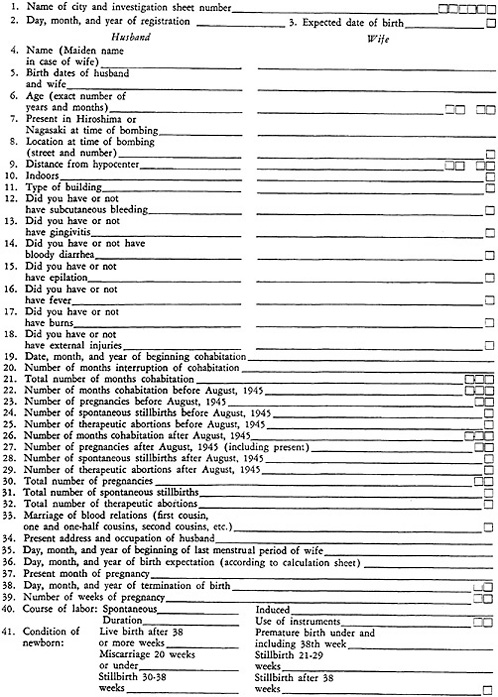
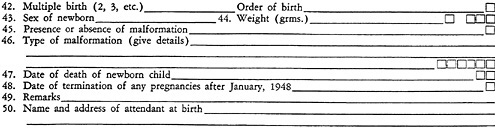
English Translation of the Japanese-Language Genetics “Short Form” |
|||
|
FIGURE 2.2 |
English Translation of the Japanese-Language Pamphlet Distributed at the Time of Pregnancy Registration |
|||
|
FIGURE 2.3 |
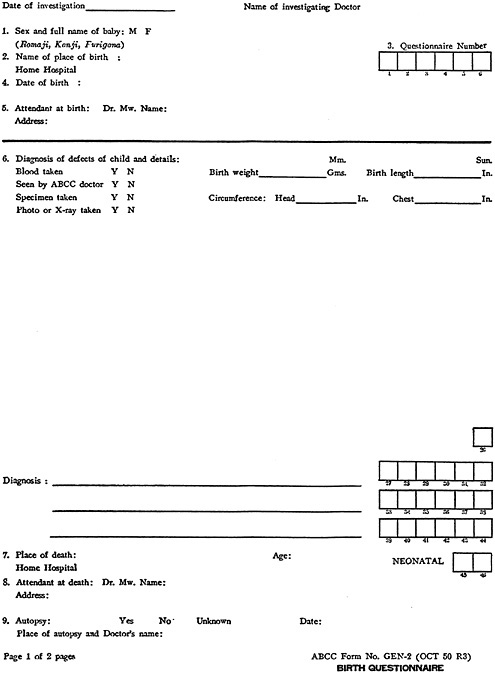
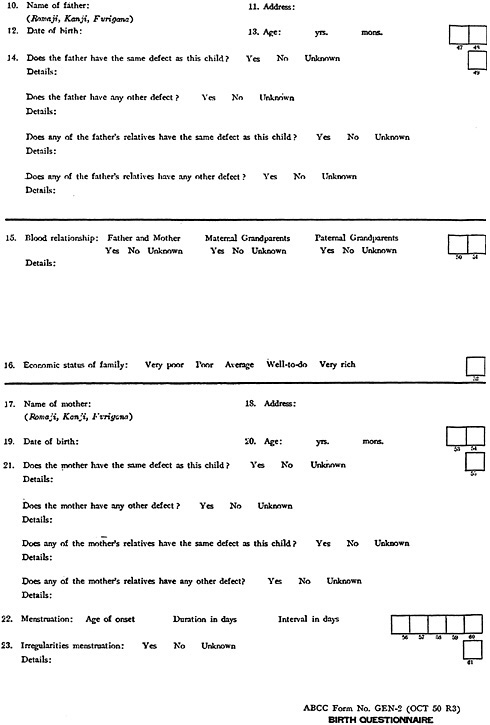
The Genetics “Long Form” |
|||
|
FIGURE 2.4 |
The Form Used for Recording Pediatric Information at Age 9 Months |
Chapter III
|
FIGURE 3.1 |
The Topography of the Hiroshima City Region |
|||
|
FIGURE 3.2 |
The Topography of the Nagasaki City Region |
Chapter IV
|
FIGURE 4.1 |
Symptom Ratio in Relation to Distance from Hypocenter for Hiroshima (Husbands and Wives Combined) |
|||
|
FIGURE 4.2 |
Symptom Ratio in Relation to Distance from Hypocenter for Nagasaki (Husbands and Wives Combined) |
|||
|
FIGURE 4.3 |
Total Dosage of Initial Gamma Radiation as a Function of Distance from the Hypocenter of the Explosion of a “Nominal” Atomic Bomb, from “The Effects of Atomic Weapons” |
|||
|
FIGURE 4.4 |
Fast and Slow Neutrons Delivered per Square Centimeter as a Function of Distance from the Hypocenter of the Explosion of a “Nominal” Atomic Bomb, from “The Effects of Atomic Weapons” |
|||
|
FIGURE 4.5 |
Neutron and Gamma Radiation Distance-Dosage Curves for the Atomic Bomb Explosions at Hiroshima and Nagasaki |
Chapter VI
|
FIGURE 6.1 |
A Schematic Representation of the Method of Sorting the Data to Obtain Non-Overlapping Indicators |
Chapter VII
|
FIGURE 7.1 |
The Distribution of the Frequency of Male Births by Age of Mother at the Birth of the Infant with Parity Ignored |
|||
|
FIGURE 7.2 |
The Distribution of the Frequency of Male Births by Parity with Maternal Age Ignored |
Chapter VIII
|
FIGURE 8.1 |
The Distribution of the Frequency of Infants with Major Malformation by Maternal Age for Specified Parities |
|||
|
FIGURE 8.2 |
The Distribution of the Frequency of Grossly Malformed Infants by Parity for Specified Maternal Ages |
Chapter IX
|
FIGURE 9.1 |
The Distribution of the Frequency of Stillborn Infants by Age of Mother for Specified Parities |
|||
|
FIGURE 9.2 |
The Distribution of the Frequency of Stillborn Infants by Parity for Specified Maternal Ages |
Chapter X
|
FIGURE 10.1 |
The Distribution of Mean Birthweight in Decagrams by Parity for All Maternal Ages, and for Maternal Age 30 Only |
|
FIGURE 10.2 |
The Distribution of Mean Birthweight in Decagrams by Maternal Age for Fixed Parities (Parities 1 and 4) |
Chapter XI
|
FIGURE 11.1 |
The Distribution of the Frequency of Neonatal Deaths by Age of Mother for Specified Parities |
|||
|
FIGURE 11.2 |
The Distribution of the Frequency of Neonatal Deaths by Parity for Specified Maternal Ages |
Chapter XIII
|
FIGURE 13.1 |
The Distribution of the Frequency of Autopsied Infants with Major Malformation, Relative to All Autopsied Infants, by Age of Mother with Parity Ignored |
Chapter XIV
|
FIGURE 14.1 |
A Graphical Representation of the Effect of Parental Exposure on: (1) the Sex Ratio; (2) the Frequencies of Malformed Infants, Stillborn Infants, and Infants Dying in the Neonatal Period; (3) Birthweight Means; and (4) Birthweight Variances |
|||
|
FIGURE 14.2 |
A Graphical Representation of the Effect of Parental Exposure on: (1) the Frequency of Malformed Infants Alive at Age Nine Months; (2) the Frequency of Death in the First Nine Months of Life; and (3) the Anthropometric Measurements of Weight, Height, Head Circumference and Chest Circumference |
|||
|
FIGURE 14.3 |
The Adequacy of the Data with Regard to Sex Ratio as Indicated by the Operating Characteristic (OC) Curves for Analyses Based on Sample Sizes of 5,629 Mothers and 2,453 Fathers, Where the True Proportion of Successes is Assumed to be 0.5198, the Value Observed in the Control Population |
|||
|
FIGURE 14.4 |
The Adequacy of the Data with Regard to Malformations, Stillbirths, and Neonatal Deaths as Indicated by the Operating Characteristic (OC) Curves for Analyses Based on Samples of Size 1,097 Parents, Where the True Proportion of Successes are Assumed to be 0.0090 for Malformations and 0.0142 for Stillbirths and Neonatal Deaths, the Control Values |
Chapter XV
|
FIGURE 15.1 |
A Schematic Representation of Two Different “Mutation Spectra” with Reference to Degree of Viability, Both Compatible with the Existing Data |
Chapter I
BACKGROUND
THE present monograph is designed as a detailed report on certain efforts made during the period 1946–1955 to provide answers to the following two questions:
-
Can there be observed, during the first year of life, any differences between the children born to parents, one or both of whom were exposed to the effects of the atomic bombings of Hiroshima and Nagasaki, and the children born to suitable control parents, and
-
If differences do exist, how are these to be interpreted?
1.1 The general administrative framework of the study.—The study to be described was undertaken as one facet of a comprehensive attempt to obtain detailed information concerning the various possible late or delayed biological effects of exposure to an atomic bombing. Certain information pertinent to the development of the over-all program is essential to an understanding of the manner in which the effort to provide answers to the two questions listed above evolved.
The background of this program begins shortly after Japan's surrender, when a Joint Army-Navy Commission made extensive observations in Hiroshima and Nagasaki on the survivors of the bombings. At the conclusion of the Commission's work its chairman, Col. A.W. Oughterson, M.C., AUS, recommended to the Surgeon General of the Army that the National Academy of Sciences—National Research Council be requested to undertake a long-range study of the medical and biological effects of the atomic bomb. This recommendation was transmitted by Surgeon Gen. Norman T.Kirk to Lewis H.Weed, chairman of the Division of Medical Sciences of the National Research Council. As a result, in June of 1946, a conference group was convened by the Council, and in November, following its recommendation, a five-man commission composed of representatives of the Council, the Army, and the Navy left for Japan for the purposes of (1) determining the current status of Japanese work on atomic bomb casualties, (2) evaluating the feasibility of American participation in continued research on these casualties, and (3) indicating the lines along which such studies should proceed. This commission, composed of Austin Brues, Paul S.Henshaw, Lt. Melvin Block, M.C., AUS, Lt. James V.Neel, M.C., AUS, and Lt. (j.g.) Frederick Ullrich, (MC) USNR, submitted a report of its findings to the Council in January, 1947.
The June, 1946 conference group had recommended that appropriate action be taken to obtain a Presidential Directive authorizing the National Research Council to initiate a long-range study of atomic bomb effects. This Directive was issued at the request of the Secretary of the Navy, James T.Forrestal, in November, 1946. and on its authority the Council, in January, 1947, established a Committee on Atomic Casualties, composed of Thomas M.Rivers (chairman), George W.Beadle, Detlev W. Bronk, Austin Brues, George M.Lyon, C.P. Rhoads, Shields Warren, Stafford L.Warren, George H.Whipple, and Raymond E.Zirkle.
At its first meeting, on March 25, 1947, the Committee on Atomic Casualties went on record to the effect that a large-scale program should be organized towards the end of learning as much as possible of medical significance from the Japanese experience. Financial support for the program was sought from the U.S. Atomic Energy Commission, which, during the fall of 1947, formally signified its intention of financing the program in Japan.
Ever since November of 1946, i.e., beginning with the visit of the five-man commission referred to earlier, there has been resident in Japan a group of investigators and supporting
personnel concerned with various phases of the over-all program. This group has been known as the Atomic Bomb Casualty Commission (ABCC). Starting with a scant handful, it grew until at its peak strength it consisted of 143 “allied” personnel (Americans, English, Australians, etc.) and 918 Japanese Nationals.
At the time that the ABCC began its operations in Japan, that country was of course under U.S. Military Occupation. It was Occupation policy that groups such as the Atomic Bomb Casualty Commission, having to do primarily with the Japanese people, should work with and through some existing Japanese agency. In early 1947, the Japanese Ministry of Welfare, at the instigation of the Public Health and Welfare Section of GHQ, SCAP, established a National Institute of Health, designed to occupy roughly the place in Japanese medicine which the National Institutes of Health then occupied in the United States. Several months later, in June of 1947, Brig. Gen. C.F.Sams, then Chief of the Public Health and Welfare Section, suggested that it would be appropriate for the ABCC to develop its program in cooperation with the Japanese National Institute of Health. Eventually there was established an Atomic Bomb Casualty Section of the Japanese National Institute of Health. The personnel of this Section have been closely integrated with ABCC personnel, in such a manner as to make the program truly a combined Japanese-American effort.
1.2 The beginnings of the Genetics Program. —So well known are the genetic effects of the irradiation of a variety of plant and animal material that inevitably one of the foremost questions in the minds of those considering the possible late consequences of the atomic bombings had to do with the characteristics of the children of exposed parents. As a member of the five-man survey commission which went to Japan in the late fall of 1946, the senior author was especially responsible for an evaluation of the lines along which the study of this question could best proceed. The results of this evaluation were laid before an ad hoc Genetics Conference convened by the National Research Council in the summer of 1947, composed of G.W.Beadle (chairman), D.R.Charles, C.H. Danforth, H.J.Muller, L.H.Snyder, and Lt. J.V.Neel. It was clearly recognized by the members of this Conference that the demonstration of the potential genetic effects of the irradiation of the human species presented many difficulties not encountered in laboratory material. It was further recognized that post-war conditions in Japan were by no means the most favorable for a study of this type.
In finally recommending that a rather large-scale effort be undertaken in Japan, the Conference felt constrained to make the following statement:
“Although there is every reason to infer that genetic effects can be produced and have been produced in man by atomic radiation, nevertheless the conference wishes to make it clear that it cannot guarantee significant results from this or any other study on the Japanese material. In contrast to laboratory data, this material is too much influenced by extraneous variables and too little adapted to disclosing genetic effects. In spite of these facts, the conference feels that this unique possibility for demonstrating genetic effects caused by atomic radiation should not be lost.” (Genetics Conference, 1947.)
Although the study which was undertaken will for purposes of convenience be termed the “Genetics Program,” because of its obvious implications, it must be emphasized that those concerned in its organization and conduct have always regarded it first and foremost as an effort to collect data on the characteristics of the children born to the irradiated survivors of the atomic bombings, data which, if indicating that the bombs had had some effect, were then subject to several possible interpretations, genetic and otherwise.
1.3 The early Japanese efforts along these lines.—The U.S. Army-Navy Joint Commission which studied the medical effects of the atomic bombs in Japan as soon as possible after the surrender worked in close cooperation with the Medical Section of a special Committee for the Investigation of the Effects of the Atomic Bombs, appointed by the Japanese National Research Council. The members of this group also recognized clearly the desirability of long-range studies on the medical effects of the bombs, but in the organization of such studies were greatly handicapped by post-war conditions in Japan. The administrative reorganization of the Japanese National Research Council and other aspects of Japanese science which the Occupation sponsored also unavoidably created uncertainties which delayed the work of this group.
Despite these many difficulties, at the time that the U.S. National Research Council's survey group visited Hiroshima in December of 1946 they found the Japanese planning to obtain data on the characteristics of the children then being born. This program, under the immediate supervision of Dr. I.Matsubayashi, was carefully reviewed. It was felt to be inadequate in several respects. Nevertheless, it is certainly a favorable commentary on Japanese interest in the problem and desire to carry on research that plans for even a small program had been set up under the circumstances then prevailing. This program was in effect very briefly and then merged with the program of the ABCC; Dr. Matsubayashi became a member of the ABCC staff.
1.4 Scientific and administrative considerations shaping the nature of the program in Japan.—The lines along which the Genetics Program in Japan was laid out in 1946–1947 were dictated not only by purely scientific considerations but also by certain practicalities of the situation. The more important scientific considerations were as follows:
1.4.1 The possible observable genetic effects of irradiation upon the first generation born after an atomic bombing are many and varied. These include changes in the sex ratio, an increase in the frequency of stillbirths, an increase in the frequency of congenital malformation, an increase in infant mortality, etc. Each of these possible indicators of genetic damage is also influenced by a number of other factors; there are no known unique yardsticks of genetic damage. Under these circumstances, the crux of any program of study was the feasibility of establishing control material which insofar as possible differed from the irradiated only with respect to the radiation factor.
1.4.2 At the time this program was organized, although there was available a mass of data concerned with spontaneous mutation rates and the genetic effects of irradiation on Drosophila, little was known concerning spontaneous mutation rates in mammals, including man, and, with the exception of the work of Charles (1950), still less concerning the mutagenic effects of the irradiation of mammalian material. Largely by extrapolation from the Drosophila material, it could be anticipated that in the light of the probable irradiation dosages sustained by the survivors of Hiroshima and Nagasaki, only very slight genetic effects should be detected in the first generation. In particular, it is worth pointing out that although the atomic bombs were dropped in August of 1945, because of the various time-consuming administrative developments recounted above, involving policy decisions and their means of implementation for the National Research Council, the U.S. Atomic Energy Commission, the U.S. Army of Occupation in Japan, and the Japanese Government, it was March of 1948 before the Genetics Program as it will be described presently was actually in action. The first children to come under the scrutiny of the program were conceived in October of 1947. There was thus a loss of information for the two years following the bombing. For a variety of reasons, some to be discussed below, it was felt that no attempt to reconstruct the frequency of malformations, stillbirths, or neonatal death during these first two post-bomb years could succeed. The practical corollary of these considerations was the necessity, once the program got under way, of a large-scale effort which would utilize as much of the available material as possible.
1.4.3 It was apparent from the outset that the Genetics Program could not and would not operate independently of the various other facets of the activities of the ABCC, but as one of a collection of integrated units. However, the organization of the Genetics Program proceeded somewhat more rapidly than the organization of other segments of the ABCC. Furthermore, there was for some time uncertainty as to the scale of operations in Japan. Under these circumstances, it was necessary to design a program with a basic, irreducible framework to which additions could be made later if circumstances permitted, but the additions had to be of such a nature that they would not invalidate a comparison of the early and later data. It was further necessary that the observations selected as possible indicators of genetic damage be relatively simple, as devoid as possible of the subjective element, and capable of being carried out under the conditions in Japan to be described below.
1.5 Local considerations shaping the nature of the program in Japan.— Among the conditions in Japan which were determining elements in the program, the following deserve special mention:
1.5.1 In Japan, the practice of obstetrics
is still largely in the hands of midwives. They attend approximately 96 per cent of the deliveries. Thus, in 1948, out of a total of 2,681,624 deliveries in Japan, 2,468,821 were attended by midwives, 102,627, by physicians, and 110,176 by unlicensed attendants. The deliveries for which midwives and unlicensed attendants are responsible usually occur at home.
The prerequisites for licensure as a midwife were revised upwards during the Occupation. However, the great majority of midwives now in practice were of course licensed under the previous system. This required that a candidate for admission to a school of midwifery had completed a kotoshogakko education (about eight years, corresponding to grammar school). Although not required, some candidates had also completed chugaku (middle school, about four years, corresponding to high school). The course in midwifery covered two years. One could either spend all two years in a school, or spend one year in school and the last year obtaining experience either in the obstetricsgynecology department of a hospital or in association with a senior midwife. One had then to pass a prefectural examination for licensure. The legal minimum age was 20 years. Not uncommonly a licensed midwife married soon after completing school and did not return to the practice of midwifery for some years.
It is apparent that whatever the midwife's qualifications for the practice of obstetrics may be, her training had not prepared her for the detection and careful description of congenital malformations. This made it necessary with respect to the Genetics Program to develop a system whereby each newborn infant was seen by a physician as soon as possible after birth.
1.5.2 The Japanese economy during the immediate post-war years, when this study was instituted, was marginal. There was strict rationing of food and articles of clothing. Since official rations were inadequate to meet caloric needs, there was a widespread “black market” in food. One of the features of the ration system was special provision for pregnant women. Such women (or their designated representative) upon certification of pregnancy by a midwife or physician could register at any time after the fifth lunar month of pregnancy and thereby obtain access to certain items of value to them and their future children. Registration was revealed by a preliminary study to be in excess of 95 per cent complete. There was thus available a system whereby very nearly all pregnant women could be contacted at mid-pregnancy.
1.5.3 Finally, mention must be made of the psychological and sociological pitfalls involved in a study of this type. This is scarcely the place for a detailed analysis of the psychological problems inherent in the operations of the ABCC in Hiroshima and Nagasaki. Some of the inevitable problems in Japanese-American relationships are apparent. Others were unexpected (Matsumoto, 1954). Each step in the program had to be planned and taken cautiously, after every effort had been made to explore the possible repercussions. In retrospect, the first year of activity in Japan may be characterized as an apparently interminable series of conferences punctuated by weekly crises which, although often inconsequential in retrospect, at the time threatened to stall the entire operation until met. Lacking any semblance of authority in Japan, the ABCC was wholly dependent upon the voluntary cooperation of the Japanese people. The good will of the city officials, local physicians, and—above all—of the midwives, was, if not indispensable, highly desirable. It should particularly be mentioned that in Japan the social stigma attached to the birth of a malformed child is rather considerable. Every effort had to be made to develop a program which would not antagonize the mothers of malformed children by exposing them to what they considered undue publicity. In this effort, the mid-wives were the key.
Although the destruction and desolation which were the aftermath of the atomic bombings have been many times described, neither photographs nor words are adequate to the occasion. In addition to the post-war stresses and strains to which all the inhabitants of Japan were subject, the citizens of Hiroshima and Nagasaki were confronted with a more formidable job of reconstruction than the inhabitants of most Japanese cities, badly bombed though these had been. These are not the circumstances in which research or even cooperation in the research of others flourishes.
Chapter II
THE PLAN
WITH the considerations outlined in Chapter I in mind, a plan of attack on the problem was developed which will now be described.
2.1 Pregnancy registration.—As mentioned earlier, in the post-war years the ration system in Japan was such that pregnant women upon registration of their pregnancy following the completion of the fifth month of gestation could thereby acquire access to certain rationed items. With the cooperation of the city administrators of Hiroshima, Nagasaki, and Kure (a control city), a system was instituted whereby at the time of her registration at the city hall (or district office) for ration purposes, each pregnant woman or her representative in these three cities completed the first two-thirds of a questionnaire which included such items as identifying information, a brief radiation history of the husband and wife, a short summary of the past reproductive performance, and pertinent details concerning the present pregnancy. In the majority of instances the informant for this questionnaire was the pregnant woman herself. Only rarely were both parents available. Accordingly the radiation information on this questionnaire tended to be more reliable for the wife than the husband (cf. Sec. 4.6).
Figure 2.1 is an English translation of this questionnaire, which will be referred to as the “Genetics Short Form.” This questionnaire was administered by trained clerks who occupied a special office in the city hall (or district office). The actual collection ‘of data began in Hiroshima in February, 1948; in Kure in March, 1948; and in Nagasaki in July, 1948. The questionnaire was filled out in duplicate; the original was then given the registrant, while the Commission retained the copy. At the time of termination of the pregnancy, the midwife or physician in attendance completed the questionnaire by answering certain questions pertaining to the characteristics of the child and delivery. More specifically, information was requested on the following possible indicators of a genetic difference between the children of control and irradiated parents: sex, birthweight, stillbirth, and presence of malformation. In case there was an abnormal termination (e.g., stillbirth, malformation), the midwife informed the Commission by telephone as soon as possible. If the outcome appeared normal, the questionnaire was held by the midwife until collected by a Commission clerk. Such collections were at first at weekly and later twice weekly intervals. Regardless of the type of termination, a Japanese physician in the employ of the Commission or the Japanese National Institute of Health called to examine the child—at once, if there was a report of an abnormal termination, or on a somewhat more leisurely schedule if the termination was reported as normal. Midwives received a small fee for each questionnaire they completed. Because of this lag between birth, questionnaire collection, and examination by a physician, it was also possible to obtain rather complete information concerning death during the first 7 days post partum, hereafter referred to as neonatal death.
The cooperation both of the mother and of the midwife in this study was of course entirely voluntary. An attempt was made at the time of pregnancy registration to explain the rudiments of the program to the registrants, and, in addition, each mother was given a brief printed description of the program. Figure 2.2 is a translation of this description. Numerous meetings were held with the Midwives' Associations of the cities to explain the program and answer questions. Attendance at the meetings was usually excellent, although, the Japanese birth rate being what it was, apt to diminish appreciably between the opening and closing of any given meeting.
Approximately a year and a half after the
program went into operation, an attempt was made to ascertain what proportion of births in Hiroshima were to mothers registered in the Genetics Program, i.e., to determine the completeness of our pregnancy registration. Inasmuch as studies by the Public Health and Welfare Section, GHQ, SCAP (Mr. L.V.Phelps) had revealed that the official Japanese registration of births by place of occurrence during the period of this study was quite complete,1 it was felt that the most valid (as well as convenient) approach to this evaluation would be to compare the number of terminations recorded by the Genetics Program each month with the number officially registered in the city. The comparison follows:
|
1948 |
City |
ABCC |
% |
|
August |
713 |
653 |
91.6 |
|
September |
723 |
674 |
93.2 |
|
October |
602 |
614 |
102.0 |
|
November |
625 |
596 |
95.4 |
|
December |
555 |
577 |
104.0 |
|
1949 |
|||
|
January |
1,001 |
914 |
91.3 |
|
February |
759 |
703 |
92.6 |
|
March |
740 |
675 |
91.2 |
|
April |
719 |
630 |
87.6 |
|
May |
707 |
634 |
89.7 |
|
June |
728 |
711 |
97.7 |
|
July |
826 |
759 |
91.9 |
|
August |
762 |
703 |
92.3 |
|
September |
740 |
685 |
92.6 |
|
10,200 |
9,528 |
93.4 |
|
Percentages greater than 100 are probably best explained by changing city boundaries and monthly carry-overs, especially in the case of the December, 1948 figure, because of the Japanese custom of delaying registration on a child born in late December. Assuming that terminations known to the ABCC were also known to the city, this indicates that approximately 7 per cent of the births occurring in the city were to mothers not registered with the Genetics Program.
A large proportion of these births to parents not registered with the Genetics Program of the ABCC subsequently came to the attention of the Program in the following two ways: (1) At the time of registration of the birth with the city, the city clerks routinely inquired if the pregnancy was known to the ABCC, and if not, directed the registrant to the Genetics Program offices in the city hall. (2) Private doctors and midwives frequently reported the names of all women whom they attended who were not registered with the Genetics Program. Births coming to the attention of the Program through these channels were placed in an “Unregistered Series.” From time to time, in an effort to improve the coverage of the Program, the reasons were investigated for the failure of the pregnancies resulting in these births to be included in the routine registration. One of the more complete investigations of this type was carried out in Hiroshima in October of 1952 and dealt with 147 unregistered births occurring in the period of June through September of that year. The reasons for not registering given by the mothers of these 147 children were as follows:
|
Reason for failing to register |
No. |
|
|
1. |
Arrived in city just prior to birth of child |
20 |
|
2. |
Registered pregnancy at city hall, but failed to visit ABCC office there |
37 |
|
3. |
Failed to register either with city for ration purposes or with ABCC, although in town during pregnancy: |
|
|
Too busy |
23 |
|
|
Forgot |
19 |
|
1 |
The actual figures for registration of live births during the years 1948, 1949, and 1950 are 98.1%, 98.8%, and 98.9% respectively, while for stillbirths the corresponding figures were 98.7%, 99.4%, and 99.4% (cf. Public Health & Welfare in Japan, 1948, 1949, 1950, by Public Health & Welfare Section, GHQ, SCAP). |
|
First seen by midwife late in pregnancy; felt registration wasn't worth bothering with |
5 |
|
|
Requested someone else to register; that person failed to do so |
17 |
|
|
Too sick to register |
4 |
|
|
Didn't know about registration |
12 |
|
|
4. |
Miscellaneous causes |
10 |
|
147 |
||
TRANSLATION OF PAMPHLET DISTRIBUTED AT THE TIME OF PREGNANCY REGISTRATION
To All Prospective Mothers:
The ABCC has a request to make of all prospective mothers. I presume you are familiar with the research project of the ABCC. The American and Japanese doctors work together in giving physical examinations to all babies born in Hiroshima, Kure, and Nagasaki, and cooperate in carrying on other scientific researches. We hope that those who have encountered the bomb and also those who have not will respond to our program. A comparative study of the physical conditions of the persons who experienced the bomb and persons who did not, insures the scientific accuracy of our studies.
When you register your pregnancy at the city office will you kindly fill out a questionnaire for ABCC? Our representative will ask you questions and fill out the questionnaire. You need not be worried about the questionnaire for it contains only questions concerning your expected baby, name of parents, birthdates, date of marriage and history of exposure to the atomic bomb. If you have any questions to ask, our representative will be happy to assist you. The form, on a white sheet, which you will be asked to take home with you, will be filled out by your attending midwife or doctor and returned to ABCC.
Within a month after delivery an ABCC doctor will call on you and make a physical examination of your baby. (If unfortunately your pregnancy terminates in abortion, stillbirth, or any other abnormality, an ABCC doctor will also call on you.) By this examination you will be able to know your baby's true physical condition and at the same time you will be making an important contribution to medical science.
In the ABCC clinic the most modern X-ray and other medical equipment are available if the necessity of a thorough examination of your baby is found necessary. In such cases the ABCC will call for you and bring you and your baby to the clinic. The results of the examinations are strictly confidential but if you desire they may be available to your family doctor. All services are performed free of charge.
NOTE:
1. Regardless of whether or not you experienced the atomic bomb, whether your pregnancy terminates in abortion or stillbirth, your cooperation will be appreciated.
2. Please preserve the questionnaire that you were asked to take home and have the attending midwife or doctor fill it out after delivery. If you lose the questionnaire it will be issued to you again, if you will present your Expectant Mother's Notebook at the city office.
3. Please inform the ABCC if you change address at any time.
Your kind cooperation is requested in this medical research program.
FIGURE 2.2—English translation of the Japanese-language pamphlet distributed at the time of pregnancy registration.
Reason (1) appears to represent an unavoidable loophole in the program, but inasmuch as mothers falling into this category as a rule were unexposed, this does not represent a serious loss of data. Reason (3) also represents an unavoidable loophole in a program geared as this was to a civic function. Reason (2), on the other hand, represented an unnecessary loss of data (which could be and was rectified), due for the most part to the fact that the city clerk failed to direct the registrant to the ABCC office, either through forgetfulness or, in the case of new clerks, not knowing that this should be done. Because of differences in city administration practices, the percentage of unregistered births was always less in Nagasaki than in Hiroshima.
The question naturally arose as to whether the information collected concerning registered births should also be obtained for these unregistered births, following which the two sets of data would, for analytical purposes, be combined. In view of the extent to which recent arrivals to the city enter into the composition of the unregistered group (20/147 in the preceding analysis), it was felt that it would be better not to combine the two series, even though this involved the loss of a certain amount of badly needed data.
As mentioned earlier, it was not necessary that the pregnant woman register in person, it being possible for her designated representative to register for her. In approximately 4 per cent of all registrations, neither the prospective mother nor the father appeared at the city hall,
the registration being carried out by some third party. Such individuals of course were unable to answer many of the items on the questionnaire. In these instances, a clerk was sent to the home to obtain the necessary data.
2.2 Special studies on abnormal terminations. —In the event that a pregnancy terminated abnormally, as in a stillbirth or a child with a congenital malformation, a supplementary questionnaire was completed in the patient's home by a doctor in the employ of the ABCC. This questionnaire covered in some detail gynecologic history, maternal disease during pregnancy, past reproductive performance, and economic status. The actual questionnaire is reproduced in Figure 2.3 and will be referred to as the “Genetics Long Form.” In addition, in the case of abnormal terminations, blood was obtained from the mother for a serological test for the presence of syphilis.
If the physician charged with completing the supplemental questionnaire encountered an unusual abnormality, or one concerning whose nature he was unsure, he could, if the parents were willing, arrange for the child to be seen by an American-national pediatrician at the ABCC headquarters, for such diagnostic studies as seemed necessary, as well as photographic documentation of the case.
The Japanese physicians concerned with the home examination of these infants were for the most part recent medical school graduates. Many of them were employed on a half-time basis, the remainder of their time being devoted to hospital duties. Each of these men, before he was sent out on home calls, received instruction in the systematic examination of the newborn infant. In addition, from time to time lectures were given on the recognition of the more common congenital abnormalities. Between 30 and 40 full or part-time physicians were employed in this capacity at any one time. For a variety of reasons, personnel turn-over was at first relatively high; this necessitated a constant training program.
2.3 The “10-percent sample.”—Each woman as she registered received a registration number for her pregnancy, these being assigned in sequence and without respect to radiation history. For every tenth registration, which is to say, all registrations for which the terminal digit in the registration number was zero, the same supplemental questionnaire just described in connection with abnormal terminations was completed in the home. A serological test for syphilis was also carried out on the mother of every tenth termination. In this way a 10 per cent sample was obtained with which to supplement the information obtained on the original questionnaire concerning the comparability of control and irradiated parents. In addition, information was obtained of value in analyzing the causation of abnormal pregnancy terminations.
2.4 The accuracy and reproducibility of the anamnestic data obtained on the Genetics Short Form and the Genetics Long Form.—The information accumulated in the course of this study is of two types: anamnestic, and observational. The accuracy of both types of information was of course a matter of vital concern. During the period covered by this investigation, many women in the study cities had several pregnancies. Each pregnancy of a given woman was registered independently of any others. Discrepancies in the answers to particular questions in the course of multiple registrations by a given woman provide some insight into the reliability of the material. In addition, because of overlaps in the various segments of the ABCC program, the same information might be obtained independently in different studies.
The information obtained on the Genetics Short Form is of three main types: (1) radiation history, (2) history of past reproductive performance, and (3) observations by midwives and physicians on the outcome of the current pregnancy. The reliability of information of types (1) and (3) will be examined in detail in Chapters IV, VIII, IX, and X. The attempt to obtain information of type (2) was motivated by the possibility of detecting an increase in the proportion of abortions and miscarriages among conceptions occurring in the period immediately following the bombing. However, a preliminary analysis of repeat registrations by the same mother, in May of 1951, suggested that the error in the reporting of abortions and miscarriages was such that any attempt to utilize these data would be ill-advised. This study thus utilizes only direct observations collected under supervision during the years 1948– 1954,
The material sought on the Genetics Long Form was collected with three purposes in mind: (1) the description in some detail of congenital defect, (2) the recording of certain
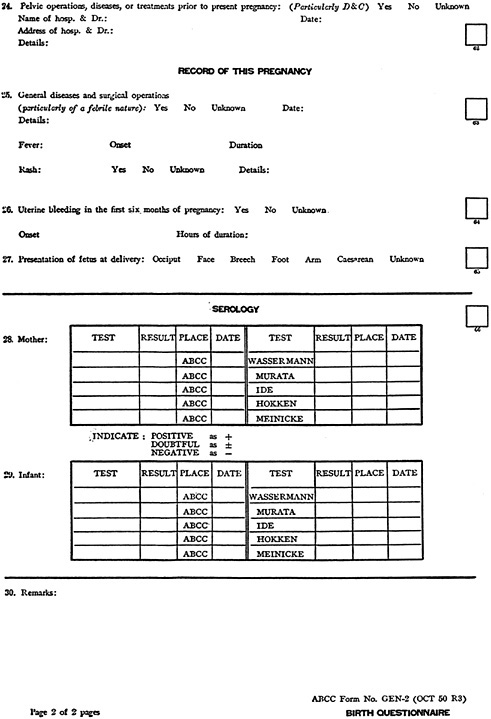
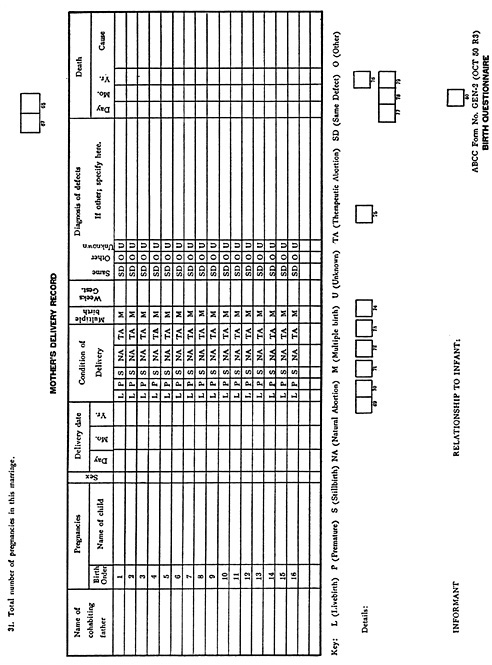
supplementary technical observations of possible pertinency to pregnancy outcome such as economic status and maternal luetic infection (as revealed by serological testing), and (3) the recording of considerable background information of possible relevancy to the manner in which a given pregnancy terminated, with particular reference to the problem of congenital defect. This included a brief family history of both father and mother, a detailed reproductive history of the mother, disease during pregnancy, etc. The reliability of the material collected under headings (1) and (2) will be discussed in Chapters V and VIII. The reliability of anamnestic data mentioned under heading (3) will be briefly considered here. This material is in the strict sense not relevant to the problem of radiation effects, the questions having been introduced because of the opportunity of adding to existing knowledge concerning the etiology of congenital defect. Unfortunately, particularly with reference to the occurrence of congenital defect in other members of the family, several analyses have raised serious doubts as to whether these histories are of sufficient reliability for research purposes. There is in general less major congenital defect reported in family histories than would be expected on the basis of the observations made during the course of this investigation. This may in part be due to lack of information and forgetfulness, but is probably in no small measure due to the social stigma connected with congenital defect, and the consequent efforts to conceal it.
2.5 The autopsy program.—As the over-all program of the ABCC developed, and particularly after a Department of Pathology was established, it became possible to initiate the performance of autopsies on deceased or stillborn infants falling within the scope of the program. Because of the greater concentration of Commission personnel in Hiroshima than in Nagasaki, infant autopsies were begun in Hiroshima in December, 1948, but not in a methodical fashion in Nagasaki until several years later.
A request to perform an autopsy was routinely made of the parents of each stillborn infant and of each infant dying during the neonatal period coming to the attention of the Commission. If permission was granted, the contactor brought the cadaver to the ABCC pathology laboratory. A complete autopsy was performed in all cases save where maceration made this impossible. Photographs and X-rays were taken when indicated. A copy of each autopsy protocol was ultimately filed with the appropriate Genetics Long Form. The cadaver was then carried to a crematorium in an ABCC vehicle. Ashes were returned to the family in a suitable receptacle on request. Cost of the coffin and cremation fee were borne by the ABCC.
When the autopsy program was well under way in the two cities, some 50 per cent of the total available material came to autopsy. For instance, an analysis of 300 consecutive registrations terminating in stillbirths or neonatal deaths, beginning January, 1950 in Hiroshima, revealed that out of the total of 311 infants involved, 158 (50.8%) came to autopsy. Of the remaining 153, 46 (14.8%) were seen by an ABCC physician but did not come to autopsy. There were 107 (34.4%) who were not seen by an ABCC physician, and concerning whose appearance at birth there is only the statement of the mother and attending midwife. This represents the most serious potential loss of information in the entire program, since a certain amount of congenital malformation could well go unrecognized or concealed. However, these unexamined infants can introduce bias into the findings only if there is a difference in reporting on the part of exposed and unexposed parents. We shall examine the latter possibility in Chapter XIII.
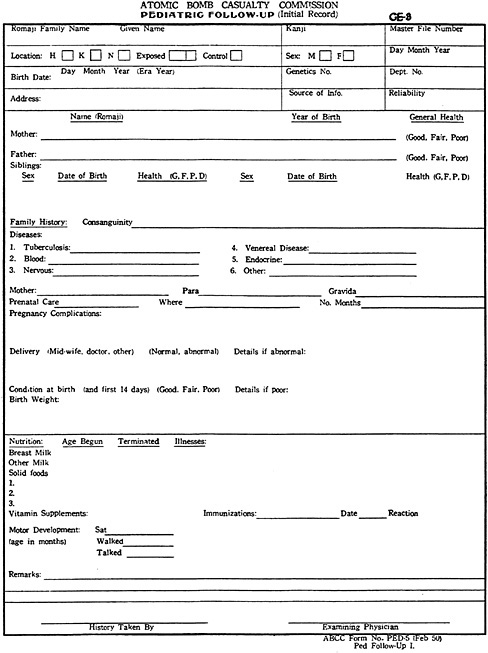
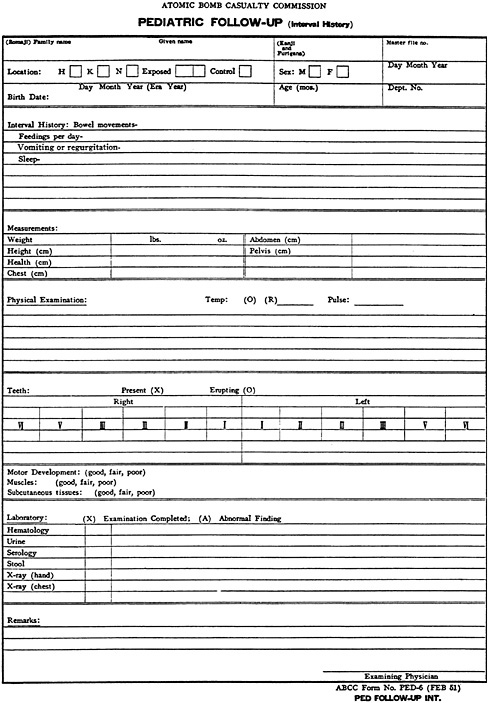
2.6 The collection of data on infants aged 9 months.—Japanese homes are not always well lighted and, because of their construction and the fuel shortage, are decidedly cold in winter. These conditions are not favorable for an adequate physical examination of a newborn child. The possibility had to be recognized that for these reasons, as well as diagnostic oversights, some malformations were not being observed at birth. Furthermore, certain defects, such as congenital dislocation of the hip, spastic paraplegia, deafness, blindness, congenital heart disease, or mental defect are not always readily diagnosable at birth. Accordingly, in January of 1950, the earliest date at which the over-all development of the ABCC permitted such action, a program was inaugurated to bring into the central clinical facility at age 9 months as many of the children examined shortly after birth as possible, both as a check on diagnostic
oversights at the time of the first examination and on supplementary diagnoses. Certain anthropometric measurements were also obtained as an index of general physical development. Furthermore, because of the possible relationship between genetic damage and death during the neonatal period of infancy, information as to time and manner of death was obtained for deceased children. The age for this study was set at 9 months rather than, e.g., one year, because of the relative ease with which a 9-month-old infant may be examined. The form on which the data were recorded is reproduced as Figure 2.4, and will be referred to as the Genetics 9-Months Follow-up.
Since it was not possible to conduct studies of all the babies examined at birth who were still alive 9 months later, a system of obtaining a random sample had to be set up. This was done by the simple expedient of calling in babies for examination according to the terminal registration digit of the pregnancy. Each month all babies with certain specified terminal registration digits were seen, the number of children seen being regulated by the other demands on the clinical facility and the personnel available. In this fashion, a random 10, 20, 30, etc. per cent of the original group could be called in for examination. Parental cooperation was usually excellent. Where a child who was included in the sample could not be examined, an attempt was made to establish why, in an effort to detect possible sources of bias.
A comparison of the recorded findings on a series of infants examined shortly after birth and again at 9 months provides a check on both the clerical and medical efficiency of the program. Such a comparison was carried out in 1952, based on 4,578 pregnancy terminations studied at birth and followed up again at age 9 months in Hiroshima in 1951. The comparison involved the findings coded on the IBM cards used for the final analysis (see below) rather than on a matching of the two original forms, since the IBM cards are of course the basis for the final tabulations. Particular attention was directed towards the occurrence of gross malformation in the two series.
A total of 38 clerical errors came to light. Approximately half of these arose in the following manner: a tentative diagnosis of major malformation made when a child was seen in the home was not confirmed when the child was brought into the central facility for examination a short time thereafter. When this same child was seen at age 9 months and the defect again not observed, this was erroneously coded as a refutation of an earlier diagnosis, when in fact no actual diagnosis had been reached. This error did not affect the actual analysis of the data. The other 20 clerical errors were of a more serious nature, involving for the most part an error in the use of the 6-digit code developed in connection with this study for the classification of congenital malformation.
From the medical standpoint, the comparison of the two sets of records brought out the unreliability, under the conditions of this study, of the diagnosis shortly after birth of congenital heart disease and congenital torticollis. This finding led to omitting these two diagnoses from the “at birth” data, although both were included in the “9 months” data.2 Excluding these two diagnoses, there were 48 instances of major defect listed among the 4,578 terminations studied shortly after birth. The follow-up examination at age 9 months increased the number of diagnosed major defects (exclusive of congenital heart disease) to 122. On the face of it, this amounts to a 154 per cent increase. However, analysis of the data revealed that three diagnoses contributed disproportionately to the 9-months total, as follows:
|
Diagnosis |
No. of times made on first examination |
No. of times made on second examination |
|
Dysplasia of acetabulum |
3 |
26 |
|
Pilonidal sinus |
5 |
22 |
|
Inguinal hernia (females only) |
5 |
19 |
|
13 |
67 |
Exclusive of these three diagnoses, there were 35 diagnoses of major defect at the time of the first examination (all confirmed later), as contrasted to 55 at the second examination, an increase of 57 per cent. It was apparent from this that the 9-months examination not only served as a valuable check on the “at birth” program but significantly increased the amount of congenital disease recognized in these children, although the bulk of this contribution was due
|
2 |
The diagnosis of congenital heart disease was based on one or more of the following criteria: persistent cyanosis, a grade III or IV apical systolic murmur, a precordial thrill, or cardiomegaly in the absence of another adequate explanation. |
to a relatively few diagnoses. The question of whether these three common diagnoses “unbalance” the 9-months data will be examined later. On the basis of these findings, the decision was made to conduct separate analyses on the malformation findings “at birth” and the additional findings at the later examination. It should perhaps be emphasized at this point that although we have presented the above analysis in terms of specific defects, the unit in the statistical analysis to be presented later of the relationship between radiation history and congenital defect was the malformed child rather than specific defects, i.e., for analytic purposes each child is scored only once regardless of the number of major defects present.
2.7 The processing of the data.—All of the questionnaires employed in this study were checked for completeness by trained clerks. In the event of an omission or an obvious error, the individual concerned was queried either by mail or by a “contactor.” Where a discrepancy appeared between the information obtained on a first registration and on a subsequent registration by the same couple, an attempt was made to determine which of the two statements was correct and the reason for the discrepancy. When the questionnaires were completed, the data necessary to the projected analyses were coded, and the coded results transferred to standard 80-column machine tabulation cards. The codes used for the Genetics Short Form, the Genetics Long Form, and the Genetics 9-Months Follow-up are reproduced in Appendix 1.
2.8 The study of spontaneous abortions.— Early in the planning of the study, the possibility presented itself that a significant fraction of the detectable genetic effects of the atomic bombs on the first post-bomb generation would be in the form of dominant lethals which would find expression during the early stages of pregnancy. Although some of these dominant lethals might manifest themselves prior to implantation, others might not be effective until a month or two after implantation. Theoretically, the occurrence of dominant lethals in any number might be detectable through an increase in early spontaneous abortions.
In the fall of 1949 an attempt was initiated in Hiroshima to obtain as many records as possible of pregnancies terminating spontaneously prior to the twentieth week of gestation. Data were collected through the personal contact of one physician with the practicing obstetricians and gynecologists of the city. Radiation histories were obtained on each couple involved, with the intent of determining whether these histories differed significantly from those obtained from parents when the pregnancy was of twenty or more weeks' duration.
In the fall of 1950, the physician originally responsible for the collection of these data severed his association with the ABCC; the collection of the data was continued by two younger men. The collection of data was discontinued in early 1952. Data on 1,053 early spontaneous terminations were obtained during the first portion of this study, and information on 638 during the latter portion.
Many problems were anticipated in the collection of data on early spontaneous terminations; most of these anticipations were realized. During the spring of 1952, a preliminary analysis of these data was carried out. This analysis clearly revealed heterogeneity within the data, in terms of differences between the findings of the first and second portions of the program. Because of the impossibility of determining the source of these differences, as well as continuing difficulty in the collection of such data, this aspect of the program was abandoned, and will not be referred to again.
2.9 Cytogenetic effects of the atomic bombs. —As one facet of the over-all Genetics Program, the possibility has been explored of detecting by cytological methods chromosomal damage among the survivors of the bombings. Testicular material obtained either at the time of surgery, by biopsy, or at autopsy was examined, using appropriate methods. These studies, which will be described in detail elsewhere by Dr. M.Kodani, revealed an unsuspected amount of chromosomal polymorphism among normal Japanese, a finding which has served as a serious drawback in the use of this material as originally envisioned.
2.10 The decision to discontinue work in Kure.—At the outset of the study, when satisfactory information was not available concerning the composition in terms of irradiation experience of the population of the cities of Hiroshima and Nagasaki, an effort was made to collect control data in the city of Kure, located some 18 miles from Hiroshima. Preliminary analyses of the year-to-year data quickly revealed
that a considerable proportion of the inhabitants of the cities of Hiroshima and Nagasaki during the years 1948 through 1953 had not been there at the time of the atomic bomb explosions. Thus there existed in these two cities a source of internal controls which appeared to obviate the necessity for a separate control city. Accordingly, in September, 1950, after data had been collected on some 8,391 pregnancy terminations, work was discontinued in Kure.
2.11 The termination of the program In January, 1954.—At the time that the program which has just been described was initiated, Japanese birth rates were at record levels. However, in 1948 and 1949 the Japanese government, as one of a series of measures designed to reduce the disparity between population number and available food resources, liberalized the legal indications for the performance of “therapeutic” abortions by physicians. Although exact figures are impossible to obtain, in 1951 approximately 300 pregnancies were being interrupted each month in Hiroshima alone. In consequence of this and possibly other measures, the birth rate in Japan, including, of course, Hiroshima and Nagasaki, underwent one of the most spectacular declines ever recorded in a civilized country (Koya, 1953, 1954; Population Reference Bureau, 1953). The decline in actual number of births registered with the Genetics Program in the two study cities is shown in Table 2.1. In addition, during the first five years of the study, there was not only an absolute decline but in Hiroshima, the largest source of data, there was also a tendency toward a relative decrease in the numbers of infants born to more heavily irradiated parents. The reasons for this are not entirely clear. In part the finding is undoubtedly due to emigration from the city and completion of reproductive span on the part of older exposed individuals, without proportional replacement by younger age groups, but other factors may also be involved.
In the original planning of the program, the anticipated duration had been approximately ten years. By 1952 the annual decline in the amount of data becoming available had reached the point where it was apparent that a serious reconsideration of the duration of the program was indicated. Accordingly, on July 10–11, 1953, a Second Genetics Conference met to consider the results of a preliminary analysis of the data, and to reach recommendations concerning the future conduct of the work. The members of this conference were Dr. G.W. Beadle, Dr. D.R. Charles, Dr. C. C. Craig, Dr. L.H. Snyder, and Dr. Curt Stern (chairman) with Drs. W.J.Schull and J.V.Neel functioning ex officio. In view of the relatively small expected return, in terms of reducing the sampling variances of possible differences, from observations extending over an additional four years, and in the light of the very real problems and the expense involved in maintaining the program at a satisfactory level of efficiency, it was the unanimous recommendation of the Conference that the program be terminated in the near future. This recommendation was accepted by the Committee on Atomic Casualties; actual data collection was suspended in February of 1954.
TABLE 2.1 PER CENT OF ALL REGISTRATIONS (INCLUDING THOSE INVOLVING PARENTAL CONSANGUINITY) WITH AT LEAST ONE PARENT HEAVILY EXPOSED (RADIATION CATEGORIES 4, 5)


2.12 Acknowledgments.—It is obvious that a program of this complexity and magnitude depends for its success on the efforts of many people in addition to the authors of this monograph. In particular, our heartfelt appreciation is due Lt. Col. Carl F.Tessmer, Dr. Grant Taylor, Dr. John Morton, and Dr. F.H. Connell, who, as successive directors of the Commission faced with the difficult task of balancing many demands on limited facilities and personnel, were always most generous in their treatment of the Genetics Program. Without the staunch, long-time support of the Committee on Atomic Casualties of the National Research Council and the Division of Biology and Medicine of the U.S. Atomic Energy Commission, this program could not have been undertaken nor continued. In particular, we are indebted to Drs. Max Zelle, Harold Plough, and Earl
Green, who, during their tenure as geneticists with the Division of Biology and Medicine of the Atomic Energy Commission, gave freely of their time and advice, and to Dr. A.E.Brandt, who, as biometrician to the Health and Safety Division of the New York Operations Office of the U.S. Atomic Energy Commission, offered a number of helpful suggestions. Turning now to Japan, it is a pleasure to mention the support received from various members of the Public Health and Welfare Section, GHQ, SCAP, and in particular from Brigadier General C.F.Sams, Chief of the Section, Col. Harry Johnson, Chief, Medical Service Division, and Mr. L.V.Phelps, Chief, Health Statistics Division. Dr. Harry C. Kelley, Deputy Chief, Scientific and Technical Division, Economic and Scientific Section, GHQ, SCAP, was an important link with Japanese science. Our special thanks are due Dr. M.Tsuzuki, who, as Chairman of the Medical Section of the Special Committee for the Investigation of the Effects of the Atomic Bombs of the Japanese National Research Council, assisted the work in many ways during the early days of the study. Later, when the Japanese National Institute of Health entered into the picture, Dr. R.Kobayashi, Director of the Institute and Dr. I.Nagai, Chief of the Atomic Bomb Section, were most helpful. Dr. H.Maki, as Director of the National Institute of Health staff in Hiroshima and Nagasaki, was an unfailing source of counsel in meeting local problems as they arose. Dr. Taku Komai served as a frequent and greatly appreciated source of contact with Japanese geneticists. The statistical analysis profited greatly from discussions and correspondence with Dr. C.R.Rao, Dr. H.L.Lucas, Dr. Robert Krooth, Dr. Marvin Kastenbaum, and Mr. Donald E.Lamphiear. Mrs. Betty Hsiao provided invaluable assistance in the computations. In addition the following persons have been so kind as to read and criticize all or part of the manuscript: Dr. H.Fairfield Smith, Dr. I. Olkin, Dr. C.C.Craig, Dr. P.S.Dwyer, Dr. Joseph Ullman, Dr. Curt Stern, Dr. L.S.Penrose, Dr. Bradford Hill, and Dr. P.Armitage. The burden of preparing the manuscript has been substantially lightened by the conscientious assistance of Miss Frances Davidson, Mrs. Jane Schneidewind, Mrs. Barbara Seijas, and Miss Grace Yesley. We are grateful to the Rockefeller Foundation for defraying publication expenses through a grant to the National Academy of Sciences. Finally, to the literally hundreds of other people, American and Japanese employees of the Commission and local Japanese, who have contributed so much to whatever success this program may have enjoyed, our sincerest thanks.
Chapter III
A COMPARISON OF HIROSHIMA AND NAGASAKI
HIROSHIMA, situated facing the Inland Sea on the southern coast of the Japanese island of Honshu, was at the time of the atomic bombing a city of approximately 350,000 inhabitants (including military personnel). Nagasaki, located on the western side of the Japanese island of Kyushu, was at that time a city of approximately 250,000 persons. In addition to the obvious differences in size and location, there are a number of other respects, pertinent to this study, in which the two cities are not comparable.
3.1 The peopling of Japan; possible differences between the inhabitants of Honshu and Kyushu.—The origin of the present-day inhabitants of Japan, like the origins of so many of the peoples of the earth, is a tantalizing riddle. Most standard reference works on the subject recognize the possibility of three distinct prehistoric streams of immigration into the Japanese islands, one entering Kyushu from the south by way of Formosa and the Ryukyu Islands, and ultimately derived from southern China,1 a second entering northern Kyushu and southern Honshu from Korea, and ultimately derived from Manchuria, and a third stream, represented by the contemporary Ainu and having affinities with the present-day inhabitants of Siberia, northern Russia, Finland, and northern Sweden, entering from the north (Munro, 1908; Brinkley, 1915; Murdoch, 1926; Sansom, 1943; Beardsley, 1955). But while Japanese mythology, the earliest written records, and the archeological findings all supply reasonably good evidence for such waves of immigration towards the end of the Stone Age, it is not at all clear whether these immigrants found Japan already inhabited and, if so, the provenance of these very earliest inhabitants (cf. Kiyono, 1949). Almost equally uncertain is the relative timing of these waves of immigration, and the proportions in which these waves, together with the possible even earlier inhabitants, blended to form the modern Japanese type. Suffice it for our purposes to recognize the possibility that some thousands of years ago there existed significant anthropological differences between the inhabitants of the vicinity of Nagasaki in southern Japan and of Hiroshima in central Japan, and the further possibility that today, despite the many historical developments which would tend to obliterate such differences, some vestige still remains.
3.2 Non-Japanese elements in the two cities. —The present-day inhabitants of Nagasaki may differ genetically from those of Hiroshima for reasons other than just outlined. Historically, Nagasaki is pre-eminent among all Japanese cities as a point of contact with Western culture. The problem to which we must now address ourselves briefly is the question of the extent to which these contacts have been accompanied by intermarriages and arrangements of convenience which have left a lasting imprint on the biotype of the inhabitants of this area.
3.2.1 Early Nagasaki contacts with the West.—From our standpoint, the history of these contacts is best divided into three periods. The first of these begins in 1542 or 1543, when three Portuguese traders who had taken passage in a Chinese junk for Liampo were driven north by a typhoon and landed on a small island off the coast of southern Japan. Within a few years they were followed by Portuguese trading ships, which also brought Jesuit priests from the missions at Macao and Goa. The next 100 years were characterized by a considerable Japanese trade with the West, much of it funneling
|
1 |
Some have suggested Indonesia, Malaysia, or Polynesia. |
through Nagasaki. This trade was at first dominated by the Portuguese, but later shared in by Spanish, Dutch, and English ships. Concurrently, Portuguese Jesuit and Spanish Franciscan missionaries were busy. The activities of these missionaries, at first readily tolerated, at length reached the point where, both in terms of numbers of converts and political overtones, they were felt by the Tokugawa shogunate to pose a threat to the stability of Japan. In 1612, an earlier ban against Christianity was for the first time rigorously enforced. The Christian converts who refused to renounce their faith—and there were many—were vigorously persecuted. At the same time, the entrance of foreigners into Japan, as well as their movement about the country, was increasingly restricted. In 1636, Japanese ships and Japanese individuals were forbidden to go abroad. By 1639, all foreigners are reported to have been expelled from Japan, and the country had embarked on an era of self-imposed seclusion.
3.2.2 The Dutch on Deshima.—This severance of ties with the West was not quite complete. From 1640 until 1853, when Commodore Perry was successful in the first steps at re-establishing intercourse with the West, the Dutch, presumably because of the non-political and non-religious nature of their prior activities, were permitted to maintain a small trading station on Deshima in Nagasaki. This span of 213 years is the second of the three periods we must recognize. During this period, Chinese were also permitted to trade at Nagasaki and in much greater numbers than the mere handful of Dutch. Thus, Kaempfer (1728) describes a Chinese section of Nagasaki with upwards of 1,000 inhabitants, and further estimates, on the basis of the number of junks coming to Nagasaki and their size, that in the years 1683 and 1684 (which may or may not be representative of previous years) there were “for each year not less than 20,000 Chinese visitors.” A year later trade with China was, at least officially, much more restricted, to 70 junks per annum with crews of not more than 30. Throughout the next century and a half the Dutch continued as in the past to send on the average one or two ships a year to Nagasaki, while Chinese activities were still further restricted, only a dozen junks a year being permitted to visit the port by 1820 (Murdoch, 1926).
3.2.3 From the reopening of Japan to World War II.—The third period may be dated from 1853 to the outbreak of World War II. Perry in his negotiations of 1853 and 1854 for port facilities declined the Japanese offers of Nagasaki, apparently feeling that its past would be more hindrance than help in establishing his new era, but under an agreement negotiated in 1857 by Harris, the first American Consul-General to Japan, Nagasaki became one of three treaty ports into which American ships could enter freely. However, the Dutch, from their beachhead at Deshima, had already profited from Perry's visit. In 1853, immediately following Perry's visit, the Japanese entered into negotiations with the Dutch for the purchase of men-of-war. In 1855, the Dutch presented the Japanese with the Soembing, the first unit of Western construction to be acquired by the Japanese Navy. In that same year, the Japanese established a navigation school and ship-building yard in Nagasaki, instruction being furnished by 22 Dutchmen. In 1857 another Dutchman, Dr. Pompe van Meerdervoort, assumed charge of a newly established school of medicine.
During the first decade following Perry's visit, while Japanese relations with foreigners were most unsettled, the number of Europeans in Nagasaki remained quite small, but beginning with the mid-1860's, and particularly after the initiation of the pro-foreign Meiji era in 1868, there arose a sizeable “foreign colony” in Nagasaki, largely concentrated on land on the eastern side of the harbor specifically set aside for this purpose. We have found it difficult to locate any exact data concerning the “foreign colony” between the reopening of Japan and 1897, with the exception of some statistics for 1864–1870, 1882, and 1889. Concerning the situation after 1897 there appears to be considerable information, but unfortunately sometimes conflicting in nature. This conflict is not so great as to invalidate an approximate evaluation of certain matters pertinent to this study.
Table 3.1 summarizes the earliest complete data on this period which we have been able to locate, made available through the courtesy of the Nagasaki Prefectural Library. Between 1864 and 1870 there were on the average 150–200 Occidentals in the city, as well as a rapidly increasing number of Chinese, the number of the latter growing from 141 in 1864 to 366 in
1870. The biological significance of this number of persons can only be evaluated in terms of the city's total population, which in 1870 was given as 29,127 (Nagasaki since the Restoration, 1925). Occidentals thus accounted for approximately 0.6 per cent of the population at this time.
Data concerning only two years during the interval 1871–1896 have come to our attention. In 1882, when the population of Nagasaki was 39,963, the total foreign population had risen to 829. Of these, six hundred and some were Chinese and the rest Occidentals, including approximately 100 English, 30 French, 30 Americans, and some Russians, Austrians, Dutch, and Danes (Nagasaki since the Restoration, 1925). By 1889, when the city population
TABLE 3.1 POPULATION FIGURESBY NATIONALITYFOR FOREIGNERS RESIDENTIN NAGASAKI CITYBETWEEN 1864 AND 1870 (Abstracted from “Records of the Investigation by Nationality of Foreigners Resident in Nagasaki City—1864 through 1879,” from the official files of the Nagasaki magistrate's office)

was 54,502, there were 354 Occidentals and 701 Chinese in residence (Nagasaki since the Restoration, 1925).
Beginning with 1897, more complete data became available. Table 3.2 summarizes city and prefectural census reports from 1897 to 1923. 2 The data are drawn from different sources, the city data from a book issued by the municipal government in 1925 (Nagasaki since the Restoration), the prefectural data from the Japanese Empire Statistical Annual (Nihon Teikoku Tokei Nenkan). It is apparent that most of the foreigners residing in Nagasaki prefecture were concentrated in the city proper, making it possible in an approximate treatment such as this to substitute prefecture for city figures where the latter are lacking. That one or the other or both sets of data are not completely accurate is suggested by the fact that for several of the years, city figures exceed those for the prefecture, a manifest impossibility unless “residence” is defined differently in the two sets of data, a point not entirely clear. City figures are not available after 1923, but those for the prefecture indicate a slow, continual increase in the number of Occidentals residing in the city, as illustrated by the figures for 1930 given in Table 3.3. Throughout the first 40 years of this century, something like 0.2 per cent of the population of the city was Occidental, and an additional 0.7 per cent, Chinese.
The ethnic breakdown of the figures for two representative years, 1910 and 1930, is indicated in Table 3.3. These simple totals fail to provide a true insight into the “dynamics” of the situation. In Table 3.4 figures based on the 1920 census report are given concerning the age composition and the marital status of four of the principal ethnic groups, as well as for the total foreign population. Attention is directed towards the high proportion of unmarried males in the 20–39 age interval. Furthermore, in evaluating the significance of the number of married women, it should be borne in mind that in cases-of mixed marriages, the wife and children assumed the citizenship of the husband (Izumi, 1921; Sasano, 1921).
3.3 The biological influence of “foreigners” on Nagasaki and Hiroshima. —It is a manifest absurdity to attempt to quantitate in any way the extent to which foreign contacts during these three periods left a biological imprint on the face of Nagasaki. However, one is perhaps permitted certain impressions. It seems unlikely for at least two reasons that the foreigners who visited Japan during the first of the three periods defined above contributed in any significant way to the genetic constitution of the present-day inhabitants of this area. For one thing, the
|
2 |
The prefecture is a geographical unit roughly corresponding to the state of the U.S.A. |
systematic suppression of Christianity, thought to involve the death of at least 20,000 Japanese converts, and perhaps 100,000 or even more (Kaempfer, 1728; Murdoch, 1926; Sansom, 1943), may have decimated the very group in which the offspring of Caucasian-Japanese unions were most apt to be found.3 For another thing, the Japanese, during the period ending in 1639 when they were ridding themselves of foreign influences, were systematic in their uprooting of all traces of the intruders, to the extent that, among other actions, it is recorded that they exiled to Macao in 1636 some 287 women and children known to be related to the Portuguese by marriage or birth (Kaempfer, 1728; Woolley, 1881).
TABLE 3.2 THE “FOREIGN” AND TOTAL POPULATIONOF NAGASAKI CITY, ANDTHE “FOREIGN” POPULATIONOF NAGASAKI PREFECTURE, 1897–1923

It is characteristic of the thoroughness of the Japanese in ridding themselves of foreign influences that during the second of the three periods we have defined, the Dutch were forced to live on a small, artificial island in the Nagasaki harbor, termed Deshima, measuring some 600×240 feet. The number of Dutch in residence was severely limited, usually to about 10 to 20, and the movements of these carefully restricted (cf. Kaempfer, 1728). But the Japanese are above all else realists. Alone among the Japanese people, prostitutes were permitted to visit Deshima, and periodically such of the Dutch as desired—their numbers perhaps swelled by the arrival of a ship—were permitted to visit Maruyama, then (and still) the brothel district of Nagasaki. These activities, like everything else the Dutch did, were carefully noted. Thus it is a matter of record that in one year (the 7th year of Kyoho, 1722) there were 270 Dutch visits to Maruyama—during that same year there were 20,738 Chinese visits (Boxer, 1950). In view of the practice of abortion and infanticide during the Tokugawa Era and the official attitude toward foreigners, it would be strange if any considerable number of children
|
3 |
Exact data on this point are of course unobtain-able. From our standpoint it is important to recognize that the permanent flight of Christians from Nagasaki to more inaccessible regions to escape persecution may, from the genetic standpoint, have done as much to obliterate any effects of interbreeding in that city as the actual death of Christians. |
from such relationships readied maturity. The few of whom there is any record are cited in reference works primarily as “curiosities” (e.g., Thunberg, 1795, 1796).
It is more difficult to evaluate the extent to which racial admixture occurred during the period ushered in by Commodore Perry's visit. The fraction of one per cent of the Nagasaki population which has been Occidental has been a very mixed group—diplomats, missionaries,
TABLE 3.3 THE ETHNIC COMPOSITIONOF THE FOREIGN COMPONENTOF NAGASAKI CITY, FORTHE YEARS 1910 AND 1930 [The figures for 1910 are based on the city alone (Kitano, 1911), while those for 1930 on prefectural census reports.]



teachers, and commercial persons—many of whom, of course, did not intermarry or otherwise contribute to the Nagasaki gene pool. However, in addition to these permanent residents, there were relatively many transient sea-men. The Russian fleet was stationed in Nagasaki during the winter months prior to the Russo-Japanese War in 1904. The intellectual climate of Japan during the late nineteenth and early twentieth centuries was characterized by the enthusiastic acceptance in some quarters of many aspects of Western civilization—there was apparently no particular opprobrium attached to mixed marriages or even temporary arrangements of convenience, as witnessed by the well-known story of Madame Butterfly, the locale for which was Nagasaki. One can state with considerable assurance that limited opportunities for racial admixture existed in Nagasaki between 1870 and 19404—the data do not permit one to go much further.
These are the bare historical facts. To what extent the present-day inhabitants of Nagasaki differ from those of Hiroshima because of racial admixture can only be a matter for conjecture. On the face of the evidence, it seems very unlikely that at most more than a few per cent of the corporate genetic constitution of present-day Nagasaki is non-Japanese in origin. This conclusion is borne out by the fact that the published A-B-O blood group frequencies of
|
4 |
The opportunities which arose during the Occupation, starting with the arrival of the First Marine Division in Nagasaki, are scarcely pertinent to the problem of the ancestry of those individuals forming the parentage of the children under study. |
TABLE 3.4 THE AGE COMPOSITIONAND ETHNIC STATUSOFTHE TOTAL FOREIGN POPULATIONOF NAGASAKIIN 1920, ASWELL AS OF THE FOUR PRINCIPAL ETHNIC GROUPSINTHIS POPULATION (From Naikaku tokei-kyoku [Cabinet statistical bureau], Census Report, 1930, V. 4, p. 40.) Abbreviations: T, total; U, unmarried; M, married; and WD, widowed or divorced.





|
25–29 |
|||||||||||||||
|
T |
383 |
330 |
53 |
150 |
117 |
33 |
123 |
116 |
7 |
74 |
72 |
2 |
29 |
22 |
7 |
|
U |
213 |
206 |
7 |
49 |
46 |
3 |
92 |
91 |
1 |
57 |
56 |
1 |
12 |
10 |
2 |
|
M |
167 |
123 |
44 |
99 |
70 |
29 |
31 |
25 |
6 |
17 |
16 |
1 |
17 |
12 |
5 |
|
WD |
3 |
1 |
2 |
2 |
1 |
1 |
— |
— |
— |
— |
— |
— |
— |
— |
— |
|
30–34 |
|||||||||||||||
|
T |
296 |
245 |
51 |
142 |
119 |
23 |
66 |
60 |
6 |
39 |
34 |
5 |
41 |
28 |
13 |
|
U |
87 |
80 |
7 |
21 |
21 |
— |
36 |
34 |
2 |
14 |
13 |
1 |
11 |
9 |
2 |
|
M |
202 |
159 |
43 |
116 |
94 |
22 |
30 |
26 |
4 |
25 |
21 |
4 |
28 |
17 |
11 |
|
WD |
7 |
6 |
1 |
5 |
4 |
1 |
— |
— |
— |
— |
— |
— |
2 |
2 |
— |
|
35–39 |
|||||||||||||||
|
T |
207 |
167 |
40 |
111 |
94 |
17 |
21 |
15 |
6 |
38 |
35 |
3 |
31 |
22 |
9 |
|
U |
53 |
44 |
9 |
17 |
16 |
1 |
10 |
6 |
4 |
16 |
14 |
2 |
7 |
6 |
1 |
|
M |
146 |
120 |
26 |
90 |
76 |
14 |
11 |
9 |
2 |
22 |
21 |
1 |
21 |
14 |
7 |
|
WD |
8 |
3 |
5 |
4 |
2 |
2 |
— |
— |
— |
— |
— |
— |
3 |
2 |
1 |
|
40–44 |
|||||||||||||||
|
T |
128 |
99 |
29 |
70 |
56 |
14 |
12 |
9 |
3 |
16 |
14 |
2 |
19 |
13 |
6 |
|
U |
11 |
7 |
4 |
2 |
2 |
— |
2 |
2 |
— |
1 |
— |
1 |
1 |
— |
1 |
|
M |
112 |
90 |
22 |
64 |
52 |
12 |
10 |
7 |
3 |
15 |
14 |
1 |
18 |
13 |
5 |
|
WD |
5 |
2 |
3 |
4 |
2 |
2 |
— |
— |
— |
— |
— |
— |
— |
— |
— |
|
45–49 |
|||||||||||||||
|
T |
115 |
86 |
29 |
71 |
56 |
15 |
14 |
8 |
6 |
8 |
7 |
1 |
12 |
10 |
2 |
|
U |
16 |
10 |
6 |
6 |
3 |
3 |
4 |
3 |
1 |
1 |
1 |
— |
1 |
— |
1 |
|
M |
85 |
70 |
15 |
54 |
48 |
6 |
9 |
5 |
4 |
7 |
6 |
1 |
10 |
9 |
1 |
|
WD |
14 |
6 |
8 |
11 |
5 |
6 |
1 |
— |
1 |
— |
— |
— |
1 |
1 |
— |
|
50–54 |
|||||||||||||||
|
T |
69 |
47 |
22 |
40 |
31 |
9 |
2 |
1 |
1 |
9 |
4 |
5 |
10 |
8 |
2 |
|
U |
12 |
7 |
5 |
6 |
5 |
1 |
1 |
— |
1 |
2 |
1 |
1 |
— |
— |
— |
|
M |
47 |
39 |
8 |
31 |
26 |
5 |
1 |
1 |
— |
5 |
3 |
2 |
7 |
7 |
— |
|
WD |
10 |
1 |
9 |
3 |
— |
3 |
— |
— |
— |
2 |
— |
2 |
3 |
1 |
2 |
|
55–59 |
|||||||||||||||
|
T |
37 |
27 |
10 |
20 |
17 |
3 |
5 |
2 |
3 |
4 |
2 |
2 |
3 |
2 |
1 |
|
U |
7 |
6 |
1 |
2 |
2 |
— |
2 |
1 |
1 |
— |
— |
— |
— |
— |
— |
|
M |
24 |
18 |
6 |
17 |
14 |
3 |
1 |
— |
1 |
3 |
2 |
1 |
1 |
1 |
— |
|
WD |
6 |
3 |
3 |
1 |
1 |
— |
2 |
1 |
1 |
1 |
— |
1 |
2 |
1 |
1 |
|
60– |
|||||||||||||||
|
T |
63 |
48 |
15 |
32 |
28 |
4 |
6 |
4 |
2 |
6 |
4 |
2 |
6 |
3 |
3 |
|
U |
12 |
9 |
3 |
4 |
4 |
— |
1 |
1 |
— |
3 |
2 |
1 |
— |
— |
— |
|
M |
37 |
32 |
5 |
20 |
19 |
1 |
5 |
3 |
2 |
2 |
2 |
— |
5 |
3 |
2 |
|
WD |
14 |
7 |
7 |
8 |
5 |
3 |
— |
— |
— |
1 |
— |
1 |
1 |
— |
1 |
persons living in Nagasaki do not differ strikingly from those of their neighbors, although one wonders about the selection for typing studies of “pure” Japanese (summary in Boyd, 1939). It is unfortunate that studies on the Rh gene frequencies are not available inasmuch as these, because of the difference between Caucasian and Oriental populations (summary in Mourant, 1954), would be expected to be especially revealing.
That there has been some admixture can scarcely be challenged. One who visits the three cemeteries where foreigners were customarily buried is impressed by the frequency with which there appear on the tombstones of the past three-quarters of a century Japanese female given names in combination with non-Japanese surnames. Unfortunately, the local church records, which might have been of real value in this connection, fared less well than the tombstones in the atomic holocaust. One of these cemeteries is the large and picturesque, semi-official “Foreign National” cemetery, conveniently subdivided into Russian, Dutch, English, etc., sections. There is a marked preponderance of males buried here. It would be passing strange if, during the 70 years preceding World War II, these men, even more than the casual sailors from so many ports, failed to leave a genetic heritage paralleling their socio-economic stamp.
Finally, some of the authors have the distinct impression of encountering from time to time in Nagasaki, individuals who, because of hair or eye color or facial conformation, strongly suggested Caucasian ancestry. Such persons are a very small minority but, in view of the general dominance in mixed Japanese-Caucasian marriages of the straight, black hair, the dark eyes, and the facial appearance of the Japanese, cannot be easily disregarded.
In striking contrast to Nagasaki, the Hiroshima area, although it has supplied relatively many emigrants to Hawaii and the U.S.A., has itself been characterized by very limited contacts with the West, even down to the time of World War II. It would seem that the possibility of a Caucasian element in this population may safely be ignored.
In addition to the possible role of historical (and pre-historical) factors in creating biological differences between the inhabitants of Hiroshima and Nagasaki, certain obvious present-day differences should be mentioned. We are indebted to Mr. Fu, Chinese Consul in Nagasaki in 1952, for the information that in February of that year there were 600 Chinese citizens in the city. These were not all “pure” Chinese; on the other hand, there were known to be many persons in Nagasaki whose ancestry was in part Chinese who no longer claimed Chinese citizenship. In Hiroshima there was no significant number of Chinese, but, by contrast, a relatively large “Korean colony,” numbering, according to data supplied by the Hiroshima Municipal Government, some 5,000 persons in January of 1952. There is reason to suspect that because of illegal entry, the number was actually somewhat larger. There were relatively few Koreans in Nagasaki.
3.4 The different impacts of the atomic bombs on the two cities.—There are important differences between Hiroshima and Nagasaki in respect to their experience with the atomic bombs.
3.4.1 Types of bombs.—Different kinds of bombs were used on the two cities, that dropped over Hiroshima being a uranium-235 bomb, whereas the one used against Nagasaki was composed of plutonium-239. As will be brought out in the next chapter, the radiation spectrum of these two bombs differed.
3.4.2 Effects of the bombs on the two cities.—The over-all effects of the atomic bombs on Hiroshima and Nagasaki have been adequately described elsewhere (British Mission, 1946; United States Strategic Bombing Survey, 1946; Los Alamos Scientific Laboratory, 1950; Oughterson et al., 1951). Suffice it to say here that both the mortality and the morbidity from the bombs differed markedly in the two cities. Because of the deterioration in Japanese vital statistics during the war and the destruction of records in consequence of the bombings, exact casualty figures will never be available. However, it is usually stated that in Hiroshima approximately 60,000 inhabitants were killed immediately or died within a few weeks of the effects of the explosion, and an additional 70,000 sustained overt injury. This figure may be a very conservative estimate of the total casualties for two reasons. As the headquarters of the Second Grand Army, the chief concentration of military power in Central ♂♀
Japan, Hiroshima was a major “staging area” for the South Pacific theater of war. The elaborate facilities of the Second Army were almost completely destroyed. Because of war-time secrecy plus the deliberate destruction of surviving military records, the military casualties will never be known, but they number well into the thousands. In addition, on the day of the bombing there were a number of work parties from neighboring towns in the area. The total number of persons killed may exceed 100,000. With respect to Nagasaki, it is usually stated that there were approximately 33,000 civilian deaths, and 25,000 surviving injured. Nagasaki contained no military installations of any significance, so that the problem of accounting for military personnel does not exist for this city. Since many more records survived here than in Hiroshima, it is felt that the figures for Nagasaki are reasonably accurate.
The plutonium-type bomb detonated over Nagasaki actually had a greater explosive power than that used on Hiroshima. The reason for the greater number of casualties in the latter city is to be sought in large part in differences in the physical features of the two cities. Hiroshima is built on the triangular delta of the river Ota (Fig. 3.1). Only one small “mountain” (Hijiyama, height 69 meters) breaks the flatness of the terrain occupied by the great majority of the city. As indicated in Fig. 3.1, the bomb was detonated not far from the “center” of this delta. The topography of Nagasaki is very different (Fig. 3.2). The city lies at the head of a long, narrow bay, running up from which there is a “mountain,” with a valley on either side. The city extends along both sides of the bay and up into the two valleys, thus roughly resembling in its outlines the letter “X.” As indicated on the map, the bomb was detonated over one of the valleys, in which there was a heavy concentration of war industry (and, incidentally, the largest Christian colony and church in Japan, and the Nagasaki Medical School and its hospital). The serious effects of the bomb were largely confined to this one valley.
The official statistics concerning the effects of the bombs are paralleled by the experience of the ABCC in the two cities. For instance, in consequence of a Radiation Census carried out in 1949, together with certain later supplementary data, it can be estimated that in 1949 there were some 31,000 inhabitants of Hiroshima who had been within 2,000 meters of the hypocenter at the time of the explosion, whereas the corresponding figure for Nagasaki was 9,850. It can be further estimated that approximately 6,000 persons then resident in Hiroshima, and 2,000 in Nagasaki, had shown such symptoms of relatively heavy irradiation as epilation, purpura, and/or oropharyngeal lesions following the bombings (ABCC Semi-Annual Report, January-June, 1954). As can be seen from Table 2.1, among the parents of children falling within the scope of the Genetics Program, there were roughly twice as many relatively heavily irradiated in Hiroshima as in Nagasaki.
3.5 The development of the ABCC program in the two cities.—Despite the number of persons on the ABCC roster (p. 2), there was, considering the magnitude of the total problem to be attacked, a chronic shortage of trained personnel, this imposed in part by budgetary considerations and in part by recruitment difficulties. The original plan had been that the ABCC would develop programs in Hiroshima and Nagasaki which would be quite comparable in size. From the first, however, the concentration of personnel and facilities in Hiroshima far outstripped that in Nagasaki. The reasons were chiefly two: (1) Given the personnel shortages alluded to above, and the greater number of relatively heavily irradiated survivors in Hiroshima, it was obviously more economical of available personnel to concentrate them in Hiroshima. (2) For a number of reasons which need not be entered into here, logistical problems, including the matter of housing, were less serious in Hiroshima. To those of your authors who found themselves curiously stirred by the colorful and dramatic history of Nagasaki—a history whose shadows confronted one at many turns—it has always seemed regrettable that practical considerations dictated putting so much more effort into Hiroshima.
Because of the clear need from the outset for all the “genetic” data which could be collected from both cities, the Genetics Program came closer to an equality of effort in the two cities than did any other facet of the ABCC's activities. Every possible attempt was made to ensure the comparability of the genetics programs in
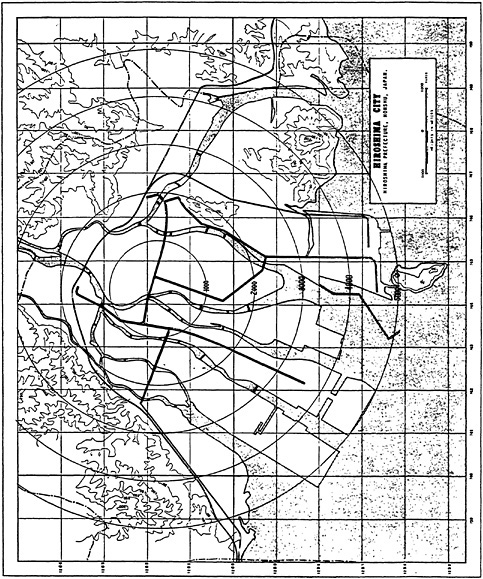

Hiroshima and Nagasaki. The two chief factors in this effort were the formulation of a rather rigid set of procedures to be adhered to in the two cities, and frequent exchanges of personnel. It is felt that in the main, this effort was successful. On the other hand, as will become evident in Chapter V, some of the reported differences in pregnancy termination between the two cities may not actually reflect true biological differences.
Chapter IV
THE CRITERIA OF RADIATION EMPLOYED IN THE STUDY
THE present chapter will be devoted to an examination of the available and practical criteria for evaluating the amount of radiation received by individuals exposed in Hiroshima and Nagasaki to the effects of the atomic bombs.
4.1 The complicated nature of the injuries sustained by some survivors; “disaster effect” vs. “radiation effect.”—The detonation of an atomic bomb may be harmful to persons in its vicinity for a variety of reasons. The air blast may inflict injury directly or secondarily, from flying debris and falling walls and roofs. The thermal radiation produces severe burns, and, in addition, further burns may be sustained as a result of fires kindled by the explosion. Under the conditions prevailing in Hiroshima and Nagasaki, serious secondary infection of these burns was the rule rather than the exception. Finally, the explosion is accompanied by the release of a variety of deleterious high energy radiations, particularly X-rays, gamma rays, and fast and slow neutrons. The complex manner in which these various noxious agents affect persons exposed to the explosion of an atomic bomb is well depicted in the Report of the Joint Commission for the Investigation of the Effects of the Atomic Bomb in Japan (Oughterson et al., 1951).
Moreover, in the wake of such a cataclysmic event as the detonation of an atomic bomb over a city, come certain well recognized accompaniments of any large-scale disaster, notably, disturbed nutrition and increased morbidity from disease. These “disaster effects” are here so complexly intertwined with the primary event that it will be difficult, if not in fact impossible, in any analysis of atomic bomb sequelae, to effect a realistic and completely satisfactory separation of the relative importance of what transpired at the time of the bombing and what transpired in the next several months. In this particular instance, the general problem of disentangling primary and secondary effects upon the manner in which pregnancies are terminating is still further complicated by the fact that certain delayed somatic effects of irradiation have been shown to occur in the population under study. The “late” effects include leukemia (Folley, Borges, and Yamawaki, 1952; Lange, Moloney, and Yamawaki, 1954; Moloney and Lange, 1954) and cataracts (Cogan, Martin, and Kimura, 1949; Sinsky, 1955). Although both of these conditions affect only small numbers of the more heavily irradiated survivors, they do occur in the group most critical to this study. It seems entirely possible that there are other late sequelae, still undefined, which may influence reproductive behavior.
In subsequent chapters an attempt will be made to correlate exposure history with a variety of possible indicators of genetic damage. However, it must be clearly understood that if a significant association can be shown to exist, this demonstration of itself does not enable one to conclude that exposure to the bomb has genetic consequences; the latter conclusion is justified only if an effect remains after the various other factors associated with the irradiation have been assigned their proper role.
4.2 The question of residual radiation following an atomic bombing.—The ionizing radiation of an atomic bomb explosion is released over a relatively brief period, of approximately 100 seconds. However, as a result of the contamination of the area due to the fall-out of radioactive by-products of the explosion, as well as secondarily induced radioactivity, there is a certain amount of residual radioactivity in an area over which a bomb has been detonated.
The estimation of the amount of residual radiation at Hiroshima and Nagasaki presents many difficulties. The distribution of residual radiation around the hypocenter in the two cities was asymmetric, the exact pattern depending on local meterological details (Warren, 1945; Warren, 1946). Based on the observed residual radioactivity at intervals following the bombing, Warren (1945) has estimated that the maximum irradiation due to residual radioactivity was in Hiroshima during the first 60 days following the bombing the equivalent of 4.2r, and in Nagasaki during the first 47 days, the equivalent of 14.2r. Wilson (1951), using similar data, has suggested that in Hiroshima the maximum cumulative dose of residual radiation at distances greater than 1,000 feet (300 meters) was not more than 10r, with somewhat higher doses prevailing in Nagasaki, especially in a fall-out area extending eastward from the hypocenter, where the cumulative dose from radioactivity might have amounted to 100r. Irradiation of this latter degree would only be experienced by individuals establishing continuous residence near ground zero immediately after the bombing, a situation which rarely, if ever, obtained, although persons coming into the area later or intermittently might of course receive lesser amounts. On the other hand, there are persistent Japanese reports of members of rescue parties and others not actually in the two cities at the time of the bombing later developing symptoms of radiation sickness, or leucopenia (Japan Science Council, 1951; Appendix 18, ABCC Semi-Annual Report, 1 January 1952–30 June 1952); this would suggest a dose of 200r (cf. Sec. 4.8). This apparent conflict of evidence remains unresolved at present; we shall adhere for the time being to the more conservative view concerning residual radioactivity. By and large, individuals exposed to the effects of the atomic bombs tended to leave the area as rapidly as possible. Accordingly, for the purposes of this study it has been felt that although exposed individuals and also those entering the city immediately after the bombings may have been subjected to some residual radiation, by comparison with the amount absorbed by those present at the moment of the explosion, this was on the average small and could be disregarded. Moreover, it might be pointed out that in the case of an individual engaged, e.g., in rescue work in Hiroshima or Nagasaki during the first few days following the bombing, it appears impossible to reconstruct his behavior during those several days in a fashion which would permit a realistic estimation of the total radiation dose which he absorbed during this period.
4.3 Factors determining the nature of the radiation data collected in this study.—At the time this study was being planned, in 1947, no data of any sort concerning the types of radiation emitted by an atomic bomb and the distance-dosage relationship were available to any of those closely connected with the program. In retrospect, in view of the many revisions the physical estimates have undergone, this is perhaps fortunate. Be that as it may, under the circumstances extensive recourse was had to the findings of the Joint Commission, then available in preliminary form. These findings, as later published (1951), established the following facts of importance in the design of the present observations:
4.3.1 The syndrome of radiation sickness due to whole-body irradiation.— Although the therapeutic uses of radiation had long since laid the groundwork for an appreciation of the signs and symptoms of “radiation sickness,” it remained for the observations of the Joint Commission to provide the definitive description of this entity. The findings, of course, vary according to the radiation dose. We are not here concerned with the early effects of lethal doses of whole-body irradiation, since persons receiving such doses can scarcely provide the parentage for a study of this nature. The Joint Commission observed that individuals receiving relatively large but yet sublethal doses of irradiation (as judged by proximity to the hypocenter in the absence of marked shielding) may or may not develop nausea and vomiting within a few hours of their exposure. There follows a relatively asymptomatic period of approximately two weeks, after which characteristic signs and symptoms appear. Some of these, such as fever, malaise, anorexia, nausea, and vomiting, have a low degree of specificity, being present in a wide variety of diseases. Other findings were much more specific. The chief among these are summarized in Table 4.1. These are figures for all survivors, irrespective of the amount of shielding which protected them. Let us restrict ourselves, for the moment, to a consideration of the findings in persons reporting themselves
TABLE 4.1 FREQUENCYOF OCCURRENCEOF CERTAIN SYMPTOMSIN PERSONS ALIVE 20 OR MORE DAYS FOLLOWINGTHE ATOMIC BOMBINGS, AS RELATEDTO DISTANCEFROM THE HYPOCENTER (Data of Joint Commission)
|
Hiroshima |
||||||||||||||||
 |
||||||||||||||||
|
Epilation |
Purpura |
Oropharyngeal lesionsa |
Necrotic gingivitis |
Diarrheab |
Bloody diarrhea |
Other hemorrhage |
||||||||||
 |
 |
 |
 |
 |
 |
 |
||||||||||
|
Ring |
Distance (meters) |
Total no. of people |
No. |
% |
No. |
% |
No. |
% |
No. |
% |
No. |
% |
No. |
% |
No. |
% |
|
1 |
0–1,000 |
749 |
520 |
69.4 |
366 |
48.9 |
458 |
61.1 |
77 |
10.3 |
375 |
50.1 |
80 |
10.7 |
285 |
38.1 |
|
2 |
1,100–1,500 |
1,125 |
341 |
30.3 |
241 |
21.4 |
381 |
33.9 |
43 |
3.8 |
476 |
42.3 |
75 |
6.7 |
197 |
17.5 |
|
3 |
1,600–2,000 |
1,824 |
151 |
8.3 |
78 |
4.3 |
286 |
15.7 |
12 |
0.7 |
666 |
36.5 |
99 |
5.4 |
112 |
6.1 |
|
4 |
2,100–2,500 |
1,450 |
69 |
4.8 |
27 |
1.9 |
230 |
15.9 |
16 |
1.1 |
519 |
35.8 |
95 |
6.6 |
94 |
6.5 |
|
5 |
2,600–3,000 |
700 |
16 |
2.3 |
13 |
1.9 |
105 |
15.0 |
1 |
0.1 |
260 |
37.1 |
34 |
4.9 |
41 |
5.9 |
|
6 |
3,100–4,000 |
576 |
7 |
1.2 |
7 |
1.2 |
39 |
6.8 |
0 |
0 |
134 |
23.3 |
13 |
2.3 |
22 |
3.8 |
|
7 |
4,100–5,000 |
239 |
0 |
0 |
4 |
1.7 |
21 |
8.8 |
0 |
0 |
59 |
24.7 |
2 |
0.8 |
5 |
2.1 |
|
Total |
0–5,000 |
6,663 |
1,104 |
16.6 |
736 |
11.0 |
1,520 |
22.8 |
149 |
2.2 |
2,489 |
37.4 |
398 |
6.0 |
756 |
11.3 |
|
9c |
Over 5,000 |
219 |
0 |
0 |
1 |
0.5 |
16 |
7.3 |
1 |
0.5 |
67 |
30.6 |
2 |
0.9 |
8 |
3.7 |
|
Grand total |
— |
6,882 |
1,104 |
16.0 |
737 |
10.7 |
1,536 |
22.3 |
150 |
2.2 |
2,556 |
37.1 |
400 |
5.8 |
764 |
11.1 |
|
Nagasaki |
||||||||||||||||
 |
||||||||||||||||
|
Epilation |
Purpura |
Oropharyngeal lesionsa |
Necrotic gingivitis |
Diarrheab |
Bloody diarrhea |
Other hemorrhage |
||||||||||
|
|
 |
 |
 |
 |
 |
 |
||||||||||
|
Ring |
Distance (meters) |
Total no. of people |
No. |
% |
No. |
% |
No. |
% |
No. |
% |
No. |
% |
No. |
% |
No. |
% |
|
1 |
0–1,000 |
789 |
249 |
31.6 |
168 |
21.3 |
275 |
34.9 |
20 |
2.5 |
337 |
42.7 |
54 |
6.8 |
110 |
13.9 |
|
2 |
1,100–1,500 |
1,882 |
460 |
24.4 |
324 |
17.2 |
607 |
32.3 |
33 |
1.8 |
736 |
39.1 |
86 |
4.6 |
233 |
12.4 |
|
3 |
1,600–2,000 |
1,034 |
128 |
12.4 |
92 |
8.9 |
200 |
19.3 |
16 |
1.5 |
358 |
34.6 |
56 |
5.4 |
78 |
7.5 |
|
4 |
2,100–2,500 |
672 |
41 |
6.1 |
24 |
3.6 |
101 |
15.0 |
4 |
0.6 |
224 |
33.3 |
23 |
3.4 |
36 |
5.4 |
|
5 |
2,600–3,000 |
644 |
16 |
2.5 |
7 |
1.1 |
84 |
13.0 |
6 |
0.9 |
195 |
30.3 |
28 |
4.3 |
18 |
2.8 |
|
6 |
3,100–4,000 |
1,141 |
16 |
1.4 |
17 |
1.5 |
121 |
10.6 |
1 |
0.1 |
268 |
23.5 |
21 |
1.8 |
28 |
2.5 |
|
7 |
4,100–5,000 |
265 |
1 |
0.4 |
1 |
0.4 |
19 |
7.2 |
0 |
0 |
23 |
8.7 |
3 |
1.1 |
5 |
1.9 |
|
Total |
0–5,000 |
6,427 |
911 |
14.2 |
633 |
9.8 |
1,407 |
21.9 |
80 |
1.2 |
2,141 |
33.3 |
271 |
4.2 |
508 |
7.9 |
|
9c |
Over 5,000 |
194 |
0 |
0 |
0 |
0 |
5 |
2.6 |
0 |
0 |
23 |
11.9 |
1 |
0.5 |
2 |
1.0 |
|
Grand total |
— |
6,621 |
911 |
13.8 |
633 |
9.6 |
1,412 |
21.3 |
80 |
1.2 |
2,164 |
32.7 |
272 |
4.1 |
510 |
7.7 |
|
aIncludes necrotic gingivitis. bIncludes bloody diarrhea. cThere is no ring 8 in the Joint Commission system of designating distance. |
||||||||||||||||
within 1,000 meters of the hypocenter. From the standpoint of distinctiveness, two symptoms —epilation and purpura—are outstanding. Oropharyngeal lesions also were frequently encountered. Diarrhea, while reported by large numbers of persons, could, at 20 days after the bombing, in any individual case be as well attributed to the poor hygienic conditions following the bombing as to the bomb itself, and does not seem to be a satisfactory symptom on which to base a study. Bloody diarrhea is a somewhat more reliable symptom, but still, from the findings of the Joint Commission, less useful than the other three symptoms already discussed.
Further evidence as to the relative validity of the findings listed in Table 4.1 as indicators of radiation exposure comes from an analysis of the manner in which the various findings tended to be associated. Epilation and petechiae were more highly associated than any other pair of symptoms in both cities. The next highest associations observed were, in both cities, epilation with oropharyngeal lesions, and petechiae with oropharyngeal lesions.
On the basis of these findings, it was felt that the appearance of epilation, petechiae, or oropharyngeal lesions, singly or in combination, within three months of the bombing, provided a relatively specific and objective yardstick of the absorption of a certain amount of radiation, such as could be employed in the present study (see also, inter alia, Warren and Bowers, 1950; Los Alamos Scientific Laboratory, 1950; vor der Bruegge, 1952; Hempelmann, Lisco, and Hoffman, 1952). Although exact data are lacking, it seems likely, on the basis of animal data, that there is considerable individual variation in susceptibility to these symptoms, a point which must of course be borne in mind when we come later to the problem of estimating radiation dosages. It will be noted that there are significant differences between Hiroshima and Nagasaki in the percentages of persons exhibiting certain symptoms subsequent to exposure within 1,500 meters of the hypocenter. These differences are customarily attributed primarily to local differences in shielding factors (see below), but may also be due in part to actual dose differences.
4.3.2 The relation between distance from the hypocenter and radiation dosage.— Although the intensity of radiation obviously must decrease with distance from the hypocenter, the exact form of the distance-dosage relationship in Hiroshima and Nagasaki remains to this day uncertain. In part this is due to inadequate information concerning certain physical properties of these atomic explosions, in part to lack of detailed information concerning atmospheric moisture content at the time of the explosion. Furthermore, there is the possibility that the distance-dosage relationship is not the same in all radii from the hypocenter. Be this as it may, at the time this study was planned it was clear from such data as are given in Table 4.1, concerning the relationship between the occurrence of certain of the symptoms described above and distance from the hypocenter, that it would be important to record position at the time of the bombing as accurately as possible.
4.3.3 The role of shielding in determining radiation dose.—The third type of information thought to be especially valuable in estimating radiation dosage concerned the amount of shielding protecting the individual from the effects of the explosion. Table 4.2 illustrates some of the findings of the Joint Commission in this respect. For the sake of brevity, only the Hiroshima data are reproduced; the findings in Nagasaki were essentially similar. An obvious question which had to be disposed of early in the design of the program concerned the elaborateness of the shielding data to be collected. Obtaining a complete shielding history can be quite time consuming. Theoretically, knowing the distance-dosage relationship and the precise shielding, one can arrive at a relatively accurate estimate of the amount of irradiation received by an individual. We have already mentioned the uncertainties surrounding the distance-dosage relationship. These uncertainties are particularly acute as regards the neutron component of the radiation spectrum, a component which in animal experiments has been shown to have a high relative biological effectiveness with respect to genetic effects. Furthermore, in the authors' opinion there is no realistic approach to the problem of radiation scatter and secondary radiation as a factor in the exact dosage received by any individual. Finally, there is room for reasonable doubt as to most individuals' abilities to reconstruct their exact positions at the time of so traumatic an event as this, and yet nothing less than such a reconstruction will suffice for a precise evaluation of shielding. With all these considerations in mind, it was
TABLE 4.2 THE EFFECTIVENESSOF SHIELDINGIN PROTECTING AGAINST RADIATION SICKNESSIN HIROSHIMA (Data of Joint Commission)
|
Outdoors or in Japanese-type buildingc |
||||||||||||||||
 |
||||||||||||||||
|
Epilation |
Purpura |
Oropharyngeal lesionsa |
Necrotic gingivitis |
Diarrheab |
Bloody diarrhea |
Other hemorrhage |
||||||||||
 |
 |
 |
 |
 |
 |
 |
||||||||||
|
Ring |
Distance (meters) |
Total no. of people |
No. |
% |
No. |
% |
No. |
% |
No. |
% |
No. |
% |
No. |
% |
No. |
% |
|
1 |
0–1,000 |
570 |
434 |
76.1 |
310 |
54.4 |
356 |
62.5 |
67 |
11.8 |
301 |
52.8 |
66 |
11.6 |
240 |
42.1 |
|
2 |
1,100–1,500 |
960 |
315 |
32.8 |
209 |
21.8 |
305 |
31.8 |
37 |
3.9 |
405 |
42.2 |
66 |
6.9 |
179 |
18.6 |
|
3 |
1,600–2,000 |
1,633 |
145 |
8.9 |
73 |
4.5 |
225 |
13.8 |
10 |
0.6 |
613 |
37.5 |
90 |
5.5 |
100 |
6.1 |
|
4 |
2,100–2,500 |
1,415 |
68 |
4.8 |
26 |
1.8 |
190 |
13.4 |
16 |
1.1 |
508 |
35.9 |
93 |
6.6 |
94 |
66 |
|
5 |
2,600–3,000 |
674 |
16 |
2.4 |
12 |
1.8 |
82 |
12.2 |
1 |
0.1 |
251 |
37.2 |
32 |
4.7 |
39 |
5.8 |
|
6 |
3,100–4,000 |
548 |
7 |
1.3 |
7 |
1.3 |
26 |
4.7 |
0 |
0 |
124 |
22.6 |
13 |
2.4 |
22 |
4.0 |
|
7 |
4,100–5,000 |
202 |
0 |
0 |
3 |
1.5 |
12 |
5.9 |
0 |
0 |
50 |
24.8 |
1 |
0.5 |
4 |
2.0 |
|
Total |
0–5,000 |
6,002 |
985 |
16.4 |
640 |
10.7 |
1,196 |
19.9 |
131 |
2.2 |
2,252 |
37.5 |
361 |
6.0 |
678 |
11.3 |
|
9d |
Over 5,000 |
46 |
0 |
0 |
1 |
2.2 |
8 |
17.4 |
0 |
0 |
18 |
39.1 |
0 |
0 |
4 |
8.7 |
|
Grand total |
— |
6,048 |
985 |
16.3 |
641 |
10.6 |
1,204 |
19.9 |
131 |
2.2 |
2,270 |
37.5 |
361 |
6.0 |
682 |
11.3 |
|
Indoors, in heavy building |
||||||||||||||||
 |
||||||||||||||||
|
Epilation |
Purpura |
Oropharyngeal lesionsa |
Necrotic gingivitis |
Diarrheab |
Bloody diarrhea |
Other hemorrhage |
||||||||||
 |
 |
 |
 |
 |
 |
 |
||||||||||
|
Ring |
Distance (meters) |
Total no. of people |
No. |
% |
No. |
% |
No. |
% |
No. |
% |
No. |
% |
No. |
% |
No. |
% |
|
1 |
0–1,000 |
113 |
60 |
53.1 |
38 |
33.6 |
55 |
48.7 |
5 |
4.4 |
46 |
40.7 |
8 |
7.1 |
30 |
26.5 |
|
2 |
1,100–1,500 |
118 |
15 |
12.7 |
21 |
17.8 |
26 |
22.0 |
3 |
2.5 |
58 |
49.2 |
8 |
6.8 |
13 |
11.0 |
|
3 |
1,600–2,000 |
94 |
2 |
2.1 |
3 |
3.2 |
12 |
12.8 |
1 |
1.1 |
35 |
37.2 |
5 |
5.3 |
8 |
8.5 |
|
4 |
2,100–2,500 |
12 |
1 |
8.3 |
1 |
8.3 |
1 |
8.3 |
0 |
0 |
7 |
58.3 |
2 |
16.7 |
0 |
0 |
|
5 |
2,600–3,000 |
14 |
0 |
0 |
1 |
7.1 |
3 |
21.4 |
0 |
0 |
2 |
14.3 |
1 |
7.1 |
2 |
14.3 |
|
6 |
3,100–4,000 |
13 |
0 |
0 |
0 |
0 |
2 |
15.4 |
0 |
0 |
5 |
38.5 |
0 |
0 |
0 |
0 |
|
7 |
4,100–5,000 |
27 |
0 |
0 |
1 |
3.7 |
1 |
3.7 |
0 |
0 |
7 |
25.9 |
1 |
3.7 |
1 |
3.7 |
|
Total |
0–5,000 |
391 |
78 |
19.9 |
65 |
16.6 |
100 |
25.6 |
9 |
2.3 |
160 |
40.9 |
25 |
6.4 |
54 |
13.8 |
|
9d |
Over 5,000 |
2 |
0 |
0 |
0 |
0 |
0 |
0 |
0 |
0 |
1 |
50.0 |
0 |
0 |
0 |
0 |
|
Grand total |
— |
393 |
78 |
19.8 |
65 |
16.5 |
100 |
25.4 |
9 |
2.3 |
161 |
41.0 |
25 |
6.4 |
54 |
13.7 |
|
aIncludes necrotic gingivitis (within 39 days). bIncludes bloody diarrhea. cIncludes people indoors, type of building unknown. dThere is no ring 8 in the Joint Commission system of designating distance. |
||||||||||||||||
concluded that while the experience of the Joint Commission left no doubt as to the desirability of collecting shielding data, this should be simple in nature.
4.4 The type of radiation data collected in this study.—In addition to the biological considerations which we have just discussed, certain “practical” considerations entered into the determination of the type of data to be collected. The histories were to be obtained by clerks with the equivalent of a high school education. These clerks, although they could be carefully drilled in their duties, could not be expected to exercise a great deal of judgment if the approach to the problem involved the compilation of an elaborate history. It could be anticipated that the turn-over among clerks would be rather high. Finally, since the history taking was to extend over an indefinite number of years, much was to be said for concentrating on certain salient features of the individual's experience, which could be as readily recalled relatively late as relatively early.
With all these considerations in mind, the
TABLE 4.3 DISTRIBUTIONBY DISTANCEAND SHIELDINGOFHUSBANDSOF WIVES REGISTERING PREGNANCIESWITHTHE GENETICS PROGRAM (HIROSHIMA) (For a definition of the classes see Sec. 4.5.)
|
Distance (hundreds of meters) |
No. persons symptomatic |
Pa |
Ga |
Ea |
PG |
PE |
GE |
PGE |
No. persons asymptomatic |
Total no. persons exposed (a) |
Total no. symptoms experienced (b) |
Ratio (b/a) |
|
In open |
||||||||||||
|
00–04 |
1 |
— |
— |
— |
— |
— |
— |
1 |
2 |
3 |
3 |
— |
|
05–09 |
15 |
1 |
— |
6 |
1 |
— |
2 |
5 |
12 |
27 |
28 |
1.04 |
|
10–14 |
53 |
4 |
3 |
22 |
— |
3 |
9 |
12 |
102 |
155 |
89 |
.57 |
|
15–19 |
44 |
5 |
6 |
23 |
2 |
3 |
3 |
2 |
287 |
331 |
56 |
.17 |
|
20–24 |
29 |
4 |
6 |
12 |
1 |
2 |
4 |
— |
409 |
438 |
36 |
.08 |
|
25–29 |
11 |
4 |
— |
4 |
— |
1 |
2 |
— |
213 |
224 |
14 |
.06 |
|
30+ |
17 |
1 |
7 |
5 |
— |
2 |
2 |
— |
868 |
885 |
21 |
.02 |
|
1,893 |
2,063 |
|||||||||||
|
In Japanese building |
||||||||||||
|
00–04 |
2 |
— |
— |
— |
— |
— |
— |
2 |
1 |
3 |
6 |
— |
|
05–09 |
39 |
1 |
1 |
8 |
— |
4 |
9 |
16 |
13 |
52 |
84 |
1.62 |
|
10–14 |
127 |
11 |
8 |
29 |
10 |
16 |
14 |
39 |
387 |
514 |
245 |
.48 |
|
15–19 |
54 |
20 |
11 |
10 |
3 |
4 |
4 |
2 |
695 |
749 |
69 |
.09 |
|
20–24 |
27 |
9 |
6 |
5 |
— |
2 |
3 |
2 |
634 |
661 |
36 |
.05 |
|
25–29 |
11 |
2 |
1 |
2 |
1 |
2 |
2 |
1 |
444 |
455 |
18 |
.04 |
|
30+ |
24 |
5 |
3 |
10 |
— |
1 |
4 |
1 |
1,636 |
1,660 |
31 |
.02 |
|
3,810 |
4,094 |
|||||||||||
|
In other shelter |
||||||||||||
|
00–04 |
— |
— |
— |
— |
— |
— |
— |
— |
2 |
2 |
— |
— |
|
05–09 |
14 |
2 |
— |
5 |
1 |
3 |
— |
3 |
17 |
31 |
24 |
.77 |
|
10–14 |
17 |
6 |
4 |
1 |
1 |
1 |
2 |
2 |
33 |
50 |
25 |
.50 |
|
15–19 |
6 |
1 |
3 |
— |
2 |
— |
— |
— |
61 |
67 |
8 |
.12 |
|
20–24 |
2 |
1 |
1 |
— |
— |
— |
— |
— |
46 |
48 |
2 |
.04 |
|
25–29 |
2 |
— |
1 |
— |
— |
— |
— |
1 |
51 |
53 |
4 |
.08 |
|
30+ |
2 |
1 |
— |
1 |
— |
— |
— |
— |
200 |
202 |
2 |
.01 |
|
410 |
453 |
|||||||||||
|
aP=Petechiae; G=Gingivitis; E=Epilation. |
||||||||||||
following information was obtained concerning each pregnant woman and her spouse included in this study:
-
Presence in Hiroshima or Nagasaki at the time of the bombing.
-
Location in city at time of bombing.
-
Distance from the hypocenter [calculated from (2)].
-
Indoors or outdoors.
-
Type of building.
-
Occurrence of subcutaneous bleeding (petechiae).
-
Occurrence of gingivitis.
-
Occurrence of bloody diarrhea.
-
Occurrence of epilation (partial or complete).
-
Occurrence of burns.
-
Occurrence of external injuries.
TABLE 4.4 DISTRIBUTIONBY DISTANCEAND SHIELDINGOFWIVES REGISTERING PREGNANCIESWITHTHE GENETICS PROGRAM (HIROSHIMA)
|
Distance (hundreds of meters) |
No. persons symptomatic |
Pa |
Ga |
Ea |
PG |
PE |
GE |
PGE |
No. persons asymptomatic |
Total no. persons exposed (a) |
Total no. symptoms experienced (b) |
Ratio (b/a) |
|||||||||||||||
|
In open |
|||||||||||||||||||||||||||
|
00–04 |
— |
— |
— |
— |
— |
— |
— |
— |
1 |
1 |
— |
— |
|||||||||||||||
|
05–09 |
14 |
— |
— |
4 |
1 |
— |
6 |
3 |
8 |
22 |
27 |
1.23 |
|||||||||||||||
|
10–14 |
75 |
9 |
2 |
24 |
1 |
8 |
13 |
18 |
156 |
231 |
133 |
.58 |
|||||||||||||||
|
15–19 |
85 |
10 |
9 |
50 |
3 |
4 |
3 |
6 |
489 |
574 |
107 |
.19 |
|||||||||||||||
|
20–24 |
53 |
7 |
6 |
26 |
1 |
— |
8 |
5 |
560 |
613 |
72 |
.12 |
|||||||||||||||
|
25–29 |
18 |
7 |
3 |
4 |
— |
— |
2 |
2 |
311 |
329 |
24 |
.07 |
|||||||||||||||
|
30+ |
24 |
2 |
6 |
11 |
— |
1 |
4 |
— |
1,020 |
1,044 |
29 |
.03 |
|||||||||||||||
|
2,545 |
2,814 |
||||||||||||||||||||||||||
|
In Japanese building |
|||||||||||||||||||||||||||
|
00–04 |
2 |
— |
— |
— |
— |
— |
— |
2 |
1 |
3 |
6 |
— |
|||||||||||||||
|
05–09 |
52 |
1 |
1 |
7 |
2 |
15 |
6 |
20 |
23 |
75 |
115 |
1.53 |
|||||||||||||||
|
10–14 |
254 |
41 |
17 |
66 |
8 |
38 |
23 |
61 |
881 |
1,135 |
445 |
.39 |
|||||||||||||||
|
15–19 |
116 |
36 |
24 |
36 |
1 |
8 |
4 |
7 |
1,668 |
1,784 |
143 |
.08 |
|||||||||||||||
|
20–24 |
65 |
18 |
13 |
22 |
1 |
6 |
1 |
4 |
1,398 |
1,463 |
81 |
.06 |
|||||||||||||||
|
25–29 |
28 |
13 |
4 |
6 |
2 |
2 |
1 |
— |
1,205 |
1,233 |
33 |
.03 |
|||||||||||||||
|
30+ |
31 |
9 |
11 |
8 |
— |
2 |
1 |
— |
3,369 |
3,400 |
34 |
.01 |
|||||||||||||||
|
8,545 |
9,093 |
||||||||||||||||||||||||||
|
In other shelter |
|||||||||||||||||||||||||||
|
00–04 |
3 |
1 |
— |
— |
— |
2 |
— |
— |
— |
3 |
5 |
— |
|||||||||||||||
|
05–09 |
35 |
3 |
— |
5 |
1 |
8 |
6 |
12 |
75 |
110 |
74 |
.67 |
|||||||||||||||
|
10–14 |
13 |
3 |
2 |
1 |
2 |
1 |
2 |
2 |
102 |
115 |
22 |
.19 |
|||||||||||||||
|
15–19 |
11 |
3 |
— |
6 |
— |
1 |
1 |
— |
181 |
192 |
13 |
.07 |
|||||||||||||||
|
20–24 |
8 |
5 |
1 |
2 |
— |
— |
— |
— |
117 |
125 |
8 |
.06 |
|||||||||||||||
|
25–29 |
1 |
— |
1 |
— |
— |
— |
— |
— |
148 |
149 |
1 |
.01 |
|||||||||||||||
|
30+ |
3 |
1 |
— |
1 |
— |
1 |
— |
— |
188 |
191 |
4 |
.02 |
|||||||||||||||
|
811 |
885 |
||||||||||||||||||||||||||
|
aP=Petechiae; G=Gingivitis; E=Epilation. |
|||||||||||||||||||||||||||
In locating the position of an individual at the time of the bombing an effort was made to pinpoint position as accurately as possible. The distance from the hypocenter was then determined by actual measurement on a large-scale map of the city. The method of measurement has varied from time to time, involving variously the use of plastic and metal tapes, coordinates, and concentric circles. In the process of calculation, meters are rounded to decameters, and decameters further rounded to hectometers, so that the coded interval in hectometers denotes (x-55) to (x+44) meters.
Items 4 and 5 on the above list represent an attempt, however rough, to accumulate certain data relative to the evaluation of shielding. Item 4 was to be answered simply as indoors or outdoors. Item 5 pursued the point somewhat further, admitting of ten alternatives, namely, if indoors, then
-
Inside concrete building,
-
Inside brick building,
-
Inside wooden Japanese or other type building,
-
Inside cave or “bunker,”
-
and if outdoors, then
-
In open,
-
Behind (within two meters) wall,
-
In trench,
-
Behind post or tree,
-
In tram, train, or car, and
-
Under eaves of house (i.e., shielded by house).
TABLE 4.5 DISTRIBUTIONBY DISTANCEAND SHIELDINGOFHUSBANDSOF WIVES REGISTERING PREGNANCIESWITHTHE GENETICS PROGRAM (NAGASAKI)
|
Distance (hundreds of meters) |
No. persons symptomatic |
Pa |
Ga |
Ea |
PG |
PE |
GE |
PGE |
No. persons asymptomatic |
Total no. persons exposed (a) |
Total no. symptoms experienced (b) |
Ratio (b/a) |
|
In open |
||||||||||||
|
00–04 |
— |
— |
— |
— |
— |
— |
— |
— |
1 |
1 |
— |
— |
|
05–09 |
5 |
— |
— |
1 |
1 |
1 |
2 |
— |
6 |
11 |
9 |
.82 |
|
10–14 |
20 |
3 |
2 |
10 |
— |
3 |
— |
2 |
51 |
71 |
27 |
.38 |
|
15–19 |
11 |
2 |
— |
5 |
1 |
1 |
— |
2 |
72 |
83 |
17 |
.20 |
|
20–24 |
4 |
1 |
1 |
2 |
— |
— |
— |
— |
94 |
98 |
4 |
.04 |
|
25–29 |
7 |
2 |
1 |
4 |
— |
— |
— |
— |
165 |
172 |
7 |
.04 |
|
30+ |
8 |
3 |
— |
4 |
— |
— |
— |
1 |
1,151 |
1,159 |
10 |
.01 |
|
1,540 |
1,595 |
|||||||||||
|
In Japanese building |
||||||||||||
|
00–04 |
— |
— |
— |
— |
— |
— |
— |
— |
1 |
1 |
— |
— |
|
05–09 |
6 |
— |
— |
1 |
— |
1 |
2 |
2 |
10 |
16 |
13 |
.81 |
|
10–14 |
45 |
6 |
6 |
9 |
3 |
7 |
2 |
12 |
186 |
231 |
81 |
.35 |
|
15–19 |
23 |
2 |
5 |
9 |
1 |
2 |
2 |
2 |
216 |
239 |
32 |
.13 |
|
20–24 |
2 |
— |
2 |
— |
— |
— |
— |
— |
220 |
222 |
2 |
.01 |
|
25–29 |
2 |
1 |
— |
1 |
— |
— |
— |
— |
387 |
389 |
2 |
.005 |
|
30+ |
11 |
4 |
2 |
3 |
— |
— |
2 |
— |
2,714 |
2,725 |
13 |
.005 |
|
3,734 |
3,823 |
|||||||||||
|
In other shelter |
||||||||||||
|
00–04 |
— |
— |
— |
— |
— |
— |
— |
— |
1 |
1 |
— |
— |
|
05–09 |
10 |
1 |
1 |
3 |
— |
2 |
— |
3 |
34 |
44 |
18 |
.41 |
|
10–14 |
43 |
5 |
4 |
10 |
5 |
4 |
6 |
9 |
188 |
231 |
76 |
.33 |
|
15–19 |
14 |
3 |
— |
4 |
1 |
2 |
1 |
3 |
171 |
185 |
24 |
.13 |
|
20–24 |
2 |
— |
1 |
1 |
— |
— |
— |
— |
103 |
105 |
2 |
.02 |
|
25–29 |
2 |
— |
1 |
— |
— |
— |
1 |
— |
101 |
103 |
3 |
.03 |
|
30+ |
4 |
2 |
1 |
1 |
— |
— |
— |
— |
1,560 |
1,564 |
4 |
.003 |
|
2,158 |
2,233 |
|||||||||||
|
aP=Petechiae; G=Gingivitis; E=Epilation. |
||||||||||||
Items 6–9, bearing on radiation sickness, were to be answered simply as “yes” or “no,” after a brief explanation of the symptom by the clerk, if necessary. Limiting answers to “yes” or “no” obviously required the clerk to exercise her judgment in some cases. For the more vague term “oropharyngeal lesions” we have substituted gingivitis, since a necrotic-type of gingivitis with gingival bleeding was one of the more prominent and specific of the oropharyngeal lesions.
In the original design of the study, no symptom among those listed was to be recognized unless it developed prior to December 15, 1945. Some instances have come to light where the alleged onset of symptoms after that date have been recorded. This cannot be attributed to exposure to the bomb. There is a good reason to believe that the erroneous inclusion of such reports of “delayed effects” occurred very rarely.
Items 10 and 11 were included as one of several approaches to the problem of disentangling the possible radiation effects of the bombs from other effects and also the general disaster effect. Thus, it was anticipated that in the event of a positive correlation between some aspect of pregnancy termination and radiation history, an attempt could be made to determine if the correlation still held up after the elimina-
tion of those recording burns or external injuries of any type.
Those familiar with the problem of evaluating radiation exposure will be quick to recognize the very simple nature of the data collected in this study. The adequacy of these data as a basis for quantitative estimates of irradiation has been the subject of considerable discussion. Specifically, the possible desirability of a much more elaborate history was repeatedly discussed. It is our contention, admittedly subjective but documented in part by the internal consistency of the data presented in the following sections, the recall factor in these situations being what it is, and in view of the radiation variables, that this represents the most practical approach to this problem which could be adopted.
TABLE 4.6 DISTRIBUTIONBY DISTANCEAND SHIELDINGOFWIVES REGISTERING PREGNANCIESWITHTHE GENETICS PROGRAM (NAGASAKI)
|
Distance (hundreds of meters) |
No. persons symptomatic |
Pa |
Ga |
Ea |
PG |
PE |
GE |
PGE |
No. persons asymptomatic |
Total no. persons exposed (a) |
Total no. symptoms experienced (b) |
Ratio (b/a) |
|
In open |
||||||||||||
|
00–04 |
— |
— |
— |
— |
— |
— |
— |
— |
1 |
— |
— |
— |
|
05–09 |
5 |
— |
— |
2 |
— |
— |
2 |
1 |
7 |
12 |
9 |
.75 |
|
10–14 |
24 |
3 |
2 |
7 |
1 |
2 |
3 |
6 |
60 |
84 |
42 |
.50 |
|
15–19 |
18 |
2 |
2 |
9 |
— |
2 |
1 |
2 |
108 |
126 |
25 |
.20 |
|
20–24 |
7 |
— |
— |
5 |
— |
— |
2 |
— |
173 |
180 |
9 |
.05 |
|
25–29 |
9 |
1 |
1 |
5 |
— |
2 |
— |
— |
274 |
283 |
11 |
.04 |
|
30+ |
10 |
2 |
3 |
4 |
— |
— |
1 |
— |
1,674 |
1,684 |
11 |
.01 |
|
2,297 |
2,369 |
|||||||||||
|
In Japanese building |
||||||||||||
|
00–04 |
— |
— |
— |
— |
— |
— |
— |
— |
— |
— |
— |
— |
|
05–09 |
4 |
— |
— |
1 |
— |
1 |
— |
2 |
7 |
11 |
9 |
.82 |
|
10–14 |
129 |
11 |
7 |
35 |
7 |
15 |
22 |
32 |
292 |
421 |
237 |
.56 |
|
15–19 |
55 |
12 |
6 |
19 |
1 |
6 |
6 |
5 |
459 |
514 |
78 |
.15 |
|
20–24 |
26 |
5 |
9 |
9 |
1 |
1 |
1 |
— |
842 |
868 |
29 |
.03 |
|
25–29 |
6 |
2 |
— |
3 |
— |
— |
1 |
— |
1,106 |
1,112 |
7 |
.006 |
|
30+ |
19 |
7 |
5 |
6 |
— |
— |
1 |
— |
7,162 |
7,181 |
20 |
.003 |
|
9,868 |
10,107 |
|||||||||||
|
In other shelter |
||||||||||||
|
00–04 |
— |
— |
— |
— |
— |
— |
— |
— |
5 |
— |
— |
— |
|
05–09 |
19 |
1 |
2 |
9 |
1 |
1 |
4 |
1 |
74 |
93 |
27 |
.29 |
|
10–14 |
56 |
3 |
6 |
24 |
4 |
5 |
7 |
7 |
185 |
241 |
86 |
.36 |
|
15–19 |
25 |
6 |
1 |
11 |
— |
— |
1 |
6 |
109 |
134 |
38 |
.28 |
|
20–24 |
9 |
2 |
3 |
3 |
— |
— |
— |
1 |
145 |
154 |
11 |
.07 |
|
25–29 |
5 |
1 |
2 |
1 |
— |
— |
1 |
— |
154 |
159 |
6 |
.04 |
|
30+ |
7 |
1 |
3 |
2 |
1 |
— |
— |
— |
2,005 |
2,012 |
8 |
.004 |
|
2,677 |
2,793 |
|||||||||||
|
aP=Petechiae; G=Gingivitis; E=Epilation. |
||||||||||||
4.5 The relation between distance, shielding, and symptoms in these data.— Tables 4.3 to 4.6 summarize the findings of the present study as regards the relationship between certain types of shielding, certain symptoms, and distance from the hypocenter. Based on items of the questionnaire (see preceding section), two degrees of shielding have been recognized, namely, that provided by being inside a Japanese-type home at the time of the explosion, and that provided by being inside any other type of structure—concrete or brick building, cave or bunker-type air raid shelter. Figures 4.1 and 4.2 present these same findings in graphic form. For ease of presentation, a “symptom ratio” has been used, consisting of the total number of symptoms (epilation, petechiae, or gingivitis) recorded by the survivors at a particular distance, divided by the number of survivors giving information. Data are not plotted for the 00–04 distances because of the few individuals in-
volved. Several important conclusions emerge from a consideration of these data:
4.5.1 For all three groups, the symptom ratio falls off rapidly with distance. In the light of these findings, as well as the distance-dosage relationship estimated on physical grounds (see below), it seems unlikely that there was significant radiation beyond 3,000 meters from the hypocenter. The few individuals reporting epilation, petechiae, and/or gingivitis beyond that distance are, with possible rare exceptions, almost certainly in error in attributing their symptoms to irradiation. Taking this 1–2 per cent as a baseline for “false reporting,” it follows that the symptomatic group within 3,000 meters may also be somewhat “diluted” by false reporting.
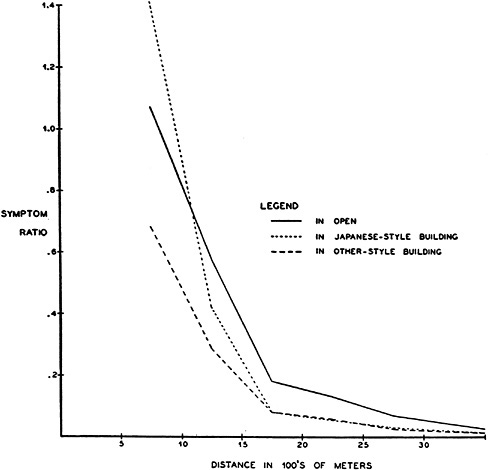
FIGURE 4.1—Symptom ratio in relation to distance from hypocenter for Hiroshima (husbands and wives combined). Explanation in text.
4.5.2 There is evidence that shielding in “other style” buildings substantially reduced the proportion of persons with symptoms at distances within 1,500 meters.
4.5.3 In what appears at first sight to be a paradox, in the 500–900 meter ring a substantially higher proportion of persons in Japanese homes developed symptoms than did persons in the open. The reason for this seems clear. At this distance, persons reporting themselves in the open must actually have been shielded by one or more buildings from the bomb burst, otherwise they almost certainly
would have sustained fatal burns. The biological evidence suggests that the total average shielding of such persons actually exceeded that of persons in Japanese homes.
4.5.4 In the 1,000–1,900 meter ring, there is a suggestion that in Hiroshima, although not so clearly in Nagasaki, presence in a Japanese-style home conferred some protection against the development of symptoms, the basis for comparison being persons reporting themselves “outdoors.” The average amount of shielding by which a person “in the open” was protected is very difficult to estimate. It is somewhat easier to quantitate the shielding of the persons in Japanese-style buildings. Woodbury (1953 and unpublished) reports that X-ray photographs taken at 62-kv indicate that the absorption of the bamboo-lattice and mud walls of the average Japanese house is equal to about 33 mm. of aluminum in the densest portion, and 15 mm. in the lightest. The absorptive value of the tile roofs which are standard construction in Japanese houses is undoubtedly more variable, depending on the distance from the hypocenter and the consequent variation in the angle of incidence of the radiation. However, for radiation incident at right angles, the average tile roof has an absorptive value in the neighborhood of 45 mm. of aluminum. Beyond 1,000 meters, persons in Japanese-type buildings in Hiroshima at the time of the explosion probably averaged several such walls or roofs between themselves and the exploding bomb. This is a significant degree of shielding. In very round terms, such shielding would screen out in the neighborhood of 50 per cent of the dosage at a level of 100r of the high-energy X-ray and gamma radiation released by the bomb.
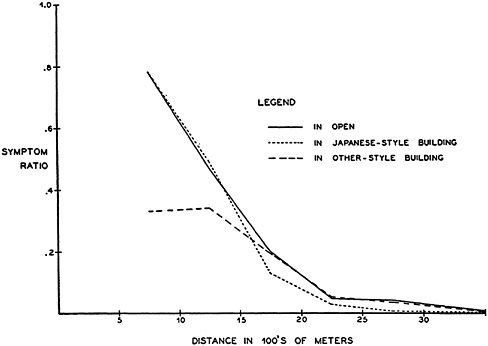
FIGURE 4.2—Symptom ratio in relation to distance from hypocenter for Nagasaki (husbands and wives combined). Explanation in text.
It seems worth pointing out that the amount of shielding implied in the statement, “in a Japanese-style home,” varies directly with distance from hypocenter, since at greater distances, because of the angle of incidence of the radiation, more walls and roofs would usually intervene between the source of radiation than at lesser distances. Persons in Nagasaki in Japanese homes at the time of the explosion on the average were probably less shielded than in
Hiroshima, because of the difference in terrain and the extension of homes up the sides of the valley.
4.6 Factors contributing to the validity of the radiation histories.— The value of several different persons obtaining a history from a given individual is well known in clinical medicine. The changes in emphasis and the new material introduced, as the patient passes from one interviewer to the next, are sometimes remarkable. From the standpoint of verifying information, the Genetics Program has been fortunate for the following reasons:
4.6.1 Over the 6-year span covered by this program, many women registered two or more times (cf. Sec. 5.6). At each registration, a history was obtained without reference to any previous history.
4.6.2 In 1950 a Radiation Census was carried out in both Hiroshima and Nagasaki. This census obtained brief data on each survivor of the bombings then living in Hiroshima and Nagasaki, including position at the time of the bombing.
4.6.3 Some of the parents falling within the scope of the Genetics Program—especially the more heavily irradiated—also came under scrutiny in connection with other special studies of the ABCC, such as the Adult Medical Program, the Ophthalmology Program, etc. Each of these latter programs obtained a very detailed radiation history.
All of the information available on any given person was correlated through a Master File. Particular attention was directed towards a comparison of the radiation histories obtained from a given person on different occasions. In the event of a discrepancy, an effort was made to query the individual concerned, in an attempt to resolve it. On the basis of the information obtained on the query, a single uniform entry was made on all the forms involved. As might be expected, changes on the Genetics Short Form were not infrequent, although the data have not been kept in such a fashion as to permit a precise analysis. However, it is our impression that important changes were not common.
4.7 Definition of radiation categories.—We are now in a position to define certain “radiation categories” which will be basic to the analysis which follows. This is done in Table 4.7. “Heavy” shielding denotes presence in concrete or brick building or air raid shelter at the time of the explosion. “Moderate” shielding includes being within a street car, train, or car, behind a wall or under the eaves of a house, i.e., on the side of the house away from the hypocenter. Finally, “light” shielding includes those giving their location as in a Japanese-style building or in a trench or behind a post or tree. Trench-type shielding is classified as “light” because of the difficulty in establishing how well an individual was protected by a trench.
TABLE 4.7 THE DEFINITIONOF “EXPOSURE CATEGORIES” TOBE EMPLOYEDINTHIS ANALYSIS

Inspection of Table 4.7 in the light of the preceding discussion suggests that this is a somewhat “conservative” classification, in terms of correction for shielding. Thus, individuals reporting “heavy” shielding but asymptomatic have all been relegated to group 2, despite the fact that the symptom ratio in heavily shielded persons within 1,000 meters is approximately 0.7. Since relatively few persons were “heavily” shielded (see below), the net effect of this will be to increase slightly the average radiation dosage of group 2. On the other hand, this removes from categories 3 and 4, which received intermediate amounts of radiation, a group of
individuals whose average radiation dose would be extremely difficult to evaluate.
The distribution of all the parents of registered terminations included in this study in terms of their radiation category is given in Table 4.8. Approximately 78.3 per cent of all the fathers who were registered, and 57.0 per cent of all the mothers, were not in the cities at all at the time of the explosion. Of those present in the cities, a substantial majority was beyond 3,000 meters from the hypocenter. Only 1.2 per cent of fathers, and 2.4 per cent of mothers, reported symptoms characteristic of radiation sickness.
In a preliminary report on this study (Neel et al., 1953), a system of radiation categories was employed which failed to take into account shielding. Thus, in this treatment group 4 was defined simply as: “In one of the two cities, and less than 1,845 meters from the hypocenter, but asymptomatic. Most of these individuals were shielded to a greater or lesser extent from the full effects of the bombs.” In this preliminary treatment, for some purposes the offspring of parents both of whom were group 4 or 5 were considered. In the case of the malformation analysis, for example, there were available 596 infants born to parents meeting these restrictions. But with the radiation categories which have just been defined, there are in the malformation analysis ( Table 8.4) only 145 infants born to parents both in categories 4 or 5. The difference in numbers is due almost entirely to the attempt to correct for shielding.
TABLE 4.8 DISTRIBUTIONOF REGISTERED BIRTHSBY PARENTAL EXPOSURE




4.8 Considerations in the estimation of the average amount of radiation received by persons in each of the five radiation categories.—We come now to an attempt to estimate the average amount of radiation represented by each of the five radiation categories. It should at once be made clear that with the possible exceptions of categories 1 and 5, any estimate is at best an exceedingly rough approximation. For categories 2, 3, and 4, we will do well if we establish the range within which the true average is likely to be found. A particular difficulty in estimating radiation dosage, already alluded to, is the fact that a wide spectrum of radiant energy is involved, with the consequent complications in expressing tissue dosage in simple terms, a difficulty only partially circumvented by expressing dosage in terms of the “roentgen equivalent physical” (rep) unit. This latter may be defined as that amount of any ionizing radiation (beta rays, neutrons, etc.) which dissipates the same amount of energy per gram of water as one roentgen of X-rays or gamma rays. All estimates refer to surface dose. The actual amount of irradiation delivered to the gonad will be less, although because of the high energy content of atomic bomb irradiation, the gonad dose will actually be rather close to the skin dose.
Category 1 individuals, outside the cities at the time of the bombing, of course have received no radiation from the atomic bomb (ignoring, of course, the possibility of residual radiation). Category 5 individuals, symptomatic and within 3,000 meters, are considered to have received as a minimum the equivalent of 200 roentgens of gamma rays (Los Alamos Scientific Laboratory, 1950). The maximum dose received by a category 5 individual is in the neighborhood of the equivalent of 600 roentgens of gamma rays. The latter figure is based on the premise that the LD50 in man for whole-body radiation is about 400 roentgens of gamma rays, but that a few individuals may survive doses amounting to 600r of gamma rays (Hempelmann, Lisco, and Hoffman, 1952). The average dose received by category 5 individuals can probably be placed at the equivalent of 300–400 roentgens of
gamma rays. We will return shortly to the important question of the magnitude of the neutron component of this estimated dosage. Suffice it to say at this point that category 5 persons as a group received a relatively larger amount of neutron radiation than any other group, and because of the relatively greater biological effectiveness of neutrons as contrasted to gamma rays, generally speaking, the dose in rep units received by category 5 persons may be substantially below the dose as expressed in roentgens.
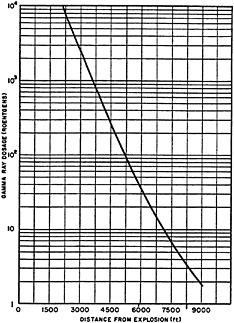
FIGURE 4.3—Total dosage of initial gamma radiation as a function of distance from the hypocenter of the explosion of a “nominal” atomic bomb, from “The Effects of Atomic Weapons.”
In arriving at our estimate of the amount of radiation received by category 2, 3, and 4 individuals, three considerations are outstanding:
4.8.1 The estimated distance-dosage curve. —Figures 4.3 and 4.4 are the distance-dosage curves in terms of neutron and gamma radiation for the explosion of a “nominal” atomic bomb, roughly comparable to what was detonated over Hiroshima and Nagasaki, as published in “The Effects of Atomic Weapons.” In the absence of other unclassified data, this must of necessity serve as the only guide available. Note that the abscissa in both figures is scaled in terms of feet rather than the meters in which we have expressed distance. Figure 4.3, if taken at face value, indicates that beyond approximately 1,600 meters the amount of gamma radiation received was less than 100r. Our own observations, involving the reported appearance of symptoms in, e.g., significant numbers of persons in the 2,000–2,400 meter ring, lead us to feel this estimate is somewhat conservative. Also, unpublished calculations of Wilson (1951) suggest that, at least for Hiroshima, the neutron curve given in Figure 4.4 is on the conservative side. On the other hand, both from these two curves and on the basis of our own observations regarding the shape of the distance-dosage curve, it seems likely that persons at distances in excess of 3,000 meters received little if any radiation.
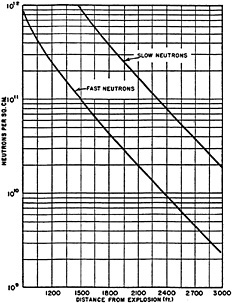
FIGURE 4.4—Fast and slow neutrons delivered per square centimeter as a function of distance from the hypocenter of the explosion of a “nominal” atomic bomb, from “The Effects of Atomic Weapons.”
4.8.2 The observations of the Joint Commission regarding leucopenia.—One of the well recognized effects of whole-body irradiation in amounts compatible with survival is a temporary leucopenia. Information concerning the proportion of individuals in the radiation categories defined above who developed leucopenia following their exposure would therefore be of value in any attempt to estimate radiation
dosage. Certain of the published observations of the Joint Commission are quite useful in this respect. The more pertinent portion of their published data is summarized in Table 4.9 (see also LeRoy, 1950). Leucopenia is here defined as a total leucocyte count per mm.3 of less than 3,000 at some time during the second through the fifth weeks following the bombing. Some of the individuals on whom the percentages in Table 4.9 are based had repeated leucocyte determinations during a hospitalization, others had but a single count, at any time between the second and fifth weeks. The figures are thus at best estimates of the percentage which on careful studies would be found to develop leucopenia. The exposure categories utilized by the Joint Commission and reproduced in Table 4.9 are somewhat different from our own, the four most severe, the ones with which we are concerned, being defined as shown in Table 4.10.
TABLE 4.9 THE FINDINGSOF THE JOINT COMMISSIONIN HIROSHIMAWITH REGARDTO THE OCCURRENCEOF EPILATION, PETECHIAE, AND LEUCOPENIAIN PERSONS FALLINGINTO VARIOUS EXPOSURE CATEGORIES (Further explanation in text.)

It will be noted that the figures regarding leucopenia are based on fewer individuals than those with respect to epilation and petechiae. This is understandable in view of the difficulties in obtaining leucocyte determinations imposed by the conditions prevailing following the bombing. As the Commission report points out, these figures must be accepted with some reservations in view of the unfavorable circumstances under which they were obtained; on the other hand, the manner in which the findings regarding leucopenia parallel those on petechiae and epilation gives indirect confirmation of their validity. Since the Commission worked with a selected sample, composed largely of injured and, in the majority of cases, hospitalized survivors, caution must be exercised in extrapolating to our own, total sample. It will be noted, however, that with the exception of exposure category A, more of the persons examined developed leucopenia than either epilation or petechiae.
TABLE 4.10 THE EXPOSURE CATEGORIES DEFINEDBY THE JOINT COMMISSION, TO BE APPLIEDTO THE INTERPRETATIONOF TABLE 4.9

Through the courtesy of The Armed Forces Institute of Pathology, it has been possible to obtain certain very useful additional tabulations of the material collected by the Joint Commission. Among exposed Japanese in Hiroshima who received one or more leucocyte determinations sometime between the second and fourteenth weeks, who failed to develop epilation, petechiae, or gingivitis, and who are not known to have died within the fourteen weeks following the bombings, the distribution of lowest observed leucocyte counts by distance is as shown in Table 4.11. More intensive studies would have shown a higher proportion with leucopenia.
TABLE 4.11 THE DISTRIBUTIONOF LEUCOCYTE VALUESIN HIROSHIMA JAPANESE WHO FAILEDTO DEVELOP EPILATION, PETECHIAE, OR GINGIVITIS FOLLOWINGTHE BOMBING, IN RELATIONTO DISTANCEFROM HYPOCENTERAND TYPEOF SHIELDING (Data of Joint Commission, as tabulated by the Armed Forces Institute of Pathology)









The concentration of values in the “9,600 and above” class would seem to indicate a grouping of values which would vitiate attempts to calculate a mean. However, generally speaking, these observations suggest that a significant number of persons in our radiation categories 3 and 4 probably developed leucopenia as that term is here defined. An exact estimate of the proportion is difficult because of the difference between the way the Joint Commission's and our own data are broken down, but in round figures, based in part on the data in Table 4.11, it can be estimated that some 5–10 per cent of group 4 parents and 2–4 per cent of group 3 parents developed leucopenia.
The average amount of whole-body irradiation which, when delivered over a period of a day or two, will produce in man leucopenia of this degree is not known with certainty. For obvious reasons, there are not many pertinent observations. Thus, studies of patients with leukemia or multiple myeloma (e.g., Collins and Loeffler, 1956), while valuable for therapeutic reasons, obviously do not permit extrapolation to normal persons. Of the more recent investigations, the most valuable for present purposes—although still, because of the nature of the subjects, to be interpreted with caution— are those of Nickson (1951), who found that in three patients with carcinoma with metastases, 120r of whole-body irradiation with 400-kv X-rays produced no significant leucopenia. Two of these patients had a moderate leucocytosis at the time of treatment, amounting to 14,700/mm.3 and 13,900/mm.3, respectively. A fourth patient, also with carcinomatosis, who was treated with 107r of 200-kv whole-body X-rays on two successive days likewise failed to develop significant leucopenia. The impropriety of extrapolating from such patients to normal individuals is apparent. Furthermore, it does not appear that these patients were followed long enough for the detection of late leucopenic effects. The studies of Hempelmann, Lisco, and Hoffman (1952) on the few persons who have been involved in industrial radiation accidents are also especially pertinent. In one case, an individual was exposed to an amount of irradiation estimated as the equivalent of 186 roentgens of 80-kv X-rays and 10.7 roentgens of γ-rays, and in another case, to the estimated equivalent of 140r of 80-kv X-rays and 8.7r of γ-rays. In neither case did leucopenia as here defined develop.
In March of 1954 certain natives of the Marshall Islands and a lesser number of Ameri-
can military personnel were accidentally exposed to the fall-out of radioactive materials subsequent to the explosion of an experimental thermonuclear device. Detailed hematological studies were carried out on these individuals (Cronkite, Bond, and Dunham, in manuscript). Through the courtesy of Dr. E.P.Cronkite and Mr. Hyman Hechter, the original data on the Marshall Islanders regarding total leucocyte counts during a 10 to 70-day period following the exposure have been made available to us. There were two groups of Marshall Islanders involved, one group of 64 estimated to have received an average dose of 175r of whole-body, gamma radiation as measured in air, and a second group of 18 estimated to have received an average dose of 69r of gamma radiation as measured in air. The actual dose received by the Marshallese has been the subject of lively discussion. The observed maximum depression in the total leucocyte count occurred between days 39 and 51 following the exposure (counts were made every four days). On day 39, 3.1 per cent of the Group I Marshallese were found to have a leucopenia of 3,000 WBC/mm.3 or less; on day 43, 6.5 per cent; on day 47, 3.1 per cent; and on day 51, 0.0 per cent. None of the Group II natives showed a leucopenia of this degree during this period.
A comparison of these figures with the Japanese figures cited above is biased by the fact that the Marshall Island figures refer to the period of peak depression, whereas the Japanese data include a longer period of time. Nevertheless, the important fact emerges that in a group of healthy persons known with some accuracy to have received a dose of whole-body gamma irradiation of approximately 175r, the frequency of leucopenia was probably no greater than (if as great as) that occurring in the category 4 parents of this study. The obvious inference is that the average radiation dose experienced by category 4 parents is at least the equivalent of 200r of whole-body gamma radiation, with category 3 parents receiving a smaller average dose, but very likely one in the neighborhood of the equivalent of 100r of whole-body gamma radiation.
4.8.3 The proportion of individuals protected by various types of shielding.— The final consideration to be introduced into this attempt to approximate the average radiation exposure in the various categories is the proportion of individuals experiencing various types of shielding. Data are not available for the whole sample. However, in a special study carried out in 1953 on all parents falling in the 1,800–2,500 meter ring, a group especially critical to this study, the breakdown shown in Table 4.12 was observed for 4,515 Hiroshima parents and 2,083 Nagasaki parents. The important point which emerges is the relatively small proportion of persons classified as receiving heavy or moderate shielding. It will be recalled that in the radiation classification adopted here, the report of “heavy” or “moderate” shielding resulted in an individual being placed in a lower radiation category. The contribution of such individuals—whose shielding is especially difficult to evaluate—to the composition of any radiation category is small.
TABLE 4.12 PROPORTIONSOF PARENTS EXPOSEDINTHE 1,800–2,500 METER RING WHO REPORTED VARIOUS TYPESOF SHIELDING
|
Degree of shielding |
Hiroshima |
Nagasaki |
|
Heavy |
4.9 |
15.9 |
|
Moderate |
2.5 |
3.0 |
|
Light |
68.0 |
67.0 |
|
None |
24.6 |
14.1 |
|
100.0 |
100.0 |
4.9 Estimates of the average amount of irradiation received by individuals in the various exposure categories.—We are now in a position to approximate the average amount of whole-body irradiation received by individuals in categories 2 through 5. Category 2 individuals, on the basis of the distance-dosage curve, probably received on the average no more than 5–10 roentgens equivalent physical (rep's). Category 3 survivors, on the same basis, as well as the known incidence of leucopenia and the shielding data, may be estimated on the average to have received 50–100 rep's. The estimation of the dosage in rep's for groups 4 and 5 is more difficult because, in contrast to groups 2 and 3, there is, on the basis of the distance-dosage curves and the occurrence of radiation cataracts in appreciable numbers of these survivors, a significant neutron component in the irradiation experienced by these persons. To make approximate allowance for this, we will express “the equivalent of 300–400 roentgens of gamma rays” suggested earlier as the average dose in category 5, as 200–300 rep's, and on the same grounds estimate the average dosage for cate-
gory 4 individuals as 100–150 rep's. The arbitrary nature of these estimates will be apparent to all students of radiobiology. Any one might well be off by a factor of 2. We feel that any attempt to be more specific cannot be justified. In arriving at what some will term overly conservative estimates, we have been influenced by the fact that traumatic and thermal injuries may in a significant proportion of persons have combined with ordinarily sublethal radiation effects in causing death, thus lowering the mean radiation dose expected in the various categories on radiological grounds alone. On the other hand, any allowance for residual irradiation would revise the dose upward.
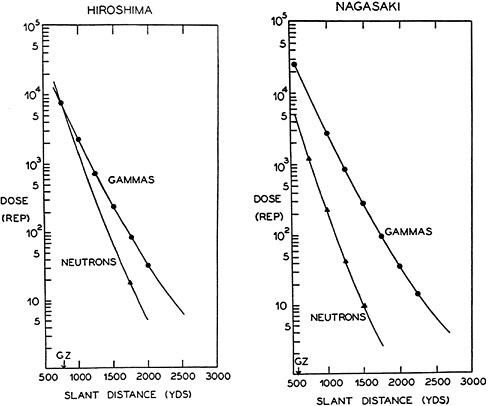
FIGURE 4.5—Neutron and gamma radiation distance-dosage curves for the atomic bomb explosions at Hiroshima and Nagasaki.
There are at present no published data which permit making a realistic estimate of the contribution of fast and slow neutrons to the total radiation spectrum. This is unfortunate in view of the relatively high biological efficiency of neutrons in inducing genetic change (summary in Symposium: Some Biological Effects of Radiation from Nuclear Detonation, 1954). However, it is important to recognize that the average dosages estimated above include, in the case of category 4 and 5 persons, a component of high effectiveness in producing genetic change.
Even should the upper rather than the lower estimates of the average amount of radiation received by survivors prove correct, the fact is clear that in the terms of the radiation geneticist, these are small doses indeed. This was recognized from the outset. But despite the improbability of being able to detect induced genetic effects in this material, there was no doubt in the minds of those who considered the problem initially, at all echelons, that “this unique possibility for demonstrating genetic effects caused by atomic radiation should not be lost” (cf. p. 2).
Note added in proof.—At the time this chapter was written, only the distance-dosage curves for a “nominal” atomic bomb had been published. However, since this manuscript went to press, distance-dosage curves, in terms of neutron and gamma radiation, have been declassified for both Hiroshima and Nagasaki. These are presented in Fig. 4.5. The gamma curves for the two cities are quite comparable, and correspond satisfactorily with those published earlier for the explosion of a “nominal” atomic bomb. However, it will be noted that the neutron curves for the two cities appear to differ significantly, with, at a given distance, rather more radiation of this type in Hiroshima than in Nagasaki. The curve for the latter city approximates that published earlier for the explosion of a “nominal” bomb. In view of the many uncertainties that enter into assigning mean dosages to our radiation exposure categories, it is not felt that these new data warrant a revision of the estimates given in this chapter. On the other hand, it is clear that there is a very strong neutron component in the radiation experienced by category 4 and 5 parents in Hiroshima, and in this connection, it will be recalled that approximately 68 per cent of all category 4 or 5 parents were from Hiroshima. In view of the high relative effectiveness of neutrons in inducing genetic change, the publication of these new curves has the effect of increasing the genetic significance to be attached to the observations herein to be reported.
Chapter V
THE COMPARABILITY OF IRRADIATION SUBCLASSES
THE infants examined in Hiroshima and Nagasaki during the course of this study may be apportioned among 25 subclasses on the basis of the radiation exposure categories of their fathers and mothers, as these categories were defined in the preceding chapter. The crux of our problem is a comparison of the characteristics of the infants comprising these subclasses. As has been emphasized several times already, all of the indicators of possible genetic damage utilized in this investigation may also be influenced by a variety of other factors. It will be the purpose of this chapter to undertake a detailed comparison of the parents of the infants comprising these subclasses with respect to certain possible differences which might influence the outcome of pregnancy. Of the many possible differences which could be explored, we shall restrict ourselves to those which in our opinion are most pertinent to the problem at hand and for which we have more nearly satisfactory data.
In the comparisons which will be presented, usually no allowance has been made for the fact that because of repeated pregnancies the same couple may be represented more than once among the parentage of a subclass. The tests of significance that follow assume no duplicate registration and thus yield underestimates of the errors of differences. It might be pointed out that, in the main, we should underestimate variances in the parental population more than in the offspring population.
5.1 Consanguinity.—It is generally recognized that the offspring of consanguineous marriages more often exhibit the consequences of genetic homozygosity than do the offspring of non-consanguineous unions. To the extent that there is a recessive, incompletely recessive, or semi-dominant genetic component in the etiology of congenital defect, stillbirth, or neonatal death, such homozygosity might be expected to alter the frequency of these events sufficiently to obscure real irradiation differences or to create spurious ones. The occurrence within the populations under study of a nonrandom distribution of consanguineous marriages thus might introduce a source of bias into the findings. This, then, was the theoretical consideration which led to the inclusion of an item in the Genetics Short Form regarding parental consanguinity. The problem seemed of special importance because of the relatively high frequency of consanguineous unions in Japan (Neel, Kodani, Brewer, and Anderson, 1949).
In Tables 5.1 and 5.2 the present data are examined as regards a relationship between exposure subclass and the frequency of consanguinity.1 Although all known degrees of consanguinity were recorded by the clerks, in the analysis attention has been restricted to marriages of first cousins, first cousins once removed, and second cousins. A few uncle-niece unions, and some involving more remote degrees of consanguinity than second cousin marriages, have been recorded during the study; all such unions have been excluded from these considerations because of the uncertainty regarding the exhaustiveness of the ascertainment.
There is significantly more consanguineous marriage in Nagasaki than in Hiroshima, this presumably a reflection of social and cultural differences between the two localities. Moreover, within the cities there is heterogeneity among exposure subclasses. In general this consists in less consanguineous marriage among the “exposed” (categories 2, 3, 4, 5) than among the
|
1 |
The differing forms utilized in the presentation of the results of the analysis of the various tables will be evident following the reading of Chapter VI. |
TABLE 5.1 CONSANGUINITY (FIRST COUSIN, FIRST COUSIN ONCE REMOVED, SECOND COUSIN) BY CITYAND PARENTAL EXPOSURE
|
Hiroshima |
||||||||
 |
||||||||
|
Fathersa |
||||||||
 |
||||||||
|
1 |
2 |
3 |
4–5 |
Total |
||||
 |
1 |
 |
n |
18,723 |
1,611 |
648 |
422 |
21,404 |
|
r |
1,242 |
97 |
42 |
23 |
1,404 |
|||
|
p |
.0663 |
.0602 |
.0648 |
.0545 |
.0656 |
|||
|
2 |
 |
n |
5,721 |
1,993 |
416 |
264 |
8,394 |
|
|
r |
311 |
117 |
27 |
16 |
471 |
|||
|
p |
.0544 |
.0587 |
.0649 |
.0606 |
.0561 |
|||
|
3 |
 |
n |
2,320 |
451 |
545 |
161 |
3,477 |
|
|
r |
97 |
23 |
16 |
4 |
140 |
|||
|
p |
.0418 |
.0510 |
.0294 |
.0248 |
.0403 |
|||
|
4–5 |
 |
n |
1,208 |
217 |
116 |
127 |
1,668 |
|
|
r |
77 |
9 |
6 |
6 |
98 |
|||
|
p |
.0637 |
.0415 |
.0517 |
.0472 |
.0588 |
|||
|
Total |
 |
n |
27,972 |
4,272 |
1,725 |
974 |
34,943 |
|
|
r |
1,727 |
246 |
91 |
49 |
2,113 |
|||
|
p |
.0617 |
.0576 |
.0528 |
.0503 |
.0605 |
|||
|
Nagasaki |
||||||||
 |
||||||||
|
Fathersa |
||||||||
 |
||||||||
|
1 |
2 |
3 |
4–5 |
Total |
||||
 |
1 |
 |
n |
16,338 |
2,420 |
258 |
149 |
19,165 |
|
r |
1,541 |
211 |
13 |
8 |
1,773 |
|||
|
p |
.0943 |
.0872 |
.0504 |
.0537 |
.0925 |
|||
|
2 |
 |
n |
10,141 |
4,483 |
301 |
188 |
15,113 |
|
|
r |
683 |
293 |
22 |
10 |
1,008 |
|||
|
p |
.0674 |
.0654 |
.0731 |
.0532 |
.0667 |
|||
|
3 |
|
n |
823 |
298 |
109 |
39 |
1,269 |
|
|
r |
69 |
14 |
7 |
4 |
94 |
|||
|
p |
.0838 |
.0470 |
.0642 |
.1026 |
.0741 |
|||
|
4–5 |
 |
n |
596 |
129 |
35 |
30 |
790 |
|
|
r |
33 |
10 |
— |
2 |
45 |
|||
|
p |
.0554 |
.0775 |
— |
.0667 |
.0570 |
|||
|
Total |
 |
n |
27,898 |
7,330 |
703 |
406 |
36,337 |
|
|
r |
2,326 |
528 |
42 |
24 |
2,920 |
|||
|
p |
.0834 |
.0720 |
.0597 |
.0591 |
.0804 |
|||
|
aIn this and subsequent tables, the term “Fathers” will be used as an abbreviation for Father's Exposure Category, and the term “Mothers” similarly. |
||||||||
unexposed (category 1), although the tendency is statistically significant only with respect to the mothers. There is also a significant city-mother interaction. Category 1 contains a high proportion of persons who did not legally reside in either of the two cities at the time of the bombings. It may be surmised that a substantial proportion of these persons have rural antecedents; the frequency of consanguinity is known to be higher in rural communities (Neel et al., 1949).
TABLE 5.2 CHI-SQUARE ANALYSISOFTHE FREQUENCYOF CONSANGUINEOUS MARRIAGESBY CITYAND PARENTAL EXPOSURE
|
Source |
DF |
X2 |
P |
|
Total |
31 |
261.453 |
<.001 |
|
Interactions, first order |
|||
|
CM |
3 |
16.913 |
<.001 |
|
CF |
3 |
1.610 |
.50–.70 |
|
MF |
9 |
6.317 |
.70–.80 |
|
Main Effects |
|||
|
Citya |
|||
|
Mother's exposure—1 |
1 |
101.499 |
<.001 |
|
Mother's exposure—2 |
1 |
10.257 |
.001–.01 |
|
Mother's exposure—3 |
1 |
22.672 |
<.001 |
|
Mother's exposure—4, 5 |
1 |
0.031 |
.80–.90 |
|
Motherb |
|||
|
Hiroshima (H) |
3 |
37.775 |
<.001 |
|
Nagasaki (N) |
3 |
83.002 |
<.001 |
|
Fatherc |
|||
|
(H) Mother's exposure—1 |
3 |
1.783 |
.50–.70 |
|
Mother's exposure—2 |
3 |
1.292 |
.70–.80 |
|
Mother's exposure—3 |
3 |
4.156 |
.20–.30 |
|
Mother's exposure—4, 5 |
3 |
2.123 |
.50–.70 |
|
(N) Mother's exposure—1 |
3 |
9.581 |
.02–.05 |
|
Mother's exposure—2 |
3 |
0.947 |
.80–.90 |
|
Mother's exposure—3 |
3 |
4.950 |
.10–.20 |
|
Mother's exposure—4, 5 |
3 |
3.210 |
.30–.50 |
|
Sum |
24 |
28.042 |
.20–.30 |
|
aAdjusted for mothers. (The meaning of the term “adjusted” is explained in Sec. 6.5.) bAdjusted for cities. cAdjusted for cities and mothers. |
|||
In Nagasaki, the bomb was detonated over that area of the city in which there was the highest concentration of Christians; Schull (1953) has shown that there is less consanguineous marriage among Christian (Catholic) Japanese in Nagasaki than among non-Christians. Thus, it may be surmised that among the non-Christian Japanese, the differences in frequency of consanguineous unions between Hiroshima and Nagasaki are even more striking than shown in Table 5.1.
5.2 Age and parity.—A probable or certain relationship between the correlated variables, parental age2 and parity,3 and most of the indicators of possible genetic damage herein studied is attested to by a voluminous literature (e.g., Ciocco, 1938; Yerushalmy, 1938; Penrose, 1939; Murphy, 1947; Landtman, 1948; Record and McKeown, 1949; Sutherland, 1949; Carter, 1950; Lowe and McKeown, 1950; Worcester, Stevenson, and Rice, 1950; Hegnauer, 1951; Karn and Penrose, 1951; Novitski, 1953; Salber and Bradshaw, 1953; MacMahon and Gordon, 1953; Myers, 1954). Our own analysis of these relationships in the present data will be published elsewhere. Suffice it to say at this point that significant associations can be readily demonstrated.
The findings in these data with respect to mean maternal age and parity differences among the mothers of the children falling into the various subclasses are shown in Tables 5.3
|
2 |
The terms “parental age,” “maternal age,” or “paternal age” as here used refer simply to age of parent(s) at birth of child. |
|
3 |
The term “parity” refers simply to total number of conceptions, including the present. |
TABLE 5.3 MEAN MATERNAL AGEBY CITYAND PARENTAL EXPOSURE (Based on unrelated parents only)










through 5.8. It will be noted that the comparison is restricted to unrelated parents. In the following chapter we shall advance reasons for excluding children born to related parents from the analysis. Because of the potential great importance of age-parity differences in this analysis, it has seemed wise to anticipate this decision with respect to this tabulation.
TABLE 5.4 ANALYSISOF VARIANCE: MOTHER'S AGEBY CITYAND PARENTAL EXPOSURE (Unrelated parents) (In this and subsequent tables, one asterisk will be used to denote a value significant at the 5 per cent level, and two asterisks, a value significant at the 1 per cent level.)
|
Source |
Sums of squares of deviations |
DF |
Mean square |
F |
|
Main effects |
||||
|
City (C) |
21,983.321551 |
1 |
21,983.3216 |
830.86** |
|
Father (F) |
43,401.030323 |
4 |
10,850.2576 |
410.08** |
|
Mother (M) |
947.687594 |
4 |
236.9219 |
8.95** |
|
Interactions |
||||
|
First order |
||||
|
CF |
74.432938 |
4 |
18.6082 |
1.42 |
|
CM |
3,107.667017 |
4 |
776.9168 |
29.36** |
|
MF |
18,682.813301 |
16 |
1,167.6758 |
44.13** |
|
Higher orders |
871.870114 |
16 |
54.4919 |
2.06** |
|
Between classes |
94,513.849388 |
49 |
1,928.8541 |
72.90** |
|
Within classes |
1,751,484.087605 |
66,197 |
26.4587 |
— |
|
Total |
1,845,997.936993 |
66,246 |
||
TABLE 5.5 THE DISTRIBUTIONOF MEAN SQUARESFOR MATERNAL AGEBY CITY, SEXOF INFANT, AND PARENTAL EXPOSURE (Unrelated parents) (The sample numbers are the same as in Table 5.3. The form of the analysis will be discussed in Chapter VI.)









 =121.021**
 =222.236**
 =144.251**
 =192.154**
Not only do the cities differ but there is also significant heterogeneity within cities among exposure subclasses as regards both mean maternal age and mean parity. In Hiroshima there is a clear tendency for maternal age to be greater when the mother or father is exposed (category 2, 3, 4, or 5) than when non-exposed (category 1). This appears to be true with reference to fathers' but not mothers' exposure in Nagasaki. An obvious explanation of the findings with regard to the relation between paternal exposure and mean maternal age is the fact that the younger males tended to be in military service while the older males remained at home (and so were exposed), and mother's age is correlated with father's. Heterogeneity between the subclasses is also indicated by the fact that most of the interaction terms are also significant.
No less variable than the mean maternal ages and parities are the mean squares (variance esti-
TABLE 5.6 MEAN PARITYBY CITYAND PARENTAL EXPOSURE (Based on unrelated parents only)










mates) for these two variables.4 From Tables 5.5 and 5.8 we note a significant heterogeneity among exposure classes, within each sex and city, in the variance estimates. It can also be shown that the variance estimates differ significantly between cities. In general, the variance estimates increase with increasing conjoint parental exposure.
TABLE 5.7 ANALYSISOF VARIANCE: PARITYBY CITYAND PARENTAL EXPOSURE (Unrelated parents)
|
Source |
Sums of squares of deviations |
DF |
Mean square |
F |
|
Main effects |
||||
|
City (C) |
1,663.729494 |
1 |
1,663.7295 |
531.52** |
|
Father (F) |
6,053.779421 |
4 |
1,513.4449 |
483.51** |
|
Mother (M) |
852.862735 |
4 |
213.2157 |
68.12** |
|
Interactions |
||||
|
First order |
||||
|
CF |
181.504471 |
4 |
45.3761 |
14.50** |
|
CM |
62.510339 |
4 |
15.6276 |
4.99** |
|
MF |
2,637.923744 |
16 |
164.8702 |
52.67** |
|
Higher orders |
77.508327 |
16 |
4.8443 |
1.55 |
|
Between classes |
13,593.325165 |
49 |
2,774.1480 |
886.27** |
|
Within classes |
207,206.531342 |
66,197 |
3.1302 |
— |
|
Total |
220,799.856507 |
66,246 |
||
TABLE 5.8 THE DISTRIBUTIONOF MEAN SQUARESFOR PARITYBY CITY, SEXOF INFANT, AND PARENTAL EXPOSURE (Unrelated parents) (The sample numbers are the same as in Table 5.6.)









 =281.717**
 =337.847**
 =324.417**
 =397.544**
5.3 Economic status.—On a priori grounds it seemed quite possible that there might be a correlation between distance from the hypocenter at the time of the explosion and economic status in post-war Japan, those persons closer in having suffered in material ways to a greater extent than those farther out. Economic status appears to be related to some of the indicators of radiation effect here under consideration, notably stillbirth frequency, birthweight, and neonatal death (e.g., Ebbs et al., 1942a, b; Balfour, 1944; Antonov, 1947; Smith, 1947; Burke et al., 1949; Dean, 1950; Nixon, 1950). It therefore seemed advisable to make some attempt to evaluate this possibility.
The economic status of the home into which the child was born was estimated for all pregnancies terminating abnormally, as well as every pregnancy whose registration number ended in
TABLE 5.9 ECONOMIC STATUSBY CITYAND PARENTAL EXPOSURE (The figure given for economic status is proportion of homes falling into the “poor” and “very poor” categories.)










zero, in connection with the use of the Genetics Long Form (Secs. 2.2 and 2.3). This evaluation was made according to a very rough scoring system admitting of five economic classifications: very poor, poor, average, well-to-do, and rich. The evaluation was carried out by the Japanese physician at the time of the home visit. The physicians were instructed that it was expected that most homes would be graded as average, i.e., that existing rather than pre-bombing standards should serve as the yardstick of comparison. Inasmuch as in the course of time a physician employed in the program found himself in all sections of the city, it was felt that this crude system of rating would pick up any marked differences between exposure categories.
The findings are given in Tables 5.9 and 5.10. The data are presented in simplified form, in terms of proportion of all homes graded as “poor” or “very poor.” In view of the subjective nature of the ratings, it is difficult to attach significance to the apparent difference between the two cities. There is no apparent relation between economic status and mother's exposure category, nor is there a relation between father's category and economic status. At first glance this observation would seem to be counter to common sense, since it would seem obvious that persons close to the hypocenter would have suffered greater material losses than those more distant, losses which would reflect themselves in economic level. However, the effect of the atomic bomb was but one of a number of sources of severe economic dislocation in post-war Hiroshima and Nagasaki. The obvious conclusion from the findings summarized in this section would be that these other causes of economic readjustment tended to complicate and even to nullify the effects of the bombs.
5.4 Frequency of positive serological test for syphilis.—In view of the well-known relationship between syphilis and stillbirth and neonatal death, a serological test for syphilis was carried out in the ABCC laboratories on each woman whose registration number terminated in “0,” as well as for any woman whose pregnancy terminated abnormally. In about 3 per cent of the terminations no test was performed, usually because of the disinclination of the mother to submit to venipuncture. The tests used were the cardiolipin microflocculation and the Kline. Tables 5.11 and 5.12 present the findings. There is a significant difference between cities, but no indication of heterogeneity between parental exposure classes.
5.5 Frequency of induced abortions and of dilatation and curettage of the uterus (D and C). —During the post-war years, in an effort to control birth rates, the Japanese government relaxed the indications for legal “therapeutic” abortion. Exact figures on the frequency with which abortions were performed are impossible to obtain for a variety of reasons. However, because of the possibility that the late complications of uterine infection following an induced
TABLE 5.10 CHI-SQUARE ANALYSISOFTHE DISTRIBUTIONOF ECONOMIC STATUSESBY CITYAND PARENTAL EXPOSURE (Unrelated parents)
|
Source |
DF |
X2 |
P |
|
Total |
31 |
120.378 |
<0.001 |
|
Interactions, first order |
|||
|
CM |
3 |
2.268 |
.50–.70 |
|
CF |
3 |
0.365 |
.90–.95 |
|
MF |
9 |
17.683 |
.02–.05 |
|
Main effects |
|||
|
Cities (C) |
1 |
82.529 |
<0.001 |
|
Fathers (F)a |
|||
|
Hiroshima |
3 |
3.782 |
.20–.30 |
|
Nagasaki |
3 |
6.262 |
.05–.10 |
|
Sum |
6 |
10.044 |
.10–.20 |
|
Mothers (M)a |
|||
|
Hiroshima |
3 |
3.354 |
.30–.50 |
|
Nagasaki |
3 |
0.028 |
>.99 |
|
Sum |
6 |
3.382 |
.70–.80 |
|
aAdjusted for cities. |
|||
abortion might influence pregnancy termination, an attempt was made to obtain some information on this point through the use of the Genetics Short Form. Each registrant was questioned concerning the occurrence of abortions. The abortions which were reported were divided into two categories, depending on occurrence before or after the date of the atomic bombing, and further subdivided as to whether they were spontaneous or induced. The findings concerning induced abortions are shown in Tables 5.13 and 5.14. The figures refer to the proportion of women reporting one or more induced abortions. Each mother is scored only once, on the basis of the first registered pregnancy. Induced abortions are reported with a significantly greater frequency in Hiroshima than in Nagasaki and, in both cities, appear to be more
TABLE 5.11 FREQUENCYOF POSITIVE SEROLOGYBY PARENTAL EXPOSURE, CITY, ANDGROUP (Unrelated “zero” parents only)










common following the bombing than before. However, there is no apparent, consistent relation to exposure history. Three of the interaction terms are significant.
In view of the possibility that it might be easier to obtain a history of a “therapeutic” D and C than of an induced abortion, a question concerning D and C was included in the Genetics Long Form. The findings in those terminations where the registration number ended in “0” are shown in Tables 5.15 and 5.16. The figures refer to the proportion of women reporting one or more D and C's, with no reference as to whether the event preceded or followed the bombings. There is a striking difference between the cities, similar in direction to that reported with respect to induced abortions, but much greater in magnitude. However, no difference with respect to exposure groups is apparent, nor are any of the interaction terms significant.
TABLE 5.12 CHI-SQUARE ANALYSISOFTHE FREQUENCYOF POSITIVE SEROLOGIESBY CITYAND PARENTAL EXPOSURE (Unrelated parents)
|
Source |
DF |
X2 |
P |
|
Total |
31 |
60.330 |
.001–.01 |
|
Interactions, first order |
|||
|
CM |
3 |
6.645 |
.05–.10 |
|
CF |
3 |
3.522 |
.30–.50 |
|
MF |
9 |
12.876 |
.10–.20 |
|
Main effects |
|||
|
Cities (C) |
1 |
8.231 |
.001–.01 |
|
Fathers (F)a |
|||
|
Hiroshima |
3 |
6.469 |
.05–.10 |
|
Nagasaki |
3 |
3.106 |
.30–.50 |
|
Sum |
6 |
9.575 |
.10–.20 |
|
Mothers (M)a |
|||
|
Hiroshima |
3 |
2.136 |
.50–.70 |
|
Nagasaki |
3 |
6.099 |
.10–.20 |
|
Sum |
6 |
8.235 |
.20–.30 |
|
aAdjusted for cities. |
|||
5.6 The frequency of repeat registrations.— Depending upon the number of pregnancies which she experienced during the period covered by this study, a woman residing in Hiroshima or Nagasaki could bear one, two, three, four or even more infants whose examination fell within the scope of the program. Table 5.17 summarizes the mean number of infants per mother in relation to the exposure categories of mother and father, by city. There is a tendency towards a higher average number of pregnancies in Nagasaki than in Hiroshima. Furthermore, particularly with respect to mothers' exposure in Nagasaki, there is apparent a tendency for the more heavily irradiated mothers to have borne more children.
5.7 Parental cooperation.—If for any reason one group of parents was more cooperative than another in permitting an examination of their newborn child, herein lies a source of bias. Fortunately, parental cooperation was excellent throughout the course of this study. Refusals to permit the ABCC physician to examine a child were infrequent, so infrequent that no analysis of the phenomenon has been carried out. It should in this connection be pointed out that such refusals could influence only the data on malformation, since sex, birthweight, and the occurrence of stillbirth were reported by the midwife, and since, further, it would be impractical to attempt to conceal a neonatal death.
In Japan as in the United States, the birth of a malformed child tends to stigmatize the parents in the lay mind. In a country where marriages are still often arranged to a large extent by the families concerned, and where the koseki (census register) is freely consulted when a marriage is under consideration, there are at work social factors encouraging the concealment of congenital abnormality. In this connection, the possibility has to be recognized of subtle influences tending to make one of the groups under study more cooperative than another group. More specifically, one had to recognize the possibility that some of the “exposed” group, learning from the newspapers that congenital abnormalities were a possible aftermath of exposure to an atomic bomb, would cooperate more completely than the controls, and thus introduce a bias.
The chief opportunity for concealing major congenital defect lay in children who were stillborn or died shortly following birth, and whose bodies were disposed of without being seen by an ABCC physician. As mentioned earlier (Sec. 2.5), an attempt was made to obtain autopsies on as many children who were stillborn or died during the neonatal period as possible. In 1950 and 1951, when the autopsy program was in full stride in Hiroshima, autopsies were obtained on approximately 50 per cent of all children who were stillborn or died during the neonatal period. Another 15 per cent of all children who were stillborn or died during the neonatal
TABLE 5.13 FREQUENCYOF MOTHERS REPORTINGONEOR MORE INDUCED ABORTIONSBY PARENTAL EXPOSURE, CITY, AND TIME (Unrelated parents)




















TABLE 5.14 CHI-SQUARE ANALYSISOF THE FREQUENCYOF MOTHERS REPORTING ONEOR MORE INDUCED ABORTIONSBY PARENTAL EXPOSURE, CITY, AND TIME (Unrelated parents)
|
Source |
DF |
X2 |
P |
|
Total |
63 |
574.384 |
<.001 |
|
Interactions, first order |
|||
|
CT |
1 |
3.057 |
.05–.10 |
|
TM |
3 |
16.265 |
.001–.01 |
|
TF |
3 |
3.725 |
.20–.30 |
|
CM |
3 |
10.087 |
.01–.02 |
|
CF |
3 |
2.616 |
.30–.50 |
|
MF |
9 |
30.308 |
<.001 |
|
Main effects |
|||
|
Cities (C) |
|||
|
Before bombing |
1 |
95.230 |
<.001 |
|
After bombing |
1 |
270.261 |
<.001 |
|
Sum |
2 |
365.491 |
<.001 |
|
Time (T) |
|||
|
Hiroshima (H) |
1 |
40.677 |
<.001 |
|
Nagasaki (N) |
1 |
5.401 |
.02–.05 |
|
Sum |
2 |
46.078 |
<.001 |
|
Mothers (M) |
|||
|
(H) Before bombing |
3 |
6.191 |
.10–.20 |
|
After bombing |
3 |
9.001 |
.02–.05 |
|
(N) Before bombing |
3 |
15.700 |
.001–.01 |
|
After bombing |
3 |
0.459 |
.90–.95 |
|
Fathers (F) |
|||
|
(H) Before bombing |
3 |
5.039 |
.10–.20 |
|
After bombing |
3 |
3.127 |
.30–.50 |
|
(N) Before bombing |
3 |
3.898 |
.20–.30 |
|
After bombing |
3 |
0.851 |
.80–.90 |
|
Sum |
12 |
12.915 |
30.–.50 |
TABLE 5.15 FREQUENCYOF DILATATIONAND CURETTAGEBY PARENTAL EXPOSUREAND CITY: ZERO TERMINATIONS










TABLE 5.16 CHI-SQUARE ANALYSISOFTHE FREQUENCYOF DILATATIONAND CURETTAGEBY PARENTAL EXPOSUREAND CITY: ZERO TERMINATIONS (Unrelated parents)
|
Source |
DF |
X2 |
P |
|
Total |
31 |
372.060 |
<.001 |
|
Interactions, first order |
|||
|
CM |
3 |
3.099 |
.30–.50 |
|
CF |
3 |
7.426 |
.05–.10 |
|
MF |
9 |
10.799 |
.20–.30 |
|
Main effects |
|||
|
Cities (C) |
1 |
346.140 |
<.001 |
|
Mothers (M)a |
|||
|
Hiroshima |
3 |
3.212 |
.30–.50 |
|
Nagasaki |
3 |
1.718 |
.50–.70 |
|
Sum |
6 |
4.930 |
.50–.70 |
|
Fathers (F)a |
|||
|
Hiroshima |
3 |
4.034 |
.20–.30 |
|
Nagasaki |
3 |
5.185 |
.10–.20 |
|
Sum |
6 |
9.219 |
.10–.20 |
|
aAdjusted for cities. |
|||
TABLE 5.17 MEAN NUMBEROF REGISTERED PREGNANCIES PER MOTHERBY PARENTAL EXPOSUREAND CITY










period were seen by a physician in the employ of the ABCC but did not come to autopsy. It follows that opportunities for the concealment of defect existed with respect to only 35 per cent of all stillbirths and neonatal deaths. In 1952 and 1953 the efficiency of the autopsy program increased, to the point where some 60–70 per cent of the possible material was being autopsied, with a corresponding decrease in opportunities for concealment. Tables 13.1 through 13.4 analyze the material coming to autopsy with reference to its randomness. It can be shown that there is no detectable bias as regards the exposure history of the parents. Since this autopsy material includes the majority of the stillbirths and neonatal deaths, it seems unlikely that there exists the possibility of a serious bias as regards parental exposure among the stillbirths and neonatal deaths who were not seen. If, for instance, unirradiated mothers of stillborn (malformed) children were especially prone to dispose of these infants without their coming to the attention of the ABCC, then, since approximately 10 per cent of stillborn children are malformed, this should depress the representation of unexposed mothers in the parents of the autopsy material; such a disproportion was not observed. On the other hand, the data are of course not sufficiently extensive to exclude small biases in this direction. In this connection, however, it must be borne in mind that all of the infants falling in this 25 per cent were seen by a Japanese midwife or obstetrician, which provides a partial safeguard against the concealment of defect, even though there were occasionally encountered striking shortcomings in midwife reporting.
5.8 Late sequelae of exposure to the bombs. —Reference has already been made (Sec. 4.1) to the occurrence among the parents of the infants under study of certain late sequelae of exposure to the atomic bombs. The best documented of these late effects are cataracts (Cogan, Martin, and Kimura, 1949; Sinsky, 1955) and leukemia (Folley, Borges, and Yamawaki, 1952; Lange, Moloney, and Yamawaki, 1954; Moloney and Lange, 1954; Moloney and Kastenbaum, 1955). Refractory anemia may also be a delayed manifestation of radiation injury (Lange, Wright, Tomonaga, Kurasaki, Matsuoke, and Matsunaga, 1955). These events occur with a frequency which cannot be ignored in a study of this type. Thus, the findings with respect to leukemia are given in Table 5.18. To date, the over-all frequency of this disease in individuals who at one time displayed one or more of the three radiation symptoms, epilation, petechiae, or gingivitis, is 0.5 per cent.
While the occurrence of cataracts would not be expected to influence pregnancy outcome, there is little doubt that a disease with the systemic manifestations of leukemia has profound effects. Whether in addition to leukemia there are other serious sequelae which have so far escaped detection cannot be said. Fillmore (1952) was not able to detect any significant sequelae in a general medical examination of 78 persons who had received sufficient radiation at the time of the bombings to develop, later, radiation cataracts. On the other hand, Lorenz and his collaborators (1954) have demonstrated a shortened life span in a variety of animals exposed to chronic irradiation, associated with the development of such conditions as pancytopenia and lymphoid, pulmonary, ovarian, and mammary tumors. Whether there are comparable effects in man is not yet known.
Whereas techniques exist for coping with the age-parity and consanguinity differences between the groups of parents with whom we are concerned, it is much more difficult in any plan of analysis to make allowance for the somatic effects of irradiation which might influence the outcome of a pregnancy. These somatic effects should be exerted largely through the mother. Thus, “effects” apparently consequent upon maternal radiation which are not confirmed by a corresponding analysis with regard to paternal radiation history must be viewed with reservations.
5.9 The changing proportion of control and irradiated from year to year.— Table 2.1 presented a summary of the number and proportion of registrations with at least one parent falling into categories 4 or 5 for the years 1948 through 1953. There was apparent a recent decrease in both the absolute and the relative representation of the more heavily irradiated. If there were any marked tendency for the level of diagnostic accuracy or parental cooperation with respect to congenital malformation to change during the course of the study, or if because of post-war improvements in medical and economic levels the stillbirth or the neonatal death rate fell appreciably or the birthweight increased, then here again are factors capable of introducing a source of spurious conclusions. Tables 5.19 and 5.20 summarize our annual
TABLE 5.18 INCIDENCEOF LEUKEMIAINTHE HIROSHIMA SURVIVORSOF THE ATOMIC BOMBINGAS RELATEDTO DISTANCEFROM THE HYPOCENTERAND THE PRESENCEOF SEVERE RADIATION COMPLAINTS (After Moloney and Kastenbaum, 1955)
|
Distance from hypocenter (meters) |
Populationa |
||||
 |
|||||
|
SRCb |
NRCc |
Total |
|||
|
0–999 |
750 |
450 |
1,200 |
||
|
1,000–1,499 |
2,250 |
8,250 |
10,500 |
||
|
1,500–1,999 |
1,750 |
16,950? |
18,700 |
||
|
2,000–2,499 |
950 |
16,250 |
17,200 |
||
|
2,500 and over |
850 |
49,650 |
50,500 |
||
|
Total |
6,550 |
91,550 |
98,100 |
||
|
Cases of leukemia |
Incidence |
||||
 |
 |
||||
|
SRC |
NRC |
Total |
SRC |
NRC |
Total |
|
14 |
1 |
15 |
1:53 |
1:450 |
1:80 |
|
15 |
9 |
24 |
1:150 |
1:917 |
1:438 |
|
3 |
2 |
5 |
1:583 |
1:8,475 |
1:3,740 |
|
1 |
1 |
2 |
1:950 |
1:16,250 |
1:8,600 |
|
0 |
4 |
4 |
— |
1:12,412 |
1:12,625 |
|
33 |
17 |
50 |
1:198 |
1:5,385 |
1:1,962 |
|
aPopulation estimated and rounded off to the nearest 50 persons. These population figures were based on the Commission's 1949 radiation census and the Japanese national census (1950). Numbers of survivors with severe radiation complaints were estimated from an analysis of the pregnancy registration data. bSRC: severe radiation complaints (heavily irradiated). cNRC: no radiation complaints (lightly irradiated). |
|||||
TABLE 5.19 THE FREQUENCYOF MALFORMATIONSBY YEAR AMONGTHE OFFSPRINGOF PARENTS NEITHEROF WHOM WAS EXPOSEDTO THE ATOMIC BOMBS


TABLE 5.20 THE FREQUENCYOF STILLBIRTHSBY YEAR AMONGTHE OFFSPRINGOF PARENTS NEITHEROF WHOM WAS EXPOSEDTOTHE ATOMIC BOMBS


figures for the frequency of gross malformations and stillbirths for the first five years of the study among the offspring of parents neither of whom was exposed to the atomic bombs. The frequency of malformations and stillbirths appears to remain sufficiently constant from year to year, that time trends should not complicate the analysis of these two indicators. On the other hand, we shall in a subsequent section (Sec. 10.4) present evidence that time trends may be of importance in the birthweight analysis.
5.10 The background of group 1 individuals. —There remains one final problem for discussion. There are important differences in background between the parents in radiation category 1 and those in categories 2 through 5. The latter have all been urban dwellers since 1945 or before. The former parents, although in part composed of residents of Hiroshima and Nagasaki who were away at the time of the bombings, and also of urbanites who have come to Hiroshima and Nagasaki from the other cities of Japan, in addition include a high proportion of emigrants from rural areas and repatriates from Manchuria, Korea, and Formosa. In addition, among the men there are many with extensive overseas military service. Although there are well-known urban-rural differences with respect to the indicators of possible genetic effect here considered, it is by no means clear to what extent these are apparent and to what extent real, and if the latter, whether they are socio-economic or biological in origin. Finally, if biological, there are no data as to how long they persist after urbanization. In the face of this situation, one can only conclude that the significance of any finding based solely on a difference between category 1 and categories 2 through 5 collectively must be viewed with reservations.
5.11 Summary.—Of the differences between the individuals in the various exposure subcategories which have come to light in the foregoing analysis, some appear to be inconsequential, of such a nature that they can be ignored with safety. Others of the differences appear to represent sources of potentially significant bias. These latter differences fall into a natural dichotomy, depending on whether or not allowance can be made for them in an analysis. Thus, one way or another, differences in the frequency of consanguinity, age, and parity can be circumvented. This is not so either with respect to the occurrence of late sequelae of the bombing among the more heavily irradiated, the possible implications of the progressive decline during the six years covered by this study in the proportion of category 4's and 5's among the registrants, or the differences in background among persons falling into category 1 as opposed to categories 2 through 5. In the following chapter, the steps taken to meet this situation will be described.
Chapter VI
STATISTICAL METHODS
THE problems posed when one attempts to employ survey data in an analytical fashion are legion. As a consequence, it is doubtful whether, given a body of survey data, any two competent statisticians would evolve essentially the same approach. Accordingly, it seems important that an attempt be made to establish the line of reasoning which led to the final form which the analysis of the Japanese data assumed. In this chapter, therefore, we shall set out in some detail the analytical plan, and consider briefly the tests of significance to be employed.
6.1 The problem and the general plan.—It has been previously stated that the purposes of this study were to answer the questions, “Is there a difference between the progeny of irradiated and non-irradiated parents?”, and “If a difference exists, how is it to be explained?” The latter question is, of course, outside the purview of statistics, but the former may be paraphrased in terms of the general statistical problem posed by this study. We may state the problem as follows: What is the significance of the association of parental exposure with those variables indicative of genetic damage due to irradiation? A meaningful answer to this question requires that no differences with respect to any of the indicators exist between the exposure groups being compared save those differences which have been taken into account in the course of the analysis or which arise from exposure experience itself. Available to us are the following two collections of data:
-
Observations on some 75,000 pregnancies terminating sometime after 20 weeks of gestation. These observations are distributed over two cities and 25 parental exposure combinations.
-
Clinical and anthropometric examinations at 9 months of age of some 21,000 infants randomly selected from pregnancies comprising (1). These observations are also distributed over two cities and 25 parental exposure combinations.
The fact that observations have been obtained in two cities permits us to view these data as constituting two approximate replications of one basic experiment.
While the basic problem is readily formulated statistically, its solution is complicated by two factors, namely, extraneous (concomitant) variation and differing numbers of observations in the various exposure cells. Before we consider the impact of these factors on the form of the analysis, let us examine the indicators of radiation damage, that is, the measurements by which we shall attempt to determine whether radiation has or has not resulted in a measurable effect upon the outcome of pregnancy terminations.
6.2 Indicators of radiation damage and the problem of non-overlapping measurements.— Among the numerous measurements or attributes by which a newborn infant or a 9-months-old child may be classified there exist at least six which a priori may be expected to reflect genetic changes due to irradiation. These six indicators of genetic damage are (1) the sex ratio, (2) birthweights, (3) measurements of bodily development, and the frequencies of (4) stillbirths, (5) neonatal deaths, and (6) gross malformations. As has already been made clear, none of these measurements is a unique yardstick of radiation damage; this is an inherent difficulty in the problem. Moreover, it is apparent that these indicators are not all mutually independent measurements of radiation damage. Some are correlated, and many would measure, to some degree, the same genetic damage.
Extrapolation from experiments involving the irradiation of laboratory animals at the relatively low levels obtaining in Hiroshima and Nagasaki suggested that the effects appearing in the human populations in question would undoubtedly be small, small enough that such effects would be demonstrable only with a very large sample (review of literature in Chapter XV). This in
conjunction with the lack of unique indices of radiation damage led us to believe that it was advisable to attempt to develop a method whereby information gained with respect to the various indicators of radiation damage would be additive, e.g., a method permitting combining information from tests of significance through the chi-square transformation of probabilities. This required that the tests of significance performed on various segments of the data be independent of one another. It was clear, however, that insofar as children who were grossly malformed were apt to be stillborn, or stillborn infants were apt to be small, tests on malformation and stillbirths, or stillbirths and birthweight, would not be wholly independent measures. We chose to remove effects such as those just indicated by a pyramidal handling of the data. Under the scheme employed, the first attribute to be measured was the sex ratio. This was followed by the frequency of malformation. In this and all subsequent partitions sex was taken into account. All grossly malformed infants were then excluded, and the frequency of stillbirths obtained. The stillborn infants were discarded in turn, and birthweights distributed on the remainder. Thus the frequencies of stillbirths in the various exposure categories were based only on those infants with no clinically obvious malformation. Similarly, birthweights were based only on those liveborn infants without clinically recognizable gross abnormalities. The order of the testing is indicated in Figure 6.1. This approach must lead to the loss of some data. However, the advantages to be gained by having measurements which were essentially non-overlapping seemed to outweigh the loss in data, particularly since the “loss” with respect to birthweight, for example, amounted to less than 3 per cent of the total observations.
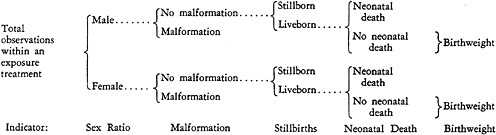
FIGURE 6.1—A schematic representation of the method of sorting the data to obtain non-overlapping indicators.
Presumably the device just described would not be necessary were we able to combine non-independent tests of significance. However, as Wallis (1951) has pointed out, to combine dependent tests of significance requires that we be able to specify the n-dimensional surface formed by groups of probabilities of n events which are not all necessarily equally probable. To specify this surface, we must know the exact kind of dependence which is present, and we obviously do not know this.
6.3 Concomitant variation.—As stated earlier, the analysis of these data is complicated not only by extraneous variation, but also by disproportion in the number of observations within the exposure cells. The problems posed by the latter we shall treat of presently; for the moment let us concern ourselves only with extraneous variation.
In Chapter V attention has been called to a rather large number of variables in which the exposure subpopulations differ significantly within or between cities. Thus, the reader has been apprised of differences in (1) the frequency of consanguineous marriages, (2) mean maternal age at birth of a registered infant, (3) mean parity, (4) the frequency of “D and C,” (5) the frequency of a positive serology, (6) the frequency of induced abortions, (7) the frequency with which repeat registrations occurred, and (8), possibly, the economic status of the parents. A number of these concomitant variables are known to influence the outcome of pregnancy terminations, for example, the frequency of malformation increases with increasing age, and birthweight increases with parity. We might rightly ask, however, whether the
effects of these variables are of sufficient consequence to lead to misinterpretation of the radiation effects, or to the obfuscating of a real effect if one should exist. It is obviously impossible to answer this question categorically with regard to all of the concomitant variables. It is possible, however, to make a general appraisal of the effect of these variables, and then to make a value judgment with regard to whether or not the effect of a given concomitant is of a magnitude large enough to warrant consideration in the analysis of a given indicator. The methods of appraisal are not fully rigorous but are descriptive and convenient to use. Since the use of these methods is not widespread and since concomitant variation is a major problem in the analysis of the data to be presented in subsequent chapters, we shall present the methods which we have employed in some detail.
In the case of a continuously distributed indicator we shall employ the ratio of two residual mean squares obtained under different assumptions regarding the population sampled, to estimate the amount of variation in the indicator ascribable to a concomitant variable and to variations in the relation between the indicator and a concomitant variable. The basis for using the ratio in this way was first pointed out to us by Dr. H.L.Lucas, Jr. whose argument, which is unpublished, we have been kindly permitted to reproduce here. The argument is as follows:
Consider the variable y, which is known or thought to be influenced by the concomitant variable, x. A simple model of this relationship would be
yij=mi+ßixij+eij
where
i=1, 2, . . . , p, designates the group,
j=1, 2, . . . , ni, designates the individual within a group 
mi=the intercept of the ith group,
ßi= the regression coefficient of the ith group,
and eij=random, independent errors with variance σ2.
Within this model, we may work out the expectations of the following quantities:
(1) The mean square for y after correction for the group means but not for regression on x. This quantity would be

(2) The mean square for y after correction for (a) the group means and (b) the common regression on x. This would be computed as
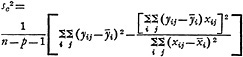
(3) The mean square for y after correction for (a) the group means and (b) separate regressions on x in each group. This residual mean square we compute as
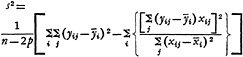
If now we let

and
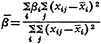
We find the expectations for a given set of xij to be
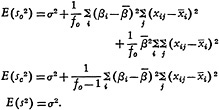
Now, if we define the second and third terms of E(so2) as σd2 and σc2, we can write
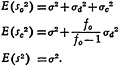
Or, since f0/(fo-1) is essentially unity, we could in the above have written with little error
E(sc2)=s2+sd2.
An objection could be made, of course, that the meanings of sd2 and sc2 depend upon the sample pattern of the xij. Let us assume, however, (a) that the sample of size  was drawn from a population of size N which divides into p groups with Ni individuals in a
group, (b) that the within-group variance of x is σx2 in all groups, (c) that the sample is random and large with the restriction (d) that

In this event, stable meaning can be given to σd2 and σc2. Define

and
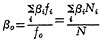
Clearly under the assumptions and restrictions just given,  =ß0 to a close approximation and
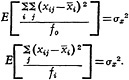
Then we see that to a close approximation

These are definitions in terms of population values. In practice, of course, instead of large random samples, arbitrarily chosen samples of any size may be used that satisfy the restrictions

and
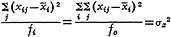
to a close approximation.
To estimate, now, the percentage of variation in y ascribable to the common relation to x, we form the ratio

The percentage ascribable to between-group variation in the relation to x is obtained by computing

Now
 per cent of the variation remaining after correction for group means that is ascribable to the common regression, and
 per cent of the variation remaining after correction for the group means and common regression that is ascribable to the different regressions.
When L1 and L2 are near unity, as in our data, 100 (L1-1) and 100 (L2-1) differ but negligibly from 100 (L1-1)/L1 and 100 (L2-1)/L2, and we shall employ the former. If L1 and L2 differ materially from unity, then 100 (L1-1)/L1 and 100 (L2-1)/L2 are appropriate when one wishes to speak of the per cent of the total variation due to a specified source. Even under the latter circumstance, however, 100 (L1-1) and 100 (L2-1) would be appropriate if one should wish to speak of the per cent increase in error variance which would result from a failure to remove a given variance source.
It seems appropriate at this point to comment briefly on the simplifying assumptions which we have used in the foregoing presentation. In the main these assumptions are not particularly restrictive when one notes that the purpose of this procedure is not a precise estimate of the variation contributed by a particular variance source, but rather to determine the order of magnitude of the contribution of this source.
In the case of a discrete indicator, we shall employ a method devised by Krooth (1955) for the analysis of the “importance” of an effect of maternal age on the presence or absence of some character among the mother's offspring. A slight modification of Krooth's method has been necessary to permit estimating, independently, the “importance” of parity in addition to maternal age. This modification, which merely involves holding one concomitant constant while measuring the other, will be apparent from a study of the tables dealing with maternal age and parity in Chapters VIII, IX, and XI.
Generally, problems posed by concomitant variation are met by one or another of the following three techniques: balanced sampling, covariance analysis, or the addition of another way of classification to the analysis wherein this
classification corresponds to intervals in the distribution of the concomitant variable. We will have occasion in analyzing these data to employ all of these alternatives save the technique of balanced sampling. The latter was not employed because in those instances where it was applicable, exact balancing led to a very large loss of data, and balancing in terms of intervals in the distribution of the concomitant variable does not generally relieve one of the responsibility of a covariance analysis. We shall now turn to a brief consideration of the courses of action adopted in each of the concomitant variables.
(1) Consanguinity.—Among these data over 90 per cent of the observations represent observations on pregnancies occurring to unrelated parents. Thus, if warranted, all pregnancies occurring to consanguineous unions could be excluded without an exorbitant loss of data. The justification for and the decision to exclude these terminations rests primarily on two factors. Firstly, Schull (in manuscript) and Morton (in manuscript) have shown fairly general, if not large, effects of consanguinity on pregnancy outcome as here measured. In the main, these effects consist of an increase in frequency of malformation with increasing consanguinity, an increase in infant mortality with increasing consanguinity, and a decrease in birthweight. Secondly, the distribution of consanguineous marriages by parental exposure is such as to introduce a bias (tending to minimize exposure differences if such exist).
(2) Maternal age and parity.—Adjustment for one or both of these variables has been undertaken for all indicators save the anthropometric measurements obtained at 9 months of age. For the analysis of the malformation data, stillbirth data, and infant mortality data, compensation for these variables took the form of adding to the analysis another level of classification. For the birthweight data, compensation for these variables took the form of an analysis of covariance.
(3) Economic status.—In respect to only one variable, birthweight, has an attempt been made to determine the effect of economic status. This stems from three considerations. Firstly, it was possible to obtain information on the economic status on only 10 per cent of the infants, so that adjustment for this variable, in the total data, is impossible. Secondly, economic status is probably of importance only insofar as it is a measure of nutritional standards. Thirdly, the only differences with regard to economic status in these data which are demonstrable are between cities and not parental exposure. It seemed dubious, therefore, whether any form of adjustment which could be entertained would justify the effort.
(4) Dilatation and curettage.—The more or less standard procedure in Japan for interrupting a pregnancy or treating a woman following a spontaneous abortion consists of dilating the cervix and curetting the uterus. It seems logical to suppose that repeated performance of this routine can lead to the formation of sufficient scar tissue in the uterus to pose an obstacle to the successful implantation and development of subsequent concepti. On this thesis the frequency of D and C was investigated with the full knowledge that possibly no adequate adjustment could be determined if exposure or city differences obtained. In Chapter V, we have indicated that while city differences obtain, no exposure differences are demonstable. We are inclined to view the recorded city differences as being largely a reflection of differences between the cities in the enthusiasm with which this question was approached by the examining physicians. No attempt has been made to take into account this variable.
(5) Positive serology.—Congenital syphilis markedly affects the frequency of stillbirths, and the neonatal mortality rate. Again, information on maternal serology was limited to but 10 per cent of the total sample. This sample, however, revealed that, within cities, no significant differences exist among exposure groups (see Sec. 5.4). The paucity of data precluded any attempt to take into account this variable in the analysis.
(6) Induced abortions.—The liberalization of the Japanese abortion law has resulted in a large-scale interruption of pregnancies. This could obviously pose a serious bias if in some parental exposure categories more interruptions occurred than in others. Moreover, undetected interruptions could play havoc with an attempt to assess the “importance” of parity on a given indicator. The data reveal no consistent exposure differences although the city rates are significantly different (see Sec. 5.5). This variable has been ignored in the analysis of the indicators.
(7) Repeat registrations.—We have stated that in the course of this study some mothers registered more than one pregnancy. Since the indicators being used are in part genetically determined, there will be a non-zero sib-sib correlation for many, if not all, of them. Therefore when repeated births involving the same parent or parents are entered into the radiation subclasses, these entries will be non-independent. The tests of significance which follow assume that each entry is independent. Consequently, the standard errors, or their equivalents in more complex tests, may in general be slightly too low, since there is actually rather less information than the test assumes. The data suggest that the frequency of repeat registrations is not the same over all exposure cells (see Sec. 5.6). The bias which this might introduce into the estimates of within-cell variances would probably be small in view of the number of repeat registrations. We have, as a consequence, ignored the fact that repeat registrations occur with different frequencies in the various exposure cells.
In general, in the succeeding chapters we shall have occasion to present analyses of the data where, on the one hand, the effect of concomitant variation is ignored, and, on the other hand, some adjustment has been made for one or more of the above-mentioned concomitants. The primary purpose of presenting the analysis in this extended fashion is to enable the reader to judge the necessity of correcting for concomitant variation, and to ascertain the effects of such corrections on the data.
6.4 Rejected observations.—As would be surmised in a study of this kind, there arise instances in which observations of dubious validity occur, and instances where the information relative to a particular variable is incomplete. In Table 6.1 are presented the number of infants who were excluded from the final analysis of the “at-birth” data along with the reasons for exclusion. Several entries in this table require comment. Firstly, it will be noted that the two largest numbers of rejections, in each city, occur by virtue of the fact that the pregnancy was unregistered (and these pregnancies are known to be biased exposure-wise and in the frequency with which abnormal terminations occur), or the pregnancy occurred to parents related as first cousins, first cousins once removed, second cousins, or occasionally closer or slightly more remote relationships. Secondly, a fairly large number of rejections occurred where the infant was described as representing an “induced termination where the birthweight was less than 2,500 grams.” The argument for rejecting these infants hinges primarily on the word “induced.” In Japan, it is customary to view any termination in which medicinal or mechanical assistance was given to the laboring mother as an induced termination. 1 This definition, while a patently plausible one, is much broader than occurs elsewhere. It was generally agreed that any pregnancy which was terminated before the natural occurrence of labor could not be scored in this study. The reason for this is two-fold, namely
TABLE 6.1 THE NUMBEROF INFANTS REJECTEDFROMTHE STUDY, TABULATEDBY REASONFOR REJECTION
|
Hiroshima |
Nagasaki |
|
|
Unregistered births |
2,372 |
892 |
|
Registered births |
||
|
Consanguinity |
2,184 |
2,979 |
|
Induced terminations where birthweight less than 2,500 gms. |
379 |
338 |
|
Unknown birthweight |
274 |
209 |
|
Unknown parity |
— |
2 |
|
Gestation less than 21 weeks, or unknown and infant less than 2,500 gms |
149 |
44 |
|
Unknown sex |
4 |
8 |
|
Unknown maternal age |
— |
— |
|
Unknown distance |
177 |
164 |
|
Exposed in one city, now residing in other city |
52 |
152 |
|
Total |
5,591 |
4,788 |
(1) the possibility that such terminations would be non-randomly distributed with respect to parental exposure, and (2) the high probability that an induced termination will result in a stillborn infant, or one dying during the neonatal period and wherein the cause of death is directly or largely attributable to the inducing agent. Our problem, therefore, was that of sorting out of all terminations loosely labelled “induced” those in which there was probably a true induction of labor. The only reasonably reliable standard for which data existed appeared to be birthweight. It seemed highly probable that if an induced termination gave rise to an infant weighing less than 2,500 grams then
|
1 |
This use of the word “induced” did not become known to us until a large number of terminations had been scored as induced in the Japanese sense. |
induction was an overt attempt to end the pregnancy rather than an attempt to assist the parturient mother. Lastly, a comment is in order regarding the category “gestation less than 21 weeks or unknown and the infant less than 2,500 grams.” It has been mentioned that the rationing system obtaining in these cities presented possibilities for error and that occasionally a pregnant female registered prior to the time when the law permitted. This would present no problem if the pregnancy continued past the time officially designated for registration. If, however, the pregnancy terminated, naturally or artificially, prior to the 21st week, then the registration represented a type of pregnancy not normally coming to our attention. Since such registrations could not be viewed as necessarily representative of pregnancies terminating before 21 weeks of gestation and because of a possible exposure bias, it seemed advisable to reject them. In some instances, mothers would not or could not provide information which would permit an estimation of the length of gestation. Accordingly, if the duration of gestation could not be estimated and the infant was apparently premature (as judged by birthweight), the termination was excluded.
To appraise the effect on the data available for analysis of the most frequent cause of exclusion of registered pregnancies, consanguinity, the reader's attention is directed to Table 5.1 wherein the distribution by exposure of the consanguineous unions is given. It will be noted from Table 5.1 that exclusion of the consanquineous marriages is more at the expense of the unexposed and lightly exposed parents than the heavily exposed parents.
The reader will find in Tables 6.2 and 6.3 an accounting, at representative stages in the analysis, of all observations which were rejected from the “at-birth” or “9-months” data. An explanation will be found in the tables for those rejections which have not been accounted for in the previous paragraphs of this section, in Section 6.2, or in Section 6.3(1).
6.5The analysis of the attribute data.—The analysis of attribute data presents a number of formidable problems not the least of which is the appropriate specification of the hypotheses of interest. More exactly, difficulties arise in the formulation of hypotheses regarding “main effects” and “interactions.” Specification of these hypotheses becomes increasingly difficult as the number of ways of classification of the observations increases. The statistical literature outlining tests of significance in multi-way classifications of attribute data is surprisingly scanty, when one ignores that portion of the literature devoted to transformations necessary to fit attribute data into one of the conventional methods of handling measurement data. Until recently, the one and only case to be considered in any detail was the 2 x 2 x 2 system of classification (Bartlett, 1935). A generalization of Bartlett's approach is to be found in Roy and Kastenbaum (1956), on which we shall draw freely. The latter authors succeed in more sharply defining the parallelism between the analysis of variance for continuous data and the analysis of attribute data.
The method of analysis which we shall outline in the succeeding paragraphs is complex. Lest the reader doubt the necessity of so complex an analytical form it is worth pointing out that our problems stem largely from the numerous ways in which these data are partitioned. The approach could certainly be simplified by ignoring some of the ways in which we have elected to partition the data such as, say, city of birth, sex, and the concomitant variation. It is our contention that such an omission is unjustifiable. If one accepts this point of view, then there is no alternative known to us other than a multi-way analysis. In attribute data, this poses problems often more complex than those which arise in the analysis of continuously distributed data. Our approach is essentially one of pooling information from different ways of classification but only after such pooling can be shown to be justified. When pooling cannot be justified, alternative statistical procedures, to be explained later, will be adopted. Few, if any, instances in the statistical literature exist wherein attribute data have been employed in the fashion required here. This is a commentary, in part, on the difficulties which arise when multi-way classification of attributes occurs, and on the biological complexity of the indicators of irradiation damage.
Before we discuss some of the particulars in the analysis of the Japanese data, we shall consider in some detail the basic arguments underlying the tests of “main effects” and “interactions.” For illustrative purposes, let us examine a simple problem. We shall assume that we are
TABLE 6.2 AN ACCOUNTINGOF THE NUMBEROF OBSERVATIONS CONSIDEREDAT REPRESENTATIVE STAGESIN THE ANALYSISOF THE “AT-BIRTH” DATAAND THE NUMBEROF REJECTED OBSERVATIONSWITH THE CAUSEOF REJECTION
|
Available observations |
Rejected observations |
|||||
 |
 |
|||||
|
Hiroshima |
Nagasaki |
Total |
Hiroshima |
Nagasaki |
Total |
|
|
Total infants seen |
38,421 |
38,205 |
76,626 |
— |
— |
— |
|
Rejected because the pregnancy was unregistered, parental exposure was unspecifiable, consanguinity or other observations were incomplete (see Table 6.3) |
— |
— |
— |
3,478 |
1,868 |
5,346 |
|
Considered for consanguinity |
34,943 |
36,337 |
71,280 |
— |
— |
— |
|
Rejected consanguinity |
— |
— |
— |
2,113 |
2,920 |
5,033 |
|
Considered for maternal age |
32,830 |
33,417 |
66,247 |
— |
— |
— |
|
Rejected multiple births |
— |
— |
— |
365 |
451 |
816a |
|
Considered for sex ratio |
32,465 |
32,966 |
65,431 |
— |
— |
— |
|
Considered for malformations |
32,465 |
32,966 |
65,431 |
— |
— |
— |
|
Rejected malformations |
— |
— |
— |
313 |
281 |
594 |
|
Rejected congenital heart disease |
— |
— |
— |
44 |
53 |
97 |
|
Total |
— |
— |
— |
357 |
334 |
691 |
|
Considered for stillbirths |
32,108 |
32,632 |
64,740 |
— |
— |
— |
|
Rejected stillbirths |
— |
— |
— |
472 |
482 |
954 |
|
Considered for neonatal deaths |
31,636 |
32,150 |
63,786 |
— |
— |
— |
|
Rejected neonatal deaths |
— |
— |
— |
414 |
480 |
894 |
|
Considered for birthweights |
31,222 |
31,670 |
62,892 |
— |
— |
— |
|
aIn Hiroshima one set of registered triplets and 181 sets of registered twins occurred; in Nagasaki there were one set of registered triplets and 224 sets of registered twins. |
||||||
TABLE 6.3 AN ACCOUNTINGOF THE NUMBEROF OBSERVATIONS CONSIDEREDAT REPRESENTATIVE STAGESIN THE ANALYSISOF THE “9-MONTHS” DATAAND THE NUMBEROF REJECTED OBSERVATIONSWITH THE CAUSEOF REJECTION
|
Available observations |
Rejected observations |
|||||
 |
 |
|||||
|
Hiroshima |
Nagasaki |
Total |
Hiroshima |
Nagasaki |
Total |
|
|
Total infants on whom there exists some follow-up study |
14,768 |
12,324 |
27,092 |
— |
— |
— |
|
Rejected inadequate exposure history, infant not part of 9-months program, etc |
— |
— |
— |
3,422 |
1,882 |
5,304a |
|
Total infants considered under the 9-months program |
11,346 |
10,442 |
21,788 |
— |
— |
— |
|
Rejected consanguinity |
— |
— |
— |
694 |
828 |
1,522 |
|
Rejected incomplete measurements |
— |
— |
— |
140 |
308 |
448 |
|
Considered for neonatal death |
10,512 |
9,306 |
19,818 |
— |
— |
— |
|
Rejected neonatal deaths |
— |
— |
— |
484 |
458 |
942 |
|
Considered for malformation |
10,028 |
8,848 |
18,876 |
— |
— |
— |
|
Rejected malformations |
— |
— |
— |
183 |
195 |
378 |
|
Considered for anthropometrics |
9,845 |
8,653 |
18,498 |
— |
— |
— |
|
aA word about this total is in order since it may appear to the reader as an inordinate loss of information. This total includes 5,089 infants who were seen at some age other than 9 months (in fact, 8–10 months). Many of these entries represent visits to the newborn malformation verification clinics. The latter infants are, of course, scored under the “at-birth” program. A second major contributor, particularly in Hiroshima, to this total of 5,089 infants stems from the initial indecision as to the “best age” at which to examine the infants. Some of the first infants seen under what was subsequently called the 9-months program were a year and a half old. These children have been rejected here in order to minimize differences between cities and, within cities, between exposure categories in the age at examination. The importance of standardizing, insofar as possible, the age at examination need hardly be labored. |
||||||
dealing with a variate of the presence-absence variety, say, presence or absence of malformation, classified by sex and city. Our data, then, form an array of eight cells, and we shall denote by nijk the observed number of individuals and by pijk the true proportion, under any given hypothesis, of observations in the (ijk)-th cell where i=1, 2; j=1, 2; and k=1, 2, and where i, j, and k are, respectively, the classifications with regard to sex, city, and the variate under study. In such a table, there are only seven comparisons with regard to k which can be made, namely, (1) the influence of sex and city on the variate (ij with k), (2) the influence of sex on the effect of city on the variate (j on k among i), (3) the influence of city on the effect of sex on the variate (i on k among j), (4) the influence of sex on the variate for each city (i with k for each j), (5) the influence of city on the variate for each sex (j with k for each i), (6) the influence of sex on the variate when cities are pooled (i with k ignoring j), and (7) the influence of city on the variate when sexes are pooled (j with k ignoring i). Let us now examine each of these comparisons in terms of their meaning and the tests which they afford.
(1) The influence of sex and city on the variate.—Under this comparison we are concerned with whether the variate is independent of the sex-city cell, or, alternatively stated, whether the variate is distributed homogeneously over the sex-city cells. The null hypothesis in this instance is
Ho:pijk=pij.p..k
and asserts that the variate has a uniform distribution over the sex-city cells, that is, that the ratio of individuals in category k=1 to the individuals in category k=2 is the same in each sex-city cell. This hypothesis affords the basis for a test which might be termed “total X2,” and which is, in effect, an omnibus test of the effect of city and sex including, of course, interaction. Non-significance implies no effect of city or sex. The degrees of freedom associated with this test are 3. In general, if i=1, . . .r; j=1, . . . s, and k=1, 2, then the degrees of freedom are (rs-1).
(2) and (3) The influence of sex on the effect of city on the variate, or the influence of city on the effect of sex on the variate.—The null hypothesis is now
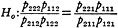
and asserts that the variate has the same distribution with respect to cities for all sexes (or sexes for all cities). This hypothesis affords the basis for a test which we shall term a test of “interaction,” or more specifically, the “interaction of sex with city (or city with sex).” Non-significance at this level does not imply no effect of sex or city, but merely that the effect of city is the same over all sexes (or sex over all cities). The degrees of freedom associated with this test are 1, or for the general case (r-1) (s-1). This use of the term interaction appears to be due to Bartlett (1935).
(4) and (5) The influence of sex on the variate for each city, or the influence of city on the variate for each sex.—Under this comparison we are concerned with whether the variate is homogeneously distributed over sexes for each city (or cities for each sex). It is important to note that the null hypotheses, which are
H0:pi1k=pi1.p.1k
and
pi2k=pi2.p.2k
or
p1jk=p1j.p1.k
and
p2jk=p2j.p2.k,
where now

do not specify that the variate must have the same distribution over sexes for all cities (or cities for all sexes). This hypothesis affords the basis for a test of the effect of city (or sex) on the variate for each sex (or city). There can be as many such tests as there are sexes (or cities). The degrees of freedom associated with each test are 1, or in general (r1-1), (r2-1), etc., where r1=r2=. . .=r. The X2's associated with these individual tests are additive; the sum, however, confounds “main effects” and “interaction.”
(6) and (7) The variate with sex, or the variate with city.—Under this comparison we are concerned with whether the variate is distributed homogeneously over all sexes neglecting cities (or all cities neglecting sexes). The null hypothesis which is
H0:pi.k=pi..p..k
or
p.jk=p.j.p..k
asserts that the variate has the same distribution over the sexes neglecting the cities (or over
cities neglecting sexes). The hypothesis affords a test of the effect of sex (or city) on the variate assuming (1) no main effect of city (or sex), and (2) no interaction between sex and city. This we shall term a “main effects” test. The degrees of freedom associated with this test are 1, or in general (r-1) or (s-1).
We shall now turn our attention to the appropriateness of these tests as illustrated by the analyses of the Japanese data. Essentially we are concerned with testing (1) whether sex has an effect on our variate independent of cities, (2) whether city has an effect independent of sex, and (3) whether the effects of sexes and cities can be considered independently. Or, to use the language of the analysis of variance, we are concerned to measure (1) the main effect due to sexes, (2) the main effect due to cities, and (3) the interaction of sex with city. The procedure for testing, which we shall outline as it would occur in the three-way table we have used for illustrative purposes, is quite general and can be extended to an n-way table. The procedure is as follows:
-
Test the hypothesis of “no interaction” of sex and city with the variate.
-
If the hypothesis of “no interaction” is accepted, then
-
Test the hypothesis of “no main city effect,” ignoring sex.
-
If the hypothesis of “no main city effect” is accepted, then test the hypothesis of “no main sex effect” ignoring city.
-
If this hypothesis is also accepted, then we may accept the general hypothesis of no main effects and no interaction.
-
If the hypothesis of “no main city effect” (ignoring sex) is rejected, then a test of the sex effect may be influenced by the city differences. We are free to test the hypothesis of “no main sex effect” ignoring city only if cities are equally or proportionally represented among the sexes. If this does not obtain, that is, if the cities are disproportionately represented among the sexes, then any differences in sex when city is ignored are apt to be attributable to the differences between cities. Unless these city differences are taken into account, a test of the effect of sex confounds the effect of city. One possible way of getting around this problem is to consider the hypothesis of “no main sex effect” at each city level. The test of this hypothesis is a X2 which is the sum of the X2 tests at each city level, with appropriate degrees of freedom (the sum of the individual tests). We shall term this test the “sum test” of sexes. This test will answer the question “Is there a main effect of sex on the variate, assuming no interaction of sex with city but a possible contribution of city?” By this procedure we may pick out the levels of city which contribute most heavily to the total X2. We will refer to this test as a test of the sex effect adjusted for cities, the “adjustment” being merely a consideration of the sex effect at all possible levels of cities. In the absence of an interaction, this will be our best test of the sex effect.
-
If the hypothesis of “no sex effect” ignoring cities is rejected, we follow the same procedure as outlined in (d).
-
If both hypotheses, namely, “no main city effect” and “no main sex effect,” are rejected, we follow the procedure outlined in (d) for both effects. This would yield two sets of tests. It is important to note that the X2 and degrees of freedom are additive within sets but not between sets.
-
If the hypothesis of “no interaction” is rejected, then the tests of sex ignoring city, and of city ignoring sex may be biased. Accordingly, our procedure will be as follows:
The effect of sex will be evaluated at each level of city, and city at each level of sex. Here, however, the “sum test” obtained by the addition of the two X2 tests of sex (one for each city) or the two X2 tests of city (one for each sex) is not a meaningful test of the main effect due to sex or city. This stems from the fact that the presence of an interaction reveals a significant inconsistency in the direction of the effect of the ways of classification on the variable. Otherwise stated, the “sum test” as a test of main effect is not meaningful because it confounds interaction.
In Chapter V, and in the chapters to follow, we have adopted the convention of indicating (1) each of the individual tests whenever adjustment is necessary, and (2) the “sum test” only when the “no interaction” hypothesis is accepted.
The adjusted tests in 2 (d), (e), and (f) above are somewhat analogous to adjusted tests in the analysis of variance in the sense that
though the degrees of freedom are additive, the X2's are not. Thus in (d) we will have
|
Source |
DF |
|
city (unadjusted) |
(s-1) |
|
sex (adjusted) |
s (r-1) |
|
Total |
(rs-1) |
and for (e) we will have
|
Source |
DF |
|
sex (unadjusted) |
(r-1) |
|
city (adjusted) |
r (s-1) |
|
Total |
(rs-1) |
In the n-way classification, the interaction hypotheses are more numerous. For example, in a four-way table with dimensions h, i, j, and k, we have
“First order interactions”
-
h on k among i
-
h on k among j
-
i on k among j
“Second order interactions”
-
h on k among i among j.
While the procedure for testing outlined in the previous pages can be so extended that our initial test is a test of “no second (or higher) order interaction,” we shall in the analysis to follow assume, in general, that all interactions higher than the first are not significant. The validity of this assumption can, of course, be questioned. In the event that serious ambiguity in the interpretation of “main effects” or “first order interactions” might arise through ignoring the higher order interactions, then the second order interactions will be explored. In view of the great amount of labor involved in the calculation of the first order interactions, involving in this case simultaneous cubic equations with one unknown for each degree of freedom, the Michigan Digital Automatic Computer has been utilized.
The above outlined procedures are, obviously, not the only possible approaches to these data. However, the logical basis for some of the alternative, simpler methods, such as Brandt's factorial chi-square, have not been set out in detail in the statistical literature. Other alternatives which will find favor in some quarters are (1) to transform the attribute data and employ an analysis of variance on the transformed variate (see Eisenhart, 1947, or Rao, 1952), or (2) to attempt a regression form of analysis of the indicator on dose of irradiation. With regard to the latter, we believe this approach is fraught with danger for at least two reasons. Firstly, the estimates of average dose in each of the five categories of parental exposure are most tenuous, and secondly, even if these estimates are reasonably reliable the distribution of doses within a given category of exposure is unknown. In the latter connection, it seems most probable that in many, if not all, exposed cells the median dose will be less than the mean dose (judging from the distance distribution of survivors). Be that as it may, for the data to follow on sex ratio, malformation, stillbirth, and neonatal death, one or more of these alternative methods of analysis was routinely performed. Since these alternatives did not give rise to results differing substantially from those obtained by the method of Roy and Kastenbaum, the results of the alternative analyses will not be presented.
The use of chi-square as a test of significance in the procedure outlined here requires certain assumptions regarding the distribution of X2 where

and where xi and mi are respectively the observed number in a cell and the expected number based on some null hypothesis. Cochran (1952) has discussed these assumptions in considerable detail, and has formulated a number of operating rules regarding the minimum expectation in a cell. One of these rules, on which we shall draw heavily, is concerned with tables with more than 1 degree of freedom and some cells with expectations greater than 5. Cochran asserts that X2, without correction for continuity, is a satisfactory approximation in this instance. In instances where the expectation in a cell was less than two, the effect of this cell on the total chi-square was carefully noted. When the total chi-square was significant and due in large measure to a single cell with an unusually small expectation, an alternate scheme of classification was employed to increase the expectation in the various cells.
6.6 The analysis of the measurement data.— In general, in the analysis of the measurement data, that is, the data with respect to birthweight and the anthropometric measurements obtained at 9 months of age, we have had occasion to
employ three common statistical procedures, namely, the analysis of variance, the analysis of covariance, and the analysis of dispersion. As is frequently true when one passes from a theoretical consideration of a test of significance to the application of such a test to a body of data, certain of the assumptions underlying the test cannot be met in the strict sense. It seems appropriate, therefore, that we consider the assumptions underlying the tests here employed, indicating where the data do not or may not satisfy the assumptions, and then to discuss briefly the variations of the basic tests necessary to meet certain problems posed by these data.
Firstly, let us consider the analysis of variance when there exist multiple ways of classification. In the classical test of the significance of the differences in a set of k means associated with a main effect, we make four basic assumptions in order to test the null hypothesis that m1= m2=...=mk, namely,
-
that the observations in a cell (for all cells) are values of random variables distributed about a true mean which is a fixed constant;
-
that the true cell means are simple additive functions of the corresponding marginal means and the general mean;
-
that the observations are uncorrelated, and have equal variances; and
-
that the observations are jointly distributed in a multivariate normal distribution.
For a detailed consideration of these assumptions the reader is referred to Eisenhart (1947); we shall concern ourselves merely with the validity and importance of these assumptions as they bear on the Japanese data. Assumption (1) needs no comment since it is basic to any statistical analysis, in a sense, and is merely an assertion that we are dealing with random variables. Assumption (4), which to some extent impinges on assumption (1), is probably not strictly satisfied in the Japanese data. In general, it has been found that variables such as height, weight, etc., are non-normal; however, the departure from normality is generally not sufficient to jeopardize seriously the validity of the test. Moreover, the analysis of variance is known to be very insensitive to non-normality (see Box, 1953). From the purely practical standpoint, assumptions (2) and (3) are the most troublesome. Assumption (2), the assumption of additivity, disallows the possibility of interactions. Alternatively stated, if additivity does not prevail then we assert that there are interactions between the ways of classification ; however, when additivity does not prevail, we can still obtain a test of the main effects. The principal effect of non-additivity rests in the alteration of the model from which the effects of classification are estimated, and the generalizations of which the new tests will admit. As an illustration, suppose we have a variable, xij, which we shall assume is normally distributed. Suppose, moreover, that a given observation can be classified with respect to properties A, and properties B. The additivity assumption asserts then that the expected value of x in the (ij)th cell is
E(xij)=m+Ai+Bj,
that is, that the expected value is a linear function of the true general mean, the effect due to A, and the effect due to B. Alternatively, if additivity does not obtain, then the expectation in the (ij) cell is
E(xij)=m+Ai+Bj+(AB)ij,
that is, the expected value is a function of the general mean, of A, of B, and a function of A and B taken conjointly. In the orthogonal case of the analysis of variance, whichever of these hypotheses obtains, the computation of the sums of squares due to interaction and to main effects remains the same. The difference between the models enters the picture only in the formation of the appropriate variance ratio, and its interpretation. If additivity prevails, then our test of the main effect due to A, say, is the ratio of the mean square due to A to the mean square within cells (error mean square). If additivity does not obtain, then we may make the comparison just stated or we may compare the mean square due to A with the mean square interaction. The former test would permit us to draw inferences with respect to A only over the circumstances which obtain with respect to A in this experiment. The latter ratio would permit us to make broader statements regarding the effect of A. For example, if the effect of mother's exposure was judged by the ratio of the mean square due to mothers to the mean square within cells and if an interaction involving mothers and, say, cities obtained, then we could make statements regarding mother's exposure only with respect to the situation obtaining in Hiroshima and Nagasaki. On the
other hand, if our contrast involved mother's exposure and the interaction of mothers and cities, then our statements with respect to the effect of mother's exposure would apply to other cities subjected to the same exposure conditions experienced by these two cities and where these other cities may be assumed to fulfill the remaining experimental conditions. While both of these comparisons have meaning, in general we shall be concerned with the broadest possible statement regarding mother's effect. It might be noted that the use of the interaction to test main effects is not good when the cell numbers are unequal (either proportionate or disproportionate). For a more complete discussion of this aspect of the analysis of variance the reader is referred to Fisher (1949).
Assumption (3) may be violated because the observations within a cell are correlated, or the variances are unequal, or both. If the variances are unequal and if we are contrasting but two means, we face the classical Fisher-Behrens problem (Fisher, 1939). For our purposes two comments here seem sufficient. Firstly, it is not inconsistent to test the same body of data under the hypothesis that the means are equal and the variances are equal, and under the hypothesis that the means are equal but the variances unequal (the Fisher-Behrens problem). Secondly, the work of Box (1953, 1954 a and b) suggests that the test of the equality of a set of means is not seriously affected if there exists only a moderate inequality of the variances and if the cell numbers are equal (“moderate” envisages an inequality of the variances wherein the larger is three times the smaller). Much larger discrepancies, however, arise if the same moderate inequality exists, and if the cell numbers are markedly unequal. The inequality of the cell entries becomes less important as the differences in the variances diminish. When an inequality in the variances exists in these data, this inequality is small and can be ignored without seriously jeopardizing the inferences which may be drawn from the tests on the means.
Thus far we have considered only tests on the means; needless to say, we shall also be interested in testing the equality of the variances. The assumptions for a valid test of the variances are less numerous. We merely assume that we are dealing with values of a random variable which are normally distributed and uncorrelated. Comparison of the variances of a series of exposure cells has meaning, however, only if all extraneous sources of variation which may be dissimilarly distributed between the exposure cells are removed. To see that this is true will be a matter of prime concern in the succeeding chapters.
The assumptions for a valid test of the equality of variances and means set out in the preceding paragraphs have been phrased in a manner appropriate to the univariate case. By a slight extension, these assumptions are equally valid for the multivariate case wherein we analyze the dispersion of a set of observations. Specifically, in the multivariate case we shall be concerned with testing two hypotheses, namely,
1. The equality of the dispersion matrices of k p-variate normal populations
H0:Σ1=Σ2=...=Σk
and where Σ1 is the variance-covariance matrix in the ith class.
2. The equality of k means for each of p variates for k p-variate normal populations with the same covariance matrix.
H0:ξ1=ξ2=...=ξk.
The ξ1 are now vectors of means.
The approach to these data which we have outlined in this and the preceding section calls, in essence, for the use of so-called “omnibus” or “portmanteau” tests.2 Not all readers will subscribe to this since omnibus tests tend to be less sensitive with respect to a particular comparison than a more specialized test. The primary justification for the omnibus test is, in our minds, the fact that such a test does not require the measure of specification of the alternatives to the null hypothesis required by a more specialized statistical tool. It is our opinion that, with the possible exception of the sex ratio, our knowledge with regard to the types of changes which may arise in human beings consequent to parental irradiation is so poorly understood as to make any real attempt to specify direction of change specious. To some our attitude will seem much too conservative, and for those readers we would point out that the more specialized tool is quite useless under the wrong conditions (Pearson, 1936). Furthermore, since the problem of radiation-induced genetic change in human beings may
|
2 |
An omnibus test is generally defined as one that has good discriminating power with regard to a large variety of alternatives to the null hypothesis. |
well constitute the most important problem in human biology in our generation, we believe quite strongly that at this stage our approach must be an open-minded one which does not draw too heavily in any particulars upon infrahuman data, the more so because of the great gaps which exist at present in comparable observations on laboratory material. The prior specification of a subset of alternatives to the null hypothesis required by a specialized test would imply a greater knowledge of the genetic effects of irradiation on the indicators here studied than we are willing to assume.
6.7 Some further problems.—There remain two more subjects for our consideration regarding the analysis of the measurement data, namely, within-cell heterogeneity and unequal numbers of observations within cells. Firstly, a brief description of what we have elected to term within-cell heterogeneity. It is patent that so long as the observations within a cell represent values of a random variable the observations will be heterogeneous in the sense that they will not all be like-values. The heterogeneity with which we are concerned is not of this variety, but rather the heterogeneity which arises if the observations within a given cell are drawn at random from not one but several normal parent populations. We are concerned with such heterogeneity since it represents a violation of assumption (3) in Section 6.6. Let us consider what may happen when this circumstance prevails. There are two chief aspects of the problem:
-
The parent populations may differ with respect to the mean, with respect to the variance, or with respect to both the mean and the variance.
-
The parent populations may or may not be represented with the same relative frequency in each of the several exposure classes. If the relative frequencies are identical among the several exposure cells, we shall say the heterogeneity is “uniform.”
What now are the consequences of within-cell heterogeneity? Let us tabulate the case:
-
Within-cell heterogeneity with respect to the mean alone.
-
Uniform consequences
-
Inflation of within-cell sum of squares, thus reducing the sensitivity of the test.
-
Usually a departure of the within-cell distribution from normality with possible plurimodality.3
-
-
Non-uniform consequences
-
Those listed for the uniform case.
-
In the event that the within-cell heterogeneity arises from concomitant variation, having nothing to do with irradiation, a spurious heterogeneity of cell means may be observed, or a true heterogeneity of cell means may be concealed.
-
-
-
Within-cell heterogeneity due to variances alone.
-
Uniform consequences
-
Departure from normality (persist-ence of higher cumulants but no plurimodality) .
-
Inflation of within-cell sums of squares, leading, as before, to a reduction in the sensitivity of tests.
-
-
Non-uniform consequences
-
Those listed for the uniform case.
-
In the event that within-cell heterogeneity arises from concomitant variation having nothing to do with irradiation, a spurious heterogeneity of cell variances may be observed, or a true heterogeneity of cell variances may be concealed.
-
-
-
Within-cell heterogeneity with respect to both means and variances.
Consequences
Any or all of those listed above may prevail.
It is thus clear that within-cell heterogeneity may lead to any or all of the following:
-
Departures from normality.
-
Inflation of the within-cell sums of squares with consequent reduction in the sensitivity of statistical tests.
-
Detection of spurious statistical effect—or concealment of true ones, provided
-
the within-cell heterogeneity does not reflect an effect of irradiation itself, but
|
3 |
A discussion of the circumstances under which the combination of Gaussian distributions leads to plurimodality can be found in Harris and Smith (1947). These authors consider the case of but two parent distributions. |
-
rather the operation of some purely concomitant factor or factors, and
-
the relative frequencies with which the several parent populations are represented in each cell are not uniform over all cells.
Clearly, the possibility of within-cell heterogeneity has to be explored in all tests, and wherever important concomitant factors are discovered they must at least be shown to exert a uniform effect or else be incorporated into the analysis. To ignore a concomitant variable uniformly distributed among the exposure groups assumes, of course, that the uniformly distributed variable does not interact with a variable which may be non-uniformly distributed, and the inflation of the error sums of squares is negligible. This topic will be discussed again in connection with the analysis of birthweight and anthropometric data.
The analysis of variance (or dispersion) is, as a general rule, computationally simple and interpretively straightforward when the number of observations within a cell is the same for all cells, or when the number within the cell is proportional to the marginal totals. This situation is often referred to as the orthogonal case of the analysis of variance. Not infrequently, the numbers within a cell do not satisfy this stricture of proportionality. When this occurs, the addition theorem for sums of squares fails and the usual computational procedures for the analysis of variance do not yield valid tests of main effects or interactions. There exist, however, a number of techniques which are appropriate to this situation, among them being the method of expected subclass numbers (Snedecor and Cox, 1935; see Snedecor, 1946), the method of weighted means (Yates, 1934), and the method of “fitting constants” (inter alia Wilks, 1938). In our analysis, we shall have frequent occasion to employ the method of fitting constants as described by Wilks, and logical extensions of this method appropriate to the multivariate analysis of dispersion. In the analysis of the anthropometric data we shall employ a procedure devised by Rao (1955) which has the added advantage of permitting one to find the standard errors of differences in the estimated constants. While this technique allows for the fact that the cell numbers are disproportionate it does not create additivity among the tests of main effects or interactions. There is a valid test for any set of main effects which can be used irrespective of the presence of interaction but such tests would confound interaction if present. For a more complete discussion of the problem of unequal cell numbers the reader is referred to Kendall (1946).
In the normal procedure in the analysis of variance for the non-orthogonal case, one would begin by inquiring into the presence or absence of interactions and, frequently, at the same time estimating main effects under the additive assumption. Main effects so estimated provide, as we have mentioned, only approximate tests if an interaction is present. If an interaction is present and a more accurate test is desired, the main effects must be estimated anew from a model in which the interaction is now accounted for. Often, however, approximate tests of the main effects may suffice if the primary concern is to establish heterogeneity between cells and not to inquire exhaustively into the main effects. We have, in Chapter V, frequently settled for approximate tests on the main effects because the presence of an interaction no less than main effects differences reveals heterogeneity between exposure cells.
6.8 The use of exposed persons as controls. —We have indicated that in the analysis of the data with respect to the various indices of radiation damage a variety of tests will be presented. Specifically, we have stated that analysis will be presented in which either (1) concomitant variation is ignored, or (2) major sources of concomitant variation are accounted for. To this list we now shall add a third comparison and indicate its purpose.
It has been stated that each parent of a registered infant has been placed into one of five exposure categories depending upon his or her position relative to ground zero, to the amount of shielding between the parent and the explosion, and to the array of symptoms experienced or not experienced following the bombing. When both parents are considered, then a given registered infant can be assigned to one and only one of twenty-five exposure cells. Unfortunately, the numbers of terminations to parents one or both of whom were in exposure categories 4 or 5 are so small as to necessitate pooling of these exposure categories. Accordingly, in the analysis to follow, an infant will have been assigned to one and only one of sixteen exposure cells wherein the appropriate cell was determined by whether the mother was
in category 1, 2, 3, or 4–5, and similarly for the father.
It will be recalled that exposure category 1 includes those individuals who were not present in Hiroshima or Nagasaki at the time of the atomic bombings. In Chapter V we have advanced reasons for doubting whether category 1 parents afford an entirely valid comparison with those parents who experienced some measure of exposure to the bombs. If exposure 1 parents are not an “adequate control,” then the only meaningful comparison which can be made to determine the effects of irradiation on our indices of genetic damage would be a comparison involving only those infants where both parents were present in the city at the time of the detonation of the bomb. Moreover, even if one accepts the validity of the comparison utilizing category 1 parents, a real irradiation effect would also lead to differences among the terminations to 2, 3, and 4–5 parents. For these two reasons, in the analysis of the indicators there will be presented two analyses, one wherein the parents one or both of whom are in category 1 are excluded, and one where they are included. It should be pointed out at this juncture that the differences which we can detect by statistical procedures are largely a function of sample number. Accordingly, it may be that differences demonstrable in the 4 x 4 comparison including category 1 parents will not be demonstrable in the 3 x 3 comparison excluding these parents solely because of the curtailment of sample size occasioned by the exclusion of the category 1 parents. The differences among the remaining exposure cells brought about by exposure, while no longer significant, should, of course, persist even following exclusion of the category 1 parents.
6.9 Presentation of material.—It would be highly desirable in a problem of this nature to present in detail the tabulations on which the various analyses are based. However, these tabulations are extremely bulky, requiring, even for presentation in a somewhat condensed form, an estimated 1,000 pages. Moreover, because of differences in statistical approach, many investigators might wish for tabulations other than those presented. Under the circumstances, it would seem that the matter of making available the raw material of this study is best met by the following procedure: the investigator who desires to verify some of the calculations presented in the following chapters, or to explore other lines of analysis, can apply to the Division of Biology and Medicine, U.S. Atomic Energy Commission, or the Committee on Atomic Casualties, National Research Council, for a duplicate set of the IBM cards on which this analysis is based. The investigator must be prepared to meet the costs of duplicating the cards and all shipping charges.
Chapter VII
ANALYSIS OF THE SEX RATIO DATA
THE characteristic for which the most data are available is the sex of the offspring.
7.1 The trait.—Among the various characteristics of the infants examined in connection with this study, sex is undoubtedly that attribute in whose determination there is the smallest margin of error. Although the sexing of prematurely borne infants presents certain well-recognized problems (cf. Tietze, 1948), by the twentieth week of gestation, the earliest at which pregnant women were permitted to register, there is seldom any room for doubt concerning the sex of a prematurely born infant.1
7.2 The genetic argument for radiation-induced changes in the sex ratio.— Lethal mutations, i.e., mutations resulting in the death of the organism sometime prior to reproduction, are an important type of mutation arising in consequence of irradiation of experimental animals. Induced lethal mutations may be dominant or recessive to their normal alleles. Such mutants are of concern to us in this chapter only insofar as they affect the sex ratio. The heterogametic nature of the human male results in (a) a differential distribution to his offspring of his sex chromosomes, and (b) a difference in the dominance relationships between the two sexes. Thus lethal mutations borne on the X-or Y-chromosomes afford ample opportunity for an alteration of the sex ratio. Accordingly, our discussion shall concern itself with this class of mutants, i.e., the X- and Y-borne lethals. Let us examine separately the possible effects on the sex ratio of maternal irradiation, paternal irradiation, and conjoint parental exposure.
Maternal irradiation would be tantamount to the irradiation of X-chromosomes alone. Since there is no differential distribution of the maternally derived X-chromosomes among the offspring, induced sex-linked dominant lethals would be expected to result in comparable reductions in the frequency of male and female births. The same would hold true for all partially sex-linked lethals if such exist. Induced sex-linked recessive lethals would find expression only in the hemizygous male or the homozygous female. The much more frequent occurrence of the former would lead to a greater diminution in male than in female births with a subsequent decrease in the sex ratio. Partially sex-linked lethal genes would result in distortion of the sex ratio within specific families, but at the population level, the sexes would be equally affected. Thus the net effect of maternal irradiation insofar as it affects the sex ratio would appear to be a reduction in the frequency of male births.
In the event of paternal exposure, the situation would be appreciably altered. Induced sex-linked lethal mutants, be they recessive or dominant, would be distributed only to the female. Thus sex-linked lethals arising in the differential segment of the paternal X-chromosome would lead to a reduction in the frequency of female births, or an augmentation of the sex ratio. Similarly, Y-borne lethals would be distributed only to sons of irradiated fathers; however, the evidence for the existence of any Y-borne genes in man is of the poorest order. The net effect of paternal exposure, all types of lethal mutants considered, would be a reduction in the frequency of female births.
If both parents were exposed, the net effect on the sex ratio would presumably be the sum of the parental effects considered separately. Since the effect on the sex ratio is different and in opposite directions for the two parents, it
|
1 |
Because of unavoidable uncertainties in determining the duration of gestation, a few women may have registered prior to the twentieth week of gestation. However, the contribution of infants of less than twenty weeks of gestation in age to the sex ratio may be regarded as negligible. Sex ratio is here defined as the proportion of male births among all births. |
would appear that if both parents were exposed there would be either no appreciable effect on the sex ratio, or if an effect existed it would be at the expense of the males. The latter is conceivable because sex-linked recessive lethals are more frequent in occurrence than sex-linked dominant lethals.
So far as irradiation effects are concerned, the sex ratio is unique among the indicators of genetic damage. Its uniqueness arises from the fact that, as has been indicated, maternal exposure would be expected to produce an effect different from paternal exposure.
7.3 Concomitant variation influencing the indicator.—Before we turn to a consideration of the data regarding the effect of parental exposure on the sex ratio, a brief consideration of the sex ratio as a variable is indicated. While it is true that in some respects the sex ratio may be the most specific of the indicators of genetic damage herein studied, in other respects it is a less satisfactory variable. A variety of factors have been alleged to influence the outcome, with regard to sex, of a pregnancy. Among these factors are maternal age (Lowe and McKeown, 1950), paternal age (Novitski, 1953), birth order (Ciocco, 1938), race (Strandskov, 1945), urban versus rural origin of the parents (Ciocco, 1938), and social strata (Bernstein, 1948). In the main, the effects of these variables are small. For example, Ciocco (1938) has shown that the difference in the sex ratio between first and fifth or higher born children is the difference between 0.5153 and 0.5124. The relationship in these data between maternal age and parity, on the one hand, and sex ratio, on the other hand, is illustrated in Figures 7.1 and 7.2. The fact that these concomitants exert such small effects and the difficulty in classifying some of them, has led us not to attempt any adjustment for maternal age, paternal age, birth order, social strata, or origin of the parents in the Japanese data.
7.4 The data.—In Table 7.1 are given the frequencies of male births by parental exposure and cities. Inspection of this table reveals no striking differences in the sex ratio among the classes of parental exposure. The analysis of these data is given in Tables 7.2a and 7.2b. Analysis fails to reveal a significant effect of cities, mother's exposure, or father's exposure, and there exists no evidence from the interactions of significant heterogeneity among these data.
As we have previously indicated, the sex ratio is the one indicator of irradiation damage wherein genetic theory specifies, with the greatest precision, the direction of change anticipated if irradiation exerts an effect on the sex ratio. Accordingly, we may ask what these data would show under a more restrictive set of alternatives to the null hypothesis, that is to say, under a one-tailed significance test. This alternative
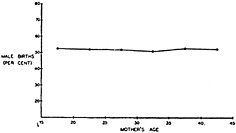
FIGURE 7.1—The distribution of the frequency of male births by age of mother at the birth of the infant with parity ignored.
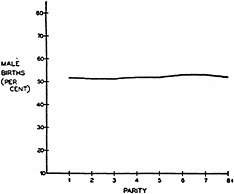
FIGURE 7.2—The distribution of the frequency of male births by parity with maternal age ignored.
analysis could proceed as follows: it may be argued that (1) the genetic effect of irradiation mediated through exposed mothers would be greater than that mediated through exposed fathers and hence the status of the father's exposure may be disregarded without undue loss of information. It may be further argued that (2) the absence of evidence for heterogeneity between cities permits pooling the observations from the two cities. Finally, (3) we have advanced reasons for believing that parents who were unexposed may not be in pari materia
TABLE 7.1 THE FREQUENCYOF MALE BIRTHSBY PARENTAL EXPOSUREAND CITY (Unrelated parents)










with parents who were exposed, and therefore terminations occurring to mothers who were unexposed should be rejected. If now we proceed on these three assumptions we may test whether the sex ratio is lower among the offspring of all mothers in exposure classes 3, 4, and 5 than it is among the offspring of all mothers in exposure class 2. The pooling of exposure class 3 with 4 and 5 serves to increase the number of observations which may be brought to bear on the question of a maternal exposure effect, and may be interpreted as a conservative step since it lowers the mean dose in the “heavily” exposed group. The results of such a comparison are presented in Table 7.3 (Comparison 1) from which we note a X2=3.925 which on a one-tailed test of significance corresponds to a probability level of 0.02. There may, then, be an effect of maternal exposure on the sex ratio. We could now ask whether there exists ancillary evidence which may shed light on the reality of this observed difference.
TABLE 7.2 CHI-SQUARE ANALYSISOF THE FREQUENCYOF MALE BIRTHSBY CITYAND PARENTAL EXPOSURE (Unrelated parents)


Let us consider first what may be termed the “internal” evidence, that is to say, evidence which can be obtained from further analysis of the data given in Table 7.1. To this end four other comparisons are given in Table 7.3. These comparisons are as follows (the numbers correspond to the numbers given in Table 7.3): a comparison of the sex ratio among terminations occurring to (2) mothers in class 2 with mothers in classes 3, 4, and 5 but eliminating all those observations where the father was unexposed, (3) mothers in class 2 whose spouses were unexposed with mothers in classes 3, 4, and 5 whose spouses were also unexposed, (4) mothers in class 2 whose spouses were unexposed with mothers in class 2 whose spouses were exposed, and lastly (5) mothers in class 2 with mothers in classes 3, 4, and 5 but eliminating the single cell where mothers were in class 2 and had unexposed spouses, i.e. the M2F1 cell. The arguments underlying these comparisons and the results obtained are as follows:
Comparison 2: The exclusion of mothers in class 1 is based on the assumption that this group is not comparable to groups 2 to 5 with regard to a number of concomitants, including age of mother, parity, and origin. From Tables 5.3 and 5.6 it should be noted that exclusion of mothers in class 1 alone leaves a series of cells, namely, mothers 2, 3, 4, and 5 and fathers 1, in which the mothers are clearly younger and have had fewer pregnancies, on the average, than is true of the mothers in the remaining exposure cells. While the effect of parity and maternal age on the sex ratio is certainly not striking, what effect there is suggests that younger mothers have a higher proportion of male births, and that first parities more frequently terminate in male infants (Ciocco, 1938). In this connection, it is interesting to note that in both cities one of the highest sex ratios among the numerically large cells occurs in that cell where the mothers are the youngest and have had the fewest pregnancies (the mothers 2-fathers 1 cell). It would be informative, then, to know whether a significant difference would obtain if the differences in maternal age and parity were further reduced by eliminating those cells in which the fathers were unexposed. Comparison 2 in Table 7.3 affords information on this point. We find not only no significant difference when unexposed fathers are rejected but also that the absolute value of the difference is smaller than that obtained when unexposed fathers were included in the comparison. The direction of the difference is, however, still consistent with the genetic argument. It may, of course, be argued that the lack of a
significant effect in this comparison is not unexpected because of the depletion of the sample, and the fact that the absolute difference is smaller could merely reflect an effect of fathers.
Comparison 3: The comparison which would maximize an effect due to mother's exposure if the effect of father's exposure was not negligible would be a comparison of the sex ratio among the children of mothers in class 2 whose hus bands were unexposed with the ratio among the children of mothers in classes 3 to 5 whose husbands were also unexposed. Moreover, from Tables 5.3 and 5.6 we note that these cells are not too dissimilar with regard to mean maternal age and parity. This comparison results in a X2=4.937, which is clearly significant. The occurrence of a more striking difference here than in comparison 1 could be interpreted as indicating that the effect of father's exposure is not negligible.
TABLE 7.3 SELECTED COMPARISONS REGARDINGTHE EFFECTOF IRRADIATIONON SEX-RATIO(See text for assumptions underlying the selection of comparisons. )















Comparison 4: If the effect of father's exposure is not negligible, as the preceding comparison might suggest, we could appraise this effect by holding mother's exposure constant (class 2) and then contrasting the offspring of unexposed fathers with those of exposed fathers. This should give rise, on genetic theory, to a higher sex ratio among the children of exposed fathers than among unexposed fathers. From comparison 4, however, we note that the direc tion of change is opposite to hypothesis, but this difference is not significant. The comparison does, however, raise questions as to the validity of using as a “control” the mothers 2-fathers 1 data. The latter is further borne out by a comparison of M2F1 with M2F2 wherein we would expect no differences, whereas we find a striking though not significantly increased sex ratio in the M2F1 cell (X2=3.221).
Comparison 5: Comparison 4 leads one to conclude that it would be informative to con trast the sex ratio when mothers are in class 2 with mothers in classes 3 to 5 but eliminating the single cell in which the mothers were 2 and the fathers were unexposed. When this is done, a non-significant difference results. This further suggests the critical role played by the rejected
cell in the tests of significance. At this point it seems appropriate to introduce evidence on the sex ratio available from the Japanese vital statistics which further imply the occurrence of an inexplicable inflation of the sex ratio in the mothers 2-fathers 1 cell. In Table 7.4 are given the national average sex ratio and the average sex ratio for Hiroshima and Nagasaki for the period 1935–1952. In terms of numbers of males per 100 females we note that at no time during the period 1935–1952 do the combined city averages or the national average equal, much less exceed, the 109.7 found in the M2F1 cell.2 The sex ratio obtaining in Kure during the years 1948–1950 was 0.5133 or 105.4 males per 100 females, a figure also lower than that observed in the M2F1 cell. It should be noted, however, that the data from “heavily” exposed mothers deviate from the national average as well as the city averages in the manner anticipated by genetic theory.
Let us turn now to the “external” evidence bearing on the difference we have been discussing, namely, the evidence afforded by comparisons other than those arising from Table 7.1. Several sources of evidence are pertinent here, namely, the stillbirth data, the early termination data, and the sex ratio among births occurring prior to the period covered by the Genetics Program.
If the depression of the sex ratio observed among terminations to “heavily” exposed mothers is due to induced sex-linked lethal genes, then we might logically expect to find evidence of increased male mortality among stillborn infants or among pregnancies terminating before 21 weeks of gestation. In this connection, it is interesting to note that the sex-mother interaction in Table 9.5 (the stillbirth data) reveals no evidence of heterogeneity among the sexes with regard to mother's exposure. We have previously stated (Sec. 2.8) that an attempt was made to obtain data on pregnancies terminating before 21 weeks of gestation. We have further stated that because these data are deficient in a number of respects they will not be presented in this report. However, for what it is worth, a preliminary analysis of these data failed to reveal evidence that “heavily” exposed mothers more frequently abort or miscarry male infants than do unexposed or “lightly” exposed mothers. If, then, one accepts the observed “exposure effect” as real, it is necessary to postulate that the induced sex-linked lethals are either gametic lethals or act so early in embryogenesis that the affected feti are resorbed or ejected at a time when the sex of the abortus cannot be readily determined.
Finally, when in a preliminary analysis of the data in 1953 it seemed likely that a significant relationship between maternal exposure and the sex ratio might exist, an effort was made to collect and scrutinize other data which would bear on this relationship. To this end, data were gleaned from the records of the Genetics Program as well as other ABCC records pertinent to the sex ratio among births occurring in Hiroshima and Nagasaki following the atomic bombings but prior to the inception of the Genetics Program.
The data to be presented in this section were collected from the histories of reproductive performance prior to approximately June, 1948 obtained on:
-
Those women who had been delivered of a registered or unregistered infant in the years 1948–1952 and known to ABCC through the Genetics Program. This information was available on only those parents who had produced a child on whom a “Genetics Long Form” was available (see Sec. 2.2).
-
All adults seen by the Commission under Project ME-55 (a random sample of adults exposed at distances of less than 2,000 meters and their controls).
-
Those women who had reported a spontaneous abortion and were seen under the study of early terminations mentioned in Section 2.8.
These three sources of data were cross-referenced to prevent duplication. In all, information was obtained on 8,824 pregnancies terminating between April, 1946 and approximately June, 1948. The former date was selected to avoid inclusion of pregnancies wherein the fetus might have been exposed in utero, and the latter date was so chosen as to prevent overlapping of these data with the Genetics Program. The sex of these infants is given in Table
|
2 |
It should be noted that the data in Table 7.4 represent only liveborn infants. Since the data presented in Table 7.1 are for all births, and since there is a relative excess of males among stillbirths, the sex ratios given in Table 7.4 are not strictly comparable with those in Table 7.1, being biased in a downward direction. It seems unlikely that allowance for this bias would bring the M2F1 cell findings in line. |
TABLE 7.4 NATIONAL STATISTICSOF LIVEBIRTHS, 1935–1952
|
All Japan |
Hiroshima City |
Nagasaki City |
Hiroshima and Nagasaki combined |
|||||||||
 |
 |
 |
 |
|||||||||
|
Year |
Total births |
Males |
Sex-ratio |
Total births |
Males |
Sex-ratio |
Total births |
Males |
Sex-ratio |
Total births |
Males |
Sex-ratio |
|
1935 |
2,190,704 |
1,122,867 |
105.2 |
7,261 |
3,724 |
105.3 |
5,503 |
2,869 |
108.9 |
12,764 |
6,593 |
106.8 |
|
1936 |
2,101,969 |
1,076,197 |
104.9 |
6,831 |
3,502 |
105.2 |
5,499 |
2,790 |
103.0 |
12,330 |
6,292 |
104.2 |
|
1937 |
2,180,734 |
1,116,154 |
104.8 |
7,066 |
3,681 |
108.7 |
5,821 |
2,989 |
105.5 |
12,887 |
6,670 |
107.3 |
|
1938 |
1,928,321 |
990,888 |
105.7 |
6,077 |
3,128 |
106.1 |
5,671 |
2,880 |
103.2 |
11,748 |
6,008 |
104.7 |
|
1939 |
1,901,573 |
973,744 |
104.9 |
6,292 |
3,225 |
105.1 |
6,515 |
3,381 |
107.9 |
12,807 |
6,606 |
106.5 |
|
1940 |
2,115,867 |
1,084,282 |
105.1 |
7,466 |
3,823 |
104.9 |
6,871 |
3,506 |
104.2 |
14,337 |
7,329 |
104.6 |
|
1941 |
2,277,283 |
1,165,437 |
104.8 |
9,039 |
4,666 |
106.7 |
8,262 |
4,213 |
104.0 |
17,301 |
8,879 |
105.4 |
|
1942 |
2,233,660 |
1,145,068 |
105.2 |
8,720 |
4,548 |
109.0 |
7,775 |
3,955 |
103.5 |
16,495 |
8,503 |
106.4 |
|
1943 |
2,267,292 |
1,163,000 |
105.3 |
9,111 |
4,618 |
102.8 |
7,735 |
3,930 |
103.3 |
16,846 |
8,548 |
103.0 |
|
1944 |
2,171,621 |
1,112,778 |
105.1 |
— |
— |
— |
— |
— |
— |
— |
— |
— |
|
1945 |
1,677,620a |
— |
— |
— |
— |
— |
— |
— |
— |
— |
— |
— |
|
1946 |
1,922,383 |
993,515 |
107.0 |
— |
— |
— |
— |
— |
— |
— |
— |
— |
|
1947 |
2,678,792 |
1,376,986 |
105.8 |
6,696 |
3,548 |
112.7 |
4,841 |
2,461 |
103.4 |
11,537 |
6,009 |
108.7 |
|
1948 |
2,681,624 |
1,378,564 |
105.8 |
— |
— |
— |
— |
— |
— |
— |
— |
— |
|
1949 |
2,696,638 |
1,380,008 |
104.8 |
7,941 |
4,154 |
109.7 |
9,137 |
4,716 |
106.7 |
17,078 |
8,870 |
108.1 |
|
1950 |
2,337,507 |
1,203,111 |
106.0 |
7,032 |
3,620 |
106.1 |
8,088 |
4,227 |
109.5 |
15,120 |
7,847 |
107.9 |
|
1951 |
2,137,689 |
1,094,641 |
104.9 |
6,409 |
3,349 |
109.4 |
7,856 |
4,095 |
108.9 |
14,265 |
7,444 |
109.1 |
|
1952 |
2,002,254 |
1,026,611 |
105.2 |
5,974 |
3,073 |
105.9 |
7,551 |
3,859 |
104.5 |
13,525 |
6,932 |
105.1 |
|
Total |
37,825,911 |
19,403,851 |
105.3 |
101,915 |
52,659 |
106.9 |
97,125 |
49,871 |
105.5 |
199,040 |
102,530 |
106.2 |
|
aNot included in total. |
||||||||||||
7.5 where the terminations are distributed by city and parental exposure.
The exposure categories given in Table 7.5 are different from those presented elsewhere in this report, being the categories in use during the preliminary analysis. No attempt has been been made to take into account shielding due to slight differences in the way in which the three different segments of the data were collected. The radiation categories are here defined as follows:
-
Not exposed, i.e., not present in the city at the time of bombing.
-
Exposed, no symptoms, over 2,545 meters from the hypocenter.
-
Exposed, no symptoms, 1,845–2,544 meters from the hypocenter.
-
Exposed, no symptoms, 1,844 or less meters from the hypocenter.
-
Exposed, symptomatic, i.e., reporting epilation and/or petechiae and/or gingivitis.
TABLE 7.5 THE FREQUENCYOF MALE BIRTHS AMONG INFANTS BORN AFTER APRIL, 1946 BUT PRIORTO JUNE, 1948, BY PARENTAL EXPOSURE





It should be noted that the average exposure in categories A, B, and E will be essentially unchanged from those in categories 1, 2, and 5. But the average exposure in categories C and D will be less than those in 3 and 4.
Inspection of these data, to the extent that trends are apparent, reveals exposure differences which are diametrically opposed to those seen in Table 7.1. The changes observed with respect to both maternal and paternal exposure are contrary to those predicted by the genetic hypothesis. The analysis of these data (see Table 7.6) reveals no significant interactions, an effect of city, but no effect of maternal or paternal exposure.
The actual worth of these data is conjectural. All of the information is anamnestic, and the misreporting of the sex of an infant, particularly those who were stillborn or who died at an early age, is a very real possibility.
The preceding paragraphs serve to point up two items of general interest. Firstly, they indicate the interpretive difficulties which arise when one begins to select specific cells or groups of cells on which to base comparisons. Secondly, they serve to indicate that while an elegant genetic argument can be advanced for expecting changes in the sex ratio consequent to parental
TABLE 7.6 CHI-SQUARE ANALYSISOF THE FREQUENCYOF MALE BIRTHS AMONG INFANTS BORN AFTER APRIL, 1946 BUT PRIORTO JUNE, 1948
|
Source |
DF |
X2 |
P |
|
Total |
17 |
228.999 |
<.001 |
|
Interactions, first order |
|||
|
CM |
2 |
1.034 |
.50–.70 |
|
CF |
2 |
0.700 |
.70–.80 |
|
MF |
4 |
8.848 |
.05–.10 |
|
Main effects |
|||
|
Cities |
1 |
5.347 |
.02–.05 |
|
Mothers |
|||
|
Hiroshima |
2 |
1.035 |
.50–.70 |
|
Nagasaki |
2 |
3.559 |
.10–.20 |
|
Sum |
4 |
4.594 |
.30–.50 |
|
Fathers |
|||
|
Hiroshima |
2 |
4.168 |
.10–.20 |
|
Nagasaki |
2 |
0.616 |
.70–.80 |
|
Sum |
4 |
4.784 |
.30–.50 |
exposure, the sex ratio, as a variable, leaves much to be desired. A voluminous literature purports to show any number of factors which can alter the sex ratio; adequate explanation for the peculiar variations which occur in the sex ratio due to those factors have not been advanced.
In view of the unsatisfactory state in which we find ourselves with regard to the effect of parental irradiation on the sex ratio, data continue to be collected in Japan which are pertinent to this problem. The present findings fail to confirm unequivocally the apparently significant effect of exposure on sex ratio reported in a preliminary note (Neel et al., 1953), although the direction of the observed effect remains the same. Among possible reasons for the disparity the following should be considered: (1) the different (improved) classification of parental exposure employed in the present analysis, (2) the superior statistical techniques which have become available since that preliminary report, and (3) the accumulation of additional data.
It is worth noting that the direction of deviation among the cells is generally consistent with that to be expected from genetic theory, namely, a reduction in the sex ratio with increasing maternal exposure, and an augmentation of the sex ratio with increasing paternal exposure.
7.5 Summary.—No significant association between sex ratio and parental exposure is demonstrable in either the comparison involving non-exposed parents or in the comparison among differing classes of parental exposure. The direction of deviation is, in general, consistent with the genetic hypothesis.
Note added in proof.—Since the previous portion of this chapter was written it has been possible to bring certain additional evidence to bear on the question of an altered sex ratio. Briefly, the source of this evidence is as follows: When in 1953 it was decided that the Genetics Program should be terminated for the reasons advanced in Section 2.11, there existed some question as to whether or not the sex ratio had been significantly altered among the pregnancies occurring to exposed parents. It seemed desirable that additional observations be made with regard to the sex of infants being born to exposed and nonexposed parents in Hiroshima and Nagasaki. Through the cooperation of the municipal authorities, during 1954 and 1955 access was obtained to the birth records on both live and stillborn infants. From these records the requisite information to identify the infant as well as his or her parents was copied along with the weight of the child, the sex, and place in sibship. Parental exposure was secured from (1) the master file on exposed individuals maintained by the ABCC, or (2) a home visit if one or both parents were not listed in the master file. In the years 1954 and 1955 there were 22,710 births concerning which, during 1954, 1955, and the early part of 1956, it was possible to obtain the information listed above. These data, which are presented in Table 7.7, were analyzed during the summer of 1956. The series is continuous with that previously reported; no infant is recorded in both sets of data.
In Table 7.8 are presented the results of an analysis of the combined data, that is, of the data available for 1948–1955. From the latter table we note that when all exposure cells are considered there is no evidence of heterogeneity between the two sets of data nor evidence for a parental exposure effect. When those infants one or both of whose parents were unexposed are excluded, a somewhat different situation obtains. We note a significant difference in the sex ratio between the two sets of data with male births being somewhat more common in 1954–1955. Since none of the interactions involving time is significant, there is no evidence that this increase is at the expense of a particular city or parental exposure. The “sum” test is, therefore, a valid measure of the effect of parental exposure on the sex ratio. Neither father's nor mother's exposure can be shown to exert a significant effect.
It is particularly interesting to examine the combined data under those assumptions given in Section 7.4, Comparisons 1 and 3, which gave rise to a significant effect of mother's exposure on the sex ratio. If in the combined data father's exposure is ignored, mother's exposure classes 3, 4, and 5 are pooled, and those infants whose mothers are in exposure class 1 are rejected, no significant effect of mother's exposure can be demonstrated (X2=1.634, DF=1, and the probability on a one-tailed test is greater than 0.10). This is, of course, at variance with the findings for the 1948–1953 data given in Section 7.4. Stated in terms of regression analysis, if sex ratio is regressed on “mean” maternal exposure using as the estimated doses 8, 60,
TABLE 7.7 THE FREQUENCYOF MALE BIRTHSBY PARENTAL EXPOSUREAND CITY 1954–1955: UNRELATED PARENTS









and 200 reps for exposure categories 2, 3, and 4–5 respectively, one obtains a regression coefficient equal to -0.55%/100 reps for the combined data and -0.81%/100 reps for the 1948–1953 data alone. The former is not significantly different from zero even on a one-tailed test whereas the latter is significant at the 5 per cent level if a one-tailed test is used. The net effect of the 1954–1955 data is, then, to render more questionable the occurrence of a significant effect of parental exposure on the sex ratio in the Hiroshima-Nagasaki data.
TABLE 7.8 CHI-SQUARE ANALYSISOF THE FREQUENCYOF MALE BIRTHS DURING THE YEARS 1948–1955 BY TIMEOF BIRTH, CITY, AND PARENTAL EXPOSURE: UNRELATED PARENTS. TWO INTERVALSOF TIMEARE RECOGNIZED, NAMELY, 1948–1953 AND 1954–1955.
|
All exposure cells |
|||
|
Source |
DF |
X2 |
P |
|
Total |
63 |
60.900 |
>.50 |
|
Interactions, First Order |
|||
|
TC |
1 |
0.760 |
.30–.50 |
|
TM |
3 |
4.758 |
.10–.20 |
|
TF |
3 |
4.845 |
.10–.20 |
|
CM |
3 |
1.453 |
.50–.70 |
|
CF |
3 |
1.589 |
.50–.70 |
|
MF |
9 |
3.310 |
.95–.98 |
|
Main Effects |
|||
|
Time (T) |
1 |
1.203 |
.20–.30 |
|
City (C) |
1 |
1.109 |
.20–.30 |
|
Mother (M) |
3 |
2.291 |
.50–.70 |
|
Father (F) |
3 |
1.431 |
.50–.70 |
|
Excluding Parents with Exposure 1 |
|||
|
Source |
DF |
X2 |
P |
|
Total |
35 |
39.421 |
>.25 |
|
Interactions, First Order |
|||
|
TC |
1 |
0.009 |
.90–.95 |
|
TM |
2 |
1.851 |
.30–.50 |
|
TF |
2 |
0.273 |
.80–.90 |
|
CM |
2 |
2.330 |
.30–.50 |
|
CF |
2 |
3.546 |
.10–.20 |
|
MF |
4 |
4.285 |
.30–.50 |
|
Main Effects |
|||
|
Time (T) |
1 |
9.507 |
.001–.01 |
|
City (C) |
|||
|
1948–1953 |
1 |
0.002 |
.95–.98 |
|
1954–1955 |
1 |
0.008 |
.90–.95 |
|
Sum |
2 |
0.010 |
>.99 |
|
Mother (M) |
|||
|
1948–1953 |
2 |
0.082 |
.95–.98 |
|
1954–1955 |
2 |
2.810 |
.20–.30 |
|
Sum |
4 |
2.892 |
.50–.70 |
|
Father (F) |
|||
|
1948–1953 |
2 |
0.126 |
.90–.95 |
|
1954–1955 |
2 |
0.449 |
.70–.80 |
|
Sum |
4 |
0.575 |
.95–.98 |
We are indebted to Dr. Robert Holmes, current director of the ABCC, and Dr. Lowell Woodbury, chief of the Statistics Unit of the ABCC, for their cooperation in connection with these later aspects of the sex-ratio program. We also acknowledge with pleasure Mrs. Jean Okumoto's efficient supervision of the collection of these data.
Chapter VIII
ANALYSIS OF THE MALFORMATION DATA
DATA on major malformations were collected at the examination shortly following birth, and again at the 9-months examination. For the reasons advanced in Section 2.6, it was deemed advisable to consider the results of these examinations separately. Moreover, to permit pooling the information from the two examinations, if such pooling was warranted, all infants found on the “at-birth” examination to have one or more major malformations were excluded from consideration in the analysis of the 9-months data.
8.1 The trait.—In any consideration of the relation of parental irradiation history to the occurrence of major congenital malformations in the offspring, it is of course first necessary to define major congenital malformation. Since there is no absolute dividing line between “major” and “minor” malformation, an attempt to formulate an a priori definition encounters certain difficulties. In actual practice, the examining physicians were required to record all abnormalities, down to and including such variations as minor haemangiomas (excluding the very common occipital-nuchal type) and auricular pits. When the final report on each infant was coded, a decision was made as to the presence of major malformation. Any one type of malformation was consistently coded as either major or minor.
Table 8.1 is a listing of the malformations which in the course of this investigation were coded as major. A discussion of the relative frequencies of the various malformations, and the various combinations in which they occurred, will be presented elsewhere. For our present purposes, then, we shall define major malformation simply as any condition found on that list. Obviously there are many other major congenital malformations which do not appear on that list, simply because they either did not occur in this series, or, if they did occur, were not recognized at birth. This listing deals solely with conditions recognizable at birth by the usual physical examination. A later chapter will deal with autopsy findings.
8.2 Reliability of diagnosis.—A question which arose repeatedly during the course of this study—and which will undoubtedly occur to the reader—concerned the completeness with which the significant malformations occurring in the populations under study were recognized and reported. This question has already been commented on briefly (Sec. 2.6). It should at the outset be made quite clear that no study organized as this one was can be expected to yield an accounting of all significant congenital defects present in the newborn population. Thus, the diagnosis of mental defect, or severe visual or hearing loss, is notoriously unreliable during the first several months of life. From the standpoint of the present study, while for obvious reasons one should strive for as high a level of diagnostic accuracy as possible, the primary danger to be guarded against is that different diagnostic standards obtain for the various segments of the population under study. There is no reason to believe that diagnostic standards were not uniform with respect to infants in one exposure subclass as compared with infants in another. We have already commented briefly on some of the evidence suggesting that no bias has been introduced by differences in the degree to which various groups cooperated in the study (Sec. 5.7).
It is important to reiterate that each infant recorded in this study, with the exception of a certain number of stillbirths or neonatal deaths, as recorded in Section 2.5, was examined by a Japanese physician. It was recognized from the outset that both the loyalties and training of the midwife were such that she might at times fail to record the obvious. This suspicion was well justified by instances in which a child with
harelip has been reported as normal by the attending midwife. Beginning in early 1950, the mothers of all living infants found to have either a major or a minor malformation in the course of the home visit were invited to bring their children to an ABCC “Verification Clinic” at some convenient time shortly after the diagnosis. Transportation to and from the clinic was supplied by the ABCC. There the child was seen by another Japanese physician and an American physician. Thus, with exceptions primarily occasioned by the disposal of the body of an infant alleged to have a major defect before examination by an ABCC physician, every malformation recognized at birth was verified before the defect was accepted. Prior to early 1951, major malformations were usually verified by a second home visit on the part of either one of the more experienced Japanese physicians or an American pediatrician. An analysis of the results of these home visits and Verification Clinic indicate a high degree of accuracy of
TABLE 8.1 AN ALPHABETICAL LISTINGOF THOSE MALFORMATIONS OBSERVEDIN THIS STUDY WHICH OCCURRING ALONE OR IN COMBINATION WITH ONE ANOTHER WERE GRADEDAS MAJOR CONGENITAL DEFECT
|
Achondroplasia Albinism Amputation, congenital Anencephaly Anonychia Anophthalmos Arthrogryposis Atresia ani or rectum Atresia of the external nares Blepharophimosis Brachydactyly Cataracts Central nervous system defect, severe Claw hand Cleft palate Club foot Coloboma iridis Corneal defect Cryptophthalmia Cystic hygroma Diaphragm, defect of Diastasis recti, severe Dislocations, multiple, congenital Dysplasia of acetabulum, congenital Ectodermal defect, congenital Ehlers-Danlos syndrome Encephalocele Exostosis, severe, of bone External ear, major malformation of Facial cleft, oblique Flexion deformity of fingers and toes Foetus amorphous Foetus papyraceous Funnel chest Gastroschisis Harelip Heart disease, congenital, cyanotic Hemimelus Hydrocephalus |
Hypertelorism Hypospadias, marked Ichthyosis congenita Inguinal hernia (females) Intestinal obstruction,? congenital defect Lymphangioma Macroglossia Major bone, absence of Malformation, complex and ill-defined Microcephaly Micropenis Microphthalmus Microtia Mongolism Neurofibromatosis (von Recklinghausen's disease) Nystagmus, congenital Oligodactyly Omphalocele Polydactyly Polyostotic fibrous dysplasia Polyoty Ptosis of eyelids Pupillary membrane, persistent Radio-ulnar synostosis Recto-vaginal fistula Rhinencephaly Situs inversus viscerum Spina bifida with or without meningocele or myelomeningocele Status Bonnevie-Ullrich Sympodia Syndactyly Synorchism Teratoma Thyroglossal duct, persistent Tumor, type undetermined |
diagnosis for those defects recognized as present.
The crucial question is, how many defects which should have been diagnosed at birth went unrecognized? There are three general approaches to the evaluation of this question which we shall now consider.
(A) The first approach involves a comparison of the frequency of major malformation in our control material with roughly comparable material collected by other investigators. The most extensive and reliable Japanese series to come to our attention is that compiled by Dr. V.Kuji (personal communication) at the Tokyo Red Cross Maternity Hospital. The findings are shown in Table 8.2. The over-all frequency of malformed individuals in this series (0.92 per cent) and in the children of the non-irradiated
TABLE 8.2 THE TYPESAND FREQUENCYOF VARIOUS MAJOR CONGENITAL MALFORMATIONS OBSERVEDATTHE TOKYO RED CROSS MATERNITY HOSPITALDURING THE YEARS 1922 THROUGH 1940 (The over-all frequency is 456 malformations among 49,645 births [0.92%]. The table is based on data made available by Drs. S.Mitani and V.Kuji.)
|
Description of abnormality |
No. of cases |
|
hemicrania (anencephaly) |
32 |
|
Hydrocephalus |
14 |
|
Congenital ascites |
2 |
|
Spina bifida with club foot |
3 |
|
Sacral teratoma |
3 |
|
Umbilical cord hernia (omphalocele) |
9 |
|
Spina bifida |
8 |
|
Club foot (T. varus, T. equino-varus) |
63 |
|
Harelip with cleft palate |
53 |
|
Polydactyly (fingers) |
38 |
|
Cleft palate |
30 |
|
Club foot (T. valgus) |
18 |
|
Hemangioma or lymphangioma |
16 |
|
Congenital teeth |
13 |
|
Malformation of ear lobe |
13 |
|
Micromelus |
11 |
|
Atresia ani et vaginalis (including imper forate anus) |
10 |
|
Syndactyly of toes |
10 |
|
Microphthalmia (and others) |
7 |
|
Luxation of knee joint |
6 |
|
Polydactyly (toes) |
6 |
|
Microcephaly |
4 |
|
Pseudohermaphroditism |
4 |
|
Hydrocephalus, cleft palate, gastroschisis |
1 |
|
Atresia ani, umbilical hernia |
1 |
|
Atresia ani, malformation of external auditory canal |
1 |
|
Atresia ani, cleft palate (mild degree?) |
1 |
|
Cleft palate, oblique facial cleft |
1 |
|
Cleft palate, malformation of fingers |
1 |
|
Cleft palate, malformation of ear |
1 |
|
Harelip, pseudohermaphroditism |
1 |
|
Harelip, oblique facial cleft, absent nose syndactyly (fingers) |
1 |
|
Harelip, polydactyly (fingers), syndactyly (toes) |
1 |
|
Fissured palate, club foot |
1 |
|
Fissured palate, microphthalmia |
1 |
|
Club hand, club foot, small thumb, miss ing right labium |
1 |
|
Elbow contraction, club foot, luxation of knee joint |
1 |
|
Inguinal hernia, micromelus, hydrocephalus |
1 |
|
Gigantism of feet and arms |
1 |
|
Polydactyly (toes), harelip |
1 |
|
Polydactyly (fingers), syndactyly (fingers) |
1 |
|
Syndactyly (fingers), harelip |
1 |
|
Torticollis, abdominal hernia |
1 |
|
Torticollis, club foot, facial asymmetry |
1 |
|
Monophthalmia, polydactyly (toes) |
1 |
|
Monophthalmia, polydactyly (fingers) |
1 |
|
Hydrocele |
4 |
|
Cleft hand (lobster claw) |
4 |
|
Polydactyly (toes) with syndactyly (toes) |
4 |
|
Ankylo-glossum (tongue-tie) |
3 |
|
Club foot (T. calcaneus) |
3 |
|
Abnormal elbow joint |
3 |
|
Malformation of external auditory canal |
3 |
|
Amelus (arm or arms missing) |
3 |
|
Inguinal and scrotal hernia |
2 |
|
Meningocele (cranium) |
2 |
|
Club hand |
2 |
|
Brachydactyly (2 fingers) |
2 |
|
Contraction of the knee joint |
2 |
|
Polydactyly (toes) with syndactyly (fingers) |
2 |
|
Malformation of fingers |
2 |
|
Absence of nose |
1 |
|
Club foot (T. equinus) |
1 |
|
Atresia ani, sympodia |
1 |
|
Parasitic teratoma of jaw |
1 |
|
Atresia ani, cleft palate |
1 |
|
Tumor of “waist” |
1 |
|
Bifid uvula |
1 |
|
Hypospadias or epispadias |
1 |
|
Cleft sternum (lower portion) |
1 |
|
Phimosis (extreme) |
1 |
|
White hair (partial albinism) |
1 |
|
Tumor (small) of vagina |
1 |
|
Anencephaly, polydactyly (fingers) |
1 |
|
Club foot, syndactyly (toes) |
1 |
|
Club foot, malformation of fingers |
1 |
|
Malformation of face |
1 |
|
Monster (amorphous) |
1 |
|
Polydactyly (fingers and toes) |
1 |
|
Missing fingers, syndactyly (toes) |
1 |
parents included in this study (0.85 per cent) is quite comparable. The agreement is all the more striking in view of two facts: (1) certain of the “malformations” on the Kuji list, such as congenital teeth, hydrocoele, and partial albinism, would be considered minor in our terminology, and (2) a hospital series in Japan cannot be considered random, but probably includes a disproportionate representation of the complications of pregnancy. In view of the tendency of gross malformations to be associated with such complications as hydramnios (Prindle, Ingalls, and Kirkwood, 1955), this should bias the Red Cross Hospital series in an upward direction. There is no evidence from this comparison that any considerable number of congenital defects diagnosable at birth are being overlooked in Hiroshima and Nagasaki.
(B) A second approach to the question of missed diagnoses of significant defect consists of checking the ABCC findings against those of another medical group in Hiroshima or Nagasaki. Such a spot check was carried out for the last three months of 1951 in Nagasaki. Out of twelve major “malformations” seen at the two largest hospitals in the city (the Nagasaki Medical School Hospital and the Mitsubishi Hospital), five were already known to the ABCC. The remaining seven were the following: congenital dislocation of the hip—3 cases; congenital heart disease—2 cases; idiocy with funnel chest—1 case; hydrocephalus—1 case. In view of the frequent delayed appearance of congenital dislocation of the hip and hydrocephalus, these cases are not thought to constitute “missed” diagnoses. As noted earlier (Sec. 2.6) congenital heart disease was not included in the “at-birth” series of the ABCC. Only the funnel chest perhaps should have been detected in the ABCC series. Again, then, there is no evidence that any substantial proportion of major defect diagnosable at birth by the techniques of physical examination was missed.
(C) A third approach to the question of accuracy of diagnosis comes from a comparison of the “at-birth” with the “9-months” series. In Section 2.6 we have recorded the results of a “spot check” in Hiroshima in 1952 concerning the clerical and medical problems which can arise in a program concerned with congenital malformations such as this, and the steps taken to meet some of these problems. Every effort was made to insure that these errors did not recur in the remainder of the study. It might be noted, however, that, as can be seen in Section 2.6, most of the errors were ones which would overestimate the number of those diagnoses which were made at birth and not subsequently verified at nine months. We may now compare the final figures for major malformations present in those infants examined at age 9 months with the findings recorded for these same infants at birth. Such a comparison, reproduced in Table 8.3, provides the best means available for reaching an opinion concerning the confidence to be placed in the “at-birth” data on congenital malformation. Perusal of the table brings out a number of points of interest. Out of a total of 563 infants with one or more major defects diagnosed either at the examination shortly after birth or at the examination at an age of approximately 9 months, or on both occasions, only 112 were clearly verifications at age 9 months of an “at-birth” diagnosis. However, there were altogether 130 infants with one or more major defects in whom the diagnosis could not be verified at 9 months because of the death of the child in question; it seems likely that the great majority of these children did indeed suffer from a major malformation. The 2 cases of defect at birth which were not verified at age 9 months were both cases of polydactyly which we assume to have undergone surgery. Of the total number of defective infants detected by these two approaches, then, the figures taken at face value indicate that only 43 per cent of them were observed at birth. However, it is clear that in many of the 319 infants with one or more defects not diagnosed shortly following birth, the defects are of such a nature that their certain detection at that time would have been difficult if not impossible. This is especially true of the two diagnoses which contribute most to this list (dysplasia of the acetabulum—133 cases; and inguinal hernia in females—56 cases; total— 189 cases, 33.6 per cent of the grand total of 563 infants or 59.3 per cent of the additional infants diagnosed at 9 months). The relatively high frequency of acetabular dysplasia may reflect a particular interest in this condition on the part of several of the American pediatricians associated with the project. We have attempted to indicate in the table by a single asterisk those diagnoses which should in all probability have been made at the time of the
TABLE 8.3 A COMPARISON, FOR HIROSHIMA AND NAGASAKI, OF THE FINDINGS AS REGARDS MAJOR CONGENITAL MALFORMATION IN INFANTS EXAMINED AT APPROXIMATELY AGE 9 MONTHS, ANDIN THOSE SAME INFANTS WHEN EXAMINED SHORTLY AFTER BIRTH (The figures are obtained from 14,768 infants in Hiroshima and 12,324 infants in Nagasaki. Infants born of consanguineous marriages have not been excluded from this comparison. Since no diagnoses of congenital heart disease were accepted on the “at-birth” examination, this diagnosis does not appear in the comparison. There were 50 such diagnoses made in Hiroshima in the “9-months” examination and 55 in Nagasaki. Explanation of asterisks in text.)
|
Comparison |
Hiro-shima |
Nagasaki |
Total |
|
57 |
55 |
112 |
|
74 |
56 |
130 |
|
2 |
0 |
2 |
|
165 |
154 |
319 |
|
Achondroplasia* |
1 |
2 |
3 |
|
Anterior synechiae |
0 |
1 |
1 |
|
Branchial cyst |
0 |
1 |
1 |
|
Cataracts** |
1 |
0 |
1 |
|
Club foot** |
2 |
2 |
4 |
|
Coloboma of eyelids* |
1 |
1 |
2 |
|
Coloboma of iris* |
2 |
0 |
2 |
|
Cyst, thyroglossal |
1 |
0 |
1 |
|
Complex and ill-defined condition* |
0 |
1 |
1 |
|
Cryptorchism |
0 |
2 |
2 |
|
Deformity of bone |
0 |
1 |
1 |
|
Dextrocardia* |
0 |
1 |
1 |
|
Dysplasia of acetabulum |
76 |
57 |
133 |
|
Ectodermal defect, congenital |
0 |
1 |
1 |
|
Funnel chest** |
8 |
5 |
13 |
|
Hammer toe |
0 |
1 |
1 |
|
Harelip and cleft palate* |
1 |
2 |
3 |
|
Hernia, inguinal, in females |
35 |
21 |
56 |
|
Hydrocephalus |
4 |
1 |
5 |
|
Hypertelorism** |
0 |
1 |
1 |
|
Hypoplasia of bone |
0 |
1 |
1 |
|
Ichthyosis (congenital type)** |
3 |
0 |
3 |
|
Laryngeal stridor, congenital |
0 |
1 |
1 |
|
Lymphangioma |
0 |
1 |
1 |
|
Maldevelopment of central nervous system |
0 |
1 |
1 |
|
Mental defect, severe |
2 |
18 |
20 |
|
Microcephaly |
4 |
2 |
6 |
|
Micrognathia* |
0 |
1 |
1 |
|
Micropenis* |
1 |
0 |
1 |
|
Microphthalmus* |
1 |
0 |
1 |
|
Microtia* |
0 |
2 |
2 |
|
Mongolism** |
8 |
7 |
15 |
|
Nystagmus, congenital |
0 |
6 |
6 |
|
Polydactyly* |
1 |
0 |
1 |
|
Ptosis |
1 |
2 |
3 |
“at-birth” examination, and by a double asterisk those diagnoses which as a rule are more difficult to make in newborn infants but which might well have been made at that time. (However, each infant was entered into Table 8.3 but once, and the numbers entered opposite specific diagnoses under item 4 refer to the number of infants in whom that diagnosis was considered the most severe one). There are 35 diagnoses in the first category, and 22 in the second. All of the remaining defects may either not have been diagnosable at birth or are of such a nature that uncertainty might surround them.
In Section 2.6 the possibility was raised that such relatively common diagnoses as acetabular dysplasia and pilonidal sinus “unbalance” the 9-months data. These are both findings which border on being normal variations, in their less extreme forms. Ideally, in an analysis of this type one would introduce a weighting constant to take into account the genetic component in the etiology of the various malformations under study, but in view of the obvious impossibility of this, there seemed no alternative to giving each diagnosis, including the common ones, equal weight.
Despite the many observations which have been published on congenital malformation in man, it is a surprising fact that to our knowledge there exists only one series comparable to this one, in terms of re-examination at some later date of a series of infants examined shortly after birth. McIntosh et al. (1954), in a study of 5,739 products of conception weighing over 500 grams who were followed, unless death intervened, until 12 months of age, and some even longer, found that only 43.2 per cent of all malformations detected in the course of the study were observable at birth. Although for a number of reasons, to be dealt with elsewhere, these figures are not directly comparable to our own, the general agreement between the two series is striking.
Table 8.3 also serves another purpose, in that it permits a partial comparison of the diagnoses being made in Hiroshima and Nagasaki. With one possible exception, the findings in the two cities appear as uniform as might be hoped for under these circumstances. It will be noted that severe mental defect is listed 18 times for Nagasaki, but only twice for Hiroshima. It seems quite likely that this reflects a difference in approach in the two cities, rather than a real difference.
8.3 The genetic argument for radiation-induced changes.—Within the spectrum of mutations induced by the irradiation of experimental animals, the most dramatic, but least common, group of mutations are the so-called “visibles.” These mutations produce, as the name implies, visible alterations in the phenotype. Although direct evidence is lacking, it seems probable that in man a certain fraction of these mutations would lead to gross physical departures from the norm readily detectable at birth. Accordingly, one measure of genetic damage consequent to atomic bombing would entail determining whether differences in the frequency of congenital malformation arose
consistent with parental exposure. On an a priori basis, we might expect that the frequency of malformation would increase with increasing parental exposure.
The extent to which the frequency of malformation would be altered by parental exposure would, naturally, be a function of the component in the etiology of such malformations attributable to genetic factors. While this component cannot be exactly specified, that it is not inappreciable is indicated by (1) the number of specific malformations known to be inherited, and (2) the finding that the total malformation rate within the Japanese data increases with increasing parental relatedness (Schull, unpublished).
8.4 Concomitant variation influencing the indicator.—Among the numerous agents for which there exists some evidence regarding a role in the etiology of congenital malformations in man, and which may prove important in the analysis of these data, are such diverse factors as maternal age, parity, nutrition, and viral infections in the first trimester of pregnancy. No really complete review of the literature on the etiology of human malformations has been published. Certain aspects of the etiology have been treated by Warkany (1947), Gruenwald (1947), and Landtman (1948).
Within the data here presented, there appear to exist only two sources of concomitant variation which require comment. These are: (a) known differences between exposure categories in maternal age and parity, and (b) possible nutritional differences between the exposure categories.
Of these concomitant variables maternal age and parity are undoubtedly the most important. An extensive literature exists describing the effects of these variables on pregnancy outcome. In the main, however, this literature is concerned with the effect of maternal age and/or parity on specific malformations rather than on the total malformation rate. Two exceptions are the work of Carter and McCarthy (1951) and Coffey and Jessop (1955), who find a positive association between maternal age and total malformation rate.
The relationship of maternal age and parity to malformation rate in the present data is summarized in Tables 8.4 and 8.5 and Figures 8.1 and 8.2. Table 8.4 presents the effect of age for specific parities. The data have been analyzed according to the method of Krooth (1955). In the column headed “A.D.” have been entered by parity class, the absolute differences between the proportion of all normal infants born at a specific age interval and the proportion of all malformed infants born at the same age interval. A X2 test has been applied to the significance of the findings for each parity class, with the usual convention of indicating significance at the 5 per cent level with one asterisk, and at the 1 per cent level with two asterisks.
For each parity, an index of absolute difference (IAD) has been calculated as suggested by Krooth (1955), namely,

where di corresponds to the individual entries in the column headed “A.D.” For each parity the proportion of the total number of births which occurred at this parity (pT) has been calculated. The IAD for maternal age, all parities considered, is simply the weighted mean of the IAD'S for the individual parities. The same material is presented graphically in Figure 8.1. In the entire data, there is a highly significant age effect, although only two of the individual parity classes show effects at the level of significance. It is noteworthy that by inspection, age effects seem to be limited to the four highest parity classes, suggesting an age-parity interaction. A much more detailed analysis of these data will be presented elsewhere.
Table 8.5 presents a similar analysis with respect to parity effects. There is a highly significant relationship between parity and the frequency of malformation in the data as a whole, consistent in all six age classes, although reaching the level of significance in just one of these six classes. The findings are shown graphically in Figure 8.2. These results, like the age effects, will be discussed in detail elsewhere. Suffice it to say for the present that the effects of age and parity appear to follow different patterns, the age effect, as noted previously, emerging strongly at the higher ages, the parity effects being more uniformly distributed.
Carter and McCarthy (1951) were inclined to attribute the positive association between maternal age and total malformation rate almost entirely to the known association of mongolism with increasing maternal age. This interpretation would not be valid for the Japanese data, since there are included only three children with
TABLE 8.4 THE EFFECT OF MATERNAL AGE AT FIXED PARITY ON THE FREQUENCY OF MALFORMED INFANTS (Detailed explanation in text.)


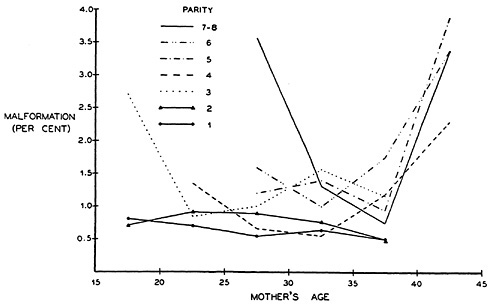
FIGURE 8.1—The distribution of the frequency of infants with major malformation by maternal age for specified parities.
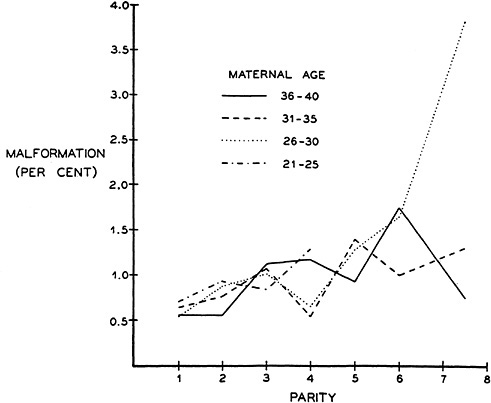
FIGURE 8.2—The distribution of the frequency of grossly malformed infants by parity for specified maternal ages.
TABLE 8.5 THE EFFECTOF MATERNAL PARITY AT FIXED AGEON THE FREQUENCY OF MALFORMED INFANTS (Detailed explanation in text.)


diagnoses of mongolism, and of these three, one was born at a maternal age of 25 and the other two at 34 and 40 years of age. The diagnosis of mongolism, while not particularly uncommon at 9 months of age (1 out of 1,580 children), was singularly infrequent in the at-birth data. This is not surprising in view of the not-uncommon failure to diagnose mongolism at birth in Caucasian infants, and the added diagnostic difficulties among Japanese.
In view of the greater average age and parity of the mother as parental exposure increases, a spurious irradiation effect could arise if the data were unadjusted for this fact. It might also be pointed out, however, that if no differences are demonstrable without age-parity adjustments, it is unlikely that differences will be detected following adjustment because of the direction of the bias.
It was felt that while some adjustment for age-parity effects was indicated, any attempt to subdivide the present data in such a manner as to take into consideration both age and parity effects would jeopardize the validity of the statistical tests employed. Somewhat arbitrarily the decision was reached to take into consideration age but not parity effects. Accordingly, for this analysis the terminations have been classified not only with respect to sex, city, and parental exposure, but also maternal age. Five age categories were recognized, namely, 15–20, 21–35, 36–38, 39–41, and 42 and over. Since the selection of the age intervals is purely arbitrary, the intervals were so selected as to be of the shortest span consistent with significant numbers in those areas where maternal age appears to be most important. It must be borne in mind, however, that the “age effects” which emerge from this analysis are also in part “parity effects.” Some bias may be introduced as a consequence of ignoring parity but this bias would again appear to favor a higher rate of malformation among the exposed population.
The necessity for accounting for possible differences between exposure cells in maternal nutrition is more difficult to appraise. Warkany's (1947) extensive studies on the effect of severe dietary stresses on pregnancy outcome in gravid rats and mice would lead to the conclusion that diet is of considerable importance. In these animals, the degree of dietary stress needed to induce malformation is, however, far more severe than could have obtained even in the war torn cities of Japan. Moreover, neither Smith (1947) nor Antonov (1947), in their studies of the populations of Rotterdam and Leningrad following severe dietary stress during World War II, could demonstrate an increase in the frequency of congenital malformations. Whatever dietary stresses may have existed in the populations of Hiroshima and Nagasaki during the earlier stages of this study were very probably not so severe as those which obtained in Rotterdam and Leningrad. With respect to possible differences in nutritional status between exposure categories, detailed dietary histories on random samples of the population are not available. However, in a marginal economy such as existed in post-war Japan, there is undoubtedly a high correlation between economic status and nutritional level; we have already seen (Sec. 5.3) that in neither city is there a demonstrable relationship between economic level and exposure history. It will be assumed in this analysis that there are no important differences in maternal nutrition with respect to the various exposure subclasses.
Lastly, by way of completing a discussion of the concomitants, it might be mentioned that during the course of this study no exceptional epidemics of German measles or other viral infections were known to have occurred in Hiroshima or Nagasaki.
8.5The “at-birth” data.—In Tables 8.6 and 8.7 are presented the “at-birth” frequencies of major malformation by parental exposure, sex of infant, and city, with and without classification of the termination by maternal age. Inspection of these tables reveals no striking, general differences in the frequency of infants with at least one major malformation by sex, city or parental exposure. The results of the analysis of these two tables are given in Tables 8.8 and 8.9. From Table 8.8 (a and b) we note no demonstrable differences when age is ignored, among the cities, sexes, or parental exposures. It is worth noting at this point that the frequency of malformation in the unexposed groups in Hiroshima and Nagasaki is very similar to the frequency of malformation in Kure where during the years control studies were in effect there 57 malformed infants were reported in 7,544 registered terminations (0.76%).
In Table 8.9, with the data further partitioned to take into account age differences among the parents, the only “main effect”
TABLE 8.6 FREQUENCYOF MALFORMED INFANTS BY PARENTAL EXPOSURE, SEX OF INFANT, AND CITY (Unrelated parents)




















TABLE 8.7 THE FREQUENCYOF MALFORMED INFANTS BY PARENTAL EXPOSURE, CITY, AND MATERNAL AGE (Unrelated parents)
|
Hiroshima |
|||||||||||||||||||||||||||
 |
|||||||||||||||||||||||||||
|
Total |
|||||||||||||||||||||||||||
 |
|||||||||||||||||||||||||||
|
Age |
Expo-surea |
11 |
12 |
13 |
14 15 |
Total F1 |
21 |
22 |
23 |
24 25 |
Total F2 |
31 |
32 |
33 |
34 35 |
Total F3 |
41 51 |
42 51 |
43 53 |
44 45 46 55 |
Total F4, 5 |
M1 |
M2 |
M3 |
M4,5 |
Total age |
|
|
15–20 |
 |
n |
801 |
265 |
121 |
55 |
1,242 |
83 |
44 |
12 |
8 |
147 |
39 |
21 |
17 |
5 |
82 |
14 |
8 |
3 |
3 |
28 |
937 |
338 |
153 |
71 |
1,499 |
|
m |
5 |
5 |
3 |
1 |
14 |
— |
1 |
— |
— |
1 |
— |
1 |
— |
— |
1 |
— |
— |
— |
— |
— |
5 |
7 |
3 |
1 |
16 |
||
|
p |
.0062 |
.0189 |
.0248 |
.0182 |
.0113 |
— |
.0227 |
— |
— |
.0068 |
— |
.0476 |
— |
— |
.0122 |
— |
— |
— |
— |
— |
.0053 |
.0207 |
.0196 |
.0141 |
.0107 |
||
|
21–35 |
 |
n |
15,476 |
4,766 |
1,921 |
985 |
23,148 |
1,309 |
1,462 |
347 |
165 |
3,283 |
497 |
302 |
382 |
85 |
1,266 |
347 |
206 |
128 |
87 |
768 |
17,629 |
6,736 |
2,778 |
1,322 |
28,465 |
|
m |
140 |
41 |
10 |
11 |
202 |
16 |
19 |
2 |
3 |
40 |
7 |
3 |
3 |
3 |
16 |
3 |
2 |
1 |
1 |
7 |
166 |
65 |
16 |
18 |
265 |
||
|
p |
.0091 |
.0086 |
.0052 |
.0111 |
.0087 |
.0122 |
.0130 |
.0058 |
.0182 |
.0122 |
.0141 |
.0099 |
.0079 |
.0353 |
.0126 |
.0086 |
.0097 |
.0078 |
.0115 |
.0091 |
.0094 |
.0096 |
.0058 |
.0136 |
.0093 |
||
|
36–38 |
 |
n |
681 |
233 |
93 |
42 |
1,049 |
64 |
212 |
44 |
16 |
336 |
36 |
31 |
68 |
11 |
146 |
24 |
15 |
18 |
9 |
66 |
805 |
491 |
223 |
78 |
1,597 |
|
m |
8 |
2 |
— |
1 |
11 |
— |
3 |
— |
— |
3 |
— |
— |
1 |
— |
1 |
1 |
— |
— |
— |
1 |
9 |
5 |
1 |
1 |
16 |
||
|
p |
.0117 |
.0086 |
— |
.0238 |
.0105 |
— |
.0142 |
— |
— |
.0089 |
— |
— |
.0147 |
— |
.0068 |
.0417 |
— |
— |
— |
.0152 |
.0112 |
.0102 |
.0045 |
.0128 |
.0100 |
||
|
39–41 |
 |
n |
254 |
85 |
38 |
26 |
403 |
34 |
105 |
15 |
11 |
165 |
17 |
19 |
37 |
5 |
78 |
5 |
14 |
5 |
14 |
38 |
310 |
223 |
95 |
56 |
684 |
|
m |
3 |
2 |
1 |
— |
6 |
1 |
2 |
— |
— |
3 |
— |
— |
— |
— |
— |
— |
— |
— |
— |
— |
4 |
4 |
1 |
— |
9 |
||
|
p |
.0118 |
.0235 |
.0263 |
— |
.0149 |
.0294 |
.0190 |
— |
— |
.0182 |
— |
— |
— |
— |
— |
— |
— |
— |
— |
— |
.0129 |
.0179 |
.0105 |
— |
.0132 |
||
|
42+ |
 |
n |
82 |
19 |
12 |
9 |
122 |
10 |
27 |
6 |
2 |
45 |
7 |
12 |
17 |
4 |
40 |
5 |
1 |
3 |
4 |
13 |
104 |
59 |
38 |
19 |
220 |
|
m |
4 |
1 |
— |
— |
5 |
— |
1 |
— |
— |
1 |
— |
— |
1 |
— |
1 |
— |
— |
— |
— |
— |
4 |
2 |
1 |
— |
7 |
||
|
p |
.0487 |
.0526 |
— |
— |
.0410 |
— |
.0370 |
— |
— |
.0222 |
— |
— |
.0588 |
— |
.0250 |
— |
— |
— |
— |
— |
.0385 |
.0339 |
.0263 |
— |
.0318 |
||
|
Total |
 |
n |
17,294 |
5,368 |
2,185 |
1,117 |
25,964 |
1,500 |
1,850 |
424 |
202 |
3,976 |
596 |
385 |
521 |
110 |
1,612 |
395 |
244 |
157 |
117 |
913 |
19,785 |
7,847 |
3,287 |
1,546 |
32,465 |
|
m |
160 |
51 |
14 |
13 |
238 |
17 |
26 |
2 |
3 |
48 |
7 |
4 |
5 |
3 |
19 |
4 |
2 |
1 |
1 |
8 |
188 |
83 |
22 |
20 |
313 |
||
|
p |
.0093 |
.0095 |
.0064 |
.0116 |
.0092 |
.0113 |
.0141 |
.0047 |
.0149 |
.0121 |
.0117 |
.0104 |
.0096 |
.0273 |
.0118 |
.0101 |
.0082 |
.0064 |
.0085 |
.0088 |
.0095 |
.0106 |
.0067 |
.0129 |
.0096 |
||
|
Nagasaki |
|||||||||||||||||||||||||||
 |
|||||||||||||||||||||||||||
|
Total |
|||||||||||||||||||||||||||
 |
|||||||||||||||||||||||||||
|
Age |
Expo-surea |
11 |
12 |
13 |
14 15 |
Total F1 |
21 |
22 |
23 |
24 25 |
Total F2 |
31 |
32 |
33 |
34 35 |
Total F3 |
41 51 |
42 52 |
43 53 |
44 45 54 55 |
Total F4,5 |
M1 |
M2 |
M3 |
M4,5 |
Total age |
|
|
15–20 |
 |
n |
432 |
488 |
42 |
29 |
991 |
109 |
173 |
24 |
5 |
311 |
11 |
9 |
2 |
— |
22 |
3 |
5 |
— |
1 |
9 |
555 |
675 |
68 |
35 |
1,333 |
|
m |
— |
6 |
— |
2 |
8 |
— |
3 |
— |
— |
3 |
— |
— |
— |
— |
— |
— |
— |
— |
— |
— |
— |
9 |
— |
2 |
11 |
||
|
p |
— |
.0123 |
— |
.0690 |
.0081 |
— |
.0173 |
— |
— |
.0096 |
— |
— |
— |
— |
— |
— |
— |
— |
— |
— |
— |
.0133 |
— |
.0571 |
.0083 |
||
|
21–35 |
 |
n |
12,616 |
7,900 |
625 |
475 |
21,616 |
1.711 |
2,932 |
186 |
89 |
4,918 |
189 |
206 |
67 |
25 |
487 |
111 |
143 |
29 |
22 |
305 |
14,627 |
11,181 |
907 |
611 |
27,326 |
|
m |
111 |
53 |
9 |
4 |
177 |
10 |
19 |
5 |
— |
34 |
5 |
— |
— |
— |
5 |
2 |
1 |
— |
— |
3 |
128 |
73 |
14 |
4 |
219 |
||
|
p |
.0088 |
.0067 |
.0144 |
.0084 |
.0082 |
.0058 |
.0065 |
.0269 |
— |
.0069 |
.0265 |
— |
— |
— |
.0103 |
.0180 |
.0070 |
— |
— |
.0098 |
.0088 |
.0065 |
.0154 |
.0065 |
.0080 |
||
|
36–38 |
 |
n |
979 |
549 |
45 |
33 |
1,606 |
193 |
494 |
39 |
12 |
738 |
20 |
25 |
14 |
5 |
64 |
10 |
10 |
3 |
1 |
24 |
1,202 |
1,078 |
101 |
51 |
2,432 |
|
m |
14 |
4 |
— |
— |
18 |
— |
4 |
— |
— |
4 |
— |
— |
— |
— |
— |
— |
1 |
— |
— |
1 |
14 |
— |
— |
9 |
23 |
||
|
p |
.0143 |
.0073 |
— |
— |
.0112 |
— |
.0081 |
— |
— |
.0054 |
— |
— |
— |
— |
— |
— |
.1000 |
— |
— |
.0417 |
.0116 |
.0083 |
— |
— |
.0095 |
||
|
39–41 |
 |
n |
451 |
303 |
28 |
18 |
800 |
117 |
366 |
19 |
5 |
507 |
15 |
16 |
8 |
5 |
44 |
8 |
12 |
2 |
3 |
25 |
591 |
697 |
57 |
31 |
1,376 |
|
m |
6 |
6 |
— |
— |
12 |
— |
7 |
— |
— |
7 |
— |
— |
1 |
— |
1 |
— |
— |
— |
— |
— |
6 |
13 |
1 |
— |
20 |
||
|
p |
.0133 |
.0198 |
— |
— |
.0150 |
— |
.0191 |
— |
— |
.0138 |
— |
— |
.1250 |
— |
.0227 |
— |
— |
— |
— |
— |
.0102 |
.0187 |
.0175 |
— |
.0145 |
||
|
42+ |
 |
n |
132 |
76 |
7 |
4 |
219 |
40 |
179 |
11 |
5 |
235 |
8 |
17 |
3 |
— |
28 |
7 |
8 |
1 |
1 |
17 |
187 |
280 |
22 |
10 |
499 |
|
m |
3 |
1 |
— |
— |
4 |
1 |
3 |
— |
— |
4 |
— |
— |
— |
— |
— |
— |
— |
— |
— |
— |
4 |
4 |
— |
— |
8 |
||
|
p |
.0227 |
.0132 |
— |
— |
.0183 |
.0250 |
.0168 |
— |
— |
.0170 |
— |
— |
— |
— |
— |
— |
— |
— |
— |
— |
.0214 |
.0143 |
— |
— |
.0160 |
||
|
Total |
 |
n |
14,610 |
9,316 |
747 |
559 |
25,232 |
2,170 |
4,144 |
279 |
116 |
6,709 |
243 |
273 |
94 |
35 |
645 |
139 |
178 |
35 |
28 |
380 |
17,162 |
13,911 |
1,155 |
738 |
32,966 |
|
m |
134 |
70 |
9 |
6 |
219 |
11 |
36 |
5 |
— |
52 |
5 |
— |
1 |
— |
6 |
2 |
2 |
— |
— |
4 |
152 |
108 |
15 |
6 |
281 |
||
|
p |
.0092 |
.0075 |
.0120 |
.0107 |
.0087 |
.0051 |
.0087 |
.0179 |
— |
.0078 |
.0206 |
— |
.0106 |
— |
.0093 |
.0144 |
.0112 |
— |
— |
.0105 |
.0089 |
.0078 |
.0130 |
.0081 |
.0085 |
||
|
aFather's exposure is indicated first. |
|||||||||||||||||||||||||||
emerging at the level of significance is the already discussed effect of maternal age on the frequency of congenital malformation. Among the first order interactions none is significant save mother's exposure-mother's age. However, since the effect of mother's exposure is not independent of age no generalizations can be made with respect to the effect of maternal irradiation based on the main effects test alone. In order to interpret the effect of maternal exposure, we must consider separately the maternal age classifications. Table 8.10 presents the distribution of the frequency of malformation by mother's age and exposure. For purposes of comparison and its bearing on a possible somatic maternal effect, a comparable table (Table 8.13) is given for father's exposure. In Table 8.11 are given the results of analyzing the effect of mother's exposure at each of the five different maternal age levels. For these five age levels mother's exposure seems to exert an effect only in the 15–20 year age interval. From inspection of Table 8.10 we note that the frequency of malformation tends to increase with increasing maternal exposure with an eight-fold difference between mother's “1” and mother's “4–5,” or a two-fold difference between mother's “2” and mother's “4–5.” This difference ceases to be significant, however, when consideration is
TABLE 8.8 CHI-SQUARE ANALYSIS OF THE FREQUENCYOF CONGENITALLY MALFORMED INFANTSBY SEX, CITY, AND PARENTAL EXPOSURE (Unrelated parents)


TABLE 8.9 CHI-SQUARE ANALYSIS OF THE FREQUENCY OF CONGENITALLY MALFORMED INFANTS BY CITY, MATERNAL AGE, AND PARENTAL EXPOSURE (Unrelated parents)
|
All exposure cells |
|||
 |
|||
|
Source |
DF |
X2 |
P |
|
Total |
156 |
164.205 |
.50–.60 |
|
Interactions, first order |
|||
|
CM |
3 |
9.657 |
.02–.05 |
|
CF |
3 |
2.053 |
.50–.70 |
|
CA |
4 |
1.914 |
.70–.80 |
|
AM |
12 |
23.786 |
.02–.05 |
|
AF |
12 |
7.907 |
.70–.80 |
|
MF |
9 |
6.107 |
.70–.80 |
|
Main effects |
|||
|
Age (A) |
4 |
18.057 |
.001–.01 |
|
City (C)a |
|||
|
Age intervals |
|||
|
15–20 |
1 |
0.438 |
.50–.70 |
|
21–35 |
1 |
2.720 |
.05–.10 |
|
36–38 |
1 |
0.032 |
.80–.90 |
|
39–41 |
1 |
0.062 |
.80–.90 |
|
42+ |
1 |
1.863 |
.10–.20 |
|
Sum |
5 |
5.115 |
.30–.50 |
|
Age intervals |
|||
|
15–20 |
3 |
14.581 |
.001–.01 |
|
21–35 |
3 |
4.463 |
.20–.30 |
|
36–38 |
3 |
2.277 |
.50–.70 |
|
39–41 |
3 |
3.111 |
.30–.50 |
|
42+ |
3 |
1.462 |
.50–.70 |
|
Sum |
15 |
25.894 |
.02–.05 |
|
Fathers (F)a |
|||
|
Age intervals |
|||
|
15–20 |
3 |
0.411 |
.90–.95 |
|
21–35 |
3 |
2.619 |
.30–.50 |
|
36–38 |
3 |
3.555 |
.30–.50 |
|
39–41 |
3 |
1.303 |
.70–.80 |
|
42+ |
3 |
1.400 |
.70–.80 |
|
Sum |
15 |
9.288 |
.80–.90 |
|
aAdjusted for age (see Sec. 6.5). bSee Table 8.11. |
|||
limited to only those cells in which both parents are exposed. Moreover, it is not significant if only mothers who were unexposed are excluded from consideration (X2=1.062; DF=2). The significance of the difference seems to be largely a function of the inordinately low frequency of malformation observed among the unexposed mothers in the 15–20-year age interval. In Table 8.12 is presented the distribution of malformed infants among mothers in the 15–20 year age interval by parity and maternal exposure. We note that unexposed mothers (in the 15–20 year age interval) having their first or second pregnancies experienced an extremely low malformation rate. An explanation for this extremely low rate is not immediately apparent.
TABLE 8.10 THE DISTRIBUTION OF FREQUENCY OF MALFORMED INFANTS CLASSIFIED BY MOTHER'S AGE AND EXPOSUREONLY



TABLE 8.11 CHI-SQUARE ANALYSIS OF THE EFFECTOF MOTHER'S EXPOSUREON THE FREQUENCYOF MALFORMED INFANTSAT EACHOFTHE FIVE DIFFERENT AGE LEVELS
|
Age group |
DF |
X2 |
P |
|
15–20 |
3 |
14.581 |
.001–.01 |
|
21–35 |
3 |
4.463 |
.20–.30 |
|
36–38 |
3 |
2.276 |
.50–.70 |
|
39–41 |
2a |
2.421 |
.20–.30 |
|
42+ |
2a |
1.196 |
.50–.70 |
|
aGroups 3, 4, and 5 have been pooled. |
|||
8.6 The “9-months” data.—The sparcity of the material available from the 9-months examination necessitated two departures from the usual analytical approach. Firstly, parental exposure categories 3, 4, and 5 were pooled. Secondly, all extraneous variation was ignored. These considerations must be borne in mind in appraising Tables 8.14 and 8.15.1 In Table 8.14
TABLE 8.12 THE DISTRIBUTIONBY MATERNAL EXPOSURE AND PARITY OF MALFORMED INFANTS BORN TO MOTHERS OF AGES 15–20



TABLE 8.13 THE DISTRIBUTION OF FREQUENCY OF MALFORMED INFANTS CLASSIFIED AT BIRTH BY MOTHER'S AGE AND FATHER'S EXPOSUREONLY



|
1 |
The discrepancy in terms of total number of infants recorded in Tables 8.3 and 8.13 is due to the fact that in the former any child seen in the “9-months follow-up” is scored (these infants will vary in age from 7 1/2 to 17 months), whereas in the latter only those infants whose ages were 8–10 months inclusive are scored. The purpose of the more rigid definition in the latter table was to minimize another source of extraneous variation, namely, age of infant. |
TABLE 8.14 THE FREQUENCY OF MALFORMED INFANTSAMONG ALL INFANTS RE-EXAMINEDAT 9-MONTHSOF AGE, BY CITY AND PARENTAL EXPOSURE (Malformed infants are defined here as being those infants found to have one or more major defects at 9 months of age not diagnosed at birth.)









are presented the frequencies of malformed infants, diagnosed at 9 months but not so diagnosed at birth, distributed by city and parental exposure. The analysis of these data is presented in Table 8.15. Inspection of the analysis reveals no significant differences between cities or father's exposure categories, but an effect of mother's exposure significant at the 5 per cent level. This effect, however, is contrary to what one might expect from radiation, since there are
TABLE 8.15 CHI-SQUARE ANALYSIS OF THE FREQUENCY OF MALFORMED INFANTS AT 9 MONTHSOF AGE BY CITY AND PARENTAL EXPOSURE (Unrelated parents)
|
Source |
DF |
X2 |
P |
|
Total |
17 |
22.543 |
.10–.20 |
|
Interactions, first order |
|||
|
CM |
2 |
1.062 |
.50–.70 |
|
CF |
2 |
1.011 |
.50–.70 |
|
MF |
4 |
3.942 |
.30–.50 |
|
Main effects |
|||
|
City (C) |
1 |
3.441 |
.05–.10 |
|
Mothers (M) |
2 |
6.070 |
.02–.05 |
|
Fathers (F) |
2 |
1.643 |
.30–.50 |
TABLE 8.16 THE DISTRIBUTION BY MATERNAL EXPOSURE OF THE SEVEN MOST COMMON MAJOR CONGENITAL MALFORMATIONS IN THE JAPANESE, EXCLUSIVE OF CONGENITAL HEART DISEASE (The incidences of the malformations are given in terms of number of malformations per 1,000 births.)



relatively more malformations among the children of category 1 mothers, and this despite the fact that age-parity effects, which should introduce a bias in the direction of hypothesis, have not been allowed for.
8.7 Analysis by specific malformation type. —The genetic basis of most of the common types of malformations is poorly understood. Accordingly, the remote possibility had to be considered that the frequency of children with certain kinds of malformations was affected in a rather specific way by parental radiation. Despite the improbability of the existence of such an effect in the absence of an effect of radiation exposure in the material as a whole, an analysis of this possibility has been undertaken. The results, with respect to the seven most common malformation types, are given in Table 8.16. When the data are partitioned in this manner there are relatively few malformations of any specific type. For this reason, the classification according to radiation history is by mother's exposure only. Inspection of Table 8.16 reveals no noteworthy trends.
8.8 Summary.—Analysis of the frequency of malformed infants by city and parental exposure reveals no significant, consistent effect of parental exposure. The small departures from expectation which are observed cannot be said to be in the direction of genetic hypothesis.
Chapter IX
ANALYSIS OF THE STILLBIRTH DATA
9.1 The trait.—The definition of a stillbirth employed in this study is an infant who shows no signs of life at birth, following a period of gestation of at least 20 weeks. Any infant that moves, makes respiratory attempts, or is born with a beating heart is not in the strict sense “stillborn.” This definition, which is that employed in United States vital statistics, runs counter to current Japanese usage, under which infants who showed signs of life at birth but never succeeded in establishing a pattern of regular respiration are frequently reported as stillborn. This usage was in part a matter of convenience, since a stillbirth required completing only one official form, whereas a livebirth dying an hour following delivery required completing two. The subject of the ABCC's usage of the term “stillbirth” was repeatedly taken up at conferences with the midwives.
The frequency of stillbirths encountered in our control material (both parents category 1) was in Hiroshima 1.27 per cent of all births (17,189 births) and in Nagasaki 1.31 per cent (14,450 births). In comparison, in 1950 the “official” stillbirth rate (stillbirths per 1,000 livebirths) was in Hiroshima prefecture 79.6 and in Nagasaki prefecture 87.7, or, expressed as percentage of all births, 7.37 per cent and 8.07 per cent respectively (Public Health and Welfare in Japan, 1950). Official statistics for other years are similar. There is apparent a marked discrepancy between official statistics and our own. There are at least five factors to be taken into account in an evaluation of these differences. Firstly, there is the matter of registration practices referred to above. Secondly, the official stillbirth data are for stillbirths after the third month of uterogestation, whereas by and large our figures refer to events following the fifth month of gestation. Thirdly, since the official figures are for an entire prefecture, there is the possibility of urban-rural differentials. This, however, works in the opposite direction than the first two factors, since in 1950 the stillbirth rate for all shi (cities) was 134.0 per 1,000 livebirths, whereas for all gun (villages and rural areas) the rate was 70.4. Fourthly, the official figures may include some induced terminations, whereas these were excluded from our own data. Lastly, those stillborn infants with gross malformations were excluded from our figures. The reasons for this exclusion were given in Section 6.2.
When approximate allowance is made for the exclusion from our figures of stillborn, malformed infants, the stillbirth rates observed in this study are quite similar to those currently obtaining in many parts of the United States (e.g., Michigan, 1950, 1.9 per cent). The possibility that the ABCC program was failing to obtain data on any substantial number of stillbirths seems precluded by the efficiency of pregnancy registration (Sec. 2.1) and the system of careful follow-up for all registered terminations.
9.2 The genetic argument for radiation-induced changes.—Animal experimentation on the genetic effects of irradiation indicates that the largest group of induced mutations having clear-cut effects detectable in the first generation of offspring following exposure are the autosomal lethals. As detected in the first generation of offspring these mutations would consist largely of the dominant lethals, although a few recessive lethals would be recovered due to the fortuitous combination in some individuals of an induced lethal mutant with an allelic lethal mutant of spontaneous origin. Presumably one of the manifestations of the presence of these mutant genes would be fetal death. Accordingly, we might expect, as one of the changes symptomatic of irradiation-induced genetic damage, an increase in the frequency with which infants are stillborn as parental exposure increases.
9.3 Concomitant variation known to affect
the stillbirth rate.—No one of the indicators with which we have dealt or shall deal is more complex with respect to concomitant variation than the one presently under consideration. No less than seven sources of concomitant variation known to affect the stillbirth rate could, conceivably, be influencing the data which we shall analyze. These seven sources of extraneous variation are congenital syphilis, birth injury, maternal age, parity, nutrition, rate of reproduction, and paternal age.
Congenital syphilis has long been one of the major causes of fetal mortality. In Hiroshima and Nagasaki the frequency of positive serologies is from 5 to 7 per cent among post-parturient women. To assess the amount of infantile mortality attributable to congenital syphilis among the births described here would have required an expenditure of time and energy which, because of the limitations of personnel
TABLE 9.1 CONGENITAL SYPHILISAMONG LIVING INFANTS BORNIN NAGASAKIIN 1951 (Incidence and relation to maternal age [after Wright, S.W. et al., 1952])

and facilities, was not possible. However, a small study was made in Nagasaki on infants born in the year 1951 in an attempt to determine the incidence of congenital syphilis among the infants being examined in connection with the genetics program (Wright, S.W. et al., 1952). Initially it was planned that this study would estimate the incidence of congenital syphilis among living infants, stillbirths, and neonatal deaths. Because of the formidable difficulties posed in estimating the latter incidences in the absence of an exhaustive post-mortem program in Nagasaki, attention had to be focused on living infants alone. Two items of interest here emerged from this study. Firstly, some seven out of every thousand liveborn infants were shown to have congenital syphilis either by clinical, serologic, or roentgenologic examination, or any combination thereof. Secondly, a gradual decline in the rate of transmission with increasing maternal age was noted. These latter data are reproduced in Table 9.1. If this same effect of maternal age is exhibited by syphilitic stillborn infants (and we have no evidence that it is not) then, because of the known differential in maternal age among the parental exposure cells, herein lies a possible source of bias. The age distribution among the exposure cells is such that this bias would tend to inflate the stillbirth rate among those parents less heavily exposed or not exposed at all. However, these potential effects would appear to be quite small, of a magnitude which could safely be ignored in this analysis.
A second major factor affecting infant survival (which it was not possible to control) is the occurrence of an injury during parturition. In the United States, it has been estimated that birth injury accounts for no less than 13.6 per cent of infantile mortality (Stander, 1941). Of the various types of injuries which may be sustained during the passage of the infant through the birth canal, by far the most common is intra-cranial injury with hemorrhage. It has been reported that 40–80 per cent of infants coming to autopsy will show evidence of this form of birth injury (Stander, 1941). In our own data among 50 autopsied infants, selected at random, 26 showed intra-cranial hemorrhages ranging from moderate to severe in degree. While the importance of birth injury in infantile death cannot be gainsaid, it is difficult to visualize circumstances which would lead to a non-random distribution of birth injuries among the parental exposure categories, and this possibility will be ignored in the analysis.
A third major factor affecting infant survival is maternal nutrition. The importance of this variable is amply attested to by an extensive literature. In the main, this literature is in agreement in indicating that rather drastic changes in maternal nutrition must occur before clearly demonstrable changes in the stillbirth rate can be shown (see, for example, Antonov, 1947, and Smith, 1947). There is no evidence that during the course of this study the limitations
imposed on maternal nutrition by economic conditions prevailing in Japan reached the levels necessary to produce measurable changes in the stillbirth rate, or that (arguing again from the rough classification of economic status presented in Sec. 5.3) such differences in maternal nutrition as existed were non-randomly distributed.
Among the variables affecting the stillbirth rate previously enumerated, the effects of maternal age and parity are by far the most complex and general in scope. These effects as manifested in the present material are summarized in Tables 9.2 and 9.3 and Figures 9.1 and 9.2. The data are presented and analyzed in the same manner as age and parity effects with respect to major congenital malformations (cf. Sec. 8.4). Again, a detailed discussion of the findings will be deferred for a subsequent publication. There is a significant effect on stillbirth frequency of both age and parity, with, in both instances, an apparent increase in stillbirth frequency at the extremes of the scale. This in-
TABLE 9.2 THE EFFECT OF MATERNAL AGE AT FIXED PARITY ON THE FREQUENCY OF STILLBORN INFANTS (The meaning of the symbols employed is explained in Sec. 8.4.)


crease at the lower end of the scale is more definite with respect to parity than with respect to age.
One of the more exhaustive previous studies of this relationship of maternal age and parity to infant survival is that of Yerushalmy (1945), who found that (1) “the lowest rates do not occur in one particular age group irrespective of parity. There is a consistent shifting of the minimum rate to the older ages with increasing parity.” (2) “When the stillbirth rates by age of mother are compared for the different parity groups the increase in the rate is not proportionate for the various age groups. The increase is very much higher for the younger age of mother groups than for the older.” The present data appear to agree with the first of these two conclusions, but of themselves would scarcely permit drawing the second conclusion—this may be in part a matter of the numbers involved. From the standpoint of controlling extraneous variation, these findings, taken in conjunction with our own, imply that the only really adequate control is one which takes into account not only maternal age but also parity. Among the Japanese data, to effect an adequate control would require recognizing approximately 25 parity-specific age intervals (five intervals for parity, and five for age, or 25 in all). The data, because of the already existing numerous ways
TABLE 9.3 THE EFFECT OF MATERNAL PARITY AT FIXED AGE ON THE FREQUENCY OF STILLBORN INFANTS (The meaning of the symbols employed is explained in Sec. 8.4.)


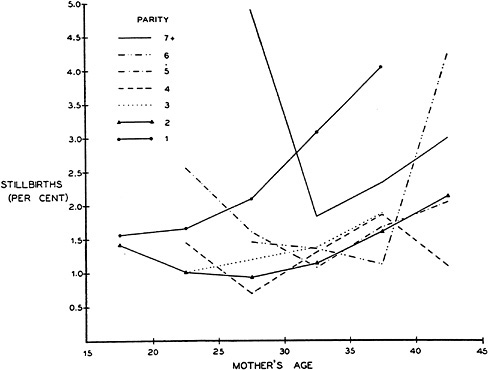
FIGURE 9.1—The distribution of the frequency of stillborn infants by age of mother for specified parities.
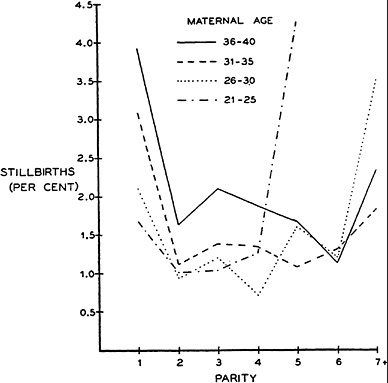
FIGURE 9.2—The distribution of the frequency of stillborn infants by parity for specified maternal ages.
of classification, would not permit so elegant an approach to the extraneous variation occasioned by mother's age and parity. Accordingly, it became a matter of judgment as to which of these two factors was to be controlled. A decision was reached to disregard age but to recognize, for analytical purposes, five parity classes, namely, parity 1, parities 2–3, 4–5, 6–7, and 8 and higher.
9.4 The data.—Tables 9.4 and 9.5 present the distribution and analysis of stillborn infants by sex, city, and parental exposure without further subdivision by parity. Inspection of Table 9.4 suggests a difference in the stillbirth rate when the mother was not exposed as opposed to when she was. From the analytical table (9.5a) we note a significant effect of mother's exposure but not of sex or father's exposure. Attention is called to the fact that the sex-mother's exposure interaction is not significant, in contrast to expectation in view of the possible effect of exposure on the sex ratio described in Chapter VII. With regard to the reality of the effect of mother's exposure on the stillbirth rate, it should be borne in mind that these data are uncorrected for parity and the more heavily exposed cells are biased in a way which would increase the stillbirth rate in these cells. If in the analysis of Table 9.4 we limit our attention to those exposure cells in which both parents were exposed, which would reduce the differences between cells with regard to parity, the apparent effect of maternal exposure disappears (see Table 9.5b). This observation is of considerable importance in the interpretation of these data since (a) maternal exposure confounds the effects of genetic and somatic damage and hence a significant effect of maternal exposure not reflected in paternal exposure might well be a somatic rather than a genetic effect, and (b) there is evidence which has been presented in Chapter V and elsewhere in this report that the comparison of pregnancy terminations occurring to exposure category 1 parents with terminations occurring to parents in any other exposure category is biased.
Let us now turn to a consideration of what these data reveal when the sex of the infant is ignored but terminations are classified with respect to parity. Tables 9.6 and 9.7 present the
TABLE 9.4 FREQUENCY OF STILLBIRTHS BY SEX, PARENTAL EXPOSUREAND CITY (Unrelated parents)



















TABLE 9.5 CHI-SQUARE ANALYSIS OF THE FREQUENCY OF STILLBIRTHS BY SEX, PARENTAL EXPOSURE, AND CITY (Unrelated parents)
|
a. All exposure cells (4×4) |
|||
 |
|||
|
Source |
DF |
X2 |
P |
|
Total |
63 |
92.343 |
.01–.02 |
|
Interactions, first order |
|||
|
CM |
3 |
.620 |
.80–.90 |
|
CF |
3 |
10.626 |
.01–.02 |
|
CS |
1 |
0.200 |
.50–.70 |
|
SM |
3 |
1.565 |
.50–.70 |
|
SF |
3 |
5.499 |
.10–.20 |
|
MF |
9 |
5.548 |
.70–.80 |
|
Main effects |
|||
|
Cities (C)a |
|||
|
Mother's exposure—1 |
1 |
0.069 |
.70–.80 |
|
Mother's exposure—2 |
1 |
0.001 |
.95–.98 |
|
Mother's exposure—3 |
1 |
0.393 |
.50–.70 |
|
Mother's exposure—4, 5 |
1 |
0.140 |
.70–.80 |
|
Sum |
4 |
0.603 |
.95–.98 |
|
Sex (S)a |
|||
|
Mother's exposure—1 |
1 |
0.725 |
.30–.50 |
|
Mother's exposure—2 |
1 |
0.661 |
.30–.50 |
|
Mother's exposure—3 |
1 |
0.202 |
.50–.70 |
|
Mother's exposure—4, 5 |
1 |
0.065 |
.70–.80 |
|
Sum |
4 |
1.653 |
.70–.80 |
|
Mothers (M) |
3 |
12.797 |
.001–.01 |
|
Fathers (F)a |
|||
|
Mother's exposure—1 |
3 |
3.943 |
.20–.30 |
|
Mother's exposure—2 |
3 |
6.769 |
.05–.10 |
|
Mother's exposure—3 |
3 |
4.192 |
.20–.30 |
|
Mother's exposure—4, 5 |
3 |
0.187 |
.95–.98 |
|
Sum |
12 |
15.091 |
.20–30 |
|
b. Excluding parents in category 1 (3×3) |
|||
 |
|||
|
Total |
35 |
14.186 |
.50–.70 |
|
Interactions, first order |
|||
|
CM |
2 |
2.001 |
.30–.50 |
|
CF |
2 |
4.121 |
.10–.20 |
|
CS |
1 |
5.737 |
.01–.02 |
|
SM |
2 |
2.083 |
.30–.50 |
|
SF |
2 |
4.825 |
.05–.10 |
|
MF |
4 |
0.781 |
.90–.95 |
|
Main effects |
|||
|
Sex (S) |
1 |
1.884 |
.10–.20 |
|
Cities (C) |
1 |
1.150 |
.20–.30 |
|
Mothers (M) |
2 |
2.816 |
.20–.30 |
|
Fathers (F) |
2 |
0.388 |
.80–.90 |
|
aAdjusted for mothers. |
|||
TABLE 9.6 THE FREQUENCY OF STILLBIRTHS BY PARENTAL EXPOSURE, CITY, AND PARITY (Unrelated parents)
|
Hiroshima |
|||||||||||||||||||||||||||
 |
|||||||||||||||||||||||||||
|
Total |
|||||||||||||||||||||||||||
 |
|||||||||||||||||||||||||||
|
Parity |
Exposurea |
11 |
12 |
13 |
14 15 |
Total F1 |
21 |
22 |
23 |
24 25 |
Total F2 |
31 |
32 |
33 |
34 35 |
Total F3 |
41 51 |
42 52 |
43 53 |
44 45 54 55 |
Total F4,5 |
M1 |
M2 |
M3 |
M4,5 |
Total |
|
|
1 |
 |
n |
5,460 |
1,699 |
665 |
338 |
8,162 |
503 |
203 |
64 |
53 |
803 |
194 |
75 |
53 |
22 |
344 |
124 |
53 |
19 |
17 |
213 |
6,281 |
2,030 |
801 |
410 |
9,522 |
|
s |
93 |
40 |
21 |
5 |
159 |
12 |
6 |
— |
— |
18 |
8 |
2 |
2 |
1 |
13 |
6 |
3 |
— |
2 |
11 |
119 |
51 |
23 |
8 |
201 |
||
|
p |
.0170 |
.0235 |
.0316 |
.0148 |
.0195 |
.0239 |
.0295 |
— |
— |
.0224 |
.0412 |
.0267 |
.0377 |
.0455 |
.0378 |
.0484 |
.0566 |
— |
.1176 |
.0516 |
.0189 |
.0251 |
.0287 |
.0195 |
.0211 |
||
|
2–3 |
 |
n |
8,329 |
2,615 |
1,106 |
543 |
12,593 |
679 |
793 |
197 |
89 |
1,758 |
288 |
163 |
202 |
45 |
698 |
183 |
108 |
67 |
50 |
408 |
9,479 |
3,679 |
1,572 |
727 |
15,457 |
|
s |
91 |
27 |
19 |
10 |
147 |
6 |
7 |
3 |
— |
16 |
4 |
4 |
5 |
— |
13 |
1 |
3 |
1 |
— |
5 |
102 |
41 |
28 |
10 |
181 |
||
|
p |
.0109 |
.0103 |
.0172 |
.0184 |
.0117 |
.0088 |
.0088 |
.0152 |
— |
.0091 |
.0139 |
.0245 |
.0248 |
— |
.0186 |
.0055 |
.0278 |
.0149 |
— |
.0123 |
.0108 |
.0111 |
.0178 |
.0138 |
.0117 |
||
|
4–5 |
 |
n |
2,630 |
748 |
309 |
173 |
3,860 |
234 |
549 |
118 |
46 |
947 |
82 |
96 |
161 |
23 |
362 |
67 |
65 |
43 |
30 |
205 |
3,013 |
1,458 |
631 |
272 |
5,374 |
|
s |
27 |
11 |
6 |
25 |
49 |
1 |
7 |
— |
1 |
9 |
2 |
2 |
2 |
— |
6 |
1 |
2 |
1 |
— |
4 |
31 |
22 |
9 |
6 |
68 |
||
|
p |
.0103 |
.0147 |
.0194 |
.0289 |
.0127 |
.0043 |
.0128 |
— |
.0217 |
.0095 |
.0244 |
.0208 |
.0124 |
— |
.0166 |
.0149 |
.0308 |
.0233 |
— |
.0195 |
.0103 |
.0151 |
.0143 |
.0221 |
.0127 |
||
|
6–7 |
 |
n |
560 |
195 |
66 |
44 |
865 |
55 |
200 |
25 |
17 |
297 |
20 |
29 |
68 |
14 |
131 |
15 |
14 |
18 |
12 |
59 |
650 |
438 |
177 |
87 |
1,352 |
|
s |
5 |
4 |
2 |
— |
11 |
— |
5 |
1 |
— |
6 |
— |
— |
— |
— |
— |
— |
— |
— |
— |
— |
5 |
9 |
3 |
— |
17 |
||
|
p |
.0089 |
.0205 |
.0303 |
— |
.0127 |
— |
.0250 |
.0400 |
— |
.0202 |
— |
— |
— |
— |
— |
— |
— |
— |
— |
— |
.0077 |
.0205 |
.0169 |
— |
.0126 |
||
|
8+ |
 |
n |
130 |
51 |
22 |
6 |
209 |
10 |
76 |
18 |
14 |
118 |
5 |
18 |
30 |
3 |
56 |
2 |
2 |
9 |
7 |
20 |
147 |
147 |
79 |
30 |
403 |
|
s |
2 |
— |
— |
— |
2 |
— |
1 |
— |
— |
1 |
— |
1 |
1 |
— |
2 |
— |
— |
— |
— |
— |
2 |
2 |
1 |
— |
5 |
||
|
p |
.0154 |
— |
— |
— |
.0096 |
— |
.0132 |
— |
— |
.0085 |
— |
.0556 |
.0333 |
— |
.0357 |
— |
— |
— |
— |
— |
.0136 |
.0136 |
.0127 |
— |
.0124 |
||
|
Sum |
 |
n |
17,109 |
5,308 |
2,168 |
1,104 |
25,689 |
1,481 |
1,821 |
422 |
199 |
3,923 |
589 |
381 |
514 |
107 |
1,591 |
391 |
242 |
156 |
116 |
905 |
19,570 |
7,752 |
3,260 |
1,526 |
32,108 |
|
s |
218 |
82 |
48 |
20 |
368 |
19 |
26 |
4 |
1 |
50 |
14 |
9 |
10 |
1 |
34 |
8 |
8 |
2 |
2 |
20 |
259 |
125 |
64 |
24 |
472 |
||
|
p |
.0127 |
.0154 |
.0221 |
.0181 |
.0143 |
.0128 |
.0143 |
.0095 |
.0050 |
.0127 |
.0238 |
.0236 |
.0195 |
.0093 |
.0214 |
.0205 |
.0331 |
.0128 |
.0172 |
.0221 |
.0132 |
.0161 |
.0196 |
.0157 |
.0147 |
||
|
Nagasaki |
|||||||||||||||||||||||||||
|
|
|||||||||||||||||||||||||||
|
Total |
|||||||||||||||||||||||||||
|
|
|||||||||||||||||||||||||||
|
Parity |
Exposurea |
11 |
12 |
13 |
14 15 |
Total F1 |
21 |
22 |
23 |
24 25 |
Total F2 |
31 |
32 |
33 |
34 35 |
Total F3 |
41 51 |
42 52 |
43 53 |
44 45 54 55 |
Total F4,5 |
M1 |
M2 |
M3 |
M4,5 |
Total |
|
|
1 |
 |
n |
3,210 |
2,407 |
184 |
136 |
5,937 |
522 |
534 |
45 |
24 |
1,125 |
53 |
46 |
10 |
4 |
113 |
26 |
20 |
2 |
4 |
52 |
3,811 |
3,007 |
241 |
168 |
7,227 |
|
s |
47 |
38 |
3 |
1 |
89 |
15 |
17 |
1 |
1 |
34 |
— |
2 |
— |
— |
2 |
— |
1 |
— |
— |
1 |
62 |
58 |
4 |
2 |
126 |
||
|
p |
.0146 |
.0158 |
.0163 |
.0074 |
.0150 |
.0287 |
.0318 |
.0222 |
.0417 |
.0302 |
— |
.0435 |
— |
— |
.0177 |
— |
.0500 |
— |
— |
.0192 |
.0163 |
.0193 |
.0166 |
.0119 |
.0174 |
||
|
2–3 |
 |
n |
6,968 |
4,516 |
355 |
.280 |
12,119 |
930 |
1,440 |
96 |
49 |
2,515 |
103 |
102 |
29 |
9 |
243 |
77 |
86 |
14 |
9 |
186 |
8,078 |
6,144 |
494 |
347 |
15,063 |
|
s |
78 |
56 |
7 |
4 |
145 |
14 |
24 |
2 |
1 |
41 |
1 |
1 |
— |
— |
2 |
1 |
1 |
— |
— |
2 |
94 |
82 |
9 |
5 |
190 |
||
|
p |
.0112 |
.0124 |
.0197 |
.0143 |
.0120 |
.0151 |
.0167 |
.0208 |
.0204 |
.0163 |
.0097 |
.0098 |
— |
— |
.0082 |
.0130 |
.0116 |
— |
— |
.0108 |
.0116 |
.0133 |
.0182 |
.0144 |
.0126 |
||
|
4–5 |
 |
n |
3,085 |
1,599 |
128 |
88 |
4,900 |
411 |
1,190 |
76 |
27 |
1,704 |
55 |
77 |
38 |
9 |
179 |
26 |
41 |
12 |
9 |
88 |
3,577 |
2,907 |
254 |
133 |
6,871 |
|
s |
39 |
20 |
5 |
— |
64 |
5 |
19 |
— |
1 |
25 |
— |
1 |
— |
1 |
2 |
— |
1 |
— |
— |
1 |
44 |
41 |
5 |
2 |
92 |
||
|
p |
.0126 |
.0125 |
.0391 |
— |
.0131 |
.0122 |
.0160 |
— |
.0370 |
.0147 |
— |
.0130 |
— |
.1111 |
.0112 |
— |
.0244 |
— |
— |
.0114 |
.0123 |
.0141 |
.0197 |
.0150 |
.0134 |
||
|
6–7 |
 |
n |
941 |
538 |
48 |
34 |
1,561 |
203 |
619 |
35 |
13 |
870 |
16 |
32 |
11 |
12 |
71 |
5 |
19 |
4 |
3 |
31 |
1,165 |
1,208 |
98 |
62 |
2,533 |
|
s |
18 |
14 |
— |
— |
32 |
4 |
8 |
— |
— |
12 |
— |
1 |
— |
— |
1 |
— |
— |
— |
— |
— |
22 |
23 |
— |
— |
45 |
||
|
p |
.0191 |
.0260 |
— |
— |
.0205 |
.0197 |
.0129 |
— |
— |
.0138 |
— |
.0313 |
— |
— |
.0141 |
— |
— |
— |
— |
— |
.0189 |
.0190 |
— |
— |
.0178 |
||
|
8+ |
 |
n |
246 |
179 |
22 |
14 |
461 |
82 |
320 |
22 |
3 |
427 |
10 |
16 |
5 |
1 |
32 |
3 |
10 |
2 |
3 |
18 |
341 |
525 |
51 |
21 |
938 |
|
s |
8 |
6 |
— |
1 |
15 |
— |
13 |
1 |
— |
14 |
— |
— |
— |
— |
— |
— |
— |
— |
— |
— |
8 |
19 |
1 |
1 |
29 |
||
|
p |
.0325 |
.0335 |
— |
.0714 |
.0325 |
— |
.0406 |
.0455 |
— |
.0328 |
— |
— |
— |
— |
— |
— |
— |
— |
— |
— |
.0235 |
.0362 |
.0196 |
.0476 |
.0309 |
||
|
Sum |
 |
n |
14,450 |
9,239 |
737 |
552 |
24,978 |
2,148 |
4,103 |
274 |
116 |
6,641 |
237 |
273 |
93 |
35 |
638 |
137 |
176 |
34 |
28 |
375 |
16,972 |
13,791 |
1,138 |
731 |
32,632 |
|
s |
190 |
134 |
15 |
6 |
345 |
38 |
81 |
4 |
3 |
126 |
1 |
5 |
— |
1 |
7 |
1 |
3 |
— |
— |
4 |
230 |
223 |
19 |
10 |
482 |
||
|
p |
.0131 |
.0145 |
.0204 |
.0109 |
.0138 |
.0177 |
.0197 |
.0146 |
.0259 |
.0190 |
.0042 |
.0183 |
— |
.0286 |
.0110 |
.0073 |
.0170 |
— |
— |
.0107 |
.0136 |
.0162 |
.0167 |
.0137 |
.0148 |
||
|
aFather's exposure is given first. |
|||||||||||||||||||||||||||
distribution and analysis of stillborn infants by city and parental exposure with further subdivision by parity. It should be noted that, as expected, there are significant differences in the stillbirth rate among different parities. From Table 9.7 we further note that when all exposure cells are considered with reference to
TABLE 9.7 CHI-SQUARE ANALYSIS OF THE FREQUENCY OF STILLBIRTHS BY PARENTAL EXPOSURE, CITY, AND PARITY (Unrelated parents)
|
Source |
DF |
X2 |
P |
|
Total |
159 |
221.950 |
.001–.01 |
|
Interactions, first order |
|||
|
CM |
3 |
0.620 |
.80–.90 |
|
CF |
3 |
10.626 |
.01–.02 |
|
CP |
4 |
8.925 |
.05–.10 |
|
MF |
9 |
5.548 |
.70–.80 |
|
PM |
12 |
9.060 |
.50–.70 |
|
PF |
12 |
16.085 |
.10–.20 |
|
Main effects |
|||
|
Parity (p) |
4 |
53.599 |
<.001 |
|
City (C)a |
5 |
8.965 |
.10–.20 |
|
Mothers (M)a |
|||
|
Parity Class 1 |
3 |
4.879 |
.10–.20 |
|
Class 2 |
3 |
7.537 |
.05–.10 |
|
Class 3 |
3 |
4.008 |
.20–.30 |
|
Class 4 |
3 |
4.269 |
.20–.30 |
|
Class 5 |
3 |
2.003 |
.50–.70 |
|
All classes |
15 |
22.696 |
.05–.10 |
|
Fathers (F)a |
|||
|
Parity Class 1 |
3 |
21.749 |
<.001 |
|
Class 2 |
3 |
1.865 |
.50–.70 |
|
Class 3 |
3 |
0.518 |
.90–.95 |
|
Class 4 |
3 |
3.521 |
.30–.50 |
|
Class 5 |
3 |
1.117 |
.70–.80 |
|
All classes |
15 |
28.770 |
.01–.02 |
|
a Adjusted for parity. |
|||
parity, there is no effect of city or of maternal exposure. However, an effect of paternal exposure significant at the 5 per cent level now appears. Inexplicably this latter effect seems to be largely, if not entirely, attributable to those fathers whose infants were firstborn. The frequency of stillbirths among firstborn infants by city and paternal exposure is presented in Table 9.8. The data suggest a regular increase in stillbirth frequencies with increasing paternal exposure. To the end of determining whether this apparent effect was explicable in terms of the residual variation in maternal age not removed by the parity classification, Table 9.9 was prepared. An examination of this table reveals a number of points of interest. Of the five age groups investigated, the stillbirth rate increases with paternal exposure in three and decreases in two. In one of the three age groups (21–25) the increase with paternal exposure primarily
TABLE 9.8 THE FREQUENCY OF STILLBIRTHSAMONG FIRSTBORN INFANTS BY CITY AND PATERNAL EXPOSURE (Unrelated parents)




reflects a “1” vs. “non-1” difference. In substance, then, when maternal age as well as parity is taken into account, there emerges no clearly consistent relationship between paternal exposure and the stillbirth rate.
9.5 Summary.—Analysis of the stillbirth data, taking into account differences between exposure cells in the parity distributions, fails to reveal significant differences between cities or consistent significant effects of parental exposure. The deviations from expectation observed are so small and inconsistent that they can scarcely be labeled as favoring or not favoring genetic hypothesis.
TABLE 9.9 THE FREQUENCY OF STILLBIRTHS AMONG FIRSTBORN INFANTSBY PATERNAL EXPOSURE AND MATERNAL AGE (Unrelated parents)
|
Fathers |
|||||||||
 |
|||||||||
|
Maternal age |
1 |
2 |
3 |
4–5 |
Total |
X22‡ |
|||
|
?20 |
 |
n |
1,772 |
356 |
78 |
29 |
2,235 |
 |
1.055 |
|
s |
29 |
8 |
1 |
— |
38 |
||||
|
p |
.0164 |
.0225 |
.0128 |
— |
.0170 |
||||
|
21–25 |
 |
n |
8,505 |
1,031 |
247 |
141 |
9,924 |
 |
5.908 |
|
s |
138 |
26 |
7 |
3 |
174 |
||||
|
p |
.0162 |
.0252 |
.0283 |
.0213 |
.0175 |
||||
|
26–30 |
 |
n |
3,100 |
372 |
84 |
56 |
3,612 |
 |
11.962** |
|
s |
63 |
8 |
5 |
4 |
80 |
||||
|
p |
.0203 |
.0215 |
.0595 |
.0714 |
.0221 |
||||
|
31–35 |
 |
n |
564 |
109 |
29 |
26 |
728 |
 |
5.768 |
|
s |
13 |
7 |
— |
1 |
21 |
||||
|
p |
.0230 |
.0642 |
— |
.0385 |
.0288 |
||||
|
36–40 |
 |
n |
144 |
51 |
16 |
11 |
222 |
 |
11.047** |
|
s |
4 |
3 |
1 |
4 |
12 |
||||
|
p |
.0278 |
.0588 |
.0625 |
.3636 |
.0541 |
||||
|
41+ |
 |
n |
14 |
9 |
3 |
2 |
28 |
 |
— |
|
s |
1 |
— |
1 |
— |
2 |
||||
|
p |
.0714 |
— |
.3333 |
— |
.0714 |
||||
|
Total |
 |
n |
14,099 |
1,928 |
457 |
265 |
16,749 |
 |
— |
|
s |
248 |
52 |
15 |
12 |
327 |
||||
|
p |
.0176 |
.0270 |
.0328 |
.0453 |
.0195 |
||||
|
‡ Classes 3 and 4–5 are pooled. |
|||||||||
Chapter X
THE ANALYSIS OF THE BIRTHWEIGHT DATA
10.1 The trait.—Birthweights were obtained for all infants. However, for the reasons given in Chapter VI we shall limit our attention to birthweights obtained on liveborn infants only. Shortly after the initiation of the study it became apparent that there was a remarkable diversity among the practicing midwives in the apparatus used to weigh newborn infants. Accordingly, early in 1949 each practicing midwife in the two cities was presented with a simple, spring type scale; prior to distribution, all scales were checked for accuracy. Weight was recorded by the midwives in momme (a Japanese unit of weight; 1 momme=3.756 grams) and later converted to grams.
10.2 The genetic argument for irradiation effects.—Thus far in our consideration of irradiation effects we have concerned ourselves with only those induced mutations which would, presumably, occasion fairly large departures from the norm among individuals in whom the gene(s) finds manifestation. There exists in addition to these classes a much larger group of induced mutant genes, the so-called “invisibles” or “detrimentals,” which give rise to much more subtle changes. These mutants, on the average, reduce the fitness of the organism. This loss of fitness may take the form of a decrease in the life span, a reduction in physical vigor, or similar changes. It seems logical to assume that in most instances a marked reduction in physical vigor would be reflected in certain body measurements, among these measurements being the birthweight of an infant. Such a reduction might be manifested as a change in the mean value, an increase in the variance of the measurement, or both. Accordingly, changes in mean birthweight or in the variance of the weights of newborn infants associated with parental exposure could be interpreted as evidence for irradiation-induced genetic damage. It should be pointed out that radiation-induced genetic changes in birthweight would, of course, be a function of the extent to which variation in birthweight is under genetic control. The available evidence (Robson, 1955; Morton, 1955) suggests that the component of variation ascribable to heredity is small. However, this does not vitiate attempts to determine the effect of irradiation-induced mutations on birthweight.
10.3 Concomitant variables known to affect birthweight.—A host of variables are known to, or thought to, influence birthweight. The most important ones, seemingly, are maternal age and parity ( inter alia, Karn and Penrose, 1951), and maternal nutrition and economic status (inter alia, Millis, 1952). A word or two regarding these variables seems appropriate.
Maternal nutrition and economic status may be considered simultaneously for our purposes since it seems quite possible that the effect of the latter is due largely to the former. While it seems axiomatic that maternal nutrition is important in birthweight, the amount of variation in birthweights attributable to maternal nutrition under various circumstances is not accurately known. However, there exists evidence (Antonov, 1947, and Smith, 1947) that, barring a totally inadequate diet, maternal nutrition has relatively little effect on body size. It is in the area of marked decrease (near starvation levels) that maternal nutrition seems most important. Unfortunately, maternal nutrition is a variable extremely difficult to measure even under the best of circumstances, and nigh impossible under the conditions in which the present study was conducted. That conditions in postwar Japan may have been such as to produce maternal nutritional deficiencies cannot be gainsaid. However, there is no evidence to suggest that during the course of this study nutrition was at near starvation levels for an appreciable number of mothers. At no time during the period 1947–1953 was the daily caloric
intake assured by the rationing system less than 1,775 calories per day. The average caloric intake for adults during the period 1947–1953, as recorded by the Public Health Section of the Hiroshima municipal government, was
|
Calories |
|
|
1947 |
1,775 |
|
1948 |
1,900 |
|
1949 |
1,912 |
|
1950 |
1,995 |
|
1951 |
2,027 |
|
1952 |
2,050 |
|
1953 |
2,073 |
This “official” intake was undoubtedly augmented, but to an extent impossible to determine, by unofficial (“black-market”) foodstuffs. Moreover, the minimal caloric intake available for women five months or more pregnant was augmented by approximately 240 calories (70 gms.) of rice. Caloric intake is, admittedly, but one facet of the appraisal of the adequacy of maternal nutrition, but in the absence of more specific information it is the only yardstick by which we can appraise the diets of the mothers involved in this study. Conceivably, some measure of the possible effect of maternal nutrition could be gained by an inspection of the data available on economic status of the parents involved in this study, or, in view of the gradual betterment of the diet during the interval of this study, an analysis of year of birth effects might be informative. From the standpoint of the present analysis, it is important to recognize that while the diet of the pregnant Japanese woman may by Western standards have been sub-optimal during a portion of this study, there is no reason to believe that there were dietary differences with respect to radiation categories.
Maternal age and parity are variables more readily measured than maternal nutrition and economic status. Their importance is amply attested to by, for example, Karn and Penrose's finding (1951) that as much as a full pound difference may exist between first- and seventh-born children. Moreover, they have shown that maternal age exerts an effect not explicable in terms of the correlation between maternal age and parity. More recently, Millis and Seng (1954), studying infants born in Singapore during the period 1950 to 1951, have extended Karn and Penrose's findings. These workers limited their attention to normal, non-premature, liveborn infants. In two of these respects Millis and Seng's data are not unlike the data here presented. Millis and Seng find that (a) parity has a positive effect, and (b) maternal age a slight negative effect on birthweight. These are findings essentially similar to Karn and Penrose's. Millis and Seng have, however, proceeded one step further, and find that the relationship of parity to birthweight, for fixed maternal age, is curvilinear and fairly consistent over differing age groups. On the other hand, the relationship of maternal age to birthweight, for fixed parity, is neither consistent nor simply stated.
In our data, we find that taken conjointly maternal age and parity can be related, fairly consistently, to birthweight by a regression of the form:
where
ŷ=m+b1x+b2w+b3z
ŷ=birthweight
m=mean birthweight
x=parity
w=parity squared
z=maternal age
and b1, b2, and b3 are, respectively, the regression coefficients associated with parity, parity-squared, and maternal age.
Since our interests here are limited to removing the effects of concomitant variation in maternal age and parity, a detailed presentation of the relationship of these variables to birthweight in Japanese children will be presented elsewhere. To afford the reader some measure of this relationship Figures 10.1–10.2 are presented.
10.4 The data and then analysis.—The extent of the data on the birthweights, and the complexity of the problem posed by their analysis, precludes presentation of the raw data in detail. It is hoped, however, that the presentation of these data will be sufficiently complete to illustrate the argument underlying the analysis.
In Table 10.1 are presented the mean birthweights in decagrams unadjusted for maternal age and parity and the number of observations on which these means are based for each of the 64 sex-city-mother-father cells. In Table 10.2 are given the results of two analyses of variance seeking to determine whether there exist significant differences among these means prior to adjustment for maternal age and parity differences. The two analyses differ only with respect to the inclusion or exclusion of the category 1 parents. A perusal of the analysis reveals little
in the way of significant differences in mean birthweight between parental exposure categories. The large number of significant interactions when the category 1 parents are included attests to the heterogeneity of the data, and vitiates attempts at generalizing with respect to parental exposure. In this connection, it is interesting to note that when these parents, that is, the category 1 parents, are excluded, the bulk of the heterogeneity disappears (see Table 10.2b). This preliminary analysis of the data does not suggest the existence of large differences in mean birthweight induced by parental exposure. It seemed pointless, however, to pursue the meaning of the interactions and main effects until adequate compensation had been made for the concomitant variables known to differ among the city-exposure cells. Before we consider the effects of concomitant variables, the reader's attention is called to Table 10.3 which presents the residual mean squares (estimated variances) by parental exposure weighted for sex and city differences. The heterogeneity is apparent on inspection.
In the analysis in which concomitant variation was to be accounted for, the data were partitioned into four parts corresponding to the four possible sex-city cells, namely, males-Hiroshima, females-Hiroshima, males-Nagasaki, and females-Nagasaki. The results of the analysis of these four city-sex cells are presented in Tables 10.4 to 10.24. To present the analytical argument, we shall content ourselves with examining in detail a single city-sex cell, namely, males-Hiroshima, and then indicating where the four city-sex cells agree or disagree.
In an analysis of these data, we are interested in obtaining answers to the following questions:
-
Is the regression of birth weight on maternal age and parity significant?
-
Are the regressions based on the individual mother-father exposure cells within a given city-sex cell homogeneous?
-
Assuming a significant regression, do the adjusted means differ significantly among parental exposures?
-
Does there exist significant heterogeneity among the variances in the mother-father cells?
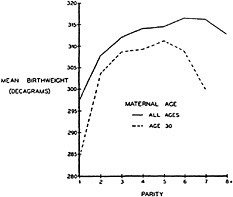
FIGURE 10.1—The distribution of mean birthweight in decagrams by parity for all maternal ages, and for maternal age 30 only.
-
How heterogeneous are the observations within a mother-father cell?
-
Assuming the answer to question (5) is “appreciable,” what are the variables which may account for the within-cell heterogeneity?
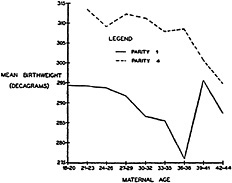
FIGURE 10.2—The distribution of mean birthweight in decagrams by maternal age for fixed parities (parities 1 and 4).
These questions have been posed in the order in which we shall treat them in the following paragraphs.
In Table 10.4 are given the results of the analysis of covariance leading to the determination of the regression coefficients b1, b2, and b3 associated with parity (x), parity squared (w), and maternal age (z) for each of the individual mother-father cells within the males-Hiroshima cell as well as the estimates of b1, b2, and b3 based on the pool of the exposure cells.1 From
|
1 |
By “pool” we refer to the results obtained when we sum the sums of squares and cross products of deviations over all 16 exposure cells, and estimate the regression coefficients therefrom. By “sum” we refer to the results obtained when a regression is fitted to each of the individual exposure cells. |
TABLE 10.1 MEAN BIRTHWEIGHT BY PARENTAL EXPOSURE, SEX, AND CITY (Unrelated parents. Means expressed in decagrams.)












TABLE 10.2 ANALYSIS OF VARIANCE OF BIRTHWEIGHT BY PARENTAL EXPOSURE AND CITY (Unrelated parents)


TABLE 10.3 THE DISTRIBUTION BY PARENTAL EXPOSURE OF THE WEIGHTED MEAN SQUARES OF DEVIATIONS (Weighting is for city and sex. The degrees of freedom associated with the mean squares are indicated in parentheses.)



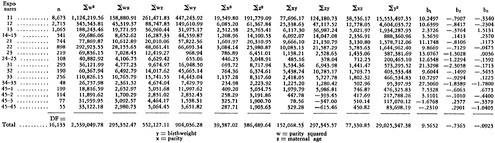
Table 10.5a we note that the estimates of b1, b2, and b3 based on the pool remove a significant amount of variation from the birthweights. In the light of the work of other investigators this is not an unexpected finding. However, if we return to Table 10.4, we note on inspection considerable heterogeneity among the b's associated with the various exposure cells. That this variation is significant is borne out by Table 10.5b.
At this point, it is of interest to inquire into the amount of variation in the birthweights accounted for by variation in the individual regressions after removing the portion associated with the common regression (see Sec. 6.3). From the data in Table 10.5, we form the mean square ratio of the “mean square residual (pool)” to the “mean square residual (sum).” The value obtained is 1.001350. Accordingly, we may assert that the variation in regressions accounts for 0.14 per cent of the variation in birthweight not accounted for by the common regression. This value obviously attains perspective only if we know the amount of variation in birthweight accounted for by the common regression. The latter we obtain from the mean square ratio
At this point, it is of interest to inquire into the amount of variation in the birthweights accounted for by variation in the individual regressions after removing the portion associated with the common regression (see Sec. 6.3). From the data in Table 10.5, we form the mean
TABLE 10.5 TESTS OF THE SIGNIFICANCE AND HOMOGENEITY OF THE REGRESSIONS OF BIRTHWEIGHT ON MATERNAL AGE AND PARITY: MALES, HIROSHIMA



square ratio of the “mean square residual (pool)” to the “mean square residual (sum).” The value obtained is 1.001350. Accordingly, we may assert that the variation in regressions account for 0.14 per cent of the variation in birthweight not accounted for by the common regression. This value obviously attains perspective only if we know the amount of variation in birthweight accounted for by the common regression. The latter we obtain from the mean square ratio
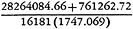
which is 1.02674. The common regression, then, accounts for 2.7 per cent of the variation in y. It is natural to inquire here whether this amount, 2.7 per cent, is of importance. To this we can only answer that in view of the small effects anticipated from irradiation, variation, accountable for on other grounds, of as small as 3 per cent could be sufficient to obfuscate irradiation differences.
For the analysis of variance on the adjusted data set out in Table 10.6, adjustment was to the common regression because adjustment to the individual exposure cell regressions removed a seemingly negligible additional amount of variation (for a discussion of the computational procedure see Wishart, 1950). For the reader not familiar with covariance analysis it might be pointed out that the computations in Table 10.6 effectively transform through the pooled regression the observed array of exposure cell means into the array of exposure cell means which one would obtain if each exposure cell had the same maternal age and parity distribution. The mean squares obtained following this transformation are wholly analogous to those obtained in a simple analysis of variance, and may be interpreted in the same sense. Inspection of this table fails to reveal significant differences among maternal or paternal exposure categories or evidence from the interaction mean square of nonadditive effects of parental exposure. The adjusted birth weight means are given in Table 10.7.
The next question to be asked of these data was, “Does there exist significant heterogeneity among the variances in the mother-father cells?” The residual mean squares for the sixteen exposure cells within males-Hiroshima are given in Table 10.8. Bartlett's test (cf. Rao, 1952) of the heterogeneity of the variances is not

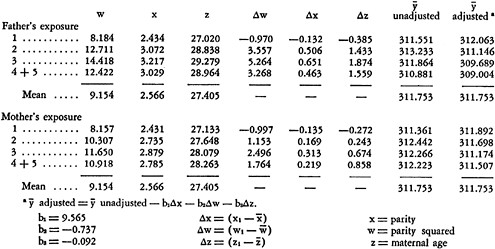
significant. Thus when all exposure cells within the males-Hiroshima cell are considered, the only evidence for an association of birthweight with parental exposure is the heterogeneity of the individual cell regressions. But, this association is neither consistent nor does it persist to a significant extent when the category 1 parents are excluded (see Table 10.5c).
Before we summarize and consider the possible interpretations of the findings on the males-Hiroshima data let us turn to the remaining three sex-city cells. Tables corresponding to those for males-Hiroshima are given for females-Hiroshima (Tables 10.9–10.13), males-
TABLE 10.8 THE RESIDUAL MEAN SQUARES FROMTHE INDIVIDUAL CELL REGRESSIONS: MALES, HIROSHIMA (The degrees of freedom are given in parentheses.)




Nagasaki (Tables 10.14–10.18) and females-Nagasaki (Tables 10.19–10.23). In none of these three sex-city cells does the analysis of variance on the adjusted data reveal significant differences as regards mean birthweight between maternal or paternal exposure categories or evidence of heterogeneity as judged by the interactions. In Table 10.24 are set out the principal findings with regard to the four sex-city cells. From this table when all exposure cells are considered we note (a) significant heterogeneity in the individual father-mother regressions in two of the four sex-city cells, (b) a reasonable measure of constancy in the amount of variation removed by the common regression in each sex-city cell, and (c) significant heterogeneity between the residual mean squares within a sex-
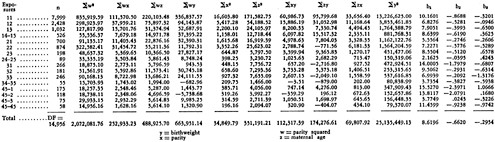
TABLE 10.10 TESTS OF THE SIGNIFICANCE AND HOMOGENEITY OF THE REGRESSIONS OF BIRTHWEIGHT ON MATERNAL AGE AND PARITY: FEMALES, HIROSHIMA




TABLE 10.12 THE ADJUSTED BIRTHWEIGHT MEANS: FEMALES, HIROSHIMA
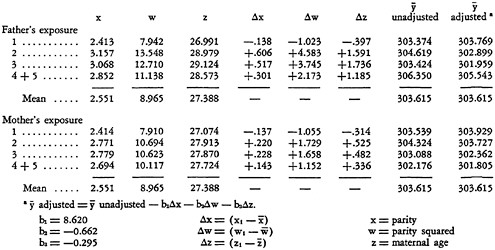
TABLE 10.13 THE RESIDUAL MEAN SQUARES FROMTHE INDIVIDUAL CELL REGRESSIONS: FEMALES, HIROSHIMA (The degrees of freedom are given in parentheses.)




TABLE 10.14 ANALYSIS OF COVARIANCE OF BIRTHWEIGHTS: MALES, NAGASAKI
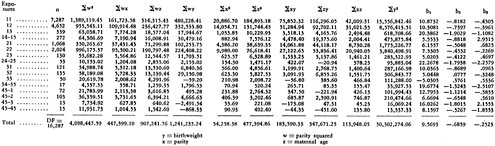
TABLE 10.15 TESTS OF THE SIGNIFICANCE AND HOMOGENEITY OF THE REGRESSIONS OF BIRTHWEIGHT ON MATERNAL AGE AND PARITY: MALES, NAGASAKI




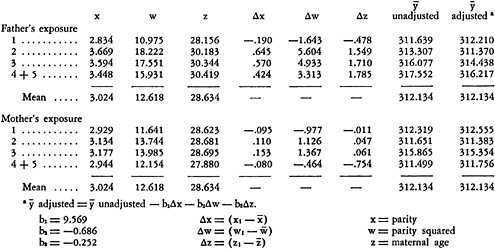
TABLE 10.18 THE RESIDUAL MEAN SQUARES FROMTHE INDIVIDUAL CELL REGRESSIONS: MALES, NAGASAKI (The degrees of freedom are given in parentheses.)




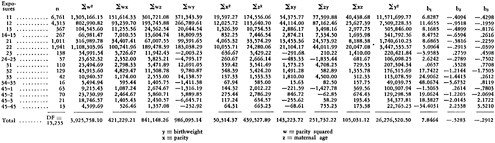
TABLE 10.20 TESTS OF THE SIGNIFICANCE AND HOMOGENEITY OF THE REGRESSIONS OF BIRTHWEIGHTON MATERNAL AGE AND PARITY: FEMALES, NAGASAKI




TABLE 10.22 THE ADJUSTED BIRTHWEIGHT MEANS: FEMALES, NAGASAKI
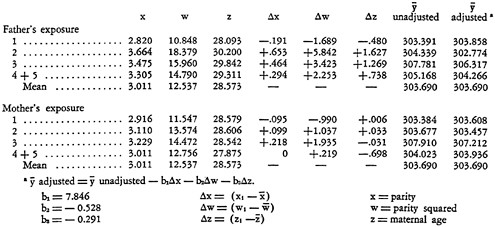
TABLE 10.23 THE RESIDUAL MEAN SQUARESFROMTHE INDIVIDUAL CELL REGRESSIONS: FEMALES, NAGASAKI (The degrees of freedom are given in parentheses.)




TABLE 10.24 A SUMMARY OF THE SALIENT FINDINGS OF THE COVARIANCE ANALYSIS
|
(a) All exposure cells |
|||||
 |
|||||
|
Cell |
Heterogeneity of regressionsa |
Variation in regressions after removing the portion associated with the common regression % |
Total variation accounted for by the common regression % |
Ratio of smallest to largest mean square (as per cent) after adjustment for individual cell regressions % |
Bartlett's test for between-cell heterogeneity of mean squares |
|
Male—Hiroshima |
Exceeds 5% level |
0.14 |
2.7 |
67 |
Not significant |
|
Female—Hiroshima |
Not significant |
0.03 |
1.9 |
58 |
Exceeds 1% level |
|
Male—Nagasaki |
Not significant |
0.05 |
2.8 |
48 |
Exceeds 5% level |
|
Female—Nagasaki |
Exceeds 5% level |
0.15 |
2.0 |
43 |
Exceeds 5% level |
|
(b) Only those cells in which both parents were exposed |
|||||
 |
|||||
|
Cell |
Heterogeneity of regressionsa |
Variation in regressions after removing the portion associated with the common regression % |
Total variation accounted for by the common regression % |
Ratio of smallest to largest mean square (as per cent) after adjustment for individual cell regressions % |
Bartlett's test for between-cell heterogeneity of mean squares |
|
Male—Hiroshima |
Not significant |
0 |
2.8 |
81 |
Not significant |
|
Female—Hiroshima |
Not significant |
0.03 |
1.3 |
58 |
Exceeds 1% level |
|
Male—Nagasaki |
Not significant |
0 |
2.1 |
48 |
Not significant |
|
Female—Nagasaki |
Exceeds 5% level |
0.72 |
0.9 |
45 |
Not significant |
|
aAll regressions of the form y=m+b1x1+b2x12+b3x2. |
|||||
city cell for three of the four sex-city cells. But, from this same table (10.24b), we note that when exposure category 1 parents are eliminated both the heterogeneity in regressions and in residual mean squares largely disappears. Before we consider the implications of this, let us first consider what might account for the differences observed when all exposure cells are utilized.
Table 10.24a, then, provides evidence, albeit inconclusive at this stage, that birthweight may be associated with parental exposure. Two points are involved, namely:
-
In two of the four sex-city cells, the relation of birthweight to parity and maternal age varies in a minor but significant fashion among father-mother cells.
-
In three of the four sex-city cells, the residual mean squares vary substantially (and significantly) among the father-mother cells.
Let us consider these points. In point (2), under the assumption that within a sex-city cell the observations within a father-mother cell have homogeneous variance, common mean, and normal distributions, we should conclude that the variance differs between the exposure cells, and that this obtains for most sex-city cells. Normality may be safely assumed, but there exists the possibility that the other assumptions are invalid here. Accordingly, two alternative or supplementary explanations of the findings in point (2) must be entertained, namely:
-
The variances are different between exposure cells, and presumably due to irradiation.
-
The variances are different between exposure cells due to unaccounted-for concomitant variation. For example, if there were year-of-birth effects, or a socio-economic status effect, then differences in the residual mean squares might reflect unequal representations with respect to year of birth, or social background.
Similarly, for point (1) we must entertain more than one explanation, namely:
-
The relation of birthweight to parity and age of mother is different among exposure cells and presumably due to irradiation.
-
Factors partially correlated with age and parity may differ between exposure cells and thus give rise to an apparent variation in the relation of birthweight to parity and mother's age.
What evidence is available which might permit a choice among these alternatives?
In addition to data covering maternal age and parity, information is available on two other concomitant variables which are relevant to the questions raised in the preceding paragraph. These variables are year of birth (for all infants) and the parental socio-economic status (for a random 10 per cent of infants). Let us consider first the effect of year of birth on the residual mean squares.
Two alternatives which might be entertained here are the following: Firstly, we could assume that the relationship of mother's age and parity to birthweight is constant over the years within a given exposure cell, but that the intercept (mean) of the regression may vary from year to year. This would lead us to fit a model asserting that

That is to say, the expected value of the kth observation on birthweight in the rth year of the ijth exposure cell (sex and city are fixed) is a function of the mean of the rth year in the ijth cell, of parity, of parity-squared, and of maternal age. Secondly, we might prefer not to assume that the relationship of mother's age and parity to birthweight is constant over years within a given exposure cell, and hence to fit a model of the form

The latter approach is, of course, equivalent to fitting a regression in each of the 112 year-exposure combinations within a given sex-city cell. It is questionable whether the increase in precision of the latter approach over the former is sufficient to justify the not insignificant additional labor in computing some 448 regressions. As a first approximation, then, we have elected to proceed using the simpler (the first) model.
To determine whether year of birth contributes significantly to the variation in birthweights, within exposure cells, following the removal of maternal age and parity effects, we may employ the mean square ratio test. The latter test consists of forming the likelihood ratio, say L, of the “mean square following removal of age and parity” to the “mean square following removal of age, parity, and year.”
We assert that year of birth contributes significantly if L>L0 where the critical value, L0, is given by

and where f and f' are, respectively, the degrees of freedom associated with the lesser and the greater mean square, and F0 is the critical F
TABLE 10.25 THE DISTRIBUTION BY PARENTAL EXPOSUREOF THE RESIDUAL MEAN SQUARES AFTER REMOVAL OF VARIATION DUE TO YEAR OF BIRTH OF THE INFANT: MALES, HIROSHIMA (Degrees of freedom are given in parentheses.)




(here F05) at (f'-f) and f degrees of freedom. In all sex-city cells, year of birth can be shown to exert an effect; this effect is, however, significant in only two instances, namely, Hiroshima-females and Nagasaki-males. Under the circumstances, then, to prevent ambiguity it seems appropriate to remove the year-of-birth effects in all cells.
TABLE 10.26 THE DISTRIBUTION BY PARENTAL EXPOSURE OF THE RESIDUAL MEAN SQUARES AFTER REMOVAL OF VARIATION DUE TO YEAR OF BIRTH OF THE INFANT: FEMALES, HIROSHIMA (Degrees of freedom are given in parentheses.)




In Tables 10.25 to 10.28 are given the distributions by parental exposure of the residual mean squares following removal of the “year-of-birth effect” for the four sex-city cells. In three of the four sex-city cells the residual mean squares do not, now, differ significantly one from another (two of these three previously revealed significant heterogeneity among the mean squares).
TABLE 10.27 THE DISTRIBUTION BY PARENTAL EXPOSURE OF THE RESIDUAL MEAN SQUARES AFTER REMOVAL OF VARIATION DUE TO YEAR OF BIRTH OF THE INFANT: MALES, NAGASAKI (Degrees of freedom are given in parentheses.)




TABLE 10.28 THE DISTRIBUTION BY PARENTAL EXPOSURE OF THE RESIDUAL MEAN SQUARES AFTER REMOVAL OF VARIATION DUE TO YEAR OF BIRTH OFTHE INFANT: FEMALES, NAGASAKI (Degrees of freedom are given in parentheses.)




In view of the fact that the variances were heterogeneous in only one sex-city cell (Hiroshima-females) when year of birth was taken into account, no attempt was made to exploit the data with regard to socio-economic status. The latter decision stemmed primarily from the fact that analysis of the socio-economic data would, since such data are available on only 10
per cent of the observations, be applicable only inferentially to the problem of whether residual concomitant variation could account for the heterogeneity of the variance estimates within the Hiroshima-females cell.
What, now, may we conclude with regard to the effect of parental exposure on birthweights? Three points are involved, namely,
-
Does parental exposure affect birthweight means?
-
Does parental exposure affect the relationship between birthweight and concomitant variables, notably maternal age and parity?
-
Does parental exposure affect birthweight variances?
With regard to birthweight means, we cannot demonstrate a significant effect of parental exposure in any one of the four sex-city cells. With regard to the regressions of birthweight on parity and maternal age, significant differences obtain among exposure cells in two sex-city cells. In one of these instances, significance does not obtain if attention is limited to only those infants born to parents both of whom were exposed. In view of the known somatic effects of irradiation, it would seem most likely that the regression differences, if real, reflect either a “disaster” effect or a direct (nongenetic) effect of irradiation. Lastly, with regard to the effect of parental exposure on birthweight variances, we note that, when maternal age and parity are removed, the variance estimates are heterogeneous among exposure cells (all exposure cells considered) in three of the four sex-city cells. If, however, year of birth is also removed, only one sex-city cell continues to exhibit significant heterogeneity in the variance estimates among exposure cells. Moreover, we note that if attention is limited to those terminations to parents both of whom were exposed, the variance estimates among the exposure cells are significantly heterogeneous in only one sex-city cell even if year of birth is not removed. These facts raise some doubt as to the reality of the differences in mean squares as an irradiation effect, especially if one assumes that a consistent pattern is the sine qua non of a radiation-induced change. Whether consistency is a valid assumption is difficult to appraise. One can postulate certain parental interactions or relationships between fetal resorption and degree of radiation damage, both admissible hypotheses, from which it would not necessarily follow that the variance would be similarly affected in all sex-city cells. The conservative interpretation of the data with regard to the birthweight variances would be one which asserts no clearly demonstrable effect of parental irradiation on the spread of birthweights.
10.5 Summary.—There exist no consistent findings suggestive of an effect of parental exposure on (a) birthweight means, (b) the relationship of maternal age and parity to birthweight, or (c) birthweight variances.
Chapter XI
ANALYSIS OF THE DATA CONCERNING DEATH DURING THE NINE-MONTH PERIOD FOLLOWING DELIVERY
11.1 The trait.—Although from its very first usage the Genetics Short Form included a question concerning death following delivery, the collection of data with reference to death after the first week following delivery was not originally systematic. However, the instruction to the midwives regarding promptly notifying the ABCC in the event of an abnormal pregnancy termination included a statement regarding death during the first days of life. As the autopsy program developed, the midwives often voluntarily informed the ABCC of death at any time during and after the first week postpartum. The routine follow-up visit was usually made between the seventh and fourteenth postpartum days—sometimes later, usually in consequence of recurrent transportation crises in the “motor pool,” seldom earlier, due largely to the system of collecting Genetics Short Forms from the midwives and also a natural and proper reluctance on the part of Japanese mothers, especially during the winter months, to permit the examination of their children at an earlier date. At the time of this follow-up visit, any deaths which had occurred were noted. This system led to quite complete information regarding death during the first week of life. In the actual analysis, we have confined our attention to the occurrence of death during the first six days postpartum. In the strict sense, this is not the neonatal period, which is usually thought of as including the first month of life, but we shall apply the term “neonatal” to it as a matter of convenience.
In addition to this information regarding neonatal death, there is available supplementary information from the “9-months program.” As noted earlier, infants were selected for follow-up studies at age 9 months on the basis of the terminal digit in their registration numbers. Thus, depending on the personnel and facilities available, one month an attempt might be made to re-examine all infants whose registration number ended in 0 or 5, the next month 0, 5, or 9, etc. At the time of the contacts necessary to arrange for this examination, it could be determined if the infant had died in the interval between our initial examination and the time of the second contact. There is thus available supplementary information for 21,788 infants concerning the occurrence of death between birth and the ninth month following delivery. The latter figure is somewhat approximate because of variations in the “contact day,” but no bias exists with reference to parental radiation history.
11.2 The genetic argument for radiation-induced changes in the neonatal death rate.— The argument from which one might expect radiation-induced genetic changes in the neonatal death rate is wholly analogous to the argument for differences in the stillbirth rate with increasing parental exposure (see Sec. 9.2). Mutations detected in the first generation of offspring by a study of the neonatal death rate would consist largely of the dominant lethals (or possibly in a more strict sense the sublethals) although some recessive lethals might also be recovered because of the fortuitous combination in some individuals of an induced lethal mutation with an allelic lethal mutation of spontaneous origin. Accordingly, we might expect as one manifestation of radiation-induced genetic damage an increase in the frequency of neonatal deaths with increasing parental exposure.
11.3Concomitant variables known to influence the occurrence of a neonatal death.—The sources of extraneous variation affecting the frequency of neonatal deaths are not unlike those variables influencing the frequency of stillbirths (see Sec. 9.3). Among the concomitant variables common to both of the aforementioned indicators are maternal disease (principally syphilis), nutrition, birth injury, maternal age, order of birth, and rate of repro-
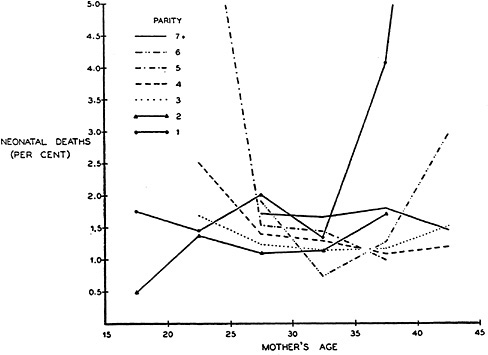
FIGURE 11.1—The distribution of the frequency of neonatal deaths by age of mother for specified parities.
duction. In the case of neonatal death this list must be augmented by the addition of at least one more extraneous variable, namely, infantile infectious diseases. In the first six days of life, the principal infectious diseases, which could and frequently do lead to the death of an infant, are respiratory infections and infantile diarrhea.
The observations and comments with regard to maternal disease, nutrition, and birth injury made in Chapter IX with regard to stillbirths are no less pertinent here. To recapitulate briefly, we noted that:
-
There existed a gradual but significant decline in the rate of transmission of syphilis from mother to infant with increasing maternal age. The age distribution among the exposure cells is such that this bias would tend to inflate the neonatal death rate among the non-exposed or less heavily exposed parents. It was felt that these effects could be ignored.
-
There is ample evidence attesting to the importance of nutrition and birth injury in the neonatal death rate, but these two variables will be ignored in our presentation because there are no demonstrable or probable differences among exposure cells.
With regard to the effect of maternal age and parity on the neonatal death rate the reader is referred to Figures 11.1 and 11.2 and Tables 11.1 and 11.2. The latter figure gives the distribution of the frequency of neonatal death by parity for specified maternal ages. The former figure gives the distribution of the frequency of neonatal death by maternal age for specified parities. From these two figures and tables we note that the effect of maternal age and parity on the frequency of neonatal death is strikingly similar to the effect of age and parity on the
stillbirth rate.1 We find that the age-specific parity distributions or the parity-specific age distributions of the frequency of neonatal death tend to be U-shaped. However, unlike the stillbirth data the minima of the age-specific parity distributions appear quite similar, whereas the minima of the parity-specific age distributions tend to occur at a higher level with increasing
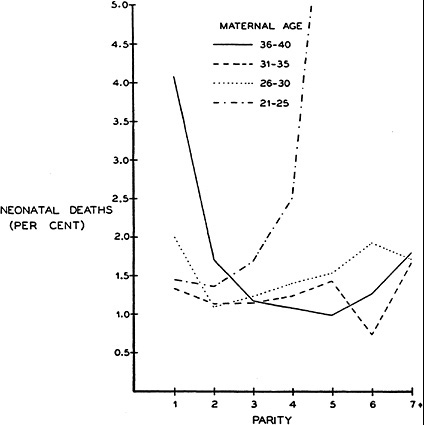
FIGURE 11.2—The distribution of the frequency of neonatal deaths by parity for specified maternal ages.
parity. These findings would suggest a significant effect of parity which varies by mother's age on the frequency of neonatal death (a rate of reproduction effect), but no significant independent effect of mother's age. This is consistent with Yerushalmy's (1938) observations in the United States. Now since the effect of parity is not independent of maternal age, adequate adjustment to control variation in parity between exposure cells would require also taking into account variation in maternal age. However, as in the case of stillbirths, a partitioning of the data as elegant as that required to effect the “best” control would seriously jeopardize the validity of the tests because of (a) the large number of empty cells, and (b) the very small expected values in the bulk of the occupied cells. Accordingly, the data were further partitioned only with regard to parity. We recognized five parity classes, namely, parity 1, parities 2–3, 4–5, 6–7, and 8 and higher. The bias which might remain after this partitioning would be one difficult to specify adequately but probably would lead to an increase in neonatal mortality among the more heavily exposed cells because of increased maternal age within these latter cells.
The possibility of a spurious irradiation effect
|
1 |
A full description of these data is to be published elsewhere. |
TABLE 11.1 THE EFFECT OF MATERNAL AGE AT FIXED PARITY ON THE FREQUENCYOF NEONATAL DEATHS


TABLE 11.2 THE EFFECT OF PARITY AT FIXED MATERNAL AGE ON THE FREQUENCY OF NEONATAL DEATHS


on the neonatal death rate due to a non-random distribution (by parental exposure) of contacts with the agents responsible for the more serious infectious infantile diseases such as the respiratory infections and infantile diarrhea is difficult to evaluate. We are not aware of any widespread outbreaks of respiratory infections or diarrhea among the newborn infants of Hiroshima and Nagasaki during the interval 1948–1953.
11.4The data.—In Tables 11.3 and 11.4 are given the distribution of neonatal deaths by sex of infant, parental exposure and city without and with allowance for parity. The corresponding analytical results are given in Tables 11.5 and 11.6. Let us consider first the evidence for an irradiation effect from the data prior to partitioning by parity. From inspection of Table 11.3 and from the results given in Table 11.5 we note a significant mother-father exposure interaction. The occurrence of this interaction considerably complicates further analysis of these data since, as in the non-orthogonal case of the analysis of variance, the disproportion among the numbers of observations in the various ways of classification leads to distortion of main effects tests based upon the marginal totals, due to the unequal contributions to the marginal class totals. Under the circumstances it would seem that the most appropriate tests for those ways of classification other than those involved in the interactions, here mother's exposure and father's exposure, would be the sum of the chi-squares obtained by testing a given way of classification at each level of the ways of classification involved in the interaction. Thus, in this instance, the test of the city effect would be obtained by summing the sixteen chi-squares and their degrees of freedom obtained by testing the effect of city on the variate at each of the sixteen mother-father levels. The disadvantage of this procedure is that all sixteen tests contribute equally to the sum, whereas the power of the individual tests will vary considerably. Ideally, perhaps, one would weight the individual contributions of these tests to the sum by their power functions. This has not been done, and hence the sum tests will probably be somewhat biased.
When the data are analyzed as just outlined, for only one of the eight exposure tests when the exposure of one parent is held constant does a significant effect of mother's or father's exposure emerge. The weight this one positive finding should be given in the face of seven non-significant, similar tests is debatable. There are significant differences between the sexes but
TABLE 11.3 THE FREQUENCY OF NEONATAL DEATHS BY PARENTAL EXPOSURE, CITY, AND SEX OF INFANT (Unrelated parents)




















TABLE 11.4 THE FREQUENCY OF NEONATAL DEATHS BY PARENTAL EXPOSURE, CITY, AND PARITY (Unrelated parents)
|
Hiroshima |
|||||||||||||||||||||||||||
 |
|||||||||||||||||||||||||||
|
Total |
|||||||||||||||||||||||||||
 |
|||||||||||||||||||||||||||
|
Parity |
Exposurea |
11 |
12 |
13 |
14 15 |
Total F1 |
21 |
22 |
23 |
24 25 |
Total F2 |
31 |
32 |
33 |
34 35 |
Total F3 |
41 51 |
42 52 |
43 53 |
44 45 54 55 |
Total F4,5 |
M1 |
M2 |
M3 |
M4,5 |
Total |
|
|
1 |
 |
n |
5,367 |
1,659 |
644 |
333 |
8,003 |
491 |
197 |
64 |
33 |
785 |
186 |
73 |
51 |
21 |
331 |
118 |
50 |
19 |
15 |
202 |
6,162 |
1,979 |
778 |
402 |
9,321 |
|
d |
72 |
18 |
3 |
7 |
100 |
7 |
4 |
— |
1 |
12 |
5 |
1 |
— |
2 |
8 |
2 |
1 |
— |
1 |
4 |
86 |
24 |
3 |
11 |
124 |
||
|
p |
.0134 |
.0108 |
.0047 |
.0210 |
.0125 |
.0143 |
.0203 |
— |
.0303 |
.0153 |
.0269 |
.0137 |
— |
.0952 |
.0242 |
.0169 |
.0200 |
— |
.0667 |
.0198 |
.0140 |
.0121 |
.0039 |
.0274 |
.0133 |
||
|
2–3 |
 |
n |
8,238 |
2,588 |
1,087 |
533 |
12,446 |
673 |
786 |
194 |
89 |
1,742 |
284 |
159 |
197 |
45 |
685 |
182 |
105 |
66 |
50 |
403 |
9,377 |
3,638 |
1,544 |
717 |
15,276 |
|
d |
99 |
34 |
15 |
3 |
151 |
7 |
8 |
— |
— |
15 |
8 |
— |
1 |
1 |
10 |
6 |
— |
— |
— |
6 |
120 |
42 |
16 |
4 |
182 |
||
|
p |
.0120 |
.0131 |
.0138 |
.0056 |
.0121 |
.0104 |
.0102 |
— |
— |
.0086 |
.0282 |
— |
.0051 |
.0222 |
.0146 |
.0330 |
— |
— |
— |
.0149 |
.0128 |
.0115 |
.0104 |
.0056 |
.0119 |
||
|
4–5 |
 |
n |
2,603 |
737 |
303 |
168 |
3,811 |
233 |
542 |
118 |
45 |
938 |
80 |
94 |
159 |
23 |
356 |
66 |
63 |
42 |
30 |
201 |
2,982 |
1,436 |
622 |
266 |
5,306 |
|
d |
38 |
18 |
5 |
5 |
66 |
2 |
4 |
— |
— |
6 |
— |
— |
1 |
— |
1 |
1 |
1 |
2 |
— |
4 |
41 |
23 |
8 |
5 |
77 |
||
|
p |
.0146 |
.0244 |
.0165 |
.0298 |
.0173 |
.0086 |
.0074 |
— |
— |
.0064 |
— |
— |
.0063 |
— |
.0028 |
.0152 |
.0159 |
.0476 |
— |
.0199 |
.0137 |
.0160 |
.0129 |
.0188 |
.0145 |
||
|
6–7 |
 |
n |
555 |
191 |
64 |
44 |
854 |
55 |
195 |
24 |
17 |
291 |
20 |
29 |
68 |
14 |
131 |
15 |
14 |
18 |
14 |
61 |
645 |
429 |
174 |
89 |
1,337 |
|
d |
8 |
6 |
1 |
2 |
17 |
2 |
5 |
— |
— |
7 |
1 |
— |
— |
— |
1 |
— |
— |
— |
— |
— |
11 |
11 |
1 |
2 |
25 |
||
|
p |
.0144 |
.0314 |
.0156 |
.0455 |
.0199 |
.0364 |
.0256 |
— |
— |
.0241 |
.0500 |
— |
— |
— |
.0076 |
— |
— |
— |
— |
— |
.0171 |
.0256 |
.0057 |
.0225 |
.0187 |
||
|
8+ |
 |
n |
128 |
51 |
22 |
6 |
207 |
10 |
75 |
18 |
14 |
117 |
5 |
17 |
29 |
3 |
54 |
2 |
2 |
9 |
5 |
18 |
145 |
145 |
78 |
28 |
396 |
|
d |
2 |
1 |
— |
— |
3 |
— |
2 |
1 |
— |
3 |
— |
— |
— |
— |
— |
— |
— |
— |
— |
— |
2 |
3 |
1 |
— |
6 |
||
|
p |
.0156 |
.0196 |
— |
— |
.0145 |
— |
.0267 |
.0556 |
— |
.0256 |
— |
— |
— |
— |
— |
— |
— |
— |
— |
— |
.0138 |
.0207 |
.0128 |
— |
.0152 |
||
|
Sum |
 |
n |
16,891 |
5,226 |
2,120 |
1,084 |
25,321 |
1,462 |
1,795 |
418 |
198 |
3,873 |
575 |
372 |
504 |
106 |
1,557 |
383 |
134 |
154 |
114 |
885 |
19,311 |
7,627 |
3,196 |
1,502 |
31.636 |
|
d |
219 |
77 |
24 |
17 |
337 |
18 |
23 |
1 |
1 |
43 |
14 |
1 |
2 |
3 |
20 |
9 |
2 |
2 |
1 |
14 |
260 |
103 |
29 |
22 |
414 |
||
|
p |
.0130 |
.0147 |
.0113 |
.0157 |
.0133 |
.0123 |
.0128 |
.0024 |
.0051 |
.0111 |
.0243 |
.0027 |
.0040 |
.0283 |
.0128 |
.0235 |
.0085 |
.0130 |
.0088 |
.0158 |
.0135 |
.0135 |
.0091 |
.0146 |
.0131 |
||
|
Nagasaki |
|||||||||||||||||||||||||||
|
|
|||||||||||||||||||||||||||
|
Total |
|||||||||||||||||||||||||||
|
|
|||||||||||||||||||||||||||
|
Parity |
Exposurea |
11 |
12 |
13 |
14 15 |
Total F1 |
21 |
22 |
23 |
24 25 |
Total F2 |
31 |
32 |
33 |
34 35 |
Total F3 |
41 51 |
42 52 |
43 53 |
44 45 54 55 |
Total F4,5 |
M1 |
M2 |
M3 |
M4,5 |
Total |
|
|
1 |
 |
n |
3,163 |
2,369 |
181 |
135 |
5,848 |
507 |
517 |
44 |
23 |
1,091 |
53 |
44 |
10 |
4 |
111 |
26 |
19 |
2 |
4 |
51 |
3,749 |
2,949 |
237 |
166 |
7,101 |
|
d |
66 |
48 |
10 |
3 |
127 |
12 |
11 |
— |
2 |
25 |
2 |
2 |
— |
— |
4 |
1 |
— |
— |
— |
1 |
81 |
61 |
10 |
5 |
157 |
||
|
p |
.0209 |
.0203 |
.0553 |
.0222 |
.0217 |
.0237 |
.0213 |
— |
.0870 |
.0229 |
.0377 |
.0455 |
— |
— |
.0360 |
.0385 |
— |
— |
— |
.0196 |
.0216 |
.0207 |
.0422 |
.0301 |
.0221 |
||
|
2–3 |
 |
n |
6,890 |
4,460 |
348 |
276 |
11,974 |
916 |
1,416 |
94 |
48 |
2,474 |
102 |
101 |
29 |
9 |
241 |
76 |
85 |
14 |
9 |
184 |
7,984 |
6,062 |
485 |
342 |
14,873 |
|
d |
94 |
62 |
3 |
3 |
162 |
11 |
13 |
— |
1 |
25 |
2 |
1 |
— |
— |
3 |
— |
— |
— |
— |
— |
107 |
76 |
3 |
4 |
190 |
||
|
p |
.0136 |
.0139 |
.0086 |
.0109 |
.0135 |
.0120 |
.0092 |
— |
.0208 |
.0101 |
.0196 |
.0099 |
— |
— |
.0124 |
— |
— |
— |
— |
— |
.0134 |
.0125 |
.0062 |
.0117 |
.0128 |
||
|
4–5 |
 |
n |
3,046 |
1,579 |
123 |
88 |
4,836 |
406 |
1,171 |
76 |
26 |
1,679 |
55 |
76 |
38 |
8 |
177 |
26 |
40 |
12 |
9 |
87 |
3,533 |
2,866 |
249 |
131 |
6,779 |
|
d |
38 |
20 |
1 |
— |
59 |
7 |
20 |
1 |
— |
28 |
1 |
1 |
— |
— |
2 |
— |
— |
— |
— |
— |
46 |
41 |
2 |
— |
89 |
||
|
p |
.0125 |
.0127 |
.0081 |
— |
.0122 |
.0172 |
.0171 |
.0132 |
— |
.0167 |
.0182 |
.0132 |
— |
— |
.0113 |
— |
— |
— |
— |
— |
.0130 |
.0143 |
.0080 |
— |
.0131 |
||
|
6–7 |
 |
n |
923 |
524 |
48 |
34 |
1,529 |
199 |
611 |
35 |
13 |
858 |
16 |
31 |
11 |
12 |
70 |
5 |
19 |
4 |
3 |
31 |
1,143 |
1,185 |
98 |
62 |
2,488 |
|
d |
12 |
8 |
1 |
1 |
22 |
1 |
8 |
— |
— |
9 |
— |
— |
1 |
1 |
2 |
— |
— |
— |
— |
— |
13 |
16 |
2 |
2 |
33 |
||
|
p |
.0130 |
.0153 |
.0208 |
.0294 |
.0144 |
.0050 |
.0131 |
— |
— |
.0105 |
— |
— |
.0909 |
.0833 |
.0286 |
— |
— |
— |
— |
— |
.0114 |
.0135 |
.0204 |
.0323 |
.0133 |
||
|
8+ |
 |
n |
238 |
173 |
22 |
13 |
446 |
82 |
307 |
21 |
3 |
413 |
10 |
16 |
5 |
1 |
32 |
3 |
10 |
2 |
3 |
18 |
333 |
506 |
50 |
20 |
909 |
|
d |
2 |
2 |
1 |
— |
5 |
— |
5 |
1 |
— |
6 |
— |
— |
— |
— |
— |
— |
— |
— |
— |
— |
2 |
7 |
2 |
— |
11 |
||
|
p |
.0084 |
.0116 |
.0455 |
— |
.0112 |
— |
.0163 |
.0476 |
— |
.0145 |
— |
— |
— |
— |
— |
— |
— |
— |
— |
— |
.0060 |
.0138 |
.0400 |
— |
.0121 |
||
|
Sum |
 |
n |
14,260 |
9,105 |
722 |
546 |
24,633 |
2,110 |
4,022 |
270 |
113 |
6,515 |
236 |
268 |
93 |
34 |
631 |
136 |
173 |
34 |
28 |
371 |
16,742 |
13,568 |
1,119 |
721 |
32,150 |
|
d |
212 |
140 |
16 |
7 |
375 |
31 |
57 |
2 |
3 |
93 |
5 |
4 |
1 |
1 |
11 |
1 |
— |
— |
— |
1 |
249 |
201 |
19 |
11 |
480 |
||
|
p |
.0149 |
.0154 |
.0222 |
.0128 |
.0152 |
.0147 |
.0142 |
.0074 |
.0265 |
.0143 |
.0212 |
.0149 |
.0108 |
.0294 |
.0174 |
.0074 |
— |
— |
— |
.0027 |
.0149 |
.0148 |
.0170 |
.0153 |
.0149 |
||
|
aFather's exposure is given first. |
|||||||||||||||||||||||||||
TABLE 11.5 CHI-SQUARE ANALYSIS OF THE FREQUENCY OF NEONATAL DEATHS BY PARENTAL EXPOSURE, CITY, AND SEX (Unrelated parents)
|
(a) 4?4 |
|||
 |
|||
|
Source |
DF |
X2 |
P |
|
Total |
63 |
83.974 |
.05–.10 |
|
Interactions, first order |
|||
|
CS |
1 |
0.070 |
.70–.80 |
|
CM |
3 |
3.192 |
.30–.50 |
|
CF |
3 |
5.336 |
.10–.20 |
|
SM |
3 |
2.202 |
.50–.70 |
|
SF |
3 |
5.224 |
.10–.20 |
|
MF |
9 |
22.986 |
.001–.01 |
|
Main effects |
|||
|
Mothers: Fathers 1 |
3 |
1.223 |
.70–.80 |
|
Fathers 2 |
3 |
4.365 |
.20–.30 |
|
Fathers 3 |
3 |
12.480 |
.001–.01 |
|
Fathers 4,5 |
3 |
4.378 |
.20–.30 |
|
Fathers: Mothers 1 |
3 |
6.258 |
.10–.20 |
|
Mothers 2 |
3 |
5.280 |
.10–.20 |
|
Mothers 3 |
3 |
7.132 |
.05–.10 |
|
Mothers 4,5 |
3 |
2.479 |
.30–.50 |
|
Sex:a M1F1 |
1 |
13.296 |
<.001 |
|
M1F2 |
1 |
0.051 |
.80–.90 |
|
M1F3,4,5 |
1 |
1.840 |
.10–.20 |
|
M2F1 |
1 |
2.504 |
.10–.20 |
|
M3F2 |
1 |
0.077 |
.70–.80 |
|
M2F3,4,5 |
1 |
0.070 |
.80–.90 |
|
M3,4,5F1 |
1 |
2.080 |
.10–.20 |
|
M3,4,5F2 |
1 |
0.204 |
.50–.70 |
|
M3,4,5F3,4,5 |
1 |
6.266 |
.01–.02 |
|
Sum |
9 |
26.388 |
.001–.01 |
|
City:a M1F1 |
1 |
2.048 |
.10–.20 |
|
M2F1 |
1 |
0.091 |
.70–.80 |
|
M3,4,5F1 |
1 |
1.837 |
.10–.20 |
|
M1F2 |
1 |
0.361 |
.50–.70 |
|
M2F2 |
1 |
0.168 |
.50–.70 |
|
M3,4,5F2 |
1 |
3.265 |
.05–.10 |
|
M1F3,4,5 |
1 |
0.780 |
.30–.50 |
|
M2F3,4,5 |
1 |
1.093 |
.20–.30 |
|
M3,4,5F3,4,5 |
1 |
0.036 |
.80–.90 |
|
Sum |
9 |
9.679 |
.30–.50 |
|
aTo increase the numbers of observations, categories 3, 4, and 5 have been pooled in these tests. |
|||
|
(b) 3?3 |
|||
 |
|||
|
Source |
DF |
X2 |
P |
|
Total |
35 |
39.587 |
.50–.60 |
|
Interactions, first order |
|||
|
CS |
1 |
0.161 |
.50–.70 |
|
CM |
2 |
0.425 |
.80–.90 |
|
CF |
2 |
4.354 |
.10–.20 |
|
SM |
2 |
2.258 |
.30–.50 |
|
SF |
2 |
5.007 |
.05–.10 |
|
MF |
4 |
5.441 |
.20–.30 |
|
Main effects |
|||
|
Sex (S)a |
|||
|
Mother's exposure—2 |
1 |
0.106 |
.70–.80 |
|
Mother's exposure—3 |
1 |
0.432 |
.50–.70 |
|
Mother's exposure—4,5 |
1 |
2.604 |
.10–.20 |
|
Sum |
3 |
3.142 |
.30–.50 |
|
City (C)a |
|||
|
Mother's exposure—2 |
1 |
1.005 |
.30–.50 |
|
Mother's exposure—3 |
1 |
0.454 |
.50–.70 |
|
Mother's exposure—4,5 |
1 |
0.980 |
.30–.50 |
|
Sum |
3 |
2.439 |
.30–.50 |
|
Mother (M) |
2 |
6.216 |
.02–.05 |
|
Father (F)a |
|||
|
Mother's exposure—2 |
2 |
3.708 |
.10–.20 |
|
Mother's exposure—3 |
2 |
1.108 |
.50–.70 |
|
Mother's exposure—4,5 |
2 |
2.421 |
.20–.30 |
|
Sum |
6 |
7.237 |
.20–.30 |
|
aAdjusted for mothers. |
|||
TABLE 11.6 CHI-SQUARE ANALYSIS OF THE FREQUENCY OF NEONATAL DEATHS BY PARENTAL EXPOSURE, CITY, AND PARITY (Unrelated parents)
|
Source |
DF |
X2 |
P |
|
Total |
159 |
189.601 |
.05–.10 |
|
Interactions, first order |
|||
|
CM |
3 |
3.192 |
.30–.50 |
|
CF |
3 |
4.855 |
.10–.20 |
|
CP |
4 |
14.401 |
.001–.01 |
|
MF |
9 |
22.986 |
.001–.01 |
|
MP |
12 |
21.436 |
.02–.05 |
|
FP |
12 |
13.334 |
.30–.50 |
|
Main effects (only CP interaction taken into account) |
|||
|
Parity (P) |
|||
|
Hiroshima (H) |
4 |
5.872 |
.20–.30 |
|
Nagasaki (N) |
4 |
32.045 |
<.001 |
|
City (C) |
|||
|
Parity |
|||
|
Class—1 |
1 |
18.585 |
<.001 |
|
Class—2 |
1 |
0.458 |
.30–.50 |
|
Class—3 |
1 |
0.420 |
.50–.70 |
|
Class—4 |
1 |
1.720 |
.10–.20 |
|
Class—5 |
1 |
0.200 |
.50–.70 |
|
Mother (M) |
|||
|
H: Parity |
|||
|
Class—1 |
3 |
11.753 |
.001–.01 |
|
Class—2 |
3 |
3.424 |
.30–.50 |
|
Class—3 |
3 |
0.809 |
.80–.90 |
|
Class—4 |
3 |
2.882 |
.30–.50 |
|
Class—5 |
3 |
0.775 |
.80–.90 |
|
N: Parity |
|||
|
Class—1 |
3 |
5.235 |
.10–.20 |
|
Class—2 |
3 |
1.977 |
.50–.70 |
|
Class—3 |
3 |
2.552 |
.30–.50 |
|
Class—4 |
3 |
2.409 |
.30–.50 |
|
Class—5 |
3 |
4.662 |
.10–.20 |
|
Sum |
30 |
36.478 |
.10–.20 |
|
Father (F) |
|||
|
H: Parity |
|||
|
Class—1 |
3 |
4.260 |
.20–.30 |
|
Class—2 |
3 |
2.387 |
.30–.50 |
|
Class—3 |
3 |
10.236 |
.01–.02 |
|
Class—4 |
3 |
2.559 |
.30–.50 |
|
Class—5 |
3 |
1.976 |
.50–.70 |
|
N: Parity |
|||
|
Class—1 |
3 |
1.085 |
.70–.80 |
|
Class—2 |
3 |
4.322 |
.20–.30 |
|
Class—3 |
3 |
3.156 |
.30–.50 |
|
Class—4 |
3 |
2.322 |
.50–.70 |
|
Class—5 |
3 |
0.846 |
.80–.90 |
|
Sum |
30 |
33.149 |
.30–.50 |
not the cities. Omission of the category 1 parents from the analysis results in the disappearance of the M-F interaction (Table 11.5b). As before, there is no significant effect of father's exposure but now a barely significant effect of mother's exposure appears.
From Tables 11.4 and 11.6, we note that when neonatal deaths are further partitioned by parity rather extensive heterogeneity in the data is revealed. Both the city-parity and mother-father interactions are significant. To adjust the main effects tests as indicated in Chapter VI leads, in this instance, to such extensive partitioning as to seriously jeopardize the validity of the tests. However, one could adjust for one of the interactions at a time. Accordingly, two sets of “main effects” tests could be generated. If one ignores the mother-father interaction, the main effects tests of city, parity, and exposure would be as given in Table 11.6. If the city-parity interaction were ignored, the tests of exposure and city would be as given in Table 11.5a, and there would, in addition, be a test of parity. One must obviously view the results of these two sets of tests as approximate. However, in neither instance does evidence emerge indicating a significant, consistent effect of parental exposure.
The results from the “at-birth” examinations are corroborated by the findings at 9 months of age, presented in Table 11.7. The reader should note the following departures from the usual classifications of the 9-months data: (1) sex of infant is ignored, (2) exposure categories 3, 4, and 5 have been pooled, and (3) deaths from birth to 9 months are recorded. The purpose of these latter procedures was to bring to bear on the problem of infant mortality following dissimilar exposure experiences on the part of the parents, the largest possible number of observations. No attempt has been made to control concomitant variation which would presumably be no less of a problem here than elsewhere in these data, and would, in the main, tend to inflate the death rate among infants born to the more heavily exposed parents. The analysis of these data is presented in Table 11.8. We note no effect of city, maternal or paternal exposure, or evidence of heterogeneity between the cities or exposure cells.
11.5 Summary.—No consistent, significant effect of parental exposure on neonatal mortality emerges from the data obtained in Hiroshima and Nagasaki on deaths occurring in the first six days postpartum. Analysis of neonatal and infantile mortality obtained at the time of the 9-months examination fails to disclose an effect of parental exposure on infant survival. No consistent exposure trend is exhibited by these data.
TABLE 11.7 THE FREQUENCY OF DEATHSBETWEEN BIRTH AND NINE MONTHSOF AGEBY PARENTAL EXPOSUREAND CITY (Unrelated parents)









TABLE 11.8 ANALYSIS OF THE FREQUENCY OF DEATHSBETWEEN BIRTH AND NINE MONTHSOF AGE, BY PARENTAL EXPOSURE AND CITY (Unrelated parents)
|
Source |
DF |
X2 |
p |
|
Total |
17 |
13.146 |
.70–.80 |
|
Interactions, first order |
|||
|
CM |
2 |
0.382 |
.80–.90 |
|
CF |
2 |
0.658 |
.70–.80 |
|
MF |
4 |
4.647 |
.30–.50 |
|
Main effects |
|||
|
City |
1 |
1.097 |
.20–.30 |
|
Mothers |
2 |
1.081 |
.50–.70 |
|
Fathers |
2 |
0.087 |
.95–.98 |
Chapter XII
THE ANALYSIS OF THE ANTHROPOMETRIC DATA
12.1 The measurements obtained at nine months.—As was pointed out in Section 2.6, one feature of the “9-months” program involved obtaining certain physical measurements on the infants seen. These measurements were felt to supply the best index to general physical vigor obtainable under the circumstances. The present chapter is concerned with an analysis of these data. It should be pointed out that because of scheduling problems, it was not possible to examine each infant at precisely nine months of age; the data here presented are based on babies varying in age from eight to ten months inclusively. Since the system of selection for study by terminal registration digit precludes an age bias with respect to irradiation history, this age variation becomes a problem only insofar as it may enhance “within-cell” variation to the point of obscuring tests on interactions and main effects. We shall consider this possibility in detail in Section 12.4.3. Caution is also indicated in utilizing certain aspects of these data for standards of normality.
The measurements to be analyzed are the interdependent variables, weight, body length, head circumference, and chest circumference. In each city, all measurements were taken by one of two nurses, both of whom devoted much of their working time to this procedure. Originally the weight of the baby was obtained by weighing mother and (stripped) child together on a beam-type scale, then weighing the mother separately, and calculating the weight of the baby from the difference. During the latter part of 1952 the practice of weighing the baby directly in a basket on the same scale was instituted. Body length was measured by a stadiometer which was wider than the width of the baby. The readings were taken directly off a scale on the instrument. Head circumference was taken with a cloth tape at the maximum girth of the head in a plane passing through the nasion. Chest circumference was measured by means of the same tape, the measurement representing the chest girth in the plane of the nipples, taken midway between inspiration and expiration. This midpoint was estimated after a brief period of observation.
12.2 The genetic argument for irradiation effects.—The genetic argument for irradiation effects is essentially the same as the argument advanced for changes in the birthweights of infants born to exposed parents. The existence of irradiation-induced changes in body measurements is predicated on the assumptions that (a) the largest class of gene mutations are the recessive “detrimentals,” and (b) the presence of “detrimentals” would be reflected in changes in body measurements consequent to abnormalities in growth pattern and rate in the first nine months of life.
The differences to be expected would be (a) changes in the multivariate means with changing parental exposure, (b) a change, quite possibly an increase, in the generalized variance with increasing parental exposure, or (c) both. The likelihood of the occurrence of these changes would obviously be a function not only of parental exposure but of the component of variation in measurements at nine months of age ascribable to genetic factors. Little information is available from which to estimate this component.
12.3 Concomitant variables known to affect growth and development during the first year of life.—The concomitant variables affecting growth and development during the first year of life are, in some respects, less well known than the variables which influence birthweight.
We do not know, for example, whether the maternal age and parity effects demonstrable at birth persist throughout the first year of life or not. That the effects of these two variables on measurements at nine months would be negligible would seem to follow from (a) the small amount of the total variation (approximately
TABLE 12.1 DISTRIBUTION OF MEAN WEIGHT IN DECAGRAMS AT 9 MONTHSOF AGE BY CITY, SEX, AND PARENTAL EXPOSURE (Unrelated parents. The numbers of observations on which the means are based are given in parentheses.)




















3%) which they account for in birthweights, (see Table 10.24) and (b) the ever decreasing correlation between weight at birth and at age x (by nine months of age this correlation is 0.319 as estimated from these data). For the purposes of this analysis we shall assume that the various exposure sub-populations do not differ significantly as regards any factor influencing growth and development.
12.4 The data.—Presented in Tables 12.1 to 12.4 are the means and the number of observations on which they are based for the 64 sex-city-mother-father cells for the measurements of weight, height, head girth, and chest girth. Inspection of these data reveals no striking trends associated with parental exposure. It should be noted, however, that, save for uncommon exceptions, infants born to parents one or both of whom are in exposure category 1 are larger in all measurements than infants born to parents both of whom were exposed.
Let us turn now to the questions to be asked of these data, namely:
-
Are there significant differences between the multivariate means associated with parental exposure?
-
Are there significant differences between ex-
TABLE 12.2 DISTRIBUTION OF MEAN HEIGHT IN MILLIMETERS AT 9 MONTHS OF AGE BY CITY, SEX, AND PARENTAL EXPOSURE (Unrelated parents. The numbers of observations on which the means are based are given in parentheses.)




















TABLE 12.3 DISTRIBUTION OF MEAN HEAD GIRTH IN MILLIMETERS AT 9 MONTHS OF AGEBY CITY, SEX, AND PARENTAL EXPOSURE (Unrelated parents. The numbers of observations on which the means are based are given in parentheses.)




















-
posure cells in the generalized variances, that is, the determinants of the variance-covariance matrices?
-
Does there exist demonstrable within-cell (exposure cell, that is) heterogeneity which would limit or augment the conclusions which can be drawn from these data?
TABLE 12.4 DISTRIBUTION OF MEAN CHEST GIRTH IN MILLIMETERS AT 9 MONTHSOF AGEBY CITY, SEX, AND PARENTAL EXPOSURE (Unrelated parents. The numbers of observations on which the means are based are given in parentheses.)



















12.4.1 The multivariate means.—The analyses of the multivariate means are given in Tables 12.5 to 12.11. Tables 12.5 to 12.8 cover the analysis when all categories of parental exposure are considered but variation in age at examination is ignored. Tables 12.9 to 12.11 present a comparable analysis save for the exclusion of all parents of exposure category 1. In both instances, analysis has been by Rao's (1955) analysis of dispersion for the case when the cell numbers are unequal and disproportionate. The analysis of dispersion is, of course, merely the multivariate equivalent of the analysis of variance.
As in the case of birthweights, we shall discuss in detail only one of these analyses and then summarize the information from the two (i.e., with and without category 1 parents) sources regarding differences in the multivariate means. In Table 12.5 are given the data appropriate to the analysis of the first order (two-factor) interactions. Inspection of the mean squares for the individual analyses of variance reveals that in most instances the interaction mean squares are smaller than the within-cell mean squares. Because of these low values Wilks' test (cf. Rao, 1952), which tests the
TABLE 12.5 ANALYSIS OF DISPERSION (All exposure cells)
|
(a) Sums of squares and cross products of deviations for the two-factor interactions |
||||||||||
 |
||||||||||
|
F×Ma |
||||||||||
 |
||||||||||
|
Source |
Total |
Within |
C×S |
F×S |
M×S |
F×C |
M×C |
F(M1, —M2) |
F(M3 —M4,5) |
F(M1 —M4,5) |
|
(DF) |
(18,497) |
(18,434) |
(1) |
(3) |
(3) |
(3) |
(3) |
(3) |
(3) |
(3) |
|
y2 |
3,804,932 |
2,955,778 |
960 |
235 |
663 |
121 |
538 |
403 |
1,887 |
369 |
|
x2 |
11,272,708 |
10,208,953 |
108 |
1,046 |
1,171 |
122 |
2,375 |
3,069 |
4,135 |
929 |
|
z2 |
8,212,037 |
7,088,914 |
83 |
596 |
686 |
2,760 |
2,051 |
980 |
1,551 |
1,180 |
|
w2 |
151,099,462 |
139,259,440 |
5,915 |
15,418 |
33,424 |
10,786 |
12,298 |
58,323 |
13,202 |
17,085 |
|
yx |
2,808,860 |
2,131,955 |
322 |
—180 |
788 |
—31 |
—419 |
856 |
1,185 |
—332 |
|
yz |
2,920,623 |
1,979,555 |
—283 |
—103 |
560 |
316 |
—141 |
552 |
1,174 |
17 |
|
yw |
11,774,995 |
10,021,620 |
—2,383 |
—200 |
3,584 |
550 |
—534 |
4,403 |
4,141 |
—574 |
|
xz |
4,416,701 |
3,829,089 |
—95 |
637 |
753 |
384 |
1,984 |
1,693 |
711 |
108 |
|
xw |
28,370,723 |
24,957,896 |
—800 |
3,610 |
5,851 |
825 |
4,389 |
10,345 |
4,465 |
3,052 |
|
zw |
22,649,636 |
21,316,400 |
703 |
2,872 |
4,390 |
5,439 |
4,876 |
6,714 |
4,154 |
3,102 |
|
(b) Mean squares for individual analyses of variance |
||||||||||
 |
||||||||||
|
F×Ma |
||||||||||
 |
||||||||||
|
Source |
Total |
Within |
C×S |
F×S |
M×S |
F×C |
M×C |
F(M1 —M2) |
F(M3 —M4,5) |
F(M1 —M4,5) |
|
(DF) |
(18,497) |
(18,434) |
(1) |
(3) |
(3) |
(3) |
(3) |
(3) |
(3) |
(3) |
|
y2 |
— |
160.34 |
960* |
78.33 |
221.00 |
40.33 |
179.33 |
134.33 |
629.00* |
123.00 |
|
x2 |
— |
553.81 |
108 |
348.67 |
390.33 |
40.67 |
791.67 |
1,023.00 |
1,378.33 |
309.67 |
|
z2 |
— |
384.56 |
83 |
198.67 |
228.67 |
920.00 |
683.67 |
326.67 |
517.00 |
393.33 |
|
w2 |
— |
7,554.49 |
5,915 |
5,139.33 |
11,141.33 |
3,595.33 |
4,099.33 |
19,44l.00 |
4,400.67 |
5,695.00 |
|
y=head circumference w=weight |
x=height M=mother |
C=city F=father |
S=sex z=chest girth |
|||||||
|
aThe father-mother interaction has been partitioned into three orthogonal components each of which compares the fathers' exposure as a whole with the two designated mothers' groups. |
||||||||||
significance of the ratio of two determinants, say, |W| and |W+Q| where |W| is the error matrix (within cells) and |Q| is the matrix due to any other category, was not performed (this ratio is, of course, the multivariate analogue of the L statistic used in Chapter X). It may be that the variation in age at examination has inflated the within-cell mean squares to the point where small interactions would be ob-
TABLE 12.6 ANALYSIS OF DISPERSION (All exposure cells)
|
(a) Sums of squares and cross products of deviations for main effects and additivity |
||||||||||
 |
||||||||||
|
Source |
Between cells |
Fathers |
Mothers |
Sex |
City |
Residuala |
||||
|
(DF) |
(63) |
(3) |
(3) |
(1) |
(1) |
(55) |
||||
|
y2 |
849,154 |
854 |
949 |
558,451 |
261,037 |
12,392 |
||||
|
x2 |
1,063,755 |
12,890 |
8,069 |
978,425 |
18,163 |
31,591 |
||||
|
z2 |
1,123,123 |
3,496 |
1,577 |
475,161 |
577,066 |
28,252 |
||||
|
w2 |
11,840,022 |
227,141 |
55,354 |
9,567,378 |
1,327,332 |
451,750 |
||||
|
yx |
676,905 |
2,119 |
1,850 |
739,190 |
—68,857 |
9,435 |
||||
|
yz |
941,068 |
1,518 |
1,045 |
515,125 |
388,118 |
11,066 |
||||
|
yw |
1,753,375 |
10,554 |
6,643 |
2,311,473 |
—588,628 |
43,488 |
||||
|
xz |
587,612 |
6,064 |
984 |
681,843 |
—102,379 |
124,722 |
||||
|
xw |
3,412,827 |
52,788 |
18,096 |
3,059,570 |
155,270 |
69,818 |
||||
|
zw |
1,333,236 |
27,420 |
6,821 |
2,132,146 |
—875,191 |
92,923 |
||||
|
(b) Mean squares for individual analyses of variance (on main effects and additivity) |
||||||||||
 |
||||||||||
|
Source |
Between cells |
Fathers |
Mothers |
Sex |
City |
Residuala |
||||
|
(DF) |
(63) |
(3) |
(3) |
(1) |
(1) |
(55) |
||||
|
y2 |
13,478.63** |
284.67 |
316.33 |
558,451** |
261,037** |
225.31 |
||||
|
x2 |
16,885.00** |
4,296.67** |
2,689.67** |
978,425** |
18,163** |
574.38 |
||||
|
z2 |
17,827.35** |
1,165.33** |
525.67 |
475,161** |
577,066** |
513.67 |
||||
|
w2 |
187,936.86** |
75,713.67** |
18,451.33 |
9,567,378** |
1,327,332** |
8,213.64 |
||||

scured. For the moment, suffice it to say that at this stage there is no evidence for the non-additivity of the main effects. The significance of this evidence is, of course, limited if there exists within-cell heterogeneity.
Turning now to Table 12.6 we note evidence from 12.6c that the multivariate means differ significantly between (1) sex-city-mother-father cells, (2) categories of paternal exposure, (3) categories of maternal exposure, (4) cities, and (5) sexes, but the pooled interactions (“Residual” in Table 12.6) are not significant. The precise nature of these differences are more clearly given in Tables 12.7 and 12.8, to which we now turn.
For each class of father's exposure, mother's exposure, sex, and city, there can be assigned a constant estimated in a fashion such that a comparison of two constants from differing classes of a single classification reflects differences between these classes in any one of the four measurements. These estimates are derived from a linear model assuming additivity of the main effects, and specifying, without loss of generality, that the constant associated with the highest class within a given classification is zero; for example, the constant for father's exposure category 4–5 (f4, 5) is assigned the value zero.1 Comparison of the difference between two con-
|
1 |
It is convenient when only two classes exist for a classification to indicate their difference rather than the constants associated with each of the two classes. For example, in Table 12.7, the constants designated (N-H) and (?-?) are in fact the difference between N and H, and males and females. |
TABLE 12.7 ESTIMATES OF CONSTANTS ,AND THEIR VARIANCES FOR TESTS OF EQUALITY (Linear model assuming only main effects)
|
Internal variancesa |
y 160.34 |
x 553.84 |
z 384.58 |
w 7,554.90 |
|||
 |
|||||||
|
Constants |
Variance—covariance matrix of estimates for any character without the internal variance. Variances are italicized. |
||||||
 |
 |
||||||
|
N—H |
7.729818** |
—2.038997** |
11.492928** |
—17.430408** |
0.0002288947 |
— |
— |
|
?—? |
10.998079** |
14.557551** |
10.144835** |
45.521958** |
0.0002165952 |
— |
— |
|
M1 |
1.078390 |
0.852651 |
1.594916 |
6.566452 |
0.0016468914 |
0.0015516228 |
0.0015359959 |
|
M2 |
0.757550 |
—0.557520 |
1.504906 |
3.730330 |
0.0015516228 |
0.0017367076 |
0.0015365419 |
|
M3 |
0.910047 |
—0.516337 |
1.323011 |
2.850223 |
0.0015359959 |
0.0015365419 |
0.0023100881 |
|
M4,5 |
0 |
0 |
0 |
0 |
0 |
0 |
0 |
|
F1 |
1.284078 |
1.654174 |
2.073144 |
12.074681 |
0.0028351553 |
0.0027620818 |
0.0027425144 |
|
F2 |
0.925659 |
—0.584108 |
1.112317 |
3.448576 |
0.0027620818 |
0.0031414861 |
0.0027436738 |
|
F3 |
1.435112 |
—0.145078 |
1.367756 |
4.406972 |
0.0027425144 |
0.0027436738 |
0.0042519096 |
|
F4,5 |
0 |
0 |
0 |
0 |
0 |
0 |
0 |
|
N=Nagasaki H=Hiroshima a Mean square (within cells). |
|||||||
stants from a given classification with the variance of the difference affords a test of the significance of the difference. For example, if we were interested in testing whether there existed evidence for a significant difference in the mean of the w measurement (weight) between father's 2 and father's 3, the test would be

where wf2 and wf3 are the w constants for father's exposure categories and 3, sw2 is the variance of w (obtained from “within-cell”), and sf22, sf32, and sf2f3 are respectively the variances of the f2 and f3 constants and their covariance. The results of all possible contrasts for the data here presented are given in Table 12.8. It should be noted that in all instances where a significant difference exists it consists of a contrast involving the comparison of infants from category 1 parents with some other class of parental exposure. We shall return to the implication of this finding, but first let us consider some explanations for the significant findings in Table 12.6. The findings requiring some statement are the differences between the cities and the parental exposure classes.
We note first that the cities differ with respect to all four measurements, with Nagasaki infants being shorter and lighter but greater in circumferential measurements than their Hiroshima counterparts. This difference while not precisely unexpected was not predicted. The findings are, however, compatible with Matsumura's and Hasebe's (see Hulse, 1943) classification of the Japanese. These authors recognize four physical types of Japanese, namely, the Ishikawa, Chikuzen, Okayama, and Satsuma. Only the Okayama and Satsuma types, whose centers of distribution are respectively the shores of the Inland Sea (and central Japan), and southern Kyushu (presumably including Nagasaki prefecture), concern us. The Okayama type is described as an individual taller than the average Japanese, and possessing a head shorter than usual but of average breadth. The Satsuma type is described as a short individual with a broad head of average length. Granted the reality of this distinction and the distribution ascribed to these types, the city differences are readily explicable. As an historical aside, it might be pointed out that Kaempfer (1728; 1906 edi-
tion, Vol. II, p. 372) commented on the relatively small stature of the inhabitants of Hizen (an area which then included Nagasaki).
The findings with respect to parental exposure are less simply resolved. As has been repeatedly stated, to assert, without qualification, that a given change is the consequence of irradiation would entail at least the demonstration that (1) a difference exists between the pregnancies occurring to “1” and “non-1” parents, and (2) differences exist among “non-1” parents consistent with increasing exposure. Let us consider to what extent these requirements are
TABLE 12.8 A SUMMARY OF THE SIGNIFICANCE OF TESTS COMPARING ALL POSSIBLE PAIRS OF EXPOSUREFOR EACH PARENTWITH RESPECT TO THE VARIABLES w, x, y, AND za
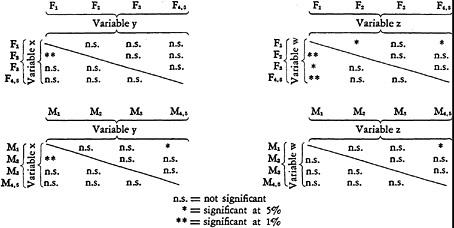 |
|
aThese tables are designed so that the entries above the diagonal refer to tests on the variable above the diagonal, whereas entries below the diagonal refer to the variable below the diagonal. |
satisfied within the Japanese anthropometric data. From Tables 12.7 and 12.8 we have evidence that “1” terminations differ from “non-1” terminations. However, from Table 12.10 we note no demonstrable differences between the “non-1” terminations. The absence of changes between exposure categories 2, 3, and 4–5 could be interpreted as evidence that the observed differences, when all categories of exposure are considered, are not due to irradiation. That this is the most likely interpretation stems from the following considerations:
-
In the main, exposure category 1 parents are repatriates from Korea, Manchuria, and elsewhere, and migrants from the rural areas surrounding Hiroshima and Nagasaki. Shapiro (1939) has shown that the Japanese who migrated to Hawaii were appreciably larger than their neighbors who remained in Japan. It is reasonable to assume that similar selection would have occurred among the migrants to Korea, Manchuria, and elsewhere in eastern and southeastern Asia in the years preceding World War II. The repatriation of the Japanese migrants to Korea, etc., following the war, was both forcible and almost exhaustive since the Japanese had become unwelcome throughout much of Asia. As a consequence of this repatriation, there may well have been settled in Hiro shima and Nagasaki in the years immediately following the bombings a group of non-exposed persons appreciably larger than the natives. Whenever possible, repatriates were settled in the areas from which they or their families originally stemmed.
-
Another factor of possible importance is nutrition. To what extent a differential in nutrition may have contributed to the observed differences is admittedly a matter of speculation. However, it seems likely that migrants from the rural areas adjacent to these cities may have had an opportunity, not available to other urban dwellers, to supplement their diet with foodstuffs from the family farm.
However, it may be argued that the requirement that a demonstrable difference obtain among the remaining exposure classes when the
TABLE 12.9 ANALYSIS OF DISPERSION (Only those cells where both parents were exposed)


TABLE 12.10 ANALYSIS OF DISPERSION (Only those cells where both parents were exposed)
|
(a) Sums of squares and products of deviations for main effects and additivity |
||||||||
 |
||||||||
|
Source |
Total |
Within |
Between |
Sex |
City |
Mother |
Father |
Residuala |
|
(DF) |
(2,366) |
(2,331) |
(35) |
(1) |
(1) |
(2) |
(2) |
(29) |
|
w2 |
19,505,898 |
17,996,341 |
1,509,557 |
1,157,230 |
102,046 |
6,403 |
1,331 |
228,733 |
|
x2 |
1,062,802 |
937,693 |
125,109 |
101,698 |
2,826 |
1,184 |
1,687 |
15,390 |
|
y2 |
508,234 |
380,665 |
127,569 |
77,087 |
38,987 |
611 |
58 |
7,670 |
|
z2 |
997,555 |
835,406 |
162,149 |
57,031 |
79,680 |
1,048 |
243 |
15,215 |
|
wx |
3,692,611 |
3,287,294 |
405,317 |
343,057 |
16,983 |
2,753 |
—114 |
35,867 |
|
wy |
1,542,974 |
1,283,995 |
258,979 |
298,675 |
—63,075 |
1,411 |
229 |
31,325 |
|
wz |
2,973,035 |
2,767,807 |
205,228 |
256,900 |
—90,173 |
2,571 |
496 |
47,545 |
|
xy |
365,478 |
282,414 |
83,064 |
88,541 |
—10,497 |
609 |
—196 |
7,470 |
|
xz |
564,292 |
501,296 |
62,996 |
76,157 |
—15,007 |
1,106 |
272 |
5,154 |
|
yz |
389,232 |
254,348 |
134,884 |
66,305 |
55,736 |
635 |
52 |
6,764 |
|
(b) Mean squares for individual analyses of variance for main effects and additivity |
||||||||
 |
||||||||
|
Source |
Total |
Within |
Between |
Sex |
City |
Mother |
Father |
Residuala |
|
(DF) |
(2,366) |
(2,331) |
(35) |
(1) |
(1) |
(2) |
(2) |
(29) |
|
w2 |
— |
7,720.44 |
— |
1,157,230** |
102,046** |
3,201.50 |
665.50 |
7,887.34 |
|
x2 |
— |
402.27 |
— |
101,698** |
2,826** |
592.00 |
843.50 |
530.69 |
|
y2 |
— |
163.31 |
— |
77,087** |
38,987** |
305.50 |
29.00 |
264.48* |
|
z2 |
— |
358.39 |
— |
57,031** |
79,680** |
524.00 |
121.50 |
524.66 |
|
Bartlett's |
||||||||
|
test |
— |
— |
— |
significant by inspection |
8.74 |
14.43 |
234.99** |
|
|
(DF) |
— |
— |
— |
(8) |
(8) |
(116) |
||
|
aIncludes all interaction terms. |
||||||||
“1” terminations are removed becomes too restrictive in practice, and that because of the great preponderance of parents one or both of whom are “1,” exclusion of the “1” parents may so reduce the sample size that we could not detect differences of the magnitude expected even if such differences did, in fact, exist. This consideration would favor drawing inferences regarding irradiation effects from the “1” vs. “non-1” contrast, however, only if there existed no a priori basis for viewing this contrast as biased. We have advanced arguments in the preceding pages which suggest that this contrast may well be biased. Accordingly, we are unwilling to draw inferences regarding the effects of irradiation in the absence of demonstrable dif-
TABLE 12.11 ESTIMATES OF CONSTANTS AND THEIR VARIANCES FOR TEST OF EQUALITY (Linear model assuming only main effects)
|
Internal variancesa |
w 7,720.44 |
x 402.27 |
y 163.31 |
z 358.39 |
||
|
|
||||||
|
Constants |
Variance—covariance matrix of estimates for any character without s2 |
|||||
|
|
 |
|||||
|
H—N |
14.047595 |
2.337845 |
—8.682824 |
—12.413078 |
0.00193378 |
— |
|
?—? |
44.24880 |
13.117449 |
11.420425 |
9.823059 |
0.00169194 |
— |
|
F2 |
0.855447 |
—3.012068 |
0.456508 |
—0.231801 |
0.00569837 |
0.00481708 |
|
F3 |
—1.261074 |
—3.104190 |
0.121017 |
—1.071249 |
0.00481708 |
0.00734644 |
|
F4–5 |
0 |
0 |
0 |
0 |
0 |
0 |
|
M2 |
2.488047 |
1.058013 |
—0.797087 |
0.691081 |
0.00698914 |
0.00604162 |
|
M3 |
6.372319 |
2.733161 |
0.607450 |
2.376684 |
0.00604162 |
0.00845267 |
|
M4–5 |
0 |
0 |
0 |
0 |
0 |
0 |
|
N=Nagasaki |
H=Hiroshima |
|||||
|
aMean square (within cells). |
||||||
ferences among the “non-1” terminations. Before pursuing this matter further, let us consider the data with regard to the generalized variances, and the effects of within-cell heterogeneity among the observations.
12.4.2 The equality of the generalized variances.—The term “generalized variance” was coined by Wilks (1932) and is defined as the determinant of the variance-covariance matrix. The generalized variance plays the same role relative to the generalized mean (multivariate mean) as that played by the variance relative to the univariate mean. The heterogeneity of a series of generalized variances may be (1) demonstrated directly by the multivariate analogue of Bartlett's test, or (2) inferred from tests on elements of the variance-covariance matrix.
Let us consider first the latter of these two approaches. It may be argued that if randomly chosen, corresponding elements in the variance-covariance matrices associated with the exposure cells are significantly different, then the generalized variances are most probably significantly different (or heterogeneous). To infer significance, of course, assumes that the elements to be tested are chosen on an a priori basis. It may be pointed out also that if the elements chosen for testing are not significantly different it does not follow that the generalized variances are not. The elements of the exposure cell variance-covariance matrices with which we shall concern ourselves are the variances of weight (w), height (x), head girth (y), and chest girth (z). Moreover, in view of the problem of the comparability of “1” and “non-1” terminations, we shall routinely perform four tests, namely, a test on the homogeneity of the variances when (1) all exposure cells are considered, (2) only those exposure cells in which both parents were exposed are considered, (3) only those exposure cells in which one or both parents are in exposure category 1, and (4) only those exposure cells in which only one parent is in exposure category 1. In Tables 12.12 to 12.15 are given the mean squares and mean products of deviations (the elements of the mean product [MP] matrices) for each exposure cell for the four city-sex cells. Inspection of the first four columns of these tables (corresponding to the estimates of the variances of w,x, y, and z) reveals no striking evidence of heterogeneity. In Tables 12.16 and 12.17 are set out the results of testing these estimates for heterogeneity by Bartlett's method (cf. Rao, 1952). From the latter tables emerges little that can be construed as evidence for the heterogeneity of the generalized variances. A comment on the two “signifi-
TABLE 12.12 MEAN PRODUCT MATRICES: MALES, HIROSHIMA
|
Exposure |
DF |
w2 |
x2 |
y2 |
z2 |
wx |
wy |
wz |
xy |
xz |
yz |
? |
|
1, 1 |
2,765 |
7,620.455 |
552.993 |
148.211 |
325.089 |
1,386.441 |
571.191 |
1,154.828 |
120.031 |
213.599 |
89.573 |
35,887,067,819 |
|
1, 2 |
871 |
8,296.716 |
588.975 |
168.083 |
355.139 |
1,484.541 |
635.730 |
1,249.869 |
146.260 |
224.932 |
94.347 |
51,960,551,297 |
|
1, 3 |
350 |
8,160.352 |
631.971 |
133.905 |
371.235 |
1,519.269 |
555.215 |
1,306.991 |
150.221 |
240.722 |
80.029 |
43,067,905,321 |
|
1, 4–5 |
169 |
6,489.417 |
421.851 |
173.214 |
270.554 |
1,049.208 |
650.190 |
879.345 |
115.690 |
141.500 |
104.440 |
26,231,272,155 |
|
2, 1 |
230 |
7,948.563 |
587.651 |
135.751 |
327.362 |
1,377.362 |
501.424 |
1,257.044 |
105.825 |
214.424 |
78.087 |
36,812,134,059 |
|
2, 2 |
236 |
7,207.711 |
507.451 |
145.489 |
300.626 |
1,362.464 |
528.694 |
1,064.885 |
98.340 |
207.770 |
67.013 |
29,131,761,372 |
|
2, 3 |
69 |
7,441.118 |
464.765 |
167.059 |
367.191 |
1,285.588 |
471.000 |
1,268.971 |
123.544 |
256.956 |
82,279 |
33,958,664,592 |
|
2, 4–5 |
29 |
8,922.964 |
771.750 |
220.821 |
253.107 |
2,120.966 |
787.286 |
1,137.071 |
201.857 |
317.357 |
104.500 |
35,915,464,679 |
|
3, 1 |
91 |
8,095.289 |
588.422 |
171.844 |
341.078 |
1,370.644 |
685.644 |
1,203.922 |
159.056 |
195.156 |
113.344 |
50,247,117,865 |
|
3, 2 |
58 |
11,331.316 |
683.860 |
150.175 |
407.561 |
2,060.526 |
791.000 |
1,845.228 |
168.228 |
323.579 |
128.719 |
34,745,901,957 |
|
3, 3 |
73 |
7,069.958 |
520.764 |
109.361 |
348.125 |
1,007.111 |
241.764 |
1,121.681 |
92.389 |
132.361 |
42.917 |
41,152,637,949 |
|
3, 4–5 |
18 |
6,635.059 |
400.000 |
152.118 |
291.765 |
982.471 |
593.529 |
1,223.471 |
163.176 |
208.647 |
122.294 |
8,153,661,713 |
|
4–5, 1 |
59 |
8,089.379 |
704.466 |
162.121 |
288.483 |
1,626.310 |
749.276 |
1,164.103 |
134.448 |
249.448 |
103.569 |
33,764,536,704 |
|
4–5, 2 |
33 |
5,870.344 |
537.875 |
143.844 |
302.875 |
972.094 |
370.000 |
1,007.344 |
146.156 |
194.531 |
56.000 |
28,295,829,672 |
|
4–5, 3 |
22 |
7,648.714 |
624.143 |
211.333 |
346.714 |
1,740.048 |
128.762 |
1,319.952 |
39.524 |
346.810 |
45.048 |
39,133,623,191 |
|
4–5, 4–5 |
12 |
6,429.727 |
491.727 |
119.000 |
348.545 |
1,170.273 |
581.727 |
1,078.364 |
78.455 |
211.182 |
138.000 |
15,896,068,251 |
TABLE 12.13 MEAN PRODUCT MATRICES: FEMALES, HIROSHIMA
|
Exposure |
DF |
w2 |
x2 |
y2 |
z2 |
wx |
wy |
wz |
xy |
xz |
yz |
? |
|
1, 1 |
2,542 |
6,909.437 |
501.892 |
131.432 |
311.724 |
1,217.874 |
455.588 |
1,050.528 |
97.090 |
195.205 |
74.754 |
30,171,743,998 |
|
1, 2 |
821 |
6,517.340 |
485.317 |
138.680 |
307.536 |
1,162.258 |
464.248 |
1,014.384 |
105.876 |
180.347 |
72.183 |
28,120,583,348 |
|
1, 3 |
330 |
6,401.730 |
471.964 |
124.897 |
288.242 |
1,092.021 |
413.473 |
977.348 |
89.321 |
169.815 |
71.742 |
24,518,913,254 |
|
1, 4–5 |
152 |
7,088.237 |
533.862 |
136.224 |
381.487 |
1,370.257 |
538.671 |
1,139.816 |
122.559 |
245.230 |
97.099 |
34,970,342,093 |
|
2, 1 |
222 |
6,655.982 |
475.248 |
145.266 |
285.707 |
1,205.333 |
489.919 |
971.752 |
97.050 |
191.856 |
84.428 |
26,354,505,356 |
|
2, 2 |
252 |
7,101.714 |
587.317 |
154.651 |
335.714 |
1,440.147 |
575.397 |
1,170.258 |
143.163 |
212.877 |
87.802 |
31,157,206,688 |
|
2, 3 |
53 |
6,857.340 |
511.094 |
107.774 |
355.189 |
1,286.585 |
558.660 |
1,163.415 |
104.434 |
221.962 |
100.491 |
18,104,432,779 |
|
2, 4–5 |
25 |
10,564.320 |
669.360 |
267.240 |
331.360 |
2,219.520 |
1,225.560 |
1,507.680 |
257.680 |
313.960 |
180.320 |
31,097,527,853 |
|
3, 1 |
99 |
7,919.091 |
534.859 |
173.283 |
339.707 |
1,536.727 |
616.747 |
1,246.495 |
130.980 |
277.303 |
97.475 |
32,297,311,094 |
|
3, 2 |
51 |
5,861.039 |
466.451 |
154.784 |
330.647 |
946.471 |
489.706 |
925.196 |
139.765 |
120.961 |
80.961 |
34,013,378,637 |
|
3, 3 |
66 |
9,430.985 |
603.091 |
158.955 |
324.742 |
1,763.212 |
890.136 |
1,409.879 |
200.818 |
277.667 |
135.424 |
43,090,442,696 |
|
3, 4–5 |
16 |
6,072.125 |
545.250 |
101.938 |
285.063 |
1,203.813 |
318.563 |
1,036.688 |
143.438 |
209.250 |
53.500 |
12,905,135,192 |
|
4–5, 1 |
47 |
7,292.979 |
538.298 |
201.702 |
264.511 |
1,364.617 |
698.043 |
1,122.468 |
178.957 |
224.426 |
125.830 |
39,618,486,089 |
|
4–5, 2 |
32 |
4,754.781 |
346.688 |
81.125 |
225.625 |
500.281 |
190.094 |
625.875 |
46.688 |
63.031 |
13.188 |
14,049,782,530 |
|
4–5, 3 |
21 |
6,661.762 |
470.714 |
191.333 |
317.429 |
1,105.810 |
551.524 |
963.857 |
65.048 |
186.381 |
32.619 |
44,268,653,408 |
|
4–5, 4–5 |
15 |
6,008.400 |
893.467 |
105.867 |
228.133 |
1,687.533 |
382.000 |
811.333 |
107.400 |
252.200 |
61.133 |
23,867,794,617 |
TABLE 12.14 MEAN PRODUCT MATRICES: MALES, NAGASAKI
|
Exposure |
DF |
w2 |
x2 |
y2 |
z2 |
wx |
wy |
wz |
xy |
xz |
yz |
∆ |
|
1, 1 |
2,073 |
8,095.760 |
585.185 |
194.300 |
388.619 |
1,434.229 |
607.827 |
1,221.924 |
120.012 |
205.034 |
144.661 |
73,332,447,415 |
|
1, 2 |
1,260 |
8,067.952 |
609.648 |
182.477 |
389.864 |
1,454.123 |
576.646 |
1,217.760 |
124.183 |
191.383 |
132.031 |
73,951,720,354 |
|
1, 3 |
98 |
7,590.929 |
480.439 |
215.876 |
432.724 |
1,241.480 |
620.184 |
1,409.459 |
131.663 |
229.520 |
173.867 |
51,018,491,679 |
|
1, 4–5 |
80 |
8,494.100 |
539.562 |
224.188 |
482.962 |
1,403.075 |
797.838 |
1,473.438 |
168.562 |
205.788 |
185.300 |
77,464,577,095 |
|
2, 1 |
282 |
8,061.277 |
631.528 |
161.582 |
371.582 |
1,575.266 |
587.287 |
1,254.394 |
125.851 |
247.993 |
130.376 |
50,550,017,916 |
|
2, 2 |
485 |
9,020.023 |
627.437 |
189.726 |
442.814 |
1,718.153 |
656.796 |
1,394.984 |
130.307 |
264.800 |
155.511 |
79,302,548,120 |
|
2, 3 |
34 |
8,408.294 |
571.618 |
160.206 |
391.853 |
785.294 |
638.118 |
1,333.412 |
41.176 |
161.206 |
156.118 |
69,440,782,051 |
|
2, 4–5 |
12 |
8,596.167 |
538.417 |
94.000 |
387.917 |
1,548.500 |
126.750 |
1,000.833 |
—0.333 |
110.000 |
125.833 |
26,226,652,145 |
|
3, 1 |
35 |
11,121.943 |
929.057 |
147.857 |
463.314 |
2,490.829 |
564.543 |
1,848.971 |
161.800 |
346.914 |
141.971 |
56,486,730,809 |
|
3, 2 |
47 |
9,479.128 |
525.064 |
193.213 |
397.830 |
1,545.574 |
476.809 |
1,402.915 |
106.787 |
186.915 |
112.404 |
78,948,705,745 |
|
3, 3 |
13 |
8,980.615 |
816.231 |
223.385 |
260.769 |
2,059.923 |
372.615 |
1,281.692 |
74.462 |
314.538 |
38.615 |
48,605,779,892 |
|
3, 4–5 |
5 |
12,353.800 |
526.200 |
167.000 |
425.800 |
2,249.800 |
891.000 |
2,149.200 |
215.000 |
426.000 |
164.000 |
4,486,865,579 |
|
4–5, 1 |
22 |
8,942.000 |
394.773 |
161.818 |
580.364 |
1,426.727 |
487.455 |
1,877.091 |
64.227 |
263.500 |
79.682 |
34,825,009,727 |
|
4–5, 2 |
35 |
7,975.143 |
559.571 |
198.771 |
349.971 |
1,386.114 |
738.286 |
1,090.800 |
150.514 |
192.886 |
156.543 |
57,967,354,402 |
|
4–5, 3 |
3 |
551.667 |
66.667 |
32.333 |
19.333 |
—76.667 |
—117.000 |
—38.000 |
33.333 |
—10.000 |
8.667 |
40,779 |
|
4–5, 4–5 |
4 |
4,436.250 |
330.500 |
228.250 |
251.250 |
1,126.000 |
558.250 |
847.500 |
83.500 |
192.000 |
214.000 |
78,359,578 |
TABLE 12.15 MEAN PRODUCT MATRICES: FEMALES, NAGASAKI
|
Exposure |
DF |
w2 |
x2 |
y2 |
z2 |
wx |
wy |
wz |
xy |
xz |
yz |
∆ |
|
1, 1 |
1,844 |
7,582.454 |
539.471 |
161.323 |
382.431 |
1,324.596 |
475.523 |
1,165.667 |
94.134 |
213.564 |
121.948 |
56,650,054,372 |
|
1, 2 |
1,167 |
6,969.566 |
573.116 |
177.429 |
376.459 |
1,239.410 |
539.459 |
1,089.111 |
112.345 |
202.589 |
135.873 |
61,898,108,594 |
|
1, 3 |
105 |
6,968.324 |
490.429 |
163.133 |
296.390 |
1,199.562 |
642.876 |
1,048.038 |
133.943 |
169.505 |
127.790 |
25,873,071,979 |
|
1, 4–5 |
79 |
7,496.405 |
714.684 |
162.684 |
424.063 |
1,471.063 |
579.658 |
1,227.443 |
107.608 |
243.241 |
137.025 |
78,227,211,737 |
|
2, 1 |
263 |
8,180.243 |
634.468 |
193.700 |
381.578 |
1,577.532 |
662.597 |
1,248.232 |
164.114 |
254.122 |
152.259 |
63,325,567,668 |
|
2, 2 |
481 |
6,867.426 |
490.775 |
163.541 |
333.008 |
1,159.262 |
462.407 |
1,029.865 |
103.181 |
169.119 |
108.083 |
44,013,362,272 |
|
2, 3 |
46 |
7,076.652 |
618.239 |
131.152 |
363.804 |
1,209.696 |
462.196 |
1,050.587 |
128.783 |
217.217 |
111.109 |
52,312,861,309 |
|
2, 4–5 |
15 |
9,057.733 |
521.667 |
93.000 |
329.867 |
1,655.400 |
147.200 |
622.000 |
64.400 |
201.067 |
44.067 |
41,442,800,443 |
|
3, 1 |
28 |
8,214.107 |
562.750 |
122.500 |
248.357 |
897.929 |
452.429 |
964.107 |
80.107 |
101.393 |
56.607 |
49,236,001,942 |
|
3, 2 |
39 |
7,524.282 |
569.615 |
103.385 |
377.333 |
1,453.359 |
414.359 |
1,091.564 |
91.872 |
178.385 |
135.897 |
24,556,887,976 |
|
3, 3 |
16 |
7,271.500 |
405.750 |
287.875 |
493.063 |
1,010.188 |
804.625 |
1,056.313 |
179.063 |
72.188 |
163.313 |
103,562,595,360 |
|
3, 4–5 |
3 |
6,013.667 |
177.667 |
70.333 |
315.000 |
889.667 |
509.333 |
—175.333 |
47.667 |
—116.000 |
2.333 |
132,897,583 |
|
4–5, 1 |
26 |
10,203.808 |
410.885 |
141.962 |
486.308 |
1,214.538 |
331.615 |
1,722.692 |
26.692 |
180.269 |
113.423 |
59,941,806,872 |
|
4–5, 2 |
15 |
7,157.400 |
914.667 |
220.400 |
435.333 |
2,002.733 |
787.533 |
1,394.333 |
221.533 |
337.533 |
189.067 |
49,612,844,266 |
|
4–5, 3 |
3 |
11,324.000 |
705.000 |
217.000 |
979.667 |
2,509.667 |
—273.667 |
3,282.000 |
—2.000 |
778.000 |
—15.667 |
326,002,045 |
|
4–5, 4–5 |
3 |
7,266.667 |
356.333 |
567.000 |
537.667 |
916.667 |
2,018.000 |
1,972.000 |
292.667 |
232.667 |
546.000 |
6,965,953 |
TABLE 12.16 TESTS OF THE HOMOGENEITY OF THE VARIANCES OF THE ANTHROPOMETRIC MEASUREMENTS OVER ALL EXPOSURE CELLS, AND SUBDIVISIONS THEREOF FOR SPECIFIED SEX AND CITY (HIROSHIMA) (The tabular entries are chi-squares.)

TABLE 12.17 TESTS OF THE HOMOGENEITY OF THE VARIANCES OF THE ANTHROPOMETRIC MEASUREMENTS OVER ALL EXPOSURE CELLS, AND SUBDIVISIONS THEREOF FOR SPECIFIED SEXAND CITY (NAGASAKI) (The tabular entries are chi-squares.)


cant” findings in Table 12.17b is necessary. Box (1949) has shown that Bartlett's X2 test overestimates significance, particularly when the degrees of freedom are large. An alternative F test which Box has shown to be relatively unbiased fails to confirm the significance of the two starred entries.
Let us, therefore, turn now to the other of the two approaches listed above, a direct test of the homogeneity of the generalized variances. The basic theory for the generalized test of homogeneity was advanced by Wilks (1932). The test employed on the data presented here proceeds from Wilks' original considerations of the problem. Briefly the test
TABLE 12.18 TEST OF THE GENERALIZED VARIANCES OF THE ANTHROPOMETRIC MEASUREMENTSBY SPECIFIED SEX AND CITY (The tabular entries are F-values. All tests are against the alternative that the variance increases with increasing parental exposure.)
|
City—sex |
All exposure cells |
Only those exposure cells where both parents were exposed |
||
|
Hiroshima—males |
F=1.128 |
DF=150,8 |
F=1.003 |
DF=80,8 |
|
Hiroshima—females |
F<1.000 |
DF=150,8 |
F<1.000 |
DF=80,8 |
|
Nagasaki—males |
F=1.109 |
DF=150,8 |
F<1.000 |
DF=80,8 |
|
Nagasaki—females |
F=1.222* |
DF=150,8 |
F=1.283 |
DF=80,8 |
is as follows: The test criterion, M, is the generalized form of Bartlett's criterion for the univariate case, and

where sijl is the unbiased estimate of the variance or covariance, sijl, between the ith and jth variable in the lth sample based on vi degrees of freedom, and suppose l=1, . . ., k, and sij is the average variance or covariance, that is,

and 
Now Box (1949) has shown that M/b is distributed as F with n1 and n2 degrees of freedom where
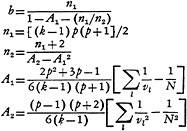
and where p is the number of variates.
The results of testing the generalized variances in this fashion are presented in Table 12.18. In no one of the sex-city cells can the generalized variances be shown to be significantly different. There is then no evidence that parental irradiation has significantly altered the variances associated with these measures of physical vigor.
12.4.3 Within-cell heterogeneity.—We have previously indicated that there may exist extraneous sources of variation which could lead to the observations within an exposure cell having dissimilar expectations with respect to the multivariate mean and the generalized variance. In other words, the observations within an exposure cell may be heterogeneous in the sense that they do not represent observations drawn from the same parent population. The most apparent possible extraneous source of variation which should be considered is difference in age at examination. To “control” the age variation we elected to recognize another way of classification, namely, age at examination. Three age groups were defined; these age groups were 7.5–8.5, 8.5–9.5, and 9.5–10.5 months at examination. The results of analyzing the data following this further partitioning are given in Tables 12.19 to 12.22. As might be surmised, the within-cell variation is reduced. However, aside from the demonstration that weight, height, head girth, and chest girth vary with the age of the infant, the results of the analysis are essentially unchanged from those results obtained when the age variation was ignored. That is to say, we still find significant differences between sexes and cities, no evidence for interaction, and that the exposure differences are explicable in terms of the differences between the “1” and “non-1” parental exposure categories.
12.5 Summary.—Analysis of the multivariate means and the generalized variances asso-
TABLE 12.19 ANALYSIS OF DISPERSION, WITH AGE (A) AT EXAMINATION INCLUDEDAS A WAY OF CLASSIFICATION (All exposure cells)


TABLE 12.20 ANALYSIS OF DISPERSION WITH AGE AT EXAMINATION INCLUDEDAS A WAY OF CLASSIFICATION
|
(a) Sums of squares and products of deviations for main effects and additivity |
|||||||||
 |
|||||||||
|
Source |
Total |
Within |
Between |
Sex |
City |
Mother |
Father |
Age |
Residual |
|
(DF) |
(18,501) |
(18,323) |
(179) |
(1) |
(1) |
(3) |
(3) |
(2) |
(169) |
|
w2 |
151,043,104 |
137,204,748 |
13,838,356 |
9,451,588 |
1,071,950 |
55,725 |
222,652 |
1,194,302 |
1,278,871 |
|
x2 |
11,256,624 |
9,814,982 |
1,441,642 |
962,798 |
5,781 |
7,101 |
12,348 |
318,396 |
91,848 |
|
y2 |
3,805,126 |
2,881,395 |
923,731 |
553,377 |
279,875 |
1,074 |
848 |
54,314 |
32,898 |
|
z2 |
7,597,178 |
6,405,833 |
1,191,345 |
472,027 |
586,157 |
1,681 |
3,456 |
13,600 |
84,037 |
|
wx |
28,057,399 |
23,287,603 |
4,769,796 |
3,016,615 |
78,721 |
17,186 |
50,678 |
615,837 |
815,882 |
|
wy |
14,587,130 |
12,525,804 |
2,061,326 |
2,286,982 |
—547,733 |
6,995 |
10,025 |
254,511 |
99,758 |
|
wz |
22,520,300 |
20,913,544 |
1,606,756 |
2,112,203 |
—792,673 |
7,518 |
26,825 |
126,822 |
243,073 |
|
xy |
2,806,433 |
1,983,136 |
823,297 |
729,925 |
—40,224 |
1,809 |
1,977 |
130,984 |
25,220 |
|
xz |
4,413,292 |
3,728,298 |
684,994 |
674,141 |
—58,212 |
1,240 |
5,724 |
65,730 |
44,883 |
|
yz |
2,918,752 |
1,933,991 |
984,761 |
511,086 |
405,031 |
1,203 |
1,464 |
26,926 |
28,499 |
|
(b) Mean squares for individual analyses of variance for main effects and additivity |
|||||||||
 |
|||||||||
|
Source |
Total |
Within |
Between |
Sex |
City |
Mother |
Father |
Age |
Residual |
|
(DF) |
(18,501) |
(18,323) |
(179) |
(1) |
(1) |
(3) |
(3) |
(2) |
(169) |
|
w2 |
— |
7,488.12 |
— |
9,451,588** |
1,071,950** |
18,575.00 |
74,217.33** |
597,151** |
7,567 |
|
x2 |
— |
535.66 |
— |
962,798** |
5,781** |
2,367.00** |
4,116.00** |
159,198** |
543 |
|
y2 |
— |
157.26 |
— |
553,377** |
279,875** |
358.00 |
282.67 |
27,157** |
195* |
|
z2 |
— |
349.61 |
— |
472,027** |
586,157** |
560.33 |
1,152.00* |
6,800** |
497** |
|
Bartlett's |
significant by inspection |
||||||||
|
(DF) |
— |
— |
— |
significant by inspection |
24.047* |
46.245** |
175.68a |
||
|
test |
— |
— |
— |
(12) |
(12) |
(676) |
|||
|
aNot significant on one-tailed test. |
|||||||||
TABLE 12.21 ESTIMATES OF CONSTANTS AND THEIR VARIANCES FOR TESTSOF EQUALITY (Linear model assuming only main effects)
|
Internal variancesa |
w 7,488.12 |
x 421.35 |
y 157.26 |
z 349.61 |
||||
 |
||||||||
|
Constants |
Variance-covariance matrix of estimates for any character without s2 |
|||||||
 |
 |
|||||||
|
N—H |
—15.78924 |
—1.15952 |
8.06781 |
11.67564 |
0.0002325668 |
— |
— |
— |
|
?—? |
45.24432 |
14.44040 |
10.94768 |
10.11102 |
0.0002165825 |
— |
— |
— |
|
F1 |
12.22589 |
1.50499 |
1.22862 |
2.15255 |
0.0028202429 |
0.0027471830 |
0.0027275426 |
0 |
|
F2 |
3.66296 |
—0.73132 |
0.87364 |
1.22502 |
0.0027471830 |
0.0031261248 |
0.0027286450 |
0 |
|
F3 |
5.07801 |
—0.03436 |
1.49375 |
1.49768 |
0.0027275426 |
0.0027286450 |
0.0042372410 |
0 |
|
F4,5 |
0 |
0 |
0 |
0 |
0 |
0 |
0 |
0 |
|
M1 |
7.09807 |
1.09708 |
1.20416 |
1.65223 |
0.0016477453 |
0.0015524865 |
0.0015371326 |
0 |
|
M3 |
4.37406 |
—0.22320 |
0.90545 |
1.55274 |
0.0015524865 |
0.0017375721 |
0.0015376733 |
0 |
|
M3 |
3.67542 |
—0.11254 |
1.09558 |
1.39793 |
0.0015371326 |
0.0015376733 |
0.0023114987 |
0 |
|
M4,5 |
0 |
0 |
0 |
0 |
0 |
0 |
0 |
0 |
|
A1 |
—28.31300 |
—14.23984 |
—6.14185 |
—2.86362 |
0.0008248126 |
0.0001840021 |
0 |
0 |
|
A2 |
—13.49855 |
—7.27893 |
—2.78079 |
—1.55995 |
0.0001840021 |
0.0002729890 |
0 |
0 |
|
A3 |
0 |
0 |
0 |
0 |
0 |
0 |
0 |
0 |
|
aMean square within cells. |
||||||||
TABLE 12.22 A SUMMARY OF THE SIGNIFICANCE TESTS COMPARING ALL POSSIBLE PAIRSOF EXPOSUREFOR EACH PARENTWITH RESPECT TO THE VARIABLES x, y, w, AND z AFTER ALLOWANCEIS MADE FOR AGE AT EXAMINATION.a
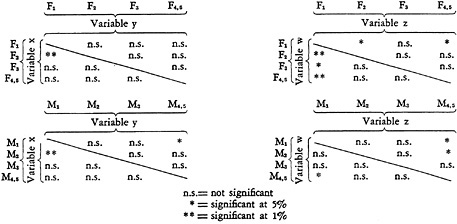 |
|
a These tables are designed so that the entries above the diagonal refer to tests on the variable above the diagonal whereas entries below the diagonal refer to the variable below the diagonal. |
ciated with the anthropometric measurements fails to reveal differences between exposure cells which are unequivocally due to parental irradiation. The only significant differences to emerge involve those contrasts utilizing infants born to parents whose exposure category is 1. These differences are in the direction of genetic expectation. In view of the numerous differences known to exist between the “1” and “non-1” parents, these differences are not thought to constitute unbiased evaluations of parental exposure.
Chapter XIII
THE AUTOPSY FINDINGS
ONE facet of the attempt to characterize the kinds and frequencies of abnormal terminations occurring to exposed and non-exposed persons in Hiroshima and Nagasaki was as ambitious an infant necropsy program as space and personnel would permit. The performance of infant autopsies began in Hiroshima in 1948 although it was not until May, 1949 that a concentrated effort was made to obtain the bodies of as many stillborn registered infants or registered infants dying during the first six days of life as was possible. Autopsies were not performed in Nagasaki until somewhat later (October, 1949), due to lack of personnel. The program in Nagasaki never attained the standard of exhaustiveness which we felt necessary to permit valid inferences. The reasons for this are somewhat complex but revolve largely around the fact that both the ABCC and Dr. I.Hayashi of the Nagasaki University Medical School were attempting to conduct an infant autopsy program. The efforts of Dr. Hayashi were motivated both by the requirements of an active teaching program in anatomy and an interest in a possible relationship between irradiation and malformation. Under the circumstances obtaining in Nagasaki, we could not assure ourselves that the infants whom we obtained for necropsy represented a random sample. Accordingly, the data obtained in Nagasaki will be presented later only with a view towards supplementing the data of Dr. Hayashi (see Hayashi, 1955; Sevitt, 1955).
The genetic argument which would lead us to expect differences between exposure cells in the frequency with which major congenital anomalies would be detected at autopsy is the same, in all major particulars, as the argument advanced in Section 8.3.
13.1 The randomness of the Hiroshima autopsies.—In the interval 1948–1953 approximately 750 infant cadavers were collected for autopsy in Hiroshima. Of this number, 717 were actually autopsied and the remainder were rejected because of advanced autolysis. Among the 717 infants autopsied only 431 represented registered pregnancies. The 286 unregistered infants who were autopsied have been excluded from the data to be presented in this chapter because they are known to be a non-random sample of all unregistered pregnancies. During the interval, March, 1948-May, 1949, only a few autopsies were performed on registered infants, the majority of these involving “special interest” material, and certainly non-random. In May of 1949, the autopsy program was greatly expanded. We have felt it wise to exclude from consideration all autopsy results obtained prior to this expansion of the program, as well as autopsy material not meeting the restrictions placed on all data and described in Section 6.4. The actual analysis is thus confined to 406 autopsies conducted on registered infants between May, 1949, and December, 1953. Tables 13.1 through 13.4 present an analysis of the randomness of this autopsy sample.
From Table 13.1 we note that: (1) the infants coming to autopsy were distributed by exposure in the same fashion as those registered infants not coming to autopsy; (2) a significantly higher proportion of males than females was obtained; and (3) in all, some 62 per cent of the infants who were stillborn or who died in the first six days of life were examined at necropsy. In view of the absence of an interaction between sex and exposure and also the absence of a significant difference in the exposure distribution of autopsied and non-autopsied infants, it would appear that valid inferences could be drawn from these data. However, this body of data is no less affected by concomitant variation than those portions of the total data presented in preceding chapters. Accordingly, it is of some interest to determine
TABLE 13.1
|
A. The randomness of the distribution of autopsied infants by sex of infant and parental exposure |
|||||||
|
Sex |
Neither parent exposed |
Mother exposed; father not |
Father exposed; mother not |
Both parents exposed |
Total |
||
|
Male |
 |
na |
178 |
103 |
23 |
39 |
343 |
|
xb |
120 |
67 |
18 |
27 |
232 |
||
|
Female |
 |
n |
156 |
98 |
24 |
26 |
304 |
|
x |
91 |
60 |
13 |
10 |
174 |
||
|
Total |
 |
n |
334 |
201 |
47 |
65 |
647 |
|
x |
211 |
127 |
31 |
37 |
406 |
||
|
aTotal number of infants stillborn or dying during the first 6 days of life. bNumber of infants stillborn or dying during the first 6 days of life who were autopsied. |
|||||||
|
B. Chi-square analysis of the frequency of autopsy by sex of infant and parental exposure |
|||||||
|
Source |
X2 |
DF |
P |
||||
|
Total |
13.6767 |
7 |
.05–.10 |
||||
|
Sex-exposure interaction |
6.2765 |
3 |
.05–.10 |
||||
|
Sex (unadjusted) |
7.4599 |
1 |
.01–.001 |
||||
|
Exposure (adjusted for sex) |
6.1008 |
6 |
.30–.50 |
||||
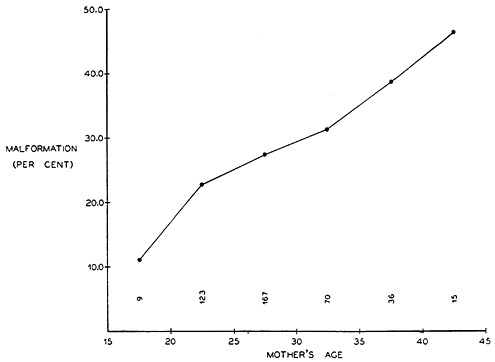
FIGURE 13.1—The distribution of the frequency of autopsied infants with major malformation, relative to all autopsied infants, by age of mother with parity ignored.
whether the autopsied infants differ from the non-autopsied infants in such sources of extraneous variation as the age of the mother at the birth of the infant, the economic status of the parents, and the presence of a positive serology on the part of the mother at the time of delivery.
Let us consider first the evidence with regard to maternal age. In Figure 13.1, the frequency of malformation among autopsied infants is distributed by maternal age. Mother's age is, we see, a rather important factor in the frequency of malformation among infants coming to autopsy. Krooth's (1955) index of absolute difference which may be used to evaluate the significance of these data is, in this instance, 10.61 per cent (variance 1.17%). Maternal age differences could, then, be an important source of bias if maternal ages are dissimilarly distributed among exposure cells. From Table 13.2, we note (a) no evidence of interaction between the sex, autopsy, or exposure categories, (b) no effect of sex of infant nor the occurrence of an autopsy on the age of the mother, but
(c) a significant difference in mothers' ages between exposure cells. This latter effect is principally characterized by a pronounced increase in mean maternal age when both parents were exposed as opposed to those cases where only one or neither parent was exposed. The
TABLE 13.2 MEAN MATERNAL AGE OF INFANTS STILLBORN OR DYING DURINGTHE FIRST 6 DAYS OF LIFEBY SEX OF INFANT, PARENTAL EXPOSURE, AND THE OCCURRENCE OF AUTOPSY



TABLE 13.3 THE DISTRIBUTION OF ECONOMIC STATUSAMONG AUTOPSIEDAND NON-AUTOPSIED INFANTS
|
Economic status |
|||||||
 |
|||||||
|
Infant |
Very poor |
Poor |
Average |
Well-to-do |
Rich |
Unclassifiable |
Total |
|
Autopsied |
5 |
56 |
325 |
20 |
— |
— |
406 |
|
Not autopsied |
2 |
18 |
210 |
11 |
— |
— |
241 |
|
Total |
7 |
74 |
535 |
31 |
— |
— |
647 |
|
X2=6.474 |
DF=3 |
P=.05–.10 |
|||||
difference in maternal age distributions will lead chiefly to a bias which results in an increase in the frequency of congenital malformations when both parents are exposed relative to the case when neither or only one parent is exposed.
With respect to the distribution of economic status we note that the autopsied infants appear more frequently to represent the lower economic groups (see Table 13.3) although this trend is not significant. The apparent trend is not unexpected in view of the fact that the ABCC assumed all expenses in the cremation, etc. of the infant cadaver. It seems quite probable that this would be a consideration of some moment to parents in the lower economic strata. The rise in frequency among the well-to-do parents, if real, is quite possibly correlated with higher levels of education and an appreciation of the information to be gained from a postmortem examination. In view of the absence of a significant difference in economic classes it seems unlikely that the autopsy data with regard to malformation are grossly biased by parental economic status.
In Table 13.4 is given the distribution of positive serologies by parental exposure and the occurrence of an autopsy. It is apparent from the analysis of these data that the autopsied infants differ somewhat from those not autopsied in the frequency with which the mother of the infant has a positive postpartum serology. The reason for this is not apparent. However, there is no evidence of an exposure effect with respect to serology, nor is the autopsy-exposure interaction significant. Accordingly, we conclude that there is no evidence of significant ex-
TABLE 13.4 THE DISTRIBUTION OF POSITIVE SEROLOGIES BY PARENTAL EXPOSUREAMONG AUTOPSIED AND NON-AUTOPSIED INFANTS (Serology is scored as the number of infants whose mother's serology was positive or negative.)
|
Infant |
Neither parent exposed |
Mother exposed; father not |
Father exposed; mother not |
Both parents exposed |
Total |
||||
|
Autopsied |
|||||||||
|
Positive |
11 |
6 |
0 |
2 |
19 |
||||
|
Negative |
200 |
121 |
31 |
35 |
387 |
||||
|
Total |
211 |
127 |
31 |
37 |
406 |
||||
|
Not autopsied |
|||||||||
|
Positive |
15 |
4 |
2 |
1 |
22 |
||||
|
Negative |
108 |
70 |
14 |
27 |
219 |
||||
|
Total |
123 |
74 |
16 |
28 |
241 |
||||
|
Total |
|||||||||
|
Positive |
26 |
10 |
2 |
3 |
41 |
||||
|
Negative |
308 |
191 |
45 |
62 |
606 |
||||
|
Total |
334 |
201 |
47 |
65 |
647 |
||||
|
Chi-square analysisa |
|||
 |
|||
|
Source |
X2 |
DF |
P |
|
Total |
9.5635 |
5 |
.05–.10 |
|
Autopsy-exposure interaction |
3.8209 |
2 |
.10–.20 |
|
Autopsy |
5.0427 |
1 |
.02–.05 |
|
Exposure (unadjusted) |
2.4682 |
2 |
.20–.30 |
|
aFather exposed and both parents exposed pooled. |
|||
traneous variation with respect to the frequency of possibly syphilitic mothers among the mothers of autopsied infants.
13.2 The data.—Two bodies of data exist pertinent to the occurrence of major malformations among infants born to exposed and nonexposed parents and coming to autopsy in Hiroshima and Nagasaki. The first body of data to be presented here is the data obtained in Hiroshima under the auspices of the Atomic Bomb Casualty Commission. We present these data first for the following reasons:
-
Proportionately more “exposed” individuals in Hiroshima received significant amounts of exposure than in Nagasaki, and as a consequence, an irradiation effect should be more pronounced in Hiroshima than in Nagasaki (other factors being equal, of course).
-
The sampling scheme underlying those infants coming to autopsy in Hiroshima is reasonably well known.
-
The data from Hiroshima are confined to infants where the age range is known; the infants were all of no less than 21 weeks' gestation and were either stillborn or died in the first six days following birth.
In Table 13.5 are presented the data with regard to the frequency of congenital malformations among infants autopsied in Hiroshima, distributed by parental exposure without adjustment for differences in maternal age. Four comparisons have been made, namely, the equality of the frequency of congenital malformations (a) among all four exposure cells, (b) between infants born to non-exposed parents and those born to parents one or both of whom were exposed, (c) between infants born to non-exposed parents and to exposed parents one or both of whom were exposed and in exposure classes 4 or 5, and (d) between infants
born to exposed parents with exposures less than 4 with infants born to parents in exposure classes 4 or 5. In no one of these instances does there emerge a significant difference. In view of the effect of maternal age, adjustment for the age differences among exposure groups would
TABLE 13.5 THE DISTRIBUTION BY PARENTAL EXPOSURE OF INFANTS BORN IN HIROSHIMA AND FOUND TOBE GROSSLY ABNORMAL AT AUTOPSY

|
(b) Distribution of abnormal infants by parental exposure when exposure is defined in terms of the categories given in Chapter IV |
||||||
 |
 |
|||||
|
Class of infant |
One or both parents in exposure categories 4 or 5 |
Both parents exposed but neither in exposure categories 4 or 5 |
Contrast |
X2 |
DF |
P |
|
Normal |
33 |
25 |
All exposure cells in 13.5a |
1.912 |
3 |
.50–.70 |
|
Abnormal |
5 (13.2%) |
8 (24.2%) |
Neither parent vs. one or both parents exposed in 13.5a |
0.059 |
1 |
.80–.90 |
|
Total |
38 |
33 |
Neither parent (13.5a) vs. one or both parents exposed as 4 or 5 (13.5b) |
0.440 |
1 |
.50–.70 |
|
All exposure cells in 13.5b |
1.451 |
1 |
.10–.20 |
|||
TABLE 13.6 THE DISTRIBUTION BY EXPOSURE CLASS OF THE EXPOSED PARENTS GIVEN IN TABLE 13.5
|
Exposure class |
Father not exposed; mother in class shown in first column |
Mother not exposed; father in class shown in first column |
Both parents exposed; more heavily exposed parent in class shown in first column |
Total |
|
2 |
72 (56.7%)a |
14 (45.2%) |
18 (48.6%) |
104 (53.3%) |
|
3 |
38 |
13 |
7 |
58 |
|
4 |
4 |
1 |
4 |
9 |
|
5 |
13 |
3 |
8 |
24 |
|
Total |
127 |
31 |
37 |
195 |
|
aPercentage of total. |
||||
lead to differences between exposure categories deviating in a greater fashion from what is to be expected under an hypothesis of radiation-induced genetic changes. Obviously the sensitivity, as it were, of the comparisons given in Table 13.5 is a function of the number of parents who received significant amounts of irradiation. The distribution of the exposed parents by exposure category is given in Table 13.6, from which we note that about 53.6 per cent of the parents received inappreciable amounts of irradiation (exposure class 2). It seems doubtful, therefore, that the autopsy data are sufficiently extensive to detect small irradiation effects such as a priori considerations would lead us to expect.
A second body of autopsy data bearing on the problem of radiation-induced genetic changes in the malformation rate is the data collected by Professor Ichiro Hayashi of the Nagasaki University Medical School. We feel compelled to present and discuss these data in some detail because of the recent grossly over-simplified, biased presentation of these data by Sevitt (1955). Professor Hayashi has kindly furnished us with a copy of a preliminary report on these
data given as an address at a meeting of the Japanese Atomic Bomb Investigation Group and members of the Japan Science Council, held at the Nagasaki Medical School on 3 October 1955. At the outset of a discussion of Hayashi's data, it should be pointed out that his data differ in two important respects from the data we have presented from Hiroshima, namely, (1) the fact that the age range among the infants coming to autopsy is not clearly defined (they are described as fetuses or newborn infants), and (2) the definition of exposure. Hayashi's exposed cases are defined as those infants who were born to parents one or both of whom lived within 10 kilometers of ground zero at the time of the bombing (August 9, 1945). It should be noted that the definition specifies lived within, which does not necessarily imply present within. Hayashi asserts that the location of these parents with regard to the hypocenter is still under investigation. If we assume, however, that all of the individuals who lived within were in fact present within 10 kilometers of the hypocenter at the time of the bombing, Hayashi's definition of exposure is still, in our estimation, a most unfortunate one for a variety of reasons. The most important of these reasons is that 10 km. extends some 7 km. beyond the area of significant irradiation (5r or higher) except possibly in the “fallout” sector (principally the Nishiyama reservoir area). A definition as all encompassing as this can only lead to a dilution of radiation effects, if such exist, because of the inclusion of large numbers of essentially unexposed persons. An additional disadvantage of Hayashi's definition which is worth mentioning is that a radius of 10 km. extends far beyond the limits of the city of Nagasaki (particularly to the north, east, and west) and hence creates difficulty in any attempt to determine the completeness and/or randomness of sampling. While we believe there is ample justification for a conservative definition of exposure, Hayashi's definition would appear overly conservative.
It is extremely difficult to appraise the real significance of Hayashi's data. Among the factors which make it difficult is, as Professor Hayashi has pointed out, the lack of information regarding (a) the randomness of the sample, (b) the degree of exposure of the parents, and (c) other etiological agents, such as maternal age, of importance in congenital malformations. Some measure of the importance and effect of these factors can be gleaned from the corpus of data collected by the Commission. With regard to maternal age, we have commented repeatedly on both its importance and the fact that maternal ages are so distributed among the terminations occurring in Hiroshima and Nagasaki as to bias upwards an estimate of the effect of irradiation.
With respect to the degree of exposure most probably experienced by the parents in Hayashi's series, the following observations are pertinent:
-
All dosage estimates, both Japanese and American, of the bombs detonated over Hiroshima and Nagasaki indicate that the instantaneous irradiation at 3,000 meters was less than 5r and consisted of gamma irradiation alone.
TABLE 13.7 HAYASHI'S DATA ON CONGENITAL ABNORMALITIES IN RELATION TO EXPOSURE OF PARENTS (After Sevitt, 1955)
|
Category |
Number of infants |
Number malformed |
% malformed |
|
One or both parents ex posed to A-bomb |
497a |
92 |
18.9 |
|
Both parents exposed |
149 |
27 |
18.1 |
|
Father exposed |
80 |
18 |
22.5 |
|
Mother exposed |
259 |
47 |
18.1 |
|
Neither parent exposed |
363 |
40 |
11.0 |
|
Both parents unknown exposure; information not available |
27 |
10 |
— |
|
X2(2?4)=10.718 |
DF=3 |
P<0.02 |
|
|
X2(2?2)=9.062 |
DF=1 |
P<0.01 |
|
|
aIncludes 9 children “mother exposed, father unknown.” |
|||
-
The total irradiation received by an individual is the sum of the instantaneous irradiation and the residual irradiation to which he or she may have been exposed. The major component of residual irradiation arises from the so-called “fallout” following the bombing. The area of fallout in Nagasaki is reasonably well defined, and is, as has been indicated, east of ground zero in the region of the Nishiyama reservoir.1 Save for a very small area immediately adjacent to the reservoir, the estimated residual irradiation from one hour to infinity following the bombing is a dose probably less than 6r, and possibly less than 2r. The area encompassed by the fallout is in the main relatively sparsely populated, and consists principally of hills and rice paddies. It is a safe conclusion that relatively few persons residing outside 3 km. from ground zero received exposures of the order of magnitude of 5r from the fallout.
|
1 |
The fallout area could be described as a band of about 3,000 meters' width (on its north-south axis) extending eastward from a point 1,500 meters from the hypocenter. |
-
In the interval 1949–1953, some 363 registered infants came to autopsy in Nagasaki under the auspices of the ABCC. The distribution by exposure of these infants is compared with those autopsied by Hayashi in Table 13.8. The two distributions are not significantly different and by inspection appear to be very nearly identical one with the other. In Table 13.9, we have given the distribution of exposed parents in our series in terms of the categories of exposure defined in Chapter IV. We note that the large majority of exposed parents (87.5 per cent) are in exposure category 2 wherein the average exposure did not exceed 5r. Since Hayashi's definition of exposure must encompass proportionately more individuals outside the 3 km. zone than are presently residing in Nagasaki (and hence would enter our study) we can only conclude that an even greater number of Hayashi's exposed cases are infants born to parents whose exposure was insignificant. In summary, then, it would appear that the great bulk of Hayashi's exposed parents must have received exposures of less than 5r.
TABLE 13.8 A COMPARISON OF THE EXPOSURE DISTRIBUTION OF HAYASHI'S DATA AND THAT OF THE ATOMIC BOMB CASUALTY COMMISSION COLLECTED IN NAGASAKI
|
Source |
Neither parent exposed |
Mother exposed; father not |
Father exposed; mother not |
Both parents exposed |
Totala |
|
Hayashi |
363 (42.66%) |
259 (30.43%) |
80 (9.40%) |
149 (17.51%) |
851 |
|
ABCC |
155 (42.70%) |
115 (31.68%) |
34 (9.37%) |
59 (16.25%) |
363 |
|
Total |
518 |
374 |
114 |
208 |
1,214 |
|
X2=0.364 |
P=.9–.95 |
||||
|
aSee text for differences between Hayashi's and ABCC's exposure definitions. |
|||||
The representativeness of Hayashi's series is, as has been indicated, a matter of conjecture; however, certain observations which we shall now discuss suggest that the series may be biased. We note that Hayashi's data (see Table 13.7) reveal a frequency of congenital malformation of 18.5 per cent among the exposed group (92 out of 497 infants) whereas the Hiroshima data, derived from a group whose average exposure was greater, is also 18.5 per cent (36 infants out of 195). Be that as it may, the more important consideration is that Hayashi's control group has a frequency of congenital malformation of only 11 per cent (40 out of 363), whereas the Hiroshima control group has a frequency of 17.5 per cent (37 out of 211). This is a significant difference, yet the evidence from physical examinations presented in Tables 8.6 and 8.7 suggests no difference in the malformation rates between these two cities. (It need hardly be pointed out that if Hayashi's exposed group is contrasted with the control group from Hiroshima no significant difference emerges.) Further evidence which suggests that Hayashi's control is low stems from the following considerations: (1) Among registered
TABLE 13.9 DISTRIBUTION BY EXPOSURE CLASS OF EXPOSED PARENTS WHOSE INFANTS CAME TO AUTOPSY AT ABCC IN NAGASAKI
|
Exposure class |
Father not exposed; mother in class shown in first column |
Mother not exposed; father in class shown in first column |
Both parents exposed; more heavily exposed parent in class shown in first column |
|
2 |
101 (87.8%)a |
33 (97.1%) |
48 (81.4%) |
|
3 |
12 |
1 |
9 |
|
4 |
— |
— |
— |
|
5 |
2 |
— |
2 |
|
Total |
115 |
34 |
59 |
|
aPercentage of total. |
|||
infants who were stillborn or who died in the first six days of life and were born to nonexposed parents in Nagasaki (both parents exposure category 1), no less than 9.4 per cent (42 out of 444) had clearly visible major malformations. (2) Experience in Hiroshima suggests that for every eight infants coming to
autopsy on whom a prior clinical diagnosis of major malformation has been made (verifiable at autopsy, of course), six cases will come to autopsy and a major malformation will be found on which no prior clinical diagnosis exists. In short, among infants coming to autopsy, clinical examination will reveal only 58 per cent of the infants with major malformations. These two observations taken conjointly suggest that a more reasonable figure for Hayashi's control would be no less than 16 per cent.
From the preceding considerations we are led to the conclusion that the more obvious explanation for Hayashi's findings lies either in extraneous variation or in non-representativeness of the control, rather than in irradiation (for example, a maternal age effect similar to the one noted in Figure 13.1 could easily produce a spurious radiation effect in a larger series of cases).
13.3 Summary.—The data with regard to the frequency of congenital malformations among the pregnancy terminations to exposed and non-exposed persons in Hiroshima afford no evidence of a significant irradiation effect, although the small differences observed are in the direction of genetic expectation. Reasons are advanced for believing that the “irradiation effect” reported by Sevitt (1955) from Hayashi's data in Nagasaki is more likely due to extraneous variation (or sampling biases) between the exposure cells than to irradiation.
Chapter XIV
RECAPITULATION
THE present chapter will be devoted to a brief recapitulation of the findings of this study, and a comparison of these results with those of other studies utilizing mammalian material.
14.1 The findings.—Information has been collected concerning the relationship between irradiation and the outcome of 76,626 pregnancies terminating in Hiroshima and Nagasaki between 1948 and 1953. The following aspects of pregnancy outcome were considered: sex of infant, occurrence of major malformation, viability at birth, birthweight, and occurrence of death during the first six postpartum days. In addition, on a random sample of 19,818 pregnancy terminations followed up at age nine months, data were obtained on infant survival up to nine months postpartum, malformations which had become apparent since the previous examination, and growth of the child as reflected in certain anthropometric measurements. The variation in these potential indicators of radiation-induced genetic change has been analyzed in relation to the experience of the parents at the time of the atomic bombings. For analytical purposes, five categories of radiation, defined in Table 4.7, have been recognized. Each infant studied may thus fall into any one of 25 categories when classified according to the radiation history of both father and mother.
In evaluating the significance of the findings, it is important to bear in mind that there are, in effect, two sets of control parents, namely, those parents (group 1) who were not in either city at the time of the bombings, and those parents (group 2) who, although in one or the other of the two cities, were at distances of 3,000 or more meters from the hypocenter or, if nearer, were significantly shielded, and presumably received negligible amounts of irradiation.
In Chapters III and V an effort has been made to explore dissimilarities between Hiroshima and Nagasaki parents which might be responsible for differences in indicator findings in the two cities. It is noteworthy that despite the several demonstrated or possible dissimilarities, the two cities did not differ significantly with respect to any of the indicators save birthweight and the anthropometric measurements at age nine months. This may be taken as some measure of “relative stability,” within this range of environmental variation, on the part of the indicators of potential genetic damage utilized in this study. This has some bearing on one's attitude towards the appropriateness of radiation category 1 parents as the source of control material. As mentioned in Section 5.10, there is a relatively high proportion of repatriates or persons of rural background among category 1 parents. It seems unlikely, however, that category 1 parents, as a group, differ biologically from the “exposed” group any more than the inhabitants of Hiroshima differ from those of Nagasaki. If this is correct, then theoretically the differences, if any, between the offspring of category 1 parents and of categories 2, 3, 4, and 5 parents may be used as a measure of combined radiation and “disaster” effect, with the radiation effect then best measured by progressive differences between the offspring of parents falling into categories 2, 3, 4, and 5.
There are significant sex differences as regards the indicators birthweight, neonatal death rate, and anthropometric measurements at age nine months, but not with respect to major malformations or stillbirths. Such sex differences are well recognized in the literature. It is perhaps worth pointing out that the level of the significance with which these previously recognized differences emerge in this analysis increases one's confidence that valid differences of appreciable magnitude between the various analytical subclasses would be detected.
The reader's attention is directed to Figures 14.1 and 14.2 which present graphically the
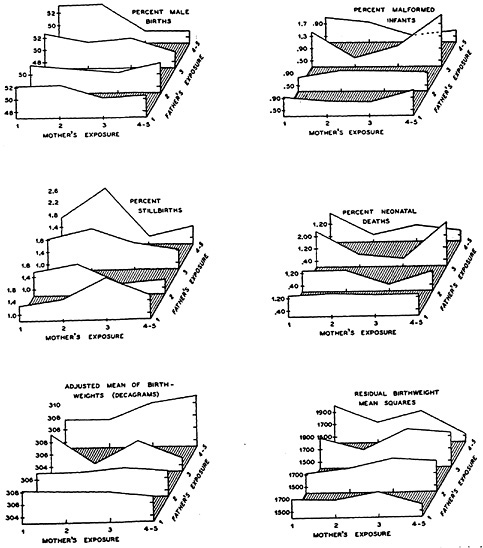
distributions of the indicators by parental exposure, and to Table 14.1 for a summarization of the tests of significance with reference to exposure. With regard to the effect of parental exposure on the indicators, we find the following:
-
Sex ratio.—The one indicator wherein differences of opinion with regard to the effect of parental exposure may arise is the sex ratio. This stems from the fact that significance or non-significance of a maternal exposure effect is, in part, a function of that portion of the data which one elects to analyze. If all exposure classes are used, there is no demonstrable effect of mother's exposure or father's exposure on a two-tailed, or for that matter, a one-tailed test of significance. Similarly, if all terminations occurring to parents one or both of whom are in exposure class 1 are rejected, there is no effect of mother's exposure or father's exposure. If, however, one rejects those terminations where the mother was in class 1 but retains the terminations where the father was in class 1, provided the mother was not also in this class, there emerges a significant effect, on a one-tailed test, of mother's exposure, but not of father's exposure. Two questions immediately arise, namely, (a) is this a legitimate comparison, and (b) if so, does there exist ancillary evidence which supports the reality of this difference?
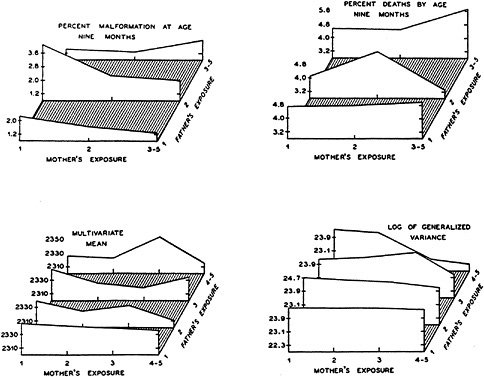
FIGURE 14.2—A graphical representation of the effect of parental exposure on: (1) the frequency of malformed infants alive at age nine months; (2) the frequency of death in the first nine months of life; and (3) the anthropometric measurements of weight, height, head circumference and chest circumference.
It is difficult to appraise the legitimacy of this comparison; however, two observations seem pertinent to any appraisal. Firstly, there is an element of arbitrariness in a procedure which rejects as unsuitable mothers in one exposure class but not fathers on such vague grounds as dissimilarity in place of origin, in the absence of demonstrable differences with respect to concomitant variables which are known or can be shown to appreciably affect the indicator. Secondly, rejection of mothers in class 1 leads to the use of a “control” approximately 25 per cent of which is contributed by
-
a single exposure cell (mothers 2, fathers 1, Hiroshima) exhibiting a sex ratio which is higher than any observed in these cities (or all of Japan) for any one of the fourteen years in the interval 1935–1952 for which data exist.
TABLE 14.1 A SUMMARIZATION OF THE COMPARISONS OF THE VARIOUS INDICATORSWITH PARENTAL EXPOSURE WHEN (a) ALL EXPOSURE CELLS ARE CONSIDERED (THE 4?4 CASE), AND (b) ONLY THOSE CELLS WHERE BOTH PARENTS WERE EXPOSEDARE CONSIDERED (THE 3?3 CASE) (The general direction of change is indicated by an arrow pointing upwards if the observed frequency of departure from “normality” increases with increasing parental exposure, and by an arrow pointing downwards if the frequency of the event decreases with increasing exposure. The tabular entries are probabilities.)
|
Parental exposure |
||||
 |
||||
|
Fathers |
Mothers |
|||
 |
 |
|||
|
Indicator |
4?4 case |
3?3 case |
4?4 case |
3?3 case |
|
Sex ratio |
.30–.50? |
.90–.95? |
.10–.20? |
.95–.98? |
|
Malformation |
||||
|
At birth |
.70–.80? |
.80–.90? |
.50–.70? |
.80–.90? |
|
At 9 months |
— |
.30–.50? |
— |
.02–.05? |
|
Stillbirth |
.20–.30? |
.80–.90? |
.001–.01? |
.20–.30? |
|
“Neonatal” death |
.20–.30? |
.02–.05? |
||
|
Death in 9 months |
— |
.95–.98? |
— |
.50–.70? |
|
Birthweight means |
||||
|
Males-Hiroshima |
.10–.25? |
— |
>.25? |
— |
|
Females-Hiroshima |
>.25? |
— |
.05–.10? |
— |
|
Males-Nagasaki |
>.25? |
— |
.10–.25? |
— |
|
Females-Nagasaki |
>.25? |
— |
.10–.25? |
— |
|
Anthropometrics generalized means |
<.001 |
.25–.50 |
.02–.05 |
.05–.10 |
|
aNo general test (see Chapter XI). |
||||

With regard to whether there exists ancillary evidence suggesting an effect of mothers exposure, it may be stated that neither the limited observations available on early pregnancy terminations, nor the stillbirth data, nor the neonatal death data, indicate an interaction of sex with mother's exposure such as one might expect if the death of male infants is a function of mother's exposure. Moreover, inspection of Figure 14.1 fails to reveal consistent changes in the “exposure surface.”
Data continue to be collected which bear on the relationship of maternal exposure to the sex ratio.1
-
Malformation.—There is no significant effect of mother's or father's exposure on the frequency of congenitally malformed infants irrespective of whether exposure class 1 parents are or are not included in the analysis. Further classification and analysis of these data to take
|
1 |
The reader may wish at this point to refer to the discussion of the findings in this supplementary material, at the end of Chap. VII. |
-
into account known differences between exposure classes in the age of the mother at the birth of the infant fails to reveal consistent, significant differences in the frequency of congenital malformation attributable to parental exposure. There is evidence, however, of an effect of mother's exposure on the frequency of malformation among the children of very young mothers (<21 years of age). This effect, however, seems largely one of an inordinately low frequency of malformation among young, unexposed mothers rather than an elevation of the frequency among exposed mothers since there is no demonstrable difference among mothers in exposure classes 2, 3, and 4–5. Finally, analysis of additional data on the frequency of congenital malformation obtained at nine months of age discloses no significant effect of parental exposure.
-
Stillbirths.—Analysis of the data unadjusted for differences in parity and maternal age between exposure cells fails to reveal an effect of paternal exposure, regardless of whether category 1 fathers are or are not included in the analysis. However, there does exist an effect of maternal exposure (significant at the 5 per cent level) when category 1 mothers are included in the analysis. This effect does not persist when mothers in exposure category 1 are excluded. Further classification of the data by parity and subsequent analysis reveals no effect of mother's exposure when the category 1 mothers are included. It would seem that the apparent mother's exposure effect is explicable in terms of differences between exposure classes in birth ranks. The latter analysis suggests an effect of paternal exposure limited to first-born infants. An explanation of this finding is not immediately apparent.
-
Neonatal death.—Both with and without allowance for differences in parity among the mothers falling into the various radiation categories, there is no significant effect of mother's or father's exposure on the frequency of neonatal death. Moreover, the analysis of deaths during the first nine months of life fails to reveal a significant effect of parental exposure.
-
Birthweight.—When allowance is made for differences between exposure cells in maternal age and parity, there exists no significant difference between classes of father's exposure or classes of mother's exposure in mean birthweight. Furthermore, it was not possible to demonstrate a consistent effect of parental exposure on (a) the relationship between birthweight and concomitant variables, notably maternal age and parity, or (b) the residual birthweight variances, that is, on the birthweight variances following removal of maternal age and parity effects. Figure 14.1 illustrates the lack of a consistent exposure effect on the birthweight means or birthweight variances.
-
Anthropometrics.—Neither the generalized means nor the generalized variances can be shown to differ among classes of paternal or classes of maternal exposure. This remains true following removal of differences between exposure cells in the age of the infant at the time the measurements were obtained.
14.2 The question of evaluating the over-all direction of the indicators. —As noted in Section 6.2, the plan of analysis adopted ensured non-overlapping indicators of genetic effects. By suitable transformations it is readily possible to combine the results of such independent tests, given a theory which permits specifying the direction of the differences between control and irradiated material. In this particular study, however, the findings are sufficiently small and inconsistent, that we have not felt an attempt at a combined treatment to be justifiable.
There is in the analysis of these data another problem, closely related to the foregoing. There are segments of the analysis which suggest the possibility of a radiation effect (e.g., certain selected comparisons within the sex ratio data; frequency of malformations in relation to maternal radiation history when only very young mothers are considered; frequency of stillbirths in relation to paternal radiation exposure history, when only the first-born children of these fathers are considered). Such findings tend to stand out in one's mind as he thinks back over the analysis as a whole. It is important in this connection not to lose sight of the fact that even in the absence of any effects whatsoever, by definition 1 in 20 independent tests or subtests may be expected to exceed the 5 per cent level of significance. Thus, while these “hints” cannot be entirely disregarded, they must be viewed against the background provided by the totality of the significance tests to which the data were subjected.
14.3 The confidence limits determined by these observations.—Thus far in our analysis we have been concerned with attempts to demonstrate a positive effect of exposure to the
atomic bombs on the indicators selected for study. There is, however, another aspect of these data. They permit us to place upper limits on the effects which may have been induced but not demonstrated by these studies. In other words, we can place confidence limits on our observations. One may proceed to establish these limits by several different approaches. To avoid misunderstanding, it should be clearly pointed out at this juncture that we are not primarily concerned with placing limits on a series of estimates, since estimates of abnormalities in pregnancy terminations derived from these data would probably have little meaning to other populations, in view of the racial differences and the variety of “experimental” conditions which could arise in man. Our primary concern here is to determine the adequacy of our test procedures. The ideal solution, perhaps, would be the computation of the power curves associated with each of the individual tests of significance. In multi-way analyses, however, the computation of the power function is, to say the least, tedious, and for a number of the tests performed here the power function is not known. An approximate solution to the problem of the adequacy of our data, sufficient for our purposes, can, however, be obtained. We shall begin by restricting our attention to the adequacy of the data for detecting differences of a specified size between a control population and a single, moderate-to-heavily irradiated population. Thus we shall seek to determine the probability of rejecting the null hypothesis (no difference between groups), given a fixed sample size, when the true situation is one wherein the exposed group differs from the control group by some amount, say d, for varying values of d. The groups with which we shall be concerned will be those terminations occurring to parents (a) neither of whom had exposures in excess of class 2—the control group, and (b) one or both of whom had exposures equal to or greater than class 3—the moderate-to-heavily irradiated group. We shall make the following simplifying assumptions:
-
The proportion of “successes” in the control population is known without error.
-
The normal approximation to the binomial distribution has the requisite accuracy over the critical range, which, for this study, includes those values for the exposed group which deviate from the control by a factor less than two.
The latter assumption requires no special comment, and seems warranted in this situation. The former assumption is obviously not strictly satisfied by these data; however, the sample number available on the control group is sufficiently large that the error associated with the estimate of the true proportion of successes for this group is small under all circumstances, and can for our purposes be disregarded when contrasted with the error associated with an estimate based on the sample sizes available for the exposed groups.
Now to determine the probability of rejecting the null hypothesis under a variety of alternative situations we proceed as follows: We shall assume that the level of confidence with regard to the null hypothesis is 0.05. There exist, then, two limiting values corresponding to this level of confidence such that the number of successes, say x, among N trials will lie within these limits 95 times in 100 if the null hypothesis is, in fact, true, that is, if there is no difference between the proportion of successes in the control, say pc, and the proportion of successes in the heavily exposed group, say pe. These limiting values, L1 and L2, are chosen so that
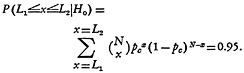
If now N and pc (or pe) are sufficiently large such that Npc>5, this probability can be reasonably approximated by the normal distribution. Under the latter circumstance, we obtain L1 and L2 from the relations

If pe?pc, but the number of successes, x, among N trials from a population characterized by pe should lie within the limits L1 and L2, we would erroneously accept the null hypothesis as true (the type II error). The probability of the latter can be computed for any value of pe, and is merely
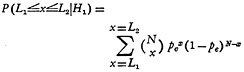
and, again, this probability can be reasonably approximated by the normal distribution. If this procedure were repeated for every possible value of pe, we would generate a continuous curve resembling either the normal cumulative probability curve (if we were interested solely in one-tailed tests of significance) or the normal frequency curve (if we were interested in two-tailed tests of significance). These curves are termed the power function of the test or the operating characteristic of the test depending upon whether we are interested in the probability of rejecting the null hypothesis when it is, in fact, false, or the probability of erroneously accepting the null hypothesis when some alternative hypothesis is true.
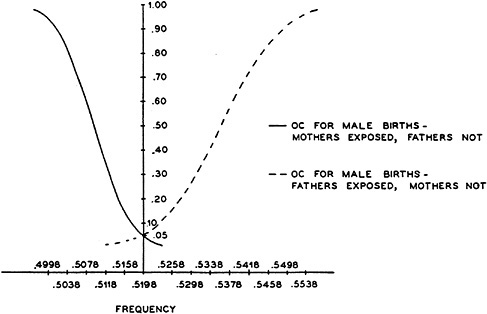
FIGURE 14.3—The adequacy of the data with regard to sex ratio as indicated by the operating characteristic (OC) curves for analyses based on sample sizes of 5,629 mothers and 2,453 fathers, where the true proportion of successes is assumed to be 0.5198, the value observed in the control population.
Figures 14.3 and 14.4 present five operating characteristic curves for sex ratio, malformation, stillbirth, and neonatal death. The two curves for sex ratio are based on sample sizes corresponding to the number of mothers in classes 3, 4, and 5 whose spouses were in classes 1 and 2, and the number of fathers in classes 3, 4, and 5 whose spouses were in classes 1 and 2. In both instances, we are concerned with one-tailed tests of significance. For the remaining operating characteristic curves the sample size was the number of parents both of whom experienced exposures equalling or exceeding class 3. Before we turn to a consideration of these five curves, it is worth noting that the amount of information actually available with regard to these four indicators is in excess of that used to compute the OC curves. Accordingly, we may view these curves as underestimating the adequacy of the data to detect departures of specified size from the null hypothesis.
Before turning to Figures 14.3 and 14.4, we must define what is meant by an adequate test. We shall say that a test is adequate with regard to the alternatives, pe-pc ≥ |s|, if the prior probability of detecting departures from the null hypothesis of size s, or greater, equals, or exceeds, some specified probability. Otherwise stated, a test is adequate with reference to all those alternatives for which the power (the probability of correctly rejecting the null hypothesis when it is, in fact, false) is not less than some specified amount. The reader may, of course, impose any power restriction he
wishes, but we shall define adequate power, here, as being 0.90. That is to say, if the prior probability of detecting a difference of size s is at least nine chances in ten we shall say that the test is adequate with regard to departures of size s or greater. This value may well be too high, since, as we have indicated, our procedure takes into account appreciably less than the total number of observations which are germaine. Within this frame of reference, we can say that our data are adequate to give reasonable assurance that we would be able to detect the following:
-
A decrease in the sex ratio, following maternal exposure, in excess of an absolute change of 1.6 per cent;
-
An increase in the sex ratio, following paternal exposure, in excess of an absolute change of 4 per cent;
-
An alteration of the malformation rate in excess of two times the control value;
-
An alteration of the stillbirth rate (and neonatal death rate) in excess of approximately 1.8 times the control value.
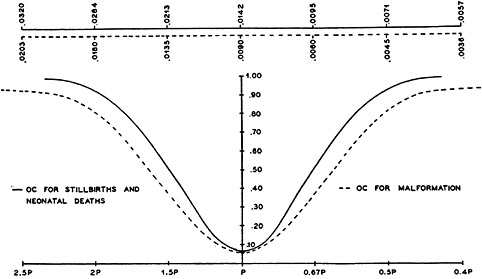
FIGURE 14.4—The adequacy of the data with regard to malformations, stillbirths, and neonatal deaths as indicated by the operating characteristic (OC) curves for analyses based on samples of size 1,097 parents, where the true proportion of successes are assumed to be 0.0090 for malformations and 0.0142 for stillbirths and neonatal deaths, the control values.
Alternatively stated, we should be unable to detect:
-
Changes of less than 1.6 per cent (absolute) in the sex ratio when the mother only was heavily exposed, or 4 per cent if the father only was exposed;
-
Changes of less than 100 per cent (absolute) in the frequency of malformed infants;
-
Changes of less than 80 per cent (absolute) in the frequency of stillborn infants or infants dying during the neonatal period.
14.4 A résumé of work on mammalian material pertinent to the interpretation of these findings.—Before proceeding to a final interpretation of these findings, we would do well to consider at some length the results of more or less comparable studies on other animal species. Although the many important studies which have been carried out on the genetic effect of irradiation on Drosophila clearly indicate the types of results to be expected in mammals, the differences between mammalian and insect physiology are such that any semiquantitative extrapolation is at best hazardous. Accordingly, we will for the purposes of this discussion confine our attention to studies on mammalian material. The current status of our knowledge of mammalian radiation genetics has recently been comprehensively summarized by Russell (1954). There is actually a rather striking dearth of information available for com-
parison with the findings of the present study. Such information as there is will be presented in the following six subsections.
In most of the work to be cited, the house mouse has been the experimental animal. Some two to four weeks after male mice are irradiated with a dosage in excess of 400r, they become sterile, the time of onset of sterility depending on dosage. In those animals which survive, fertility usually returns in four to twelve weeks, again depending on dosage. There are important quantitative and qualitative differences between the observable genetic effects associated with sperm released in the pre-sterile period— corresponding to the result of irradiation of spermatocytes, spermatids, and spermatozoa— and the effects associated with sperm released during the post-sterile period—corresponding to the irradiation of spermatogonia. We will consider primarily data collected during the post-sterile period, since this corresponds to the period during which observations have been made in Japan.
14.4.1 Effects on sex ratio.—It will be recalled that genetic theory suggests that the irradiation of males should result in an increase in the proportion of males in the next generation. Parkes (1925), studying the offspring of male mice exposed to doses of X-ray below those which produce temporary sterility, reported (a) a moderate but non-significant increase in the proportion of males born to mice mated 0–4 days after irradiation (59.4 per cent of 133 offspring of irradiated males vs. 51.6 per cent of 735 controls), (b) a significant decrease in the proportion of males born from matings made 5–18 days after irradiation, and (c) no change in the sex ratio among the offspring of matings made 19–57 days post irradiation, this group apparently reflecting the results of the irradiation of spermatogonia. The observations of Hertwig (1938) on the results of irradiation of spermatogonial stages in the house mouse are reproduced in Table 14.2. Although the difference is in the postulated direction, the results of a comparison of “all irradiated” vs. “controls” are not at the level of significance nor, for that matter, were the results obtained during the pre-sterile period significant. However, when only the two groups receiving the most irradiation are considered, there is a significant difference. Russell (1954) reports that in his experiments with the exposure of male mice to 600r, there were 50.35 per cent males in 72,472 post-sterile period offspring, as against 51.00 per cent males in 55,828 controls. Finally, Kalmus, Metrakos, and Silverberg (1952) reported a significant decrease in the frequency of females among the offspring of male mice mated immediately following treatment with 150 or 300r, but were unable to confirm this observation in a later study (Trasler and Metrakos, 1953).
Even if clear-cut effects had been demonstrated for the house mouse, the advisability of extrapolating to man would be rendered questionable by the much, higher apparent proportion of inherited defects which are sex-linked in man than in the mouse, suggesting the possibility of a genetically more active differential segment of the X-chromosome in man. The corollary of this is, of course, a probable higher expectation of induced sex-linked lethals per unit irradiation in man.
TABLE 14.2 THE EFFECT OF IRRADIATION OF MALE MICE ON THE SEX RATIO OF OFFSPRING CONCEIVED DURING THE POST-STERILE PERIOD (After Hertwig, 1938)
|
Dose in r |
Number of offspring |
Number of males |
% males |
|
400 |
415 |
197 |
47.47 |
|
500 |
167 |
86 |
51.50 |
|
600 |
167 |
86 |
51.50 |
|
800 |
683 |
347 |
50.80 |
|
1,000 |
574 |
291 |
50.69 |
|
1,200–1,400 |
171 |
102 |
59.65 |
|
1,500–1,600 |
63 |
37 |
58.72 |
|
All doses |
2,240 |
1,146 |
51.16 |
|
Controls |
2,595 |
1,290 |
49.71 |
|
X2 (all doses vs. controls)=1.011 |
|||
|
DF=1 |
0.50>P>0.30 |
||
Recently Macht and Lawrence (1955) have published a detailed comparison of the sex ratio, the frequency of twinning, the frequency of fetal death, and the occurrence of congenital defect among the children of radiologists as contrasted with the children of physicians in other specialties (pathologists, psychiatrists, anesthesiologists, plastic surgeons, and ophthalmologists). The information was obtained by questionnaires mailed to the subjects. Answers were obtained from 74.1 per cent of the radiologists queried, with information on 5,461 children, but from only 53.8 per cent of controls, with data on 4,484 children. Because of the
publicity given the matter of the genetic risks of radiation, one immediately wonders if radiologists as a group were especially motivated to reply, perhaps particularly if the reproductive history was in some way unusual. The authors are aware of this source of bias, and quite properly point out that inasmuch as the distribution of single persons, married couples without children, and married couples with children is similar in the two groups, this suggests that radiologists with (abnormal) children were not especially motivated to reply. On the other hand, they present data suggesting that recall for abnormal terminations is better for later than earlier pregnancies. Despite this, they combine the (early) reproductive history of radiologists prior to entering this field with the control data. A study of their Table 13 suggests that this may be an important source of bias.
TABLE 14.3 THE SEX RATIO AMONG LIVEBIRTHS AND FETAL DEATHS IN THE STUDY OF MACHT AND LAWRENCE (1955)


A second source of bias in this study stems from the fact that “persons who did not respond (to the questionnaire) within approximately two months were sent a second questionnaire together with a further appeal that it be returned.” Of the total completed questionnaires available for analysis, 78.5 per cent of those completed by radiologists were obtained on first writing, as contrasted to 63.8 per cent of those from non-radiologists. The possible significance of this to the study lies in the fact that there was, in general, a higher percentage of abnormal outcomes reported on “second-appeal” questionnaires than on “first-appeal” questionnaires. Specification of the direction of the bias introduced is difficult, since it depends on one's interpretation of the reasons for the different results obtained on the two appeals. But that this may be an important source of bias is indicated by the fact that whereas after correction for parity differences, there were 3.10 per cent more “abnormal offspring (fetal death and congenital defects)” in the children of radiologists than non-radiologists on the basis of first questionnaires, this difference dropped to 0.76 per cent on second questionnaires. This is a striking and disturbing discrepancy.
Inasmuch as their study will be widely quoted, a detailed comparison between their findings and our own seems indicated. With regard to the indicator under consideration, sex ratio, the findings are as shown in Table 14.3. With respect to livebirths, the proportion of males is decreased, although not significantly so, a finding opposite in direction to expectation when fathers are irradiated unless—as they suggest—the male is more sensitive than the female to the effects of induced mutations in the autosomes. Among fetal deaths (their term; includes miscarriages and stillbirths), the data are in the direction of expectation but so very limited in number that even the large difference observed is not significant; it is worth noting that sex was not recorded for 81 per cent of this material.
14.4.2 Effects on malformation frequency. —Dominantly inherited mutant forms, some of which in our terminology would be classified as congenital malformations, have been detected in small numbers by Charles (1950) among the offspring of male mice exposed to 60r (7 in 3,072 offspring; 0 in 2,755 controls), and by Russell (1954) among the post-sterile period
offspring of male mice exposed to 600r (5 in approximately 30,000 offspring; number of controls not stated). The examination given the offspring by Russell was much less searching than that by Charles since Russell's work was primarily oriented in other directions. From the quantitative standpoint, these findings have debatable carry-over value for man if only because of the tendency observed in most laboratories for female mice to devour dead and defective embryos immediately following parturition.
The older medical literature contains a number of studies, based on the questionnaire approach, of the relationship between therapeutic irradiation and the “health” of children conceived subsequently (review in Murphy, 1928). For a variety of reasons, and particularly with reference to the problems of diagnostic standards and control observations, these data do not lend themselves to critical inferences. More recently, however, Macht and Lawrence (1955), in the study described earlier, after correcting for parity differences between the two sets of data, record 5.99 per cent congenital defect among 5,461 children of radiologists and 4.84 per cent among 4,484 control children. The figures cannot be compared with those of the present study because (a) minor defects are included, (b) autopsy findings are included with no analysis of comparability of autopsy frequency in the two groups, (c) congenital conditions not usually regarded as malformations, such as erythroblastosis fetalis and atelectasis of the lung, are included in the list, (d) multiple defects in one individual are scored separately, and (e) disease states are listed which very probably developed and were detected sometime postpartum, such as muscular dystrophy, Oppenheim's disease, spondylolisthesis, celiac syndrome, melanoma, lymphosarcoma, retinoblastoma, Tay-Sach's disease, missing teeth, and defective night vision. There are differences between the children comprising the two groups which are difficult to understand: There are 14 cases of “erythroblastosis” and one “died 4 days Rh positive problem” among the children of radiologists but only three cases of “erythroblastosis” among the controls. The interpretation of this discrepancy is complicated by the fact that the children born to radiologists before they entered this specialty are included among the controls, and, as is well-known, erythroblastotic infants are found among later pregnancies. This fact would tend to bias the results in the observed direction, although whether to the extent observed is debatable. There are nine cases of atelectasis of the lungs among the exposed group but only three among the controls. These two differences alone account for approximately one-third of the observed 1.15 per cent increase in malformation among the children of radiologists. Although Macht and Lawrence believe the difference between the two groups is significant, we do not feel they have established this fact.
14.4.3 Effects on stillbirth frequency.— Mutations with a dominant lethal effect can,
TABLE 14.4 THE EFFECT OF IRRADIATION OF MALE MICE ON THE FREQUENCY OF STILLBIRTHSAMONG OFFSPRING CONCEIVED DURING THE POST-STERILE PERIOD (After Hertwig, 1938)
|
Dose in r |
Number of offspring |
Stillborn |
% stillborn |
|
400 |
423 |
21 |
4.97 |
|
500 |
170 |
11 |
6.47 |
|
600 |
175 |
12 |
6.85 |
|
800 |
693 |
12 |
1.73 |
|
1,000 |
590 |
36 |
6.10 |
|
1,200–1,400 |
171 |
0 |
0.0 |
|
1,500–1,600 |
65 |
11 |
16.92 |
|
All doses |
2,287 |
103 |
4.50 |
|
Controls |
2,616 |
90 |
3.45 |
|
X2 (all doses vs. controls)=3.649 |
|||
|
DF=1 |
0.10>P>0.05 |
||
by definition, produce death any time from shortly following fertilization to just prior to reproduction (cf. Hadorn, 1955). If the dominant lethal exerts an effect during the last trimester of pregnancy, the result would be a stillbirth. Evidence concerning an increase in stillbirths among the pre- and post-sterile period progeny of irradiated male mice is unsatisfactory because of the tendency, referred to in the preceding section, for females following parturition to devour stillborn young. Hertwig (1938) has published data, reproduced in Table 14.4, which show a small and insignificant increase in stillbirths in the offspring of post-sterile period irradiated male mice, and Strandskov (1932), in a pioneer experiment in which the dose varied from 173 to 2,592r, has recorded similar data for the guinea pig, although the latter's results must be interpreted with caution
because the effect was present in post-sterile period but not pre-sterile period offspring. However, the number of the latter observed was quite small (39).
Macht and Lawrence (1955) report 13.77 per cent “fetal death” in the children of the exposed, as contrasted to 12.50 per cent in the controls. The term fetal death “includes all reported cases where the product of conception was not born alive. It therefore includes miscarriages and stillbirths irrespective of the length of uterogestation and regardless of whether or not the embryo or fetus was otherwise normal at this stage” (p. 447). From the frequency of the event in the controls, as well as the wording of the questionnaire, this term must include abortions as well. The difference between the two series was not statistically significant. Crow (1955), in a similar questionnaire-type study, also failed to detect any statistically significant differences between frequencies of stillbirths and miscarriages among the children of radiologists and in the children of a control group of pathologists.
14.4.4 Effects on birthweight.—Strandskov (1932) observed that when correction was made for the smaller mean litter size of females mated to irradiated male guinea pigs, mean birthweight was decreased in the post-sterile period offspring of his experiment from 90.93 gms. in the controls to 86.35 gms. in the poststerile period offspring. The number of animals involved is not stated but can be estimated from the data in the paper to be approximately 260 for the controls and 75 for the irradiated. The data are not presented in such a way that the significance of the findings can be analyzed. The interpretation is further complicated by the fact that only the data for animals surviving at least 30 days are presented. Variances are not given for the birthweights of guinea pigs conceived during the post-sterile period, a point of especial interest in view of the findings of our study. There do not seem to be comparable data for the house mouse.
14.4.5 Effects on neonatal death rates.— Hertwig (1938) observed a slightly but not significantly increased death rate during the first 75 days following birth in the offspring of male mice receiving 800–1,600r, the survival figures being 79.14 ±1.80 per cent in 508 progeny of irradiated mice as contrasted to 82.43 it 1.38 per cent in 757 control offspring. Strandskov's data, on the other hand, involving approximately the numbers referred to earlier, reveal no difference in post-natal death rate in the offspring of irradiated guinea pigs up to 30 days postpartum. Crow (1955), in the questionnaire study referred to earlier, found that “the infant mortality rates also were not significantly different in the children of the two groups, but the numbers were very small.”
14.4.6 Effects on growth and development. —The only pertinent data appear to be those of Strandskov (1932). At 30 days postpartum the mean weight of the post-sterile period offspring of irradiated male guinea pigs, corrected for litter size, was 265.73 gms., against a control value of 281.66 gms. The number of animals involved is presumably the same as for the birthweight figures given above.
14.5 Interpretation of the findings.—The interpretation of the findings of the present study can now be very simply stated. The foregoing section has brought out the fact that when one considers data of a type which it is feasible to collect on human populations, the available information on other animals is scattered, fragmentary, and often contradictory. However, this information, taken in conjunction with the much more extensive data on Drosophila, certainly does not suggest a high likelihood of demonstrating clear-cut effects in Hiroshima and Nagasaki. The divergence of opinion with regard to what one might expect in human populations is sufficiently large as to make it unprofitable to explore all presently held opinions with regard to all of the indicators. However, it does seem worth-while to explore a single class of mutations, say the sex-linked lethals. Evidence from Drosophila suggests that the yield in sex-linked lethals is approximately 3 per cent per 1,000 roentgens (Timoféeff-Ressovsky, 1937; Spencer and Stern, 1948; Muller, 1954). The yield in the mouse, on the basis of the data on induced autosomal mutations, might, if the mouse X-chromosome had the same number of loci capable of giving rise to lethal mutations as the Drosophila X, be greater by a factor of 15–20. Now, if the dosage estimates advanced for the various exposure classes are reasonably accurate, then the average dose in rep's received by the 5,629 mothers with exposure 3 or greater (whose spouses were in
classes 1 or 2) is approximately 100 rep's. If we impose the restrictions indicated in the previous paragraphs with regard to an adequate test, then differences in the sex ratio between the control (average exposure 0 rep's) and the exposed group (100 rep's) as large as 1.6 per cent (absolute change) would quite probably not be detected. Accordingly, we may estimate that the yield, in man, might be as high as roughly 2 per cent per 100 rep's and we would not detect it. This is a value six times that in Drosophila, but approximately one-half to one-third the value to be expected if human genes were as sensitive to irradiation as the small series of tested mouse genes (extrapolating from autosomal visibles to sex-linked lethals) and the X-chromosome of man had the same genetic length as that of Drosophila. This is, of course, the upper limit; the yield could be, and quite probably is, much lower. Similar conjectures could be made for a number of the other indicators.
Accordingly, we can say of the present study that under circumstances where, on the basis of what is known concerning the radiation genetics of mammals, it appeared unlikely that conspicuous genetic effects of the atomic bombs could be demonstrated, such effects have in fact not been demonstrated. The present study can in no way be interpreted to mean that there were no mutations induced in the survivors of the atomic blasts. Neither, on the other hand, is the reverse interpretation—that of mutation production— permissible from this series of observations, although, on the basis of all that is known of radiation genetics, there is no real reason to doubt that mutations were produced in Hiroshima and Nagasaki. We are left with inconclusive findings, albeit findings which permit us to set confidence limits.
Chapter XV
PERMISSIBLE INFERENCES
15.1 Basic data necessary to reaching permissible inferences.—There would at this juncture be ample justification, judging from the genetic literature of recent years, to utilize the findings of this study, taken in conjunction with other available information, as the basis for a semi-quantitative treatment of the problem of the genetic risks of increased radiation of the human species. Such calculations proceed in general along the following lines: On the basis of existing data, one estimates the average spontaneous mutation rate of human genes and the number of genes in man. From this one obtains an estimate of the average number of mutations per human gamete per generation (a “total” mutation rate). Then, again on the basis of existing data, one estimates the probability of mutation/locus/r in man, and from this the amount of radiation required to double, triple, or otherwise increase the mutation rate over the spontaneous baseline. Next, then, by one approach or the other, one estimates the ratio of “recessive” mutations which have been accumulated in the population to “recessive” mutations arising anew each generation, the so-called “accumulation factor.” Given this, one can estimate by how much, on the basis of the preceding calculations, this frequency will be altered by any arbitrary increase in radiation. Finally, on the basis of certain assumptions concerning gene physiology and the operation of natural selection in man, one attempts to evaluate the phenotypic impact of this increase in radiation.
There are, then, five estimates which are basic to these semi-quantitative treatments:
-
The spontaneous mutation rate in man.
-
The induced mutation rate/locus/r in man.
-
The total number of genes in man.1
-
The “accumulation factor.”
-
The manner in which selection operates on the total gene complex.
It is our contention, which we will now proceed to document, that the available data on which these five estimates are based are so inadequate that semi-quantitative treatments are ill-advised, since except to the relatively few who have made a detailed study of the problem, they impart an air of mathematical exactitude and scientific accuracy to an area where the errors are sometimes large and often indeterminate.
15.2 The spontaneous mutation rate in man. —Current thinking concerning the rate of mutation of mammalian genes is for obvious reasons strongly influenced by what is known concerning Drosophila rates. We will accordingly first consider briefly what seem to us to be some of the more pertinent data concerning this species. For methodological reasons it is customary to distinguish on the basis of their physiological effects between three categories of mutations, namely, those associated with visible effects, those associated with lethal effects, and those which express themselves through a reduction of viability in the absence of detectable somatic effects, the so-called semilethal mutations (1–10 per cent viability) and deleterious mutations (over 10 but less than 100 per cent viability). Terminology in this field leaves something to be desired. Thus, the “deleterious” mutations must have an organic basis, so that many of them would be found on careful study to be also “visibles.” By the same token, most “visibles” are also “deleterious.” Finally, the dividing line between “lethals” and “semi-lethals” may be altered by culture conditions. Be that as it may, the division into
|
1 |
The product of (1)?(3), or (2)?(3), is the rate of mutation per gamete, spontaneous or induced, as the case may be. It is possible in suitably designed experiments to estimate this directly (cf. Muller, 1955), and so decrease the number of variables involved in the calculation. |
these three categories has an operational usefulness, as we shall now see.
Beginning with the pioneer attempts of Muller (1934; see also Kerkis, 1935, and Timoféef-Ressovsky, 1935), a number of efforts have been made to establish the relative frequencies with which these types of mutations are represented among all mutations. These attempts have involved radiation-induced rather than spontaneous mutations because of the much more laborious nature of the problem if attacked through the study of spontaneously occurring mutations. In view of the possibility that the relative frequency of lethals is higher among the radiation-induced mutations because of the increased proportion of minute deletions, the estimate of the ratio, (semi-lethels+deleterious)/lethals, may be a minimum estimate. Muller (1954; see also Falk, 1955) places this ratio at 3–5 to 1. This same author goes on to state that “…the ratio may indeed be considerably higher than this, since the technique was hardly refined enough for the detection of detrimentals with a viability greater than some 85 per cent of normal. Other studies have shown that ‘invisible' mutants causing sterility or lowered fertility of some degree also form a very large group. This group, however, overlaps, to an extent not yet well investigated, that of the detrimental mutations” (p. 396).
The significance of information concerning the relative frequency of mutants with viability in the 85–99 per cent range in attempts to quantitate the genetic risks of radiation is of course enormous. A related problem concerns the frequency of mutations for which the organism at the time is able to compensate completely, the undetectable mutations. Lately considerable attention has been directed towards the genetic basis and evolutionary implications of physiological homeostasis (refs. in Lerner, 1955). The possibility cannot be ruled out that the principle of homeostasis enables some organisms to compensate entirely, under particular sets of circumstances, for the effects of certain mutations.
It may be argued that there is no reason to be concerned about the relative frequency of mutants with undetectable effects in a consideration of the deleterious effects of radiation. However, these mutations are undetectable only under the conditions set by the observer. Under other conditions, set by nature and not by man, they might have decided effects. It is not at all difficult to argue that the mutants-with-over-85% viability which cannot now be studied in Drosophila may in evolutionary importance far outweigh the visibles.
Muller (1950) in a discussion of the question of the numerical relationship between lethals, on the one hand, and semi-lethals and deleterious mutations, on the other hand, has made the following statement: “However, studies carried on in Drosophila during the past year by Meyer, Edmondson, and the writer indicate that in this organism the assumption of an equal distribution of detrimental mutations throughout all iho values2 (when represented on an arithmetic scale) does not hold. Instead, it appears that, following the high but descending peak formed by complete lethals (iho=100%) and nearly complete lethals (iho=between 98% and 100%), there is a marked drop in the frequency of mutations. The mutations studied were induced in an autosome (the second chromosome) by ultraviolet light acting on an interphase stage (in the polar cap). Along with 208 complete lethals there were 20 mutants found in the range of iho between 98% and 100%, and again only 20 in the range of iho between 90% and 98%, although this range is four times as wide as the preceding one. If the rest of the distribution, as far as iho=10%, had only the same frequency of mutations as in the range between 90% and 98% there would have been only 240 detrimentals in the entire interval between 100% and 10%, to set against the 208 complete lethals found. But since we know from other work, previously cited, that the detrimentals in this interval are in reality several (about 5) times as numerous as the complete lethals, it is evident that their frequency must, at lower degrees of detriment (lower iho), rise very much above that existing in the 90% to 98% range. The distribution of frequencies of iho therefore forms a bimodal curve with one peak at the left origin, lethality (iho=100%), and another peak somewhere to the right.
“Little more than this is yet known definitely about the shape of the curve in question, important though this genetic question is. However, there are grounds, both theoretical and observational, for regarding it as very unlikely that the second peak is near the first or that the rise towards it is sharp. Hence it is probable that
|
2 |
iho—the amount of impairment produced by a gene when homozygous. |
detrimental mutations, instead of having an even distribution with respect to values of iho, form a curve which, except for its peak of near-lethals at the left end, is massively skewed towards the right, with its mean at a value of iho significantly beyond the middle (0.5)” (pp. 140–141).
If we consider these remarks of Muller in conjunction with the possibility of “invisible” mutants discussed earlier, then the problem of estimating the relative frequency of lethal mutants vs. those viable to some degree assumes new complexity. Figure 15.1 attempts to present some of this complexity graphically. The abscissa of this figure represents viability of the homozygous genotype in some arbitrary environment. In this connection, it is apparent that the term “lethal” is relative, some lethal mutations having effects under no known circumstances compatible with life, other lethal mutations having far lesser effects. Likewise, the term “normal” as applied to viability is relative, some normals being more normal than others, with the differences brought out only under unusual circumstances. Thus far, observations have been limited to the range of lethality and 1–85 per cent viability. As Muller has pointed out in the statement quoted above, there is great doubt concerning the shape of the curve of numerical relationships within this range. We have indicated two of the principal alternatives. Curve A assumes a mode at 60–70 per cent viability, from which it would seem likely that the proportion of mutations in the 85–100 per cent and normal viability range is small. Curve B assumes that the mode is farther to the right with the corollary that there is a considerable group of mutations not now being detected. How large that group is depends of course on the shape of the curve.
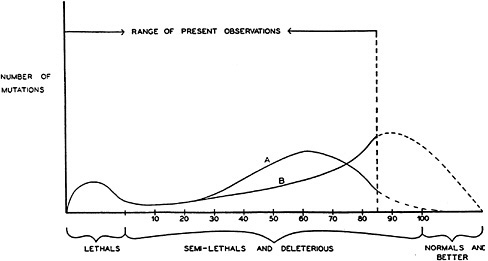
FIGURE 15.1—A schematic representation of two different “mutation spectra” with reference to degree of viability, both compatible with the present data. Further explanation in text.
The question of the relative frequency of lethal mutations as contrasted to visibles, is on somewhat more secure footing than the question of the ratio of lethal mutations to mutations reducing viability to a lesser degree. In tabulating the results of radiation experiments by five different workers, Schultz (1936) found this ratio to be 7.4:1. In view of the well recognized differences in the ability of individuals to recognize mutant phenotypes, the true ratio is probably somewhat lower. We prefer, for instance, the ratio of 5.2:1 which obtained in the extensive and meticulous experiments of Spencer and Stern (1248). For all three groups, the ratio of visibles: lethals: semi-lethals and deleterious has been set at approximately 1:5:20, although, as noted above, the third figure is certainly an underestimate.
The important question of the mutation spectrum at individual loci remains in its early stages
because of the amount of labor involved in securing reliable data. There is evidence that in Drosophila some few genetic loci which are associated with visible mutants are not absolutely essential to life, although in the absence of these loci viability is usually markedly reduced. On the other hand, there are numerous illustrations of lethal and visible mutations arising at what seems to be the same locus. It should also be pointed out that the question of the total relative frequency of mutation at different loci is in a very unsettled state. Although there seems no doubt that the rate of recovery of mutations differs from locus to locus, care must be exercised in reasoning to the magnitude of the true differences (cf. Neel and Schull, 1954). In the following discussion of mutation rates at specific loci, the fact that these are selected loci must constantly be borne in mind.
TABLE 15.1 FREQUENCY OF OCCURRENCE OF SPONTANEOUS “VISIBLE MUTATIONS” IN VARIOUS SPECIES

Three recent studies on the rate of occurrence of spontaneous “visible mutations” in Drosophila appear outstanding. The results, in terms of frequency of appearance of visible mutations, are summarized in Table 15.1. There appear to be significant differences between the studies with respect to the observed frequencies, although it must be kept in mind that different loci are involved in the three studies. Furthermore, the work (unpublished) of Glass and Ritterhoff suggests that the mutation rates of males and females differ, although different loci were being tested in the two sexes. This observation may provide a clue to the apparent difference between the findings of Muller, Valencia, and Valencia (1950) and Alexander (1954), since the former were studying mutation rates in females and the latter in males. It is also noteworthy that in other experiments with the same strain used for the “visible mutation” studies, Muller, Valencia, and Valencia (1950) recovered 0.7 per cent sex-linked lethal mutations per generation, a rate some fourfold that ordinarily observed. Since the numbers involved are not given, the reliability of this apparent fourfold increase cannot be evaluated. Muller et al. argue, from this fourfold increase in recovered lethals, that “the frequency of gene-mutations at the nine loci would ordinarily average between 10-5 and 7×10⁻⁶ per locus in females” (p. 125).3 For our present purposes, it will be sufficient to average all three of these series together, with no attempt to introduce the correction suggested by Muller et al. (which would in any event then appear to create a possible discrepancy between their findings and those of Glass and Ritterhoff). In a total of 1,665,345 locus tests, at least 32 mutations were recovered, a rate of 1.9×10⁻⁵. However, this applies only to “visible mutations.” If lethals, semi-lethals, and deleterious mutations are arising at these same loci, the mutation rate must be higher. If, for instance, the ratio of visibles: (undetected lethal+semilethal+deleterious mutations) at these loci was a conservative 1:4, the mutation rate per locus becomes 1×10⁻⁴!
Two other studies involving individual loci should be quoted: Lefevre (1955), in a paper which contains an excellent discussion of the problem of estimating spontaneous mutation rates, reports that the rate of appearance of mutants with visible or lethal effects at the y locus is “about 1 per 75,000” (p. 379). On the other hand, Bonnier and Lüning (1949), in a paper criticized by Muller (1954) because the rate of recovery of spontaneous mutations ap
|
3 |
The question of the frequency of these “high mutation rate” lines has been discussed by Ives (1950; see also Neel, 1942), who suggests that the mutator genes which are responsible for these high rates “are the major cause of both gene mutations and inversions in natural populations” (p. 251). |
peared to be too low in comparison with certain other findings, observed only one mutation at the white and forked loci among 153,579 flies tested for visible mutations, a rate of .4×10–5. Both of these estimates do not take into account the semi-lethal and deleterious mutations. The same conservative 1:5 ratio applied in the preceding paragraph would bring these estimates well within the range of the others quoted earlier.
Utilizing a somewhat different approach, Dobzhansky, Spassky, and Spassky (1952) have estimated the average rate of mutation to lethals, semi-lethals (1–20 per cent viability), and visibles per lethal producing locus in different species. These estimates, which they feel are more likely to be overestimates than underestimates, are reproduced in Table 15.2. Again, the estimate does not include the deleterious mutants.
TABLE 15.2 ESTIMATED AVERAGE MUTATION RATESPER LETHAL-PRODUCING LOCUS IN SEVERAL DROSOPHILA SPECIES (After Dobzhansky, Spassky, and Spassky [1952]. These estimates are felt by the investigators to be more likely overestimates than underestimates.)
|
Species |
Second chromosome |
Third chromosome |
|
D. melanogaster |
1.1×10⁻⁵ |
— |
|
D. pseudo-obsura |
— |
1.1×10⁻⁵ |
|
D. willistoni |
2.2×10⁻⁵ |
3.0×10⁻⁵ |
|
D. prosaltans |
1.1×10⁻⁵ |
2.1×10⁻⁵ |
In summary, then, it would appear that depending on one's view of the representativeness of the loci studied, and the problem of the relative frequency of mutations not detected by current techniques, there is room for a wide divergence of opinion concerning the average rate of mutation of Drosophila genes, with the range of possibilities perhaps extending from 0.5×10⁻⁵ to 5×10⁻⁵. It is in our opinion not permissible to apply even this wide range of estimates directly to human problems, since even within species of the same genus mutation rates appear to differ significantly (cf. Table 15.2).
Turning now to mammals, we find that significant studies are available for only two species, the house mouse and man himself. The figures for the house mouse were derived in much the same fashion as the figures quoted for Drosophila, namely, through a search for mutant individuals among animals simultaneously heterozygous at multiple loci. Russell (1954), in connection with the important observations on radiation-induced mutations in the house mouse which we will refer to shortly, has now amassed the control data shown in Table 15.1. The rate of appearance of visible mutations in 265,076 locus tests was 0.8×10⁻⁵. The observational error is of course large. Again it must be recognized that these tests detect only a fraction of the mutations occurring at these loci.
The available estimates for the frequency of occurrence in man of mutations with certain visible effects are shown in Table 15.3, prepared by Dr. T.E.Reed in collaboration with one of us (J.V.N.). Many of the problems involved in estimating human mutation rates have been discussed elsewhere (Haldane, 1948, 1949; Neel, 1952; Neel and Schull, 1954; Nachtsheim, 1954). Because of the particular problems associated with the study of incompletely recessive genes, no estimates based on such genes are included. The average of the estimates in Table 15.3 is approximately 3×10⁻⁵. This estimate, now, is entirely limited to dominant mutations with visible effects. Even what would seem a very conservative allowance for recessive visibles and for the lethal, semi-lethal, and deleterious mutations would bring the average estimate up to 1×10⁻⁴ for these loci.
The representativeness of these estimates has been repeatedly challenged. There can be no doubt that there is definite selection in the loci studied. How this influences our estimates is not at all clear. As we have pointed out elsewhere (Neel and Schull, 1954), mutation at any particular locus may be thought of in terms of these aspects: (1) the frequency of mutation at that locus; (2) the number of alternative forms of the gene which may occur at any locus, i.e., the number of multiple alleles; and (3) the ease with which the effect associated with each of these multiple alleles can be detected. We assume that some loci are more mutable than others because we detect the results of mutation more frequently at these loci. However, making allowance for “unstable loci,” the hypothesis has not been disproven that the inherent instability of all the genes is, by virtue of their biochemical complexity, very similar, but that the results of mutation are more readily detected at some loci than at others because of the role of that particular locus in the animal's physiology. It is entirely conceivable that the
loci4 thus far selected for study in man are those at which a high proportion of all possible alleles at that locus results in readily detectable effects, but at which the per locus mutation rate is fairly representative of the human species. This problem is discussed further in Neel and Schull (1954).
For purposes of calculation, estimates of the rate of mutation of human genes have included 10–5 (Evans, 1949), 10-7 (Wright, 1950), and 2×10⁻⁵ (Muller, 1950; Slatis, 1955). In the current state of our knowledge students of the problem can select and justify estimates differing from one another by a factor of 100.
15.3The radiation-induced mutation rate in man.—If we turn now to the estimation of the sensitivity of human genes to irradiation, we must first of all take cognizance of the same technical problems that exist in the estimation of spontaneous rates, as well as additional problems discussed by Muller (1954). For reasons brought out earlier, we are interested in effects on spermatogonia rather than mature sperm. For obvious reasons, no precise estimates are available for man. Until relatively recently, there was no mammalian material whatsoever. Now, however, Russell's (1954) figures, based on specific locus tests, indicate a visible mutation rate in spermatogonial cells of (25.0±3.7)× 10-8/gene/r. Russell has emphasized the danger of generalizing from these limited results, a point with which we heartily agree. But as long as these are the only figures available, they can
|
4 |
In point of accuracy, we do not know but what any particular mutation rate study in man is detecting mutation at several loci. |
TABLE 15.3 FREQUENCY OF OCCURRENCE OF NINE DIFFERENT DOMINANTOR SEX-LINKED MUTATIONS IN MAN
|
Dominant genes |
|||
 |
|||
|
Character |
Method of estimationa |
Mutations per gene per generation |
Source |
|
Epiloia |
Direct |
0.4–0.8×10⁻⁵ |
M.Gunther and L.S.Penrose (1935, J.Genet. 31:413), L.S.Penrose (1936, Ann Eugen. 7:1). |
|
Chondrodystrophyb |
Direct |
4.2×10⁻⁵c |
E.T.Mørch (1941, Opera ex Domo Biologiae Hereditariae Humanae Universitatis Hafniensis, Vol. 3). |
|
Indirect |
4.3×10⁻⁵ |
J.B.S.Haldane (1949, Proc. 8th Int. Cong. Genet., Hereditas, suppl. : 267) from data of Mørch (1941, vide supra). |
|
|
Direct |
4.9×10⁻⁵c |
J.B.S.Haldane (1949, vide supra from data of Mørch, 1941, vide supra). |
|
|
Direct |
7×10⁻⁵ |
J.A.Böök (1952, J.Genet. Humaine 1:24). |
|
|
Pelger's nuclear anomaly |
Direct |
2.7×10⁻⁵ |
H.Nachtsheim (1954, Naturwiss. 17:385). |
|
Aniridia |
Direct |
0.5×10⁻⁵ |
C.J.Møllenbach (1947, Opera ex Domo Biologiae Hereditariae Humanae Universitatis Hafniensis, Vol. 15). |
|
Retinoblastoma |
Direct |
1.4×10⁻⁵ |
U.Philip and A.Sorsby (unpublished, quoted by Haldane, 1949, vide supra). |
|
Direct |
2.3×10⁻⁵ |
J.V.Neel and H.F.Falls (1951, Science 114: 419). |
|
|
Direct |
4.3×10⁻⁶d |
F.Vogel (1954, Ztschr. menschl. Vererbungs-u. Konstitutionslehre 32:308). |
|
|
Waardenburg's syndrom |
Direct |
3.7×10⁻⁶ |
P.J.Waardenburg (1951, Amer. J.Hum. Genet. 3:195). |
|
Neurofibromatosis |
Direct |
1.3–2.5×10⁻⁴ |
F.W.Crowe, W.J.Schull, and J.V.Neel (1956, Multiple Neurofibromatosis, American Lectures in Dermatology series, C.C. Thomas). |
|
Indirect |
0.8–1.0×10⁻⁴ |
F.W.Crowe, W.J.Schull, and J.V.Neel, loc. cit. |
|
|
Sex-linked recessive genes |
|||
 |
|||
|
Character |
Method of estimationa |
Mutations per gene per generation |
Source |
|
Hemophilia |
Indirect |
3.2×10⁻⁵e |
J.B.S.Haldane (1947, Ann. Eugen. 13:262) from data of M.Andreassen (1943, Opera ex Domo Biologiae Hereditariae Humanae Universitatis Hafniensis, Vol. 6). |
|
Childhood progressive muscular dystrophy |
Directf |
1×10⁻⁴ |
F.E.Stephens and F.H.Tyler (1951, Amer. J. Hum. Genet. 3:111). |
|
Indirect |
1×10⁻⁴ |
F.E.Stephens and F.H.Tyler (1951, loc. cit). |
|
|
Indirect |
4.5–6.5×10⁻⁵ |
A.C.Stevenson (1953, Ann. Eugen. 18:50). |
|
|
aEstimation is considered to be direct when based on observed mutations, indirect when not so based. All indirect estimation makes use of estimates of the relative fitness and frequency at birth of the trait, and assumes that the population is in equilibrium. bSlatis (1955, Amer. J.Hum. Genet. 7:76) has suggested that these estimates may be spuriously high in this case because of some evidence for the occurrence of phenocopies. cIndependent estimates from different data contained in the paper of Mørch (1951). dThis estimate is based on the proposition that approximately 75 per cent of all sporadic cases of retinoblastoma are phenocopies. There are reasons to believe that this is an overestimate of the proportion of phenocopies. On the other hand, the estimates of Philip and Sorsby, and Neel and Falls, which treated all sporadic cases as due to mutation, are undoubtedly too high. eThis study may have included three distinct types of hemophilia: (a) classical sex-linked hemophilia resulting from deficiency of anti-hemophilic globulin (AHG), (b) a sex-linked clotting defect from lack of “plasma thromboplastin component” (PTC), and (c) an autosomally-inherited clotting defect from lack of “plasma thromboplastin antecedent” (PTA). Frick (1954, J.Lab. & Clin. Med. 43:860) found that of 55 patients with coagulation defects, 45 had AHG deficiency, 6 had PTC deficiency, and 4 had PTA deficiency. Probably, therefore, Andreassen's study was mainly concerned with AHG deficiency; the mutation rate estimate for this deficiency may be about 15 per cent too high. fStrictly, not a true direct estimate but an approximation which overestimates the mutation rate. |
|||
not help but strongly influence current thought. For what it is worth this average rate is about 15–20 times the figure of 1.5×10⁻⁸/gene/r obtained for Drosophila melanogaster spermatogonia under comparable conditions (Alexander, 1954). Again, we emphasize that these estimates are undoubtedly based on the recovery of only a portion of the mutations occurring at these loci, with no assurance that the relative recovery rates are the same in the two species. Even so, taken at face value, the data would seem to indicate that mouse genes are decidedly more sensitive to irradiation than Drosophila genes. However, Ives (1954) has recently drawn attention to a number of factors which make it difficult to say precisely how much (if any) more sensitive mouse genes are than Drosophila genes, concluding that “for the present the radiation-induced mutation rate per r per locus appears to be similar in flies and mice” (p. 364). Although Ives' paper was written prior to the appearance of the paper by Alexander, quoted above, some of his objections would doubtless still stand, particularly the point concerning the disproportionate contribution of mutation at one particular locus to Russell's conclusions. Many of Ives' objections seem to have been met by a recent paper by Russell (1956). Early discussions of the genetic effects of radiation on human populations used an estimate of the frequency of induced mutation (3×10⁻⁸/gene/r) based on work on mature Drosophila sperm (Evans, 1949; Wright, 1950); more recent treatments (Muller, 1955; Slatis, 1955) have used a figure (2×10⁻⁷/gene/r) based on Russell's work on mouse spermatogonia, although Sturtevant (1955) prefers to retain the figures based on Drosophila.
In a discussion of radiation hazards, it is sometimes convenient to think in terms of the amount of radiation necessary to double the spontaneous mutation rate. This is obviously a function of the average spontaneous mutation rate per locus and the probability of mutation per locus per r. For purposes of discussion, Muller (1954; 1955), on the basis of Russell's (1954) work, has utilized figures ranging between 37 and 80r as the doubling dose. Haldane (1955), on the other hand, appears to feel that the doubling dose is closer to 3r, which would seem to imply a belief that the average spontaneous mutation rate per locus is in the neigh
borhood of 1×10⁻⁶. Westergaard (1955) also stresses the possibility that the doubling dose may be low, in the neighborhood of 3–6r.
15.4Estimates of the number of genes in man.—The haploid gene number in Drosophila is commonly placed at 5,000 to 10,000 (cf. Muller, 1935). The existence of the relatively enormous salivary gland cell chromosomes in Drosophila, and the usual correspondence between a genetic locus and a visible “band” in these chromosomes, provides an unusual opportunity for gene number estimates in this species. No corresponding situation has been established in man or any other mammal. It is commonly argued that man, because of his greater physiological complexity, must have more genes than Drosophila. There exists only one piece of objective evidence in support of this argument. Spuhler (1948) has pointed out that the mean total length of the chromosomes in late prophase nuclei in man is some 8.5 times that of Drosophila. If one assumes that the spacing of the genes in the chromosomes is similar in the two species, this permits an estimate of the haploid gene number in man of between 42,000 and 85,000. Current treatments of the problem use estimates of the haploid gene number of from 100,000 (Evans, 1949) to 5,000 (Muller, 1950; Slatis, 1955). The data, then, permit competent students of the problem to make assumptions varying by a factor of 20.
15.5The “accumulation factor.”—The term “accumulation factor” is applied to the ratio of “recessive” genes already present in the population to those arising spontaneously each generation through mutation. Evans (1949), the first to make use of this factor in calculations, assumed, “somewhat arbitrarily,” a value of 50. No discussion of the basis for this estimate is given. With his assumptions concerning average mutation rate (1×10⁻⁵) and haploid gene number (1×10⁵), the total mutation rate per zygote would be 2.0, and the average number of accumulated “recessive” genes per individual would be 100.
Muller (1950), on the other hand, after an extensive discussion of the evidence regarding the average degree of dominance of Drosophila genes, arrives at an “accumulation factor”— his p value—of 40, writing at the same time that there is “such a lamentable paucity of numerical values for human beings, or for any vertebrates, of a type which would throw light on the actual values of these factors, that we cannot feel too secure in regarding even 40 as a lower limit for p” (p. 141). The total mutation rate per gamete (µt), i.e., the product of gene number×average mutation rate, is set for purposes of calculation at 0.1. Introducing a factor of 2 to make allowance for the fact that selection probably operates predominantly on heterozygotes, the average number of “recessive” deleterious genes carried by a human being is placed at 2×0.1×40=8. In a later calculation, Muller (1954) adopts a figure of 0.3 as the total mutation rate, and suggests a figure of 100 for p. This leads to an estimate of 60 for the average number of recessive deleterious genes for which each individual is heterozygous.
Slatis (1954) has attempted a direct calculation of the frequency of abnormal autosomal recessive genes in man, from a consideration of the outcome of first cousin marriages. Data are presented on 17 sibships, in nine of which defects occur that are attributed to recessive inheritance. This leads to the estimate that “the average person is heterozygous for eight abnormal genes” (p. 418). Although the method is a valuable contribution, the data are unfortunately so biased as to be practically worthless for a calculation of this type. As Slatis points out, five of these nine families were ascertained because of the abnormality. Furthermore, two of the four remaining traits (polydactyly, distal webbing of the digits) are frequently due to dominant genes of irregular penetrance. If one discards those sibships, the data remaining are insufficient for a calculation of this type. The extensive data on the children born to consanguineous parents which were collected in the course of the present study, although still incompletely analyzed, are at marked variance with those of Slatis as regards frequency of appearance of genetic defect in the offspring.
In his later discussion of the results of the induction of mutations by irradiation, Slatis (1955) uses this figure of 8 for the average number of recessive deleterious genes present in man. Muller's above-quoted estimate of 60 is dismissed as “obviously too high,” on the basis of a calculation which assumes that each of these recessive genes has a clear-cut and readily demonstrable effect. While we hold no particular brief for either Evans' estimate of 50 nor Muller's of 60, Slatis' rejection of estimates of this magnitude appears to be based on the mis
conception that all deleterious genes of any importance to the problem should result in clear-cut, readily diagnosable defect.
15.6The nature of natural selection.—We come now to the last of the factors which enter into attempts to quantitate the genetic effects of the irradiation of human populations. All treatments of this subject, implicitly or explicitly, make certain assumptions concerning the mode of operation of natural selection. This problem has been treated most extensively by Muller (1950, 1954). In his earlier treatment, Muller (1950) writes: “Moreover since, firstly, the extinction rate due to an individual locus is exceedingly small and since, secondly, in the great majority of cases the extinctions caused by any locus are probably only in small proportion (relatively to the whole) determinately connected with those caused by particular genes at other loci, we may tentatively and as a first approximation consider the genetic deaths associated with different loci as occurring independently” (p. 121). Later (p. 151) we read: “We have seen (p. 138) that if µt, the total mutation rate per gamete, is 0.1, and if the dominance is ‘effective,' then nt, the frequency of newly manifested cases per individual, is the same as the frequency of individuals eliminated at equilibrium under natural selection, and has a value only slightly less than 0.2, namely, 0.18, provided we assume (1) the independence of distribution and (2) the independence of detrimental action of the mutant genes. Although the second assumption is certainly inaccurate, as pointed out previously, nevertheless provisional consideration of the matter indicates that it is unlikely for the frequency and strength of synergistic action of mutant genes to be so great as to reduce the frequency of elimination from a value of 0.18 to below, say, 0.15.” We interpret this passage to mean that, given Muller's assumptions, at genetic equilibrium, at a minimum, the reproductive performance of the population will be, as a result of natural selection, some 15 per cent below what it would have been in the absence of these mutations. Somewhat later, however, it is pointed out that, given the assumption of an average of 8 deleterious genes per individual, artificial selection which prohibited that 3 per cent of the population with the highest concentration of deleterious genes from breeding could balance the total mutation rate of 0.1 per individual which is assumed. Thus, the operation of natural selection is postulated to involve the elimination at equilibrium of approximately five times as many individuals as a “completely efficient” system of artificial selection.
As Neel and Falls (1951) have emphasized in considering this problem, the survival of an individual under competition is as a rule not determined by single genes but by constellations of genes. These constellations of genes may be considered as having either additive or nonadditive effects—a variety of observations suggest that non-additive effects are rather common where combinations of mutant genes are concerned (e.g., in Drosophila, Neel, 1941, 1943; House, 1953a, b; in the guinea pig, Wright, 1949). Non-additive effects suggest that an individual with 12 deleterious “recessives” does not necessarily carry double the handicap of one with 6. The concept of synergistic gene action was given the term “dependent overlapping” by Muller (1954). It is to be distinguished from “independent overlapping,” the latter illustrated by the case of an individual who meets genetic extinction through the effect of a given gene who would have met extinction anyway through the effect of one or more other independently acting genes which he also happened to carry. Muller (1954) in his most recent treatment of dependent overlapping modifies the earlier position stated in the preceding paragraph, and now considers it very unlikely that dependent overlapping “would reduce the elimination rate of individuals by a factor of more than 2 or 3,” but after a consideration of the probable distribution of mutant genes in the individuals of a population, does not introduce this factor into his most recent calculation of the average number of deleterious genes per individual (60), although introduction of the factor would of course reduce the estimate to a half or third. It is to us not clear how our present knowledge permits assigning a definite numerical value to the role of dependent overlapping. This question must certainly be considered one of the most important in the field of natural selection.
The problem of defining the balance between selection and mutation is extremely complex. Thus, Muller (1950) on pages 149–50 argues as follows: “Whatever the values finally found, it is evident that the natural rate of mutation of man is so high, and his natural rate of repro
duction so low, that not a great deal of margin is left for selection. Thus if µt has the minimal value of 0.1 (nt=0.18) an average reproductive rate of 2.4 children per individual would be necessary to compensate for individuals genetically eliminated, without taking any account whatever of all the deaths and failures to reproduce due to non-genetic causes. But when these are taken into account as well (even though we allow only that reduced number of them that occur under modern conditions) it becomes perfectly evident that the present number of children per couple cannot be great enough to allow selection to keep pace with a mutation rate of 0.1. If, to make matters worse, µt should be anything like as high as 0.5, a possibility that cannot yet be ignored, our present reproductive practices would be utterly out of line with human requirements.”
Now, if at equilibrium, and invariably, over a long period of time, each member of one generation contributes genetically to, on the average, two members of the next, then there is no question whatever of a decrease in the size of the population. This condition is both necessary and sufficient to define the restriction on a population of unaltering size, and the mortality experience of the population—intrinsic or extrinsic in source—will effect no change in number provided the condition is met. Suppose, for example, there are N individuals in one generation. These N individuals will, under the condition, contribute 2N gametes to the next generation. Since the number of individuals equals 1/2 the number of gametes, there will be N individuals in the next generation.5
Therefore, Muller's statement that there must be on the average 2.4 children per individual to compensate for those lost through selection is somewhat ambiguous, and his assertion that still further compensation is necessary for additional sources of mortality is even more difficult to interpret. Without meaning to belabor the point, suppose, to take a simple and extreme case, there are N individuals born into one generation, and 2/3's of them are completely sterile. If the condition for unaltering size, given in the above paragraph, is met, there will still be 2N gametes contributed to the next generation, and therefore N individuals.
Let us accept the assumption that selection acts primarily through the heterozygote. If there are pi heterozygotes at locus i (and let us consider but one mutant allele), and if Wi is the mean number of children to whom persons heterozygous at locus i contribute genetically (“fitness”), W¯ is the mean fitness of the whole population, µi is the mutation rate per chromosome per generation from the normal allele to the mutant gene, and if, finally, there are but N individuals in the population, then there will be Npi heterozygotes in one generation who will contribute NpiWi gametes so that there will be 1/2 NpiWi “affected” genes from “affected” parents. There will be NW¯ loci (of the type in question) in the whole of the next generation, and of these (near enough) NWµi will be represented by “affected” genes newly mutated from the wild type.
Since the population is in equilibrium, there will be no change in gene frequency from the first generation to the second, hence
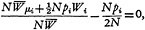 or
or

Therefore, 2µi is the ratio of gametes lost through selection acting on the parents of the second generation to the number of gametes actually present in the form of zygotes in the second generation.
Now in the passage quoted, Muller assumes that µt—a quantity which he considers to be roughly, though not exactly, equivalent to  (the sum being over all loci)—is equal to 0.18. Thus, ignoring overlapping effects, as Muller does,6 the ratio of gametes lost through selection to gametes actually realized in zygotes is 0.18. If Wo is the mean fitness which would prevail in the absence of this gametic loss, and if W¯ is the fitness which in fact does prevail, then

Substituting 0.18 for µt and letting W¯ equal 2, the minimum fitness which will enable the population to maintain its numbers, we find Wo= 2.36. This then is presumably the origin of
|
5 |
We are indebted to Dr. Robert Krooth for calling our attention to the line of reasoning developed in this and the following several paragraphs. |
|
6 |
And we shall not in this section consider whether this is permissible. |
Muller's 2.4—it is a virtual fertility, not an actual one. It is the fertility which would prevail if there were no gametic loss due to mutation and if the population were just maintaining itself; it is not the fertility which must prevail to maintain the size of the population. If the actual fertility of the population were 2.4, the population of the United States would increase by 20 per cent within a single generation.
If now we substitute 2.4 for W¯, the actual fertility, and 0.18 for µt, we find the virtual fertility of the population to be 2.832. Substituting Wo=2.832 and W¯=2 into the formula, we can determine the maximum total mutation rate which would permit the population to maintain its numbers. This quantity equals 0.416, which is slightly more than twice as large as the figure given above for µt (=0.18). In other words, if the “average reproductive rate of 2.4 children per individual” actually did prevail, a human population could experience a permanent doubling of Muller's estimate of the total natural mutation rate without loss in number.
Finally, and in summary, if one really did take all the genetic and non-genetic factors into account in the computations, a minimum virtual fertility far higher than those considered above would result, but the population of the country would still maintain itself (and it is in fact increasing exponentially) provided W¯ averages 2, even if  averaged, say, but 10 per cent!
In addition to the question of the extent to which selection may be considered to involve single genes as contrasted to constellations of genes, and the relationship at equilibrium between fertility and mutation rate, there is perhaps an even more basic assumption as regards selection which enters into treatments of this problem. It is customary to assume that the mutations produced by irradiation have with very rare exceptions harmful effects; one accordingly calculates the increase in “undesirable recessive traits,” “congenital malformations,” etc. In point of fact, however, irradiation, insofar as it increases the appearance of mutations which would occur anyway, accelerates a process which modern biology accepts as the cornerstone of evolution. Although the results of mutation are from the standpoint of the organism usually unfortunate, they may sometimes be beneficial. Natural selection, it is assumed, sorts out the beneficial from the harmful. Treatments of the problem of the genetic effects of irradiation tend to assume that modern civilization has so blunted the effectiveness of selection that the ill-effects of radiation-induced mutation far outweigh the potential good. In view of our abysmal ignorance of the actual selective forces which have shaped mankind, there is no way to reach a valid opinion concerning the extent to which Western culture does in fact negate the selective mechanisms which are responsible for Homo sapiens as we know him today. There is also no real information on the extent to which certain characteristics which are of great importance to the species and which have a strong genetic component, such as intelligence, are maintained by “balanced polymorphic” systems (cf. Penrose, 1950), which systems would be relatively resistant to increased mutation pressure. Of all the gaps in the background information necessary to an accurate quantitative approach to the genetic effects of increased radiation, the deficiency of data on this point is perhaps the most striking.
Muller (1954, pp. 436–37) has spelled out the conditions under which radiation might speed the evolutionary advance of man (or any other animal) as follows: “…the first is that the spontaneous mutation rate should not be already so high that when irradiation is applied mutations occur too frequently to allow an equilibrium elimination rate and/or a genetic load low enough to be tolerated by the population. A second condition is that the advantageous mutants should multiply fast enough to replace the original type at a rate commensurate with their increased rate of origination. A third requirement is that the organism should not be at the limit of an evolutionary blind end, i.e., that pathways of advantageous change still remain open to it. Such opportunities will be present in greater abundance, allowing more of the mutations that occur to be helpful in the given situation, if the population has been placed in an environment, and subjected to conditions of living, somewhat different from those previously natural to it; for it must already have become so highly adapted to its natural conditions as to make further progress difficult. Advance is also achieved more readily if the population is one which has to some extent lost, through genetic changes or recombinations, its original nicety of adaptation. This may have
come about through the prior establishment of some more or less harmful mutations, the effects of which can now be overcome by reverse or counteracting mutations. Such prior retrogression is likely to have occurred if the given population has recently been derived from one or from a mixture of a few more or less inbred lines, or from relatively few progenitors; in that case, moreover, the population will also start out with unusually restricted genetic variability, which the application of radiation will tend to remedy.”
With respect to the first two of these conditions, Muller argues that very probably “human beings are already near if not at or beyond the mutation rate which, in relation to their conditions of living and breeding, is the ‘critical' one.” With respect to the second condition, Muller contends that the reproductive differentials between members of the human species are insufficient to allow for the necessary rate of incorporation of advantageous mutations into the genotype. For both of these arguments, it is important to recognize that although they may be in essence correct, we are in no position to supply the precise figures on which quantitative treatments of the problem of the genetic risks of irradiation must be based. Finally, with respect to the third condition, one can argue that in view of the striking changes in the circumstances under which man lives which have occurred during the past century, man is entering a period of biological readjustment, during which he will need an increased store of genetic variability on which to draw. Wallace (1951, et seq.) has recently irradiated Drosophila populations under circumstances which, as Muller (1954) points out, fulfill these very conditions. At the end of 100 generations of exposure to 2,000r each generation, viability and fertility appeared unimpaired. While extrapolation to human populations can under no circumstances be justified, this does remain an illustration of the amount of irradiation which under special circumstances a species can tolerate.
In a recent paper, Keosian (1955) has taken the extreme point of view that on the basis of the existing evidence, it can actually be argued that increased radiation will lead to genetic betterment. The gist of the argument is that with respect to human populations much room exists for biological progress, so that “increased genetic variability can lead to an accelerated evolution along beneficial lines.” This approach challenges the validity of the concept that man is near a “critical mutation load,” and also assumes the normal operation of natural selection, or at least sufficient natural selection, plus improved medical care, that the potential beneficial effects of radiation-induced mutations will outweigh the ill effects.
In order to avoid possible misunderstanding, in closing this section we would emphasize that we do not mean, directly or by inference, to suggest that radiation will lead to the genetic betterment of human populations. Thus, quoting Keosian's speculations does not constitute endorsement of his position. Our purpose is solely to emphasize the present inadequacies in our knowledge of the operation of natural selection on human populations, inadequacies which permit widely different viewpoints.
15.7Concluding remarks.—It seems wise at this point to phrase as succinctly as possible the present position of the authors regarding the genetic risks of radiation. On the basis of extensive plant and animal work, it seems reasonable to conclude that all levels of irradiation of human populations will result in mutation production. There is a high probability (but not certainty) that under the conditions of Western culture, such mutations will act to the detriment of the populations concerned. However, the present data do not permit, in the authors' opinion, a satisfactory quantitative approach to this problem.
Radiation is but one of a number of dysgenic influences at work in human populations. Two others commonly mentioned are war and differential birth rates. The quantification of these influences is just as unsatisfactory as that of radiation.
As coal and oil resources dwindle, increasing recourse will be had to atomic fuel as a source of energy. Our concern as to the undesirable consequences of increased radiation due to industrial installations, as well as other sources, must find a frame of reference. If it were possible to assess the sum total of the influences which would be considered dysgenic, does increased radiation of all types at the present and at foreseeable levels constitute 1%, 10%, or 50% of that total—and what is the size of the total?
It will seem to many that to attempt to phrase the problem in those terms is hopelessly im
practical. At the moment, yes. But it is the belief of the authors that the stage is now set for very substantial advances in our knowledge of the genetics of man. Given the facilities and the investigators, great progress can be made towards a better understanding of the problem of the genetic effects of the irradiation of human populations, and, on the time scale of human evolution, within a relatively short period of time.
We have seen that great uncertainty exists concerning the value of each of the five factors which must be known to quantitate the genetic effects of the irradiation of human populations. The data presented in this monograph have potential value in the clarification of these factors. Given independent approaches which lead to the elucidation of, for example, gene number or gene sensitivity to irradiation, these data then enable the next step to be taken. At the moment, however, we are reluctant to infer more than that the data remove the remote possibility of a conspicuous sensitivity of human genes to irradiation (i.e., marked mutability). Even this conclusion is open to challenge, depending on the definition given “conspicuous.” As the term is here employed, we mean only that under circumstances where a group of geneticists felt that a clear-cut demonstration of genetic radiation effects was unlikely (Genetics Conference, 1947), no effects have been conclusively demonstrated. Conversely, had clearly significant effects on sex-ratio and malformation and stillbirth frequencies emerged, these would, on the basis of current knowledge, have qualified as “conspicuous” effects. More specifically, we feel that the present data render it improbable that, as has been suggested by some (Haldane, 1955), human genes are so sensitive that as little as 3r, or even 10r, will double the present mutation rate, although it must be admitted that a rigorous demonstration of this belief would be difficult.
But, it may be argued, the urgency of the problem of setting “permissible” individual radiation dosages is such that we must be guided by the data at hand. There is no doubt concerning the urgency of the problem. There is doubt concerning the advisability of calculations which have the appearance of mathematical exactitude to persons not thoroughly indoctrinated in genetics and unfamiliar with the shaky basis of the primary assumptions. Exposure to irradiation of all types should undoubtedly be minimized until we have a clearer idea of just how harmful these effects are. Until the day of this better understanding, it is as unfortunate, on the one hand, to deny the possibility that low doses are dysgenic at all as it is, on the other hand, to assert that a serious threat to the genetic integrity of mankind is involved. The practical difficulty in this position is the apparent necessity of setting tolerance limits for, e.g., workers in situations involving the production of atomic energy, or military personnel involved in the use of atomic weapons. However, it is well worth bearing in mind that even if the present “limits” are ultimately found to be too high, there are few who would argue that in the period it takes to establish that fact with certainty, man will have suffered serious genetic harm. There is, on the other hand, the possibility that by refusing to be drawn into premature speculative calculations which in the nature of things will be “used” as soon as they have been set to paper, and by insisting on all possible occasions that the work that should be done actually be carried forward, the geneticist in the long run will arrive more quickly at the goal of a lasting, valid appraisal of this problem.
But although we entertain reservations concerning the inferences which can be drawn from the data presented in this report, this should not be construed to indicate doubts concerning the wisdom of collecting the material. A problem as complex as the evaluation of the genetic risks of human irradiation will only finally be solved through the combined efforts of many investigators. This study will have justified itself if in that final synthesis it proves of value.
APPENDIX
PROCEDURE FOR CODING GENETICS SHORT-FORM QUESTIONNAIRES
|
Column |
||||
|
1. |
Genetics Questionnaire number (First digit indicates location; subsequent five, the case number.) |
1–6 |
||
|
Hiroshima |
H |
00000 |
||
|
Kure |
K |
00000 |
||
|
Nagasaki |
N |
00000 |
||
|
2. |
Husband's Master File number (First digit indicates location.) |
7–12 |
||
|
Hiroshima |
2 |
00000 |
||
|
Kure |
5 |
00000 |
||
|
Nagasaki |
0 |
00000 |
||
|
3. |
Wife's Master File number (First digit indicates location.) |
13–18 |
||
|
4. |
Age (Coded as 00 to 99, two columns for husband, two for wife.) |
19–22 |
||
|
5. |
In Hiroshima or Nagasaki at time of bombing (YES or NO for husband and wife.) |
23 |
||
|
1 |
Neither |
|||
|
2 |
Husband only in Hiroshima |
|||
|
3 |
Wife only in Hiroshima |
|||
|
4 |
Both in Hiroshima |
|||
|
5 |
Husband only in Nagasaki |
|||
|
6 |
Wife only in Nagasaki |
|||
|
7 |
Both in Nagasaki |
|||
|
8 |
Husband in Hiroshima; wife in Nagasaki |
|||
|
9 |
Wife in Hiroshima; husband in Nagasaki |
|||
|
6. |
Distance from hypocenter (In hundreds of meters, with maximum coded 98 and final entry being 99 or greater; two columns for husband, two for wife.) |
24–27 |
||
|
7. |
Indoors or outside. (Coded as both if only one exposed.)1 |
28 |
||
|
Neither sheltered by hill |
||||
|
2 |
Both outside |
|||
|
3 |
Husband outside, wife indoors |
|||
|
4 |
Wife outside, husband indoors |
|||
|
5 |
Both indoors |
|||
|
Husband sheltered by hill |
||||
|
B |
Both outside |
|||
|
C |
Husband outside, wife indoors |
|||
|
D |
Wife outside, husband indoors |
|||
|
E |
Both indoors |
|||
|
Wife sheltered by hill |
||||
|
K |
Both outside |
|||
|
L |
Husband outside, wife indoors |
|||
|
M |
Wife outside, husband indoors |
|||
|
N |
Both indoors |
|||
|
Both sheltered by hill |
||||
|
S |
Both outside |
|||
|
T |
Husband outside, wife indoors |
|||
|
U |
Wife outside, husband indoors |
|||
|
V |
Both indoors |
|||
|
8. |
Type of building (Answered as Japanese or other, the latter including concrete buildings of all types, brick, air raid shelters, etc. Coded as both if only one exposed.) |
29 |
||
|
1 |
Husband in Japanese type bldg., wife outdoors |
|||
|
1It should be noted that in this and a number of items to follow, special provision is not made for the case where only one parent is exposed. When this obtained, the unexposed parent was treated as having given the same response as the exposed parent. Thus, if the husband were exposed and the wife not, and if the husband asserted that he was outdoors at the time of the bombing, item 7 would be coded as 2, namely, both outside. No confusion should exist between this situation and the one where both parents were in fact exposed and outside because of items 5 and 6 in the code. |
||||
|
Column |
||||
|
2 |
Husband in other type bldg., wife outdoors |
|||
|
3 |
Wife in Japanese type bldg., husband outdoors |
|||
|
4 |
Wife in other type bldg., husband outdoors |
|||
|
5 |
Both in Japanese type bldg. |
|||
|
6 |
Both in other type bldg. |
|||
|
7 |
Husband in Japanese type bldg., wife in other type |
|||
|
8 |
Husband in other type, wife in Japanese type bldg. |
|||
|
9. |
Petechiae (Coded as both if only one exposed. Coded as:) |
30 |
||
|
Husband |
Wife |
|||
|
1 |
yes |
yes |
||
|
2 |
yes |
no |
||
|
3 |
no |
yes |
||
|
4 |
no |
no |
||
|
10. |
Gingivitis (Coded as both if only one exposed. Coded as:) |
31 |
||
|
Husband |
Wife |
|||
|
1 |
yes |
yes |
||
|
2 |
yes |
no |
||
|
3 |
no |
yes |
||
|
4 |
no |
no |
||
|
11. |
Bloody diarrhea (Coded as both if only one exposed. Coded as:) |
32 |
||
|
Husband |
Wife |
|||
|
1 |
yes |
yes |
||
|
2 |
yes |
no |
||
|
3 |
no |
yes |
||
|
4 |
no |
no |
||
|
12. |
Epilation (Coded as both if only one exposed. Coded as:) |
33 |
||
|
Husband |
Wife |
|||
|
1 |
yes |
yes |
||
|
2 |
yes |
no |
||
|
3 |
no |
yes |
||
|
4 |
no |
no |
||
|
13. |
Fever (Coded as both if only one exposed. Coded as:) |
34 |
||
|
Husband |
Wife |
|||
|
1 |
yes |
yes |
||
|
2 |
yes |
no |
||
|
3 |
no |
yes |
||
|
4 |
no |
no |
||
|
14. |
Burns (Coded as both if only one exposed. Coded as:) |
35 |
||
|
Husband |
Wife |
|||
|
1 |
yes |
yes |
||
|
2 |
yes |
no |
||
|
3 |
no |
yes |
||
|
4 |
no |
no |
||
|
15. |
Trauma (Coded as both if only one exposed. Coded as:) |
36 |
||
|
Husband |
Wife |
|||
|
1 |
yes |
yes |
||
|
2 |
yes |
no |
||
|
3 |
no |
yes |
||
|
4 |
no |
no |
||
|
16. |
Total duration of cohabitation (In months coded from 1 to 999.) |
37–39 |
||
|
17. |
Months cohabitation prior to August 1945 (Coded from 1 to 999.) |
40–42 |
||
|
18. |
Conceptions prior to August 1945. (Coded from 0 to 99.) |
43–44 |
||
|
19. |
Stillbirths prior to August 1945 (Coded from 0 to 9.) |
45 |
||
|
20. |
Therapeutic abortions prior to August 1945 (Coded as 0 to 9.) |
46 |
||
|
21. |
Months cohabitation after August 1945 (Coded from 1 to 999.) |
47–49 |
||
|
22. |
Conceptions after August 1945 (Coded as 1 to 99.) |
50–51 |
||
|
23. |
Stillbirths after August 1945 (Coded as 0 to 9.) |
52 |
||
|
24. |
Therapeutic abortions after August 1945 (Coded as 0 to 9.) |
53 |
||
|
25. |
Total conceptions (Coded as 0 to 99.) |
54–55 |
||
|
26. |
Total stillbirths (Coded as 0 to 9.) |
56 |
||
|
27. |
Total therapeutic abortions (Coded as 0 to 9.) |
57 |
||
|
28. |
Consanguinity (Coded as:) |
58 |
||
|
1 |
None |
|||
|
2 |
First cousins |
|||
|
3 |
One and one-half cousins |
|||
|
4 |
Second cousins |
|||
|
5 |
Other |
|||
|
9 |
Unknown |
|||
|
Column |
|||||
|
29. |
Date of termination |
59–60 |
|||
|
Month |
Year |
||||
|
January |
1 |
1948 |
1 |
||
|
February |
2 |
1949 |
2 |
||
|
March |
3 |
1950 |
3 |
||
|
April |
4 |
1951 |
4 |
||
|
May |
5 |
1952 |
5 |
||
|
June |
6 |
1953 |
6 |
||
|
July |
7 |
1954 |
7 |
||
|
August |
8 |
||||
|
September |
9 |
||||
|
October |
0 |
||||
|
November |
X |
||||
|
December |
V |
||||
|
30. |
Duration of pregnancy in weeks (Coded as 00 to 99, unknown is 99.) |
61–62 |
|||
|
31. |
Onset of labor (Coded as:) |
63 |
|||
|
1 |
Spontaneous less than 24 hours |
||||
|
2 |
Spontaneous more than 24 hours |
||||
|
3 |
Induced less than 24 hours |
||||
|
4 |
Induced more than 24 hours |
||||
|
5 |
Operative |
||||
|
32. |
Course of labor (Coded as:) |
64 |
|||
|
1 |
Normal |
||||
|
2 |
Operative |
||||
|
3 |
Instrumental |
||||
|
4 |
Miscellaneous complications |
||||
|
33. |
Termination (Coded as:) |
65 |
|||
|
1 |
Livebirth after 38th week |
||||
|
2 |
Premature birth under or including 38th week |
||||
|
3 |
Stillbirth 20 weeks or under |
||||
|
4 |
Stillbirth 21–29 weeks |
||||
|
5 |
Stillbirth 30–38 weeks |
||||
|
6 |
Stillbirth after 38th week |
||||
|
7 |
Unknown livebirth |
||||
|
8 |
Unknown stillbirth |
||||
|
34. |
Multiple birth (Coded as:) |
66 |
|||
|
1 |
Single birth |
||||
|
2 |
First twin |
||||
|
3 |
Second twin |
||||
|
4 |
First triplet |
||||
|
5 |
Second triplet |
||||
|
6 |
Third triplet |
||||
|
35. |
Sex of newborn. (Coded as:) |
67 |
|||
|
1 |
Male |
||||
|
2 |
Female |
||||
|
3 |
Undetermined |
||||
|
36. |
Weight of newborn. (In tens of grams. 999 for unknown.) |
68–70 |
|||
|
37. |
Abnormality (Coded as:) |
71 |
|||
|
1 |
Normal |
||||
|
2 |
Congenital disease |
||||
|
3 |
Birth injury |
||||
|
4 |
Major malformation |
||||
|
5 |
Minor malformation |
||||
|
6 |
Congenital disease, birth injury |
||||
|
7 |
Congenital disease, major malformation |
||||
|
8 |
Congenital disease, minor malformation |
||||
|
9 |
Birth injury, major malformation |
||||
|
0 |
Birth injury, minor malformation |
||||
|
X |
Congenital disease, birth injury, major malformation |
||||
|
V |
Congenital disease, birth injury, minor malformation |
||||
|
38. |
Type of abnormality. (Classified by code. See Part II.) |
72–77 |
|||
|
39. |
Neonatal death (Coded as age at death.) |
78–79 |
|||
|
00 |
Under 1 day |
||||
|
01 |
1 day |
||||
|
02 |
2 days |
||||
|
03 |
3–6 days |
||||
|
04 |
7–13 days (1 week) |
||||
|
05 |
14–20 days (2 weeks) |
||||
|
06 |
21–27 days (3 weeks) |
||||
|
07 |
1 month |
||||
|
08 |
2 months etc. to 11 months |
||||
|
40. |
Other pregnancies since 1948 (Number for which questionnaire was completed.) |
80 |
|||
CODING INSTRUCTIONS FOR GENETICS FOLLOW-UP QUESTIONNAIRES
|
Column |
|||||
|
1. |
Genetics number (As item 1, columns 1 to 6, of Genetics Short-Form Code, i.e., first digit indicates location, subsequent five, the case number.) |
1–6 |
|||
|
2. |
Parental radiation history (As items 5, 6, 9, 10 and 12, columns 23, 24–27, 30, 31, and 33 of the Genetics Short-Form Code.) |
7–14 |
|||
|
(a) Location: (In Hiroshima or Nagasaki at time of bombing. Yes or no for husband and wife.) |
|||||
|
1 |
Neither |
||||
|
2 |
Husband only in Hiroshima |
||||
|
3 |
Wife only in Hiroshima |
||||
|
4 |
Both in Hiroshima |
||||
|
5 |
Husband only in Nagasaki |
||||
|
6 |
Wife only in Nagasaki |
||||
|
7 |
Both in Nagasaki |
||||
|
8 |
Husband in Hiroshima; wife in Nagasaki |
||||
|
9 |
Wife in Hiroshima; husband in Nagasaki |
||||
|
(b) Distance: (Distance from hypocenter in hundreds of meters, with maximum coded 98 and final entry being 99 or greater, two columns for husband, two for wife.) |
|||||
|
(c) Petechiae: (Coded as both if only one exposed.) |
|||||
|
Husband |
Wife |
||||
|
1 |
yes |
yes |
|||
|
2 |
yes |
no |
|||
|
3 |
no |
yes |
|||
|
4 |
no |
no |
|||
|
(d) Gingivitis: (Coded as both if only one exposed.) |
|||||
|
Husband |
Wife |
||||
|
1 |
yes |
yes |
|||
|
2 |
yes |
no |
|||
|
3 |
no |
yes |
|||
|
4 |
no |
no |
|||
|
(e) Epilation: (Coded as both if only one exposed.) |
|||||
|
Husband |
Wife |
||||
|
1 |
yes |
yes |
|||
|
2 |
yes |
no |
|||
|
3 |
no |
yes |
|||
|
4 |
no |
no |
|||
|
3. Date of child's birth. (As item 29, columns 59–60 of Genetics Short-Form Code. Coded as:) |
15–16 |
||||
|
Month |
Year |
||||
|
January |
1 |
1948 |
1 |
||
|
February |
2 |
1949 |
2 |
||
|
March |
3 |
1950 |
3 |
||
|
April |
4 |
1951 |
4 |
||
|
May |
5 |
1952 |
5 |
||
|
June |
6 |
1953 |
6 |
||
|
July |
7 |
1954 |
7 |
||
|
August |
8 |
||||
|
September |
9 |
||||
|
October |
0 |
||||
|
November |
X |
||||
|
December |
V |
||||
|
4. |
Duration of pregnancy in weeks (As item 30, columns 61–62 of Genetics Short-Form Code. Coded as 00 to 99; 99 is unknown.) |
17–18 |
|||
|
5. |
Onset of labor (As item 31, column 63 of Genetics Short-Form Code. Coded as:) |
19 |
|||
|
1 |
Spontaneous less than 24 hours |
||||
|
2 |
Spontaneous more than 24 hours |
||||
|
3 |
Induced less than 24 hours |
||||
|
4 |
Induced more than 24 hours |
||||
|
5 |
Operative |
||||
|
6. |
Termination (As item 33, column 65 of Genetics Short-Form Code. Coded as:) |
20 |
|||
|
1 |
Livebirth after 38th week |
||||
|
2 |
Premature birth under or including 38th week |
||||
|
3 |
Stillbirth 20 weeks or under |
||||
|
4 |
Stillbirth 21–29 weeks |
||||
|
5 |
Stillbirth 30–38 weeks |
||||
|
6 |
Stillbirth after 38th week |
||||
|
7 |
Unknown livebirth |
||||
|
8 |
Unknown stillbirth |
||||
|
Column |
|||
|
7. |
Sex (As item 35, column 67 of Genetics Short-Form Code. Coded as:) |
21 |
|
|
1 |
Male |
||
|
2 |
Female |
||
|
3 |
Unknown |
||
|
8. |
Weight (As item 36, column 68 to 70, of Genetics Short-Form Code. Weight of newborn coded in tens of grams. 999 for unknown.) (NOTE: Items 1 to 8 were punched on the Long Form IBM card by machine transfer from the Short-Form IBM card.) |
22–24 |
|
|
9. |
Multiple birth (Coded as:) |
25 |
|
|
1 |
Single birth |
||
|
2 |
First twin |
||
|
3 |
Second twin |
||
|
4 |
First triplet |
||
|
5 |
Second triplet |
||
|
6 |
Third triplet |
||
|
10. |
Abnormality (Coded as:) |
26 |
|
|
A |
Normal to clinical examination and autopsy |
||
|
1 |
Normal to clinical examination |
||
|
2 |
Congenital disease (including autopsy data) |
||
|
3 |
Birth injury (clinical diagnosis only) |
||
|
4 |
Major malformation—clinical or autopsy diagnosis |
||
|
5 |
Minor malformation—clinical or autopsy diagnosis |
||
|
6 |
Congenital disease, birth injury |
||
|
7 |
Congenital disease, major malformation |
||
|
8 |
Congenital disease, minor malformation |
||
|
9 |
Birth injury, major malformation |
||
|
0 |
Birth injury, minor malformation |
||
|
X |
Congenital disease, birth injury, major malformation |
||
|
V |
Congenital disease, birth injury, minor malformation |
||
|
11. |
Clinical and autopsy diagnosis (Maximum of three diagnoses of 6 digits; first digit of each diagnosis coded as:) |
27–44 |
|
|
1 |
Clinical diagnosis of defect limited to one region or system |
||
|
2 |
Clinical diagnosis of multiple defects, with most important defect coded first, and successive diagnoses introduced by a 1 |
||
|
3 |
Clinical diagnosis of a complex and ill-defined defect |
||
|
4 |
Clinical diagnosis of a double monster |
||
|
A |
Autopsy confirmation of 1.., coded as A followed by five diagnostic digits |
||
|
B |
Autopsy confirmation of 2. ., coded as B followed by five diagnostic digits; successive diagnoses as A… |
||
|
C |
Autopsy confirmation of 3.., coded as C followed by five diagnostic digits |
||
|
D |
Autopsy confirmation of 4.., coded as D followed by five diagnostic digits |
||
|
J |
Autopsy diagnosis alone of a 1.., coded as J followed by five diagnostic digits |
||
|
K |
Autopsy diagnosis alone of a 2. ., coded as K followed by five diagnostic digits; successive diagnoses as J… |
||
|
L |
Autopsy diagnosis alone of a 3.., coded as L followed by five diagnostic digits |
||
|
M |
Autopsy diagnosis alone of a 4.., coded as M followed by five diagnostic digits |
||
|
S |
Autopsy fails to confirm a clinical diagnosis of a 1.., coded as S followed by five diagnostic digits |
||
|
T |
Autopsy fails to confirm a clinical diagnosis of a 2.., coded as T followed by five diagnostic digits; successive diagnoses as S… |
||
|
Column |
|||
|
U |
Autopsy fails to confirm a clinical diagnosis of a 3.., coded as U followed by five diagnostic digits |
||
|
V |
Autopsy fails to confirm a clinical diagnosis of a 4. ., coded as V followed by five diagnostic digits |
||
|
12. |
Neonatal and infant death (Coded as age at death; 99 is unknown.) |
45–46 |
|
|
00 |
Under 1 day |
||
|
01 |
1 day |
||
|
02 |
2 days |
||
|
03 |
3–6 days |
||
|
04 |
7–13 days |
||
|
05 |
14–20 days |
||
|
06 |
21–27 days |
||
|
07 |
1 month |
||
|
08 |
2 months |
||
|
09 |
3 months |
||
|
etc. to 11 months |
|||
|
13. |
Age of father at termination of pregnancy (Coded as 00 to 99. Unknown coded as 99.) |
47–48 |
|
|
14. |
Family history of father (Coded as:) |
49 |
|
|
1 |
Negative family history |
||
|
2 |
Father alone with same defect |
||
|
3 |
Father alone with other defect |
||
|
4 |
Other paternal relatives with same defect |
||
|
5 |
Other paternal relatives with other defect |
||
|
6 |
Father and other paternal relatives with same defect |
||
|
7 |
Father same defect, paternal relatives with other defect |
||
|
8 |
Father with other defect, paternal relatives with same defect |
||
|
9 |
Father and paternal relatives with other defect |
||
|
0 |
Unknown |
||
|
(NOTE: Same or other defect refers to the same or a different defect from that present in the infant.) |
|||
|
15. |
Consanguinity of parents (Coded as:) |
50 |
|
|
1 |
None |
||
|
2 |
First cousins |
||
|
3 |
One and one-half cousins |
||
|
4 |
Second cousins |
||
|
5 |
Other |
||
|
6 |
Unknown |
||
|
16. |
Consanguinity of grandparents. (Coded as:) |
51 |
|
|
1 |
Both negative |
||
|
2 |
Paternal positive, maternal negative |
||
|
3 |
Paternal negative, maternal positive |
||
|
4 |
Paternal and maternal positive |
||
|
5 |
Paternal unknown, maternal positive |
||
|
6 |
Paternal unknown, maternal negative |
||
|
7 |
Paternal positive, maternal unknown |
||
|
8 |
Paternal negative, maternal unknown |
||
|
9 |
Paternal unknown, maternal unknown |
||
|
17. |
Economic status (Coded as:) |
52 |
|
|
1 |
Very poor |
||
|
2 |
Poor |
||
|
3 |
Average |
||
|
4 |
Well-to-do |
||
|
5 |
Rich |
||
|
6 |
Not indicated |
||
|
18. |
Age of mother at termination of pregnancy (Coded as 00 to 99. Unknown coded as 99.) |
53–54 |
|
|
19. |
Family history of mother (Coded as:) |
55 |
|
|
1 |
Negative family history |
||
|
2 |
Mother alone with same defect |
||
|
3 |
Mother alone with other defect |
||
|
4 |
Other maternal relatives with same defect |
||
|
5 |
Other maternal relatives with other defect |
||
|
6 |
Mother and other maternal relatives with same defect |
||
|
7 |
Mother with same defect, maternal relatives with other defect |
||
|
8 |
Mother with other defect, maternal relatives with same defect |
||
|
Column |
|||
|
9 |
Mother and maternal relatives with other defect |
||
|
0 |
Unknown |
||
|
(NOTE: Same or other defect refers to the same or a different defect from that present in the infant.) |
|||
|
20. |
Menstrual history |
||
|
1 |
Age of onset in years to nearest year, coded as 00 to 99; 99 is unknown |
56–57 |
|
|
2 |
Duration in days, coded as 0 to 9 (no entry is unknown; greater than 9 coded as 9) |
58 |
|
|
3 |
Interval in days between periods coded as 00 to 39 (coded as 00 if entry is “irregular,” 99 if unknown) |
59–60 |
|
|
21. |
Irregularity of menstruation (Coded as:) |
61 |
|
|
1 |
None |
||
|
2 |
Periods of amenorrhea exceeding 90 days |
||
|
3 |
Periods of amenorrhea of less than 90 days |
||
|
4 |
Cycles of 3 weeks or less |
||
|
5 |
Ill-defined or nature not stated |
||
|
22. |
Pelvic operations, treatment, or diseases (Coded as:) |
62 |
|
|
1 |
None |
||
|
2 |
Pelvic operations, abdominal approach |
||
|
3 |
Pelvic operations, D and C |
||
|
4 |
Radium or X-ray therapy |
||
|
5 |
Other |
||
|
6 |
Pelvic operations, D and C, and abdominal |
||
|
7 |
Unknown |
||
|
23. |
Illness during pregnancy. (Coded as:) |
63 |
|
|
1 |
None |
||
|
2 |
Febrile disease, clearly defined |
||
|
3 |
Other illness, may be febrile but no clear indication |
||
|
4 |
Unknown |
||
|
24. |
Uterine bleeding during first six months of pregnancy (Coded as:) |
64 |
|
|
1 |
None |
||
|
2 |
Present |
||
|
3 |
Unknown |
||
|
25. |
Presentation (Coded as:) |
65 |
|
|
1 |
Occiput |
||
|
2 |
Face |
||
|
3 |
Breech |
||
|
4 |
Footling |
||
|
5 |
Arm |
||
|
6 |
Cesarean section |
||
|
7 |
Unknown |
||
|
26. |
Maternal and infant serology (NOTE: For Nagasaki, the prepartum Hokensho serological tests are coded as the alphabetical equivalents of 1 to 8. The prepartum serology is to be coded if postpartum testing by ABCC did not occur.) |
66 |
|
|
1 |
Mother negative, child untested |
||
|
2 |
Mother negative, child negative |
||
|
3 |
Mother negative, child positive |
||
|
4 |
Mother positive, child untested |
||
|
5 |
Mother positive, child negative |
||
|
6 |
Mother positive, child positive |
||
|
7 |
Mother and child untested |
||
|
8 |
Mother doubtful, child untested |
||
|
27. |
Total number of pregnancies this marriage (Coded as 00 to 99. Multiples scored as one pregnancy; 99 is unknown.) |
67–68 |
|
|
28. |
Number of liveborn infants (Coded as 00 to 99. Multiples scored as 2, 3, etc., or in combination.) |
69–70 |
|
|
29. |
Number of premature infants (Liveborn or stillborn exclusive of abortions, coded as 0 to 9. Multiples scored as 2, 3, etc., or in combination.) |
71 |
|
|
30. |
Number of stillborn infants (Coded as 0 to 9. Multiples scored as 2, 3, etc., or in combination; artificial interruption after 20 weeks ending in stillborn fetus is scored as stillborn infant.) |
72 |
|
|
Column |
|||
|
31. |
Number of pregnancies terminating as spontaneous abortions, i.e., gestation of less than or equal to 20 weeks (Coded as 0 to 9. Multiples scored as 2, 3, etc., or in combination.) |
73 |
|
|
32. |
Number of pregnancies terminating as induced abortions, i.e., gestation of less than or equal to 20 weeks (Coded as 0 to 9.) |
74 |
|
|
33. |
Number of pregnancies terminating as multiple births (Coded as 0 to 9.) |
75 |
|
|
34. |
Number of infants dying before one year of age (Coded as 0 to 9.) |
76 |
|
|
35. |
Defective terminations in sibs (Coded as:) |
77–79 |
|
|
36. |
Relationship of informant to infant (Coded as:) |
80 |
|
|
1 |
Mother |
||
|
2 |
Father |
||
|
3 |
Maternal grandmother |
||
|
4 |
Maternal grandfather |
||
|
5 |
Paternal grandmother |
||
|
6 |
Paternal grandfather |
||
|
7 |
Not related |
||
|
8 |
Other |
||
|
9 |
Unknown |
||
|
A |
Father and mother |
||
|
B |
Other combination |
||
|
Code Column 77 |
Code Column 78 |
Code Column 79 |
|
|
Child abnormal clinically*; negative sibship history |
1 |
||
|
Child abnormal; negative sibship history with respect to this defect but other defect |
2 |
No. of sibs with other major defect, 1...9 |
|
|
(NOTE: A history of another minor defect is scored as 2, column 77, with no entry in columns 78–79.) |
|||
|
Child abnormal; positive sibship history with respect to this defect |
3 |
No. of sibs with same defect, including this sibling, 1...9 |
|
|
Child abnormal; positive sibship history with respect to this defect and other defect present in sibship |
4 |
No. of sibs with same defect, including this sibling, 1...9 |
No. of sibs with other major defect, 1...9 |
|
Child normal; sibship history negative |
5 |
||
|
Child normal; sibship history positive for defect |
6 |
No. of sibs with major defect, 1...9 |
|
|
(NOTE: In the event a previous Long Form exists on this family, it will be indicated by an X in column 79 if some number other than 4 is entered in column 77. If 4 is entered in column 77, then M is to be punched in column 79.) *The term “abnormal” as used here does not apply to stillbirths or abortions, but only to visible defects. |
|||
CODING INSTRUCTIONS FOR PEDIATRICS FOLLOW-UP QUESTIONNAIRE
|
Column |
||||
|
1. |
Genetics Questionnaire number (As item 1, columns 1–6 of Genetics Short-Form Code. Coded as: first digit indicates location; subse quent five, the case number.) |
1–6 |
||
|
Hiroshima |
H |
00000 |
||
|
Nagasaki |
N |
00000 |
||
|
Kure |
K |
00000 |
||
|
Column |
|||||
|
2. |
Mother's Master File number (Coded as: first digit indicates location.) |
7–12 |
|||
|
Hiroshima |
2 |
00000 |
|||
|
Nagasaki |
0 |
00000 |
|||
|
Kure |
5 |
00000 |
|||
|
3. |
Parental age at time of termination. (As calculated from Genetics Short-Form Code. Coded as 00 to 99; 99 is unknown; two columns for husband, two for wife.) |
13–16 |
|||
|
4. |
Parental radiation history (As items 5–15, columns 23–36, of Genetics Short-Form Code. Coded as:) |
17–30 |
|||
|
(a) Location: (In Hiroshima or Nagasaki at time of bombing; yes or no for husband and wife. Coded as:) |
|||||
|
1 |
Neither |
||||
|
2 |
Husband only in Hiroshima |
||||
|
3 |
Wife only in Hiroshima |
||||
|
4 |
Both in Hiroshima |
||||
|
5 |
Husband only in Nagasaki |
||||
|
6 |
Wife only in Nagasaki |
||||
|
7 |
Both in Nagasaki |
||||
|
8 |
Husband in Hiroshima; wife in Nagasaki |
||||
|
9 |
Wife in Hiroshima; husband in Nagasaki |
||||
|
(b) Distance: (From hypocenter in hundreds of meters, with maximum coded as 98 and final entry being 99 or greater, two columns for husband, two for wife.) |
|||||
|
(c) Indoors or outside: (Coded as both if only one exposed.) |
|||||
|
Neither sheltered by hill |
|||||
|
2 |
Both outside |
||||
|
3 |
Husband outside, wife indoors |
||||
|
4 |
Wife outside, husband indoors |
||||
|
5 |
Both indoors |
||||
|
Husband sheltered by hill |
|||||
|
B |
Both outside |
||||
|
C |
Husband outside, wife indoors |
||||
|
D |
Wife outside, husband indoors |
||||
|
E |
Both indoors |
||||
|
Wife sheltered by hill |
|||||
|
K |
Both outside |
||||
|
L |
Husband outside, wife indoors |
||||
|
M |
Wife outside, husband indoors |
||||
|
N |
Both indoors |
||||
|
Both sheltered by hill |
|||||
|
S |
Both outside |
||||
|
T |
Husband outside, wife indoors |
||||
|
U |
Wife outside, husband indoors |
||||
|
V |
Both indoors |
||||
|
(d) Type of building: (Answered as Japanese or other, the latter including concrete buildings of all types, brick, air raid shelters, etc. Coded as both if only one exposed. Coded as:) |
|||||
|
1 |
Husband in Japanese type bldg., wife outdoors |
||||
|
2 |
Husband in other type bldg., wife outdoors |
||||
|
3 |
Wife in Japanese type bldg., husband outdoors |
||||
|
4 |
Wife in other type bldg., husband outdoors |
||||
|
5 |
Both in Japanese type bldg. |
||||
|
6 |
Both in other type bldg. |
||||
|
7 |
Husband in Japanese type bldg., wife in other type |
||||
|
8 |
Husband in other type bldg., wife in Japanese type |
||||
|
(e) Petechiae: (Coded as both if only one exposed. Coded as:) |
|||||
|
Husband |
Wife |
||||
|
1 |
yes |
yes |
|||
|
2 |
yes |
no |
|||
|
3 |
no |
yes |
|||
|
4 |
no |
no |
|||
|
Column |
|||||
|
(f) Gingivitis: (Coded as both if only one exposed. Coded as:) |
|||||
|
Husband |
Wife |
||||
|
1 |
yes |
yes |
|||
|
2 |
yes |
no |
|||
|
3 |
no |
yes |
|||
|
4 |
no |
no |
|||
|
(g) Bloody diarrhea: (Coded as both if only one exposed. Coded as:) |
|||||
|
Husband |
Wife |
||||
|
1 |
yes |
yes |
|||
|
2 |
yes |
no |
|||
|
3 |
no |
yes |
|||
|
4 |
no |
no |
|||
|
(h) Epilation: (Coded as both if only one exposed. Coded as:) |
|||||
|
Husband |
Wife |
||||
|
1 |
yes |
yes |
|||
|
2 |
yes |
no |
|||
|
3 |
no |
yes |
|||
|
4 |
no |
no |
|||
|
(i) Fever: (Coded as both if only one exposed. Coded as:) |
|||||
|
Husband |
Wife |
||||
|
1 |
yes |
yes |
|||
|
2 |
yes |
no |
|||
|
3 |
no |
yes |
|||
|
4 |
no |
no |
|||
|
(j) Burns: (Coded as both if only one exposed. Coded as:) |
|||||
|
Husband |
Wife |
||||
|
1 |
yes |
yes |
|||
|
2 |
yes |
no |
|||
|
3 |
no |
yes |
|||
|
4 |
no |
no |
|||
|
(k) Trauma: (Coded as both if only one exposed. Coded as:) |
|||||
|
Husband |
Wife |
||||
|
1 |
yes |
yes |
|||
|
2 |
yes |
no |
|||
|
3 |
no |
yes |
|||
|
4 |
no |
no |
|||
|
5. |
Date of birth (As item 29, columns 59–60 of Genetics Short-Form Code. Coded as:) |
31–32 |
|||
|
Month |
Year |
||||
|
January |
1 |
1948 |
1 |
||
|
February |
2 |
1949 |
2 |
||
|
March |
3 |
1950 |
3 |
||
|
April |
4 |
1951 |
4 |
||
|
May |
5 |
1952 |
5 |
||
|
June |
6 |
1953 |
6 |
||
|
July |
7 |
1954 |
7 |
||
|
August |
8 |
||||
|
September |
9 |
||||
|
October |
0 |
||||
|
November |
X |
||||
|
December |
V |
||||
|
6. |
Duration of pregnancy in weeks (As item 30, columns 61–62 of Genetics Short-Form Code. Coded as 00 to 99; 99 is unknown.) |
33–34 |
|||
|
7. |
Course of labor (As item 32, column 64 of Genetics Short-Form Code. Coded as:) |
35 |
|||
|
1 |
Normal |
||||
|
2 |
Operative |
||||
|
3 |
Instrumental |
||||
|
4 |
Miscellaneous complications |
||||
|
8. |
Termination (As item 33, column 65 of Genetics Short-Form Code. Coded as:) |
36 |
|||
|
1 |
Livebirth after 38th week |
||||
|
2 |
Premature birth under or including 38th week |
||||
|
3 |
Stillbirth 20 weeks or under |
||||
|
4 |
Stillbirth 21–29 weeks |
||||
|
5 |
Stillbirth 30–38 weeks |
||||
|
6 |
Stillbirth after 38th week |
||||
|
7 |
Unknown livebirth |
||||
|
8 |
Unknown stillbirth |
||||
|
9. |
Sex (As item 35, column 67 of Genetics Short-Form Code. Coded as:) |
37 |
|||
|
1 |
Male |
||||
|
2 |
Female |
||||
|
3 |
Undetermined |
||||
|
10. |
Weight (As item 36, columns 68–70, of Genetics Short-Form Code. Weight of newborn coded in tens of grams; 000 to 999; 999 is unknown.) (NOTE: Items 1 to 10 are to be a machine transfer from the Short-Form IBM card to the Pediatrics Follow-up IBM card.) |
38–40 |
|||
|
11. |
Master File number (Of infant as given on Pediatrics Follow-up form.) |
41–46 |
|||
|
Column |
|||
|
12. |
Age (At examination in months given on Pediatrics Follow-up form. Coded as 00 to 99; 99 is unknown.) |
47–48 |
|
|
13. |
Multiple birth (Coded as:) |
49 |
|
|
1 |
Single birth |
||
|
2 |
First twin |
||
|
3 |
Second twin |
||
|
4 |
First triplet |
||
|
5 |
Second triplet |
||
|
6 |
Third triplet |
||
|
14. |
Abnormality (As diagnosed either on home visit [initial], or when child is brought to clinic for confirmation of a diagnosis of malformation, or on 9-months follow-up but not autopsy diagnosis.) |
50 |
|
|
1 |
Normal |
||
|
2 |
Congenital disease |
||
|
3 |
Birth injury |
||
|
4 |
Major malformation |
||
|
5 |
Minor malformation |
||
|
6 |
Congenital disease, birth injury |
||
|
7 |
Congenital disease, major malformation |
||
|
8 |
Congenital disease, minor malformation |
||
|
9 |
Birth injury, major malformation |
||
|
0 |
Birth injury, minor malformation |
||
|
X |
Congenital disease, birth injury, major malformation |
||
|
V |
Congenital disease, birth injury, minor malformation |
||
|
15. |
Diagnosis on home visit and followup (Maximum of four diagnoses each of six digits, first digit coded as:) |
51–74 |
|
|
1 |
Home visit and/or Pediatrics Clinic diagnosis at early age of defects limited to one system or region, confirmed on 9-months follow-up. |
||
|
2 |
Home visit and/or Pediatrics Clinic diagnosis at early age of multiple defects, with most important defect coded first, and successive defects introduced by a 1..., confirmed on 9-months followup. |
||
|
3 |
Home visit and/or Pediatrics Clinic diagnosis at early age of a complex and ill-defined defect, confirmed on 9-months follow-up. |
||
|
4 |
Home visit and/or Pediatrics Clinic diagnosis at early age of a double monster or teratoma, confirmed on 9-months follow-up. |
||
|
A |
Home visit and/or Pediatrics Clinic diagnosis at early age of a 1..., not confirmed on 9-months follow-up (child alive). |
||
|
B |
Home visit and/or Pediatrics Clinic diagnosis at early age of a 2..., not confirmed on 9-months follow-up (child alive); successive diagnoses introduced by A.... |
||
|
C |
Home visit and/or Pediatrics Clinic diagnosis at early age of a 3..., not confirmed on 9-months follow-up (child alive). |
||
|
D |
Home visit and/or Pediatrics Clinic diagnosis at early age of a 4..., not confirmed on 9-months follow-up (child alive). |
||
|
J |
Home visit and/or Pediatrics Clinic diagnosis at early age of a 1..., cannot now be confirmed because child dead. |
||
|
K |
Home visit and/or Pediatrics Clinic diagnosis at early age of a 2..., cannot now be confirmed because child dead; successive diagnoses introduced by J.... |
||
|
L |
Home visit and/or Pediatrics Clinic diagnosis at early age of a 3..., cannot now be confirmed because child dead. |
||
|
M |
Home visit and/or Pediatrics Clinic diagnosis at early age of a 4..., cannot now be confirmed because child dead. |
||
|
Column |
|||
|
S |
Nine-months follow-up diagnosis of a defect limited to one region or system not previously diagnosed. |
||
|
T |
Nine-months follow-up diagnosis of multiple defects not previously diagnosed, most important coded “first with diagnoses after the first introduced by S.... |
||
|
U |
Nine-months follow-up diagnosis of a complex and ill-defined defect not previously diagnosed. |
||
|
V |
Nine-months follow-up diagnosis of a double monster or teratoma not previously diagnosed. |
||
|
16. |
Infant and neonatal mortality (Coded as:) |
75–76 |
|
|
00 |
Under 1 day |
||
|
01 |
1 day |
||
|
02 |
2 days |
||
|
03 |
3–6 days |
||
|
04 |
7–13 days |
||
|
05 |
14–20 days |
||
|
06 |
21–27 days |
||
|
07 |
28–55 days |
||
|
08 |
56–83 days |
||
|
09 |
84–111 days |
||
|
10 |
112–139 days |
||
|
11 |
140–167 days |
||
|
12 |
168–195 days |
||
|
13 |
196–223 days |
||
|
14 |
224–251 days |
||
|
15 |
252–279 days |
||
|
16 |
280–307 days |
||
|
17 |
308–325 days |
||
|
18 |
326–353 days |
||
|
19 |
Over 1 year |
||
|
99 |
Unknown—(see L.F. code) |
||
|
17. |
No punch—seen in clinic (Coded as:)1 |
77 |
|
|
1 |
Dead on L.F. |
||
|
2 |
Found dead by P.C. |
||
|
3 |
Moved or unable to locate |
||
|
4 |
Infant ill 3 successive weeks |
||
|
5 |
Mother ill 3 successive weeks |
||
|
6 |
Both or other P or F |
||
|
7 |
Other reasons |
||
|
18. |
Consanguinity (Coded as:) |
78 |
|
|
1 |
Not related |
||
|
2 |
First cousins |
||
|
3 |
One and one-half cousins |
||
|
4 |
Second cousins |
||
|
5 |
Other |
||
|
6 |
Unknown |
||
|
19. |
Exposure category |
79–80 |
|
|
Father's Column 79 |
|||
|
Mother's Column 80 |
|||
|
1 The purpose of this item in the code is severalfold; but primarily it is designed to detect biases which might arise due to unequal attrition ratio among the exposure subclasses. It also affords some measure of the accuracy of the reports of death. Selection was by terminal registration digit and hence some of the infants selected were known to be stillborn or to have died during the neonatal period. For the latter cases, the statement at 9 months could be collated with the information available on the at-birth records. |
|||
REFERENCES
ALEXANDER, M.L. 1954. Mutation rates at specific autosomal loci in the mature and immature germ cells of Drosophila melanogaster.Genetics39:409–428.
ANTONOV, A.N. 1947. Children born during the siege of Leningrad in 1942. J.Pediat.30:250–259.
ATOMIC BOMB CASUALTY COMMISSION SEMI-ANNUAL REPORT. January 1, 1952–June 30, 1952. Appendix 18.
ATOMIC BOMB CASUALTY COMMISSION SEMI-ANNUAL REPORT. January–June, 1954.
BALFOUR, M.I. 1944. Supplementary feeding in pregnancy. Lancet1:208–210.
BARTLETT, M.S. 1935. Contingency table interactions. J.Roy. Stat. Soc.2:248–252.
BEARDSLEY, R.K. 1955. Japan before history: a survey of the archaeological record. FarEastern Quarterly14:317–346.
BERNSTEIN, M.E. 1948. Changes in sex ratio, upper social strata. Human Biol.20:182– 194.
BONNIER, G., and LÜNING, K.G. 1949. Studies on X-ray mutations in the white and forked loci of Drosophila melanogaster. I. A statistical analysis of mutation frequencies. Hereditas35:163–189.
BOX, G.E.P. 1949. A general distribution theory for a class of likelihood criteria. Biometrika36:317–346.
BOX, G.E.P. 1953. Non-normality and tests on variances. Biometrika40:318–335.
BOX, G.E.P. 1954a. Some theorems on quadratic forms applied in the study of analysis of variance problems. I. Effect of inequality of variance in the one-way classification. Ann. Math. Stat.25:290–302.
BOX, G.E.P. 1954b. Some theorems on quadratic forms applied in the study of analysis of variance. II. Effects of inequality of variance and of correlation between errors in the two-way classification. Ann. Math.Stat.25:484–498.
BOXER, C.R. 1950. Jan Compagnie in Japan,1600–1850.The Hague: Martinus Nijhoff. Pp. xii and 198.
BOYD, W.C. 1939. Blood groups. Tabulae Biol.17:113–240.
BRINKLEY, F. 1915. A History of the JapanesePeople. New York: Encyclopedia Britannica Co.Pp. xi and 784.
BRITISH MISSION TO JAPAN. 1946. The Effectsof Atomic Bombs at Hiroshima and Nagasaki. London: His Majesty's Stationery Office. 39 pp.
BURKE, B.S., STEVENSON, S.S., WORCESTER, J., and STUART, H.C. 1949. Nutrition studies during pregnancy: V. Relation of maternal nutrition to condition of infant at birth: study of siblings. J. Nutrition38:453–467.
CARTER, C. 1950. Maternal states in relation to congenital malformations. J. Obst. &Gynec., Brit. Emp.57:897–911.
CARTER, C., and McCARTHY, D. 1951. Incidence of mongolism and its diagnosis in the newborn. Brit. J. Soc. Med.5:83–90.
CHARLES, D.R. 1950. Radiation-induced mutations in animals. Radiology55:579–581.
CIOCCO, A. 1938. Variations in the sex ratio at birth in the United States. Hum. Biol.10:36–64.
COCHRAN, W.G. 1952. The chi-square test of goodness of fit. Ann. Math. Stat.23:315– 345.
COFFEY, V.P., and JESSOP, W.J. E. 1955. Congenital abnormalities. Irish J. Med.Sci., Sixth Series,No. 349. Pp. 30–48.
COGAN, D.G., MARTIN, S.F., and KIMURA, S.J. 1949. Atom bomb cataracts. Science110:654–655.
COLLINS, V.P., and LOEFFLER, R.K. 1956. The therapeutic use of single doses of total body radiation. Am. J.Roent.75:542–547.
CRONKITE, E.P., BOND, V.P., and DUNHAM, C.L. (eds.) The effects of ionizing radiation on human beings: a report on the Marshallese and Americans accidentally exposed to radiation from fallout and a discussion of radiation injury in the human being. (Unpublished manuscript.)
CROW, J.F. 1955. A comparison of fetal and infant death rates in the progeny of radiologists and pathologists. Am. J.Roent.73:467–471.
DEAN, R.F.A. 1950. Effect of undernutrition on size of baby at birth and on ability of mother to lactate. Proc. Roy. Soc. Med.43:273–274.
DOBZHANSKY, TH., SPASSKY, B., and SPASSKY, N. 1952. A comparative study of mutation rates in two ecologically diverse species of Drosophila. Genetics37:650–664.
EBBS, J.H., BROWN, A., TISDALL, F.F., MOYLE, W.J., and BELL, M. 1942b. The influence of improved prenatal nutrition upon the infant. Canad. Med. Assoc. J.46:6–8.
EBBS, J.H., SCOTT, W.A., TISDALL, F.F., MOYLE, W.J., and BELL, M. 1942a. Nutrition in pregnancy. Canad. Med. Assoc. J.46:1–6.
EISENHART, C. 1947. In: Eisenhart, C., Hastay, M.W., and Wallis, W.A.Techniques ofStatistical Analysis. New York: McGraw-Hill Co.Pp. xiv and 473.
EISENHART, C. 1947. The assumptions underlying the analysis of variance. Biometrics3:1–21.
EVANS, R.D. 1949. Quantitative inferences concerning the genetic effects of radiation on human beings. Science109:299–304.
FALK, R. 1955. Studies on X-ray induced viability mutations in the third chromosome of Drosophila melanogaster.Hereditas41: 259–278.
FILLMORE, P.G. 1952. The medical examination of Hiroshima patients with radiation cataract . Science116:322–323.
FISHER, R.A. 1939. The comparison of samples with possibly unequal variances. Ann.Eugen.9:174–180.
FISHER, R.A. 1949. The Design of Experiments.5th edition. Edinburgh: Oliver & Boyd. Pp. xi and 242.
FOLLEY, J.H., BORGES, W., and YAMAWAKI, T. 1952. Incidence of leukemia in survivors of the atomic bomb in Hiroshima and Nagasaki, Japan. Am. J.Med.13:311–321.
FURUHATA, T. 1929. The distribution of blood groups of the Japanese. UkrainischesZentralblatt für Blutgruppenforschung.Vol. 3.
GENETICS CONFERENCE. 1947. Genetic effects of the atomic bombs in Hiroshima and Nagasaki. Science106:331–333.
GRUENWALD, P. 1947. Mechanisms of abnormal development. I. Causes of abnormal development in the embryo. Arch. Path.44:398–436.
HADORN, E. 1955. Letalfaktoren.Stuttgart: G. Thieme. 338 pp.
HALDANE, J.B.S. 1948. The formal genetics of man. Proc. Roy. Soc. Lond., Series B. 135:147–170.
HALDANE, J.B.S. 1949. The rate of mutation of human genes. Proc. VIII Int. Cong. Genetics . Hereditas Suppl.Pp. 267–273.
HALDANE, J.B.S. 1955. Genetical effects of radiation from products of nuclear explosions . Nature176:115.
HARRIS, H., and SMITH, C.A.B. 1947. The sib-sib age of onset correlation among individuals suffering from a hereditary syndrome caused by more than one gene. Ann.Eugen. Lond.14:309–318.
HASEBE, K. 1917. Geographical distribution of stature of the Japanese. Tohoku Journal ofMedicine2:152 (quoted from Matsumura, 1925).
HAYASHI, I. 1955. Pathological research on the influence of atomic bomb exposure upon fetal development. An address given at a joint meeting of the Japanese Atomic Bomb Investigation Group and members of the Japan Science Council at Nagasaki on October 3, 1955.
HEGNAUER, H. 1951. Incidence of congenital defects and age of mother. Geburtshilfeund Frauenheilkunde11:771–777.
HEMPELMANN, L.H., LISCO, H., and HOFFMAN, J.G. 1952. The acute radiation syndrome: a study of nine cases and a review of the problem . Ann. Int. Med.36:279–510.
HERTWIG, P. 1938. Unterschiede in der Entwicklungsfähigkeit von F1 Mäusen nach Röntgen-bestrahlung von Spermatogonien, fertigen und unfertigen Spermatozoen. Biol. Zentr.58:273–301.
HOUSE, V.L. 1953a. The interaction of mutants affecting venation in Drosophila melanogaster. I. Interaction of Hairless, engrailed, and cubitus interruptus. Genetics38:199– 215.
HOUSE, V.L. 1953b. The interaction of mutants affecting venation in Drosophila melanogaster. II. Additive and pattern effects of combinations of Hairless, engrailed, and cubitus interruptus. Genetics38:309–327.
HULSE, F.S. 1943. Physical types among the Japanese. In: Coon, C.S. and Andrews, J.M. IV., editors. Studies in the Anthropology of Oceania and Asia. Papers of thePeabody Museum20:122–133.
IVES, P.T. 1950. The importance of mutation rate genes in evolution. Evolution4:236– 252.
IVES, P.T. 1954. Radiation-induced mutation rates in Drosophila and mice. Amer. Nat.88:361–364.
IZUMI, TETSU 1921. Kokusai-ho gairon (Outline of the International Law). Tokyo: Yuhi-kaku. Pp. xxiii and 591.
JAPAN SCIENCE COUNCIL. 1951. Summary Report on Atomic Bomb Casualties and Damages.Translated and reproduced by the Atomic Bomb Casualty Commission. 140 pp.
KAEMPFER, E. 1728. The History of Japan,translated by J.G.Scheuchzer. New York: The Macmillan Co. 1906. 3 vols., pp. xc and 337; pp. x and 397; and pp. ix and 386.
KALMUS, H., METRAKOS, J.D., and SILVERBERG, M. 1952. Sex ratio of offspring from irradiated male mice. Science116:274–275.
KARN, M.N., and PENROSE, L.S. 1951. Birthweight and gestation time in relation to maternal age, parity, and infant survival. Ann. Eugen.16:147–164.
KENDALL, M.G. 1946. The Advanced Theoryof Statistics. Vols. I and II. London: Charles Griffin and Co., Ltd. Pp. xii and 457; pp. vii and 521.
KEOSIAN, J. 1955. Speculations on hazards of exposure to radiations. Science122:586– 587.
KERKIS, J.J. 1935. The preponderance of “physiological mutations.”Summ. Commun. XV Intern. Physiol. Congr.(Leningrad-Moscow) (quoted from Muller, 1954). Pp. 198–200.
KITANO, KOJI. 1911. Nagasaki kyodo shi (History of Nagasaki). Nagasaki: Nagasaki Shogakko Shokuin-kai. 354 pp. (see p. 162).
KIYONO, KENJI. 1949. The origin of the Japanese race. Kagaku Asahi, August (in Japanese).
KOYA, Y. 1953. The program for family planning in Japan. Eug. News38:1–3.
KOYA, Y. 1954. A study of induced abortion in Japan and its significance. Milbank Mem.Fund Quart.32:282–293.
KROOTH, R.S. 1955. Some problems in maternal age. Am. J.Hum. Genet.7:147– 162.
LANDTMAN, B. 1948. Relationship between maternal conditions during pregnancy and congenital malformations. Arch. Dis.Child.23:237–246.
LANGE, R.D., MOLONEY, W.C., and YAMAWAKI, T. 1954. Leukemia in atomic bomb survivors. I. General observations. Blood9:574–585.
LANGE, R.D., WRIGHT, S.W., TOMONAGA, M., KURASAKI, H., MATSUOKA, S., and MATSUNAGA, H. 1955. Refractory anemia occurring in survivors of the atomic bombing in Nagasaki, Japan. Blood10:312– 324.
LASKER, G.W. 1946. Migration and physical differentiation. Am. J. Phys. Anthropol.4:273–300.
LEFEVRE, G., JR. 1955. Mutation isoalleles at the yellow locus in Drosophila melanogaster.Genetics40:374–387.
LERNER, I.M. 1955. Buffered genotypes and improvement in egg production. Amer.Nat.89:29–34.
LEROY, G.V. 1950. Hematology of atomic bomb casualties. Arch. Int. Med.86:691– 710.
LORENZ, E., and collaborators. 1954. Effects of long-continued total-body gamma irradiation on mice, guinea pigs, and rabbits. Chaps. I, II, III, IV, V, and VI. In: Biological Effects of External X andGamma Radiation (R.E.Zirkle, ed.). New York: McGraw-Hill Book Co.Pp. xxvi and 530.
LOS ALAMOS SCIENTIFIC LABORATORY. 1950. The Effects of Atomic Weapons. Washington, D.C.: U.S. Govt. Printing Office. Pp. x and 456.
LOWE, C.R., and MCKEOWN, T. 1950. The sex ratio of human births related to maternal age. Brit. J.Soc. Med.4:75–85.
MACHT, S.H., and LAWRENCE, P.S. 1955. National survey of congenital malformations resulting from exposure to roentgen radiation. Amer. J.Roent.73:442–466.
MACMAHON, B., and GORDON, J.E. 1953. Epidemiologic inferences derived from maternal age. Am. J.Med. Sci.226:326–349.
MATSUMOTO, Y.S. 1954. Patient rapport in Hiroshima. Amer. J.Nursing54:69–72.
MATSUMURA, A. 1925. Cephalic index and stature of Japanese and their local differences . Journal of Faculty of Science(Tokyo University). Section V; Vol. I; Part I; pp. 1–312.
MCINTOSH, R., MERRITT, K.K., RICHARDS, M.R., SAMUELS, M.H., and BELLOWS, M.T. 1954. The incidence of congenital malformations: a study of 5,694 pregnancies . Pediatrics14:505–522.
MILLIS, J. 1952. A study of the effect of nutrition on fertility and the outcome of pregnancy in Singapore in 1947 and 1950. Med. J.Malaya6:157–172.
MILLIS, J. and SENG, Y.P. 1954. The effect of age and parity of the mother on birthweight of the offspring. Ann. Hum. Genet.19:58–73.
MOLONEY, W.C., and LANGE, R.D. 1954. Leukemia in atomic bomb survivors. II. Observations on early phases of leukemia. Blood9:663–685.
MOLONEY, W.C., and KASTENBAUM, M.A. 1955. Leukemogenic effects of ionizing radiation on atomic bomb survivors in Hiroshima City. Science121:308–309.
MORTON, N.E. 1953. Present Status of the Genetics Analysis(mimeographed publication of the Atomic Bomb Casualty Commission) .
MORTON, N.E. 1955. The inheritance of human birthweight. Ann. Hum. Genet.20: 125–134.
MORTON, N.E.Empirical risks in consanguineous marriage: II. Birthweight, gestation time, and measurements of infants(in manuscript).
MOURANT, A.E. 1954. The Distribution of theHuman Blood Groups.Springfield: C.C. Thomas. Pp. xxi and 438.
MULLER, H.J. 1934. Radiation genetics. Proc.IV Intern. Radiologen Kongr.2:100–102.
MULLER, H.J. 1935. On the dimensions of chromosomes and genes in Dipteran salivary glands . Amer. Nat.69:405–411.
MULLER, H.J. 1950. Our load of mutations. Am. J.Hum. Genet.2:111–176.
MULLER, H.J. 1954. The nature of the genetic effects produced by radiation. In: RadiationBiology (A.Hollaender, ed.). New York: McGraw-Hill Book Co.Vol. I, pp. 351– 453.
MULLER, H.J. 1955. How radiation changes the genetic constitution. Bull. Atomic Scientists11:329–338.
MULLER, H.J., VALENCIA, J.I., and VALENCIA, R.M. 1950. The frequency of spontaneous mutations at individual loci in Drosophila . Genetics35:125–126.
MUNRO, N.G. 1908. Prehistoric Japan. Yokohama. Pp. xvii and 705.
MURDOCH, J. 1926. A History of Japan. New York: Greenberg. 3 vols.
MURPHY, D.P. 1928. Ovarian irradiation, its effect on the health of subsequent children . Surg., Gyn., and Obst.47:201–215.
MURPHY, D.P. 1947. Congenital Malformations.Second edition. Philadelphia: J.B. Lippincott Co.127 pp.
MYERS, R.J. 1954. The effect of age of mother and birth order on sex ratio at birth . Milbank Mem. Fund Quart.32:275–281.
NACHTSHEIM, H. 1954. Die Mutationsrate menschlicher Gene. Naturwissen17:385– 392.
NAGASAKI-SHI SHOGAKKO SHOKUIN-KAI. 1925. Meiji Ishinigo no Nagasaki (Nagasakisince the Restoration).692 pp. (see pp. 86–89).
NAIKAKU TOKEI-KYOKU (Cabinet Statistical Bureau)Census Report. 1930. Vol. 4, p. 40.
NAIKAKU TOKEI-KYOKU. NIHON TEIKOKU TOKEI NENKAN (JAPANESE EMPIRE STATISTICAL ANNUAL) . 1899–1938. Nos. 19– 58.
NEEL, J.V. 1941. Studies on the interaction of mutations affecting the chaetae of Drosophila melanogaster. I. The interaction of hairy, polychaetoid, and Hairy wing. Genetics26:52–68.
NEEL, J.V. 1942. A study of a case of high mutation rate in Drosophila melanogaster.Genetics27:519–536.
NEEL, J.V. 1943. Studies on the interaction of mutations affecting the chaetae of Drosophila melanogaster. II. The relation of character expression to size in flies homozygous for polychaetoid, hairy, Hairy wing, and the combinations of these factors. Genetics28:49–68.
NEEL, J.V. 1952. The study of human mutation rates. Amer. Nat.86:129–144.
NEEL, J.V., and FALLS, H.F. 1951. The rate of mutation of the gene responsible for retinoblastoma in man. Science114:419– 422.
NEEL, J.V., KODANI, M., BREWER, R., and ANDERSON, R.C. 1949. The incidence of consanguineous matings in Japan. Am. J.Hum. Genet.1:156–178.
NEEL, J.V., SCHULL, W.J., MCDONALD, D.J., MORTON, N.E., KODANI, M., TAKESHIMA, K., ANDERSON, R.C., WOOD, J., BREWER, R., WRIGHT, S., YAMAZAKI, J., SUZUKI, M., and KITAMURA, S. 1953. The effect of exposure to the atomic bombs on pregnancy termination in Hiroshima and Nagasaki: Preliminary report. Science118: 537–541.
NEEL, J.V., and SCHULL, W.J. 1954. HumanHeredity. Chicago: University of Chicago Press. 361 pp.
NICKSON, J.J. 1951. Blood changes in human beings following total-body irradiation. National Nuclear Energy SeriesIV–20: 308–337.
NIXON, W.C.W. 1950. Social factors in obstetrics. In: Modern Trends in Obstetricsand Gynecology. (K.Bowes, ed.). New York: Paul B.Hoeber. Pp. 201–218.
NOVITSKI, E. 1953. The dependence of the secondary sex ratio in humans on the age of the father. Science117:531–533.
OUGHTERSON, A.W., LEROY, G.V., LIEBOW, A.A., HAMMOND, E.C., BARNETT, H.L., ROSENBAUM, J.D., and SCHNEIDER, B.A. 1951. Medical effects of atomic bombs: The report of the Joint Commission for the Investigation of the Effects of the Atomic Bomb in Japan . In 5 vols. Issued by Technical Information Service, U.S. Atomic Energy Comm., Oak Ridge, Tenn.
PARKES, A.S. 1925. The effects on fertility and sex-ratio of sub-sterility exposures to X-rays. Proc. Roy Soc. Lond.,Series B, 98: 415–436.
PEARSON, E.S. 1936. The efficiency of statistical tools and a criterion for the rejection of outlying observations. Biometrika28:308– 320.
PENROSE, L.S. 1939. Maternal age, order of birth and developmental abnormalities. J. Ment. Sci.85:1141–1150.
PENROSE, L.S. 1950. Propagation of the unfit. Lancet2:425–427.
POPULATION REFERENCE BUREAU, INC. 1953. Falling birth rates: what do they mean?Population Bull.9:13–23.
PRINDLE, R.A., INGALLS, T.H., and KIRKWOOD, J.B. 1955. Maternal hydramnios and congenital anomalies of the central nervous system. N.E.J.Med.252:555– 561.
PUBLIC HEALTH AND WELFARE SECTION, GHQ, SCAP. 1948, 1949, 1950. PublicHealth and Welfare in Japan.
RAO, C.R. 1952. Advanced Statistical Methodsin Biometric Research. New York: Wiley and Sons, Inc.Pp. xvii and 390.
RAO, C.R. 1955. Analysis of dispersion for multiply classified data with unequal numbers in cells. Sankya15:253–280.
RECORD, R.G., and MCKEOWN, T. 1949–1950. Congenital malformations of the central nervous system. Parts I–III . Brit. J.Soc.Med.3:183–219; 4:26–50; 4:217–220.
ROBSON, E.B. 1955. Birthweight in cousins. Ann. Hum. Genet.19:262–268.
ROY, S.N., and KASTENBAUM, M.A. 1956. A generalization of analysis of variance and multivariate analysis to data based on frequencies in qualitative categories or class intervals . Ann. Math. Stat.27:749–757.
RUSSELL, W.L. 1954. Genetic effects of radiation in mammals. In: Radiation Biology (A.Hollaender, ed.). New York: McGraw-Hill Book Co.Vol. I, pp. 825–859.
RUSSELL, W.L. 1956. Comparison of X-ray-induced mutation rates in Drosophila and mice . Amer. Nat.90:67–80.
SALBER, E.J., and BRADSHAW, E.S. 1953. Birthweights of South African babies. IV. Association with maternal age. Brit. J.Prev. Soc. Med.7:20–23.
SANSOM, G.B. 1943. Japan: A Short CulturalHistory. New York: D. Appleton-Century Co.Pp. xviii and 554.
SASANO, AKIKUNI. 1921. Nihon Kokusai shiho(Japan's International Private Laws). Tokyo: Nichiei-do. 247 pp. (see p. 162).
SCHULL, W.J. 1953. The effect of Christianity on consanguinity in Nagasaki. Amer. Anthrop.55:74–88.
SCHULL, W.J.Empirical risks in consanguineous marriage: I. Sex ratio, malformation, stillbirth, and neonatal and infantile death (in manuscript).
SCHULTZ, J. 1936. Radiation and the study of mutations in animals. In: Biological Effects
of Radiation (B.M.Duggar, ed.). New York: McGraw-Hill Book Co.Vol. II, pp. 1209–1261.
SEVITT, S. 1955. The bombs. Lancet269:199– 201.
SHAPIRO, H.L. 1939. Migration and Environment. New York: Oxford University Press. Pp. xi and 594.
SINSKEY, R.M. 1955. The status of lenticular opacities caused by atomic radiation. Am. J.Ophth.39:285–293.
SLATIS, H.M. 1954. A method of estimating the frequency of abnormal autosomal recessive genes in man. Am. J.Hum. Genet.6:412–418.
SLATIS, H.M. 1955. Current status of information on the induction of mutations by irradiation . Science121:817–821.
SMITH, C.A. 1947. Effects of maternal undernutrition upon the newborn infant in Holland 1944–1945. J.Pediat.30:229–243.
SNEDECOR, G.W. 1946. Statistical Methods. Ames: Iowa State College Press. Pp. xvi and 485.
SPENCER, W.P., and STERN, C. 1948. Experiments to test the validity of the linear r-dose/mutation frequency relation in Drosophila at low dosage. Genetics33:43–74.
SPUHLER, J.N. 1948. On the number of genes in man. Science108:279–280.
STANDER, H.J. 1941. Williams' Obstetrics.8th Edition. New York: D. Appleton-Century Co.Pp. xix and 1401.
STRANDSKOV, H.H. 1932. Effect of X-rays in an inbred strain of guinea-pigs. J.Exper.Zool.63:175–202.
STRANDSKOV, H.H. 1945. Birth sex ratios in the total, the “white” and the “colored” U.S. populations. Am. J.Phys. Anthrop.N.S.3:165–175.
STURTEVANT, A.H. 1955. The genetic effects of high energy irradiation of human populations . Engrg. & Sci. Mo. January, 1955.
SUTHERLAND, I. 1949. Stillbirths: Their Epidemiology and Social Significance. New York: Oxford Univ. Press. 95 pp.
SYMPOSIUM : Some biological effects of radiation from nuclear detonations . Amer. Nat.88: 209–314. 1954.
THUNBERG, K.P. 1795. Travels in Europe,Africa, and Asia, Made between the Years 1770 and 1779.4 vols. 3rd edition. London: F. and C.Rivington.
THUNBERG, K.P. 1796. Voyage de C.P.Thunberg au Japon.2 vols. Paris: B.Dandré.
TIETZE, C. 1948. A note on the sex ratio of abortions. Hum. Biol.20:156–160.
TIMOFÉEFF-RESSOVSKY, N.W. 1935. Auslosung von Vitalitätsmutationen durch Röntgen-bestrahlung bei Drosophila melanogaster.Nachr. Ges. Wis. Göttingen (Math.-physik. Klasse, Fachgruppen VI, Biol.)1:163–180.
TIMOFÉEFF-RESSOVSKY, N.W. 1937. Mutationsforschung in der Vererbungslehre.Dresden: Th. Steinkopff. Pp. x and 181.
TRASLER, D.G., and METRAKOS, J. 1953. Sex ratio of offspring from irradiated male mice. Genetics38:697.
UNITED STATES STRATEGIC BOMBING SURVEY. 1946. The Effects of Atomic Bombs onHiroshima and Nagasaki. Washington: U.S. Govt. Printing Office. Pp. ix and 91.
VOR DER BRUEGGE, C.F. 1952. Radiation injury following A-bomb explosion. Ann.Int. Med.36:1444–1458.
WALLACE, B. 1951. Genetic changes within populations after X-irradiation. Genetics36:612–628.
WALLIS, W.A. 1951. Personal communication.
WARKANY, J. 1947. Etiology of congenital malformations. In: Advances in Pediatrics.Vol. II, pp. 1–63. New York: Academic Press. Pp. x and 409.
WARREN, S. 1946. Memorandum to Chief of Naval Operations. Subject: Target report —atomic bombs, Hiroshima and Nagasaki, Art. 2—Medical Effects, Supplementary Studies. Dated May 29, 1946.
WARREN, S., and BOWERS, J.Z. 1950. The acute radiation syndrome in man. Ann. Int.Med.32:207–216.
WARREN, S.L. 1945. Memorandum to Maj. Gen. L.R.Groves. Subject: Preliminary report—atomic bomb investigation. Dated November 27, 1945.
WESTERGAARD, M. 1955. Man's responsibility to his genetic heritage. Impact of Scienceon Society6:63–87.
WILKS, S.S. 1932. Certain generalizations in the analysis of variance. Biometrika24: 471–491.
WILKS, S.S. 1938. The analysis of variance and covariance in non-orthogonal data. Metron13:141–154.
WILSON, R.R. 1951. Report on nuclear radiation at Hiroshima and Nagasaki, submitted to the Committee on Atomic Casualties of the National Research Council .
WISHART, J. 1950. Field Trials II. The Analysisof Covariance.Technical Communication No. 15. Commonwealth Bureau of Plant Breeding and Genetics . Cambridge (see p. 35).
WOODBURY, L.A. 1953. Analysis of the relationship of shielding and distance factors to radiation cataracts. ABCC Semi-AnnualReport, January 1, 1953-June 30, 1953, Part 1, Appendix 15.
WOOLLEY, W.A. 1881. Historical notes on Nagasaki. Asiatic Soc. of Japan, Transactions.9:125–151.
WORCESTER, J., STEVENSON, S.S., and RICE, R.G. 1950. 677 congenially malformed infants and associated gestational characteristics. II. Parental factors. Pediatrics6: 208–222.
WRIGHT, S. 1949. Estimates of the amounts of melanin in the hair of diverse genotypes of the guinea pig, from transformation of empirical grades. Genetics34:245–271.
WRIGHT, S. 1950. Discussion on population genetics and radiation. J.Cell, and Comp.Physiol.,35, Suppl. 1, pp. 187–204.
WRIGHT, S.W., et al. 1952. A study of the incidence of congenital syphilis among living Japanese infants. ABCC Semi-AnnualReport, January 1, 1952–June 30, 1952.
YATES, F. 1934. The analysis of multiple classifications with unequal numbers in the different classes. J.Am. Stat. Assoc.29:51– 66.
YERUSHALMY, J. 1938. Neonatal mortality by order of birth and age of parents. Am. J.Hyg.28:244–270.
YERUSHALMY, J. 1945. On the interval between successive births and its effect on survival of infant. I. An indirect method of study. Hum. Biol.17:65–106.
SUBJECT INDEX
Abortions, reporting of, 9
spontaneous, 18
therapeutic (induced), 19, 61, 76
Acetabulum, dysplasia of, 15, 102, 104
“Accumulation factor,” in man, 212
Age, maternal
allowance for, in analysis, 76
differences in irradiation subclasses, 55
Age effects, maternal
on death during first 9 months, 152
on growth and development, 165
on malformation frequency, 105, 189
on sex ratio, 89
on stillbirth frequency, 119
Ainu, 21
Americans, in Nagasaki, 23
Analytic methods, general
attribute data
Analytic methods, specific
analysis of dispersion, 168
Bartlett's test, 137, 175, 179
concomitant variation, approach to, 73
confidence limits, 197
covariance analysis, 75, 133, 137
determinants of matrices, 168
F test, 179
heterogeneity, within-cell, 85, 133, 137, 168, 175, 179
index of absolute difference, 105, 185
means, multivariate, 164, 165, 168, 170, 175, 179
“omnibus” tests, 84
“portmanteau” tests, 84
pyramidal handling of data, 73
significance test, one-tailed, 89, 198
variance, generalized, 164, 168, 175, 179
variance analysis, 82, 86, 133, 137, 150, 157, 175
Wilks' test, 168
Anamnestic data, reliability of, 14
Anthropometric studies
genetic component in, 164
measurements obtained, 164
variation, effect of maternal age on, 165
parity, 165
Armed Forces Institute of Pathology, 47
Atomic Bomb Casualty Commission, 2
Atomic bombs, mortality from, 28
radiation from, 33
Austrians, in Nagasaki, 23
Autopsy program, 9
description of, 184
of Hayashi, 189
randomness of autopsies, 184
type of data, 187
Biases, of sampling, 191
see also “comparability of irradiation subclasses”
Birth injury
death during first 9 months, 152
effect on stillbirth rate, 119
Birth rates, Japanese, 19
Birthweight
accuracy of, 131
effect on, of maternal age, 132, 148
nutrition, 131
year of birth, 148
genetic component in, 131
Blood group (A-B-O) frequencies, 25
Chest circumference of child, in relation to parental radiation, 164
Chikuzen type, of Japanese, 171
China, 21
Chi-square, 82
factorial, 82
in analysis of age and parity effects on malformations, 105
Christianity, ban against, 22, 24
Codes for data, 18
Genetics Long Form, 221
Genetics "9 Follow-up, 225
Genetics Short Form, 218
Committee for the Investigation of the Effects of the Atomic Bombs (Japanese), 2, 20
Committee on Atomic Casualties, 1, 19, 87
Comparability of irradiation subclasses
dilatation and curettage of uterus, 61, 73
parental cooperation, 63
positive serological test for syphilis, 61, 73
sequelae of exposure, 69
year to year changes in proportions, 69
Confidence limits, of attribute data, 196
Congenital defect—see “malformation, congenital”
Consanguinity
allowance for, in analysis, 76
differences, in exposure subgroups, 53, 73
effect of Christianity on, 55
Controls, use of exposed persons as, 86
see also “comparability of irradiation subclasses”
Cooperation, of parents, 63
Covariance analysis, 75, 133, 137
Cytogenetic studies, 18
Danes, in Nagasaki, 23
Death, from birth to 9 months of age
frequency of, as affected by birth injury, 152
congenital syphilis, 152
maternal age, 152
maternal nutrition, 152
genetic component of, 151
neonatal, definition of, 151
operating characteristic curve of, 198
Degrees of freedom
in analysis of attribute data, 81
“Disaster effect,” vs. “radiation effect,”33, 150, 192
Distance, in relation to symptoms, 41
Distance-dosage relationship, 36, 46
Drosophila, 199, 203, 204, 208, 209, 212, 213, 216
mutation rate, induced, 211
mutation rate, spontaneous, 206
number of genes in, 212
Dutch, in Nagasaki, 22, 23, 24
Economic status, allowance for, in analysis, 76
effect on birthweight, 131
effect on frequency of autopsy, 186
of control and irradiated, 59
Errors, clerical, 15
diagnostic, 15
Exposure to radiation, sequelae of
Finland, 21
Formosa, 21
Franciscans, in Nagasaki, 22
French, in Nagasaki, 23
Funnel chest, 102
Gamma rays, importance in dosage, 52
Genes—see also “accumulation factor”
additive effects of, 213
number in Drosophila, 212
Genetic damage, indicators of, 3, 5, 72
Genetics Conferences
second, 19
Genetics Long Form, 9, 14, 61, 93, 221
Genetics 9-Months Follow-up, 15, 225
Genetics Short Form, 5, 9, 44, 53, 61, 218
Guinea pig, 213
radiation of, effect on birthweight, 203
on growth and development, 203
on neonatal death rate, 203
Goa, 21
Government, Japanese, 3
Head circumference of child, in relation to parental radiation, 164
Heart disease, congenital, 15, 102
Heterogeneity, within exposure cells, 85, 133, 137, 168, 175, 179
Honshu, 21
Indonesia, 21
Ishikawa type, of Japanese, 171
Japan Science Council, 34, 189
Japanese, origin of, 21
physical types of, 171
Jesuits, in Nagasaki, 21
“Korean colony,” in Hiroshima, 28
Kyushu, 21
LD50, man, 45
Length of child, in relation to parental radiation, 164
Leucopenia, following irradiation, 46, 50
Malaysia, 21
Malformation, congenital—see also under specific type
accuracy of diagnosis, 99
autopsy studies of, 184
definition of
major, 99
minor, 99
frequency, in relation to parental radiation, 195
at age 9 months, 115
at birth, 110
specific types, 117
frequency of, as affected by maternal age, 105
nutrition, 110
parity, 105
viral infections, 110
operating characteristic curve of, 198
opportunities for concealment, 63
study of Macht and Lawrence, 202
types encountered, in ABCC study, 100
comparison, in Hiroshima and Nagasaki, 102
in other studies on Japanese, 101
Marshall Islands, 49
Meiji era, 22
Mental defect, severe, 102, 104
Midwives Association, 5
Ministry of Welfare, Japanese, 2
Miscarriages, reporting of, 9
Mongolism, 110
Mouse
radiation of, effect on malformation frequency, 201
on neonatal death rate, 203
on sex ratio, 200
on stillbirth frequency, 202
sterility following irradiation, 200
Mutation rates, induced by radiation, 3
in Drosophila, 211
in the mouse, 210
Mutation rates, spontaneous, 3, 205
in Drosophila, 208
in man, 209
in the mouse, 209
Mutations, types of
“detrimentals,”164
“invisibles,”131
Nagasaki Medical School, 29, 102, 184, 188, 189
National Academy of Sciences-National Research Council (U.S.), 1, 3, 19, 20
National Institute of Health, Japanese, 2, 5, 20
National Research Council, Japanese, 2
Neonatal death—see “death, neonatal”
Neutrons, importance in dosage, 51, 52
“Nine-months program,” description of, 14
Nutrition, maternal, effect on
birthweight, 132
death during first 9 months, 152
malformation frequency, 105
size of adult, 172
stillbirth frequency, 119
Okayama type, of Japanese, 171
Operating characteristic curves, 198
Parity
allowance for, in analysis, 76
differences, in irradiation subclasses, 55
Parity effects
on death during first 9 months, 152
on growth and development, 165
on malformation frequency, 105
on sex ratio, 89
on stillbirth frequency, 120
Plutonium-239, 28
Polynesia, 21
Prefecture, definition of, 23
Pregnancy registration, Japanese, 5
completeness of, 7
Radiation, indicators of genetic effects of, 3, 5, 72
Radiation, symptoms of
diarrhea, 36
oropharyngeal lesions, 29, 36, 47
Radiation categories
definition of
by ABCC, 44
by Hayashi, 189
Radiation Census, 44
validity of, 44
Radiation sickness, syndrome of, 34
Ration system, 4
Registration, of pregnancy—see “pregnancy registration”
Rejected observations, justification, 77
Rockefeller Foundation, 20
Roentgen, 45
Roentgen equivalent physical, 45, 46, 51, 203
Russia, 21
Ryukyu Islands, 21
Sampling, balanced, 75
Satsuma type, of Japanese, 171
Selection, natural, in man, 213
Sequelae, late, of exposure to bombs, 69
Sex differences, in anthropometrics, 170
in birthweight, 135
in indicator values, 192
in malformation frequency (absent), 110
in neonatal death rate, 157
in stillbirth frequency (absent), 124
Sex ratio
effect of concomitant variation on, 89
effect of irradiation of parents on, 89, 194
genetic control of, 88
operating characteristic curves of, 198
study of Macht and Lawrence, 201
in relation to symptoms, 41, 42
Siberia, 21
Spanish, 22
Sterility, in mouse following radiation, 200
Stillbirth
definition of, 118
frequency of, as affected by
birth injury, 119
congenital syphilis, 119
maternal age, 120
nutrition, 119
parity, 120
paternal age, 120
genetic component in, 118
operating characteristic curve of, 198
study of Macht and Lawrence, 203
Sweden, 21
Syphilis, maternal, 9
allowance for, in analysis, 76
different rates, in irradiation subclasses, 61
effect on death during first 9 months, 152
effect on stillbirth frequency, 119
relation to frequency of autopsy, 187
“Ten-per cent sample,”9
U.S. Army of Occupation, 3
U.S. Army-Navy Joint Commission, 2, 47, 49
U.S. Atomic Energy Commission, 1, 3, 19, 87
“Unregistered Series,”7
Uranium-235, 28
Uterus, dilatation and curettage of, 61
allowance for, in analysis, 76
Variance analysis, 82, 86, 133, 137, 150
Variances, test for equality of, 84
Viral diseases
effect on malformation frequency, 105
Weight of child, in relation to parental radiation, 164
Y-chromosome, 88
NAME INDEX
Alexander, M.L., 208, 211, 230
Antonov, A.N., 59, 110, 131, 230
Armitage, P., 20
Barnett, H.L., 234
Bell, M, 231
Bellows, M.T., 233
Block, M., 1
Bronk, D.W., 1
Brown, A., 231
Brues, A., 1
Butterfly, Madame, 25
Charles, D.R., 2, 19, 201, 202, 230
Connell, F.H., 19
Cox, G., 86
Danforth, C.H., 2
Davidson, F., 20
Dwyer, P.S., 20
Evans, R.D., 210, 211, 212, 231
Forrestal, J.T., 1
Glass, H.B., 208
Green, E., 20
Haldane, J.B.S., 209, 211, 217, 231
Hammond, E.C., 234
Harris, T., 22
Hayashi, I., 184, 188, 189, 190, 191, 231
Hechter, H., 50
Hempelmann, L.H., 36, 45, 49, 231
Henshaw, P.S., 1
Hertwig, P., 200, 202, 203, 231
Hill, B., 20
Hoffman, J.G., 36, 45, 49, 231
Holmes, R., 98
Hsiao, B., 20
Johnson, H., 20
Kaempfer, E., 22, 24, 171, 232
Kastenbaum, M., 20, 69, 233, 234
Kelley, H.C., 20
Kirk, N.T., 1
Kitamura, S., 234
Kobayashi, R., 20
Komai, T., 20
Krooth, R., 20, 75, 105, 185, 214, 232
Kuji, V., 101
Lamphiear, D.E., 20
Lawrence, P.S., 200, 202, 203, 232
Liebow, A.A., 234
Lyon, G.M., 1
Macht, S.H., 200, 202, 203, 232
Maki, H., 20
Matsubayashi, I., 3
McDonald, D.J., 234
Meerdervoort, P., 22
Merritt, K.K., 233
Mitani, S., 101
Moloney, W.C., 33, 69, 232, 233
Morton, J., 19
Moyle, W.J., 231
Muller, H.J., 2, 203, 206, 207, 208, 210, 211, 212, 213, 215, 216, 233
Nagai, I., 20
Neel, J.V., 1, 2, 19, 45, 53, 55, 96, 208, 209, 210, 213, 233, 234
Olkin, I., 20
Penrose, L.S., 20, 55, 131, 215, 232, 234
Plough, H., 19
Rao, C.R., 20, 82, 86, 137, 168, 175, 234
Reed, T.E., 209
Rhoads, C.P., 1
Richards, M.R., 233
Ritterhoff, R.K., 208
Rivers, T.M., 1
Rosenbaum, J.D., 234
Russell, W.L., 199, 200, 201, 202, 210, 211, 234
Samuels, M.H., 233
Schneider, B.A., 234
Schneidewind, J., 20
Schull, W.J., 19, 54, 105, 208, 209, 210, 234
Scott, W.A., 231
Seijas, B., 20
Sevitt, S., 184, 188, 191, 235
Slatis, H.M., 210, 211, 212, 235
Smith, C.A., 59, 110, 131, 235
Smith, H.F., 20
Stern, C., 19, 20, 203, 207, 235
Strandskov, H.H., 89, 202, 203, 235
Stuart, H.C., 230
Suzuki, M., 234
Takeshima, K., 234
Taylor, G., 19
Tessmer, C.F., 19
Timoféeff-Ressovsky, N.W., 203, 206, 235
Tisdall, F.F., 231
Tsuzuki, M., 20
Ullman, J., 20
Ullrich, F., 1
Valencia, J.I., 208
Valencia, R.M., 208
Vor der Bruegge, C.F., 36, 235
Weed, L.H., 1
Whipple, G.H., 1
Wood, J., 234
Wright, S., 210, 211, 213, 236
Wright, S.W., 69, 232, 234, 236
Yamawaki, T., 33, 69, 231, 232
Yamazaki, J., 234
Yesley, G., 20
Zelle, M., 19
Zirkle, R.E., 1


