
4
Air Exposures
AN EXTENSIVE BODY OF literature exists on the epidemiology of air pollution. Rather limited information is available about airborne exposures from hazardous-waste sites. In order to improve the scientific basis for studying health effects of such exposures, this chapter reviews methodologic approaches to the study of air pollution, and discusses how these approaches may be applied to the study of airborne exposure to hazardous wastes. Also, relevant studies on airborne exposure to materials similar to those found at hazardous-waste sites are assessed, along with some evidence of exposures from hazardous-waste sites or other related exposures, such as may occur with the sick building syndrome.
This chapter is organized into four sections. The first part reviews longitudinal and cross-sectional studies of mortality. The second part details a variety of studies of morbidity. The third section discusses emerging evidence about the sick building syndrome, as similar constellations of symptoms have been reported at hazardous-waste sites. Conclusions are found in the fourth section. This chapter follows a methodologic sequence, but emphasizes questions, problems, and conclusions that apply to exposures from hazardous-waste sites and to exposures from single-point sources.
An increasing portion of recent epidemiologic studies involves studies of diseases with multifactorial causes, low relative risks, ex-
posures to large populations, and therefore high attributable risks. This has also been true for the study of air pollution, because entire populations of cities or regions are exposed. In contrast, studies of hazardous-waste sites will often have to deal with risks from multifactorial outcomes, and small populations are usually involved. Questions of analysis and sample size addressed in air pollution studies also must be addressed in any epidemiologic assessment of hazardouswaste exposure. Furthermore, exposure through air is recognized as a feature in the epidemiology of hazardous-waste sites, not only because lead dust can blow off such sites and volatile organic compounds can be encountered, but because the outgassing of volatile contaminants in domestic water is a recognized phenomenon (Andelman et al., 1986; McKone, 1987). As noted in Chapter 3, trichlorethylene, which has been shown to outgas in domestic water (Andelman et al., 1986), is the second most commonly found compound at hazardouswaste sites.
MORTALITY STUDIES
LONGITUDINAL ANALYSIS
Studies of trends over time in air pollution and disease patterns have produced a growing body of literature that has associated day-to-day fluctuations in air pollution with daily fluctuations in mortality across a wide range of exposures with no evidence of thresholds. The early studies of pollution and daily mortality in London examined discrete episodes (Great Britain Minstry of Health, 1954), and recent analyses show a strong and consistent association between daily particulate concentration and daily mortality across 14 years of data (Schwartz and Marcus, 1990). Figure 4-1 illustrates that relationship. In both cases, the relationship with particulates held independently of sulfur dioxide but not vice versa. One report that analyzes mortality in Steubenville, Ohio (Schwartz and Dockery, 1990), finds a significant association between mortality and airborne particulate matter at concentrations well below the ambient air quality standard of 150 micrograms per cubic meter. The consistency of findings in these studies is complemented by a consistency in the magnitude of the effect. Assuming a log linear model for mortality counts, the Steubenville analysis associates an increase of 100 micrograms per cubic meter in particle concentration with a 3.8 percent increase in the daily rate of mortality; in London it was associated with a 4 percent increase, and in New York with about a 3 percent increase. In separate analyses of the relationship between particu-
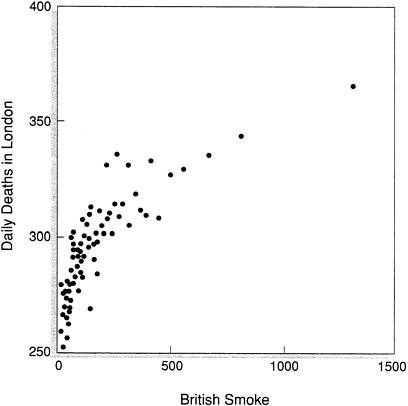
FIGURE 4-1 Mean daily deaths in London versus mean smoke (µg/m3), 1958–1972. Source: Schwartz and Marcus, 1990, with permission.
lates and the daily rate of mortality for each year in London, the regression coefficients of particulates were consistent as well.
Acute mortality from exposure to hazardous industrial products occurred in Bhopal, India, in 1984. The analytical issues raised in studies of such acute events are relevant to the study of hazardous wastes. Longitudinal studies of such episodes within a single population are confounded by multiple factors that occur when different geographic regions are compared. These issues are discussed in more detail in the section on longitudinal studies of morbidity.
CROSS-SECTIONAL STUDIES OF MORTALITY
Cross-sectional studies provide epidemiologic snapshots or pulses of a given area at one point in time. Recent computer technology has permitted easier preparation of maps of comparative mortality data from different regions of the U.S. and Canada. Of more relevance to
hazardous-waste studies are smaller scale comparisons of adjacent counties or Zip Codes. Although such indicators are relatively crude and insensitive, they have been used to compare mortality data in populations close to or more distant from point sources of emissions, such as smelters that emit arsenic. In one study in Sweden, Pershagen (1985) found significant small-scale regional differences in lung cancer rates that could be attributable to such air emissions, and Lloyd et al. (1984) suggest that changes in sex ratio of births might also be found in a similar polluted environment. In general, area studies of health patterns linked to hazardous-waste sites have been too small to permit significant mortality comparisons. Moreover, exposures in such studies certainly involve multiple routes and can induce multiple adverse effects.
At least one cross-sectional ecological study (Lave and Seskin, 1977) found associations between long-term airborne exposures to sulfate pollution and age-, race-, and sex-adjusted mortality rates in urban areas of the U.S. These studies were criticized because of their highly ecological nature and poor control for other factors that could explain geographic variations in mortality rates. Subsequent studies (Lipfert, 1980; Chappie and Lave, 1982) obtained better data on other relevant risk factors, such as smoking and industrial employment. A more recent study by Griffith et al. (1989) reports an association between the presence of hazardous-waste sites in counties in the U.S. and excess cancer mortality. No effort was made to control for cigarette sales by county, employment in high-risk industries, or presence of industrial facilities that might emit carcinogens. Without these controls, such studies may be of limited value.
Vinyl chloride (VC) is a substance found at many hazardous-waste sites (see Appendix 3-A of this volume). In the 1970s, several epidemiologic investigations indicated that occupational exposure to VC was associated with an increased risk of angiosarcoma of the liver as well as cancer of other sites (Infante, 1981). In addition, epidemiologic study and case reports associated angiosarcoma of the liver with community exposure to VC. Brady et al. (1977) reported the results of a New York State case control study of 26 confirmed cases of angiosarcoma of the liver. Controls were comprised of individuals who had an internal malignant tumor other than primary liver cancer; they were matched with cases on the basis of age at diagnosis, race, sex, place of residence and vital status. Of 10 women with angiosarcoma of the liver, five lived within one mile of VC polymerization or fabrication plants (1 case lived within 1700 feet for 62 years; 4 cases lived from 500 to 4500 feet for 8 to 27 years), whereas none of their matched controls lived as close. According to the au-
thors, this observation added support to the hypothesis that exposure to VC outside the industrial setting may be an important factor in the etiology of angiosarcoma of the liver. In addition to the above study, Christine et al. (1974) noted six cases of angiosarcoma of the liver in Connecticut. Of these, one lived within two miles of a plant producing wire coated with polyvinyl chloride while a second lived within 0.5 mile of a plant producing vinyl sheets. None of the individuals was known to have had occupational exposure to VC or arsenic or diagnostic exposure to thorium dioxide. Rosenman et al. (1989) recently reported higher odds ratios for central nervous system birth defects in areas around two VC polymerization facilities in New Jersey.
One review of age-adjusted, sex-, race- and site-specific cancer mortality rates in U.S. counties for three time periods found significantly elevated rates of bladder cancer in males in counties surrounding the Drake Superfund site in Pennsylvania (Budnick et al., 1984). Elevations of birth defects also occurred, but were not statistically significant. This site, in Clinton County, Pennsylvania, included the volatile human carcinogens beta-naphthylamine, benzidine, and benzene dispersed over a 46-acre area. Airborne exposure was suspected to have occurred, given the nature of the chemicals involved. Subsequent investigation determined that males in these counties had between 20 and 30 times the rate of bladder cancer as nonexposed males; their primary employment was in the manufacture of beta-naphthylamine, a potent bladder carcinogen (Marsh et al., 1991). No general evidence of environmental effects was obtained, as Chapter 3 noted.
CHRONIC MORBIDITY STUDIES
LONGITUDINAL ANALYSIS
These studies have been of three types: long-term studies of actively exposed persons, prospective studies of a distinct group, and follow-up studies of exposed children.
Long-term studies of individuals acutely exposed to an initial single dose of a pollutant and then subjected to some chronic exposure have included a follow-up of the population exposed to dioxins at Seveso, Italy (Bertazzi et al., 1989). Follow-up studies of a small group of people acutely exposed to chlorine from an accidental release (Weill et al., 1969) have been published. These studies are required if long-term changes or risks are to be identified. In some instances, full recovery occurs; in others, involving sulfur dioxide, sulfuric acid, oxides of nitrogen, or ammonia, recovery may be very slow and in-
complete (Bates, 1989). Where increased rates of cancer are involved, long-term follow-up will be needed.
One prospective study of a distinct group (such as Seventh Day Adventists —Euler et al., 1988—which have a stable population for which health outcomes can reliably be recorded) has been useful in identifying associations between total suspended particulates and respiratory symptoms and bronchitis, and between ozone levels and the incidence of asthma. Such studies are not applicable to hazardous-waste sites, however. Follow-up studies of residents of Love Canal, New York, chronically exposed for varying periods have been reported (Janerich et al., 1981). In general, these have not revealed striking long-term effects, although an increase in prevalence of low-birth-weight babies in Love Canal was linked to exposures from wastes deposited there (Vianna and Polan, 1984; Goldman et al., 1985).
There also are important data on children with chronic elevations of lead in their blood in whom subsequent effects have been detected with long-term follow-up studies. Follow-up studies of children known to have suffered from lead exposure showed that lead levels in umbilical cord blood predict a child's performance on the Bailey scales of mental development at 6 months and at 18 months of age (Bellinger et al., 1987). Exposure categories were in three groups, <5 µg/dL (micrograms per deciliter), 5-10 µg/dL, and >10 µg/dL. The fall-off in performance was significantly different between the lowest and highest exposure categories; in the middle it depended on economic circumstance, and poorer children performed worse than did others for the same lead level. Needleman et al. (1990) demonstrated that poorer school performance, reading problems, and deficits in intelligence tests persist into adolescence. Needleman's follow-up of children known to have been exposed to lead indicates an odds ratio of 5 for failure to graduate from high school and of 7 for reading disabilities (Needleman et al., 1990).
As noted in Chapter 3, lead is the commonest contaminant of hazardous-waste sites. It also is present in mining wastes, house paint, and urban soils contaminated by leaded gasoline and flaking house paint. Studies of the effects of lead are therefore clearly relevant to hazardous-waste site exposures, and they indicate the importance of ensuring that exposures of children to lead from hazardous-waste sites does not occur.
If adequate markers of exposure to developmental toxins can be secured (as was relatively easy in the case of lead), the outcome measurements can be sensitive enough to demonstrate significant long-term adverse effects. Unfortunately, markers of exposure often do
not exist; where available they can provide reliable evidence of long-term effects.
CROSS-SECTIONAL STUDIES OF MORBIDITY
Community Studies
Cross-sectional community studies typically compare communities with different levels of air pollution or populations that live different distances from a hazardous-waste site. All such studies have several problems: Measurement error can occur when the same exposure is assumed for every subject within a group. There are undetected differences between communities for risk factors. There can be “recall bias” if one group knows it is in the high-exposure category. There is little standardization of the equipment used to measure exposure in different locations. Recent studies, such as that by Flessel et al. (1991), suggest that more detailed population exposure measurements over time, in this example to DNA adducts of polycyclic aromatic hydrocarbons, may permit more precise analyses of long-term consequences.
In spite of these difficulties, successful community studies have been done. In contrast to ecologic studies that lack information on potential confounders, community studies generally have collected individual data on nonpollution risk factors. One early study (Holland and Reid, 1965) compared lung function in groups of male postal workers in London and in a number of provincial towns where levels of particulate matter and sulfur dioxide were much lower. In all smoking categories, they found a significant decrement of pulmonary function, measured as Forced Expiratory Volume 1 (FEV1), in the London workers. A more recent study (Groupe Cooperatif PAARC, 1982) found significant regressions in men, women, and children of FEV1 against sulfur dioxide pollution levels in 10 French cities. In the U.S., the best example of such studies is the six-city study that found a strong association between respirable particles and prevalence of acute bronchitis in children, although no differences were found in FEV1 (Dockery et al., 1989).
Other studies of this kind, including one report from Israel (Goren and Hellman, 1988), document that different respiratory symptoms occur in communities with different pollutant exposures. A report from Finland (Jaakkola et al., 1990) indicates that malodorous emissions from kraft pulp mills are associated with eye, nasal, and respiratory symptoms, although reporting bias cannot be ruled out in this case. Schwartz (1989) presents an analysis of pulmonary performance,
spirometric data from several thousand randomly selected children in the National Health and Nutrition Survey, which shows that those with greater chronic exposure to ozone experience reductions in lung capacity, as measured by forced vital capacity. An important aspect of most of these studies is that exposure was continuous, but to various levels, rather than dichotomous. This allows one to examine the dose-response relationship and to determine if the pattern suggests a direct linear, monotonic association, or some other dose-response relationship.
In addition to epidemiologic study results (Wagoner et al., 1980) and case reports (Sprince and Kazemi, 1980) among workers exposed to beryllium compounds, neighborhood cases of beryllium disease also have been observed in cross-sectional studies. Chronic beryllium disease is a pulmonary and systemic granulomatous disease caused by inhalation of beryllium. The interval between initial exposure and the clinical manifestation of disease varies from several months to years. Exertional dyspnea is the most common symptom. Other symptoms are cough, fatigue, weight loss, chest pain and arthralgia. Through the study of subjects admitted to the U.S. Beryllium Case Registry, specific criteria for the diagnosis of chronic beryllium disease have been established (Sprince and Kazemi, 1983). In 1948, Hardy reported chronic beryllium disease in persons who lived adjacent to a fluorescent lamp plant in Massachusetts. Additional cases of beryllium disease have been reported among persons living in the vicinity of a beryllium extraction plant (Eisenbud et al., 1949). Atmospheric pollution resulting from stack discharge was thought to be responsible for the latter diseases. By 1960, 47 cases of neighborhood beryllium disease were in the Beryllium Case Registry (Tepper et al., 1961); between 1966 and 1974, 76 new cases were added (Hasan and Kazemi, 1974).
Examples of cross-sectional morbidity studies that involve hazardous-waste sites include one on the Upper Ottawa Street Landfill in Hamilton, Ontario (Hertzman et al., 1987), in which significant differences in symptoms were found between an exposed and a control population, and a study (Baker et al., 1988) of 2039 persons in 606 households located near the Stringfellow Hazardous Waste Disposal Site in California. Both reports contain considerable discussion of how differences in symptom perception and recall can be reduced. A similar study involving a waste site in Lowell, Massachusetts, was reported by Ozonoff et al. (1987). The target population included all households within 400 meters of the site, and the control area was a ring of households between 800 meters and 1200 meters from the site. None of these studies found differences in reproductive out-
come or cancer mortality, but all three documented significant differences in symptoms recording. The symptoms varied widely, with headache, irritability, and fatigue being common in all three studies. However, all of these symptoms may also increase due to other factors, such as perceived risk.
The authors of these reports drew somewhat different conclusions from their studies, based on the degree to which they believed recall bias accounted for differences in reported symptoms. Recall bias is difficult to avoid if a community is episodically exposed to a noxious agent (such as hydrogen sulfide) with a very powerful odor. Recent studies of such communities in Alberta report that symptoms were more common in exposed groups than in controls, but that there were no difference in objective data of morbidity or mortality (Dales et al., 1989). This paper includes considerable discussion of the problem of recall bias. Hopwood and Guidotti (1988) also show that recall bias operates in the recalling of incidents of acute exposure.
Although it might be concluded that recall bias explains the symptom differences in all of these studies, the real possibility nevertheless exists that the symptoms complained of are more sensitive as indicators of significant exposure than are more severe outcomes. In air pollution studies, recall bias cannot account for daily diary records of respiratory symptoms that relate to variations in air pollution. Longitudinal studies of recorded symptoms and exposure around hazardous-waste sites could similarly avoid much of the problem, although this has not so far, to our knowledge, been attempted.
A different example of the use of cross-sectional community studies is the use of data on birth defects from different localities separated by their proximity to known hazardous-waste sites or contaminated water supplies. The Lipari Landfill study (NJDOH, 1989) found low average birth weight in children born or conceived while the Gloucester County, New Jersey, landfill was operating. After the landfill closed, the differences disappeared, adding plausibility to the association between exposure to airborne pollutants and low birth weight. Follow-up studies of residents close to Love Canal yielded similar results with this end point, with some evidence of an effect that subsided in later years (Goldman et al., 1985).
Individual Studies
In community studies, the same exposure is assigned or assumed for all individuals. Individual cross-sectional studies use measures of individual rather than community levels of exposure and correlate them with differences in outcome variables across individuals rather
than mean differences between communities. Many studies of the epidemiology of low-level lead toxicity fall into this category. Tooth lead levels in children have been related to intelligence and attention span deficits since the pioneering work of Needleman et al. (1972). Other studies have linked blood lead levels to children's stature (Schwartz et al., 1986), umbilical cord lead levels to congenital anomalies (Needleman et al., 1984), and identified bone demineralization as an internal source of lead exposure (Silbergeld et al., 1988).
It is clear that whenever one can use an individual marker of exposure, the power of such studies is greatly augmented. Monster and Smolders (1984) did an imaginative analysis of exhaled air for tetrachlorethane in teachers and their five-year-old pupils at a kindergarten near a factory with fugitive emissions. They then compared these levels to those found in a control group. Exhaled tetrachlorethane was then measured in a group of residents of an old people's home situated near a chemical-waste dump. Significant differences were found between the two groups of children, with those closer to the factory having higher levels. It was also shown that residents living on the first floor of the home (which is closer to the waste site) had significantly higher levels than did residents who lived on the second floor.
ACUTE MORBIDITY STUDIES
There are three categories of studies of acute morbidity: diary studies, population-based studies, and analysis of large data banks.
DIARY STUDIES
Diary studies of respiratory symptoms were first used in the 1950s as indicators of the pulmonary effects of air pollution (Lawther et al., 1970). These involved analyses of daily subjective records of respiratory symptoms, as they relate to pollution. There has recently been a resurgence of interest in this method, because it reduces the possibility of confounding by other factors that are difficult to control in cross-sectional studies, which compare rates of illness or symptoms across areas with different pollutant concentrations. In the longitudinal diary study, the population acts as its own control. Hence, variations between subjects in reporting rates due to subjective factors, differences in susceptibility, and passive smoke exposure are normalized and do not confound the pollution relationship.
Despite the inherent subjectivity of self-recorded data on symp-
toms, diaries of symptoms and medication use have been effective in identifying air pollution as a risk factor for respiratory illness in recent years. Most of these studies also demonstrate a lack of association between air pollution and nonrespiratory illness, giving credence to the primary findings. Monitoring of peak flow rates and symptoms was also useful in the analysis of occupational asthma in electronic workers employed in soldering (Burge et al., 1979).
Schwartz and Zeger (1990) re-examined an earlier diary study of student nurses in Los Angeles, California (Hammer et al., 1974), and found significant associations between exposure to ozone and the incidence of coughing, between exposure to nitrogen dioxide and daily incidence rates of sore throats, and between exposure to carbon monoxide and headaches. Analysis of the diary entries also proved a sensitive instrument for detecting the connection between chronic exposure to passive smoke and coughing with phlegm production.
A study in Utah of respiratory symptoms, medication use, and daily Peak Expiratory Flow (PEF) measurements of children and adults with asthma (Pope, 1991) finds a clear association between increased symptoms and decreased PEF values and levels of PM10 particulate pollution, which originated mostly from a nearby steel mill. This study was not complicated by the presence of other pollutants, such as ozone, sulfur dioxide, or sulfuric acid aerosol. Ozone has been associated with symptom reporting in persons with asthma (Whittemore and Korn, 1980). Ostro et al. (1991) report that symptoms worsened in a group of asthma patients studied in Denver, Colorado, in relation to daily aerosol hydrogen ion levels.
Studies reported by Lippman (1989), Raizenne et al. (1989), and Kinney et al. (1988) of children attending summer camps are a special case, because daily symptom reporting and daily measurements of lung function can be correlated to pollution levels measured continuously at the same site. The researchers found it difficult to attribute symptoms of function loss to specific pollutants, but they did show that combinations of pollutants, such as ozone, aerosol sulfates, and sulfuric acid, are associated with a variety of adverse respiratory effects. In these studies, daily measurements of lung function have generally been used as the outcome measurement.
Diary data might be useful in assessing the occurrence of symptoms when exposure to a single-point source (such as a factory) is intermittent because of changes in wind direction, and they would of course be much easier to interpret where the individuals have not been aware of fluctuations in the concentrations of the pollutants.
POPULATION-BASED STUDIES
Population-based studies assay all persons within a given region. They offer many of the advantages of diary studies because they deal with an entire community, and they allow the examination of rarer outcomes, such as physician visits or hospital admissions. Pope (1989) reports an association between hospitalization for respiratory illness and PM10 concentrations in Utah Valley, located in Utah County of central Utah. The relationship was found at levels well below the current ambient air quality standard (24-hour PM10 standard of 150 micrograms per cubic meter and an annual PM10 standard of an expected arithmetic mean of 50 µg/m3). A particularly striking effect was seen for the opening, closing, and reopening of a local steel mill. Further analysis shows a significant association in Salt Lake County as well (Pope et al., in press). Bates and Sizto (1987) found a significant relationship between summer air pollutants and hospital admissions for acute respiratory disease in southern Ontario. Data from acute-care facilities in the region 's 79 hospitals were taken over a nine-year observation period.
An example of a population-based case-control study relevant to airborne toxic substances, although not specific to hazardous-waste sites, is the one conducted by Linos et al. (1991). Mortality rates for leukemia and non-Hodgkin's lymphoma (NHL) have been rising in the central region of the U.S. Linos and colleagues were interested in the hypothesis that general environmental factors might account for this increase. Subjects consisted of white males in Iowa and Minnesota diagnosed between 1980 and 1983; there were 520 cases of leukemias and 572 of NHL, who were matched to 1130 controls. The relative risks (RR) were adjusted for factors associated with NHL and leukemia, e.g., pesticide exposure, occupational exposure, social class, use of hair dyes, smoking, and family history of hematopoietic malignancy. The authors found a statistically significant increase in the risk of developing NHL (RR=1.4) and a slight, nonsignificant excess for leukemia (RR=1.2) among men who lived 0.8-3.2 km (0.5-2 miles) from a factory. Petroleum or chemical factories were associated with the leukemia risk, while stone, clay, and glass factories correlated with NHL. The authors state: “These environmental associations may provide clues to the unexplained rising morality rates of leukemia and NHL in the central United States” (Linos et al., 1991, p. 73).
Other studies have reported a correlation between visits to hospital emergency departments and pollutant levels. Some of these have been positive (Levy et al., 1977; Bates et al., 1990); in another the association was present but weak (Samet et al., 1981), and in others
no association was found (Richards et al., 1981; Goldstein and Weinstein, 1986). Because the mix of pollutants varies, and a number of other factors affect hospital emergencies, such results are not unexpected.
Hospital studies that include all hospitals in the area can provide data comparable with those generated in population-based studies. Hospital-based studies are very relevant to future research on hazardous wastes and point sources of pollution in several ways. First, they provide broad support for the use of systematic and longitudinal symptom reporting, or hospital visits, as valid outcome measurements and investigative tools. Such reports are easier to obtain than are physiologic measurements, and in the case of respiratory illness they appear to be as useful in some cases as are measurements of function test change. Second, the critical feature of such studies is their longitudinal nature. Many of the difficulties that arise from reporting bias in using data from questionnaires administered once for hazardous-waste exposures (detailed in the next section) could be avoided by using monitored data of temporal fluctuations in exposure in a population, together with diary information. This might be more effective than depending on cross-sectional comparisons between groups of subjects who probably are aware of their relative exposure ranking and who therefore are prone to recall bias.
LARGE DATA BANK ANALYSES
Recent analyses of the Health Interview Survey of the U.S. National Center for Health Statistics have permitted studies of associations between the number of days people report being restricted due to respiratory conditions and levels of air pollutants (Portney and Mullahy, 1986; Ostro and Rothschild, 1989). Strong associations were found with fine particles and weaker ones with ozone. The large numbers of subjects in these studies have permitted significant associations to be found. An important strength of their analyses is the random selection of the subjects.
SPECIAL CONSIDERATIONS
THE SICK BUILDING SYNDROME
Initial reports of the occurrence of mild symptoms in people working in sealed, usually recently constructed, office buildings were generally discounted. However, the syndrome has been firmly established for several reasons. First, a remarkable concordance has been found in the kinds of complaints made by workers in different loca-
tions and in different countries: Headaches, fatigue, inability to concentrate, and mild inflammation of the eyes and pharynx were the most common complaints (Mendell and Smith, 1990). The complaints were generally more common in air-conditioned buildings, and they could not be attributed to fungi (such as Aspergillus) known to be responsible for the infection “humidifier fever.” Work from Denmark (Molhave, 1985; Kjaergaard et al., 1989) has not only identified a group of volatile organic compounds most commonly present when complaints are recorded, but has shown that controlled exposures to these compounds (and not to others) elicit the same symptoms in groups of subjects who might or might not have reported adverse symptoms previously. The recent controlled-exposure study of n-decane (common in building materials) from the Aarhus group (Kjaergaard et al., 1989) provides an excellent example of how subjective symptoms, such as eye irritation, can be objectively studied. Effects on humans were demonstrated at 1/500th of the exposure level that produced effects on rats. In the study, 63 healthy subjects randomly selected from the regular Danish population were exposed to n-decane in concentrations of 10, 35, or 100 microliters/liter in a controlled double-blind study. Subjects were exposed for 6 hours per exposure day for a total of 4 exposure days. Dose-dependent changes in irritation of mucous membranes (measured by decreased tear film stability and an increase in conjunctival polymorphs), as well as subjective observations of increased sensation of odor intensity and perception of reduced air quality, were documented.
Diary data also can be used to compare complaints of symptoms that arise from working in new office buildings (Mendell and Smith, 1990). Reports of similar symptoms (fatigue, headache, and inability to concentrate) by populations in North American and European cities lends credibility to the phenomenon being reported.
Although the unravelling of the genesis of this syndrome is not yet complete, it contains important lessons for studies of hazardous-waste-site epidemiology. In many cases involving hazardous-waste sites, the complaints are subjective and similar to those of the sick building syndrome. In addition, objective markers of exposure have not been identified. Furthermore, many of the volatile compounds found in sealed modern buildings, including formaldehyde, toluene, and trichlorethylene, also are common constituents of waste dumps.
It has recently been suggested that exposure to low levels of formaldehyde is followed by changes in cells that indicate that the immune system has been affected (Thrasher et al., 1987). Although the precise significance of such changes is unclear, the possibility must
be considered that exposure to toxic substances from hazardous-waste dumps causes similar or related changes.
ASTHMA AND OTHER RESPIRATORY PROBLEMS
During the past decade, our knowledge of factors related to asthma and other examples of increased airway responsiveness has expanded greatly (NRC, 1989). Exposures to a wide range of substances (more than 200 are listed in a review (Taylor, 1980)) can induce airway responsiveness that can be specific for the substance. Asthma is a common and well-studied disturbance of the human immune system. More commonly, exposure leads to a nonspecific increase in airway responsiveness as measured by inhaled histamine or methacholine aerosols. This response is not always immunologic. Toluene diisocyanate, widely used in industry as a solvent, is a powerful inducer of asthma and adult-onset hypersensitivity (Paggiaro et al., 1986), as are platinum salts, anhydides, and some acids (NRC, 1989). Exposures to ozone can increase the sensitivity of the subject to a subsequent exposure to an allergen (Boushey, 1989) or to sulfur dioxide (Koenig et al., 1990); and asthma patients are much more sensitive to inhaled sulfur dioxide than are those who do not have asthma (Sheppard, 1989).
At the same time this knowledge was being secured, and when summer pollutant levels were being shown to be associated with respiratory morbidity as indicated by hospital admission data (Bates and Sizto, 1987), it became apparent that hospital admissions for asthma were increasing (Mao et al., 1987; Gergen and Weiss, 1990) and that increases in asthma mortality were occurring (Sly, 1988; Weiss and Wagener, 1990). Prevalence surveys also indicated an increase in asthma, both in the U.S. (Gergen et al., 1988) and in Britain (Burney et al., 1990).
A full discussion of these phenomena is beyond the scope of this volume; it is not yet established why these increases have occurred. A number of studies of hazardous-waste sites document complaints of “chest tightness” and “shortness of breath” or other respiratory symptoms (Ozonoff et al., 1987). Therefore, the possibility must be entertained that proximity to some of these sites has induced increased airway responsiveness. To our knowledge, this has not yet been specifically evaluated in hazardous-waste-site studies. One study found no evidence of an increased prevalence of asthma in people living close to a polyurethane factory in Finland (Nuorteva et al., 1987).
Although the role of ambient air pollution in asthma prevalence has not yet been determined, it seems likely that air pollution is an aggravating factor. It seems unlikely, however, that exposures from hazardous-waste sites could have played a part in the generally increased prevalence of asthma, given the relatively small size of the potentially exposed populations. The role of exposures from hazardous-waste sites in the development of respiratory symptoms cannot be readily evaluated.
MONITORING OF AIR POLLUTANTS
A crucial lesson from the recent history of environmental epidemiology has been the critical role played by the general availability of monitoring data for a number of air pollutants. Many of the analyses discussed above could not have been undertaken without this extensive data base on pollutants for which monitoring data are routinely acquired. The nature of the data base also has shaped epidemiologic studies. For example, fewer studies of daily exposure have been done for particulates, because these often are sampled only every sixth day. This has hindered the attempt to replicate the London mortality analyses, except in rare cases, such as Steubenville, Ohio, where sampling results were available on a daily basis (Schwartz and Marcus, 1990) or in the Utah studies (Pope, 1989; Pope et al., in press). Exposure to hydrocarbons in urban air has not been monitored routinely since the 1970s and there has been little work on their direct effects except in studies of the sick building syndrome (Molhave, 1985; Kjaergaard et al., 1989). Routine monitoring of ambient air around hazardous-waste sites is not feasible because of their number, the low likelihood of detection in most cases, and cost. In addition, the small size of the exposed populations in most cases makes the sites difficult to study with standard epidemiologic techniques. Nevertheless, more systematic assessments of where such monitoring and such studies might be appropriate needs to be done early in the process of identifying and describing sites for study. It might well be appropriate that one major site with a nearby exposed population should be intensively studied over a period of a year or so, to acquire data that might be applicable to similar sites.
CONCLUSIONS
A variety of methodological approaches have been taken to the study of air pollution epidemiology. These can be applied to the study of hazardous wastes, but are likely to vary as to their success.
Thus, studies of trends over time in air pollution and disease patterns have produced a growing body of literature that has associated day-to-day fluctuations in air pollution with daily fluctuations in mortality across a wide range of exposures with no evidence of thresholds. It is not likely to be worthwhile to conduct such studies at hazardous-waste sites, especially in light of the complex and changing nature of the pollutants, the absence of long-term records, such as exist for criteria air pollutants, and problems of determining the baseline, or expected rates, of a variety of subtle health end points of interest, such as neurological, behavioral, and reproductive problems.
Lessons that have been learned in air pollution studies are relevant to epidemiologic studies of hazardous-waste sites. Of particular importance are the need to measure exposure as precisely as possible, and the value of obtaining longitudinal data on exposures and disease outcomes in order to strengthen time-series analyses. The recent symposium organized by the National Academy of Sciences (NRC, 1991) stressed the paramount importance (and difficulties) of exposure measurement.
Symptom reports appear to be sensitive indicators of adverse health effects. Simultaneous use of air monitoring and diary records could reduce the problem of recall bias, and are particularly valuable when small changes in pollutant levels cannot be detected by the subjects in a study. It is likely that air emissions from hazardous-waste sites have caused a variety of symptoms indicating low-level interference with normal function. These are often comparable to the symptoms reported in the sick building syndrome. There are insufficient data to determine whether or not airborne exposure to toxics from hazardous-waste sites has resulted in nationwide increases in cancer mortality, or adverse pregnancy outcomes. However, the limited number and low power of studies, and the long latency of some cancers and other chronic diseases, mean that these effects cannot be completely ruled out in most areas.
It is not easy to decide whether to launch an epidemiologic study. With more detailed assessment of exposure, the extent of possible adverse effects will be better understood. We think it is important to draw attention to resource needs for adequate study designs. While a decision to conduct an epidemiologic study of hazardous-waste sites must take account of expressed public concern, this concern should, especially in an era of scarce resources, be balanced by the best available scientific evidence, including the quality of exposure and outcome data and the probability that an answer could be obtained that would be interpretable per se or after combination with the data from multiple studies.
REFERENCES
Andelman, J.B., A. Couch, and W.W. Thurston. 1986. Inhalation exposures in indoor air to trichlorethylene from shower water Pp. 201-213 in Environmental Epidemiology, F.C. Kopfler and G.F. Craun, eds. Chelsea, Mich.: Lewis.
Baker, D.B., S. Greenland, J. Mendlein, and P. Harmon. 1988. A health study of two communities near the Stringfellow Waste Disposal site Arch. Environ. Health 43: 325-334
Bates, D.V., M. Baker-Anderson, and R. Sizto. 1990. Asthma attack periodicity: A study of hospital emergency visits in Vancouver Environ Res. 51: 51-70
Bates, D.V. 1989. Respiratory Function in Disease. Third Edition. Philadelphia: W.B. Saunders. 558 pp.
Bates, D.V., and R. Sizto. 1987. Hospital admissions and air pollutants in Southern Ontario: The acid summer haze effect Environ Res. 43: 317-331
Bellinger, D., A. Leviton, C. Waternaux, H. Needleman, and M. Rabinowitz. 1987. Longitudinal analyses of prenatal and postnatal lead exposure and early cognitive development N. Engl. J. Med. 316(17): 1037-1043
Bertazzi, P.A., C. Zocchetti, A.C. Pesatori, S. Guercilena, M. Sanarico, and L. Radice. 1989. Ten-year mortality study of the population involved in the Seveso incident in 1976. Am. J. Epidemiol. 129: 1187-1200
Boushey, H.A. 1989. Ozone and asthma. Pp. 214-217 in Susceptibility to Inhaled Pollutants, M.J. Utell and R. Frank, eds. ASTM STP 1024. Philadelphia: American Society for Testing and Materials.
Brady, J., F. Liberatore, P. Harper, P. Greenwald, W. Burnett, J.N.P. Davies, M. Bishop, A. Polan, and N. Vianna. 1977. Angiosarcoma of the liver: An epidemiologic survey. J. Natl. Cancer Inst. 59: 1383-1385
Budnick, L.D., D.C. Sokal, H. Falk, J.N. Logue, and J.M. Fox. 1984. Cancer and birth defects near the Drake Superfund site, Pennsylvania Arch. Environ. Health 39: 409-413
Burge, P.S., W.H. Perks, I.M. O'Brien, A. Burge, R. Hawkins, D. Brown, and M. Green. 1979. Occupational asthma in an electronics factory: A case control study to evaluate aetiological factors. Thorax 34: 300-307
Burney, P.G.J., S. Chinn, and R.J. Rona. 1990. Has the prevalence of asthma increased in children? Evidence from the national study of health and growth 1973-1986 Br. Med. J. 300: 1306-1310
Chappie, M., and L. Lave. 1982. The health effects of air pollution: A reanalysis. J. Urban Econ. 12: 346-376
Christine, B.W., H.S. Barrett, and D.S. Lloyd. 1974. Epidemiologic notes and reports. Angiosarcoma of the liver—Connecticut Morbid. Mort. Weekly Rep. 23: 210-211
Dales, R.E., W.O. Spitzer, S. Suissa, M.T. Schechter, P. Tousignant, and N. Steinmetz. 1989. Respiratory health of a population living downwind from natural gas refineries. Am. Rev. Respir. Dis. 139: 595-600
Dockery, D.W., F.E. Speizer, D.O. Stram, J.H. Ware, J.D. Spengler, and B.G. Ferris, Jr. 1989. Effects of inhalable particles on respiratory health of children. Am. Rev. Respir. Dis. 139: 587-594
Eisenbud, M., R.C. Wanta, C. Dustan, L.T. Steadman, W.B. Harris, and B.S. Wolf. 1949. Non-occupational berylliosis. J. Ind. Hyg. Toxicol. 31: 282-294
Euler, G.L., D.E. Abbey, J.E. Hodgkin, and A.R. Magie. 1988. Chronic obstructive pulmonary disease symptom effects of long-term cumulative exposure to ambient levels of total oxidants and nitrogen dioxide in California Seventh-Day Adventist residents Arch. Environ. Health 43: 279-285
Flessel, P., Y.Y. Wang, K.I. Chang, J.J. Wesolowski, G.N. Guirguis, I.-S. Kim, D. Levaggi, and W. Siu. 1991. Seasonal variations and trends in concentrations of filter-collected polycyclic aromatic hydrocarbons (PAH) and mutagenic activity in the San Francisco Bay area J. Air Waste Manage. Assoc. 41: 276-281
Gergen, P.J., and K.B. Weiss. 1990. Changing patterns of asthma hospitalization among children: 1979 to 1987 J. Am. Med. Assoc. 264: 1688-1692
Gergen, P.J., D.I. Mullally, and R. Evans III. 1988. National survey of prevalence of asthma among children in the United States, 1976 to 1980 Pediatrics 81: 1-7
Goldman, L.R., B. Paigen, M.M. Magnant, and J.H. Highland. 1985. Low birth weight, prematurity and birth defects in children living near the hazardous waste site, Love Canal Haz. Waste Haz. Materials 2: 209-223
Goldstein, I.F., and A.L. Weinstein. 1986. Air pollution and asthma: Effects of exposures to short-term sulfur dioxide peaks Environ. Res. 40: 332-345
Goren, A.I., and S. Hellman. 1988. Prevalence of respiratory symptoms and diseases in schoolchildren living in a polluted and in a low polluted area in Israel Environ. Res. 45: 28-37
Great Britain Ministry of Health. 1954. Mortality and Morbidity During the London Fog of December 1952 Report on Public Health and Medical Subjects, Vol. 95 London: Her Majesty's Stationery Office. 60 pp.
Griffith, J., R.C. Duncan, W.B. Riggan, and A.C. Pellom. 1989. Cancer mortality in U.S. counties with hazardous waste sites and ground water pollution Arch. Environ. Health 44: 69-74
Groupe Cooperatif PAARC. 1982. Air pollution and chronic or repeated respiratory diseases. II. Results and Discussion Bull. Eur. Physiopath. Respir. 18: 101-116
Hammer, D.I., V. Hasselblad, B. Portnoy, and P.F. Wehrle. 1974. Los Angeles students nurse study. Daily symptom reporting and photochemical oxidants Arch. Environ. Health 28: 255-260
Hardy, H.L. 1948. Delayed chemical pneumonitis in workers exposed to beryllium compounds Am. Rev. Tuberc. 57: 547-556
Hasan, F.M., and H. Kazemi. 1974. Chronic beryllium disease: A continuing epidemiologic hazard. Chest 65: 289-293
Hertzman, C., M. Hayes, J. Singer, and J. Highland. 1987. Upper Ottawa Street Land-fill Site health study Environ. Health Perspect. 75: 173-195
Holland, W.W., and D.D. Reid. 1965. The urban factor in chronic bronchitis. Lancet 1: 445-448
Hopwood, D.G., and T.L. Guidotti. 1988. Recall bias in exposed subjects following a toxic exposure incident Arch. Environ. Health 43: 234-237
Infante, P.F. 1981. Observations of the site-specific carcinogenicity of vinyl chloride to humans Environ. Health Perspect. 41: 88-94
Jaakkola, J.J.K., V. Vilkka, O. Marttila, P. Jappinen, and T. Haahtela. 1990. The South Karelia Air Pollution Study: The effects of malodorous sulfur compounds from pulp mills on respiratory and other symptoms Am. Rev. Respir. Dis. 142: 1344-1350
Janerich, D.T., W.S. Burnett, G. Feck, M. Hoff, P. Nasca, A.P. Polednak, P. Greenwald, and N. Vianna. 1981. Cancer incidence in the Love Canal area. Science 212: 1404-1407
Kinney, P.L., J.H. Ware, and J.D. Spengler. 1988. A critical evaluation of acute ozone epidemiology results Arch. Environ. Health 43: 168-173
Kjaergaard, S., L. Molhave, and O.F. Pedersen. 1989. Human reactions to indoor air pollutants: n-decane Environ. Int. 15: 473-482
Koenig, J.Q., D.S. Covert, Q.S. Hanley, G. van Belle, and W.E. Pierson. 1990. Prior exposure to ozone potentiates subsequent response to sulfur dioxide in adolescent asthmatic subjects Am. Rev. Respir. Dis. 141: 377-380
Lave, L.B., and E.P. Seskin. 1977. Air Pollution and Human Health. Baltimore: Published by Johns Hopkins University Press for Resources for the Future 368 pp.
Lawther, P.J., R.E. Waller, and M. Henderson. 1970. Air pollution and exacerbations of bronchitis. Thorax (England) 25: 525-539
Levy, D., M. Gent, and M.T. Newhouse. 1977. Relationship between acute respiratory illness and air pollution levels in an industrial city Am. Rev. Respir. Dis. 116: 167-173
Linos, A., A. Blair, R.W. Gibson, G. Everett, S. Van Lier, K.P. Cantor, L. Schuman, and L. Burmeister. 1991. Leukemia and non-Hodgkin's lymphoma and residential proximity to industrial plants Arch. Environ. Health 46: 70-74
Lipfert, F.W. 1980. Sulfur oxides, particulates, and human mortality: Synopsis of statistical correlations J. Air Pollut. Control Assoc. 30: 366-371
Lippmann, M. 1989. Health effects of ozone: A critical review. J. Air Pollut. Control Assoc. 39: 672-695
Lloyd, O.L., M.M. Lloyd, and Y. Holland. 1984. An unusual sex ratio of births in an industrial town with mortality problems Br. J. Obstet. Gynaecol. 91: 901-907
Mao, Y., R. Semenciw, H. Morrison, L. MacWilliam, J. Davies, and D. Wigle. 1987. Increased rates of illness and death from asthma in Canada. Can. Med. Assoc. J. 137: 620-624
Marsh, G.M., L.C. Leviton, E.O. Talbott, C. Callahan, D. Pavlock, G. Hemstreet, J.N. Logue, J. Fox, and P. Schulte. 1991. Drake Chemical Workers' Health Registry Study: 1. Notification and medical surveillance of a group of workers at high risk of developing bladder cancer Am. J. Ind. Med. 19: 291-301
McKone, T.E. 1987. Human exposure to volatile organic compounds in household tap water: The indoor inhalation pathway Environ. Sci. Technol. 21: 1194-1201
Mendell, M.J., and A.H. Smith. 1990. Consistent pattern of elevated symptoms in air-conditioned office buildings: A reanalysis of epidemiologic studies Am. J. Pub. Health 80: 1193-1199
Molhave, L. 1985. Volatile organic compounds as indoor air pollutants. Pp. 403-414 in Indoor Air & Human Health, R.B. Gammage and S.V. Kaye, eds. Chelsea, Mich.: Lewis.
Monster, A.C., and J.F.F. Smolders. 1984. Tetrachloroethane in exhaled air of persons living near pollution sources Int. Arch. Occup. Environ. Health 53: 331-336
Needleman, H.L., O.C. Tuncay, and I.M. Shapiro. 1972. Lead levels in deciduous teeth of urban and suburban American children Nature. 235(5333): 111-112
Needleman, H.L., M. Rabinowitz, A. Leviton, S. Linn, and S. Schoenbaum. 1984. The relationship between prenatal exposure to lead and congenital anomalies. J. Am. Med. Assoc. 251: 2956-2959
Needleman, H.L., A. Schell, D. Bellinger, A. Leviton, and E.N. Allred. 1990. The long-term effects of exposure to low doses of lead in childhood. An 11-year follow-up report N. Engl. J. Med. 322: 83-88
NJDOH (New Jersey Department of Health). 1989. A Report on the Health Study of Residents Living Near the Lipari Landfill Environmental Health Service. 120 pp.
NRC (National Research Council). 1989. Biologic Markers in Pulmonary Toxicology. Washington, D.C.: National Academy Press.
NRC (National Research Council). 1991. Frontiers in Assessing Human Exposures to Environmental Toxicants Washington, D.C.: National Academy Press.
Nuorteva, P., T. Assmuth, T. Haahtela, J. Ahti, E. Kurvonen, T. Nieminen, T. Saarainen, K. Seppala, P. Veide, and S. Viholainen. 1987. The prevalence of asthma among inhabitants in the vicinity of a polyurethane factory in Finland Environ. Res. 43: 308-316
Ostro, B.D., and S. Rothschild. 1989. Air pollution and acute respiratory morbidity: An observational study of multiple pollutants Environ. Res. 50: 238-247
Ostro, B.D., M.J. Lipsett, M.B. Weiner, and J.C. Selner. 1991. Asthmatic responses ot airborne acid aerosols Am. J. Public Health 81: 694-702
Ozonoff, D., M.E. Colten, A. Cupples, T. Heeren, A. Schatzkin, T. Mangione, M. Dresner, and T. Colton. 1987. Health problems reported by residents of a neighborhood contaminated by a hazardous waste facility Am. J. Ind. Med. 11: 581-597
Paggiaro, P.L., A. Innocenti, E. Bacci, O. Rossi, and D. Talini. 1986. Specific bronchial reactivity to toluene diisocyanate: Relationship with baseline clinical findings Thorax 41: 279-282
Pershagen, G. 1985. Lung cancer mortality among men living near an arsenic-emitting smelter Am. J. Epidemiol. 122: 684-694
Pope, C.A. 1989. Respiratory disease associated with community air pollution and a steel mill, Utah Valley Am. J. Public Health 79: 623-628
Pope, C.A. 1991. Respiratory hospital admissions associated with PM10 pollution in Utah, Salt Lake, and Cache valleys Arch. Environ. Health 46: 90-97
Pope, C.A., D.W. Dockery, J.D. Spengler, and M.E. Raizenne. In press. Respiratory health and PM10 pollution: A daily time series analysis Am. Rev. Respir. Dis.
Portney, P.R., and J. Mullahy. 1986. Urban air quality and acute respiratory illness. J. Urban Economics 20: 21-38
Raizenne, M.E., R.T. Burnett, B. Stern, C.A. Franklin, and J.D. Spengler. 1989. Acute lung function responses to ambient acid aerosol exposures in children. Environ. Health Perspect. 79: 179-185
Richards, W., S.P. Azen, J. Weiss, S. Stocking, and J. Church. 1981. Los Angeles air pollution and asthma in children. Ann. Allergy 47: 348-354
Rosenman, K.D., J.E. Rizzo, M.G. Conomos, and G.J. Halpin. 1989. Central nervous system malformations in relation to two polyvinyl chloride production facilities Arch. Environ. Health 44: 279-282
Samet, J.M., Y. Bishop, F.E. Speizer, J.D. Spengler, and B.G. Ferris, Jr. 1981. The relationship between air pollution and emergency room visits in an industrial community. J. Air Pollut. Control Assoc. 31: 236-240
Schwartz, J. 1989. Lung function and chronic exposure to air pollution: A cross-sectional analysis of NHANES II. Environ. Res. 80: 309-321
Schwartz, J., and D.W. Dockery. 1990. Particulate air pollution and daily mortality in Steubenville, Ohio Am. Rev. Respir. Dis. 141: A74
Schwartz, J., and A. Marcus. 1990. Mortality and air pollution in London: A time series analysis Am. J. Epidemiol. 131: 185-194
Schwartz, J., and S. Zeger. 1990. Passive smoking, air pollution, and acute respiratory symptoms in a diary study of student nurses Am. Rev. Respir. Dis. 141: 62-67
Schwartz, J., C. Angle, and H. Pitcher. 1986. The relationship between childhood blood lead levels and stature Pediatrics 77: 281-288
Sheppard, D. 1989. Mechanisms of airway hyperresponsiveness. Pp. 47-52 in Susceptibility to Inhaled Pollutants, M.J. Utell and R. Frank, eds. ASTM STP 1024. Philadelphia: American Society for Testing and Materials.
Silbergeld, E.K., J. Schwartz, and K. Mahaffey. 1988. Lead and osteoporosis: Mobilization of lead from bone in postmenopausal women Environ. Res. 47: 79-94
Sly, R.M. 1988. Mortality from asthma, 1979-1984. J. Allergy Clin. Immunol. 82: 705-717
Sprince, N.L., and H. Kazemi. 1980. U.S. beryllium case registry through 1977. Environ. Res. 21: 44-47
Sprince, N.L., and H. Kazemi. 1983. Beryllium disease. Pp. 481-490 in Environmental and Occupational Medicine, W. Rom, ed. 1st edition. Boston: Brown, Little.
Taylor, A.J. Newman. 1980. Editorial: Occupational asthma. Thorax 35: 241-245
Tepper, L.B., H.L. Hardy, and R.I. Chamberlin. 1961. Pp. 25-29 in Toxicity of Beryllium Compounds. New York: Elsevier Pub.
Thrasher, J.D., A. Wojdani, G. Cheung, and G. Heuser. 1987. Evidence of formaldehyde antibodies and altered cellular immunity in subjects exposed to formaldehyde in mobile homes Arch. Environ. Health 42: 347-350
Vianna, N.J., and A.K. Polan. 1984. Incidence of low birth weight among Love Canal residents. Science 226(4679): 1217-1219
Wagoner, J.K., P.F. Infante, and D.L. Bayliss. 1980. Beryllium: An etiologic agent in the induction of lung cancer, nonneoplastic respiratory disease, and heart disease among industrially exposed workers Environ. Res. 21: 15-34
Weill, H., R. George, M. Schwarz, and M. Ziskind. 1969. Late evaluation of pulmonary function after acute exposure to chlorine gas. Am. Rev. Respir. Dis. 99: 374-379
Weiss, K.B., and D.K. Wagener. 1990. Changing patterns of asthma mortality. J. Am. Med. Assoc. 264: 1683-1687
Whittemore, A.S., and E.L. Korn. 1980. Asthma and air pollution in the Los Angeles area. Am. J. Public Health 70: 687-696


