
SPIRALed Engineering Education
Lead Institution: University of Utah, Salt Lake City, UT
Collaborating Institutions: Olin College of Engineering, the University of Texas at Austin, Virginia Tech, community colleges in Utah
Category: Capstone, Course/Curricular
Date Implemented: August 2008
Website: mech.utah.edu

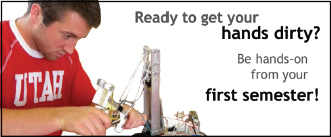
Program Description: The purpose of this program is to improve students’ abilities to solve practical, open-ended engineering problems by improving their critical thinking skills and their knowledge of engineering hardware, science, and modeling and simulation tools. We are doing this (1) in a manner applicable to large public institutions with inadequate resources, (2) for incoming students with limited knowledge of engineering and declining science and math skills, and (3) in the face of burgeoning enrollments. For place-based educational institutions, now challenged by online education, we have asked three questions concerning how we can maintain the excellence of the education of engineers in the USA. How can we (1) best utilize the revolutionary technological advances affecting education, (2) complement them to improve our students’ education, and (3) do so economically in large, public institutions? Our approach is to develop coordinated sequences of courses that involve (1) SPIRALing the students’ education (Student-driven Pedagogy of Integrated, Reinforced, Active Learning) by reinforcing and extending their knowledge in a coordinated series of classes (vs. the inoculation approach of isolated lecture classes); (2) teaching by design to motivate learning via open-ended projects that involve modeling, simulation and construction, and competitions with finished devices, while also developing teamwork and communication skills; (3) tailoring projects to each course’s technical material; (4) providing laboratory experiences that build towards the students’ designs; and (5) using video lectures to complement textbooks so that class time can be better used for active learning. We have begun incorporating these elements into two, two-course sequences. The first-year sequence has a mechatronics and robotics theme and emphasizes engineering spreadsheet calculations, software skills, hardware, manufacturing skills, and programming and controls. The sophomore year sequence has a sustainability theme and emphasizes numerical methods and thermodynamics. Our emphasis is on developing a strong basis for spiraling knowledge into our junior level courses, particularly mechatronics, which has a year-long design project, and into our senior capstone design project course. We plan to have complete documentation of the guidelines needed for an instructor anywhere to self-start our new courses and once developed, these electronic/hardcopy manuals will be continually updated as our courses evolve.
Anticipated and Actual Outcomes: We are tracking three outcomes: (a) final exams (pre- and post-introduction of revised classes), (b) retention of knowledge, measured via exams at the start of the junior year, and (c) retention, tracking the names of students receiving upper-division status in the Mechanical Engineering program. The primary goal of the four new courses is to teach students the skills needed to develop, apply, and evaluate engineering models when designing engineering systems. Within each course, students learn and integrate the modeling, mathematical, experimental, programming and manufacturing techniques needed to complete a project. Modeling predictions are compared to the performance of the students’ devices during the final competitions. Professional engineering skills to be improved are: (a) design methodology skills, i.e., ability to organize, manage and complete engineering projects, including problem definition, creativity, appropriate analysis, system integration, follow-through to construction and completion, economic considerations, design under uncertainty, testing and evaluation; (b) communication and teamwork skills developed through multiple design projects, which are natural vehicles for proposals, memos, design reviews, final reports and co-operative learning; and c) awareness of social, ethical, and environmental concerns.
Assessment Information: These courses are under development so full evaluation is not yet possible. Preliminary evidence from (a) final exam performance, (b) retention of knowledge, and (c) retention of students indicates that the students are learning the material better as measured by their final exam performance, that they are retaining knowledge better as measured at the beginning of their junior year, and that the new classes are helping us with retention of students. It must be emphasized that this information is very preliminary, with lots of confounding variables, and that eventual evaluation of its success can only come after the courses are more fully developed and refined, and evaluations performed using much more sophisticated tools, especially when evaluating our long-term goal of improving higher-level thinking skills.
Funding/Sustainability: Development of the first two course sequences was funded by a 3-year NSF CCLI grant of $200,000 ($148,480 in direct costs) used to hire graduate student TAs to help develop the materials. The Mechanical Engineering Department provided an additional TA every semester for development and implementation (~$20,000/year) and allowed reduced teaching/additional instructor time during course development. The Senior Vice-President for Academic Affairs provided $11,000 of flexible funding. We have worked closely with the College of Engineering’s CLEAR program (Communication, Leadership, Education and Research), which provides communication instructors who help students with oral presentations, memos and reports, teamwork, and the required end-of-semester self-assessment exercises. CLEAR originated in Mechanical Engineering and spread throughout the college with a William and Flora Hewlett Foundation grant, which led to permanent funding from the University.

