
NAE Grand Challenge Scholars Program at Duke University
Lead Institution: Duke University, Durham, NC
Collaborating Institutions: The Franklin W. Olin College of Engineering, University of Southern California’s Viterbi School of Engineering
Category: Course/Curricular
Date Implemented: February 2009
Website: http://www.pratt.duke.edu/grandchallengescholars

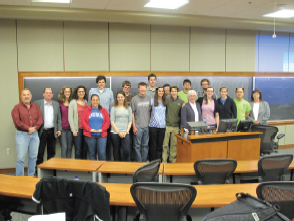
Program Description: The five components of the National Academy of Engineering (NAE) Grand Challenge Scholars Program are: (1) Project or independent research related to a Grand Challenge. (2) Interdisciplinary curriculum that prepares engineering students to work in domains of public policy, business, law, ethics, human behavior, risk, medicine, and the sciences. (3) Entrepreneurial experience that prepares students to translate invention to innovation. (4) Global dimension that enables students to lead innovation in a global economy. (5) Service learning experience that deepens the students’ motivation to bring their technical expertise to bear on societal problems. The Duke program educates engineering undergraduates to have the technical expertise, breadth of knowledge, and the social, ethical, and environmental awareness to successfully pursue leadership positions in addressing the NAE Grand Challenges for Engineering. This is accomplished by requiring each GC Scholar to propose and complete a five-component GC portfolio, and by completing a GC senior thesis. All undergraduate students in the Pratt School of Engineering at Duke are eligible to participate in the NAE GC Scholars Program, and are free to pursue affiliation with a broad array of programs at Duke University as long as it is endorsed by the GC Faculty Advisor and is approved by the GC Scholars Program Steering Committee. However, certain programs are more facile fits to the GC Scholars Program; consequently the majority of our GC scholars have affiliated with the following programs: Duke Engage Program, Pratt Fellows Program, Pratt Smart Home Fellows Program, Pratt Engineering World Health Program, Pratt Engineers Without Borders Program, and the Center for Entrepreneurship and Research Commercialization. Within the Pratt School of Engineering of Duke University, all departments have been represented in the Grand Challenge Scholars Program. These departments are Biomedical, Civil and Environmental, Electrical and Computer, Mechanical, and Materials Science.
Anticipated and Actual Outcomes: The goal of the first two years is to foster the early engagement of engineering undergraduates who may be interested in pursuing a Duke NAE Grand Challenge Scholars designation. It is recommended that interested underclassmen participate in GC-related curricular (course credit) or extra-curricular (no course credit) activities, and engage in organized and informal discussions with faculty and students involved in the GC Scholars Program. Students interested in receiving a Grand Challenge Scholar designation must submit a proposal to the Pratt GC Scholars Committee prior to Thanksgiving Break in the first semester of their junior year. The GC Scholars Steering Committee reviews proposals and successful candidates are notified early in the spring term. The proposed GC portfolio and written GC senior thesis both must be completed by the close of finals period prior to graduation. It is expected that senior GC scholars will present their work in Pratt GC-related activities to network with other scholars and to provide information to interested underclassmen. Senior GC scholars also should plan to attend the national GC Summit to present their work and to network with GC Scholars from other participating engineering schools.
Assessment Information: Each Scholar and Faculty Advisor formulate a Portfolio in which the student must show in-depth completion of a (1) research-based or project-based practicum and (2) an interdisciplinary curriculum composed of an engineering major and a series of at least two additional non-engineering courses, both specifically linked to one of the Grand Challenges. “In-depth” is defined as three or more regular semester classes, independent studies, or the equivalent. The student must also show medium or minimum depth completion of (1) an entrepreneurial component on the process of translating invention and innovation into market ventures that is thematically linked to one of the Grand Challenges, (2) completion of a global component that instills awareness of global marketing, economic, ethical, cross-cultural, and/or environmental concerns, and (3) a service-learning component that deepens social awareness and heightens motivation to develop practical solutions for society’s problems. “Medium-depth” is defined as at least one of the following: a practicum immersion experience or research activity that spans an 8-week summer or a regular semester, or one regular semester class or independent study. “Minimum-depth” is defined as a semester or less of extracurricular experience such as a volunteer activity, short course, workshop, seminar series, or conference.
Funding/Sustainability: Estimated funding for the first year of the program was $100,000. This includes budgets for the first two classes of Scholars. The Pratt School of Engineering and generous donors sponsored the initiation of the program. An endowment was secured from a generous donor, and additional foundation support has been secured for the program. The program is reviewed annually by the GC Scholars Steering Committee consisting of the directors of undergraduate studies in each of the four academic departments and the directors of Duke Engage Program, Pratt Fellows Program, Pratt Smart Home Fellows Program, Pratt Engineering World Health Program, Pratt Engineers Without Borders Program, and the Center for Entrepreneurship and Research Commercialization.

