
Bernard M. Gordon-MIT Engineering Leadership Program
Lead Institution: Massachusetts Institute of Technology, Cambridge, MA
Collaborating Institutions: Industry, Government, Penn State University, Tufts University, Northeastern University, University of California-San Diego, Rice University, Southern Methodist University, University of Florida, Iowa State University, University of Toronto, U.S. Naval Academy, and U.S. Air Force Academy
Category: Course/Curricular
Date Implemented: September 2008
Website: http://web.mit.edu/gordonelp

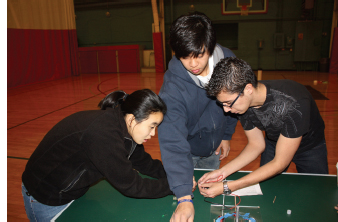
Program Description: The major objectives are to (1) educate and prepare future engineering leaders of innovation, invention, and implementation efforts, and (2) endeavor to transform engineering leadership in the nation, thereby significantly increasing its product development capability. The Gordon Engineering Leader program (GEL) links (a) immersive experiences on- and off-campus in which students practice, observe, and discuss engineering leadership with (b) courses that provide conceptual and analytical models and frameworks that support engineering leadership with (c) reflection, evaluation and feedback from faculty, peers, program alumni, and experienced engineering industry mentors on lessons learned from activities. Rising juniors and seniors apply for the GEL Year One (GEL1) program consisting of courses in engineering leadership and engineering innovation and design, hands-on engineering leadership labs and projects, mentorships, and a personal leadership development plan. Students who successfully complete GEL1 may apply for the more intensive GEL Year Two (GEL2) program of courses in project engineering and planning and human and organizational contexts, additional engineering leadership labs and projects, a substantial internship, additional mentoring and coaching, increased leadership roles, and a final presentation of their personal leadership development plan. GEL includes experiential learning opportunities for the development of leadership capabilities in weekly two-hour Engineering Leadership Laboratories (ELLs), set in an industry context, that provide practice and feedback on one or more of the capabilities of effective engineering leaders. Sophomores prepare for the program by participating in an introduction to engineering practice, an introductory internship, personalized coaching, reflective activities, and practice in interpersonal and career-enhancing skills. For non-GEL engineering undergraduates, we partner with departments and provide classes, materials, and activities to promote leadership capability development. The Program is also part of a collaboration of like-minded academic institutions that meet to discuss and implement strategies to advance the practical and pedagogical principles of engineering leadership and to share lessons learned and best practices. We also partner with industry to develop the leadership capabilities of early-career engineers by sharing materials and approaches, discussing the creation of workshops and professional courses, and including their engineers in courses, projects and labs, and as mentors.
Anticipated and Actual Outcomes: Expected student performance outcomes include increased proficiency in the 30 Capabilities of Effective Engineering Leaders, which are grouped as: Attitudes of leadership; Relating; Making sense of context; Visioning; and Delivering on the vision. Students are assessed weekly in the ELLs. In addition, GELs, through their Personal Leadership Development Plans, self-assess these outcomes, identify areas to improve, and create action plans to improve targeted areas. Although it is too early to judge the careers of our students, GEL students have received employment offers from companies impressed with their internship performance. Also, companies who have sponsored interns, in addition to requesting more interns, have become involved as mentors, ELL observers/evaluators, guest speakers, or contributors of authentic data/information to enhance the ELLs. On a survey of all graduating seniors, GELs had higher confidence in (1) making decisions given uncertainty and (2) recognizing when to stop improving a product and focus on implementation compared to non-GELs in engineering, and higher confidence than graduating seniors in the Sloan School of Management.
Assessment Information: Prior research on practice-based learning for development of engineering capabilities and self-efficacy in selection and pursuit of an engineering degree have guided the design of the curriculum and the emphasis that is placed on the experiential and real-world nature of the ELLs. Program success is noted by 90% of applicants citing strong recommendations from current students as the primary reason for applying. ELLs student leaders are evaluated, GELs perform self-assessments, self-reflections, and create plans for improvement of leadership capabilities, and GEL2s are required to create and present a portfolio of evidence of their capability development. Assessment of leadership self-efficacy included a pre-/post-test survey in 2010-2011; GELs rated their self-confidence that they could “Persuade a team to give up on an approach that at the moment only you see why it cannot succeed,” and “Help team members arguing for very different strategies arrive at a choice they can all support.” Confidence increased significantly for most statements, except the statement “Raise critical questions that reveal both strengths and weaknesses of a team member’s new idea,” resulting in revising the ELL on inquiry/dialoguing/advocacy.
Funding/Sustainability: Initial program funding was from the Bernard M. Gordon Foundation, with an overall pledge of $20M over 10 years and a requirement of matching funds to be raised by 2020. The matching and additional funds are being raised through fundraising, industrial grants, contracts and gifts, and a start-up contribution from the Dean of Engineering. It is anticipated that as the Program grows and achieves increased notice, it will receive additional donations from alums and companies who have hired graduates and will become self-sustaining from those donations and from endowment earnings.

