
The Vertically Integrated Projects (VIP) Program
Lead Institution: Georgia Institute of Technology, Atlanta, GA
Collaborating Institutions: Morehouse College, Purdue University, University of Strathclyde
Category: Curricular
Date Implemented: January 2009
Website: http://vip.gatech.edu, https://engineering.purdue.edu/vip, http://www.strath.ac.uk/viprojects

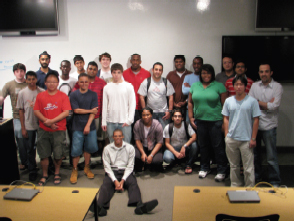
Program Description: The Vertically Integrated Projects (VIP) program is an undergraduate design program that operates in a research and development context. Undergraduates on VIP teams earn academic credit for their participation in design teams that create products based on ideas from faculty research. The teams are: Large – 10-20 students per team; Multidisciplinary – drawing students from around campus; Vertically Integrated – a mix of sophomores through seniors each semester; and Long Term – undergraduates may participate for up to 3 years. The products and systems the teams design and develop are of sufficient scale and complexity to be of significant benefit to the faculty mentors’ research effort. The size and vertically integrated nature of VIP teams function like a small engineering design firm. Students progress from “entry-level” positions at the sophomore year, during which they learn about the projects and technology from the more senior students. As juniors they apply what they learn in their courses and as new team members to the design of the project. As seniors they generally lead some aspect of the project and are mentored in technical and project management tasks by the graduate students and faculty. The program works well in any discipline and is especially well-suited to multidisciplinary efforts. The VIP program traces its origin to the Engineering Projects in Community Service (EPICS) Program. We observed some weaknesses in EPICS that led to the creation of VIP. EPICS has insufficient recognition of faculty effort as team advisors in the evaluation processes leading to pay increases and promotions, which can be overcome in part by focusing the teams on projects of benefit to faculty research efforts. In EPICS, some projects drawn from the community lack sufficient technical depth to challenge the students, which can be addressed by focusing the teams on design problems embedded in faculty research efforts. Finally, projects were limited to disciplines closely associated with community issues, which can be overcome by focusing on faculty-initiated projects. Companies support VIP with donations of funds or equipment. Partners/customers of VIP teams are typically the same as those associated with each faculty advisor’s research effort. Every discipline involved contributes its own expertise to the overall collaborative effort of each VIP team.
Anticipated and Actual Outcomes: We anticipated the formation of sophisticated collaborative networks within and between VIP teams and various groups of students and tracked and characterized the networks within and between the teams at Purdue and Georgia Tech. Results show students actively interact regarding both technical and managerial advice. The number of individuals with whom students interact has increased slightly as the program has grown. The E-I index (# of contacts outside group − # of contacts inside group)/(total contacts) shows increasing integration across gender, years, and teams. Students at Purdue were slightly more interactive across graduate and undergraduate student ranks. Students tended to develop 2-3 sources of advice. Graduate students are knowledge leaders and serve as the primary resources for the range of advice and assistance, but there is important peer exchange among undergraduates. The data show not only that advice-based ties flow across undergraduate and graduate students, but that the undergraduate students are also engaging across rank regarding technical and project management information and assistance. While it is expected that information should flow within each team, results showed that significant ties exist across teams at both institutions.
Assessment Information: The critical benchmarks are the number of faculty, graduate students and undergraduates involved, the number of disciplines involved, and the total number of teams. At GT, the ultimate goals include: at least 100 teams and a total enrollment each semester of 1500 or more students; at least one VIP team in each discipline; and full integration into the curriculum. Current goals include a uniform strategy across all engineering and computing disciplines for integrating senior design/capstone courses with VIP so that VIP is both the first true vehicle for multidisciplinary senior design and students can remain members of their VIP team while satisfying senior design requirements. We are currently proposing further research to correlate student performance, as measured by design notebook grades and peer evaluations, with centrality to the collaborative network within a student’s team.
Funding/Sustainability: At both Purdue and Georgia Tech, the start-up costs were roughly: 25% release time for the lead faculty member; support for a research staff member; a TA to help with course management, oversight of the VIP lab, administration of the design notebook process and the peer evaluation process; a room large enough for a meeting of 20 or more people; projector; a few desktop and laptop machines; and access to virtual servers. Funding was raised via NSF grants, the endowment income for Prof. Coyle’s Chair and Center, ECE and the College of Computing, and gifts from several companies and donors. At Georgia Tech, all funding is recurring. The College of Engineering recently approved a request for recurring funds for a Program Manager to assist with the administration and growth of the VIP Program. VIP is thus already sustainable over the long term. To assist with the continued expansion of the program, the VIP leadership of all schools will continue to collaborate on proposals to the National Science Foundation, foundations, corporations, and potential donors.

