
EPICS (Engineering Projects in Community Service) Program
Lead Institution: Purdue University, West Lafayette, IN
Collaborating Institutions: Industry and community partners (non-profit, government)
Category: Service Learning
Date Implemented: August 1995
Website: www.purdue.edu/epics

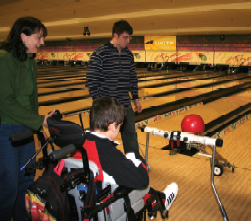
Program Description: Engineering Projects in Community Service (EPICS) is an engineering-based design program operating in a service-learning context. Students earn credit participating in multidisciplinary design teams that solve technology-based problems for local and global not-for-profit organizations. Students experience the entire design process to create products that work and are durable, easy to maintain, and accompanied by appropriate manuals and documentation. The curricular structure supports designs over several semesters and students may register for multiple semesters or years. Faculty, instructors, and industry volunteers are advisors while students lead large design teams and create and manage project plans, budgets, the design and development process, and the relationship with their community partner. Designs are reviewed through formal industrial design reviews and students must communicate frequently with a wide range of audiences. Vertical integration (first-year through senior students teamed together), provides built-in mentoring and continuity for projects spanning semesters. EPICS also has a lecture and workshop component with topics such as the design process, project management, leadership, ethics, and social context. Workshops offer students active learning experiences to develop skills to hone on the project team. Another EPICS objective was to share technical knowledge of the university with the community, which has been accomplished with over 300 diverse projects. The community context both offers opportunities for students to explore ethical and social context issues related to their designs and helps attract and retain students who are underrepresented in engineering. EPICS integrates cultural, disciplinary, and community perspectives in a way that illustrates the value of diversity. It was initiated based on industry feedback that real-life design projects with real users would produce better learning and professional preparation; since then, educational research has supported the principles and practices on which EPICS is based. EPICS disseminated the model to 20 universities and 50 high schools in the U.S. and 27 abroad and was awarded the NAE’s Gordon Prize in 2005.
Anticipated and Actual Outcomes: A multidisciplinary curriculum committee oversees the academic aspects of EPICS. The original intent was to provide the broad education needed for the practice of engineering, but with increasing participation of students from outside engineering, outcomes were adapted and adjusted to be inclusive. The current outcomes are: ability to apply disciplinary material to the design of community-based projects, understanding of design as a start-to-finish process, ability to identify and acquire new knowledge as part of the problem-solving/design process, awareness of the customer, ability to function on multidisciplinary teams and appreciate contributions from individuals from other disciplines, ability to communicate effectively with varying audiences, awareness of ethics and professional responsibility, and appreciation of social contexts. Over 5000 student self-reported evaluations indicate that more than 80% advanced in design process, communication skills, teamwork, and community awareness; more than 70% developed technical skills, resourcefulness, and organizational skills; and 68% developed ethical awareness. The most valuable skills learned were: teamwork (86%), communication (49%), organization (39%), technical (36%), and leadership (26%). Another analysis shows early participation increases engineering retention and 70% of students report increased motivation to stay in engineering.
Assessment Information: Students develop a portfolio of artifacts, including design notebooks, reports, and reflections, which are used to both determine grades and assess learning. Other analyses focus on understanding design, ethics, and communication and have shown that EPICS is developing these desired attributes. EPICS attracts more women than are represented in their respective majors. A qualitative research study included interviews with women in EPICS and found that, while the students thought the community context was important, the main reason they enrolled in EPICS was to gain engineering experience. Industry panels assess the design teams across an entire day and include comparisons across teams, which serves as an informal external evaluation of the overall program. Evaluations are also done by the community partners. Research efforts, including six PhD theses, have included fundamental research into the development of human-centered design skills, retention and motivation among diverse students, development of professional skills, ethical reasoning, and cross-disciplinary learning and communication. Research continues to inform the curriculum, principles, and practices and is used to develop and enhance EPICS.
Funding/Sustainability: Cost is approximately $1700 per student/year. The original 2-year FIPSE grant was $70,658 with a Purdue match of $210,936 for faculty release and TA support. In 1997, a three-year grant from Learn and Serve America was secured for $100,000/year with a one-for-one match. Cost sharing was used to leverage faculty time and TAs, but as EPICS proved its value all departments moved to direct support. The directors negotiated models of faculty teaching credit and TA allotments based on enrollments from their respective majors. Purdue contributes funds for administrative staff, and a staff person works with other universities to build a network of educators who collaborate and learn from experiences and research findings. The provost provides annual support. EPICS is in the College of Engineering and University budgets with instructional support proportional to enrollment. Corporate partnerships provide materials and supplies to provide designs at no cost to the community. Grants are solicited for large projects, special initiatives, and research activities, and a partnership with IEEE supported global expansion.

