
Keeping Up with Increasing Demands for
Electrochemical Energy Storage
JEFF SAKAMOTO
Michigan State University.
The interest in vehicle electrification is unprecedented. Several automotive manufacturers are producing or planning to produce hybrid electric vehicles (HEVs), plug-in hybrid electric vehicles (PHEVs), and fully or battery electric vehicles (BEVs). Lithium-ion (Li-ion) battery technology is the current leading candidate to meet the near-and medium-term needs for electric vehicles. Leveraging considerable growth and development from the manufacturing of batteries for microelectronics, Li-ion technology has advanced significantly in the last decade. However, the leap from small-scale microelectronic batteries (tens of watt hours) to electric vehicle battery packs (tens of kilowatt hours) is not trivial. Performance metrics such as cost/kilowatt hour, specific energy (Wh/kg), specific power (kW/kg), safety, and cycle life are considerably more demanding for electric vehicles than for laptops and cell phones. Electric vehicles (EVs) show promise in minimizing reliance on fossil fuels, but their widespread use will likely require a revolutionary advance in energy storage technology. Research in sophisticated and efficient power electronics, battery/cell telemetry, safety, thermal management, and schemes to recycle/reuse EV batteries can help to establish a solid foundation for the development and use of EVs. This article provides an overview of energy storage technology for vehicle electrification, highlights challenges, and discusses opportunities at the frontiers of battery research.
THE NEED FOR ADVANCED ENERGY STORAGE
In terms of sustainability, minimizing dependence on fossil fuels and reducing CO2 emissions are compelling arguments to electrify vehicles. And from a practical perspective, EVs can take advantage of existing infrastructure for elec-
trical power production and transport—infrastructure that will soon be bolstered by efforts to augment renewable energy production whose primary byproduct is electrical power (e.g., through photovoltaic cells and wind turbines).
If electrical energy becomes the preferred form of energy, electrochemical energy storage is a natural fit. In contrast, hydrogen fuel cell technology requires an entirely new infrastructure to efficiently produce hydrogen and then transport, store, and reconvert it to electrical energy.
To put into perspective the amount of energy consumed by the transportation sector, of the total 2.85 × 10¹⁶ watt-hours (1 Quad = 2.93 × 10¹⁴ watt-hours) of energy used by the United States in 2011 27.7% (7.91 × 10¹⁵ watt-hours) went to transportation (Figure 1).1 However, due to the relatively low chemical-to-mechanical energy conversion efficiency of internal combustion engine (ICE) technology, the ratio of serviceable to rejected energy is disproportionately low compared to other energy use sectors.
If EVs can improve energy efficiency in the short term and the technology for non-fossil-fuel-based/renewable electrical power generation can be realized in the long term, the benefits to our country’s current and future sustainability are clear. Assuming the latter, the following discussions focus on electrical energy storage, specifically batteries.
CHALLENGES FOR ELECTROCHEMICAL ENERGY STORAGE AND USE IN EVS
Defining the ideal battery for EVs is complicated because of the numerous powertrain configurations involved in HEVs, PHEVs, and BEVs; for example, the capacity (kWh), power (kW), and cycle life can be considerably different for an HEV compared to a BEV (Khaligh and Li 2010). To simplify discussion, this article focuses on BEVs with battery characteristics that can power a four-seat vehicle for approximately 100 miles on a single charge, criteria favorable for widespread adoption.2Figure 2 shows the necessary performance attributes of an effective EV battery.
Vehicle range is determined by the amount of energy stored in the battery and the rate at which the energy is expended to propel the vehicle. A 23 kWh battery used to power a ~70 kW electric motor is believed to be sufficient to achieve a range of about 160 km. The mass and volume of the battery should be minimized to reduce the vehicle mass while maximizing vehicle cabin volume, respectively.
__________
1These data and the accompanying figure are from the Lawrence Livermore National Laboratory website, https://flowcharts.llnl.gov/content/energy/energy_archive/energy_flow_2011/LLNLUSEnergy2011.png, accessed November 9, 2012.
2Whether this BEV performance standard is specifically required to significantly impact energy consumption is not yet known, but agencies and auto companies generally agree with this definition (Bruce et al. 2012; CCC 2012; Thackeray et al. 2012).
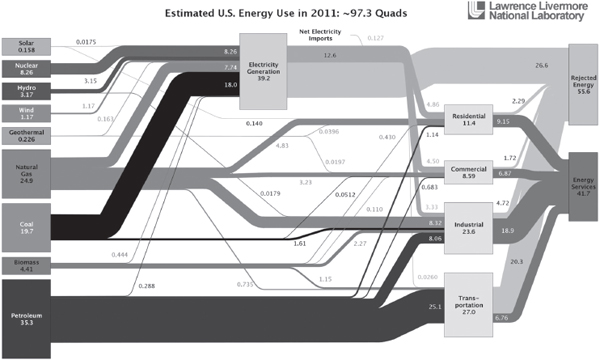
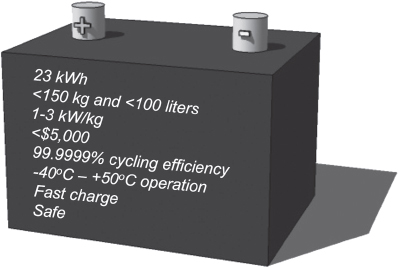
FIGURE 2 Battery performance criteria to power the next generation of battery electric vehicles.
Vehicle acceleration is determined by specific power (kW/kg) or how quickly the stored energy can be extracted per unit mass of battery. A common metric is in the single to multi-kW/kg range (e.g., 1–3 kW/kg).
Replacement of the ICE powertrain with an electric powertrain should not considerably add to the vehicle cost, and the cost of the battery pack should be less than $5,000.
Ensuring consistent, long-term vehicle range requires a charging efficiency of 99.9999% such that approximately 80% of the original battery capacity is available at the end of the vehicle’s life.
Widespread use of BEVs will entail operation in dramatically different climates, so the battery must be capable of operating at relatively low and high ambient temperatures.
Although it is difficult to quantify how fast is fast enough, the issue of range anxiety may be addressed if a battery pack can be charged at a charging station as quickly as a gasoline tank can be filled at a gas station.
Last, and perhaps most importantly, the battery technology must be safe and reliable.
LI-ION BATTERIES
Of the battery chemistries available today (Figure 3), Li-ion has the highest specific energy (Tarascon and Armand 2001) and is the only technology capable of meeting the criteria shown in Figure 2. While other energy storage technologies such as supercapacitors, flywheels, and compressed air are in development, only Li-ion batteries are mature enough or meet the necessary criteria or both (Dunn et al. 2011). Li-ion batteries also have the distinct advantage of both intrinsically high cell voltage (>3 V) and the capacity to store lithium ions in the solid state, resulting in high specific energy and low cell volume (energy density), respectively.
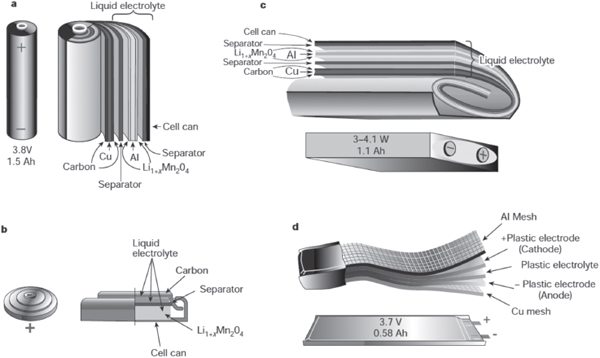
In a typical Li-ion cell (Figure 4), lithium ions are shuttled, with relatively high efficiency, between the anode and cathode via a liquid Li-ion electrolyte (EVSAE 2012). Graphite (in powder form) is by far the most common anode that reversibly uptakes and releases lithium ions between graphene sheets. The cathode consists of a ceramic of nominal formula LiMO2 (in powder form), where M stands for a transition metal such as cobalt (Co), manganese (Mn), or nickel (Ni) that can change valence states upon insertion/extraction of Li-ions. During
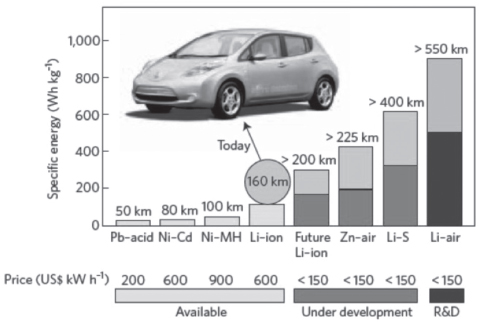
FIGURE 3 Comparison of battery technologies currently available and under development (Bruce et al. 2012). Darker shading in the bars indicates the specific energy values in laboratory-scale prototypes; lighter shading indicates the range of anticipated specific energy values for Li-S and Li-air technologies, respectively. Cd, cadmium; Li, lithium; MH, metal hydride; Ni, nickel; Pb, lead; Zn, zinc.
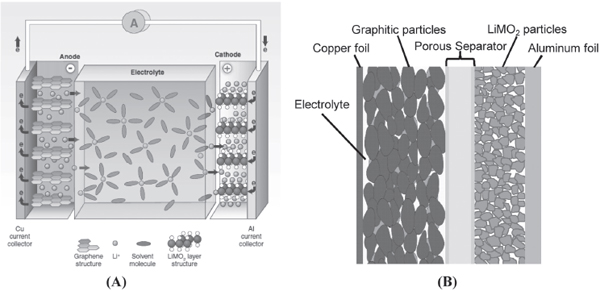
discharge, it is more energetically favorable for the graphite anode to release its Li-ions and for the cathode uptake Li-ions to reduce the M valence charge (e.g., M4+ to M3+). This shuttling of lithium ions from the anode to the cathode is accompanied by the simultaneous passing of electrons through an external circuit to power the electric vehicle.
Since their invention in 1991 by Sony and professor John B. Goodenough, Li-ion batteries have been integrated into cell phones, laptop computers, and other microelectronics (Figure 5). And some of the first Li-ion-powered EVs were not terrestrial but instead were vehicles sent to survey the surface of Mars in 2003 through NASA’s Mars Exploration Program (Huang et al. 2000). The Mars Exploration Rover Li-ion batteries started development in 1996 and were flight qualified and implemented in 2003, a testament to how quickly Li-ion battery technology can progress.
In 2008, a combination of factors led to a significant push to improve vehicle fuel efficiency, resulting in a rapid transformation of the auto industry with an emphasis on vehicle electrification. In 2011 GM rolled out the PHEV Volt and Nissan the BEV Leaf, and in 2012 Ford started selling the BEV Ford Focus.
These past and recent successes are impressive, but Li-ion battery packs still require considerable reductions in cost as well as increases in specific energy to extend vehicle range. The following section presents a materials perspective on opportunities in electrochemical energy storage and milestones whose achievement will address these issues.
OPPORTUNITIES IN ELECTROCHEMICAL ENERGY STORAGE
Unlike lead (Pb)-acid, nickel-cadmium (Ni-Cd), and nickel—metal hydride (Ni-MH) battery technologies, Li-ion technology performance has room for improvement, as shown in Figure 3. Advanced electrode and cell designs and electrode material breakthroughs (Thackeray et al. 2012) may enable a doubling in energy density and a fourfold reduction in cost compared to available Li-ion technology. Eventually, however, Li-ion technology improvements will crest, requiring a breakthrough in battery technology to approach the cost target (~$150/kWh) and the range of an ICE powertrain vehicle (>400 km).
Several research and government agency reports (e.g., Bruce et al. 2012; CCC 2012) present complementary near-term roadmaps to guide battery research and development over the next two decades. Three milestones extrapolated from these roadmaps illustrate the frontiers of battery development, with substantial steps in 2015 and 2020 followed by a revolutionary leap in 2030.
2015 MILESTONE: OPTIMIZE CURRENT MATERIALS
AND CELL COMPONENT DESIGN
In the short term the focus is on optimization of materials and conventional liquid electrolytes. At present, approximately 50% of a battery pack mass is dead weight (Johnson and White 1998). For example, in the cell cross-section shown in Figure 4b, only the graphite anode and LiMO2 particles store lithium and therefore energy; the electrical current—collecting foils, electrolyte, separator, and hermetic container do not store energy.
Increasing the mass/volume fraction of active material is one strategy to improve specific energy. Making thicker, less porous electrodes is a popular approach to achieve this, but thicker and less porous active electrode layers impede the transport of ions in the electrolyte and thus reduce power (Buqa et al. 2005).
Furthermore, the nonuniform current in thicker electrodes can cause metallic lithium to deposit on the anode and oxygen gas to be released from certain LiMO2 cathodes, which can be a safety hazard in the presence of heat and flammable electrolyte solvents. These challenges can be addressed through research on advanced electrode designs, powder processing, and coating technologies (DOE 2010).
Cycle life is another concern that requires attention. A passivation layer forms on the surface of a graphitic anode particle during the solid electrolyte interphase (SEI). As lithium intercalates and deintercalates from graphite particles, the corresponding swelling and contraction create fissures in the SEI, resulting in the continuous and irreversible consumption of lithium and diminishing capacity retention. Again, improved electrode designs to homogenize charge flow could address this concern, as could the development of new electrolytes and/or electrolyte additives to make the SEI more robust.
Economies of scale will probably not play a significant role in minimizing cost per kilowatt hour ($/kWh) (Bruce et al. 2012; CCC 2012) by 2015. Rather, new materials with appreciably better performance and lower cost are needed to bring costs down to the target of approximately $150/kWh.
2020 MILESTONE: ELECTRODE AND ELECTROLYTE
MATERIALS BREAKTHROUGHS
The 2020 milestone focuses on reducing cost rather than increasing specific energy, although it is hoped that the latter will increase by more than a factor of two. Once the electrode and cell design have been optimized, increases in the specific energy will require new electrode and complementary electrolyte materials that can store more lithium or charge-per-unit mass/volume and that have higher voltage (energy = amps × volts × time). If the new materials can be made at comparable or lower cost, a byproduct of increased specific energy will be a commensurate decrease in cost/kWh (Figure 3).
Alloying anodes such as silicon (Si)- or tin (Sn)-based electrodes will likely constitute the next generation of Li-ion battery anodes (Thackeray et al. 2012). The term “alloying” is used to describe the reversible, electrochemical reaction between lithium and a pure element such as silicon or tin.
Specific capacity (milliamp hours per gram, or mAh/g), which refers to the amount of lithium that an electrode can uptake and release, is commonly used where one mole (6.94 grams) of lithium can provide 26.8 Ah of electrical charge. Graphitic anodes have a theoretical specific capacity of 372 mAh/g, and silicon and tin have specific capacities of 4,009 and 960 mAh/g, respectively, making the interest in these anodes apparent.
However, a >300% change in volume accompanies the uptake and release of lithium from silicon and tin, creating significant mechanical stresses that cause decrepitation and poor cycle life (Deshpande et al. 2010). One solution is to reduce the powder particle size from the typical micron scale to the nano scale and thus decrease the magnitude of strain. Creating nano Si wires with <100 nm dimensions, originally demonstrated by the Cui group (Wu et al. 2012), reduces the overall strain to minimize decrepitation and improve cycle life. Another approach is to increase cycle life by embedding Si or Sn particles in an elastic or compliant carbon matrix to create an encapsulation effect (Zhao et al. 2011). Envia Systems recently announced a 400 Wh/kg Li-ion cell pack using Si-based anodes, but it has yet to be commercialized (Thackeray et al. 2012). Advanced materials processing and materials engineering could play a major role in optimizing alloying electrode performance and reducing cost.
On the cathode side, there are two promising approaches. First, the cathode system, a composite layered structure, enables the full extraction of one molecular unit of lithium, or x = 1 per formula unit of xLi2MnO3(1 – x)LiMO2 (M = Mn, Ni, Co) (Thackeray et al. 2012). This type of material, developed by Thackeray and colleagues at Argonne National Laboratory, can deliver nearly twice the specific capacity compared to conventional LiMO2 cathodes.
There are a few practical concerns associated with this material strategy, however. For example, the lithium must come from the anode (which is not the case with conventional LiMO2 cathodes) and the charging voltage (4.6 V) is outside the stability window of most conventional electrolytes, resulting in diminished cycle life.
The second approach involves increasing the cathode reaction voltage from about 4.0 V to approximately 5.0 V to result in a 20% increase in specific energy, provided the specific capacity is comparable to that of conventional cathodes. Examples of high-voltage cathodes include LiMn1.5Ni0.5O2 and LiMPO4 (M = Co, Ni) (Allen et al. 2011), both of which are relatively mature compared to the composite layered cathodes described above, but the lack of stable electrolytes limits their widespread implementation.
Higher cell voltage (cathode side) and a stable SEI (anode side) with advanced anodes both require significant improvements in electrolytes. One approach is
to integrate additives to conventional electrolytes to improve the high-voltage (cathode) stability. The Kang group achieved this by increasing the electrolyte stability to enable the use of LiCoPO4 (4.8 V) cathodes (von Cresce and Kang 2011). A completely different approach involves a solid electrolyte material breakthrough using a ceramic rather than liquid electrolyte. The advantages could include higher stability (0 to >6 V) and perhaps safety as a flammable liquid electrolyte is replaced by a highly thermal and chemically stable ceramic.
A class of ceramics referred to as “fast-ion conductors” conducts lithium ions about as fast as a conventional liquid electrolyte. Additionally, these ceramics have negligible electronic conductivity and the Li-ion conductivity improves with increasing temperature. Recent examples of promising solid electrolytes include sulfur (S)-based (Kamaya et al. 2011) and oxide-based electrolytes (Murugan et al. 2007; Rangasamy et al. 2011) that exhibit Li-ion conductivities comparable to conventional liquid electrolytes.
Next-generation Li-ion batteries will require new materials for anodes, cathodes, and electrolytes. Advanced materials and ceramic processing technology based on lessons learned from the 2015 milestone will play a key role in achieving the 2020 milestone. The development of new electrolyte materials, in particular, will advance progress toward the 2030 milestone of enabling new battery chemistry beyond Li-ion technology.
2030 MILESTONE: BEYOND LI-ION BATTERIES
If electric powertrains are to replace ICE technology, without raising concerns about cost or range, a new battery technology is required (Bruce et al. 2012). Three of the most popular battery chemistries that represent the frontier of energy storage are Li-S, Zn-air, and Li-air (the metal air batteries are actually semifuel cells, but for brevity and consistency they are referred to as batteries). Because the challenges related to Zn-air technology are relatively well known (Lee et al. 2011), the focus here is on Li-S and Li-air batteries, which are not as well understood.
Li-S is attractive because of its high theoretical energy density (2,199 Wh/l), high theoretical specific energy (2,567 Wh/kg), and the low cost and abundance of sulfur (Bruce et al. 2012). Factoring in the mass of the electrolyte, electrical current—collecting foils, packaging, and other features, the practical specific energy is reduced to approximately 600 Wh/kg, which is still considerably higher than that of advanced Li-ion batteries. In a Li-S cell, elemental lithium and sulfur are the reactants, a nonaqueous electrolyte shuttles lithium ions between electrodes, and, because sulfur does not have sufficient electrical conductivity, a specific porous carbon (Ji et al. 2009) is added to increase the effective electrical conductivity of the S-cathode.
Two challenges remain: (1) prevention of deleterious mechanisms that result from the formation of soluble Li-S compounds during cycling and (2) achievement
of a stable/cyclable Li-electrolyte interface, a challenge since the 1980s when it led to the demise of rechargeable lithium metal anode batteries.
Li-air batteries are of two types: nonaqueous and aqueous (Bruce et al. 2012); the “air” in question is the source of oxygen and, for the aqueous batteries, water vapor. Nonaqueous batteries involve the reaction of lithium with oxygen gas (O2) to form Li2O2. (The reference to “air” may be a bit misleading since both water vapor and carbon dioxide must be excluded from the reaction/ cell in the nonaqueous configuration.) During discharge, lithium is transported through a nonaqueous electrolyte and reacts with O2 in the presence of a porous carbon network and a catalyst to form solid precipitates of Li2O2. The theoretical energy density of this system is (3,436 Wh/l) and the theoretical specific energy is (3,505 Wh/kg). Some of the key challenges for nonaqueous Li-air batteries are (1) development of an oxygen-permeable membrane that excludes carbon dioxide and water vapor, (2) development of effective cathode electrodes that prevent pore occlusion resulting from the formation of solid byproducts during discharge, and (3) effective integration of catalysts to improve reaction kinetics.
In the second type of Li-air battery an aqueous electrolyte is used to transport lithium ions into a carbon cathode electrode to form lithium hydroxide (LiOH) during discharge. At lower concentrations LiOH is soluble in the electrolyte, whereas at higher concentrations (i.e., greater degrees of discharge) it precipitates out as a solid. The theoretical energy density of the aqueous variant is (2,234 Wh/l) and the theoretical specific energy is (3,582 Wh/kg). Some of the challenges that remain for aqueous Li-air technology are technologies to (1) protect the lithium metal anode from the aqueous electrolyte using a ceramic electrolyte membrane, (2) prevent reactions with carbon dioxide from ambient air, and (3) prevent pore and electrolyte interface occlusion when/if LiOH precipitates at higher depths of discharge. Although there are few examples of advanced prototypes, the projected specific energy for both Li-air variants is expected to be about 1,000 Wh/kg.
The majority of the challenges involve the discovery of new materials and development of an electrolyte to enable the use of metallic lithium anodes. The need for ceramic electrolytes that protect the lithium metal anode is one aspect common to Li-air and Li-S technology. In addition to poor cycle stability, excess lithium is required to counter the effects of poor cycling efficiency. For example, two- to fourfold excess lithium may be necessary, thus reducing the energy density. One recent material breakthrough (Murugan et al. 2007) identified a new class of ceramic oxide electrolyte that is believed to exhibit the unprecedented combination of stability against lithium with high, room-temperature ionic conductivity (Figure 6).
In addition to new electrolytes, advanced catalyst and catalyst support electrodes, similar to those found in fuel cells, are required to improve rechargeability and power.
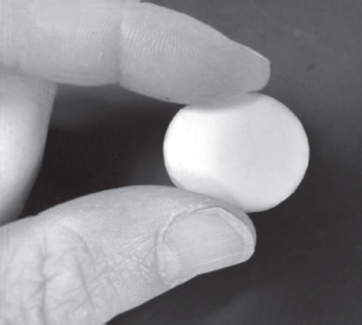
FIGURE 6 Ceramic electrolytes may enable the use of metallic lithium (Li) anodes. A new ceramic electrolyte referred to as LLZO (Li7La3Zr2O12) exhibits the unprecedented combination of high ionic conductivity and stability against metallic lithium and air. Shown above, a prototypical LLZO membrane fabricated in the Sakamoto lab using unique powder synthesis and sintering technology.
CONCLUSIONS
There is a compelling need for advanced electrochemical energy storage to power the next generation of electric vehicles. Furthermore, interest in Li-ion technology is on the rise, if growing attendance at the five-year-old annual symposium “Beyond Li-ion” is any evidence. But although Li-ion batteries offer substantial performance advantages over previous battery technologies, range capacity and cost are major challenges to overcome by 2015. Better electrode, cell, and pack design, together with advanced manufacturing and power electronics, will establish a solid foundation for future EV technology.
By 2020, material and electrolyte breakthroughs are expected to provide moderate improvements in BEV range—and dramatic reductions in cost. Anodes that are cheap (based on Si or Sn) are expected to uptake and release more lithium per unit mass. On the cathode side, the focus will be on increasing the voltage and lithium uptake and release per unit mass. Developing higher-stability liquid and solid electrolytes will complement higher-voltage cathodes and efforts to revolutionize energy storage in the long term (2030).
Provided the necessary electrical infrastructure is in place by 2030, a breakthrough in electrochemical energy storage is required if ICE technology is to be replaced by BEVs. Li-air or Li-S batteries may be the high specific energy, low-cost technology of the future, but significant materials and engineering challenges must first be overcome. Solving the lithium metal anode—electrolyte interface stability issue; developing novel catalyst/catalyst support cathodes; and creating stable, semipermeable solid electrolytes require further research and development if Li-air and Li-S technologies are to mature.
The frontiers of electrochemical energy storage are exciting from multiple perspectives, and are likely to generate significant engineering research and development opportunities in the coming decades.
REFERENCES
Allen J, Jow TR, Wolfenstine J. 2011. Improved cycle life of Fe-substituted LiCoPO4. Journal of Power Sources 196(20):8656–8661.
Bruce PG, Freunberger SA, Hardwick LJ, Tarascon JM. 2012. Li-O2 and Li-S batteries with high energy storage. Nature Materials 11:19–29.
Buqa H, Goers D, Holzapfel M, Spahr ME, Novak P. 2005. High rate capability of graphite negative electrodes in lithium-ion batteries. Journal of the Electrochemical Society 152(2):A474–A481.
CCC [Climate Change Committee]. 2012. Cost and performance of EV batteries. Cambridge UK: Element Energy Limited.
Deshpande R, Cheng YT, Verbrugge MW. 2010. Modeling diffusion-induced stress in nanowire electrode structures. Journal of Power Sources 195:5081–5088.
DOE [Department of Energy]. 2010. Energy storage R & D annual progress report. Washington.
Dunn B, Kamath H, Tarascon J-M. 2011. Electrical energy storage for the grid: A battery of choices. Science 334:928–935.
EVSAE [Society of Automotive Engineers International Vehicle Electrification]. 2012. Lithium in the limelight: Li-ion battery research heats up around the globe. June. Available online at www.nxtbook.com/nxtbooks/sae/12EVSD0626/index.php.
Huang CK, Sakamoto J, Wolfenstine J, Surampudi S. 2000. The limits of low-temperature performance of Li-ion cells. Journal of the Electrochemical Society 147:2893–2896.
Ji X, Lee KT, Nazar LF. 2009. A highly ordered nanostructured carbon-sulphur cathode for lithium-sulphur batteries. Nature Materials 8:500–506.
Johnson BA, White RE. 1998. Characterization of commercially available lithium-ion batteries. Journal of Power Sources 70:48–54.
Kamaya N, Homma K, Yamakawa Y, Hirayama M, Kanno R, Yonemura M, Kamiyama T, Kato Y, Hama S, Kawamoto K, Mitsui A. 2011. A lithium superionic conductor. Nature Materials (letters) 10:682–686.
Khaligh A, Li Z. 2010. Battery, ultracapacitor, fuel cell, and hybrid energy storage systems for electric, hybrid electric, fuel cell, and plug-in hybrid electric vehicles: State of the art. IEEE Transactions on Vehicular Technology 59(6):2806–2814.
Lee JS, Kim ST, Cao R, Choi N-S, Liu M, Lee KT, Cho J. 2011. Metal-air batteries with high energy density: Li-air versus Zn-air. Advanced Energy Materials 1:34–50.
Murugan R, Thangadurai V, Weppner W. 2007. Fast lithium ion conduction in garnet-type Li7La3Zr2O12. Angewandte Chemie International Edition 46:7778–7781.
Rangasamy E, Wolfenstine J, Sakamoto J. 2011. The role of Al and Li concentration on the formation of cubic garnet solid electrolyte of nominal composition Li7La3Zr2O12. Solid State Ionics 206:28–32.
Tarascon J-M, Armand M. 2001. Issues and challenges facing lithium batteries. Nature 414:359–367.
Thackeray MM, Wolverton C, Isaacs ED. 2012. Electrical energy storage for transportation: Approaching the limits of, and going beyond, lithium-ion batteries. Energy and Environmental Science 5:7854–7863.
von Cresce A, Kang X. 2011. Electrolyte additive in support of 5 V Li-Ion chemistry. Journal of the Electrochemical Society 158(3): A337–A342.
Wu H, Chan G, Choi JW, Ryu I, Yao Y, McDowell MT, Lee SW, Jackson A, Yang Y, Hu L, Cui Y. 2012. Stable cycling of double-walled silicon nanotube battery anodes through solid-electrolyte interphase control. Nature Nanotechnology (letters) 7:310–315.
Zhao X, Hayner CM, Kung MC, Kung HH. 2011. In-plane vacancy-enabled high-power Si-graphene composite electrode for lithium-ion batteries. Advanced Energy Materials 1(6):1079–1084.


