
Overview of Climate Engineering
ELI KINTISCSCH
Science Magazine
Massachusetts Institute of Technology
Top science institutions around the world, including the US National Academies and the UK Royal Society, have called for studies into deliberate tinkering with the planet’s climate or atmosphere to partially offset global warming, a practice known as climate engineering or geoengineering. Various characteristics distinguish the two major types of geoengineering: solar radiation management (SRM; e.g., orbiting sunshades, aerosols sprayed into the stratosphere) and carbon dioxide removal (CDR; e.g., carbon-sucking machines, catalysis of oceanic algal growth). The number of scientists studying both is steadily increasing, and several companies are conducting CDR engineering research, but the United States has yet to follow the lead of a number of European countries that have dedicated programs for geoengineering research.
Efforts at global carbon dioxide pollution abatement remain stalled even as the effects of a warming planet become increasingly apparent. Research findings suggest that the planet may be closer to global tipping points, such as the release of methane from permafrost, than previously thought. As the global climate crisis intensifies, taboos once held by scientists and policymakers are falling by the wayside. Adaptation, the organized response to a warming planet and its myriad local impacts, was once viewed by top officials as a distraction from the main priority of mitigating global greenhouse gas emissions. Now local and national governments around the world are creating plans to respond and adapt to warmer temperatures, higher seas, more pervasive drought, and other environmental challenges.
Geoengineering is a radical form of adaptation. The publication in 2006 of a controversial paper by Nobel Prize winner Paul Crutzen titled “Albedo Enhancement by Stratospheric Sulfur Injections: A Contribution to Resolve a Policy
Dilemma?” both jumpstarted the discussion of geoengineering and lent credibility to an idea that had until then existed largely in the shadows of academia.
Every serious researcher or policy expert who studies climate engineering, including Crutzen, believes that cutting greenhouse gas emissions is at least as important as developing geoengineering technologies, if not more urgent.
It is useful to consider abatement, carbon dioxide removal, and solar radiation management in proper context with one another. In Figure 1, each large circular element represents a process that drives the next step in the chain. The central items are interventions that mitigate the impact between two linked terms; for example, efficiency lowers the consumption of energy that results from consumption of goods and services. Three abatement steps—using less energy (“conservation”), using energy more efficiently (“efficiency”), and producing energy less carbon-
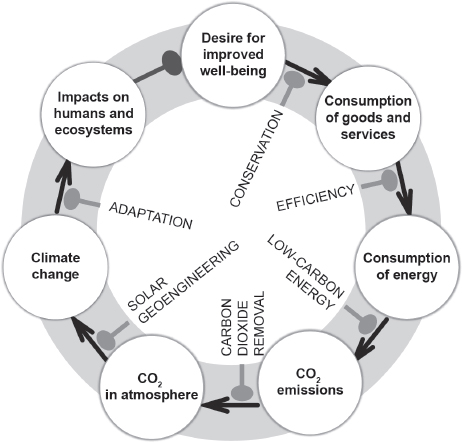
FIGURE 1 Connections among various factors in terms of the climate challenge. See text for discussion. The round-tipped “arrow” between the “impacts on human systems” and “desire for improved well-being” indicates that the former drives the latter. Reprinted with permission from Caldeira et al., 2013.
intensively (“low-carbon energy”)—can together lower global greenhouse gas emissions. Next are geoengineering options. The round-tipped “arrows” indicate a more tenuous relationship than the other links.
As shown in Figure 1, CDR goes a step further than abatement. By pulling gases out of the atmosphere it gets at the heart of the problem: if lowering emissions is akin to reducing one’s exposure to a virus that causes a fever, CDR is like using an antiviral medication. SRM is one step further still. It does not change the level of CO2 in the atmosphere but instead serves to reduce its climatic effects. Temperature is the most prominent of those effects, and SRM lowers the planet’s thermostat by directly reducing the amount of solar energy absorbed by the planet. Perhaps the metaphorical equivalent is using a cold compress to alleviate fever.
Both CDR and SRM techniques attempt to mimic natural processes that scientists mostly understand. But that is where their similarities end. In their technical aspects, the political dynamics that might govern their deployment, and their feasibility, the differences between them are stark. That’s one reason that many scientists try to avoid using the terms “geoengineering” or “climate engineering” to generalize between the two.
PLANETARY SUNBLOCK: SOLAR RADIATION MANAGEMENT
“Fast, cheap, imperfect and uncertain” is how Harvard physicist David Keith (2011), one of the leading thinkers on both methods, describes SRM. The most commonly explored technique for blocking sunlight from the planet is to mimic the natural cooling effect of volcanoes by spreading sulfurous particles in the stratosphere. The following paragraphs explain Keith’s characterization.
Fast: The 1991 eruption of the Mount Pinatubo volcano sprayed 5 million tons of sulfur aerosol into the stratosphere as sulfur dioxide, which scattered light away from Earth and cooled the planet by 0.5°C (Kravitz 2013). Modeling studies (e.g., Caldeira and Matthews 2007) suggest that if a similar quantity of sulfur aerosol were artificially injected into the stratosphere, the cooling could be essentially instantaneous.
Cheap: A recent study by an aerospace research firm suggests that the costs of deploying a global SRM scheme to offset anthropogenic warming “are comparable to the yearly operations of a small airline” (McClellan et al. 2010).
Imperfect: A number of modeling studies have suggested various side effects of this technique, including depriving the planet of solar energy that influences rainfall, leading to less precipitation (Ricke et al. 2010). This effect could disrupt the southeast Asian monsoon season or weather in South America, potentially exacerbating droughts.
Uncertain: Many aspects of the climate system are not fully understood, so tinkering with a fundamental variable that drives the system—the amount of solar energy entering it—may have serious unexpected or unintended consequences.
Since Crutzen’s landmark paper, research into SRM has evolved from proof-of-concept modeling into more sophisticated efforts. The Geoengineering Model Intercomparison Project (GeoMIP) involves 19 different global climate models. Each has run separate simulations with four standardized scenarios in which solar radiation management is deployed in different ways (Kravitz et al. 2011). Because different climate models employ different assumptions, characteristics, and physics, use of the same initial conditions, the thinking goes, may yield more robust results about the environmental effects of various SRM strategies. One example of the increasingly sophisticated modeling research on stratospheric aerosols is a recent study that found that sulfate aerosols deployed to offset warming caused by a doubling of CO2 concentrations would make the sky 3 to 5 times brighter—and less blue—than it is currently, which could affect photosynthesis in plants and people’s psychological moods (Kravitz et al. 2012).
In the United States, David Keith and Harvard colleague James Anderson, an atmospheric chemist, are planning “to develop in situ experiments to test the risk and efficacy of aerosols in the stratosphere” (Keith 2012).
The most visible effort to explore stratospheric approaches through actual experimentation is the Stratospheric Particle Injection for Climate Engineering (SPICE) project, led by Bristol University and supported by the British government at £1.6 million for 3½ years. Along with ongoing work to design particles and computer modeling, the project originally included a planned field experiment to spray 150 liters of water 1,000 meters in the air to test how a balloon would behave in the wind during spraying, a feasibility test. The field experiment was cancelled because of public concern about lack of regulations on SRM as well as worries over a patent application that one of the research participants had filed before receiving UK funds for the project (Watson 2012).
THINNING THE GREENHOUSE LAYER:
CARBON DIOXIDE REMOVAL
Scientists have proposed a variety of techniques for removing CO2 from the atmosphere. These range from engineering forests to be more carbonaceous, to growing massive algal blooms at sea, to sucking carbon dioxide out of the atmosphere.
Few credible scientists believe CDR techniques to be a panacea. The approach has attracted somewhat less attention and different kinds of controversy than SRM, which Keith (2011) calls “slow, expensive and effective,” as explained below.
Slow: Global yearly emissions of CO2 are 34 million cubic metric tons, resulting in an accumulation of 500 billion tons of anthropogenic CO2 in the atmosphere. Relying heavily on CDR as part of a climate response strategy means creating a massive industry—perhaps the biggest engineering project in human history—to steadily remove this mass of gas from the atmosphere one molecule at a time.
Expensive: A 2011 study by the American Physical Society concluded that collecting CO2 directly from the atmosphere “is not currently” economically viable despite “optimistic” technical assumptions (APS 2011). It estimated that the basic cost of a system that could be built today would be about $600/ton, an order of magnitude more than the estimate for low-carbon energy sources.
Effective: CDR methods build off commercial techniques that work in submarines and space shuttles to clean air of CO2 gas and promise fewer side effects than SRM methods.
A number of startups are focusing on different techniques for CDR. In 2007 Sir Richard Branson launched a $25 million contest called the Virgin Earth Challenge to encourage the development of technologies that “will result in the net removal of anthropogenic, atmospheric greenhouse gases each year for at least ten years without countervailing harmful effects.”1 The 11 contest finalists represent a decent survey of leading commercial entities in this area, including firms that propose to sequester carbon in biochar added to soil, to directly capture atmospheric CO2 through chemical methods, or to burn biofuels and sequester the resultant CO2 in the ground.
GEOENGINEERING RESEARCH POLICY AND
PUBLIC OPINION
Several European governments have supported organized programs to support climate engineering research. The United States has none. Studies on the governance of climate engineering approaches are being conducted by a coalition co-led by the UK Royal Society (SRM Governance Initiative), an Oxford University group on a two-year grant (Climate Geoengineering Governance project), and the European Transdisciplinary Assessment of Climate Engineering project, led by the Institute for Advanced Sustainability Science in Potsdam, Germany.
Meanwhile, work on the ethics of climate engineering has yielded, among other things, the so-called “Oxford Principles,” proposed to restrict research into SRM and CDR (Rayner et al. 2009). They include the following guidelines:
• That SRM be regulated as a public good
• That the public be involved in research related to SRM decisions, including field experiments
• That research plans and results be transparent and shared publicly
• That bodies independent of researchers studying climate engineering assess the environmental and socioeconomic impacts of research
• That decisions about deploying technology on a global scale be made only when “robust governance structures” to oversee such efforts are in place.
__________
1Virgin Earth Challenge announcement; posted online at www.virgin.com/subsites/virginearth/ (accessed July 28, 2012).
A number of expert panels (e.g., Long et al. 2011) have urged the United States to create a dedicated research program in this area. But although the National Science Foundation has supported a handful of studies on SRM, and funds from various agencies have supported work applicable to CDR approaches, there is no integrated, organized effort in the federal government.
Several studies exploring public opinion on climate engineering technologies have been published. In August 2011 Cardiff University released results of a quantitative public engagement research project involving about 35 people that met for a day and a half. “Very few people were unconditionally positive about either the idea of geoengineering or the proposed [SPICE] field test. However, most were willing to entertain the notion that the test as a research opportunity should be pursued” (Parkhill and Pidgeon 2011).
An Internet poll of 3,105 American, Canadian, and British individuals published in 2011 found that 8% and 45% of respondents, respectively, correctly defined the interchangeable terms “geoengineering” and “climate engineering” (Mercer et al. 2011). In the same survey, respondents were asked to rate statements from 1, for “strongly disagree,” to 4, for “strongly agree.” For the statement “If scientists find that Solar Radiation Management can reduce the impacts of global warming with minimal side effects, then I would support its use,” the average response was 3.01. The statement “Solar Radiation Management will help the planet more than it will hurt it” received an average response of 2.49. The results suggest that geoengineering could be viewed favorably by the public.
CONCLUSION
As the world’s population contends with the challenge of climate change, respected scientists will continue studying climate engineering as part of a suite of responses—the most important of which is the immediate curtailing of greenhouse gas emissions. For policymakers and researchers in this area, the following considerations will have to be taken into account: the need to address risks inherent to the two types of climate engineering through research despite a lack of dedicated funding for such work in the United States; the conduct of such studies, including possible field studies, in an ethical way; and ongoing, open debate on the study and use of climate engineering while mindful of public opinion, still nascent, on the prospect of deploying the technology.
REFERENCES
APS [American Physical Society]. 2011. Direct Air Capture of CO2 with Chemicals. A Technology Assessment for the APS Panel on Public Affairs. Available online at www.aps.org/policy/reports/assessments/upload/dac2011.pdf (accessed November 9, 2012).
Caldeira K, Matthews HD. 2007. Transient climate-carbon simulations of plantetary geoengineering. Proceedings of the National Academy of Sciences of the United States of America 104:9949–9954.
Caldeira K, Bala G, Cao L. 2013. The Science of Geoengineering. Annual Review of Earth and Planetary Sciences 41.
Crutzen PJ. 2006. Albedo enhancement by stratospheric sulfur injections: A contribution to resolve a policy dilemma? Climatic Change 77:211–221.
Keith D. 2011. Towards a Federal Research Program on Solar Radiation Management. Presentation at the American Meteorological Society. Washington DC, April 12. Available online at www.ametsoc.org/atmospolicy/climatebriefing/Keith.pdf (accessed August 5, 2012).
Keith D. 2012. “Can Geoengineering Save the World?” ScienceLive online chat, May 30. http://news.sciencemag.org/sciencenow/2012/05/live-chat-can-geoengineering-sav.html (accessed November 13, 2012).
Kravitz B. 2013. Climate engineering with stratospheric aerosols and associated engineering parameters. In Frontiers of Engineering 2012: Reports on Leading-Edge Engineering from the 2012 Symposium. Washington, DC: National Academies Press.
Kravitz B, Robock A, Boucher O, Schmidt H, Taylor KE, Stenchikov G, Schulz M. 2011. The Geo-engineering Model Intercomparison Project (GeoMIP). Atmospheric Science Letters 12:162–167. Kravitz B, MacMartin DG, Caldeira K. 2012. Geoengineering: Whiter skies? Geophysical Research Letters 39: L11801.
Long JCS, Rademaker S, Anderson JG, Benedick R, Caldeira K, Chaisson J, Goldson D, Hamburg SP, Keith DW, Lehman R, Lowy F, Morgan MG, Sarewitz D, Schelling TC, Shepherd JG, Victor DG, Welan D, Winickoff DE. 2011. Geoengineering: A National Strategic Plan for Research on the Potential Effectiveness, Feasibility, and Consequences of Climate Remediation Technologies. Washington: Bipartisan Policy Center.
Mercer AM, Keith DW, Sharp JD. 2011. Public understanding of solar radiation management. Environmental Research Letters 6:044006.
McClellan J, Sisco J, Suarez B, Keogh G. 2010. Geoengineering Cost Analysis: Final Report. Cambridge MA: Aurora Flight Sciences Corporation.
Parkhill KA, Pidgeon NF. 2011. Public engagement on geoengineering research: Preliminary report on the SPICE deliberative workshops. Technical Report. Understanding Risk Group Working Paper, 11-01. Cardiff University School of Psychology, Wales.
Rayner S, Redgwell C, Savulescu J, Pidgeon N, Kruger T. 2009. Memorandum on draft principles for the conduct of geoengineering research. UK House of Commons Science and Technology Committee enquiry into the Regulation of Geoengineering.
Ricke K, Morgan G, Allen M. 2010. Regional climate response to solar-radiation management. Nature Geoscience 3:8.
Watson M. 2012. Testbed news, May 16. Available online at http://thereluctantgeoengineer.blogspot.com/2012/05/testbed-news.html (accessed August 12, 2012).


