
2
STRUCTURAL LOADING CHARACTERISTICS
Among wind turbine failures, those associated with structural dynamics are most common. Stresses in the blades oscillate, particularly at connections of the blade with other components of the wind turbine, leading to fatigue failures. These failures are not adequately predictable based on the current state of the art. The reasons for this are (1) the inability of current methods to accurately characterize the loading, (2) inadequate response prediction methodology, and (3) a paucity of material test data at the high-cycle numbers.
In general, there are at least four ways to deal with fatigue-related problems in a structure:
-
improve the material characteristics so that the structure will sustain higher cyclic stresses,
-
lower the operating stress levels by altering the structural/ configuration design,
-
improve the manufacturing process so that quality variations are minimized, and
-
make the structure so inexpensive to manufacture and maintain that to periodically replace certain components is cost-effective.
This chapter concentrates on the second approach—a type of aeroelastic tailoring. Shirk et al. (1986) presented a definition for aeroelastic tailoring and suggested that it become the standard: ''Aeroelastic tailoring is the embodiment of directional stiffness into an aircraft structural design to control aeroelastic deformation, static or dynamic, in such a fashion as to affect the aerodynamic and structural performance of that aircraft in a beneficial way.'' They also pointed out that parallels exist between aeroelastic tailoring and active control methodology. Although active control focuses primarily on the control law, there is nothing to prevent the structure from being modified to assist the active controller in its task. Similarly, even in the absence of an external energy source, aeroelastic tailoring itself uses a form of control law to modify the behavior of a structure.
In addition to being a form of passive control, structural tailoring provides a method to optimize the performance of actively controlled structures. Shirk et al. (1986) also mentioned that the effective integration of active controls and structural stiffness is another area of potential reward. The aeroelastic benefits derived from deformation control due to structural tailoring and the movement of actively controlled surfaces each have limits. They suggested that the synergistic effect derived by the optimum interaction of each be explored. Issues of controllability and observability of aircraft dynamics are strongly influenced by the flexibility of the structure. Also, simultaneous optimization of control gains and structural properties often becomes prohibitively expensive for large degrees of freedom, and physical insight is often lost in the resulting control law.
Belvin and Park (1988) undertook a pioneering study along this direction. They presented a method for optimization of closed-loop structural systems, using such structural tailoring schemes as tailoring the thickness to maximize the model stiffness of selected modes. Results were obtained for some simple structures, including a beam and a truss beam, showing the
importance of structural tailoring to increase dynamic performance and to reduce the control effort.
Armanios et al. (1990) explored the benefits of tailoring the macro- as well as the micro-structure; that is, they examined altering ply stacking sequence, fiber orientation, and blend of material plies, to contain and resist damage in flexible structures. One of their purposes was to demonstrate that damage tolerance can be designed into a structure. It was shown that for a generic damaged ply model, which includes microcracking, delamination, and fiber fracture and their interaction, damage modes alter the stillnesses of the structural component at the damage site. Therefore, redistribution of local stiffnesses could be used to enhance toughness.
Rehfield and Atilgan (1987) showed that in closed-cell blades additional couplings arise, other than those designed in, which must be accounted for. These "parasitic" couplings are extension shear (accompanies bending twist) and bending shear (accompanies extension twist). With these additional couplings the analysis will predict structural stillnesses smaller (more flexible) than without them.
In light of the above, structural, elastic, and aeroelastic tailoring concepts are promising for active/passive control of flexible structures. Therefore, development of an interdisciplinary analysis methodology for design, optimization, and control of structures would be useful. Haftka and Kamat (1989) developed an approach for simultaneous nonlinear analysis and optimization of structures. This starting analysis shows how integrated interdisciplinary approaches can lead to more understanding as well as computational benefits.
Various wind turbine configurations have been studied and tried, such as horizontal axis wind turbines (HAWTs) versus vertical axis wind turbines (VAWTs), stall- versus pitch-controlled turbines, fixed- versus free-yaw turbines, up- versus down-wind rotors, constant versus variable rpm, high-solidity slow running versus low-solidity fast running, stiff versus flexible, and different manners of overspeed protection. No doubt there are other configurations not yet tried (Watson, 1989) or even conceived. A few attempts have been made to study the gains that could be made by elastic tailoring (e.g., Karaolis et al., 1987). These studies did not lead, however, to significant changes in the way wind turbines are designed.
There are many questions to be answered concerning the design of wind turbines. Cost is one of the primary considerations. Some very inexpensive methods for building blades exist, but will they produce practical blades as far as performance is concerned? For example, it is known that pultrusion can produce blades at a fraction of the cost of present blades. One restriction of such blades, however, is that they must be spanwise uniform. Given the present structural design of HAWTs (i.e., without elastic coupling), this is known to be an energy-inefficient design for aerodynamic reasons. No research has been done, however, to indicate whether such losses could be compensated for by elastic tailoring, thus making pultrusion a practical manufacturing technique. The position of the committee is that the impact of future research on modeling and the design process will be negligible unless configuration, aerodynamic structural design, and materials properties issues are considered together.
LOAD CHARACTERIZATION
To successfully design a wind turbine blade structure, it is necessary that a representative model of the system loads be developed. While not necessarily being able to accurately predict these loads, this model should predict realistic peak-to-peak stress levels and oscillatory frequencies. The mechanisms for these stress reversals are reasonably well understood. Blades are exposed to relatively high levels of turbulence and random gusts in the air and, in some configurations, tower shadow effects. These, along with steady and quasi-periodic aerodynamic loads due to steady components of wind and vertical wind shear, coupled with steady centrifugal forces and periodic gravitational forces (in HAWTs) from the rotation create distributed loads along the blades. These distributed loads, in turn, have steady, periodic, and random components.
The steady, periodic, random loads lead to static and dynamic deformations of the blades; these deformations also consist of steady, periodic, and random components. All these distributed spanwise loads lead to oscillating stresses in the blades, which vary spanwise and over each cross section. Because of the strong influence of aerodynamics and structural dynamics on the internal loads, this problem is very much interdisciplinary. One cannot choose a material for these machines "out of context" (i.e., without considering the aeroelastic aspects of the problem). For additional discussion of the load characterization, see de Vries (1979).
BLADE FAILURE EXPERIENCE
At the blade root, the oscillating stresses are passed into the rotor hub and certain harmonics are passed through the shaft into the tower. Many failures involve the connecting structure between the blade and the hub. Others involve failures of the steel connectors between the main part of the blade and the bearing, which allows for pitching of the outboard section in stall-controlled machines. Still others involve subassembly joints in the main blade component and chordwise cracking of the blade shell.
In order to put blade failure experience in perspective, it should be noted that the preponderance of such failures have occurred at joints and other discontinuities in the rotor structure. There is a category of blade designs and type that has experienced a high failure rate principally due to defects in manufacture and design. Other manufacturers of blades, however, have not experienced these failures. At present the oldest blades have been in service for about 8 years. Because of a lack of knowledge of fatigue properties and performance at large numbers of cycles, it is expected that these blades will be replaced after about 10 years of service--far short of their design life of 30 years.
As a side note, relative advantages and disadvantages of pitch-controlled versus stall-controlled wind turbine designs are not well understood. While this is not a materials issue, per se, such configuration parameters do influence the structural design, which is, in turn, closely coupled to the material selection. For example, U.S. Windpower blades are of the pitch-controlled variety and have exhibited relatively high reliability based on in-field operations. While all the factors influencing reliability are not clear, configuration will certainly have an impact. A similar statement can be made concerning HAWT versus VAWT configurations. VAWT blades have some advantages concerning loads since they are not subject to once-per-revolution gravitational stress reversals. They do, however, experience a once-per-revolution aerodynamic loading reversal. Considering all the aspects of design, however, one cannot rule out any of the well-known configurations at this time.
High-cycle fatigue is not as serious a problem for most applications in the aerospace industry as it is for helicopters. Some of the same problems in helicopters are also present in wind turbines. Part of the fatigue problem with wind turbine rotors is manifested as leading and trailing edge cracks that form as the blades undergo continual use. Research has shown that, because early design efforts focused almost entirely on blade flapping moments and gave inadequate attention to inplane (chordwise or lead-lag) moments, these cracks were not anticipated (Conover and Young, 1989). Although poor quality control is a factor in the development of these cracks, it would appear that design procedures that do not take all necessary aspects into account are major contributors. Indeed, extant response codes (such as FLAP [Wright et al., 1988]) provide neither in-plane bending nor torsional contributions to the stress prediction. With composite blades, which typically have three-dimensional stress fields, this is far from adequate.
LESSONS FROM HELICOPTER EXPERIENCE
The helicopter industry has taken a rather conservative approach to changing the structural and configuration design of the rotor/hub (by this we
refer to the inboard section of the blade, the blade/hub attachment and pitch-control hardware, and the hub itself). Conventional articulated helicopter rotor configurations have flap and lead-lag hinges and pitch bearings. They also require auxiliary mechanical dampers to dissipate energy from ground resonance mechanical instability. Serious talk of so-called hingeless and bearingless rotors began about 25 years ago, along with hopes of eliminating the mechanical dampers. The actual development and use of such rotors, however, has been slow in coming. Nevertheless, the relatively clean bearingless rotor designs that are now being adopted are very different from the conventional articulated rotor designs of 10 to 20 years ago. The weight, parts count, and drag of the rotor/hub have been significantly reduced. On many systems the mechanical dampers have been replaced by elastomeric restraints. The number of components that have to be replaced periodically has been reduced, and the performance and flying qualities of the newer rotorcraft are better (Ormiston et al., 1988). The new designs did not come without cost, however, and any significant change in the way wind turbines are designed will likely require years of research.
Helicopter rotor blades spin at a relatively high angular speed and, although flexible, are effectively stiffened by centrifugal forces. Because of the free rotation in flap and lead-lag directions at the root in articulated rotors, a large component of their motion is as a rigid body. Loads in these configurations are transferred through the hub into the fuselage primarily as shear forces at the roots of the blades. Blade aeroelastic instabilities can be avoided by properly placing the axis of mass centers of the blade. The analyses of 20 years ago used in designing these blades were, for the most part, linear.
When hingeless and bearingless helicopter rotors began to be designed, many new problems surfaced. First, the loads and vibration problems multiplied because of the nonnegligible hub moments. Second, a number of newly observed and sometimes catastrophic instabilities surfaced that had to be avoided. Because of the possibility of these instabilities, the process of designing the blades became more complicated. In fact, to accurately predict the behavior of such a rotor blade, highly sophisticated structural analyses are required. This is due to a number of factors:
-
Effectively cantilevering the blade root into the hub brings root stresses into the boundary value problem that governs the blade deformation. When combined with already strong axial and lateral loads, these stresses make the problem geometrically nonlinear. Conventional rotor analyses were linear. Early hingeless (not necessarily bearingless) rotor analyses were nonlinear, although they allowed only for moderate rotations due to deformation. The nonlinearity implies that even the linearized structural dynamics or aeroelasticity analysis (typically carried out in terms of assumed modes) must be conducted relative to a deformed state. This state can only be determined from a nonlinear analysis.
-
In order to control the blade's pitch and reduce the root stresses, a portion of the blade near the root must be very flexible. Because of the wide range of pitch angles through which the outboard portion of the blade must be rotated, rotations of the inboard portion due to deformation may be large. That is, a moderate rotation analysis may not be adequate. This also implies that even the types of assumed modes needed for rapid convergence may be functions of the deformed state of the blade--greatly complicating the analysis.
-
The hardware necessary to control the blade pitch introduces additional load paths (see Figure 5-3). These load paths render the structure statically indeterminate and disallow certain simplifications that can be made in a determinate structure.
In addition to these complications, one must also account for the use of composite materials in modern blades. This entails several more aspects of the analysis that must be upgraded. Most blade models are beams of the classical type in which transverse shear deformation is assumed to be
negligible. It is well known that shear deformation must be accounted for in composite blades.
Also, with blades made of isotropic materials, simple engineering beam theories will usually suffice in the determination of beam stiffness. Except for torsional stiffness, the stiffness constants are simply integrals of modulus-weighted geometric quantities over the cross section. The reader is reminded that these integrals fall out from St. -Venant (interior) elasticity solutions for the beam that implicitly include the effects of sectional deformation (warping) in and out of the cross-section plane. When shear deformation is included, solution of the flexure problem of St. -Venant is required. This problem is of the same order of difficulty as the St. -Venant torsional problem, and both require some sort of computer solution for irregular-section geometries.
When we generalize this to beams made from anisotropic materials, all of the stiffness constants depend on the in- and out-of-plane warping in complicated ways; and, in order to determine the equivalent-beam elastic constants, it is necessary to solve the St. -Venant (interior) problem for in-and out-of-plane warping with the recognition that these warping displacements are coupled. Only for single-celled, thin-walled sections can this be done with sufficient accuracy without a computer. For further discussion of this, see Giavotto et al. (1983) and Atilgan and Hodges (1990). This implies that in order to analyze composite blades, it is necessary to undertake two separate analyses: one to get the section properties and one to use them in a response analysis. In addition, if stresses over the blade section are desired, additional information concerning the stress distribution for the applicable types of loading may need to be derived. See Figure 2-1.
There are a variety of computer-based blade analysis methods in existence that are applicable to the wind turbine problem (Table 2-1). (See, for example, Rehfield, 1985 [analytical]; Bauchau, 1985; Kosmatka, 1986; Borri and Merlini, 1986; Wörndle, 1982, and Giavotto et al., 1983 [two-dimensional or quasi-three-dimensional]; and Lee and Stemple, 1987 [three-dimensional]). The quasi-three-dimensional methods are solved by discretization of the cross-
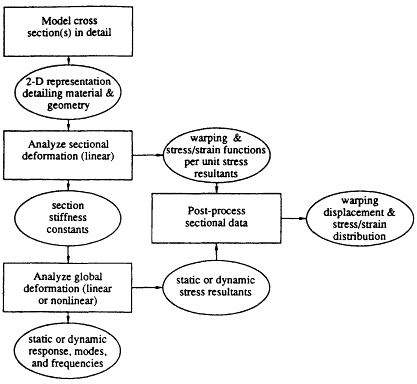
Figure 2-1
Process necessary to analyze composite blades.
TABLE 2-1 Blade Sectional Analysis Codes
|
Principal Investigator(s) |
Name of Code |
Restrictions |
Country of Origin |
Analysis Type |
|
Bauchau |
- |
no in-plane warping; thin-walled |
U.S. |
2-D finite element (quasi-3-D) |
|
Giavotto, Borri, et al. |
ANBA |
no restrained warping |
Italy |
2-D finite element (quasi-3-D) |
|
Kosmatka |
- |
uniaxial stress field; no restrained warping |
U.S. |
2-D finite element |
|
Lee |
- |
no in-plane warping; simple-section geometry |
U.S. |
3-D finite element |
|
Rehfield/Nixon |
TAIL |
no in-plane warping; thin-walled; uniaxial stress |
U.S. |
analytical |
|
Wörndle |
- |
uniaxial stress field; no restrained warping |
Germany |
2-D finite element |
section plane by finite elements in order to obtain the properties. (The term quasi-three-dimensional indicates that the axial coordinate is handled analytically.) They are far more efficient than a three-dimensional finite element model would be. Unfortunately, however, most of these methods do not treat all aspects of the problem, and some of these methods are too complex for a personal computer (PC).
Rehfield's method, the simplest of these methods, was programmed for a PC by Mark Nixon (NASA, Langley). Although Rehfield's analysis takes restrained warping into account, Nixon's code does not. Explicit treatment of in-plane warping (Poisson contraction and anticlastic deformation) is circumvented by the uniaxial stress assumption. However, Rehfield does not consider initial twist and curvature, which are important for wind turbines. Also, the shear stiffnesses obtained by this code are not sufficiently accurate because of the neglect of out-of-plane St. -Venant flexural warping.
Bauchau, Kosmatka, Lee, and Wörndle have codes that are more general than Nixon's, but they are also considerably more complex. The committee knows of no industrial users of Kosmatka's and Lee's codes in the United States. Wörndle's code was developed in Germany and, although it is used by the German helicopter company Deutsche Aerospace (previously MBB), the committee knows of no users in the United States. Bauchau's code is used in the U.S. helicopter industry. It accounts for restrained warping and initial twist and curvature. It is restricted, however, to the thin-walled case and yields results that are comparable to those of Rehfield's analysis (Bauchau et al., 1987).
The code of Giavotto et al. (1983) (called ANBA) was developed in Italy. Although it is the most powerful of all these codes, it does not account for
restrained warping (probably not an important limitation for wind turbine blade sections). It is also considerably more computationally intensive than the others, requiring 20 minutes of CPU time (for large problems) on a MAC II running A/UX. It is commercially available in the United States. While it is evident that there are PC-based tools for determining blade elastic constants, to date there are no codes that incorporate the beam elastic constants into a fully coupled aeroelastic response code for wind turbine blades. The distinction here is very important, and both the determination and the incorporation must be compatible in kinematical and geometrical assumptions (e.g., if pretwist is to be taken into account, then both the sectional and response analyses must include its effects). For additional references on the subject of composite blade modeling, see Hodges (1990).
These couplings are very important in the response analysis. Modern fixed-wing aircraft designs have made use of the properties of composites to tailor the structure so that certain performance or stability criteria are met or enhanced. An example of this is the X-29 forward swept wing aircraft. Without composites, design of this airplane would not have been possible (see Shirk et al., 1986, for a review of tailoring). With both helicopter and tilt-rotor blades, various investigators have proposed these types of passive tailoring schemes to increase stability margins, decrease weight, avoid high stresses in some localities, and increase efficiency.
The chief mechanisms for tailoring in these contexts are couplings between bending and twist deformation modes and between extension and twist deformation modes. For example, Ormiston et al. (1976) incorporated two coupling parameters in a rotor blade, one of which is equivalent to a bending-twist coupling and the other to an elastic coupling between the flap and lead-lag directions. They showed that one could then passively extract some of the damping coming from the air that is naturally present in the heavily damped flap mode and put it where it is needed--in the otherwise weakly damped lead-lag mode. Theoretical and experimental work indicated that the lead-lag damping could be increased by an order of magnitude without noticeably affecting the flap damping.
Current wind turbine rotor blades are quite stiff and heavy relative to helicopter blades. Part of the reason for this is to prevent tower strikes. Given that wind turbine rotors must carry large edgewise gravity bending moments, which argues for using their large planform dimensions to actively carry those moments, it may be that hinges are the most practical way to get large pitch effects with such large and stiff rotor structures. Flap bending/twist coupling could provide small outboard blade angle changes to help a constant-rpm machine retain optimum efficiency over the low wind range, but variable rpm provides a much more effective and versatile way of doing this, and it is on the near horizon. Using extension-twist coupling to provide overspeed limitation for fixed-pitch rotors may be the most potent near-term use of elastic tailoring, as it could simplify rotor construction while removing a lot of rotor cost and also be much more reliable than current mechanical latch mechanisms.
Determining whether wind turbine blades can be made lighter, less expensive, with lower loads (i.e., with longer life), with performance equal to or better than present blades, and free from instabilities should be the goal of any basic and applied research directed toward the wind turbine problem. Whatever elastic tailoring schemes are proposed, however, must not compromise on total (manufacturing, installation, and maintenance) cost per year of life. In order to speed up the incorporation of these technologies (along with active control as appropriate), the designer must have access to computational tools. If active control is to be considered for achieving these gains (see Chapter 6), the control design should be undertaken in combination with the passive measures.
RECOMMENDATIONS
The following areas are recommended for future research:
-
Simple cross-sectional analyses and codes need to be developed for determination of the sectional elastic constants. To accomplish this in an accurate and computationally efficient manner will require additional research. The resulting tools may likely be in the spirit of Rehfield/Nixon but with additional wind turbine parameters included, such as initial curvature, initial twist, and taper and with additional attention given to obtaining shear stiffnesses more accurately and accounting for restrained warping. Although ANBA, for example, already deals with all these effects, a Rehfield/Nixon-type code has the advantage of requiring very little CPU time on a PC. Bauchau's code may already meet most of these requirements; what is unknown to the committee is the level of complexity and PC CPU time that the wind turbine industry will deem simple enough.
-
Aeroelastic response analyses need to be developed for the wind turbine problem that incorporate the appropriate types of elastic coupling derived in the analyses mentioned above for the first recommendation. These could be simple modal analyses making use of a few natural modes and a few perturbation modes as described by Bauchau and Liu (1989). (Note that modal analyses and finite element analyses are not mutually exclusive. Modal analyses can be based on finite element models.) The code need only contain a representative model of aerodynamics used to characterize the load spectrum for design purposes. Obtaining this type of aerodynamic model is vital. This itself would also require additional research.
-
Formal optimization procedures need to be employed in the systematic investigation of the effects of certain aerodynamic, configuration, structural, and control parameters on the overall design. This will require the development of complete simulation tools that are compatible with formal optimization.
REFERENCES AND BIBLIOGRAPHY
Armanios, E. A., L. W. Rehfield, and F. Weinstein. 1990. Understanding and Predicting Sublaminate Damage Mechanisms in Composite Structures. Composite Materials: Testing and Design, ed. by S. P. Garbo, ASTM STP 1059, American Society for Testing and Materials, Philadelphia, pp. 231-249.
Atilgan, A. R., and D. H. Hodges. 1990. A Unified Nonlinear Analysis for Nonhomogeneous Anisotropic Beams with Closed Cross Sections. AIAA Journal, submitted for publication.
Bauchau, O. A. 1985. A Beam Theory for Anisotropic Materials. Journal of Applied Mechanics, Vol. 52, pp. 416-422.
Bauchau, O. A., and C. H. Hong. 1987. Finite Element Approach to Rotor Blade Modeling. Journal of the American Helicopter Society, Vol. 32, No. 1, pp. 60-67.
Bauchau, O. A., B. S. Coffenberry, and L. W. Rehfield. 1987. Composite Box Beam Analysis: Theory and Experiments. Journal of Reinforced Plastics and Composites, Vol. 6, pp. 25-35.
Bauchau, O. A., and S. P. Liu. 1989. Finite Element Based Modal Analysis of Helicopter Rotor Blades. Vertica. Vol. 13, pp. 197-206.
Belvin, K. W., and K. C. Park. 1988. Structural Tailoring and Feedback Control Synthesis: An Interdisciplinary Approach. In Proceedings of the 29th Structures, Structural Dynamics, and Materials Conference. AIAA Paper No. 88-2206, Williamsburg, Virginia, pp. 1-8.
Borri, M., and P. Mantegazza. 1985. Some Contributions on Structural and Dynamic Modeling of Rotor Blades. l'Aerotecnica Missili e Spazio, Vol. 64, No. 9, pp. 143-154.
Borri, M., and T. Merlini. 1986. A Large Displacement Formulation for Anisotropic Beam Analysis. Meccanica, Vol. 21, pp. 30-37.
Conover, K., and J. Young. 1989. Experiences with Commercial Wind Turbine Design. EPRI GS-6245, Vol. 1, April, pp. 3-37 - 3-38.
de Vries, O. 1979. Fluid Dynamic Aspects of Wind Energy Conversion. AGARDAG-243.
Eggleston, D. M., and F. S. Stoddard. 1987. Wind Turbine Engineering Design. Van Nostrand Reinhold, New York. Chapters 4, 10, and 12.
Giavotto, V., M. Borri, P. Mantegazza, G. Ghiringhelli, V. Carmaschi, G. C. Maffioli, and F. Mussi. 1983. Anisotropic Beam Theory and Applications. Computers and Structures. Vol. 16, pp. 403-413.
Gewehr, H. W. 1980. Development of Composite Blades for Large Wind Turbines. 3rd International Symposium on Wind Energy Systems, Denmark.
Haftka, R. T., and M. P. Kamat. 1989. Simultaneous Nonlinear Structural Analysis and Design. Computational Mechanics, Vol. 4, No. 4, pp. 409-416.
Hodges, D. H. 1990. A Review of Composite Rotor Blade Modeling. AIAA Journal, March, Vol. 28, No. 3, pp. 561-565.
Hodges, R. V., M. W. Nixon, and L. W. Rehfield. 1987. Comparison of Composite Rotor Blade Models: A Coupled-Beam Analysis and an MSC/NASTRAN Finite-Element Model. NASA TM 89024, NASA.
Karaolis, N. M., P. J. Musgrove, and G. Jeronimidis. 1987. Passive Aerodynamic Control Using Composite Blades. Proceedings of Workshop on the Use of Composite Materials for Wind Turbines. ETSU-N-109, Harwell, England, November 4, pp. 71-101.
Kosmatka, J. B. 1986. Structural Dynamic Modeling of Advanced Composite Propellors by the Finite Element Method. Ph.D. dissertation, University of California, Los Angeles.
Lee, S. W., and A. D. Stemple. 1987. A Finite Element Model for Composite Beams with Arbitrary Cross-Sectional Warping. Proceedings of the 28th Structures, Structural Dynamics and Materials Conference. AIAA Paper No. 87-0773, Monterey, California, April 6-8, pp. 304-313.
Ormiston, R. A., W. G. Bousman, D. H. Hodges, and D. A. Peters. 1976. Hingeless Helicopter Rotor with Improved Stability. United States Patent 3,999,886. December 28.
Ormiston, R. A., W. G. Warmbrodt, D. H. Hodges, and D. A. Peters. 1988. Rotorcraft Aeroelastic Stability (Army/NASA Research 1967-1987). NASA Conference Publication 2495, Vol. l, pp. 353-529.
Rehfield, L. W. 1985. Design Analysis Methodology for Composite Rotor Blades. Presented at the 7th DoD/NASA Conference on Fibrous Composites in Structural Design. AFWAL-TR-85-3094, Denver, Colorado, June 17-20, pp. (V(a)-1)-(V(a)-15).
Rehfield, L. W., and A. R. Atilgan. 1987. Analysis, Design and Elastic Tailoring of Composite Rotor Blades. Final Report, Grant No. NAG-l-638. U.S. Army Aerostructures Directorate, Langley Research Center.
Rehfield, L. W., A. R. Atilgan, and D. H. Hodges. 1990. Nonclassical Behavior of Thin-Walled Composite Beams with Closed Cross Sections. American Helicopter Society, Vol. 35, No. 2, pp. 42-50.
Shirk, M. H., T. J. Hertz, and T. A. Weisshaar. 1986. Aeroelastic Tailoring--Theory, Practice, and Promise. Journal of Aircraft, Vol. 23, No. 1, pp. 6-18.
Stoddard, F., V. Nelson, K. Starcher, and B. Andrews. Horizontal Axis Wind Turbine (HAWT) Elastic Twist Determination. Final Report. SERI Contract RL-6-06013.
Watson, R. 1989. Space Frame Wind Turbine. Ninth ASME Wind Energy Symposium. New Orleans, January, pp. 93-99.
Wörndle, R. 1982. Calculation of the Cross Section Properties and the Shear Stresses of Composite Rotor Blades. Vertica, Vol. 6, pp. 111-129.
Wörndle, R., and H. Mang, 1984. Zur Schubspannungs verteilung und Schubsteifigkeit bei querkraftbeanspruchten, inhomogenen Querschitten beliebiger Form aus orthotropen Werkstoffen. Ingenieur-Archiv, Vol. 54, pp. 25-42.
Wright, A. D., B. L. Buhl, and R. W. Thresher. 1988. FLAP Code Development and Validation, SERI/TR-217-3125, Solar Energy Research Institute Report, Golden, Colorado.


