
4
NATURAL CAPITAL AND THE BUILT ENVIRONMENT
Among the skyscrapers and office buildings of Houston are streets and bikeways, open spaces, and waterways that make up the natural and built environment of the city. John Nielsen-Gammon, professor and state climatologist at Texas A&M University, discussed the interaction between cities and natural resources and what they mean to each other in the context of urban sustainability. For an urban center, sustainability implies longevity, and a factor becoming more relevant to Houston is the role drought and water have played historically in the sustainability of urban regions. Dr. Nielsen-Gammon presented data demonstrating the trend in summertime rainfall and temperatures from 1895 to 2011, with 2011 having the lowest amount of rain and highest temperatures in the record (Figure 4-1). If the conditions seen in 2011 were to become normal, stated Dr. Nielsen-Gammon, then the climate in Houston would be equivalent to that in north central Pakistan.
Much of the heat in 2011 was due to a lack of rainfall, and with climate change, rainfall over the long term is projected to decline. Also complicating these projections, and contributing to potential risk, is that rainfall over the past century has been difficult to predict. Because of this, it is hard to predict how long the current drought will last. Dr. Nielsen-Gammon explained that model projections show a steady increase in temperature and these predictions match observed conditions across the state over the past 30 years. The consequences of higher temperatures mean that more energy will be used for cooling, and that more drought-like conditions will occur with increased evaporation. The increase in evaporation will impact water storage in lakes and reservoirs at the same time that population growth in the region is driving increased demand for water. Dr. Nielsen-Gammon described how many systems – energy, water, and food supply – are interconnected, so that negative impacts in one affect the others; sustainability in this context is about
adaptability and being able to change course to maintain a pathway to sustainability.
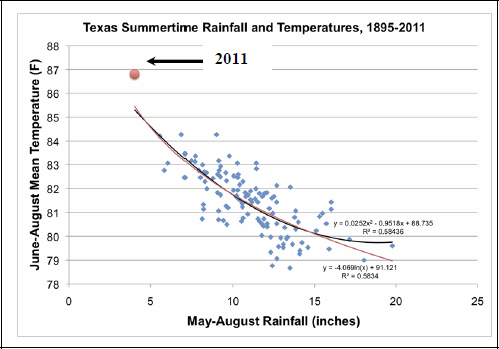
FIGURE 4-1 Texas summertime rainfall and temperatures.
SOURCE: John Nielsen-Gammon, presentation, January 18, 2012.
Lisa Gonzalez, research scientist at the Houston Advanced Research Center (HARC), highlighted some of the key habitats and ecosystem services in the Houston metropolitan region. Houston is often referred to as the “Bayou City” due to the number of bayous and waterways in the region, and those waterways serve as distributary channels for storm water, freshwater inflows for Galveston Bay, and conduits for transportation and international trade. Buffalo Bayou, one of the city’s most symbolic bayous, faces challenges due to industrialization in the lower reaches, urbanization in the middle reach, and suburbanization in the upper reaches.
Land development around Buffalo Bayou and the city’s other bayous affects the water quality of these systems, said Ms. Gonzalez. The Texas Council on Environmental Quality (TCEQ) found that as many as 90 percent of the streams in Harris County are impaired. The TCEQ determines whether water quality in a water body used for recreation meets the standard for levels of indicator bacteria, such as
Escherichia coli (E. coli). High concentrations of bacteria in water bodies have been associated with an increased risk of becoming ill from recreational activities. In the Houston region, bacteria are the most common pollutant of concern, and an implementation plan has been drafted to address 60 bacteria-impaired segments representing 80 percent of assessed streams in the region (TCEQ, 2011). In the Houston ship channels, industrial toxins such as polychlorinated biphenyl (PCBs) and other dioxins remain a threat to aquatic wildlife and human health; consumption advisories exist for several species of fish.
The Houston region has two large river systems—the Trinity River and the San Jacinto River. These rivers are important for freshwater inflows into the Galveston Bay, with the Trinity River supplying more than half of that inflow. Ms. Gonzalez stated that with current drought conditions and rising salinity levels, many freshwater plants along the Trinity Bay Delta can no longer be found. Houston also has extensive riparian forests and bottomlands that are intricately linked to the rivers, bayous, and waterways in the region. The Trinity River bottomlands are found on the eastern side of the city, the Columbia bottomlands on the western edges of the region along the Brazos River, and riparian forests along all the bayous. These riparian zones and bottom lands provide storm water retention, flood mitigation, and water quality protection in more densely populated areas. Historically, many of these riparian zones were cleared during a period of channelization and development.
Another habitat important to the Houston region are coastal prairies, said Ms. Gonzalez; less than one percent of all native coastal prairies are estimated to be left in the United States. Early accounts from people first arriving to the Houston region described a land covered by coastal prairie with green ribbons of riparian forests along waterways. There are examples of remaining coastal prairie, including the Armand Bayou Nature Center and Katy Prairie near the University of Houston, Coastal Center. The Katy Prairie is considered conservation land and is privately held and managed for that purpose. In addition to development occurring in this habitat, invasive species such as the Chinese Tallow tree are a growing threat and require extensive resources, money, and manpower to help control. Some of the services provided by coastal prairie habitat include grazing for food production, wildlife habitat, nature viewing, and hunting.
Wetlands are another important habitat in the region, and particularly unique are Estuarine wetlands, which exist along the bay. Palustrine wetlands are freshwater wetlands that extend into the upper
reaches of the watershed. Both kinds of wetlands provide protection from storm surge, fish and wildlife habitat, and water quality protection in urban areas. However, since the 1950s more than 30,000 acres of wetlands have been lost in the region. Estuarine wetlands have been the focus of restoration efforts and regulatory protection, and their acreage has been consistent. Freshwater wetland areas, in contrast, have experienced a decline in acreage in areas where there has been more development because they are not included in wetland permitting regulations (Figure 4-2).
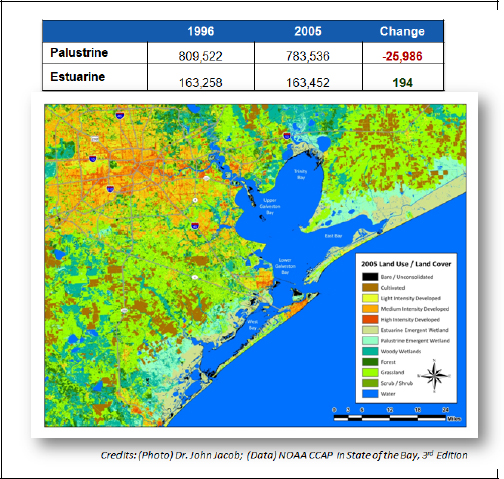
FIGURE 4-2 Change in wetlands in the Houston metropolitan region.
SOURCE: Lisa Gonzalez, presentation, January 18, 2012.
Oyster reefs in Houston are an example of a bay habitat linked directly to the urban setting because they provide commercial seafood, explained Ms. Gonzalez. Extreme storm events result in excess storm
water flowing into urban bayous, and the resulting elevated bacteria levels directly affect oyster reefs’ ability to provide their economic and ecological service. Oyster reefs that were abundant in the 1950s were gone by the 1990s, partly due to intensive shell dredging. Additionally, the remaining reefs were damaged by Hurricane Ike in 2008 and again by decreased inflows due to drought in 2011.
A rich assortment of habitats continue to provide numerous services to the human population, stated Ms. Gonzalez; however, urban development and other human uses often do not consider the ecosystem services that are lost. Also, many important habitats lie outside of the regulatory realm (e.g. freshwater wetlands) and so novel, non-regulatory management approaches are needed. Although restoration has been a focus in the region for the past 30 years, greater efforts to conserve habitat are needed. Habitat conservation is difficult to fund due to the lack of non-federal matching funds, conservation landholders, and managers, but these issues must be addressed in coming years if the remaining habitat diversity around Houston is to be protected.
Ms. Gonzalez provided a vision for a path forward for natural capital considerations in the Houston Metropolitan region:
- Use existing strategies in novel ways, such as watershed protection plans in permitting activities or changing existing policies and legislation
- Create incentive programs to encourage private land owners and developers to work with conservation organizations and land trusts in order to foster more low-impact development in Houston
- Bring more non-federal dollars to Houston and increase the leveraging of funds through new partnerships with large conservation organizations
- Increase and better coordinate the use of existing technologies and data for decision making at local government level, such as GIS and decision support systems
- Shift thinking away from preserving nature’s past and change the discussion, engaging the general public to create a better future
John Randolph, a professor at Virginia Polytechnic Institute and State University (Virginia Tech), explained that one mechanism used for land conservation in Virginia that allows for permanent protection of land resources is a tax credit for the donation of conservation easements. The state government, under democratic leadership, had a goal of establishing 400,000 new acres of permanently conserved land in
Virginia. That goal was achieved and the same proposal, under republican leadership, was recently adopted. This conservation tax credit has become a non-partisan, financial incentive to put land in permanent conservation. Although Texas does not have an income tax, there may be other financial incentives for conserving privately owned land, Dr. Randolph said. Another mechanism is the transfer of development rights, he continued; however, a lack of zoning in the Houston region is a barrier to this mechanism. Zoning would provide opportunities to transfer development rights from private-sector land that could be conserved to land suitable for development—where density could be increased.
From the natural habitats in the Houston metropolitan area, the discussion moved toward the built environment and the infrastructure required for transportation. Carol Lewis, associate professor of transportation studies and director of the Center for Transportation Training and Research at Texas Southern University, discussed the linkages between transportation and sustainability. To move away from traffic congestion, pollution associated with vehicular traffic, and dependence on foreign oil, explained Dr. Lewis, more attention needs to be given to walkable communities, light rail systems, and bikeable pathways. This is the idea of complete streets; they are not just for cars but for many modes of transit. Transit-oriented development (TOD) has shown that households in these communities are twice as likely to not own a car. This results in tremendous energy savings as well. A study conducted by Lewis and Goodwin (1996) showed that if only 5 percent of employees at that time in downtown Houston gave up driving for just one day a week, the annual energy savings would be 239 million BTUs. Changing habits can make profound differences, they concluded.
It is also important to think about planning more broadly at the regional or mega-regional level, Dr. Lewis said. The Houston-Galveston Area Council (H-GAC) bridges the planning efforts of several communities across the area and pulls them together into a broader more overarching plan. This example should be replicated with communities letting go of political boundaries and focusing more on needs across the region. The Houston region, for example, is part of a mega-region consisting of Dallas, San Antonio, and Austin, and so there should be better planning efforts among these regions.
Dr. Lewis also elaborated on how providing parking spaces could be detrimental to sustainability initiatives. Donald Shoup from University of California, Los Angeles, is known for his discourse on the high cost of
free parking and his argument that if parking was eliminated, then development costs would be greatly reduced and more efficient urban design could be developed that would reduce auto dependence and also restrain sprawl—all important contributors to sustainability, noted Dr. Lewis. One policy barrier to such programs is the City of Houston’s requirement that parking be provided for individual developments. An example of a solution to this barrier is a transit corridor ordinance passed three years ago by Houston that allows developers who build next to the light rail to provide fewer parking spaces than other builders – an issue that has been contentious in Houston. Although developers often claimed that banks would not finance development with fewer parking spaces, the opposite has proven true in some instances. There appears to be a disconnect, noted Dr. Lewis, between what the city is trying to do sustainably and what banks and developers tend to finance and build.
One area that needs further attention, noted Dr. Lewis, is the ability to fund sustainability initiatives, as there is a lot of competition for available resources. It will also be important to identify the policies and technical guidelines that need modification, such as the requirement for a certain number of parking spaces per so many thousand square feet of development, and identify case studies in the published literature, draw out lessons learned, and apply them to the Houston region and elsewhere. Change is incremental, concluded Dr. Lewis, but it is important to continue to move incrementally toward better sustainability.
In addition to the infrastructure for transportation that makes up the built environment, there are also numerous buildings that comprise the Houston skyline. Rives Taylor, director of sustainable design at Gensler discussed regeneration as a way to move toward sustainability. Buildings have a major impact in terms of energy and water use, he noted; the approximately 76 million residential buildings and 5 million commercial buildings across the United States consume 40 percent of the nation’s energy and 76 percent of all electricity (EIA, 2008). Much of the air pollution that exists in Houston and the health effects associated with it comes from the burning of fossil fuels for electricity.
Water use in buildings—from the potable water coming directly into a building to the water used to cool turbines in the generation of electricity—is another area where efficiency can be gained, said Mr. Taylor. Much of the water coming into buildings does not need to be potable, because it is used for cooling, toilets, or fire suppression. Water will continue to be an issue in the Houston region, and will need to be used differently moving forward. Building materials is also an area with
a large impact on waste, Mr. Taylor added; construction debris, for example, accounts for over 25 percent of landfill content.
Buildings can be expensive to construct, but operating costs can be even more, Mr. Taylor said. Investing in smart design before you build allows for the building to operate more efficiently later. One dollar invested in smart design can actually translate into as much as $30 in operational cost savings over a 30-year life of a building. Insulating buildings is the simplest, most cost-effective way to tackle climate change, he said. Insulation is a onetime cost with a payback that makes sense for most developers and builders. Developers need to rethink the nature of buildings so that there is more low-impact design and transit-oriented development.
Also important is the environment buildings create, Mr. Taylor said. Recruiting the next generation of the best and brightest workers is challenging if they are expected to work in an atmosphere that does not convey a clean, healthy building. Research has shown, Mr. Taylor stated, that healthy, day-lit buildings result in better productivity and 80 percent less energy used. Currently, every building being built or renovated in Houston is a Leadership in Energy and Environmental Design (LEED)certified building. There are innovations in design that have led to more efficient buildings. Passive design, for example, is a natural system that cools the building through basic physics and not through internal climate control mechanisms. A double skin on a building allows for a ventilation system made from metal that cools when the sun goes down and pulls cool air in below that warms as it rises. An under floor air distribution system (Figure 4-3) puts air where people sit rather than up in the air, and also has the following benefits:
- Heated air temperature sits lower in a room
- Less fan energy needed
- Only the occupied zone is heated or cooled
- Less overall energy needed to provide the same level of comfort
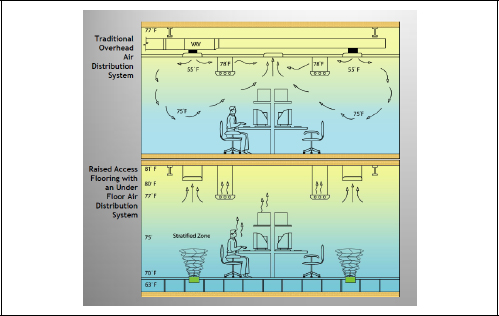
FIGURE 4-3 Illustration depicting air currents of an under floor air distribution system.
SOURCE: Rives Taylor, presentation, January 18, 2012.
Another example of sustainable building design at the industrial level is a LEED platinum project at a global energy corporation (name not disclosed). This building is 423,500 gross square feet in area, has an occupancy of 2,200 seats, and generates its own power through a cogeneration plant using natural gas. This building also captures rainwater, condensate, and groundwater to generate somewhere between 100,000 and 115,000 gallons a day of nonpotable water used to flush toilets and irrigate, Mr. Taylor said. This building reduces water use by over 68 percent and although it is an energy-intensive building, it optimizes the energy it uses. There are catalysts for transforming a city into a livable city, which requires thinking at a much larger scale, Mr. Taylor said in conclusion. The challenge is looking not at an individual building, but at streets, blocks, or districts. It’s having a city that is diverse and that has green infrastructure, efficient mass transit, accessible medical care, and integrated parks and trees.
This page intentionally left blank.


