
1
NASA’s Past and Current Trajectory
According to prior National Research Council (NRC) studies, establishing and maintaining strong NASA programs in space and aeronautics will enhance national economic vitality, public well-being, scientific knowledge, and national security (NRC, 2006, 2009). As a result, these studies assert, the vitality of NASA programs is a national imperative that will grow in importance in the future.
To date, space exploration by humans has scarcely intruded into the infinite expanse beyond the limits of planet Earth. Scientific instruments, on the surface or in orbit around Earth or other bodies in the solar system—and other probes that have passed by one or more bodies as they tour the solar system— have enabled U.S. scientists to carefully examine vast regions of space with ever greater perception, answering old questions and raising new ones about the past, present, and future of the universe. Earth orbit also provides an excellent vantage point for spacecraft to examine Earth and its biosphere, collecting scientific data or providing valuable services, such as direct broadcasting, satellite communications, weather observations, and other types of surveillance for military, commercial, and civil purposes. In addition, long-term aeronautical research and development has provided enormous benefits in the development of safe and efficient commercial as well as military air vehicles.
NASA was created in the midst of the Cold War as a multi-purpose agency to pursue goals in robotic and human spaceflight and to build on aeronautics technology development begun over several decades by the National Advisory Council on Aeronautics (NACA). NASA quickly acquired or built substantial infrastructure and space capabilities at various locations throughout the United States because these capabilities, primarily test facilities, did not already exist in industry. The largest of NASA’s many missions over the past half-century has been the pursuit of human spaceflight, and approximately half of the agency’s current budget is devoted to this pursuit. NASA’s Earth and space science and aeronautics missions have received smaller amounts of funding—currently science is approximately 29 percent, aeronautics is approximately 3 percent, and technology is also approximately 3 percent. Historically, science was a significantly smaller percentage of the budget than it is today, although starting in the 1990s the percentage of NASA’s budget devoted to Earth and space science grew, and in the 2000s the aeronautics budget shrank.
Human spaceflight goals have generally been established by presidential policy, subject to congressional authorization and appropriations. The goal of human spaceflight has itself changed over the years. During the 1960s the ultimate purpose was geopolitical—to compete against the Soviet Union and demonstrate U.S. technological prowess on an international stage. During the 1970s the purpose was to reduce the cost of launching spacecraft to orbit and to develop routine operations for humans in space. By the 1980s, the goal had become to develop a space station with Western allies. By the 1990s this goal had evolved to include engagement with post-Cold War Russia. Since the early 1970s, human spaceflight has been confined to low Earth orbit.
Earth and space science goals are ostensibly established in the decadal survey process led by the NRC, a process that has been highly successful at developing priorities in Earth and space sciences and leading to their eventual implementation. This process has been under strain in recent years. Some projects, such as the James Webb Space Telescope, have run over budget, and the administration has rejected the proposed planetary science program and also postponed work on a key element of the astronomy community’s decadal survey. Although it is beyond the scope of this report to recommend
ways of improving the decadal survey process, the committee notes that at the time this report was being finalized, the NRC was undertaking a workshop to identify lessons learned from past decadal surveys, including ways in which they might be improved.
NASA’s aeronautics program budget is currently approximately 3 percent of the overall agency’s budget, hardly reflective of a strategic imperative. Over the decades, the goals for aeronautics have ranged from efficient subsonic fixed-wing aircraft to high-speed civil transport systems to hypersonic airbreathing engines for multiple-stage-to-orbit space access.
NATIONAL AERONAUTICS AND SPACE ACT OF 1958 AND ITS EVOLUTION
The focus of NASA on aeronautics and space dates back to its founding, when the National Aeronautics and Space Act of 1958 transformed the NACA into NASA. The act specified that NASA shall plan, direct, and conduct aeronautical and space activities to increase scientific knowledge; support the development of advanced aircraft; develop and operate advanced spacecraft; consult with the Department of Defense (DOD) and other federal agencies regarding matters of mutual interest; strongly encourage commercial activities in space; and ensure that the United States remains a leader in aeronautics and space. For example, the first launch of a NASA spacecraft is shown in Figure 1.1. The act has been modified by Congress many times over the years, often upon presidential recommendation. This section describes some of the key changes.
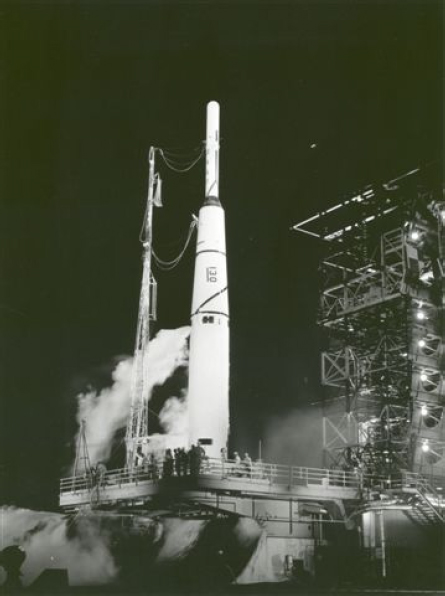
FIGURE 1.1 Thor-Able I, with the Pioneer I spacecraft atop, prior to launch at Cape Canaveral. Pioneer I launched on October 11, 1958, the first spacecraft launched by the 11-day-old National Aeronautics and Space Administration. Although the spacecraft failed to reach the Moon, it did transmit 43 hours of data. SOURCE: NASA.
In 1973 the provisions for the National Aeronautics and Space Council, which was set up in 1958 to coordinate among the nation’s space and aeronautics agencies while contributing to the national space policy, was deleted from the National Aeronautics and Space Act along with its functions after President Nixon abolished the council in an executive reorganization plan. This body was later resurrected as the National Space Council in the 1989 NASA Authorization Act. The council was used by President George H.W. Bush, but Presidents Bill Clinton, George W. Bush, and Barack Obama neither funded nor staffed the National Space Council.
In 1984 Earth science was formally added as one of NASA’s objectives. In addition, the act was modified to mandate that NASA “seek and encourage, to the maximum extent possible, the fullest commercial use of space.”
In 1990, NASA support of the commercial use of space was strengthened by the addition of requirements that NASA “encourage and provide for Federal Government use of commercially provided space services and hardware, consistent with the requirements of the Federal Government.”
EVOLUTION OF NASA’S VISION AND MISSION STATEMENTS
Throughout its history, NASA has continually modified the statements of its vision and mission. It is not clear whether these changes reflected substantive changes in the evolution of NASA’s strategic thinking over time or simply reflected other, less substantial issues. In any event, a comparison of the different statements over time reveals some interesting changes. Consider the following statements of the agency’s “vision”:
• 1986: NASA’s vision is to be at the forefront of advancements in aeronautics, space science, and exploration.
• 1992: NASA is committed to the future. As explorers, pioneers and innovators, we boldly expand frontiers in air and space to inspire and serve American and to benefit humanity.
• 1994-2000: NASA is an investment in America’s future. As explorers, pioneers, and innovators, we boldly expand frontiers in air and space to inspire and serve America and to benefit the quality of life on Earth.
• 2003: To improve life here, To extend life to there, To find life beyond.
• 2006: To advance U.S. scientific, security, and economic interests through a robust space exploration program.
• 2011: To reach for new heights and reveal the unknown, so that what we do and learn will benefit all humankind.
A comparison of these statements shows that “air” or “aeronautics” has not been explicitly mentioned in the vision since 2000. Science has not been explicitly mentioned since 1986, when the vision mentioned aeronautics, space science, and exploration. The shortest of the visions, from 2003, succinctly encapsulates what NASA does, but, like the current one, does not explicitly mention aeronautics, science, or space, and is not easily identified as a NASA-unique vision.
NASA mission statements have likewise evolved over time:
• 1994-2000: The NASA mission is to:
— Explore, use, and enable the development of space for human enterprise.
— Advance scientific knowledge and understanding of the Earth, the solar system, and the universe and use the environment of space for research.
— Research, develop, verify, and transfer advanced aeronautics, space, and related technologies.
• 2003: To understand and protect our home planet, to explore the universe and search for life, to inspire the next generation of explorers … as only NASA can.
• 2006: To pioneer the future in space exploration, scientific discovery, and aeronautics research.
• 2011: Drive advances in science, technology, and exploration to enhance knowledge, education, innovation, economic vitality, and stewardship of Earth.
These mission statements are longer and provide more detail than the vision statements, and they consistently mention NASA-related themes such as exploration and science. In addition, all of them explicitly mention aeronautics except for two—the 2003 statement and the current (2011) formulations.
Despite NASA’s broad portfolio that spans human spaceflight, space and Earth science, and aeronautics research, in the public mind the agency is most closely associated with human spaceflight. In 2004, after many years of uncertainty about the futures of the space shuttle and the International Space Station, President George W. Bush announced a “Vision for Space Exploration” (NASA, 2004) that called for astronauts to return to the Moon by 2020 and someday to go to Mars. Similar goals had been expressed by President George H.W. Bush in 1989, but they did not receive bipartisan support, and the President’s proposed budgets for achieving these goals were rejected. By 1992 the goals were essentially abandoned.
The 2004 Vision announcement followed by almost exactly a year the space shuttle Columbia tragedy that cost the lives of seven astronauts. The Columbia Accident Investigation Board noted in its report that if astronauts lives were to be at risk through space exploration, the rationale and goals needed to be better defined (CAIB, 2003).
President George W. Bush did not propose adding significant funding to NASA’s budget to accomplish the new goals, however. Instead, his plan was to terminate the space shuttle program in 2010 after completing construction of the ISS and to end U.S. involvement in the ISS in the 2015-2016 timeframe. The space shuttle and ISS funds would be redirected to achieving the Moon/Mars goals.
In 2005, a Republican-controlled Congress passed the 2005 NASA Authorization Act, which supported President Bush’s Moon/Mars program while also stressing the need for adequate utilization of the ISS and holding open the possibility of continuing the space shuttle program beyond 2010. Three years later, a Democratic-controlled Congress passed the 2008 NASA Authorization Act, which was similar to the 2005 act. At that point in time, Congress and the White House and Democrats and Republicans were all in general agreement about the future of the human spaceflight program. NASA pursued the presidential and congressional policies by initiating the Constellation program to build capabilities to send people back to the Moon and to Mars, including new launch vehicles and spacecraft.
In January 2009, President Barack Obama convened a special committee, chaired by Norman Augustine, to look at the human spaceflight program and offer options. In its report, Seeking a Human Space-flight Program Worthy of a Great Nation (Executive Office of the President, 2009), the committee concluded that there were “technical and budgetary issues” in major components of the Constellation program (e.g., Ares I, Orion) that were creating considerable schedule delays (p. 11). Independent analyses showed that “the length of the gap in U.S. ability to launch astronauts into space [would] be at least seven years” (p. 12). The Augustine committee concluded further that in order for NASA to pursue a mission of sending humans beyond low Earth orbit (LEO), NASA required additional funding of $3 billion more per year.
In February 2010, as part of the fiscal year (FY) 2011 budget request, the White House proposed terminating the Constellation program and replacing it with a NASA effort to develop technologies for human exploration beyond LEO. No decision on what kind of vehicles to build would be made until at least 2015, and no specific destination or timeframe for human expeditions beyond LEO was included.
Meanwhile, the President decided that instead of NASA developing a replacement capability for the space shuttle to ferry astronauts to and from the ISS, NASA would build on its Commercial Orbital Transportation Services (COTS) partnership agreements with U.S. industry, initiated in 2006. This approach would enable them to contract for the development of “commercial crew” space transportation systems, where NASA would help pay companies to develop their own space transportation systems, and the companies would invest significant amounts of their own money toward development with the expectation of the emergence of a private human spaceflight market.
Congress also wanted a destination and a timetable for sending astronauts beyond LEO. In April 2010, the President announced his goals of sending astronauts to an asteroid by 2025 and to orbit Mars in the 2030s. These goals were officially expressed in the 2010 National Space Policy issued by the White House 2 months later (Executive Office of the President, 2010).
The totality of the decisions—to proceed with President Bush’s plan to terminate the space shuttle, but to also end the Constellation program that was developing a replacement U.S. crew transportation capability—resulted in programmatic disruptions. These decisions also resulted in an indefinite extension of the number of years the United States would need to depend on Russia to take NASA astronauts to and from the ISS. In addition, the decisions to rely on the commercial sector to build a new U.S. crew space transportation system, when some were skeptical that the companies were technically ready to take on such a responsibility, and to replace the Moon with an unspecified asteroid as the next destination for human spaceflight—made without prior consultation and contravening two existing laws—were met with congressional skepticism.
A number of influential members of Congress insisted that the government—NASA—build a new crew transportation system regardless of any commercial crew aspirations. Congress wanted a new large rocket reminiscent of the Saturn V used for the Apollo program to enable trips beyond LEO, whatever the destination, and to accelerate as much as possible restoring U.S. ability to launch people into space rather than relying on Russia.
In October 2010, Congress and the White House reached a compromise in the 2010 NASA Authorization Act. In essence, the agreement was for NASA to do both what the White House and Congress wanted. NASA would proceed with the White House plan for commercial crew transport as well as Congress’s plan for a NASA-developed Space Launch System (SLS), based heavily upon legacy systems such as those developed for the space shuttle program, and an Orion spacecraft that would take humans beyond LEO and serve as a backup in case the commercial systems did not materialize.
The budget outlook for NASA, meanwhile, worsened. The President had planned to add $6 billion to NASA’s budget over 5 years when he announced his new plan in the FY2011 budget request. A year later, with Republicans regaining control of the House and deficit-reduction becoming the dominant political theme, NASA was hoping for level funding at best. Today, the same NASA that was deemed by the Augustine committee to be unable to afford the Constellation program now must fund Constellation’s replacement—SLS/Orion—and also fund commercial crew transport. NASA still must find funds for a habitation and support module to enable long-duration trips beyond LEO.
Some in Congress remain wary of the administration’s plans, stating that budget requests since the 2010 NASA Authorization Act have favored spending on commercial crew rather than SLS/Orion. NASA also took longer than expected to choose an SLS design, prompting congressional criticism that the agency was delaying making a decision. All the while, support for the idea of sending astronauts to an asteroid failed to gain widespread support, and NASA has not undertaken any visible steps required to make such a mission possible. These issues, in part, led Congress to commission the current study to examine NASA’s strategic direction.
The one piece of common ground is that sending humans to Mars remains the long-term goal for everyone involved in this debate. As shown in Box 1.1, that has been the driving force in presidential policies and speeches for decades. The debate is about the steps between the ISS and Mars and when we will get there, dictated largely by budget constraints.
BOX 1.1 The Presidents Speak on Human Exploration of Mars
President George H.W. Bush, Address at the National Air and Space Museum, July 20, 1989
In 1961 it took a crisis—the space race—to speed things up. Today we don’t have a crisis; we have an opportunity. To seize this opportunity, I’m not proposing a 10-year plan like Apollo; I’m proposing a long-range, continuing commitment. First, for the coming decade, for the 1990’s: Space Station Freedom, our critical next step in all our space endeavors. And next, for the new century: Back to the Moon; back to the future. And this time, back to stay. And then a journey into tomorrow, a journey to another planet: a manned mission to Mars (Bush, 1989).
President George W. Bush, Remarks on U.S. Space Policy at NASA Headquarters, January 14, 2004
With the experience and knowledge gained on the moon, we will then be ready to take the next steps of space exploration: human missions to Mars and to worlds beyond. Robotic missions will serve as trailblazers—the advanced guard to the unknown. Probes, landers and other vehicles of this kind continue to prove their worth, sending spectacular images and vast amounts of data back to Earth. Yet the human thirst for knowledge ultimately cannot be satisfied by even the most vivid pictures, or the most detailed measurements. We need to see and examine and touch for ourselves. And only human beings are capable of adapting to the inevitable uncertainties posed by space travel (Bush, 2004).
President Barack Obama, Speech Outlining his Administration’s Space Policy at Cape Canaveral, Florida, April 15, 2010
By 2025 we expect new spacecraft designed for long journeys to allow us to begin the first ever crewed missions beyond the Moon into deep space. So we’ll start by sending astronauts to an asteroid for the first time in history. By the mid-2030s I believe we can send humans to orbit Mars and return them safely to Earth. And a landing on Mars will follow and I expect to be around to see it (NASA, 2010).
Office of Management and Budget (OMB) Circular A-11 (section 230) requires federal agencies to prepare strategic plans that define long-term objectives and to explain why those objectives were selected, how they will be achieved, and how progress will be measured. Strategic plans are expected to include appraisals of agency capabilities and provide a context for making decisions about agency priorities and budgets.
The most recent NASA strategic plan was issued in 2011 (NASA, 2011). Overall, the 2011 strategic plan is generally consistent with the 2010 National Space Policy, although there are some differences in emphasis. The 2011 strategic plan describes six strategic goals, each of which is associated with two to five desired outcomes. (See Box 1.2, which also lists the challenges identified for each strategic goal.1) The six strategic goals are aligned with eight of NASA’s nine major budget line items for FY2012. In other words, the strategic plan does not identify any strategic goals that are not already funded in NASA’s current budget. Importantly, however, the strategic plan does not address the rationale
1 More information on all of the goals, objectives, and challenges is included in the strategic plan (NASA, 2011).
BOX 1.2 NASA’s 2011 Strategic Goals, Outcomes, and Challenges
Strategic Goal 1: Extend and sustain human activities across the solar system.
Outcomes
1.1 Sustain the operation and full use of the International Space Station (ISS) and expand efforts to utilize the ISS as a National Laboratory for scientific, technological, diplomatic, and educational purposes and for supporting future objectives in human space exploration.
1.2 Develop competitive opportunities for the commercial community to provide best value products and services to low Earth orbit and beyond.
1.3 Develop an integrated architecture and capabilities for safe crewed and cargo missions beyond low Earth orbit.
Challenges
• Advanced Technology Development
• Availability of Commercial Cargo and Crew Services
• Affordability and Sustainability
Strategic Goal 2: Expand scientific understanding of the Earth and the universe in which we live.
Outcomes
2.1 Advance Earth system science to meet the challenges of climate and environmental change.
2.2 Understand the Sun and its interactions with Earth and the solar system.
2.3 Ascertain the content, origin, and evolution of the solar system and the potential for life elsewhere.
2.4 Discover how the universe works, explore how it began and evolved, and search for Earth-like planets.
Challenges
• Access to Space
• Program Management
• Availability of Plutonium 238
Strategic Goal 3: Create the innovative new space technologies for our exploration, science, and economic future.
Outcomes
3.1 Sponsor early-stage innovation in space technologies in order to improve the future capabilities of NASA, other government agencies, and the aerospace industry.
3.2 Infuse game-changing and crosscutting technologies throughout the Nation’s space enterprise to transform the Nation’s space mission capabilities.
3.3 Develop and demonstrate the critical technologies that will make NASA’s exploration, science, and discovery missions more affordable and more capable.
3.4 Facilitate the transfer of NASA technology and engage in partnerships with other government agencies, industry, and international entities to generate U.S. commercial activity and other public benefits.
Challenge
• Implementation of a New Approach.
Strategic Goal 4: Advance aeronautics research for societal benefit.
Outcomes
4.1 Develop innovative solutions and advanced technologies through a balanced research portfolio to improve current and future air transportation.
4.2 Conduct systems-level research on innovative and promising aeronautics concepts and technologies to demonstrate integrated capabilities and benefits in a relevant flight and/or ground environment.
Challenges
• Inherent Risk
• Partnership Influences
• Resources
Strategic Goal 5: Enable program and institutional capabilities to conduct NASA’s aeronautics and space activities.
Outcomes
5.1 Identify, cultivate, and sustain a diverse workforce and inclusive work environment that is needed to conduct NASA missions.
5.2 Ensure vital assets are ready, available, and appropriately sized to conduct NASA’s missions.
5.3 Ensure the availability to the Nation of NASA-owned, strategically important test capabilities.
5.4 Implement and provide space communications and launch capabilities responsive to existing and future science and space exploration missions.
5.5 Establish partnerships, including innovative arrangements, with commercial, international, and other government entities to maximize mission success.
Challenges
• Meeting Changing Facilities Requirements
• Achieving and Sustaining State-of-the-Art Technologies for Institutional Capabilities
• Managing a Distributed Infrastructure Base
Strategic Goal 6: Share NASA with the public, educators, and students to provide opportunities to participate in our Mission, foster innovation, and contribute to a strong national economy.
Outcomes
6.1 Improve retention of students in STEM disciplines by providing opportunities and activities along the full length of the education pipeline.
6.2 Promote STEM literacy through strategic partnerships with formal and informal organizations.
6.3 Engage the public in NASA’s missions by providing new pathways for participation.
6.4 Inform, engage, and inspire the public by sharing NASA’s missions, challenges, and results.
Challenges
• Attracting Students to Science, Technology, Engineering, and Mathematics
• Reaching New Audiences
SOURCE: NASA (2011).
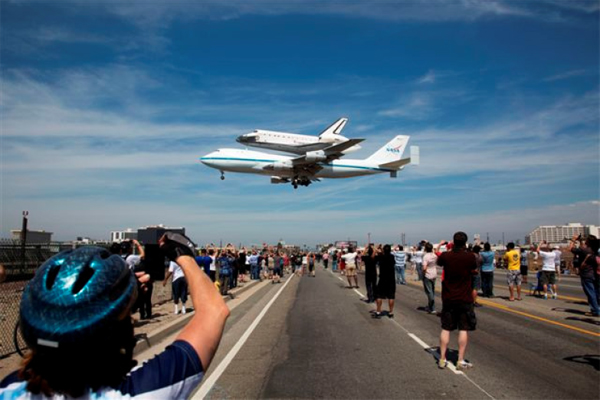
FIGURE 1.2 The space shuttle Endeavour, atop the Shuttle Carrier Aircraft lands at Los Angeles International Airport on September 21, 2012, in Los Angeles, California. SOURCE: NASA/Matt Hedges.
for resource allocation among the six strategic goals. In addition, while the NASA budget does not provide a breakdown of budget estimates associated with of the six strategic goals, it appears that the first two goals—human spaceflight and space science—account the for a large majority of the NASA budget, while two other goals—aeronautics and technology development—receive, in total, only 6.4 percent of the budget. The 3.2 percent for aeronautics is a surprisingly small investment considering its importance to the U.S. economy and world leadership position. It is apparent, however, that some of the outcomes and challenges presented in the 2011 strategic plan will not be achieved by NASA as its programs are currently structured and funded because NASA does not have the resources needed or because of shortcomings in the state of the art of related science and/or technology.
The 2006 NASA strategic plan had similarly broad goals to those in the 2011 plan, but with somewhat greater specificity, e.g., its first strategic goal is to “fly the shuttle as safely as possible until its retirement, not later than 2010” (NASA, 2006, p. 4). (See Figure 1.2.) Consistent with the initiation of the COTS program in 2006, there is a strategic goal to “encourage the pursuit of appropriate partnerships with the emerging commercial space sector” (p. 4). The 2003 NASA strategic plan that was created earlier in the Bush Administration is much more similar to the current NASA plan in that there are broad, sweeping goals with relatively little specificity. Neither the 2003 plan nor the 2006 plan explicitly lists any prioritization in their strategic goals.
NASA ORGANIZATION AND STAFF LEVELS
NASA’s organization includes nine field centers: Ames Research Center, Dryden Flight Research Center, Glenn Research Center, Goddard Space Flight Center, Johnson Space Center, Kennedy Space Center, Langley Research Center, Marshall Space Flight Center, and Stennis Space Center. The Jet Propulsion Laboratory (JPL) is not a NASA field center, but is instead a federally funded research and
development center (FFRDC), although it is commonly referred to as a NASA field center. NASA also operates several other facilities such as the Wallops Flight Facility, which is managed by Goddard Space Flight Center and used as a launch site for small satellites, sounding rockets and some air vehicles. NASA also operates the Michoud Assembly Facility, which is managed by Marshall Space Flight Center and has the ability to manufacture and test large scale rocket engines and their components.
The location of the centers is shown in Figure 1.3. NASA, like many government agencies, augments its civil servant workforce with contractors, both for direct support and to provide the equipment and capabilities that the agency procures, such as launch vehicles and spacecraft.
All of the NASA centers have long and varied histories; the oldest, Langley Research Center, will celebrate its centennial in 2017. The capabilities of some centers overlap, to some degree, with other centers, but differences in staff expertise, facility capabilities, history, mission, culture, and current issues and challenges make it difficult to address some management issues with a one-size-fits-all approach.2
On-site contractors play a major role at all the NASA centers. As shown in Table 1.1, the size of the contractor workforce exceeds the size of the civil servant workforce at each of the centers. The numbers of civil servants and contractors are roughly comparable at half of the centers (Ames Research Center, Dryden Flight Research Center, Glenn Research Center, Langley Research Center, and Marshall Space Flight Center). The number of on-site contractors far exceeds the number of civil servants at the other centers (Goddard Space Flight Center, Johnson Space Center, Kennedy Space Center, and Stennis Space Center). Overall, about one-third of the staff working at NASA centers are civil servants and about two-thirds are on-site contractors.
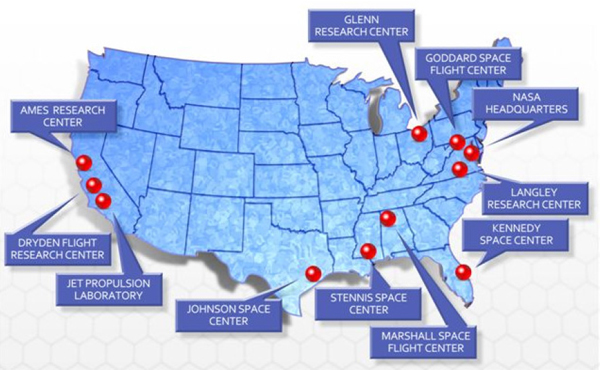
FIGURE 1.3 NASA Headquarters, the NASA centers, and the Jet Propulsion Laboratory.
2 Conclusions and recommendations related to the issues faced by the centers are provided in the Chapter 2 section, “Examining NASA’s Institutional Structure.”
TABLE 1.1 NASA Civil Service and Contractor Personnel by Field Center (including the Jet Propulsion Laboratory), Fiscal Year 2012a
| NASA Center | Number of Civil Servants (Full-Time Permanent)b | Number of Contractorsc | Total Number of Employees | Percentage of Civil Servants | Percentage of Contractors |
| Ames Research Center | 1,243 | 1,322 | 2,565 | 48% | 52% |
| Dryden Flight Research Center | 576 | 650 | 1,226 | 47% | 53% |
| Glenn Research Center | 1,710 | 1,690 | 3,400 | 50% | 50% |
| Goddard Space Flight Center | 3,428 | 6,100 | 9,528 | 36% | 64% |
| Jet Propulsion Laboratory | ~ 300c | 4,848 | ~5,150 | ~6% | ~94% |
| Johnson Space Center | 3,383 | ~12,000 | ~15,400 | 75% | 25% |
| Kennedy Space Center | 2,178 | 6,099 | 8,277 | ~25% | ~75% |
| Langley Research Center | 1,938 | 1,700 | 3,638 | 53% | 47% |
| Marshall Space Flight Center | 2,563 | 3,537 | 6,100 | 42% | 58% |
| Stennis Space Center | 294 | ~2,000d | ~2,300 | ~13% | ~87% |
| Total | 17,613 | ~40,000 | ~57,500 | ~31% | ~69% |
NOTE: Does not include Headquarters personnel.
a During its visits to the NASA field centers, the committee inquired about the aging of the NASA workforce and was informed that this is no longer considered a concern by the field center leadership. Over the past several years, NASA has engaged in a selective hiring program that has brought in new and younger employees, generally reversing an aging workforce trend that had been highlighted as a problem by previous NASA leadership.
b NASA (2012).
c Information provided to committee members by center staff during site visits by small groups of committee members to each NASA center.
d NASA’s Stennis Space Center manages a site that includes a total of approximately 5,200 personnel, including many civil service and contractors from other government agencies and industry who are funded by organizations ther than NASA for their own purposes. About 2,000 of them are working under contract to NASA.
Virtually all of JPL’s workforce is composed of contractors who are employed by the California Institute of Technology, which operates JPL, although about 300 NASA civil servants are assigned there. Stennis Space Center, which is focused on ground-based rocket testing, encompasses 140,000 acres, has a relatively small civil service staff, and most of the rest of the staff are contractors.
Since FY2000, the total size the civil servant workforce (which includes full-time, part-time permanent, term appointment, student, and other non-permanent staff) has been relatively stable, with an average of 18,272 staff, with a maximum of 18,633 and a minimum of 17,219 (NASA, 2012).
At NASA headquarters, primary program activities are carried out by the Human Exploration and Operations Mission Directorate (HEOMD), the Science Mission Directorate, the Aeronautics Research
Mission Directorate, and the Office of the Chief Technologist. More information on these activities appears below in the section “NASA’s Primary Program Areas.”
Figure 1.4 shows the historical trend in NASA budget outlays (adjusted to constant FY2011 dollars).3 In the post-Apollo era, NASA spending was relatively flat throughout the remainder of the 1970s and first half of the 1980s. Outlays increased significantly the late 1980s, which was a period of rapid expansion of the ISS program in concert with robust space shuttle and space science programs. Starting in 1987, NASA’s budget increased to cope with the aftermath of the Challenger accident. DOD was directed to transfer $2.1 billion to NASA in FY1987 as a lump sum to pay for a replacement orbiter, and NASA was allocated other return-to-flight funding. This money was to cope with programmatic delays for spacecraft that had to be launched on the space shuttle (like the Hubble Space Telescope and Galileo), and funds to change to a “mixed fleet” approach where the agency would procure expendable launch vehicle services for spacecraft previously scheduled for launch on the space shuttle. NASA’s budget, therefore, rose steadily from FY1987 to FY1991 but stabilized thereafter. NASA spending reached a plateau in the early 1990s and has remained within a relatively small band for a period of almost two decades since the mid-1990s.
Many NASA observers have cited the relationship of NASA spending to gross domestic product or to the federal budget total as a proxy measure of the national priority assigned to NASA. Due to the changes in federal budget policy over the past 25 years, a more reasonable benchmark is to compare NASA outlays to total federal non-defense discretionary spending, i.e., the portion of the budget that is annually appropriated by Congress, of which NASA is a part. Using this measure, Figure 1.5 shows that NASA outlays constituted about 4 percent of non-defense discretionary spending in the post-Apollo era in the 1970s and early 1980s, rising to 6 percent with the NASA budget build-up in the late 1980s and early 1990s, and then gradually declining to a level of about 3 percent of non-defense discretionary spending. This is not to imply that there should be any specific target benchmark for the NASA budget, but rather to point out that, particularly in recent years, the NASA budget has been remarkably constant in both absolute spending levels as well as share of non-defense discretionary spending for at least a decade. This trend, reflecting the series of decisions on the NASA budget by the administration and Congress each year, provides important context for the discussion of issues related to NASA’s strategic direction in Chapter 2.
Human Exploration and Space Operations
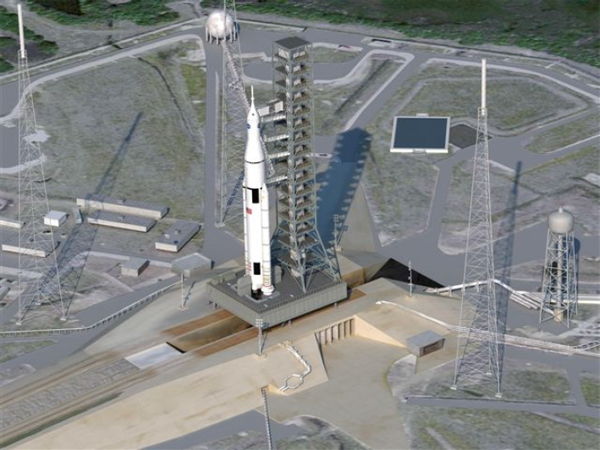
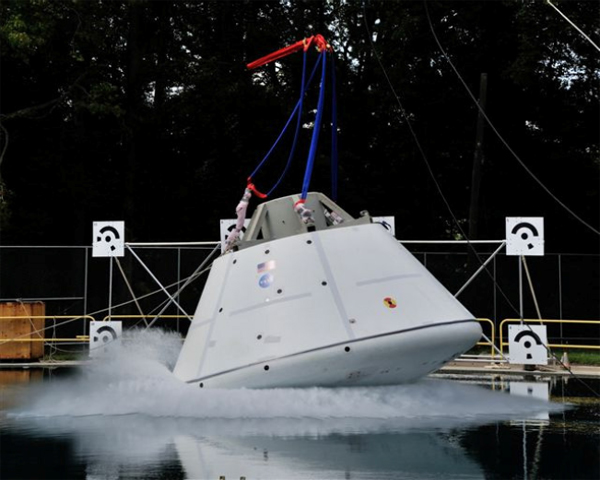
Currently, NASA is developing a Space Launch System program, the goal of which is to create a heavy-launch vehicle capable of transporting humans and cargo, including the Orion Multi-Purpose Crew Vehicle, beyond LEO (see Figures 1.6 and 1.7). The first SLS, slated for 2017 launch, will carry a prototype Orion capsule without a crew.4 These two projects account for about 80 percent of the exploration budget. The balance of the budget supports commercial spaceflight activities and research and development of various exploration systems.
3 For agencies with stable budgets, outlays in any given fiscal year tend to approximate the annual budgets for those agencies as approved by the appropriations act or other federal legislation (such as a continuing resolution) for those agencies. Differences arise between annual outlays and budgets because funding provided in one year’s budget is not completely expended before the end of the fiscal year.
4 See http://www.nasa.gov/pdf/664158main_sls_fs_master.pdf. Accessed October 2012.
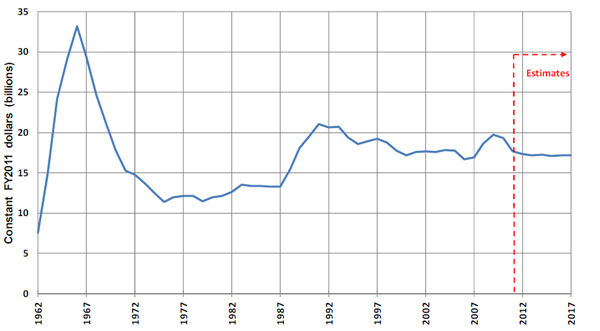
FIGURE 1.4 NASA outlays in constant fiscal year (FY) 2011 dollars (billions), FY1962 to FY2017. NASA’s first budget was FY1959, but comparable Office of Management and Budget (OMB) data for FY1959-FY1961 are not available. SOURCE: Based on data from OMB (2012) and adjusted for inflation by the NRC using the GDP Chained Price Deflator in OMB (2012, Table 4.1, Outlays by Agency: 1962-2017 and Table 10.1, Gross Domestic Product and Deflators Used in the Historical Tables: 1940-2017, Column 3, GDP (Chained) Price).
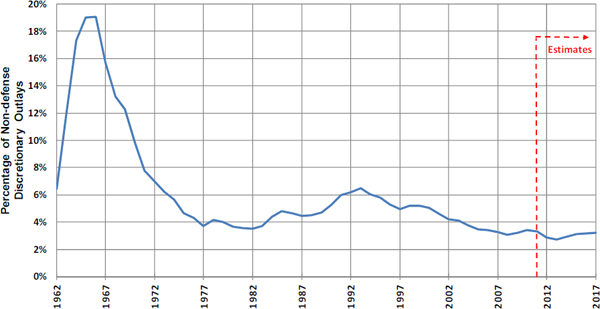
FIGURE 1.5 NASA outlays as a percentage of non-defense discretionary outlays, fiscal year (FY) 1962 to FY2017. SOURCE: Based on data from OMB (2012, Table 8.1, Outlays by Budget Enforcement Act Category: 1962-2017).
Space operations remains a separate line item, at least for now. It pays for the cost of operating and maintaining the ISS as well as communications, launch services, and a few other items in the Space Flight and Support line. It includes closing out the Space Shuttle Program. NASA has recently merged the two organizations at NASA Headquarters that managed these programs to form the Human Exploration and Operations Mission Directorate. Most NASA centers receive funding from HEOMD to some degree; the leaders include Johnson Space Center, Kennedy Space Center, Marshall Space Flight Center, Glenn Research Center, and Langley Research Center. Human exploration and space operations together account for almost half of NASA’s FY2012 budget.5 NASA also performs life and microgravity science research funded by HEOMD. This research, among other things, is intended to determine how the human body adapts to long-duration spaceflight and how to mitigate the negative effects of microgravity and other issues.
Earth and space science is primarily concerned with scientific inquiries associated with Earth, the Sun and its sphere of influence (heliophysics), bodies in the solar system other than Earth or the Sun (planetary science), and the expanse of the universe outside the solar system. Although these are collectively managed by NASA’s Science Mission Directorate, they each face somewhat different challenges, have different constituencies and politics, and fulfill different needs. Each of these topics is addressed briefly below. Additional information is available in the following most recent decadal surveys published on these topics by the NRC:
• Earth Science and Applications from Space: National Imperatives for the Next Decade and Beyond (NRC, 2007);
• Solar and Space Physics: A Science for a Technological Society [prepublication version] (NRC, 2012b);
• Vision and Voyages for Planetary Science in the Decade 2013-2022 (NRC, 2011); and
• New Worlds, New Horizons in Astronomy and Astrophysics (NRC, 2010).
These decadal surveys (as well as a decadal survey in life and microgravity science produced in 2011) are a primary source of strategic guidance for NASA science programs. In some cases, there is generally a good correlation between the strategic plans and the priorities that NASA establishes for the space sciences. Counterexamples include (1) NASA’s recent decision to postpone indefinitely work toward a Mars sample return mission, even though a Mars sample return mission is the highest priority in the most recent decadal survey for planetary science (NRC, 2011) and (2) substantial and unexpected reductions in the budget for astrophysics that make it impossible for NASA to develop the highest-priority missions in the most recent decadal survey for astronomy and astrophysics until late in this decade (NRC, 2010).
Earth Science
Earth is a complex, ever-changing system that directly affects national and global prospects for sustainable prosperity and well being. NASA is currently completing the development of a set of foundational missions, decadal survey missions, and climate continuity missions. Integrated investigations of Earth’s interior, land surface, biosphere, atmosphere, and oceans are essential to
5 At the time that this study was concluding, the NRC was starting a new study on the goals of the human spaceflight program.
understanding and predicting changes to Earth and the impact those changes will have on humanity in terms of climate variability and change, land-use changes, biodiversity, oceanography, water resources and the global hydrologic cycle, atmospheric chemistry, and weather. Understanding these changes will, in some cases, inform national and international policy decisions intended to accommodate and/or mitigate specific changes. With regard to accurately understanding Earth’s systems, NASA has the lead in making and interpreting most Earth science observations from space and has partnered with the National Oceanic and Atmospheric Administration (NOAA), which has the lead for weather observations and prediction (NRC, 2007).
Heliophysics
Some issues of particular importance to heliophysics (that is, solar and space physics) are relevant to life on Earth. These issues include the ability to predict variations in the space environment caused by the Sun and understanding the response of Earth’s magnetosphere, ionosphere, and atmosphere to variations in solar-terrestrial conditions. Heliophysics also examines how the Sun interacts with other bodies within the solar system. The recent decadal survey report on solar and space physics outlined four scientific goals going forward and recommended continued support for the program elements of a heliosphysics systems observatory and the implementation of programs in advanced stages of development. This includes the Radiation Belt Storm Probes that were recently launched to understand the Sun’s influence on Earth by studying Earth’s radiation belts. Advances in heliophysics require scientists to study the Sun, Earth, and the heliosphere6 as a coupled system, and NASA has the knowledge and spacecraft to do just that (NRC, 2012b).
Planetary Science
Areas of particular interest include understanding the origin and evolution of terrestrial planets and detailing the processes that drive climate on Earth-like planets. But the science goals of planetary missions vary widely depending on the destination(s) of a particular mission and the instruments that it carries. Climate processes are of interest in the study of Mars, as is the quest to determine (1) if life has ever existed on Mars and (2) how conditions on the surface of the planet and in the interior have evolved over time. The recently landed NASA/JPL Mars Curiosity Rover, shown in Figure 1.8, is an example of robotic exploration to answer such questions. Distinct sets of science goals also exist for the other planets, for planetary moons, and for other objects in the solar system (NRC, 2011). Planetary science was subject to significant budget cuts in the President’s FY2013 budget, forcing NASA to drop out of a partnership with the European Space Agency (ESA)-led ExoMars missions. The Mars Program Planning Group, which was chartered to provide options for a Mars mission that integrate science, human exploration, and technology, recently recommended several avenues for a sample return mission from Mars. This recommendation closely aligns with that of the NRC decadal survey for planetary science. However, Mars sample return has not yet been adopted by the administration as a priority goal for NASA.
Although Mars has received a great deal of attention in the past year, the reality is that NASA’s planetary science program has a tremendous number of spacecraft currently in operation. The Cassini mission is still healthy and returning a wealth of data on Saturn. NASA currently operates the Lunar Reconnaissance Orbiter as well as the dual spacecraft Ebb and Flow around the Moon. The
6 The heliosphere is the region of space subject to the effects of the solar wind, which consists of charged particles (mostly electrons and protons) emitted by the Sun.
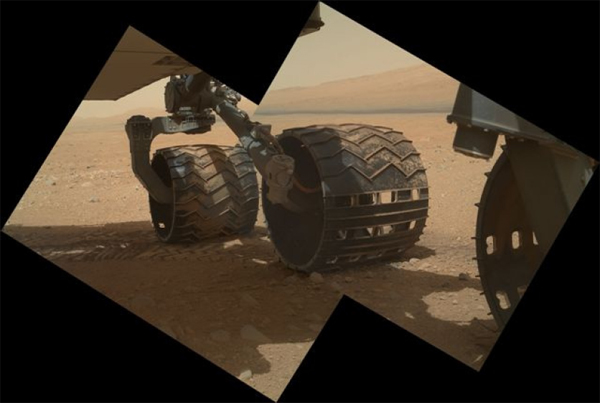
FIGURE 1.8 This view of the three left wheels of NASA’s Mars rover Curiosity combines two images that were taken by the rover’s Mars Hand Lens Imager during the 34th martian day, or sol, of Curiosity’s work on Mars (September 9, 2012). In the distance is the lower slope of Mount Sharp. SOURCE: NASA/JPL.
MESSENGER spacecraft is the first ever to orbit Mercury. New Horizons is heading toward a 2015 rendezvous with Pluto, and Juno will orbit Jupiter that same year. Mars Reconnaissance Orbiter and Mars Odyssey, as well as the Opportunity rover, all continue operating at Mars. At the time this report was being prepared, the Dawn spacecraft had left the asteroid Vesta en route to the large asteroid Ceres. Collectively, these missions have provided substantial amounts of information on our solar system, and they are rewriting our current understanding of the formation and evolution of the solar system, contributing to the search for the existence of past or even current life on other planets, and assisting in the understanding of exoplanets.
Astronomy and Astrophysics
NASA astrophysics missions allow modern scientific explorers to search over unimaginable distances: the closest star (other than the Sun) is more than 20 trillion miles away, and the distance to the closest galaxy (other than our home galaxy) is thousands of times farther away. Astronomical instruments look across space and back in time: the Hubble Space Telescope, which can make observations free of the distorting effects of Earth’s atmosphere, has observed the most distant object seen, more than 13 billion light-years away, just as it appeared 13 billion years ago. The Hubble Space Telescope, the James Webb Space Telescope (shown in Figure 1.9 and scheduled for launch in 2018), and other current and future missions will allow scientists to continue to explore in greater depth the most basic questions of human destiny. However, current budget priorities of the administration have led to delays—probably to the end of the decade—before a new program could be developed to pursue the most recent decadal survey priority in dark energy science, exoplanet science, and an understanding of the cosmos.
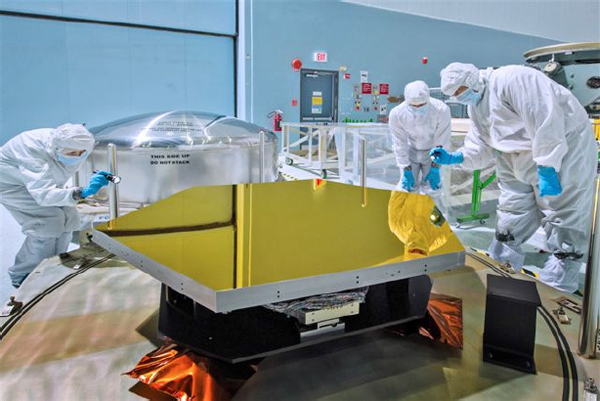
FIGURE 1.9 Technicians and scientists check out one of the James Webb Space Telescope’s first two flight mirrors on September 19, 2012, in the clean room at NASA’s Goddard Space Flight Center in Greenbelt, Maryland. SOURCE: NASA.
Aeronautics research is the foundation on which NASA was built, having been created out of the aeronautics research facilities of the National Advisory Committee for Aeronautics.7 Four of the ten NASA centers were founded as part of these NACA facilities, and although a number of legacy facilities such as large subsonic wind tunnels have been “mothballed” or even dismantled over the years, many of the NASA aeronautics facilities are utilized regularly by other government agencies such as DOD, the Federal Aviation Administration (FAA), and NOAA. The federal government’s longstanding interest in aeronautics research is justified by the direct and indirect impacts that aeronautics has on the U.S. economy through the development of safe and efficient civil and military air vehicles. NASA aeronautics research has included focused investigations in many different disciplines (e.g., aerodynamics, propulsion, materials and structures, avionics, and flight dynamics and controls) directed at many different applications (e.g., efficient subsonic fixed-wing aircraft, high-speed civil transport systems, rotary wing aircraft, and even hypersonic airbreathing engines for multiple-stage-to-orbit space access). During the past 6 years, the key priorities and goals for NASA aeronautics research have included increased aviation system capacity, improved aircraft safety and reliability, increased vehicle efficiency and performance, reduced energy consumption and environmental impact, utilization of synergies with national defense and homeland security, and support for the space program. An example of NASA research aircraft for developing new fuel efficiency technologies is shown in Figure 1.10.
7 NASA’s Langley Research Center, Ames Research Center, Glenn Research Center, and Dryden Flight Research Center trace their roots to NACA’s Langley Memorial Aeronautical Laboratory (Hampton, Virginia), Ames Aeronautical Laboratory (Moffett Field, California), Aircraft Engine Research Laboratory (Cleveland, Ohio), and Muroc Flight Test Unit (Edwards Air Force Base, California), respectively.
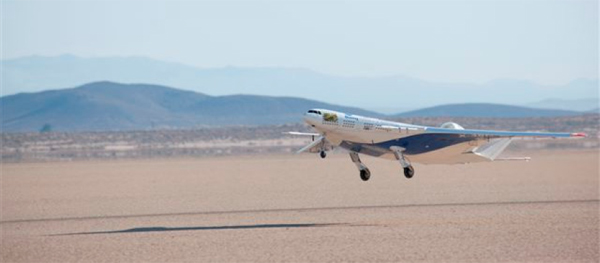
FIGURE 1.10 The NASA X-48C, which is a remotely piloted model of a hybrid wing body aircraft, takes flight for the first time. This aircraft is used for developing new fuel efficiency technologies. SOURCE: NASA/Tony Landis.
Because of the unique nature of most NASA missions, NASA has had a number of very specific technological requirements in areas ranging from expendable and reusable launch vehicles to deep space propulsion systems, and much more. As a consequence, NASA has invested heavily in the development of advanced space technology over the years. Technological advances in these areas have yielded benefits far beyond space exploration itself in down-to-Earth applications (NASA, 2008).
In the early decades of NASA’s existence, the accelerated development of concepts such as rockets and sensing technologies were given sufficient resources to meet ambitious timetables, e.g., the Saturn V development for the Apollo program or the Space Shuttle Main Engine development for the space shuttle. Since then, concepts for NASA space transportation in particular tended to be technologically ambitious (e.g., the X-33) and/or significantly constrained by the budget (e.g., Constellation). Guidance on specific mission-related development of space technologies, apart from launch systems, now routinely appears in the decadal surveys produced by the NRC for Earth and space science (see NRC, 2007, 2010, 2011, and 2012b).
Until recently in the past decade, an explicit line item for space technology, apart from launch technology, was absent from the NASA budget. In the FY2012 budget, the Space Technology Program was established, in part with funds freed up by cancellation of Constellation. The Space Technology Program, which is managed by NASA’s Office of the Chief Technologist, is intended to complement technology development conducted by NASA’s mission directorates. The Space Technology Program will focus on crosscutting technologies that serve the needs of multiple NASA mission directorates, government agencies, and industries; an example is shown in Figure 1.11. The Space Technology Program will also support technologies that would enable unprecedented new missions or capabilities but are too risky to warrant substantial investment by the mission directorates. Guidance on mission-related development of space technologies now routinely appears in the decadal surveys produced by the NRC for Earth and space science (see NRC, 2007, 2010, 2011, and 2012b). Most recently the NRC completed a major roadmapping study that established technology development goals for the Space Technology Program, and NASA has now begun implementing those goals into its plans (NRC, 2012a). Congress directed that one-third of the Space Technology Program’s current budget be dedicated to research focused on human exploration goals (U.S. House of Representatives, 2011).
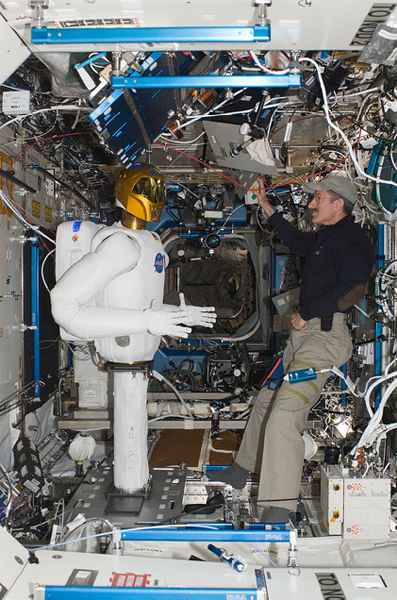
FIGURE 1.11 Robonaut 2 during checkout on the International Space Station. SOURCE: NASA.
Since 2008, Cross Agency Support has been used to fund a range of NASA operations in these areas, including the construction of facilities and infrastructure, to provide capabilities that cannot be tied directly to the specific needs of a particular directorate or program. Cross Agency Support also funds center management and operations, which is a vital part of NASA operations.
NASA-SUPPORTED COMMERCIAL SPACE ACTIVITIES
Since the late 1950s, the U.S. government has been involved extensively in setting requirements, designing, testing, developing, and launching human and robotic spacecraft. NASA’s Commercial Orbital Transportation Services program, initiated in 2006, is designed to foster development of privately operated space transportation systems for access to the ISS. This program, which is currently in Phase 2, is a public-private partnership, in that both NASA and the participating contractors contribute to the cost of developing new systems. Currently, both SpaceX and Orbital Sciences Corporation are under contract to develop new launch vehicles and spacecraft, and on May 25, 2012, and again on October 9, 2012, a Dragon capsule (without a crew) successfully berthed with the ISS. (See Figure 1.12.) In addition, some
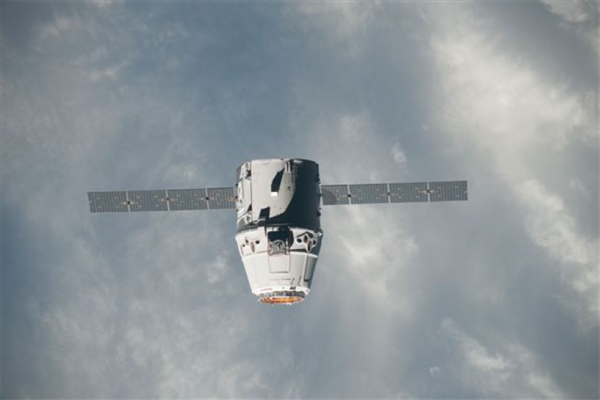
FIGURE 1.12 The SpaceX Dragon commercial cargo craft approaches the International Space Station on May 25, 2012, for grapple and berthing. SOURCE: NASA.
private companies, such as Virgin Galactic, are developing relatively low-cost, suborbital space transportation systems on their own, with the expectation that space tourism by individuals will become a viable business model. To date, more than 500 individuals have made deposits of $20,000 to $200,000 with Virgin Galactic toward a future flight on a Virgin Galactic spacecraft (still under development). Now that NASA has adopted an initiative to develop commercial capabilities with private companies who are entering the business of developing testing and operating space systems. The government no longer has an exclusive role in the design, development, testing, evaluation, and operations of human spacecraft systems.
NASA’s new approach to procuring transportation services is an extension of U.S. government policy that discourages direct government competition with industry in manufacturing systems or providing services that are available in the private marketplace. Of course, this approach is possible only because of previous investments by NASA and DOD over many decades in the development of launch vehicles, systems, processes, technologies, and components. Just as many ongoing improvements in commercial spacecraft are enabled by NASA’s ongoing development of advanced technologies for future civil space missions, the growth of a U.S. commercial space transportation sector would be greatly facilitated by continued investments by NASA in space transportation technology. The National Aeronautics and Space Act of 1958 directs NASA to preserve the role of the United States as a leader in aeronautical and space science and technology. Also, as a major consumer of space transportation services, it is in NASA’s interest to promote advances in space transportation technologies, systems, and capabilities. NASA research is particularly important for precompetitive technologies that are at such a low level of maturity and/or have such a high level of risk that industry cannot justify developing these technologies using private capital.
During the first 6 years of its existence, NASA’s budget increased by an average of 70 percent each year. With the race to the Moon in full swing, NASA’s budget topped out at $37 billion (in FY2011 dollars) in 1965. After falling by 60 percent after the end of the Apollo program, the budget topped out again at $23 billion in FY1991 to support a high level of activity on both the space shuttle and ISS programs. More recently, NASA’s budget has been relatively stable. During the 15-year period from 1997 through 2011, the budget each year has varied by no more than 5 percent from the average value of $18.4 billion (in FY2011 dollars).
Despite the relative stability of NASA’s budget and workforce over the last 15 years, NASA is going through a profound transition:
• From a period of robust space exploration and operations with well-defined and supported objectives to one where there is a clear long-term destination for human exploration (Mars) but a lack of a well-defined national initiative or consensus on the path to get there.
• From a period when the United States had space transportation capabilities second-to-none to a period where the United States must rely on others to launch our astronauts.
• U.S. leadership in space science is being threatened by insufficient budgets to carry out the missions identified in the strategic plans (decadal surveys) of the science communities, while the cost of missions is rising, science budgets are decreasing, and partnerships with the ESA are collapsing—even as other space agencies (most notably ESA) are mounting increasingly ambitious programs.
• From a period where the primary focus of four NASA field centers was on aeronautics research and technology development and where NASA contributed major advances in these areas, benefitting the U.S. economy, quality of life, and national security, to a period where the continued viability of those centers requires financial support from NASA programs or other organizations outside of NASA’s aeronautics program.
• The strategic importance of space is rising and the capabilities of other spacefaring nations are increasing, while U.S. leadership is faltering.
The factors that are driving these transitions and possible corrective action are addressed in Chapter 2.
Bush, G.H.W., 1989. “Remarks on the 20th Anniversary of the Apollo 11 Moon Landing.” George Bush Presidential Library and Museum, July 20. Available at http://bushlibrary.tamu.edu/research/public_papers.php?id=712.
Bush, G.W. 2004. Remarks by the President on U.S. Space Policy. President Bush Announces New Vision for Space Exploration Program. January 14. Available at http://history.nasa.gov/Bush%20SEP.htm.
CAIB (Columbia Accident Investigation Board). 2003. Columbia Accident Investigation Board Report: Volume 1. Available at http://caib.nasa.gov/. August.
Executive Office of the President. 2009. Review of U.S. Human Spaceflight Plans Committee, Seeking a Human Space-flight Program Worthy of a Great Nation. Washington, D.C.: NASA.
Executive Office of the President. 2010. National Space Policy of the United States of America, June 28. Available at http://www.whitehouse.gov/sites/default/files/national_space_policy_6-28-10.pdf.
NASA (National Aeronautics and Space Administration). 2004. The Vision for Space Exploration. NP-2004-01-334-HQ. Washington, D.C.: NASA.
NASA. 2006. 2006 NASA Strategic Plan. Washington, D.C.: NASA.
NASA. 2008. NASA Exploration and Innovation Lead to New Discoveries. NW-2008-09-188-HQ. Available at http://spinoff.nasa.gov/Spinoff2008/pdf/timeline_08.pdf.
NASA. 2010. President Outlines Exploration Goals, Promise. Feature by Steven Siceloff, NASA’s John F. Kennedy Space Center. April 15. Available at http://www.nasa.gov/about/obamaspeechfeature.html.
NASA. 2011. 2011 NASA Strategic Plan. Available at http://www.nasa.gov/pdf/516579main_NASA2011StrategicPlan.pdf.
NASA. 2012. Workforce Information Cubes for NASA: Historical trend in headcount of all employees by year. Available at http://wicn.nssc.nasa.gov/wicn_cubes.html.
NRC (National Research Council). 2006. Decadal Survey of Civil Aeronautics: Foundation for the Future. Washington, D.C.: The National Academies Press.
NRC. 2007. Earth Science and Applications from Space: National Imperatives for the Next Decade and Beyond. Washington, D.C.: The National Academies Press.
NRC. 2009. America’s Future In Space: Aligning the Civil Space Program with National Needs. Washington, D.C.: The National Academies Press.
NRC. 2010. New Worlds, New Horizons in Astronomy and Astrophysics. Washington, D.C.: The National Academies Press.
NRC. 2011. Vision and Voyages for Planetary Science in the Decade 2013-2022. Washington, D.C.: The National Academies Press.
NRC. 2012a. NASA Space Technology Roadmaps and Priorities: Restoring NASA’s Technological Edge and Paving the Way for a New Era in Space. Washington, D.C.: The National Academies Press.
NRC. 2012b. Solar and Space Physics: A Science for a Technological Society. Washington, D.C.: The National Academies Press.
OMB (Office of Management and Budget). 2012. FY 2013 Budget of the U.S. Government: Historical Tables. Available at http://www.whitehouse.gov/sites/default/files/omb/budget/fy2013/assets/hist.pdf.
U.S. House of Representatives, 2011. Agriculture, Rural Development, Food and Drug Administration, and Related Agencies Programs for the Fiscal Year Ending September 30, 2012, and for Other Purposes Conference Report to Accompany H.R. 2112. Available at http://www.gpo.gov/fdsys/pkg/CRPT-112hrpt284/pdf/CRPT-112hrpt284.pdf.


