
ADVANCED SOLID-STATE LIGHTING
Committee on Assessment of Solid-State Lighting
Board on Energy and Environmental Systems
Division on Engineering and Physical Sciences
NATIONAL RESEARCH COUNCIL
OF THE NATIONAL ACADEMIES
THE NATIONAL ACADEMIES PRESS
Washington, D.C.
THE NATIONAL ACADEMIES PRESS • 500 Fifth Street, NW • Washington, DC 20001
NOTICE: The project that is the subject of this report was approved by the Governing Board of the National Research Council, whose members are drawn from the councils of the National Academy of Sciences, the National Academy of Engineering, and the Institute of Medicine. The members of the committee responsible for the report were chosen for their special competences and with regard for appropriate balance.
This study was supported by contract number DE-EE0001405 between the National Academy of Sciences and the U.S. Department of Energy. Any opinions, findings, conclusions, or recommendations expressed in this publication are those of the author(s) and do not necessarily reflect the views of the organizations or agencies that provided support for the project.
Cover: The Thomas Jefferson Memorial following a lighting system redesign in 2001 to include installation of metal halide lamps, induction lamps, and light-emitting diodes. The cove lighting application for the memorial utilizes io Lighting LLC’s Line .75 fixture, 3KHO, 45 degree beam spread in 18-inch daisy chained segments. Photograph copyright Peter Aaron/Esto. Reprinted with permission.
International Standard Book Number 13: 978-0-309-27011-3
International Standard Book Number 10: 0-309-27011-1
Copies of this report are available from the National Academies Press, 500 Fifth Street, NW, Keck 360, Washington, DC 20001; (800) 624-6242 or (202) 334-3313; http://www.nap.edu.
Copyright 2013 by the National Academy of Sciences. All rights reserved.
Printed in the United States of America
Advisers to the Nation on science, Engineering, and Medicine
The National Academy of Sciences is a private, nonprofit, self-perpetuating society of distinguished scholars engaged in scientific and engineering research, dedicated to the furtherance of science and technology and to their use for the general welfare. Upon the authority of the charter granted to it by the Congress in 1863, the Academy has a mandate that requires it to advise the federal government on scientific and technical matters. Dr. Ralph J. Cicerone is president of the National Academy of Sciences.
The National Academy of Engineering was established in 1964, under the charter of the National Academy of Sciences, as a parallel organization of outstanding engineers. It is autonomous in its administration and in the selection of its members, sharing with the National Academy of Sciences the responsibility for advising the federal government. The National Academy of Engineering also sponsors engineering programs aimed at meeting national needs, encourages education and research, and recognizes the superior achievements of engineers. Dr. Charles M. Vest is president of the National Academy of Engineering.
The Institute of Medicine was established in 1970 by the National Academy of Sciences to secure the services of eminent members of appropriate professions in the examination of policy matters pertaining to the health of the public. The Institute acts under the responsibility given to the National Academy of Sciences by its congressional charter to be an adviser to the federal government and, upon its own initiative, to identify issues of medical care, research, and education. Dr. Harvey V. Fineberg is president of the Institute of Medicine.
The National Research Council was organized by the National Academy of Sciences in 1916 to associate the broad community of science and technology with the Academy’s purposes of furthering knowledge and advising the federal government. Functioning in accordance with general policies determined by the Academy, the Council has become the principal operating agency of both the National Academy of Sciences and the National Academy of Engineering in providing services to the government, the public, and the scientific and engineering communities. The Council is administered jointly by both Academies and the Institute of Medicine. Dr. Ralph J. Cicerone and Dr. Charles M. Vest are chair and vice chair, respectively, of the National Research Council.
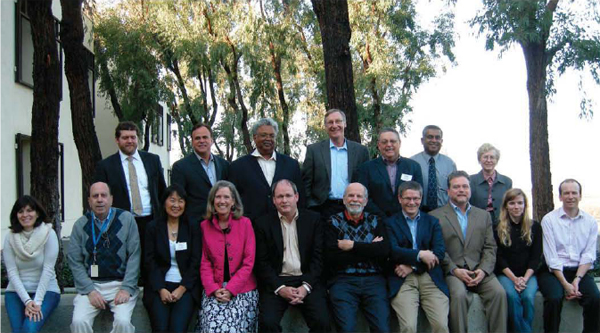
Members and staff at the February 2012 meeting of the Committee on Assessment of Solid-State Lighting. From left to right, back row: David Cooke, Steven P. DenBaars, Michael G. Spencer, Stephen Forrest, Michael Ettenberg, Nadarajah Narendran, and Maxine Savitz; front row: Inês Azevedo, James Zucchetto, Evelyn L. Hu, Nancy E. Clanton, Gary Marchant, John G. Kassakian, Pekka Hakkarainen, Paul A. DeCotis, Wendy Davis, and Martin Offutt. Photo courtesy of LaNita Jones.
COMMITTEE ON ASSESSMENT OF SOLID-STATE LIGHTING
JOHN G. KASSAKIAN, NAE,1Chair, Massachusetts Institute of Technology
INÊS AZEVEDO, Carnegie Mellon University
NANCY E. CLANTON, Clanton & Associates
WENDY DAVIS, University of Sydney
PAUL A. DeCOTIS, Long Island Power Authority
STEVEN P. DenBAARS, NAE, University of California, Santa Barbara
MICHAEL ETTENBERG, NAE, Dolce Technologies
STEPHEN FORREST, NAE, University of Michigan
PEKKA HAKKARAINEN, Lutron Electronics
EVELYN L. HU, NAS2/NAE, Harvard University
GARY MARCHANT, Arizona State University
NADARAJAH NARENDRAN, Rensselaer Polytechnic Institute
MAXINE SAVITZ, NAE, Honeywell, Inc. (retired)
MICHAEL G. SPENCER, Cornell University
Staff
JONNA HAMILTON, Study Director (through December 2011)
MARTIN OFFUTT, Study Director (from December 2011)
JAMES ZUCCHETTO, Director, Board on Energy and Environmental Systems
DAVID COOKE, Research Associate, Board on Energy and Environmental Systems
LaNITA JONES, Administrative Coordinator, Board on Energy and Environmental Systems
ALICE WILLIAMS, Senior Project Assistant, Board on Energy and Environmental Systems
E. JONATHAN YANGER, Senior Program Assistant, Board on Energy and Environmental Systems
________________
1 NAE, National Academy of Engineering.
2 NAS, National Academy of Sciences.
BORD ON ENERGY AND ENVIRONMENTAL SYSTEMS
ANDREW BROWN, JR., NAE,1Chair, Delphi Corporation, Troy, Michigan
WILLIAM F. BANHOLZER, NAE, The Dow Chemical Company, Midland, Michigan
MARILYN BROWN, Georgia Institute of Technology, Atlanta
WILLIAM CAVANAUGH III, Progress Energy, Raleigh, North Carolina
PAUL A. DeCOTIS, Long Island Power Authority, Albany, New York
CHRISTINE EHLIG-ECONOMIDES, NAE, Texas A&M University, College Station, Texas
SHERRI GOODMAN, CNA, Alexandria, Virginia
NARAIN HINGORANI, NAE, Consultant, Los Altos Hills, California
ROBERT J. HUGGETT, Consultant, Seaford, Virginia
DEBBIE NIEMEIER, University of California, Davis
DANIEL NOCERA, NAS,2 Massachusetts Institute of Technology, Cambridge
MICHAEL OPPENHEIMER, Princeton University, Princeton, New Jersey
DAN REICHER, Stanford University, Palo Alto, California
BERNARD ROBERTSON, NAE, Daimler-Chrysler Corporation (retired), Bloomfield Hills, Michigan
GARY ROGERS, FEV, Inc., Auburn Hills, Michigan
ALISON SILVERSTEIN, Consultant, Pflugerville, Texas
MARK H. THIEMENS, NAS, University of California, San Diego
RICHARD WHITE, Oppenheimer & Company, New York, New York
Staff
JAMES J. ZUCCHETTO, Director
DANA CAINES, Financial Associate
DAVID COOKE, Research Associate
ALAN CRANE, Senior Program Officer
JOHN HOLMES, Senior Program Officer
LaNITA JONES, Program Associate
ALICE WILLIAMS, Senior Project Assistant
E. JONATHAN YANGER, Senior Project Assistant
________________
1 NAE, National Academy of Engineering.
2 NAS, National Academy of Sciences.
Solid-state lighting (SSL) is a new technology that has evolved from a few key inventions involving light-emitting diodes (LEDs) in the 1960s and spurred more recently by fundamental breakthroughs in LEDs made in the 1990s. As such, SSL lighting is not a refinement of an incumbent lighting technology but has evolved in parallel with, if more rapidly than, the incandescent and fluorescent lamps familiar to consumers. As discussed in this report, SSL lighting not only can offer improvements in efficacy (i.e., the ability to deliver the same amount of light using less electricity) and improved durability and the convenience of less frequent maintenance (e.g., in roadway lighting or in aviation), but also opens up the possibility of new applications owing to the technology’s high performance in cold environments, long life, and new form factors.
Whether SSL products are to achieve widespread deployment will depend on factors such as cost and consumer acceptance. Cost will depend on the needs of the basic SSL technology, including the material set of the LED device and the raw materials this implies, and the ease of manufacturing, including the effect of scale economies and learning that can be achieved during ramp-up of production—to name only a few such considerations. Technological breakthroughs—such as innovations in the design of the LED emitter devices or improved materials or manufacturing techniques—will also have a bearing on cost. The report summarizes the current state of technological readiness of the candidate technologies, including organic LEDs (OLEDs), for use in SSL products and evaluates the barriers to their improved cost and performance.
Acceptance by the consumer is more difficult to quantify. As discussed in the report, this will depend on factors related to the technology and also the workings of the marketplace. The former include the quality of light emitted by these devices and the subjective attributes of how this is perceived by the human eye. Also of importance will be the ease of use and the useful lifetime of these devices. The latter set of factors includes the problem of high initial cost, which can be mitigated by economic incentives such as tax credits, utility-sponsored rebates, or breakthroughs in manufacturing technology.
Were widespread deployment of SSL products to be achieved, one benefit would be reduced energy consumption. The Energy Independence and Security Act of 2007 (EISA 2007) mandates higher efficacy in general lighting according to a set of targets and timetables, of which the first has already begun. This report evaluates the likely impacts on energy use of this phase-out and, in addition, considers the benefits that might accrue in scenarios considering market penetration of the SSL products greater than the targets.
This report on advanced solid-state lighting was undertaken at the request of Congress in the EISA 2007. Funding has been provided by the U.S. Department of Energy’s Office of Energy Efficiency and Renewable Energy via the lighting program directed by James Brodrick, PhD.
John G. Kassakian, Chair
Committee on Assessment of Solid-State Lighting
This report was made possible through the hard work and dedication of the 13 individuals who served on the Committee on Assessment of Solid-State Lighting, whose biographies are presented in Appendix A.
The data and conclusions presented in the report have benefited from a substantial amount of information provided by federal officials, academic researchers, and industry analysts and technologists who met with the committee during the open sessions of the meetings in Washington, D.C., and Woods Hole, Massachusetts. These individuals are listed in Appendix B.
Special recognition is due the sponsor point-of-contact, James Brodrick, lighting program manager with the U.S. Department of Energy, who on two occasions gave substantive and informative presentations to the committee and made himself available for follow-up discussions—all of which proved invaluable to the committee’s understanding of the nature of the problem and the questions being asked.
This report has been reviewed in draft form by individuals chosen for their diverse perspectives and technical expertise, in accordance with procedures approved by the National Research Council’s (NRC’s) Report Review Committee. The purpose of this independent review is to provide candid and critical comments that will assist the institution in making its published report as sound as possible and to ensure that the report meets institutional standards for objectivity, evidence, and responsiveness to the study charge. The review comments and draft manuscript remain confidential to protect the integrity of the deliberative process. We wish to thank the following individuals for their review of this report:
William F. Banholzer, NAE,1 Dow Chemical,
Randy Burkett, Randy Burkett Lighting Design, Inc.,
Makarand Chipalkatti, Osram Sylvania,
Linda Cohen, University of California, Irvine,
P. Daniel Dapkus, NAE, University of Southern California,
Curtis Fincher, DuPont Displays,
Noah Horowitz, Natural Resources Defense Council,
Julia Phillips, NAE, Sandia National Laboratories, and
Sue Tierney, Analysis Group.
Although the reviewers listed above have provided many constructive comments and suggestions, they were not asked to endorse the conclusions or recommendations nor did they see the final draft of the report before its release. The review of this report was overseen
________________
1 National Academy of Engineering.
by Elsa M. Garmire, Dartmouth College. Appointed by the NRC, she was responsible for making certain that an independent examination of this report was carried out in accordance with institutional procedures and that all review comments were carefully considered. Responsibility for the final content of this report rests entirely with the authoring committee and the institution.
Metrics for Measuring Light Output
Visible Spectrum and Quality of Light
Current Lighting Consumption in the United States
2 HISTORY OF PUBLIC POLICY ON LIGHTING
History of Federal Government Lighting Policy
Current Federal and State Programs
Specifications for High-Performance Buildings
Compact Fluroescent Lamp Case Study
Controlling the Color Output of the LED
Quantum Well Thickness and Composition
Materials Issues for White LEDs
Materials Growth: Mechanisms, Reactors, and Monitoring
The Search for an Improved Substrate
Challenges and Promises for LEDs
The OLED Device Structure and Operation
Controlling the Color Output of the OLED
Key Issues for Improved Device Performance
Issues for OLED Device Reliability and Manufacturing
Summary and Comparison of LED and OLED SSL
4 ASSESSMENT OF SOLID-STATE LIGHTING PRODUCTS
Subcomponents of an SSL Product
LED Product Measurement and Performance
Luminaires with Entirely New Form Factors
System and Controls Compatibility
Evaluating SSL Lighting Applications
Testing and Measurement Standards
Barriers and the SSL Value Chain
Upstream Opportunities and Challenges
Midstream Opportunities and Challenges
Downstream Opportunities and Challenges
Utility-Administered Programs and Partnerships
SSL Cost and Energy Savings Potential
Residential and Commercial Energy Consumption Surveys
Role of Government in Aiding Widespread Adoption
Outreach and Communication on Implementing Standards
Public Funding of Applied Energy R&D
7 FINDINGS AND RECOMMENDATIONS


