
The workshop participants heard a series of presentations on energy-conservation efforts within the military services and in private-sector companies representing the aircraft, chemical, automobile, and armaments industries (see the workshop agenda, Appendix B). Abstracts of these presentations are provided in Appendix D. A brief summary of the main points of the presentations and the ensuing discussion is given next, in chronological order of presentation.
Kevin Geiss, Deputy Assistant Secretary of the Air Force for Energy
Kevin Geiss, Deputy Assistant Secretary of the Air Force for Energy, presented the primary motivation for reducing energy consumption—to support the Air Force mission. He discussed the Air Force’s three-fold strategy: (1) reduce demand, (2) increase supply, and (3) change the culture, and noted progress toward the goals shown in Figure 1-3 in Chapter 1. A key need is to install meters to provide data on electricity use with finer precision so that they can determine what specific processes and equipment are using the energy and where the major opportunities are. Each facility’s energy use is unique and dynamic as workloads change. Furthermore, Geiss noted, culture change takes time. Personnel need to be encouraged to be innovative and must receive appropriate training to be able participate effectively in efforts aimed at reducing energy consumption. Without more data on energy use, “You don’t know what you don’t know.” The question was raised as to whether there is any evidence that installation of smart meters actually results in energy savings. The biggest gains may require automated energy management control systems—that is, going beyond just providing data for energy analysis.
Joseph Sikes, Director of Facilities Energy Privatization, Office of the Deputy Under Secretary of Defense for Installations and Environment
Joseph Sikes, Director of Facilities Energy Privatization, Office of the Deputy Under Secretary of Defense for Installations and Environment, emphasized the main objective of Department of Defense (DoD) energy projects—to do the mission better. Recent initiatives have included expanding the use of renewables, installing microgrids, and technology development. At the end of the year, all of the military services will report data on energy use. This information will be put into an online database to increase visibility. An annual energy management report is expected to be released in March 2013, in which all bases will be listed by energy-intensity and energy-reduction targets. Sikes noted that facilities use 20 to 25 percent of DoD energy. The energy-intensity metric (British thermal units per square foot) is far from ideal, but “one we are stuck with.” Unless it is adjusted for changes in external factors, it can give the wrong answer. For instance, when soldiers return from deployments overseas, energy use on U.S. bases goes up, even if the buildings have become more efficient. In that case, British thermal units per person would be a better metric. Also, consolidation of data centers or demolition of unneeded buildings, which can be desirable from an efficiency point of view, reduces the overall square footage and therefore increases the energy-intensity metric. Most of the direct spending on energy within DoD is on expanding renewable-energy projects. In principle, renewables provide a distributed source of energy at a base, and so a base is more secure in a crisis if it is set up so that it can be switched from the grid to a local microgrid on the base. Unfortunately, we are not there yet, and the renewable projects do not pay back the investment unless the bases are on islands (e.g., Kwajalein, Shemya, Diego Garcia) or are otherwise difficult to supply (e.g., Djibouti).
Sikes related that considerable gains in reducing energy use can be made just by gridding the generators on a base so that energy output can be tuned to the electricity demand. The Navy has done considerable work on optimal gridding of shipboard generators. Another opportunity involves peak shaving and demand-side management, in which bases can save a lot of money by working with local utilities. He also noted that there is a memorandum of understanding among major federal agencies (including the Department of Energy [DOE], the DoD, and the Department of Homeland Security) to promote emergency-management cooperation with local authorities, and that military bases are working more closely with government and private entities outside the base. If closer cooperation could be established between the DoD, local energy utilities, and federal regulators of local utilities, then some of these costs could be reduced at many installations. The local utilities are not depending on the fees from the bases, but they have to keep a higher capacity level by law because the solar capacity is not counted.
One participant noted that the metric for renewable energy—the quantity procured or produced divided by total energy—does not actually address either energy reduction or energy security. It is important to review this metric so that it does not cause unintended consequences. Another observer noted that although the acquisition of new military systems and equipment provides a unique opportunity to consider life-cycle energy efficiency, there is currently no directive to the acquisition community to enable serious investment in energy reduction. Stated differently, this not just as an investment in energy reduction, but as part of the life cycle cost of purchasing and operating the equipment, rather than just the capital cost for it. More efficient equipment is often more costly upfront, but less expensive when considering the full lifecycle costs. Energy considerations need to be threaded throughout the business analysis in acquisition decisions, and they need to be codified in guidance that carries weight.
Paul Bollinger, Director, Boeing Energy
According to the presentation by Paul Bollinger, Director, Boeing Energy, Boeing takes a life-cycle approach to reducing its environmental footprint—including that related to energy consumption, greenhouse gases, water consumption, hazardous waste, and solid waste. It has an integrated management system for measuring and reporting on progress, with a roll-up that can focus on sites, regions, or enterprise-wide results. “It comes down to culture,” he said. More than 6,000 employee-involvement teams meet once per week. Boeing received the 2012 Environmental Protection Agency Energy Star Partner of the Year award. Its chief executive officer is publicly committed to conserving energy, and its energy consumption has decreased since the base year 2007 despite increased production of aircraft.
The discussion after the presentation explored Boeing’s motivations for reducing energy. Boeing’s 787 aircraft is sold in part for its fuel efficiency. By extension, customers are also looking at the production efficiency. Commercial airlines focus on energy efficiency, which is tracked for each pilot and aircraft tail number. Significant savings have been achieved simply by adjusting the center of mass of the aircraft for optimum efficiency. Bollinger noted that the military does not have the same financial motivation as that of a commercial enterprise. He observed that support for energy conservation comes and goes in the various military services and that officers need to be held accountable for making progress on the energy front. Big fuel savings are possible when equipment is replaced—for example, when the Joint Surveillance Target Attack Radar System program transitioned to the more efficient Boeing 737 aircraft.
Col Douglas Wise, Chief, Civil Engineering Operations and Readiness Division, HQ AFMC/A70
Five of the top 10 energy-consuming installations in the Air Force are within AFMC, including the three air logistics complexes (ALCs): Oklahoma City ALC, Oklahoma (#1), Ogden ALC, Utah (#3), and Warner Robins (ALC), Georgia (#7). Col Douglas Wise, Chief, Civil Engineering Operations and Readiness Division, Headquarters Air Force Materiel Command (AFMC), estimated that for AFMC to reach its energy-reduction goals in FY 2015 would require investing the entire operations and maintenance (O&M) budget of the Air Force. Installations are not able to keep the money that they save with from energy-reduction investments, and so they have less incentive to make these investments. An ongoing point of friction is that of relating energy savings to the mission—for example, how does a 1 percent energy saving affect the mission?
FY 2010 saw the first standardized reporting of energy intensity, in the form of standard spreadsheets that could be shared with all installations. Water use is not currently metered, but the goal is to do so in the 2015-2016 time frame. Several potential sources of money, or “colors of money,” are available to fund energy projects. These include O&M (“3400” funds); research, development, testing, and evaluation (“3600” funds); and capital investment funds. These funding sources are not fungible— that is, one cannot use 3400 funds for projects at test facilities. In FY 2009, focus funds (approximately $200 million per year) were set aside in the O&M budget for energy-related projects, and the Major Commands (MAJCOMs) were asked to submit project proposals with estimated returns on investment. In addition, Energy Savings Performance Contracts (ESPCs), which fall under Executive Order,1 and Utility Energy Service Contracts (UESCs), in which third-party companies come in and do projects to improve a facility for a fixed fee, are options available to the Air Force. In that case, the company owns and maintains the infrastructure and captures any long-term profits. Col Wise estimated that the private sector (e.g., Wal-Mart) invests about 3 to 4 percent of its budget in renewing its infrastructure, whereas the DoD/Air Force invests about 1 percent.2
______________________
1For additional information, see Presidential Memorandum — Implementation of Energy Savings Projects and Performance-Based Contracting for energy savings. December 2, 2011. Available at http://www.whitehouse.gov/the-press-office/2011/12/02/presidential-memorandum-implementation-energy-savings-projects-and-perfo. Last accessed on December 27, 2012.
2The Air Force has historically invested at 2 percent (or less) of plant replacement value on operations and maintenance (O&M) and recapitalization. O&M is the day-to-day maintenance of a facility while recapitalization is the replacement of building subsystems, to include roofs, HVAC, control systems, paving, fire protection apparatus, among other items. Recapitalization may vary as a facility ages; that is, you will likely spend more on recapitalization as subsystems fail. There are differing opinions on a good rule of thumb for O&M and recapitalization. One estimate cites 4 percent (2 percent for O&M and 2 percent for recapitalization). For additional information, see For additional information, see http://www.tradelineinc.com/reports/E81F7036-BECE-11D4-95B9005004022792. Other estimates recommend 29 percent for O&M and 4 percent for recapitalization. For additional information, see http://www.tradelineinc.com/reports/59A81BA1-DB23-11D4-95BA005004022792/0/0/. Either way, the
Civil engineering (CE) personnel manage the installation of meters and other building-related projects, but logistics personnel have responsibility for the industrial processes that go on inside the buildings. The ALCs lack a funding source for conservation programs. The CE side can help, but it cannot drive the process. The CE and sustainment communities need to work together. The AFMC is undergoing a management change in which 12 sustainment centers are being reorganized into 5, with each center overseeing multiple installations. This reorganization provides an opportunity to increase the visibility of process energy efficiency. The ensuing discussion raised several points. One participant noted that it is sometimes difficult to cleanly define “process energy.” In paint hangars, for example, the heating, ventilation, and air conditioning (HVAC) system serves the dual purpose of maintaining a comfortable temperature as well as providing heat for the painting process. This can cause problems when investment is required and funding sources have definite colors. Fifteen years ago, pollution prevention was integrated into the depots. The personnel already exist and could be repurposed to focus on energy reduction—it is not a personnel issue. Indeed, pollution prevention money has been used for energy projects at Tinker AFB.
Col Stephen Wood, Vice Commander, 72nd Air Base Wing, Tinker Air Force Base
Col Stephen Wood, Vice Commander of the 72nd Air Base Wing, Tinker AFB, discussed efforts to reduce process energy at the Air Force Sustainment Center (AFSC), one of the reorganized sustainment centers in AFMC, based at Tinker AFB. He noted that the mandated energy meters have been purchased and that installation at the building level should be completed by the spring of 2013. Submetering, or metering of individual processes inside buildings, at the industrial process level has not yet been accomplished, but it will be needed in order to provide data to process owners. Lt Gen Bruce Litchfield, commander of the AFSC, has set a goal of 5 percent reduction in energy consumption per year, which goes beyond the federal goals. AFSC has identified the major inefficiencies in its industrial processes, and is initiating partnerships with local government, industry, and academia to address them. Challenges include low utility rates across the complexes and changing processes that place limits on the required investment-payback times for energy-reduction investments. The discussion following this presentation focused on opportunities to work with local utilities to reduce electricity costs. Utilities have an incentive to reduce peak loads through demand-side management programs and interruptible power deals that lead to lower rates to customers.
Air Force is below recognized standards. Also, the figures cited by Col Wise include only real property assets, not equipment items, such as dipping tanks, spray booth equipment, among other items. SOURCE: Col Douglas Wise, Chief, CE Operations and Readiness Division, HQ AFMC/A70. Personal communication to Carter Ford on December 19, 2012.
Kirk Rutland, Technical Director, Test Sustainment Division, Arnold Engineering and Development Complex
Kirk Rutland, Technical Director of the Test Sustainment Division, Arnold Engineering and Development Complex, explained how Arnold creates flight-test conditions on the ground; the controlled conditions provide better test data, and ground testing is more cost-effective and efficient than air testing. A huge amount of energy is required to “create the conditions.” The test workload constitutes approximately 93 percent of the power demand, which is 18 megawatts (MW) on average, but can surge to a peak of 400 MW, equivalent to about one-third of the power average demand of Nashville, Tennessee. Customers are generally the acquisition community, who need the test data to help them make decisions. Much of the infrastructure at Arnold is from the 1940s and 1950s, but it still works, and even though it is not the most efficient, its replacement is a low priority. Fighting obsolescence of infrastructure is a much bigger concern than energy efficiency, although there are opportunities for efficiency improvements when infrastructure is replaced.
The metric of performance at Arnold is “more data in less time,” not energy efficiency, Rutland explained. If a test campaign can be shortened by several days, much more money is saved than could be saved by energy efficiency. Process energy use is not metered. Some energy use at Arnold is excluded from the Air Force energy bill, so the question is asked—what is the incentive? Energy-efficiency investment costs cannot be passed on to the customer, so the question is, where to go for money for reducing process energy use? During the discussion, the question was raised as to whether the ideal efficiency of test processes at Arnold is known. The answer was that no studies have been done. Energy use per test data point has not been tracked. A related point is that responsibility for managing energy use at Arnold tends to be placed on civil engineering personnel, who do not have the expertise to address processes in which the bulk of energy is used.
Cameron Stanley, Support Contractor, Advanced Power Technology Office, Air Force Research Laboratory
Cameron Stanley, Support Contractor, Advanced Power Technology Office (APTO), Air Force Research Laboratory (AFRL), indicated that APTO is supporting energy-related projects in five bucket areas: hydrogen, renewable energy integration, waste to energy, advanced energy technologies, and energy storage. There are three crosscutting focus areas: operational energy, process energy, and energy security. Congress recently added $40 million to APTO’s budget to implement new cutting-edge technologies. Stanley stated that technology solutions (e.g., energy storage) must be tailored to specific environments and/or applications. To be successful, AFRL needs better requirements for Air Force energy-related projects and also good technology-transition partners. The metrics also need to be appropriate. For instance, investments in the
cyber area often lead to smaller, faster processing, and this investment is desirable; however, the processors also tend to have a higher energy intensity. A point raised in the discussion is the importance of getting young, energetic students involved in these energy technology projects, whether at the Air Force Academy or through the Air Force Institute of Technology (AFIT) at Wright-Patterson AFB, Ohio.
The November 5 session ended with a discussion of the presentations and discussions that the workshop participants had heard. Participants noted that the Air Force had demonstrated progress on energy issues, at least at the MAJCOM level, although less so at higher levels. The Air Force Council has responsibility for achieving efficiency targets and subpanels of the Council are concerned with energy, but some workshop participants argued that a continuing effort will be needed to ensure that the gains are sustainable. Wal-Mart has the slogan “Save Energy, Live Better”; the Air Force needs a slogan such as “Save Energy, Fight Better.” Partnering among the Air Force, government, and industry was viewed by many workshop participants as an important way forward. An example of a potential source of useful information for the Air Force is the Construction Industry Institute (CII) at the University of Texas that brings together key private companies and government agencies. Funding issues are key to progress in this area. Many participants stated that proper incentives for improving energy efficiency are needed. Trade-offs between reducing energy use and meeting readiness objectives need to be explored. The proper approach is one of balance, and identifying when both efficiency and conservation strategies could impact the mission versus just require a change in culture (as conservation frequently does). It was also noted that having the right sensors and meters to measure energy use is important in order to effect change. Proper metrics are also needed. For example, energy intensity measured in British thermal unit per square foot, while a good metric for office space and living quarters, is not a very good metric for process energy use. It was argued that the Air Force has been focused on the low-hanging fruit in facility energy use, whereas technology improvements are needed but not funded. How can a process that has twice the throughput at half the cost be implemented?
Robert Gemmer, Technology Manager from the Advanced Manufacturing Office (AMO) in DOE’s Office of Energy Efficiency and Renewable Energy (EERE), was invited to give an unscheduled presentation on AMO’s outreach to industry in its effort to improve the energy efficiency of industrial processes. There are now industrial assessment
centers3 at 26 land-grant universities aimed at educating students and identifying ways to assess and improve industrial processes such as the following: (1) process heating (which accounts for one-third of all industrial energy use), (2) boilers and steam delivery, (3) compressed air, (4) air movement systems, and (5) motors. AMO has developed a suite of software tools4 for identifying where the energy savings opportunities are. A group of 200 qualified specialists trained in the use of these tools is available for outreach. A small subset of these specialists, the “energy experts,” is able to teach the use of the tools and are available to work with clients.5 Former Secretary of Energy Samuel Bodman instituted a program in which 200 industrial facilities were checked for opportunities to reduce energy use in steam and process heating. The program identified $500 million in potential savings, of which 40 percent ($200 million) has been realized. A list of participants is available. DOE has also calculated the theoretical energy required to process materials, and has estimated the practical energy minimum for the same processes.6 During the discussion of this presentation, several workshop participants from industry praised the Industrial Assessment Centers of AMO, noting that they had used these centers as training opportunities for their own employees.
Thomas Hicks, Deputy Assistant Secretary of the Navy for Energy
The Navy does not promote an energy/environmental agenda per se—like the Air Force, it is explicitly concerned with energy security and combat capability. Deputy Assistant Secretary of the Navy for Energy Thomas Hicks gave a high-level overview of the Navy’s energy-related programs, including goals for alternative energy (e.g., waste to energy, biofuels) and renewables, power purchase agreements, and culture change. Incentives are given to commanders to be more efficient, and awareness of energy use has made facilities more efficient. The latter effort led to a 10 percent reduction in energy used in housing. The Navy has made a conscious effort to bring energy guidance as a factor into the acquisition process; Hicks cited an energy-efficient landing ship as an example. Much of the ensuing discussion focused on skepticism regarding the cost-effectiveness of investments in renewables and other energy projects. It was pointed out that it is necessary to take advantage of renewable energy credits and tax incentives to make the investments attractive for third-party power purchase agreements, and “take or pay” guarantees have to be provided so that if a base is closed or another
______________________
3Additional information on Industrial Assessment Centers can be found at http://www1.eere.energy.gov/manufacturing/tech_deployment/iacs.html. Accessed November 20, 2012.
4Additional information on energy assessment tools can be found at http://www1.eere.energy.gov/manufacturing/tech_deployment/software_ssat.html. Accessed November 20, 2012.
5Additional information can be found at http://www1.eere.energy.gov/manufacturing/tech_deployment/assessment_process.html. Accessed November 20, 2012.
6Additional information on DOE’s Clean Energy Application Centers can be found at http://www1.eere.energy.gov/manufacturing/resources/footprints.html. Accessed November 20, 2012.
energy source is chosen, the third party will be compensated for its investment. Part of the problem is that energy security and mission capability are not monetized. Platforms may use more energy but provide more capability; the Joint Strike Fighter is an example. It is important to have energy metrics but, although they should be a factor, they should not be the only factor.
Sandrine Schultz, Energy Program Manager, Commander, Navy Installations Command
Sandrine Schultz, Energy Program Manager for the Navy Installations Command presented a developing heads-up “dashboard” tool that displays data on energy intensity from building-level meters overlaid on a geospatial map of the facility to promote awareness of energy use and to show improvements for both field personnel and managers (see Figure 2-1). The display is very intuitive, with problem buildings shown in red and satisfactory buildings in green. The data can be rolled up at various levels, from individual units in facilities to entire facilities. The module is updated on a monthly basis (for example, to account for buildups in places such as Guam), and data
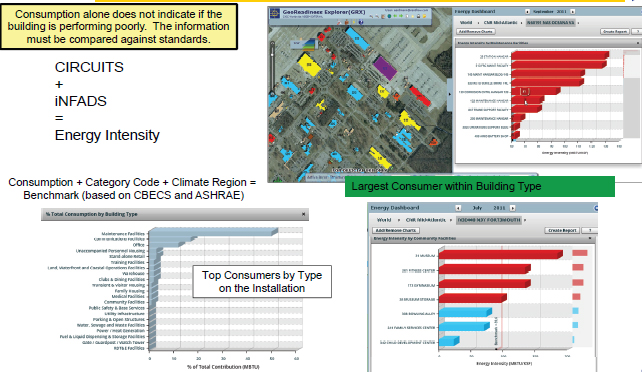
FIGURE 2-1 Example of the energy-intensity dashboard display being developed by the U.S. Navy. Metering data on the intensity of energy use is overlaid on geospatial facility maps, with colors indicating building performance. NOTE: CBECS, Commercial Buildings Energy Consumption Survey; ASHRAE, American Society of Heating, Refrigerating, and Air-Conditioning Engineers. SOURCE: Sandrine Schultz, Energy Program Manager, Commander, Navy Installations Command, presentation to the workshop, November 5, 2012, Washington, D.C.
errors are corrected immediately. The energy dashboard tool is to be made available throughout the Navy on November 17, 2012. The general response of the participants to this presentation was very favorable, and the suggestion was made that the Air Force may wish to adopt a tool like this as a way to monitor and promote its own energy-reduction efforts.
John Dwyer, Deputy Chief of Staff for Logistics, Army Materiel Command
The Army’s goals and programs for energy-use reduction, development of renewables, and water conservation are similar to those of the Navy and the Air Force as discussed above, according to John Dwyer, Deputy Chief of Staff for Logistics, Army Materiel Command (AMC). There is a full-time civilian energy manager (GS 12 to GS 14) at 95 percent of Army installations. Savings identified by these managers have yielded a return on investment (ROI) in their salaries by a factor of five. There are weekly installation briefings on energy with high commander visibility. Capital investment program projects require the metering of electricity and are not approved if they are not expected to result in energy savings. The Army also uses the energy-intensity metric, but normalizes it by direct labor hours to account for changes in personnel levels.
Budgets available for funding energy-related projects in AMC are predicted to shrink in coming years. The AMC has identified its most energy-intensive processes through energy audits. It relies heavily on ESPCs with third parties to address these. Equipment used directly on the production line is paid for by Army core funding, and the infrastructure is financed by third parties. About $360 million is estimated to be needed to enable AMC to meet its energy intensity reduction goals—about two to three times its annual energy expenditure. Therefore, private sector financing through various mechanisms is viewed as critical for success. Several participants viewed with favor the normalization of the energy-intensity metric by direct labor hours, noting that further adjustments were needed to account for changes in facility square footage through consolidation, demolitions, or base closures. The question was raised as to whether funds that might materialize from the return of Army facilities in Germany to the German government could be made available to fund energy projects. The answer was that those funds would remain in Germany for use in future construction projects there.
The Federal Energy Management Program (FEMP) provides the services, tools, and expertise to federal agencies to help them achieve their energy-use, greenhouse gas, and water-consumption reduction goals as mandated by legislation and Executive Orders. Timothy Unruh, Program Manager for FEMP, in DOE’s EERE, noted that the Air Force is ahead of the rest of the federal government in meeting its goals for energy- and
water-consumption reduction. FEMP is also working with the military academies to give energy-related awards to students, in categories defined by the academies.
A December 2, 2011, Presidential Memorandum7 stated that “The Federal Government will enter into a minimum of $2 billion in performance-based contracts in Federal building energy efficiency within 24 months.” FEMP coordinates these contracts, 39 of which have been awarded, with a total value of $427 million. An example is an $80.7 million ESPC signed in August 2012 at Tinker AFB that is expected to reduce energy intensity by 30 percent and save $6.4 million per year. The project decentralizes steam heating so that steam will no longer be sent long distances. These third-party projects typically take about 2 years to develop, then another 2 years to show results. It is not known how the $2 billion goal, which does not require any appropriation, matches the actual need. One comment following this presentation was that there needs to be an understanding of what it is that one wants to meter and of what meters or sensors are most appropriate to the task. A process expert should select the right meter for a particular process. In some cases, a 15-minute meter may be useless and a 30-second meter may be right. A second comment suggested an alternative metric for evaluating project success: dollars invested per British thermal unit saved. A dollar invested should yield a 6,000-8,000 Btu reduction.
Al Hildreth, Company Energy Manager, General Motors North America
General Motors (GM) has an annual energy budget of approximately $1 billion and a robust business process to manage it, according to Al Hildreth, Company Energy Manager for General Motors North America. Goals have been set by top management to reduce energy, greenhouse gases, and water use, and GM participates in the Energy Star program. All plants are ISO 50001-certified. GM uses the metric megawatt-hours (MWh) per vehicle to measure its energy intensity; in North America it currently requires 2.59 MWh to produce a vehicle, equivalent to the electricity used by one household in a year. GM uses a proprietary energy-management dashboard display to track energy intensity that half of its plants currently feed into.
GM estimates that 60 percent of its energy consumption is due to processes and has conducted audits to identify opportunities for reduction. The largest electricity user is the paint shop. Hildreth discussed a series of steps that were taken to improve energy efficiency in painting operations, the most significant of which was increasing the fraction of recirculated air to outside air. Annual energy savings from taking these steps amounted to nearly $3 million. Most participants were favorably impressed by GM’s program and its energy-intensity metric, and thought that the Air Force’s efforts to
______________________
7For additional information, see “Presidential Memorandum — Implementation of Energy Savings Projects and Performance-Based Contracting for energy savings.” December 2, 2011. Available at http://www.whitehouse.gov/the-press-office/2011/12/02/presidential-memorandum-implementation-energy-savings-projects-and-perfo. Last accessed on December 27, 2012.
reduce industrial process energy would benefit from a closer collaboration with companies such as GM.
James B. Porter, Jr., Independent Consultant
As indicated by James B. Porter, Jr., retired vice president for engineering and operations at DuPont, DuPont consumes 129 trillion Btu of energy per year, compared with the Air Force’s 65 trillion Btu. DuPont’s business goal is “sustainable growth” that entails increasing shareholder and societal value while decreasing the footprint of operations. In 1999, DuPont announced the goal of holding energy use at or below the 1990 baseline, with additional goals for greenhouse gases and renewable energy use. In fact, DuPont has achieved a 6 percent reduction in energy consumption since 1990, despite the 40 percent increase in production. The commitment of senior leadership to sustainable growth is the key to DuPont’s success; this commitment percolates down through the enterprise. A single site manager at each plant is responsible for all aspects of operations, including meeting energy-savings targets. Energy-use data are aggregated at the site level. The metric is energy dollars spent last year divided by energy dollars spent this year. It is important to keep the value proposition in front of managers and stockholders, Porter noted. DuPont estimates that it has gotten a 60 percent internal rate of return from its investment in energy projects.
DuPont has many subject-matter experts in energy-related issues. They are deployed by means of a leveraged model to maximize effectiveness and efficiency. Peer-to-peer forums of energy champions have been key enablers. Technology is also being used to promote energy savings, with a website that disseminates best practices, downloadable energy engineering assessment tools, and virtual workshops that enable energy training without the necessity of travel. Peer recognition for meeting energy goals is important, perhaps more so than recognition by management. The DuPont culture is that all energy-management projects are good business projects. The notion of “sustainable energy management” seemed to resonate with the Air Force participants in the workshop, as well as the emphasis on the commitment of top leadership. In response to a question, Porter noted that the energy-efficiency culture promoted by DuPont has also spilled over into the energy choices that their employees make in their personal lives.
Roger Weir, Energy Manager, ATK Aerospace Systems
As noted by Roger Weir, Energy Manager for ATK Aerospace Systems, ATK is the world’s top producer of solid rocket propulsion systems and military ammunition. Its operations are widely dispersed, with some 24 offices and operating locations in 23 states. Starting in 2009, each location was required to develop an energy plan, but communication among sites and sharing of best practices have proved challenging.
Annual energy spending is $70 million, and 7.3 trillion Btu are consumed. No funds are specifically allocated for energy projects, which must compete for funding with other projects. ATK has a dashboard display system for tracking water, air, gas, electricity, and steam (WAGES) consumption on a monthly basis and comparing it to budget targets, primarily for primary process building owners. Annual pay increases are tied to cost reduction in these areas. Weir cited several projects involving improvements to processes that had significant energy savings, although the motivation for undertaking them was to increase throughput:
• Replacing an electric furnace with a natural gas furnace.
• Replacing a gas-fired continuous line anneal furnace with a cellular electric furnace,
• Replacing an old anneal furnace with a new one that has improved insulation,
• Modernizing steam boiler controls, and
• Installing remote maintenance of an HVAC system with an automatic trouble notification system.
ATK believes that the future sustainable grid will involve much more distributed electricity generation, with energy storage technologies becoming more prevalent. Weir described a 3-year joint project between DOE and ATK to explore several of these technologies and to gather data on their performance.
Kenneth Walters, Chief of the Measurement and Analysis Division of the AFMC’s Air Force Civil Engineer Center—Energy, was invited to give an overview of progress in the metering of electricity use in Air Force facilities. The Energy Policy Act of 2005 mandates that federal agencies put meters on all facilities where it is cost-effective. To judge cost-effectiveness, the Air Force uses an algorithm based on the estimated amount of electricity used in a building and the cost of the electricity, and it assumes that at least 2 percent of electricity costs would be saved just from the awareness that an installed meter would provide. Fully burdened, the cost of installing a meter is about $10,000. If savings are calculated to be a few thousand dollars per year, this is judged to be cost-effective. Some 74 percent of the mandated electricity meters have been installed at Air Force facilities, at a cost of $100 million. The remainder are expected to be installed in the next few months. Military construction specifications require meters on all new buildings.
The Air Force has already contracted out the development of an advanced meter-reading system (AMRS) that will provide a dashboard display of electricity use enterprise-wide, similar to the system described above being developed by the Navy. It is expected to be deployed over the next 2 years. Submetering of specific processes has
not yet been addressed, but it is not precluded. One problem is that the meters are of different types and they talk to different proprietary systems, so in some cases it is necessary to pull data from alternative sources.
Col Steven Wood, Vice Commander, 72nd Air Base Wing, Tinker Air Force Base
Col Steven Wood was asked to comment on relevant activity at Tinker AFB, which is a joint Air Force and Navy base with good cooperation between the two. The Navy pays for its electricity based on its usage. From the perspective of the Air Force,, electricity use at Tinker AFB is reported as the fenceline electricity minus amounts attributed to other customers and tenants. In 2009, Tinker AFB took over an old GM plant that was only lightly used, and so the energy-intensity metric dropped (due to the increase in the denominator square footage). Tinker AFB has purchased meters to monitor electricity, gas, and water usage, although they are not all installed. Current energy projects do not yet address industrial process energy, but Tinker AFB is ramping up a team to focus on process energy, as are Hill AFB, Utah, and Robins AFB, Georgia.
Col Gregory Ottoman, Chief of the Environment and Energy Division, Office of the Deputy Chief of Staff for Logistics, Installations, and Mission Support, noted that the progress of the Air Force in reducing facility energy intensity (16.8 percent since 2003) leads the other services. The Air Force has three reasons to invest in energy projects: (1) It must try to meet congressional and presidential mandates; (2) the savings in utility costs are considerable, with about $2 dollars saved for every dollar invested; and (3) reducing energy use contributes to national security (although there is no price tag on this benefit). It all boils down to funding, Ottoman said, and finding the dollars to invest will get harder in the future. Restoration and maintenance (R&M) funds for retrofitting facilities that are currently being set aside for energy projects will no longer be set aside in FY 2016, and so energy projects will have to compete with all other projects. These funds can’t be used for improving industrial processes or for laboratories. There are no excess dollars in the infrastructure budget; about $1 billion is available, but the backlog is around $33 billion.
Leadership needs to decide to dedicate funding to energy projects. There is an oversight and resourcing council chaired by Terry Yonkers, Assistant Secretary of the Air Force for Installations, Environment and Logistics, that has energy as part of its purview. The focus of federal mandates and EOs on the relatively small fraction of Air Force energy consumed in facilities rather than the much larger fraction used in aviation appears to be skewed, but this is changing. One stated goal was to reduce aviation fuel
use by 10 percent from 2006, but this goal has not been met due to the wars in Iraq and Afghanistan. There are expected to be new initiatives on reducing fuel use in aviation in this Program Objective Memorandum (POM) cycle.
Ottoman argued that the metrics for measuring energy intensity may be appropriate for office buildings but are not appropriate for addressing industrial process energy. Also, base utility bills are in the “must pay” category. Commanders and managers know that they will get the money necessary to pay them—which reduces the incentive for reducing consumption. The Air Force believes that it is in relatively good shape in meeting its goals for reducing water consumption and expanding renewable energy. However, there is a recognition that decisions regarding energy and environmental projects continue to be made on an ad hoc basis, which leads to suboptimization. For example, the Air Force has leased land at Nellis Air Force Base on which a contractor has built a photovoltaic (PV) electricity system, ostensibly to meet renewable energy and energy security goals for the base. However, the PV electricity is not connected to the base, but instead goes directly to the grid, and there does not appear to be funding available or the right incentives to make the connection to the base. Technology tends to be applied where it can be applied, as opposed to where it should be applied. Ottoman stated that there needs to be a macro model that could lead to a more holistic approach to energy and environmental decision making throughout the Air Force.
Much of the discussion following this presentation revolved around the issue of fragmented decision making and suboptimization. One participant commented that DuPont’s energy initiatives also started as scattered and ad hoc efforts, and only coalesced into a coherent program over time. The Office of the Deputy Assistant Secretary of the Air Force for Energy has only been in existence for about 2 years, with a small staff and minimal contractor support. The biggest concern may be the lack of visibility of energy issues at headquarters outside of the civil engineering community. There are no “blue-suit” logisticians; leadership is needed to address process energy. Several participants asserted that energy use must be translated into cost in order to influence the acquisition community.
Several workshop participants also commented on issues related to metering. Metering will provide quicker and more accurate data on energy consumption to managers. The Empire State Building in New York City was renovated several years ago and meters were installed. Businesses located in the building competed to reduce their electricity consumption. The lesson was that energy use should not be viewed as an isolated island—there is a whole community involved. Other comments related to funding for submetering, which will be needed in order to tackle industrial process energy. Submetering would have to be funded by maintenance accounts rather than civil engineering accounts. However, meters would not have to remain indefinitely at a single site. It should be possible to save money by moving meters around from site to site in order to verify the value of investments as part of a research and development process.


