CHAPTER 1
THE U.S. DECADE FOR NATURAL DISASTER REDUCTION
The United States is extremely vulnerable to natural disasters. Every state is exposed to one or more of a host of hazards: earthquakes, droughts, floods, hurricanes, landslides, tornadoes, tsunamis, volcanoes, and wildfires. As Hurricane Hugo demonstrated in 1989, natural disasters can undo years of development and devastate natural resources in minutes or hours. The growth of cities; the special vulnerability of such groups as the elderly and the poor; the increased complexity of housing, communication, and transportation systems; and the potential fragility of an increasingly electronic and computerbased economy further increase the potential for catastrophe in the wake of a hazardous event.
The Decade for Natural Disaster Reduction offers an opportunity to create a safer future. The scientific and technological advances of the last half century provide unprecedented opportunities for mitigating the impact of natural hazards. Recognizing this fact, Dr. Frank Press, President of the National Academy of Sciences, proposed an international decade to address natural disaster reduction at the Eighth World Conference on Earthquake Engineering in 1984. In 1987, the United Nations adopted a resolution declaring the 1990s the International Decade for Natural Disaster Reduction (IDNDR). The U.S. Senate and House of Representatives endorsed the Decade concept in resolutions passed the following year.
Direct losses from natural disasters in the United States, currently averaging $20 billion per year, continue to escalate. (See Table 1 for events with insured losses exceeding $5 million each.) The forces that contribute to disaster-related losses are well known. In spite of advances in hazard and risk assessment, vulnerable development continues in disaster-prone areas, often without recognition of the hazard. Although the scientific knowledge exists to forecast where, for example, earthquakes, wildfires, and landslides are most likely to occur, vulnerable new structures are being built in areas that ought to be avoided. Similarly, intensive development is occurring along the hurricane-prone Atlantic and Gulf coasts.
These escalating losses from disasters can be stemmed. Natural hazards are not inevitable calamities. Loss reduction measures can be incorporated into the estimated $4 trillion of new development that will occur in the United States during the 1990s. Steps can be taken to protect natural resources and existing structures. Individuals can take action to protect their lives and their homes.
A NEW APPROACH TO DISASTER REDUCTION
Progress in diminishing the effects of natural hazards in the next 10 years will require a fundamental shift in public perceptions of natural disasters. Hazard reduction policies and practices need to be integrated into the mainstream of community activities throughout the nation. This process should build on successful programs, encourage governmental cooperation, and find new ways to implement decades of research. The result should be the widespread existence of new and expanded hazard reduction pro-
grams that are compatible with community goals.
Additional research is needed to further understanding of the physical and social mechanisms of natural hazards and the disasters they precipitate. Research could lead to greater understanding of the causes of disasters, provide a foundation for improved planning, and lead to the development and implementation of cost-effective disaster reduction measures.
The new approach must enlist groups and disciplines not currently involved in hazard reduction. Educators, for example, can incorporate disaster preparedness and mitigation into school curricula, thus shaping the thinking of all citizens, including the next generation of engineers, architects, public administrators, and health professionals. Specialists in information technology and communications can contribute to improved emergency response. Local elected and appointed officials can use available research findings to ensure that development and reconstruction in their communities is hazard-resistant.
The scientific and technical knowledge — from basic research to implementation — exists to support this effort, but there are also significant constraints on the use of this knowledge. First, multidisciplinary disaster reduction efforts require a level of cooperation and coordination between specialties and organizations that is difficult to achieve. Second, only a limited amount of funding is available for the many
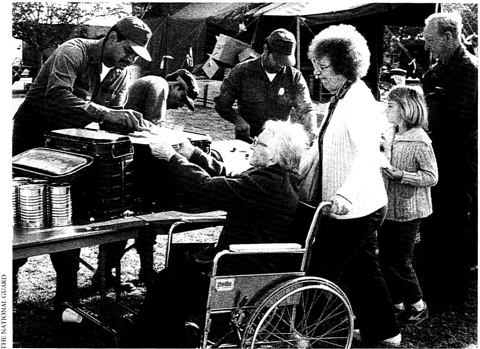
Temporary shelters provide a dry refuge, food, warmth, survivors of Hurricane Hugo. Response teams and others providing assistance must take into account the special needs of the very young, the very old, the injured, the handicapped, and non-English speakers when establishing assistance centers.
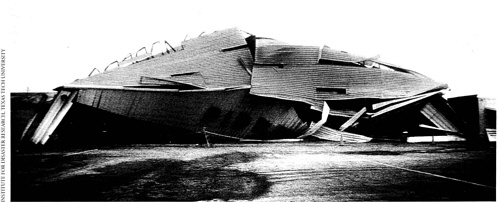
High winds flattened this airport hangar like the proverbial house of cards when Hurricane Hugo struck Charleston, S.C., with deadly force.
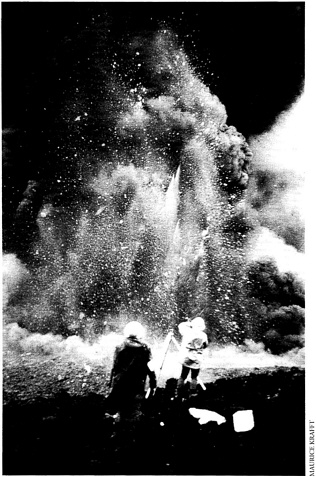
Often under difficult and dangerous conditions, researchers and scientists investigate many different types of disasters to try to understand the nature, cause, and possible effects of each event.
|
EXAMPLES OF ACHIEVEMENTS BY THE YEAR 2000
|
worthwhile disaster reduction efforts that state and local governments as well as nongovernmental participants could undertake. Third, individuals naturally tend to deny that a disaster will strike home, or they adopt the fatalistic view that disasters are inevitable. The public also assumes that if a disaster does occur, the government will provide unlimited assistance in restoring their lives to predisaster normalcy. Thus, successful Decade programs must be founded on the existing scientific and technical expertise while reflecting the social, cultural, economic, and political realities of communities.
A FRAMEWORK FOR HAZARD REDUCTION
The Committee proposes an integrated, multidisciplinary program for the nation to reduce the impacts of natural hazards. Key elements of the Decade program include hazard and risk assessments; awareness and education; mitigation; preparedness for emergency response, recovery, and reconstruction; prediction and dissemination of warnings; strategies for learning from disasters; and international cooperation. Each of these elements is important in reducing the toll of natural disasters. Collectively, they can save lives and limit losses, making the United States and the world a safer place now and for future generations.
The ultimate measure of the Decade's success will be improvements in the patterns of life, property, and natural resource losses. Because disasters occur irregularly and have widely varying impacts, the effects of disaster reduction measures will be clear only over time. The Decade's progress, therefore, should be judged in the short term by using surrogate measures — for example, the number of state and local jurisdictions that improve their hazard and risk assessments, train response teams, develop and exercise emergency response and recovery plans, or take steps to strengthen building codes or their enforcement; documented changes in the awareness and actions of such groups as the media, health workers, architects, engineers, policy makers, and the public; qualitative and quantitative changes in efforts to transfer technology and enhance professional skills through conferences and workshops; and the number of new bilateral and multilateral projects.
|
STRATEGIES FOR DISASTER REDUCTION Lives can be saved and losses substantially limited by the year 2000 by:
|
Each of the following chapters sets forth one major recommendation for a particular aspect of hazard reduction, followed by descriptions of specific program components. The recommendations and descriptions do not necessarily delineate priorities. Instead, the collective framework is intended as a guide for government, industry, business, professionals, health workers, volunteers, educators, researchers, public interest groups, and others to develop their own plans for participating in the Decade. It is expected that the agenda will be revised as these recommendations are translated into actions by these groups. What is important is that the United States move forward without hesitation to reach the common goal of a safer future for all.