
Questions? Call 888-624-8373

PAPERBACK
list:$19.00
Web:$17.10
add to cart

PDF BOOK
your price: $15.00
add to cart

Rights & Permissions

topleft topright

Potential Applications of Concentrated Solar Photons (1991)
Commission on Engineering and Technical Systems (CETS)

Page
67
bottomleft bottomright

The following HTML text is provided to enhance online readability. Many aspects of typography translate only awkwardly to HTML. Please use the page image as the authoritative form to ensure accuracy.


Potential Applications of Concentrated Solar Photons

APPENDIX E
Pressure Dependence of Photochemical Reactions

Augmentation of thermal reactions by excitation with photons is pressure dependent because of the activation and deactivation of excited states by collisions. This was illustrated by the simple example provided by Dellinger et al. [1] at the workshop associated with this study. For the simple model (Figure E-1) of a photolytic followed by thermal excitation to an energy level
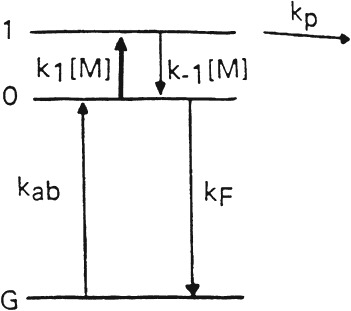
FIGURE E-1 Three State of thermal-photolytic model.

Page
67

Below are the first 10 and last 10 pages of uncorrected machine-read text (when available) of this chapter, followed by the top 30 algorithmically extracted key phrases from the chapter as a whole.
Intended to provide our own search engines and external engines with highly rich, chapter-representative searchable text on the opening pages of each chapter. Because it is UNCORRECTED material, please consider the following text as a useful but insufficient proxy for the authoritative book pages.

Do not use for reproduction, copying, pasting, or reading; exclusively for search engines.

OCR for page 67
Potential Applications of Concentrated Solar Photons APPENDIX E Pressure Dependence of Photochemical Reactions Augmentation of thermal reactions by excitation with photons is pressure dependent because of the activation and deactivation of excited states by collisions. This was illustrated by the simple example provided by Dellinger et al. [1] at the workshop associated with this study. For the simple model (Figure E-1) of a photolytic followed by thermal excitation to an energy level FIGURE E-1 Three State of thermal-photolytic model.

OCR for page 68
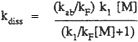
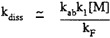
Potential Applications of Concentrated Solar Photons leading to dissociation, the rate constant kdiss for the overall reaction can be shown to be where the rate coefficients are identified in Figure E-1, and [M] is the total molar concentration. For the conditions favorable to dissociation, (k1/kF)(kp/k-1)>1, the rate constant can be approximated by At high pressures the thermal reaction approaches equilibrium and the rate constant becomes equal to the absorption rate kab, independent of pressure. At low pressures the rate becomes proportional to pressure and can be approximated by Experimental programs should be designed to provide the coefficients needed to model their temperature and pressure dependencies using the quantum Rice Rammsberg and Kassel or Rice Rammsberg Kassel and Marcus representations (1). REFERENCE 1. Dellinger, B., Graham, J., Berman, J.M., and Klosterman, D. "High-Temperature Photochemistry Induced by Concentrated Solar Radiation." Workshop on Potential Applications of Concentrated Solar Photons, NRC, Nov. 7–8, 1990, Golden, Colo.

Representative terms from entire chapter:

rate constant