
8
Hydrologic Implications of Climate Uncertainty in the Western United States
Marshall E. Moss
U.S. Geological Survey
Tucson, Arizona
By now, a vast majority of the inhabitants of the United States of America are aware of and accept the fact that levels of greenhouse gases, such as carbon dioxide, are increasing in the earth's atmosphere. Probably, most people with even a minimal education in science also accept that increased atmospheric greenhouse gas concentrations will cause additional energy retention in the earth's immediate environment—an increased greenhouse effect. However, drawing conclusions about changes in hydrologic phenomena brought about by the augmented green-house effect is not a straightforward exercise. One might logically conclude that a part of the additional energy would accelerate the hydrologic cycle: that is, there would be more precipitation, more infiltration, more evapotranspiration, and more runoff. But, heretical as it may seem, the hydrologic cycle as depicted in most basic texts does not exist. There is a myriad of paths by which a molecule of water can transit about the globe, and the likelihood of it doing so in a cyclic manner is infinitesimally small. Thus, the simplified concept of a hydrologic cycle offers little insight into the hydrologic impacts of potential climate change.
Instead of a cycle as the conceptual analog for hydrology, a random walk seems more appropriate. In the hydrologic random walk, a water molecule's passage through one of the reservoirs of the earth's hydrosphere or its transition from one reservoir to another is controlled probabilistically by the distribution of energy and mass within and among adjacent reservoirs. Hydrology is the science of understanding the aggregations of a great many molecules of water passing through and among the reservoirs. To predict the hydrologic impacts of increased atmospheric concentrations of greenhouse gases, knowledge of the partitioning of the incre-
mental energy within the various reservoirs is required. This paper explores our current ability to define this partitioning and draws conclusions about the resulting implications on the hydrology of the western United States.
To illustrate the complexity of the hydrologic random walk, it is useful to consider the concept of teleconnections (Namias, 1981), which is a statistical approach relating the magnitudes of weather or hydrologic events that occur at great distances from each other. For teleconnections to be more than a statistical oddity, they must be the result of seasonally preferred paths through the hydrologic random walk. The relation of weather patterns around the globe to an aperiodic anomalous warming of the eastern Pacific Ocean, the El Niño Southern Oscillation (ENSO), is a teleconnection that has been much explored recently. For example, as shown in Figure 8.1, Ropelewski and Halpert (1987) demonstrated a positive correlation between ENSO events and precipitation magnitudes over much of the Colorado River basin. This correlation implies that an energy exchange between the atmosphere and the Pacific Ocean can alter the probabilities of precipitation in the western United States during ENSO events.
A more explicit depiction of a preferred path of a similar or even greater spatial scale is found in the work of Koster as reported by Eagleson (1986). Figure 8.2 shows the regions where water that is evaporated in the month of March from a grid cell of 10 degrees longitude by 8 degrees latitude located in southeastern Asia is first redeposited on earth. Most of the land area under the mandate of the Bureau of Reclamation receives moisture from this cell, as does most of eastern Asia and the northern Pacific. Thus, evidence indicates a very complex system of reservoirs of moisture and energy in the oceans, in the atmosphere, and on the land that interacts with itself to define the existing climate and hydrology in the western United States.
What do we know about the response of this complex system to an increased greenhouse effect? Probably, we know best the physics of the transport of mass and energy in most reservoirs of the system. However, we know the physics only at spatial scales that are not fully compatible with the data bases and computing facilities that are available today. Climatologists and oceanographers have attempted to bridge this incompatibility by constructing mathematical general circulation models (GCMs) of the earth's atmosphere and oceans. GCMs are, at best, compromises between the sophistication of the description of the physics and the temporal and spatial scales at which transport is computed; thus,
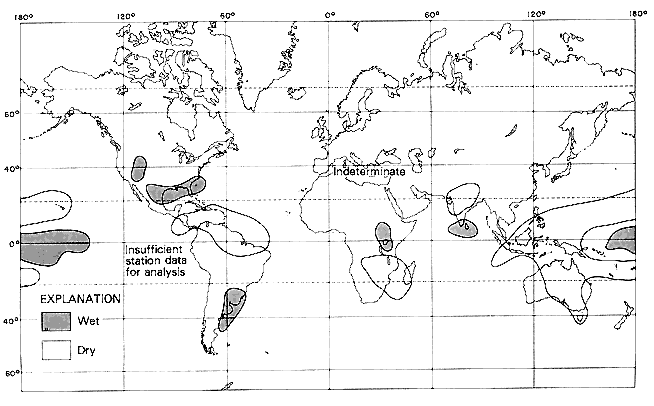
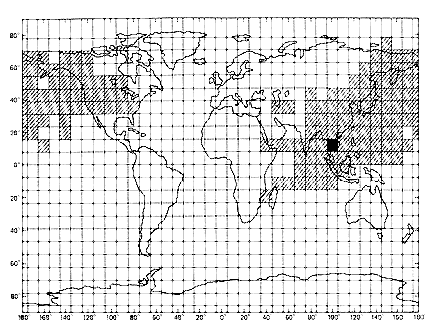
FIGURE 8.2 Region of influence of Southeast Asia March evaporation.
SOURCE: Reprinted, by permission, from Eagleson (1986). Copyright © 1986 by the American Geophysical Union.
they have computational grids that are several degrees in both latitude and longitude.
Information about hydrologic processes on and beneath the land surfaces of earth is poorly served by these compromises. For example, a common GCM representation of the land surface within a grid is that of a uniform soil of constant depth, the so-called bucket model, from which runoff is generated when the soil is saturated and precipitation exceeds evapotranspiration during any time step of computation. Runoff so defined is quite a different phenomenon from that recognized under the same name in hydrology. Furthermore, the spatial averaging that takes place over a grid cell yields variables that have little relevance to most problems of interest to
traditional hydrologists and little applicability in water-resources decisionmaking.
To extract relevant hydrologic information from GCMs, two requirements must be met. First, outputs from the GCMs must be hydrologically meaningful. Second, there must be significant information contained in those outputs. Hydrologic models that convert GCM runoff to a meaningful variable do not currently exist; thus, GCM runoff fails the first criterion.
Other outputs from GCMs, such as precipitation, temperature, and relative humidity, might be hydrologically meaningful except for the discrepancies between their spatial scales of aggregation and the spatial resolution needed for these variables in existing hydrologic models. One approach that could resolve such discrepancies is statistical disaggregation (Valencia and Schaake, 1973). If this approach can be applied with some degree of confidence to spatial disaggregation of such GCM outputs, the outputs could meet the first cirterion, whereas GCM runoff could not.
Another approach for the resolution of the scale discrepancy is the use of models of a finer scale for selected geographical regions of interest nested within a GCM (Giorgi, 1990). This approach shows great promise at the meteorological mesoscale, which is pertinent for many of the larger-scale hydrologic problems. It is conceivable that nested models and disaggregation models could be combined to address hydrologic problems of an even smaller scale.
With respect to the second criterion, quite a large body of literature exists that describes qualitatively the uncertainties inherent in climate modeling. A comprehensive review of this literature was done recently by Dickinson (1989). However, in the only attempt to date to quantify the information derived from GCMs, Moss (1991) has found that, for the grid cell highlighted in Figure 8.3, information from the Community Climate Model of the National Center for Atmospheric Research about July precipitation under current climatic conditions is limited to less than 20 percent of the information contained in 30 years of actual records. For January precipitation, the model output is limited to about 15 percent of the 30-year record. Extrapolations required to estimate future climate changes would undoubtedly degrade the resulting information below these limits. Thus, there may be some useful hydrologic information in GCMs, but our current ability to extract it is very limited.
Because of the paucity of hydrologic information that can be extracted from climate models, hydrologists generally have opted for scenario analysis (Lave and Epple, 1985) as a means to investigate the sensitivity of hydrologic systems to climate change. For example,
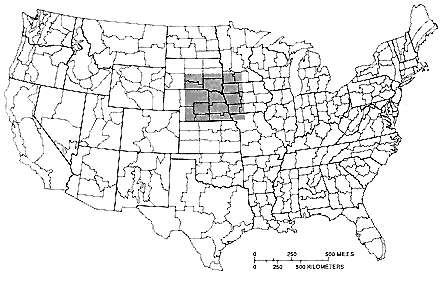
FIGURE 8.3 A GCM cell superimposed on the map of the State Climate Divisions.
Revelle and Waggoner (1983) assumed a scenario of a 10 percent decrease in precipitation and an increase of 2°C and used the empirical relations from Langbein and others (1949) to explore the impacts on runoff in the Colorado River basin. They found a potential decrease in average annual runoff of approximately 50 percent. However, the data used by Langbein were collected in the first half of this century, when carbon dioxide in the atmosphere was not at the levels contemplated in the climate-change scenarios. Most plants respond to increased levels of carbon dioxide by decreasing their rates of transpiration, and this feedback is not included in the work of Revelle and Waggoner (1983). Idso and Brazel (1984) estimated the vegetation effect and found that the 50 percent decrease in runoff reported earlier would become a 50 percent increase instead. Stockton (1975) has estimated the annual runoff of the upper Colorado River basin for the period 1520 to 1961 using dendrochronology and has found the mean annual runoff for this period to be approximately
13.5 million acre-feet. Figure 8.4 shows the decadal averages for the reconstructed record and the range of plus and minus 50 percent of the long-term average. It can be seen that the level of hydrologic uncertainty as depicted by the mean annual runoff, given the climate-change scenario of Revelle and Waggoner (1983) and of Idso and Brazel (1984), is greater than the decadal runoff variability experienced during at least 440 years.
Schaake (1990) has attempted to reduce this uncertainty by the use of more complex hydrologic models on the Animas River, which is a subbasin of the Colorado River basin. His results are summarized in Table 8.1. In essence, he found: (1) that an increase in precipitation would cause an increase in runoff that was greater in percentage than that of the increase in precipitation, and (2) that an increase in temperature would cause a minor decrease in annual runoff but would cause major changes in the seasonal distribution of the runoff. The second finding can be attributed to the dominance of the runoff regime in the Animas River by snow accumulation and melt. Gleick (1987) and Lettenmaier and others (1989) found similar results in the Sacramento River basin, which also is a snowmelt-dominated system.
Several other studies have been conducted using the scenario approach; Gleick (1989) provides a recent review of these. Each demonstrates, in its own way, one or more possible outcomes for the hydrologic effects of climate change. It should be reiterated that each is subject to its own inherent assumptions and should be considered as a measure of the system's sensitivity to those assumptions and not necessarily as a likely outcome of climate change. At this time, the plausibility of each scenario can only be determined subjectively, because the probability of any climate scenario cannot yet be determined.
Thus, today's state of understanding concerning the hydrologic implications of climate change is best characterized as one of uncertainty in which the level of uncertainty itself is uncertain. Because the validity of water resources decisions is very sensitive to hydrologic uncertainty, one of the first priorities of hydrologic research should be the quantification of the added uncertainty caused by an enhanced greenhouse effect. In other words, water resources planners and decisionmakers should encourage the research community to assess the level of hydrologic uncertainty while concurrently reducing it.
There are two paths for the reduction of uncertainty: (1) data collection, and (2) research. Traditionally, data collection has played the primary role in uncertainty reduction in hydrology. However, in the nonstationary world caused by climate change, the dominant role
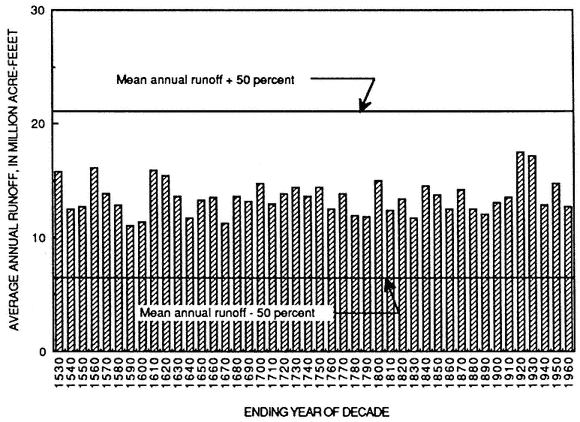
FIGURE 8.4 Reconstructed runoff for the Colorado River at Lee's Ferry.
TABLE 8.1 Sensitivity of runoff to climate change for the Animas River at Durango, Colorado.
|
|
Period |
||
|
|
Annual Average |
January |
June |
|
Runoff (thousands of acre-feet) |
545 |
12 |
163 |
|
Percentage runoff change for 10% increase in precipitation |
19.7 |
17.1 |
12.1 |
|
Percentage runoff change for 10% increase in ETP |
-7.0 |
3.8 |
8.9 |
|
Percentage runoff change for 2°C temperature increase |
-2.1 |
37.4 |
-26.8 |
|
Percentage runoff change for 10% increase in ETP and 2°C temperature increase |
-8.6 |
22.9 |
-30.4 |
|
SOURCE: Schaake, 1990. |
|||
of data must be reduced (Moss and Lins, 1989), because the information content of the raw data degrades with time. In other words, the hydrologic processes operational at the time that the data were collected are subsequently modified by the climate changes. Thus, yesterday's data lose their relevance to today's circumstances unless sufficient understanding of the climate-hydrology interactions is available to capture the information in yesterday's data and apply it to today's situation. The current level of understanding of hydroclimatology is not sufficient to perform this act of information retention. Therefore, increased support for research in hydroclimatology is a prerequisite to uncertainty reduction. Nevertheless, data collection is a necessity as well. Research without supporting data is a tenuous approach at best; furthermore, the data will be valuable in their own right once sufficient research is done so that they can be properly interpreted.
REFERENCES
Dickinson, R. E. 1989. Uncertainties of estimates of climatic change: a review. Climatic Change 15:5-13.
Eagleson, P. S. 1986. The emergence of global-scale hydrology. Water Resources Research 22(9):6s-14s.
Giorgi, F. 1990. Simulation of regional climate using a limited area model nested in a general circulation model. Journal of Climate 3:941-963.
Gleick, P. H. 1987. Regional hydrologic consequences of increases in atmospheric CO2 and other trace gases. Climatic Change 10:137-161.
Gleick, P. H. 1989. Climate change, hydrology, and water resources. Reviews in Geophysics 27:329-344.
Idso, S. B., and A. J. Brazel. 1984. Rising atmospheric carbon dioxide concentrations may increase streamflow . Nature 312:51-53.
Langbein, W. B., et al. 1949. Annual Runoff in the United States. Circular 52. Washington, D.C.: U.S. Geological Survey.
Lave, L. B., and D. Epple. 1985. Scenario Analysis, Climate Impact Analysis. New York: John Wiley & Sons.
Lettenmaier, D. P., T. Y. Gan, and D. R. Dawdy. 1989. Interpretation of hydrologic effects of climate change in the Sacramento-San Joaquin river basin, California. Appendix A, Pp. 1-1 to 1-52 in J. B. Smith, and D. A. Tirpak, eds., Potential Effects of Global Climate Change on the United States. Washington, D.C.: U.S. Environmental Protection Agency.
Moss, M. E. 1991. Bayesian relative information measure--a tool for analyzing the outputs of general circulation models. Journal of Geophysical Research, in press.
Moss, M. E., and H. F. Lins. 1989. Water Resources in the Twenty-first Century: A Study of the Implications of Climate Uncertainty. Circular 1030. Washington, D.C.: U.S. Geological Survey.
Namias, J. 1981. Teleconnections of 700 mb Height Anomalies for the Northern Hemisphere. CALCOFI Atlas No. 29. La Jolla, California: Scripps Institution of Oceanography.
Revelle, R. R., and P. E. Waggoner. 1983. Effects of carbon dioxide-induced climate change on water supplies in the western United States. Pp. 419-432 in Changing Climate. Washington, D.C.: National Academy Press.
Ropelewski, C. W., and M. S. Halpert. 1987. Global and regional scale precipitation patterns associated with the El Niño/Southern Oscillation. Monthly Weather Review 115:1606-1626.
Schaake, J. C. 1990. From climate to flow. Pp. 177-206 in Climate Change and U.S. Water Resources. New York: John Wiley and Sons.
Stockton, C. W. 1975. Long-term Streamflow Records from Tree Rings. Tucson: University of Arizona Press.
Valencia R. D., and J. C. Schaake. 1973. Disaggregation processes in stochastic hydrology. Water Resources Research 9:580-585.


