
14
Some Aspects of Hydrologic Variability
Stephen J. Burges
University of Washington
Seattle, Washington
Much of the discussion at the colloquium reminded several members in the audience of the debate in the research community about the ''Hurst phenomenon'' which occupied some extremely thoughtful scientific hydrologists and water resource engineers for a 15-year period after Hurst's book summarizing his findings was published (Hurst et al., 1965). Possible explanations of the Hurst phenomenon based on threshold conditions are given in Klemes (1974) and Potter (1976).
The essence of Hurst's observations were that after examining numerous geophysical time series throughout the world (annual streamflow volumes, rainfall, lake varves, etc.), he determined that the degree of apparent persistence (long intervals of well below or well above "normal" trends) could be indexed to a coefficient "H" which we now know as the Hurst coefficient. A random process has H = 0.5 while one that can describe prolonged multiyear duration droughts is in the range of 0.7 to perhaps as large as 0.85. The time series associated with such "Hurst like" measure resemble remarkably the sequences now considered in "alternative scenarios" resulting from "climate change." This means that the tools of stochastic hydrology that were developed over a 20-year period starting in the mid-1960s might be useful for assessing water resource system reliability under variable climates. If the annual scale is considered, both the range of what could be experiences in any year (the marginal probability distribution), and the connectedness of low flow years, high flow years, etc. (the serial persistence or autocorrelation) can be represented by these tools. Shorter time increments can be examined by disaggregating annual quantities (e.g., Lane and Frevert, 1990).
Three figures are included to illustrate variability and operational consequences. Figure 14.1 shows a portion of a tree ring growth index time series from Dell, Montana (Lettenmaier and Burges, 1978). The time between A and B is 50 years, a typically data rich record length when determining system reliability. One form of variability is an apparent increasing trend within this 50-year period. When viewed in a larger time frame, it is clear that there is no trend but the series indicates different types of variability—extreme swings from low to high as well as an apparent increasing trend superposed on extreme swings. Tree-ring series are being used increasingly in regression equations as surrogates of streamflow that occurred before stream gauges were installed with the objective of providing an equivalent long historical record of "streamflow that might have occurred."
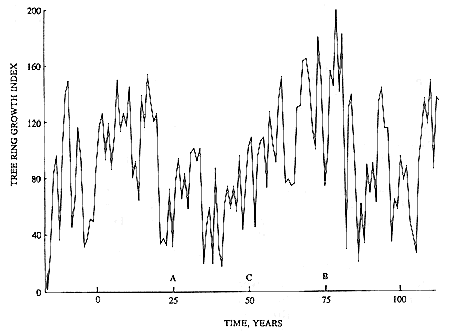
FIGURE 14.1 Annual tree ring index for Limber pine at Dell, Montana showing the range of variability that can be observed in a geophysical time series. The time period between A and B corresponds to 50 years. C corresponds approximately to the year 1810.
Figure 14.2 shows estimated natural annual flow for the Logan River, Utah (USGS Gauge 10-1090) for a 70-year period. The measure of long-term persistence, the Hurst coefficient, is approximately 0.8 and the lag-one correlation coefficient, a measure of shorter-term persistence, is 0.4. This is a highly persistent river flow situation with prolonged excursions from the mean level of both high and low flow with associated swings in flow volume from year to year. The variability about the mean level is related to the standard deviation of the annual flow volume.
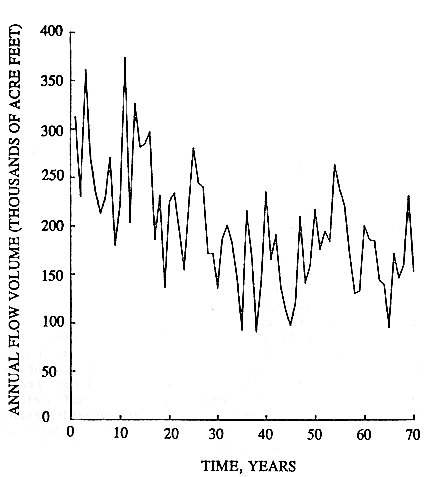
FIGURE 14.2 Annual flow time series, Logan River, Utah (USGS Gauge 10-1090), Hurst coefficient H = 0.80, lag-one correlation coefficient = 0.4, record length 70 years.
Figure 14.3 shows the estimated theoretical empirical storage-reliability diagram for a single reservoir having historical input annual streamflow persistence almost identical to the natural case shown in Figure 14.2. The annual coefficient of variation (standard deviation divided by the mean) for this hypothetical situation is 0.5 which is not overly variable. (Hydrologically benign rivers in Western Washington State have annual coefficients of variation between about 0.18 and about 0.25, depending on catchment size, Arroyo Seco, California has a coefficient of variation of approximately 0.75; many Australian rivers have annual coefficients of variation in excess of 1.0). Three contracted supply levels (physical as opposed to economic demand) are shown: 0.5, 0.7, and 0.9 of the mean annual flow volume. The cumulative probability distribution of needed storage size for a particular physical demand was determined by routing 1000 (independent) stochastically generated sequences, each having length 40 years through a mass curve analysis (sequent peak algorithm, Fiering, 1967) to yield 1000 values of storage. These derived quantities were ranked from high to low order and plotted in Figure 14.3 using an extreme value Type I distribution page. (An extreme value Type I cumulative probability distribution plots as a straight line on such a scale). Reliability is interpreted as follows. For the 98 percent level and a demand of 0.5 of the mean annual flow volume, if the reservoir capacity was approximately three times the annual flow volume, then in 98 percent of all 40-year long stochastic sequences that are all statistically equivalent to the indicated streamflow parameters (mean, variance, and persistence), demand would be satisfied fully. In the remaining 2 percent of sequences, there would be some short fall. Relevant methods for generating annual scale single site and multiple site stochastic or "synthetic" streamflow volumes are given by Salas et al. (1980), and Stedinger et al. (1985) among others.
To place Figure 14.3 in context, consider the capacities of Glen Canyon and Hoover Dams. Their combined capacities are approximately four times the mean annual natural flow of the river or approximately eight times the present flow volume at Lee's Ferry. (Actual Hurst coefficient estimates and annual coefficient of variation for the natural river flow volume are not readily available). Figure 14.3, which is not meant to represent conditions for the Colorado River system, shows clearly that as the physical demand level increases for the hypothetical threshold hydrologic condition modeled, the reliability for a given storage decreases markedly. The stochastic hydrology tools (the formal schemes for generating synthetic flow sequences) for making such assessments
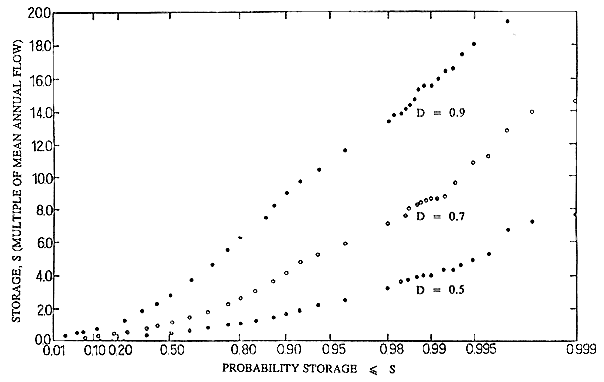
FIGURE 14.3 Storage reliability diagram for a normally distributed annual flow population: mean = 1.0, coefficient of variation = 0.5, Hurst coefficient = 0.8, lag-one correlation = 0.4; operation life = 40 years. Storage volumes, S, were determined using the sequent peak algorithm (Fiering, 1967) for three fixed annual physical "contracted supply" levels, D = 0.5, 0.7, and 0.9 of the mean annual flow volume.
are well tested and have been available for some time. Those tools could be extremely useful for considering both present and future variability.
REFERENCES
Burges, S. J., and D. P. Lettenmaier. 1975. Operational comparison of stochastic streamflow generation procedures. Technical Report 45, Harris Hydraulics Laboratory. Seattle: Department of Civil Engineering, University of Washington.
Fiering, M. B. 1967. Streamflow Synthesis. Cambridge, Mass.: Harvard University Press.
Hurst, H. E., R. P. Black, and Y. M. Simaika. 1965. Long-Term Storage--An Experimental Study. London: Constable.
Klemes, V. 1974. The Hurst phenomenon: a puzzle. Water Resources Res. 20(4):675-688.
Lane, W. L., and D. K. Frevert. 1990. Applied Stochastic Techniques (LAST Personal Computer Package Version 5.2), Users Manual. Denver: U.S. Bureau of Reclamation.
Lettenmaier, D. P., and S. J. Burges. 1978. Climate change: detection and its impact on hydrologic design. Water Resources Res. 14(4):679-687.
Potter, K. W. 1976. Evidence of nonstationarity as a physical explanation of the Hurst phenomenon. Water Resources Res. 12(5):1047-1052.
Salas, J. D., J. W. Delleur, V. Yevjevich, and W. L. Lane. 1980. Applied Modeling of Hydrologic Time Series. Littleton, Colorado: Water Resources Publications.
Stedinger, J. R., D. P. Lettenmaier, and R. M. Vogel. 1985. Multisite ARMA (1,1) and disaggregation models for annual streamflow generation. Water Resources Res. 13(2):497-509.


