
8
Industrial Products
Beyond all the possible pesticides and pharmaceuticals, neem provides many useful and valuable commonplace materials. For instance, oil extracted from the seeds goes into soaps, waxes, and lubricants, as well as into fuels for lighting and heating. The solid residue left after the oil is removed from the kernels is employed as a fertilizer and soil amendment. In addition, wood from the trees is valued for construction, cabinetry, and fuel. The bark is tapped for gum and extracted for tannins and dental-care products. The leaves are sometimes used for emergency livestock feed. And the profuse flowers are a prized source of honey.
NEEM OIL
Of all these products, the oil is perhaps the most commercially important. In composition, it is much like other vegetable oils, composed primarily of triglycerides of oleic, stearic, linoleic, and palmitic acids. 1
To obtain neem oil, the seeds are first broken open and the kernels separated. The kernels are then pressed in industrial expellers or in hand- or bullock-operated wooden presses (ghanis). The oil yield is sometimes as high as 50 percent of the weight of the kernel.
This "cold-pressed oil" is mainly used in lamps, soaps, and other nonedible products. It is generally dark, bitter, and smelly. Unlike most vegetable oils, it contains sulfur compounds, whose pungent odor is reminiscent of garlic.
A large industry in India extracts the oil remaining in the seed cake using hexane. This solvent-extracted oil is not as high quality as the
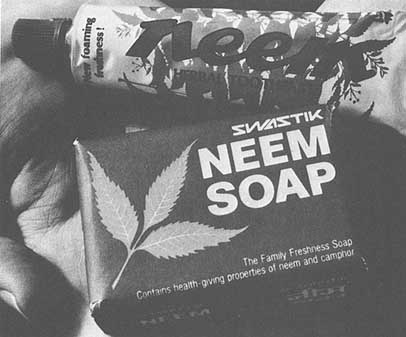
In India, neem ingredients are found in many popular consumer goods. Neem oil, for instance, has been a major ingredient in soaps for at least 50 years. Its antiseptic properties have been used to particular advantage in the manufacture of special medicated soaps and toothpastes. In addition, pharmaceutical preparations—emulsions, ointments, poultices, and liniments, as well as cosmetics such as creams, lotions, shampoos, hair tonics, and gargles—have been prepared. The latest cosmetic preparations are entirely free of the odor that previously restricted neem oil's use. (Agricultural Research Service, USDA)
Purifying neem oil is an elaborate and costly process at present. In one method, the smelly sulfur compounds are distilled off, which frees the oil from both odor and susceptibility to rancidity (because it also removes the free fatty acids). This process has long been used industrially.
As an alternative to pressing out the oil, the kernels can be extracted first with alcohol and then with hexane.2 Alcohol removes the bitter and odoriferous compounds; hexane recovers the oil. This stepwise extraction upgrades both meal and oil. On the other hand, it requires
|
Neem Oil in India The neem trees occurring throughout India represent a large, although very scattered, resource. Already, neem oil is a common commodity traded freely in the markets, but much more could be produced. It has been estimated that India's neems bear about 3.5 million tons of kernels each year and that, in principle, about 700,000 tons of oil might be recoverable. The annual production in the late 1980s was only around 150,000 tons. (About 34 tons of neem oil were exported in 1990 valued at 300,000 rupees.) To increase the amount of oil harvested, the Khadi and Village Industries Commission has pioneered various aspects of processing the fruit and seeds over the past two decades. This grass-roots organization located in Pune has been the leading advocate for neem oil as a resource for India's villagers. Already, it has created the makings of a major village industry, developed on a rational and organized basis. One difficulty, as with most oilseeds of the forest, is that neem must be harvested during the wet season, and without local drying facilities the fruits and seeds rapidly deteriorate and become contaminated with aflatoxin (see page 53). Ideally, the fruits should be depulped without delay and the seeds thoroughly dried. The Khadi and Village Industries Commission has devised and popularized simple methods for depulping, drying, and decorticating neem products, even in the remotest villages. |
Some of the many everyday uses for neem oil in India are discussed below.
Soap
India's supply of neem oil is now used mostly by soap manufacturers. Although much of it goes to small-scale specialty soaps, large-scale producers also use it, mainly because it is cheap. Generally, the crude oil is used to produce coarse laundry soaps. However, more expensive soaps are made by saponifying the crude oil and distilling the resulting
Cosmetics
Neem is perceived in India as a beauty aid. Powdered leaves, for example, are a major component of at least one widely used facial cream. Purified neem oil is also used in nail polish and other cosmetics.
Lubricants
Neem oil is nondrying, and it resists degradation better than most vegetable oils. In rural India it is commonly used to grease cart wheels. It could find many similar lubrication applications in other locations, especially in village settings in the warmer parts of the world where neem can be grown.
FERTILIZERS
Neem has demonstrated considerable potential as a fertilizer. For this purpose, neem cake and neem leaves are especially promising.
Neem Cake
The residue left after the oil has been removed varies widely in composition. However, the broad ranges in composition are:
|
|
13-35 percent |
|
Carbohydrate |
26-50 percent |
|
Crude fiber |
8-26 percent |
|
Fat |
2-13 percent |
|
Ash |
5-18 percent |
|
Acid-insoluble ash |
1-17 percent |
This so-called ''neem cake" has considerable local potential. Although too bitter for animal feed, it seems to have unique promise as a fertilizer. It contains more nitrogen, phosphorus, potassium, calcium, and magnesium than farmyard manure or sewage sludge.4 It is widely used in India to fertilize cash crops, particularly sugarcane and vegetables. Plowed into the soil, it protects plant roots from nematodes and white ants, probably due to its content of the residual limonoids.
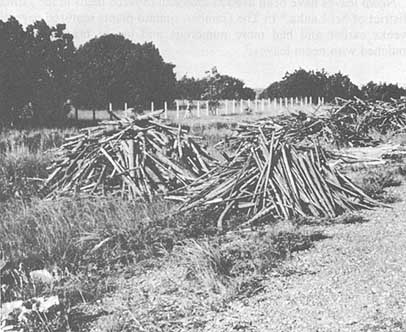
Accra plains, Ghana. Stacks of neem firewood for sale are a common sight beside many roads in West Africa. (E.S. Ayensu)
Surprisingly, neem cake sometimes seems to make soil more fertile than calculations predict.5 This is apparently due to an ingredient that blocks soil bacteria from converting nitrogenous compounds into (useless) nitrogen gas. When mixed with urea, for example, neem cake cuts down on the amount of urea converted to nitrogen gas in the soil. So far, this finding, which might prove to be a major breakthrough, has not been pursued beyond the laboratory. If it proves real in everyday practice, it might boost the effectiveness of fertilizers everywhere—restoring to the soil that part of their power now lost by bacterial action.
Neem Leaves
The cake is not the only source of fertilizer. In some areas of India's Karnataka State, people grow the tree mainly for its green leaves and twigs, which they "puddle" into flooded rice fields before the rice seedlings are transplanted.
Neem leaves have been used as mulch in tobacco fields in the Jaffna district of Sri Lanka.6 In The Gambia, tomato plants matured several weeks earlier and had more numerous and longer branches when mulched with neem leaves.7
TIMBER
As noted previously, neem is a member of the mahogany family, and the properties of its wood resemble mahogany. It is relatively heavy, with a specific gravity varying from 0.56 to 0.85 (average, 0.68). When freshly cut, it has a strong smell. Although easily sawn, worked, polished, and glued, it must be dried carefully because it often splits and warps. It also splits easily when nailed, so that holes must be prebored. Nevertheless, it is a good construction timber and is widely used in carts, tool handles, and agricultural implements. In South India it is a common furniture wood.
The heartwood is red when first exposed, but in sunlight it fades to reddish brown. It is aromatic, beautifully mottled, narrowly interlocked, and medium to coarse in texture. It is subject to only slight shrinkage and can be readily worked by hand or machine. Although it lends itself to carving, it does not take a high polish.
The timber is durable even in exposed situations. It is seldom attacked by termites, is resistant to woodworms, and it makes useful fence posts and poles for house construction. Pole wood is especially important in developing countries; the tree's ability to resprout after cutting and to regrow its canopy after pollarding makes neem highly suited to pole production.
FUEL
Neem produces several useful fuels. As mentioned above, its oil is burned in lamps throughout India. In addition, its wood has long been used for firewood. Moreover, the husk from the seeds—containing no oil and representing the bulk of the wastage in pesticide manufacture—is mainly employed as fuel.
Because of the tree's good growth and valuable firewood, it has become the most important plantation species in northern Nigeria. It is also grown for fuel around large towns. Charcoal made from this neem wood is of excellent quality, with a calorific value only slightly below that of coal from Nigeria's Enugu mines.
OTHER PRODUCTS
Several products in addition to those previously discussed have been generated from neem. Among them are the following examples.
-
Resin An exudate can be "tapped" from the trunk by wounding the bark. This high-protein material is not a substitute for polysaccharide gums, such as gum arabic. It may, however, have a potential as a food additive, and it is widely used in South Asia as "neem glue." 8
-
Bark Neem bark contains 14 percent tannins, an amount similar to that in conventional tannin-yielding trees (such as Acacia decurrens). Moreover, it yields a strong, coarse fiber commonly woven into ropes in the villages of India.
-
Honey In parts of Asia neem honey commands premium prices, and people promote apiculture by planting neem trees.
-
Food There are odd reports of people eating neem. Leaf teas may be harmful, especially if drunk in quantity over a long period, but it is said that Mahatma Gandhi, who had a hearty respect for the nutritive value of greens, commonly prepared a neem-leaf chutney and ate it with gusto—despite its incredibly bitter taste. Recently, the discovery of a rare neem tree with "sweet" leaves has been reported. 9
-
Fruit Pulp Pericarp represents about half the weight of neem fruits, and when they are processed to obtain the seeds, large quantities of pulp are also produced. This neem-fruit pulp is a promising substrate for generating methane gas, and it may also serve as a carbohydrate-rich base for other industrial fermentations.10


