
3
Technological Imperatives for Change
It is apparent from the wealth of materials surveyed that the causes of forest conversion and deforestation vary with the characteristics of the natural resource base, the level of national or local development, demographics, institutional philosophy and policy, and the resulting social and economic pressures on land resources. The appropriateness of solutions for sustainable resource use depend on these same determinant factors, only some of which are subject to change and to management. Solutions are thus highly time- and place-dependent. The focus of the discussion and recommendations in this chapter is on the assessment of land use options and on the factors limiting their broad implementation.
The committee has found that publicly supported development efforts are confined to a range of land use choices that is too narrow. Use of some systems is being supported in places where they are clearly nonsustainable, while other potentially highly productive systems for some environments are being neglected. The study has identified sustainable land use options suitable for a broad range of conditions in the humid tropics. That so many instances of diverse production systems was found is not surprising; that they appear to have such broad applicability across the humid tropics is of great development interest.
KNOWLEDGE ABOUT LAND USE OPTIONS
Land uses have different goals and involve varying degrees of forest conversion, management skill, and investment. They confer different biophysical, economic, and social benefits. Geographic and demographic factors define their opportunities and constraints. Consequently, trade-offs are involved in choosing among them.
A Comparison of Land Use System Attributes
To be readily usable by development planners, land use systems should be defined according to their environmental, social, and economic attributes, and described in detail. The place and role for each system, which will depend on the level of national or local development, should be identified along with conditions required for their implementation and evolution.
Throughout the humid tropics, intensive cropping systems now occupy most of the resource-rich lands—those with fertile soils, little slope, and adequate rainfall or irrigation for crop growth during much of the year. The potential for continued increases in productivity on these lands through genetic improvement is uncertain, although it is probable for some crops in some regions. In addition, opportunities exist to reduce losses from pests and diseases and to cut back on the use of pesticides through better application of integrated pest management. Modest improvements in health and nutritional benefits may come through additional crop diversification and reduction in pesticide use. Changes in other social and economic attributes are likely to be very gradual.
More efforts are being made to identify and measure the attributes of agroecosystems that can serve as indicators of sustainability (Dumanski, 1987; Ehui and Spencer, 1990). Physicochemical, biological, social, cultural, and economic factors are being used to analyze system performance and potential. Many aspects of agricultural sustainability are difficult to categorize and quantify. In applying information that is quantifiable, issues of scale are critical (Consultative Group on International Agricultural Research, 1989, 1990).
Table 3-1 provides a framework for comparing the attributes and potential contributions to sustainability of land use systems. It is a tool that researchers, resource managers, policymakers, and development planners and practitioners can use in devising land use strategies.
The biophysical attributes in Table 3-1 include the nutrient cycling capacity of the system, the capacity of the system to conserve soil and water, the resistance of the system to pests and diseases, the level of biological diversity within the system, and the carbon flux
TABLE 3-1 Comparison of the Biophysical, Social, and Economic Attributes of Land Use Systems in the Humid Tropicsa
|
Biophysical Attributes |
Social Attributes |
Economic Attributes |
||||||||||||||||||||||||||||||
|
Nutrient Cycling Capacityb |
Soil and Water Conservation Capacity |
Stability Toward Pests and Diseasesg |
Biodiversity Levelh |
Carbo Storag |
Health and Nutritional Benefitsj |
Cultural and Communal Viabilityk |
Political Acceptabilityl |
Required External Inputsm |
Employment Per Land Unit |
Income |
||||||||||||||||||||||
|
Land Use Systems |
L |
M |
H |
L |
M |
H |
L |
M |
H |
L |
M |
H |
L |
M |
L |
M |
H |
L |
M |
H |
L |
M |
H |
L |
M |
H |
L |
M |
H |
L |
M |
H |
|
Intensive cropping |
||||||||||||||||||||||||||||||||
|
High-resource areasc |
Xe |
Xf |
X |
X |
O |
X |
X |
X |
O |
X |
X |
X |
X |
X |
||||||||||||||||||
|
Low-resource areas |
X |
O |
X |
O |
X |
O |
X |
O |
X |
X |
O |
X |
O |
X |
O |
X |
X |
O |
X |
O |
||||||||||||
|
Low-intensity shifting cultivation |
X |
X |
O |
X |
X |
X |
O |
X |
X |
X |
X |
X |
X |
|||||||||||||||||||
|
Agropastoral systems |
X |
X |
O |
X |
X |
X |
X |
O |
X |
O |
X |
O |
X |
X |
O |
X |
||||||||||||||||
|
Cattle ranching |
Xd |
X |
O |
X |
X |
Oi |
X |
O |
X |
O |
X |
O |
X |
X |
X |
X |
||||||||||||||||
|
Agroforestry |
X |
X |
X |
X |
O |
X |
X |
X |
O |
X |
O |
X |
X |
O |
X |
O |
||||||||||||||||
|
Mixed tree systems |
X |
X |
O |
X |
X |
X |
X |
O |
X |
O |
X |
O |
X |
O |
X |
O |
X |
O |
||||||||||||||
|
Perennial tree crop plantations |
X |
X |
O |
X |
X |
X |
X |
X |
X |
Xn |
X |
X |
||||||||||||||||||||
|
Plantation forestry |
X |
X |
O |
X |
O |
X |
X |
X |
X |
X |
X |
Xn |
X |
X |
||||||||||||||||||
|
Regenerating and secondary forests |
X |
X |
O |
X |
X |
X |
X |
X |
X |
X |
X |
X |
||||||||||||||||||||
|
Natural forest management |
X |
X |
X |
X |
X |
X |
X |
O |
X |
O |
X |
X |
X |
|||||||||||||||||||
|
Modified forests |
X |
X |
X |
X |
X |
O |
X |
X |
X |
O |
X |
X |
||||||||||||||||||||
|
Forest reserves |
X |
X |
X |
X |
X |
X |
X |
X |
X |
X |
||||||||||||||||||||||
|
NOTE: The letters L (low), M (moderate), and H (high) refer to the level at which a given land use would reflect a given attribute. a In this assessment, “X” denotes results using the best widely available technologies for each land use system. The “O” connotes the results of applying best technologies now under limited-location research or documentation. The systems could have the characteristics denoted by “O” given continued short-term (5- to 10-year period) research and extension. b The capacity to cycle nutrients from the soil to economically useful plants or animals and replenish them without significant loss to the environment. c Those areas having fertile soils with little slope and few, if any, restrictions to agricultural land use. They have adequate rainfall or irrigation during much of the year for crop growth. d High efficiency of recycling but low levels of nutrient removal through harvesting. e Present technologies may develop high flow with high crop production, but they often entail high nutrient loss. Future technologies hold promise for greater containment and efficiency. f Lowland, flooded rice production has both high nutrient flow and very high efficiency of recycling and of nutrient containment. g Indicates the natural ability to maintain pests and diseases below economic threshold levels in tropical ecosystems. h Refers to the diversity of plant and crop species which, in turn, fosters diversity of flora and fauna both above and below the ground. i Assumes diversity of plant species under well-managed grazing systems, which may include tree species in silvipastoral systems. j To farms and their local communities. k The ability to survive as a land use system and to provide income, employment, and needed goods in communities under continued and increasing population pressure. The systems must make optimum use of local resources and encourage acceptable levels of local equity. l Politically desirable at levels above the local community (that is, county, region, province, state, or national level). At higher government levels it is assumed that generating cash flow through national or international channels usually takes precedence, but with the well-being of local communities having increasing consideration. m Levels of external inputs appropriate to maintain optimal production with best available technologies. These levels, particularly of pesticides, may not be environmentally sustainable in the long term. n Includes capital investment for establishment. |
||||||||||||||||||||||||||||||||
and storage capacity of the system. They serve to characterize the relative complexity, efficiency, and environmental impacts of the various land uses. Perennial tree crop plantations, for example, are generally monocultural systems, and less biologically diverse than primary forests. The biological simplicity of these plantations renders them more susceptible to insect pests and microbial and fungal diseases (Ewel, 1991). Perennial tree plantations, however, have a higher capacity for nutrient cycling than annual crop systems, and are better able to conserve soil and water due to the presence of a permanent, often stratified, vegetative cover. Plantations, due to the large biomass of the trees, also store about 10 times more carbon than do annual crops. The carbon storage capacity of plantations, however, is less than primary or mature forests (Dale et al., Appendix, this volume; Houghton et al., 1987). Once a forest matures, the storage and release of carbon achieves equilibrium; carbon dioxide sequestered through new growth equals that discharged from the oxidation of decaying old growth.
Important social attributes of these land use systems include health and nutritional benefits, cultural and communal viability, and political acceptability. Health and nutritional benefits reflect the capacity of a system to offset problems associated with intensive agrochemical use, heavy metal contamination, degraded water resources, high disease vector populations, and other public health concerns, as well as the capacity of the system to provide local people with a variety of food products at adequate levels. Cultural and communal viability refers to the ability of production systems to be adapted to local cultural traditions and to enhance community structures. Similarly, the ability of a system to ensure and enhance social welfare could be taken as a measure of its political acceptability.
Among the economic attributes that should be taken into account in comparing land use systems are the level of external inputs (such as fertilizer and equipment) required, the amount of employment generated, and the amount of income generated. Precise assessments of these economic attributes are especially difficult to derive. All can vary widely, even within a given type of land use, depending on the management practices employed, the impact of market fluctuations (or, in some cases, the lack of accessible markets), the type of crops grown, and other variables. The approximations in Table 3-1 are intended only to offer a sense of the relative economic costs and benefits across the spectrum of land use systems. Agroforestry systems, for example, require little fertilizer (although initial amendments may be required on degraded lands). With modification, they can be designed to generate moderate levels of employment or income on a per unit area basis. Perennial tree plantations require
considerable chemical inputs and labor to maintain productivity, but generate more employment and income than agroforestry systems on a per unit area basis.
None of these features alone will determine the viability or sustainability of a given system. Rather, each system entails positive and negative attributes that must be viewed in the context of local biophysical, economic, and social opportunities and constraints. Furthermore, these attributes, and others not included, interact in complex ways to determine the rate and direction of change within an agroecosystem, and, more widely, within landscapes and regions. Hence, different systems will be appropriate and sustainable for different locations depending on the level of development and the relative availabilities of land, labor, and capital.
Table 3-1 also assumes the use of the best available technologies. For example, areas with poor soil and water resources have received far less attention from rural and agricultural development programs, but increasing population and development pressures and the need for greater cash income are forcing conversion of these areas to more productive and intensive land uses. For many of these areas, the newly researched and demonstrated technologies for mixed cropping systems show considerable promise. Low-input transitional technologies have potential for stabilizing erosion and lengthening the rotation cycle in low-intensity shifting cultivation areas, which are under severe stress to produce more by shortening the fallow period (Sanchez and Benites, 1987).
In all attribute categories, intensive cropping, agroforestry systems, agropastoral systems, mixed tree plantations, and, to some extent, modified forests offer significant benefits. This is particularly true in countries where industrial expansion or tourism is creating markets for high-value fruit, spice, and fiber products produced as woody perennial species or for animal products that can be integrated into small farm systems. Mixed perennial and annual crop systems (agroforestry) have a relatively high capacity to conserve soil and water, good nutrient cycling characteristics, and moderately high levels of diversity, which in turn provides enhanced protection against pests and diseases. They are suited to small-scale, labor-intensive settings and require modest capital to initiate. These land uses rate high in social and political acceptability in that they promote social well-being and generate income.
Cattle ranching, perennial tree crop plantations, and plantation forestry offer some desirable biophysical attributes but somewhat fewer social benefits. Although they require higher capital investments, they can be politically desirable from the viewpoint of national in-
vestment strategy because they usually generate products for export. They conserve production resources if well managed, but because they involve government or private ownership of large tracks of land, local people may not view such extensive land use as socially desirable where employment and incomes are low. Overgrazing and poor management practices may reduce or even destroy long-term soil productivity. With the use of the best available technologies, however, the biophysical attributes of each of these systems can be improved to acceptable levels of sustainability for a wide range of conditions.
Forest reserves and secondary forests have excellent biophysical attributes, but their social and economic acceptability at the local level is often low, especially where population pressure is great. While secondary and managed natural forests can be moderately productive, members of the local community need to share in, and gain from, the management of forest resources. Forest reserves have national value and may generate considerable local benefits if tourism and other low-impact uses are properly managed.
Indigenous Knowledge and Production Systems
The vast body of indigenous knowledge on land use systems must be recorded and made available for use in national development planning.
The need for widely adaptable sustainable land use systems in the humid tropics has brought increased attention to traditional systems of agricultural production and land management, and indigenous knowledge of tropical resources. Until recently the long history of agricultural adaptations among indigenous people was neglected as researchers focused on transferring modern crop production models and techniques perfected in the temperate zones. Many traditional forms of land management, including stable shifting agriculture, agroforestry, home gardens, and modified forests, are being lost along with the forests and the cultures in which they evolved. It is important that these systems be investigated and understood. Research can offer insights into many aspects of traditional systems: their structure, genetic diversity, species composition, and functioning as agroecosystems; their social and economic characteristics; the decision-making processes of the farmers and forest dwellers who manage them; their impact on local communities and ecosystems; and their potential for wider application.
Likewise, indigenous knowledge of local plants and animals is being lost as traditions of intergenerational training are eroded. This loss, of special interest to ethnobotanists and conservation biologists,
needs to become a matter of general concern for all who are interested in the foundations of sustainable land use. The study of traditional uses of plants and animals may suggest new ways to diversify farming operations, to take advantage of natural forest resources, and to gain financial returns for the protection of biological diversity. The research process can have additional benefits by fostering collaborative relationships between researchers and indigenous peoples, and providing the groundwork for successful local development projects.
Traditional systems and indigenous knowledge will not yield panaceas for land use problems in the humid tropics. Researchers need to evaluate both the benefits and drawbacks of traditional systems, with the aim of understanding the ability of these agroecosystems to meet regional environmental needs and to help alleviate poverty (Gómez-Pompa et al., Part Two, this volume). Traditional ways of making a living in humid tropical environments, refined over many generations by intelligent land-users, provide necessary insight into managing tropical forests, soils, waters, crops, animals, and pests. Many of the practices, products, and processes inherent in these traditional approaches can provide lasting benefits within more modern agricultural systems.
LAND USE DESIGN AND MANAGEMENT CONSIDERATIONS
Agricultural development involves a wide range of land use design and management considerations. If land use activities or interventions are planned and undertaken at the wrong level or scale, these efforts can hinder rather than enhance sustainability. To development appropriate land use designs, geophysical diversity, population pressures, and socioeconomic needs must be fully examined. Development activities need to be highly detailed and finely tuned to local conditions. This, in turn, requires community and farmer input and control. Centralized operations at the regional or national level cannot provide the attention to detail that is needed. It may be necessary, however, to establish guidelines and long-term plans for erosion or pollution control through more centralized institutions.
At the national and regional levels, general land use characteristics need to be appraised and monitored in forming national policy, allocating development resources, and fashioning broad resource use guidelines. General land use planning requires data on soil type, topography, forest cover, and other geographic factors, as well as data bases on demographic and other socioeconomic factors. Data must be available in adequate quantity and quality for central planning.
Successful planning at the community level includes cultural, social, political, and economic factors at the local level (Chambers et al., 1989; National Research Council, 1991a). It is also essential that communities have access to a wide range of land use options. In most communities, knowledge of a variety of land use systems is limited. Descriptive literature is either inappropriate or unavailable, and no procedure is in place for local people to gain direct access to sources of information. Development specialists tend to promote the particular system in which they were trained or that donors have mandated. The fact that they are specialists usually precludes broad-based training in or knowledge of integrated resource management.
Activities undertaken at the farmer level should focus on the constraints that farmers face in adopting appropriate systems, including insecure and inadequate land tenure, lack of credit and economic incentives, and lack of access to technology and required inputs (often planting materials).
Sustainability and the Integration of Land Uses
A scientific basis for designing and selecting land uses, and their combinations, must be developed.
In moving toward more sustainable means of agricultural production and resource conservation in the humid tropics, land uses need to be integrated so their interactions are mutually reinforcing. In other words, the land use options used by a community must not only make optimum use of the resource base, but complement each other in nutrient flow, biodiversity, and in meeting the range of community needs. Progress toward this goal could be hastened if:
-
The attributes and long-term environmental and socioeconomic effects of various land uses were better understood;
-
The biological and agricultural characteristics of humid tropic landscapes, watersheds, or other areas amenable to areawide management plans were more fully ascertained and useful land use classification systems were developed; and
-
Appropriate land use planning and development efforts, involving people and institutions at the farm, community, regional, and national levels, were further advanced.
The spatial and temporal integration of land uses is fundamental to sustainable agriculture and the conservation of natural resources. Spatial arrangements are defined by the area being considered. For example, on the farm they can refer to cropping patterns and terrain management, such as terracing. In a larger area, they can pertain to
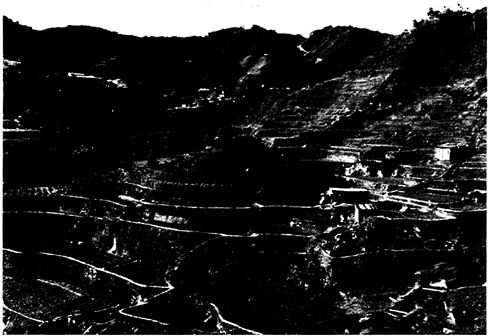
At an elevation of about 1,800 m (6,000 ft) in the Cameron Highlands of Malaysia, villagers grow vegetables on terrace farms that are situated on land cleared of tropical forests. Credit: James P. Blair © 1983 National Geographic Society.
different types of land uses in close proximity. The spatial arrangement of various land uses affects biophysical factors (for example, the presence of pollinators and pest predators or the rate of soil erosion within a watershed) as well as socioeconomic factors (for example, the availability of markets and reliable infrastructure) within the agroecosystem. Much of the theoretical groundwork and applied research on land use spatial patterns and relationships has been developed in terms of biogeography, forestry, landscape ecology, and conservation biology (Harris, 1984; Hudson, 1991; MacArthur and Wilson, 1967). Increased interaction between agricultural researchers, planners, and scientists from these related disciplines would allow greater insight into the best arrangement of land uses.
As difficult as it is to determine the appropriate mix of land uses within a region, country, or specific site, sustainability also requires the temporal arrangement of land uses and their integration over time. Time frames have always been taken into account in traditional shifting cultivation systems and are incorporated, for example, in the
design of rotation schedules. Expanded time frames should also be considered in planning long-term shifts in land use. In practice, regenerating forests and various low-input cropping and agroforestry systems may serve primarily as preparatory or transitional land uses (Sanchez, 1991).
While there is no exact way to determine which mix of systems will be most appropriate at any one place or point in time, the need to consider issues of scale in making decisions is critical. Land use scenarios should be considered at various geographical scales, from the farm to the landscape to the watershed to the region. An agricultural technology may offer sustainable productivity at the farm level, but have adverse social, economic, and environmental effects on the surrounding landscape (Okigbo, 1991). An individual farmer, for example, may benefit by capturing a significant proportion of a water source for irrigation. If, however, that source provided water for domestic use by downstream users, supported other downstream economic activities, or was critical to the stream's ecological functions, the individual benefit would have potentially serious communitywide effects.
Conversely, the success of a particular technology will be influenced by its ability to adapt to the components, processes, and relationships within the larger agroecosystem. Terracing, for example, is most often undertaken on steeply sloping lands to reduce the effective slope on which farming occurs. Successful implementation, however, depends on the physical, social, and economic characteristics of the larger ecosystem. The type of terraces, their height, closeness to each other, and the extent of terracing must be suited to the specific conditions of the ecosystem. These considerations of scale are especially important in weighing the information presented in Table 3-1 and the policy issues discussed in Chapter 4.
Improved resource use also requires an appreciation of changing demographics. For example, traditional shifting cultivation has been the most sustainable form of agriculture in many areas of the humid tropics. It may remain a suitable land use system where population levels are low and stable. However, to prescribe its continued (or expanded) use in areas lacking a sufficient land base would diminish the sustainability of the area as a whole. As population density increases or decreases, the appropriate role of shifting cultivation will change. The conditions that define this role are not easily predicted.
Many resource management problems in the humid tropics reflect the inability of institutions to address land use problems and potential solutions in an integrated manner (Lundgren, 1991). Most institutions involved in research, education, training, resource man-
agement, and international aid and development are structured according to various components of land use systems—for example, soils, water, crops, forests, range, livestock, and fisheries. Many have focused on managing one or two components for maximum productivity, without considering other consequences.
To overcome professional and institutional divisions, local and national agencies in the humid tropics need to foster cross-sector communication and action. Integrated management requires closer cooperation among hydrologists, soil scientists, agronomists, foresters, livestock and fishery managers, conservation biologists, cartographers and geographic information specialists, economists, sociologists, and other professionals. It also requires close cooperation between resource professionals, farmers, and other rural residents.
At the same time, local resource management activities need to be viewed within a broader context. The land management problems that undermine agroecosystem sustainability—soil erosion and sedimentation, nutrient depletion, declining water quality and availability, the loss of biological diversity, pest outbreaks, and destructive floods and fires—should be addressed through coordinated responses at scales larger than the field or local village level. Solutions require critical understanding of how the mosaic of land types and land uses within a given landscape or watershed supports or destabilizes local physical, biological, and ecological functions. This broader scale is also needed to address social and economic aspects of land use in a manner that extends beyond the local community (Okigbo, 1991).
Achieving an optimal mix of land uses will not be easy anywhere in the humid tropics. In any given area, this mix will vary according to the status of forest resources, climatic factors, topography, soil characteristics, levels of biological diversity, population pressures, indigenous populations, current land uses, and other considerations. To encourage optimal use of the land, zoning may be necessary. Decisions about major categories of land use can best be made at the national level; more specific decisions about land use must be made at lower levels. For example, in countries that retain large areas of primary forest, such as Brazil and Zaire, extractive reserves and natural forest management will be more important than in countries where deforestation is well advanced (see Part Two, this volume). Countries with high-population density, poor soils, and large areas of degraded lands will seek to allocate more space for labor-intensive restorative agroforestry systems than countries with fertile soils suitable for more intensive forms of crop agriculture. Countries that also contain large areas outside the humid tropics will need to coordinate land allocations across ecological boundaries.
It is highly important to involve local farmers, forest dwellers, and communities in zoning decisions at every step in the process. Just as the basic aim of land tenure reforms is to give people a stake in land and land uses, so should the zoning process seek to give citizens a greater voice in determining the land's future.
All countries have areas of special biological interest, whether these contain rare or endemic species, unusually high levels of biological diversity, or remnants of primary forest. The amount, types, and location of land that can and should be protected need to be determined. The design of forest reserves needs to be coordinated with agroecological zoning to avoid, to the extent possible, the effective destruction of habitat through isolation and fragmentation, to establish effective buffer zones and corridors, and to provide opportunities for integrated management. This is especially important in areas where forest reserves provide critical environmental services, such as the protection of upland watersheds.
The criteria used to evaluate land resources will themselves vary from country to country. In many cases, ongoing research will be required to delineate more precisely basic land attributes such as levels of biological diversity, susceptibility to erosion, potential for different agroforestry systems, and the state of forest regeneration in deforested areas. Remote sensing and geographical information systems can make the agroecological zoning process more efficient. Clearly this is one area where international support should be given to national resource agencies to strengthen their capacities.
Land Use Patterns and Land Classification
Land use classification systems that include geophysical, biological, and socioeconomic determinants must be developed for each country. Their evolution must involve the local communities that will ultimately be responsible for resource use. National priorities and ability to provide resources and infrastructure must also be considered.
Biological, geophysical, and climatic characteristics (including natural vegetation type, soil type and condition, slope, slope aspect, water availability, rainfall, humidity, light, wind, storm type, and storm intensity and frequency) determine land suitability for different types and combinations of agricultural and forestry systems. Ultimately, social, economic, and institutional conditions will determine the actual patterns of land use and the productivity levels within a landscape. Where human population density is low, more land tends to be used for agriculture, and the variety of land uses tends to be limited. As population pressure on the land rises, the variety of land
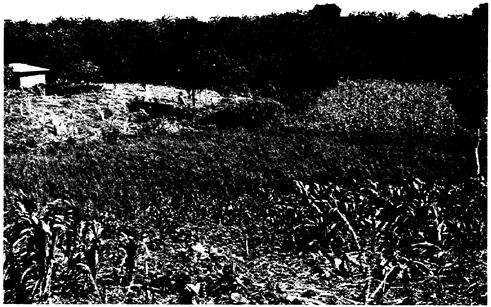
This typical agricultural landscape in the lowlands of Tabasco, Mexico, shows a mixed-crop land use system adapted to various field conditions by local farmers. Intercropped maize and beans occupy the better soil in the foreground; rice grows in a wet area in the middle; cassava has recently been harvested from the poorer, more well-drained soils around the house; maize grows in the background to the right on soils enriched by annual flooding but high enough for cropping during the rest of the year; a multistoried mixed tree plantation occupies the background where a diversity of timber and fruit trees provide shade for cacao trees below. Credit: Stephen Gliessman.
uses increases as people take fuller advantage of natural resources and of each production niche.
Land use patterns may become extremely diverse and complex if productivity and sustainability are demanded of all available land. For example, in a village at a lower mountain elevation, farmers may work the valley-bottom floodplains, the gentle to steeply sloping mountain soils (which may be too steep to terrace or may have cooler northern exposures), dry hilltops, and eroded gullies or stone outcroppings. They must take into account climate—heavy seasonal rains and the possibility of summer thunderstorms with hail, which restricts the growing of tree fruit. If land pressures in the village are high and markets are available, appropriate land use systems could include lowland rice with winter crop rotation, terraced rice, terraced mixed upland crops, growth of animal fodder on terrace faces, agroforestry, mixed forest plantings, highland grazing, animal feed gathered from
nearby vegetation, and extractive reserves. This entire range of systems types can be found, for example, in many villages in Southeast Asia. Although population pressures in these villages may be high, the social, political, and institutional conditions permit the blending of national, regional, community, and farmer interests in adjusting land uses to the geophysical environment.
Such adjustments could be encouraged if methods of land use classification that better incorporated biological, geophysical, climatic, and socioeconomic characteristics were developed. Few if any countries in the humid tropics have programs for detailed and systematic evaluations of natural resources of the type and at the scale necessary for assessing management options (Lal, 1991a). Similarly, there is no general classification system of ecological zones, of agricultural production potential, or of agricultural land use patterns that can provide an adequate framework for global-scale analysis of forestry and agriculture in the humid tropics (Lal, 1991a; Okigbo, 1991; Oram, 1988).
Existing land classification schemes do provide important baseline information. The soil and geophysical classifications of the Food and Agriculture Organization of the United Nations, for example, can be used to determine land use potential and environmental fragility, and to map and quantify the area within various categories of land use (Food and Agriculture Organization, 1976). Holdridge's classification of life zones based on climatic data is an important tool for understanding plant species adaptability and comparing forest system properties, and may be of value in indicating the potential of management options most appropriate for different lands (Holdridge, 1967; Lugo and Brown, 1991).
In general, these and other land classification systems have not been designed to incorporate socioeconomic factors, such as human population density and access to roads, or important biological factors, such as the degree of biodiversity. Inventories that might yield basic data for improved land use classification systems have usually been conducted on a partial basis, have focused only on resources of known commercial value, and have been hindered by a lack of strong institutional support (Latin American and Caribbean Commission on Development and Environment, 1990). As a result, science cannot calculate with precision the areas suitable for various land uses.
Maintenance of Biomass
The ability of a land use system to maintain high residual biomass in the form of wood, herbaceous material, or soil organic matter should be a primary requirement for restoring degraded or abandoned lands.
Biomass in the form of wood, herbaceous material, or soil organic matter significantly effects local and global ecological systems. It is essential for sustaining soil structure and fertility, recycling rainfall, and preventing soil erosion and floods. For example, a healthy stand of rain forest produces high levels of cloud recharge. About three-fourths of the rainfall is evaporated either directly from the soil and from the surface of leaves or from transpiration by plants, and roughly one-fourth runs off into streams, returning to the ocean (Salati and Vose, 1984).
Plant biomass, above and below ground, also plays a role in air quality and potential climatic changes. Through photosynthesis, trees use carbon dioxide in the atmosphere to produce the oxygen necessary to support life. Terrestrial soils are the largest reservoir of carbon, containing two times as much carbon as green plants (Lal, 1990). The clearing of forests releases carbon into the atmosphere that had previously been stored in trees and soils.
Through proper agricultural management techniques, some land uses have the potential for increasing the storage of soil carbon and the production of biomass. When fallow periods are long enough, carbon and other nutrient levels are maintained under shifting cultivation. A by-product of plantation cropping of fast-growing forests is the carbon fixation both in the standing forests and in their root systems. However, research is needed to determine which types of systems and combinations of plant and animal species are most effective in different regions.
Monitoring Systems and Methodologies
Resources should be available for linking national monitoring agencies with global satellite-based data sources so these agencies can refine, update, and verify their data bases for tracking land use changes and effects.
Monitoring systems and methodologies must be improved to trace land use changes and their effects. For example, only within the past 2 decades in the United States has it become possible to estimate the magnitude of soil loss and its effect on productivity. In most countries of the humid tropics, only rudimentary data on soil loss are available (World Resources Institute, 1992). The same holds for data on groundwater pollution, salinization, sedimentation rates, levels of biological diversity, greenhouse gas emissions, and other environmental phenomena (Ruttan, 1991). In addition to collecting these data, this effort should include assessments of the social effects of environmental change on human populations, especially the health of individuals and communities. It is also important that monitoring
add to the knowledge of, and ability to quantify, the impact of agricultural practices on the levels of greenhouse gases.
Broad-scale environmental phenomena are inherently difficult to quantify. This problem is exacerbated in the humid tropics by the escalating rate of deforestation. Accurate data on the spatial extent of, and biogeochemical processes associated with, deforestation and land use in the humid tropics are critical. Such data are especially important for research on global climate change, which relies heavily on computer models. International data bases employing satellite-generated information have improved monitoring capacities, but they should be more effectively linked with national monitoring systems. In many cases, these international data bases cannot be accessed at the national level. As a result, major discrepancies occur between the international and national data on basic questions such as the extent of forest cover and the rate of deforestation. Where data are available, their utility can be impaired by a lack of standard definitions and land use classifications.
The Global Environment Monitoring System (GEMS) of the United Nations Environment Program is an example of international efforts toward making data more readily available to resource planners and other analysts who might use them to advise development decision makers. The GEMS has activities related to air and water quality in 142 countries. However, due to inadequate financial resources, the coverage and quality of data have been weakened (World Bank, 1992).
ECOLOGICAL GUIDELINES FOR SYSTEMS MANAGEMENT
Systems options are selected, as discussed above, through stakeholder negotiation based on geophysical resources, social needs, markets, and the range of social and economic conditions. The target systems then evolve from existing conditions to higher productivity through progressive changes. The degree to which these systems increase in ecological sustainability, particularly in a fragile soil environment, depend largely on the following six biologically based elements:
-
The degree to which nutrients are recycled. Productivity within a system is directly related to the magnitude of nutrient mobilization and flow. Sustainability is directly related to the efficiency of nutrient use and to the reduction of nutrient loss, either to ground or surface water or to the atmosphere.
-
The extent to which the soil surface is physically protected. Soil loss through water transport or wind erosion must be minimized. It should be protected from oxidation or other chemical deterioration
-
through protective plant cover. Physical deterioration, compaction, and loss of structure through rainfall can be equally damaging, reducing productive potential. Continuous crop or crop residue cover from appropriately managed systems is crucial to maintenance of productive potential.
-
The efficiency and degree of utilization of sunlight and soil and water resources. With increasing limitations on the extent of natural resources in many populous countries, the selected agricultural systems must be managed for optimal use, including continuous crop cover, good crop and animal genetic potential, minimal pest damage, and optimal nutrient supply.
-
A small offtake (harvested removal) of nutrients in relation to total biomass. This factor is especially important on the more fragile soils. Where soils are erosive, have poor nutrient status, or are otherwise chemically or physically fragile, the maintenance of high biomass systems is critical.
-
Maintenance of a high residual biomass in the form of wood, herbaceous material, or soil organic material. A carbon source for both energy and nutrient retention is critical to the support of biomass in the soil and to crop and animal productivity.
-
The structure and preservation of biodiversity. The efficiency of nutrient cycling and the stability of pests and diseases in the system depend on the amount and type of biodiversity as well as its temporal and spatial arrangement (structural diversity). Traditional systems, particularly those in marginal production environments, often have significant stability and resiliency as a result of structural diversity. Research is only now beginning to quantify these effects.
TECHNICAL NEEDS COMMON TO ALL LAND USE OPTIONS
Three scientific areas, interwoven throughout the report, are an essential part of every land use option and its application to any given environment. The degree to which a land use is sustainable often depends on the success in dealing with pest management, nutrient cycling, and water management.
Pest Management
Plant and animal protection is crucial to the productivity of any land use system. Although many land uses have an inherent stability or resiliency with regard to pests and diseases, additional steps may be needed to protect plants and animals from damage due to insects, weeds, pathogens, or nematodes. Pest-induced losses to crops before
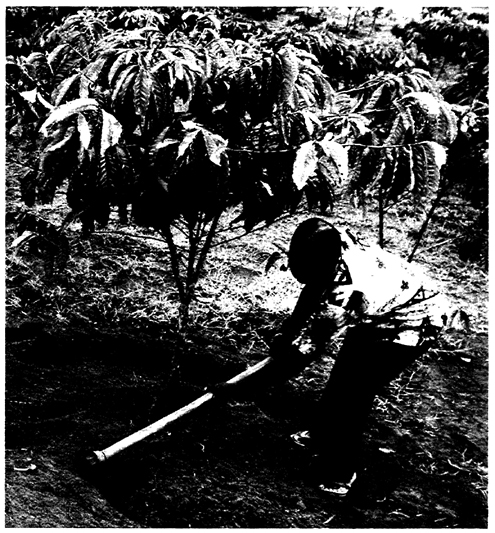
A farmer in Zaire tends his coffee trees. Coffee is one of the country's most profitable crops and is well suited to mixed crop small farms.Credit: James P. Blair © 1983 National Geographic Society.
harvest can be as high as 36 percent in developing countries (U.S. Agency for International Development, 1990). Current efforts to manage losses emphasize the use of chemical pesticides. Heavy, widespread use, however, can lead to detrimental effects on nontarget organisms, water contamination, pesticide resistance, and chemical residues on food. Chemical control for some important pests and pathogens may also not be economically viable.
The development of economically and environmentally sound so-
lutions to these problems is central to the issues of resource sustainability and achieving agricultural production goals. Research suggests that knowledge about natural biological processes in the crop and animal production environment may lead to management approaches or new products that, alone or combined with the careful use of chemicals, are effective against pests. For example, integrated pest management (IPM) is an ecologically based strategy to control pest populations and minimize crop loss through biological, cultural, and chemical means. It relies on natural mortality factors, such as pest predators, weather, and crop management, and reduces the need for pesticide use. Its adoption, however, is hindered by technical, institutional, socioeconomic, educational, and policy constraints in developing countries.
Technical constraints, such as knowledge of the controlling factors of the pest, the ability to manage predator populations, and difficulty in making the necessary crop management changes, are beginning to be overcome. In Indonesia, IPM was successfully used to control the rice plant hopper (Kenmore, 1991). Biological control methods tailored to the crop and pest were effectively used in Africa to control damage from the cassava mealybug and cassava green mite (Herren, 1989).
Nutrient Cycling
High productivity requires the enhanced movement of nutrients from soil to crops and trees, or from crops to animals and returning to crops. The lack of nutrients is often the most limiting factor on low-fertility soils. As productivity increases, however, nutrient flow and containment become increasingly critical, posing significant risk to water quality. Surface runoff containing phosphorus and nitrogen enriches water and accelerates the aging of lakes, whereby aquatic plants are abundant and oxygen is deficient. Nitrate buildup in water at levels above 10 parts per million poses serious health risks to humans.
High residual biomass systems are efficient in the extraction, use, and recycling of nutrients. Yet, even with perennial tree plantations, the fertilization needed for optimum yields can lead to loss to the environment unless appropriate cover crop and other measures are taken for their containment (Vincent and Hadi, Part Two, this volume).
Integrated nutrient management to reduce nutrient losses is thus critical to all systems. The magnitude of loss will vary with location, topography, cropping system, and other site-specific factors. Increases in soil fertility can be gained through the integration of livestock
with tree and food crops, tillage practices and mulching, alley cropping, crop rotation, cover crops, and mixed cropping (Cashman, 1988; Francis, 1986; Gliessman, 1982; Lal, 1987; Part Two, this volume).
Water Management
Water is an increasingly precious and limiting resource in all systems. Its quantity and quality play a vital role in the functioning of natural ecosystems and in economic development. Water resources are shared by all life forms in the environment. Its multiple use in hydroelectric generation, irrigation, fish and shellfish production, and waste disposal requires an integrated approach to its management.
Quality of the water resource is determined both by its purity and by the variability in stream flow or aquifer level. Land use in catchment areas is a critical determinant of both aspects of downstream water quality (Bjorndalen, 1991; Lundgren, 1985). Degradation of upstream areas leads to cycles of declining productivity and poverty both in the directly affected area as well as for downstream irrigation, fisheries, tourism, and other uses. Management of water resources is a cross-cutting issue that can serve as a focal point for a development program's organization, institutional structure, and impact assessment. It can only be addressed in an integrated fashion, beginning with selection of land use options appropriate not only to the geophysical setting but to the social and economic environment (Lal and Rassel, 1981). Watershed-level management capacity is required for all successful land use development planning.
COMMODITY-SPECIFIC RESEARCH NEEDS
Major public sector support is needed for research on basic food and feed grain commodities, both in genetic improvement and in management technologies. An appropriate economic environment must be maintained to continue and expand private sector technology development in the capital-intensive, vertically integrated industries, such as poultry, hogs, fish, and silk production, and in the development of appropriate inputs. Above all, farmer-collaborative networks for integrative technology adaptation and dissemination are needed. These are discussed in Chapter 4.


