
APPENDIX
Emissions of Greenhouse Gases from Tropical Deforestation and Subsequent Uses of the Land
Virginia H. Dale, Richard A. Houghton, Alan Grainger, Ariel E. Lugo, and Sandra Brown
Wide-scale land use change is resulting in numerous environmental consequences: degradation of soils, loss of extractive resources, loss of biodiversity, and regional and global climate change, among others. Common land use changes are forest degradation and the conversion of forests to agricultural systems and pastures. Because many agricultural systems in the humid tropics are not sustainably managed, each year large areas of forest are cleared to provide new fertile lands. Sustainable agriculture offers one means of offsetting the global consequences of large-scale land use change.
This paper discusses the emissions of greenhouse gases associated with land use change and the potential impact that sustainable agriculture may have on these emissions. Land uses involving intensive deforestation and intensive agricultural practices increase greenhouse gas emissions; in the case of deforestation, by eliminating a
Virginia H. Dale is a research scientist in the Environmental Sciences Division at Oak Ridge National Laboratory, Oak Ridge, Tennessee; Richard A. Houghton is a senior scientist at the Woods Hole Research Center, Woods Hole, Massachusetts; Alan Grainger is a bioecographer, resource economist, modeler, and environmental policy analyst and is currently a lecturer in geography at the University of Leeds, Leeds, United Kingdom; Ariel E. Lugo is director and project leader of the Institute of Tropical Forestry, U.S. Forest Service, U.S. Department of Agriculture, Puerto Rico; Sandra Brown is associate professor of Forest Ecology in the Department of Forestry, University of Illinois, Urbana-Champaign, Illinois.
source of oxygen production, carbon dioxide (CO2) conversion, and carbon (CO) sequestration; in the case of agriculture, by increasing sources of methane (CH4) through rice and livestock production. The emphasis here is on CO2, the major contributor to the greenhouse effect, and on tropical deforestation, the major land use change that accounts for the current increase in atmospheric CO2 concentrations. The net flux of carbon from land use changes is calculated by adding the stocks of carbon per unit area for the major land uses of the world to the rates of change in land use. Therefore, this paper reviews estimated carbon content and the rates of change in the carbon content of the major land uses in the humid tropics. That discussion forms a basis for estimating the flux of greenhouse gases from land use changes. Because projections of future impacts are based on particular models, this paper presents and compares the major model structures. Lastly, it discusses how the sustainable uses of land can reduce future emissions of greenhouse gases. The last section also presents a set of priorities for future research.
EFFECTS OF LAND USE CHANGE ON GLOBAL CLIMATE
Changes in the earth's climate are predicted to cause a 0.3°C warming per decade (range, 0.2° to 0.5°C per decade), which may instigate a 6-cm rise in sea level per decade (range, 3 to 10 cm per decade) in the next century (Houghton et al., 1990). These changes are anticipated as a result of the buildup of radiatively important gases in the atmosphere. Aside from water vapor, the major biogenic gases that contribute to the greenhouse effect (greenhouse gases)—CO2, CH4, nitrous oxide (N2O), chlorofluorocarbons (CFCs), and ozone—result either entirely or in part from human activities. Except for CFCs, these gases are also part of the natural cycles between ocean, land, and atmosphere. The increasing concentrations of these gases in the atmosphere, however, and the enhanced greenhouse effect that may result are due to increased emissions of these gases as a result of human activities, predominantly fossil fuel combustion and the expansion of agricultural lands (for CO2 concentrations, see Figure A-1) (Post et al., 1990). Currently, the burning of fossil fuels is the major contributor, but historically, land use changes have had a larger impact on atmospheric greenhouse gas concentrations (Houghton et al., 1983). Agriculture and the clearance of forests for agricultural use have accounted for about 50 percent of the total emissions of carbon over the past century (Figure A-2). In the past CO2 has accounted for more than half of all gases that contribute to the greenhouse effect and is expected to account for 55 percent over the next century (Houghton et al., 1990).
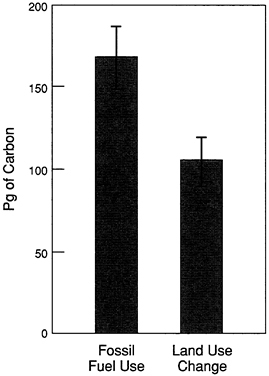
FIGURE A-1 Carbon dioxide (CO2) released from burning of fossil fuels and expansion of agricultural lands from 1850 to 1980. The lines within the bars indicate standard deviations; Pg, petagram. Source: Dale, V. H., R. A. Houghton, and C. A. S. Hall. 1991. Estimating the effects of land-use change on global atmospheric CO2 concentration. Can. J. Forest Res. 21:87–90. Reprinted with permission.
The annual net flux of carbon to the atmosphere from land use change is estimated to have been 0.4 to 2.6 Pg of carbon per year in 1980 (1 Pg = 1015 g) (Detwiler and Hall, 1988a; Houghton et al., 1987). The annual net flux of carbon as a result of fossil fuel emissions was between 5.0 and 5.5 Pg from 1980 to 1988 (Marland and Boden, 1989). Therefore, the recent contribution of CO2 to the atmosphere from land use change in terrestrial ecosystems is between 10 and 50 percent of the flux resulting from fossil fuel emissions. If 10 percent is correct, then land use change is not a major cause of the increases in atmospheric CO2 concentrations. Researchers must accurately identify whether the larger values are correct or whether the rate of land use change is increasing. It is also important to continue research to estimate the carbon flux resulting from the human impact on terrestrial ecosystems. The role of “undisturbed” forests also requires sci-
entific attention because, as these forests regenerate following natural or undetected human disturbances, carbon sequestration could offset some of the emissions resulting from human activities. Note that forests classified as undisturbed have frequently been subject to some human manipulations.
This paper discusses the effects of land use change on greenhouse gas emissions and the potential impact that sustainable agriculture may have on the interaction. The emphasis is on CO2, the major contributor to the greenhouse effect (Figure A-3), and on tropical deforestation, the major land use change involved in the current increase in atmospheric CO2 concentrations (Dale et al., 1991). A major finding from this review is that most of the current flux of greenhouse gases to the atmosphere from the tropics is due to the conversion of forests to agricultural uses and that sustainable agricultural practices could be a significant means of controlling the expansion of deforestation. Sustainability —which exists when land can be used for a long period of time without significant declines in the
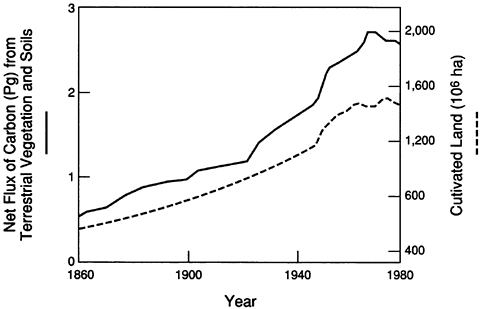
FIGURE A-2 Change in the area of cultivated land and net flux of carbon (Pg, petagram) from terrestrial sources from 1860 to 1980. Source: Houghton, R. A., J. E. Hobbie, J. M. Melillo, B. Moore, B. J. Peterson, G. R. Shaver, and G. M. Woodwell. 1983. Changes in the carbon content of terrestrial biota and soils between 1860 and 1980: A net release of CO2 to the atmosphere. Ecol. Monogr. 53:235–262.
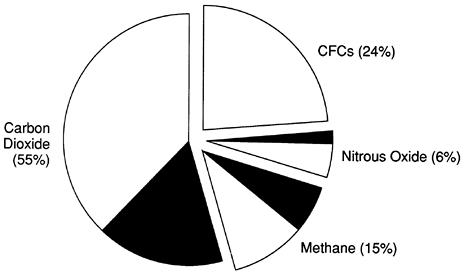
FIGURE A-3 Contributions of different gases to the greenhouse effect calculated for the 1980s. Screened segments indicate the relative contributions of deforestation and land use to the total emissions. White segments represent industrial and natural contributions. For the chlorofluorocarbons (CFCs), all the emissions are industrial. Source: Houghton, J. T., G. J. Jenkins, and J. J. Ephraums, eds. 1990. Climatic Change: The IPCC Scientific Assessment. Cambridge: Cambridge University Press.
ecologic attributes of the land—may require inputs of fertilizer, irrigation, use of machines, periods of fallow, adjacent land preserves, or other manipulations. The situation should be seen as sustainable from the viewpoints of both the landholder, who is able to make a living from the land, and the land itself, which maintains soil conditions adequate for growing agricultural or forest crops (Costanza, 1991). Therefore, it is important to evaluate the costs and benefits of particular forms of sustainable agriculture (including greenhouse gas emissions resulting from land use practices).
MAJOR LAND USE CHANGES RESPONSIBLE FOR THE FLUX OF GREENHOUSE GASES
Forests contain about 90 percent of all the carbon stored in terrestrial vegetation and are being cleared at a very rapid rate. (Table A-1 indicates the variability in estimates of deforestation, and Dale [1990] discusses the methods used to obtain the estimates.) With this clearing, the carbon previously stored in the trees and soils is being re-
TABLE A-1 Rates of Deforestation of Closed Tropical Forests by Source of Information (in Thousands of Hectares per Year)
|
Region |
Myers, 1980a (1979) |
FAO and UNEP, 1981b (1976–1980) |
FAO, 1991e (1981–1990) |
|||
|
Tropical America |
3,710 |
4,119 |
3,301 |
10,859 |
7,680 |
7,290 |
|
Tropical Africa |
1,310 |
1,319 |
1,204 |
1,338 |
1,580 |
4,788 |
|
Tropical Asia |
2,320 |
1,815 |
1,608 |
2,390 |
4,600 |
4,707 |
|
Total |
7,340 |
7,235 |
6,113 |
14,587 |
13,860 |
16,785 |
|
NOTE: FAO and UNEP, Food and Agriculture Organization of the United Nations and United Nations Environment Program; WRI, World Resources Institute. Numbers in parentheses are years to which deforestation data apply. a Refers only to closed forests in the humid tropics. b Refers to all tropical closed forests. c Uses data from the Food and Agriculture Organization and United Nations Environment Program (1981) only for forests in the humid tropics. d Refers to 34 countries that contain 97 percent of the world's total area of tropical humid forests. e Estimates for 62 of the 76 countries in the tropics; they include almost all of the humid forests along with some dry areas (Food and Agriculture Organization, 1991). The fact that some open forests are included makes a comparison with closed forests somewhat misleading. |
||||||
leased into the atmosphere. The net rate and the completeness of carbon release depend on the fraction of the forest burned, the decomposition rate of downed wood, and the fate of forest products. For example, when wood is burned, it quickly releases carbon into the atmosphere, whereas wood structures retain their carbon for a longer period of time, and some charcoal is essentially a form of permanent carbon storage. Crops and pastures may hold 2 to 5 percent of the carbon in vegetation per unit area, compared with that held by forest vegetation.
About half of the mass of vegetation is carbon. Estimates of biomass come from direct measurements (Ajtay et al., 1979; Brown and Lugo, 1982; Olson et al., 1983) or are derived from wood volumes reported in large-scale forest inventories (Brown and Lugo, 1984; Brown et al., 1989) (Table A-2). On average, the soils of the world contain about three times more organic carbon than is contained in vegetation.
The net flux of carbon to the atmosphere from land use changes depends not only on stocks of carbon in forests and rates of land use change but also on uses of agricultural lands (Table A-3). Land use changes can be triggered by natural events (such as fire, hurricanes, or landslides) or by people. Because the land use changes instigated by people have the greatest effect on the net carbon flux, only those changes are discussed here. The land use changes considered below include permanent agriculture and pasture, degradation of croplands and pastures, shifting cultivation, forest plantations and tree crops, logging, and degraded forests (Table A-3).
Many surveys have addressed the causes of tropical deforestation. Myers (1980, 1984) emphasized the roles of cattle ranchers, loggers, and farmers. Grainger (1986) distinguished between the land
TABLE A-2 Carbon Stocks in Vegetation and Soils of Different Types of Ecosystems Within the Tropics (Megagrams per Hectare)
|
Closed Forestsa |
|||||
|
Source and Region |
Forests in Humid Tropics |
Seasonal Forests |
Closed Forestsb |
Open Forests or Woodlandsa |
Crops |
|
Vegetation |
|||||
|
Tropical America |
176, 82 |
158, 85 |
89, 73 |
27, 27 |
5 |
|
Tropical Africa |
210, 124 |
160, 62 |
136, 111 |
90, 15 |
5 |
|
Tropical Asia |
250, 135 |
150, 90 |
112, 60 |
60, 40 |
5 |
|
Soilsc |
100 |
90 |
NA |
50 |
NA |
|
NOTE: NA, not available. a The first value of each pair of data is based on destructive sampling of biomass (Ajtay et al., 1979; Brown and Lugo, 1982; Olson et al., 1983); the second value is calculated from estimates of wood volumes (Brown and Lugo, 1984; Houghton et al., 1985). It is not evident which estimate is more accurate. b These estimates are also based on wood volumes reported by the Food and Agriculture Organization and United Nations Environment Program (1981) and use the revised conversion factors given by Brown et al. (1989). The first value of each pair of data is for undisturbed forests; the second value is for logged forests. c The values are averaged from estimates by Brown and Lugo (1982), Post et al. (1982), Schlesinger (1984), and Zinke et al. (1986). SOURCES: Houghton, R. A. 1991a. Releases of carbon to the atmospherefrom degradation of forests in tropical Asia. Can. J. Forest Res.21:132–142; Houghton, R. A. 1991b. Tropical deforestation and atmosphericcarbon dioxide. Climatic Change 19:99–118. |
|||||
TABLE A-3 Initial Carbon Stocks Lost to the Atmosphere When Tropical Forests Are Converted to Different Kinds of Land Use and the Tropical Land Use Areas, 1985
|
Percentage of Carbon Lost from: |
|||
|
Land Use |
Vegetation |
Soil |
Tropical Land Use Area, 1985 (millions of ha) |
|
Permanent agriculture |
90–100 |
25 |
602a |
|
Pasture |
90–100 |
12 |
|
|
Degraded croplands and pastures |
60–90c |
12–25c |
? |
|
Shifting cultivation |
60 |
10 |
435d |
|
Degraded forests |
25–50e |
? |
? |
|
Plantations |
30–50f |
? |
17d |
|
Logging |
25g (range 10–50) |
? |
169d |
|
Forest reserves |
0 |
0 |
? |
|
NOTE: For soils, the stocks are to a depth of 1 m. The loss of carbon may occur within 1 year with burning or over 100 years or more with some wood products. The question marks denote unknown information. a Food and Agriculture Organization. 1987. Yearbook of Forest Products. Rome, Italy: Food and Agriculture Organization of the United Nations. b Area includes pastures on natural grasslands as well as those cleared from forest. c Degraded croplands and pastures may accumulate carbon, but their stocks remain lower than the initial forests. d Food and Agriculture Organization and United Nations Environment Program. 1981. Tropical Forest Resources Assessment Project. Rome, Italy: Food and Agriculture Organization of the United Nations. e Houghton, R. A. 1991a. Releases of carbon to the atmosphere from degradation of forests in tropical Asia. Can. J. Forest Res. 21:132 –142. f Plantations may hold as much or more carbon than natural forests, but a managed plantation averages one-third to one-half as much carbon as an undisturbed forest because it is generally regrowing from harvest (Cooper, C. F. 1982. Carbon storage in managed forests. Can. J. Forest Res. 13:155–166). g Based on current estimates of aboveground biomass in undisturbed and logged tropical forests (Brown, S., A. J. R. Gillespie, and A. E. Lugo. 1989. Biomass estimation methods for tropical forests with applications to forest inventory data. Forest Sci. 35:881–902). When logged forests are colonized by settlers, the losses are equivalent to those associated with one of the agricultural uses of the land. SOURCE: Unless indicated otherwise, data are from Houghton, R. A.,R. D. Boone, J. R. Fruci, J. E. Hobbie, J. M. Melillo, C. A. Palm,B. J. Peterson, G. R. Shaver, G. M. Woodwell, B. Moore, D. L. Skole,and N. Myers. 1987. The flux of carbon from terrestrial ecosystemsto the atmosphere in 1980 due to changes in land use: Geographicdistribution of the global flux. Tellus 39B:122–139. |
|||
uses that replace forests and the underlying causes of deforestation: socioeconomic factors, environmental factors, and government policy. Fearnside (1987) divided the causes of deforestation in Brazil into proximate and ultimate causes. Repetto (1989) stressed the economic incentives set by government policies. One approach is no more correct than another, although Repetto's approach may be the most useful for determining how to change current incentives. From the perspective of sustainable agriculture, however, there is yet another approach to assigning cause to deforestation—most deforestation in the tropics has been, and still is, due to the development of new agricultural land. The expansion of agricultural land, and thus deforestation, could be reduced by adopting methods of sustainable agriculture.
Permanent Agriculture
When forests and woodlands are cleared for cultivated land, an average of 90 to 100 percent of the aboveground biomass is burned and immediately released to the atmosphere as CO2. Up to an additional 25 percent of carbon in the 1 m of surface soils is also lost to the atmosphere (Table A-3). Most of the loss occurs rapidly within the first 5 years of clearing; the rest is released over the next 20 years.
The wood harvested for products subsequently oxidizes, but it does so much more slowly than does the wood felled for cultivated land. The material remaining above and below the ground decays, as does the organic matter of newly cultivated soil. The rates of decay vary with climate, but in the humid tropics, most material decomposes within 10 years (John, 1973; Lang and Knight, 1979; Swift et al., 1979). However, recent work has indicated that many tropical woods take up to several decades to decompose (S. Brown and A. E. Lugo, personal observations). A small fraction of burned organic matter is converted to charcoal, which resists decay (Comery, 1981; Fearnside, 1986; Seiler and Crutzen, 1980). When croplands are abandoned, the lands may return to forests at rates determined by the intensity of disturbance and climatic factors (Brown and Lugo, 1982, 1990b; Uhl et al., 1988).
Cultivation of staple food crops in fields is common in the humid tropics—as it is elsewhere in the world—and is sustainable on good soils. Rice, maize, and cassava are the principal crops. Rice is usually cultivated in flooded fields or paddies, and the productivity and sustainability of wet rice cultivation is enhanced by reducing soil acidity under anaerobic conditions. This improves nutrient availability and the fertilization capabilities of the algae, decayed stubble, and
animal dung that exist in soil. Soil erosion is reduced because the soil surface is covered by water and because of the constraints on soil movement imposed by the mounds of earth surrounding the paddies.
Wet rice cultivation is one of the most sustainable land uses in the humid tropics; however, it is not universally applicable. Level, easily flooded sites are required (for example, river floodplains), although slight slopes can be accommodated by terracing. If the water above the sediment is aerobic, it can act as a sink for CH4, another greenhouse gas. However, CH4 is produced in copious amounts under the anaerobic conditions of the flooded fields. So, in addition to the CO2 given off when the forest is cleared initially, there is a continuing emission of CH4. This presents a major and not easily resolvable problem. Although control of deforestation by promoting the spread of wet rice cultivation makes sense because of its high productivity and sustainability, this might be harmful from a climate change perspective.
Pastures
The changing of forests to pastures results in a 90 to 100 percent loss of carbon from the vegetation, which is similar to that for cultivated lands (Table A-3). Because pastures generally are not cultivated, the loss of carbon from pasture soils is less than the loss from cropland soils (about 12 percent compared with 25 percent). Most studies show a loss of soil carbon (Fearnside, 1980, 1986; Hecht, 1982a), sometimes as much as 40 percent of the carbon originally contained in the forest soil (Falesi, 1976; Hecht, 1982b). However, under some conditions there appears to be no loss of soil carbon (Buschbacher, 1984; Cerri et al., 1988), and there may even be an increase (Brown and Lugo, 1990b; Lugo et al., 1986).
Theoretically, cattle ranching on planted pastures is an attractive option because it should maintain a continuous grassy cover on the soil surface and does not involve cultivation, thereby reducing soil degradation. The hydrologic and soil conservation properties of pastures observed on experimental sites are generally favorable. In practice, however, both productivity and sustainability can be low in some tropical areas, causing frequent abandonment of land. The results are a continuing need to clear more forests to provide fresh pastures; overgrazing, which causes widespread, degraded vegetative cover and changes in composition; and soil compaction from constant trampling by animals, which exposes the soil to other forms of degradation. However, in well-managed pasturelands, this pattern of events does
not occur. For example, large areas of productive pasturelands that have been in use for several decades or more exist in Venezuela, Costa Rica, and Puerto Rico. The organic carbon content of the soil of well-managed pasturelands is as high or higher than that of the forests from which the pasturelands were originally derived (S. Brown, personal observation).
From a climate change perspective, there are disadvantages to pastures. First, the amount of biomass per unit area is low. Second, frequent burning of pastures to maintain productivity leads to emissions of greenhouse gases in addition to the emissions following the initial clearing. Third, cattle emit CH4 from their guts. In this case, continuing greenhouse gas emissions are not compensated for by high sustainability, as is the case with wet rice cultivation.
Degradation of Croplands and Pastures
In many areas of the humid tropics, the abandonment of croplands is not followed by forest regeneration. Degraded croplands and pastures may accumulate carbon, but 60 to 90 percent of the carbon in the original forest and 12 to 25 percent of the soil carbon has been lost to the atmosphere (Houghton et al., 1987). Much of the land is abandoned in the first place because it has lost its fertility or has been eroded. These abandoned, degraded lands do not immediately return to forests, yet their degradation requires that new lands be cleared to keep the areas of productive croplands and pastures constant. The new lands are most frequently obtained by clearing forests.
Degraded lands are characterized by having been deforested and exposed to factors that reduced the land's productive potential (Lugo, 1988). According to Grainger (1988), the area of degraded lands in the tropics exceeds the area of unspoiled forestlands. The degraded lands have already lost a fraction of the carbon they stored initially and have the potential to serve as carbon sinks, should they be managed properly or rehabilitated by artificial or natural means.
Shifting Cultivation
The practice of traditional shifting cultivation, in which short periods of cropping alternate with long periods of fallow, during which time forests regrow, is common throughout the tropics. This form of shifting cultivation is sustainable when low population densities exist over large areas and the forests recover during the fallow phase. Shifting cultivation results in about a 60 percent loss of the original
carbon in the vegetation and a 10 percent loss of the carbon in the soils when the forest is cut and burned (Houghton et al., 1987). Large amounts of soil organic carbon are lost in association with permanent agricultural systems but not in association with short-term shifting agricultural systems (Ewel et al., 1981). Deforestation for shifting cultivation releases less net carbon to the atmosphere than does deforestation for permanently cleared land because of the partial recovery of the forests (Table A-3). The length of the cycle varies considerably among regions because of both ecologic and cultural differences (Turner et al., 1977). Decay rates for the plant material left dead at the time of deforestation and accumulation rates for regrowing vegetation during the fallow periods vary by ecosystem (Brown and Lugo, 1982, 1990a; Saldarriaga et al., 1988; Uhl, 1987; Uhl et al., 1982). Less soil organic matter is oxidized during the shifting cultivation cycle than during continuous cultivation (Detwiler, 1986; Schlesinger, 1986). Under shifting cultivation, deforestation is temporary and recurrent. During the fallow stage, these areas are carbon sinks. Soils can recover their soil organic carbon at rates as high as 2 Mg/ha (1 Mg = 106 g) per year following abandonment of agriculture to forest succession (Brown and Lugo, 1990b) (Table A-4). However, much of the shifting cultivation today is nontraditional, and fallow periods are often shortened to the point where the land becomes so badly degraded that it is virtually useless for any agricultural activity (Grainger, 1988).
Three main types of shifting cultivation can be identified: traditional long-rotation, short-rotation, and encroaching cultivation (Grainger, 1986, In press).
TRADITIONAL LONG-ROTATION SHIFTING CULTIVATION
Traditional shifting cultivation, which is practiced on long rotations of at least 15 to 20 years and often longer, is one of the few proven sustainable land uses in the humid tropics. Cropping for 1 to 5 years is followed by a 10- to 20-year fallow period, during which time the fertility of the land (that is, the nutrient content of both soil and vegetation) regenerates and weed growth is eliminated. Although it is sustainable, this practice has low productivity and can support only a low population density. It is now restricted to fairly remote areas where competition for land is low.
SHORT-ROTATION SHIFTING CULTIVATION
Most shifting cultivation is now carried out on short rotations of less than 15 years. Rotations of 6 years are common in Asia, and
TABLE A-4 Processes that Create Carbon Sinks and Their Potential Magnitude in the Tropical Closed-Forest Landscape
|
Process |
Magnitude (grams of carbon/m2/year) |
|
Biomass accumulation in forests >60–80 years old and logged forests |
100–200 |
|
Biomass accumulation in secondary forest fallows 0–20 years olda |
200–350 |
|
Biomass accumulation in plantationsb |
140–480 |
|
Accumulation of coarse woody debrisc |
|
|
Forests >60–80 years old |
20–40 |
|
Forests 0–20 years old |
17–30c |
|
Accumulation of soil organic carbon |
|
|
Background rates |
2.3–2.5 |
|
Forest succession |
50–200 |
|
Conversion of cultivation to pastureland or grassland |
30–42 |
|
a Converted to carbon units by multiplying organic matter by 0.5. b Weighted average rates across all species and age classes. c Two studies described by Brown and Lugo (1990b) report an average amount of coarse woody debris at an age of about 20 years of 8.5 percent of the aboveground biomass; this percentage of the biomass accumulation rate was assumed to go into coarse woody debris during the 20-year period. SOURCE: Lugo, A., and S. Brown. In press. Tropical forests as sinksof atmospheric carbon. Forest Ecol. Manage. |
|
even shorter rotations are found in Africa. Rotation length is reduced in response to the need for a more settled life-style than that led by traditional itinerant shifting cultivators (when farmers stay in one place they use a smaller area of land and rotate crops more frequently). The amount of available land is reduced as the population density increases or other land uses encroach onto territories where shifting cultivation was formerly practiced. The shorter the rotation length, the less time fertility has to regenerate and the greater the scope for a long-term decline in soil fertility and, hence, a decline in yields per hectare. When clearing and burning are done more frequently, there is a greater probability that the land will become infested by weeds. Weeds are just as important a cause of land abandonment as declining yields.
A number of points arise. First, because local conditions and management practices have a crucial influence on rotation length, it is difficult to identify a general threshold rotation at which shifting
cultivation becomes unsustainable (Young, 1989). Second, it has been argued that increases in cropping intensity in response to rising populations are usually accompanied by measures to improve productivity and sustainability (Boserup, 1965). However, some agricultural economists disagree and point out that, in practice, increasing intensity often leads to a decline in yields, increased soil degradation, and lower sustainability (Blaikie and Brookfield, 1987). Third, although the sustainability of shifting cultivation is determined by how well it sustains the yield per hectare over succeeding rotations, it can also be evaluated from a carbon budget perspective with respect to how much carbon is stored, on average, in the fallow vegetation and how much soil carbon is restored after cropping. Short rotations do not allow forests to regenerate, as is the case in traditional agricultural practices. The usual result is a low bushy vegetation technically referred to as secondary forest but commonly called forest fallow and which has a low carbon content per hectare. If agricultural sustainability declines, then the carbon stock could also fall to a low level (for example, if some robust weedy species takes hold and prevents the regeneration of woody cover).
Because short-rotation shifting cultivation is such a widespread practice, its elimination is not feasible. Instead, a major effort is required to improve its productivity and sustainability. This may involve the judicious use of fertilizers (Sanchez et al., 1983) or the development and promotion of low-input cropping practices that improve the soil (Sanchez and Benites, 1987). The latter would include the planting of trees during the fallow period as an alternative to sole reliance on natural regeneration (Juo and Lal, 1977).
ENCROACHING CULTIVATION
Encroaching cultivation, a widespread practice, is typically carried out by landless migrants. Farmers spread out in waves from roads into the forest, clearing forest and cropping land until yields are too low and weed infestation is too great to continue. They then move to an adjacent patch of forest and repeat the process. Instead of working with the nutrient cycling mechanisms of the natural ecosystem so that they can return at a later date to crop the land again, encroaching cultivators usually exhaust the fertility of the land and leave behind a scrubby wasteland. This is of little use for agriculture and renders the land incapable of supporting regenerating vegetation, which could increase the carbon stock and improve soil conditions. Thus, productivity and sustainability are both poor, and from the points of view of both deforestation and carbon budget analysis, the impact of encroaching cultiva-
tion is more akin to permanent cultivation than shifting cultivation, but with none of the former's potential advantages.
Tree Plantations
Tropical forests may also be replaced by two types of tree plantations: forest plantations and tree crop plantations, from which the output consists of food, oils, and other nontimber products. Monocultures are often, but not always, grown in both types of plantations. The forest plantation area in the tropics was only about 1 percent of the total closed-forest area in 1980 (Lanly, 1982). Forest plantations are typically established to restore cover to areas where forests are not as abundant as they once were and where both timber and fuelwood are in short supply. Plantations can contain as much carbon as the original vegetation, but they typically contain 30 to 50 percent of the carbon in the original vegetation because of short rotations (Lugo et al., 1988). The net primary productivity of plantations can be high, with values about 3 and 10 times those of secondary and mature forests, respectively (Brown et al., 1986; Lugo et al., 1988). Soil organic matter also builds up on tree plantations (Brown and Lugo, 1990a; Cuevas et al., 1991). Because of a plantation's high rate of biomass accumulation and the predominance of younger plantations, the positive impact of tree plantations on the carbon cycle in the tropics is greater than might be evident (Brown et al., 1986). Moreover, many of these plantations are established for environmental protection purposes or to rehabilitate degraded lands (about 17 percent of the total area [Evans, 1982]) and are thus likely to continue to accumulate carbon for long time periods.
Numerous tree crops are grown on plantations in the humid tropics, including oil palm, rubber, cacao, coconut, bananas, and coffee. Some plantations are very large, covering thousands of hectares; others are quite small. In all cases, however, the replacement of forest by an alternative tree cover does result in some of the factors that lead to sustainability, including maintenance of a relatively closed canopy of vegetation that covers the land and minimal disturbance of the soil. The amount of biomass per unit area is also high, but it is not equivalent to that in mature forests. Productivity is good on the best soils, and the high capital intensity of operations gives a commercial incentive to plantation operators to be careful when choosing sites. However, weed removal to increase productivity also exposes the soil to erosion, thereby diminishing sustainability. One way to overcome this problem is to intercrop the tree crops with another perennial crop or pastures—an application of the silvopastoral agroforestry system.
Logging
Logging of forests in the tropics is generally selective in that only the largest commercial trees are removed (Lanly, 1982), but there is often damage to the residual trees (Ewel and Conde, 1978). As of 1980, almost 15 percent of the closed forests had been logged. This area was increasing annually by an additional 4.4 million ha. Logging removes 10 to 50 percent of the carbon in vegetation (Houghton et al., 1987). Although logging removes living biomass, both directly for products and through transfers to dead biomass (necromass), during recovery vigorous regrowth can occur in the residual stand.
The farmers responsible for most of the deforestation in the tropics tend to prefer stands that have already been modified (usually logged) (Brown and Lugo, 1990b; Lanly, 1982). These stands are easier to cut and clear or are accessible because of road construction (Grainger, 1986). More than half of the area deforested in 1980 originated from selectively logged forests (Lanly, 1982); thus, their biomass had already been reduced.
The rate of aboveground carbon accumulation (as biomass) in tropical forests ranges widely between negative values (when stands are degrading) to more than 15 Mg/ha/year in fast-growing plantations (Lugo et al., 1988). During logging, CO2 is released into the atmosphere from the mortality and decay of trees damaged in the harvest operations, the decay of logging debris, and the oxidation of the wood products. Logging may also cause a net withdrawal of carbon from the atmosphere if logged forests are allowed to regrow and the extracted wood is put into long-term storage, such as buildings or furniture. Long-term observations of the carbon dynamics of forest plots, either undisturbed or subjected to slight disturbances in their recent past, do not support the notion that they have steady-state levels of carbon (Brown et al., 1983; Weaver and Murphy, 1990). In all cases, tree growth plus ingrowth (trees with the minimum diameter to be included in the survey) accumulated more aboveground carbon than was lost by tree mortality. Ingrowth into tree stands tends not to be a significant carbon sink unless the stand is recovering from an acute disturbance such as intensive logging (Brown et al., In press) or a hurricane. If the land is not used following harvest, the regenerating forest probably accumulates more carbon than it releases, and in the long run the net flux of carbon may be close to zero (Harmon et al., 1990).
Rates of harvest are reported annually in the Yearbook of Forest Products (Food and Agriculture Organization, 1946–1987). Average extraction rates in different regions range between 8.4 and 56.9 m3/ha
of total growing stocks of 100 to 250 cm3/ha (Lanly, 1982). About one-third of the original biomass is damaged or killed in the harvesting process (Kartawinata et al., 1981; Nicholson, 1958; Ranjitsinh, 1979). The dead material decays exponentially. The undamaged, live vegetation accumulates carbon again at rates that vary with the type of forest and the intensity of logging (Brown and Lugo, 1982; Brown et al., In press; Horne and Gwalter, 1982; Uhl and Vieira, 1989). The live vegetation then eventually dies and decomposes, returning CO2 to the atmosphere. The harvested products decay at rates that depend on their end use (Food and Agriculture Organization, 1946–1987); for example, fuelwood typically decays in 1 year, paper in 10 years, and construction materials in 100 years (Houghton et al., 1987).
Degraded Forests
In addition to controlled selective logging and the extraction of other resources from forests, illicit extraction of timber products occurs in vast areas (Brown et al., 1991). This “log poaching” reduces the forests biomass and, in the process, releases 25 to 50 percent of the carbon in vegetation to the atmosphere (Houghton et al., 1987). This release of carbon has often been overlooked in estimates of carbon flux. The lowering of biomass through the illicit extraction of wood, forage, or other resources may account for some of the differences in the estimates of biomass discussed above. If the higher estimates based on direct measurement of biomass were selective of stands that showed no sign of disturbance, and if the lower estimates of biomass came from a sampling of more representative stands, the difference in estimates may be of human origin. Stands recovering from previous disturbances (young secondary forests, more than 20 years old) accumulate aboveground carbon at rates from 2.2 to 3.8 Mg/ha/year (Brown and Lugo, 1990b) (Table A-4). Depending on whether the degradation occurred long ago or recently (Brown et al., 1991; Flint and Richards, 1991), an accounting of the carbon that has been released as a result of degradation may increase estimates of carbon flux by 50 percent or more (Houghton, 1991a).
ESTIMATED FLUX OF GREENHOUSE GASES FROM LAND USE CHANGES
The estimated carbon content and rates of change of the major land uses in the tropics reviewed above can be used to estimate the flux of greenhouse gases from those land use changes. The discussion
on fluxes is broken down by gas: CO2, CH4, N2O, and carbon monoxide (CO).
Carbon
The specific amount of CO2 released as a result of tropical deforestation is difficult to quantify (Table A-5). The most current estimated release of carbon from land use change in the tropics is 1.1 to 3.6 Pg for 1989. In 1980, 22 of 76 tropical countries contributed 1 percent or more to the total flux; five countries (Brazil, Indonesia, Colombia, Côte d'Ivoire, and Thailand) contributed half of the total net release (Houghton et al., 1985). In 1989, four countries (Brazil, Indonesia, Myanmar, and Mexico) accounted for more than 50 percent of the release (Houghton, 1991b).
The expansion of agricultural lands and pasturelands accounts for most of the carbon loss due to tropical deforestation (Table A-3). Losses due to forest degradation are hard to quantify because of the difficulty of identifying areas of degraded forests on a broad scale. The roles of biomass burning and carbon sinks should also be considered.
BIOMASS BURNING
Biomass burning is estimated to release 3.0 to 6.2 Pg of carbon annually (Crutzen and Andreae, 1990). This release is a gross emis-
TABLE A-5 Estimated Release of Carbon Dioxide as a Result of Tropical Deforestation
|
Year |
Petagram (Pg) of Carbon Released as Carbon Dioxide |
Reference |
|
1980 |
0.9–2.5 |
Houghton et al., 1985 |
|
1980 |
0.6–1.1a |
Molofsky et al., 1984 |
|
1980 |
0.4–1.6b |
Detwiler and Hall, 1988b |
|
1980 |
0.5–0.7 |
Grainger, 1990d |
|
1980 |
0.9–2.5c |
Hao et al., 1990 |
|
1989 |
1.1–3.6 |
Houghton, 1991b |
|
a This value does not include deforestation of fallow areas, which was estimated to release 0.4 to 0.8 Pg of carbon to the atmosphere (Houghton et al., 1985). b This value does not include permanent loss of fallow areas. c The study did not consider long-term releases associated with decay or long-term accumulations associated with growth. |
||
sion; however, most of the carbon released in a year is accumulated in the growth of recovering vegetation. The burning of grasslands, agricultural lands, and savannahs, however, has increased over the last century, because rarely burned ecosystems, such as forests, have been converted to frequently burned ecosystems, such as agricultural lands or grasslands or shrub lands. For example, the area of grasslands, pastures, and croplands increased by about 50 percent between 1850 and 1985 in tropical America (Houghton et al., 1991) and between 1880 and 1980 in tropical Asia (Flint and Richards, 1991; E. P. Flint and J. F. Richards, Duke University, personal communication, 1991). The area of natural grasslands actually decreased but was more than offset by increases in the combined areas of pastures and croplands. The relative increases observed in tropical America and Asia are probably greater than increases in Africa, where large areas of savannahs already existed before the last century. Burning of almost half of the world's biomass is estimated to occur in the savannahs of Africa (Hao et al., 1990). Worldwide carbon emissions from the burning of savannahs and agricultural lands have probably increased by 20 to 25 percent over the last 150 years.
The formation of charcoal as a result of burning sequesters carbon. Because carbon in charcoal is oxidized slowly, if at all, charcoal formation removes carbon from the short-term carbon cycle, resulting in long-term sequestration (Seiler and Crutzen, 1980). Each year, between 0.3 and 0.7 Pg of carbon is estimated to be converted to charcoal through fires (Crutzen and Andreae, 1990). Only about 0.1 Pg of carbon is estimated to be formed in charcoal as a result of fires associated with shifting cultivation and deforestation; however, the production, fate, and half-life of carbon in charcoal are poorly known, so the size of this carbon sink is uncertain.
TROPICAL SYSTEMS AS CARBON SINKS
The potential for vegetation to be a carbon sink depends on the balance of all natural processes of the carbon cycle and the influence of human and natural disturbances. Potential long-term carbon sinks include large trees, necromass, changes in wood density, soil organic carbon (SOC), and carbon export. A significant fraction of the net accumulation of aboveground carbon in tropical forest stands appears to occur in the continuous growth of older trees that get progressively larger with age (Brown and Lugo, 1992; Brown et al., In press). Necromass is a potential long-term carbon sink because of the relatively slow rate of wood decomposition (decades to centuries) (Table A-4) (Harmon et al., 1990). The importance of changes in
wood density as a carbon sink relates to the fact that species composition changes as forests mature. Typically, mature forest species have higher density woods than do pioneer species (Smith, 1970; Whitmore and Silva, 1990), so more carbon can be stored per unit of wood volume produced by mature forest species (for example, Weaver [1987]). SOC is a long-term storage compartment for atmospheric carbon. Schlesinger (1990) recently showed that some tropical soils under forests continue to accumulate SOC over thousands of years at a rate of about 2.3 g CO/m2/year (the flux background rate in Table A-4). However, large SOC depletions may be associated with deforestation, and the rate of recovery of SOC to initial levels is slow. Conversion of cultivated cropland to pastures also results in SOC accumulation (Lugo et al., 1986). SOC will recover under forest plantations, and some species appear to accelerate its recovery (Lugo et al., 1990a,b). Carbon export may occur when carbon is transported by rivers to oceanic systems.
Other Greenhouse Gases
Most of the carbon released to the atmosphere from land use changes is released as CO2 (Table A-6 and Figure A-3). The emissions of CH4, N2O, and CO to the atmosphere are also of interest because they contribute either directly or indirectly to the heat balance of the earth and have been increasing during recent decades (Figure A-4). The accumulation of CH4 in the atmosphere contributed about 15 percent of all gases that contributed to the greenhouse effect in the 1980s; the contribution from N2O was about 6 percent. Although CO is not radiatively important itself, it reacts chemically with hydroxyl radicals (OH) in the atmosphere, some of which would otherwise react with, diminishing its concentration.
Land use change is a major contributor to the releases of CH4 and N2O. Fifty to 80 percent of the annual release of CH4 is from land (Houghton et al., 1990). The higher estimate includes releases from natural wetlands and termites, largely natural sources. Rice paddies, ruminant animals, and biomass burning are estimated to contribute 20, 15, and 8 percent, respectively, of the total emissions of CH4.
About 65 to 75 percent of the annual releases of N2O are thought to come from land (Houghton et al., 1990), with soils alone contributing 50 to 65 percent. Soils may also be an important sink for atmospheric N2O and CH4. The magnitude of the soil sink is not known. In fact, the global budget for N2O is not understood well enough to account for the observed increase in the concentration of N2O in the atmosphere. An additional source is not yet accounted for.
TABLE A-6 Annual Global Emissions of Greenhouse Gases
|
Contribution to Greenhouse Effect in 1980s (percent) |
||||||
|
Gas |
Source |
Annual Emissionsa |
Percent Emissions of Gases |
Radiative Forcing Relative to CO2 Molecule |
Total |
Deforestation |
|
CO2 |
Industrial |
5.6 Pg of C |
50 |
1 |
50 |
|
|
Bioticb |
2.0–2.8 Pg of C |
20–25 |
||||
|
Tropical deforestation |
2.0–2.8 Pg of C |
20–25 |
13–16 |
|||
|
CH4 |
Industrial |
50–100 Tg of C |
8–10 |
25 |
20 |
|
|
Bioticb |
320–785 Tg of C |
63–66 |
||||
|
Tropical deforestation |
136–310 Tg of C |
26–27 |
8 |
|||
|
N2O |
Industrial |
<1 Tg of N |
250 |
5 |
||
|
Bioticb |
3–9 Tg of N |
75 |
||||
|
Tropical deforestation |
1–3 Tg of N |
25 |
1–2 |
|||
|
CFCs |
Industrial |
700 Gg |
100 |
1,000s |
20 |
|
|
Bioticb |
0 Gg |
0 |
0 |
|||
|
Total |
95 |
22–26 |
||||
|
NOTE: No natural emissions of CO2 can be measured on a regular basis; the values of biotic and deforestation sources are identical. 1 Pg = 1015 g; 1 Tg = 1012 g; 1 Gg = 109 g. CO2, carbon dioxide; CH4, methane; N2O, nitrous oxide; CFCs, chlorofluorocarbons; C, carbon; N, nitrogen. a Data are from Ramanathan et al. (1987). The greenhouse gases considered here are only those directly released as a result of human activities. Tropospheric ozone, which is formed as a result of other emissions, contributes another 5 percent to the total. The major greenhouse gas, water vapor, is not directly under human control but will increase in response to a global warming. b Biotic emissions include emissions from tropical deforestation as well as natural emissions. c Relatively little CH4 is emitted as a result of deforestation. Most of CH4 emissions result from rice cultivation or cattle ranching, which are land uses that replace forests. Additional releases occur with repeated burning of pasturelands and grasslands. |
||||||
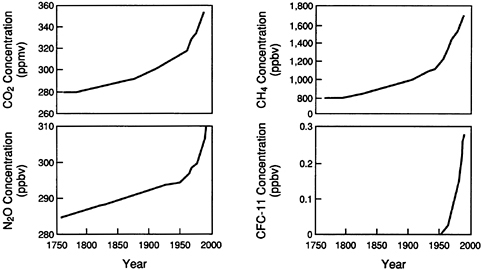
FIGURE A-4 Atmospheric concentrations of the major greenhouse gases —carbon dioxide (CO2), methane (CH4), nitrous oxide (N2O), and chlorofluorocarbon 11 (CFC-11)—from 1750 to 2000; ppbv, parts per billion (by volume); ppmv, parts per million (by volume). Source: Data from Houghton, J. T., G. J. Jenkins, and J. J. Ephraums, eds. 1990. Climatic Change: The IPCC Scientific Assessment. Cambridge: Cambridge University Press.
METHANE
A small fraction of the carbon released to the atmosphere may be CH4. The releases of CH4 during burning are generally 2 orders of magnitude lower than those of CO2: 0.5 to 1.5 percent of the CO2 released (Andreae et al., 1988; Crutzen et al., 1985). The radiative effect of a molecule of CH4, however, is 25 times greater than that of a CO2 molecule, so if as much as 4 percent of the carbon were emitted as CH4, the radiative effects of CO2 and CH4 would be equal in the short term. Because the average residence time of CH4 in the atmosphere is only about 10 years, whereas that of CO2 is 100 to 250 years, the long-term greenhouse effect due to CO2 is greater than that due to CH4 (Table A-6) (Houghton et al., 1990; Lashof and Ahuja, 1990; Rodhe, 1990).
If the ratio of CH4/CO2 emitted in fires associated with deforestation is 1/100, and if 40 percent of the emissions from deforestation resulted from burning, then only about 10 Tg (1 Tg = 1012 g) of carbon as CH4 would be emitted to the atmosphere directly from deforestation. This flux is based on the net flux of CO2, however. Burning
of pastures, grasslands, and fuelwood is estimated to have released 30 to 75 Tg of CH4 annually (Cicerone and Oremland, 1988). In addition, 60 to 170 Tg of CH4 is released from rice cultivation (Cicerone and Oremland, 1988), 27 Tg is released from natural tropical wetlands (Matthews and Fung, 1987), and 19 to 38 Tg is released from cattle ranching in the tropics (some of which occurs on natural savannahs and grasslands) (Lerner et al., 1988). Thus, a total of 136 to 310 Tg of carbon, or about 26 percent of the global emissions of CH4, may arise from the tropics (Table A-6). The expansion of wetlands through the flooding of forests for hydroelectric dams could become a significant new source of CH4 in the future.
NITROUS OXIDE
The gas N2O is also emitted to the atmosphere following deforestation. Small amounts of N2O are released during burning, but most of the release occurs in the months following a fire. Fire affects the chemical form of nitrogen in soils and, as a result, favors denitrification (Cofer et al., 1989; Levine et al., 1988). One of the by-products of denitrification is the production of nitric oxide (NO) and N2O.
Estimates of the global emissions of N2O are tentative. Industrial sources are thought to contribute less than 1 Tg of N2O per year. Earlier estimates of this flux were higher, but the measurements are now thought to have been artificially high (Muzio and Kramlich, 1988). The soils of natural ecosystems are estimated to release 3 to 9 Tg of nitrogen annually as N2O (Table A-6) (Seiler and Conrad, 1987). Fertilized soils may release 10 times more per unit area, and the soils of new pastures may release even higher amounts (Anderson et al., 1988; Levine et al., 1988). Deforestation for tropical pastures may well be a major contributor to the global increase in N2O concentrations (Table A-6) (Luizão et al., 1989).
CARBON MONOXIDE
CO is not a greenhouse gas, but it does affect the oxidizing capacity of the atmosphere through interaction with OH and thus indirectly affects the concentrations of other greenhouse gases such as CH4 and N2O. Generally, CO emissions account for 5 to 15 percent of the total CO2 emissions from burning of biomass, depending on the intensity of the burn (Andreae et al., 1988; Cofer et al., 1989; Crutzen et al., 1979, 1985). More CO is released from smoldering fires than during rapid burning or flaming. The burning associated with deforestation may thus release 40 to 170 Tg of carbon as CO. In addition,
the repeated burning of pastures and savannahs in the tropics is estimated to release 200 Tg of carbon as CO (Hao et al., 1990). Together, these emissions of CO from the tropics are as large as estimates of global emissions from industrial sources (Cicerone, 1988).
Total Radiative Effect from All Gases Released as a Result of Tropical Deforestation
The global emissions (both total emissions and emissions from tropical deforestation) of the three greenhouse gases previously discussed above (CO2, CH4, and N2O) are given in Table A-6. Biotic emissions include the emissions from tropical deforestation. By taking the sums of the emissions and taking into account the different radiative effects of the gases and their residence times in the atmosphere (Ramanathan et al., 1987), tropical deforestation accounts for about 25 percent of the radiatively active emissions globally (Houghton, 1990a) (Figure A-3).
ESTIMATING FUTURE IMPACTS
Estimation of the future impacts of land use changes encompasses many dimensions. The spatial scale of interest is the entire earth, but by focusing on the tropics, or key areas in the tropics, insights can be achieved. This review restricts the time dimension to the next century because critical socioeconomic and political decisions that will have major environmental repercussions will be made during that time frame. Models are an essential tool in projecting future patterns and impacts of land use change. Because no one model encompasses all of the processes of importance or all of the scales of interest, four main model types are reviewed here. One set of models emphasizes the accounting of carbon gains and losses in the landscape because of changes in land use, whereas the others integrate the socioeconomic and ecologic aspects of land use change. Together, they demonstrate approaches to determining future impacts under different scenarios of land use change, management, and population change. All of these models suffer from poor knowledge of deforestation rates, the biomass per unit area, the rate of biomass recovery, and changes in the carbon pools as a result of disturbance.
Carbon Accounting Models
The models of Moore and colleagues (1981), Houghton and colleagues (1983, 1985, 1987), Detwiler and Hall (1988a), and Bogdonoff
and colleagues (1985) are based on information at the biome level, predict carbon fluxes over large regions of the earth, and account for lags in the releases or uptake of carbon. These lags result from the slowness of decay of dead plant material, soils, and wood products or the accumulation of carbon in regrowing forests following shifting cultivation and logging. The annual flux estimation includes timing of the releases and accumulations of carbon stock following land use changes. For example, 50 to 60 percent of the carbon emitted to the atmosphere in 1980 is calculated to have resulted from the deforestation during the first year after the trees are cut. The remaining net flux in 1980 resulted from the decay of vegetation and soils and from the oxidation of wood products generated by deforestation in previous years.
Deforestation and other land use changes initiate changes in vegetation and soil. In the year of deforestation, a large amount of carbon is released through burning. Afterward, the decay of soil organic matter, downed wood, and wood products continues to release carbon to the atmosphere, but at lower rates. If croplands are abandoned, regrowth of live vegetation and redevelopment of soil organic matter withdraw carbon from the atmosphere and again carbon accumulates on land. Such changes have been defined for different types of land uses and different types of ecosystems in different regions of the tropics. Annual changes in the different reservoirs of carbon (live vegetation, soils, downed wood, and wood products) determine the annual net flux of carbon between the land and atmosphere. Because ecosystems and land uses vary and calculations require accounting for cohorts of different ages, accounting (bookkeeping) models have been used for the calculations.
The accounting models developed by Houghton (1990b) allow for a projection of the effects of particular patterns of deforestation or reforestation. For example, when deforestation is based on population change, the projected rate of global deforestation more than doubles between 1980 and 2045 (Figure A-5), at which time the forests of Asia would be eliminated. Closed forests in the rest of the tropics would be eliminated by about 2065, and open forests would be eliminated 10 years later. In a reforestation scenario, land that had supported forests in the past and that is not presently used for crops or settlements is allowed to regenerate, with all logging stopping by 1991. The projected accumulation of carbon on lands abandoned by shifting cultivation would be 54 Pg; that on reforested land would be 98 Pg. The models can also be used to compare alternative assumptions on factors that affect carbon emissions. For example, the high- and low exponential curves in Figure A-5 signify the inclusion and the
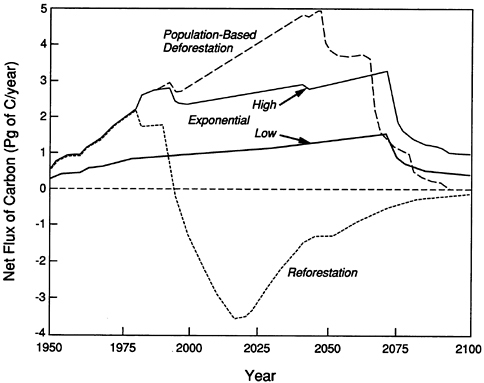
FIGURE A-5 Four projections of the annual net flux of carbon between tropical land and the atmosphere, in petagrams (Pg) of carbon (C) per year, based on different assumptions of deforestation and reforestation rates. Positive fluxes indicate a net release of carbon from the atmosphere. The curves marked, Exponential High and Low, are based on two extremes of carbon emissions associated with high and low estimates of biomass in the tropical forest. Abrupt reductions in emissions near 2045, 2060, and 2070 result from an elimination of forests in a major region and, hence, an abrupt reduction in the rate of tropical deforestation. Source: Houghton, R. A. 1990b. The future role of tropical forests in affecting the carbon dioxide concentration of the atmosphere. Ambio 19:204–209. Reprinted with permission.
lack of inclusion of the conversion of forest fallow to permanently cleared land and show that there is a significant difference between the simulations in the rate of deforestation for the entire tropics.
The accounting models have been extremely useful in projecting the future effects of particular scenarios of land use practices. It is largely because of the results that have been obtained from these models that current research is focused on land use practices in the tropics and the effects of CO2 releases. However, these accounting models do not incorporate feedbacks between the socioeconomic and
ecologic aspects of land use change. Therefore, the most recent models of land use integrate a variety of aspects of land use change so that the causes of deforestation and its impacts can be evaluated.
Models that Integrate Socioeconomic and Ecologic Aspects of Land Use Change
Given the socioeconomic forces that frequently initiate land use changes and, as a result, that cause major ecologic effects, modeling of the land use change process requires models that combine socioeconomic and ecologic factors.
FACTORS AFFECTING LAND USE CHANGES
Grainger (1986,1990b, In press) has argued that land use changes can be attributed to three sets of underlying causes: socioeconomic factors, physical environmental factors, and government policies. It is assumed that national land use morphology (the relative proportions of different land uses, each with different biomass, productivity, and sustainability characteristics) changes over time in response to these underlying causes, each of which is described here briefly. Land use also has a role linked to the degree of sustainability and other factors (discussed later).
Socioeconomic factors, such as population growth and economic development, are the key driving forces causing large areas of forestland in the humid tropics to be transferred to agricultural uses. Rising populations require more land for settlement and crops to supply the increasing demand for food. Growing population densities also lead to more intensive farming practices. National population growth rates are somewhat correlated with deforestation rates in the humid tropics (Allen and Barnes, 1986; Grainger, 1986).
In terms of agriculture, economic development increases per capita food consumption and the need to grow export cash crops. Crops that are grown for export earn foreign currency, which funds continued economic growth. Both trends lead to more deforestation and, assisted by the improved access to Western technology that comes with economic development, to more chain saws, tractors, and other mechanized equipment that increase the rate at which forests can be cleared or damaged. At the same time that economic development catalyzes the spread of deforestation, however, it can also control it, by providing a greater opportunity to invest in improved agricultural techniques and technologies (for example, high-yielding crop varieties) that can grow the same amount of food on a smaller area of
land than before. In addition, economic development of the industrial, service, and other non-land-based sectors can diminish the pressure for land conversion.
Physical environmental factors affect land use because deforestation is a spatial phenomenon, with land use changes occurring because of the diffusion of people, economic activity, and new techniques into forested areas from existing centers of settlement. The diffusion process is channeled by physical factors such as ease of access by rivers and roads, topography, and soil type. Some of these factors promote the expansion of agriculture; others constrain it. Many have a secondary economic component. For example, the longer the distance or more difficult the access from a given area to the nearest market, the higher the cost of transporting produce and the higher the price that needs to be charged to make cultivation of a crop economically viable.
Land use changes are also influenced by government policies. In some cases the link is direct, as in Brazil, where agricultural and regional policies have actively promoted the expansion of cattle ranching in the Amazon region. In other instances the link is indirect, through policies that either promote population growth and economic development or change the country's physical infrastructure (for example, by building the highway networks).
MODELS
Carbon flux models that emphasize supply and demand have been built at three scales. The importance of the factors instigating land use changes is scale dependent.
National-to-Global Model Estimates of future impacts of land use changes have been made by expanding the scope of a model previously built to simulate long-term trends in national deforestation rates (Grainger, 1986, 1990b). The theoretical basis of this model lies in a more complex systems model that links together land uses and the underlying socioeconomic causes of land use change outlined above (Grainger, 1986, 1990b, In press).
Because of the lack of data that can be used to initialize the many parameters in this systems model and the paucity of empirical studies of deforestation processes, a simpler national simulation model was devised, using the same principles for the quantitative simulation of possible long-term trends. In this model the area of agricultural land, and hence the rate of deforestation, is assumed to depend on (1) the population growth rate, (2) the rate of increase in food
TABLE A-7 Regional Trends in Deforestation Rates in the Humid Tropics, 1980 to 2020 (Millions of Hectares per Year)
|
High-Deforestation Scenario |
Low-Deforestation Scenario |
|||||||||
|
Region |
1980 |
1990 |
2000 |
2010 |
2020 |
1980 |
1990 |
2000 |
2010 |
2020 |
|
Africa |
1.6 |
1.5 |
1.2 |
0.9 |
0.9 |
1.0 |
0.9 |
0.7 |
0.6 |
0.4 |
|
Asia-Pacific |
1.7 |
1.5 |
1.2 |
1.1 |
1.1 |
1.1 |
0.9 |
0.7 |
0.5 |
0.4 |
|
Latin America |
3.3 |
3.1 |
2.7 |
2.2 |
1.7 |
2.0 |
1.6 |
1.1 |
0.6 |
0.0 |
|
Humid tropics |
6.6a |
6.1 |
5.1 |
4.3 |
3.7 |
4.1a |
3.4 |
2.5 |
1.7 |
0.9 |
|
a Compare these values with the estimate of 5.6 million ha per year by Lanly (1982) for 1976–1980. SOURCES: Grainger, A. 1986. The Future Role of the Tropical RainForests in the World Forest Economy. Oxford: Oxford Academic Publishers;Grainger, A. 1990b. Modeling deforestation in the humid tropics.Pp. 51–67 in Deforestation or Development in the Third World?, Vol.III, M. Palo and G. Mery, eds. Bulletin No. 349. Helsinki: FinnishForest Research Institute. |
||||||||||
consumption per capita (α), (3) the rate of increase in yield per hectare (β), and (4) the availability of forestland and agricultural land (Grainger, 1986, 1990b). Deforestation rates normally equal the additional area of farmland required each year and are assumed to become zero when the forest area per capita reaches 0.1 ha (an arbitrary limit that is estimated by empirical analysis and that corresponds to the attainment of an eventual new point of equilibrium in the national land use system). After this, increased food production can only be gained by raising the yield per hectare and obtaining extra farmland from nonforestland (Grainger, 1991).
The model simulates a decline in deforestation rates for 43 countries that contain 96 percent of the world's total area of the humid tropical forests and 92 percent of the total deforestation rate in 1980 ( Table A-7). Two alternative scenarios—the high- and low-deforestation scenarios—were simulated with the simpler national deforestation model by using initial population growth rates, which were the same as those for 1970 to 1980, and growth rates in food consumption per capita (α ) and yield per hectare (β), which were estimated on the basis of average regional values for 1970 to 1980 (Table A-8). In the high-deforestation scenario, the deforestation rate falls from 6.6 million ha/year in 1980 to 3.7 million ha/year in 2020. In the low-deforestation scenario, it falls from 4.1 million ha/year to just 0.9 million ha/year, ending close to zero in Latin America, where, in a number of countries, the increase in agricultural productivity made
TABLE A-8 Assumed Increases in Per Capita Food Consumption (α) and Yield per Hectare (β) (Percentage per Year)
|
High-Deforestation Scenario |
Low-Deforestation Scenario |
|||||
|
Region |
α |
β |
α-β |
α |
β |
α-β |
|
Africa |
0.5 |
1.0 |
−0.5 |
0.0 |
1.0 |
−1.0 |
|
Asia-Pacific |
1.5 |
1.5 |
0.0 |
1.5 |
2.0 |
−0.5 |
|
Latin America |
1.5 |
2.0 |
−0.5 |
0.5 |
1.5 |
−1.0 |
|
SOURCES: Grainger, A. 1986. The Future Role of the Tropical RainForests in the World Forest Economy. Oxford: Oxford Academic Publishers;Grainger, A. 1990b. Modeling deforestation in the humid tropics.Pp. 51–67 in Deforestation or Development in the Third World?, Vol.III, M. Palo and G. Mery, eds. Bulletin No. 349. Helsinki: FinnishForest Research Institute. |
||||||
possible a net return of land to forests (and, hence, negative deforestation rates), mostly toward the end of the simulation period. The high-deforestation scenario predicts a reduction of about 20 percent in total forest area, in comparison with a fall of less than 10 percent in the low-deforestation scenario (Table A-9). These results suggest that deforestation may not have as devastating an effect on the forests in the humid tropics as some have feared. Indeed, even if deforestation rates continue at the levels estimated for 1976 to 1980, the overall reduction in forest area by 2020 would be only 23 percent (Grainger, 1986, 1990b).
TABLE A-9 Regional Trends in Forest Area in the Humid Tropics, 1980 to 2020 (Millions of Hectares)
Expansion of the simpler national deforestation model to simulate the net emissions of CO2 similarly results in a decline in carbon release (Table A-10). CO2 emissions in the model include the loss of carbon from burning of cleared vegetation and soil oxidation; the model takes into account both lags in carbon emissions and the subsequent uptake of carbon in the soil and the regenerating vegetation (as described by Grainger [1990d]). Two scenarios were simulated, corresponding to the low-and high-deforestation scenarios described above. In the low and high carbon emissions scenarios, 0.4 and 0.7 Pg of carbon, respectively, were released from the humid tropics in 1980, corresponding to estimated carbon releases of 0.5 to 0.8 Pg (Grainger [1990d]). These fell to 0.1 and 0.4 Pg of carbon, respectively, by 2020. The simulations suggest that if governments take steps to ensure that growth in agricultural productivity can outpace the rise in food consumption per capita, like the rate assumed here, then the consequent fall in deforestation rates could lead to a cut in carbon emission rates from the forests in the humid tropics of 40 to 70 percent over the next 30 years.
TABLE A-10 Two Scenarios for Future Trends in Carbon Dioxide Emissions from Deforestation in the Tropics (Petagrams of Carbon per Year), 1980 to 2020
|
High-Deforestation Scenario |
Low-Deforestation Scenario |
|||||||||
|
Region |
1980 |
1990 |
2000 |
2010 |
2020 |
1980 |
1990 |
2000 |
2010 |
2020 |
|
Humid tropics |
||||||||||
|
Africa |
0.192 |
0.187 |
0.158 |
0.131 |
0.125 |
0.132 |
0.122 |
0.902 |
0.756 |
0.609 |
|
Asia |
0.211 |
0.193 |
0.164 |
0.157 |
0.151 |
0.138 |
0.120 |
0.949 |
0.712 |
0.557 |
|
Latin America |
0.298 |
0.281 |
0.250 |
0.208 |
0.158 |
0.179 |
0.150 |
0.106 |
0.578 |
0.089 |
|
Total |
0.702 |
0.661 |
0.572 |
0.495 |
0.434 |
0.449 |
0.391 |
0.291 |
0.205 |
0.126 |
|
All tropicsa |
||||||||||
|
Africa |
0.235 |
0.230 |
0.201 |
0.174 |
0.168 |
0.174 |
0.164 |
0.133 |
0.118 |
0.104 |
|
Asia |
0.220 |
0.202 |
0.173 |
0.166 |
0.160 |
0.147 |
0.129 |
0.104 |
0.080 |
0.065 |
|
Latin America |
0.342 |
0.325 |
0.294 |
0.252 |
0.202 |
0.223 |
0.193 |
0.150 |
0.102 |
0.053 |
|
Total |
0.797 |
0.757 |
0.668 |
0.591 |
0.530 |
0.544 |
0.486 |
0.387 |
0.300 |
0.221 |
|
a Simulations include the following constant values of emissions (petagrams of carbon) from the dry tropics: Africa, 0.043; Asia, 0.009; Latin America, 0.044; total dry tropics, 0.096. SOURCE: Grainger, A. 1990d. Modeling future carbon emissions fromdeforestation in the humid tropics. Pp. 105–119 in Tropical ForestryResponse Options to Global Climate Change. Report No. 20P-2003. Washington,D.C.: Office of Policy Analysis, U.S. Environmental Protection Agency. |
||||||||||
The omission of changes in agricultural sustainability is one of a number of structural limitations of the simpler national systems model that could, in practice, lead to higher deforestation rates in the future. As sustainability and yields decline, more deforestation is needed elsewhere unless there is some compensating increase in productivity on better soils. The model assumes that all deforestation that takes place in response to increased demand for food satisfies that demand and continues to satisfy it indefinitely. If this assumption was not justified, then deforestation rates could be higher than those simulated by the model. However, since sustainability is site and land use specific, production of a realistic simulation of the actual conditions could well require a spatial model rather than the highly aggregated model used here. This, in turn, would depend upon the results of detailed field studies of the actual effects of nonsustainability and would require that spatial data on land suitability, land use patterns, and forest cover be obtained.
Spatially Explicit Models Spatially explicit models include such specifics as soil, vegetation, and land use practices for each model cell (unit) and can simulate feedbacks between environmental conditions, land use practices, future opportunities, and sustainability. For example, Southworth and colleagues (1991) developed a model that simulates colonization and its effects on deforestation, land use, and associated carbon losses. The model projects patterns and rates of deforestation under different immigration policies, land tenure practices, and road development scenarios and includes feedbacks between changes in soil and vegetation conditions and future opportunities for land use (Dale et al., In press).
A spatial model (Figure A-6) was used to contrast sustainable agricultural practices with the typical scheme of colonists in Rondônia, Brazil, of burning the tropical forest, planting annual and perennial crops and then pastures, and lastly, abandoning their lots. The results from simulations show how these extremes of resource management can affect carbon storage and release in the humid tropics (Southworth et al., 1991). The resulting carbon and land use profiles are markedly different at both the lot-specific and regional levels. The lot-specific net carbon loss profiles depend on the land use practices of particular families. Once a lot nears the point of full clearance, it is abandoned, starting a very gradual process of carbon recovery. In later years some of these lots have been absorbed into larger cattle ranches and are grazed. The land clearance rate is assumed to be similar to that of tenant farming (in practice, it can be expected to vary by rancher). The sustainable agriculture scenario
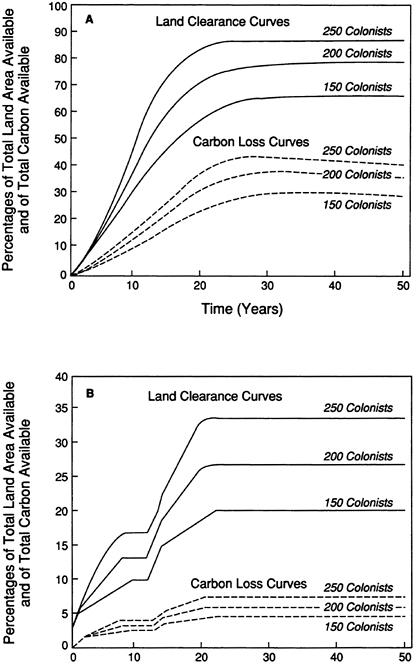
FIGURE A-6 Areawide changes in carbon release and land cleared for (A) typical colonist scenario and (B) sustainable agriculture scenario. Source: Southworth, F., V. H. Dale, and R. V. O'Neill. 1991. Contrasting patterns of land use in Rondônia, Brazil: Simulating the effects on carbon release. Int. Soc. Sci. J. 130:681–698. Reprinted with permission.
(Figure A-6) also shows significant carbon depletion during the initial 2-year phase of clearing the lot; this is followed by a stability in the carbon content of the lot during the intercropping period. Given the noticeably different results obtained from the two scenarios examined, it is worth asking what needs to be done to implement sustainable shifting cultivation in Rondônia or in other forested regions in the tropics. Activities that reduce the negative exponential decline of carbon in the simulations were represented by planting trees intermixed with annuals. Recovery of previously pastured land in this area is apparently affected more by treatment of the land than it is by soil nutrient stocks (Buschbacher et al., 1988). For example, a soil with low nutrient content but a high density of pioneer trees had twice as much biomass 2.5 years after abandonment as a site with higher soil nutrient content and few root sprouts (Buschbacher et al., 1988). In Ouro Preto, Rondônia, farmers who concentrated on perennial crops were better off in terms of material possessions and housing than the other colonists (Leite and Furley, 1985).
The introduction of economic considerations into the set of rules used by the spatially explicit model can expand understanding of the causes and consequences of particular land management scenarios. Two outcomes of this approach to dynamic microsimulation of land use changes include (1) the opportunities to experiment with “land holding capacity,” or the number of people a region can be expected to sustain over a given period of time, and (2) the analysis of how ecology and socioeconomics interact to influence the spatial and temporal pattern of land use.
Abstract Spatial Consideration of Land Use Patterns Nonexplicit spatial considerations of land use practices allow researchers to analyze theoretical relationships between the socioeconomic and ecologic aspects of land use. For example, Jones and O'Neill (In press) developed a model that distributes agricultural activities (forestry or food production) within the spatial domain of a Thü nen circle (an abstract area that radiates outward from a central market). The dominant process that influences spatial distribution is the costs of transporting labor and of purchasing inputs and products. The unique feature of the model of Jones and O'Neill is that the environmental impacts of the economic activity, such as soil degradation or erosion, directly reduce productivity. Thus, degradation and conservation measures to mitigate degradation become endogenous variables that influence economic decisions.
The models consider the spatial distribution of activity at equilibrium and emphasize the total spatial extent of the activity (for ex-
ample, total area of deforestation) and the intensity of activity per hectare (for example, erosion potential). The models are designed to explore how changes in the economy (for example, prices, transportation costs, wages, and population) or in the ecology (for example, soil fragility) would be expected to influence the extent and intensity of the agricultural activity.
To date, a suite of seven models has been developed. These models follow the same overall conceptualization but differ in their assumptions or constraints. For example, the total population may be considered to be constant within a region, or immigration-emigration may be permitted. Three of the models explore the implications of a shifting agricultural system in which economic and ecologic parameters determine the percentage of a lot permitted to lie fallow in a given year. By using a suite of models, the individual scenario remains simple and amenable to analytic solution while a variety of scenarios covering a number of different assumptions can be explored.
SUSTAINABILITY AND THE REDUCTION OF FUTURE IMPACTS
The effect of alternative land uses and agricultural sustainability on tropical deforestation can be evaluated with spatially explicit models. However, five factors constrain the sustainability of land use in the humid tropics. (1) Site quality imposes inherent limitations on the sustainability of each type of land use practiced at a given level of intensity. Low-fertility Oxisols and Ultisols are widespread (Sanchez, 1976) and require careful husbandry to avoid degradation and fertility depletion. Sloping lands susceptible to erosion are prevalent. (2) The choice of land use for a particular site affects its sustainability in two main ways. First, the land use may be unsustainable at the level of intensity originally practiced; that is, permanent field cropping on low fertility soils on sloping lands may increase the land's susceptibility to erosion. Second, the land use may become unsustainable as its intensity of use increases. This is commonly found with shifting cultivation as rotations become shorter. (3) Socioeconomic factors constrain the sustainability of land uses. Thus, a rise in population density may result in more intensive shifting cultivation, and if rotations become too short, it may lead to soil degradation and a decline in yields and sustainability. Although economic development can enable investments that make agriculture more productive and sustainable, the lack of economic development, or poverty, means that many farmers are unable to make such investments. (4) A general erosion by the market economy of societies with people who earn their living from subsistence agricultural activities is an inevitable
consequence of economic development. Permanent cultivators of cash crops focus on growing the most profitable crops and ensuring that yields are as high as possible. This may not necessarily mean that sustainability is prized, too, however. Cattle ranching in Brazilian Amazonia is a prime example of a case in which the emphasis was on short-term financial gains rather than long-term sustainability. (5) Sustainability can also decline as a result of external influences, as when one land use has an impact on another. For example, expansion of the area of permanent agriculture or logging may jeopardize shifting agriculture by affecting its area and intensity. Such expansion is possible because shifting cultivators often lack legal land rights.
The situation is complicated even more by the considerable variation in the degree of sustainability of the resulting agricultural land uses. Overintensive use of land, whether it is due to poor management, inadequate suitability of the land for a given use, inability to invest in required inputs, or socioeconomic and policy factors, can lead to a decline in soil fertility and crop yields and, hence, a decline in the amount of biomass per unit area and the carbon uptake rate. The ultimate result may be a change in land use as land is abandoned. Lack of sustainability also has another effect: more deforestation is required to increase the area of agricultural land so that overall production is maintained, and this leads to further CO2 emissions.
A move toward sustainability is therefore a vital consideration if deforestation is to be controlled. It is also an important alternative to consider if greenhouse gas emissions are to be reduced and carbon uptake maximized. Improvements in sustainability go hand in hand with increasing productivity on selected lands. Because low-fertility soils are widespread in the humid tropics, the area of land suited to intensive agriculture under foreseeable socioeconomic conditions is limited. One solution involves increasing the productivity of intensive agriculture on only the best lands so that an increasing share of national food production can be managed. Low-intensity agriculture and forestry could then be allowed to continue elsewhere.
Agroforestry
One promising way to increase the productivity and sustainability of land use on poorer soils is to use agroforestry systems, a variety of techniques that combine the growing of herbaceous crops and trees and the raising of livestock on the same or adjacent areas of land. This simulates the multilayered structure of natural tropical forests
and maintains the high level of vegetative cover needed to protect the soil from erosion (Grainger, 1980, 1991).
Agroforestry also plays a role in efforts to combat the greenhouse effect. So far most attention has been given to large-scale afforestation to increase the rate of carbon uptake by terrestrial biota (Grainger, 1990a,c; Houghton, 1990b; Sedjo and Solomon, 1989). There are practical limits, however, to how fast the establishment rate of timber plantations (for growing industrial wood or fuelwood) can be increased. Foresters identified this problem in the 1970s for reasons unconnected with the greenhouse effect: There were simply insufficient forestry personnel to plant the number of trees needed, and those trees that were planted could be cut down prematurely by local people because young plantations were poorly protected. The best solution was determined to be the establishment of social (or community) forestry programs. Personnel involved with these forestry programs support and assist with the establishment of new tree cover on communal lands or private farmlands, rather than in government forest reserves, with varying degrees of participation by local people. Tree species that satisfy local needs for food, fodder, fuelwood, and other products are chosen. Many social forestry projects involve agroforestry systems of one sort or another. Any new initiative to expand forest cover in the tropics will probably involve a combination of monoculture plantations and agroforestry systems, thereby enhancing the sustainability of land use on the poorer lands on which such activities are likely to be concentrated.
Carbon Sinks
If sustainable land use practices spread, there is a high potential for carbon sinks to increase in importance in the global carbon budget. For example, carbon accumulation in the biomass and soils of forest fallow could continue for many decades if less of this land had to be recut and burned to meet the demands of food production. At the same time, the need to continue deforesting tropical lands might be reduced, and because many of these forests are still recovering from past disturbances, they could continue to sequester carbon in biomass, necromass, and soil. Therefore, models that project future carbon releases from the tropics must consider the switch to more sustainable uses of the landscape. These uses should encompass an optimum mix of land uses (for example, mature forest, logged forests, secondary forests, and annual and perennial crops). The models should also be able to evaluate the ability of the various land uses to
sequester carbon through biomass accumulation in primary and secondary forests or plantations, woody debris, and soils (Table A-4).
Priorities for Future Research
To better assess the role of land use changes on climate change, including the impact of sustainability, more research is needed to extend the scope of the data collection, analyses, and modeling approaches outlined here. Some key priorities include the following:
-
There is an urgent need to undertake field studies to gain a better understanding of what constitutes sustainable systems. The critical information needed from field studies is a better understanding of what defines sustainable systems. For example, it would be useful to know the threshold rotation at which shifting cultivation becomes sustainable and what factors influence that threshold. The data should be collected within a well-defined and standardized sampling format so that comparisons can be made between different ecosystems.
-
Further field and remote-sensing research into deforestation and land use change processes is needed so that many of the functional relationships can be quantified at both local and national levels.
-
It is important to develop an index of agricultural sustainability that could be used in land use models and land use planning techniques. The index could be estimated on the basis of such factors as land capability, land use intensity, available investment capital, food yield per hectare, economic rate of return, transportation systems, and cultural factors.
-
More development, testing, and comparisons of the models discussed above are needed. These models can explore the factors that lead to sustainability and project the regional and global repercussions of sustainable agriculture. Because each model emphasizes different aspects of the system and operates at different spatial scales, they are useful for exploring different types of questions.
-
More information is needed on the biomass densities and carbon sequestration rates of alternative tropical land uses and how these vary with productivity and the degree of sustainability.
ACKNOWLEDGMENTS
W. M. Post, G. Marland, and four anonymous reviewers provided useful comments on the manuscript. J. P. Veillon made available his long-term data for the forests of Venezuela. Research was partially
sponsored by the Carbon Dioxide Research Program, Atmospheric and Climatic Change Division, Office of Health and Environmental Research, U.S. Department of Energy, under contract DE-AC05–84OR21400 with Martin Marietta Energy Systems, Inc.
REFERENCES
Ajtay, G. L., P. Ketner, and P. Duvigneaud. 1979. Terrestrial primary production and phytomass. Pp. 129–182 in SCOPE 13 The Global Carbon Cycle, B. Bolin, E. T. Degens, S. Kempe, and P. Ketner, eds. New York: Wiley.
Allen, J. C, and D. F. Barnes. 1986. The causes of deforestation in developing countries. Ann. Assoc. Amer. Geog. 75:163–184.
Anderson, I. C., J. S. Levine, M. A. Poth, and P. J. Riggan. 1988. Enhanced biogenic emissions of nitric oxide and nitrous oxide following surface biomass burning. J. Geophys. Res. 93:3893–3898.
Andreae, M. O., E. V. Browell, M. Garstang, G. L. Gregory, R. C. Harriss, G. F. Hill, D. J. Jacob, M. C. Pereira, G. W. Sachse, A. W. Setzer, P. L. Silva Dias, R. W. Talbot, A. L. Torres, and S. C. Wofsy. 1988. Biomass-burning emissions and associated haze layers over Amazonia J. Geophys. Res. 93:1509–1527.
Blaikie, P., and H. Brookfield. 1987. Approaches to the study of land degradation. Pp. 27–48 in Land Degradation and Society, P. Blaikie and H. Brookfield, eds. London: Methuen.
Bogdonoff, P., R. P. Detwiler, and C. A. S. Hall. 1985. Land use change and carbon exchange in the tropics. III. Structure, basic equations, and sensitivity analysis of the model. Environ. Management 9:345–354.
Boserup, E. 1965. The Conditions of Agricultural Growth: The Economics of Agrarian Change under Population Pressure. Chicago: Aldine.
Brown, S., and A. E. Lugo. 1982. The storage and production of organic matter in tropical forests and their role in the global carbon cycle. Biotropica 14(3):161–187.
Brown, S., and A. E. Lugo. 1984. Biomass of tropical forests: A new estimate based on forest volumes Science 223:1290–1293.
Brown, S., and A. E. Lugo. 1990a. Effects of forest clearing and succession on the carbon and nitrogen content of soils in Puerto Rico and US Virgin Islands. Plant Soil 124:53–64.
Brown, S., and A. E. Lugo. 1990b. Tropical secondary forests. J. Trop. Ecol. 6:1–32.
Brown, S., and A. E. Lugo. 1992. Biomass estimates for tropical moist forests of the Brazilian Amazon Interciencia 17:8–18.
Brown, S., A. E. Lugo, S. Silander, and L. Liegel. 1983. Research history and opportunities in the Luquillo Experimental Forest General Technical Report SO-44. New Orleans: Southern Forest Experiment Station, U.S. Forest Service, U.S. Department of Agriculture.
Brown, S., A. E. Lugo, and J. Chapman. 1986. Biomass of tropical tree
plantations and its implications for the global carbon budget Can. J. Forest Res. 16:390–394.
Brown, S., A. J. R. Gillespie, and A. E. Lugo. 1989. Biomass estimation methods for tropical forests with applications to forest inventory data. Forest Sci. 35:881–902.
Brown, S., A. J. R. Gillespie, and A. E. Lugo. 1991. Biomass of tropical forests of South and Southeast Asia. Can. J. Forest Res. 21:111–117.
Brown, S., L. Iverson, and A. E. Lugo. In press. Land use and biomass changes in Peninsular Malaysia during 1972–82. In Effects of Land Use Change on Atmospheric Carbon Dioxide Concentrations: Southeast Asia as a Case Study, V. H. Dale, ed. New York: Springer-Verlag.
Buschbacher, B. 1984. Changes in Productivity and Nutrient Cycling Following Conversion of Amazon Rainforest to Pasture. Ph.D. dissertation. University of Georgia, Athens.
Buschbacher, R., C. Uhl, and E. A. S. Serrão. 1988. Abandoned pastures in eastern Amazonia. II. Nutrient stocks in the soil and vegetation. J. Ecol. 76:682–699.
Cerri, C. C., B. Volkoff, and F. Andreux. 1988. Nature and behaviour of organic matter in soils under natural forest and after deforestation, burning and cultivation in Amazonia. Paper presented at the 46th International Congress of Americanists, July 4–8, 1988, Amsterdam, Holland.
Cicerone, R. J. 1988. How has the atmospheric concentration of CO changed? Pp. 49–61 in The Changing Atmosphere, F. S. Rowland and I. S. A. Isaksen, eds. New York: Wiley-Interscience.
Cicerone, R. J., and R. S. Oremland. 1988. Biogeochemical aspects of atmospheric methane. Global Biogeochem. Cycles 2:299–327.
Cofer, W. R., J. S. Levine, D. I. Sebacher, E. L. Winstead, P. J. Riggan, B. J. Stocks, J. A. Brass, V. G. Ambrosia, and P. J. Boston. 1989. Trace gas emissions from chaparral and boreal forest fires. J. Geophys. Res. 94:2255–2259.
Comery, J. A. 1981. Elemental Carbon Deposition and Flux from Prescribed Burning on a Longleaf Pine Site in Florida. Master's thesis. University of Washington, Seattle.
Cooper, C. F. 1982. Carbon storage in managed forests. Can. J. Forest Res. 13:155–166.
Costanza, R. 1991. The ecological effects of sustainability: Investing in natural capital In Environmentally Sustainable Economic Development Building on Bruntland R. Goodland, H. Daly, and S. El Serafy, ed. Environment Working Paper 46. Washington, D.C.: World Bank.
Crutzen, P. J., and M. O. Andreae. 1990. Biomass burning in the tropics: Impact on atmospheric chemistry and biogeochemical cycles. Science 250:1669–1678.
Crutzen, P. J., L. E. Heidt, J. P. Krasnec, W. H. Pollack, and W. Seiler. 1979. Biomass burning as a source of atmospheric gases CO, H2, N2O, NO, CH3Cl and COS. Nature 282:253–256.
Crutzen, P. J., A. C. Delany, J. Greenberg, P. Haagenson, L. Heidt, R. Lueb, W. Pollock, W. Seiler, A. Wartburg, and P. Zimmerman. 1985. Tropo-
spheric chemical composition measurements in Brazil during the dry season. J. Atmospheric Chem. 2:233–256.
Cuevas, E., S. Brown, and A. E. Lugo. 1991. Above and below ground organic matter storage and production in a tropical pine plantation and paired broadleaf secondary forest. Plant Soil 135:257–268.
Dale, V. H. 1990. Report of a Workshop on Using Remote Sensing to Estimate Land Use Change. ORNL/TM 11502. Oak Ridge, Tenn.: Oak Ridge National Laboratory.
Dale, V. H., R. A. Houghton, and C. A. S. Hall. 1991. Estimating the effects of land-use change on global atmospheric CO2 concentrations. Can. J. Forest Res. 21:87–90.
Dale, V. H., F. Southworth, R. V. O'Neill, and A. Rosen. In press. Simulating spatial patterns of land-use change in Rondônia, Brazil. In Some Mathematical Questions in Biology, R. H. Gardner, ed. Providence, R.I.: American Mathematical Society.
Detwiler, R. P. 1986. Land use change and the global carbon cycle: The role of tropical soils. Biogeochemistry 2:67–93.
Detwiler, R. P., and C. A. S. Hall. 1988a. Tropical forests and the global carbon cycle. Science 239:42–47.
Detwiler, R. P., and C. A. S. Hall. 1988b. The global carbon cycle. Letter. Science 241:1738–1739.
Evans, J. 1982. Plantation Forestry in the Tropics. Oxford: Clarendon Press.
Ewel, J., and L. Conde. 1978. Environmental implications of any-species utilization in the moist tropics. Pp. 107–123 in Proceedings of Conference on Improved Utilization of Tropical Forests Madison, Wis.: Forest Products Laboratory, U.S. Forest Service, U.S. Department of Agriculture.
Ewel, J., C. Berish, B. Brown, N. Price, and J. Raich. 1981. Slash and burn impacts on a Costa Rican wet forest site. Ecology 62:816–829.
Falesi, I. C. 1976. Ecossistema de Pastagem Cultivada na Amazônia Brasiliera. Boletim Técnico No. 1. Belém, Brasil: Centro de Pesquisa Agropecuária do Trópico Úmido.
Fearnside, P. M. 1980. The effects of cattle pasture on soil fertility in the Brazilian Amazon: Consequences for beef production sustainability. Trop. Ecol. 21:125–137.
Fearnside, P. M. 1986. Brazil's Amazon forest and the global carbon problem: Reply to Lugo and Brown. Interciencia 11:58–64.
Fearnside, P. M. 1987. Causes of deforestation in the Brazilian Amazon. Pp. 37–61 in The Geophysiology of Amazonia. Vegetation and Climate Interactions, R. E. Dickinson, ed. New York: Wiley.
Flint, E. P., and J. F. Richards. 1991. Historical analysis of changes in land use and carbon stocks of vegetation in South and Southeast Asia. Can. J. Forest Res. 21:91–110.
Food and Agriculture Organization (FAO). 1946–1987. Yearbook of Forest Products. Rome, Italy: Food and Agriculture Organization of the United Nations.
FAO. 1987. 1986 Production Yearbook. Rome, Italy: Food and Agriculture Organization of the United Nations.
FAO. 1991. Interim report on Forest Resources Assessment 1990 project. Item 7 of the Provisional Agenda, Committee on Forestry, Tenth Session COFO-90/8(a). Rome, Italy: Food and Agriculture Organization of the United Nations.
Food and Agriculture Organization and United Nations Environment Program. 1981. Tropical Forest Resources Assessment Project. Rome, Italy: Food and Agriculture Organization of the United Nations.
Grainger, A. 1980. The development of tree crops and agroforestry systems. Int. Tree Crops J. 1:3–14.
Grainger, A. 1984. Quantifying changes in forest cover in the humid tropics: Overcoming current limitations. J. World Forest Resource Management 1:3–63.
Grainger, A. 1986. The Future Role of the Tropical Rain Forests in the World Forest Economy. Oxford: Oxford Academic Publishers.
Grainger, A. 1987. The future environment for forest management in Latin America. Pp. 1–9 in Management of the Forests of Tropical America: Prospects and Technologies J. C. F. Colon, F. H. Wadsworth, and S. Branham, ed. Washington, D.C.: U.S. Department of Agriculture.
Grainger, A. 1988. Estimating areas of degraded tropical lands requiring replenishment of forest cover. Int. Tree Crops J. 5:31–61.
Grainger, A. 1990b. Modeling deforestation in the humid tropics. Pp. 51–67 in Deforestation or Development in the Third World?, Vol. III, M. Palo and G. Mery, eds. Bulletin No. 349. Helsinki: Finnish Forest Research Institute.
Grainger, A. 1990c. The Threatening Desert. Controlling Desertification. London: Earthscan Publications.
Grainger, A. 1990d. Modeling future carbon emissions from deforestation in the humid tropics. Pp. 105–119 in Tropical Forestry Response Options to Global Climate Change. Report No. 20P-2003. Washington, D.C.: Office of Policy Analysis, U.S. Environmental Protection Agency.
Grainger, A. 1991. The Tropical Rain Forests and Man. New York: Columbia University Press.
Grainger, A. In press. Population as concept and parameter in the modelling of tropical land use change. In Proceedings of the International Symposium on Population-Environment Dynamics, October 1–3, 1990, University of Michigan, Ann Arbor.
Hao, W. M., M. H. Liu, and P. J. Crutzen. 1990. Estimates of annual and regional releases of CO2 and other trace gases to the atmosphere from fires in the tropics, based on the FAO statistics for the period 1975–1980. In Fire in the Tropical Biota, J. G. Goldammer, ed. Berlin: Springer-Verlag.
Harmon, M. E., W. Ferrell, and J. F. Franklin. 1990. Effect on carbon storage of conversion of old-growth forest to young forest. Science 247:699–702.
Hecht, S. B. 1982a. Agroforestry in the Amazon Basin: Practice, theory and limits of a promising land use. Pp. 331–372 in Amazonia: Agriculture
and Land Use Research, S. B. Hecht, ed. Cali, Colombia: Centro Internacional de Agricultura Tropical.
Hecht, S. B. 1982b. Cattle Ranching in the Brazilian Amazon: Evaluation of a Development Strategy. Ph.D. dissertation. University of California, Berkeley.
Horne, R., and J. Gwalter. 1982. The recovery of rainforest overstorey following logging. I. Subtropical rainforest. Aust. Forestry Res. 13:29–44.
Houghton, J. T., G. J. Jenkins, and J. J. Ephraums, eds. 1990. Climatic Change: The IPCC Scientific Assessment. Cambridge, U.K.: Cambridge Univer-sity Press.
Houghton, R. A. 1990a. The global effects of tropical deforestation. Environ. Sci. Technol. 24:414–422.
Houghton, R. A. 1990b. The future role of tropical forests in affecting the carbon dioxide concentration of the atmosphere. Ambio 19:204–209.
Houghton, R. A. 1991a. Releases of carbon to the atmosphere from degradation of forests in tropical Asia. Can. J. Forest Res. 21:132–142.
Houghton, R. A. 1991b. Tropical deforestation and atmospheric carbon di-oxide. Climatic Change 19:99–118.
Houghton, R. A., J. E. Hobbie, J. M. Melillo, B. Moore, B. J. Peterson, G. R. Shaver, and G. M. Woodwell. 1983. Changes in the carbon content of terrestrial biota and soils between 1860 and 1980: A net release of CO2 to the atmosphere. Ecol. Monogr. 53:235–262.
Houghton, R. A., R. D. Boone, J. M. Melillo, C. A. Palm, G. M. Woodwell, N. Myers, B. Moore, and D. L. Skole. 1985. Net flux of carbon dioxide from tropical forests in 1980. Nature 316:617–620.
Houghton, R. A., R. D. Boone, J. R. Fruci, J. E. Hobbie, J. M. Melillo, C. A. Palm, B. J. Peterson, G. R. Shaver, G. M. Woodwell, B. Moore, D. L. Skole, and N. Myers. 1987. The flux of carbon from terrestrial ecosystems to the atmosphere in 1980 due to changes in land use: Geographic distribution of the global flux. Tellus 39B:122–139.
Houghton, R. A., D. S. Lefkowitz, and D. L. Skole. 1991. Changes in the landscape of Latin America between 1850 and 1980. I. A progressive loss of forests. Forest Ecol. Management 38:143–172.
John, D. M. 1973. Accumulation and decay of litter and net production of forest in tropical West Africa. Oikos 24:430–435.
Jones, D. W., and R. V. O'Neill. In press. Land use with endogenous environmental degradation and conservation Resources and Energy.
Juo, A., and R. Lal. 1977. The effect of fallow and continuous cultivation on the chemical and physical properties of an alfisol. Plant Soil 47:567–584.
Kartawinata, K., S. Adisoemarto, S. Riswan, and A. P. Vayda. 1981. The impact of man on a tropical forest in Indonesia. Ambio 10:115–119.
Lang, G. E., and D. H. Knight. 1979. Decay rates for tropical trees in Panama. Biotropica 11:316–317.
Lanly, J. P. 1982. Tropical Forest Resources. FAO Forestry Paper No. 30. Rome: Food and Agriculture Organization of the United Nations.
Lashof, D. A., and D. R. Ahuja. 1990. Relative contributions of greenhouse gas emissions to global warming Nature 344:529–531.
Leite, L. L., and P. A. Furley. 1985. Land development in the Brazilian Amazon with particular reference to Rondônia and the Ouro Pretocolonisation project. Pp. 119–140 in Change in the Amazon Basin. Volume II. The Frontier after a Decade of Colonization, R. Heming, ed. Manchester, United Kingdom: Manchester University Press.
Lerner, J., E. Matthews, and I. Fung. 1988. Methane emission from animals: A global high-resolution database. Global Biogeochem. Cycles 2:139–156.
Levine, J. S., W. R. Cofer, D. I. Sebacher, E. L. Winstead, S. Sebacher, and P. J. Boston. 1988. The effects of fire on biogenic soil emissions of nitric oxide and nitrous oxide. Global Biogeochem. Cycles 2:445–449.
Lugo, A. E. 1988. The future of the forest. Ecosystem rehabilitation in the tropics. Environment 30(7):16–20,41–45.
Lugo, A., and S. Brown. In press. Tropical forests as sinks of atmospheric carbon. Forest Ecol. Manage.
Lugo, A. E., M. J. Sanchez, and S. Brown. 1986. Land use and organic carbon content of some subtropical soils. Plant Soil 96:185–196.
Lugo, A. E., S. Brown, and J. Chapman. 1988. An analytical review of production rates and stemwood biomass of tropical forest plantations. Forest Ecol. Manage. 23:179–200.
Lugo, A. E., D. Wang, and F. H. Bormann. 1990a. A comparative analysis of biomass production in five tropical tree species. Forest Ecol. Manage. 31:153–166.
Lugo, A. E., E. Cuevas, and M. J. Sanchez. 1990b. Nutrients and mass in litter and top soil of ten tropical tree plantations Plant Soil 125:263–280.
Luizão, F., P. Matson, G. Livingston, R. Luizão, and P. Vitousek. 1989. Nitrous oxide flux following tropical land clearing. Global Biogeochem. Cycles 3:281–285.
Marland, G., and T. Boden. 1989. Carbon dioxide release from fossil-fuel burning. Testimony presented at a hearing before the U.S. Senate Committee on Energy and Natural Resources, July 26, 1989.
Matthews, E., and I. Fung. 1987. Methane emission from natural wetlands: Global distribution, area, and environmental characteristics of sources. Global Biogeochem. Cycles 1:61–86.
Molofsky, J., E. S. Menges, C. A. S. Hall, T. V. Armentano, and K. A. Ault. 1984. The effects of land use alteration on tropical carbon exchange. Pp. 181–184 in The Biosphere: Problems and Solutions, T. N. Veziraglu, ed. Amsterdam: Elsevier.
Moore, B., R. D. Boone, J. E. Hobbie, R. A. Houghton, J. M. Melillo, B. J. Peterson, G. R. Shaver, C. J. Vorosmarty, and G. M. Woodwell. 1981. A simple model for analysis of the role of terrestrial ecosystems in the global carbon budget. Pp. 365–385 in Carbon Cycle Modelling, B. Bolin, ed. SCOPE 16. New York: Wiley.
Muzio, L. F., and J. C. Kramlich. 1988. An artifact in the measurement of N2O from combustion sources. Geophys. Res. Lett. 15:1369–1372.
Myers, N. 1980. Conversion of Tropical Moist Forests. Washington, D.C.: National Academy Press.
Myers, N. 1984. The Primary Source. New York: W. W. Norton.
Myers, N. 1989. Deforestation Rates in Tropical Forests and Their Climate Implications London: Friends of the Earth.
Nicholson, D. I. 1958. An analysis of logging damage in tropical rain forests, North Borneo Malaysian Forester 231:235–245.
Olson, J. S., J. A. Watts, and L. J. Allison. 1983. Carbon in live vegetation of major world ecosystems. TR004. Washington, D.C.: U.S. Department of Energy.
Post, W. M., W. R. Emanuel, P. J. Zinke, and A. G. Stangenberger. 1982. Soil carbon pools and world life zones. Nature 298:156–159.
Post, W. M., T. S. Peng, W. R. Emanuel, A. W. King, V. H. Dale, and D. L. DeAngelis. 1990. The global carbon cycle. Amer. Sci. 78:310–326.
Ramanathan, V., L. Callis, R. Cess, J. Hansen, I. Isaksen, W. Kuhn, A. Lacis, F. Luther, J. Mahlman, R. Reck, and M. Schlesinger. 1987. Climate-chemical interactions and effects of changing atmospheric trace gases. Rev. Geophys. 25:1441–1482.
Ranjitsinh, M. K. 1979. Forest destruction in Asia and the South Pacific. Ambio 8:192–201.
Repetto, R. 1989. The Forest for the Trees? Government Policies and the Misuse of Forest Resources. Washington, D.C.: World Resources Institute.
Rodhe, H. 1990. A comparison of the contribution of various gases to the greenhouse effect. Science 248:1217–1219.
Saldarriaga, J. G., D. C. West, M. L. Tharp, and C. Uhl. 1988. Long-term chronosequence of forest succession in the Upper Rio Negro of Colombia and Venezuela. J. Ecol. 76:938–958.
Sanchez, P. A. 1976. Properties and Management of Soils in the Tropics. New York: Wiley.
Sanchez, P. A., and J. R. Benites. 1987. Low-input cropping for acid soils of the humid tropics. Science 238:1521–1527.
Sanchez, P. A., J. H. Villachica, and D. E. Bandy. 1983. Soil fertility dynamics after clearing a tropical rainforest in Peru Soil Sci. Soc. Amer. J. 47:1171–1178.
Schlesinger, W. H. 1984. The world carbon pool in soil organic matter: A source of atmospheric CO2. Pp. 111–124 in The Role of Terrestrial Vegetation in the Global Carbon Cycle: Measurement by Remote Sensing, G. M. Woodwell, ed. SCOPE 23. New York: Wiley.
Schlesinger, W. H. 1986. Changes in soil carbon storage and associated properties with disturbance and recovery. Pp. 194–220 in The Changing Carbon Cycle and Global Analysis, J. R. Trabalka and D. E. Reichle, eds. New York: Springer-Verlag.
Schlesinger, W. H. 1990. Evidence from chronosequence studies for low carbon-storage potential of soils. Nature 348:232–234.
Sedjo, R. A., and A. M. Solomon. 1989. Climate and forests. Pp. 105–119 in Greenhouse Warming: Abatement and Adaptation, N. J. Rosenberg, W. E. Easterling, P. R. Crosson, and J. Darmstadter, eds. Washington, D.C.: Resources for the Future.
Seiler, W., and R. Conrad. 1987. Contribution of tropical ecosystems to the global budgets of trace gases, especially CH4, H2, CO, and N2O. Pp. 133–162 in Geophysiology of Amazonia, R. E. Dickinson, ed. New York: Wiley.
Seiler, W., and P. J. Crutzen. 1980. Estimates of gross and net fluxes of carbon between the biosphere and the atmosphere from biomass burning. Climatic Change 2:207–247.
Smith, R. F. 1970. The vegetation structure of a Puerto Rican rain forest before and after short-term gamma irradiation. Chapter D-3 in A Tropical Rain Forest, H. T. Odum and R. F. Pigeon, eds. Springfield, Va.: National Technical Information Service.
Southworth, F., V. H. Dale, and R. V. O'Neill. 1991. Contrasting patterns of land use in Rondônia, Brazil: Simulating the effects on carbon release. Int. Social Sci. J. 130:681–698.
Swift, M. J., O. W. Heal, and J. M. Anderson. 1979. Decomposition in Terrestrial Ecosystems. Berkeley: University of California Press.
Turner, B. L., R. Q. Hanham, and A. V. Portararo. 1977. Population pressure and agricultural intensity. Ann. Assoc. Amer. Geographers 67:384–396.
Uhl, C. 1987. Factors controlling succession following slash-and-burn agriculture in Amazonia. J. Ecol. 75:377–407.
Uhl, C, and I. C. G. Vieira. 1989. Ecological impacts of selective logging in the Brazilian Amazon: A case study from the Paragominas region of the state of Para. Biotropica 21:98–106.
Uhl, C., H. Clark, K. Clark, and P. Maquirino. 1982. Successional pattern associated with slash-and-burn agriculture in the Upper Rio Negro region of the Amazon Basin. Biotropica 14:249–254.
Uhl, C., R. Buschbacher, and E. A. S. Serrão. 1988. Abandoned pastures in eastern Amazonia. I. Patterns of plant succession. J. Ecol. 76:663–681.
Weaver, P. L. 1987. Structure and Dynamics in the Colorado Forest of the Luquillo Mountains of Puerto Rico. Ph.D. dissertation. Department of Botany and Plant Pathology, Michigan State University East Lansing.
Weaver, P. L., and P. G. Murphy. 1990. Forest structure and productivity in Puerto Rico's Luquillo Mountains. Biotropica 22:69–82.
Whitmore, T. C., and J. N. M. Silva. 1990. Brazil rain forest timbers are mostly very dense. Commonwealth Forestry Rev. 69(1):87–90.
World Resources Institute. 1990. World Resources 1990–91. New York: Oxford University Press.
Young, A. 1989. Agroforestry for Soil Conservation. Wallingford, United Kingdom: CAB International.
Zinke, P. J., A. G. Stangenberger, W. M. Post, W. R. Emanuel, J. S. Olson. 1986. Worldwide Organic Soil Carbon and Nitrogen Data. ORNL/CDIC-18. Oak Ridge, Tenn.: Oak Ridge National Laboratory.


