
Brazil
Emanuel Adilson Souza Serrão and Alfredo Kingo Oyama Homma
Deforestation of the Brazilian Amazon, the largest tropical forest reserve on the planet, has attracted worldwide attention in recent years. The environmental disturbances have been claimed to be a result of agricultural developments over the past 3 decades. Because of the increasing rural and urban population demands for food and fiber and the need for environmental conservation and preservation, however, land in the Brazilian Amazon must be used on a sustainable basis. The search for a compromise between ecologic and population demands is a major challenge to those in governmental, nongovernmental, and private institutions. This profile addresses the questions of agricultural sustainability in the Brazilian humid tropics by analyzing the important present and potential land uses and by considering their sustainabilities and potential for improvement and expansion.
BASIS FOR SUSTAINABILITY ANALYSIS OF AMAZONIAN AGRICULTURE
Sustainability must be the basis for analysis and implementation of agricultural land use alternatives for the Brazilian Amazon, but
Emanuel Adilson Souza Serrão is a research agronomist and Alfredo Kingo Oyama Homma is a socioeconomist at the Centro de Pesquisa Agroflorestal da Amazônia Oriental (Center for Agroforestry Research of the Eastern Amazon), Empresa Brasileira de Pesquisa Agropecuária (Brazilian Enterprise for Agricultural Research), Belém, Brazil.
few analyses have provided insight (Alvim, 1989; Fearnside, 1983, 1986; Homma and Serrão, In preparation). The possibility of developing sustainable agriculture in the Amazon depends on its permanence in an area and on increasing land and labor productivity standards, thereby reducing the pressure for more deforestation. This concept of sustainability implies an equilibrium in time among agronomic and/or zootechnical, economic, ecologic, and social feasibility. Equilibrium is frequently fragile in Amazonian agricultural systems, and no agricultural land use system in the Amazon meets all four of these prerequisites for sustainability at highly satisfactory levels.
The land use systems analyzed here were selected because of their present and potential importance characterized by their scale of utilization (for example, total area used and number of farmers involved), the types of farmers that use each system, its economic importance, possibilities for future markets, environmental implications, and possibilities for agroindustries. Characterization also includes technological patterns (for example, land and labor use intensity, input utilization, adoption of technology, product processing, and management practices) and productivity patterns (for example, maintenance of productivity, productivity increase potential, and relationship between productivity and the environment).
More than enough land has already been deforested for agricultural development in the Amazon. From a technical point of view, by using only about 50 percent of the already deforested land and other less fragile ecosystems, such as well- and poorly drained savannahs and alluvial floodplains, it is possible to produce sufficient amounts of food and fiber to meet the demands of the region's population for the next decade at least. Future agricultural production in the Amazon will depend on higher levels of land use intensification with decreasing rates of deforestation (the decreasing deforestation brought about as a result of increasing national and international pressures for environmental conservation, increasing local environmental ethics, and increasing population density and, consequently, higher land prices). Productivity and sustainability must be the foundation for future agricultural development. In this scenario, agricultural technology will play the major role.
THE BRAZILIAN HUMID TROPICS
The Brazilian humid tropics encompasses the geographic area that has been named, for development purposes, the legal Amazon, an area of about 510 million ha, corresponding to 60 percent of Brazil's national territory.
Although there has been a significant increase in population density in the Amazon during the past 3 decades, only about 10 percent (16 million) of Brazil's population inhabits this immense region (Brazilian Institute of Geography and Statistics, 1991). This population is unevenly distributed throughout the region in densely populated nuclei separated by extensive, virtually uninhabited land.
The average population density in the Amazon is about 2.7 inhabitants per 100 ha. Presently, 61 percent of Brazil's population in the northern region lives in urban areas, and a significant portion of that population lives on the outskirts of Belém, Manaus, and other major cities. The region's population is expected to grow moderately in the next 2 decades, increasing from the present 16 million people (in 1990) to 26 million by 2010 (a 62 percent increase). This means that the Amazon population at the end of the first decade of the next century will be 13 percent of the country's population compared with the present 11.4 percent (Medici et al., 1990; Superintendency for the Development of the Amazon, 1991).
In general, per capita income in the Amazon region is very low, equivalent to US$1,271 (1991), which represents 51.5 percent of Brazil's per capita income (Superintendency for the Development of the Amazon, 1991).
The Environment
The Amazon hydrographic basin covers about 6 million km2 and is considered the largest river network in the world. It is navigable along 20,000 km of waterways and has a total watershed area of about 7.3 million km2. This network includes muddy-water rivers that originate in alluvial soil regions. The rivers deposit organic and inorganic sediments along their paths, forming floodplains locally called várzeas. These floodplains are rich in nutrients and organic matter and have a high potential for agricultural development.
The Amazonian climate is predominantly hot and humid and often presents conditions for high levels of biomass production. Relatively large amounts of solar radiation reach the earth's surface throughout the year. Average temperatures vary between 22° and 28°C, the daily variations being considerably higher than seasonal variations. Relative humidity tends to be high in most of the region, varying from about 65 to 90 percent. Total annual rainfall varies between 1,000 and over 3,000 mm. The rainy season is from December and January through May and June in most of the region, and a dry season occurs during the rest of the year.
The vegetation that covers the Amazon is related to climatic con-
ditions, but rain forests are the predominant ecosystem. The main types of vegetation are dense upland forests, open upland forests, savannah-type vegetation that includes well- and poorly drained savannahs, and alluvial floodplain (várzea) vegetation (Nascimento and Homma, 1984). Dense upland forests, which have high levels of biomass and include the tallest tree species, occupy about 50 percent of the legal Amazon. Open forests, which have a considerably smaller biomass volume, shorter trees, and more palm species and lianas, occupy about 27 percent of the region. Well-drained savannah vegetation (cerrado) with different arboreal and herbaceous gradients occurs in extensive areas in the states of Amapá and Roraima and occurs less extensively in areas in other parts of the region, where the forest is interrupted.
About 80 percent of the legal Amazon (430 million ha) is upland, nonflooding area. The remaining 20 percent (70 million ha) is floodable area (Nascimento and Homma, 1984). Nascimento and Homma (1984) estimate that approximately 88 percent (450 million ha) of Amazonian soils are dystrophic (acidic and low in fertility) and that the remaining 12 percent (50 million ha) is eutrophic (less acidic and relatively high in fertility). Of the latter, 25 million ha is upland soils, and 25 million ha is floodable soils.
Macroecologic Units
At least one attempt (Nascimento and Homma, 1984) has been made to combine natural resources information by superimposing climate, soil, and vegetation maps to locate macroecologic units suitable for agricultural development, conservation, and preservation in the Amazon (Table 1). These macroecologic units and their distributions could be useful for making the first approximations of agroecological zoning in the Amazon.
AGRICULTURAL DEVELOPMENT
To evaluate agricultural sustainability in the Brazilian Amazon, it is important to examine agricultural development chronologically and from the physical and economic viewpoints.
Chronological Agricultural Development
The history of the development of the Amazon is pinpointed with ill-fated booms, badly oriented development projects, some partial successes, and ecologic and social mishaps (Norgaard, 1981).
TABLE 1 Macroecological Units of the Legal Amazon
|
Mapping Unit |
||||
|
Climate |
Vegetation |
Soil |
Approximate Area (million ha) |
Percentage of Total Legal Amazon Area |
|
Afi |
Dense forest |
Upland dystrophic |
60.0 |
11.66 |
|
Floodplain eutrophic (várzea) |
7.9 |
1.53 |
||
|
Floodplain dystrophic |
4.5 |
0.88 |
||
|
Open forest |
Upland dystrophic |
13.0 |
2.53 |
|
|
Floodplain eutrophic (várzea) |
0.8 |
0.15 |
||
|
Open native grassland |
Upland dystrophic |
0.2 |
0.04 |
|
|
Floodplain eutrophic (várzea) |
1.0 |
0.21 |
||
|
Subtotal |
87.4 |
17.00 |
||
|
Ami |
Dense forest |
Upland eutrophic |
5.2 |
1.02 |
|
Upland dystrophic |
116.4 |
22.64 |
||
|
Floodplain dystrophic (várzea) |
11.3 |
2.19 |
||
|
Floodplain dystrophic |
13.7 |
2.66 |
||
|
Open forest |
Upland eutrophic |
12.7 |
2.48 |
|
|
Upland dystrophic |
16.5 |
3.22 |
||
|
Floodplain eutrophic (várzea) |
2.3 |
0.45 |
||
|
Savannah (cerrado) |
Upland eutrophic |
1.0 |
0.20 |
|
|
Upland dystrophic |
12.2 |
2.37 |
||
|
Floodplain eutrophic (várzea) |
0.5 |
0.10 |
||
|
Open native grassland |
Upland eutrophic |
1.0 |
0.19 |
|
|
Upland dystrophic |
10.9 |
2.11 |
||
|
Floodplain eutrophic (várzea) |
4.0 |
0.77 |
||
|
Floodplain eutrophic |
3.1 |
0.60 |
||
|
Subtotal |
210.8 |
41.00 |
||
|
Awi |
Dense forest |
Upland eutrophic |
1.5 |
0.30 |
|
Upland dystrophic |
27.7 |
5.38 |
||
|
Floodplain eutrophic (várzea) |
0.8 |
0.16 |
||
|
Floodplain dystrophic |
1.9 |
0.37 |
||
|
Open forest |
Upland eutrophic |
5.6 |
1.09 |
|
|
Upland dystrophic |
80.8 |
15.72 |
||
|
Floodplain eutrophic (várzea) |
0.25 |
0.05 |
||
|
Floodplain dystrophic |
7.4 |
1.45 |
||
|
Savannah (cerrado) |
Upland eutrophic |
3.4 |
0.67 |
|
|
Upland dystrophic |
66.0 |
12.83 |
||
|
Floodplain dystrophic |
5.1 |
1.00 |
||
|
Open native grassland |
Upland eutrophic |
0.8 |
0.16 |
|
|
Upland dystrophic |
11.7 |
2.28 |
||
|
Floodplain dystrophic |
2.8 |
0.54 |
||
|
Subtotal |
215.75 |
42.00 |
||
|
Total |
513.95 |
100.00 |
||
|
SOURCE: Adapted from Nascimento, C. N. B., and A. K. O. Homma. 1984.Amazônia: Meio Ambiente e Tecnologia Agrícola. Documento 27. Belém, Brazil: Brazilian Enterprise for Agricultural Research–Center for Agroforestry Research of the Eastern Amazon. |
||||
Even though mining and energy-producing projects have emerged as the main development thrusts in the Amazon, associated development activities, including agricultural activities, usually follow in their wake (Smith et al., In press-a,b). For this reason, some important historical aspects of agricultural development in the Amazon that will pave the way to a better understanding of the analysis of agricultural sustainability given later in this profile are presented here.
From the early seventeenth to the early twentieth centuries, agricultural development in the Amazon depended on extraction activities in existent forests. Even today, extrativismo (extractive land use) plays a very significant role in the regional economy, mainly because of the commercialization of timber, heart of palm, rubber, and Brazil nuts, among other forest products, in addition to hunting and fishing.
More modern agricultural and livestock development began to take place toward the end of the first quarter of the twentieth century along the relatively fertile várzea floodplains, not only because of the favorable conditions they offered for agricultural production but also because of favorable river transportation along the Amazon River network.
By the mid-1950s, the várzea development gave way to the up-land terra firme development when road construction started criss-crossing the region. This phase was characterized by extensive agricultural development where forest slash-and-burn activity was the main feature. Road construction was then considered synonymous with progress and made the region attractive to immigrants. Cattle raising, shifting (slash-and-burn) subsistence agriculture, and timber exploration are now the dominant features of upland development (Homma and Serrão, In preparation).
Physical and Economic Agricultural Development
To analyze agricultural sustainability in the Brazilian humid tropics, it is important to have an idea of how and where agricultural development has taken place. More detailed descriptions are given in the literature (Homma, 1989; Homma and Serrão, In preparation; Nascimento and Homma, 1984; Serrão and Homma, In press).
From 1900 to 1953, extraction activities in the Amazon were greater than crop farming and cattle raising, contributing 50 percent of the agricultural gross national product (AGNP) in the region mainly because of the major influence of rubber extraction in the Amazon economy (Homma, 1989). After the mid-1940s, the decline of extraction began with the dissemination of jute cultivation along the Amazon várzea
floodplains and with the expansion of black pepper agriculture in eastern Pará. From 1965 to 1971, for the first time, crop farming and cattle raising surpassed extraction activities.
The predominance of crop farming and cattle raising over extraction activities was observed in the 1970s and continues to the present. Most of those involved with extraction activities turned to crop farm-
ing and cattle raising, which was also the case with those who came with the migratory flux in that same period.
Shifting agriculture has become the major activity of a large number of small farmers. It is characterized by low levels of technology and low productivity, even though it is a reasonably good alternative for the partial recovery of soil fertility and for the recovery of weed-,
|
pest-, and disease-infested areas, because of the accumulation of nutrients in the biomass during the various fallow periods imposed on cultivated tracts of land. However, this land use system has imposed substantial losses of forest resources and is subject to increasing socioeconomic instability when the population density increases.
Extensive cattle raising systems have been predominant in certain areas of the Amazon where natural grassland ecosystems (such as well-and poorly drained savannah grasslands and floodplain grasslands) are available and on the pasturelands that have replaced forests over the past 3 decades. Supported by tax incentive programs, this sector has been responsible for most of the deforestation in the Brazilian Amazon region (Browder, 1988).
The majority of the region's most important transformations in the primary (agricultural production) sector started in the 1960s with the expansion of the agricultural frontier, mostly as a result of tax incentive policies and the construction of important highways, which favored the development of colonization programs and the installation of large agricultural projects, the bulk involving cattle raising. Cattle raising expansion began in the mid-1960s because of the low utilization levels of labor, which was scarce at the time, and the abundance of land.
This most recent regional agricultural development phase is characterized by accelerated, large-scale, and aggressive exploration of natural resources. This replaces the humid tropical forests with land use systems with generally low ecologic and socioeconomic efficiencies (cattle raising projects and shifting agriculture) or large-scale predatory “industrial” extraction activities such as those for timber and heart of palm (Euterpe oleracea). Because of the environmental degradation that they cause, these land use systems have been severely criticized (Mahar, 1989).
During the past 3 decades, despite their still modest acreage in relation to shifting agriculture and cattle raising, perennial crop plants such as African oil palm (Elaeis guineensis), rubber (Hevea spp.), cacao (Theobroma cacao), Brazil nut (Bertholletia excelsa), guaraná (Paullinia cupana), and semiperennials such as black pepper (Piper nigrum) and, more recently, urucu (Bixa orellana) have become increasingly important. Special government financing programs such as the Cacao Development Program, PROBOR (the Natural Rubber Production Incentives Program), as well as a number of credit lines during the 1970s, give farmers incentives to expand these crops.
Today, there are different forms of agricultural production in the Amazon because of different environmental and basic infrastructural peculiarities. These range from extraction activities in remote areas
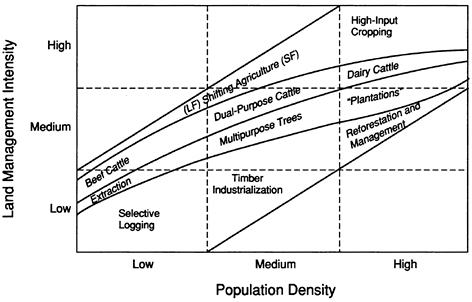
FIGURE 1 Effects of population density on land use in the Brazilian humid tropics. LF, Long fallow; SF, short fallow. Source: Adapted from Serrão, E. A. S., and J. M. Toledo. In press. Sustaining pasture-based production systems in humid tropics. In Development or Destruction: The Conversion of Tropical Forest to Pasture in Latin America, S. B. Hecht, ed. Boulder, Colo.: Westview.
with low population densities to extensive cattle raising, or from agricultural activities in recently opened frontier lands to those in long-occupied areas.
Land use intensification for forest product exploitation, traditional crop production, and cattle production has been influenced by population density and land prices (Figure 1). In areas with low population densities, where land prices are normally low, extraction activities, such as those for rubber, timber, and Brazil nuts, coexist with shifting agricultural systems with long fallow periods and extensive livestock activities (Serrão and Toledo, In press). In areas with medium population densities, land prices are higher, which brings about less extraction activity, shifting agricultural systems with shorter fallow periods, more intensive cattle production, and perennial cropping activities. In areas with high population densities, intensive annual and perennial cropping is expanded, subtracting from activities in areas previously devoted to extraction, shifting agriculture, and extensive cattle raising. Land prices become even higher and intensive agricultural practices are predominant. At this stage, more
intensive integrated agricultural production (the agrisilvopastoral approach) begins to take place.
These contrasting situations of population and land use intensity form mosaics where areas have a virtual absence of development, intense spatial expansion, intense agricultural modernization, very intensive spatial expansion, and very high levels of modernization.
There are at least five distinct situations that characterize the present state of agricultural development in the Amazon (Figure 2).
AGRICULTURAL DEVELOPMENT IN NORTHEASTERN PARÁ
The northeastern part of the state of Pará was one of the first areas to be brought into upland agricultural production in the Amazon. After supporting rubber extraction activities by producing and supplying agricultural products to rubber-producing areas in the Amazon, this region went through a series of transformations and now produces about 90 percent of Brazil's black pepper; 50 percent of the national malva (Urena lobata) fiber; and most of the Hawaiian papaya, palm oil, passion fruit, oranges, and native fruits produced in the Brazilian Amazon region. This region also produces a significant amount of animal protein, from cattle and poultry.
With approximately 10 million ha (about 8.7 percent of the state's total area) and a population of about 2.5 million inhabitants (or 15 percent of the Amazon region's population), this region is the most densely populated area of the Amazon. About 0.5 million people live in rural areas, where small-scale shifting-agriculture farmers work the land alongside farming operations that use higher levels of technology (mechanization, fertilizers, improved crop management) and where social and physical infrastructures (roads, electricity, communication, health, and education) are satisfactory compared with those of other regional development poles. This region's development has been greatly influenced by the construction and operation of the Belém-Brasília Highway in the 1960s.
The northeastern part of the state of Pará has the most developed agroindustry in the Amazon region, mainly in relation to timber, African oil palm, jute (Corchorus capsularis), and malva fiber and meat processing. In Belém, extraction and agriculture of several products such as wood, Brazil nut, rubber, guaraná, native and exotic fruits, and other crops are industrialized.
In relative terms, and considering the Amazon as a whole, the northeastern part of the state of Pará is where agricultural development has the highest levels of sustainability because of its adaptation over time.
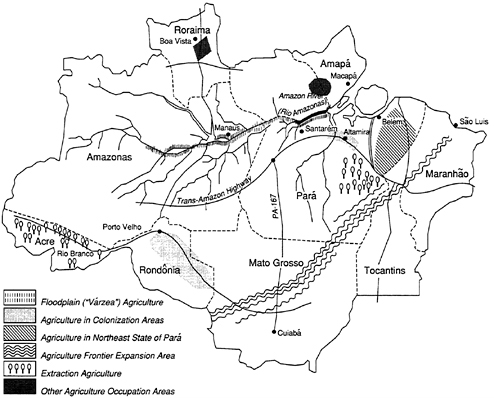
FIGURE 2 Main agricultural development areas in the Amazon. Source: Adapted from Nascimento, C. N. B., and A. K. O. Homma. 1984. Amaz ônia: Meio Ambiente e Tecnologia Agrícola. Documento 27. Belém, Brazil: Brazilian Enterprise for Agricultural Research–Center for Agroforestry Research of the Eastern Amazon.
AGRICULTURE IN VÁRZEA FLOODPLAINS
This type of agriculture has developed mainly along the margins of the Amazon and Solimões rivers on fertile várzea floodplain soils subjected to an annual flooding and receding water regimen. It was the first major agricultural development in the region, facilitated by river navigation, before the beginning of the road-building era in the 1960s. It has lost some if its importance over time, however, because of the decline in extraction activities (McGrath, 1991) and the increasing attraction of more dynamic areas in the region. There has been a strong tendency to migrate from the rural riverbank areas to main urban nuclei, resulting in almost stagnant agricultural development after 30 years of agricultural predominance by jute.
In addition to jute and malva fiber and subsistence food and fruit
crops, beef and cow's milk (although limited somewhat by periodic flooding of the native floodplain grasslands) are also produced. There is also some timber, jute and malva fiber, rubber, and Brazil nut processing as well as good aquatic food sources, mainly fish. There is water buffalo raising potential in the floodplains and estuaries of the Amazon.
AGRICULTURE IN FRONTIER EXPANSION AREAS
At the outset of the 1970s, a dynamic period of agricultural development occurred primarily in the south of Pará, in the north of Mato Grosso, within Tocantins, and in the south of Maranhão. Road construction, tax incentives (where the Superintendency for the Development of the Amazon [SUDAM] has had a major role), and credit availability were the main driving forces for this development. In this development process, cattle ranches have been established. These are surrounded by small shifting agricultural plots cultivated by squatters, who also serve as labor for the cattle ranches.
Development in this area has been characterized by frequent land ownership conflicts in which religious groups and the government have played conflicting roles. In some areas, land conflicts are due to (1) invasion by squatters in areas already occupied by people who depend on the extraction of Brazil nuts and (2) large influxes of gold prospectors who, when they are unsuccessful in their search for ore, look for alternative livelihoods. The interconnection of the Belém-Brasília and Trans-Amazon highways, the construction of the Caraj ás-São Luís Railroad, and state roads such as the PA-150 made this region the point of entry of migratory fluxes from the northeastern part of Brazil. The implementation of the Carajás iron-processing plants and the discovery of gold in the Serra Pelada area, among other factors, induced the development of small farms and, consequently, the migratory flux to this particular region.
Large-scale cattle raising, which involves slash-and-burn destruction of the forest, has been severely criticized for its role in the region 's deforestation. One of the reasons for land conflicts is the dichotomy of cattle raising, which demands large tracts of land for pasture establishment (to cover up for rapid pasture degradation) with low labor use, which then limits employment and becomes incompatible with the needs of small-scale farmers, who need to work outside their own plots to supplement their income.
Even though there has been development along important frontier highways, the infrastructures of frontier expansion areas are still deficient, particularly for small-scale farmers. Even so, many frontier
areas in this region became municipalities in the 1980s. Large private colonization projects were also developed. The agricultural segments of these projects contemplate improved land use systems for coffee, cacao, black pepper, rubber, guaraná, and beef cattle.
Another agricultural development front is developing in western Maranh ão. This region has Brazil's northeastern economic, social, and cultural characteristics and abundant labor force and roadways. The main agricultural activities are food crop production (mainly rice), cattle raising, and babassu palm (Orbignya martiana) extraction.
AGRICULTURE IN OFFICIAL COLONIZATION AREAS
Official colonization areas have been occupied mainly by farmers whose origins are in Brazil's northeastern and south-central regions and who were stimulated by the official colonization programs started in the early 1970s. While SUDAM played a major role in the agricultural development in frontier expansion areas, the Land Reform and Colonization Institute took the leading role in official colonization areas.
Two distinct regions were important in the context of official colonization. One was the region along the Trans-Amazon Highway, colonized mainly by landless northeastern Brazilians who left their region of origin because of socioeconomic constraints and prevailing severe droughts. Cacao, sugarcane, and food crop production were predominant agricultural activities. However, during the last 20 years of development, cattle raising also became important, causing the fusion of many agricultural lots owned by small-scale farmers.
Another colonization settlement was developed in different points in the former territory that is now the state of Rondônia. In this case, there was an intensive spontaneous and programed migratory flux of farmers from the northeast and south-central regions of Brazil who dedicated themselves to growing cacao, coffee, rubber, and food crops.
Agricultural lots have gone through significant amounts of fusion induced by a shortage of labor (displaced by gold mining activities), low cacao and coffee prices, and credit and tax incentives for cattle raising activities. Several milk-processing plants also operate in this region.
AREAS OF FOREST PRODUCT EXTRACTION
Areas where extraction of forest products is predominant are widespread in the Amazon and include different combinations of forest extraction and agricultural activities of various intensities. Some are
very old, going back to the initial occupation of the region, and are now in a state of almost economic stagnation and population increase.
The most important area of extraction activity is in the state of Acre, where rubber tapping is the main activity for 55,000 gatherers who, in some measure, are also involved in complementary shifting agriculture and Brazil nut gathering.
Because of the expansion of the agricultural frontier, rubber tappers are able to maintain their activities with intensive support from national and international movements. This expansion pressured the Brazilian government to create, in 1987, the Settlement of Extractive Areas Project. This project established guidelines for the settlement of extractive reserve regions as a specific mode of agrarian reform in the Amazon region. That model was recently (1990) transformed into the Extractive Reserve. This initiative was an important factor in reducing the accelerated expansion of the agricultural frontier.
The rubber tapper's main drawback is their artificially maintained economic sustainability, which, because of the current weakness of their economic base, has been exogenously supported by the taxation of imported rubber. Their main strength is their successful organization.
After the assassination of rubber tapper Chico Mendes in December 1988, ample discussion has taken place in Brazil and elsewhere, bringing about an “extraction syndrome” that portrays the idea of extraction as the model for feasible development of the Amazon as a sustainable system. The emotional environment generally involved in the subject of extraction has been a limiting factor in discussing the matter technically and objectively.
DEFORESTATION FOR AGRICULTURAL DEVELOPMENT
Deforestation in the Brazilian Amazon region is closely connected to agricultural development, mainly with shifting agriculture, cattle raising, and logging activities. Because of this and because the extent, rate, causes, and consequences of deforestation have been a major concern worldwide, some highlights are stressed here.
Extent of Deforestation
A number of estimates of the extent of deforestation in the Amazon have been published previously (Brazilian Institute of Space Research, 1990; Fearnside, 1982, 1984; Mahar, 1989; Senado Federal, 1990). Some of those estimates and others publicized in leading national and international newspapers and magazines have overestimated the
extent of deforestation and, in most cases, are associated with somewhat exaggerated and alarming trends in environmental degradation and its consequences.
The estimates of the Brazilian Institute of Space Research (Instituto de Pesquisas Espacias; INPE) are probably the most trustworthy. A Brazilian Senate committee's final report (Senado Federal, 1990), published in 1990 and reflecting INPE's estimates (Brazilian Institute of Space Research, 1990), indicated that until 1989, some 34 million ha of Amazon forest of various biomass gradients was deforested. This represents about 7 percent of the legal Amazon region and an area corresponding to seven Costa Ricas or to about the amount of cultivated land in Italy, England, and France. Table 2 gives the extent and rate of deforestation in the so-called Legal Amazon through 1990.
Rate of Deforestation
Even though the figures given above may not be considered alarming if the total Amazon forest area is taken into account, the speed with which deforestation has been taking place in the past 2 decades is disturbing.
The Brazilian Senate committee (Senado Federal, 1990) report shows that in only 11 years (from 1978 to 1989, when total deforestation reached 7 percent of the area of the legal Amazon), there was a rapid increase in deforestation (417 percent). This time frame coincides with the most active period of migration to the region. According to the report, the state of Rondônia suffered the most intensive deforestation (about 12 percent in 1989).
Since the creation of Our Nature Program (Programa Nossa Natureza) and the consequent advent of the Brazilian Institute of Environment (Instituto Brasileiro do Meio Ambiente e dos Recursos Naturais Renovaveis, IBAMA) in 1989, the trend has been in the direction of decelerating deforestation.
According to Alcântara (1991), deforestation was 2.1 million ha in 1989 and 1.4 million ha in 1990. Deforestation in 1991 was 1.11 million ha, according to the Brazilian Institute of Space Research. Besides ecologic conscientiousness and control of forest burning by government agencies—especially IBAMA —the economic crisis in Brazil explains the trend in deforestation. The exaggerated estimates for 1987, which indicated that 8 million ha was deforested, were probably due to the lack of experience during the first year of the INPE/IBDF (Brazilian Institute of Forest Development) (now IBAMA) agreement. In reality, 60 percent of the fires detected were the result of burning for pasture management in already existing pasturelands.
TABLE 2 Deforestation in the Legal Amazon Through 1990
|
Deforested Area (km2 [in thousands]) |
Deforested Area (percent of area originally in forest) |
Rate of Deforestation (km2 [in thousands]/year) |
||||||||||
|
State |
Original Forest Area (km2 [in thousands]) |
Jan. 1978 |
Apr. 1988 |
Aug. 1989 |
Aug. 1990 |
Jan. 1978 |
Apr. 1988 |
Aug. 1989 |
Aug. 1990 |
1978-1988 |
1988-1989 |
1989-1990 |
|
Acre |
154 |
2.5 |
8.9 |
9.8 |
10.3 |
1.6 |
5.8 |
6.4 |
6.7 |
0.6 |
0.6 |
0.6 |
|
Amapá |
132 |
0.2 |
0.8 |
1.0 |
1.3 |
0.1 |
0.6 |
0.8 |
1.0 |
0.1 |
0.2 |
0.3 |
|
Amazonas |
1,561 |
1.7 |
17.3 |
19.3 |
19.8 |
0.1 |
1.1 |
1.2 |
1.3 |
1.6 |
1.3 |
0.5 |
|
Maranhão |
155 |
63.9 |
90.8 |
92.3 |
93.4 |
41.2 |
58.5 |
59.5 |
60.2 |
2.7 |
1.4 |
1.1 |
|
Mato Grosso |
585 |
20.0 |
71.5 |
79.6 |
83.6 |
3.4 |
12.2 |
13.6 |
14.3 |
5.1 |
6.0 |
4.0 |
|
Pará |
1,218 |
56.3 |
129.5 |
137.3 |
142.2 |
4.6 |
10.6 |
11.3 |
11.7 |
7.3 |
5.8 |
4.9 |
|
Rondônia |
224 |
4.2 |
29.6 |
31.4 |
33.1 |
1.9 |
13.2 |
14.0 |
14.8 |
2.3 |
1.4 |
1.7 |
|
Roraima |
188 |
0.1 |
2.7 |
3.6 |
3.8 |
0.1 |
1.5 |
1.9 |
2.0 |
0.2 |
0.7 |
0.2 |
|
Tocantins/Goiás |
58 |
3.2 |
21.6 |
22.3 |
22.9 |
5.4 |
37.0 |
38.3 |
39.3 |
1.7 |
0.7 |
0.6 |
|
Amazonia Legal |
4,275 |
152.1 |
372.8 |
396.6 |
410.4 |
3.6 |
8.7 |
9.3 |
9.6 |
21.6 |
18.1 |
13.8 |
|
Hydroelectric, inundated forest |
— |
0.1 |
3.9 |
4.8 |
4.8 |
0.0 |
0.1 |
0.1 |
0.1 |
0.4 |
1.0 |
0.0 |
|
Deforestation, all sources |
— |
152.2 |
376.7 |
401.4 |
415.2 |
3.6 |
8.8 |
9.4 |
9.7 |
22.0 |
19.0 |
13.8 |
|
SOURCE: Comissão Interministerial para a Preparação da Conferência das Nações Unidas Sobre Meio Ambiente e Desenvolvimento. 1991. SubsidiosTécnicos para a Elaboração do Relatório Nacional do Brasil para a CNUMAD. Brasilia: Brazilian Institutefor the Environment and Renewable Natural Resources. |
||||||||||||
In general, the importance of shifting subsistence agricultural activities in relation to deforestation in the Amazon region has been purposely overlooked for political and socioeconomic reasons. In 1985, the area in the northern region actually cultivated with short-cycle crops was estimated at about 1.35 million ha (Brazilian Institute of Geography and Statistics, 1991). However, despite the reduced individual lot sizes for shifting agriculture (between 10 and 50 ha), if one considers that there are more than 500,000 small-scale farmers who practice it in the Amazon, that each farmer cultivates an average of 2 ha for 2 consecutive years, and that these 2 ha are left to fallow for about 10 years, this activity is responsible for altering at least 10 million ha in a process of “silent deforestation ” (Homma, 1989).
One implication for estimating the contribution to deforestation by different land use systems is the fact that farm plots devoted to annual crop farming are frequently sold or abandoned after only a few years of use, mainly because of rapidly declining yields. In general, they are then converted to pasturelands, increasing the area devoted to cattle raising. Therefore, some of the deforestation attributed to livestock development may have been caused by the spread of small-scale agriculture (Mahar, 1989).
Logging has been practiced in the Amazon for over 300 years (Rankin, 1985). For most of that time it was done manually and was restricted to relatively accessible, seasonally inundated forests. With the advent of road construction in the 1960s, interfluvial forests became more accessible to loggers. When this is combined with the depletion of native forests in southern Brazil and SUDAM's incentives for timber extraction operations, the result has been very large-scale logging activities in the region during the past decade (Uhl and Vieira, 1989). In 1978, 7.7 million m3 of wood was harvested from the Amazon forest. In 1987, the harvest rose to 24.6 million m3.
In 1987, the Amazon region contributed 55 percent of domestic timber production, in comparison with 24 percent in 1978 (IBGE, 1989). The advent of chainsaws in the 1970s resulted in technologically more efficient logging operations. This has resulted in a more than 30-fold increase in logging productivity over that from manual logging and has been a major factor contributing to logging intensity in the region. It is not clear how much deforestation can be attributed to logging because much of the timber extracted is a by-product of land clearing for other agricultural purposes (Mahar, 1989), mainly cattle raising and shifting agriculture.
Even though selective logging by itself results in the removal of only a few trees from the forest, the process causes considerable damage to the forest structure. In a selectively logged dense forest in the
eastern part of the state of Pará, Uhl and Vieira (1989) found that although only 16 percent of the existing trees were harvested, 26 percent of the remaining trees were killed or damaged. On the basis of recent satellite imagery of disturbed forestlands, checking on the ground, and the number of sawmills (and their capacity to process timber), it is estimated that logging has accounted for about 10 percent of total deforestation in the state of Pará (Watrin and Rocha, In press).
These proximate causes (Mahar, 1989) of deforestation for agricultural development are consequences of government policies designed to open up the Amazon for human settlement and to encourage other types of economic activities.
Government policies and the consequent proximate causes of deforestation in the region do not reflect merely the regional needs for agricultural development, however. Most of the driving forces pushing deforestation in the Amazon result from a series of largely unseen causes nationwide, such as high population growth rates (more than 3 million people per year), high inflation, a socioeconomic environment in which land is a valuable reserve, unequal income distribution, lack of technological improvement in extra-Amazon areas, insufficient scientific knowledge of the region's natural resources, low levels of regional agricultural technology, external market growth for wood products, low education levels, high agricultural input costs, conflicting development and environmental policies, legislation inconsistent with the environmental conservation, weak law enforcement, and a large foreign debt.
The great problem, however, is the fact that the slash-and-burn practice is the cheapest alternative land preparation method for farmers. To use already deforested lands, mechanization and application of lime, fertilizers, and other modern inputs are required at an estimated cost of US$400/ha, in comparison with US$70/ha for the traditional slash-and-burn process.
Environmental Impacts of Deforestation
Deforestation for agricultural development in the Brazilian Amazon region has been closely connected with environmental disturbances, mainly climate change, loss of biodiversity, soil erosion, flooding, and the impact of smoke. Typical deforestation contributes to the increase in the atmospheric carbon dioxide concentration and, therefore, to the possible warming of the earth that may result from this increase.
To a large extent, agricultural development in forested areas of
the Amazon has been based, for traditional and socioeconomic reasons, on slash-and-burn practices and pasture formation and management. Because of its intensity in the region—as many as 8 million ha were burned for agricultural purposes in the Brazilian Amazon in 1987, the highest annual incidence ever observed (Brazilian Institute of Space Research, 1990)—present and potential fire hazards have been a major concern. When the susceptibility to fire of four different dominant vegetation cover types in the eastern Amazon was studied, it was found that cattle pastures were the most fire-prone ecosystem; this was followed by selectively logged forests and second-growth (capoeira) vegetation. The primary forest is practically immune to fire (Uhl and Kauffman, 1990; Uhl et al., 1990a).
Despite its socioeconomic importance to agricultural development in the region (Falesi, 1976; Serrão, et al., 1979), fire has probably caused more damage than benefits in the process of agricultural development. In addition to destroying biomass, it contributes to losses in biodiversity (Uhl and Kauffman, 1990; Uhl et al., 1990a) and atmospheric pollution through the release of gases (principally carbon dioxide, methane, and nitrous oxide) that contribute to the greenhouse effect (Goldemberg, 1989; Salati, 1989, In press).
In general, estimates of the quantity of greenhouse gases released when forests are cleared are imprecise because of uncertainties regarding the extent of cleared areas, the amount of biomass per hectare, the amount of carbon in the biomass, and the conversion rates of carbon in biomass burning. Despite these uncertainties, Serrão (1990) estimates that during the past 20 years, conversion of forest to pasture consumed about 5.2 billion metric tons of forest biomass and caused a net increase in atmospheric carbon dioxide of about 2.4 billion metric tons. If carbon dioxide emissions from pasture management burning are added, it is possible that deforestation for pasture in the Amazon alone has contributed to up to 6 percent of carbon dioxide worldwide emissions.
Even though specific data are not available to quantify the local adverse effects of deforestation and burning for agricultural development in the Amazon, the local probable adverse effects are increases in temperature (20° to 50°C) and albedo (up to 100 percent) and decreases in evapotranspiration (30 to 50 percent), rainfall (20 to 30 percent), relative humidity (20 to 30 percent), and water infiltration (10 to 100 percent) (L. C. B. Molion, Instituto Nacional de Pesquisa da Amazônia, personal communication, 1990). The most relevant consequence of deforestation and burning at the local level is soil degradation, with soil loss rates of up to 300 metric tons/ha/year caused primarily by runoff (as a result of a 15 to 20 percent reduction in the
interception of rainwater) carrying between 4,000 and 5,000 m3 of water (with soil) to streams and rivers (L. C. B. Molion, unpublished data).
The inability to predict the environmental impacts of deforestation by burning is partly because of a lack of understanding of the natural functions of the Amazon forest. Nepstad et al. (1991), for example, found that some Amazon forest trees have roots that extend to 12 m in depth and are therefore able to draw water from the soil throughout prolonged dry periods. The climatic aspect of the loss of these dry season functions is unknown.
MACROLIMITATIONS FOR SUSTAINABLE AGRICULTURAL DEVELOPMENT
Environmental and socioeconomic characteristics of the Brazilian Amazon region place important limitations on the existence, maintenance, or implementation of sustainable agricultural development. The present level of scientific knowledge and socioeconomic development precludes mid- and long-term generalizations. Therefore, the following are some exogenous and endogenous variables that influence agriculture sustainability in the Amazon but are not controlled by farmers.
Climate
Climatic factors are difficult to influence and almost impossible to control, despite their decisive influence on the types of crops that are planted and their dominant effect on almost all agricultural operations and biologic processes (Croxall and Smith, 1984).
The hot and humid climate reduces the efficiency of humans, animals, and land. Humans work less efficiently in hot climates (Kamarck, 1976). The hot and humid climate of the Amazon is frequently associated with high biotic pressures and acidic and infertile soils, conditions that are serious limiting factors for the sustainability of most crops in the region. In the humid tropics, unusually long dry spells determine agricultural sustainability. They have been occurring in the Amazon more frequently now than they did in the past.
Because of the Amazon's climatic characteristics, the most favorable environmental conditions for primary productivity are through photosynthesis by plants (Alvim, 1990). It is through photosynthesis that plants incorporate approximately 95 percent of their biomass components, namely, carbon (44 percent), oxygen (45 percent), and hydrogen (6 percent), from water and air, not from the soil. Chemical components from the soil make up only about 5 percent of the solid
matter in the plant biomass. The total annual solar radiation reaching the Amazon is, for that reason, the greatest environmental factor that determines the primary productivity potential of the region.
Biotic Pressure
According to Goodland and Irwin (1977), the conversion of the humid tropical forest for agricultural production maximizes the return on a short-term basis, but this causes an invariable discontinuity of future production. This is because of high levels of soil leaching, organic matter decomposition, and biotic pressures.
Weeds, pests, and diseases are the most important limiting factors for increased production and productivity in the Brazilian humid tropics. Production losses because of biotic pressure have been estimated to be between 20 and 30 percent without including losses from storage (Croxall and Smith, 1984).
Despite the high economic importance of weeds as a limiting factor for sustainability in crop- and pasturelands, little is known about the extent to which they contribute to economic losses in the Amazon. However, a few million dollars is probably spent annually for weed control in crop- and pasturelands. Hundreds of weed species have been identified in croplands (Stolberg and de Souza, 1985) and cultivated pastures (Camarão et al., 1991; Dias Filho, 1990; Hecht, 1979) in the Amazon. This large number of weeds and their varied morphological features are limiting factors for their efficient control (Dias Filho, 1990). There is much yet to be learned about weed management and control in crop- and pasturelands in the Brazilian humid tropics.
Pests and diseases have been serious limiting factors for crop and pasture production in the Amazon. Some diseases are worth mentioning, such as rubber tree leaf blight caused by the fungus Microcyclus ulei, cacao witchbroom caused by the fungus Crinipellis perniciosa, black pepper fusarium caused by the fungus Fusarium solani f. sp. piperis, African oil palm fatal yellowing caused by a still-unknown agent, tomato bacterial wilt, and the Phaseolus bean mela caused by the fungus Rhyzoctonia solani. Insect pests such as pasture spittle bugs (mainly Deois species) and caterpillars and other short-cycle crop insects can cause severe damage and economic losses to crop-and pasturelands (Silva and Magalhães, 1980).
Soil-Related Limitations
About 70 percent of the existing land in the Brazilian humid tropics is appropriate for crop production, about 15 percent is appropri-
ate for cultivated and native grasslands and forestry, and the remaining area has strong limitations for agricultural development and should be left as ecologic reserves (Silva et al., 1986).
Infrastructural deficiencies, price and market fluctuations, and the adoption of the same agricultural production practices that colonizers used on their original land explain why various agriculture-based products have failed on these relatively fertile lands. However, regions with low fertility and acidic soils have not been transformed into deserts, as some have foreseen (Goodland and Irwin, 1975). On the contrary, such regions have been very dynamic in terms of agricultural development.
Sociocultural Limitations
Agricultural sustainability in the Amazon is strongly influenced by sociocultural constraints (Homma and Serrão, In preparation). The low educational levels of most of the rural populations affects the dissemination of improved agricultural technologies because an inability to read and write increases the time and costs necessary for disseminating information.
Land, work, and capital have traditionally been considered the basic factors of productive agricultural systems. Land includes all natural resources, but soil and climate are the basic factors. Work includes labor and management. Capital is represented by funds for agricultural operations and infrastructure (Goedert, 1989). The failures of many agricultural development programs in the Amazon have been, among other factors, a result of inefficiency or neglect in the management of these programs, where misuse of government funds—for example, fiscal incentives or rural credit—has been a major limiting factor (E. B. Andrade, personal communication, 1991).
The solutions for small-scale farming in the Amazon are frequently complex. Basing his evaluation on scientific data, the technician tends to design a technology that saves land, inputs, or labor. However, the small-scale farmers's criteria for evaluating their own technologies are more complex and include factors such as the quantity and quality of certain agricultural products for consumption and sale, income, benefit per unit of work, and security offered by production systems in terms of reduced risk. These criteria are applied intuitively. For example, in a survey carried out in one colonization nucleus in the county of Altamira in the state of Pará (International Center for Tropical Agriculture, 1975), the farmers listed their limiting factors in the following order: health deficiency; lack of seeds, fertilizers, and transportation; low prices for their products; and the
presence of pests and diseases. The project technicians, however, listed limiting factors in the following order: lack of transportation, low prices for products, pests and diseases, lack of seeds and fertilizers, and health problems.
Health factors undoubtedly affect agriculture-based colonization projects in the Amazon (Dias and de Castro, 1986). In an agricultural system whose efficiency depends on labor productivity, minimum health standards are needed. In frontier areas, high incidences of endemic diseases require that the health question be treated with proficiency.
In summary, farmers synthesize the human factor, but they are not the only humans involved. Even though they make the decisions for the agricultural operation, they are influenced by the willingness, intelligence, ability, and honesty of politicians, decision makers, consumers, and others. The capacities of farmers are limited not only because of their own limited abilities but also because of limited facilities and a limited work force.
Political Limitations
In general, development policies for the Brazilian Amazon region have shown low levels of efficacy in the internalization of income and labor, reinforcing the tendency to concentrate development activities within a few states, mainly Pará and Amazonas, and in the urban areas of state capitals. The penetration of capital into the field has determined the disarticulation of traditional activities in rural areas, stimulating large-scale rural-to-urban migration, which, in association with migratory fluxes, results in increasing social tensions regarding land ownership, swelling of populations in cities, and growing urban unemployment and underemployment. It has resulted in the deterioration of the population's quality of life (Homma and Serrão, In preparation).
This situation makes it clear that there is an “Amazonian cost of development”—that is, a set of difficulties for those who want to invest in developing the Amazon. It includes infrastructure deficiency, long distances, reduced stocks of technology, low labor and land productivities, limited access to capital, and other factors that aggregate more to regional than to national financial costs (Superintendency for the Development of the Amazon, 1986).
Agricultural development in the Amazon must be related to other sectors of the economy. The rural-to-urban migration that is under way does not correspond to significant changes in agricultural technology because of the deficient agrarian infrastructure and the search for a better life in the cities.
It seems that some rural activities begin to be implemented because of urban needs, for example, vegetable, fruit, and poultry production. Exportation of agricultural products, however, has been the driving force for improved agricultural production, with jute, malva, black pepper, papaya, oil palm, melon, and some extraction products (such as Brazil nuts and timber) being the main examples.
To date, technological evolution with a significant increase in agricultural productivity has been very limited. In general, an increase in production has been due to the expansion of the agricultural frontiers through land use systems with low levels of sustainability.
ENVIRONMENTAL BOTTLENECKS FOR SUSTAINABLE AGRICULTURAL DEVELOPMENT
Agricultural development in the Amazon has been faced with a number of environmental bottlenecks that have limited its bioeconomic sustainability. Along with the continental dimensions of the Brazilian Amazon, the complexity of the humid tropical ecosystems stands out, requiring that most of the technology be generated locally. This aspect and the region's socioeconomic environment limit the availability and the capacity of technology generation and transfer.
More specifically, environmental peculiarities, such as low fertility and high acidity of soils, favorable climatic conditions for the prevalence of pests and diseases, and aggressiveness of weed plants, are limitations for maintaining agricultural development with satisfactory levels of sustainability.
Even with the limited available knowledge and technology for agricultural development, the high costs of agricultural inputs as a result of a regional infrastructure have limited their utilization and, consequently, have impaired growth in production and productivity. As a result, traditional low-efficiency land use systems, despite their low productivity and high levels of environmental degradation, continue to be used because of their low costs and protectionist policies (Paiva, 1977).
The following are some general constraints under which agricultural development has taken place in the region and that limit sustainability.
-
Insufficient knowledge of natural resources (climate, soil, fauna, flora, water resources);
-
High biotic pressures (weeds, pests, and diseases);
-
Low levels of sustainable production of annual food and fiber crops because of the reduced number of improved varieties and reduced knowledge of cultural practices;
-
Low levels of sustainable production of perennial food and industrial crops because of a lack of improved varieties and reduced crop management knowledge;
-
Low levels of sustainable production of pasturelands because of insufficient knowledge of forage species, pest and weed control, and pasture reclamation and management;
-
Insufficient domestication of native plants with present and potential economic value for more intensive production;
-
Reduced development of agroindustry of regional products, deficient transportation and storage, and distances to market;
-
Difficulties in systematizing available research results and making them compatible with the agroecologic zoning of the region; and
-
Reduced knowledge regarding reclamation of degraded lands and soil conservation.
There is a tendency to promote agroecologic and economic zoning of the Amazon as the panacea for preservation and conservation compatible with the needs for economic development. Conservationists tend to promote agroecologic and economic zoning in an attempt to limit economic activities as much as possible, while developmentalists see it as a guarantee for maintaining production activities. What must be realized is that 16 million people live in the Amazon and need to be fed and sheltered. They also have rights to health care, education, and a decent quality of life. Therefore, agroecologic and economic zoning makes sense only if it includes the participation of local communities. It should primarily consider the competitiveness of production costs and the ecologic implications involved, not just unilateral ecologic considerations. Agroecologic and economic zoning must be accompanied by strong technical assistance programs and a strong social infrastructure (Hirano et al., 1988).
PRESENT KNOWLEDGE BASE FOR AGRICULTURAL DEVELOPMENT
Knowledge about agriculture in the Amazon comes from research and experience gained regionally and from similar, extra-Amazon regions. Research has played a major role in the process of knowledge accumulation. Even though knowledge accumulation through research started as early as the 1930s, the greatest efforts began in the 1970s after which, among other events, the Brazilian Enterprise for Agricultural Research (EMBRAPA) and the Cooperative System of Agriculture Research (headed by EMBRAPA) were created. If agriculture-related publications can serve as an index of knowledge accumulation, from a total of about 1,400 publications produced up to 1985, about

Tropical forests in Brazil supply a variety of commercial products, including cashew nuts. Credit: James P. Blair © 1983 National Geographic Society.
1,200 were generated between 1970 and 1985 (Homma, 1989), a period that is strongly related to the beginning of economic development in the Amazon and the institution of EMBRAPA.
Recognizing the insufficiency of knowledge for sustainable agricultural development, the following sections summarize the present knowledge base for different areas.
Domestication of Nontimber Forest Extraction Products
Some significant advances have been accomplished in this area. Various native plant species that have been extracted from the forest have gone through a slow and difficult process of domestication (Homma, 1989). The available knowledge supports more intensive planting of rubber trees, Brazil nut, guaraná, cupuaçu (Theobroma grandiflorum), pupunha (Guilielma gasipaes), açaí (Euterpe oleracea), urucu (Bixa orellana), and malva (Urena lobata). As the region's population density increases and markets become available, presently and potentially valuable native forest plants will have to be domesticated.
Natural Resources—Climate, Soil, and Vegetation
A reasonable amount of knowledge about the natural resources of the Brazilian humid tropics, such as soil classification and potentialities, is available. Most of this information is still at a very reduced scale (1:2,500,000), however (Silva et al., 1986). A reasonable-approximation climatic classification supported by a network of small stations spread over the region is also available (Bastos et al., 1986). Also available are satisfactory vegetation classification and maps of the Amazon, which, along with edaphic and climatic information, allows for a reasonable approximation of agroecologic and economic zoning for more sustainable agricultural development (Nascimento and Homma, 1984; Silva et al., 1986).
Forest Exploration
Knowledge of forest exploration has gone in two directions. There is a search for valuable timber products by developing inventories of specific areas and extraction and sustainable management strategies (Superintendency for the Development of the Amazon, 1986; Yared, 1991). This is true also for medicinal forest products (Van den Berg, 1982). In the other direction, efforts have been made to domesticate tree species of high economic value, introduce exotic species, establish integrated systems involving agriculture and cattle raising, and select and test cellulose-producing plants.
Annual Food and Fiber Crops
Some knowledge has been gained for obtaining improved varieties of rice, beans, cassava, and maize, as well as for the development of cultural practices and of integrated systems with perennial crop plants. Rice growing in the várzea floodplains may be implemented because of a reasonable amount of field research and testing. Despite their decline in socioeconomic importance, jute and malva have been the most researched fiber-producing plants in the region (Da Silva, 1989a,b), with emphasis on the selection of more productive varieties, cropping systems, seed production, and decortication.
Perennial Crops
Some progress has been achieved in the selection and introduction of cultivars; cultural practices; pest and disease control; and processing of perennial crop plants such as rubber, black pepper, cacao, oil palm, coffee, guaraná, and native fruit trees (Alvim, 1989). For oil
palm, one important achievement was the product resulting from crossing African oil palm with the native caiaué oil palm and the introduction of pollinating insects in the region.
Pastures and Animal Production
Significant progress has recently been achieved in the knowledge base of the environmental, technological, and socioeconomic interrelations involved in the process of pasture degradation, obtaining better-adapted forage plants, and reclamation of pastures formed after cutting and burning of forests (Dias Filho and Serrão, 1982; Serrão, 1986a; Serrão and Toledo, 1990; Serrão et al., 1979). Also, more recently, the knowledge base on the ecologic implications of pasture degradation and the ecologic and economic recuperation of degraded pasture ecosystems has increased (Buschbacher et al., 1988; Nepstad et al., 1990; Uhl and Kauffman, 1990; Uhl et al., 1988, 1990a,b).
A fair amount of knowledge on the potential and limitations of natural grassland ecosystems has also become available. If these grasslands are more efficiently utilized for cattle pasture (Serrão, 1986b) and other agricultural purposes, they can help to reduce the pressure on more forestlands.
Management techniques, genetic improvements in cattle herds, and sanitary measures have been developed for both cattle and water buffaloes. These allow for the design of production systems that are more efficient than traditional ones. The available stock of knowledge of water buffaloes is significant (da Costa et al., 1987; Lau, 1991; Moura Carvalho and Nascimento, 1986; Nascimento and Carvalho, In press).
Aquaculture
Although still rudimentary, the available knowledge on the fauna of Amazonian rivers has made it possible to develop simple, potentially sustainable fish production systems with native fishes such as tambaqui (Colossoma spp.), pirarucu (Arapaima gigas), and tucunaré (Cichla ocellaris), as well as exotic fishes such as tilapia (Oreochromis niloticus), in integrated systems with swine and water buffalo (Imbiriba, In press).
Agroindustrial Technology
Processing and industrialization of regional products have been given relatively high research priorities in the past 2 decades. Technology is becoming available, for example, for the processing of water buffalo milk (mainly for cheese making), tropical fruit nectar pres-
ervation, industrialization of black pepper by-products, powdered guaraná and açaí, cupuaçu chocolate, and cellulose from Amazonian wood species.
Basic Knowledge
Applied research and technology generation has been accompanied by some progress in basic research. Despite serious limitations in personnel, equipment, and infrastructure, knowledge has been obtained in the fields of botany, ecology, soil physics and chemistry, plant genetics and physiology (primarily rubber and cacao plants), plant pathology (mainly black pepper, cacao, and rubber plants), entomology, and climatology.
DIFFUSION AND UTILIZATION OF TECHNOLOGY
Diffusion of technology plays an important role in the utilization of knowledge and technology for agricultural development in the Brazilian humid tropics. Formal technical assistance and rural extension in the Brazilian humid tropics have been low in efficiency for supporting agricultural development. The reduced efficiency in the diffusion and adoption of technological improvements is still a major bottleneck in developing more sustainable agriculture in the Amazon.
Technology diffusion is apparent in the region in three main forms: (1) forms used by the Amazon Indians (for example, slash-and-burn planting of cassava and utilization of native plants); (2) imported forms, brought into the region by migrants, that tend to improve local technological standards (for example, Japanese immigrants introduced the jute fiber plant, black pepper, Hawaiian papayas, melon, and Barbados cherry and improved crop and soil management practices for those and other crops); and (3) forms developed by regional research institutions, which is still the weakest form. This low efficiency rating is associated with the still reduced stock of available technology, its feasibility level, and the fragile support provided by basic research. Nevertheless, the contribution of basic knowledge is important not only because it increases the frontier of knowledge that can be used in the future but also because it helps to form scientific judgments about the Amazon.
Because of the still relatively reduced dimension of agriculture in the Amazon, which functions by using the extremes of primitive and imported technologies, the market for technological improvements is small. Small-scale marketing of agricultural products in the region also limits the adoption of improved technologies. The adoption of devel-
oped technological practices may not result in success in terms of profitability, however, because of market deficiencies. For example, planting irrigated rice in some floodplain areas does not always result in improved standards of living for the farmers who adopt that technology.
The socioeconomic constraints, mainly in education and health, typically prevalent in the rural areas of the Brazilian Amazon region make agricultural technology a secondary priority. Owners of typical small-and medium-sized farms frequently have more important objectives than increasing land and labor productivity. In those cases, the social aspects of rural extension are more important than the technological aspects. This situation became more prevalent during the period of the New Republic (1984–1989), when technical assistance and extension focused almost exclusively on small farmers.
In a trend toward growing democratization, rural communities may be induced to take more responsibilities and play a more important role in the technology diffusion process.
AMAZONIAN AGRICULTURAL LAND USE SYSTEMS AND THEIR SUSTAINABILITIES
Agricultural development in the Amazon has taken place through the implementation of a number of agricultural production land use systems. The labor and technology utilization varies from very extensive to fairly intensive. This section evaluates the present states of sustainability of the most important agricultural land use systems, namely, extraction of forest products, upland shifting cultivation, várzea floodplain cropping, cattle raising, perennial crop plantation, and agrisilvopastoral systems (systems that combine crops, pastures, animals, and trees). An overview of these systems is given in Table 3A, Table 3B, and Table 3C. The technological, socioeconomic, and ecologic sustainability parameters used in this analysis are listed in the sidebar entitled, “Parameters for Analyzing Sustainability of Land Use Systems.”
Extraction of Nontimber Forest Products
Even though extraction activities are the oldest land use systems in the Amazon, only in the past decade have they become a subject of major interest for agronomists, ecologists, anthropologists, socioeconomists (Allegretti, 1987, 1990; Anderson, 1989, 1990; Fearnside, 1983, 1990; Homma, 1989; Peters et al., 1990) and even politicians, because of the national and international concern over the aggressive deforestation that has occurred over the past 25 years.
Economically important nontimber products that are extracted
from forests include natural rubber (mainly from Hevea brasiliensis), nonelastic glues (waxes), fibers, oils, and food products (for example, fruits, heart of palm, and Brazil nuts).
In the Brazilian humid tropics, there are two types of extraction, namely, gathering extraction, in which the resource is extracted without any major damage to the plant, and destructive extraction, in which the extraction activity results in the destruction of the plant (Homma, 1989). Both forms of extraction can be sustainable if the extraction does not go beyond the species's regeneration capacity (Peters, 1990).
Unmanaged extraction has the tendency to be destructive in the long run. Because forests offer a fixed amount of products, the capacity to meet increasing demands for a particular product becomes limited, resulting in higher prices and replacement of the resource by domesticated or synthetic substitutes (Homma, 1989). Because of the fixed amount of a resource, expansion possibilities are limited and there is low land and labor productivity. Theoretically, extraction activities typically have a three-phase economic cycle: expansion, stagnation, and decline. Maintenance of extraction activities requires low population pressure, no synthetic substitutes or domestic products, special market conditions, and available stocks of forest products.
Plant domestication can make extraction activities unstable. When there is an adequate amount of extracted stock and domestication technology is not efficient, the extraction activity can compete; but when the extracted product is scarce, prices increase, stimulating domestication of the resource (Homma, 1989).
Synthetic resources also make extraction unstable, even though substitution is usually not perfect, such as for rubber, waxes, and lynalol. Forest food products are less vulnerable to competition from synthetic substitutes but are more vulnerable to domestication.
Frontier expansion and population growth also make extraction activities unstable. The survival of extraction depends on the maintenance of the primary forest. As forest areas become reduced, the cost for extraction in those areas increases. As a consequence, even with strict controls to avoid incorporation of these lands, the increase in the prices of agricultural lands tends to reduce even more the competitiveness of extraction.
In recent years, extraction of forest products has been suggested to be the model for sustainable development of the Amazon (Allegretti, 1987, 1990; Fearnside, 1990; Peters et al., 1990). A recent report (Peters et al., 1990) attempts to show the feasibility of extraction from the economic point of view. The authors concluded that 1 ha of standing primary forest near Iquitos, Peru, can yield US$6,820 annu-
TABLE 3A Land Use Systems in the Brazilian Humid Tropics: Producers, Products, and Technological Intensity
|
Technological Intensity |
||||
|
System and Regiona |
Typeb; Number of Producers or Farmers |
Products Explored |
Knowledge-Dependentc |
Capital-Dependent |
|
Nontimber extraction; Acre, Amapá, Rondônia, Pará |
Small; 70,000 |
Rubber, Brazil nut, heart of palm, oil, fruits |
Very low |
Very low/ low |
|
Timber extraction; Pará, Rondônia, Mato Grasso |
Medium/large; 25,000 |
Timber |
Low |
High |
|
Upland shifting agriculture; Amazon region |
Small; 400,000 |
Beans, cassava, malva, rice, maize, fruits, cotton |
Medium |
Low |
|
Traditional várzea floodplain crop production; Amazonas, Pará |
Small; 50,000 |
Jute, cassava, maize, beans, fruits |
Medium |
Very low |
|
Upland perennial and semi-perennial crop production; Pará, Rondônia, Mato Grasso |
Medium/large; 20,000 |
Oil palm, rubber, cocoa, guraná, Brazil nut, black pepper, coffee, urucu, coconut, citrus, cupua çu, Barbados cherry |
Medium/high |
Medium/high/veryhigh |
|
Wood plantation production; Pará, Amapá |
Large; very few |
Timber, cellulose |
High |
Very high |
|
Agroforestry systems (Nippo-Brazilian type); Pará |
Medium; 500 |
Multiple annual and perennial crop |
High |
High/very high |
|
Cattle production on first-cycle forest-replacing open pastures; Amazon region |
Large; 5,000 (?) |
Beef cattle |
Low/medium |
High/very high |
|
Cattle production on second-cycle forest-replacing open pastures; Amazon (Pará, Mato Grasso, Tocantins) |
Large; 1,000–1,500 d |
Beef cattle |
Medium/high |
High/very high |
|
Cattle production on forest-replacing, pasture-based agrisilvopastoral systems; Pará |
Medium/large; 100–200 |
Beef and dairy cattle, timber, crops |
High |
High |
|
Cattle production on native várzea floodplain grassland; Pará, Amazonas, Amapá |
Small/medium/large; at least 2,000 |
Beef and dairy cattle |
Low |
Low |
|
Cattle production on native, well-drained savannah grassland; Amap á, Roraima, Rondônia |
Medium/large; 3,500 |
Beef cattle |
Low |
Medium |
|
Cattle production on native, poorly drained savannah grassland; Par á, Mato Grasso, Maranhão |
Medium/large; at least 1,000 |
Beef cattle |
Low |
Medium |
|
a Other regions may have a particular land use system, but on a smaller scale. b In relation to landholding size. c Knowledge of natural resources, species, and technical practices. d These farmers were included in the number of first-cycle pasture farmers. |
||||
TABLE 3B Land Use Systems in the Brazilian Humid Tropics: Productivity and Present Sustainability
|
Productivity perb |
Present Sustainability Level |
||||||||
|
System and Regiona |
Area |
Capital |
Person |
Agronomic |
Zootechnical |
Ecological |
Economic |
Social |
Cultural |
|
Nontimber extraction; Acre, Amapá, Rondônia, Pará |
Very low |
Medium (?) |
Very low |
Very high |
NA |
Very high |
Low |
Low |
Very high |
|
Timber extraction; Pará, Rondônia, Mato Grasso |
Very low |
Very high |
Medium (?) |
Low |
NA |
Low (?) |
Low |
Low |
? |
|
Upland shifting agriculture; Amazon region |
Medium |
High |
High |
Low/medium |
NA |
Low |
Low/medium |
Low/medium |
Medium |
|
Traditional várzea floodplain crop production; Amazonas, Pará |
Medium/high |
High |
High |
Medium |
NA |
Medium |
Low/medium |
Low/medium |
Medium |
|
Upland perennial and semiperennial crop production; Pará, Rondônia, Mato Grasso |
High |
Low/medium |
Medium |
Low/medium |
NA |
Low/medium |
Low/medium |
Medium |
? |
|
Wood plantation production; Pará, Amapá |
High |
Medium |
Medium |
Medium |
NA |
High |
Medium |
Low/medium |
? |
|
Agroforestry systems (Nippo-Brazilian type); Pará |
High |
Medium |
Medium |
Medium/high |
NA |
Medium/high |
Medium/high |
Medium |
Medium |
|
Cattle production on first-cycle forest-replacing open pastures; Amazon region |
Low |
Low |
Medium/high |
Low |
Medium/high |
Low |
Low/medium |
Low |
? |
|
Cattle production on second-cycle forest-replacing open pastures; Amazon (Pará, Mato Grasso, Tocantins) |
Medium |
Medium |
Medium/high |
Medium |
Medium/high |
Low/medium |
Low/medium |
Low/medium |
? |
|
Cattle production on forest-replacing, pasture-based agrisilvopastoral systems; Pará |
Medium/high |
High |
High |
Medium/high |
Medium |
Medium/high |
Medium |
Medium |
? |
|
Cattle production on native várzea floodplain grassland; Pará, Amazonas, Amapá |
Medium |
Medium/high |
Medium/high |
High |
Low/medium |
Medium/high |
Medium |
Medium |
Medium |
|
Cattle production on native, well-drained savannah grassland; Amap á, Roraima, Rondônia |
Low |
Low/medium |
Medium/high |
Medium/high |
Medium |
Medium/high |
Medium |
Medium |
? |
|
Cattle production on native, poorly drained savannah grassland; Par á, Mato Grasso, Maranhão |
Low |
Medium/high |
Medium/high |
Medium/high |
Medium |
Medium/high |
Medium/high |
Low |
Medium |
|
NOTE: Question marks indicate uncertain or unknown information; NA, not applicable. a Other regions may have a particular land use system, but on a smaller scale. b Wealth generated over time. |
|||||||||
TABLE 3C Land Use Systems in the Brazilian Humid Tropics: Potential for Increasing Sustainability
|
Potential for Increasing Sustainability |
||||||||
|
System and Regiona |
Agronomic |
Zootechnical |
Ecological |
Economic |
Social |
Cultural |
Potential for Expansionb |
Research Needs |
|
Nontimber extraction; Acre, Amapá, Rondônia, Pará |
Medium |
NA |
Low |
Low/medium |
Medium (?) |
Low |
Low |
Exploration and management techniques; enrichment; integration with agroforestry; marketing |
|
Timber extraction; Pará, Rondônia, Mato Grasso |
Medium |
NA |
Medium (?) |
Medium |
Medium |
? |
Very high |
Exploration and management techniques; enrichment |
|
Upland shifting agriculture; Amazon region |
Medium/high |
NA |
Medium |
Medium |
Medium |
Medium (?) |
Low/medium |
Organic matter management; improved crop varieties; integration with agroforestry |
|
Traditional várzea floodplain crop production; Amazonas, Pará |
Medium/high |
NA |
Low/medium |
Medium |
Medium |
? |
High |
Water control for crop production; selection of adapted crop varieties; non-water-polluting intensive crop systems |
|
Upland perennial and semiperennial crop production; Pará, Rondônia, Mato Grasso |
Low/medium |
NA |
Medium |
Medium/high |
Medium/high |
? |
Medium |
Disease control; agroforestry; domestication of high-value native perennial crop plants |
|
Wood plantation production; Pará, Amapá |
Medium |
NA |
Medium |
Low |
Low/medium |
? |
High |
Domestication of high-value timber and cellulose-producing trees; integration into agrosilvopastoral systems |
|
Agroforestry systems (Nippo-Brazilian type); Pará |
Medium/high |
NA |
Medium/high |
Medium/high |
Medium/high |
Medium |
High |
Domestication of high-value tree, food, and forage crops; development of alternative systems |
|
Cattle production on first-cycle forest-replacing open pastures; Amazon region |
Medium |
Medium |
Medium |
Medium |
Medium |
? |
Low |
Should not be stimulated now |
|
Cattle production on second-cycle forest-replacing open pastures; Amazon (Pará, Mato Grasso, Tocantins) |
Medium |
Medium |
Medium |
Medium |
Medium |
? |
Medium/high |
Selection of grasses and legumes for open pastures; selection of forages, crops, and trees for agrosilvopastoral systems |
|
Cattle production on forest-replacing, pasture-based agrisilvopastoral systems; Pará |
Medium |
Medium |
Medium |
Medium |
Medium |
? |
Medium |
Selection of forages, crops, trees, and animals for integrated systems; designing, testing, and implementing alternative agrosilvopastoral systems |
|
Cattle production on native várzea floodplain grassland; Pará, Amazonas, Amapá |
Medium |
Medium |
Medium |
Medium |
Medium |
Low |
Low/medium |
Selection of forages for pasture establishment on adjacent upland areas; integration of native and cultivated pastures |
|
Cattle production on native, well-drained savannah grassland; Amap á, Roraima, Rondônia |
Medium/high |
Medium |
Low/medium |
Medium |
Low/medium |
? |
Medium/high |
Fire and grazing management; selection of forages, crops, and trees for integrated systems |
|
Cattle production on native, poorly drained savannah grassland; Par á, Mato Grasso, Maranhão |
Medium |
Medium |
Medium |
Medium |
Medium |
Low/medium |
Low/medium |
Mineral supplementation; selection of forage grasses and legumes for pasture establishment in gradients G1 and G2 |
|
NOTE: Question marks indicate uncertain or unknown information; NA, not applicable; gradients G1 and G2 correspond to the well-drained savannah grassland ecosystem. a Other regions may have a particular land use system, but on a smaller scale. b In relation to socioeconomic and ecological practices. |
||||||||
|
Parameters for Analyzing Sustainability of Land Use Systems Technological Parameters Demand for technical assistance Demand for mechanization Demand for fertilizers, lime, herbicides, insecticides, fungicides Demand for quality seed Demand for equipment Incidence of pests and diseases Management intensity Weed control Possibility of combination with other systems Production fluctuation Resilience to attacks of pests and diseases Need for organic fertilization Labor need Need for a high level of specialization Soil conservation practices Harvesting ease Establishment ease Stability Productivity Ecological Parameters Level of environmental degradation Receptiveness from ecological community (national, international) Degradation of fauna and flora Loss of biodiversity Cause of water pollution (streams, rivers) Extent of deforestation needed Extent of burning needed Long-term implication in relation to the ecology Current judgment of producer in relation to ecology Present extent of environmental degradation because of use Support from environmental institutions Possibility of being used in degraded lands Effect on climate change Effect on greenhouse gases Potential for improving environmental conditions Economic Parameters Subject to price fluctuations Need for intermediaries for commercialization Trustworthy policies for the sector Need for credit Problems of overproduction Competitiveness with other activities (production systems) |
|
Cost of labor needed Cost of modern inputs (for example, mechanization, seeds, fertilizer, and pest control) Ease of acquiring modern inputs Extension services (easy, difficult) Research support need Physical infrastructure (for example, roads and transport) State or national price policies Ease of product commercialization Local, regional, national, and international markets Environmental protection pressures Future scenarios for the Amazon (for example, price liberation) Level of technology Dysfunction between producing what, how, and for whom Social Parameters Labor offer (for example, planting, weeding, harvesting, and industrialization) Labor intensive by nature (for example, extractivism) Level of education required for farmer or labor Length of tradition required Immigrants from other regions Mutirão practices Level of income required Allowable social infrastructure (for example, school, health centers, and social clubs) Interaction among producers (for example, Japanese and rubber tappers) Strong political participation (lobbying capabilities) Also serving as labor for other agricultural activities (for example, small farmers also serving as labor for weeding pastures in large neighboring cattle ranches) Mobilization Equitability Cultural Parameters Dependence on cultural tradition (for example, farmers from Bahia for cacao and from São Paulo for coffee) Cultural background versus adoption of technology Fear of being a pioneer (wait for others) Extension service's familiarity with local ecological and socioeconomic environment Parochialism Mixture of farmers' origins Strength of political leadership Access to local, regional, and national news Access to newspapers and magazines Length of time dedicated to agricultural activity Knowledge of day-to-day life in the Amazon |
ally, at present values. However, such an analysis is of a static nature and does not take into account the above-mentioned factors that affect the stability of extraction.
Extraction activities are agronomically and ecologically sustainable. However, their economic and social sustainabilities are restricted to the short term. In most cases extraction activities are associated with the acquisition of food products from agricultural activities. For example, the autonomous rubber tappers of Acre integrate shifting agriculture with cattle raising activities.
Extractive reserves have the advantage of being entirely open to management options. They also cause minimal micro- and macro-environmental damage (Fearnside, 1983, 1990).
SUSTAINABILITY OF NONTIMBER RESOURCE EXTRACTION
Within the scenario of nontimber extraction activities, what can be done to promote a more realistic and sustainable use of extractive reserves? Many of the inherent problems of extraction systems in the Amazon may be solved, as long as extraction is not seen as a panacea. These systems have marginal economic viabilities, and because they lack strong economic and social structures, they can be, and frequently are, replaced by other agricultural land use systems, such as shifting agriculture and cattle raising (Anderson, 1989).
Therefore, if extractive reserves are to function, they must evolve. To be successful, in addition to simple extraction practices, they must incorporate other land use systems that would ideally intensify production per unit area with a minimal reduction in their ecologic sustainabilities.
According to Anderson (1989), in the Amazon humid tropics, agroforestry systems represent the best alternative to conciliate these demands (see below). Maintenance of a forestlike canopy that is typical of those systems maintains ecologic sustainability, while other activities under the canopy increase production in economic terms. The rate of this increase is related to the management intensity of natural resources.
Anderson (1989) analyzed three real-world commercial land use systems with increasing management intensities, namely, extraction of forest products, extensive agroforestry, and intensive agroforestry. Each system has weak and strong points. Extraction requires minimum input but produces minimum returns. Intensive agroforestry gives high levels of return, but costs of labor, input, and capital are also very high. Even though extensive agroforestry seems to be able to combine the best features of the two extremes of land use intensity,
TABLE 4 Comparison of Three Land Use Strategies in the Brazilian Amazon Region
|
Factor |
Extraction of Forest Products |
Extensive Agroforestry |
Intensive Agroforestry |
|
Area utilized per household (ha) |
372 |
36 |
28 |
|
Annual labor requirements |
|||
|
Person-days per holding |
199 |
661 |
2,477 |
|
(percent family labor) |
(100) |
(92.2) |
(23.3) |
|
Person-days per hectare |
0.53 |
18.36 |
88.46 |
|
Hired labor costs per holding ($) |
0 |
134.05 |
4,939.63 |
|
Hired labor costs per hectare ($) |
0 |
3.72 |
176.42 |
|
Material costs ($) |
|||
|
Fertilizers, pesticides |
0 |
0 |
13,490.02 |
|
Utensils, machinery |
87.65 |
51.77 |
1,738.24 |
|
Material costs per holding |
87.65 |
51.77 |
15,228.26 |
|
Material costs per hectare |
0.24 |
1.44 |
543.87 |
|
Gross return ($) |
|||
|
Per holding |
960.00 |
2,733.45 |
29,667.39 |
|
Per hectare |
2.58 |
75.93 |
1,05955 |
|
Net return ($) |
|||
|
Per holding |
872.35 |
2,547.63 |
9,499.50 |
|
Per hectare |
2.35 |
70.77 |
339.27 |
|
Per person-day of family labor |
4.38 |
4.18 |
16.46 |
|
SOURCE: Anderson, A. B. 1989. Estratégias de uso da terra para reservas extrativistas da Amazônia. Pará Desenvolvimento 25:30–37. |
|||
it is only feasible under highly specific ecologic conditions (Table 4). Perhaps the best strategy for extractive reserves is a combination of three systems.
According to Anderson (1989), one scheme to accomplish integration might involve the utilization of swidden plots (plots where the vegetative cover has been burned) as sites for agroforestry systems since, in most areas where extraction activities occur, swidden plots are abandoned after a few years of cultivation. Instead of being abandoned, such plots could be used to establish plantations of perennial tree crops.
As in other swidden-fallow agroforestry systems in the Amazon (Denevan and Padoch, 1987; Posey, 1983), the degree of intervention could increase from the center of the plot, with intensively maintained plantations giving way to manipulated forest fallow. Along this management gradient, depending on the stage of land use intensiveness in the extractive reserve, a wide range of plant products and
game resources could be exploited. The local market must be able to absorb the resulting products, however. In this way, higher levels of overall sustainability of the integrated system would be secured (Anderson, 1989).
RESEARCH NEEDS
To increase the sustainability of extraction activities, there must be a search for the alternative land use models. It seems most logical to follow the agroforestry approach, since extraction per se is a land use system with low levels of socioeconomic sustainability. Research efforts and policies should consequently be aimed at transforming extractive reserves into viable enterprises. The selection of high-value, low-input, easy-to-establish annual and perennial crops and trees for extractive reserve enrichment should be the most important goal of research.
Extraction of Timber Products
Timber extraction—a subsystem of extraction of forest products—has had accelerated growth during the past 2 decades because of wood scarcity in the extra-Amazon regions of Brazil and in south-eastern Asia and because of the increased value of some regional wood species such as mahogany and cerejeira (Amburana acreana) (Yared, 1991).
About 50 percent of Brazil's native forest timber is extracted from the northern region; 85 percent of that is extracted from the state of Pará.
Even though timber extraction may be seen as a threat to the region 's forest resources, timber is second in economic value only to mineral products in the export market. In 1988, for example, the states of Pará and Amapá exported about 500 m3 of wood worth US$150 million (Associaçáo das Indústrias de Madeiras dos Estados do Pará e Amapá, 1989). It also contributes significantly to regional employment. Each sawmill employs an average of 34 workers and each veneer and plywood plant employs about 300 workers, contributing to the employment of about 125,000 people in the Brazilian Amazon region in 1989 (this does not include indirect employment) (Yared, 1991).
The only source of timber for the wood industry in the Amazon is native forest. Timber comes from selective logging operations or from deforestation for other purposes (for example, for cattle pasture establishment and shifting agriculture). In areas with high timber
extraction pressures, selective logging is characterized by destructive management practices that include incursions into logged forests at intervals too short to allow sufficient time for the biologic regeneration of the forest, resulting in genetic erosion of important species (Yared, 1991). In addition, selective logging is frequently the first step toward the occupation of the logged forest by other land use systems, mainly cattle pastures.
A more recent development is the link between logging and ranching (Uhl et al., In preparation). This link arose because of the high costs involved in reclaiming first-cycle degraded pastures in the Amazon. (First-cycle pastures are those formed after slashing and burning of the primary forest vegetation.) The present cost of pasture reformation is about US$250/ha (Mattos et al., In press), which is too costly because of the high interest on credit and the lack of tax incentives. Therefore, ranchers selectively log their remaining forest segments to finance the formation of second-cycle pastures. (Second-cycle pastures are reformed degraded first-cycle pastures.) The forest now plays a critical role in sustaining cattle-raising activities, which creates pressures for additional deforestation.
Because of logging's important role in the regional ranching economy and in the accumulation of wealth by a new entrepreneurial class, Uhl et al. (1991) evaluated its social and environmental impacts. They concluded that the impacts have been substantial. Even though employment is considerable, those employed in the logging sector spend most of their wages satisfying their basic needs, with little prospect for improving their lives or those of their children.
Logging results in substantial damage to the forest (Uhl et al., 1991). Canopies are opened by 30 percent or more, and 25 trees are damaged for each tree that is harvested. These open conditions favor the growth of vine species, which frequently dominate logged sites for many years.
Economically, technologically, and environmentally, natural forest management for timber extraction has been deficient (Uhl et al., 1991; Yared, 1991). However, there are possibilities for improvement. Technologies developed by the research and development institutions in the region, such as EMBRAPA and SUDAM, are gradually becoming available. For example, in the polycyclic system (Yared, 1991), timber extraction is planned in such a way as to minimize irreversible damage to the forest. Experiences with large-scale operations of this system show that it is possible to log about 40 m3 of wood per ha at a cost of about US$10/m3, including transportation to distances of up to 100 km. Since the price of logged timber varies between US$9.50/ m3 (light wood) and US$17.5/m3 (heavy, dark wood, the type that
contributes to 90 percent of total extracted volume), extraction by this system is profitable (Yared, 1991).
Even though the actual and potential environmental effects of logging are considerable (Uhl et al., 1991), research results show that logged forests in the Amazon have satisfactory resilience (Yared, 1991). Although the opening of the forest canopy after selective logging favors the growth of a larger number of trees with low economic value, the regeneration of presently and potentially valuable trees is adequate, allowing for new harvests in the future. On the basis of the polycyclic method of sustained timber production systems (de Graaf and Poels, 1990), simulation studies show that an adequate volume of wood is expected 30 years after logging (Silva, 1989) and that the expected volume can be doubled or even tripled if appropriate silvicultural treatments are carried out during and after logging. In this system, for a continuous annual supply of wood (as logs) of about 30 million m3 (demand in 1987 was 24.6 million m3) and considering harvest cycles of 30 years and average extraction of 40 m3/ ha, it would be necessary to immobilize an area of about 22 million ha, which represents almost 10 percent of the total dense forest area of the Amazon. With this system, timber production presumably would not require additional deforestation.
SUSTAINABILITY OF TIMBER EXTRACTION
Use of a sustainable management system for timber extraction is far from being realistic. There are serious restrictions to the proposed sustainable native timber extraction management system for adoption on a commercial scale (Pearce, 1990). There are biologic restrictions because of low humid tropical forest growth rates, resulting in unfeasible time spans between harvests, and there are economic restrictions because of high-interest bank loans, management is costly, returns on capital investments are long term, and minimum-sized forests are too large to rotate. This ties up capital in an inflationary economy with high rates of interest. Therefore, sawmills prefer to buy wood from occasional independent suppliers.
Forest timber resources are abundant and cheap in the Brazilian humid tropics. Therefore, there is little incentive on the part of the industry to engage in constructive management (Uhl et al., 1991). Management will only begin to make sense if or when forest timber resources become scarce. Then, timber industries will be able to manage timber forest resources for sustainable yields and still possibly make profits. Although this is not occurring at present, sustainable timber exploration in the Amazon may be possible in the future.
According to Uhl et al. (1991), government policies that encourage sustainable management for timber exploration should be designed to make timber resources artificially scarce. This could be done by allowing logging only in designated areas of state forests and prohibiting sawmill owners from relocating their operations. In turn, each sawmill could be given a license to log a specified area of forest adequate for supplying the mill indefinitely, if it were properly managed. In the meantime, enforceable guidelines should be developed. These guidelines should specify how logging and management operations should be conducted.
RESEARCH NEEDS
Research should concentrate on the search for feasible sustainable extraction (methods that will result in the minimum wastage of timber and other nontimber forest resources) of native forest timber products and on the domestication of presently and potentially important high-value timber-producing trees.
Shifting Agriculture in Upland Areas
Shifting (slash-and-burn) agriculture is still probably the most important land use system in the region; it still accounts for at least 80 percent of the region's total food production. It is also important because of the number of people who depend on it directly and indirectly. Yet, despite its importance to the regional macroeconomy, its feasibility has declined with the declining process of agricultural frontier expansion because of deforestation restrictions, increasing consolidation of already existing poles of development, and increasing demographic density and the consequent increasing food demand and land prices (see Figure 1). Under these conditions, long fallow periods—the prime condition necessary for maintaining the agronomic sustainability of the system—are not as feasible as before, and in the long run, shifting agriculture will be replaced naturally by more intensive land use systems.
From the socioeconomic point of view in Brazil, and particularly in the Amazon, annual subsistence crops (mainly cassava, beans, malva, rice, and maize) are connected with those small-scale farmers who have lower standards of living (Kitamura, 1982). Higher standards of living are necessary for increasing the sustainability of shifting agriculture. Nakajima's (1970) classification of the agricultural properties of small farms can be used to illustrate this point ( Figure 3): on the basis of the rate of production by the family and the rate of
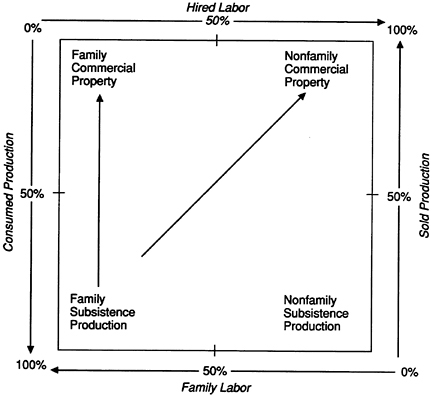
FIGURE 3 Possible forms of production in relation to labor utilization and production destination in a typical small-farm (including shifting agriculture) enterprise. Source: Adapted from Nakajima, C. 1970. Subsistence and commercial family farms: Some theoretical models of subjective equilibrium. Pp. 165–185 in Subsistence Agriculture and Economic Development, C. R. Wharton, ed. Chicago: Aldine Publishing.
participation of family labor, Nakajima classified properties as those dedicated exclusively to subsistence production and those dedicated exclusively to commercial production. In the Brazilian humid tropics, the first situation is rarely found, except in indigenous communities. On the other hand, very few shifting-agriculture farmers are dedicated exclusively to production commercialization.
Improvement in socioeconomic sustainability is possible for commercial family or nonfamily properties. However, limiting factors such as the prevailing inadequate infrastructural and technological conditions impose severe constraints on improvement efforts. Therefore, although favoring equity in income distribution among those who practice it, shifting agriculture offers few possibilities for socio-
economic improvements (Alves, 1988; Alvim, 1989; Homma and Serrão, In preparation).
An evaluation of small farms in the eastern Amazon (Burger and Kitamura, 1987) suggests that external factors such as population pressure, integration of a market economy, and cultural and technological influences are disrupting small-farm production systems, causing their degradation in three dimensions—namely, ecologic degradation as a consequence of shorter fallow periods, resulting in low, unstable, and undiversified production; economic degradation caused by unfavorable price relations for basic food products that are controlled by the government and that prevent agricultural modernization (Alvim, 1989); and human resource degradation as a result of insufficient work force replacement because of low levels of nutrition and formal and informal education as well as the loss of skilled labor to urban areas.
SUSTAINABILITY OF SHIFTING AGRICULTURE IN UPLAND AREAS
From the biologic point of view, annual crops such as rice, maize, cassava, beans, and sugarcane demand substantial quantities of soil nutrients for satisfactory yields (Goodland and Irwin, 1975), but Amazon upland soils are generally dystrophic, and the environment is favorable for pests and diseases that affect cultivated plants. Improved adapted varieties and cultural practices that include minimum amounts of agricultural inputs (mainly fertilizers and pesticides) are needed to improve agronomic sustainability.
Although some technological improvements may be achieved, however, incorporation of technology by small-scale food crop farmers has been practically nil. According to Pastore (1977), ignorance, impotence, and lack of interest are the main factors limiting the use of new technological developments by Brazilian small-scale farmers. First, farmers are unaware of the available new technologies. Second, even though they have a reasonable knowledge of new technologies, they cannot adopt them because of cultural and socioeconomic restrictions. Third, although they are aware of and are able to adopt new agricultural techniques, small-scale farmers prefer to take other courses of action.
Despite its low sustainability levels and the tendency that it will disappear in the remote future because of population pressures and other factors (see Figure 1), shifting agriculture will continue to be an important agricultural land use system in the Amazon. Therefore, it is necessary to raise the socioeconomic standards of farmers who practice it. An increase in the level of their income from agricultural activities may be accomplished by encouraging them to use improved
technologies with as few inputs as possible and by making appropriate credit available.
Reductions in the cycle of shifting agriculture would also considerably reduce ecologic disturbances. For example, by cropping 2 ha for 3 years instead of 2 years, silent deforestation (as discussed above) would be reduced by about 30 percent. Annual food crop production models, such as the Yurimagua model (Nicholaides et al., 1985; Sanchez et al., 1982), which involves intensive land use, including fertilizers, need to be implemented in the Brazilian humid tropics, as long as they are adjusted to the socioeconomic environment of the region (Fearnside, 1987).
RESEARCH NEEDS
Research support should be directed toward a gradual transformation of shifting agriculture into more sustainable agroforestry and even agropastoral systems, thus preventing farmers who practice shifting agriculture from being displaced from their lands. Research should focus on the development of annual and perennial crop varieties and their integrated utilization in agroforestry systems to improve the sustainability of upland agriculture by small farmers in the Brazilian humid tropics.
Várzea Floodplain Agriculture
Várzea floodplain agricultural systems, which have mainly been developed along the floodable margins of the Amazon River and its tributaries with their muddy, sediment-rich waters, can also be considered systems of shifting agriculture because they have some common features such as slash-and-burn practices, growth of predominantly annual food crops, and small-scale farmers with similar socioeconomic situations.
There are differences, however. Floodplain vegetation is less heterogeneous and includes large tracts of herbaceous, mostly grassy vegetation. Floodplain soils are more fertile than upland soils. Shifting cycles are considerably shorter in floodplains than they are in uplands because of higher soil fertility. Floodplains are subject to an annual flooding and receding cycle, with its consequent flooding risks. Agricultural activities complement subsistence fishing activities in the floodplain system; jute and malva as fiber are important products of floodplain agriculture.
Typically, agricultural practices consist first of selecting areas of the floodplain with the least probability of being totally flooded dur-
ing the high-water season. Then, the arboreal and herbaceous vegetation is cleared and burned during the dry season, and crops are planted in the beginning of the rainy season and harvested before the onset of the following dry season. Soil fertility conditions allow these same operations to be carried out for years on the same patch of land.
On average, if atypical floodings are not a limiting factor and minimal cultural management is practiced, yields can be considerably higher than those in the standard upland shifting agricultural system.
SUSTAINABILITY OF FLOODPLAIN AGRICULTURE
The possibility of agronomic sustainability of floodplain food crop agriculture is certainly higher than that in uplands, mainly because of more favorable soil conditions. However, weed invasion, pests, and diseases and the risks of flooding are serious constraints to agronomic sustainability.
Socioeconomic sustainability, though, is lower than that in the upland shifting agricultural system because of deficient basic infrastructural conditions (education, health, transportation) in the floodplain areas. In particular, commercialization of agricultural products is deficient because river transportation from the interior to the commercial centers is slow and generally precarious. To counterbalance this situation, however, floodplain farmers can get most of their dietary animal protein needs from fish.
At the present levels of demographic density and low technological intensity, the ecologic sustainability of the floodplain agricultural system is satisfactory because the extent and intensity of clearing and burning are relatively low.
It has been emphasized that the Amazon's várzea floodplains should be used as an alternative to intensive agricultural production (mainly annual food crops) in forested areas, thus reducing the pressure of silent deforestation brought about by the shifting agricultural system in upland regions (Lima, 1956; Nascimento and Homma, 1984). To date, this possibility has been explored mostly on paper and in conferences and debates within political and scientific communities. This certainly can and must be achieved with technological improvements involving better crop cultivars for appropriate production systems under either controlled or uncontrolled water conditions and an appropriate socioeconomic environment for development of this system.
Intensive agricultural production in the floodplains would involve intensive pest and disease control. Therefore, precautions should be
taken to avoid agrotoxic water pollution in streams and lakes. This type of water pollution could cause serious, unpredictable environmental consequences (Goulding, 1980).
RESEARCH NEEDS
If the development described above is to take place, research must concentrate on the development of production systems with minimum inputs and with the least possible damage to the aquatic ecosystem of the floodplains.
Cattle Raising on Pastures that Have Replaced Forests
A major agricultural development in the Brazilian humid tropics has been the turning of rain forests into pastures to raise cattle. This was a result of the road construction developments that began in the mid-1960s. This type of land use system has been seriously questioned in view of its agronomical-zootechnical, socioeconomic, and, principally, ecologic implications (Browder, 1988). It has been blamed for being the main cause of environmental degradation and for being infeasible biologically and socioeconomically (Fearnside, 1983, 1990; Hecht, 1983; Hecht et al., 1988). It is defended, however, as being an adequate activity for opening frontiers for development and making good use of the available land and labor force (Falesi, 1976; Montoro Filho et al., 1989).
SUSTAINABILITY OF CATTLE RAISING
Analyses that contemplate more recent, improved pasture-based cattle raising developments point toward the possibility of increasing levels of sustainability (Serrão, 1991; Serrão and Toledo, 1990, In press). The economic and ecologic sustainability of the cattle raising activities that have replaced forests in the Amazon depends to a large extent on the sustainability of the pastures. In general, it is agreed that zootechnical (animal component) sustainability is much less limiting than agronomic (pasture) sustainability is. Beef cattle (mainly zebu) breeds are well adapted to the Brazilian humid tropics, where parasites and diseases are less limiting to beef cattle than are other environmental conditions in the country (Serrão, 1991).
In general, during the first 3 to 4 years after the first-cycle pasture formation by cutting and burning forest biomass and then sowing grass seeds, primary pasture production is relatively high, supporting stocking rates of up to two 300-kg (live weight) head of cattle
per ha. After that period, a gradual but fairly rapid decline in productivity takes place. This is accompanied by weed encroachment and results in an advanced stage of degradation that occurs between 7 and 10 years after pasture establishment. It is estimated that, to date, at least 50 percent (about 10 million ha) of the total first-cycle pastures formed in the past 25 years have reached advanced stages of degradation (Serrão, 1990, 1991). At this stage, the carrying capacity cannot exceed 0.3 head of cattle (100 kg [live weight]) per ha. The average carrying capacity of first-cycle pastures during their life cycle is about 0.7 head per ha (Mattos et al., In press), which is considered too low for improved pasture standards.
In their average 6- to 7-year productive life, first-cycle pastures have produced as much as 250 to 300 kg of beef. This level of productivity is very low, especially when it is compared with those of other agricultural products, such as cassava, rice, maize, beans, cacao, and Brazil nuts, in terms of protein and energy production as well as monetary value per unit area (Mattos et al., In press).
These problems, which have resulted in low levels of sustainability, were typical of cattle raising activities in the 1960s and 1970s. The 1980s was the beginning of a new and more sustainable cattle raising trend in forested areas. The knowledge obtained from research in the late 1970s and early 1980s made it evident that first-cycle pasture degradation is caused by an interrelation of environmental, technological, and socioeconomic constraints. Environmental constraints included low soil fertility, with phosphorus being the main limiting factor; high biotic pressures, principally of insects (spittle bugs, for the most part) and weed aggressiveness; and water stress. Technological constraints included low adaptability of pioneer forage grasses (mainly guinea grass, Brachiaria decumbens, and Hyparrhenia rufa), poor pasture establishment and management, nonutilization of forage legumes, and fertilization. Socioeconomic constraints included unfavorable input/product ratios, inadequate development policies, land speculation, and deficient governmental and nongovernmental technical support. Beginning in the early 1980s, however, progressive ranchers began to adopt technological innovations in the search for higher levels of sustainability in their operations. Thus, a significant proportion of first-cycle pastures that were formed from the use of better-adapted forages such as B. humidicola, B. brizantha cultivar Marandu, and Andropogon gayanus cultivar Planaltina had considerably higher levels of agronomic sustainability than those formed in the 1960s and 1970s.
Higher land use intensification in cattle development areas in the Amazon was induced by considerable reductions in tax incentives
and subsidies for cattle in the past decade, the increased area of degradation of first-cycle pastures, increasing pressures for environmental preservation, the increased availability of scientific knowledge and technologies for pasture production, the decreased availability of forest areas in already established ranching projects, increasing population density in already established development poles, and consequent increases in land prices (see Figure 1).
With land use intensification, much degraded first-cycle pastureland has been converted to second-cycle pastures. In this second-cycle pasture generation, more modern agricultural technologies are being used. These technologies include mechanization for preparation and seeding of degraded pasturelands, soil fertilization, better forage grasses, higher-quality forage seeds, and improved pasture management. Official data are not available, but Serrão (1991) estimated that at least 10 percent of the total degraded first-cycle pastures formed to date have been reclaimed and converted to second-cycle pastures. Despite the recent improvements in pasture sustainability, socioeconomic, environmental, and agronomic constraints are still pending for the expansion of second-cycle pastures. One aspect is the high cost involved with transforming degraded pastures to second-cycle pastures. High-interest governmental and private bank credit has induced the logging and ranching link (Mattos et al., In press). This link is one more driving force toward deforestation. This constraint may be minimized by the utilization of cash crops (such as maize, rice, and beans) in association with forage grasses and legumes in the process of second-cycle pasture establishment. Returns from growing cash crops can considerably reduce the cost of pasture establishment (Veiga, 1986), minimize the need for the logging and ranching link, and add more to the subsistence food supply in the region.
Second-cycle pastures will continue to be monoculture open pastures with low levels of biomass accumulation; however, is it correct to keep searching for higher levels of sustainability for cattle raising in the humid tropics on the basis of the traditional pasture systems (open monoculture pastures) used in the region? It is known that the monoculture—whether domesticated, naturalized, or exotic—that has replaced the humid tropical forest without taking into account its environmental (climatic, edaphic, and biotic) adversities and its great biodiversity has had serious agronomic sustainability limitations. This is the case, for example, for rubber, cacao, black pepper, and more recently, African oil palm. In the case of pastures, it is probable that the dissemination of spittle bugs (the most economically significant pasture insect pest) has been the result of extensive deforestation to
form monoculture pastures of Brachiaria decumbens in the early 1970s, B. humidicola, and other, less important Brachiaria species.
In view of this environmental and socioeconomic scenario, there should be a search for alternative models of pasture-based cattle raising systems that can be agronomically, ecologically, and socioeconomically more sustainable than those in use. Within that context are the agrisilvopastoral systems. These systems are defined by King and Chandler (1978) as agricultural production systems in which arboreal and nonarboreal crops are grown simultaneously or sequentially in planned association with annual food crops and/or pastures. They have recently claimed the attention of research and commercial agricultural operations.
By this integrated approach, high levels of sustainability are expected as follows:
-
Agronomically—reduction of risks caused by pests and diseases and improved cycling and, consequently, better utilization of nutrients;
-
Economically—different sources of income;
-
Socially—production of different products, more direct and indirect employment opportunities, higher levels of labor specialization; and
-
Ecologically—higher levels of biomass accumulation, improvement in the hydrological balance, improvement in soil conservation, and improved environmental conditions for micro- and macroflora and -fauna (Serrão and Toledo, In press).
It is expected that the pasture-based integrated approach will be significantly implemented during the 1990s in the process of reclamation of already degraded pasturelands and that this approach will be a common practice in the first decade of the next century (Serrão, 1991).
With technological intensification and the consequent improvement in the sustainability of forest-replacing pastures, complemented by more efficient utilization of the native grassland ecosystem (see below), productivity from cattle raising operations in the Amazon can be doubled or tripled. Therefore, from the technical point of view, no more than 50 percent of the area already used for cattle raising is actually necessary to meet the regional demand for beef, milk, and other agricultural products at least through the 1990s. If this is correct, and given the relatively favorable resilience of degraded pasture ecosystems (Buschbacher et al., 1988; Uhl el al., 1988, 1990b), a considerable amount of already degraded pastureland can
be reclaimed or regenerated toward forest formation and biomass accumulation (Nepstad et al., 1990, 1991).
RESEARCH NEEDS
Although there has been some progress in increasing the sustainability of cattle raising operations on forest-replacing pastures in the Brazilian humid tropics, from a technological point of view, insufficient adapted forage germplasm is probably the most important constraint to continued progress. The main priority of applied research should be to correct this problem by developing adapted cultivars of grasses and legumes. This should be combined with additional applied research efforts for designing and implementing integrated agrisilvopastoral systems (Serrão and Toledo, 1990, In press; Veiga and Serrão, 1990). Applied research is also necessary to develop a means of restoring forest biomass in degraded pasturelands, especially through the strategic introduction of high-value timber and fruit trees to provide some economic return from the regeneration process.
More sustainable future development of cattle raising on forestreplacing pasture systems should be based on high-knowledge and low-input land use systems. Basic research is essential for this and studies should be concentrated on the ecology of the weed community in regional pastures, the biotic and abiotic mechanisms of forest regeneration in degraded pasture, the phosphorus cycling mechanism in pasture ecosystems, and the microbiology of soil organisms in pastures, especially in relation to Rhizobium species and mycorrhizae.
Cattle Raising on Native Grassland Ecosystems
Before the advent of pasture development in forested areas in the 1960s, cattle raising in the Brazilian Amazon was carried out almost exclusively on native grassland ecosystems with varied botanical, hydrological, edaphic, and productivity characteristics (Serrão, 1986b). After the more-negative-than-positive results of cattle raising on forest-replacing pastures and the need to minimize the pressure of cattle raising on new segments of forested areas, the emphasis is on the importance of native grasslands. Native grasslands can complement more sustainable and more intensive pasture development in already explored forested areas.
Nascimento and Homma (1984) and Serrão (1986b) estimate that there are between 50 and 75 million ha of land in the Brazilian humid tropics with varying gradients of herbaceous and arboreal vegetation and with varying grazing potentials. Serr ão (1991) estimates that
these lands carry about 6 million head of cattle but could potentially carry 30 million head. Economically, the most important ecosystems are well-drained cerrado-type savannah grasslands with varying herbaceous and arboreal gradients, poorly drained cerrado-type savannah grasslands with varying flooding gradients, and várzea floodplain grasslands (Serrão, 1986b).
WELL-DRAINED SAVANNAH GRASSLANDS (WDSG)
WDSG correspond to the typical cerrado grassland. WDSG have little edaphic and floristic variation, are found in smaller patches where the forest's vegetation is interrupted, and have varying gradients of herbaceous and arboreal strata.
The herbaceous stratum is of major interest for animal production. It is mainly made up of grasses of the genera Andropogon, Eragrostis, Trachypogon, Paspalum, and Mesosetum and, on a much smaller scale, of legumes of the genera Stylosanthes, Desmodium, Zornia, and Centrosema (Coradin, 1978; Eden, 1964; Serrão and Simão Neto, 1975).
One of the main limitations of WDSG for cattle production is its low forage productivity. Available data (Brazilian Enterprise for Agricultural Development, 1980, 1990) indicate that primary production of WDSG herbaceous extracts rarely exceeds 5 metric tons of dry matter per ha. Consequently, the carrying capacity varies from 4 to 10 ha per animal unit (AU) (1 AU equals 450 kg live weight), which is very low. The low nutritive value of the available forage is the main limitation of WDSG. Even under the most favorable conditions, during the rainy season, available forage, protein, phosphorus, and dry matter digestibility of the grasses in WDSG are below standard critical levels for beef production (Brazilian Enterprise for Agricultural Research, 1990; National Research Council, 1976; Serrão and Falesi, 1977).
Serrão and Falesi (1977) suggest that the low productivity and quality of WDSG are related to the low levels of soil fertility in the ecosystem and the high rate and speed of lignification of the available grasses in the herbaceous stratum. These constraints are accentuated during the dry season, when the contributions of native legumes are probably insignificant because of their sparse presence in the ecosystem. The use of fire to burn WDSG toward the end of the dry season helps to alleviate the low-quality constraint for at least the first 2 or 3 months of the following growing season (Serrão, 1986b). Despite its economic and ecologic importance, research on the burning of WDSG has been neglected.
Cattle raising productivity in the WDSG of the Brazilian humid
tropics can be increased by more intensive utilization of the natural ecosystem per se and by supplemental feeding of cattle on nearby improved cultivated pastures. These types of pastures provide higher production and quality potentials, have a positive effect on increasing the carrying capacity of the land, and reduce the problem of low quality in the system as a whole (Serrão, 1986b; Serrão and Falesi, 1977). Selection of adapted improved grasses such as Brachiaria humidicola, B. decumbens, B. brizantha cultivar Marandu, and Andropogon gayanus cultivar Planaltina as well as research on pasture fertilization have contributed to increased WDSG productivity (Brazilian Enterprise for Agricultural Research, 1980; Serrão, 1986b).
Despite their inherent low productivity, WDSG have relatively high levels of ecologic and agronomic sustainability because of their resilience after burning disturbances, the very low soil fertility conditions, and the relatively harsh climatic conditions that prevail in the ecosystem. To date, however, socioeconomic sustainability has been marginal.
Applied research must be prioritized for the selection of adapted and more productive forage germplasm, pasture establishment and management, mineral supplementation, and fire management in the native savannah. Basic research should concentrate on physical and biologic characterization and on water stress pressures in WDSG.
CATTLE RAISING ON ALLUVIAL FLOODPLAIN (VÁRZEA) GRASSLANDS (FPG)
FPG ecosystems are found mainly in association with “white” muddy-water rivers. The Amazon River is the main contributor to their formation, as are other tributaries whose waters are rich in the organic and mineral sediments deposited annually on the floodplains when river waters recede (Sioli, 1951a,b).
Prototype FPG (Figure 4) have mainly been developed along the lower and mid-Amazon River regions. They are also found, on a smaller scale, on Marajó Island and in the state of Amapá. The predominant soils are fertile alluvial inceptisols, which generally support a herbaceous vegetation with high productivity and quality potential. “Amphibian” grasses, that float when the water is high and thrive on the restingas (the highest part of the várzea ecosystem) in the dry season after the water recedes, are dominant (Brazilian Enterprise for Agricultural Research, 1990). The amphibian grasses Echinochloa polystachya, Hymenachne amplexicaulis, Leersia hexandra, Luziola spruceana, Paspalum fasciculatum, Oryza species, and Paspalum repens are the most important from the standpoint of animal production (Brazilian Enter-
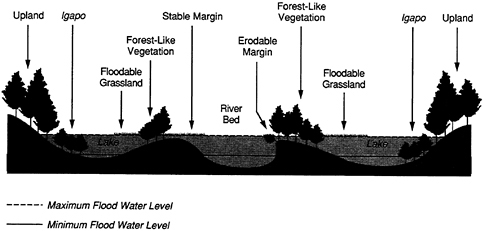
FIGURE 4 Profile of a typical várzea floodplain grassland (FPG) ecosystem of the lower and mid-Amazon River region. “Igapo” is the inundated parts of riverine woodlands. Sources: Sioli, H. 1951a. Sobre a sedimentação na várzea do baixo Amazonas. Pp. 42 –66 in Boletim Técnico 24. Belém, Brazil: Instituto Agronomico do Norte; Serrão, E. A. S. 1986b. Pastagens nativas do trópico úmido brasileiro. Conhecimentos atuais. Pp. 183–205 in Simpósio do Trópico Úmido I, Vol. V. Anais. Belém, Brazil: Brazilian Enterprise for Agricultural Research–Center for Agroforestry Research of the Eastern Amazon.
prise for Agricultural Research, 1990; Serrão, 1986b; Serrão and Falesi, 1977; Serrão and Simão Neto, 1975).
In addition to being the main source of feed for cattle, the importance of FPG has increased as interest has increased in raising water buffaloes because of their proved higher efficiency in utilizing floodplain grasslands (da Costa et al., 1987; Nascimento and Moura Carvalho, In press).
FPG produce relatively high levels of forage, up to 20 metric tons or more of forage dry matter per ha, depending on the flooding gradient (Camarão et al., 1991; Serrão, 1986b). The forage quality of FPG is considerably higher than that of WDSG and is similar or superior to that of upland sown pastures. Daily live weight gains of between 400 and 600 g for cattle and water buffaloes are fairly common, mainly during the dry season (September through February), when grazing conditions are adequate (Camarão et al., 1991; da Costa et al., 1987; Serrão, 1986b).
The agronomic sustainability of FPG is high because of the favorable edaphic and hydrologic conditions of várzea and várzea-like eco-
systems. Forage production potential is higher in the dry season, when adjacent upland native (savannah-type) and cultivated pastures have less available forage and are lower in quality. Utilization of FPG during the flooding season (March through August) is difficult, resulting in poor animal performance and the frequent loss of animals, mainly cattle, since water buffaloes are better able to thrive under partial flooding conditions.
The high-productivity (dry season)/low-productivity (flood season) fluctuations of FPG affect their economic sustainability because animals are ready for market only when they are 48 to 54 months old. Results of recent research (da Costa et al., 1987; Serrão et al., In preparation) and from commercial operations indicate that the integration of improved upland pastures of Brachiaria species, mainly B. humidicola (for grazing in the wet season), with adjacent FPG (which are grazed in the dry season) can considerably increase production and the economic sustainability of cattle raising activities in FPG. These integrated systems reduce the age at which cattle are ready for market by as much as 40 percent (da Costa et al., 1987; Serrão et al., In preparation).
Cattle raising on FPG has the potential for more intensive production with a more favorable socioeconomic environment. Owners of small-and medium-sized farms are the main practitioners of this activity, but the main constraint on sustainability in agricultural development in the floodplains of Brazil's humid tropics is the lack of a better socioeconomic environment for the farmers.
Research is needed to obtain higher levels of technical sustainability for cattle raising in FPG. Research should concentrate on more efficient means of managing FPG per se and on the selection of better-adapted and more-productive forages for pasture establishment and utilization in upland areas adjacent to FPGs.
CATTLE RAISING ON POORLY DRAINED SAVANNAH GRASSLANDS (PDSG)
PDSG are drainage-deficient native grasslands typical of the eastern part of Marajó Island in the state of Pará (Figure 5). A typical PDSG ecosystem is frequently associated with FPG when the PDSG is in its more humid gradient. (In Figure 5, gradients G1 and G2 correspond to the WDSG ecosystem, and gradient G3 is similar to the FPG ecosystem [Serrão, 1986b].) Inceptisols (mainly groundwater laterites), entisols (mostly groundwater podzolic soils and quartz sands), and oxisols (latosols) are the predominant soils. Herbaceous, grassy vegetation is predominant in the ecosystem. Grasses of the genera Axonopus, Andropogon, Trachypogon, Eragrostis, Eleusine, Paspalum, and
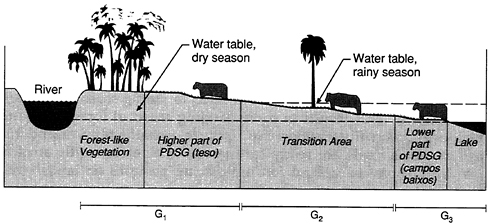
FIGURE 5 Profile of a typical poorly drained savannah grassland (PDSG) ecosystem on the Island of Marajó, state of Pará. Gradient G1 corresponds to the well-drained savannah grassland ecosystem; G2 is the transition area from G1 to G3; and G3 corresponds to the floodplain grassland ecosystem (Serrão, 1986). Sources: Organization of American States and Instituto do Desenvolvimento Economico e Social do Pará. 1974. Marajó: Um Estudo para Seu Desenvolvimento. Washington, D.C.: Organization of American States; Serrão, E. A. S. 1986b. Pastagens nativas do trópico úmido brasileiro. Conhecimentos atuais. Pp. 183–205 in Simpósio do Trópico Úmido I, Vol. V. Anais. Belém, Brazil: Brazilian Enterprise for Agricultural Research–Center for Agroforestry Research of the Eastern Amazon.
Panicum are the main components in gradients G1 and G2, while those of the genera Eriochloa, Echinochloa, Hymenachne, Leersia, Luziola, and Oryza tend to dominate in gradient G3.
Various gradients of PDSG occupy about 2 million ha (Organization of American States and Instituto do Desenvolvimento Economico e Social do Pará, 1974) of the eastern portion of Marajó Island, where cattle raising has been the main activity for the past 300 years (Teixeira, 1953). More than 1 million head of cattle and water buffalo are grazed on PDSG, mostly in cow-calf operations. PDSG are intermediate between WDSG and FPG for cattle production. Productivity is generally low. The annual primary productivities of gradients G1 and G2 (Figure 5) are rarely higher than 6 metric tons of dry matter per ha, and their carrying capacities vary from 3 to 5 ha/AU (Brazilian Enterprise for Agricultural Research, 1980; Organization of American States and Instituto do Desenvolvimento Economico e Social do Pará, 1974; Teixeira Neto and Serrão, 1984). Although the forage quality of PDSG is slightly higher than that of WDSG, it is intrinsically low, resulting in relatively low animal performance (Serrão, 1986b).
As in WDSG, low levels of productivity and quality of PDSG are associated with low levels of soil fertility, although, because of higher soil moisture levels during most of the year in gradients G1 and G2, pasture productivity and quality in PDSG tend to be somewhat higher than in WDSG (Serrão, 1986b).
PDSG on Marajó Island are subjected to strong seasonal climatic fluctuations. This results in corresponding seasonal forage and animal production fluctuations that, in turn, considerably extend the age at which cattle are ready for market. Therefore, cattle are finished on improved upland forest-replacing pastures on lands other than on the Island.
Despite the above-mentioned floristic, edaphic, hydrological, and management limitations, PDSG have good potential for extensive cattle raising activities. The resilience of PDSG in light of edaphic, climatic, and management constraints is high, resulting in relatively high agronomic and ecologic sustainabilities.
Typically, cattle raising on PDSG is carried out by a few employees and their families on large ranches owned by individual proprietors. The employees generally have low socioeconomic standards of living, which renders low levels of socioeconomic sustainability to the system.
Because of ecologic limitations on Marajó Island, cattle raising on PDSG has reached its limit for expansion. However, research results (Brazilian Enterprise for Agricultural Development, 1980; Marques et al., 1980; Teixeira Neto and Serrã o, 1984) indicate that there is room for sustainable increased production by intensifying the utilization of PDSG or, as with WDSG, by replacing patches of native savannahs in gradients G1 and G2 with more productive improved pastures to qualitatively and quantitatively supplement the native pasture.
Additional research is necessary to promote more sustainable use of PDSG. Basic research is needed to generate knowledge on the ecology and ecophysiology of the native grassland for its sustainable use. Applied research efforts should concentrate on the selection of adapted and more productive pasture grasses and legumes, mainly for gradients G1 and G2 (see Figure 5), mineral supplementation, and native savannah grassland management.
Perennial Crop Agriculture
Perennial crop farming has been considered an ideal model for agriculture in the Brazilian humid tropics as a means of minimizing local environmental disturbances and maintaining the ecologic equilibrium in the region (Alvim, 1978).
Ecologically, perennial crops—as well as forest and agroforestry plantations—are the closest to natural forests in their efficiency in protecting the soil from erosion, leaching, and compaction (Alvim, 1989). In addition, in comparison with short-cycle crops, perennial crops have lower demand for soil nutrients, because of their efficient soil nutrient recycling mechanisms, and higher tolerance to high acidity and aluminum toxicity, which are common limitations of about 80 percent of Amazonian soils (Nicholaides et al., 1985).
SUSTAINABILITY OF PERENNIAL CROP AGRICULTURE
The potential of perennial crops in the agricultural development of the humid tropics has been underestimated or neglected. Although there are ecologic and agronomic reasons for being optimistic, there are important considerations limiting economic sustainability, since for most of the important perennial crop products, there is limited market potential, which is a constraint for large-scale plantations.
Although perennial crops are recognized as having fairly high levels of agronomic sustainability, high biotic pressure caused by the variety of pests and diseases these crops are plagued by is probably the most limiting factor in the Brazilian humid tropics (Morais, 1988). Leaf blight disease (caused by the fungus Microcyclus ulei, which attacked rubber tree plantations in the 1930s) continues to be a major limiting factor of rubber tree plantations today. Fusariose, or dry rot (caused by the fungus Fusarium solani f. sp. piperis), has caused serious agronomic and economic problems to the black pepper industry for many years. Witchbroom disease (caused by the fungus Crinipellis perniciosa), which affects cacao; and, more recently, the fatal yellowing disease of African oil palm (caused by an unknown pathogen) have been serious threats to the agronomic and economic sustainabilities of important perennial crops.
The social sustainability of perennial crop agriculture may be high (Alvim, 1989; Fearnside, 1983). These crops are appropriate to both small and large operations and are labor intensive, generating high levels of employment in small areas. However, profits are marginal (Flohrschütz, 1983) and cannot finance the infrastructural adaptation and economic and ecologic changes necessary for prolonged sustainability of the land use system.
A major limitation to expanding perennial crop plantations in the Amazon is the market dimension. Regional experiences have shown rapid market saturation for products such as black pepper and urucu (Bixa orellana). This market saturation creates serious economic sustainability problems for those land use systems. Use of only a
small fraction of the Amazon for perennial crop production may saturate national and international markets. For example, 200,000 ha of rubber tree plantations would be enough to make Brazil self-sufficient in natural rubber, 160,000 ha of cacao plantations would be enough for the Amazon region to contribute 50 percent of the Brazilian cacao production, and 10,000 ha of guaraná is sufficient to saturate national and international markets. Growth of the black pepper market is subject to the rate of population growth. These considerations also apply to Brazil nuts, coffee, and African oil palm.
Present and potential national and international timber markets seem to be unlimited. Therefore, timber production in reforestation projects should be emphasized and stimulated, whether directly in homogeneous plantations or indirectly in integrated agroforestry and silvopastoral (pasture, animal, and tree) systems.
In addition to the presently economically important perennial plants, there are many others in the forest that also are or may be important as fruit, medicinal, timber, fiber, and oil products. These products need to be domesticated for future plantation or agroforestry land use systems. Association of perennial crops with other plants with shorter cycles, and even pastures, should reduce the biologic risks and make the system more accommodating to market fluctuations.
RESEARCH NEEDS
Research will be the basis for more sustainable perennial crop systems. Economically important diseases of the present high-value perennial crops must be the priority of applied and basic research. Emphasis should also be given to research of the domestication of potential high-value perennial crops and to the definition of production systems.
Agroforestry
Agroforestry systems (AFSs) have recently been examined as land use systems that will use land resources in the Brazilian humid tropics more sustainably. They should gradually replace or be associated with present extensive low-sustainability land use systems such as open monoculture pasture-based cattle raising systems, upland shifting agricultural systems, and extractive forest reserves. Possible combinations of AFSs are presented in Figure 6. The reasons for this emphasis of AFSs are as follows.
-
AFSs may increase the productive capacity of certain agricultural lands that have had reduced productive capacity because of mismanagement that resulted in compaction and loss of fertility.
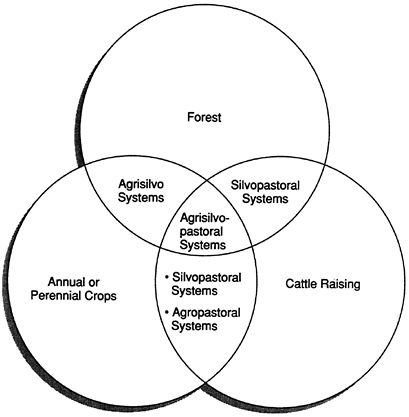
FIGURE 6 Possible combinations involving annual and perennial crops with trees and cattle raising. Source: Homma, A. K. O., and E. A. S. Serrão. In preparation. Será Possivel a Agricultura Autosustentada na Amazônia?
-
AFSs allow the growth of combinations of species with different demands for energy, resulting in the more efficient use of solar energy because of the vertical stratification of associated plants. If the association includes leguminous plants, soil fertility can also be increased.
-
In AFSs, crop diversification reduces biologic risks and is more adaptable to market fluctuations. The introduction of a tree component in annual or perennial cropping systems or in cattle-raising systems may favor the replacement of unsustainable slash-and-burn agricultural systems.
AFSs present peculiarities in relation to market, technological practices, farm administration, and management. For example, the rubber tree –cacao systems recommended by research institutions result in yield reductions, in relation to the single-crop system, of about 75 percent for rubber and 50 percent for cacao. From the market point of view,
between 100,000 to 120,000 ha of rubber plantation in production is needed today to neutralize rubber imports, while the market for cacao is fairly restricted.
Anderson et al. (1985) described and analyzed a commercial AFS with relatively high levels of sustainability that is being developed by riverbank dwellers. This system is based on the extraction of forest products with and without management and is being developed in a periodically inundated várzea floodplain of the Amazon River estuary, in the vicinity of Belém, where it is difficult to use conventional agricultural practices. The main activities in the system include hunting, fishing, raising of small domestic animals, and harvesting of fruits, heart of palm, wood, organic fertilizer, ornamental plants, latex, fibers, oil-bearing seeds, and medicinals. These products are sold in the Belém farmer 's open market. This is an example of a semiextractive agroforestry system in which a proportion of the economically valuable trees in the system are domesticated or semidomesticated.
An important example of sustainable agroforestry agriculture is one developed by Japanese immigrants and their offspring (NippoBrazilian farmers) who have farmed remote forest regions of the Amazon Basin since the late 1920s (Subler and Uhl, 1990). In the mid-1950s black pepper fusariose became the most serious constraint to sustainability of black pepper production, the main activity of those farmers at the time. In the early 1970s these farmers had to diversify their agricultural systems.
Nippo-Brazilian farmers have replaced most of their black pepper agriculture with diverse agroforestry arrangements. Farmers rely on intensive cultivation, producing a diversity of high-value cash crops through mixed cropping of perennial plants. These plants include a wide variety of perennial trees (such as cacao, rubber, cupuaç u [Theobroma grandiflorum], graviola [Annona muricata], papaya, avocado, mango, and Brazil nut) and palms (such as açai [Euterpe oleracea], coconut, oil palm, peach palm), shrubs and vines (pineapple, Barbados cherry [Malpighia glabra], banana, coffee, passion fruit, black pepper, and urucu), and annuals (such as cotton, cowpea beans, pumpkin, cassava, melon, pepper, cucumber, cabbage) (Subler and Uhl, 1990).
Most farms are operated by single families, and the average size is between 100 and 150 ha. On average, however, each farm cultivates only about 20 ha (Flohrschütz et al., 1983). The rest of the area is generally in secondary forest regeneration, following pepper field abandonment or previous slash-and-burn activity, or is undisturbed forest. Figure 7 shows a typical Nippo-Brazilian agroforestry farm in Tomé-Açu.
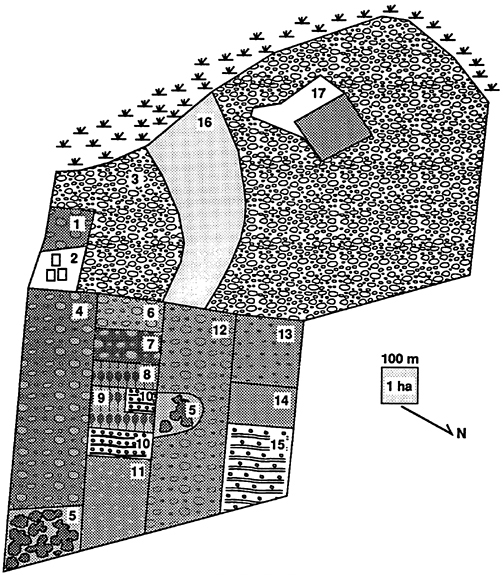
FIGURE 7 Land use on a representative Nippo-Brazilian farm in Tom é-Açu. 1, cacao, erythrina; 2, household area; 3, coconut, citrus, mangosteen, graviola; 4, cacao, erythrina, andiroba, Brazil nut; 5, secondary forest regeneration; 6, cacao, vanilla, palheteira, freijó; 7, cacao, paricá,; 8, rubber trees; 9, rubber trees, black pepper, cacao; 10, rubber trees, passion fruit; 11, black pepper, cacao; 12, cacao, banana, Cecropia sp.; 13, black pepper, cupuaçu; 14, black pepper; 15, passion fruit, cupuaçu; 16, pasture grasses; 17, black pepper, clearing. Source: Subler, S., and C. Uhl. 1990. Japanese agroforestry in Amazonia: A case study in Tomé-Açu, Brazil. Pp. 152–166 in Alternatives to Deforestation: Steps Toward Sustainable Use of the Amazon Rain Forest, A. B. Anderson, ed. New York: Columbia University Press.
Nippo-Brazilian AFSs (NBAFSs) rely on fairly heavy inputs of chemical and organic fertilizers, although the amounts tend to decrease as the trees in the systems reach maturity. There is also a high labor requirement. A typical farm with about 20 ha in cultivation uses approximately six to eight full-time laborers, which, together with inputs, also make capital investments high (Subler and Uhl, 1990).
The basis for the success of those systems is largely constant experimentation with innovative techniques and the use of cooperative marketing systems. From an overall analysis of these systems, Subler and Uhl (1990) came to the following conclusions about NBAFSs:
-
NBAFSs are conservative of forest and soil resources, requiring relatively small-scale forest clearing and maintaining soil fertility for a long time.
-
The long-term sustainability of NBAFSs may be questionable since there is a trend toward increasing fertilizer and energy prices.
-
Even though transportation is a limiting factor to the development of NBAFSs in remote frontier areas, they may be largely used with the increasing road network in the region.
-
Rather than displacing rural inhabitants, NBAFSs use local human resources, but their high labor requirements make them vulnerable to labor shortages and increasing labor costs.
-
Even though the high prices received for crops such as cacao, black pepper, passion fruit, and rubber make up for the heavy capital investments required by NBAFSs, market saturation may be a limiting factor for large-scale adoption of the system.
-
Some form of institutional support through training, credit, and community services seems to be necessary to encourage the adoption of NBAFSs by Brazilian small-scale farmers.
In the case of silvopastoral systems, as trees grow taller, integrated management difficulties become more evident. For example, fire outbreaks cannot be overlooked, since fire may be a major limitation for arboreal vegetation. According to Veiga and Serrão (1990), the success of integration depends mainly on the equilibrium of the interaction among the animal, tree, and pasture components. The competition for light, water, and nutrients between tree and pasture must be well understood.
Silvopastoral systems are in their initial stages of development in the Amazon. Most of those land use systems are concentrated in the eastern state of Pará on small- and medium-sized properties, where Veiga and Serrão (1990) found associations of rubber, coconut, African oil palm, cashew, urucu, pine, mango, and Brazil nut trees with
strata of grasses and legumes for cattle grazing. They observed that the main management and sustainability limitations of the varied integrated system are related to pasture production and persistence —the pasture is overgrazed in most cases and maintenance management is deficient (for example, insufficient weed control). Under those conditions, since the available forage in the system tends to be overestimated, extra buffer pasture areas should complement the integrated system for more flexible grazing management.
Promising silvopastoral system combinations are being tested and evaluated by EMBRAPA researchers in Paragominas in the eastern state of Pará (Veiga and Serrão, 1990). Two native timber-producing trees, namely, paricá (Schizolobium amazonicum) and tatajuba (Bagassa guianensis), and one exotic tree species (Eucalyptus teriticornis) are each associated individually with three forage grasses (Brachiaria brizantha cv. Marandu, B. humidicola, and B. dictyoneura). Five years after establishment and 3 years under grazing management, the combination of paricá × B. brizantha, for example, is showing satisfactory levels of agronomic and ecologic sustainability.
Undoubtedly, AFSs rank high in terms of sustainability among the agricultural land use systems used in the Brazilian humid tropics, and there is a probability of expansion in the near future. The probability is so high that EMBRAPA's agricultural research centers in the Amazon have recently been changed into agroforestry research centers.
Although they rank high in sustainability, AFSs cannot be considered a panacea for the Amazon. Their expansion will depend on the market for the products involved, labor use intensity, and most important, their economic profitability. Monocultures of cupuaçu, Barbados cherry, and black pepper have higher profitabilities than do some arboreal associations because of the present market demand characteristics of the region. Therefore, appropriate market conditions need to be developed to ensure the expansion of AFSs.
Research priorities for developing more sustainable AFSs should include the domestication and introduction of high-value, multipurpose native and exotic trees and food and forage crops for the development and management of integrated systems of crops, pastures, animals, and trees.
LAND USE INTENSITY, RESEARCH, AND TECHNOLOGY: THE KEY FOR SUSTAINABILITY
The low sustainability of agricultural development in the frontier expansion process has been an important cause of high rates of deforestation and the consequent negative environmental and socioeco-
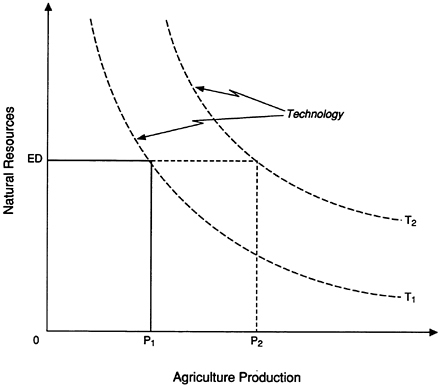
FIGURE 8 Exchange relations between agricultural production and natural resource disturbances affected by technological development. ED, environmental disturbances; T1, inappropriate technology; T2, more appropriate technology; P1, agricultural production with technology T1; P2, agricultural production with technology T2. Source: E. B. Andrade, personal communication, 1990.
nomic implications. A major reason for this is the fact that, in the past 30 years, the most important political decisions regarding regional agricultural development have largely bypassed scientific and technological considerations.
Because of society's demand for food and fiber and deforestation restrictions in the Brazilian Amazon, more production must be realized mostly from already deforested lands. This implies increasing land and labor productivities, which can only be achieved with land use intensification. This, in turn, can only be achieved with the strong support of science and technology, but the levels of technology used for the most important agricultural land use systems that replace forests have typically been low.
Figure 8 illustrates the importance of technology for agricultural production in relation to the conservation of natural resources. Logi-
cally, for each degree of agricultural development there is a corresponding degree of environmental degradation. In the Amazon, use of inappropriate technologies has resulted in low levels of agricultural products with high levels of environmental degradation. However, scientific and technological developments can propitiate increases in agricultural production with more appropriate technologies at the same (or even lower) level of environmental degradation. The low technological level of agricultural production in the Amazon indicates a high potential for improvement.
From these considerations and considering the insufficiency of the available knowledge basis, the search for sustainability will depend to a large extent on research development. Research should be directed mainly toward increasing the productivities of already deforested areas to guarantee a local supply of food and fiber and the export of products that are exclusive to the Brazilian Amazon region and toward reducing the pressure on new forest frontiers. Research should also be directed toward supporting the conservation and preservation of natural resources.
To accomplish those more general goals that integrate the needs of society with the conservation of natural resources, future agricultural development should be built fundamentally on the diversity that characterizes the humid tropical ecosystem and should mirror as much as possible its complexity (National Research Council, 1991). Therefore, research should focus on the following:
-
Increasing basic knowledge of Amazonian natural ecosystems;
-
Surveying, classifying, and analyzing presently and potentially successful agricultural land use and land resource management systems;
-
Developing and promoting principles and components of land management that sustain land resources under the constraints of humid tropical ecosystems;
-
Reclaiming degraded ecosystems for intensive agricultural production and regeneration of the ecosystem; and
-
Promoting the agroecologic zoning of the Brazilian humid tropics.
Basic research on the following topics is immediately relevant for increasing the sustainability of Amazonian agricultural systems:
-
Nutrient, water, and biomass cycling in forest ecosystems that have been disturbed by agriculture as well as those that are undisturbed;
-
Climatic, edaphic, and biologic disturbances caused by deforestation and fire utilization for agricultural development purposes;
-
Evaluation of biotic and abiotic factors that influence degradation and regeneration of forest ecosystems disturbed by agriculture; and
-
Survey, classification, and analysis of presently and potentially important agricultural land use systems.
Applied research should focus on the continuous search for alternative sustainable agricultural production systems and on improving the sustainability of important systems already in use. Applied research priorities for the most important agricultural land use systems in the Brazilian Amazon are given in Table 3. In addition, applied research for fish production systems should focus on domestication of economically important freshwater fish; controlled native fish reproduction and management; and development of integrated systems that include fish, crop, and cattle production.
Institutional Capacity
More than ever, research is fundamental for agricultural development in the Amazon. The present agricultural production limitations and the need for natural resource conservation demand a research agenda that requires an enormous institutional effort.
Figure 9 lists the research institutions that are directly and indirectly involved with agricultural research and natural resources conservation in the Amazon. Paradoxically, those institutions have been practically stagnant during the past decade from the standpoint of infrastructure, personnel (quantitatively and qualitatively), and financial situation. In addition, intense politicization and lack of stimuli (for example, low salaries) within research institutions have reduced the research impetus. It is difficult to foresee any short-term improvement in institutionalized agricultural research in Brazil as a whole and in the Amazon in particular.
A FUTURE SCENARIO
Throughout the history of the Amazon, economic features have reflected its dependence on more developed nations. During the “drogas do sert ão” phase (extraction of cacao, medicinal and aromatic plants, and plant and animal oils), it depended on Portugal, and during the rubber cycle it depended on rubber-importing countries. Starting in the 1970s, national and international capitals directed the occupancy of the Amazon, extrapolating the dimension of occupied area to include future economic possibilities.
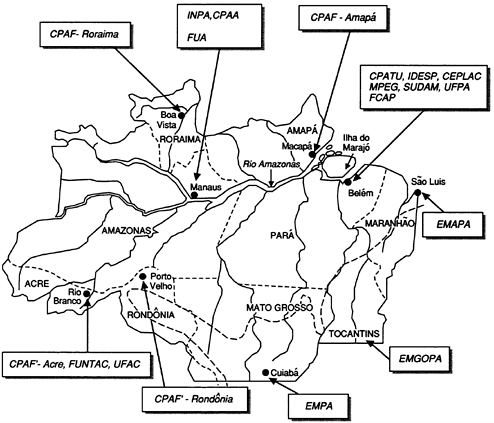
FIGURE 9 Research institutions directly and indirectly involved with agricultural development in the Amazon. Key to acronyms: CPAF-Roraima, Centro de Pesquisa Agroflorestal de Roraima; INPA, Instituto Nacional de Pesquisas da Amazônia; CPAA, Centro de Pesquisa Agroflorestal da Amazônia Ocidental; FUA, Fundação Universidade do Amazonas; CPAF-Amapá, Centro de Pesquisa Agroflorestal do Amapá; CPATU, Centro de Pesquisa Agroflorestal da Amazônia Oriental; IDESP, Instituto de Desenvolvimento Econômico Social do Pará; CEPLAC, Comissão Executiva do Plano da Lavoura Cacaueira; MPEG, Museu Paraense Emilio Goeldi; SUDAM, Superintendência do Desenvoluimento da Amaz ônia; UFPA, Universidade Federal do Pará; FCAP, Faculdade de Ciências Agrarias do Pará; EMAPA, Empresa Maranhense de Pesquisa Agropecuária; EMGOPA, Empresa Goiana de Pesquisa Agropecuária; EMPA, Empresa Matogrossense de Pesquisa Agropecuária; CPAF-Rondônia, Centro de Pesquisa Agroflorestal de Rondônia; CPAF-Acre, Centro de Pesquisa Agroflorestal do Acre; FUNTAC, Fundaçãe Tecnologia do Acre; UFAC, Universidade Federal do Acre.
The greater concern with the environment that started in the 1980s as a result of the alarming rates of deforestation will direct the future economic development of the region. The future scenario of development in the Amazon is therefore discussed at the national and international levels, with the environmental question being the backdrop. Other variables, such as the Acre-Pacific Highway through Peru, minimization or cancellation of support to agricultural activities, and road construction restrictions, will also direct the level of human occupation of the Amazon.
Environmental aggression should be reduced considerably in the future. However, the growth of pockets of poverty cannot be eliminated if environmental policy is directed exclusively toward zero deforestation. Small-scale farmers will probably be the main victims, rural to urban migration will be enforced, and unemployment and underemployment will be stimulated if more ample development policies are not implemented.
One probable consequence of environment-oriented policies will be increasing land value, which will likely induce utilization of more capital-intensive technologies in already deforested lands. Agricultural activities will be restricted to meet the regional demands for products that are not exclusively Amazonian and the external demand for Amazon-exclusive products that are competitive with products from other regions.
Despite criticism, native timber extraction will probably grow in intensity to meet growing national and international market demands. Contradictions about its sustainability will probably induce silvicultural development in already deforested areas of the Amazon. In that direction, the FLORAM (Forest Environment) megasilviculture project (Universidade de São Paulo, 1990) is being proposed. Besides economics, the project is also intended to study atmospheric carbon fixation. The Forest Poles Project for the Eastern Amazon is another example; it aims to forest 1 million ha of land along the CarajásItaquí Highway at a cost of US$1.2 billion.
Extraction activities, and specifically extractive rubber tapping (in this case, even with external support that is now under way), should gradually decline in importance. Some extractors will move toward agroforestry.
Other activities with low levels of sustainability such as traditional shifting agriculture will not be able to be maintained in the long run because of increasing population density in addition to deforestation restrictions.
What will happen to the regional development of science and technology? Research activities in the Amazon are stagnant, and the
future is cloudy. The conservation, preservation, and rational utilization of many natural resources will largely depend on the future generation of knowledge and technology.
The tendency to reduce environmental disturbances is due more to economic and/or legal impediments that are created rather than to environmental ethics or consciousness. Day-to-day regional life includes high demographic densities, urbanization, the need for more employment, low income, and low quality of life. If poverty, unemployment, underemployment, and the lack of a basic infrastructure persist, conservation and preservation intentions will gradually lose the support of the population.
EXPANSION POTENTIAL OF PRESENT LAND USE SYSTEMS
Extraregional forces will likely direct the pace of production activities in the Amazon. With the label of environmental cause, a set of measures to discourage production activities, except for agroforestry and extraction activities, are being launched. Some have proposed that extraction activities should be the land use system for about 25 percent of the Brazilian Amazon region.
On the other hand, a set of intraregional forces reacts to the impropriety of agricultural systems from the point of view of macro-economics in relation to the region's inhabitants. This presupposes that agricultural activities must supply the local population's needs for food, generate employment, guarantee better living standards, and promote the region 's development.
Within the not-so-remote future, it is probable that the extractive reserve syndrome will be weakened when realistic and impartial evaluations are made. The conclusion will likely be that it is not easy to propose simple solutions for the Amazon.
Environmentally oriented proposals have not been accompanied by reasonable development alternatives. Consequently, they may induce rural as well as urban socioeconomic adversities such as unemployment, which is already high in the region. This stagnation scenario might favor extraction activities and even become their justification. In that scenario, production activities considered to be harmful to the environment will continue in the search for new adaptations to the prevalent biosocioeconomic environment.
The closing of the agricultural frontier will make land more expensive, which will induce the use of more capital-intensive technologies. Small farmers will find it difficult to maintain their activities because of restrictions on deforestation and burning, the basic ingredient of shifting agriculture. Unless other alternatives are of-
fered, deforestation reduction of 500,000 ha/year may cause serious adversities to small-scale farmers in the Amazon.
Várzea floodplain agriculture will probably remain stagnant. If political measures are taken to increase the food supply to the main urban nuclei, food production along the floodplain may be stimulated. Because of the favorable conditions for raising water buffalo in the várzeas, it may be even more strongly stimulated than it was previously.
Although environmental restrictions tend to be reinforced, the survival strategy of farmers will prevail. The emergence of new, alternative products exclusive to the Brazilian Amazon region are always possible, whether they supply regional needs or are exported. With strict environmental controls, the prices of these products will increase. This will, in turn, stimulate more intensive production, resulting in the displacement of small farmers. As long as they do not have external market competition, export products, because they are exclusive, will have a good chance for sustainable production.
The possibility for developing an “Amazonian agriculture” cannot be discarded. This may be the positive side of the exaggerated interest in extraction activities. Agricultural development based on domesticated natural resources, such as medicinal plants, toxic plant products, native fruits, oils, and heart of palm, may have ample markets in the future. The beginning of that trend seems to be under way. The success of these new alternatives will depend on the research capacity for plant domestication and market dimension.
The local society will likely react to environmental policies that come from outside the region. In that sense, a more progressive vision for the Amazon cannot be overlooked. It may be that the production sector will demand regional access to the Pacific and more investments in rural areas in terms of social infrastructure, besides tax incentives, subsidies, and export taxes, with all of these demands being under environmentally oriented premises. The maintenance of uneconomic extraction systems by the state—with a social crisis dilemma—may be the result of society's acceptance of more progressive measures.
These facts may create a new equilibrium in the sustainability of the production system as a whole. The international capitalistic system itself will favor these actions because of its implicit interest in the timber and mineral markets. The growth of timber extraction is inevitable because of the increasing internal and external demand for wood products. Under the assumption of a not-yet-proved sustainability, timber extraction will probably continue for the next few decades and will probably be the last extraction activity in the Amazon. The
need for maintaining biodiversity and the slow vegetative growth cycles of forest timber resources will restrict timber extraction to some selected areas.
Increasing prices of timber products will induce production on timber plantations, the only alternative to meet future demands because of population increases. Future plantations will also be needed to meet the future demands of the paper and cellulose industries. Ecologically, these plantations will be justified as a means of absorbing atmospheric carbon.
Integrated systems to increase agronomic and ecologic sustainabilities will be stimulated even if economic sustainability is marginal. Within this context, agrisilvopastoral systems are included. Intelligent, appropriate combinations will be proposed. Their implementation will largely be limited by market dimension, management, and the availability of technology.
Other activities will probably be implemented. Fish production—whether through cultivation of native and exotic fish under controlled conditions or through the replenishing of rivers and lakes—and domestication of high-value native wildlife will be developed.
With the present technological standards of agriculture in the Amazon, the possibilities for high levels of agronomic and ecologic sustainability are reduced. Socioeconomic limitations for sustainable agriculture are also important barriers, since agronomic and ecologic sustainability is generally economically infeasible.
To maintain productivity gains, maintenance of sustainability requires continuous investments in research. Environmental constraints will always be a challenge to research in the search for agricultural sustainability in the humid tropics.
In the long run, the comparative advantages of abundance of natural resources and unqualified labor will be abandoned. It is probable that increasing technological advances and labor qualification will be the main supports of future agricultural activities.
Despite these limitations, there are ample possibilities for increasing agricultural sustainability in the Brazilian humid tropics without having to incorporate new segments of forest and within global perspectives of sustainability. Continuous technological development within the farmer's capacity to accompany technical progress is indispensable to implementing production systems that are more compatible with agronomic and ecologic sustainability. Economic viability must be within short- and long-term horizons, preferably without any protectionist measures.
Economic profitability is a key factor for agricultural sustainability in the Amazon. Rural poverty will not allow high ecologic sustainability.
Even in the case of cattle raising activities, the adoption of fewer ecosystem-degrading processes will depend on higher values of cattle-related products. However, an awakening of society's awareness and the formation of a new ethic in relation to profitability, which includes environmental costs, are necessary.
From this analysis of traditional and presently developing land use systems in the Brazilian humid tropics, it is clear that some land use systems are more appropriate for implementation. Because these have demonstrated moderate to high levels of sustainability and high expansion potential for mid- and long-term agricultural development, and on the basis of their favorable present and potential sustainability features, priority for expansion and research support should be given to the following land use systems:
-
Nippo-Brazilian-type agroforestry,
-
Integrated pasture-based (agrisilvopastoral) systems,
-
Native forest timber extraction with sustainable management,
-
Reforestation for timber and cellulose production, and
-
Várzea floodplain agriculture.
Technological and educational deficiencies are the main factors limiting farmers in their attempts to practice agriculture that allows higher levels of sustainability in the Amazon. Research is not the panacea for meeting high levels of agricultural sustainability as defined here. The reduced success of most agricultural enterprises in the Amazon is not so much due to the productive potential of the land as it is due to deficient social, economic, and infrastructural conditions; lack of stable and coherent agricultural policies; and fluctuations in the prices of agricultural products. More investments are needed in the rural environment to improve quality of life, thus avoiding (or minimizing) a rural exodus and continuous migration to new areas.
REFERENCES
Alcântara, E. 1991. A ciência afasta o perigo do desastre global. Rev. Veja, São Paulo 24(41):78–84.
Allegretti, M. H. 1987. Reservas Extrativistas: Una Proposta de Desenvolvimento da Floresta Amazônica. Curitiba, Brasil: Instituto de Estudos Amazônicos.
Allegretti, M. H. 1990. Extractive reserves: An alternative for reconciling development and environmental conservation in the Amazon. Pp. 252–274 in Alternatives to Deforestation: Steps Toward Sustainable Use of the Amazon Rain Forest, A. B. Anderson, ed. New York: Columbia University Press.
Alves, E. 1988. Pobreza Rural no Brasil: Desafios da Extensão e da Pesquisa.
Brasilia: Companhia de Desenvolvimento do Vale do Rio São Francisco.
Alvim, P. T. 1978. Floresta Amazônica: Equilibrio entre utilização e conservação. Ciéncia Cultura 30(1):9–16.
Alvim, P. T. 1989. Tecnologias apropriadas para a agricultura nos trópicos úmidos. Agrotrópica 1(1):5–26.
Alvim, P. T. 1990. Agricultura apropriada para uso contínuo dos solos na região Amazônica. Espaço, Ambiente Planejamento 2(11):1–71.
Anderson, A. B. 1989. Estratégias de uso da terra para reservas extrativistas da Amazônia. Pará Desenvolvimento 25:30–37.
Anderson, A. B. 1990. Extraction and forest management by rural inhabitants in the Amazon estuary. Pp. 65–85 in Alternatives to Deforestation: Steps Toward Sustainable Use of the Amazon Rain Forest, A. B. Anderson, ed. New York: Columbia University Press.
Anderson, A. B., A. Gely, J. Strudwick, G. L. Sobel, and M. G. C. Pinto. 1985. Um sistema agroflorestal na várzea do estuário Amazônico (Ilha das Onças, Munícipio de Barcarena, Estado do Pará). Acta Amazon. Manaus 15(Suppl.):195–224.
Associação das Indústrias de Madeiras dos Estados do Pará e Amapá. 1989. Comércio Exterior: Produtos Exportados Pelo Estado do Pará. Fonte, Brasil: Carteira de Comércio Exterior, Banco do Brasil.
Bastos, et al. 1986. O estado atual de conhecimentos de clima da Amazônia brasileira com finalidade agricola. Pp. 19–36 in Simpósio do Trópico Úmido I, Vol. VI, Anais. Belém, Brazil: Brazilian Enterprise for Agricultural Research–Center for Agricultural Research of the Humid Tropics.
Brazilian Enterprise for Agricultural Research. 1980. Centro de Pesquisa Agropecuária do Trópico Úmido, Belém, Projeto Melhoramento de Pastagem da Amazônia (PROPASTO). Relatório Técnico 1976/79. Belém, Brazil: Center for Agricultural Research of the Humid Tropics.
Brazilian Enterprise for Agricultural Research. 1990. Relatório Técnico Anual do Centro de Pesquisa Agropecuária do Trópico Úmido. Belém, Brazil: Center for Agricultural Research of the Eastern Amazon.
Brazilian Institute of Geography and Statistics. 1981. Anuário Estatístico do Brasil. Rio de Janeiro: Brazilian Institute of Geography and Statistics.
Brazilian Institute of Geography and Statistics. 1991. Anuário Estatístico do Brasil. Rio de Janeiro: Brazilian Institute of Geography and Statistics.
Brazilian Institute of Space Research. 1990. Avaliação da Alteração da Cobertura Florestal na Amazônia Legal Utilizando Sensoriamento Remoto Orbital. São Paulo: Brazilian Institute of Space Research.
Browder, J. O. 1988. The social costs of rainforest destruction: A critique and economic analysis of the “hamburger debate.” Interciencia 13:115–120.
Burger, D., and P. Kitamura. 1987. Importância e viabilidade de uma pequena agricultura sustentada na Amazônia oriental. Tübinger Geog. Studien 95:447–461.
Buschbacher, R., C. Uhl, and E. A. S. Serrão. 1988. Abandoned pasture in eastern Amazônia. II. Nutrient stocks in the soil and vegetation. J. Ecol. 76:682-699.
Camarão, A. P., and E. A. S. Serrão. In press. Produtividade e qualidade de pastagens de várzeas inundáveis.
Camarão, A. P. C., M. Simão Neto, E. A. S. Serrão, I. A. Rodrigues, and C. Lascano. 1991. Identificação e composiças química de espécies invasoras de pastagens cultivadas consumidas por bovinos em Paragominas, Pará. Boletim de Pesquisa 104. Belém, Brasil: Empresa Brasileira de Pesquisa Agropecuária.
Comissão Interministerial para a Preparação da Conferência das Nações Unidas Sobre Meio Ambiente e Desenvolvimento. 1991. Subsidios Técnicos para a Elaboração do Relatório Nacional do Brasil para a CNUMAD. Brasilia: Brazilian Institute for the Environment and Renewable Natural Resources .
Coradin, L. 1978. The Grasses of the Natural Savannahs of the Territory of Roraima, Brazil. Master's thesis. Herbert H. Lehman College of the City University of New York, New York.
Croxall, H. E., and L. P. Smith. 1984. The Fight for Food; Factors Limiting Agricultural Production. London: George Allen.
da Costa, N. A., J. B. Lourenco Junior, A. P. Camarão, J. R. F. Margues, and S. Dutra. 1987. Produção de carne de bubalinós em sistema integrado de pastagem nativa de terra inundável e cultivada de terra firme. Boletim de Pesquisa No. 86. Belém, Brasil: Empresa Brasileira de Pesquisa Agropecuária.
Da Silva, J. F. 1989a. Malva. Informações Básicas para Seu Cultivo. Documento 7. Belém, Brazil: Brazilian Enterprise for Agricultural Research–Unidade de Execução de Pesquisa de Âmbito Estodual.
Da Silva, J. F. 1989b. Juta. Informações Básicas para Seu Cultivo. Documento 8. Belém, Brazil: Brazilian Enterprise for Agricultural Research–Unidade de Execução de Pesquisa de Âmbito Estodual.
de Graaf, N. R., and R. L. H. Poels. 1990. The Celos management system: A polycyclic method for sustained timber production in South American rainforest. Pp. 116–127 in Alternatives to Deforestation: Steps Toward Sustainable Use of the Amazon Rain Forest, A. B. Anderson, ed. New York: Columbia University Press.
Denevan, W. M., and C. Padoch. 1987. Swidden-fallow agroforestry in the Peruvian Amazon. Adv. Econ. Bot. 5:1–7.
Dias, G. L. D., and M. D. de Castro. 1986. A Colonização Oficial no Brasil: Erros e Acertos na Fronteira Agrícola. São Paulo: Instituto de Pesquisas Economicas, Universidade de São Paulo.
Dias Filho, M. B. 1990. Plantas Invasoras em Pastagens Cultivadas da Amazônia: Estratégias de Manejo e Controle. Documento 42. Belém, Brazil: Brazilian Enterprise for Agricultural Research–Center for Agroforestry Research of the Eastern Amazon.
Dias Filho, M. B., and E. A. S. Serrão. 1982. Recuperação, Melhoramento e Manejo de Pastagens na Região de Paragominas, Pará; Resultados de Pesquisa e Algumas Informações Práticas. Documento 5. Belém, Brazil: Brazilian Enterprise for Agricultural Research–Center for Agricultural Research of the Humid Tropics.
Eden, M. J. 1964. The Savannah Ecosystem—Northern Rupununi, British Guiana. McGill University Savanna Research Project. Report 1. Savannah Research Report Series. Montreal: McGill University.
Falesi, I. C. 1976. Ecossistema de Pastagem Cultivada na Amazônia Brasileira. Boletim Técnico No. 1. Belém, Brazil: Brazilian Enterprise for Agricultural Research–Center for Agricultural Research of the Humid Tropics.
Fearnside, P. 1982. Desmatamento na Amazônia: Com que intensidade vem ocorrendo? Acta Amazôn. 10:579–590.
Fearnside, P. 1984. A floresta vai acabar? Ciência Hoje 2(10):43–52.
Fearnside, P. M. 1983. Development alternatives in the Brazilian Amazon: An ecological evaluation . Interciencia 8(2):65–78.
Fearnside, P. M. 1986. Human Carrying Capacity of the Brazilian Rainforest. New York: Columbia University Press.
Fearnside, P. M. 1987. Rethinking continuous cultivation in Amazônia. BioScience 37:209–214.
Fearnside, P. M. 1990. Predominant land uses in Brazilian Amazon. Pp. 233–251 in Alternatives to Deforestation: Steps Toward Sustainable Use of the Amazon Rain Forest, A. B. Anderson, ed. New York: Columbia University Press.
Flohrschütz, G. H. H. 1983. Análise Econômica de Estabelecimentos Rurais no Município de Tomé-Acu, Pará. Um Estudo de Caso. Documento 19. Belém, Brazil: Brazilian Enterprise for Agricultural Research–Center for Agricultural Research of the Humid Tropics.
Goedert, W. J. 1989. Região dos cerrados: Potencial agrícola e política para seu desenvolvimento agrícola. Pesq. Agrope. Bras. Brasília 24(1):1–17.
Goldemberg, J. 1989. Amazônia and the greenhouse effect. Pp. 13–17 in Amazônia: Facts, Problems and Solutions, Vol. I. São Paulo: Universidade de São Paulo.
Goodland, R. J., and H. Irwin. 1975. A Selva Amazônica: Do Inferno Verde ao Deserto Vermelho? São Paulo: Itatiaia.
Goodland, R. J., and H. Irwin. 1977. O cerrado e a floresta amazônica. Pp. 9–37 in Seminário Regional de Desenvolvimento Integrado 1, Vol. 2. Manaus and Belém, Brazil: Superintendency for the Development of the Amazon.
Goulding, M. 1980. The Fishes and the Forest. Berkeley: University of California Press.
Hecht, S. B. 1979. Leguminosas espontâneas en praderas Amazônicas cultivadas esu potencial forragero. Pp. 71–78 in Producción de Pastos en Suelos Ácidos de los Trópicos, P. A. Sanchez and L. E. Tergas, eds. Cali, Colombia: International Center for Tropical Agriculture.
Hecht, S. B. 1983. Cattle ranching in eastern Amazon: Environmental and social implications . Pp. 155–188 in The Dilemma of Amazonian Development, E. F. Moran, ed. Boulder, Colo.: Westview.
Hecht, S. B., R. B. Norgaard, and G. Possio. 1988. The economics of cattle ranching in eastern Amazônia. Interciencia 13(5):233–240.
Hirano, C., F. C. S. Amaral, F. Palmieri, J. O. I. Larach, and Souza Neto.
1988. Delineamento Macro-ecológico do Brasil. Rio de Janeiro: Serviço Nacional de Levantamento e Conservação de Solos.
Homma, A. K. O. 1989. A Extração de Recursos Naturais Renováveis: O Caso do Extrativismo Vegetal na Amazônia. Ph.D. dissertation. Universidade Federal de Viçosa, Viçosa, Brazil.
Homma, A. K. O., and E. A. S. Serrão. In preparation. Será Possível a Agricultura Autosustentada na Amazônia?
Imbiriba, E. P. In press. Produção e manejo de alevinos de pirarucu, Arapaima gigas (Cuvier). Belém, Brazil: Brazilian Enterprise for Agricultural Research–Center for Agroforestry Research of the Eastern Amazon.
International Center for Tropical Agriculture. 1975. Informe Anual 1974. Cali, Colombia: International Center for Tropical Agriculture.
Kamarck, A. M. 1976. The Tropics and Economic Development. Baltimore: Johns Hopkins University.
King, K. F. S., and M. T. Chandler. 1978. The Wasted Lands: The Programme of Work of International Council for Research in Agroforestry. Nairobi, Kenya: International Council for Agroforestry Research.
Kitamura, P. C. 1982. Agricultura Migratória na Amazônia: Um Sistema de Produção Viável. Documento 12. Belém, Brazil: Brazilian Enterprise for Agricultural Research–Center for Agroforestry Research of the Eastern Amazon.
Lau, H. D. 1991. Manual de Práticas Sanitárias para Bubalinos Jovens. Circ. Tec. 60. Belém, Brazil: Brazilian Enterprise for Agricultural Research–Center for Agroforestry Research of the Eastern Amazon.
Lima, R. R. 1956. A Agricultura nas Várzeas do Estuário do Amazonas. Belém, Brasil: Instituto Agronômico do Norte.
Mahar, D. J. 1989. Government Policies and Deforestation in Brazil's Amazon Region. Washington, D.C.: World Bank.
Marques, J. R. F., J. F. Teixeira Neto, and E. A. S. Serrão. 1980. Melhoramento de Pastagens na Ilha de Marajó: Resultados e Informações Práticas. Miscelânea 6. Belém, Brazil: Brazilian Enterprise for Agricultural Research–Center for Agricultural Research of the Humid Tropics.
Mattos, M. M., C. Uhl, and D. A. Gonçalves. In press. Perspectives econômicas e ecológicas da pecuária na Amazônia Oriental na década de 90. Paragominas como estudo de caso. Pará Desenvolvimento.
McGrath, D. G. 1991. Varzeiros, Geleiros, and Resource Management in the Lower Amazon Floodplain. Belém, Brasil: Núcleo de Altos Estudos Amazônicos–Universidade Federal do Pará.
Medici, A. C., H. A. Moura, L. A. P. Oliveira, M. M. Moreira, and T. F. Santos. 1990. Déficits Sociais na Amazônia. Belém, Brazil: Superintendency for the Development of the Amazon.
Montoro Filho, A. F., A. E. Comune, and F. H. de Melo. 1989. A Amazônia e a Economia Brasileira—A Integração Econômica, os Desafios e as Oportunidades de Crescimento. São Paulo: Associação dos Empresários da Amazônia.
Morais, F. I. D. 1988. O cultivo do cacaueiro na Amazônia brasileira. Pp. 41–55 in Faculdade de Ciências Agrárias do Pará, Departamento de So-
los, Simpósio Sobre Produtividade Agroflorestal da Amazônia: Problemas e Perspectivas. Programa e Resumos. Belém, Brasil: Faculdade de Ciencias Agrarias do Pará.
Moura Carvalho, L. O. D., and C. N. B. Nascimento. 1986. Tecnologia de criação de búfalos no Trópico Úmido brasileiro. Pp. 239–249 in Simpósio do Trópico Úmido, Vol. V. Anais. Belém, Brazil: Brazilian Enterprise for Agricultural Research–Center for Agricultural Research of the Humid Tropics.
Nakajima, C. 1970. Subsistence and commercial family farms: Some theoretical models of subjective equilibrium. Pp. 165–185 in Subsistence Agriculture and Economic Development, C. R. Wharton, ed. Chicago: Aldine Publishing.
Nascimento, C. N. B., and A. K. O. Homma. 1984. Amazônia: Meio Ambiente e Tecnologia Agrícola. Documento 27. Belém, Brazil: Brazilian Enterprise for Agricultural Research–Center for Agroforestry Research of the Eastern Amazon.
Nascimento, C. N. B., and L. O. D. Moura Carvalho. In press. Criaçao de Búfalos: Alimentação, Manejo, Melhoramento e Instalaçoés. Belém, Brazil: Brazilian Enterprise for Agricultural Research–Center for Agroforestry Research of the Eastern Amazon.
National Research Council. 1976. Nutrient Requirements of Beef Cattle, 5th ed. Washington, D.C.: National Academy of Sciences.
National Research Council. 1991. Toward Sustainability: A Plan for Collaborative Research on Agriculture and Natural Resource Management. Washington, D.C.: National Academy Press.
Nepstad, D., C. Uhl, and E. A. S. Serrão. 1990. Surmounting barriers to forest regeneration in abandoned, highly degraded pastures: A case study from Paragominas, Pará, Brasil. Pp. 215–229 in Alternatives to Deforestation: Steps Toward Sustainable Use of the Amazon Rain Forest, A. B. Anderson, ed. New York: Columbia University Press.
Nepstad, D. C., C. Uhl, and E. A. S. Serrão. 1991. Recuperation of a degraded Amazonian landscape: Forest recovery and agricultural restoration. Ambio 20:248–255.
Nicholaides, J. J., III, D. E. Bandy, P. A. Sanchez, J. R. Benitez, J. H. Villachica, A. J. Coutu, and C. S. Valverde. 1985. Agriculture alternative for the Amazon Basin. BioScience 35:279–285.
Norgaard, R. B. 1981. Significado do potencial para produzir arroz com irrigação controlada na várzea Amazônica. Rev. Econ. Rural 19(2):287–313.
Organization of American States and Instituto do Desenvolvimento Economico e Social do Pará. 1974. Marajó: Um Estudo para Seu Desenvolvimento. Washington, D.C.: Organization of American States.
Paiva, R. M. 1977. Modernização agrícola e processo de desenvolvimento econômico: problema dos países em desenvolvimento. Pp. 37–86 in Ensaios sobre Política Agrícola Brasileira, A. Veiga, ed. São Paulo: Secretaria de Agricultura.
Pastore, J. 1977. Agricultura de subsistência e opções tecnológicas. Estudos Econ. 7(3):9–18.
Pearce, D. 1990. Recuperação ecológica para conservação das florestas: A perspectiva da economia ambiental. Trabalho apresentado no Seminário “Recuperação Ecológica para Conservação das Florestas,” Promovido pelo. Instituto Brasileiro do Meio Ambiente e Recursos Naturais Renováveis, Overseas Development Administration, and Imperial Chemical Industries, Brasília. Mimeograph.
Peters, C. M. 1990. Population ecology and management of forest fruit trees in Peruvian Amazon. Pp. 86–98 in Alternatives to Deforestation: Steps Toward Sustainable Use of the Amazon Rain Forest, A. B. Anderson, ed. New York: Columbia University Press.
Peters, C. M., A. H. Gentry, and R. O. Mendelsohn. 1990. Valuation of an Amazonian rain forest. Nature 339:655–656.
Posey, D. A. 1983. Indigenous knowledge and development: An ideological bridge to the future. Ciência Cultura 35:877–894.
Rankin, J. M. 1985. Forestry in the Brazilian Amazon. Pp. 369–392 in Amazônia, G. T. Prance and T. E. Lovejoy, eds. Oxford: Pergamon.
Salati, E. 1989. Soil, water and climate of Amazônia. An overview. Pp. 265–319 in Amazônia: Facts, Problems and Solutions, Vol. I. São Paulo: Universidade de São Paulo.
Salati, E. In press. Possible climatological changes. In Development or Destruction: The Conversion of Tropical Forest and Pasture in Latin America, T. E. Downing, S. B. Hecht, H. A. Pearson, and C. Garcia-Downing, eds. Boulder, Colo.: Westview.
Sanchez, P. A., D. E. Bandy, J. H. Villachica, and J. J. Nicholaides III. 1982. Amazon basin soils: Management for continuous crop production. Science 216:821–827.
Senado Federal. 1990. CPI [Senate Committee Inquiry] Hiléia Amazônica. Relatório Final. Brasilia: Senado Federal.
Serrão, E. A. S. 1986a. Pastagem em área de floresta no trópico umido brasileiro. Conhecimentos atuais. Pp. 147–174 in Simpósio do Trópico Úmido I, Vol. V. Anais. Belém, Brazil: Brazilian Enterprise for Agricultural Research–Center for Agroforestry Research of the Eastern Amazon.
Serrão, E. A. S. 1986b. Pastagens nativas do trópico umido brasileiro. Conhecimentos atuais. Pp. 183–205 in Simpósio do Trópico Úmido I, Vol. V. Anais. Belém, Brazil: Brazilian Enterprise for Agricultural Research–Center for Agroforestry Research of the Eastern Amazon.
Serrão, E. A. S. 1990. Pasture development and carbon emission/accumulation in the Amazon (topics for discussion). Pp. 210–222 in Tropical Forestry Response Options to Global Climate Change. São Paulo Conference Proceedings. Washington, D.C.: U.S. Environmental Protection Agency.
Serrão, E. A. S. 1991. Pastagem e pecuária. Pp. 85–137 in O Futuro Econômico da Amazônia. Revista do Partido do Movimento Democrático Brasileiro. Brasília: Senado Federal.
Serrão, E. A. S., and I. C. Falesi. 1977. Pastagem do trópico úmido brasileiro.
In Simpósio Sobre Manejo de Pastagens, 4. Piracicaba, Brasil: Escola Superior de Agricultura Louis de Queiroz.
Serrão, E. A. S., and A. K. O. Homma. In press. A Questão da Sustentabilidade da Pecuária Substituindo Florestas na Amazônia: A Influénca de Variáveis Agronómicas, Biológicas e Socioeconomicas. Documento Elaborado a Pedido do Banco Mundial. Washington, D.C.: World Bank.
Serrão, E. A. S., and M. Simão Neto. 1975. The adaptation of forages in the Amazon region. Pp. 31–52 in Tropical Forages in Livestock Production Systems. Special Publication 24. Madison, Wis.: American Society of Agronomy.
Serrão, E. A. S., and J. M. Toledo. 1990. The search for sustainability in Amazonian pastures. Pp. 195–214 in Alternatives to Deforestation: Steps Toward Sustainable Use of the Amazon Rain Forest, A. B. Anderson, ed. New York: Columbia University Press.
Serrão, E. A. S., and J. M. Toledo. In press. Sustaining pasture-based production systems in the humid tropics. In Development or Destruction: The Conversion of Tropical Forest to Pasture in Latin America, S. B. Hecht, ed. Boulder, Colo.: Westview.
Serrão, E. A. S., A. P. Camarão, and J. A. Rodrigues Filho. In preparation. Sistema Integrado de Pastagens Nativas de Terra Inundável e da Terra Firme na Engorda de Bovinos. Belém, Brazil: Brazilian Enterprise for Agricultural Research–Center for Agroforestry Research of the Eastern Amazon.
Serrão, E. A. S., I. C. Falesi, J. B. Veiga, and J. F. Teixeira Neto. 1979. Productivity of cultivated pastures on low fertility soils in the Amazon of Brazil. Pp. 195–225 in Pasture Production in Acid Soils of the Tropics, P. A. Sanchez and L. E. Tergas, eds. Cali, Colombia: International Center for Tropical Agriculture.
Silva, A. B., and B. P. Magalhães. 1980. Insetos Nocivos de Pastagens no Estado do Pará. Boletim de Pesquisa No. 8. Belém, Brazil: Brazilian Enterprise for Agricultural Research–Center for Agroforestry Research of the Eastern Amazon.
Silva, B. N. R., et al. 1986. Zoneamento agrossilvopastoril da Amazônia: Estado atual do conhecimento. Pp. 225–240 in Simpósio do Trópico Úmido I, Vol. VI. Anais. Belém, Brazil: Brazilian Enterprise for Agricultural Research–Center for Agricultural Research for the Humid Tropics.
Silva, J. N. M. 1989. The Behaviour of Tropical Rain Forest of the Brazilian Amazon after Logging. Ph.D. thesis. Oxford University, Oxford, England.
Sioli, H. 1951a. Alguns resultados dos problemas da limunologia Amazônica. Pp. 3–41 in Boletim Técnico 24. Belém, Brasil: Instituto Agronomico do Norte.
Sioli, H. 1951b. Sobre a sedimentação na várzea do baixo Amazonas. Pp. 42–66 in Boletim Técnico 24. Belém, Brasil: Instituto Agronomico do Norte.
Smith, N. J. H., P. T. Alvim, E. A. S. Serrão, A. K. O. Homma, and I. C. Falesi. In press-a. Environment and Sustainable Development in Amazônia.
Smith, N. J. H., P. T. Alvim, E. A. S. Serrão, A. K. O. Homma, and I. C. Falesia. In press-b. Amazônia. In Critical Environmental Zones in Global Environmental Change , J. Kasperson and R. Kasperson, eds. Tokyo: United Nations University Press.
Stolberg, A. V., and V. S. F. de Souza. 1985. Catálogo de ervas daninhas da Amazônia. Brazilian Enterprise for Agricultural Research–Center for Agroforestry Research of the Eastern Amazon, Belém, Brazil. Mimeograph.
Subler, S., and C. Uhl. 1990. Japanese agroforestry in Amazônia: A case study in Tomé-Açu, Brazil. Pp. 152–166 in Alternatives to Deforestation: Steps Toward Sustainable Use of the Amazon Rain Forest, A. B. Anderson, ed. New York: Columbia University Press.
Superintendency for the Development of the Amazon. 1986. I Plano de Desenvolvimento da Amazônia, Nova República 1986/1989. Belém, Brazil: Superintendency for the Development of the Amazon.
Superintendency for the Development of the Amazon. 1991. Cenários da Amazônia. Ciência Hoje 13(78):52–61.
Teixeira, J. F. 1953. O Arquipélago do Marajó. Rio de Janeiro: Brazilian Institute of Geography and Statistics.
Teixeira Neto, J. F., and E. A. S. Serrão. 1984. Produtividade Estacional, Melhoramento e Manejo de Pastagem na Ilha de Marajó. Comunicado Técnico 51. Belém, Brazil: Brazilian Enterprise for Agricultural Research–Center for Agricultural Research for the Humid Tropics.
Toledo, J. M., and E. A. S. Serrão. 1982. Pasture and animal production in Amazônia. Pp. 282–309 in Amazônia: Agriculture and Land Use Research, S. B. Hecht, ed. Cali, Colombia: International Center for Tropical Agriculture.
Uhl, C., and J. B. Kauffman. 1990. Deforestation, fire susceptibility, and potential tree responses to fire in eastern Amazon. Ecology 71:437–449.
Uhl, C., and I. C. G. Vieira. 1989. Ecological impacts of selective logging in the Brazilian Amazon: A case from the Paragominas region of the state of Pará. Biotropica 21(2):98–106.
Uhl, C., R. I. Buschbacher, and E. A. S. Serrão. 1988. Abandoned pasture in eastern Amazônia. I. Patterns of plant succession. J. Ecol. 76:663–681.
Uhl, C., J. B. Kauffman, and E. D. Silva. 1990a. Os caminhos do fogo na Amazônia. Ciência Hoje 11(65):24–32.
Uhl, C., D. Nepstad, R. Buschbacher, K. Clark, B. Kauffman, and S. Subler. 1990b. Studies of ecosystem response to natural and anthropogenic disturbances provide guidelines for designing sustainable land-use systems in Amazônia. Pp. 24–42 in Alternative to Deforestation: Steps Toward Sustainable Use of the Amazon Rain Forest, A. B. Anderson, ed. New York: Columbia University Press.
Uhl, C., A. Veríssimo, M. M. Mattos, Z. Brandino, and I. C. G. Vieira. 1991. Social, economic, and ecological consequences of selective logging in an Amazon frontier: The case of Tailandia. Forest Ecol. Manag. 46:243–273.
Uhl, C., A. Veríssimo, M. M. Mattos, P. Barreto, and R. Tarifa. In prepara-
tion. Aging of the Amazon frontier: Opportunities for genuine development .
Universidade de São Paulo. 1990. Projecto Floram: Uma plataforma. Estudos Avançados, São Paulo 4(9):7–280.
Van den Berg, M. E. 1982. Plants Medicinais na Amazônia; Contribuição ao Seu Conhecimento Sistemático. Belém, Brasil: Conselho Nacional de Desenvolvimento Científico e Tecnológico and Programa do Trópico Úmido.
Veiga, J. B. 1986. Associação de culturas de subsistência com forrageiras na renovação de pastagens degradadas em area de floresta. Pp. 175–181 in Simpósio do Trópico Úmido I, Vol. V. Anais. Belém, Brazil: Brazilian Enterprise for Agricultural Research–Center for Agroforestry Research of the Eastern Amazon.
Veiga, J. B., and E. A. S. Serrão. 1990. Sistemas silvopastoris e produção animal nos trópicos úmidos: A experiência da Amazônia brasileira. Pp. 37–68 in Pastagens. Piracicaba, Brasil: Sociedade Brasileira de Zootecnia.
Watrin, O. S., and A. M. A. Rocha. In press. Levantamento da Vegetação Natural e do Uso da Terra no Município de Paragominas (PA) Utilizando Imagens TM/LANDSAT. Boletin de Pesquisa 124. Belém, Brazil: Brazilian Enterprise for Agricultural Research–Center for Agricultural Research for the Humid Tropics.
Yared, J. A. G. 1991. Exploraçãuo florestal. Pp. 141–159 in O Futuro Econômíco da Amazônia. Revísta do Partido do Movimento Democrático Brasileiro 16. Brasília: Senado Federal.


