
Côte d'Ivoire
Simeon K. Ehui
Côte d'Ivoire is located in western Africa on the Gulf of Guinea (Atlantic Ocean) between Liberia and Ghana. It covers an area of 322,463 km2. With the exception of a relief zone in the western region, where the altitude reaches above 1,300 m, the land rises gradually from the coast to the north and does not exceed 800 m (Persson, 1977). The country has three main types of vegetation. The southern part of the country consists of closed, humid forests (humid evergreen and semideciduous forests), and then, toward the north, there is a transition zone (forest-savannah mosaic). The transition zone turns into open country in the north, with vast woodlands or savannah ( Figure 1).
The most important timber species in the humid evergreen forests are Tieghemella heckelii (makoré), Tarrietia utilis (niangon), and Mansonia altissima (bété), which require annual rainfall of 1,600 mm. Celtis species are an important part of the dominant layer in the humid semideciduous forests, which require annual rainfall of 1,350 to 1,600 mm. The most important timber species exclusive to this zone is Triplochiton scleroxylon (samba). In the dry season the trees of the upper layer shed their leaves. The forest-savannah mosaic is found north of the moist semideciduous forest and is a transition between
Simeon K. Ehui is a senior economist with the International Livestock Center for Africa, Addis Ababa, Ethiopia.
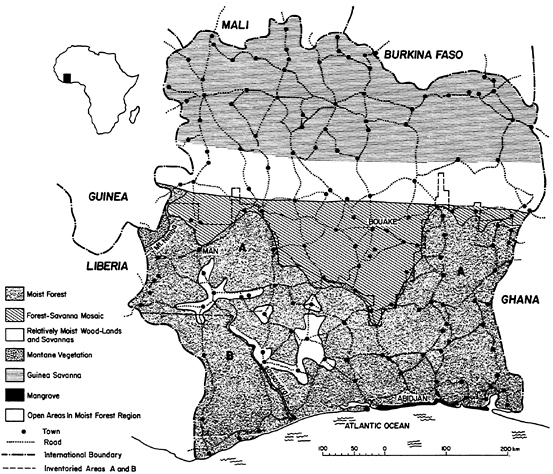
FIGURE 1 Côte d'Ivoire and its forests. Source: Adapted from Persson, R. 1977. Forest resources of Africa. Part II. Regional Analysis Research Notes No. 22. Stockholm, Sweden: Royal College of Forestry.
moist semideciduous forests and the savannah woodlands in the north, which are deciduous and require annual rainfall of 1,000 mm. They are characterized by Isoberlinia doka, Uapaca togoensis, and Anogeissus leiocarpa. Gallery forests are also found along rivers. Other vegetation types in the country include the humid highland mountain forests, found in the mountains in the western part of the country, and mangroves, found along the Atlantic coast. There are areas of littoral savannah in the humid evergreen forest zone (Persson, 1977).
In the coastal region, the climate is tropical, with two dry and two rainy seasons each year. Dry seasons are from December to April and from August to September; rainy seasons are from May to
July and from October to November. Temperatures generally remain fairly constant throughout the year, ranging from about 22°C at night to 33°C during the day, and humidity is permanently high. Average annual rainfall is more than 1,800 mm. Toward the north, however, it gradually diminishes, and seasonal variations change to one rainy season (May to October) and one dry season (November to April). In the upper north, the climate exhibits more extreme variations than in the south, but it is less humid.
POPULATION
The average annual population growth rate in Côte d'Ivoire is one of the highest in the world (3.6 percent). In 1960, the population was about 3.8 million, and the 1975 census recorded a population of 6.67 million. By the end of 1985, the population was estimated to have risen to more than 10 million. The population was estimated to be 13.02 million as of mid-1991, more than tripling in 3 decades (Economic Intelligence Unit, 1991). Projections indicate that the population will reach 18 million by the end of the century and 39.3 million by 2025 (International Bank for Reconstruction and Development, 1989), which is equivalent to an average annual increase of 3.6 percent.
The high population growth rate is partly attributable to immigration from poorer neighboring countries (mainly Mali and Burkina Faso). Immigrants make up more than 20 percent of the total population of Côte d'Ivoire. Other contributing factors are the high fertility rate (7.4 births per woman) and improvements in the health of Ivoirians. Life expectancy at birth rose from 44 years in 1965 to 52 years in 1987. Although the crude birth rate changed little over this period (52 per 1,000 population in 1986), the crude death rate fell from 22 to 15 per 1,000 population (Economic Intelligence Unit, 1991; International Bank for Reconstruction and Development, 1989). An increasing proportion of the population lives in urban areas. For example, in 1960 the urban population as a proportion of the total population was estimated to be 19.3 percent; it had increased to 32.2 percent by 1975, and by 1990, it was estimated to be about 46.6 percent. Between 1960 and 1990, the urban population grew at an annual average rate of 7.2 percent, whereas the rural population grew at only 2.7 percent (World Resources Institute, 1990).
Despite the rapid population growth, Côte d'Ivoire still appears to have a relatively low population density (39 inhabitants per km2 in 1990). However, when taking into account only the usable land (that is, total land area less nonarable land, including inland water bodies, wasteland, built-up areas, parks and reserves, and 50 percent of the
TABLE 1 Agricultural Population Densities in Forest and Savannah Zones in Côte d'Ivoire, 1965–1989a
|
Forest Zone |
Savannah Zone |
Nationwide |
||||
|
Year |
Population (1,000s) |
Density (no./km2) |
Population (1,000s) |
Density (no./km2) |
Population (1,000s) |
Density (no./km2) |
|
1965 |
2,030 |
14.9 |
1,378.0 |
12.0 |
3,408 |
13.8 |
|
1975 |
3,003 |
22.0 |
1,443.0 |
12.6 |
4,446 |
17.7 |
|
1985 |
3,932 |
28.9 |
1,518.0 |
13.2 |
5,450 |
21.7 |
|
1989 |
5,303b |
38.9b |
1,551.0b |
13.5b |
6,854 |
27.3 |
|
a The total usable land area in the country is 251,120 km2, including 136,249 km2 for the forest zone and 114,871 km2 for the savannah zone. b Values are estimates. SOURCES: Modified from Durufles, G., P. Bourgerol, B. Lesluyes, J.C. Martin, and M. Pascay. 1986. Desequilibres Structurels et Programmesd'Ajustement en Côte d'Ivoire. Paris, France: Mission d'Evaluation, Ministère de la Cooperation. Data for the agricultural population in 1989are from Food and Agriculture Organization. 1989. 1989 ProductionYearbook. Rome, Italy: Food and Agriculture Organization of the UnitedNations. |
||||||
reserved forestlands), the population density increases to 50 inhabitants per km2.
A good indicator of the rate at which forestlands are being used is the agricultural population density, which is defined as the ratio of agricultural population divided by the total area of usable land. Table 1 presents the agricultural population densities over a 24-year period (1965–1989) for the forest and savannah zones. The data indicate that agricultural population densities have increased over time nationwide and that they are higher in the forest zone than they are in the savannah zone (Figure 2). By 1989, the forest and savannah zones had densities of 38.9 and 13.5 inhabitants per km2, respectively.
FOREST RESOURCES
The status of forest resources in Côte d'Ivoire is difficult to describe because data on the extent and condition of tropical forest areas are widely scattered and frequently inaccurate (U.S. Office of Technology Assessment, 1984). Accuracy is further impaired by the lack of standard definitions and classifications of forest types. Table 2 presents the status of tropical forests in Côte d'Ivoire in the 1980s and their evolution since 1900. The Food and Agriculture Organization and United Nations Environment Program (1981) indicate that
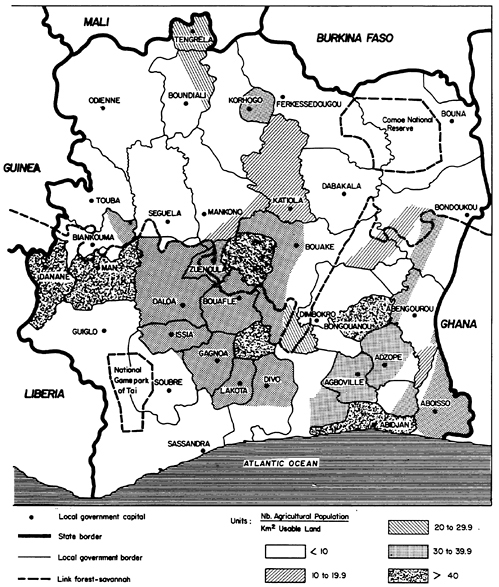
FIGURE 2 Agricultural population density in Côte d'Ivoire in 1985. The numbers next to the symbols are in agricultural population per square kilometer of usable land. Source: Adapted from Durufles, G., P. Bourgerol, B. Lesluyes, J. C. Martin, and M. Pascay. 1986. Desequilibres Structurels et Programmes d'Ajustement en Côte d'Ivoire. Paris, France: Mission d'Evaluation, Ministère de la Cooperation.
TABLE 2 Evolution of Tropical Forest Endowments in Côte d'Ivoire and Rates of Deforestation from 1900 to 1990
|
Year or Period |
Forest Cover, Dense Humid Tropical Forest (millions of ha) |
Average Annual Area Deforested (ha/year) |
Average Annual Rate of Deforestation (as percentage of forested area) |
|
1900 |
14.50 |
— |
— |
|
1955 |
11.80 |
— |
— |
|
1965 |
8.98 |
— |
— |
|
1973 |
6.20 |
— |
— |
|
1980 |
3.99 |
— |
— |
|
1985 |
2.55 |
— |
— |
|
1990 |
1.55a |
— |
— |
|
1956–1965 |
— |
280,000 |
2.37 |
|
1966–1973 |
— |
350,000 |
3.90 |
|
1974–1980 |
— |
315,000 |
5.80 |
|
1981–1985 |
— |
290,000 |
7.26 |
|
1986–1990 |
— |
200,000a |
7.84a |
|
NOTE: Information that is not available is denoted by a dash. a Estimated. SOURCE: Modified from Food and Agriculture Organization and UnitedNations Environment Program. 1981. Pp. 124–125 in Tropical ForestResources Assessment Project (in the Framework of GEMS). Forest Resourcesof Tropical Africa. Part II. Country Briefs. Rome, Italy: Food andAgriculture Organization of the United Nations. |
|||
total forest cover at the beginning of the colonial period (1900) was on the order of 15 million ha. In 1990, forest cover was estimated to be 1.55 million ha.
To appreciate the rapid rate of forest clearing in Côte d'Ivoire, it is useful to compare the country's rate of deforestation with that of Indonesia, the world's leading producer of tropical logs from 1973 to 1983. Table 3 shows that the annual level of deforestation has been about half that of Indonesia, a poorer country with 6 times the area of Côte d'Ivoire and a population that is 16 times greater than that of C ôte d'Ivoire. However, the estimated annual rate of deforestation in Côte d'Ivoire (7.26 percent) after 1980 was more than 12 times that of Indonesia (0.5 percent).
Given the current trend in deforestation rates, it is estimated that in 10 to 20 years, natural forests will not satisfy the local demand for logs in Côte d'Ivoire. Furthermore, it is estimated that Côte d'Ivoire, which until 1983 was the most prolific exporter of logs in Africa, will become a net importer by the end of the century (Bertrand, 1983).
TABLE 3 Deforestation in Indonesia Versus that in Côte d'Ivoire
|
Parameter |
Indonesia |
Côte d'Ivoire |
|
Population in 1985 (millions) |
162.000 |
10.1 |
|
Area (ha) deforested annually (1981–1985) |
600,000 |
290,000 |
|
Annual deforestation rate (deforestation annually as percentage of forested area) |
0.5 |
7.26 |
|
Per capita income in 1985 (US$) |
530 |
660 |
|
Area (thousand km2) |
1,919 |
322 |
|
SOURCE: Adapted from Gillis, M. 1988. West Africa: Resource managementpolicies and the tropical forest. Pp. 299–351 in Public Policiesand the Misuse of Forest Resources, R. Repetto and M. Gillis, eds.New York: Cambridge University Press. |
||
This is not surprising since, solely on the basis of the commercial benefits of tropical forests, Ehui and Hertel (1989) showed that the optimal steady-state forest stock in Côte d'Ivoire exceeds what is considered to be needed to meet current levels for social discount rates less than 8 percent. (A social discount rate, measured in percent, expresses the preference of a society as a whole for present rather than future returns.) Only when the social discount rate reaches the relatively high value of 9 percent does some further deforestation appear to be socially optimal. The optimal steady-state forest stock decreases in direct proportion to higher social discount rates because future forest stocks are valued less than present well-being, thus there is the motivation to clear the forest faster. The critical value of forests increases when one takes into account the noncommercial benefits of tropical forests, for example, the preservation of genetic diversity and climatic benefits. Thus, it is likely, even on strictly commercial grounds, that Côte d'Ivoire has already excessively depleted its forest resources.
Today, the main forestry policy question facing the government of Côte d'Ivoire is how to manage effectively what is left of the original 15 million ha of tropical rain forest, which has been reduced to less than 2 million ha (Ehui and Hertel, 1989; Spears, 1986). Current government policy objectives, as defined in the 1976–1980 and 1981 –1985 5-year plans, include preservation and protection of the forest stock (Borreau, 1984). A first step toward those objectives was the creation in 1978 of a permanent forestry domain of 4.7 million ha and a rural forestry domain of 731,750 ha that is reserved for agriculture. However, because of continual encroachment of uncontrolled shifting cultivation onto forestlands, it has become difficult, if not impossible, to achieve the forest protection objective (Bourreau, 1984). As a
result, the officially preserved forest area has continuously been reduced to keep pace with the remaining forest stock.
DOMESTIC ECONOMY
Côte d'Ivoire is essentially an agricultural country, relying on its two principal cash crops—cacao and coffee—for almost 50 percent of its export revenues (Economic Intelligence Unit, 1991). In the first 2 decades following independence (in 1960), Côte d'Ivoire's gross domestic product (GDP) grew by 7.5 percent annually, which ranked among the highest in Africa and among the top 15 in the world (Michel and Noël, 1984). In 1965, C ôte d'Ivoire had a per capita GDP of about US$169. By 1980, it had risen to about US$1,150, ranking second among developing countries in sub-Saharan Africa. Apart from a brief respite in 1985–1986 because of excellent harvests and improved agricultural exports, a severe slowdown has occurred since 1980, and in 1987 the per capita GDP was estimated to be only US$690, a decline of 40 percent from its 1980 level. From a peak level of US$1,170 in 1980, the per capita gross national product (GNP) declined to US$740 in 1987. During the period from 1980 to 1987, Côte d'Ivoire experienced net negative growth of −3.0 percent/year (Table 4).
There are several reasons for the slowdown in Côte d'Ivoire's
TABLE 4 Average Annual Change in Growth and Structure of Production in Côte d'Ivoire, 1965–1987
economy: (1) a dramatic adverse shift in the country's terms of trade in the early 1980s mainly because of the continuing slump in commodity prices and (except in 1985–1986) the depreciation of the dollar against the CFA (Communauté Financière Africaine) franc (in 1991, US$1 = CFA franc 275); (2) a serious drought during 1982–1984 that affected both agricultural production and hydroelectricity generation, thereby reducing power supplies to industry; and (3) the high cost of servicing the debt incurred to finance ambitious investment projects launched during the boom years of the late 1970s.
The total external public debt at the end of 1989 totaled US$15.4 billion, representing about 182 percent of the country's total GNP. In 1970 total public debt was only US$255 million, 19 percent of GNP. By 1980 it had risen to US$4.3 billion, equivalent to 44 percent of the country's GNP. Interest payment on the public debt in 1989 was estimated at US$517 million. The total debt service ratio (measured as a proportion of exports of goods and services) during the same period (1989) was estimated to be about 41 percent. In 1980 it was estimated to be 24 percent of the exports of goods and services. It was swollen in 1980 by the increase in the value of the U.S. dollar, in which more than 40 percent of the country's debt is denominated. In 1970 the debt service ratio was only 7.1 percent (Economic Intelligence Unit, 1991; International Bank for Reconstruction and Development, 1989).
AGRICULTURE
The overall performance of Côte d'Ivoire's economy springs from its agriculture. With a consistent annual growth rate of 5 percent, Côte d'Ivoire achieved the highest agricultural growth rate in subSaharan Africa during the first 2 decades after its independence in 1960 (Lee, 1983). Despite an apparent decline of its share in the GDP (Table 4), agriculture still remains the pillar of the country's economy. It contributes about 33 percent of the GDP, provides between 50 and 75 percent of the nation's total export earnings, and employs an estimated 79 percent of the labor force, of which 13 percent are immigrants (Economic Intelligence Unit, 1991). Table 5 presents details of the structure of merchandise import and export trade in Côte d'Ivoire during 1965, 1980, and 1987.
Export Crops
Export of agricultural products was the primary source for agricultural growth. Agricultural products account for more than 75 per-
TABLE 5 Structure of Merchandise Imports and Exports in Côte d'Ivoire, 1965, 1980, and 1987 (Percent Share)
|
1965 |
1980 |
1987 |
||||
|
Merchandise |
Imports |
Exports |
Imports |
Exports |
Imports |
Exports |
|
Food |
18 |
— |
17 |
— |
19 |
— |
|
Fuel |
6 |
2 |
17 |
6 |
15 |
4 |
|
Other primary commodities |
3 |
93 |
3 |
84 |
4 |
86 |
|
Machinery and transport equipment |
28 |
1 |
28 |
2 |
28 |
2 |
|
Other manufactures |
46 |
4 |
35 |
7 |
35 |
7 |
|
SOURCE: Compiled from International Bank for Reconstruction and Development.1989. Sub-Saharan Africa: From Crisis to Sustainable Growth, a Long-TermPerspective Study. Washington, D.C.: World Bank. |
||||||
cent of export earnings. The major agricultural exports are coffee, of which Côte d'Ivoire is the world's fifth largest producer; cacao, of which it became the world's largest producer in 1977–1978, surpassing Brazil and Ghana; and cotton. Together, these three commodities account for more than 60 percent of the area under cultivation, 50 percent of export earnings, and 75 percent of total cash earnings from agricultural activities. Cacao production has expanded rapidly, rising from 140,000 metric tons in 1965 to 388,000 and 543,000 metric tons in 1980 and 1987, respectively. The average annual rate of growth is estimated to be about 6 percent (Table 6).
Coffee production followed a different pattern. As a result of the producer price parity (by which farmers receive the same price for a product regardless of whether it is good or substandard) for cacao and coffee, which has been in place since the mid-1970s, production of coffee has been falling steadily. Coffee is more difficult to produce than cacao, and it is also taxed more heavily. Output fell from 210,000 metric tons in 1980 to an estimated 163,000 metric tons in 1987. Production of cotton rose from 2,000 metric tons in 1965 to 39,000 metric tons in 1980 and 68,000 metric tons in 1987. As a result, Côte d'Ivoire is now Africa's third largest cotton producer, after Egypt and Sudan (Economic Intelligence Unit, 1991).
Another important export commodity is timber, which accounted for almost 7 percent of export earnings in 1988, but forest resources have been greatly depleted and timber exports have been falling. The forestry industry was traditionally the country's third main export earner. The total area of timber harvested for export was esti-
TABLE 6 Volume, Percentage of Total Merchandise Export Value, and Growth in Volume of Major Agricultural Exports in Côte d'Ivoire, 1965–1987
|
Parameter and Year or Period |
Cacao |
Coffee |
Cotton |
|
Volume (1,000s of metric tons) |
|||
|
1965 |
140 |
186 |
2 |
|
1980 |
388 |
210 |
39 |
|
1987 |
543 |
163 |
68 |
|
Percentage of total merchandise export value |
|||
|
1965 |
17.6 |
36.6 |
0.2 |
|
1980 |
29.9 |
22.0 |
2.2 |
|
1987 |
36.6 |
13.7 |
2.5 |
|
Volume growth (percent) |
|||
|
1965–1973 |
4.6 |
1.7 |
26.3 |
|
1973–1980 |
6.1 |
−1.1 |
14.1 |
|
1980–1987 |
6.2 |
−2.9 |
10.7 |
|
SOURCE: Compiled from International Bank for Reconstruction and Development.1989. Sub-Saharan Africa: From Crisis to Sustainable Growth, a Long-TermPerspective Study. Washington, D.C.: World Bank. |
|||
mated to have fallen from 15.6 million ha at the beginning of the century to only 1 million ha in 1987.
Food Crops
The principal food crops in Côte d'Ivoire are cassava, yams, cocoyam (taro), maize, rice millet, sorghum, and plantains. The country is self-sufficient in manioc (cassava), yams, bananas (plantains), and maize. Table 7 presents estimates of the compositions of Ivoirian diets. Yams are the most consumed commodity, followed by bananas (plantain) and manioc (cassava). The principal grain that is produced and consumed is rice; it has become a staple for much of the urban population and is also popular in rural areas because of its ease of preparation and storage. Although rice production has risen steadily, it has not increased rapidly enough to keep pace with per capita consumption. The result is that Côte d'Ivoire meets more than half of its current rice needs through imports (Figure 3) (Trueblood and Horenstein, 1986). Overall, Côte d'Ivoire's agricultural sector has performed well relative to those sectors throughout the rest of sub-Saharan Africa. Figure 4 and Figure 5 present per capita food and agricultural production, respectively, in Côte d'Ivoire and sub-Saharan
TABLE 7 Composition of Ivoirian Diets, 1980
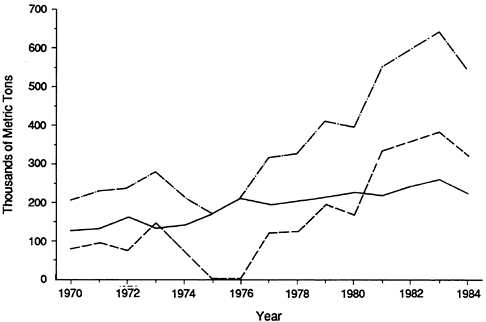
FIGURE 3 Milled rice production (——), imports (– – – –), and consumption (– · – · –) in Côte d'Ivoire. Source: Adapted from Trueblood, M. A., and N. R. Horenstein. 1986. The Ivory Coast: An Export Market Profile. Foreign Agricultural Economic Report No. 223. Washington, D.C.: Economic Research Service, U.S. Department of Agriculture.
Africa. Although sub-Saharan Africa has received much publicity for its recent famines (for example, the famine caused by drought in Ethopia from 1984 to 1986) and declining per capita food production, per capita food production in Côte d'Ivoire has actually increased considerably over time; agricultural production (which includes non-food crops) has generally increased as well, albeit with more fluctuation (Trueblood and Horenstein, 1986).
Sources of Agricultural Growth
The factors responsible for Côte d'lvoire's general economic performance can be credited to a carefully implemented agricultural policy. Since independence in 1960, agriculture in C ôte d'Ivoire has been promoted by planning, research, and investment aided by significant inflows of foreign labor and capital and (on average) by relatively high world prices for Ivoirian exports such as coffee and cacao. The government has lent strong support to the agricultural sector and, in
particular, to the numerous smallholders through its programs of guaranteed producer price, input subsidies, and agricultural extension services (Trueblood and Horenstein, 1986).
Most cacao and coffee production is in the hands of smallholders who employ foreign labor. They sell their crops to the state marketing agency at prices that are fixed by the government. By means of a stabilization fund, the government has been able to sustain the development of agricultural exports by providing producers with minimum guaranteed prices, despite the sharp fluctuations in world market prices. At times, however, these producer prices were far below world market prices (most notably during the boom years of 1975 to 1977), thus enabling the government to exact surpluses from the producers and use the proceeds to invest in other sectors of the economy, as well as subsidize inputs to farmers. The stabilization fund has been able to make transfers to public enterprise budgets and to pay
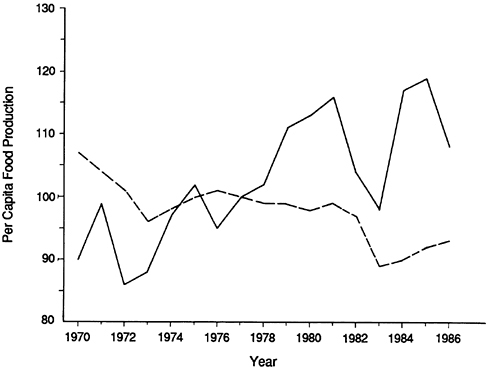
FIGURE 4 Per capita food production in Côte d'Ivoire (——) and subSaharan Africa (– – –), 1970–1986. Source: U.S. Department of Agriculture, Economic Research Service. 1988. World Indices of Agricultural and Food Production 1977–86. Statistical Bulletin No. 759. Washington, D.C.: U.S. Government Printing Office.
for food production development projects, as in the case of rice in northern Côte d'Ivoire (Gbetibouo and Delgado, 1984).
Although government revenues have been generated mainly through predatory price policies that exact surpluses from farm exports (coffee and cacao in particular), farmers in Côte d'Ivoire have received prices that, on average, have assured them incomes higher than those of farmers in the sub-Saharan region (den Tuinder, 1978; Gbetibouo and Delgado, 1984). World prices were depressed during most of the 1980s, and the government was unable either to exact surpluses from the export crop sector or to maintain the real purchasing power of the planters (Economic Intelligence Unit, 1991). The surpluses generated by the stabilization fund during the boom years were not enough to support producer prices, which were halved in 1989.
Another factor that has contributed to agricultural growth is the expansion in the agricultural land frontier (which arises solely from deforestation). Table 8 presents estimates of agricultural land utilization for cash and food crops and their growth rates between 1960 and 1984.
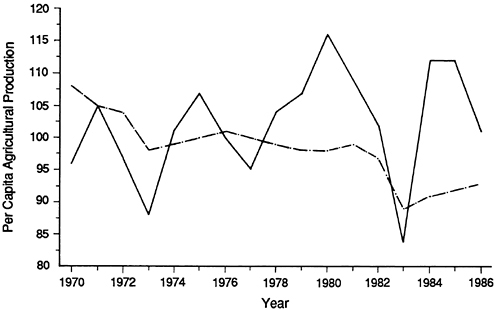
FIGURE 5 Per capita agricultural production in Côte d'Ivoire (——) and sub-Saharan Africa (– · – · –), 1970–1986. Source: U.S. Department of Agriculture, Economic Research Service. 1988. World Indices of Agricultural and Food Production 1977–86. Statistical Bulletin No. 759. Washington, D.C.: U.S. Government Printing Office.
TABLE 8 Agricultural Land Utilization for Cash and Food Crops in Côte d'Ivoire, 1960–1984 (in Thousands of Hectares)
|
Agricultural Land Utilization |
1960 |
1970 |
1980 |
1984 |
Annual Growth Rate (percent), 1960–1984 |
|
Cash cropsa |
1,022 (56) |
1,592 (56) |
2,827 (67) |
3,025 (64) |
5.3 |
|
Food cropsb |
817 (44) |
1,112 (44) |
1,419 (33) |
1,698 (36) |
3 |
|
Total cropped area |
1,839 (100) |
2,714 (100) |
4,246 (100) |
4,723 (100) |
4.3 |
|
NOTE: Numbers in parentheses are the percent shares of the total cropped area. a Cash crops include coffee, cacao, oil palm, coconut, rubber, and cotton. b Food crops include rice, maize, millet, sorghum, yams, cassava, and groundnuts. SOURCE: Compiled from International Bank for Reconstruction and Development.1985. Côte d'Ivoire Agricultural Sector Statistical Annex 7. Washington,D.C.: World Bank. |
|||||
CAUSES OF DEFORESTATION
The causes of deforestation in Côte d'Ivoire are varied but can be categorized as principal (direct) and underlying (indirect).
Principal Causes
The conversion and use of forestlands for agriculture and logging activities are the principal causes of deforestation in Côte d'Ivoire. Use of forest for fuelwood and clearing forests for cattle grazing are also causative factors, but to a lesser extent.
AGRICULTURE
Increased agricultural production has been a result of expansion of the land area devoted to agricultural uses. With huge untapped reserves of arable land, economic growth was fueled by the rapid extension of the land frontier (Lee, 1983). The expansion, however, has often been onto marginal soils and sloping uplands that cannot support permanent cropping as do the temperate areas, where agricultural production has increased in recent decades mainly through the more intensive use of already cleared land (Ehui and Hertel, 1992a). Table 9 summarizes changes in cropland area in the forest regions of Côte d'Ivoire in 1965 and 1985. During this 20-year period, untouched primary forests were reduced by about 66 percent, whereas the area under cultivation more than doubled (Spears, 1986).
TABLE 9 Vegetative Cover in the Forest Regions of Côte d'Ivoire, 1965 and 1985 (in Millions of Hectares)
|
Vegetative Cover |
1965 |
1985 |
|
Untouched primary forest |
9.0 |
3.0 |
|
Tree crop |
1.1 |
2.8 |
|
Food crop |
0.5 |
0.9 |
|
Forest fallow (secondary forest and bush) |
3.1 |
7.0 |
|
Total |
13.7 |
13.7 |
|
SOURCE: Adapted from Spears, J. 1986. Key forest policy issues forthe coming decade. Côte d'Ivoire forestry subsector discussion paper.World Bank, Washington, D.C. May. Photocopy. |
||
LOGGING
It is unclear the extent to which selective logging has contributed to deforestation; however, it is known that the use of heavy equipment for the extraction of timber causes substantial secondary tree losses. Deforestation and land degradation occur with the removal of best-tree species, and harvested trees fall against and destroy other trees. Figure 6 depicts the level of timber production and exports from 1965 to 1983.
The building of roads and passages to reach logging sites is another direct cause of deforestation. Not only are forests destroyed to make room for the roads, the roads and passages then provide access to previously undisturbed areas. For example, a road program funded by the African Development Bank has led to the construction of a major highway along the Atlantic coast (Economic Intelligence Unit, 1991). This road provided access to formerly undisturbed coastal forests and mangroves, and since 1988 an inrush of immigrants has lead to massive destruction of the coastal forests.
FUELWOOD
Fuelwood, which constitutes the most important source of energy in Côte d'Ivoire, accounts for nearly 53 percent of all wood extracted in the country. However, deforestation caused by fuelwood extraction from the humid forest zone is limited compared with that from the savannah zone, where vegetation is characterized by open woodlands.
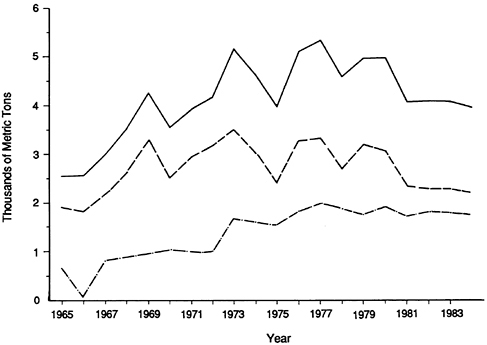
FIGURE 6 Total production (——), exports (– – – –), and domestic use of timber (– · – · –) in Côte d'Ivoire, 1965–1984. Source: Adapted from Bourreau, C. 1984. Plan Quinquennal (1986 –1990). Bilan Diagnostic Première Partie: Les Foréts et la Production Forestrière. Abidjan, Côte d'Ivoire: Direction des Eaux et Foréts, Ministère de l'Agriculture.
CATTLE GRAZING
Grazing is rare in the forest zone of Côte d'Ivoire, as it is in most of the humid tropical areas of Africa. This is primarily because of the occurrence of tsetse flies, which carry trypanosomiasis (sleeping sickness), and because of the topographic limitations of the forest cover, that is, the high tree density and a highly developed root network that prevents the use of animals. Unlike the Amazon region, where one of the main causes of deforestation has been conversion of forests to pastures by livestock ranchers, livestock plays a limited role in deforestation in Côte d'Ivoire.
Underlying Causes of Deforestation
Some of the underlying causes of deforestation are the result of the combined effects of the spread of shifting cultivation, which, in turn, is caused by population pressures, unclearly defined land ten-
ure regimes (property arrangements), and government agricultural and forestry policies.
SHIFTING CULTIVATION
The major impetus for the increases in agricultural lands in Côte d'Ivoire is shifting (slash-and-burn) cultivation. It is an extensive system of food crop production in which natural forests, secondary forests, or open woodlands are felled and burned. Theoretically, the cleared area is cultivated for a few years (usually 1 to 3 years), after which the land is abandoned and allowed to return to forest or bush fallow. The process is repeated after a period of time that ranges between 4 and 20 years. It is necessary to practice shifting cultivation in the tropics because of the low nutrient content of many tropical soils. Most of the nutrients are in living plants, and the nutrients are made available when an area is cleared and burned; the resultant nutrient-rich ash fertilizes the soil (Persson, 1975). The system, however, operates effectively only when there is sufficient land to allow a long fallow period so that soil productivity, which is exhausted during the short cropping cycle, can be restored.
Today, because of increasing populations, fallow periods are being reduced and smallholders are compelled to clear more forests or to exploit the more fragile, marginal lands that cannot support an increasingly large population. Considerable deforestation occurs because of the movement of shifting cultivators into areas opened up by logging. It is estimated that for each 5 m3 of logs harvested in Côte d'Ivoire, 1 ha of forest is converted into cropland by subsequent cultivators (Myers, 1980).
LAND TENURE REGIMES
Excessive clearing of forestlands also occurs because of the openaccess nature of forest resources in Côte d'Ivoire. The open-access nature of management can best be expressed by popular sayings of Ivoirians: “[L]and belongs to whoever cultivates it” or to “. . . whoever uses it and values it” (Bertrand, 1983). What is happening is, in effect, the result of government policies that attempt to supplant local tenure regimes. By ignoring the distinction between common property and open access, the government has failed to offer legal mechanisms for protecting communal land rights. Instead, attempts are often made to convert common properties into government lands and private properties, even though the public sector's capacity to manage the forest resources and the legal infrastructure needed to enforce private tenure are poorly developed. As a result, people
gather what they need from the forest and freely exploit forest resources, in spite of the fact that current legislation forbids unauthorized clearing of state-owned forests (Southgate et al., 1990).
Close examination of the Ivoirian land tenure regime structure indicates that there is a juxtaposition of informal, customary laws and formal government legislation. Customary laws regulate the traditional land use patterns, which are based on group or communal ownership. The government legislation (which was initially inherited from the colonial power, France, and has slowly been reformed) distinguishes among three forms of land tenure.
State Ownership The first and most important is forestland under state ownership. Commonly called reserved forests, these are vast areas of forestlands surveyed to be protected from illegal encroachment. The people who settle in reserved forests clear them and illegally take valuable forest products, apparently because the laws are not well enforced or because the forests are not well policed. As a result, 100,000 people per year have spontaneously migrated into and settled in the forest zone for the past 20 years. In reality, enforcement of laws is particularly difficult, if not impossible, because peasants obey customary laws, which sometimes run counter to the spirit and provision of state forestland ownership laws. In a society like Côte d'Ivoire's, in which the institutions that govern the use of resources overlap, enforcement must deal with several institutional structures. The weakening of traditional property arrangements without the provision of a viable institutional alternative diminishes the incentives for forest dwellers to conserve natural resources (Bromley and Cernea, 1989).
Collective Ownership The second form of forestland tenure is communal, or collective, ownership. Under this category, local communities (villages) are recognized as the owners of the forestlands, but the government and others may manage them. Group ownership constitutes the most common form of land ownership in Côte d'Ivoire. Land is viewed as belonging to a common ancestor, and any member of the extended family can use it when it becomes vacant, but it cannot strictly be sold or transferred to someone outside the family. Although individual cultivators have control over the crops they produce, the group (or the extended family) has the power to decide on the use of a particular area of land.
The problem is that the communal landholdings are poorly delineated. They cannot be distinguished unambiguously, nor can communal landholdings be distinguished from state holdings. Because of this lack of clearly defined property rights, the economies of the people who live in the forests of Côte d'Ivoire are largely geared to the extensive use of land. Peasants sometimes view the forests as an
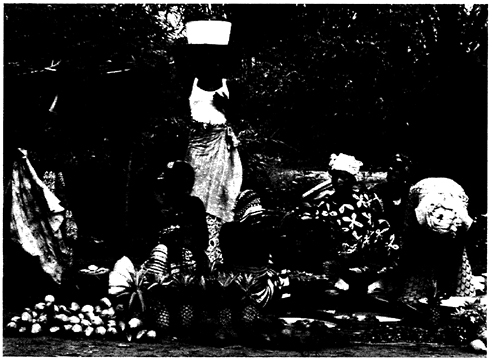
Women sell pineapples, maize, coconuts, yams, and other local produce at a market in Côte d'Ivoire. Credit: James P. Blair © 1983 National Geographic Society.
obstacle to the development of their plantations and fields. As a result, open-access types of exploitative behavior arise. Under the open-access system, no individual or group of individuals wants to incur the costs required to protect and maintain forest resources. On the contrary, individual forest users have every incentive to clear forestlands as soon as possible because they have no guarantee that whatever they leave untouched will be available in the near future.
Private Individual Ownership The third and last form of land tenure is private individual ownership. This form of ownership is the least developed, however, because few individuals own forestland outright (Bertrand, 1983; Food and Agriculture Organization and United Nations Environment Program, 1981).
GOVERNMENT POLICIES
The final underlying cause of deforestation in Côte d'Ivoire discussed here is government agricultural and forestry policies. One
example is the marketing policy for the major export crops in Côte d'Ivoire (notably, coffee, cacao, cotton, and palm oil). The prices of these commodities are regulated by a marketing board, the Caisse de Stabilization et de Soutien des Prix des Produits Agricoles (CSSPA; Agricultural Product Price Support and Stabilization Fund). The board guarantees a fixed price to planters throughout the crop year and, at times, for several consecutive seasons. Prices are set on a cost-plus basis and are lower than international prices, thus enabling the government to generate surpluses. As long as producer prices are low, farmers will not be able to afford to use intensive means of production. It is therefore more profitable to cultivate extensively at the expense of forests. It appears, however, that cash crop farmers have found it more profitable to cultivate extensively than to intensify their cultivation practices. Also, despite the creation of the Agricultural Development Bank in 1968, farmers still face severe capital constraints. Many smallholders are unable to gather sufficient funds for investment because the cost of credit is very high. Also, the titling problems exacerbated by unclearly defined property rights place small-scale farmers at a distinct disadvantage in negotiating with banks and government entities for credit.
Some forestry-based policy instruments have also contributed to the rapid rate of deforestation in Côte d'Ivoire. The fiscal policy in the forestry sector distinguishes among four types of royalties and license fees (Gillis, 1988): (1) a timber royalty, (2) a concession license, (3) a public work fee, and (4) an annual area charge.
Timber royalty rates (imposed on harvested volumes rather than on a per tree basis) were set in 1966 and have remained unchanged. Despite some differentiation in the royalty schedule according to tree species, timber royalties are judged to be too low relative to free on-board (FOB) log export values to have serious implications for lower rates of deforestation. The cost of the concession license is only US$0.25/ ha, and public work fees amount to US$0.79 and US$0.40/ha on the richer and poorer stands, respectively. Both are one-time levies. The annual area charge is levied at the rate of US$0.05/ha/year. These charges are estimated to be too low to have notable effects on forest-clearing decisions. The very low fees that are charged for the right to clear forests encourage the exploitation of marginal stands by providing a large profit margin while offering little incentive for more intensive exploitation of more valuable stands because expanding the area of harvest is less costly than intensifying cultivation. If these fees had been increased substantially by 1970, the nation might have experienced a somewhat lower rate of deforestation than actually occurred in the 1970s and 1980s (Gillis, 1988).
EFFECTS OF DEFORESTATION
The conversion of forestlands to other uses produces a broad range of effects, including (1) changes in climate and microclimate, (2) erosion of biodiversity, (3) long-term decline of agricultural productivity and income, and (4) forest damage associated with the loss of timber production potential. Together, these effects constitute a serious threat to agricultural sustainability in Côte d'Ivoire.
Climate and Microclimate
Scientists are concerned that tropical deforestation might affect climate on a global scale by increasing the levels of carbon dioxide (CO2) in the atmosphere (Sedjo, 1983). This is because a significant portion of the world's carbon is locked in the wood of the tropical forests. Some of the carbon that is stored in forest soils is also released as the land is converted from forestland to cropland. Climatologists are engaged in a continuing debate, however, regarding the global effects of deforestation in this regard. One analysis suggests that the amount of CO2 released by the clearing and burning of wood from dense tropical forests may be roughly equivalent to the amount of CO2 released by fossil fuel combustion (Woodwell, 1978). Concerns about the concentrations of CO2 in the atmosphere arise from the hypothesis that rising atmospheric CO2 concentrations will cause a greenhouse effect, with disruptions of the world's agricultural productivity in the twenty-first century (U.S. Department of State, 1980).
There is little science-based information on the effect of deforestation on the microclimate in Côte d'Ivoire. Spears (1986) measured the bioclimatic impact of different vegetative covers and showed that different vegetative covers result in distinctly different transpiration and energy exchange characteristics. In the past 2 decades, rainfall levels have generally decreased and the soils of forest regions have become progressively drier, particularly in the south-central part of Côte d'Ivoire. However, it is necessary to interpret carefully the climatic and ecologic data obtained over long time periods. The lower rainfall of the past 2 decades could represent downswings in rainfall that are part of the 30-year rainfall cycles of the region. Such trends are apparent from the rainfall records of Côte d'Ivoire and other countries in the region.
Ghuman and Lal (1988) reported experimental results of a study done in a region of Nigeria in which the climate is similar to that in Côte d'Ivoire. The study quantified the magnitude and trends in alterations of the soil, hydrology, microclimate, and biotic environ-
ments resulting from the conversion of a tropical rain forest to different land use systems and agricultural practices. The rainfall results showed that the amount of rainfall under the forest canopy was about 12 percent less than that in cleared areas. The amount of solar radiation received in the cleared area was 25 times greater than that received under forests. On average, soil and air temperatures and evaporation rates were lower in areas under forest cover than they were in cleared areas. Relative humidities (which inversely correspond to variations in air temperature) were higher in forest areas than in cleared ones.
Biodiversity
There are no empirical data on the extent of erosion of biodiversity because of deforestation in Côte d'Ivoire. However, forests are known to contain a wide variety of plant and animal species, many of which have not been examined by scientists. For example, they contain the gene pools of parent species from which many agricultural crops were originally bred and, therefore, may be needed for future breeding efforts if crops are devastated by new diseases or other catastrophes. Some of these species may be critically important for pest and disease resistance in agricultural crops. For example, because of a smaller gene pool, it will be harder to counteract a weakness such as reduced disease resistance in varieties of plants and animals used for economic production. Other species have important potential as pharmaceutical agents, some of which are known only to people indigenous to the forests. The erosion of the genetic base as a result of deforestation will make it increasingly difficult to maintain economic production from biologic resources.
Agricultural Productivity
After forests are cleared from the land, the soil's physical and chemical properties undergo significant changes, leading to nutrient losses, accelerated rates of soil erosion, and declining yields (Lal, 1981; Seubert et al., 1977). Forests protect the soil by regulating stream flows (thereby minimizing soil erosion), modulating seasonal flooding, and preventing the silting of dams and canals. Forests help to accelerate the formation of topsoil, create favorable soil structures, and store nutrients. Using data from Côte d'Ivoire, Ehui and Hertel (1989, 1992a) showed that part of the agricultural growth in Côte d'Ivoire has been accomplished at the expense of the natural resource base and is therefore unsustainable. In particular, they showed that
deforestation contributes positively to crop yields, but that increases in the cumulative amount of deforested lands cause yields to fall. This study thus confirms soil scientists's hypotheses that crop yields increase immediately after deforestation because of the nutrient content of the ash that is present after burning. However, yields decline over time because of the loss of the soil productivity as a result of movement of cropping activity onto marginal lands, removal of organic matter, and erosion. This affects the overall productivity and sustainability of the agricultural sector. Ehui and Hertel (1989, 1992a) also showed that aggregate yields are somewhat insensitive to deforestation in the same year, but are sensitive to the cumulative amount of deforestation over several years. A 10 percent increase in cumulative deforested land results in a 26.9 percent decline in aggregate yields.
In a follow-up study, Ehui and Hertel (1992b) conducted simulation studies that measured the value of conserving marginal forest-lands in Côte d'Ivoire by taking into account the short- and long-term impacts of deforestation on agricultural productivity. Examination of the impacts of deforestation and cumulative deforested lands on food crop revenues indicated that forest conservation results in net benefit to agriculture. For example, with a one-time 20 percent decrease in the rate of deforestation, the net value of food crop revenues rose by US$21.3 million. This translated into approximately US$507/ha of forest saved. Ehui and Hertel (1992b) concluded that at current rates of deforestation, Côte d'Ivoire has been forgoing long-term agricultural revenues in pursuit of short-term gains.
Forest Damage and Timber Production Potential
The lack of proper forest management, which leads to excessive logging and agroconversion, also leads to losses in earnings from the timber industry. Using the average timber export tax rate as the opportunity costs of unmanaged forestlands and annual deforestation of 300,000 ha, Bertrand (1983) estimated that the annual cost of deforestation is between US$69 million and US$295 million. Bertrand also estimated that lost FOB earnings range between US$80 million and US$200 million. These are important losses because the forestry-based sector plays a larger role in Côte d'Ivoire's economy than it does in any other African country (Gillis, 1988). The contribution of the forestry-based sector in the decade prior to 1981 was consistently about 6 percent of GDP, the highest in Africa. The value of wood extracted from forests rose from nearly US$600 million in 1977 to US$900 million in 1980, by which time the value of log and wood
product exports reached US$562 million, or about 11 percent of total export earnings, down from the peak of 35 percent in 1973 (Gillis, 1988). In the decade prior to 1981, the Ivoirian forestry-based sector was a fairly strong source of tax revenues, providing, in all years except 1973, an annual average of 6 percent of government revenues, which was greater than the average for all other African countries except Liberia. The decline in the nation's forest export taxes and fees in relation to total government revenues has primarily been due to a reduction in total exports of higher value logs (for example, sappelli, sipo [Entandrophragma utile] and samba [Triplochiton scleroxylon], which are used to make furniture and to build houses). By 1978, lower value species constituted more than 50 percent of Ivoirian timber exports, the richer stands of sappelli and sipo trees having been largely depleted.
AGRICULTURAL INTERVENTIONS AND SUSTAINABILITY
About 60 percent of Côte d'Ivoire's population lives in the forests. Spontaneous settlement and migration into the forest zone has averaged 100,000 people a year for the past 20 years. Instead of forcing people out of the forests, the best hope for slowing deforestation is to provide the people already there with the means of intensifying agricultural productivity and to combine sound agricultural and forestry policies to slow future migration into forest zones (Spears, 1986). Interventions to increase agricultural productivity can be divided into two categories: technological interventions and policy interventions.
Technological Interventions
Shifting (slash-and-burn) cultivation is still the dominant land use system in vast areas of Côte d'Ivoire. This traditional food crop production system, which is based solely on the restorative properties of woody species, has sustained agricultural production on up-lands in many parts of the tropics for many generations. The system involves partial clearing of the forest or bush fallow. The cropping period is marked by a random spatial arrangement of crops and “regrowth” of woody perennials. Long fallow periods (10 to 20 years) are necessary to allow regeneration of soil productivity and weed suppression. However, the annual population growth rate of 4 percent increases the need for food, which, in turn, increases the need for land, causing increased deforestation and shorter fallow periods (2 or 3 years), which reduces the productive capacity of the land,
decreases crop yields, and increases the opportunity for weed and pest infestation.
In the forests of Côte d'Ivoire, as in many other parts of the humid tropics, the maintenance of soil fertility constitutes the major constraint to increased agricultural sustainability. One of the basic characteristics of soils in the humid tropical lowlands of Africa is the susceptibility of the soils to degradation and the tendency for soil productivity to decline rapidly with repeated cultivation (Carr, 1989; Lal, 1986). The greatest challenge to research and extension staff is to maintain soil fertility in a sustainable manner. Farmers need sustainable land use systems that allow them to achieve the necessary levels of production while conserving the resources on which that production depends, thereby permitting the maintenance of productivity. According to Lal (1986), sustainable land use management technologies should include the following:
-
Preservation of the delicate ecologic balance, namely, that among vegetation, climate, and soil;
-
Maintenance of a regular, adequate supply of organic matter on the soil surface;
-
Enhancement of soil fauna activity and soil turnover by natural process;
-
Maintenance of the physical condition of the soil so that it is suitable for the land use;
-
Replenishment of the nutrients removed by plants and animals;
-
Creation of a desirable nutrient balance and soil reaction;
-
Prevention of the buildup of pests and undesirable plants;
-
Adaptation of a natural nutrient recycling mechanism to avoid nutrient losses from leaching; and
-
Preservation of ecologic diversity.
All of these requirements are met in the traditional shifting cultivation systems that allow short cropping periods followed by long fallow periods. The scarcity of arable land because of increasing population pressures, however, has drastically shortened fallow periods, making a change or an adaptation of technology inevitable. Recent studies of farming systems have been done at national agricultural research centers, such as country-based research centers and universities in sub-Saharan Africa, and at international agricultural research centers, such as the International Institute of Tropical Agriculture (IITA), Ibadan, Nigeria; the International Livestock Center for Africa (ILCA), Addis Ababa, Ethiopia; and the International Center for Research on Agroforestry (ICRAF), Nairobi, Kenya. Based on the
developments of this research, a survey of the literature indicates that five basic technologies are used to restore soil fertility in annual mixed (livestock and crops) cropping systems (Carr, 1989).
ORGANIC MATTER
This technology is based on the importation of organic matter from outside the system. It usually relies on wood ash as a soil enhancer. Because of the high levels of mineralization of organic matter in the humid tropics, the system requires heavy and frequent application of organic matter and does not provide a viable technology for field-scale crop production when only human labor is used.
MULCHES AND COVER CROPS
Mulch cover is an essential ingredient of conservation farming. Without an adequate amount of mulch, the soil structure deteriorates rapidly and crop yields decline. Mulch can be procured from crop residues, a cover crop, or a combination of both of these. In a crop residue system, substantial crop residue mulch is regularly added to the soil surface. It has proved to be beneficial for a wide range of soils and agroecologic environments in the tropics. The main benefits include better soil and water conservation, improved soil moisture and temperature regimes, amelioration of soil structure, favorable soil turnover through enhanced biotic activity of soil fauna, and protection of the soil from intense rains and desiccation. Because of amelioration of the soil structure and the effect of mulch on weed suppression, mulching is generally beneficial to crop growth (Lal, 1986).
When crop residue is inadequate, a practical means of procuring mulch is by the incorporation of an appropriate cover crop or the use of a planted fallow in the rotation. Research results have shown that in addition to providing mulch residues, planted fallows are more effective in restoring soil physical and nutritional properties than long bush fallow (Lal, 1986:77–81). Organic matter can be built up and soil structure can be improved, even on eroded and degraded lands, by growing appropriate planted fallow for 2 to 3 years (Wilson et al., 1982, 1986).
Despite the potential benefits that can be derived from the use of crop residues or herbaceous cover crops, their use has never gained popular acceptance in the humid tropics (Wilson et al., 1986), perhaps because farmers may be averse to using green manure crops that occupy the land during the rainy season without providing a
direct return or because the herbaceous crops do not survive the dry period before the cropping season in areas with low total annual rainfall.
INORGANIC FERTILIZERS
Appropriate fertilizer regimes have been developed. These regimes enhance crop growth but do not cause soil acidification or toxicity problems. For example, experiments conducted at the IITA (Ibadan, Nigeria) have shown that low-level application of lime and inorganic fertilizer results in lower rates of degradation of acidic soils (which are predominant in the tropical humid forests) and reduced acidity and toxicity, permitting significantly improved yields for crops such as maize. Other work shows, however, that if fertilizer is the only input, yields decline over time. In addition, lime and other, related fertilizers are not always available. Another problem related to the use of lime is that many soil nutrients can be lost through leaching because they are released as a result of changes in soil acidity (International Institute of Tropical Agriculture, 1990). In addition, fertilizers cannot readily be found because of high prices and difficulties in transporting them to the areas where they are needed.
AGROFORESTRY
For many generations, farmers have exploited the potential of trees and shrubs for soil fertility regeneration and weed suppression in traditional slash-and-burn agricultural systems. The effectiveness of the role of trees and shrubs depends not only on the compositions of the woody species and soil characteristics but also on the length of the fallow periods (Nye and Greenland, 1960). Work at international research centers, such as the IITA, ILCA, and ICRAF, over the past 2 decades has demonstrated that replacing traditional species with trees that are both leguminous and tolerant of frequent pollarding can help slow down soil degradation. This led to the development of and research on alley cropping systems (Kang et al., 1981).
Alley Cropping Alley cropping is an agroforestry system in which crops are grown in alleys formed by hedgerows of trees and shrubs, preferably legumes (Figure 7). The hedgerows are cut back at the time of planting of food crops and are periodically pruned during cropping to prevent shading and to reduce competition with the associated food crops. The hedgerows are allowed to grow freely to cover the land when there are no crops (Kang et al., 1981). The major advantage of alley cropping over the traditional shifting and bush
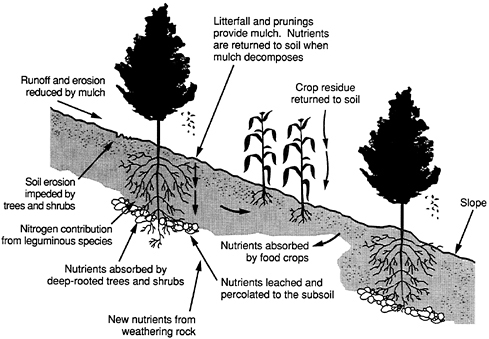
FIGURE 7 Schematic representation showing the benefits of nutrient cycling and erosion control in an alley cropping system. Source: Kang, B. T., A. C. B. M. van der Kruijs, and D. C. Cooper. 1989. Alley cropping for food production. Pp. 16-26 in Alley Farming in the Humid and Sub-humid Tropics, B. T. Kang and L. Reynolds, eds. Ottawa, Canada: International Development Research Center.
fallow system is that the cropping and fallow phases can take place concurrently on the same land, thus allowing farmers to crop the land for an extended period of time without returning to a fallow period.
The ILCA has extended the concept of alley cropping to include livestock by using a portion of the hedgerow's foliage for animal feed (the alley farming method) (Kang et al., 1990). Use of woody legumes provides rich mulch and green manure to maintain soil fertility, enhance crop production, and provide protein-rich fodder for livestock. On sloping lands, planting of hedgerows along the contours greatly reduces soil erosion. Alley cropping or farming is a potentially beneficial technology, but despite the improved basic knowledge about this technology, it is still in the development phase in the humid tropics. Additional technical and economic analysis is required.
Recently, Ehui et al. (1990) conducted an economic analysis of the
effect of soil erosion on alley cropping and on no-till and bush fallow systems. They concluded that, in general, when access to new forest-lands is costless in terms of foregone production because the land is fallow, slight decreases in yields from erosion will not detract significantly from the profit obtained by using traditional bush fallow systems with long fallow periods. However, in those cases in which land values increase because of population pressures, farmers who use bush fallow systems have incurred costs by keeping land out of production (that is, in fallow). Alley cropping was shown to be more profitable during the growing season, despite its higher labor requirement.
CONSERVATION TILLAGE
Studies at the IITA and elsewhere have shown the advantage of conservation tillage, an approach to soil surface management that emphasizes use and improvement of natural resources rather than exploitation and mining for quick economic return. Conservation tillage is defined as any system that leaves at least 30 percent of the previous crop residue on the surface after planting (Lal et al., 1990:207). When it is successfully applied, conservation tillage may maintain soil fertility and control erosion. The various types of conservation tillage include minimum tillage, chisel plowing, plow-plant, ridge tillage, and no-tillage.
In the humid tropics, no-till farming, which involves seeding through a crop residue mulch or on unplowed soil, has several advantages. One is the conservation of soil and water. Other advantages are the lowering of the maximum soil temperature and the maintenance of higher levels of organic matter in the soil. Experimental data from Ibadan, Nigeria (a subhumid zone), indicate that conservation tillage can be extremely effective in controlling soil erosion. For example, mean soil erosion rates for areas with slopes of up to 15 percent were estimated to be 0.1 and 9.4 metric tons/ha for no-till and plowed systems, respectively. Ehui et al. (1990) showed that, in areas with increasing population pressures, the no-till system is more profitable than the traditional bush fallow systems. The alley cropping system with 4 m of space between hedgerows is more profitable than the no-till system.
Policy Interventions
Government intervention is required when there are market failures. Some causes of market failure are the lack of clearly defined or
secure property rights, variable external market pressures, inappropriate timber taxation, and a short-sighted plan that pursues quick profits at the expense of long-term, sustainable benefits (Panayotou, 1983). These causative factors characterize the economy of Côte d'Ivoire and emphasize the fact that policy reforms that address fundamental issues are needed.
SECURE PROPERTY RIGHTS
The pressure for shorter fallow periods, spurred by population growth, requires investments in land improvements to retain soil fertility and investments of capital to expedite the preparation of land for farming and to increase productivity. The incentive to undertake such investments is based in part on secure future access to that land. Inappropriate land tenure regimes or the lack of a secure means of land ownership forces farmers to take actions—encroachment onto marginal lands, deforestation, and cultivation of steep slopes—that help them only in the short term. The main effect of insecure land tenure is the land operators's uncertainty about their ability to benefit from any investments they might make to improve and sustain the productive capacities of their farms (Feder and Noronha, 1987). Francis (1987) noted that community-controlled rotations of land parcels discouraged the adoption of alley farming in southeastern Nigeria. Survey results by Lawry and Stienbarger (1991) showed that most farmers who practice alley cropping obtained their land through divided inheritances, which allows them full control over their land.
Ownership security reinforces both investment incentives and the availability of investment capital. Availability of credit from institutional sources in particular frequently depends on the borrower's ownership security because unsecured loans are more risky for institutional lenders and less likely to be granted. In Côte d'Ivoire, proper titling of rural land areas is necessary to provide sufficient land tenure security for the people because the rights to most forest areas belong to the government. There are only a few individuals with property rights in Ivoirian forest areas. A unified, state-controlled system of rural land registration is one way of enhancing ownership security.
Goodland (1991) proposed that, in addition to being secure, land holdings should be of a size that can sustainably support families and provide them with a reasonable standard of living. Adequate parcel size promotes agricultural intensification and conservation of soils and forestland.
Promotion of sustainable use of forest lands can be achieved by
granting long-term forest concessions to timber exploiters. Long-term concessions increase the forest exploiters' land tenure security and promote the efficiency of resource use. Such concessions should be revoked, however, and the concessionaires fined if the land is used in an unsustainable manner. Implementation of this policy would require that the government properly monitor logging activities of the concessionaires.
FISCAL POLICIES
Earlier in this profile it was noted that one of the causes of deforestation is that timber license fees and royalties are, collectively, too low to encourage sustainable management of forest resources. Ehui and Hertel (1989, 1992a) showed that, although deforestation in C ôte d'Ivoire increases aggregate yields in the short term, it has long-term deleterious effects on productivity. Depletion of forest resources is associated with external factors, which have not been properly accounted for. (An “external factor” being the resultant effect when the action of one individual or farm has a positive or negative effect on other individuals or farms that are not parties to the activity but, as a consequence, incur the costs or enjoy the benefits.) For example, loggers and shifting cultivators receive the full benefits from extraction of timber and slash-and-burn land preparation, respectively, but they incur only some of the costs; the rest of the costs are incurred by downstream farmers—and by the society at large—in the forms of flooding, siltation, and erosion.
Theoretically, the preferred policy for controlling excessive deforestation would be taxation. A proper level of taxation on forest exploiters would reduce the level of deforestation to a point at which the marginal social costs of deforestation would be equal to the marginal benefits. (Marginal social costs are defined as the direct costs of clearing the forest plus the associated opportunity or user costs.) Because the forest stock is fixed, any unit cleared or consumed is unavailable for use in the future. Consequently, current deforestation comes at the expense of future benefits from forest endowment, resulting in opportunity or user costs.
CREDIT, PRICE POLICIES, AND MARKETS
Other reasons for the excessive rate of deforestation in Côte d'Ivoire include capital constraints faced by the farmers combined with the often highly imperfect and distorted capital markets and relatively
low producer prices. Often, it is cash funds for consumption and investment—not land—that is the scarcest resource for farmers. Capital constraints prevent the optimal use of resources. It is at this point that affordable credit is needed. In many rural areas, institutional credit either is not available or is too costly. The result is that many farmers are unable to put their land to its best use, even if they have the knowledge and motivation to do so. The lack of credit is also exacerbated by the low prices, relative to world market prices, that farmers receive for their products. One solution to excessive deforestation is to intensify agricultural productivity, thus negating the need to deforest more land. Intensification occurs through the use of improved inputs and extension services and when farmers are encouraged to mechanize their farming operations and apply pesticides. Without adequate prices and credit farmers will not be able to acquire these inputs.
The proper role of markets in sustainable soil management needs to be outlined as well. In studying agricultural mechanization and the evolution of farming systems in sub-Saharan African, Pingali et al. (1987) showed that for a given population density, an improvement in access to markets causes further intensification of the farming system (in this case, use of the plow). Their survey results support the hypothesis that, with poor access to markets, extensive forms of farming such as forest fallow and bush fallow are usually practiced.
SUMMARY
Côte d'Ivoire achieved the highest agricultural growth rate (5 percent) in sub-Saharan Africa during the first 2 decades after independence in 1960 (den Tuinder, 1978; Lee, 1983). This growth rate was driven primarily by increases in the area under cultivation (Lee, 1983; Spears, 1986), which arose solely from deforestation (see Table 2). As a result, agricultural expansion has often involved movement onto poorer soils and sloping uplands that cannot support permanent cropping (Bourreau, 1984) and is therefore unsustainable; this has mitigated rural poverty.
Planners must implement an agricultural system that can feed an increasing population without irreparably damaging the natural resource base on which agricultural production depends. Today, with an annual population growth rate of close to 4 percent, the main forestry policy question facing the government of Côte d'Ivoire is how to effectively manage what is left of the tropical rain forest.
TABLE 10 Forest Loss Scenarios in Côte d'Ivoire, 1990–2029
|
Scenario and Time Period |
Forest Cover at Beginning of Decade (millions of ha) |
Average Loss (millions of ha/year) |
Total Loss for Decade (millions of ha) |
Forest Cover at End of Decade (millions of ha) |
Percent Loss for the Decade |
|
Baseline scenario |
|||||
|
1990–1999 |
1.55 |
0.08 |
0.8 |
0.15 |
52 |
|
2000–2009 |
0.75 |
0.06 |
0.6 |
0.15 |
80 |
|
2010–2029 |
0.15 |
0.05 |
0.15 |
0 |
100 |
|
Worst-case scenario |
|||||
|
1990–1999 |
1.55 |
0.20 |
1.55 |
0 |
100 |
|
2000–2009 |
0 |
0 |
0 |
0 |
0 |
|
2010–2029 |
0 |
0 |
0 |
0 |
0 |
|
Best-case scenario |
|||||
|
1990–1999 |
1.55 |
0.05 |
0.55 |
1.05 |
32 |
|
2000–2009 |
1.05 |
0.02 |
0.20 |
0.85 |
19 |
|
2010–2029 |
0.85 |
0.01 |
0.10 |
0.75 |
12 |
Three Deforestation Scenarios
Table 10 presents the expected patterns of deforestation over the next 30 years using three scenarios: a base-case scenario (scenario A), a worst-case scenario (scenario B), and a best-case scenario (scenario C).
In the base-case scenario, it is assumed that there will be some reformation of government policy toward forest resource management but no real high-level political commitment. Because forest resources have decreased to such a large extent, the rate of deforestation in this scenario will, in the 1990s, decline to about 80,000 ha/ year. The rate will decline to 60,000 ha/year from 2000 to 2009 and to 50,000 ha/year from 2010 to 2029 before the forests are depleted of their resources.
The worst-case scenario is based on a laissez faire policy, in which the government will, as in the past, have no overall land use policy. Price and fiscal policies will be unchanged, and there will be no effort to intensify agriculture. In this scenario, the rate of deforestation is hypothesized to be at least the same as that during the previous decade (that is, almost 200,000 ha/year). At this rate, there will be no remaining highland forest by the end of 2000. This hypothesis is based on the assumption that there will be no population growth control, that the population will continue to grow at an average rate of 3.6 percent per year, and that the major source of food and agricultural growth for the country will be through the expansion of the agricultural land frontier into presently forested areas rather than through land-saving technologies. Also, projecting the current slump in prices for Côte d'Ivoire's major export crops (cacao and coffee) and the increasing debt burden and unemployment rate in the cities, farmers and loggers will be encouraged, in an effort to increase foreign exchange earnings, to cut the remaining tracts of natural forests.
In the best-case scenario, the rate of deforestation is expected to average 50,000 ha/year between 1990 and 1999, 20,000 ha/year between 2000 and 2009, and 10,000 ha/year between 2010 and 2029. With these levels of deforestation there will be 1.05 million ha of forest remaining by 2009 and 0.85 million ha of forest remaining by 2029. This scenario is based on the assumption that policy and technology options listed below (see also, Spears [1986]) will be supported by the government, with high-level political commitment.
Technology options lie in the direction of sustainable and economically efficient agricultural practices—that is, practices that can maintain protective organic mulches on the soil surface by maximizing biomass production (organic residue production) while minimiz-
ing the negative competitive effects on the crops or animals produced. Policy options lie in the direction of reformation of land tenure rights and taxation and fees for timber extraction.
TECHNOLOGY OPTIONS
Technology options include the following:
-
Use of organic manure and inorganic fertilizers;
-
Use of mulches and cover crop systems;
-
Intensification of agricultural production in humid forest zones through the use of tree-based technologies—such as alley cropping —that can reduce dependence on bush fallowing;
-
Development of intensive food crop production in lowland areas;
-
Conservation tillage; and
-
Creation of a buffer zone of intensive agricultural perennials (coffee, cacao, oil palm, and rubber) around or adjacent to the most imminently threatened forest areas.
POLICY OPTIONS
Policy options include the following:
-
Continue public awareness, mass education about and moral persuasion against deforestation;
-
Incorporate environmental conservation curricula in schools, including intensive forestry and agroforestry education, training, and research, with special emphasis on topics such as tree breeding and genetic improvement in order to increase productivity and shorten plantation rotations;
-
Establish a mechanism for defining proper land tenure regimes (for example, a unified, state-controlled system of land titling);
-
Improve timber pricing and fiscal policies (for example, sales of permits for the extraction of forest products and strict monitoring of current extraction and transportation procedures);
-
Raise timber extraction taxes to reflect the true price of forest resources and to help fund reforestation;
-
Institute subsidies, investment tax credits, and other incentives for reforestation by private and government agencies;
-
Support large-scale government and private investments in reforestation;
-
Improve agricultural pricing and credit policies; and
-
Prepare a land use plan for forest zones, demarcating areas suited to perennial agricultural tree crops, food crops, and forestry and setting up a more effective government mechanism for land use allocation in forest zones.
In Côte d'Ivoire, most forestlands are owned by the government, and prices for extraction of forest resources are fixed far below what is necessary to make sustainable practices cost-effective and to stimulate capital formation for replanting operations. With the costs of deforestation externalized (for example, the impact of deforestation on the future productivity of the land), forestland pricing policy needs a thorough revamping if forest regeneration is to be boosted and excessive deforestation reduced.
Illegal encroachments of forests because of unclearly defined property rights have become increasingly common, and the multiple activities that follow encroachment (for example, cattle grazing and shifting cultivation) intensify the deleterious effects of deforestation. Policies regarding land titling must, therefore, also be revamped.
Among the agricultural technology options, alley cropping appears to be the most promising. Even though alley cropping has proved to be agronomically and economically more viable than alternative land use systems, its successful adoption depends on the prevailing policy environment. Without sound economic policies that support agriculture —such as investment in infrastructure, proper incentives to farmers, adequate supplies of production inputs, effective marketing, and credit facilities—it will be difficult to achieve increased agricultural productivity through new land use technologies.
REFERENCES
Bertrand, A. 1983. La déforestation en zone de forêt en Côte d'Ivoire. Rev. Bois Trop. 220:3–17.
Bourreau, C. 1984. Plan Quinquennal (1986–1990). Bilan Diagnostic Première Partie: Les Forêts et la Production Forestrière. Abidjan, Côte d'Ivoire: Direction des Eaux et Forêts, Ministère de l'Agriculture.
Bromley, D., and M. M. Cernea. 1989. The Management of Common Property Natural Resources: Some Conceptual and Operational Fallacies. Washington, D.C.: World Bank.
Carr, S. J. 1989. Technology for Small Scale Farmers in Sub-Saharan Africa: Experience with Food Crop Production in Five Major Ecological Zones. World Bank Technical Paper No. 109. Washington, D.C.: World Bank.
den Tuinder, B. A. 1978. Ivory Coast: The Challenge of Success. Baltimore: Johns Hopkins University Press.
Durufles, G., P. Bourgerol, B. Lesluyes, J. C. Martin, and M. Pascay. 1986.
Desequilibres Structurels et Programmes d'Ajustement en Côte d'Ivoire . Paris, France: Mission d'Evaluation, Ministère de la Cooperation.
Economic Intelligence Unit. 1991. Côte d'Ivoire Country Profile: Annual Survey of Political and Economic Background . London: Business International Limited.
Ehui, S. K., and T. W. Hertel. 1989. Deforestation and agricultural productivity in the Côte d'Ivoire. Amer. J. Agric. Econ. 71:703–711.
Ehui, S. K., and T. W. Hertel. 1992a. Testing the impact of deforestation on aggregate agricultural productivity . Agric. Ecosystems Envir. 38:205–218.
Ehui, S. K., and T. W. Hertel. 1992b. Measuring the value of marginal forest conservation in Côte d'Ivoire. Draft paper. Addis Ababa, Ethiopia: International Livestock Center for Africa.
Ehui, S. K., B. T. Kang, and D. S. C. Spencer. 1990. Economic analysis of soil erosion effects in alley cropping, no-till and bush fallow systems in south western Nigeria. Agric. Syst. 34:349–368.
Feder, G., and R. Noronha. 1987. Land systems and agricultural development in sub-Saharan Africa. World Bank Res. Observer 2(2):143–169.
Food and Agriculture Organization and United Nations Environment Program. 1981. Tropical Forest Resources Assessment Project (in the Framework of GEMS). Forest Resources of Tropical Africa. Part II. Country Briefs. Rome, Italy: Food and Agriculture Organization of the United Nations.
Francis, P. A. 1987. Land tenure systems and agricultural innovation: The case of alley farming in Nigeria. Land Use Policy (July):305–319.
Gbetibouo, M., and C. L. Delgado. 1984. Lessons and constraints for export crop-led growth. Pp. 115–147 in the Political Economy of Ivory Coast, I. W. Zartman and C. Delgado, eds. New York: Praeger.
Ghuman, B. S., and R. Lal. 1988. Effects of deforestation on soil properties and micro-climate of a high rain forest in southern Nigeria. Pp. 225–244 in The Geophysiology of Amazônia: Vegetation and Climate Interactions, R. E. Dickinson, ed. New York: Wiley, for the United Nations University.
Gillis, M. 1988. West Africa: Resource management policies and the tropical forest . Pp. 299–351 in Public Policies and the Misuse of Forest Resources, R. Repetto and M. Gillis, eds. New York: Cambridge University Press.
Goodland, R. 1991. Tropical Deforestation: Solutions, Ethics and Religion. Environment Working Paper No. 43. Washington, D.C.: World Bank.
International Bank for Reconstruction and Development (IBRD). 1985. Côte d'Ivoire Agricultural Sector Data Base Statistical Annex 7. Washington, D.C.: World Bank.
IBRD. 1989. Sub-Saharan Africa: From Crisis to Sustainable Growth, A Long-Term Perspective Study. Washington, D.C.: The World Bank.
International Institute of Tropical Agriculture. 1990. IITA Annual Report 1989/1990. Ibadan, Nigeria: International Institute of Tropical Agriculture.
Kang, B. T., G. F. Wilson, and L. Spiken. 1981. Alley cropping maize with leucaena in southern Nigeria. Plant Soil 63:165–179.
Kang, B. T., A. C. B. M. van der Kruijs, and D. C. Cooper. 1989. Alley cropping for food production. Pp. 16–26 in Alley Farming in the Humid and Sub-humid Tropics, B. T. Kang and L. Reynolds, eds. Ottawa, Canada: International Development Research Center.
Kang, B. T., L. Reynolds, and A. N. Atta-Krah. 1990. Alley farming. Adv. Agron. 43:315–359.
Lal, R. 1981. Clearing a tropical forest. II. Effects on crop performance. Field Crops Res. 4:345–354.
Lal, R. 1986. Soil surface management in the tropics for intensive land use in higher and sustained production. Adv. Agron. 5:1–109.
Lal, R., O. J. Eckert, N. R. Fausey, and W. M. Edwards. 1990. Conservation tillage in sustainable agriculture. Pp. 203–225 in Sustainable Agricultural Systems, C. A. Edwards, R. Lal, P. Madden, R. H. Miller, and G. House, eds. Ankeny, Iowa: Soil and Water Conservation Society.
Lawry, S. W., and D. M. Stienbarger. 1991. Tenure and Alley Farming in the Humid Zone of West Africa. Final Report of Research in Cameroon, Nigeria and Togo. Land Tenure Center Research Paper No. 105. Madison: University of Wisconsin.
Lee, E. 1983. Export led rural development: The Ivory Coast. Pp. 99–127 in Agrarian Policies and Rural Poverty in Africa, D. Ghia and S. Radwan, eds. Geneva: International Labor Office.
Michel, G., and M. Noël. 1984. Short-Term Responses to Trade and Incentive Policies in the Ivory Coast: Comparative Static Simulations in a Computable General Equilibrium Model. World Bank Staff Working Paper No. 647. Washington, D.C.: World Bank.
Myers, N. 1980. Conversion rates in tropical moist forests: Review of a recent survey . Pp. 48–66 in Proceedings of International Symposium on Tropical Forest, Utilization and Conservation, Ecological, Socio-Political and Economic Problems and Potentials, F. Mergen, ed. New Haven, Conn.: University of Connecticut.
Nye, P. H., and D. J. Greenland. 1960. The Soil Under Shifting Cultivation. Commonwealth Bureaux of Soils Technical Communication No. 51. Harpenden, England: Farnham Royal.
Panayotou, T. 1983. Renewable resource management for agricultural and rural development: Research and policy issues. Agricultural Development Council, Bangkok. Photocopy.
Persson, R. 1975. Forest Resources of Africa. Part I. Regional Analysis. Research Notes No. 22. Stockholm, Sweden: Royal College of Forestry.
Persson, R. 1977. Forest Resources of Africa. Part II. Regional Analysis. Research Notes No. 22. Stockholm, Sweden: Royal College of Forestry.
Pingali, P., Y. Bigot, and H. P. Binswanger. 1987. Agricultural Mechanization and the Evolution of Farming Systems in Sub-Saharan Africa. Baltimore: John Hopkins University Press.
Sedjo, R. A. 1983. How serious is tropical deforestation? Are the world's
tropical forests being rapidly deforested? Only in places say the authors. J. Forestry 81:792–794.
Seubert, C. E., P. A. Sanchez, and C. Valverde. 1977. Effects of land clearing methods on soil properties of an Ultisol and crop performance in the Amazon jungle of Peru. Trop. Agric. (Trin.) 54:307–321.
Southgate, D., J. Sanders, and S. Ehui. 1990. Resource degradation in Africa and Latin America: Population pressure, policies, and property arrangements. Amer. J. Agric. Econ. 72:1259–1263.
Spears, J. 1986. Key forest policy issues for the coming decade. Côte d'Ivoire forestry subsector discussion paper. World Bank, Washington, D.C. May. Photocopy.
Trueblood, M. A., and N. R. Horenstein. 1986. The Ivory Coast: An Export Market Profile. Foreign Agricultural Economic Report No. 223. Washington, D.C.: Economic Research Service, U.S. Department of Agriculture.
U.S. Department of Agriculture, Economic Research Service. 1988. World Indices of Agricultural and Food Production 1977–86. Statistical Bulletin No. 759. Washington, D.C.: U.S. Government Printing Office.
U.S. Department of State. 1980. The World's Tropical Forests: A Policy, Strategy and Program for the United States. U.S. Interagency Task Force on Tropical Forests. A Report of the President. Washington, D.C.: U.S. Government Printing Office.
U.S. Office of Technology Assessment. 1984. Technology to Sustain Tropical Forest Resources. Washington, D.C.: U.S. Government Printing Office.
Wilson, G. F., R. Lal, and B. N. Okigbo. 1982. Effect of cover crops on soil structure and on yield of subsequent arable crops grown under strip tillage on an eroded Alfisol. Soil Tillage Res. 2:233–250.
Wilson, G. F., B. T. Kang, and K. Mulongoy. 1986. Alley cropping: Trees as sources of green-manure and mulch in the tropics. Biol. Agric. Horticult. 3:251–267.
Woodwell, G. M. 1978. Biotic Interactions with Atmospheric Carbon Dioxide, Forests, Soil Humus. Oxford: Pergamon.
World Resources Institute. 1990. World Resources 1990–91. New York: Oxford University Press.


