
Zaire
Mudiayi S. Ngandu and Stephen H. Kolison, Jr.
Zaire is located directly on the equator in the central part of the African continent. It is the third largest country in Africa, with an area of 2,344,885 km2, three times the size of the state of Texas. Zaire has three distinct land areas: the tropical rain forests, located in the central and northern parts of the country; the savannahs, located in the northern and southern parts of the country; and the highlands, which consist of the plateaus, rolling meadows, and mountains found along the country 's eastern border, all along the Great Rift valley. The highest point in this area is 5,809 m, on Ruwenzori Peak in Kivu Province.
Zaire's rivers and lakes are probably its most important natural resources. The most prominent is the Zaire River (formerly the Congo River). It is the fifth longest river in the world and is second only to the Amazon in the volume of water it carries. The Zaire River flows for about 4,667 km, but together with its tributaries, navigability of up to about 11,500 km is possible. In some parts of the country, however, the Zaire River is not navigable because of falls and rapids. The country also has several deep lakes, including Lake Tanganyika in the southeast.
Mudiayi S. Ngandu is an associate professor of agricultural economics and Stephen H. Kolison, Jr., is an assistant professor and coordinator of the forestry resources program at the School of Agriculture, The George Washington Carver Agricultural Experiment Station, Tuskegee University, Tuskegee, Alabama.
FOREST TYPES
Forest types range from dry semideciduous to swamps. Figure 1 shows the geographic distributions of forestland areas by the four distinguishable types: (1) evergreen rain forests and swamp forests in the central basin; (2) dry and moist semideciduous forests to the north and south of the evergreen forests; (3) montane forests in the eastern uplands on the borders with Tanzania, Rwanda, and Burundi; and (4) woodland and wooded savannahs in the far south. The variety of forest types is due to both soil types and a variety of climatic conditions.
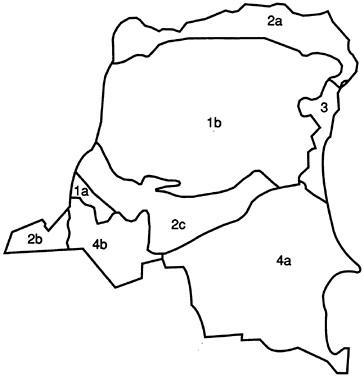
FIGURE 1 Geographic distribution of forestland areas in Zaire, by type. Forest types are as follows: 1. (a) Evergreen rain forests and swamp forests and (b) closed forests of the central basin. 2. (a) Dry semideciduous forests, substantially degraded, and (b and c) moist semideciduous forests of Mayumbe in the lower Zaire River region. 3. Montane forests of Kivu Province. 4. (a) Open forests, woodlands, and wooded savannahs, mainly in Shaba, and (b) part of Bandundu. Source: Government of Zaire and Canadian International Development Agency. 1990. Plan d'Action Forestier Tropical. Vol. I, Annex 2, Forestry Map. Kinshasa, Zaire, and Ottawa, Canada: Government of Zaire and Canadian International Development Agency.
CLIMATE
Climatic conditions vary with almost each region of the country. In the tropical rain forests, average annual rainfall reaches 220 cm, and the average daytime temperature is about 30°C. The equator runs through the center of this region, and the weather is hot and humid throughout the year. In the savannahs, the average annual rainfall is about 120–160 cm, and the average daytime temperature is 24°C. The climate of the highlands is characterized by an average daytime temperature of about 21°C and average annual rainfall of about 160–240 cm.
POPULATION
In 1988, Zaire had a population of about 35.4 million (Table 1) and an estimated annual population growth rate of 3 percent. The estimated population for 1991 was 39.2 million for an average population density of about 14 people per km2. The population of Zaire is about 30 percent urban and 70 percent rural. Kinshasa, the capital and largest city, has a population of about 5 million. Matadi, in the Zaire delta (formerly the Congo), is the major port for exports. (For more information, see U.S. Department of State [1988].)
Society and Culture
There are about 700 local languages and dialects spoken in Zaire. Four of these—Lingala, Swahili, Tshiluba, and Kikongo—serve as official languages, in addition to French, which was introduced by the Belgians. All 700 languages belong to the Bantu group of languages. French is used in schools and in conducting official business and is used in particular by those with about 8 years or more of schooling. As regards religion, the U.S. Department of State (1988) noted that the population is about 80 percent Christian (Roman Catholics, Protestants, and indigenous Christians), and 10 percent syncretic and traditional religions.
LAND TENURE
Zaire has two recognized land tenure systems: the modern and the customary. Under the modern system, all land is owned by the government. The right to use land is therefore assigned or given by the government through the Department of Land Affairs, Environment, Nature Conservation, and Tourism (DLAENCT). In many parts of the country, however, the customary land tenure system is used.
TABLE 1 Selected Macroeconomic Indicators and Agricultural Statistics for Zaire
|
Indicator or Statistic |
Units |
1970 |
1975 |
1980 |
1985 |
1987 |
1988 |
1989 |
|
Macroeconomic indicators |
||||||||
|
Population |
Million |
20.3 |
23.2 |
26.7 |
31.1 |
33.2 |
34.3 |
35.4 |
|
Rate of growth |
Percent/year |
2.8 |
2.7 |
2.8 |
3.1 |
3.3 |
3.3 |
3.3 |
|
Agricultural population |
Percent |
75.9 |
72.7 |
70.7 |
67.8 |
66.5 |
65.9 |
— |
|
Pop/km2 of total area |
No. |
87.0 |
99.0 |
114.0 |
133.0 |
141.0 |
146.0 |
151.0 |
|
Total labor force |
Percent |
42.8 |
40.9 |
39.1 |
37.9 |
37.3 |
37.0 |
— |
|
Agricultural labor force |
Percent |
79.1 |
75.4 |
71.5 |
68.7 |
67.5 |
66.9 |
— |
|
GNP total |
Million current $ |
3,653 |
6,963 |
11,473 |
4,976 |
4,976 |
5,826 |
— |
|
Rate of growth |
Percent/year |
— |
13.8 |
10.5 |
−15.4 |
— |
17.1 |
— |
|
GNP per capita |
$/person |
80 |
300 |
430 |
160 |
150 |
170 |
— |
|
GDP in agriculture |
Percent |
16.3 |
18.8 |
28.8 |
32.9 |
32.2 |
31.0 |
— |
|
Consumer price index |
1985 = 100 |
— |
1 |
16 |
100 |
279 |
510 |
1,041 |
|
Energy conservation/coal equity |
1,000 megatons |
1,438 |
1,743 |
1,948 |
2,043 |
2,134 |
2,211 |
— |
|
Energy conservation/person/year |
kg of coal |
? |
75 |
73 |
66 |
64 |
65 |
— |
|
Energy conservation/$1,000 of GNP |
kg of coal |
394 |
250 |
170 |
411 |
429 |
380 |
— |
|
Exchange rate |
Local currency/$ |
500 |
500 |
2,800 |
49,873 |
112,403 |
187,070 |
381,445 |
|
Total debt |
Million $ |
— |
2,152 |
4,462 |
5,117 |
6,497 |
7,055 |
— |
|
Total debt service |
Million $ |
— |
208 |
393 |
365 |
302 |
400 |
— |
|
Debt service ratio |
Percent |
— |
25 |
24 |
38 |
31 |
36 |
— |
|
Consumption indicators |
||||||||
|
Per capita util-cereals |
kg/year |
34 |
43 |
42 |
41 |
42 |
42 |
40 |
|
Calorie intake/person/day |
Calories |
2,141 |
2,162 |
2,043 |
2,049 |
2,046 |
2,001 |
— |
|
Protein intake/person/day |
Grams |
33 |
32 |
29 |
30 |
30 |
30 |
— |
|
Factors of production |
||||||||
|
Total land |
1,000 ha |
234,541 |
234,541 |
234,541 |
234,541 |
234,541 |
234,541 |
234,541 |
|
Arable and permanent cropland |
1,000 ha |
7,250 |
7,450 |
7,600 |
7,800 |
7,850 |
7,850 |
— |
|
Permanent pastures |
1,000 ha |
15,000 |
15,000 |
15,000 |
15,000 |
15,000 |
15,000 |
— |
|
Irrigated area |
1,000 ha |
— |
7 |
9 |
9 |
— |
— |
|
|
Agricultural labor/1,000 ha |
No. |
947 |
961 |
981 |
1,037 |
1,065 |
— |
— |
|
Tractors/1,000 ha |
No. |
— |
— |
— |
— |
— |
— |
— |
|
Tractors/1,000 agricultural workers |
No. |
— |
— |
— |
— |
— |
— |
— |
|
Fertilizer use |
kg/ha |
— |
— |
— |
— |
— |
— |
— |
|
Production values |
||||||||
|
Total agriculture |
Million $ |
1,920 |
2,131 |
2,207 |
2,567 |
2,675 |
2,740 |
— |
|
Total food |
Million $ |
1,739 |
1,946 |
2,046 |
2,363 |
2,454 |
2,515 |
— |
|
Total crop |
Million $ |
1,811 |
2,009 |
2,079 |
2,430 |
2,533 |
2,597 |
— |
|
Total livestock |
Million $ |
110 |
122 |
128 |
137 |
141 |
143 |
— |
|
Crop production/ha |
International $ |
250 |
270 |
274 |
312 |
323 |
— |
— |
|
Agricultural production/agricultural worker |
International $ |
280 |
298 |
296 |
317 |
320 |
— |
— |
|
Production indices (1979–1981 = 100) |
||||||||
|
Total agriculture |
Index |
87.9 |
96.5 |
100.7 |
115.4 |
120.5 |
121.7 |
122.5 |
|
Total agricultural per capita |
Index |
119.1 |
113.7 |
100.7 |
99.1 |
97.2 |
95.2 |
92.7 |
|
Total food |
Index |
85.6 |
94.6 |
100.2 |
114.1 |
118.7 |
120.4 |
121.2 |
|
Total food per capita |
Index |
115.9 |
111.4 |
100.2 |
98.0 |
95.8 |
94.1 |
91.7 |
|
Total crop |
Index |
86.9 |
96.4 |
100.8 |
116.6 |
121.9 |
123.1 |
123.8 |
|
Total livestock |
Index |
95.6 |
97.5 |
99.7 |
106.7 |
110.5 |
111.9 |
114.0 |
|
Crop production/ha |
Index |
92.1 |
99.5 |
101.0 |
115.0 |
119.1 |
— |
— |
|
Agricultural production/agricultural worker |
Index |
95.5 |
101.6 |
100.9 |
108.1 |
109.1 |
— |
— |
|
Production, quantities |
||||||||
|
Cereals—total |
1,000 Mtons |
666 |
758 |
862 |
1,109 |
1,145 |
1,155 |
1,230 |
|
Rate of growth |
Percent/year |
9.2 |
2.6 |
2.6 |
5.2 |
1.6 |
.9 |
6.5 |
|
Wheat |
1,000 Mtons |
3 |
2 |
4 |
20 |
25 |
35 |
35 |
|
Rice, paddy |
1,000 Mtons |
180 |
208 |
234 |
297 |
300 |
300 |
315 |
|
Corn (maize) |
1,000 Mtons |
428 |
496 |
594 |
726 |
730 |
730 |
790 |
|
Barley |
1,000 Mtons |
2 |
— |
— |
— |
— |
— |
— |
|
Oats |
1,000 Mtons |
5 |
— |
— |
— |
— |
— |
— |
|
Sorghum |
1,000 Mtons |
25 |
27 |
14 |
32 |
60 |
60 |
60 |
|
Millet |
1,000 Mtons |
23 |
25 |
16 |
29 |
30 |
30 |
30 |
|
Soybeans |
1,000 Mtons |
2 |
2 |
10 |
17 |
18 |
18 |
18 |
|
Cottonseed |
1,000 Mtons |
46 |
36 |
19 |
50 |
50 |
50 |
50 |
|
Peanuts, in shell |
1,000 Mtons |
267 |
308 |
337 |
386 |
394 |
410 |
400 |
|
Palm oil |
1,000 Mtons |
232 |
181 |
168 |
160 |
165 |
178 |
178 |
|
Sugar, ? |
1,000 Mtons |
46 |
63 |
48 |
63 |
68 |
76 |
70 |
|
Roots and tubers |
1,000 Mtons |
10,861 |
12,424 |
13,664 |
16,232 |
16,995 |
17,007 |
17,051 |
|
Pulses |
1,000 Mtons |
122 |
145 |
139 |
121 |
129 |
140 |
140 |
|
Fruits |
1,000 Mtons |
2,135 |
2,429 |
2,421 |
2,540 |
2,601 |
2,669 |
2,666 |
|
Vegetables |
1,000 Mtons |
385 |
451 |
485 |
515 |
535 |
550 |
555 |
|
Coffee |
1,000 Mtons |
70 |
83 |
80 |
92 |
102 |
97 |
98 |
|
Tea |
1,000 Mtons |
7 |
7 |
3 |
5 |
6 |
6 |
6 |
|
Cocoa |
1,000 Mtons |
6 |
5 |
4 |
4 |
6 |
6 |
6 |
|
Meat |
1,000 Mtons |
170 |
174 |
174 |
186 |
193 |
197 |
200 |
|
Beef and veal |
1,000 Mtons |
18 |
21 |
22 |
24 |
26 |
26 |
26 |
|
Mutton and lamb |
1,000 Mtons |
2 |
2 |
2 |
3 |
3 |
3 |
3 |
|
Pork |
1,000 Mtons |
25 |
27 |
27 |
28 |
29 |
29 |
29 |
|
Poultry |
1,000 Mtons |
11 |
13 |
13 |
14 |
15 |
16 |
16 |
|
Eggs |
1,000 Mtons |
6 |
7 |
8 |
8 |
8 |
6 |
8 |
|
Cotton lint |
1,000 Mtons |
23 |
18 |
10 |
26 |
26 |
26 |
26 |
|
Hides and skins |
1,000 Mtons |
5 |
5 |
6 |
6 |
— |
— |
— |
|
Area by selected crops |
||||||||
|
Cereals — total |
1,000 ha |
916 |
1,014 |
1,094 |
1,292 |
1,356 |
1,356 |
1,357 |
|
Rate of growth |
Percent/ year |
6.8 |
2.0 |
1.5 |
3.4 |
2.4 |
— |
— |
|
Wheat |
1,000 ha |
6 |
4 |
4 |
26 |
27 |
28 |
28 |
|
Rice |
1,000 ha |
244 |
268 |
293 |
334 |
344 |
345 |
345 |
|
Corn (maize) |
1,000 ha |
595 |
675 |
743 |
849 |
874 |
874 |
875 |
|
Barley |
1,000 ha |
3 |
— |
— |
— |
— |
— |
— |
|
Oats |
1,000 ha |
8 |
— |
— |
— |
— |
— |
— |
|
Sorghum |
1,000 ha |
29 |
32 |
28 |
41 |
66 |
66 |
66 |
|
Millet |
1,000 ha |
31 |
35 |
26 |
41 |
43 |
42 |
42 |
|
Soybean |
1,000 ha |
2 |
2 |
10 |
15 |
15 |
15 |
15 |
|
Peanuts |
1,000 ha |
384 |
432 |
482 |
553 |
567 |
567 |
570 |
|
Seed cotton |
1,000 ha |
179 |
151 |
100 |
175 |
175 |
175 |
175 |
|
Yields, selected crops |
||||||||
|
Cereals—total |
kg/ha |
727 |
747 |
788 |
859 |
846 |
852 |
907 |
|
Wheat |
kg/ha |
530 |
492 |
925 |
769 |
926 |
1,250 |
1,250 |
|
Rice, paddy |
kg/ha |
736 |
776 |
800 |
889 |
873 |
870 |
913 |
|
Corn (maize) |
kg/ha |
719 |
734 |
800 |
855 |
835 |
835 |
903 |
|
Barley |
kg/ha |
790 |
1,199 |
600 |
600 |
600 |
600 |
600 |
|
Oats |
kg/ha |
625 |
— |
— |
— |
— |
— |
— |
|
Sorghum |
kg/ha |
867 |
841 |
516 |
900 |
915 |
913 |
909 |
|
Millet |
kg/ha |
735 |
725 |
605 |
700 |
700 |
714 |
714 |
|
Soybean |
kg/ha |
842 |
739 |
1,012 |
1,138 |
1,207 |
1,241 |
1,241 |
|
Peanuts |
kg/ha |
695 |
713 |
700 |
698 |
694 |
723 |
702 |
|
Seed cotton |
kg/ha |
390 |
358 |
292 |
440 |
440 |
440 |
440 |
|
Yields, livestock products |
||||||||
|
Beef and veal |
kg/animal |
144 |
144 |
149 |
150 |
150 |
147 |
146 |
|
Pork |
kg/animal |
50 |
51 |
50 |
50 |
50 |
50 |
51 |
|
Mutton and lamb |
kg/animal |
11 |
11 |
11 |
11 |
10 |
10 |
10 |
|
Milk |
kg/animal |
754 |
783 |
838 |
855 |
883 |
883 |
883 |
|
Eggs |
kg/animal |
3 |
3 |
3 |
3 |
3 |
3 |
3 |
|
Trade |
||||||||
|
Self-sufficiency ratio |
||||||||
|
Cereals |
Percent |
74 |
68 |
75 |
75 |
72 |
72 |
70 |
|
Food |
Percent |
102 |
103 |
100 |
100 |
98 |
100 |
— |
|
Agriculture |
Percent |
— |
103 |
103 |
99 |
— |
— |
— |
|
Value of total exports |
Million $ |
775 |
826 |
632 |
949 |
983 |
120 |
— |
|
Value of total imports |
Million $ |
535 |
900 |
835 |
793 |
764 |
763 |
— |
|
Trade balance |
Million $ |
240 |
−74 |
797 |
156 |
219 |
357 |
— |
|
Value of agricultural exports |
Million $ |
112 |
192 |
235 |
222 |
212 |
164 |
— |
|
Value of agricultural imports |
Million $ |
63 |
153 |
167 |
237 |
221 |
201 |
— |
|
Agricultural trade balance |
Million $ |
49 |
39 |
68 |
−15 |
−9 |
−37 |
|
|
Imports from United States |
Million $ |
62 |
187 |
153 |
102 |
103 |
122 |
— |
|
Exports to United States |
Million $ |
41 |
67 |
370 |
415 |
321 |
384 |
— |
|
Agricultural imports from United States |
Million $ |
3 |
18 |
44 |
25 |
35 |
34 |
— |
|
Agricultural exports to United States |
Million $ |
20 |
24 |
31 |
5 |
11 |
5 |
— |
|
Agricultural exports |
||||||||
|
Cereals |
1,000 $ |
— |
192 |
— |
— |
— |
— |
— |
|
Wheat and flour |
1,000 $ |
— |
187 |
— |
— |
— |
— |
— |
|
Rice |
1,000 $ |
— |
4 |
— |
— |
— |
— |
— |
|
Corn (maize) |
1,000 $ |
— |
1 |
— |
— |
— |
— |
— |
|
Oil crops and feed products |
1,000 $ |
3,180 |
2,827 |
1,627 |
1,800 |
1,400 |
1,700 |
1,700 |
|
Vegetable oils |
1,000 $ |
40,964 |
35,330 |
15,265 |
9,235 |
4,000 |
7,500 |
7,500 |
|
Fibers |
1,000 $ |
4,602 |
615 |
3,500 |
— |
230 |
370 |
370 |
|
Cotton lint |
1,000 $ |
4,095 |
615 |
3,500 |
— |
230 |
370 |
370 |
|
Other |
1,000 $ |
507 |
— |
— |
— |
— |
— |
— |
|
Tobacco and products |
1,000 $ |
22 |
412 |
— |
— |
— |
— |
— |
|
Vegetables, fruits, and nuts |
1,000 $ |
16 |
49 |
— |
— |
— |
— |
— |
|
Sugar |
1,000 $ |
75 |
7 |
— |
— |
— |
— |
— |
|
Beverages |
1,000 $ |
38,368 |
114,320 |
174,889 |
181,440 |
178,286 |
123,500 |
6,500 |
|
Coffee, green and roasted |
1,000 $ |
33,900 |
103,910 |
166,440 |
169,640 |
168,186 |
116,000 |
— |
|
Cocoa beans |
1,000 $ |
2,576 |
6,575 |
6,941 |
8,200 |
8,100 |
6,500 |
6,500 |
|
Tea and mate |
1,000 $ |
1,892 |
3,834 |
1,508 |
3,600 |
2,000 |
1,000 |
— |
|
Wine and beer |
1,000 $ |
— |
1 |
— |
— |
— |
— |
— |
|
Live animals |
1,000 $ |
— |
217 |
— |
— |
— |
— |
— |
|
Meat products |
1,000 $ |
— |
— |
— |
— |
— |
— |
— |
|
Dairy products and eggs |
1,000 $ |
— |
6 |
— |
— |
— |
— |
— |
|
Agricultural imports |
||||||||
|
Cereals |
1,000 $ |
17,644 |
56,989 |
84,900 |
65,200 |
80,800 |
80,500 |
— |
|
Wheat and flour |
1,000 $ |
8,928 |
23,714 |
41,400 |
33,200 |
39,700 |
39,500 |
— |
|
Rice |
1,000 $ |
4,235 |
3,246 |
6,500 |
9,000 |
18,100 |
21,000 |
— |
|
Corn (maize) |
1,000 $ |
4,456 |
30,000 |
37,000 |
23,000 |
23,000 |
20,000 |
20,000 |
|
Barley |
1,000 $ |
22 |
— |
— |
— |
— |
— |
— |
Under this system, which varies depending on the region and people, land ownership is collective—that is, land is held by groups or clans. The group, through its appointee, assigns land for use to its members. Land used by a family over a long period of time is recognized by the group or clan as belonging to that family, but the family may not sell the land because, in practice, land ownership rights belong, ultimately, to the national government. (This reflects the nature of the existing power relationship between the central government and the local communities.)
THE MACROECONOMIC SETTING
In the 1980s, management of Zaire's macroeconomy was constrained by the heavy external debt-servicing burden (by 1988, as much as 60 percent of exports of goods and services and 65 percent of the operating budget). This debt arose from the country's borrowings in the late 1960s and the 1970s when Zaire's export earnings were relatively higher and expected to grow and the country benefited from favorable terms of trade. With the deterioration in export earnings in the 1980s, a rising debt burden, and the accumulated effects of past economic mismanagement, Zaire, in cooperation with its major creditors, embarked on a series of economic adjustment programs. Unfortunately, these programs were unsuccessful and have resulted in drastic declines in the standard of living, public-sector employment, wages, and salaries. (See Table 1 for selected macroeconomic performance indicators.)
The related tight budgetary measures did not produce results because they were not accompanied by the institutional reforms necessary to strengthen policy formulation and implementation. The forestry sector has been adversely affected by the ongoing economic adjustment programs, and these constraints are likely to continue. Reforms mandated by the economic adjustment programs offer an opportunity to initiate a meaningful dialogue between the Zairian government and the international aid donor community regarding long-term forestry policy issues and deforestation. In this context, debt-for-nature swaps, as proposed for the heavily indebted Latin American countries, should also be applicable to African countries like Zaire (Government of Zaire and the Canadian International Development Agency, 1990; Hines, 1988).
It is, however, a tenuous hypothesis to link deforestation with foreign exchange to service external debt. In a study by Capistrano (1990), external foreign exchange earnings and the external debt-servicing burden were identified as significant macroeconomic factors
contributing to accelerated deforestation in a number of countries, including Zaire, during 1967–1989. However, 98 percent of total wood production in Zaire is for domestic consumption and only 1 percent is exported. Deforestation is more appropriately linked to in-country uses of wood. In addition, because of extensive underinvoicing at the Matadi Port and inadequate export statistics related to other leakages, the reliability of Zaire's data on export earnings from logs and other wood products may also be questionable. To date, the forestry sector has not contributed significantly to the country 's export strategy or to alleviation of its external debt. These findings encourage strong support for the establishment of a reliable data base as part of any long-term investigation of reforestation in Zaire.
FOREST RESOURCE DISTRIBUTION AND THE STATE OF FOREST MANAGEMENT
Zaire has 207 million of the 436 million ha of forests in central Africa or 47.56 percent of the total in the region that includes Angola, Cameroon, Central African Republic, Congo, Equatorial Guinea, Gabon, and Zaire (see Table 2). In addition, 75 percent of Zaire's national territory is covered by forests. In 1975, Persson (as cited in World Resources Institute [1988]) and the Government of Zaire and the Canadian International Development Agency (1990) estimated that Zaire's total forest cover in 1970 amounted to about 234 million ha, including lakes and rivers (Table 3).
About 101 million ha of closed forests is situated in the central basin and Mayumbe regions (Table 4), while the montane forests occupy about 300,000 ha (Table 3). The band of montane forests spreads from the Haut Zaire Province in the northeast through the Kivu and northern Shaba provinces. The savannah-type formations are found mainly in the northern- and southernmost parts of the country (see Figure 1).
Distributions
COMMERCIAL FOREST AREA
Commercial forestland is classified as that forestland capable of producing at least 20 ft3 (0.56 m3) of industrial roundwood per acre (0.4 ha) annually (Blyth et al., 1984). This means that 1 ha of forest should be capable of producing at least 1.4 m3 of industrial roundwood annually. According to the World Bank (1986), about 139 million ha of forestland in Zaire is commercially exploitable. About
89.43 percent of this estimated area consists of closed forest in the central basin (Food and Agriculture Organization and United Nations Environment Program, 1981b). Furthermore, on the basis of the World Bank report, each hectare is capable of producing 5 m3 of industrial round wood annually; this is very different from the 1.4 m3 estimated by Blyth (1984). (The average of 5 m3/ha applies to forestland areas that have been logged several times. The figure for the first harvest is on the order of 25–35 m3/ha. The difference between these two figures is an indication of inefficiencies in logging methods [Food and Agriculture Organization and United Nations Environment Program, 1981b:562–563].)
Although 89.43 percent of the commercial forestlands is situated in the central basin, it does not mean that these forest resources are accessible. In fact, some studies indicate that up to 30 percent of the entire central basin is on waterlogged or seasonally flooded soils, thus making them less attractive for commercial logging (World Resources Institute, 1988).
TABLE 2 Areas of Natural Woody Vegetation in Zaire, 1980 (in Thousands of Hectares)
|
Vegetation |
Area |
|
Tree formations |
|
|
Closed |
105,750 |
|
Open |
71,840 |
|
All |
|
|
Total |
177,590 |
|
Percent of region (Central Africa) |
52.87 |
|
Percent of country |
59.83 |
|
Fallow of |
|
|
Closed formation |
7,800 |
|
Open formation |
10,600 |
|
Shrub formation |
11,300 |
|
Woody formations and fallows |
|
|
Total |
207,290 |
|
Percent of region (Central Africa) |
15.80 |
|
Percent of country |
88.36 |
|
SOURCE: Food and Agriculture Organization and United Nations EnvironmentProgram. 1981a. Pp. 41–44 in Tropical Forest Resources AssessmentProject. Forest Resources of Tropical Africa, Part I. Rome, Italy:Food and Agriculture Organization of the United Nations. |
|
TABLE 3 Types of Forests in Zaire, 1970 (in Thousands of Hectares)
|
Forest Type, Location |
Area |
|
Closed forest, central basin |
101,000 |
|
Closed forest, Mayumbe |
240 |
|
Montane forests |
300 |
|
Subtotal, closed forests |
101,540 |
|
Dry forest, Shaba region |
20,000 |
|
Savannah woodland, Guinean type |
85,000 |
|
Savannah woodland, Sudan-Zambian type |
27,000 |
|
Gallery forests |
760 |
|
Subtotal, open forests |
132,760 |
|
Total, all forest types |
234,300 |
|
NOTE: Values include the areas of lakes and rivers within the areas of the forest types; there is no allowance for urban or agricultural land use. Note the inconsistencies between these estimates of Persson (1975) and those of the Food and Agriculture Organization of the United Nations (Rome, Italy) in Table 2. Hence the need for reconciling them. SOURCES: Persson (1975) cited in World Resources Institute. 1988.P. 86 in Zaire Forestry Policy Review and Related Studies. DraftSummary Report. Kinshasa, Zaire, and Washington, D.C.: World ResourcesInstitute; Government of Zaire and Canadian International DevelopmentAgency. 1990. Unnumbered appendix table and Table 2.1, p. 19 in Pland'Action Forestier Tropical. Vols. I and II. Kinshasa, Zaire, andOttawa, Canada: Government of Zaire. |
|
NATIONAL PARKS AND RESERVES
About 22 million ha of forestlands in Zaire are classified as national parks, wildlife and forest reserves, reforestation sites, and gardens. Of this, 60 percent has been allocated to wildlife, hunting, and nature reserves, while only 3 percent of the area has been set aside for forest reserves (Table 5).
Forest Management
There is limited documentation on forest management in Zaire, and there is no evidence that timber is managed on a sustainable yield basis. The Zairian government indicates (World Resources Institute, 1988) that industrial wood production and forest manage-
|TABLE 4 Forest Cover in the Central Basin of Zaire
|
Cover Type |
Inventoried Area (ha) |
Percentage of Total Area Inventoried |
Total Area if Extrapolated to Entire Basin (1,000 ha) |
|
Evergreen forest |
425,234 |
8.0 |
8,000 |
|
Semideciduous forest |
2,287,981 |
43.2 |
43,623 |
|
Mature secondary forest |
737,465 |
13.9 |
14,039 |
|
Immature secondary forest |
110,898 |
2.1 |
2,121 |
|
Subtotal, upland forest |
3,561,578 |
67.2 |
67.792 |
|
Seasonally flooded forest |
1,563,475 |
29.5 |
29,795 |
|
Nonforested areas |
173,176 |
3.3 |
3,333 |
|
Total area |
5,298,229 |
100.0 |
101,000 |
|
SOURCE: Department of Land Affairs, Environment, Nature Conservation,and Tourism and International Institute for Environment and Development,World Resources Institute. 1990. Appendix table in Zaire Forest PolicyReview. Draft Summary Report. Kinshasa, Zaire: Department of LandAffairs, Environment, Nature Conservation, and Tourism, and Washington,D.C.: World Resources Institute. |
|||
TABLE 5 Uses of Forestlands in Zaire (in Thousands of Hectares)
|
Forestland Use |
Approximate Area |
|
National parks |
8,360 |
|
Wildlife, hunting, nature reserves |
13,091 |
|
Classified forests and forest reserves |
753 |
|
Reforestation sites |
112 |
|
Botanical zoological gardens |
3 |
|
Subtotal, classified land |
22,319 |
|
Forestland allocated for wood production |
21,500 |
|
Other nonclassified forestland |
85,419 |
|
Total |
129,310 |
|
NOTE: Note the inconsistencies in the estimates of total forestlands, especially compared with estimates in Table 2 and Table 3. Also note that of all forestlands classified, only 22 million ha of a total of 129 million ha have been classified. SOURCE: Department of Land Affairs, Environment, Nature Conservation,and Tourism and International Institute for Environment and Development,World Resources Institute. 1990. Appendix table in Zaire Forest PolicyReview. Draft Summary Report. Kinshasha, Zaire: Department of LandAffairs, Environment, Nature Conservation, and Tourism, and Washington,D.C.: World Resources Institute. |
|
ment consist of prescribed allowable cuts combined with guidelines on harvesting practices. It seems, however, that the vast majority of timber extractors do not adhere to the cut or harvesting guidelines. There is evidence that modest reforestation efforts took place some 40 years ago but that very little took place in the 1960s, 1970s, or 1980s (World Resources Institute, 1988). Other forest management plans are in the form of protection and conservation of areas designated as national parks and wildlife reserves (World Resources Institute, 1988).
FOREST-BASED INDUSTRY
Industrial Roundwood Production
In 1988, about 113,000 m3 of logs worth US$15 million and 20,000 m3 of sawn wood worth US$4 million were exported from Zaire (International Society of Tropical Foresters News, 1990). It has been estimated that Zaire produces about 2.6 million m3 of industrial roundwood annually. About 81 percent is cut by small-scale operators and domestic pit-sawers. (Domestic pit-sawers are individuals who cut logs by using pits and hand-operated saws. Usually the process requires two persons, with one person in the pit holding one end of the saw and the other person standing over the log holding the other end of the saw.) The remaining 19 percent is cut by forest concessionaires (owners of companies that produce forest products on a large scale). These concessionaires control extensive tracts of forestland leased from the government. Most of this production is used to meet domestic demands, with less than 1 percent being exported (World Resources Institute, 1988). There are between 100 and 200 large- and medium-scale forestry-based companies in Zaire (Government of Zaire and the Canadian International Development Agency, 1990; World Resources Institute, 1988).
Tax Policies and Investment Procedures
There appears to be a discrepancy between the value of exported wood products and the government's estimated value on which the export tax is based. The government levies taxes on exported wood products on the basis of actual export market prices. Therefore, for the government to collect the full, prescribed amount of taxes on these products, it must be fully aware of the prevailing prices in the international markets so that it can make the necessary adjustments in the required taxes. Because the government does not keep track of
price trends, however, exporters take advantage of the situation and report prices far below actual market prices. Thus, the value of certain species, which is based theoretically on the value on international markets, is, in effect, unrelated to the tax levied. It is estimated that the true market value and corresponding government revenue are reduced by about 50 percent (Government of Zaire and the Canadian International Development Agency, 1990:42). The government of Zaire loses an estimated 50 percent of its potential forest products tax revenue.
Bureaucratic red tape, extra taxes, and uneven collection of taxes place a particularly heavy burden on domestic pit-sawers and small-scale operators. At the same time, the relatively lower extra taxes assessed to higher valued primary tree species create an incentive for large operators to engage in selective logging (World Resources Institute, 1988). Thus, not only are taxes enforced unevenly between operators of forest concessions and small operators but also selective logging by larger concessionaires removes the more valuable tree species, leaving the lesser valued species for the small-scale and individual loggers, and in the process of removal damages what trees remain.
The cumbersome investment and export procedures have had an adverse effect on potential investors. It is equally true that the absence of policy and lack of enforcement of measures that have been enacted have created an environment in which existing companies familiar with the rules of the game benefit immensely. These unsustainable forest management practices and the underlying public policies reduce the long-term contribution of the forestry industry to the national income.
Domestic Loggers
The structure of the logging industry points to the important role of small-scale logging operators and domestic pit-sawers. Of the total industrial wood production of 500,000 m3 per year in the late 1980s, domestic loggers accounted for about 70 percent of sawn wood for domestic processing and consumption. Not only have the local pit-sawers and small-scale operators successfully supplied domestic markets in many parts of the country with wood at a fraction of the cost charged by large logging companies but also their contribution to employment and income creation is significant. The estimated value of locally produced sawn wood is on the order of US$200 million, compared with an estimated US$37 million of exported forest products produced by large companies. The level of dynamism, resilience, and productivity of domestic loggers is remarkable, given
the many adverse policy biases, particularly heavier export taxation than on large commercial loggers (Government of Zaire and the Canadian International Development Agency, 1990), facing local pit-sawers and small-scale logging operators.
Equally significant, however, is the impact of domestic loggers on deforestation, forestland degradation, and depletion. The depletion of the Mayumbe forests in Bas-Zaire attributable to domestic loggers, the severe degradation of the montane forests in the Kivu region, and the depletion of the woodlands and wooded savannahs in the Shaba and Bandundu regions cannot be dismissed. To promote long-term and sustainable forest management practices in commercial logging, public policies need to be reoriented so that they serve traditional domestic pit-sawers and small-scale operators better than they do at present (World Resources Institute, 1988). One of the policies that needs to be reoriented is the policy on land tenure. Because local communities cannot own forestlands or have the security of long-term tenure, they have no guarantee that they will be able to reap the benefit of any time or labor they might put toward sustainable practices and, therefore, have no incentive to replant trees they cut down. This lack of security progresses to depletion of fuelwood supplies and forest destruction. To prevent this destructive sequence, the government, in association with its major aid donors, needs to enter into a dialogue with local communities to resolve these issues.
DEFORESTATION AND ITS CAUSES
There are many causes of deforestation: the advancement of agricultural frontiers, demand for fuelwood, commercial logging, overgrazing of forested lands, and demand for land because of high population density. Another cause central to the problem is that the institutions responsible for formulating and implementing forestry policies are ineffective and inefficient in carrying out these functions. In Zaire, assessing the significance of the causes of deforestation is hampered by the lack of adequate and reliable data on such factors as estimates of forest cover, agricultural land use, and extent of forest regeneration. This is evidenced by the widely different forest area totals noted by various sources (see Table 2, Table 3, Table 4 and Table 5). The lack of a national forestry policy has nurtured an environment that is not supportive of data collection. Fortunately, the seed of a policy has been planted through the remarkable efforts of a few dedicated national academics, civil servants, and a handful of foreign advisers, so that there is now a greater interest in the forestry sector than there was in previ-
ous years. However, this seed, in terms of policy formulation and implementation, has yet to take root.
The limited data available, mainly from the Food and Agriculture Organization (FAO) and United Nations Environment Program (1981a), indicate that during the period 1976–1980, the average annual deforestation rate of closed broadleaf forests was about 165,000 ha (Table 6). It is difficult to estimate the relative weights of the various factors responsible for deforestation, namely, agricultural crop conversion, perennial cash crops, small-scale farming, traditional subsistence agriculture, logging on commercial concessions, and tree-cutting for fuelwood. However, on the basis of 1976–1980 discussions with Zairian forestry experts, which were superseded by information from regional assessments, FAO projected that 180,000 ha would be deforested annually from 1981 to 1985.
Not all forestland clearing results in deforestation—some land
TABLE 6 Average 5-Year Deforestation of Closed Broadleaf Forests in Zaire (in Thousands of Hectares)
|
Type of Area Deforested |
Area |
|
Productive |
|
|
Undisturbed |
|
|
1976–1980 |
145 |
|
1981–1985 |
155 |
|
Logged |
|
|
1976–1980 |
20 |
|
1981–1985 |
25 |
|
Total |
|
|
1976–1980 |
165 |
|
1981–1985 |
180 |
|
Unproductive |
|
|
1976–1980 |
2 |
|
1981–1985 |
2 |
|
All areas |
|
|
1976–1980 |
167 |
|
1981–1985 |
182 |
|
SOURCE: Food and Agriculture Organization and United Nations EnvironmentProgram. 1981a. P. 86 in Tropical Forest Resources Assessment Project.Forest Resources of Tropical Africa. Part I. Rome, Italy: Food andAgriculture Organization of the United Nations. |
|
TABLE 7 Area Logged for Industrial Hardwood, 1975–1981 (in Hectares)
reverts back to forests, at least temporarily. In many instances, however, degradation is irreversible, so forest regeneration is not possible. Of the 80,000–100,000 ha logged for industrial hardwood production for export and domestic consumption each year, an unknown portion is permanently deforested (World Resources Institute, 1988). Table 7 gives the amount of forestland logged for industrial wood production during 1975–1981 (Department of Land Affairs, Environment, Nature Conservation, and Tourism and International Institute for Environment and Development, World Resources Institute, 1990), when a total of 559,215 ha and an average of 80,000 ha/year were logged. This is not in agreement with FAO's estimate of 180,000 ha (Food and Agriculture Organization and United Nations Environment Program, 1981a); indeed, FAO's estimate is about 100 percent higher. Perhaps this inconsistency is an indication that there is much more logging than is reported.
Because of the abysmal record of commercial concessions regarding replanting, which has been required since 1982 but not enforced, one can infer that deforestation attributable to unsound logging practices is significant. A crude ordinal ranking based on the available data related to the major causes underlying deforestation and estimates of the area of forestland permanently removed in Zaire each year is given in Table 8 (in descending order). This ordinal ranking is based on (1) a review of the existing literature from the standpoint of
TABLE 8 Ordinal Ranking of Causes of Deforestation
the relative weights assigned to the various causes of deforestation, (2) interviews with national experts, and (3) the authors' knowledge of the country. An important realistic assumption underlying the ranking is that virtually no significant replanting has taken place. In addition, there seems to be more logging by large- and small-scale operators than official statistics indicate.
There is a lack of adequate time-series data on permanent forest removal for various cropland uses. However, there are other indicators of forestland degradation, impoverishment, and depletion that, if combined with the lack of reforestation, point to an unsustainable rate of forest resource exploitation. Using the conservatively estimated rate of deforestation of closed broadleaf forests—165,000–180,000 ha/year (Capistrano, 1990; Food and Agriculture Organization and United Nations Environment Program, 1981a)—it can be inferred that, on average, about 1 percent of Zaire's total forestlands may have
been permanently removed each year in the past decade. These estimates are extremely conservative, especially since they apply to the deforestation of broadleaf forests and not to savannahs. Since reforestation is insignificant and many forest areas are not under government control, the rate of forest destruction in Zaire is probably much higher than these numbers suggest.
Other indirect evidence, such as the shortened fallow period in traditional subsistence agricultural systems combined with the demographic pressures on land in many areas of Zaire, supports the thesis that permanent forest removal, along with forestland degradation and depletion, has worsened in the past 10 years. The magnitude of this increase is not known with certainty, however, a 1 percent permanent deforestation rate annually is considered to be detrimental to the environment, especially without reforestation.
Advancement of Agricultural Frontiers
For Zaire, there are at least three challenges to analyzing the long-term effects of traditional farming on forest areas. First, all farming does not necessarily take place on lands classified as commercial forests. Second, not all of the forestland converted to cropland remains in crop production. Usually the land is farmed for a number of years and then abandoned; depending on the soil's capabilities, some soil types easily allow regeneration over time, others do not. Third, adequate and reliable data are not available.
Fuelwood Demand and Harvesting
Fuelwood is an important source of energy for rural and urban households in Zaire, but more than 66 percent of the population lives in parts of the country where there is an increasing imbalance between fuelwood demand and supply. World Bank projections (World Bank and United Nations Development Program, 1983) to the year 2000 point to a growing demand for fuelwood, which is reflected in ever-increasing prices for charcoal along with pervasive shortages. According to these projections, each year about 5.5 million ha of forestlands would have to be depleted to meet the increasing fuelwood requirements. Without meaningful alternatives to fuelwood as a source of energy and given the dubious success of isolated and limited experiments with fuelwood plantations and more efficient wood-burning furnaces, the demand for fuelwood harvesting is likely to continue to put pressure on forests and increase the level of their destruction.
According to the World Resources Institute (1988), annual fuelwood
demand is about 25 million m3, and annual production of industrial roundwood is 2.6 million m3. This means that about 27.6 million m3 of wood would be required annually to meet the estimated demand. Assuming annual growth of 700 million m3 of wood on commercial forestlands, it can be inferred that about 4 percent of the growth of commercial forests would need to be removed annually just to meet the demands for fuelwood and industrial roundwood. On the basis of forest productivity, which is estimated to be 5 m 3 ha, this level of wood consumption will require logging about 6 million ha annually.
If reforestation is carried out and/or fuelwood plantations are established at a rate at least equivalent to the rate of removal, then the present rate of removal may not present a problem in the long run. Under the present circumstances, however, this would be an optimistic scenario because it is unlikely that such measures will be adopted in the near future. The worst-case scenario, one in which the area of forestland continues declining while the demand for wood (fuelwood and industrial roundwood) accelerates, appears to be the more likely for Zaire' s future; and on the basis of current information, this appears to be the case. Unless this is reversed, not only will the rate of consumption or removal exceed the rate of growth, but also the growing stock itself will be threatened.
No systematic analysis of fuelwood plantations or the related issues of local community ownership and control has been undertaken to date. Also it is unclear whether the more efficient wood-burning furnaces have been thoroughly tested in various regions of Zaire or whether their rate of adoption by farmers and private charcoal-producing businesses justifies large-scale investments.
Unregulated Commercial Logging
Each hectare of commercial forestland in Zaire is capable of producing at least 5 m3 of industrial round wood/year according to the Government of Zaire and the Canadian International Development Agency (1990). Given this estimate, one can infer that the 139 million ha of forestlands classified as commercial produces about 700 million m3 and can be considered the total annual growth for those areas classified as commercial forestlands (Food and Agriculture Organization and United Nations Environment Program, 1981b; World Bank, 1986).
The logging industry, despite prescribed management practices and regulations enacted since 1982, has been virtually unregulated because of weak administrative capabilities of key forest management institutions. These weak capabilities concern planning, orga-
nizing, and monitoring harvesting and management methods to achieve sustained yields. This lack of performance in managing existing forest resources allocated to industrial wood production (estimated at 100,000 –150,000 ha per year in the 1980s) casts serious doubt on DLAENCTs capacity to manage the 600,000 ha of forest to be used to produce a target of 6 million m3 of industrial wood by the year 2000. This production level is 12 times the present production level of about 500,000 m3 (Government of Zaire and the Canadian International Development Agency, 1990:37–42).
Large-scale operators (mostly foreign), domestic pit-sawers, and small-scale operators use many methods that lead to unsustainable logging. High-value species most in demand in export markets are logged selectively; however, there is waste and destruction of the surrounding low-value species. A few logging companies (and special interest groups) control larger areas than is allowed by law, areas that are larger than can be sustainably exploited. Logging companies often exceed annual cut ceilings specified in concession agreements and cut immature trees whose diameters are below the limit. Loggers operate without forest-use permits and harvest forestlands that are not allocated to industrial wood production. Finally, there are inadequate reforestation efforts because of the lack of policy and penalties.
Added to these unsustainable logging practices are the government 's flat-tax policies based on incorrectly quoted prices for higher value species, with the effect that high-value species are taxed at the same rate as low-value ones and are selectively harvested to the destruction of surrounding species. In terms of biodiversity, this policy encourages questionable tree-grading and does not help the promotion of lesser known species. It is estimated that Zaire has about 70 species of tropical woods, but only a dozen are known and marketed.
Population Density and Forest Removal
The relationship between population density and forest resource exploitation is not well known, but it is known that there is a high correlation between the two (Government of Zaire and the Canadian International Development Agency, 1990). The most densely forested areas, such as the central basin, tend to have below-average population densities. Zaire's fast-growing population (in excess of 3 percent annually [U.S. Department of State, 1988]) is concentrated in areas with fertile land and in economic enclaves.
Areas of greatest population concentration and urbanization are associated with permanent forest removal, as in the Mayumbe forests (Figure 1, area 2b); with forest degradation and impoverishment, as
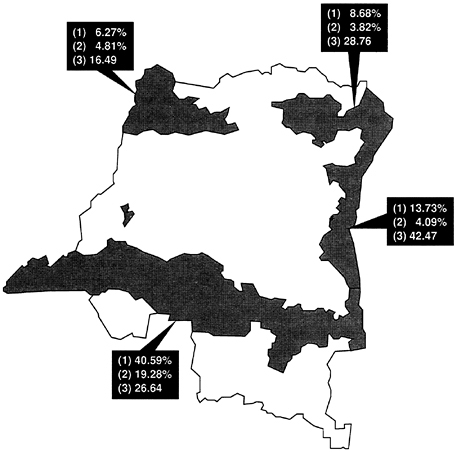
FIGURE 2 Areas of population concentration in Zaire. (1) Percent total population. (2) Percent total land area (square kilometers). (3) Population density per square kilometer. Source: Government of Zaire and the Canadian International Development Agency. 1990. Plan d'Action Forestier Tropical. Vol. I, Annex 2. Forestry Map. Kinshasa, Zaire, and Ottawa, Canada: Government of Zaire.
in the northern rim along the border (Figure 1, area 2a) and in the montane forests of Kivu (area 3); and with depleted woodlands and wooded savannahs in the south, Bandundu, and southwestern, Shaba, areas of the country (Figure 1, areas 4a and 4b). These areas are highly urbanized and heavily populated. Figure 2 shows that about 70 percent of Zaire's estimated population of 35 million (1988 estimate) lives on less than 33 percent of the total land area.
The population concentration associated with large urban centers is clustered along three major areas: the west-southeast band, which extends from the lower Zaire River region (Bas-Zaire) through Kinshasa
to north Shaba; the mid-southeast/northeast band, which extends from north Shaba across the Kivu region to the higher Zaire River region (Haut-Zaire); and the densely populated centers of Gemena in the Equateur region and Kisangani and Isiro in the Haut-Zaire region. This pattern of population concentration is, to some extent, related to the relatively fertile soils (derived from volcanic materials and known to support agriculture), particularly in the Kivu region, and also to the uneven pattern of economic growth, urbanization, and administration established by the colonial government. This pattern has been reinforced in the postindependence era beyond the capacities of current physical and social infrastructures, especially in the major urban centers. The forestland areas in the three major areas with the highest population concentrations are the most impoverished and depleted.
The declining income of the rural population, because of the government 's inadequate pricing and market policies and general neglect of agriculture, has caused farmers to stress cultivation practices beyond their technical limits. In addition, to compensate for declining yields and low prices, farmers have had to bring more forestland into cultivation to sustain their families, thus aggravating the permanent removal of natural forests (Government of Zaire and the Canadian International Development Agency, 1990).
INSTITUTIONAL ARRANGEMENTS AND POSSIBLE REFORMS
Responsibility for forest resources management in Zaire has shifted frequently in the past 20 years as ministries and agencies have been reshuffled, reorganized, or relabeled. One constant has been that the department responsible for forestry, DLAENCT, been the orphan child of the Ministry of Agriculture, Rural Development and Extension or the Ministry of Land Affairs or the Ministry of Tourism. DLAENCT was always several steps removed from the centers of financial, personnel, and political decision making, for example, the president's office and the National Executive Council. As a subordinate entity to a larger ministry, DLAENCT always fell prey to overriding national budget priorities within the agricultural sector. In fact, although DLAENCT has been separated from the Department of Agriculture for some time, its budgetary allocation is still often combined with that of the Department of Agriculture. It amounted to about 0.4 percent of the country's total operating budget in 1985 and rose slightly to 0.5 percent in 1987 (compared with an average of 1.1 percent for agriculture during 1985–1987 [World Bank, 1986:Table A, Annex A]). Moreover, these budgetary allocations fall far short of actual spending because of unusual central financial control practices; that is, the
line ministries are not allowed to spend the amounts allocated to them.
Despite these meager budgetary allocations, DLAENCT's mandate has broadened over the years to include the goals of revenue generation, forest conservation and wildlife protection, and the development of local community-based forests. These objectives are in addition to the traditional goal of forest service management in spite of the fact that there is some agreement that DLAENCT sufficiently structured or empowered to effectively formulate appropriate policies or to implement relevant strategies for dealing with sustainability and resource management issues in the forestry sector.
In Zaire, austerity measures arising from the economic adjustment programs of recent years have lead to chronic problems for DLAENCT: inadequate funding and staffing, delinking of budget allocations from the amount of revenue generated from forestry activities, and a narrow and short-term view of forest resource exploitation. All of these are incompatible with long-term and sustainable resource management. Since civil service salaries today have declined dramatically in real terms to about 20 percent of their level 10 years ago, it is not surprising that the focus of DLAENCT is on the more lucrative and most visible aspects of its management activities: logging concessions and negotiations with large companies. These transactions can yield tangible individual recognition and monetary benefits to participants, often in the form of legal and illegal, but tolerated, payments.
The monetary returns on activities such as community-based forestry programs are low, however. DLAENCT lacks an active social, economic, and political constituency with vested interests in DLAENCT's objectives of forest management on a sustainable yield basis. There seems to be a lack of concern about the control and ownership of forestlands by local communities and the need to train a national cadre of technocrats to design suitable corrective policies and institutions to carry out these policies.
DLAENCT also has a responsibility to serve small-scale foresters. The government should adequately concentrate on their needs by establishing community-owned and -managed forests and providing agroforestry extension advice. Therefore, an urgent need in DLAENCT is a well-trained cadre of technocrats with the ability to inventory the forest and design corrective policies. There also needs to be appropriate administrative and financial support to implement those policies.
It follows that training of skilled (secondary school education level) as well as advanced-level technicians (post-secondary school
education level) is also needed, as suggested by the Department of Land Affairs, Environment, Nature Conservation, and Tourism and International Institute for Environment and Development, World Resources Institute (1990). This could be accomplished by providing basic training in Zaire and specialized graduate training overseas. This would provide support for and serve to strengthen the forestry option at the Bengemisa College of Agronomy and the regular 5-year agronomy/forestry program proposed for the University of Kinshasa and the University of Kisangani at Yangambi.
Given the autonomy of each campus within the National University of Zaire and the agricultural and forestry development challenges facing each university's surrounding community, it makes sense for each campus to have a B.S.-level agronomy/forestry program. Although traditional training in forestry has focused on providing students with forest management skills (for example, forestry management regulations and measurement techniques), what is needed is a much stronger orientation in environmental and resource management, with a specific emphasis on problem-solving abilities related to research and policy.
Given the autonomy of each campus, however, it will be difficult to use all three separate campuses in the most economic manner. One possibility is a central core curriculum at each university, with optional curricula distributed among the three campuses. Ultimately, however, it will be necessary to send graduate students overseas for specialization, for example, to study environmental sciences and sustainable agriculture practices, including those related to forestry.
There is a critical need to understand how key forest management institutions such as DLAENCT function and the institutional reforms that are required to make them function better. Given the nature of critical or sectoral linkages among forestry institutions in Zaire, the second-class stature of DLAENCT within the power structure of the government erodes its coordination capacity with other key departments that address forestry and sustainable agriculture, such as energy, transport, rural development, and agriculture.
In sectoral matters such as access to and ownership of forestland, fuelwood harvesting, soil erosion, and reduced fertility caused by shifting cultivation practices, the opinions of the DLAENCT are the informed voice in the government, and these opinions must have great weight in decision making. The prerequisite for such intersectoral linkages is that DLAENCT be given a greater role in policy formation and implementation. It must also be given greater prominence in forestry matters vis-à-vis the central decision-making departments (for example, central planning, finance, and the president's office).
Cooperation and coordination between the institutions and the departments that address the forestry needs of Zaire are absolutely necessary.
SUGGESTIONS FOR SUSTAINABLE MANAGEMENT
Sustainable management will not be possible until the limited and unreliable data base on Zaire's forest cover, causes and extent of deforestation, and corrective measures is expanded with verifiable information.
Research Agenda
The following two-phase research agenda is proposed.
PHASE I: AGRICULTURAL AND FORESTRY AGENDA
Concurrently with field trials, there should be a detailed forestry survey of the following five regions: Yuki, Kisangani, Mayumbe (the Tshela site), Yamgambi, and Kaniameshi.
-
Yuki is in the Bandundu region in the heart of the central basin rain forest where ebony trees are logged for export and low-value species are used for charcoal for Kinshasa.
-
Kisangani is on the fringes of the central basin rain forest just north of the equator. Logging in this area is entirely for local consumption.
-
Mayumbe, in the Mayumbe forests of lower Zaire, is an area where large logging companies cut timber for export.
-
Yamgambi is the region where the corridor system was tried before the independence of Zaire in 1960. Yamgambi is located about 100 km from Kisangani and is the site of the National Agronomic Research Institute.
-
Kaniameshi is on the fringes of open wooded savannah forests in southern Shaba near the Zambian border.
These savannah forests are subject to shifting-cultivator's seasonal brush fires, an important land-clearing practice. There is a need to field test low-input types of farming systems to alleviate the destructive effects of shifting cultivation even in areas with relatively low population density (see Table 9).
Ongoing research on various agroforestry systems implemented in other tropical countries should be tested in Zaire at the five selected sites to determine whether these systems are suitable to spe-
cific ecosystems within Zaire. (Table 9 supplies available data from some of these five sites.) This research will require staff at all levels and must be a long-term effort that leads to lasting results on the suitability of specific agroforestry systems. It must include those subjects pertaining to forestry that environmental scientists deem necessary, as defined by FAO (1981a). The objective is to assess problems of ecosystems and devise the means to correct these problems (see Table 9). The most promising and suitable farming systems will then be replicated and strictly observed at 12 other sites representative of different forest growth systems. Again, there will be a need for trained staff.
Some of the systems that should be tested at these sites are alley cropping, unproved fallow, low-input cropping, livestock pasture, forest/ farming mosaic, continuous cropping, and the corridor system. The corridor system has been practiced in Yamgambi (Jurion and Henry, 1969) and was found to be technically and economically viable, but it was terminated because it restricted the movement of a population traditionally accustomed to the nomadic life of shifting cultivation (Ruthenberg, 1971). Local culture and practices must be considered and incorporated into any research practice implemented.
Because commercial logging is done on exclusive private concessions, it will be necessary to collect data from areas proximate to commercial production areas if access to private concessions is not possible.
PHASE II: EXTENSION OF DATA AND SERVICES TO POTENTIAL USERS
Large- and small-scale operators and, in particular, those who practice shifting cultivation must be made aware of the results of Phase I and all research and resources must be made available to them. Therefore, an efficient extension service with appropriately trained personnel will be required.
Human Resources Development
The pervasive shortage of well-trained staff in forestry and environmental management at all levels—technical, undergraduate, graduate, and specialized—must be rectified by extension workers, including those already employed, trained to carry out the requirements of the improved and restructured programs. There should be courses for in-house staff, training at Zaire's three universities mentioned above, and specialized training at overseas institutions.
TABLE 9 Proposed Agricultural and Forestry Research: Selected Commercial Logging Sites, Deforestation, and Charcoal Production
|
A. Site-Specific Characteristics |
|||
|
Logging Company (Year of Establishment) |
Location |
Soil Type |
Altitude (m) |
|
Siforzal (1950) |
Kisangani (northern central basin) |
Oxisol |
485 |
|
Onatra (publicly owned) (1896) |
Yuki (central basin) |
Oxisol |
500 |
|
Agrifor Forescom (publicly owned) (1883) |
Tshela (south) |
Ultisol |
300 |
|
B. Soil and Weather Data for Locations Close to the Three Sites in Part A |
|||||||||
|
Location |
Horizon |
Depth (cm) |
pH |
Calcium |
Potassium |
Cation Exchange Capacity |
Clay |
Silt |
Sand |
|
Yangambia |
A11 |
0–22 |
4.1 |
0.3 |
0.07 |
5.3 |
14.3 |
3.2 |
82.5 |
|
A12 |
22–45 |
4.4 |
0.3 |
0.05 |
3.7 |
18.3 |
4.2 |
77.5 |
|
|
A/B |
45–60 |
4.3 |
0.4 |
0.04 |
3.8 |
19.8 |
3.8 |
76.4 |
|
|
B21 |
60–220 |
4.5 |
0.5 |
0.05 |
3.0 |
20.9 |
3.6 |
73.5 |
|
|
B22 |
220–250 |
4.3 |
0.3 |
0.03 |
2.5 |
19.4 |
3.2 |
77.4 |
|
|
Yuki, Lodjab |
A1 |
0–8 |
4.1 |
0.85 |
0.06 |
4.25 |
11.8 |
1.5 |
86.7 |
|
A31 |
8–23 |
4.1 |
0.30 |
0.04 |
2.95 |
11.1 |
1.4 |
87.5 |
|
|
A32 |
23–38 |
4.2 |
0.80 |
0.03 |
2.1 |
17.1 |
2.1 |
81.8 |
|
|
B21 |
38–85 |
4.3 |
0.50 |
0.06 |
1.6 |
15.5 |
2.0 |
82.5 |
|
|
B22 |
85–200 |
4.5 |
0.55 |
0.06 |
1.5 |
17.6 |
1.7 |
81.7 |
|
|
Tshelac |
A1 |
0–18 |
5.1 |
2.0 |
0.19 |
6.7 |
38.4 |
8.0 |
53.6 |
|
A3 |
18–38 |
4.9 |
1.3 |
0.04 |
6.4 |
43.6 |
7.8 |
48.6 |
|
|
B2t1 |
38–63 |
4.7 |
1.0 |
0.02 |
5.3 |
54.6 |
6.5 |
38.9 |
|
|
B2t2 |
63–98 |
4.7 |
0.7 |
0.02 |
4.5 |
52.8 |
6.3 |
40.9 |
|
|
B31 |
98–150 |
4.9 |
0.7 |
0.02 |
5.2 |
54.8 |
6.0 |
39.2 |
|
|
B32 |
150–200 |
5.0 |
4.3 |
59.1 |
7.0 |
33.9 |
|||
|
a The elevation of Yamgambi is ±500 m, rainfall is 1,875 mm/year, and the soil is typic haplorthox. b For Yuki, Lodja (a research station site), data for forested Kasai are used. The elevation of Yuki is ±625 m, rainfall is 1,800 mm/year, and the soil is typic eutrorthox. c For Tshela, data for Mayumbe are used. The elevation of Mayumbe is ±300 m, rainfall is 1,000 mm/year, and the soil is oxic paleustult. SOURCES: (Part A) Kande, M. 1991. Draft doctoral dissertation. NorthCarolina State University, Raleigh; Sys, C. 1972. CaracterisationMorphologique et Physico-Chimique de Profils Types de l'Afrique Centrale.Serie Hors, Publications INEAC. Brussels: Institut National d'EtudesAgronomiques du Congo. (Part B) Jurion, J., and J. Henry. 1969. CanPrimitive Farming be Modernised? Serie Hors, Publication INEAC. Brussels:Institut National d'Etudes Agronomiques du Congo; Smith, G. D., C.Sys, and A. Van Wamberke. 1975. Application of Soil Taxonomy to theSoils of Zaire (Central Africa). Bulletin de la Africa. Bulletinde la Societé Belge de Pedologie; N. Spec. 5. Brussells: Societeé Belge de Pedologie; Sys, C. 1972. Caracterisation Morphologiqueet Physico-Chimique de Profils Types de l'Afrique Centrale. SerieHors, Publications INEAC. Brussels: Institut National d'Etudes Agronomiquedu Congo. |
|||||||||
Land Tenure Policies
Community-owned and -managed forests with proper reforestation will not be possible in Zaire until the land tenure and land ownership rights of local communities are more secure. Whatever laws do exist, they appear to be applied in such a way as to favor large commercial operators. Therefore, the existing relevant laws must be modified. The new regulations must be structured to strengthen communal or local government and individual ownership rights and to ensure that enforcement of all forestry laws and regulations is uniform.
Strengthening the Forestry Department
Forestry policy formulation and the implementation of forestry projects involve the ministries of DLAENCT—agriculture, rural development, environmental—and the transportation ministry. These ministries have a significant impact on forestry management policies; therefore, coordination and consultation between these ministries on matters pertaining to forestry should be mandated in any government policy to minimize conflict. Furthermore, the budget should clearly state what funds are disbursed directly for forestry.
Funding
The government of Zaire has stated to its citizens and to international organizations that it wishes to sustain its environment. This statement should be translated into action. All funds allocated to sustaining forestry should be spent for that purpose, fair and responsible taxation policies should be augmented, and agencies that provide aid that supports sustainable agroforestry systems should commit to a long-term but strictly monitored environmental and resource management system in Zaire.
With some modifications and refinements, these suggestions will meet the objectives for formulating appropriate measures and policies to avoid the potentially disastrous effects of the destruction, depletion, and degradation of tropical forest cover in Zaire.
ACKNOWLEDGMENTS
The authors express their gratitude to the School of Agriculture and Home Economics of Tuskegee University and the George Washington Carver Agricultural Experiment Station for the valuable sup-
port they provided. Matungulu Kande of North Carolina State University at Raleigh and of the Faculty of Agronomy, University of Kisangani, Kisangani, Zaire, deserves special credit for sharing so generously of his private data base and collections on Zaire during his May 1991 visit to Tuskegee University. Finally, the authors are much indebted to a group of dedicated support staff in the School of Agriculture and Home Economics, Tuskegee University, especially Mary Cade, Judy Kinebrew, Sibyl Caldwell, and Marva Ballard.
REFERENCES
Blyth, J. E., Jr., J. Tibben, and W. B. Smith. 1984. Primary Forest Product, Industry and Timber Use, Iowa, 1980. USDA Research Bulletin NC-82. Washington, D.C.: U.S. Department of Agriculture.
Capistrano, A. D. N. 1990. Macroeconomic Influences on Tropical Forest Depletion: A Cross-Country Analysis. 1967–1989. Ph.D. dissertation. University of Florida, Gainesville.
Department of Land Affairs, Environment, Nature Conservation, and Tourism and International Institute for Environment and Development , World Resources Institute. 1990. Zaire Forest Policy Review. Draft Summary Report. Kinshasa, Zaire: Department of Land Affairs, Environment, Nature Conservation, and Tourism, and Washington D.C.: World Resources Institute.
Food and Agriculture Organization and United Nations Environment Program. 1981a. Tropical Forest Resources Assessment Project. Forest Resources of Tropical Africa. Part I. Rome, Italy: Food and Agriculture Organization of the United Nations.
Food and Agriculture Organization. 1981b. Tropical Forest Resources Assessment Project. Forest Resources of Tropical Africa. Part II. Rome, Italy: Food and Agriculture Organization of the United Nations.
Government of Zaire and the Canadian International Development Agency. 1990. Plan d'Action Forestier Tropical. Vols. I and II. Kinshasa, Zaire, and Ottawa, Canada: Government of Zaire.
Hines, D. 1988. Zaire Forestry Resources: Economic and Policy Perspectives. Working Paper. Washington, D.C.: World Resources Institute.
International Society of Tropical Foresters News. 1990. Log and sawnwood sources reported. Int. Soc. Trop. Foresters News 11(4):9.
Jurion, F., and J. Henry. 1969. Can Primitive Farming Be Modernised? Hors Serie, Publications INEAC . Brussels: Institut National d'Etudes Agronomiques du Congo.
Kande, M. 1991. Draft doctoral dissertation. North Carolina State University, Raleigh.
Ruthenberg, H. 1971. Farming Systems in the Tropics. London: Oxford University Press.
Smith, G. D., C. Sys, and A. Van Wamberke. 1975. Application of Soil
Taxonomy to the Soils of Zaire (Central Africa). Bulletin de la Societé Belge de Pedologie, N. Spec. 5. Brussels: Societé Belge de Pedologie.
Sys, C. 1972. Characterisation Morphologique et Physico-Chimique de Profils Types de l'Afrique Centrale. Serie Hors, Publications INEAC. Brussels: Institut National d'Etudes Agronomique du Congo.
U.S. Department of Agriculture, Economic Research Service. 1990. World Agriculture: Trends and Indicators, 1970–1989. Statistical Bulletin No. 815. Washington, D.C.: U.S. Department of Agriculture.
U.S. Department of State. 1988. Zaire Background Notes. Washington, D.C.: U.S. Department of State.
World Bank. 1986. Zaire: Toward Sustained Agricultural Development. Agriculture Sector Memorandum. Washington, D.C.: World Bank.
World Bank and United Nations Development Program. 1983. Zaire Energy Assessment Report. Washington, D.C.: World Bank.
World Resources Institute (WRI). 1988. Zaire Forestry Policy Review and Related Studies. Draft Summary Report. Kinshasa, Zaire, and Washington, D.C.: World Resources Institute.
WRI. 1990. World Resources 1990–91. New York: Basic Books.


