
2
FEDERAL MANAGEMENT AND SUPPORT
Federal support of plant-science research in the United States now comes chiefly from the U.S. Department of Agriculture (USDA), the National Science Foundation (NSF), the Department of Energy (DoE), and the National Institutes of Health (NIH). Other agencies that provide lesser support are the Department of the Interior, the National Aeronautics and Space Administration, the National Oceanic and Atmospheric Administration, and the Office of Naval Research.
The information in this section of the report is taken from a variety of public sources. Much of the data and inferences we present are based on reports from NSF (NSF, 1990b) and the American Association for the Advancement of Science (AAAS, 1990). Analysis and comparisons are difficult because the data were generated for a variety of purposes. Agencies report expenditures and other data with different definitions of disciplines and without agreement about whether specific research programs are "basic" or "applied" and whether grants are "competitive" or "noncompetitive.'' Thus, the expenditure figures in this report are best estimates based on the committee's interpretations. The data describe a patchwork of funding for plant research in the United States from five federal agencies with different policies and practices.
THE FEDERAL INSTITUTIONS
U.S. Department of Agriculture
The research programs of USDA began in the land grant colleges with the signing of the Morrill Act in 1862. (A history
of the origins and provisions of the formula grant program can be found in Kerr, 1987.) In 1887 the Hatch act provided annual funding to support state agricultural experiment stations. The Smith-Lever Act of 1914 established cooperative extension programs at the land grant colleges. In 1962, the McIntire-Stennis Act gave funding to public colleges and universities for forestry research and graduate programs.
USDA agencies that conduct a significant amount of plant-biology research include the Agricultural Research Service (ARS), the Cooperative State Research Service (CSRS), and the Forest Service (FS). ARS and CSRS are under the Assistant Secretary for Science and Education and FS is under the Assistant Secretary for Natural Resources and the Environment. CSRS supports research scientists primarily associated with land-grant college and university agriculture experiment stations (AES). ARS and FS have intramural research programs in agriculture and forestry, respectively. USDA intramural research is also performed at research centers and by scientists located at universities.
The primary focus of this analysis of USDA plant-biology research is on CSRS and its three principal mechanisms of support. These are formula funding to State Agricultural Experiment Stations associated with land-grant colleges and universities, Special Research Grants that are either Congressionally earmarked to specific research programs or are awarded competitively, and competitive grants.
Formula funding is commonly referred to as base support for agriculture experiment station scientists and is spent largely at the discretion of individual AES directors. The majority of the funds are used for salary support.
The CSRS competitive grants program under the National Research Initiative supports peer-reviewed, investigator-initiated grants in six major categories, two of which, plant systems and natural resources and the environment, are directly relevant to plant-biology research. When the NRI is fully funded, $250 million annually will be devoted to supporting grants in these two categories.
The distribution of funds among these programs is shown in Table 1.
Table 1 Actual and estimated USDA expenditures for research and development, 1989 to 1991, for selected areas, in millions of dollars
|
|
FY 1989 Actual |
FY 1990 Estimate |
FY 1991 Budget |
|
Agricultural Research Service |
525.3 |
546.9 |
587.8 |
|
Cooperative State Research Service |
307.9 |
324.9 |
335.4 |
|
Competitive research grants |
39.7 |
42.5 |
100.0 |
|
Agricultural experiment stations |
155.5 |
155.1 |
158.5 |
|
Cooperative forestry research |
17.5 |
17.3 |
13.0 |
|
1890 colleges and Tuskegee |
24.3 |
27.7 |
31.5 |
|
Special research grants |
45.6 |
56.3 |
25.6 |
|
Alternative crops research |
1.0 |
0.3 |
0.9 |
|
Agriculture productivity |
4.5 |
4.4 |
4.5 |
|
Other |
19.8 |
21.3 |
1.4 |
|
Forest Service |
138.3 |
148.0 |
160.0 |
|
Source: Excerpted from Table II-15, AAAS, 1990. |
|||
Funding for Plant-Science Research
USDA provides by far the largest amount of federal funding for plant-science research, and the scientific questions addressed are justified primarily by their applicability to the production and processing of agricultural and forest products.
In response to our inquiry, USDA's Current Research Information Service provided data on funding for plant research. In 1988, USDA allocated $300 million for its intramural program of research in plant sciences administered by the Agricultural Research Service. About $100 million was
allocated through CSRS; $70 million was awarded by other USDA units for research on plants at AES and other cooperating institutions. Under the provisions of the Hatch Act and the McIntire-Stennis Act that govern CSRS allocations to the states, state governments must match (often by multiples of twice or more depending on the specific funding authority) the formula funds received from the federal government. Total formula-based funding far exceeds the federal contribution because of this state participation in plant-science research.
Of the total USDA allocation reported to the committee, 94% is non-competitively awarded to land grant colleges for support of intramural research by Agricultural Research Service (ARS) employees and scientists at state agricultural experiment stations, and for special grants, often awarded at the direction of Congress. Some of the institutions that receive formula funds use a system of intramural peer review of investigator-initiated proposals as a basis for distributing the funds, but local peer review seldom is as rigorous as is peer review by NIH, NSF, or the NRICGP.
Support for Training
USDA formula funds provided to the states can be used for training as well as research and many research assistants are supported by funds received by their supervisors. ARS has a program that supports about 20 postdoctoral fellows. However, USDA and other federal programs explicitly designed to train the next generation of scientists for careers directed to agriculture, food, and the environment are relatively new and only modestly supported.
The Food and Agricultural Sciences National Needs Graduate Fellowships Grant Program, which began in 1984 by supporting 302 predoctoral trainees, supported only 58 predoctoral fellows in 1989. Some grants were for plant
research; for example, in plant biotechnology and forestry (USDA, 1990a). Many graduate students and perhaps a few postdoctoral fellows are supported by funds received by their supervisors from USDA under the formula grant system.
Competitively Awarded Research and Training Grants
A distinctive feature of CSRS funding of plant biology at academic institutions is that most grants are allocated to selected institutions by formula rather than through open competition among scientists in all research laboratories. The program of the Competitive Research Grants Office (CRGO, now NRICGP) originated in 1978 to award USDA funds competitively. The competitive-grants research program was a major departure from other USDA programs. All scientists at U.S. institutions working on science questions pertinent to a range of identified needs of U.S. agriculture are eligible to apply for funds. Its initial appropriation, in 1978, was $15 million; in 1990, it made awards of about $46 million, including about $27 million for projects in the plant sciences. Stimulated by the National Research Initiative (USDA, 1990b), NRICGP funding grew to $73 million in 1991 and is projected to grow to about $100 million in 1992. When the initiative is fully funded at a total of $500 million, it is projected to budget $125 million for research in plant systems. Another $125 million is scheduled for the plant-biology related program in natural resources and the environment.
Table 2 and Figure 3 show competitively-awarded funds for plant-biology research from federal agencies.
Table 2 Federal competitive grant awards for plant-science research, 1990a
|
Agency |
|
Awards |
|
Department of Agriculture Competitive Research Grants Office (excluding animal research) |
|
$26,978,318 |
|
Department of Energy Division of Energy Biosciences |
|
18,668,092 |
|
National Aeronautics and Space Administration Division of Life Sciences |
|
3,200,000 |
|
National Institutes of Health National Institute of General Medical Sciencesb |
|
12,500,000 |
|
National Science Foundation, Directorate for Biological, Behavioral and Social Sciences (BBS) |
|
69,854,198 |
|
Division of Molecular Biosciences |
15,790,736 |
|
|
Division of Cellular Biosciences |
19,178,209 |
|
|
Division of Instrumentation and Resources |
|
|
|
Special Programs of BBS |
2,764,789 |
|
|
Instrumentation and Instrumentation Development |
496,508 |
|
|
Division of Biotic Systems and Resources |
|
|
|
Ecosystem Studiesc |
17,029,316 |
|
|
Biological Research Resourcesd |
1,189,585 |
|
|
Ecology Program |
3,886,764 |
|
|
Systematics Program |
5,569,181 |
|
|
Population Biology and Physiological Ecology |
3,949,110 |
|
|
Total |
|
$131,200,608 |
|
a Some awards made in fiscal year 1990 are multiyear awards. b Estimate for research on higher plants. c Estimate includes the entire program's expenditures. d Collections used in support of plant-biology research. |
||
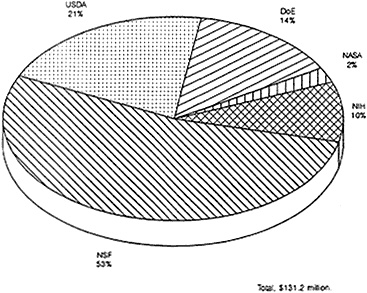
Figure 3 Percentage distribution among federal agencies of competitive awards funding for plant-science research, fiscal year 1990.
Department of Energy
The DoE Division of Energy Biosciences provided about $18.7 million in support of plant-science research in 1990 as part of its mission to explore biologic processes of potential use in energy production. The division uses a merit review system for decisions about awards of grants. After determining that a proposal meets basic standards of scientific merit, completeness, and compatibility with the DoE mission, agency project managers use DoE personnel and, in most cases, an ad hoc panel of external experts, to review the applications. DoE staff members interpret the reviews and discussions and make grant award decisions.
DoE-supported research is performed primarily in universities (80% of all funds and 87% of all grants awarded by the Division of Energy Biosciences in 1990) and national laboratories (11% of all funds) and it includes basic biologic studies of plant physiology, biochemistry, pathology, and genetics. Of the 172 projects funded by the Energy Biology Program in 1990, 150 were at universities and nonprofit institutions. Fifteen of that number went to the Michigan State University Plant Research Laboratory and two went to other University Plant Science Centers. Of the other 22 projects, 12 were at three national laboratories; the remaining 10 were at a variety of institutions.
DoE provides major support to several institutions. The Plant Research Laboratory at Michigan State University, which has been supported by DoE for many years and is subject to regular review, received $2.6 million in fiscal year 1990. The University of Georgia, including the Complex Carbohydrate Research Center, had about $3.5 million in grants in 1990 (many are for multiyear support). The Center for the Study of Early Events in Photosynthesis at Arizona State University received $1.2 million in 1988 to cover 30 months. (All of the above data are from DoE, 1990)
National Science Foundation
The NSF Directorate of Biological, Behavioral, and Social Sciences (BBS) provides about $70 million annually in support of plant-biology research. NSF is the largest federal provider of competitively awarded research grants in basic plant biology, and support for this area accounts for almost 25% of all funds awarded by BBS. Funding comes from the BBS Divisions of Molecular Biosciences, Cellular Biosciences, Instrumentation and Resources, and Biotic Systems and Resources and from specific programs within the divisions, which represent a wide
array of disciplines, including ecology, systematics, and population biology.
NSF's review procedure invests significant decision-making authority in program managers, who obtain advice from a standing advisory committee and outside reviewers. Program managers' decisions are reviewed and approved by the heads of the divisions and the directorate.
NSF support for research is part of its extensive program of research grants, symposia, and other meetings, and its funding of instrumentation and resources. The foundation provides support for several large-scale projects: It received $4.4 million for 1991 in support of the Arabidopsis genome project, a major initiative in plant-biology research (NSF, 1990a). A Michigan State University science and technology center focusing on microbial ecology is supported by NSF. Another center, for developing strategies to engineer plants for resistance to pathogens, was founded in 1991 at the University of California, Davis. Center awards are made competitively for fixed terms and are subject to periodic review.
Included in this NSF support is more than $2 million for about 80 postdoctoral fellowships and approximately $500,000 for about 20 Presidential Young Investigators who work on basic plant biology. Some predoctoral fellowships in plant sciences are provided through the NSF Education Directorate. In late 1990, BBS awarded its first 10 training grants, including one from the BBS Research Training Groups Program for a plant-cell-biology program at the University of California, Davis. The training grants typically support five to 10 graduate students as well as undergraduates and postdoctoral fellows. Grants are about $1.5 million each for five years and can provide funds for instrumentation. These training grants are an important new initiative in NSF funding.
National Institutes of Health
In keeping with its focus on studies of basic biologic processes, NIH provided through the National Institute of General Medical Sciences (NIGMS) about $12.5 million in 1990 for research on higher plants through investigator-initiated, competitively awarded grants. We have not included in our summary about $45 million awarded by NIGMS for research on yeast models. All NIH grants and fellowships are awarded competitively on scientific merit, as judged by study sections of scientific peers.
Multiagency Cooperation
Federal organizations cooperate in support of research. For example, USDA, DoE, and NSF decide together on how to support centers such as the one for the study of complex carbohydrates at the University of Georgia and the center for the study of lipid and starch biosynthesis at Michigan State University. However, for administrative reasons, such centers are funded by one agency-for example, DoE, in the case of the University of Georgia, and USDA, in the instance of Michigan State University. An Interagency Plant Science Committee has representatives from USDA, NIH, DoE, NSF, the Department of the Interior, the National Aeronautics and Space Administration, and the Office of Naval Research; it meets regularly to discuss issues of common interest. The Arabidopsis Genome Research Project is coordinated under an interagency agreement among NSF, the NIH National Center for Human Genome Research, USDA, and DoE. In September 1991, USDA, DoE, and NSF signed an agreement to continue their joint program on collaborative research in plant biology.
IMPEDIMENTS TO AN EFFECTIVE PROGRAM OF BASIC PLANT-BIOLOGY RESEARCH
The committee members have pooled their experience and compiled information obtained in interviews with other scientists in formulating the following list of impediments to plant-biology research and training. The committee has considered the issues within a framework that rests on three main principles:
-
Basic research to elucidate fundamental processes often leads to unexpected results that can have great practical value.
-
Science progresses best when the ideas for research are conceived and the work performed by researchers in individual laboratories rather than by highly managed teams or groups focused on applied research.
-
An important responsibility of an academic community is education and training that will provide a steady stream of new investigators.
Lack of Focus on Plant Science as an Important Basic Biology Discipline
Most of the federal funds that support research in the plant sciences are allocated for programs that target practical problems rather than the understanding of basic plant processes. Biomedical research is directed toward practical questions, but NIH has emphasized basic biomedical research. That philosophy and NIH's generous funding have produced a continuing stream of discoveries in medicine, the development of a new biotechnology industry, and worldwide U.S. leadership in biomedical research.
Plant Sciences are Isolated from Other Disciplines of Biology
Land grant universities have been the primary source of research and graduate education in the plant sciences. Of 724 Ph.D. recipients in plant biology in 1988–1989, 90% were from land grant universities (NSF, 1990b Table A 11). The pattern differs dramatically in biomedical research, in which one-third of the doctorates are awarded by private universities.
The absence of plant-science research and training programs from many of the institutions where health-related research has flourished has reduced the opportunities for communication between disciplines and worked to the disadvantage of both research areas. The divergence has become more pronounced with the rapid advance in knowledge of molecular processes. Plant biology programs often are isolated from other research and teaching in biology, even in broadly based and productive institutions. There are exceptions, and some schools, both public and private, have highly effective research and training in the full range of biologic systems, including prokaryotic, fungal, plant, and animal biology.
Funding for Basic Plant-Biology Research is Insufficient
The $131.2 million in federal money spent by a variety of entities in fiscal year 1990 on competitively awarded grants for basic plant-biology research is small compared with the amount spent on many other federal scientific research programs. NIH institutes range in expenditures from $115 million for the new National Institute of Deafness and Communications Disorders to $1.6 billion for the National Cancer Institute. The institute median is about $450 million. About 80% of the expenditures
are for extramural research. The budget of NIGMS (the institute closest in spirit to the model we propose for an institute of basic plant biology) was $629 million in 1990 (AAAS, 1990). In comparing basic plant biology with basic biomedicine, it is apparent that plant biology lacks a coherent program and adequate financial support for training and research.
Total federal support for basic research in 1990 was $11.4 billion; about $5.2 billion went for basic life-science research (NSF, 1990c). The $131.2 million of competitively awarded funds for basic plant biology was only 2.5% of the total expenditure for life-science research.
Funding is Awarded to Specific Institutions
USDA's research support is directed predominantly to land grant universities and to intramural research at ARS. Much of the support is awarded by formula to qualifying land grant institutions. The money is used effectively, but it is not available to investigators at other institutions, including those at which a substantial portion of the nation's high-quality biologic research is conducted. In addition, only those faculty at land grant institutions who have agricultural experiment station appointments have access to formula funds.
Grants for Plant Research are Smaller
The awards from peer-reviewed grant programs at NSF, DoE, and NRICGP are typically less than $100,000 per year for a term of two or three years. In comparison, the average grant from the National Institute of General Medical Sciences is $170,000 per year for four years (USDHHS, 1991). The short-term, small grants for plant research are usually just adequate
to provide salary for perhaps two trainees plus a modest amount for laboratory operating expenses and overhead. As a consequence, the development of a plant-science research laboratory large enough to compete effectively in today's world of science requires that an investigator acquire several small grants and submit new proposals frequently. This constraint tends to focus research into small, short-term packages, often molded to match the missions of different granting agencies.
Financial Support for Training in Plant Sciences is Inadequate and Undependable
Funding for direct support of predoctoral and postdoctoral training in plant sciences is commonly inadequate and undependable. In 1984, $5 million was appropriated to establish the USDA National Needs Graduate Fellowship Program, which enabled 302 students to enroll in a wide range of graduate degree programs; funding ceased in 1986. In 1987, USDA provided $2.8 million for new fellowships, and this funding remained constant for fiscal year 1989. USDA has been unable to provide sufficient funding or to sustain the modest programs it has begun. ARS has a program in support of about 25 postdoctoral fellowships in ARS laboratories.
NSF's support of training is modest and the substantial NIH support is not directed primarily toward development of plant scientists. NSF (1990b) reported that there were 7,317 graduate students in plant biology disciplines and about 1,120 postdoctoral fellows in 1988–1989. Federal fellowships support 7% of the postdoctoral trainees and 4% of the graduate students, whereas federal research grants support 21% of the graduate students and 53% of the postdoctoral fellows. Graduate students also receive support from various other sources, including institutions (28%), state governments (15%), and personal funds (11%). Other sources of support for
postdoctoral fellows include state governments (11%), foreign governments (7%), and industry (7%). Compared with a total of about 2,100 federally supported trainees in plant biology, NIH supported about 11,000 predoctoral and postdoctoral trainees in human health through fellowships and perhaps another 4,500 through research grants in 1989 (IOM, 1990).
Although the elements of a desirable training sequence exist in the form of fellowships and some support for training, they are unconnected-pipes, not a pipeline. The current system for the support of undergraduate, graduate, and postdoctoral training lacks the structure and continuity necessary for ready progression from one level to the next.
-
At the undergraduate level, plant science often is missing from departments of biology. This is especially true in private universities; only 280 (6%) of a total of 4,517 full-time plant biology faculty were at private institutions in 1988–1989 (NSF, 1990b, Table A-3). Thus, many undergraduates are never exposed to plant biology.
-
At the graduate level, eight of the 25 top-ranked universities in order of receipt of federal funds for life science research do not have doctoral programs in plant biology (NSF, 1990b).
-
Many schools that do teach plant biology fail to provide adequate training for undergraduates who wish to pursue careers in plant research. Undergraduates often do not have the basic scientific training required to compete for entrance to the available graduate programs in basic biology.
-
Insufficiently rigorous training of students has a negative effect on plant-biology research. In a recent NSF poll, 53% of the representatives of major academic programs in plant biology cited ''poor quality of graduate and undergraduate students'' as a factor that limited progress in plant biology (NSF, 1990b, Figure 11).
-
Although NSF and NIH provide some postdoctoral awards for plant biologists, neither supports the substantial amount of graduate training in plant biology that is prerequisite for postdoctoral work.
The Need for Instrumentation and Facilities is Critical
A survey of instrumentation and facilities needs for agricultural biotechnology, conducted at 13 representative U.S. land grant universities and two private companies in 1989, has shown a critical need for instruments, modern laboratory space, and consumable materials (NASULGC, 1989). Although the study was intended to gauge the needs for agricultural biotechnology, we perceive its findings to mirror a pervasive problem in all segments of plant science. Collections and herbaria that serve as important research resources generally are poorly supported. There is a need to ensure that these resources are not lost through neglect.


