
3
Previous Reviews of Research in the National Park Service
Research in the National Park Service (NPS) got its start in 1929 when George M. Wright, a former park naturalist at Yosemite, used his own funds to conduct a survey of national park wildlife to identify wildlife problems and assist in wildlife management. The momentum grew in 1932 when the NPS established a separate Wildlife Division within the Branch of Research and Education, with Wright as its first chief. Under Wright's leadership, and using funds from the Civilian Conservation Corps, the division grew to a staff of 27 scientists. However, the new program lost influence with Wright's death in 1936. Budget constraints during the Depression and a lack of support from park managers for scientific research led to reduced funding, and by 1939 the three remaining staff members of the division were transferred to the Fish and Wildlife Service (Sumner, 1983).
Research received very little attention from the NPS during the next two decades. Then in the early 1960s, Secretary of the Interior Stuart Udall called for two independent scientific reviews of resource management and research in the national parks. The first was done by a blue ribbon committee, the Leopold committee, which was chaired by A. Starker Leopold. Its mandate was to advise the secretary regarding wildlife management in the national parks. The second re-
quest for assistance asked the National Academy of Sciences (NAS) to recommend ''a research program designed to provide the data required for effective management, development, protection, and interpretation of the national parks; and to encourage the greater use of the national parks by scientists for basic research.'' This committee was chaired by William J. Robbins.
As a result of Secretary Udall's requests for advice, two landmark documents appeared in 1963: "Wildlife Management in the National Parks" (Leopold et al., 1963), broadly known as the Leopold report, and "A Report by the Advisory Committee to the National Park Service on Research" (NRC, 1963), known as the Robbins report. These two documents provided the first comprehensive reviews of science and resource management in the parks. Their recommendations urged a stronger role for science in the parks. Unfortunately, the reports' assessments of the NPS research and resource management programs remain as relevant today as they were nearly three decades ago, because very few of their recommendations have been implemented effectively.
Many additional reviews and studies of the NPS research and resource management programs have been made since the Leopold and Robbins reports were completed (Table 3-1). Some of these have been conducted by bodies external to the NPS; others were developed internally, sometimes in response to congressional inquiries. This chapter focuses mainly on reports generated outside the agency, especially the Leopold Report; the Robbins Report; a National Parks and Conservation Association (NPCA) report titled "Research in the National Parks: An Assessment of Needs" (NPCA, 1988a); and a report of the Commission on Research and Resources Management Policy in the National Park System (NPCA, 1989), also known as the Gordon report, after its chair, John C. Gordon of Yale University. The NPS's 1992 report "National Parks for the 21st Century: The Vail Agenda," and other internal reports are noted, however.
PAST REPORTS
The Leopold report was precedent setting in that it recommended management and research directed at whole park
Table 3-1
Major Reviews of NPS Research or Resource Management Programs
|
Date |
Author |
Title |
|
1963 |
Leopold et al. |
Wildlife Management in the National Parks |
|
1963 |
National Research Council |
A Report by the Advisory Committee to the National Park Service on Research (Robbins report) |
|
1977 |
Allen and Leopold |
A Review and Recommendations Relative to the NPS Science Program |
|
1979 |
National Parks and Conservation Association |
External Threats to the Parks |
|
1979 |
Conservation Foundation |
Federal Resource Lands and Their Neighbors |
|
1980 |
National Park Service |
State of the Parks: A 1980 Report to Congress |
|
1981 |
National Park Service |
State of the Parks: A Report to the Congress on a Service Strategy for Prevention and Mitigation of Natural and Cultural Resource Management Problems |
|
1987 |
Castleberry |
Workshop of NPS Regional Chief Scientists, Omaha, Nebraska, Dec. 3–5, 1986 |
|
1987 |
General Accounting Office |
Limited Progress Made in Documenting and Mitigating Threats to the Parks |
|
1988 |
National Parks and Conservation Association |
Research in the Parks: An Assessment of Needs |
|
1989 |
National Parks and Conservation Association |
National Parks: From Vignettes to a Global View (Gordon report) |
|
1992 |
National Park Service |
National Parks for the 21st Century: The Vail Agenda |
ecosystems, with attention paid to all biological components. Controls on populations were to be by natural means. Spraying for native insect infestations was to cease. Fire suppression practices, extensive at that time, were to be halted. The report recommended that modern, scientifically based management techniques be applied and that park research programs be expanded. Although noting that the NPS could benefit from research conducted by other federal agencies or by groups outside the government, the Leopold committee concluded that the NPS research program should be strengthened and controlled from within the Park Service. The report concluded that "the agency best fitted to study park management problems is the National Park Service itself."
Secretary Udall embraced the Leopold report's recommendations. In a memorandum dated May 2, 1963, he instructed the NPS to incorporate the Leopold findings into its operations. It states, "a primary goal of park management is to maintain the biotic associations within each park as nearly as possible in that relationship which existed at a predetermined time period. The goal then is to maintain or create the mood of wild America." Udall's memorandum also states that "research to prepare for future management and restoration programs should be accomplished by the National Park Service. Research should also enable critical appraisal of ecological relationships in various plant and animal associations."
In the same year, the Robbins report (NRC, 1963) recommended the following:
-
Greater distinction between administration, operational management, and research management.
-
Inventorying and mapping of the natural history resources of each park.
-
The creation of a permanent, independent, and identifiable research unit within the NPS.
-
The appointment of an assistant director for research reporting to the director.
-
The preparation of research programs plans for each park, establishing research laboratories or centers where justified.
-
That research should be publishable and should be published.
-
That additional financial support should be given to NPS.
-
Closer relations with the scientific community.
-
Greater consultation between management and research units.
-
The creation of a scientific advisory committee.
The National Park Service responded to the Leopold and Robbins reports in several ways. An Office of Natural Science Studies was created to build a program in scientific studies; this office was a quality control unit directly under the supervision of the chief scientist, who reported to the director. The Leopold committee was in part reconstituted as a permanent Natural Sciences Advisory Committee. In response to the Robbins report, formal research plans were developed for a few major park units. The social sciences were added in an attempt to better understand the human dimensions of park use and management. Also, a mutual interest developed between the NPS and some academic researchers.
There were two major problems, however, that combined to plague the NPS science program at the beginning of the 1970s: inadequate funds to support a continuing program, and a question of who should direct the work of scientists. In 1972, the position of NPS chief scientist was assigned to the associate director for professional services. This not only reduced direct access to the NPS director, but it also decreased the prestige and effectiveness of the chief scientist and of the science program.
At the request of then-NPS Director Gary Everhardt, in 1977 Durward Allen and Starker Leopold reviewed the service's natural science program. Their findings appear in a document known as the Allen and Leopold report (Allen and Leopold, 1977), which was submitted to the new NPS director, William Whalen. It states,
The National Park Service has reached a time in its history, and in the history of the nation, when science and research should be given a much greater and clearly recognized re-
sponsibility in policy making, planning, and operations. Seat-of-the-pants guesses in resource preservation and management are open to challenge and do not stand up well in court or in the forum of public opinion. To be right in decisions affecting natural environments, and to serve its educational missions, the Service requires an increasingly sophisticated system of gathering new facts and getting them applied at all levels, from the back country to [the Washington Office].
The Allen-Leopold committee found no fault with the direction of the NPS science program itself, only with its lack of funding, staffing, and influence in the agency. The committee recommended the creation of a position of associate director for natural science, with line authority over regional chief scientists and park scientists; park superintendents would have only administrative control over research in their parks. The report expressed concern about "inadequate utilization by management of scientific information already available" and proposed that resource management biologist positions be established in the larger parks as a liaison between management and research. The committee also expressed the need for a more formal promotion ladder for scientists.
But Director Whalen did not support a science initiative, despite a new NPS science and technology reorganization (which included making the chief scientist an associate director) that had been approved by Robert Herbst, assistant secretary for parks and wildlife. The Allen-Leopold report's recommendations were not implemented.
Two concurrent assessments of threats to the parks took place in 1978, and reports appeared the following year. First, the NPCA undertook an assessment of the external threats to the national parks, and a report, "NPCA Adjacent Lands Survey: No Park Is an Island," appeared in the March/April issue of National Parks & Conservation Magazine (NPCA, 1979). The summary stated
In short, unless all levels of government mount a concerted effort to deal with adjacent lands problems in a coordinated manner, the National Park Service mandate to preserve areas within its jurisdiction in an unimpaired state for the benefit of future generations will be completely undermined.
Second, The Conservation Foundation (CF) published a report, "Federal Resource Lands and Their Neighbors," that also documented the widespread problems associated with adjacent land uses (Conservation Foundation, 1979).
The NPCA and CF reports created enough public interest in the seriousness of the threats to the national parks that in April 1979, Representative Philip Burton (Democrat, California) and Representative Keith Sebelius (Republican, Kansas), respectively the chair and ranking minority member of the Subcommittee on National Parks and Insular Affairs of the House Interior Committee, formally asked the NPS to prepare a report on the threats to the park system. In response, NPS began a comprehensive assessment that included a questionnaire that was sent to every park unit. In May 1980, the NPS submitted "State of the Parks: A 1980 Report to Congress" (NPS, 1980), which made the following admissions:
-
Seventy-five percent of the reported threats were classified by on-site park observers as inadequately documented.
-
Scenic resources were reported to be significantly threatened in more than 60 percent of the parks.
-
Air quality was reported to be endangered in more than 45 percent of the parks.
-
Mammal, plant, and freshwater resources were reported to be threatened in more than 40 percent of the units.
-
More than 50 percent of the reported threats were attributed to sources or activities external to the parks.
In addition, the NPS listed four actions essential to protecting and preserving the resources of the parks:
-
Prepare a comprehensive inventory of the important natural and cultural resources of each park and develop a plan at the park level for managing these resources.
-
Establish accurate baseline data on park resources and conduct comprehensive monitoring programs designed to detect and measure changes both in these resources and in the ecosystem environments within which they exist.
-
Pay additional attention to those threats which are associated with sources and activities located external to the parks.
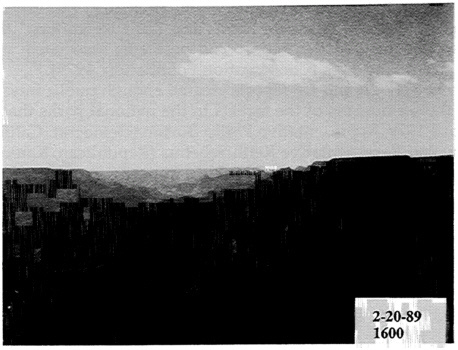
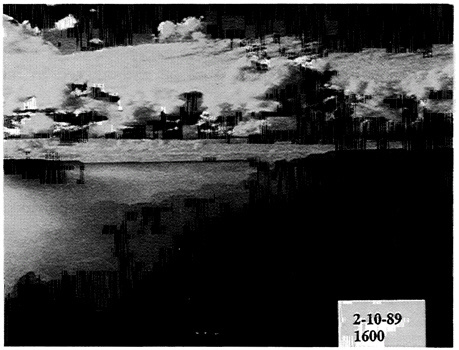
Activities on adjacent lands can pose significant threats to the nation's parks. In Grand Canyon National Park, inner-canyon haze caused by air pollution can reduce visibility significantly. The 2-10-89 view shows extremely high pollution, with a visual range of less than 30 km. CREDIT: NPS Air Quality Division, Denver.
-
Improve our capability to better quantify and document the impacts of various threats, particularly those which are believed to most seriously affect important park resources and values.
In summary, the report stated
To accomplish these objectives will require that the Service significantly expand its research and resource management capabilities. At the present time, the natural science research program of the National Park Service is base funded at a level of only nine million dollars and is staffed by fewer than 100 scientists; this is an average of less than one researcher for each three units of the System and represents only 1.1 percent of the total Park Service staff (NPS, 1980).
The 1980 NPS assessment revealed its unequivocal awareness of serious science-related problems in the park system and of what was needed to correct them. These were the same problems that had been identified repeatedly by independent review committees over a period of nearly 20 years.
In response, Congress asked for a second report to outline an implementation strategy for addressing threats to the parks. A "State of the Parks—A Report to the Congress on a Service Strategy for Prevention and Mitigation of Natural and Cultural Resource Management Problems" was submitted to Congress in 1981 (NPS, 1981). It proposed a strategy for both short-and mid-term actions to prevent or mitigate the problems, including the identification of so-called significant resource problems for immediate attention. Other actions included the development of information baseline standards, special protection zone guidelines, biological monitoring and environmental indexes, and a resource information tracking system; the initiation of a boundary study of historic and archaeological parks; an assessment of cooperative park study units; major natural resource management training programs for superintendents, midlevel, and beginning employees; and a special natural resource management trainee program. In addition, the 1981 NPS report called for a science program review by the National Academy of Sciences.
Five years later, concern was expressed by members of Congress that most of the actions proposed by the NPS had
not been implemented, so the General Accounting Office (GAO) was asked to assess NPS progress on its prevention and mitigation strategy. The resulting 1987 GAO report, "Limited Progress Made in Documenting and Mitigating Threats to Parks," concluded that "the Park Service's strategy for better managing park resources has yet to be fully implemented. Some parks do not have approved resource management plans, and the plans that have been prepared are not being used in formulating the Park Service's annual budgets. Further, many of the 11 initiatives intended to support the development and use of the plans were not followed through" (GAO, 1987).
Further deficiencies in the NPS science program were identified by the Park Service when, in December 1986, the 10 regional chief scientists participated in a workshop to develop their own recommendations for improving their science programs (Castleberry, 1987). They recommended the following actions:
-
Make better use of cooperative agreements for research.
-
Revise NPS planning to better integrate natural-and cultural-resource research.
-
Hold regular meetings of managers to review research proposals.
-
Identify emerging national problems.
-
Subject all research to periodic evaluations.
-
Relax limitations on attendance at scientific meetings.
-
Develop mechanisms for job exchanges between scientists.
-
Evaluate the NPS publications program.
-
Hold semiannual or annual meetings of regional chief scientists.
-
Make science program presentations to the regional directors.
Most of the recommendations from the regional chief scientists were designed to give greater autonomy and responsibility to NPS scientists, and to allow their interaction with the broader scientific community.
More recently, NPCA conducted a detailed analysis of NPS operations and prepared a nine-volume report, based
on extensive interviews with managers, scientists, and other concerned persons within and outside of NPS (NPCA, 1988b). Volume 2 of that study, "Research in the Parks: An Assessment of Needs," examines the NPS's cultural, historical, and natural science research (NPCA, 1988a). It recommended the following:
-
Specific new legislation for research, standardized resource inventories, and permanent monitoring programs.
-
A separate budget line item for research, equivalent to 10 percent of the total NPS operating budget.
-
Establishment by Congress of an NPS science advisory board.
-
Creation of an independent NPS research arm under the associate director for research, with line authority to regional chiefs of research.
-
Establishment of national park science centers and cooperative park study units for each major biome.
-
Clear definitions for science, research, and management of natural and cultural resources.
-
Greater use of research findings.
-
Increased support for publishing, attendance at professional meetings, and sabbaticals.
-
Greater use of specialized performance evaluation systems for scientists.
-
More effective data management.
A more recent comprehensive review of research and resource management in the parks was conducted by the Commission on Research and Resource Management Policy in the National Park System, which produced the report "National Parks: From Vignettes to a Global View" (NPCA, 1989). This 17-person commission, also known as the Gordon commission after chair John C. Gordon, was funded primarily by the Andrew W. Mellon Foundation, and its work was facilitated by NPCA. The commission was very critical of the degree to which the NPS has fulfilled its obligations in research and in management of natural and cultural resources.
The Gordon commission recommended that the NPS adopt a "new vision" to meet the environmental challenges of the twenty-first century, "a vision based on the principles of eco-
system management [and] on sound research.'' Four major tasks were proposed:
-
Develop and use the concept of ecosystem management.
-
Implement a research program to meet the needs of the Park Service and to educate the public.
-
Adopt professional standards for the recruitment, promotion, and continued development of park managers.
-
Educate Americans and the international public about natural and cultural systems and the ways in which those systems change.
All four tasks are highly interrelated: ''These strategies are interdependent: an improved ecosystem management program requires an adequate research base and professionals to implement it, and the information thus gained must be presented to the public effectively" (NPCA, 1989).
The Gordon report included an extensive commentary on the meaning of ecosystem management and on the NPS failure to comprehend and apply this concept. The commission recommended aggressive stewardship and management structured in the context of well-defined objectives. The commission concluded that "The concept of 'naturalness' is not a simple and comprehensive guide for management and will not anywhere substitute for identification of well-defined, park-specific, and research-based objectives."
The Gordon commission's recommendations about research in the national parks were extensive and strongly worded. It found that "research is basic to the mission of the National Park Service. Yet, the Park Service, unlike other federal agencies ... lacks an explicit mission for research. Without a sufficient knowledge base, it is impossible to make wise management decisions. Research must be broad-based because the national park system is so huge and diverse. Research must also be ongoing, incorporating new techniques and interpretations as appropriate." The report calls for "a quantum leap in both the quantity and quality of research supported by the National Park Service." Particularly important are long-term as opposed to short-term research; holistic inves-
tigations of entire ecosystems; and experimentation, an approach typically discouraged by NPS management.
The Gordon report provided 13 recommendations for development of a credible NPS research program. These included provision of a formal mandate for a research program independent of park management and given a line-item budget equivalent to at least 10 percent of the agency's budget, establishment of long-term ecosystem-level research projects in at least 6 to 10 parks, significant support for extramural research, peer review during all phases of in-house research, and development within parks of zones specifically for research.
The Gordon report was emphatic about the need for the NPS to take major steps to enhance the professional qualifications of its staff. This is equally applicable to research, resource management, and park protection. Recruitment of professionals, development of clear career ladders, and support for training programs are all discussed. A final recommendation called for developing and implementing a system of accountability for managing and protecting natural and cultural resources at all levels of the agency.
In 1992, the NPS released "National Parks for the 21st Century: The Vail Agenda," prepared for the director by the Steering Committee of the 75th Anniversary Symposium. The effort is yet another voice in the gathering momentum calling for change within the NPS. The report outlines a vision built on six strategic objectives:
-
Resource stewardship and protection: The NPS's primary responsibility must be to protect park resources.
-
Access and enjoyment: Each park unit should be managed to provide the nation's diverse public with access to and recreational and educational enjoyment of the lessons contained in that unit, while maintaining unimpaired those unique attributes that are its contribution to the national park system.
-
Educating and interpretation: The NPS is responsible for interpreting and conveying each park unit's and the park system's contributions to the nation's values, character, and experience.
-
Proactive leadership: The NPS must be a leader in
-
local, national, and international park affairs, actively pursuing the mission of the national park system and assisting others in managing their park resources and values.
-
Science and research: The NPS must engage in a sustained and integrated program of natural, cultural, and social science resource management and research aimed at acquiring and using the information needed to manage and protect park resources.
-
Professionalism: The NPS must create and maintain a highly professional organization and work force.
The fifth objective, fostering science and research, reiterates the message that science is critical to the NPS mission. The report acknowledges that the lack of a specific legislative mandate for science has hampered systemwide support and that the science program in general has suffered from a lack of independence and broad peer review. To engage in a sustained, integrated program of natural, cultural, and social science, the Vail Agenda recommends that secure legislation and funding be mandated; that training in information management and the role, use, and production of research information be accelerated; and that resource protection, access, and interpretation decisions be based on full consideration of the best available scientific research.
Whether this NPS-generated report is any more successful than past reports in sparking change within the agency remains to be seen, however.
CONCLUSION
The recommendations of many serious reviews over nearly three decades reveal both a unanimity of opinion about the need for research to support resource management in the national parks (Table 3-2) and an abysmal lack of response by the NPS. There is a broad concurrence in the basic recommendations among the four major external reports, and these opinions are echoed by the NPS's internal documents.
Major expansion of the NPS research program, including budgetary and administrative restructuring to provide for its financial and directional independence from management,
Table 3-2
Major Categories of Recommendations on NPS Research and Resource Management from Past External Reviews
is a consistent recommendation from external reviews. Three of the reports call for legislation to provide a congressional mandate for science in the NPS because the lack of such a mandate has often been cited by agency sources as a problem. All the major external reports also call for basic and applied research, for expanded coordination with research programs carried out by other institutions, and for better integration overall with the broader scientific community. Much better quality control of NPS research (through peer review) and establishment of centers of excellence are called for in many of the reports.
Resource management issues were given major attention by three of the four major external reviews (the Robbins report focused almost exclusively on research). There is strong agreement about the need for NPS to set specific management objectives and develop plans that reflect those objectives, to apply ecosystem principles to the management of park properties, and to develop credible inventory and monitoring programs.
Both the Gordon report (NPCA, 1989) and "Research in the Parks—An Assessment of Needs" (NPCA, 1988a), the two most recent external studies, identify the hiring of qualified personnel as a major issue, a call repeated by internal documents. This involves recruitment of professionally trained scientists, resource managers, and rangers and their continued professional development and advancement. Implicit in these findings is that selective recruitment and consistent support for training and development programs are not currently emphasized in the Park Service.
Since the first major independent reviews of the adequacy of the NPS science program were conducted in the early 1960s, many experts have shared their views on the scope and quality of the NPS research program. In all, the many reviews provide both general and very specific recommendations for strengthening science in support of the parks. Many of the suggested improvements were recommended repeatedly, yet few have been effectively or consistently implemented. Where responses have been attempted, they have always had to struggle to compete for funds and consistent organizational support. Despite repeated admonitions, the
importance of a strong science program—although recognized by some regions, parks, and personnel—simply has not garnered servicewide support. The question of why the Park Service has been so reluctant to strengthen its reliance on science is difficult to answer, in part because the reasons are often subtle and political. Sometimes the reasons relate to training—managers without backgrounds in science often do not think of science when they attack their problems; it is not in their tool kit and they may have had little contact with scientists during their careers. Their reluctance to use science comes in part because they do not fully recognize its potential. Indeed, many administrations have come and gone during the past 30 years and they have operated in very different settings, but with the same result—science has not taken hold as a key element in the foundation of the NPS mission.


