
4
Chinese Participation in International Global Change Research Programs
INTRODUCTION
This chapter presents an overview of Chinese activities in three major international global change programs: (1) the International Geosphere-Biosphere Program (IGBP), which is sponsored by the International Council of Scientific Unions (ICSU), (2) the World Climate Research Program (WCRP), which is sponsored jointly by the World Meteorological Organization and ICSU, and (3) the Human Dimensions of Global Environmental Change (HD/GEC) Program, which is sponsored by the International Social Science Council.
Research highlights are presented in each of the core project areas in which China is, plans to be, or has the potential (in the panel's view) to be actively engaged. A section on the Chinese Ecological Research Network (CERN) is also included as it is a component of the CNCIGBP'S global change program. Further details about the organization and research of selected institutions identified in this chapter are provided in Appendix A.
Below are listed Chinese institutes conducting research related to IGBP, WCRP, or HD/GEC that are identified in this report.
Biospheric Aspects of the Hydrological Cycle and Global Energy and Water Cycle Experiment (BAHC/GEWEX) IGBP, WCRP
Institute of Geography, CAS
Lanzhou Institute of Plateau Atmospheric Physics, CAS
Shanghai Institute of Plant Physiology, CAS
Data and Information Systems (DIS), IGBP
Institute of Atmospheric Physics, CAS
Global Analysis, Interpretation, and Modeling (GAIM), IGBP
Institute of Atmospheric Physics, CAS
Institute of Botany, CAS
Chinese Academy of Meteorological Sciences, SMA
Peking University
Shanghai Institute of Plant Physiology, CAS
State Oceanographic Administration
University of Science and Technology of China, CAS
Global Change and Terrestrial Ecosystems (GCTE), IGBP
Institute of Botany, CAS
Shanghai Institute of Plant Physiology, CAS
Human Dimensions of Global Environmental Change (HD/GEC), ISSC
Commission for Integrated Survey of Natural Resources, CAS
Guangzhou Institute of Geography
Institute of Automation, CAS Institute of Systems Science, CAS
Ministry of Aviation and Space Flight
Nanjing Institute of Geography and Limnology, CAS
Research Center for Eco-Environmental Sciences, CAS
State Science and Technology Commission
Xinjiang Institute of Geography, CAS
International Global Atmospheric Chemistry Project (IGAC), IGBP
Anhui Institute of Optics and Fine Mechanics, CAS
Beijing Municipal Academy of Agriculture and Forestry Services
Chinese Academy of Meteorological Sciences, SMA
Institute of Atmospheric Physics, CAS
Nanjing University
Peking University
Research Center for Eco-Environmental Sciences, CAS
South China Institute of Botany, CAS
University of Science and Technology of China, CAS
Joint Global Ocean Flux Study (JGOFS), IGBP; Land-Ocean Interactions in the Coastal Zone (LOICZ), IGBP
First Institute of Oceanography, SOA
Guangzhou Institute of Geography
Institute of Geography, CAS
Lanzhou Institute of Desert Research, CAS
Nanjing Institute of Geography and Limnology, CAS
Nanjing University, Department of Geo and Ocean Sciences
Qingdao Institute of Oceanology, CAS
Qingdao University of Oceanology
Second Institute of Oceanography, SOA
South China Sea Institute of Oceanology, CAS
Third Institute of Oceanography, SOA
Xiamen University, Department of Oceanography
Past Global Changes (PAGES), IGBP
Beijing Normal University, Department of Geography
Chinese Academy of Meteorological Sciences, SMA
Chinese University of Geosciences, Wuhan
Commission for Integrated Survey of Natural Resources, CAS
Fudan University
Guiyang Institute of Geochemistry, CAS
Institute of Atmospheric Physics, CAS
Institute of Botany, CAS
Institute of Geography, CAS
Institute of Geology, CAS
Institute of Geology, CAGS
Institute of Oceanographic Geology, MOGM
Kunming Institute of Botany, CAS
Lanzhou Institute of Glaciology and Geocryology, CAS
Lanzhou Institute of Desert Research, CAS
Nanjing Institute of Geography and Limnology, CAS
Nanjing University
National Remote Sensing Center, CAS
Northeast Normal University
Peking University
Qinghai Institute of Saline Lakes, CAS
Shaanxi Normal University
Shenyang Institute of Applied Ecology, CAS
South China Sea Institute of Oceanology, CAS
Third Institute of Oceanography, SOA
Tongji University
Xi'an Laboratory of Loess and Quaternary Geology, CAS
Xinjiang University, Department of Geography
Yunnan Institute of Geological Sciences
Zhongshan University
System for Analysis, Research, and Training (START), IGBP
Institute of Atmospheric Physics, CAS
Institute of Botany, CAS
Research Center for Eco-Environmental Sciences, CAS
Xi'an Laboratory of Loess and Quaternary Geology, CAS
Tropical Ocean and Global Atmosphere Program (TOGA), WCRP
Chinese Academy of Meteorological Sciences, SMA
First Institute of Oceanography, SOA
Institute of Atmospheric Physics, CAS
Institute of Geography, CAS
Institute of Mechanics, CAS
Lanzhou Institute of Plateau Atmospheric Physics, CAS
Qingdao Institute of Oceanology, CAS
Qingdao University of Oceanology
Second Institute of Oceanography, SOA
South China Sea Institute of Oceanology, CAS
Third Institute of Oceanography, SOA
INTERNATIONAL GLOBAL ATMOSPHERIC CHEMISTRY PROJECT
The International Global Atmospheric Chemistry Project (IGAC) was created under the auspices of the Commission on Atmospheric Chemistry and Global Pollution in 1988 in response to the growing international concern over observed changes in atmospheric chemical compositions and their potential impact on mankind. When the IGBP was formed, IGAC was adopted as one of its core projects. The overall goal of IGAC is to measure, understand, and thereby predict changes—now and over the next century—in global atmospheric chemistry, with emphasis on changes affecting the oxidizing capacity of the atmosphere, the impact of atmospheric composition on climate, and the interactions of atmospheric chemistry with the biota. The goal is broad and encompasses several contemporary environmental issues, including the increased acidity of precipitation, the depletion of stratospheric ozone (O3), and global warming due to the accumulation of greenhouse gases, for example, carbon dioxide (CO2), methane (CH4), nitrous oxide (N2O), and chlorofluorocarbons (CFCs).
According to the IGAC plan, six major foci address important problems in global atmospheric chemistry, whose solutions require international cooperation: (1) natural variability and anthropogenic perturbations of the marine atmosphere; (2) natural variability and anthropogenic perturbations of tropical atmospheric chemistry; (3) role of polar regions in changing atmospheric composition; (4) role of boreal regions in changing atmospheric composition; (5) global dis-
tribution, transformation trends, and modeling; and (6) international support activities.
Research Highlights
Atmospheric chemistry research is carried out in a number of institutes and universities, usually addressing urban air pollution issues such as oxidants, suspended particles, and toxic species. Recently, some attention has been directed at research projects that have regional and global implications. Most of these projects are closely related to IGAC research activities. A major focus is on greenhouse gas emissions, including CH4, N2O, and CO2. Research projects on stratospheric O3 have also been carried out. Regional-scale research activities are focused on acid precipitation and oxidants. In addition, the interesting problem of long-range transport of Asian dust and its impact on the Pacific Basin has also drawn some attention. A brief description of these projects is presented here and additional details are discussed in Chapter 5.
The panel identified significant interest in studying CH4 emissions in China. Observed to be increasing at the rate of about 1 percent per year, CH4 is one of the important trace gases implicated in global warming. With present day concentrations of about 1.75 ppm, increases in CH4 can affect global climate as well as tropospheric and stratospheric chemistry. Rice paddy fields—of which 24 percent of the world's total lie in China—are an important source of atmospheric CH4, contributing to approximately 10 to 20 percent of total global emissions. At least four groups, the Chinese Academy of Sciences (CAS) Institute of Atmospheric Physics, Chinese Academy of Meteorological Sciences (CAMS), CAS Research Center for Eco-Environmental Sciences (RCEES), and CAS Nanjing Institute of Soil Science, have either made or started measurements of CH4 emissions from rice fields. Some of the measurements were conducted as bilateral collaborations between the CAS Institute of Atmospheric Physics and the Fraunhofer Institute in Germany (Wang et al. 1992) and between the CAS Institute of Atmospheric Physics and the U.S Department of Energy (DOE)1 (Khalil et al. 1990). These groups have also started measurements of N2O emissions from soils. In addition, exchange of CO2 between the biosphere and the atmosphere is being studied at the CAS South China Institute of Botany and RCEES.
Trace gas and aerosol monitoring is carried out by various organizations. CAMS, RCEES, and Peking University operate several atmosphere stations in rural and remote areas where measurements of
O3, sulfur dioxide (SO2), aerosols, and precipitation chemistry are carried out. In addition, networks of stations have been established for national-scale precipitation chemistry measurements by NEPA and CAMS and regional-scale measurements by RCEES and several provincial agencies.
Aerosol chemistry studies also focus primarily on urban and regional-scale environmental problems. An exception is the study of Asian dust storms that exert a large influence on the chemical and physical characteristics of aerosols and precipitation over eastern Asia and the northern Pacific Ocean. CAMS has an extensive program to study the formation and transport of dust storms. A cooperative international program, the China and America Air-Sea Experiments (CHAASE), has been conducted to study the compositions of aerosol particles and precipitation in China and Korea since 1990 (Arimoto et al. 1990, Gao et al. 1992a,b). The program involves the State Oceanographic Administration (SOA), the Korean Ocean Research and Development Institute, and the University of Rhode Island.2 In addition, as part of the WCRP Tropical Ocean and Global Atmosphere (TOGA) program (see below), compositions of rain and aerosol samples collected over the western Pacific Ocean were analyzed under bilateral projects between the U.S. National Oceanographic and Atmospheric Administration (NOAA) and the State Meteorological Administration (SMA) and between NOAA and the Chinese National Research Center for Marine Environment Forecasts at the State Oceanographic Administration (SOA).
Total O3 is measured by scientists from the CAS Institute of Atmospheric Physics at a station in Beijing and one in Yunnan Province. Ground-based remote sensing techniques for measuring stratospheric trace gases such as O3 and nitrite (NO2) are under development at CAS Anhui Institute of Optics and Fine Mechanics and Peking University. Modeling studies of the stratospheric O3 are conducted at the CAS Institute of Atmospheric Physics, SMA, CAS University of Science and Technology of China, and Peking University. In addition, chemistry models of the troposphere are also under development at some of these institutes for the study of regional and global environmental problems.
In September and October 1991, the U.S. National Aeronautics and Space Administration (NASA) conducted the first of its four planned airborne experiments over the Pacific Basin as part of what are collectively called the Pacific Exploratory Mission (PEM). Their major objectives are to investigate the budgets of tropospheric oxidants, reactive nitrogen species, and sulfur species. The first of these experiments, known as PEM-West, is coordinated through the East Asia-
North Pacific Regional Study (APARE) of the IGAC Program, which includes scientists from China, Hong Kong, Japan, Korea, Taiwan, and the United States. PEM-West scientists measured a suite of important trace gases and aerosols from two aircraft (a NASA DC-8 and a short-range Japanese aircraft)3 and six intensive ground stations over the western Pacific Ocean. SMA, in collaboration with NOAA, operates one such intensive station on the eastern coast of China.
PAST GLOBAL CHANGES
The objective of the IGBP Past Global Changes (PAGES) Core Project4 is to organize efforts internationally to better understand past changes in the earth system in order to put current and future global changes into perspective and to improve the interpretation of their causes and dynamics. PAGES has taken a ''two-stream'' approach. The first stream is directed to relatively recent earth history of the last 2,000 years. The second stream takes a longer view of the glacial-interglacial cycles of the Late Quaternary Period (IGBP 1990).
Review of CNCIGBP Literature
Research on historical analysis of environmental change is voluminous in China; virtually every aspect of PAGES research described in IGBP Report No. 12 (1990) or in Bradley (1991) is being reported. Every CAS institute involved in global change research lists some form of historical analysis (CAS 1991), and the National Natural Science Foundation of China (NSFC) has funded this area extensively (Appendix B). In fact, the literature is so enormous that it would require a separate and extensive inquiry to catalogue and review materials cited by the Chinese. With few exceptions, work identified by the panel was restricted to China and connections with the rest of the earth system such as telecommunications with global climate anomalies remain to be made.
The fundamental objectives of this work have been summarized by the CNCIGBP (Ma 1991):
-
Reconstruction of past climate change and environmental variation, especially covering the last 2,000 years, through the enormous Chinese historical writings on climate and environmental descriptions, especially in eastern China.
-
Development of multiproxy data from tree-ring chronologies, archaeological studies, and ice core and sedimentary analyses to supplement written records.
-
Study of glacial-interglacial cycles in the Late Quaternary Period, with special attention toward rapid and abrupt changes in order to better understand future global changes.
-
Establishment of an historical proxy data bank in China.
-
Performance of some historical analyses on particularly critical areas of China.
The January 1990 Report of the Chinese National Committee for IGBP (CNCIGBP 1990a) describes an element of a core project titled, "Studies of Historical Evolution of Environment." This is elaborated on more completely in the September 1990 report (CNCIGBP 1990b), which lists a number of objectives based mainly on the organization developed by IGBP. A focus on PAGES research is prominent, including three definite activities: (1) pilot assessment of the current state of the life-supporting environment in China; (2) study of the historical evolution of life-supporting environment in China; and (3) impacts of paleoclimate change on underground water resources in the Late Pleistocene Epoch and trends of climate change in arid and semiarid areas. The second activity, in particular, has numerous studies listed. Other historical analyses are imbedded in the GCTE section of that document.
As mentioned in the introduction of the CNCIGBP (Chapter 2), the Bulletin of the CNCIGBP, (CNCIGBP 1991) lists three focal areas for past global change research. Under "Ongoing research projects ...," several might incorporate historical analyses although it is not explicitly stated. The final section of this bulletin gives an overview of pilot studies conducted between 1988 and 1991 that clearly put climate change in an historical perspective.
Research Highlights
This pervasive consciousness of the variable past has elevated paleoenvironmental studies to a much higher relative level of priority in the Chinese global change program than in the United States or Europe. Every institute or laboratory that panel members visited included a paleoenvironmental component in its overall global change program. The range of records being studied included everything from the analysis of Chinese Imperial Court records at the CAS Institute of Geography (Appendix A) to the study of isotopic time series from ice cores from mid-latitude glaciers at the CAS Lanzhou Institute of Glaciology and Geocryology (Appendix A) and loess deposits by the CAS Xi'an Laboratory of Loess and Quaternary Geology (Appendix A). In each of these cases, American researchers are collaborators.
This research also demonstrates the unique paleoenvironmental records in China that are a crucial resource for the global PAGES community. The quality of scholarship and skill in this area seemed very high. The relatively modest cost and technological level required for many paleoenvironmental studies undoubtedly aid in the success of these programs. But this research is also well-supported with sophisticated instrumentation at the CAS Lanzhou Institute of Glaciology and Geocryology and the CAS Nanjing Institute of Geography and Limnology (Appendix A), two key institutions for research on paleoenvironments.
A major project, "The Origin, Evolution, Environmental Change, and Ecosystems of the Qinghai-Tibet Plateau," is funded by State Science and Technology Commission, with contributions from participants (20 units from CAS and universities are involved). This project is notable for its scale, multidisciplinary scope, and the cross institutional organization of research. This project has four components: (1) structure, evolution of lithosphere and geodynamics (lead principal investigators (PIs): Pan Yushen, CAS Institute of Geology and Kong Xiangru, CAS Institute of Geophysics), (2) environmental changes during the Late Cenozoic Era (Shi Yafeng, CAS Lanzhou Institute of Glaciology and Geocryology and Li Jijun, Lanzhou University), (3) monitoring and prediction of recent climate change and its environmental impact (Tang Maocang and Cheng Guodong, CAS Lanzhou Institute of Glaciology and Geocryology), and (4) the structure, function, evolution, and differentiation of ecosystems (Zheng Du, CAS Institute of Geography and Zhang Xinshi, CAS Institute of Botany). The project is headed by Sun Honglie, CAS vice president, and is scheduled to run from 1992 to 1996. Although research design details were not available to the panel, this combination of scope and topics shows a welcome opportunity to couple the past, present, and future.
Summary of PAGES Research
Historical analyses that could be related to the PAGES Core Project are replete in past and planned Chinese research efforts. This is an area where China already has made significant contributions to the study of paleoclimate; the physical and historical resources available for analysis are substantial. The Chinese have a strong tradition in this approach, and the Chinese global change program is building on this foundation. The major study of the Qinghai-Tibet Plateau is a good example of progress being made to expand and integrate work
on paleoenvironments. Chinese efforts could be further strengthened by considering the relationship between past changes and the broader global system that may have driven some of these phenomena.
Historical analysis is voluminous, and integration with prospective research (designed to provide projections of and scenarios for future climate, land use, and other important environmental changes) will further enhance their contributions in this area.
GLOBAL CHANGE AND TERRESTRIAL ECOSYSTEMS
Global Change and Terrestrial Ecosystems (GCTE) is an IGBP core project to develop the capability to predict the effects of changes in climate, CO2 concentration, and land use on terrestrial ecosystems and how these changes can lead to feedbacks to the physical and chemical climate system.
China's Vegetation and Climate
The vegetation zones in China range from tropical rainforest and monsoon forests in southern China to boreal forests in the north, and from east to west the vegetation grades from humid forests and intensive agriculture to temperate steppes and extreme deserts, with agriculture confined to areas where water for irrigation flows from the high mountains. The topography dominated by the Qinghai-Tibet Plateau not only provides large expanses occupied by alpine vegetation, permafrost, and ice, but the plateau itself also plays an important role in modifying the atmospheric circulation and climate over the surrounding area; it is an obstacle causing the westerly jet stream to be diverted to northern China. This strongly affects the development of monsoons in southern China and the aridity of western China. The climate of western China is strongly continental and may be among the most sensitive areas of the globe to possible feedbacks on the physical climate system from changes in terrestrial ecosystems.
Extensive anthropogenic changes in vegetation cover have occurred and are still occurring due to overgrazing, logging, irrigation, and conversion of marginal lands to agriculture. In addition to widespread land degradation and soil erosion, clear evidence from lake levels and climate records show that a drying and warming trend in the arid western parts of China has occurred in the past few decades. In contrast to the prevalent attitude in the West that the climate may be considered to be in a steady state, and, therefore, constant until
proven otherwise, the prevailing attitude in China is that the climate is always changing, as has been amply recorded in China's long history.
Research Highlights
The panel identified outstanding research projects on natural vegetation at the CAS Institute of Botany and one on agricultural systems at the CAS Shanghai Institute of Plant Physiology.
CAS Institute of Botany
Under the leadership of Zhang Xinshi, director of the CAS Institute of Botany, very sophisticated information systems used to study climate-vegetation interactions in China have been developed at the Laboratory for Quantitative Vegetation Analysis. Databases on climate, topography, soils, land use, and vegetation cover have been integrated into a geographical information system (GIS) developed at the institute. Advanced Very High Resolution Radiometer (AVHRR) vegetation index data received and processed by the National Satellite Meteorological Center are being used by institute researchers. The computer facilities are principally advanced microcomputers with modern software. Vegetation zonation has been analyzed by using several classification schemes that are widely used for world-wide comparison and study of climate-vegetation interactions, including Thornwaite's and Holdridge's classifications, Budyko's radiative dryness index, and potential annual net primary productivity (NPP). In addition, multivariate methods have been used to rank and classify climate zones according to their climatological and geographical parameters.
This work provides a very strong foundation for studies of the effects of climate and CO2 change on terrestrial vegetation. Work is in progress to extend the use of remotely sensed vegetation index imagery in studies of vegetation dynamics and to use radiative transfer approaches to model NPP. Models of ecosystem physiology and coupling of physiological processes to the physical climate system are needed to link these studies to general circulation model (GCM) simulations of alternative climate scenarios and to examine continental-scale vegetation feedbacks on the climate system. The technological level of the facilities at the CAS Institute of Botany, especially the computer equipment, is not high by Western standards. Nevertheless, the creative use of resources and intellectual sophistication of the approach make this a world-class effort.
Progress at the CAS Institute of Botany has been benefitted by strong international collaboration, including with Mark Harwell at the University of Miami and Alan Robock at the University of Maryland. Moreover, it appears that collaboration on climate-vegetation interactions has been easier to initiate with foreign scientists than with Chinese colleagues at other local institutions.
CAS Shanghai Institute of Plant Physiology
Extensive and sophisticated work on agricultural ecosystems was identified at the CAS Shanghai Institute of Plant Physiology, which provides valuable foundations for further studies of the effects of climate and CO2 change on agricultural ecosystems. Wang Tianduo is the lead scientist for a large-scale integrated study of the efficiency of water use for agricultural production on the North China Plain. This unique study takes an integrative view of the hydrology, irrigation management, cropping strategies, and economic factors that govern agricultural output for the lower Huanghe River system (Wang 1990). Of particular note is the regional focus of this research and the strong mechanical approach to modeling water use in the physiological processes of crops based on models developed by scientists at the institute. However, this dynamic and relevant project has received only minor funding under the Eighth 5-Year Plan. Wang Tianduo will be involved in a NSFC-funded project, "Water-Saving Agriculture on the North China Plain," which is scheduled to begin in 1992, although it does not appear that this project will be a major vehicle for continuing Wang's water use efficiency studies.
It would be possible to use the design of this study to examine the impacts of CO2 fertilization on agriculture in a water-limited system or to examine the impacts of changes in precipitation or temperature of the region. This study also presents the opportunity to couple present physiological models to climate models in order to examine feedbacks from changes in the agricultural system on the regional climate. However, no such activities are planned at this time. This appears to be a unique study that presents the potential for examining the responses to CO2 and to climate change of one of the most important and populous agroecosystems in the Earth system.
Summary of GCTE Research
The diverse topography and climate of China provide unique opportunities to examine the role of climate and the effect of climate
change on terrestrial ecosystems. The panel identified outstanding and relevant research projects on natural vegetation at the CAS Institute of Botany and one on agricultural systems at the CAS Shanghai Institute of Plant Physiology. However, Chinese research appears to place less emphasis on detecting evidence for change; instead, more emphasis is placed on impacts of and responses to change.
BIOSPHERIC ASPECTS OF THE HYDROLOGICAL CYCLE AND GLOBAL ENERGY AND WATER CYCLE EXPERIMENT
Chinese researchers are active in modeling and measuring interactions between the land surface and the atmosphere. Significant efforts are ongoing in the development of models to represent the role of vegetation in controlling surface energy balance and evapotranspiration. The landscape of western China contains considerable contrast between well-watered irrigation districts along its rivers and surrounding arid areas. These produce effects on mesoscale atmospheric circulation and this phenomenon is the subject of both theoretical and empirical study, such as the Sino-Japanese experiment discussed below. Finally, because of China's historical dependence upon irrigation, hydrology is a mammoth enterprise, and considerable data on surface and groundwater hydrology exists at all scales, though these data are not—as yet—well integrated into the global change endeavor. Overall, China is poised to conduct significant work under the joint IGBP-WCRP project, Biospheric Aspects of the Hydrological Cycle and Global Energy and Water Cycle Experiment (BAHC/GEWEX). Below are details of active work in areas central to the BAHC/GEWEX research agenda.
Research Highlights
Sino-Japanese Atmosphere-Land Surface Processes Experiment
The Sino-Japanese Atmosphere-Land Surface Processes Experiment (HEIFE [the Chinese abbreviation has been retained in English documentation]), a collaboration between CAS and Kyoto University, is a large study of land surface climatology and land surface hydrology in a region where intense irrigation has created an oasis with a strong atmospheric subsidence over the irrigated zone. The CAS Lanzhou Institute of Plateau Atmospheric Physics is the lead institution for this study, and other CAS institutions are involved in specific areas of investigation. The study will continue for about 5 years, with intensive field measurements in 1991 and 1992. These studies
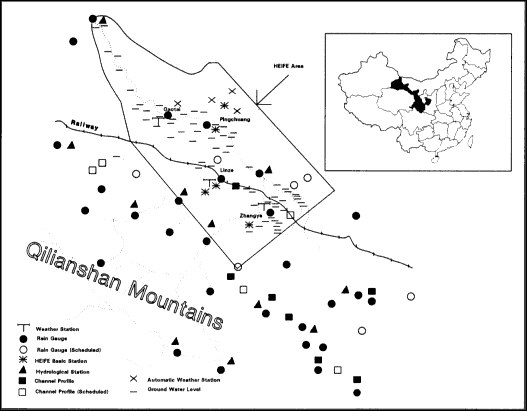
are to be applied to improving parameterization of fluxes in GCMs and development of water-saving irrigation procedures.
The site of the HEIFE experiment is an intensively irrigated region near Linze in Gansu Province (Map 4–1). The major water source is the Heihe River, which is fed by glaciers and summer (monsoon) snowfall in the Qilianshan mountain range. The irrigated oasis is surrounded by stone-surfaced (gobi) and shifting dune deserts. Rainfall in the HEIFE region is extremely low (119.5 mm w/1 3.5 mm snow annual precipitation). The elevation is 1,400 m, with a mean annual temperature of 7.6°C and a mean maximum temperature of 39.1°C.
Despite this harsh climate, wheat and corn production is high and some cotton and rice are grown. Wheat, corn, and soybeans are generally intercropped, with a wheat nurse crop providing sufficient humidity in its canopy to allow successful germination and early growth of corn or soybeans, despite prohibitively low humidity for those crops in the free atmosphere.
Irrigation management in this area is critically important, as salt water lies below the irrigation-derived water table and care must be taken to avoid salt contamination of shallow groundwater, thus the applied emphasis on management of evapotranspiration. Intensified irrigation in this part of the upper Heihe River has had an adverse effect on downstream water users in Inner Mongolia Autonomous Region, but this consequence does not appear to be a major consideration in water management around the experimental site.
Chinese Research. Work is being conducted in six major research areas:
-
Analysis of turbulent structure and fluxes in the planetary and internal boundary layer
-
Surface radiation fluxes
-
Evaporation and surface water balance measurements
-
Numerical modeling of boundary layer meteorology
-
Development of techniques for water-conserving irrigation practices
-
Development of a database of the region's land surface information for subsequent analysis and interpretation
Japanese Research. Work is being conducted in five major research areas:
-
Large-scale circulations
-
Water cycle in the Heihe River Basin
-
Boundary layer dynamics
-
Fluxes and transport of yellow sand and dust
-
Water utilization and plant productivity
The field experiment involves continuous monitoring of basic cli-
mate parameters, surface radiation, groundwater level, stream flow, evapotranspiration (by using lysimetry), and crop biomass. In addition, four Intensive Observing Periods and Biological Observing Periods are scheduled. During both periods, additional soundings and eddy flux, atmospheric profiling, dust content, and CO2 flux measurements will be conducted. During the biological observation periods, crop physiological parameters (crop height, leaf area index, transpiration, photosynthesis, leaf water potential, and root system mass) will be made. While no detailed information on sampling strategy for the biological parameters was made available, based on panel members' observations, it is likely that they will be made in a small number of agricultural test plots and not sampled in a spatially extensive fashion over the site. The experimental design for the study apparently was developed largely by meteorologists, and panel members saw little evidence of intellectual involvement by plant biologists or agronomists in this aspect of the projects' development.
The experimental design of the array of meteorological observation sites was decided through an innovative application of a numerical simulation model of the mesoscale circulation in the planetary boundary layer over the diverse surfaces included in the experiment. The area was sectioned into grids according to land use surface properties. Simulations were then conducted to examine whether potential meteorological sites provided accurate representations of their respective regions.
Use of remote sensing data is limited to the definition of land use over the area and is not available to define temporal dynamics of vegetation cover. Also, this project does not have an aircraft-based measurement component. These are clearly related to the project's limited funding and very high leasing costs for obtaining these services from other institutes or branches of the government.
It was difficult to ascertain the level of collaboration with the Japanese in this project, in part because the panel members' visit did not coincide with visits by any of these collaborators. Some of the equipment was clearly provided by the Japanese. However, it was also apparent that the Chinese input of expertise and equipment was significant. The major limitations appear to be related to the level of funding. Yet, the resources for some aspects of the project show abundant—if not redundant—use of resources, suggesting some difficulty in establishing priorities.
Summary of BAHC/GEWEX Research
The HEIFE experiment is important in China as much for its role as a pathfinding study in interdisciplinary and integrated science as
for the new findings concerning the oasis or cold island effect and other aspects of land-atmosphere coupling in arid regions. The study involves meteorological, ecological, hydrological, and agronomic measurements and atmospheric modeling. The project involves scientists from all of these disciplines, and, while integration is not perfect, it can serve as a model study.
The first prerequisite for the success of such a study—the acquisition of a high quality data set—clearly will be met. It is still unclear to what extent interdisciplinary analysis of the extensive data set will be completed, but workshops and data meetings are scheduled. The experiment has high visibility in China and its success can serve as a valuable model for future collaborative interdisciplinary projects.5 While the experiment itself has been bilateral by agreement, scientists from other Chinese institutions and foreign scientists are welcome to participate in analyzing the data. In the future, multilateral rather than bilateral experiments under BAHC/GEWEX auspices will be a welcome and important next step.
PROGRAMS ON MARINE ENVIRONMENTS
Introduction
China has a coastline of over 18,000 and claims more than 5,000 coastal islands. This coastline borders the inland Bohai Sea, Yellow Sea, East China Sea, and South China Sea, which collectively extend across temperate, subtropical, and tropical climate zones (Zhang 1984). Historical, contemporary, and future changes in land cover and basin hydrology will continue to alter drastically the delivery of water and sediments as well as eolian materials to the coastal zone, particularly in the deltaic regions of the Huanghe, Yangtze, and Pearl Rivers. These changes pose serious threats to the livelihoods of millions of people. The rapid development of mariculture in China and elsewhere in Asia has compounded these problems. While mariculture is a very efficient means of producing animal protein, it sometimes is detrimental to natural coastal environments. For example, it can threaten the sustainability of fisheries production offshore and cause pollution near shore.
Thus, China has considerable reason to be interested in the ocean, particularly in the coastal zone. This interest is reflected in the extensive activities China has undertaken since 1950. According to Zhang Haifeng (1984), a total of about 100 marine scientific and technological institutions are active in China and enjoy extensive communication with international marine organizations. Internal communica-
tion is promoted by a common national publishing house, the China Ocean Press.
Most marine research relevant to global change is carried out in CAS, which has the strongest basic marine science programs, as well as SOA, universities, and MOA. A list of leading marine organizations and their locales is provided below (Zhang 1984). Responsible administrative systems are identified in parentheses.
China Ocean Press, (SOA), Beijing
Dalian Fisheries College, Ministry of Agriculture (MOA), Dalian
Department of Geo and Ocean Sciences, Nanjing University (SEDC), Nanjing
Department of Marine Geology, Tongji University (SEDC), Shanghai
Department of Oceanography, Xiamen University (SEDC), Xiamen
East China Sea Fisheries Institute, Chinese Academy of Fisheries Science (MOA), Shanghai
First Institute of Oceanography (SOA), Qingdao
Institute of Acoustics (CAS), Beijing
Institute of Coastal and Ocean Engineering, East China College of Water Conservancy (SEDC), Nanjing
Institute of Marine Environmental Protection (SOA), Qingdao
Institute of Marine Geology, Tongji University (SEDC), Shanghai
Institute of Marine Scientific and Technological Information, National Oceanographic Data Center (SOA), Tianjin
Institute of Ocean Engineering, Dalian College of Technology (SEDC), Dalian
Institute of Ocean Technology (SOA), Tianjin
Institute of Subtropical Oceanography, Xiamen University (SEDC), Xiamen
Marine Fisheries Research Institute of Zhejiang Province (Zhejiang Province), Shenjiamen
Marine Geomorphology and Sedimentology Research Division, Nanjing University (SEDC), Nanjing
Nanjing Water Research Academy (Ministry of Water Resources and Ministry of Communications), Nanjing
National Marine Environmental Forecasting Center (SOA), Beijing
Ningbo Oceanography School (SOA), Ningbo
Qingdao Institute of Oceanology (CAS), Qingdao
Qingdao Ocean University (SEDC), Qingdao
Research Division of Marine Economic Geography, Geography Department, Liaoning Normal University (SEDC), Dalian
Second Institute of Oceanography (SOA), Hangzhou
Shandong Institute of Oceanographic Instrumentation, Qingdao
Shanghai Fisheries College (MOA), Shanghai
South China Sea Fisheries Research Institute, Chinese Academy of Fisheries Science (MOA), Guangzhou
South China Sea Geological Survey, Ministry of Geology and Mineral Resources), Guangzhou
South China Sea Institute of Oceanology (CAS), Guangzhou
State Oceanographic Administration, Beijing
Third Institute of Oceanography (SOA), Fujian
Xiamen Fisheries College (MOA), Xiamen
Yellow Sea Fisheries Research Institute, Chinese Academy of Fisheries Science (MOA), Qingdao
Zhanjiang Fisheries College (MOA), Zhanjiang
Zhejiang Fisheries College (MOA), Zhejiang
Zhejiang Provincial Institute of Estuarine and Coastal Engineering Research (Zhejiang Province), Zhejiang
Land-Ocean Interactions in the Coastal Zone
In late 1989, IGBP organizers recognized that many agents of global change would have specific impacts on the coastal zone. These agents include climate change, sea-level rise, and land use as it influences delivery of materials from the land to the sea. In addition to these new or forecasted impacts, the coastal zone already suffers from several aspects of intensive human use, such as overexploitation of fishing stocks, habitat destruction, and increasing concentrations of toxic substances. Such human effects, while not global in extent, are highly pervasive throughout the temperate and tropical coastal zones of the world. Recognition of this critical interface between land and sea came too late to permit development of a plan that could be accepted as an initial core project in 1990. Instead, Land-Ocean Interactions in the Coastal Zone (LOICZ) was presented as an initial concept for a core project in IGBP Report No. 12 (1990). This project is still in the planning stage, and its evaluation and acceptance as a core project is not expected before late 1992.
An IGBP working group held a NATO-sponsored workshop in October 1991 attended by approximately 40 coastal zone specialists who further refined research plans for LOICZ. The LOICZ-NATO workshop allowed scientists to fill gaps left by the initial definition of LOICZ and to identify three focal areas for LOICZ research: (1) land-ocean exchange, including activities on drainage basin dynamics, estuarine dynamics, atmospheric exchange and cross-shelf exchange between estuaries and coastal oceans with the open ocean; (2) biogeomorphology, including activities on sea-level change, coastal
circulation, and physical feedback of biotic communities on coastal geomorphology; and (3) ecosystems and biogeochemical cycles in the coastal ocean, including activities in the biological structure of ecosystems, biological energetics and material processing (especially carbon, nitrogen, and phosphorus cycles), gas exchange, carbonate dynamics, and sediment dynamics.
It is important for this discussion of Chinese activities in marine science to note that the initial working definition of the coastal zone held by LOICZ was ''the area extending from the landward margin affected by salt water to the outer edge of the continental shelf.'' At the same time, the Joint Global Ocean Flux Study (JGOFS) is dedicated to understanding the fluxes of materials in the open oceans beyond the shelf breaks (IGBP 1990). Thus, the shelf break, a potentially critical zone of hydrodynamics and biogeochemistry, was omitted in this planning. More recently, JGOFS and LOICZ have resolved to examine this interface zone jointly.
Although JGOFS is dedicated to understanding the fluxes of materials in the open oceans beyond the shelf breaks, it is clear that China is conducting a number of important research projects under the rubric of JGOFS that actually fit under the aegis of the proposed LOICZ, since all of the East China Sea and South China Sea are on coastal shelves. In fact, some of these Chinese JGOFS projects fit exactly with the kinds of activities planned by the latest LOICZ-NATO workshop. LOICZ organizers should definitely take into account the programs currently listed by CNCIGBP as JGOFS.
LOICZ Research Highlights
Among marine research projects CAS considers part of China's global change program (CAS 1991), many of the studies would be important in understanding and predicting change in delivery of water and sediments to the coastal zone from land and some on the coastal seas themselves. The CAS Lanzhou Institute of Desert Research has studied the effects of climate change and land use change on desert riparian systems. The CAS Institute of Geography's Department of Hydrology has studied changes in land use and water and sediment delivery to the Huanghe and Yangtze Rivers. The CAS Nanjing Institute of Geography and Limnology has studied riverine hydrology modeling, coastal zone geomorphology, and historical analysis of land use change. The CAS South China Sea Institute of Oceanology has studied coastal and deep sea oceanography, estuarine processes, and coral reef growth rates. The CAS Qingdao Institute of Oceanology has recently begun a project on carbon cycling.
Outside of CAS, notable work was identified at two institutions. The Department of Geo and Ocean Sciences at Nanjing University has researched coastal zone geomorphology, delta subsidence, historical changes in land use, and sediment delivery by major rivers. And, the Guangzhou Institute of Geography has researched the historical geomorphology and interactions of sea-level rise and subsidence of the Pearl River Delta.
The NSFC has listed a number of supported programs in "Strengthening Coordination for more Effectively Funding for IGBP" (Zhang 1991), which is found in Appendix B. This document conveniently is organized by IGBP core projects, and specifically listed under LOICZ are seven very important projects, including sea-level change, flooding patterns, red tide, and changes in the Huanghe River drainage.
In combination, various institutions and universities appear to have coastal zone geomorphology well covered, and the potential for substantive contributions by China to LOICZ is excellent. These prospects would be even brighter if coordination among these institutions were strengthened and predictive work given higher priority.
Joint Global Ocean Flux Study
The Joint Global Ocean Flux Study (JGOFS) has the following objectives: (a) the determination and understanding of "processes controlling the time varying fluxes of carbon and associated biogenic elements in the ocean, and to evaluate the related exchanges with the atmosphere, sea floor, and continental boundaries;" and (b) development of "a capability to predict on a global scale the response of oceanic biogeochemical processes to anthropogenic perturbations, in particular, those related to climate change" (IGBP 1990).
Chinese JGOFS Committee
Chinese involvement in JGOFS began in February 1987, following the International Scientific Planning and Coordination Meeting for Global Ocean Flux Studies held at the ICSU Headquarters in Paris. The Chinese JGOFS Committee was established in February 1989, and in August 1989, the committee published the "Chinese Tentative Plan for the Joint Global Ocean Flux Study." This report reviews Chinese interest in JGOFS, provides scientific background for their activities, and outlines a tentative plan. An outline of future activity in JGOFS and a discussion of its overlap with the WCRP World Ocean Circulation Experiment (WOCE) is included in the Chinese JGOFS Committee's report. NSFC shares the costs of JGOFS projects ($1 million/5 years) equally with CAS (NSFC 1991a).
National Program on Margin Flux in the East China Sea. The Chinese JGOFS Committee's activities in the Eighth 5-Year Plan focus on the establishment of a national program on Margin Flux in the East China Sea (MFECS). Hu Dunxin, of the CAS Qingdao Institute of Oceanology, heads a CNCIGBP working group on ocean flux studies. The driving force of MFECS is the knowledge that coastal and marginal seas account for a significant portion of the primary productivity in the oceans. The East China Sea has one of the widest continental shelves in the world, receiving and accommodating a huge amount of material from the Yangtze River (5 x 10⁹ tons/year) and the Huanghe River (10.7 x 10⁹ tons/year), which are the two largest rivers emptying into the Pacific Ocean. MFECS has the following objectives:
-
Understand the contribution of the seas in the northwest Pacific margin, for example the East China and Yellow Seas, to the flux or budget of carbon and relevant biogenic elements of the Pacific Ocean.
-
Understand the oceanic processes (physical, biological, chemical, and sedimentological) controlling the margin flux in the study area.
-
Provide validated flux numbers for carbon and related elements between the Pacific Ocean and the East China Sea.
-
Assess the primary productivity in the East China and Yellow Seas in order to provide scientific background for assessing biological productivity and resources.
MFECS will address the following scientific questions:
-
Is primary production in the East China Sea supported by nutrient input from the Pacific Ocean or from the Yangtze River? What processes control this input?
-
Are the organic materials produced in the East China Sea exported seaward to the Pacific Ocean by the Kuroshio Ocean Current or landward to the near-shore zone by upwelling?
-
Is the Okinawa Trough a sink for carbon and other materials? What processes control the lateral exchange of carbon and other materials between the Pacific Ocean and the East China Sea?
-
What are the processes controlling the vertical flux of carbon and the related biogenic elements in the East China Sea?
These questions will be answered by carrying out the following research:
-
Study the vertical flux processes in some typical areas of the Yellow and East China Seas by studying the air-sea exchange mechanism: CO2 fixation by phytoplankton and transport of carbon in the euphotic zone and the biogeochemical and sedimentological processes in benthic layer.
-
Study the horizontal flux processes in the East China Sea margin by examining horizontal fluxes of water and other material through physical processes near the Kuroshio Ocean Current.
-
Study the transport of carbon and other materials on the East China Sea shelf by examining the input of carbon and other material from the Huanghe and Yangtze Rivers.
-
Study the dynamics of the transport of carbon and other material on the shelf of the Yellow Sea and the East China Sea.
-
Study the role of (terrestrial) calcium carbonate in the carbon cycle in the southern Yellow Sea and northern East China Sea.
-
Study the dynamic processes of sediment in the Okinawa Trough.
-
Study remote sensed data in combination with in situ measurements of phytoplankton.
-
Model vertical flux processes in typical areas of the East China Sea and the Yellow Sea, including modeling of margin flux and the role of physical and biogeochemical processes.
An initial MFECS activity, an international workshop on the margin flux in the western boundary area of the Pacific Ocean was scheduled to be held in mid-June 1992 in Qingdao. Following the conference, a Chinese field experiment is planned for late 1992. This experiment would be followed by an international field experiment in the second half of 1993.
Tropical Ocean and Global Atmosphere
The Chinese are participating in the WCRP Tropical Ocean and Global Atmosphere (TOGA) Core Project, which is devoted to understanding the exchange of energy between the atmosphere and tropical waters. The three principal organizations involved in this research are SOA, SMA, and CAS. The Chinese have studied the so-called "warm pool" of the western Pacific Ocean. Under the "Agreement on U.S.-PRC Cooperation in TOGA Coupled Ocean-Atmospheric Response Experiment (TOGA/COARE)" (a more specific short-term project), the Chinese will carry out a coordinated set of air-sea measurements to be made in the South Pacific between 1 November 1992 and 28 February 1993.
Observation Programs
Activities include a joint U.S.-China program between NOAA and SMA involving air and sea interactions in the tropical West Pacific. From December 1985 to 1990, one ship completed eight cruises, and data from these expeditions were published in January 1992 in a book of common papers. A second program, the Australian Monsoon Experiment, is a trilateral U.S.-China-Australia program. The third CAS observation program, "Air-Sea Interaction in the Tropical West Pacific and Interannual Variability of Climate," operated from 1985 to 1989.
TOGA-Monsoon Climate Research
Monsoon climate research involves CAS, SMA, and selected universities and focuses on eastern Asian monsoons. One cooperative program between SMA and the National Science Foundation (NSF), "PRC-U.S. Cooperative Studies on Eastern Asian Monsoons," began in 1983 and will terminate in 1992. A monograph, Eastern Asian Monsoons, is in press.
Monitoring of El Niño Events
This aspect of Chinese involvement in TOGA began in 1986 and is coordinated by the SMA. As part of this program, the Climate Monitoring Bulletin has been published monthly since 1989. The SOA, under the US-PRC Protocol on Cooperation in Marine and Fishery Science and Technology, and CAS as a group under the Chinese National Climate Committee (CNCC), are both studying the air-sea interaction directly in accordance with the TOGA project. Even though SMA and universities are involved in TOGA, the information presented to the panel predominantly described CAS activities.
From 1985 to 1990, nine expedition cruises (each lasting for 2 months) were conducted during winter months in the tropical (25° N and 10° S) western Pacific (west of 150° E) by two vessels, Science No. 1 and Experiment No. 3. The cruises focused on the fluxes of momentum, heat, moisture, and other materials at the air-sea interface by using approximately 20 kinds of measuring equipment. Four billion data have been indexed and stored in a data bank that can be used for air-sea interaction studies, ground-truthing, and other research purposes. Following the PRC-USA Bilateral Coordinating Group Meeting on TOGA/COARE cooperation held in Guangzhou early in September 1991, CAS research vessels Science No. 1 and Experiment
No. 3 and SOA research vessel Xiangyanghong No. 5 were chosen to participate in TOGA.
The Chinese have tried to forecast El Niño and La Niña events by using historical and observational data collected from 1985 to 1990. The 1987–1988 El Niño and the 1988–1989 La Niña forecasts were successful, but the 1988–1989 El Niño development was not. In the process, the Chinese discovered different types of El Niño, El Niño development processes, and climate effects over China. As it turned out, the relationship between climate over China and El Niño was not a simple statistical problem.
For basic research on air-sea interaction, the Chinese are undertaking various activities: (1) different methods of measuring fluxes; (2) an air-sea column heat budget study by using data from two-vessel synchronous observation; (3) publication of the Atlas of Climate Physics of Tropical Pacific Ocean; (4) a newly designed air-sea coupled numerical model employing the daily synchronous coupling technique; and (5) a laboratory study of the air-sea interface, which has shown that the "low of wall" obtained from rigid surface is not valid for large areas over the ocean.
In the Eighth 5-Year Plan, NSFC and CAS are each contributing 5.5 million yuan ($1 million) and SOA 55 million yuan ($10 million) to fund TOGA. NSFC also supports WOCE but amounts and proportions were not given (NSFC 1991b).
Summary of Research in Marine Environments
China is located on a large piece of the world's coastal land area and a substantial scientific infrastructure addresses coastal zone issues in a first-rate manner. The Chinese JGOFS plans (which, under current definitions, can be considered LOICZ activities) and TOGA involvements are ambitious and valuable components of IGBP and WCRP. The participating scientists are well qualified and eager for international cooperation. In addition to marine research, China offers a combination of land-based research endeavors that are very important to a LOICZ focus on land-ocean interactions (Shi et al. 1990). It is quite likely that Chinese efforts would be restricted to Chinese coastal zones—whether in cooperation with TOGA or LOICZ—unless activities were funded from international sources. As LOICZ planning continues, involvement of Chinese scientific leadership might bring particular strength to activities in coastal Asia—an area identified by LOICZ planners as being especially interesting and important from a global perspective.
Plans described by the CNCIGBP for marine research in the national global change plan are ambiguous. The January 1990 status report of the CNCIGBP (CNCIGBP 1990a), has a section under supporting activities titled "Ocean Studies in the China Sea in Association with Global Change." In this section eight studies are listed that would be associated with LOICZ objectives, several of which may or may not involve JGOFS objectives for deep ocean studies, and several of which fit into the TOGA program. Notably, much of the Chinese involvement in TOGA is on the broad marginal shelves of the China coast rather than over deep water. In addition, other land-based projects are listed throughout the report that would be important to the land-to-sea component of LOICZ. The September 1990 status report of the CNCIGBP (1990b), indicates a focus on changing sea levels under GCTE activities and some activities listed under JGOFS that are largely coastal rather than deep sea activities.
GLOBAL ANALYSIS, INTERPRETATION, AND MODELING
The Global Analysis, Interpretation, and Modeling (GAIM) aspect of IGBP was initially envisioned as a core project, but in 1992, the Scientific Committee of the IGBP decided that its cross-cutting nature would be better served if it was administered as a coordinating committee. GAIM encompasses the broad area of development and analysis of coupled atmospheric and oceanic GCMs and of models of land ecosystems, along with analysis and interpretation of global data sets. Priorities for GAIM focus on global biogeochemical modeling coupled to climate system modeling. Primary responsibility for the international continuation of global climate model development lies with WCRP, however. Thus, key activities for GAIM are modeling terrestrial and marine primary productivity, carbon storage, and trace gas production. Transport of chemical substances in the atmosphere and oceans is also central to GAIM's mission.
Chinese IGBP activities contain relatively few efforts aimed directly at the central GAIM questions. However, many activities contribute materially to GAIM, which are described elsewhere in this report under IGBP and WCRP core program descriptions. The reader is referred to work on ecosystem dynamics described under GCTE, the CAS Institute of Botany section in Appendix A, the report on land process modeling under BAHC/GEWEX, the report on marine modeling under JGOFS and LOICZ, and the report on climate modeling in the CAS Institute of Atmospheric Physics. As GAIM evolves internationally, it is likely that Chinese participation will increase, and involvement of Chinese scientists should be encouraged so that activities already under way can be further developed.
SYSTEM FOR ANALYSIS, RESEARCH, AND TRAINING
The System for Analysis, Research, and Training (START) initiative provides the infrastructure for regional research and cooperation in support of the IGBP, WCRP, and the ISSC/IGBP Human Dimensions of Global Environmental Change (HD/GEC) programs. The START initiative was launched at a meeting sponsored by the ICSU Scientific Committee for the IGBP (SC-IGBP) in December 1990 in Bellagio, Italy, where participants found that "the most effective configuration of regional collaboration would be a global system of regional networks dedicated to analysis, research, and training." Each regional research network (RRN) would consist of a number of regional research sites (RRS) and a regional research center (RRC) (IGBP 1991). In December 1991, the START Standing Committee,6 issued guidelines for the establishment of RRCs, including objectives,7 functions, and criteria for regional START proposals.
The START Standing Committee has identified 13 approximate geographic regions that "span a scientifically coherent area," and China has land mass in three: Central Arid Asia, Tropical Asian Monsoon, and Temperate East Asia.8 The START Standing Committee has received funding from the Global Environment Facility (GEF)9 to establish RRNs for the Tropical Asian Monsoon Region in Association for Southeast Asian Nations (ASEAN) countries.10 for the Northern African Region in Africa north of the Equator, and for the Inter-American Institute for Global Change Research11 (IGBP 1992a, 1992b).
Chinese Start Proposal
The CNCIGBP is developing a proposal to the START Standing Committee to establish a RRN for East Asia and Western Pacific (EAWEP) and to house its RRC at GAS.12 While this version of the proposal does not yet meet newly established START guidelines for establishing RRNs, it does show that CAS does have substantial resources to contribute to START objectives.
Regional Geography
The region for the proposed network would include Japan, Korea, the Philippines, Republic of Mongolia, the far eastern part of the former USSR, and some Pacific Islands. The proposal does not yet outline how multilateral work would be organized and administered.
Scientific Themes
The Chinese propose four central scientific themes for the EAWEP network.
Impact of global change on sustainable development. This theme focuses firstly on regional climate and environmental responses to global warming, including impacts of warming on the monsoon system, sea level, water resources, and ecosystem structure and function. A second area of study is the impact of global change on economic development, in particular the impact on agriculture in coastal zones (including islands). The third area of study is the impact on human society.
Regional problems of global significance. Five research areas are put forward: (1) the role of the changing monsoon system in the global hydrological cycle and global climate; (2) methane from rice paddy production; (3) changing land use patterns, for example, the deforestation and renewability of tropical monsoon forests; (4) land-ocean interactions in the coastal zone; and (5) past global change studies from records of the Qinghai-Tibet and Loess Plateaux, deep sea cores, and proxy data from Chinese literature.
Development of human resources. The Chinese want to establish an international school for global change to address all types of educational and training needs (Chapter 3). They have approached the Pacific Science Association, which currently is headed by CAS President Zhou Guangzhao, for assistance in funding a fellowship program for global change education.
Policy and strategies for global environmental issues. This theme was not very well articulated in the March version of the proposal. No specific approaches or policy areas were identified, although mention was made of promoting sustainable development and North-South cooperation on global environmental issues.
Network Organization
In general, the Chinese proposal follows the organizational and operational outlines recommended for START at the Bellagio meeting. One modification is the proposed subcenter for Pacific Islands, located on an unnamed Pacific island, that would assist the RRC by dealing specifically with issues particular to those islands.
The EAWEP RRC would be located in the National Center for Global Change Research, which CAS is proposing to establish, and which would be administered by a secretariat. CAS would host the RRC because of its leadership role in basic sciences and because of its
strong scientific infrastructure. CAS also hosts the China Center for the ICSU Committee on Data for Science and Technology (CODATA) and is the secretariat for the ICSU World Data Center (WDC)-D, and five of the nine WDC-D subcenters13 are in CAS. Furthermore, CAS is in the process of upgrading its ecological stations into a network for long-term studies.
Summary of the CNCIGBP Proposal
The draft CNCIGBP proposal to the START Standing Committee demonstrates the large and multidisciplinary research enterprise that CAS offers to the study of environmental and climate change. The proposed scientific themes closely reflect the current Chinese research agenda. Overall, this proposal will be further strengthened when details are added concerning multilateral links in the proposed EAWEP region.
Of the developing countries, China offers one of the most advanced scientific infrastructures. Furthermore, it is an important site for research in many of the global change topics. A strong role for China in START would be beneficial to China, the region, and the three major international global change programs.
DATA AND INFORMATION SYSTEMS FOR THE IGBP
Data and Information Systems (DIS) for the IGBP was established to provide global data needed by core projects and, eventually, to provide data management and information services (IGBP 1990). Since its inception, DIS has been open to China's active involvement, for example, in the development of a 1 km global AVHRR data set and in having a site for one of the DIS land cover change pilot studies.
Under the leadership of Fu Congbin, who is from the CAS Institute of Atmospheric Physics and a representative from China to the SC-IGBP, the Chinese global change program has two relevant activities using Chinese AVHRR data. First, Fu has used AVHRR data to produce a normalized difference vegetation index (NDVI) for the country. Second, and most recently, in collaboration with the State Meteorological Satellite Center on a national project of the Eighth 5-Year Plan, the CAS Institute of Atmospheric Physics will produce 1 km AVHRR data sets for the first time in China.
In IGBP Report No. 12 (1990), listed under DIS are various sites around the world for land cover change pilot studies, one of them being the Gansu Grassland Project. In 1990, the Gansu Grassland Ecological Research Institute was named as the lead institute for a
national grasslands monitoring project to be funded by MOA. At the time, it seemed that this project, headed by Chen Quangong, would fit nicely into the DIS agenda. However, attempts to have Chen attend IGBP Land Cover Change Working Group meetings have not been successful.
At the IGBP Asian Planning Meeting in December 1991, one of the DIS recommendations would promote linkage between DIS and regional and national centers responsible for data (IGBP 1992a). China has national data centers at CAS, SMA, and NEPA that could be more strongly linked to DIS activities.
Data management and accessibility are very important issues in science. In China, data often are not well managed and can be considered commodities at the institutional and agency levels, and, therefore, are not easily available. Chinese participation in international programs would prompt better management and improve data accessibility. While DIS will primarily address global data needs in support of core projects, the Chinese can pursue their data and information needs and interests by increasing their participation in programs such as START and GAIM.
HUMAN DIMENSIONS OF GLOBAL ENVIRONMENTAL CHANGE PROGRAM
According to NSFC, China plans to participate in the Human Dimensions of Global Environmental Change (HD/GEC) Program that is sponsored by the International Social Science Council. The goals of the HD/GEC program are consistent with China's research priorities; in fact, the study of the impact of human activities is evident to one degree or another in many current research agendas. However, this area of the global change research agenda often requires interdisciplinary research, which challenges the way most Chinese research is organized (Chapter 3).
In the mid-1980s, CAS carried out some research that has resulted in some published reports and articles: ''Survival and Development,'' "On a Sustained and Harmonious Development of National Economy," "Current Status, Causes, and Strategies of China's Ecological Environment," and "Study of Chinese Population Development." The purpose of these works was to report on the interactions between humans, natural resources, and development.
The CAS Institute of Geography has compiled a map of land resources in China (1:1,000,000) and national, regional, provincial, and county maps of land use in China (1:1,000,000) that will be important to research on land use change and human dimensions of global change.
Research Highlights
An example of the type of research that the Chinese are considering under the human dimensions rubric is a CAS project, "Analysis in China's National Conditions: Research on Harmonious Development of China's Population, Resources, Environment, and Economy," led by Zhou Lisan, CAS Nanjing Institute of Geography and Limnology. Also participating are the Commission for Integrated Survey of Natural Resources (CISNAR), RCEES, and the CAS Institute of Systems Science. This 2-year project is scheduled for completion in 1992. The study will examine population, resources, environment, economies, and differences in regional development in order to develop long-term strategies for overall economic development. Additional examples of projects can be found in Appendix B.
Summary of HD/GEC Research
The highly applied nature of much of China's science fosters and often demands that relationships between man and nature be investigated. Unfortunately, like most countries, China's scientific and educational infrastructures and funding mechanisms are not organized in a way to promote substantive and prolonged interdisciplinary work. Still, given China's resource consumption patterns, natural resource base, population growth, and settlement patterns, it probably stands to gain more than most countries from actions to promote the HD/GEC agenda and, with it, the justification and basis for interdisciplinary work.
CHINESE ECOLOGICAL RESEARCH NETWORK
The IGBP has provided further justification of and context for long-term ecological research, and CAS has capitalized on this link in promoting its Chinese Ecological Research Network (CERN) as a distinct component of China's national global change program. As it is recognized in the IGBP, the value of global change research will depend on a structure allowing data to be shared and analysis to be carried out at different scales. The plan for CERN seeks to establish such a structure for Chinese ecological data and analysis.
CAS first started to organize CERN in 1987 to reorganize and improve the way ecological research and data collection could be undertaken at its 52 ecological and monitoring stations located throughout the country. An internal review of ecological work showed a lack of standardization of methodologies, data management, and of requisite equipment (Zhao 1990).
While CERN's mandate supports global change research, its main
mission supports governmental national resource development policies, which seek the maximum exploitation of natural resources. The CERN research program emphasizes local and regional human impacts on the environment, improved agricultural production, resource management and development, and long-term environmental monitoring.
Organization of the Network
Over the next five years, CAS will implement CERN by upgrading 29 of its 52 ecological research and monitoring stations. In the Eighth 5-Year Plan, CAS has budgeted 45 million yuan ($8.2 million) for construction and equipment and 10 million yuan ($1.8 million) for CERN-related research. In addition, CAS is applying for a $16 million World Bank loan for equipment and training.
CERN is organized into three parts: (1) a network of demonstration sites, which would show land use and reclamation practices, low-input agricultural production techniques, and other "optimization" production techniques; (2) a research network, which would conduct studies on 10 core topics in the ecological sciences, atmospheric sciences, and agronomy; and (3) monitoring networks consisting firstly of a "basic observing system" that will measure meteorology, hydrology, and biology and at all 29 CERN stations, and secondly of a network that will measure trace gases, wet and dry deposition of heavy metals, and other variables at a limited number of stations.
Synthesis Center
The Synthesis Center, which is in the planning phase, will be located at CISNAR. CISNAR already houses the Integrated Research Center for Natural Resources and Agricultural Development (established in 1990 and sponsored jointly with the National Commission for Agricultural Regional Planning) and World Data Center-D for Renewable Resources and Environment, as well as various other large-scale (regional and national) databases based on CISNAR survey projects over the years.
Synthesis Center research will focus on regional and national scales and interdisciplinary studies, with an emphasis on natural resource management and policy questions.
Subcenters
Four institutes have been named to coordinate and validate data collected at CERN stations. These subcenters are organized by disci-
pline: soil (CAS Nanjing Institute of Soil Science), hydrology (CAS Institute of Geography), atmosphere (CAS Institute of Atmospheric Physics), and botany and zoology (CAS Institute of Botany) (Appendix A). While the packaging of data along traditional disciplinary lines is not ideal for many global change issues, the subcenter institutes are centers of excellence for global change research. For example, the CAS Institute of Botany is a leader in ecological modeling and is well placed to develop variable-scale analyses. The subcenters will concentrate on disciplinary studies.
Field Stations
Of the 29 CERN stations initially chosen to be included in the network, 11 have been designated "leading" stations. These stations have been selected based on their superior research and on the strength of their research staff, physical plant, and equipment relative to other stations. These stations will have expanded research and monitoring agendas and will be sites for remote sensing and regional monitoring studies. The remaining stations have been chosen based on criteria similar to those employed for "leading" stations. A selection process was employed in part because of administrative and financial considerations.
CAS has determined that each field station should have a minimum of five basic maps: topography, soil, vegetation, geomorphology, and remote sensing imagery. Beginning in 1992, CAS will initiate a plan to install one personal computer and GIS software at each field station in order to digitize these maps.
CERN Information System
The key to CERN's success will be its ability to produce valid, well documented, and accessible data. CAS officials are well aware of the importance of improving research data management capabilities and of making data available nationally and internationally. To this end, CAS is investing heavily in data and information management over the next five years. And, eventual links to the CAS computer network will further improve the CERN Information System.
CERN planners have devised an index system of structure and function variables for ecosystems that will be the basis of six databases to be set up. Database I will include basic ecological and environmental data that will be collected by all 29 CERN stations and sent to the Synthesis Center for analysis. Database II will contain process-oriented data collected at certain specified sites, for example,
from the specialized research assigned to "leading" stations. To date, three sets of standardized methodologies (forest, agriculture, and grasslands), along with one book of international standard methodologies, have been produced to meet field station needs.
Database III and its subsets relate primarily to field stations: (1) background information on field stations, including natural environment, resources, and energy, (2) social and economic data (probably up to county level), (3) management data for individual research projects (at least metadata such as methodologies, main results, and principal investigator), and (4) station administration.
Database IV will contain data collected from other projects that may be of use to CERN. Database V will contain data on large-scale data bases collected by the four subcenters. Database VI will contain social and economic data.
Databases at the Synthesis Center will be considered permanent, which includes long-term monitoring data and data from structure and function research and demonstration projects. Social, economic, and natural resource data will also be permanent. Data from process-level studies are not considered permanent and will be managed by researchers until they are finished (in approximately 5 years) analyzing their results. Regardless, scientists will not be forced to relinquish data. Once the process or ecosystem study is complete, data will be stored at the subcenters or Synthesis Center, depending on the CERN research needs and the type of research undertaken.
CERN Research
Core Projects
The first experiment to be conducted under CERN auspices, the "Structure and Function of Major Ecological Systems in China and Demonstration of Their Optimum Managerial Models," was begun in 1989. Currently called the "Network Study on Ecosystems in China: Study on the Structure and Function of Main Ecosystems in China and Approaches to Increasing Their Productivity (1991–1995)," it outlines standardized research organized by four major ecosystems: agroecology, forest, grassland, and aquatic field stations. The study outline can be found in Appendix D. CERN's ten core projects are listed below:
-
Study of the impact of climate change and human activities on ecosystem degradation
-
Monitoring and prediction of natural disasters
-
Study of the impact of climate change and human impacts on fragile ecotones
-
Study of NPP on a national scale and its relationship to climate change and human activities
-
Study of geographic divergence of water cycling and water balance
-
Study of the geographic divergence of the energy cycle
-
Study of the geographic divergence of biogeochemical cycling
-
Study of crops
-
Study of the rules of ecosystem succession
-
Development and use of optimized management models
Within these projects, certain basic research will be conducted on such topics as those listed below:
-
The hydrological cycle, including precipitation, surface water, soil moisture, and ground water models
-
The nutrient cycle, including the prediction of soil nutritional levels and research on the role of soils in the carbon, nitrogen, sulfur, and phosphorus cycles
-
Trace gases fluxes and their generation, transportation, and transformation in various ecosystems
-
The decomposition, accumulation, and transport of organic chemical pollutants and heavy metal elements
-
The energy flow process
Cooperative Links Between CERN and the U.S. Long-Term Ecological Research Network
Chinese and American scientists in the U.S. Long-Term Ecological Research (LTER) Network have been involved in successful ecological cooperative projects both in the United States and in China, including coarse woody debris studies (H.J. Andrews LTER, Oregon State University), modeling (Virginia Coast Reserve, University of Virginia; Central Plains Experimental Range, Colorado State University), and data management (Sevilleta LTER, University of New Mexico; H.J. Andrews LTER). CERN stations involved in these types of collaboration include Changbaishan, Xilingele, and Dinghushan (Appendix D). Support for this work has come from various sources such as the National Science Foundation and UNESCO's Man and the Biosphere (MAB) Program. These links to American LTER scientists and sites have been major avenues for the introduction—on a project-by-project basis—of new research techniques and tools such as modeling and GIS, which have positively influenced the development of CERN (Leach 1990).
In 1990, CAS asked the CSCPRC to help strengthen these cooperative links. Specifically, CERN planners were interested expanding their knowledge of how LTER is organized and LTER data are managed. In May 1991, a CERN delegation led by Sun Honglie, CAS vice president and CERN chairman, visited five LTER stations and the LTER Network office. Of particular interest to the delegation was intersite cooperation, data management, network communications, and site management.14 In September 1991, a delegation of LTER scientists, led by James Gosz (Sevilleta LTER), went to China, where they visited CERN stations in forest, grassland, desert, and agricultural ecosystems and discussed possibilities for cooperative studies at these sites (Gosz and Leach 1992).14 While they were there, LTER scientists were also part of a World Bank team that reported to the Bank on the state of CERN plans (Leach et al. 1992).
Participation in the MAB Program
Chinese participation in the MAB program is financed by CAS and has a secretariat of six persons located in the CAS Bureau of Resources and Environmental Sciences, which also administers CERN. The chairman of the China MAB Committee is Sun Honglie, who is also a CAS vice president, director of the Commission for Integrated Survey of Natural Resources, chairman of CERN, and a member of CNCIGBP. China MAB has a budget of about 130,000 yuan per year.
The Chinese MAB program has no particular mandate to fulfill any part of the global change research plan. The most important function is the maintenance of biosphere reserves that will be important sites for the monitoring of ecosystem changes. China has eight biosphere reserves, and four of them are also CERN sites: Changbai Mountain, Jilin Province (temperate forest, World Heritage Site, and a CERN site); Dinghu Mountain, Guandong Province (CERN site); Fanjing Mountain, Guizhou Province; Wuyi Mountain, Fujian Province; Tianchi Lake, Xinjiang Uighur Autonomous Region (glacial lake, alpine forest, and meadow and a CERN site); Wolong, Sichuan Province; Xilingele, Inner Mongolia Autonomous Region (grassland; CERN site); and Shennongjia, Hubei Province.
Like cooperative research with LTER scientists, the MAB program has been an important avenue for the introduction of new ecological concepts, techniques, and training. Examples of projects include the Cooperative Ecological Research Project, which was carried out with Hans Brunig of Hamburg University and others on ecosystem processes at the Xiaoliang station of the CAS South China Institute of Botany, an ecosystem restoration project with Sandra Brown at the
University of Illinois at the CAS South China Institute of Botany, and a project on the comparison of broadleaved forests at Changbai Mountain for which Orie Loucks, Miami University (Ohio), is the American PI.
Summary of CERN
CERN is an ambitious and important commitment by CAS to improve the way it conducts ecological research. The large information and data management requirements will demand closer attention to quality assurance, documentation, and standards. The scope of this undertaking has significant implications for the types of contributions China can make to ecological studies and international scientific programs.
NOTES
|
1. |
The four tasks of the DOE-CAS Joint Research on the Greenhouse Effect are carried out by scientists at the State University of New York at Albany and at Stony Brook, Lawrence Livermore National Laboratory, National Center for Atmospheric Research, National Oceanic and Atmospheric Administration, Oregon Graduate Institute of Science and Technology, and Oak Ridge National Laboratory on the U.S. side and by the CAS Institute of Atmospheric Physics and the CAS Institute of Geography on the Chinese side. See also details in Appendix C. |
|
2. |
The Xi'an Laboratory of Loess and Quaternary Geology (Appendix A) and the University of Rhode Island are conducting a bilateral comparative study (Appendix C) on atmospheric transport of soils that is based on CHAASE research. |
|
3. |
The Chinese did not participate in the aircraft experiments and many difficulties were encountered in trying to use China as a base for aircraft operations. After much negotiation, the NASA aircraft was allowed a short stopover in Shanghai and only on the condition that all scientific instruments be shut off. This is a good example of the type of challenges that can arise in bringing China fully into some of the international experimental programs. |
|
4. |
Liu Tungsheng, director of the Xi'an Laboratory for Loess and Quaternary Geology, is a member of the PAGES Scientific Steering Committee. |
|
5. |
Eric Smith, Florida State University, and Kuo Nan Liou, University of Utah are developing a land-surface climatology collaborative project with CAS. The experiment site would be at the Inner Mongolia Grassland Experiment Station, about 70 km south of Xilinhot, in a temperate, semi-arid continental steppe zone of typical grassland vegetation. Currently, plans call for experiments to begin in 1996. If funded and carried out, this project would complement the HEIFE experiment by contrasting water and energy fluxes in an irrigated environment with those fluxes in a dryland environment. |
|
6. |
Li Wenhua, Commission for Integrated Survey of Natural Resources, is a member of the committee. |
|
7. |
RRNs and RRCs should organize around five objectives: (1) a focus on data and information management, accessibility of data, data exchange with international programs, and coordination with IGBP DIS, WCRP, and HD/GEC data programs; (2) |


