
National Academy of Sciences | 150 Year Anniversary

Questions? Call 800-624-6242

| Items in cart [0]

The National Academies Press

PAPERBACK
price:$49.00
add to cart

Rights & Permissions

topleft topright

Issues in Risk Assessment (1993)
Commission on Life Sciences (CLS)

Citation Manager

. "2.3 Variation in Carcinogen Potency." Issues in Risk Assessment. Washington, DC: The National Academies Press, 1993.

Please select a format:

BibTeX EndNote RefMan


Page
117
bottomleft bottomright

The following HTML text is provided to enhance online readability. Many aspects of typography translate only awkwardly to HTML. Please use the page image as the authoritative form to ensure accuracy.


Issues in Risk Assessment

1986b). When the level of exposure was not constant throughout the study period, a time-weighted average daily dose was used to determine the TD50. Although more precise methods of estimating carcinogenic potency with time-dependent exposure patterns are available (Murdoch & Krewski, 1988), this is not critical for our present purposes (cf. Murdoch et al., 1992).

The CPDB includes data on over 3700 experiments on 975 different chemicals conducted under the National Cancer Institute/National Toxicology Program and by other investigators who have reported their results in the scientific literature (Gold et al., 1989). For each chemical, the CPDB may include studies done on different sexes, species and strains; by various routes of exposure; or under other experimental conditions. For each experiment, the doses and crude tumor response rates for each lesion demonstrating evidence of a dose-related effect are provided, thereby affording the opportunity for secondary analyses of the experimental results.

2.3 Variation in Carcinogen Potency

The CPDB includes data on potent chemical carcinogens such as 2,3,7,8-tetraclorodibenzo-p-dioxin (TCDD), as well as less potent compounds such as DDT. Gold et al. (1984) noted that the TD50 value in the CPDB for chemicals inducing tumors in rats varied by seven orders of magnitude or 10 million-fold.

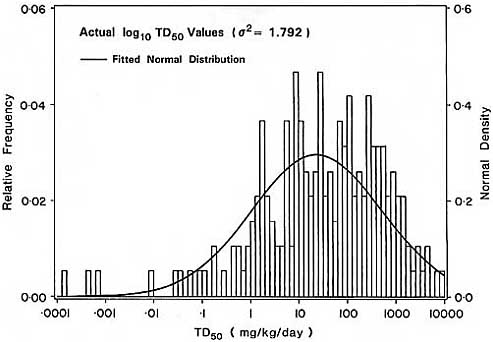
In studying the distribution of carcinogenic potency, Rulis (1986) noted that the TD50 values for 343 rodent carcinogens selected from the CPDB were roughly lognormally distributed. (In cases where more than one experiment was done on the same chemical or where more than one lesion was dose-related in a single study, the minimum TD50 value was used in this analysis.) Similar distributions have been observed using other subsets of the CPDB (Krewski et al., 1990b). For example, consider the distribution of TD50 values shown in Figure 1a for 191 of the 217 compounds considered previously by Krewski et al. (1990b). These compounds were selected to satisfy a number of criteria, including the requirements that the experiment have at least two doses in addition to unexposed controls and demonstrate clear evidence of carcinogenicity. The 26 experiments omitted from the current analysis included only one
Page
117
Front Matter (R1-R18)
Executive Summary (1-2)
USE OF THE MAXIMUM TOLERATED DOSE IN ANIMAL BIOASSAYS FOR CARCINOGENICITY (3-8)
THE TWO-STAGE MODEL OF CARCINOGENESIS (9-9)
A PARADIGM FOR ECOLOGIC RISK ASSESSMENT (10-12)
Issues In Risk Assessment Use Of Maximum Tolerated Dose in Animal Bioassays for Carcinogenicity (13-14)
BACKGROUND (15-17)
SCOPE OF REPORT (18-20)
DEFINITIONS AND BACKGROUND (21-23)
CORRELATIONS (24-32)
RELATIONSHIP BETWEEN TOXICITY AND CARCINOGENICITY OBSERVED AT MTD (33-42)
QUALITATIVE INFORMATION (43-48)
QUANTITATIVE INFORMATION (49-52)
OPTION 1 (53-53)
OPTION 2 (54-54)
OPTION 3 (55-56)
Option 4A (57-58)
Option 4B (59-60)
5 Conclusions and Recommendations (61-66)
REFERENCES (67-78)
BACKGROUND (79-79)
DEFINING AND DETERMINING THE MTD (80-90)
Appendix B Organizing Subcommittee (91-92)
Appendix C Federal Liaison Group (93-94)
Appendix D Workshop Program (95-96)
Appendix E Workshop Attendees (97-110)
1. INTRODUCTION (111-112)
2.1 Measures of Carcinogenic Potency (113-115)
2.2 Carcinogenic Potency Database (CPDB) (116-116)
2.3 Variation in Carcinogen Potency (117-118)
2.4 Classification of Carcinogens (119-120)
3.1 Empirical Correlations (121-124)
3.2 Range of Possible TD50 Values (125-125)
3.3 Analytical Correlations (126-127)
3.4 Model Dependency (128-129)
3.5 Genotoxic vs. Nongenotoxic Carcinogens (130-130)
4.1 Predictions Based on the MDT (131-131)
4.2 Predictions Based on Mutagenicity and Acute Toxicity (132-134)
5.1 Correlation Between Upper Bounds On the Low Dose Slope and MTD (135-135)
5.2 Correlation Between q1* and the TD50 (136-138)
5.3. Preliminary Estimate of Risk (139-139)
6. INTERSPECIES EXTRAPOLATION (140-140)
6.1 Extrapolation from Rats to Mice (141-143)
6.2 Extrapolation from Rodents to Humans (144-145)
7. CONCLUSIONS (146-148)
8. ACKNOWLEDGEMENTS (149-149)
9. REFERENCES (150-159)
ANNEX A: MAXIMUM LIKELIHOOD METHODS FOR FITTING THE WEIBULL MODEL (160-161)
ANNEX B. SHRINKAGE ESTIMATORS OF THE DISTRIBUTION OF CARCINOGENIC POTENCY (162-163)
ANNEX C: ADJUSTMENT OF POTENCY VALUES FOR LESS THAN LIFETIME EXPOSURE (164-165)
ANNEX D: CORRELATION BETWEEN TD50 AND MTD (166-168)
ANNEX E: CORRELATION BETWEEN TD50S FOR RATS AND MICE (169-172)
Appendix G Informal Search for ''Supercarcinogens" (173-174)
CRITERIA AND CANDIDATE CHEMICALS (175-176)
DATA (177-180)
RESULTS (181-181)
DISCUSSION (182-184)
Issues in Risk Assessment The Two-Stage Model Of Carcinogenesis (185-186)
INTRODUCTION (187-187)
BIOLOGIC CONSIDERATIONS (188-189)
THE TWO-STAGE MODEL (190-195)
APPLICATIONS OF THE TWO-STAGE MODEL TO ANIMAL DATA (196-211)
Data Needs (212-212)
Criteria for Adoption (213-213)
Prospects (214-214)
CONCLUSIONS AND RECOMMENDATIONS (215-216)
REFERENCES (217-222)
BIOLOGICAL FACTORS IN TWO-STAGE MODELS (223-225)
TWO-STAGE MODEL OF CLONAL EXPANSION (226-227)
APPLICATION OF THE TWO-STAGE MODEL TO ANIMAL DATA (228-232)
Appendix B Workshop Program (233-234)
Appendix C Workshop Federal Liaison Group (235-236)
TOPIC GROUP MEMBERS (237-238)
Appendix E Workshop Organizing Task Group (239-240)
Isuees In Risk Assessment A Paradigm for Ecological Risk Assessment (241-242)
1 Introduction (243-246)
2 Scope of Ecological Risk Assessment (247-248)
COMPONENTS OF THE 1983 FRAMEWORK (249-250)
CONSISTENCY OF CASE STUDIES WITH THE 1983 FRAMEWORK (251-253)
INTEGRATION OF ECOLOGICAL RISK INTO THE 1983 FRAMEWORK (254-254)
DEFINITION OF FRAMEWORK COMPONENTS FOR ECOLOGICAL RISK ASSESSMENT (255-258)
EXTRAPOLATION ACROSS SCALES (259-260)
QUANTIFICATION OF UNCERTAINTY (261-261)
VALIDATION OF PREDICTIVE TOOLS (262-262)
VALUATION (263-264)
5 Conclusions (265-266)
6 Recommendations (267-268)
REFERENCES (269-272)
Appendix A Workshop Participants (273-278)
Appendix B Workshop Organizing Subcommittee and Federal Liaison Group (279-280)
Appendix C Workshop Introduction (281-282)
TERRY F. YOSIE BUILDING ECOLOGICAL RISK ASSESSMENT AS A POLICY TOOL (283-285)
D. WARNER NORTH: RELATIONSHIP OF WORKSHOP TO NRC'S 1983 RED BOOK REPORT (286-288)
MICHAEL SLIMAK: U.S. ENVIRONMENTAL PROTECTION AGENCY ACTIVITIES IN ECOLOGICAL RISK ASSESSMENT (289-292)
CASE STUDY 1: TRIBUTYLTIN RISK MANAGEMENT IN THE UNITED STATES (293-293)
Discussion (294-294)
CASE STUDY 2: ECOLOGICAL RISK ASSESSMENT FOR TERRESTRIAL WILDLIFE EXPOSED TO AGRICULTURAL CHEMICALS (295-296)
CASE STUDY 3A: MODELS OF TOXIC CHEMICALS IN THE GREAT LAKES: STRUCTURE, APPLICATIONS, AND UNCERTAINTY ANALYSIS (297-298)
CASE STUDY 3B: ECOLOGICAL RISK ASSESSMENT OF TCDD AND TCDF (299-299)
Discussion (300-300)
CASE STUDY 4: RISK ASSESSMENT METHODS IN ANIMAL POPULATIONS: THE NORTHERN SPOTTED OWL AS AN EXAMPLE (301-301)
Discussion (302-302)
CASE STUDY 5: ECOLOGICAL BENEFITS AND RISKS ASSOCIATED WITH THE INTRODUCTION OF EXOTIC SPECIES FOR BIOLOGICAL CONTROL OF A... (303-303)
Discussion (304-304)
CASE STUDY 1: UNCERTAINTY AND RISK IN AN EXPLOITED ECOSYSTEM: A CASE STUDY OF GEORGES BANK (305-306)
Discussion (307-308)
Generic Issues (309-309)
Analysis of Case Studies (310-310)
DOSE-RESPONSE ASSESSMENT (311-311)
Selection of End Points (312-312)
Consideration of Nonlinearities And Discontinuities (313-313)
Understanding the Stressor (314-314)
Additions to the 1983 Paradigm Needed for Ecological Risk Assessment (315-315)
Modeling Needs for Stress-Response Relationships (316-316)
Methods of Measuring Stressors for Ecological Exposure Assessment (317-317)
Definition of Risk Characterization (318-318)
Components of Risk Characterization (319-319)
Organization and Presentation (320-320)
Differences from and Similarities To the 1983 Report (321-321)
Application to the Case Studies (322-323)
Agricultural Chemicals (324-324)
Northern Spotted Owl (325-325)
General Discussion: Models and Risk Assessment (326-326)
Uncertainties Identified In the Case Studies (327-327)
Implications of Uncertainty for Ecological Risk Assessment (328-328)
VALUATION (329-330)
Risk Assessment Has Many Uses (331-332)
Different Risk Assessment Methods Are Suited to Different Risk Assessment Needs (333-333)
Risk Assessors and Risk Managers Need to Communicate (334-334)
Credibility is Crucial (335-336)
Appendix G Contemplations on Ecological Risk Assessment (337-342)
Appendix H Workshop Summary (343-346)
Appendix I References for Appendixes (347-350)
Appendix J Workshop Program (351-356)

Below are the first 10 and last 10 pages of uncorrected machine-read text (when available) of this chapter, followed by the top 30 algorithmically extracted key phrases from the chapter as a whole.
Intended to provide our own search engines and external engines with highly rich, chapter-representative searchable text on the opening pages of each chapter. Because it is UNCORRECTED material, please consider the following text as a useful but insufficient proxy for the authoritative book pages.

Do not use for reproduction, copying, pasting, or reading; exclusively for search engines.

OCR for page 117
Issues in Risk Assessment 1986b). When the level of exposure was not constant throughout the study period, a time-weighted average daily dose was used to determine the TD50. Although more precise methods of estimating carcinogenic potency with time-dependent exposure patterns are available (Murdoch & Krewski, 1988), this is not critical for our present purposes (cf. Murdoch et al., 1992). The CPDB includes data on over 3700 experiments on 975 different chemicals conducted under the National Cancer Institute/National Toxicology Program and by other investigators who have reported their results in the scientific literature (Gold et al., 1989). For each chemical, the CPDB may include studies done on different sexes, species and strains; by various routes of exposure; or under other experimental conditions. For each experiment, the doses and crude tumor response rates for each lesion demonstrating evidence of a dose-related effect are provided, thereby affording the opportunity for secondary analyses of the experimental results. 2.3 Variation in Carcinogen Potency The CPDB includes data on potent chemical carcinogens such as 2,3,7,8-tetraclorodibenzo-p-dioxin (TCDD), as well as less potent compounds such as DDT. Gold et al. (1984) noted that the TD50 value in the CPDB for chemicals inducing tumors in rats varied by seven orders of magnitude or 10 million-fold. In studying the distribution of carcinogenic potency, Rulis (1986) noted that the TD50 values for 343 rodent carcinogens selected from the CPDB were roughly lognormally distributed. (In cases where more than one experiment was done on the same chemical or where more than one lesion was dose-related in a single study, the minimum TD50 value was used in this analysis.) Similar distributions have been observed using other subsets of the CPDB (Krewski et al., 1990b). For example, consider the distribution of TD50 values shown in Figure 1a for 191 of the 217 compounds considered previously by Krewski et al. (1990b). These compounds were selected to satisfy a number of criteria, including the requirements that the experiment have at least two doses in addition to unexposed controls and demonstrate clear evidence of carcinogenicity. The 26 experiments omitted from the current analysis included only one

OCR for page 118
Issues in Risk Assessment FIGURE 1a Variation in carcinogenic potency of 191 chemical carcinogens selected from the CPDB.