
National Academy of Sciences | 150 Year Anniversary

Questions? Call 800-624-6242

| Items in cart [0]

The National Academies Press

PAPERBACK
price:$49.00
add to cart

Rights & Permissions

topleft topright

Issues in Risk Assessment (1993)
Commission on Life Sciences (CLS)

Citation Manager

. "DEFINITION OF FRAMEWORK COMPONENTS FOR ECOLOGICAL RISK ASSESSMENT." Issues in Risk Assessment. Washington, DC: The National Academies Press, 1993.

Please select a format:

BibTeX EndNote RefMan


Page
255
bottomleft bottomright

The following HTML text is provided to enhance online readability. Many aspects of typography translate only awkwardly to HTML. Please use the page image as the authoritative form to ensure accuracy.


Issues in Risk Assessment

and (2) pays insufficient attention to the critical problem of effective communication with risk managers and the public. The opinion of the committee, however, is that these deficiencies are not unique to ecological risk assessment. Differences in the functions of different regulatory agencies clearly influence the types of data and inference guidelines used in health risk assessments, and effective risk communication is as important (and often as inadequately performed) in health as in ecological risk assessment.

DEFINITION OF FRAMEWORK COMPONENTS FOR ECOLOGICAL RISK ASSESSMENT

Hazard identification is redefined to be the determination of whether a particular hazardous agent is associated with health or ecological effects that are of sufficient importance to warrant further scientific study or immediate management action.

This change in definition is intended to account for the influence of regulatory mandates and other policy considerations on the conduct of risk assessments. Examples of such influences are restrictions on data acquisition or response time (e.g., premanufacture notification assessments under the Toxic Substances Control Act), standardized data requirements and regulatory criteria (pesticide registration under the Federal Insecticide, Fungicide, and Rodenticide Act), and the scoping provisions of the National Environmental Policy Act. Other aspects of hazard identification, such as investigation of cause-effect relationships and preliminary screening, would remain essentially unchanged.

Exposure-response assessment is defined as the determination of the relation between the magnitude of exposure and the probability of occurrence of the effects in question. Replacement of the term "dose" with a more general term is required, because "dose" has a distinctly medical connotation and cannot be effectively applied to nonchemical stresses, such as habitat change or harvesting. The "responses" addressed in ecological risk assessments include direct effects of exposure and the much broader indirect effects, such as secondary poisoning of raptors due to accumulation of pesticide residues in their prey and effects of harvesting on fish-community structure.

Exposure assessment is defined as the determination of the extent of

Page
255
Front Matter (R1-R18)
Executive Summary (1-2)
USE OF THE MAXIMUM TOLERATED DOSE IN ANIMAL BIOASSAYS FOR CARCINOGENICITY (3-8)
THE TWO-STAGE MODEL OF CARCINOGENESIS (9-9)
A PARADIGM FOR ECOLOGIC RISK ASSESSMENT (10-12)
Issues In Risk Assessment Use Of Maximum Tolerated Dose in Animal Bioassays for Carcinogenicity (13-14)
BACKGROUND (15-17)
SCOPE OF REPORT (18-20)
DEFINITIONS AND BACKGROUND (21-23)
CORRELATIONS (24-32)
RELATIONSHIP BETWEEN TOXICITY AND CARCINOGENICITY OBSERVED AT MTD (33-42)
QUALITATIVE INFORMATION (43-48)
QUANTITATIVE INFORMATION (49-52)
OPTION 1 (53-53)
OPTION 2 (54-54)
OPTION 3 (55-56)
Option 4A (57-58)
Option 4B (59-60)
5 Conclusions and Recommendations (61-66)
REFERENCES (67-78)
BACKGROUND (79-79)
DEFINING AND DETERMINING THE MTD (80-90)
Appendix B Organizing Subcommittee (91-92)
Appendix C Federal Liaison Group (93-94)
Appendix D Workshop Program (95-96)
Appendix E Workshop Attendees (97-110)
1. INTRODUCTION (111-112)
2.1 Measures of Carcinogenic Potency (113-115)
2.2 Carcinogenic Potency Database (CPDB) (116-116)
2.3 Variation in Carcinogen Potency (117-118)
2.4 Classification of Carcinogens (119-120)
3.1 Empirical Correlations (121-124)
3.2 Range of Possible TD50 Values (125-125)
3.3 Analytical Correlations (126-127)
3.4 Model Dependency (128-129)
3.5 Genotoxic vs. Nongenotoxic Carcinogens (130-130)
4.1 Predictions Based on the MDT (131-131)
4.2 Predictions Based on Mutagenicity and Acute Toxicity (132-134)
5.1 Correlation Between Upper Bounds On the Low Dose Slope and MTD (135-135)
5.2 Correlation Between q1* and the TD50 (136-138)
5.3. Preliminary Estimate of Risk (139-139)
6. INTERSPECIES EXTRAPOLATION (140-140)
6.1 Extrapolation from Rats to Mice (141-143)
6.2 Extrapolation from Rodents to Humans (144-145)
7. CONCLUSIONS (146-148)
8. ACKNOWLEDGEMENTS (149-149)
9. REFERENCES (150-159)
ANNEX A: MAXIMUM LIKELIHOOD METHODS FOR FITTING THE WEIBULL MODEL (160-161)
ANNEX B. SHRINKAGE ESTIMATORS OF THE DISTRIBUTION OF CARCINOGENIC POTENCY (162-163)
ANNEX C: ADJUSTMENT OF POTENCY VALUES FOR LESS THAN LIFETIME EXPOSURE (164-165)
ANNEX D: CORRELATION BETWEEN TD50 AND MTD (166-168)
ANNEX E: CORRELATION BETWEEN TD50S FOR RATS AND MICE (169-172)
Appendix G Informal Search for ''Supercarcinogens" (173-174)
CRITERIA AND CANDIDATE CHEMICALS (175-176)
DATA (177-180)
RESULTS (181-181)
DISCUSSION (182-184)
Issues in Risk Assessment The Two-Stage Model Of Carcinogenesis (185-186)
INTRODUCTION (187-187)
BIOLOGIC CONSIDERATIONS (188-189)
THE TWO-STAGE MODEL (190-195)
APPLICATIONS OF THE TWO-STAGE MODEL TO ANIMAL DATA (196-211)
Data Needs (212-212)
Criteria for Adoption (213-213)
Prospects (214-214)
CONCLUSIONS AND RECOMMENDATIONS (215-216)
REFERENCES (217-222)
BIOLOGICAL FACTORS IN TWO-STAGE MODELS (223-225)
TWO-STAGE MODEL OF CLONAL EXPANSION (226-227)
APPLICATION OF THE TWO-STAGE MODEL TO ANIMAL DATA (228-232)
Appendix B Workshop Program (233-234)
Appendix C Workshop Federal Liaison Group (235-236)
TOPIC GROUP MEMBERS (237-238)
Appendix E Workshop Organizing Task Group (239-240)
Isuees In Risk Assessment A Paradigm for Ecological Risk Assessment (241-242)
1 Introduction (243-246)
2 Scope of Ecological Risk Assessment (247-248)
COMPONENTS OF THE 1983 FRAMEWORK (249-250)
CONSISTENCY OF CASE STUDIES WITH THE 1983 FRAMEWORK (251-253)
INTEGRATION OF ECOLOGICAL RISK INTO THE 1983 FRAMEWORK (254-254)
DEFINITION OF FRAMEWORK COMPONENTS FOR ECOLOGICAL RISK ASSESSMENT (255-258)
EXTRAPOLATION ACROSS SCALES (259-260)
QUANTIFICATION OF UNCERTAINTY (261-261)
VALIDATION OF PREDICTIVE TOOLS (262-262)
VALUATION (263-264)
5 Conclusions (265-266)
6 Recommendations (267-268)
REFERENCES (269-272)
Appendix A Workshop Participants (273-278)
Appendix B Workshop Organizing Subcommittee and Federal Liaison Group (279-280)
Appendix C Workshop Introduction (281-282)
TERRY F. YOSIE BUILDING ECOLOGICAL RISK ASSESSMENT AS A POLICY TOOL (283-285)
D. WARNER NORTH: RELATIONSHIP OF WORKSHOP TO NRC'S 1983 RED BOOK REPORT (286-288)
MICHAEL SLIMAK: U.S. ENVIRONMENTAL PROTECTION AGENCY ACTIVITIES IN ECOLOGICAL RISK ASSESSMENT (289-292)
CASE STUDY 1: TRIBUTYLTIN RISK MANAGEMENT IN THE UNITED STATES (293-293)
Discussion (294-294)
CASE STUDY 2: ECOLOGICAL RISK ASSESSMENT FOR TERRESTRIAL WILDLIFE EXPOSED TO AGRICULTURAL CHEMICALS (295-296)
CASE STUDY 3A: MODELS OF TOXIC CHEMICALS IN THE GREAT LAKES: STRUCTURE, APPLICATIONS, AND UNCERTAINTY ANALYSIS (297-298)
CASE STUDY 3B: ECOLOGICAL RISK ASSESSMENT OF TCDD AND TCDF (299-299)
Discussion (300-300)
CASE STUDY 4: RISK ASSESSMENT METHODS IN ANIMAL POPULATIONS: THE NORTHERN SPOTTED OWL AS AN EXAMPLE (301-301)
Discussion (302-302)
CASE STUDY 5: ECOLOGICAL BENEFITS AND RISKS ASSOCIATED WITH THE INTRODUCTION OF EXOTIC SPECIES FOR BIOLOGICAL CONTROL OF A... (303-303)
Discussion (304-304)
CASE STUDY 1: UNCERTAINTY AND RISK IN AN EXPLOITED ECOSYSTEM: A CASE STUDY OF GEORGES BANK (305-306)
Discussion (307-308)
Generic Issues (309-309)
Analysis of Case Studies (310-310)
DOSE-RESPONSE ASSESSMENT (311-311)
Selection of End Points (312-312)
Consideration of Nonlinearities And Discontinuities (313-313)
Understanding the Stressor (314-314)
Additions to the 1983 Paradigm Needed for Ecological Risk Assessment (315-315)
Modeling Needs for Stress-Response Relationships (316-316)
Methods of Measuring Stressors for Ecological Exposure Assessment (317-317)
Definition of Risk Characterization (318-318)
Components of Risk Characterization (319-319)
Organization and Presentation (320-320)
Differences from and Similarities To the 1983 Report (321-321)
Application to the Case Studies (322-323)
Agricultural Chemicals (324-324)
Northern Spotted Owl (325-325)
General Discussion: Models and Risk Assessment (326-326)
Uncertainties Identified In the Case Studies (327-327)
Implications of Uncertainty for Ecological Risk Assessment (328-328)
VALUATION (329-330)
Risk Assessment Has Many Uses (331-332)
Different Risk Assessment Methods Are Suited to Different Risk Assessment Needs (333-333)
Risk Assessors and Risk Managers Need to Communicate (334-334)
Credibility is Crucial (335-336)
Appendix G Contemplations on Ecological Risk Assessment (337-342)
Appendix H Workshop Summary (343-346)
Appendix I References for Appendixes (347-350)
Appendix J Workshop Program (351-356)

Below are the first 10 and last 10 pages of uncorrected machine-read text (when available) of this chapter, followed by the top 30 algorithmically extracted key phrases from the chapter as a whole.
Intended to provide our own search engines and external engines with highly rich, chapter-representative searchable text on the opening pages of each chapter. Because it is UNCORRECTED material, please consider the following text as a useful but insufficient proxy for the authoritative book pages.

Do not use for reproduction, copying, pasting, or reading; exclusively for search engines.

OCR for page 255
Issues in Risk Assessment and (2) pays insufficient attention to the critical problem of effective communication with risk managers and the public. The opinion of the committee, however, is that these deficiencies are not unique to ecological risk assessment. Differences in the functions of different regulatory agencies clearly influence the types of data and inference guidelines used in health risk assessments, and effective risk communication is as important (and often as inadequately performed) in health as in ecological risk assessment. DEFINITION OF FRAMEWORK COMPONENTS FOR ECOLOGICAL RISK ASSESSMENT Hazard identification is redefined to be the determination of whether a particular hazardous agent is associated with health or ecological effects that are of sufficient importance to warrant further scientific study or immediate management action. This change in definition is intended to account for the influence of regulatory mandates and other policy considerations on the conduct of risk assessments. Examples of such influences are restrictions on data acquisition or response time (e.g., premanufacture notification assessments under the Toxic Substances Control Act), standardized data requirements and regulatory criteria (pesticide registration under the Federal Insecticide, Fungicide, and Rodenticide Act), and the scoping provisions of the National Environmental Policy Act. Other aspects of hazard identification, such as investigation of cause-effect relationships and preliminary screening, would remain essentially unchanged. Exposure-response assessment is defined as the determination of the relation between the magnitude of exposure and the probability of occurrence of the effects in question. Replacement of the term "dose" with a more general term is required, because "dose" has a distinctly medical connotation and cannot be effectively applied to nonchemical stresses, such as habitat change or harvesting. The "responses" addressed in ecological risk assessments include direct effects of exposure and the much broader indirect effects, such as secondary poisoning of raptors due to accumulation of pesticide residues in their prey and effects of harvesting on fish-community structure. Exposure assessment is defined as the determination of the extent of

OCR for page 256
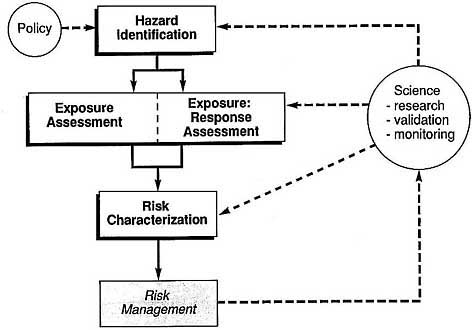
Issues in Risk Assessment exposure to the hazardous agent in question before or after application of regulatory controls. In the committee's view, the term "exposure" can legitimately be applied to nonchemical stresses, including physical stresses (such as habitat and UV radiation) and biological stresses (such as species introductions). The committee considered changes in terminology on the grounds that the term "exposure" is too closely associated with chemical risks. However, the alternative terms discussed (e.g., stress and stressor) were unsuitable because of conflicts with medical uses of the same or similar terms. Risk characterization is defined as the description of the nature and often the magnitude of risk, including attendant uncertainty, expressed in terms that are comprehensible to decision-makers and the public. Extension of the definition provided in the 1983 report is needed to permit more explicit discussion of uncertainty, to facilitate expression of risks in management-relevant terms (including valuation), and to emphasize the importance of communication between scientists and managers. The committee believes that improved communication is as important for health risk assessment as it is for ecological risk assessment. The revised framework is summarized in Figure 3-2. The relationships among the four components are unchanged from the Red Book: hazard identification is the initial step in an assessment. Exposure assessment and exposure-response assessment occur roughly in parallel and must be closely linked. The arrangement of those components in Figure 3-2, within a single box divided in half by a "permeable membrane," is intended to emphasize the ties between them. Risk characterization synthesizes the results of technical analyses and expresses them in a form suitable for valuation studies or other policy analyses that are carried out as part of risk management. In addition to the four basic components, Figure 3-2 depicts two aspects of risk assessment that the committee wants to emphasize. As previously noted, it is essential to recognize that management considerations (e.g., regulatory constraints on the scope or time available for an assessment or legally prescribed definitions of acceptable or unacceptable uses) can shape the hazard identification step. The committee would also like to emphasize the need to create a connection between the results of today's risk assessments and the science base for future risk assessments. The risk assessment process should not end when a regulatory decision is made. Followup in the form of monitoring (where
OCR for page 257
Issues in Risk Assessment FIGURE 3-2 Extension of the 1983 NAS risk assessment paradigm to include ecological as well as human health risks.

OCR for page 258
Issues in Risk Assessment measurable effects have been predicted), validation studies, and basic research are needed to improve the data and models available to technical risk assessors whenever the same or a similar problem is encountered in the future.