
14
Subjective Reports of Heat Illness
Richard F. Johnson1 and Donna J. Merullo
INTRODUCTION
During the first several days of rapid deployment of soldiers to the field, dietary salt consumption is often reduced due to the altered salt content of field rations and a general reduction in total ration consumption (USARIEM, 1990). If the deployment is to a hot environment, such as a jungle or a desert, decreased salt consumption becomes particularly problematic due to increased salt losses during sweating. To shed light on the minimum daily consumption of salt required to acquire and sustain heat acclimation during simulated desert living, a large study was conducted on the effects of salt intake on young soldiers during heat acclimation. A detailed description of the study is presented elsewhere in this volume (Chapter 12). Briefly, the study compared the effects of diets containing low normal (8 g) and low (4 g) levels of daily dietary salt intake in 17 healthy soldiers. The soldiers underwent a 7-day dietary stabilization period (no heat exposure) followed by 10 days of heat acclimation (8 hours per day at 41°C, 20 percent relative humidity, walking at 5.6 km per hour for 30 minutes per hour). The physiological response data resulting from the study are presented by Armstrong et al. in Chapter 12. The focus of this chapter is on the influence of dietary salt intake on the soldiers' subjective reports of symptoms of heat illness during heat acclimation. Symptoms of heat illness,
as experienced by the individual soldier exercising in the heat, are important because they are the sole indications by which the soldier judges the onset of heat injury (Armstrong et al., 1987).
In a study of the signs and symptoms of one type of heat illness—heat exhaustion—Armstrong et al. (1987) exposed 14 healthy unacclimated men to 8 days of heat acclimation by intermittent treadmill running in an environmental chamber set at 41°C, 39 percent relative humidity. During the study, the subjects experienced nine different signs and symptoms: abdominal cramps, chills, dizziness, flushed skin with ''heat sensations,'' elevated resting heart rate, hyperirritability, "rubbery" legs, piloerection, and vomiting and nausea. The incidence of these signs and symptoms decreased as the number of days of heat exposure increased. The signs and symptoms were gathered through careful clinical observations and the solicitation of the subjects' verbal reports of their experiences.
In the present study, a standardized psychological instrument, the Environmental Symptoms Questionnaire (ESQ) (Kobrick and Sampson, 1979; Sampson and Kobrick, 1980), was used to evaluate soldiers' reports of symptoms of heat illness. The ESQ is a 68-item questionnaire that measures a variety of symptoms including headache, dizziness, nausea, thirst, and cramps (Table 14-1). The ESQ is worded in the past tense, and the subject is required to reflect on symptoms experienced during the hours prior to administration. The subject rates each symptom on a 6-point scale ranging from "not at all" to "extreme." The ESQ has been successfully used to assess symptomatology under conditions of high terrestrial altitude (Banderet and Lieberman, 1989; Kobrick and Sampson, 1979; Rock et al., 1987; Sampson and Kobrick, 1980), ambient cold (Johnson et al., 1989), combat field feeding (Hirsch et al., 1984; USACDEC/USARIEM, 1986), and the administration of nerve agent antidote (Kobrick et al., 1990).
METHOD
Subjects
Seventeen healthy male U.S. Army soldiers volunteered to participate in the study. Prior to heat acclimation, all underwent 1 week of dietary stabilization (days 1 to 7) during which consumption of dietary salt was held constant at 8 g per day. On the first (day 8) of 10 days of heat acclimation (days 8 to 17), subjects were randomly, and in a double-blind fashion, assigned to either the 4-g dietary salt group (n = 8), or the 8-g dietary salt group (n = 9). Examination of selected personal characteristics (age, height, weight, and race) indicated that the two groups were comparable to one another. The subjects assigned to the 4-g salt group averaged 19.8 years old, 71.3 inches tall, and weighed 174.9 pounds; seven were Caucasian and one
was Hispanic. The subjects assigned to the 8-g salt group averaged 19.9 years old, 70.9 inches tall, and weighed 169.67 pounds; eight were Caucasian and one was Hispanic.
Procedure
The ESQ was administered to all participants 13 times during the study. To obtain baseline measures during nonheat exposure days when all were consuming a constant 8 g of dietary salt per day, the ESQ was administered during the afternoons of days 1, 4, and 7. On each of the 10 days of heat acclimation (days 8 to 17), the ESQ was administered at the end of the 8 hours of heat exposure.
Subjective reports of heat illness were assessed in two ways: (a) a tabulation of 12 ESQ symptoms selected for their previously established relationship to exercise in the heat (Armstrong et al., 1987), and (b) the formulation and analysis of an overall index of subjective heat illness.
Release 2.1 of the computer-based statistical package Complete Statistical System (CSS) (StatSoft, 1988) was used to perform all statistical analyses.
RESULTS
Tabulation of Selected ESQ Symptoms
The 12 items on the ESQ that are related to the 9 symptoms of heat illness observed by Armstrong et al. (1987) are displayed in Table 14-2 (4-g salt diet) and in Table 14-3 (8-g salt diet) for each subject for each of the 10 heat acclimation days. The 12 symptoms include stomach cramps (item 17), chilly (item 36), dizzy (item 4), warm and sweaty (items 30 and 33), heart beating fast (item 11), irritability and restlessness (items 62 and 63), disturbed coordination (item 7), weakness (item 19), shivering (item 37), and nausea (item 24). Only those symptoms rated at least "1" by the participant (indicating that the symptom was present regardless of how intense it was felt) are listed in the tables. An analysis of variance of the number of symptoms reported as present differed among days, F (9, 135) = 6.10967, p < .001, with the mean number of symptoms present being greater, by Duncan post hoc tests (p < .05), during the first 2 days of heat acclimation (means = 4.3 and 4.0) than during the remaining 8 heat acclimation days (means = 3.1, 2.9, 3.2, 2.4, 2.5, 2.5, 2.2, and 2.3). Although there was a trend for more symptoms to be reported by subjects in the 4-g diet group (mean = 3.2) than by the 8-g diet group (mean = 2.6), the analysis of variance was not significant with respect to the main effect of diet, F (1,15) = 1.17, p > .20; the interaction between diet and heat acclimation day was also not significant, F (9,135) = 1.775, p > .05. In Tables 14-4 (4-g salt diet)
TABLE 14-1 U.S. Army Research Institute of Environmental Medicine Environmental Symptoms Questionnaire (ESQ)
Circle the number of each item to correspond to HOW YOU HAVE BEEN FEELING TODAY. PLEASE ANSWER EVERY ITEM. If you did not have the symptom, circle zero (NOT AT ALL).
|
|
|
Not At All |
Slight |
Somewhat |
Moderate |
Quite a Bit |
Extreme |
|
1. |
I felt lightheaded. |
0 |
1 |
2 |
3 |
4 |
5 |
|
2. |
I had a headache. |
0 |
1 |
2 |
3 |
4 |
5 |
|
3. |
I felt sinus pressure. |
0 |
1 |
2 |
3 |
4 |
5 |
|
4. |
I felt dizzy. |
0 |
1 |
2 |
3 |
4 |
5 |
|
5. |
I felt faint. |
0 |
1 |
2 |
3 |
4 |
5 |
|
6. |
My vision was dim. |
0 |
1 |
2 |
3 |
4 |
5 |
|
7. |
My coordination was off. |
0 |
1 |
2 |
3 |
4 |
5 |
|
8. |
I was short of breath. |
0 |
1 |
2 |
3 |
4 |
5 |
|
9. |
It was hard to breathe. |
0 |
1 |
2 |
3 |
4 |
5 |
|
10. |
It hurt to breathe. |
0 |
1 |
2 |
3 |
4 |
5 |
|
11. |
My heart was beating fast. |
0 |
1 |
2 |
3 |
4 |
5 |
|
12. |
My heart was pounding. |
0 |
1 |
2 |
3 |
4 |
5 |
|
13. |
I had a chest pain. |
0 |
1 |
2 |
3 |
4 |
5 |
|
14. |
I had chest pressure. |
0 |
1 |
2 |
3 |
4 |
5 |
|
15. |
My hands were shaking or trembling. |
0 |
1 |
2 |
3 |
4 |
5 |
|
16. |
I had a muscle cramp. |
0 |
1 |
2 |
3 |
4 |
5 |
|
17. |
I had stomach cramps. |
0 |
1 |
2 |
3 |
4 |
5 |
|
18. |
My muscles felt tight or stiff. |
0 |
1 |
2 |
3 |
4 |
5 |
|
19. |
I felt weak. |
0 |
1 |
2 |
3 |
4 |
5 |
|
20. |
My legs or feet ached. |
0 |
1 |
2 |
3 |
4 |
5 |
|
21. |
My hands, arms, or shoulder sached. |
0 |
1 |
2 |
3 |
4 |
5 |
|
22. |
My back ached. |
0 |
1 |
2 |
3 |
4 |
5 |
|
23. |
I had a stomach ache. |
0 |
1 |
2 |
3 |
4 |
5 |
|
24. |
I felt sick to my stomach (nauseous). |
0 |
1 |
2 |
3 |
4 |
5 |
|
25. |
I had gas pressure. |
0 |
1 |
2 |
3 |
4 |
5 |
|
26. |
I had diarrhea. |
0 |
1 |
2 |
3 |
4 |
5 |
|
27. |
I felt constipated. |
0 |
1 |
2 |
3 |
4 |
5 |
|
28. |
I had to urinate more than usual. |
0 |
1 |
2 |
3 |
4 |
5 |
|
29. |
I had to urinate less than usual. |
0 |
1 |
2 |
3 |
4 |
5 |
|
30. |
I felt warm. |
0 |
1 |
2 |
3 |
4 |
5 |
|
|
|
Not At All |
Slight |
Somewhat |
Moderate |
Quite a Bit |
Extreme |
|
31. |
I felt feverish. |
0 |
1 |
2 |
3 |
4 |
5 |
|
32. |
My feet were sweaty |
0 |
1 |
2 |
3 |
4 |
5 |
|
33. |
I was sweating all over. |
0 |
1 |
2 |
3 |
4 |
5 |
|
34. |
My hands were cold. |
0 |
1 |
2 |
3 |
4 |
5 |
|
35. |
My feet were cold. |
0 |
1 |
2 |
3 |
4 |
5 |
|
36. |
I felt chilly. |
0 |
1 |
2 |
3 |
4 |
5 |
|
37. |
I was shivering. |
0 |
1 |
2 |
3 |
4 |
5 |
|
38. |
Parts of my body felt numb. |
0 |
1 |
2 |
3 |
4 |
5 |
|
39. |
My skin was burning or itchy. |
0 |
1 |
2 |
3 |
4 |
5 |
|
40. |
My eyes felt irritated. |
0 |
1 |
2 |
3 |
4 |
5 |
|
41. |
My vision was blurry. |
0 |
1 |
2 |
3 |
4 |
5 |
|
42. |
My ears felt blocked up. |
0 |
1 |
2 |
3 |
4 |
5 |
|
43. |
My ears ached |
0 |
1 |
2 |
3 |
4 |
5 |
|
44. |
I couldn't hear well. |
0 |
1 |
2 |
3 |
4 |
5 |
|
45. |
My ears were ringing. |
0 |
1 |
2 |
3 |
4 |
5 |
|
46. |
My nose felt stuffed up. |
0 |
1 |
2 |
3 |
4 |
5 |
|
47. |
I had a runny nose. |
0 |
1 |
2 |
3 |
4 |
5 |
|
48. |
I had a nose bleed. |
0 |
1 |
2 |
3 |
4 |
5 |
|
49. |
My mouth was dry. |
0 |
1 |
2 |
3 |
4 |
5 |
|
50. |
My throat was sore. |
0 |
1 |
2 |
3 |
4 |
5 |
|
51. |
I was coughing. |
0 |
1 |
2 |
3 |
4 |
5 |
|
52. |
I lost my appetite. |
0 |
1 |
2 |
3 |
4 |
5 |
|
53. |
I felt sick. |
0 |
1 |
2 |
3 |
4 |
5 |
|
54. |
I felt hungover. |
0 |
1 |
2 |
3 |
4 |
5 |
|
55. |
I was thirsty. |
0 |
1 |
2 |
3 |
4 |
5 |
|
56. |
I felt tired. |
0 |
1 |
2 |
3 |
4 |
5 |
|
57. |
I felt sleepy. |
0 |
1 |
2 |
3 |
4 |
5 |
|
58. |
I felt wide awake. |
0 |
1 |
2 |
3 |
4 |
5 |
|
59. |
My concentration was off. |
0 |
1 |
2 |
3 |
4 |
5 |
|
60. |
I was more forgetful than usual. |
0 |
1 |
2 |
3 |
4 |
5 |
|
61. |
I felt worried or nervous. |
0 |
1 |
2 |
3 |
4 |
5 |
|
62. |
I felt irritable. |
0 |
1 |
2 |
3 |
4 |
5 |
|
63. |
I felt restless. |
0 |
1 |
2 |
3 |
4 |
5 |
|
64. |
I was bored. |
0 |
1 |
2 |
3 |
4 |
5 |
|
65. |
I felt depressed. |
0 |
1 |
2 |
3 |
4 |
5 |
|
66. |
I felt alert. |
0 |
1 |
2 |
3 |
4 |
5 |
|
67. |
I felt good. |
0 |
1 |
2 |
3 |
4 |
5 |
|
68. |
I was hungry. |
0 |
1 |
2 |
3 |
4 |
5 |
|
SOURCE: Adapted from Kobrick and Sampson (1979) and Sampson and Kobrick (1980). |
|||||||
TABLE 14-2 Subjective Report of Environmental Symptoms Questionnaire Symptoms of Heat Illness: 4-g Salt Diet (n = 8)
|
|
Symptoms* on Heat Acclimation Day |
||||||||||
|
Subject |
1 |
2 |
3 |
4 |
5 |
6 |
7 |
8 |
9 |
10 |
Total Symptoms |
|
1 |
4 |
4 |
11 |
19 |
19 |
33 |
33 |
19 |
19 |
19 |
42 |
|
|
7 |
11 |
19 |
30 |
30 |
62 |
62 |
33 |
33 |
33 |
|
|
|
11 |
19 |
30 |
33 |
33 |
63 |
63 |
62 |
62 |
62 |
|
|
|
17 |
30 |
33 |
|
62 |
|
|
63 |
63 |
63 |
|
|
|
19 |
33 |
|||||||||
|
|
30 |
36 |
|||||||||
|
|
33 |
||||||||||
|
12 |
7 |
4 |
11 |
11 |
11 |
11 |
11 |
11 |
11 |
11 |
41 |
|
|
11 |
11 |
19 |
30 |
30 |
30 |
19 |
19 |
30 |
30 |
|
|
|
19 |
19 |
30 |
33 |
33 |
33 |
33 |
30 |
33 |
62 |
|
|
|
30 |
30 |
33 |
62 |
|
|
|
33 |
|||
|
|
33 |
33 |
62 |
||||||||
|
|
62 |
36 |
|||||||||
|
|
|
62 |
|||||||||
|
13 |
4 |
30 |
33 |
62 |
33 |
30 |
11 |
30 |
30 |
19 |
37 |
|
|
7 |
33 |
62 |
63 |
62 |
33 |
19 |
33 |
33 |
30 |
|
|
|
11 |
62 |
63 |
|
63 |
|
30 |
|
62 |
33 |
|
|
|
19 |
63 |
|
|
|
|
33 |
|
63 |
62 |
|
|
|
30 |
|
|
|
|
|
62 |
|
|
63 |
|
|
|
33 |
|
|
|
|
|
63 |
||||
|
11 |
7 |
7 |
19 |
30 |
7 |
30 |
30 |
30 |
30 |
|
33 |
|
|
30 |
19 |
30 |
33 |
19 |
62 |
63 |
63 |
|
63 |
|
|
|
33 |
30 |
33 |
62 |
30 |
|
63 |
||||
|
|
|
33 |
62 |
63 |
|
33 |
|||||
|
|
|
62 |
63 |
|
|
62 |
|||||
|
|
|
63 |
|
|
|
63 |
|||||
|
|
Symptoms* on Heat Acclimation Day |
||||||||||
|
Subject |
1 |
2 |
3 |
4 |
5 |
6 |
7 |
8 |
9 |
10 |
Total Symptoms |
|
2 |
19 |
19 |
19 |
19 |
19 |
19 |
30 |
30 |
30 |
30 |
31 |
|
|
30 |
30 |
30 |
30 |
24 |
30 |
33 |
33 |
33 |
33 |
|
|
|
33 |
33 |
33 |
33 |
30 |
33 |
|||||
|
|
|
62 |
62 |
|
33 |
62 |
|||||
|
|
|
|
|
|
62 |
||||||
|
22 |
4 |
4 |
17 |
19 |
19 |
19 |
17 |
19 |
|
36 |
27 |
|
|
19 |
11 |
19 |
36 |
36 |
36 |
36 |
36 |
|||
|
|
33 |
17 |
36 |
||||||||
|
|
36 |
19 |
|||||||||
|
|
|
24 |
|||||||||
|
|
|
30 |
|||||||||
|
|
|
33 |
|||||||||
|
|
|
36 |
|||||||||
|
|
|
63 |
|||||||||
|
8 |
11 |
11 |
11 |
11 |
30 |
11 |
30 |
11 |
30 |
11 |
25 |
|
|
30 |
30 |
30 |
30 |
|
30 |
33 |
30 |
33 |
30 |
|
|
|
33 |
33 |
33 |
33 |
|
|
|
33 |
|
33 |
|
|
6 |
4 |
4 |
30 |
19 |
19 |
33 |
19 |
30 |
33 |
30 |
23 |
|
|
11 |
30 |
33 |
33 |
30 |
|
33 |
33 |
|
33 |
|
|
|
17 |
33 |
|
|
33 |
||||||
|
|
30 |
||||||||||
|
|
33 |
||||||||||
|
Total |
37 |
42 |
29 |
23 |
27 |
20 |
22 |
21 |
18 |
20 |
259 |
|
Mean |
4.6 |
5.3 |
3.6 |
2.9 |
3.4 |
2.5 |
2.8 |
2.6 |
2.3 |
2.5 |
3.2 |
|
* Symptoms: 4 = dizzy; 7 = coordination off; 11 = heart beating fast; 17 = stomach cramps; 19 = weakness; 24 = nausea; 30 = warm; 33 = sweaty; 36 = chilly; 37 = shivering; 62 = irritability; 63 = restlessness. |
|||||||||||
TABLE 14-3 Subjective Report of Environmental Symptoms Questionnaire Symptoms of Heat Illness: 8-g Salt Diet (n = 9)
|
|
Symptoms* on Heat Acclimation Day |
||||||||||
|
Subject |
1 |
2 |
3 |
4 |
5 |
6 |
7 |
8 |
9 |
10 |
Total Symptoms |
|
4 |
4 |
7 |
7 |
7 |
7 |
7 |
7 |
7 |
7 |
19 |
53 |
|
|
7 |
11 |
11 |
11 |
11 |
19 |
19 |
19 |
19 |
30 |
|
|
|
11 |
19 |
19 |
19 |
19 |
30 |
30 |
30 |
30 |
33 |
|
|
|
19 |
30 |
30 |
30 |
30 |
33 |
33 |
33 |
33 |
|
|
|
|
30 |
33 |
33 |
33 |
33 |
||||||
|
|
33 |
63 |
36 |
36 |
36 |
||||||
|
|
63 |
|
37 |
37 |
|||||||
|
|
|
|
63 |
||||||||
|
25 |
4 |
4 |
30 |
30 |
30 |
30 |
30 |
30 |
30 |
30 |
33 |
|
|
7 |
30 |
33 |
33 |
33 |
33 |
33 |
33 |
33 |
33 |
|
|
|
19 |
33 |
62 |
62 |
62 |
|
62 |
62 |
62 |
62 |
|
|
|
30 |
62 |
|||||||||
|
|
33 |
||||||||||
|
|
62 |
||||||||||
|
26 |
7 |
30 |
30 |
30 |
30 |
11 |
11 |
30 |
11 |
11 |
32 |
|
|
11 |
33 |
33 |
33 |
33 |
30 |
30 |
33 |
30 |
30 |
|
|
|
30 |
|
63 |
63 |
63 |
33 |
33 |
63 |
33 |
33 |
|
|
|
33 |
|
|
|
|
63 |
|
|
63 |
|
|
|
21 |
4 |
4 |
30 |
30 |
4 |
17 |
30 |
30 |
30 |
30 |
30 |
|
|
7 |
19 |
33 |
33 |
7 |
30 |
33 |
33 |
33 |
33 |
|
|
|
19 |
33 |
|
|
19 |
33 |
|||||
|
|
30 |
|
|
|
24 |
||||||
|
|
33 |
|
|
|
30 |
||||||
|
|
|
|
|
|
33 |
||||||
|
|
|
|
|
|
36 |
||||||
|
|
Symptoms* on Heat Acclimation Day |
||||||||||
|
Subject |
1 |
2 |
3 |
4 |
5 |
6 |
7 |
8 |
9 |
10 |
Total Symptoms |
|
3 |
30 |
30 |
30 |
19 |
19 |
19 |
19 |
30 |
30 |
19 |
29 |
|
|
33 |
33 |
33 |
30 |
30 |
30 |
30 |
33 |
33 |
30 |
|
|
|
|
|
|
33 |
33 |
33 |
33 |
62 |
|
33 |
|
|
|
|
|
|
62 |
62 |
|
|
|
|
62 |
|
|
7 |
30 |
11 |
11 |
7 |
30 |
30 |
30 |
30 |
30 |
30 |
26 |
|
|
33 |
30 |
30 |
19 |
33 |
33 |
33 |
33 |
33 |
33 |
|
|
|
|
33 |
33 |
30 |
|
|
|
|
|
63 |
|
|
|
|
|
|
33 |
|||||||
|
|
|
|
|
62 |
|||||||
|
5 |
4 |
30 |
33 |
|
62 |
62 |
62 |
62 |
62 |
|
16 |
|
|
7 |
33 |
|
|
|
|
63 |
63 |
63 |
|
|
|
|
11 |
||||||||||
|
|
19 |
||||||||||
|
|
30 |
||||||||||
|
27 |
4 |
17 |
33 |
33 |
7 |
7 |
33 |
33 |
33 |
33 |
15 |
|
|
19 |
|
|
|
33 |
33 |
|||||
|
|
30 |
||||||||||
|
|
33 |
||||||||||
|
9 |
|
30 |
30 |
62 |
|
|
|
62 |
|
|
4 |
|
Total |
35 |
24 |
24 |
26 |
28 |
21 |
20 |
21 |
20 |
19 |
238 |
|
Mean |
3.9 |
2.7 |
2.7 |
2.9 |
3.1 |
2.3 |
2.2 |
2.3 |
2.2 |
2.1 |
2.6 |
|
* Symptoms:4 = dizzy; 7 = coordination off; 11 = heart beating fast; 17 = stomach cramps; 19 = weakness; 24 = nausea; 30 = warm; 33 = sweaty; 36 = chilly; 37 = shivering; 62 = irritability; 63 = restlessness. |
|||||||||||
and 14-5 (8-g salt diet), the data from Tables 14-2 and 14-3 are recast to present the 12 symptoms of heat illness and the number of times each symptom was reported each day. Regardless of diet group, the predominant symptoms were warmth, sweatiness, weakness, irritability and restlessness, and rapid heart beat. Both diet groups reported symptoms of dizziness and disturbed coordination to occur most often during the first 2 days of heat acclimation. Chills, shivering, and nausea were rarely reported.
Overall Index of Subjective Heat Illness
To evaluate the subject's overall subjective feelings of heat illness, an index of subjective heat illness was developed. First, all 68 ESQ items were scrutinized for their relationship to clinical descriptions of heat illness (compare with Armstrong et al., 1987; Knochel, 1984; Richards et al., 1979). Twentyeight were selected for evaluation (items 1, 2, 4, 5, 7, 8, 9, 11, 16, 17, 19, 23, 24, 26, 27, 30, 33, 36, 37, 38, 41, 52, 53, 55, 56, 59, 62, and 63). An initial overall index of subjective illness was calculated for each subject by summing the intensity ratings of the 28 items. This initial index was then used in an item analysis to assess the index's reliability according to Cronbach's alpha statistic (Cronbach, 1951). Initial running of the analysis for all 17 subjects resulted in the deletion of three of the items (items 24, 26, and 37; nausea, diarrhea, and shivering) due to too many missing cases or null variances. An additional three items (items 23, 36, and 59; stomach ache, chilly, and concentration off) were deleted due to negative correlations with the total score. This left 22 ESQ items (Table 14-6) in the final index of subjective heat illness (SHI); Cronbach's alpha statistic for the SHI is 0.86.
To assess the comparability of the two diet groups prior to heat acclimation and when all were still on the 8-g salt diet, a 2 × 3 (diet group × diet stabilization day) analysis of variance was conducted on the SHI. This analysis yielded only nonsignificant effects, indicating that both groups were comparable prior to heat acclimation and prior to the implementation of the 4-g salt diet for eight of the subjects. To assess the influence of diet and day of heat acclimation, a 2 × 10 (diet × day of heat acclimation) analysis of variance was conducted on the SHI. This analysis yielded a significant main effect for day of heat acclimation, F (9,135) = 7.179, p < .001, and a significant interaction between diet and day of heat acclimation, F (9,135) = 2.875, p < .01 (but not a significant main effect for diet, F (1,15) = 0.397, p > .5).
These data are presented graphically in Figure 14-1 for the ESQ administrations during both the diet stabilization period (days 1 to 7) and the 10 days of heat acclimation (days 8 to 17). Figure 14-1 clearly demonstrates the comparability of the subjects in the two diet groups prior to heat acclimation and the influence on both groups of the heat acclimation. Duncan
TABLE 14-4 Number of Times Each Heat Illness Symptom Was Reported During Heat Acclimation, 4-g Salt Diet (n = 8)
|
|
|
Heat Acclimation Day |
||||||||||
|
ESQ* |
Symptom |
1 |
2 |
3 |
4 |
5 |
6 |
7 |
8 |
9 |
10 |
Total |
|
33 |
Sweaty |
8 |
8 |
7 |
6 |
6 |
5 |
6 |
6 |
6 |
5 |
63 |
|
30 |
Warm |
7 |
8 |
6 |
5 |
6 |
5 |
4 |
6 |
5 |
5 |
57 |
|
19 |
Weakness |
5 |
5 |
5 |
4 |
5 |
2 |
3 |
3 |
1 |
2 |
35 |
|
62 |
Irritability |
1 |
4 |
4 |
3 |
4 |
3 |
2 |
1 |
2 |
3 |
27 |
|
11 |
Heart beating fast |
5 |
4 |
3 |
2 |
1 |
2 |
2 |
2 |
1 |
2 |
24 |
|
63 |
Restlessness |
0 |
3 |
2 |
2 |
2 |
2 |
3 |
2 |
3 |
2 |
21 |
|
36 |
Chilly |
1 |
3 |
1 |
1 |
1 |
1 |
1 |
1 |
0 |
1 |
11 |
|
4 |
Dizzy |
4 |
4 |
0 |
0 |
0 |
0 |
0 |
0 |
0 |
0 |
8 |
|
7 |
Disturbed coordination |
4 |
1 |
0 |
0 |
1 |
0 |
0 |
0 |
0 |
0 |
6 |
|
17 |
Stomach cramps |
2 |
1 |
1 |
0 |
0 |
0 |
1 |
0 |
0 |
0 |
5 |
|
24 |
Nausea |
0 |
1 |
0 |
0 |
1 |
0 |
0 |
0 |
0 |
0 |
2 |
|
37 |
Shivering |
0 |
0 |
0 |
0 |
0 |
0 |
0 |
0 |
0 |
0 |
0 |
|
Total |
|
37 |
42 |
29 |
23 |
27 |
20 |
22 |
21 |
18 |
20 |
259 |
|
* ESQ = Environmental Symptoms Questionnaire. |
||||||||||||
TABLE 14-5 Number of Times Each Heat Illness Symptom Was Reported During Heat Acclimation, 8-g Salt Diet (n = 9)
|
|
|
Heat Acclimation Day |
||||||||||
|
ESQ* |
Symptom |
1 |
2 |
3 |
4 |
5 |
6 |
7 |
8 |
9 |
10 |
Total |
|
33 |
Sweaty |
7 |
7 |
8 |
7 |
7 |
7 |
7 |
7 |
7 |
7 |
71 |
|
30 |
Warm |
8 |
7 |
7 |
6 |
6 |
6 |
6 |
6 |
6 |
6 |
64 |
|
19 |
Weakness |
5 |
2 |
1 |
3 |
3 |
2 |
2 |
1 |
1 |
2 |
22 |
|
62 |
Irritability |
1 |
1 |
1 |
4 |
3 |
1 |
2 |
4 |
2 |
2 |
21 |
|
7 |
Disturbed coordination |
5 |
1 |
1 |
2 |
3 |
2 |
1 |
1 |
1 |
0 |
17 |
|
11 |
Heart beating fast |
3 |
2 |
2 |
1 |
1 |
1 |
1 |
0 |
1 |
1 |
13 |
|
63 |
Restlessness |
1 |
1 |
2 |
1 |
1 |
1 |
1 |
2 |
2 |
1 |
13 |
|
4 |
Dizzy |
5 |
2 |
0 |
0 |
1 |
0 |
0 |
0 |
0 |
0 |
8 |
|
36 |
Chilly |
0 |
0 |
1 |
1 |
2 |
0 |
0 |
0 |
0 |
0 |
4 |
|
17 |
Stomach cramps |
0 |
1 |
0 |
0 |
0 |
1 |
0 |
0 |
0 |
0 |
2 |
|
37 |
Shivering |
0 |
0 |
1 |
1 |
0 |
0 |
0 |
0 |
0 |
0 |
2 |
|
24 |
Nausea |
0 |
0 |
0 |
0 |
1 |
0 |
0 |
0 |
0 |
0 |
1 |
|
Total |
|
35 |
24 |
24 |
26 |
28 |
21 |
20 |
21 |
20 |
19 |
238 |
|
* ESQ = Environmental Symptoms Questionnaire. |
||||||||||||
TABLE 14-6 The 22 Environmental Symptoms Questionnaire (ESQ) Items Constituting the Index of Subjective Heat Illness
|
ESQ Symptom No. |
Description |
|
1 |
Lightheaded |
|
2 |
Headache |
|
4 |
Dizzy |
|
5 |
Faint |
|
7 |
Coordination off |
|
8 |
Short of breath |
|
9 |
Hard to breathe |
|
11 |
Heart beating fast |
|
16 |
Muscle cramp |
|
17 |
Stomach cramps |
|
19 |
Weak |
|
27 |
Constipated |
|
30 |
Warm |
|
33 |
Sweaty |
|
38 |
Body parts numb |
|
41 |
Vision blurry |
|
52 |
Lost appetite |
|
53 |
Sick |
|
55 |
Thirsty |
|
56 |
Tired |
|
62 |
Irritable |
|
63 |
Restless |
post hoc tests (p < .05) of the means plotted in Figure 14-1 showed that (a) the two diet groups differed from one another only on the first 2 days of heat acclimation, with the 4-g salt group demonstrating significantly more heat illness, and (b) each group acclimated to the heat such that by the fourth day of heat acclimation the SHI had reached a level that did not differ from any of the succeeding days (that is, reduction in the SHI had reached asymptote).
Discussion
Many of the signs and symptoms of heat exhaustion reported by Armstrong et al. (1987) were also prominent in this study. The results of the present study indicate that, regardless of diet group, the predominant symptoms during heat acclimation are warmth, sweatiness, weakness, irritability and restlessness, and rapid heart beat. In addition, dizziness and disturbed coordination occur most often during the first 2 days of heat acclimation.
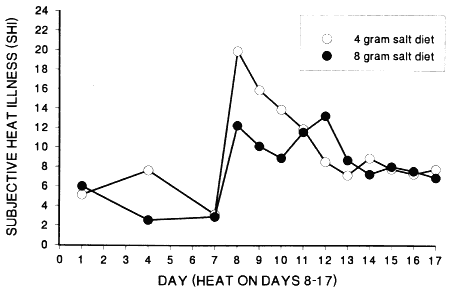
FIGURE 14-1 Mean index of subjective heat illness (SHI) for each test day, where n = 17 male soldiers (4-g salt group, n = 8; 8-g group, n = 9).
On the fifth day of heat acclimation (day 12), there appears to be an increase in subjective heat illness, as measured by the SHI, for the 8-g salt group (see Figure 14-1). Although this ''blip'' in the curve is statistically nonsignificant, it begs an explanation because it disrupts an otherwise fairly smooth curve to asymptote. To address this issue, an inspection of the daily log notes was conducted. The log notes showed that one of the subjects in the 8-g group (subject 21) reported feeling the "possible onset" of flu-like symptoms on that day. When this subject's entire data set for all days is removed from the analysis, the "blip" on day 12 disappears without changing the rest of the curve. Consequently, this "blip" is likely due to one subject experiencing symptoms unrelated to the treatment procedures on day 12.
CONCLUSIONS
Whether measured by the mean number of heat illness symptoms reported or by an overall index of subjective heat illness (the SHI), subjective reports of heat illness are significantly higher during the first 2 days of heat acclimation than during subsequent days. A diet that includes the daily consumption of 8 g of salt (as compared to 4 g of salt) during heat acclima-
tion results in significantly diminished reports of subjective heat illness during those first 2 days of heat acclimation. After the initial 2 days of heat acclimation, there is no measurable difference in subjective reports of heat illness between the two dietary groups. If subjective heat illness is to be minimized during heat acclimation, and especially if the first 2 days of heat acclimation are significant to military operations, a diet consisting of 8 g of salt per day is preferable to a diet of 4 g of salt per day.
REFERENCES
Armstrong, L.E., R.W. Hubbard, W.J. Kraemer, J.P. DeLuca. and E.L. Christensen 1987 Signs and symptoms of heat exhaustion during strenuous exercise. Ann. Sports Med. 3:182–189.
Banderet, L.E., and H.R. Lieberman 1989 Treatment with tyrosine, a neurotransmitter precursor, reduces environmental stress in humans. Brain Res. Bull. 22:759–762.
Cronbach, L.J. 1951 Coefficient alpha and the internal structure of teats. Psychometrika 16:297–334.
Hirsch, E., H.L. Meiselman, R.D. Popper, G. Stairs, B. Jezior, I. Lichton, N. Wenkam, J. Burt, M. Fox, S. McNutt, M.N. Thiele, and O. Dirige 1984 The effects of prolonged feeding meal, ready-to-eat (MRE) operational rations . Technical Report NATICK/TR-85/035. U.S. Army Natick Research and Development Center, Natick, Mass.
Johnson, R. F., L. G. Branch, and D. J. McMenemy 1989 Influence of attitude and expectation on moods and symptoms during cold weather military training. Aviat. Space Environ. Med. 60:1157–1162.
Knochel, J. 1984 Environmental heat illness. Arch. Int. Med. 133:841–864.
Kobrick, J.L., and J.B. Sampson 1979 New inventory for the assessment of symptom occurrences and severity at high altitude. Aviat. Space Environ. Med. 50:925–929.
Kobrick, J.L., R.F. Johnson, and D.J. McMenemy 1990 Subjective reactions to atropine/2-PAM chloride and heat while in battle dress uniform and in chemical protective clothing. Milit. Psychol. 2:95–111.
Richards, D., R. Richards, and P.J. Schofield 1979 Management of heat exhaustion in Sydney's The Sun City-to-Surf fun runners. Med. J. Aust. 2:457–461.
Rock, P.B., T.S. Johnson, A. Cymerman, R.L. Burse, L.J. Falk, and C.S. Fulco 1987 Effect of dexamethasone on symptoms of acute mountain sickness at Pike's Peak, Colorado (4,300 m). Aviat. Space Environ. Med. 58:668–672.
Sampson, J.B., and J.L. Kobrick 1980 The Environmental Symptoms Questionnaire: Revisions and new field data. Aviat. Space Environ. Med. 51:872–877.
StatSoft 1988 CSS (Complete Statistical System) Release 2.1. Tulsa, Okla.: StatSoft.
USACDEC/USARIEM (U.S. Army Combat Developments and Experimentation Center and U.S. Army Research Institute of Environmental Medicine) 1986 Combat Field Feeding System—Force Development Test and Experimentation (CFFS-FDTE), vol. 1–3. Technical Report Nos. CDEC-TR-85-006A, CDEC-TR-85-006B,
CDEC-TR-85-006C. Fort Ord, Calif.: U.S. Army Combat Developments and Experimentation Center.
USARIEM (U.S. Army Research Institute of Environmental Medicine) 1990 Sustaining Health and Performance in the Desert: A Pocket Guide to Environmental Medicine for Operations in Southwest Asia. Technical Note 91–2. U.S. Army Research Institute of Environmental Medicine, Natick, Mass.
Discussion
PARTICIPANT: I can't remember whether the manipulation of the salt intake preceded the heat exposure or not. Were they instituted at the same time?
DR. JOHNSON: The onset of heat exposure and the manipulation of salt intake occurred on the same date.
PARTICIPANT: So we don't know whether your subjects may have been, say, pre-adapted for 4-gram intakes and what effect that might have had on their initial response to heat exposure. I mean, it is confounded now. Since they are adapting both to the lower salt intake and to the heat at the same time, we are not sure what would have happened if they were first exposed to heat.
PARTICIPANT: Weren't they on 8 grams first?
DR. JOHNSON: Yes, they were all on 8.
PARTICIPANT: It would be interesting to see what would happen if some of them had been on the 4-gram sodium diet during the stabilization period.
DR. JOHNSON: There was a practical reason for conducting the study the way we did. It is unlikely that soldiers would be on a 4-gram sodium diet in garrison prior to going into the field. It is more likely that they would be on at least an 8-gram sodium diet in garrison followed by a decrease in sodium intake per day when deployed to the field.
PARTICIPANT: Was there any evidence at all throughout the study of hyponatremia? I mean, how low did sodium levels ever get in this study?
DR. ARMSTRONG: The sodium levels were normal day to day. However, there was one subject who experienced water intoxication on the very first day.
PARTICIPANT: That is interesting.
DR. ARMSTRONG: He gained 10 pounds in a matter of just a few hours of exercise on the treadmill. He thought that he should drink a lot of water to stay healthy during exercise and heat exposure. Since we were watching for drops in body weight, we did not expect this. He was removed from the
study at that point. It was an extremely unusual circumstance, and his data are not included in this presentation. His data are being written up separately as a case study. Other than that, there were no signs of hyponatremia.
PARTICIPANT: With respect to the index of subjective heat illness that you have constructed, can you analyze it using confidence intervals instead and might you get a different interpretation of the results?
DR. JOHNSON: There are many ways that we can analyze the data. We have presented two here: looking for differences between groups based on frequency counts of symptom reports, and conducting traditional analyses of variance on the index of subjective heat illness. Analyses using confidence intervals is a good suggestion but we have not done that here.
PARTICIPANT: One of the things that struck me is the increased reports of heat discomfort under a condition of minimal heat strain. That is, the increase is modest. What might you anticipate with greater heat strain? Since discomfort may be more closely related to changes in skin temperature than to changes in core temperature, might this relationship be the reason for the increase in subjective heat illness?
DR. JOHNSON: There may be such a relationship, but we did not look at relationship to skin temperature changes. We are, however, interested in what these data mean in terms of absolute levels of symptom intensity. That is, reports of subjective heat illness, as measured by the SHI (an intensity index), show that there are significant differences between the groups during the first two days of heat exposure. The data also show that these differences between the groups disappear by the third day of heat exposure, and that the absolute levels have significantly decreased to a much less intense level. We consider these levels as not very intense in an absolute sense because not one person was removed from the heat chamber due to subjective discomfort. In other studies, however, under similar temperature conditions but with the subjects wearing chemical protective clothing, a greater array of symptoms is reported and these symptoms are more intense. Under these condition, subjects do remove themselves because of extreme discomfort.
PARTICIPANT: If I remember correctly, the for these subjects was somewhere around 45 to 46 ml per kilogram per minute. Was the incidence of symptoms associated with level of physical fitness?
DR. JOHNSON: All subjects were somewhat uniform in this regard, and we found no relationship between symptoms and fitness levels.
PARTICIPANT: Have you done any studies where you have looked at heat strain and performance?
DR. JOHNSON: We have collected data where we have looked at these variables. We have found that performance of militarily relevant tasks such as marksmanship, is related to heat exposure. Specifically, up to 6 hours exposure to 95°F with 60 percent relative humidity significantly impairs steadiness of the soldier's outstretched arm and hand. Rifle marksmanship for stationary targets, which requires extreme steadiness of the arm and hand, is also impaired during the same heat exposure.
PARTICIPANT: I remember years ago when I was working in the military ergonomics, that subjective ratings depended on who asked the question. For example, if a woman asked male soldiers how they felt, the soldiers tended to report that they felt better than if the questioner was a man.
DR. JOHNSON: That is a good point and it is often overlooked by casual users of subjective report techniques. It is also one of the reasons that we adopted a standardized questionnaire. We wanted to avoid the subtle influences on subjective response due to inadvertent rewording of the questions and due to variability in the characteristics of the questioner. In this study, the questionnaire was always administered by the same person and at a table far removed from the rest of the staff and from other subjects.
PARTICIPANT: Since the administration of the two salt diets was double blind, I am curious as to whether the subjects could guess which diet they had received.
DR. JOHNSON: We did collect the data and found that the subjects were unable to guess at better than a chance level. The double blind procedure was a success.
PARTICIPANT: I missed how the meals were administered.
DR. JOHNSON: The diets were constructed around MREs. For the high salt diet, we used standard off-the-shelf MRE entrees. For the low salt diet, a food engineer altered MREs by removing the sodium glutamate and all the salt-containing preservatives. Ninety percent of the difference in the sodium in the two diets was due to these re-engineered entrees. All other food was obtained from a supermarket. These other foods were mixed so that they looked the same. Taste tests done before the study indicated that independent judges could not tell the difference. Those MRE entrees with the low salt could not be distinguished from those with more salt.


