
5
Water Requirements During Exercise in the Heat
Carl V. Gisolfi1
INTRODUCTION
Water is essential to life. It constitutes the medium in which chemical reactions occur and is crucial to normal function of the cardiovascular system. Water constitutes about 70 percent of body weight in the normal adult. It decreases from 75 percent at birth to 50 percent in old age and is the largest component of the body. Adipose tissue contains less water than lean tissue; thus women have slightly less body water than men. The effects of dehydration occur with as little water loss as 1 percent of body weight and become life threatening at 10 percent (Adolph et al., 1947). Humans cannot adapt to a chronic water deficit, so fluid losses must be replaced if physiological function is to continue unimpaired.
The purpose of this chapter is to review the water requirements of soldiers exercising in the heat. The Desert Shield and Desert Storm operations in 1990 and 1991 made us acutely aware of the importance of military maneuvers in severe heat. Military missions are often 4 to 6 hours in duration and require mild to heavy exercise. This discussion will examine the range of these work loads. Furthermore, chronic water intake is a concern because inadequate water intake over days can lead to water depletion and heat exhaustion.
The requirement for water in the heat is dependent on fluid lost, which
in turn depends on such factors as exercise intensity, exercise duration, environmental conditions, state of training and heat acclimatization, gender, and age. Selected studies are used to illustrate the influence of these different factors rather than to review the literature. Finally, the prediction of sweat losses under a variety of conditions is discussed, as well as the calculation of water requirements under these circumstances.
DISTRIBUTION OF BODY WATER
Total body water constitutes about 70 percent of lean body mass and is most simply divided into two major compartments: (a) intracellular water, which represents 50 percent of body weight or 35 liters in a 70-kg man, and (b) extracellular water, which represents 20 percent of body weight or 14 liters. The latter compartment is subdivided into plasma volume (5 percent body weight) and interstitial fluid volume (15 percent body weight). Intracellular water is not readily measured. It is calculated from measurements of total body water and extracellular fluid volume.
AVENUES OF FLUID LOSS AND GAIN
Table 5-1 gives normal values for daily water intake and output in a healthy adult. However, these values are subject to marked variation. For example, respiratory water loss can range from 200 ml per day when breathing humidified air to 1500 ml per day when exercising at high altitude. Water loss from cutaneous evaporation could range from 500 ml per day at rest in a cool environment to 10 liters per day during exercise in the heat. Fecal losses could range from 100 ml per day when on a mixed diet to 32
TABLE 5-1 Normal Values for Daily Intake and Output of Water in Adults
|
Intake Source |
Amount (ml per day) |
Source Output |
Amount (ml per day) |
|
Drinking |
1200 |
Urine |
1400 |
|
Food |
900 |
Lungs and skin |
900 |
|
Oxidation* |
300 |
Feces |
100 |
|
Total |
2400 |
Total |
2400 |
|
* Oxidative metabolism produces 0.6 ml water per gram of carbohydrate, 1.09 ml water per gram of fat, and 0.44 ml water per gram of protein. SOURCE: Gisolfi (1986), used with permission. Data modified from Muntwyler (1968). |
|||
liters per day or more in a patient with diarrhea. Obligatory urine volume is limited by the concentrating power of the kidneys, but it can vary from 250 to 1400 ml per day depending on diet. Urine volume is usually 700 ml per day, but a high-protein diet demands more obligatory water to excrete the osmotically active products of protein metabolism.
DETERMINANTS OF SWEAT RATE
Water requirements during exercise in the heat primarily depend on evaporative cooling. Metabolism and environmental heat exchange determine the required evaporative cooling (Ereq) to achieve thermal balance. Because respiratory water loss contributes little to evaporative cooling in warm or hot environments, cooling must come primarily from cutaneous sweat secretion. The rate of sweating and its regulation are determined by core and skin temperatures, skin wettedness, heat storage, metabolism, and the set point.
WATER REQUIREMENTS
Hot-Wet Versus Hot-Dry Environment
The U.S. military deploys troops to tropical and desert climates, and therefore military men and women are exposed to both wet and dry heat. Figure 5-1 shows the sweat responses as well as the mean changes in rectal temperature, heart rate, and metabolic rate of four distance runners walking 5.6 km per hour in dry heat, in wet heat, and in a cool environment. Experiments were performed 4 to 5 weeks apart and consisted of 4 hours of continuous walking, lunch (30 minutes), followed by another 2 to 3 hours of walking. Water was ingested ad libitum, but the subjects were constantly informed of their weight loss and were successful in maintaining fluid balance. All men walked 6 hours in the neutral and hot-dry environments except one subject who stopped walking after 5.5 hours in dry heat with a rectal temperature of 39°C and a heart rate of 136 beats per minute (bpm). Another subject walked for 7 hours in dry heat and finished with a rectal temperature of 38.3°C and a heart rate of 132 bpm. Sweat rate in the desert environment averaged 1210 ± 56 (x ± SE) ml per hour (Table 5-2).
In the hot-wet environment, sweat rate averaged only 716 ± 56 (x ± SE) ml per hour, which resulted in higher rectal temperatures (39.3°C) and heart rates (132 bpm). The reduced rate of sweating in this environment was associated with sweat gland fatigue (Brown and Sargent, 1965; Hertig et al., 1961; Kerslake, 1972; Nadel and Stolwijk, 1973; Robinson and Gerking, 1947). The mechanism responsible for this phenomenon is not clear, but evidence suggests that it is related to excessive wetting of the skin (Brebner
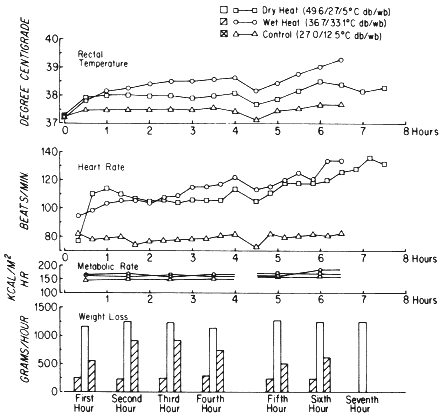
FIGURE 5-1 Rectal temperatures, heart rates, metabolic rates, and weight losses of four highly trained endurance runners during mild treadmill exercise in dry heat, in wet heat, and in a cool ambient temperature. Subjects consumed lunch in the test environment between 4.0 and 4.5 hours. Values are means ± SE. SOURCE: Gisolfi et al. (1977), used with permission.
and Kerslake, 1964; Collins and Weiner, 1962; Nadel and Stolwijk, 1973). These subjects were highly trained and essentially heat acclimatized as a result of their training. Untrained or unacclimatized subjects would have considerably lower sweat rates and would experience much more physiological strain than was shown by these men.
Exercise Intensity and Training
Under constant environmental conditions, skin sweating is a linear function of heat production or exercise intensity (Nielsen, 1969). Training in a neu-
tral environment that results in a significant elevation in maximal oxygen uptake  reduces the core temperature threshold for the onset of sweating (Roberts et al., 1977) but does not necessarily increase total body sweat rate (Taylor, 1986). Sweat rates of male subjects have been found to be positively correlated with aerobic capacity (Greenleaf et al., 1972).
Heat Acclimatization
Maximal sweating capacity can rise from 1.5 liters per hour in a healthy unacclimatized man to as much as 2 to 3 liters per hour in a highly trained acclimatized soldier (Wenger, 1988). One of the highest sweat rates ever observed was recorded on Alberto Salazar during the 1984 Olympic Marathon. Salazar was running at 85 percent of (5.2 meters per second) and had a body weight loss of 5.43 kg (-8.1 percent body weight) despite an estimated fluid ingestion of 1.88 liters. This weight loss was equivalent to a sweat rate of 3.71 liters per hour (Armstrong et al., 1986).
Age and Gender
Military personnel range in age from 18 to 50 years and comprise 14 percent women. The effects of age and gender on thermoregulation, particularly the sweating response to exercise and thermal stress, have been elegantly reviewed by Drinkwater (1986). Contrary to popular opinion, differences in physiological responses to thermal stress cannot be attributed to differences in gender or age. When differences do appear among subjects of
TABLE 5-2 Mean Sweat Rates of Four Highly Trained Endurance Athletes Who Walked (3.5 mph) for 5 to 7 Hours in Hot-Wet, HotDry, and Neutral Climates
|
|
Sweat Rate (liters per hour) |
||
|
Subject |
Hot-Wet Environment* |
Hot-Dry Environment† |
Neutral Environment‡ |
|
KM |
778 |
1247 |
178 |
|
JC |
659 |
1198 |
302 |
|
MN |
838 |
1234 |
272 |
|
BC |
590 |
1159 |
265 |
|
Mean ± SE |
715 ± 56 |
1210 ± 20 |
254 ± 27 |
|
* 37/33°C dry bulb/wet bulb. † 50/28°C dry bulb/wet bulb. ‡ 27/13°C dry bulb/wet bulb. |
|||
different age and gender, they are primarily due to differences in aerobic power or heat acclimatization.
In the 1960s, studies of temperature regulation at rest and during exercise in the heat concluded that women were less tolerant of exercise in the heat than were men (Morimoto et al., 1967; Wyndham et al., 1965); however, these investigators did not match their subjects for aerobic power or body weight-to-mass ratio. Weinman et al. (1967) were the first to suggest that gender differences could be explained by differences in physical fitness.
With regard to the effects of age on exercise-heat tolerance, it is well accepted that the aged are more susceptible to thermal injury than their younger counterparts during heat waves. This apparent heat intolerance among the aged has been attributed to a reduction in sweating capacity, a decline in aerobic fitness, or a combination of the two. In a recent review of the effects of exercise and age on thermoregulation, Kenney and Gisolfi (1986) found no evidence that men or women up to 50 to 60 years of age had any impairment in temperature regulation that could be attributed to age per se. This conclusion is also supported by the review of Drinkwater (1986). Robinson et al. (1986) found a decrement in sweating capacity in men 44 to 60 years of age, but this decline in sweating had no adverse effect on the ability of these men to acclimatize to work in a hot-dry (50°C) environment. The decline in heat tolerance associated with men and women 50 to 60 years of age can be readily attributed to reductions in cardiovascular fitness, lack of heat acclimation, or both.
Prediction of Water Requirements
Sweat rate can be predicted from a measure of the overall heat load (Ereq) and the maximal evaporative cooling capacity of the environment (Emax) (Shapiro et al., 1982). The advantage of the latter prediction is that sweat rate (and therefore water required) can be determined from environmental conditions, exercise intensity, and the type of clothing worn without making any physiological measurements (Shapiro et al., 1982). The formula for calculating sweat loss in g per m2 per hour is
sweat loss = 27.9 × Ereq(Emax)-0.455
CONCLUSIONS AND RECOMMENDATIONS
-
Water requirements during exercise in the heat depend on fluid loss from sweating. Sweat rate is proportional to metabolic rate and can amount to 3 to 4 liters per hour or as much as 10 liters per day.
-
Training and heat acclimatization can increase sweat rate by 10 to 20 percent or 200 to 300 ml per hour.
-
Men sweat more than women and require more water, but women show the same physiological responses as men when performing work at the same relative intensity. Well-trained heat-acclimatized women show similar physiological responses to hot-wet and hot-dry heat as men.
-
Within the age range of the current U.S. military force (18 to 50 years), there is no decrement in sweating, and therefore the water requirement during exercise in the heat is unchanged.
REFERENCES
Adolph, E.F., and associates 1947 Physiology of Man in the Desert. New York: Interscience Publishers.
Armstrong, L.E., R.W. Hubbard, B.H. Jones, and J.T. Daniels 1986 Preparing Alberto Salazar for the heat of the 1984 Olympic Marathon. Physician Sportsmed. 14(3):73–81.
Brebner, D.F., and D.M. Kerslake 1964 The time course of the decline in sweating produced by wetting the skin. J. Physiol. (Lond.) 175:295–302.
Brown, W.K., and F. Sargent 1965 Hitromeiosis. Arch. Environ. Health 11:442–453.
Collins, K.J., and J.S. Weiner 1962 Observations on arm-bag suppression of sweating and its relationship to thermal sweat-gland fatigue. J. Physiol. (Lond.) 161:538–556.
Drinkwater, B.L., ed. 1986 Female Endurance Athletes. Champaign, Ill.: Human Kinetics Publishers.
Gisolfi, C. V. 1986 Impact of limited fluid intake on performance. Pp. 17–28 in Predicting Decrements in Military Performance Due to Inadequate Nutrition. Washington, D.C.: National Academy Press.
Gisolfi, C.V., N.C. Wilson, and B. Claxton 1977 Work-heat tolerance of distance runners. Ann. N.Y. Acad. Sci. 301:139–150.
Greenleaf, J.E., B.L. Castle, and W.K. Ruff 1972 Maximal oxygen uptake, sweating and tolerance to exercise in the heat. Int. J. Biometeor. 16:375–387.
Hertig, B.A., M.L. Riedesel, and H.S. Belding 1961 Sweating in hot baths. J. Appl. Physiol. 16:647–651.
Kenney, M.J., and C.V. Gisolfi 1986 Thermal regulation: Effects of exercise and old age. Pp. 133–143 in Sports Medicine for the Mature Athlete. Indianapolis, Ind.: Benchmark Press.
Kerslake, D.M., ed. 1972 The Stress of Hot Environments. Cambridge, England: Cambridge University Press .
Morimoto, T., Z. Slabochova, R.K. Naman, and F. Sargent II 1967 Sex differences in physiological reactions to thermal stress. J. Appl. Physiol. 22:526–532.
Muntwyler, E. 1968 Water and electrolyte metabolism and acid-base balance. St. Louis, Mo.: C.V. Mosby.
Nadel, E.R., and J.A.J. Stolwijk 1973 Effects of skin wettedness on sweat gland response. J. Appl. Physiol. 35:689–694.
Nielsen, B. 1969 Thermoregulation in rest and exercise. Acta Physiol. Scand. Suppl. 323:1–74.
Roberts, M.F., C.B. Wenger, J.A.J. Stolwijk, and E.R. Nadel 1977 Skin blood flow and sweating changes following exercise and heat acclimation. J. Appl. Physiol. 43:133–137.
Robinson, S., and S.D. Getking 1947 Thermal balance of men working in severe heat. Am. J. Physiol. 149:476–488.
Robinson, S., H.S. Helding, F.C. Consolazio, S.M. Horvath, and E.S. Turrell 1986 Acclimatization of older men to work in heat. J. Appl. Physiol. 20:583–586. Shapiro, Y., K.B.
Pandolf, and R.F. Goldman 1982 Predicting sweat loss response to exercise, environment and clothing. Eur. J. Appl. Physiol. 48:83–96.
Taylor, N.A.S. 1986 Eccrine sweat glands. Adaptations to physical training and heat acclimation. Sports Med. 3:387–397.
Weinman, K.P., Z. Slabochova, E.M. Bernauer, T. Morimoto, and F. Sargent II 1967 Reactions of men and women to repeated exposure to humid heat. J. Appl. Physiol. 22:533–538.
Wenger, C.B. 1988 Human heat acclimatization. Pp. 153–197 in Human Performance Physiology and Environmental Medicine at Terrestrial Extremes. Indianapolis, Ind.: Benchmark Press.
Wyndham, C.H., J.F. Morrison, and C.G. Williams 1965 Heat reactions of male and female Caucasians. J. Appl. Physiol. 20:357–364.
DISCUSSION
PARTICIPANT: It is a little unclear. I thought you said that men sweat more but if you expressed it as amount of sweat, provided surface area was the same, but then it looked like in one of the slides it was different.
DR. GISOLFI: No, they are not the same. Even if you express it as percent body surface area, women still sweat less. But the important point is, women are able to maintain the same core body temperature as men when they are at the same relative work load.
PARTICIPANT: And was that formula applicable for both men and women?
DR. GISOLFI: No, the formula was based on men.
PARTICIPANT: Is there any effect from body mass?
DR. GISOLFI: Body fat is going to impede heat loss, certainly, and if you evaluate the impact of body weight to surface area ratio, the heavier person has a greater metabolic heat load and has a smaller surface area to dissipate that heat. These individuals will have more trouble dissipating heat when exposed to a warm environment exercising at the same intensity as an individual who is not carrying that much weight.
PARTICIPANT: Does it affect sweating?
DR. GISOLFI: Not to my knowledge, just having an increased subcutaneous layer of fat does not influence the sweating response.
PARTICIPANT: I have another question about age. Do you have any data on general range?
DR. GISOLFI: There doesn't seem to be a difference in the sweating response up to about 50 or 55. When you get over 60 and it is more clear over 70 years of age, then there is a decrement in the sweating response.
The individuals that Robinson studied (Robinson et al., 1986) were over 60. I think the mean age was something like 61 or 62 years. There was a decrement in the sweating response, but it wasn't reflected in their ability to regulate their body temperature which is, again, the more important point.
PARTICIPANT: Carl, in 1980 Dimri published a review of 55 papers in which he looked at this last point that you mentioned here, the increase in sweating rate during a 7-to 10-day period of heat acclimation (Dimri et al., 1980).
He found in those 55 papers that 15 of them showed no increase in the sweating rate. I know you published a paper at least once that showed no increase in the sweating rate during the deacclimation of 7 to 10 days. Could you comment on that for us?
DR. GISOLFI: I think it depends on the level of fitness of the subject. If you are dealing with a relatively fit individual that you then heat acclimatize, you probably see little change in the sweating response.
If you are dealing with people who are terribly unfit and you heat acclimatize them, you will see a rather substantial elevation in the sweating response.
PARTICIPANT: And also I know you mentioned that in dry environments when you published these studies, for hot, dry and wet, dry environments, there was less of an increase in the sweating range.
PARTICIPANT: At the initiation of exercise, there is an immediate drop or increase in plasma osmolality that doesn't seem to be such in the sweating. That is, there seems to be a movement of fluid from the blood volume to intracellular volume.
I am wondering whether that is due to being acclimatized and unacclimatized and to what extent does that shift in plasma volume affect the sweat rate.
DR. GISOLFI: Initially, I don't think plasma volume and plasma tonicity have a marked influence on sweat rate. The sweating response is being driven primarily by an increase in core body temperature and secondarily by changes in skin temperature.
There are influences from increments in plasma volume and tonicity but compared to an elevation in core body temperature, they are rather small.
DR. GISOLFI: I wanted to make a comment back on sweating, though, on how sweating changes with acclimatization. You must be careful in your interpretation of the literature because if you just look at total body sweating, you get very misleading results.
The magnitude of sweating is related to the rise in body temperature. So if you heat acclimatize a soldier, you will observe increases in sweating early in the process. However, at the end of acclimatization, if you are looking at just total body sweating, you are actually looking at a small rise in body temperature and the same sweating response. The important point is that for a given rise in core temperature, you do have more sweating.
PARTICIPANT: I would like to go back to this prediction equation briefly. That did not take into account obesity or any kind of differences in adiposity amongst individuals; is that right?
DR. GISOLFI: That's correct. The heat required term is based on metabolic rate, which takes body weight into account. Adiposity is not specifically addressed by this equation.
PARTICIPANT: This was done in a military population?
DR. GISOLFI: This was done in the military population, to my knowledge. It is only body weight that is taken into consideration.
PARTICIPANT: So this is a specialized group, then, so it would not necessarily fit across the board; is that what you are saying then?
DR. GISOLFI: Yes. I would also say that I am not familiar with any literature that has indicated that an increase in adiposity reduces the sweating response.
PARTICIPANT: In fact, you showed your men had half the body fat of women and yet their ability to lose heat was equal so adiposity may or may not make any difference, probably not.


