
MAGELLAN'S VENUS
A World Revealed
by Andrew Chaikin

August 1990 was a time of shrinking horizons for planetary scientists. For a generation, unmanned space probes had revealed the most spectacular places in the solar system. They had orbited Mars and photographed volcanoes nearly three times as high as Mt. Everest, a canyon that would stretch the length of the United States, and dry river valleys that spoke of an ancient watery epoch on this desert world. They had flown past Io, the tiny moon of Jupiter, and found it to be so volcanically active that it is literally turning itself inside out. And, most recently, in 1989, Voyager 2 had made a thrilling reconnaissance of Neptune and its moon Triton, an ice world at the edge of the solar system. Indeed, every major world in the sun's family (save Pluto) and a bevy of moons had been orbited, flown past, or landed on. A great era of discovery had ended. In contrast to the budgetary heyday of the 1960s that had spawned these voyages, austerity was now the rule. With only a handful of missions approved for the coming decades—often fraught with delays and budget
cuts—planetary scientists seemed to have little to look forward to. The arrival of a robotic explorer called Magellan in orbit around Venus in August 1990 seemed almost like an afterthought.
Except, that is, to the scientists who had spent the better part of two decades working to make this happen. To them, Magellan offered a unique chance to study the one planet long considered by many scientists to be most like our own. Equipped with a radar-imaging system to pierce the cloudy veil, Magellan was designed to map the planet's surface in unprecedented detail. High on the list of the Magellan science team's questions was the most intriguing one of all: Is Venus still geologically active?
To be sure, much was known of Venus prior to Magellan's arrival. Soviet landers had proved that it is a place of broiling heat and crushing atmospheric pressure. The planet's surface features had been glimpsed in the preceding two decades, first using Earth-based radar and then from orbiting Soviet and American probes. But Magellan's pictures showed features as small as a few hundred meters across, far more detail than any previous views of Venus—in fact, better resolution than that available for vast areas of Earth, namely the ocean basins. From the first images the spacecraft radioed to Earth, the Magellan team of scientists—many of whom were veterans of several planetary missions—were stunned. The sheer variety of features was breathtaking. Everywhere, it seemed, there were volcanoes, ranging in size from tiny peaks at the limits of resolution to giant shield volcanoes hundreds of kilometers across. The smaller variety, several kilometers in diameter, numbered in the tens or even hundreds of thousands. Most of the planet's surface was covered with smooth, flat plains, also attributed to outpourings of molten lava. At first glance, it seemed that much of Venus' history was written in volcanism.
Elsewhere, huge belts of fractures sliced through the equatorial plains, extending nearly all the way around the planet. Looking closely, the scientists saw much finer fractures distributed over almost the entire planet. Elsewhere, they found complex jumbles of hills and valleys, now known as tesserae, that seemed to be in the process of destruction by tectonic forces. And there were some features found nowhere else in the solar system: giant welts called coronae, whose margins are jumbles of fractured rock but whose centers seem to have been formed by the buildup of lava. The smallest coronae are less than 100 kilometers
across; the largest, christened Artemis, is 2500 kilometers in diameter, roughly the size of Greenland. Even more mysterious was an incredibly long and narrow channel, nicknamed the River Styx by Magellan scientists. Roughly 2 kilometers wide and some 6800 kilometers long, more than the distance from Havana, Cuba, to Anchorage, Alaska, the River Styx is a puzzle: What carved it? With no water available, geologists speculated on a variety of other fluids, including liquid sulfur; today molten lava of an unusual composition is considered most likely.
The biggest surprise, however, was the crispness of the landscapes in nearly all the Magellan images. Almost every feature seemed to have been preserved in pristine condition from the time of its formation. The surface showed virtually no evidence of erosion, a fact attributed to the absence of water in Venus' atmosphere (and, to a lesser extent, to the calmness of the surface winds). In some places, different sets of features were superimposed on top of each other, like a multiple-exposed photograph. It was immediately evident that the surface of Venus had a profoundly rich and detailed story to tell. By the middle of 1991, Magellan had finished its first 243-day mapping cycle had begun its second, and the scientists were overwhelmed. ''The trouble with this mission," said one Magellan team member, "is that we get so much data it's mind-boggling." Said another, "It's as if we'd never seen Earth, and we lived on the far side of the moon, and all of a sudden we've got a 100-meter-resolution picture. … It's a whole new planet out there." Today, more than 3 years after Magellan began its mission, decoding that story has challenged some of their most basic preconceptions about Venus and about the nature of planetary evolution.
A VEILED WORLD
Like most scientific pursuits, astronomy demands more of those who practice it than curiosity, and from the beginning Venus has challenged astronomers' abilities to be detectives. A near-twin of Earth in size (Venus' diameter is 12,102 kilometers; Earth's diameter is 12,756), mass (81.5 percent of earth's mass), and bulk composition, Venus is our nearest planetary neighbor;1 for many decades it was also the most mysterious. Veiled by opaque clouds composed mostly of carbon dioxide, Venus displays only a featureless brilliant white disk in the telescope. Even to the unaided eye, however, it is among the most beautiful of celestial objects; gracing predawn or early evening skies, it can shine brightly enough to cast shadows.
Before the space age, some astronomers speculated that beneath the
clouds Venus might be a steamy tropical world much like prehistoric Earth, but nothing could have been further from the truth. In 1963 Mariner 2, history's first planetary probe, showed that temperatures on Venus were too high to support liquid water. A decade later, Mariner 10 surveyed the Venusian upper atmosphere and clocked winds up to 300 kilometers per hour (Pasachoff, 1990, p. 179). Remarkably, while Venus rotates once every 243 days, its atmosphere whips around the planet in the other direction, once every 4 days.
To find out what lay beneath those clouds, astronomers had only one tool: radar. By the early 1970s, they were using radio telescopes like the 300-meter dish at Arecibo Observatory in Puerto Rico to bounce radar signals off the planet's surface. Good observations were possible only during inferior conjunction, the period when Venus is closest to Earth. Because Venus always shows the same face to Earth at this time—a result of a near commensurability of Venus' rotation rate and Earth's orbital period—Earth-based radar surveys were limited to about 25 percent of the planet. Images made from the radar data showed just enough to tantalize: circular features that seemed to be impact craters, bright spots thought to be volcanoes, and banded terrain that might be the result of crustal folding. Clearly, Venus' surface had been shaped by a variety of geologic processes, but no one would be able to say more without getting a better look.
Meanwhile, in 1975 the Soviet Union scored an astonishing success when two unmanned probes, Veneras 9 and 10, parachuted through a dense atmosphere laden with droplets of sulfuric acid and touched down on the torrid surface. The Veneras found surface temperatures of 450°C and pressures of 90 bars (i.e., 90 times the pressure at the surface of Earth). And in the brief minutes before they succumbed to these hellish conditions, the probes sent back black and white images of a rock-strewn surface. At Venera 9's landing site the rocks were surprisingly sharp edged, testifying to an almost total absence of erosion, while Venera 10's images showed rocks with a pancake-like appearance. In 1982 the Soviets bettered this spectacular achievement with Veneras 13 and 14, each of which survived on the surface for more than 2 hours. In addition to sending back higher-quality images, including some in color, each lander actually drilled a sample of the surface material and brought it inside a sealed chamber for chemical analysis. The results indicated a composition consistent with basalt, the iron- and magnesium-rich volcanic rock most common on the surfaces of the earth and moon.
As is so often the case in science, a single piece of information—that there is probably basalt on Venus—had great significance. Geologists
believe that Earth coalesced from a swarm of smaller bodies called planetesimals some 4.6 billion years ago. Intense heat from impacting debris, and from the decay of radioactive isotopes contained in the planetesimals, melted the interior, allowing it to separate into layers of different composition. Heavier elements such as iron and nickel sank to the middle to form the molten core, while lighter species, such as the calcium-rich mineral feldspar, floated to the top and cooled into a primordial crust. In the middle, iron- and magnesium-rich minerals like pyroxene and olivine formed the hot and plastic layer called the mantle. This process, called differentiation, is the first major step in a planet's evolution from a primitive body. Laboratory experiments have shown that basalt is derived by partly melting dense mantle rocks. On Earth, basalt covers 70 percent of the surface: if forms the crust underneath the oceans, emplaced by the continuous outpouring of molten rock at the mid-ocean ridges. We know from the Apollo lunar samples that basalt is also pervasive on the moon's smooth dark lowland regions called the maria, proving that these areas formed volcanically. The bright highland areas, on the other hand, are rich in calcium feldspar and are thought to be the remnants of the primordial crust. Clearly, the moon also underwent differentiation. And from the Venera analyses, scientists could say confidently that Venus too had reached that important evolutionary milestone.
A MATTER OF HEAT
But that came as no surprise. Indeed, scientists would have been astonished had Venus proven to be a primitive body, simply because of its size. Ultimately, a planet's geologic history is largely shaped by its efforts to get rid of the excess heat in its interior. One important factor in determining a planet's initial heat supply, and how fast that heat can be shed, is size. How fast can a planet generate heat? That depends on its volume: bigger planets start out with more heat left over from the process of accretion, as well as a greater supply of heat-producing radioactive elements. But the rate at which a planet loses heat is proportional to its surface area. Smaller planets, whose ratio of surface area to volume is higher, deplete their heat supplies sooner than large ones.
A survey of the rocky worlds that populate the inner solar system, the so-called terrestrial planets,2 illustrates a direct relationship between size and degree of geologic activity. Our moon, 3476 kilometers across, started out with less heat than Earth did. It also cooled faster, mostly by means of conduction through the rigid outer shell and to a lesser extent by the volcanic outpourings that formed the maria. Most scientists agree
that by around 3.2 billion years ago the moon's internal fires had cooled enough to end volcanic activity. From that point on, the moon was considered geologically moribund. Its interior may have remained warm for some time, but there was no longer any expression of interior activity on the surface. Unlike Earth, where volcanic activity, erosion, and deformation of the crust have erased all but traces of its earliest history, the moon today is a museum. Its surface still displays the scars of its infancy: countless impact craters formed by bombardment from meteoroids and asteroids, the leftover debris from the solar system's formation. The largest craters on the moon, termed impact basins, are hundreds of kilometers across. The smallest, pinpricks blasted by micrometeorites, are visible on the surfaces of lunar rocks.
Mercury, the next-largest terrestrial planet (4878 kilometers in diameter) has a cratered, moon-like surface that suggests it also did not evolve much beyond chemical differentiation and mare volcanism. But Mars, still larger (6786 kilometers across), is clearly more evolved than Mercury and the moon. While it too has heavily cratered areas resembling the lunar highlands, Mars's spectacular volcanoes, canyons, and dry river valleys attest to a more extensive and varied geologic history. But is Mars still active today? That question might seem impossible to answer in the absence of rock samples to provide absolute age measurements (a handful of meteorites are thought to have been blasted off the Martian surface but probably very early in the planet's history). However, a technique called crater counting allows geologists to estimate the ages of planetary surfaces from photographs alone, in particular by measuring the frequency of craters of different sizes. The principle is simple: like a target in a shooting gallery, a planetary surface will display more craters the longer it is exposed to bombardment from cosmic debris. For example, the lunar highlands, which date back to the formation of the solar system 4.6 billion years ago, are much more heavily cratered than the maria , which formed roughly a billion or more years later. With some assumptions about the flux of impacting bodies over time, geologists have estimated that on Mars the oldest cratered terrains are quite a bit younger than the moon's, having formed roughly 3.8 billion years ago. The freshest surfaces, including some volcanic plains, may have formed in very recent geologic time. It is possible that Mars's geologic activity has continued to the present but at very low levels. The simple pattern that emerges is that the larger terrestrial planets held on to their heat longer and thus had longer geologic lifetimes.
What of Earth? Roughly twice the size of Mars, Earth is still vigorously
active, and unlike the other terrestrial planets has evolved well beyond chemical differentiation and simple volcanism. Earth manages its heat budget by means of an "engine" that we call plate tectonics. The surface of Earth is divided into a set of about 10 moving, interlocking plates, some thousands of kilometers across, whose interactions with each other and the interior account for most of the major crustal, or tectonic, processes. This engine is powered by convection within the hot plastic mantle. Because Venus is so similar to Earth in size, scientists speculated that it too might still be geologically active. In fact, Soviet landers had measured the concentrations of the radioactive isotopes of uranium, thorium, and potassium in Venus' rocks and found that they contain the same amounts as terrestrial rocks, suggesting that Venus' interior is as hot as Earth's. Could Venus have developed plate tectonics? That question would go unanswered until scientists could obtain a global view of its surface.
ORBITERS LIFT THE VEIL
In 1978 NASA's Pioneer Venus Orbiter (PVO) was dispatched to monitor Venus' atmosphere and to map the planet's surface elevations using a radar altimeter. PVO proved to be a true stalwart; it transmitted data to Earth until the fall of 1992, when it burned up in the atmosphere. A decade before that, however, the altimeter had mapped more than 90 percent of the planet with a resolution of 100 kilometers or better, enough to show gross topographic differences. PVO's portrait showed that 60 percent of the surface is pool-table flat, in no place deviating from the mean planetary radius of 6051 kilometers by more than 500 meters. Rising up from these rolling plains are a handful of highland regions, the largest of which, Aphrodite Terra,3 is about the size of Africa. Another highland area, named Ishtar Terra, is roughly the size of Australia and is one of the most geologically spectacular regions on the planet. While the western part of Ishtar is a vast plateau some 2000 kilometers across, its eastern portion contains a range of mountains that tower up to 12 kilometers above the planet's mean radius—greater (34 percent more) than the height of Mount Everest above sea level. Ishtar bears a tantalizing resemblance to the Tibetan plateau, where due to plate tectonics India is colliding with Asia, pushing up the Himalayas in the process.
At first glance, Ishtar and the other highland regions seem to suggest a similarity to Earth's continents. But a closer look at the data reveals a fundamental difference. The hypsometry of Earth, that is, the statistical distribution of its surface elevations, is strongly bimodal: the continents
cluster around 0.5 kilometers above sea level; the ocean basins at about 4.5 kilometers below it. But Venus' hypsometric profile is unimodal. Truly high regions are rare; only 5 percent of the surface lies at elevations greater than 2 kilometers above the mean radius. Lowlands are even rarer; less than 1 percent of the surface lies more than a kilometer below it. The total relief on Venus, about 13 kilometers, is similar to that on Earth, but there are few sharp transitions. At least on a scale of tens of kilometers, most features on Venus grade smoothly into one another.
This has important implications for Venus' surface composition. On Earth, composition is closely linked to elevation, since continental crust is rich in granite and oceanic crust is basaltic; since granite is less dense than basalt, the continents tend to be more buoyant than the ocean basins. Purely on the strength of Venus' hypsometry, geologists have proposed that its surface composition is probably fairly uniform and, as the Venera landers showed, basaltic.
Furthermore, absent on PVO's map were clear signs of features suggesting plate tectonics. There were no analogs of mid-ocean ridges or subduction zones. Attempting to explain an absence of plate tectonics, scientists noted the planet's high surface temperature, which heats surface rocks roughly halfway to their melting points. As a result, researchers hypothesized, the Venusian lithosphere would be substantially more plastic than Earth's and would lack the rigidity necessary to form a series of global interlocking plates. It seemed likely that if Venus were still active, it would have to have developed a form of geology substantially different from that of Earth. PVO's data, however, lacked the resolution to resolve the uncertainty.
In 1983 the Soviet Union returned to Venus, this time with a pair of orbiters equipped with imaging radar. Veneras 15 and 16 mapped about 25 percent of the northern hemisphere of the planet showing features as small as a few kilometers, comparable to the best Earth-based radar views. Their images gave scientists a first glimpse of Venus' impressive array of volcanic and tectonic landforms. It remained for Magellan to finish the unveiling.
CONTROVERSY IN CRATES
If there were any doubts that Venus had experienced a rich geologic history, Magellan removed them. As expected, Magellan found no signs of active plate tectonics on Venus, and no unambiguous signs that such activity had ever occurred in the past. It did not verify the hypothesis of Brown University's James Head and Larry Crumpler that Aphrodite
might turn out to be an analog of a terrestrial mid-ocean ridge, where new crust forms as two plates are pulled apart. It was also clear that deciphering the extraordinarily detailed history written on the Venusian surface was going to be a long and difficult job. The first and simplest step was to attempt to establish the age of the surface by means of crater counting. The Venera images had already suggested a paucity of craters on Venus, and Magellan gave confirmation. In part, this is due to the fact that Venus' atmosphere has a density only 40 times less than the meteoroids that enter it. Projectiles 100 meters or less in diameter are destroyed before they can strike the surface. In some cases, meteoroids appear to have exploded only a few kilometers above the ground, producing round blotches of apparently fractured terrain that show up as dark spots in Magellan's radar images. But in general, craters smaller than about 35 kilometers, which make up the vast majority of the craters on the moon and other terrestrial planets, are far more scarce on Venus. Craters less than about 2 kilometers across are absent altogether. This reduces considerably the size of the statistical sample available to crater-counting geologists and makes any estimate of Venus' surface age more uncertain. Nevertheless, some 912 craters have been identified, and according to Gerald Schaber of the U.S. Geological Survey in Flagstaff, Arizona, the story they tell is extraordinary. For one thing, they appear to be spatially random, precisely the distribution one would expect if the entire planet were plunked down in the cosmic shooting gallery and allowed to accumulate craters. But for how long? How old is the surface of Venus? According to Schaber, the number and size of the craters are consistent with an average age of about 500 million years—give or take a few hundred million. It could not have been a more provocative result, for it suggested that a few hundred million years ago the slate of Venusian history was wiped clean, then begun anew.
What could have obliterated all traces of geologic evolution for the previous 4.5 billion years? Schaber, along with the University of Arizona's Robert Strom and several colleagues proposed that Venus suffered an episode of volcanic activity so pervasive and so intense that nearly the entire planet was covered in fresh lava. In recent years, geologists have theorized that massive volcanic outbursts resurfaced parts of Earth, including a basalt "mega-eruption" 250 million years ago that covered much of what is now Siberia. But Schaber says, "We're talking about volcanism on Venus on a scale that makes even those pale in comparison." Furthermore, Schaber found that the vast majority of Venusian craters—some 61 percent—appear pristine. Of the remaining craters, only 4 percent have been invaded by newer lava flows (Figure 5.1
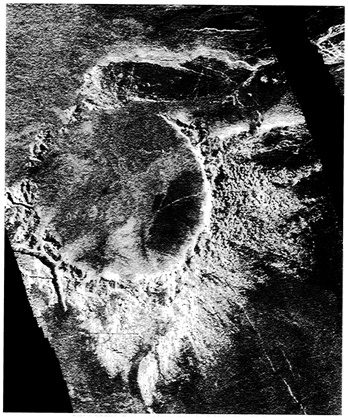
FIGURE 5.1 Craters like this one, flooded by one of Venus' pervasive lava flows, are relatively rare in Magellan images. Bright features in this and other Magellan images are better reflectors of radar energy, usually due to steeper slopes or higher surface roughness. (Courtesy of the Jet Propulsion Laboratory, NASA.)
). That suggests that the catastrophe ended abruptly; otherwise, more partly buried craters would be seen. Since the resurfacing event, Schaber proposed volcanic and tectonic activity could continue at reduced levels, especially along the fracture belts that connect the broad low rises in the equatorial highlands.
The main attraction of Schaber's so-called global resurfacing model was that it neatly explained the observed crater distribution. And yet the idea that the planet completely repaved itself and then became relatively quiescent was immediately controversial. At the very least, the idea
seemed to explode the notion that Venus and Earth had traveled similar evolutionary paths. At worst, it raised troubling questions. What could have caused the enormous volcanic outburst Schaber was proposing? Why did the subsequent level of activity drop so sharply afterward? For that matter, was the 500-million-year age implied by the cratering statistics valid to begin with?
"It's important not to get trapped in statistics," said Roger Phillips, now at Washington University in St. Louis. In 1991 Phillips, who had collaborated with Schaber on initial analyses of the Magellan results, challenged his colleague's hypothesis. The distribution of craters on Venus may be random, he stressed, but that doesn't mean it represents a surface of uniform age. In fact, he pointed out, the planet has areas where craters are noticeably more common than average, and others where they are relatively sparse. Now, that kind of "clumpiness" occurs in any random sample. But was it possible that Venus' craters weren't randomly placed after all, that these clumps and gaps were telling us something about the planet's evolution?
As a geophysicist, Phillips doesn't normally concern himself in great detail with the pictures taken by a planetary probe. While geologists study what has happened on the surface of a planet, geophysicists like Phillips are more concerned with what has gone on inside it. But Magellan has required geophysicists like Phillips to cross over into geology, to try to make sense of Magellan's strange findings.
By the fall of 1991 Phillips and some of his colleagues had spent time studying the Magellan images, in particular looking for craters that had been cracked by faults or partially invaded by lava flows. To be sure, such modified craters are in the minority on Venus; like other landforms, most craters look as fresh as the day they were formed. But to Phillips's surprise, work by his collaborator Richard Raubertas at the University of Rochester showed that the modified craters were not randomly sprinkled around the planet but concentrated in areas where "normal" craters were few in number. The connection was telling. "To me, that's the first clue that those areas of low crater density are not that way due to chance, but in fact, something is eating craters on Venus." Phillips proposed that if craters on Venus were being destroyed randomly over time—here, buried by a lava flow; there, chewed to bits by a fault zone—the result would still be a random distribution of craters but on surfaces with many different ages. The only constraint, Phillips said, was that each of these small resurfacing events must act in such a way as to produce a crater distribution that appears random. (In 1992, as a "mathematical convenience," Phillips considered a model in which there was
an equilibrium between resurfacing and crater production; he later rejected this model.)
But planetary scientists are hardly in agreement; each hypothesis has its supporters and skeptics among the Magellan scientists. Phillips' computer simulations of Venus' evolution, designed to show that a spatially random crater distribution could be preserved despite small scattered resurfacing events, met with mixed reviews. As Schaber says, "The cratering record is the easiest [aspect of Venus' history] to interpret, but, boy, it sure has caused a lot of controversy."
In part, the controversy stems from Venus' relatively small number of craters and the ambiguity that results from counting them. But there is another factor, namely the differing perspectives of the geologists, like Schaber, and geophysicists like Phillips. Two geophysicists who are attempting to unravel the mystery are Suzanne Smrekar of Caltech's Jet Propulsion Laboratory and Robert Grimm of Arizona State University. Officially, they are not members of the Magellan team, and being in their early thirties, they are considerably younger than most of those researchers; they belong to a new generation of planetary scientists. "It's important to realize," Grimm says, "that what we see on the surface isn't the whole story."
As a geophysicist, Grimm finds the global resurfacing model difficult to accept. "Here's Venus going like gangbusters, and suddenly it comes grinding, screeching, choking to a halt," he says, explaining that the current level of geologic activity is only a tiny fraction of what would have been required during the resurfacing event. "That's geophysically curious to me."
Grimm stresses that, while Schaber's global resurfacing hypothesis is the simplest geologically speaking, it challenges geophysicists' notions of how planets behave. From Grimm's point of view, the simplest hypothesis is that Venus—which had seemed so much like a twin sister before the spacecraft reconnaissances—really is like Earth on the inside, with a mantle that is vigorously convecting and causing geologic activity in the overlying lithosphere. But is this borne out by what we know about Venus? Though it is hidden from our view, geophysicists have developed some clever techniques to try to find out.
PROBING THE INTERIOR
Geophysicists like Smrekar and Grimm have relied primarily on seismic data to probe Earth's interior. Variations in the velocity of seismic waves picked up at widely spaced receiving stations reveal the
presence of layers of differing density, which are the result of differing temperature, chemical composition, or crystal structure. For example, part of the upper mantle is less viscous than the mantle rocks deeper down. This zone, named the asthenosphere, extends from just below the lithosphere (about 125 kilometers down, on average) to about 250 kilometers. This layer is thought to behave fairly plastically, possibly because it may also contain pockets of partially molten rock. The asthenosphere plays an important role in plate tectonics: it cushions the overlying lithospheric plates as they ride along. In effect, it decouples them somewhat from the convective action of the mantle, thus moderating the intensity of surface tectonic activity.
On Venus, geophysicists have had only one probe of the interior: a map of the planet's gravity field compiled during the Pioneer Venus mission. By recording minute Doppler shifts in the radio signals from the orbiting spacecraft, scientists were able to monitor subtle changes in the craft's motion and from this to construct a low-resolution gravity map. As on Earth, tiny variations in the strength of the field are detected, but the pattern of these variations is markedly different. On Venus, areas where the field strength is slightly greater than average, called positive gravity anomalies, occur wherever there is a topographic high such as Aphrodite or Ishtar. Negative anomalies (places where the field strength is slightly diminished) are detected within lowland basins like Lavinia Planitia. This is in sharp contrast to the situation on Earth, where gravity anomalies bear little relation to gross (continent-scale) topography and are assumed to be caused by density variations deep within the mantle. We know, however, that the gross topography of Earth's surface reflects variations in thickness within the upper reaches (i.e., the upper several tens of kilometers) of the crust, rather than the state of the deep mantle.
A more systematic way of comparing the gravity anomalies of Earth and Venus is provided by a measurement called the apparent depth of compensation (ADC). Consider an iceberg floating in the ocean. The small visible portion is supported by a much larger submerged icy mass that is in turn held up by isostatic pressure from the surrounding, higher-density fluid. If the iceberg is stable—if it is not sinking or rising—it is said to be isostatically compensated. Similarly, a topographic high such as a mountain must also be supported in some fashion, lest it sink under its own weight. The principle of isostatic compensation of mountains was discovered in 1865 by Sir George Airy, England's astronomer royal, who used it to explain a discrepancy between two sets of surveying measurements made in India.
Some terrestrial mountains, such as the Himalayas, are supported by subsurface masses, or roots, made of crustal rocks whose density is lower than the surrounding mantle rocks; the Himalayas, like the iceberg, are isostatically compensated. Others, like the Hawaiian swell—the broad topographic rise surrounding Hawaii's volcanic islands—are supported instead by an upwelling of hot buoyant material from the mantle. The Hawaiian swell is said to be dynamically compensated. In both cases the positive gravity anomaly of the surface topography is offset to some degree by the negative anomaly of the underlying hot lower-density material.
The apparent depth of compensation is computed in three steps. First, the profile of a topographic feature is inverted to form a mirror image. Next, the vertical scale of this mirror image is exaggerated until it simulates the shape of a crustal root required to support the observed topography. This exaggeration is necessary because the root is not a very efficient source of buoyancy. For example, the density contrast between ice and seawater is 10 times smaller than the density of ice, which is why only 10 percent of an iceberg's total mass is above the water. For crustal roots and surrounding mantle rock, the density contrast is four to five times smaller than the density of the load at the surface. Finally, the depth of this simulated root is increased until the resulting gravity anomaly matches the observed value. The deeper the root, the less effect it has on the gravity field measured at or above the surface. The result, the apparent depth of compensation, is not a literal value but an index of the depth of the maximum density contrast, whether due to differences in composition (as for a crustal root) or temperature (as for Hawaii). If the compensating material were compressed to a point, the ADC tells how deep it would have to lie to produce the observed gravity signature.
The surprising result from PVO's gravity data is that the apparent depths of compensation for many features on Venus range from 100 to 300 kilometers, much greater than on Earth. This suggests that these areas are dynamically compensated simply because the high temperatures found at great depths would cause a crustal root to weaken and flow away over geologic time. The simplest explanation is that the ADC values reflect the thickness of the lithosphere. And therein are the makings of a dilemma. Cornell geophysicist Donald Turcotte points out that other evidence implies that Venus' lithosphere is much thinner. Turcotte starts with the premise, supported by the Soviet data on radioactive isotopes, that Venus' heat budget is similar to Earth's. On average, Earth's interior temperature increases with depth at a rate of 25° C
per kilometer. If Venus' thermal gradient is the same, then as Turcotte points out, we can solve for the thickness of the lithosphere since we know the temperatures at both ends of the gradient. The surface is at 450° C; the base of the lithosphere would correspond to approximately 1250° C, the temperature at which basalt becomes so plastic that it can be swept up in the convecting action of the mantle. Again assuming a thermal gradient equal to Earth's, the 800-degree difference between the two corresponds to a lithosphere only 32 kilometers thick. ''There's no quibble about these numbers," says Turcotte; "these numbers just have to be." A 32-kilometer lithosphere would be unusually thin compared to the terrestrial average of 100 kilometers. A thicker lithosphere, Turcotte says, would explain how Venus' highlands are supported. Furthermore, he notes, there are the high ADCs to contend with. They make sense, he says, if they represent the bottom of the lithosphere. For that reason, Turcotte believes that in most places the lithosphere of Venus is several hundred kilometers thick; however, he says, it's only temporary. While Turcotte believes Venus today is far less geologically "alive" than Earth, he does not believe the planet is dead or even dying; rather, it is in a state of quiescence or, as Sue Smrekar terms it, "hibernation." Turcotte believes a hibernating Venus is the explanation for the global resurfacing model.
SCENARIO FOR AN ANCIENT CATASTROPHE
To start, Turcotte focuses on the question that is central to any planet's evolution, namely how Venus has gotten rid of its excess heat. First, he says, consider how well our own planet manages that task. Earth's plate tectonic engine is so finely tuned that it accomplishes 85 percent of the heat extraction needed to keep the planet's interior stable over geologic time (i.e., many millions of years or more). That means having just the right amounts of subduction zones and mid-ocean ridges, just the right plate velocities. In other words, the rates of production and destruction are ideal—and no one can say how or why that is the case.
Now imagine that Venus' heat engine is not nearly so finely adjusted. Instead of running smoothly for a billion years or more, it goes in fits and starts. There are periods of intense geologic activity, perhaps similar in form to plate tectonics but perhaps not. During these times, heat is released at a rapid rate, allowing the interior to cool. With cooling, geologic activity wanes in intensity, and the lithosphere—up to now, perhaps as thin as 15 to 25 kilometers over much of the planet—begins to thicken. After about 100 million years, the lithosphere has
grown so thick that it blocks all volcanism. The planet enters a state of geologic quiescence. With its thick unbroken lithosphere, Venus is now more like Mars than Earth.
Because volcanism has stopped, heat builds up in the interior. Plumes of hot mantle material rise to meet the lithosphere, thinning and buoying it, causing topographic highs. In these places some geologic activity may resume. Meanwhile, the rest of the lithosphere continues to thicken, releasing its own heat to the surface by means of conduction. Heat transfer is so efficient, Turcotte says, that the lithosphere can grow to a thickness of perhaps 300 to 400 kilometers without being melted by the underlying mantle material.
But the lithosphere does not continue to grow indefinitely. At some point, the stress due to the lithosphere's great weight makes it susceptible to fracturing, especially in places where plumes of hot material rise up from the mantle. Fractures open up, and pieces of the lithosphere bend, then break, then sink into the underlying mantle. The fractures propagate, until most of the lithosphere has fractured and been subducted into the mantle. Without knowing whether this ever develops into plate tectonics, we can use the term "lithospheric recycling," of which plate tectonics is just one variety.
Meanwhile, volcanism resumes, flooding the planet with fresh lava. After another 100 million years, when the interior has recooled and the lithosphere rethickened, there is another period of quiescence, and the cycle continues. On average, Turcotte envisions a new resurfacing event about every 500 million years, which means that Venus should be due to wake up fairly soon.
If this sounds decidedly unearthly, that is exactly the point. "The thing one has to realize about Earth," Turcotte says, "is the importance of the continents." He explains that the continents, made of relatively weak, granitic rocks, have done their part to keep plate tectonics going by breaking apart several times over geologic history, allowing new ocean basins to open up. The difference in Venus' tectonic style may be due largely to the fact that it has no weak granitic crust. In any case, the remarkable thing, Turcotte says, is not that Venus is different from Earth but that our own world's geologic engine is able to run as smoothly as it does.
Without knowing what kind of geologic activity Venus has during its active periods, Turcotte is unable to specify precisely how it stops. But looking at today's Venus, he says, we see clues to how it starts. Some researchers have proposed that the strange features called coronae are actually sites of incipient subduction. The fractures that ring these
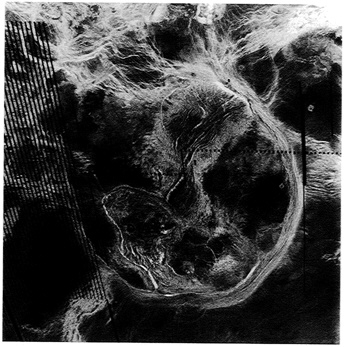
FIGURE 5.2 Like welts on Venus' skin, coronae are an enigmatic class of features thought to have formed from upwellings of molten rock beneath the surface. Most display lava flows encircled by a fractured ring of tectonic ridges. Artemis corona, the largest such feature, is some 2100 kilometers wide, and is surrounded instead by a wide circular trench. (Courtesy of the Jet Propulsion Laboratory, NASA.)
features, say the scientists, are places where the lithosphere is bending and sinking into the mantle. The coronae in Magellan's images, Turcotte suggests, represent places where lithospheric recycling tried to get started but couldn't. As with so many ideas about Venus, this idea is controversial (see Figure 5.2).
VENUS IS ALIVE
One of the recurring themes of Magellan's Venus is that the same data may draw widely differing interpretations from different scientists. In the case of the ADC values indicated by the gravity data, Bob Grimm and Sue Smrekar take the opposite view from Donald Turcotte. They do not believe Venus has a thick lithosphere. At the 100- to 200-kilometer depths indicated by the ADC values, Grimm notes, temperatures would
almost certainly be too high for rocks to remain solid over geologic time. But if the lithosphere is relatively thin, what is holding up Venus' highlands? Isostatic compensation by means of a low-density crustal root seems to be out of the question, for the same reason: the thickness of crustal rocks required would also be unable to withstand such high temperatures. That leaves only one alternative: Venus' highlands are dynamically supported by mantle convection. Is that feasible?
"No geophysicist doubts that the interior is convecting," Grimm says, noting with an unintentional pun, "It would have to be stone cold inside for it not to convect." The question, he adds, is whether this causes geologic activity. The answer seems to be yes. In 1991 Smrekar and Roger Phillips studied two-thirds of Venus' landforms using PVO's gravity data. They found that half of the 10 Venusian highland regions they studied had ADCs in excess of 150 kilometers. These regions also resemble areas on Earth called hot spots, places where hot mantle material is welling up and deforming the lithosphere directly above it. Hot-spot volcanism, for example, is thought to have formed the Hawaiian islands; over time the motion of the Pacific plate over the hot mantle plume resulted in a series of volcanoes arrayed along a line. At least five of the Venusian uplands studied by Smrekar and Phillips occupy broad, dome-like uplifts and seem to be places where volcanism and crustal rifting have occurred. Because of these characteristics, so much like terrestrial hot spots, the two geophysicists concluded that the Venusian features are probably hot spots as well. Are they active today? Smrekar says, "Even a fairly sluggish planet might occasionally be able to squeeze out one plume. For example, Mars produced one whopping plume that created the Tharis Mons volcano, which is not thought to be active today." But on Venus, she says, the presence of five probable hot spots strongly suggests that Venus' mantle is anything but sluggish.
More recently, Grimm and Phillips made a case study of the upland region called Eistla Regio. Its western and central regions, which comprise an area about the size of Brazil, are a pair of broad, dome-shaped highs separated by rift valleys. Each of the domes is topped by two volcanoes. Grimm's desire was to determine what kinds of forces might be acting on these features as a result of temperature and density variations in the underlying mantle. Here again the Pioneer Venus gravity survey provided the key. In computer simulations Grimm used the gravity data for Eistla to calculate the forces of tension and compression that would be experienced by the surface if Eistla were being supported by mantle convection. His results predicted that in the trough the crust should be pulling apart, while the surrounding plains should experience
compression. In fact, this is reflected by the geologic features we see in Magellan images: a rift zone some 100 kilometers wide cuts through the middle of Eistla, while on the surrounding plains the low ridges attest to compressive forces. Grimm believes a plume of molten rock is ascending directly under Eistla Regio. Presumably, it was the source of the lavas that built the two large volcanic shields. As the plume material crests and spreads laterally, it causes the overlying lithosphere to be torn apart. At the margins, where the plume material is descending, the surface above is compressed. The plume's buoyancy also accounts for the broad uplift that forms Eistla. Furthermore, Grimm believes, the existence of a significant gravity anomaly at Eistla means that uplift is still going on today. He suspects that a variety of similar scenarios are at work in Ishtar, Aphrodite, and the other Venusian highlands.
The idea that Venus' topographic features may arise from convective action within the mantle has broad implications. In a general sense, Grimm says, this tells us that Venus' lithosphere is mechanically more strongly coupled to the mantle than on Earth (which in turn, he says, would cause high ADC values). He and Smrekar believe the reason for this is that Venus lacks a low-viscosity asthenosphere. This makes sense if we consider how the Earth's asthenosphere is formed: When oceanic crust subducts into the mantle, it carries sea water down with it, which drastically reduces the melting temperature of the surrounding mantle rocks. As a result, the rocks of the uppermost mantle—the asthenosphere—exist almost at their melting temperature and probably contain pockets of molten rock. In other words, the Earth has an asthenosphere because it has oceans. But Venus' water is thought to have boiled away during an episode of so-called runaway greenhouse heating, perhaps a billion years after the planet formed, changing the planet into a bone-dry furnace. Just why Venus has no asthenosphere is controversial, but if it is true, Grimm and Smrekar say, it explains the high ADC values, because the mantle would be more strongly coupled to the surface. It also has major implications for the planet's geologic style, as we will see.
Meanwhile, for more evidence that Venus is geologically active today, Smrekar looks to the enigmatic coronae. These features, she says, are thought to begin life as volcanoes that eventually flatten into a more gentle topographic high. "If the coronae stopped forming 500 million years ago," Smrekar says, "there should not be any left in the early, volcano-like stages." But, she notes, Magellan has found coronae in all stages of development. In other words, Venus is currently volcanically active.
But on that point there is unanimous agreement among the Magellan
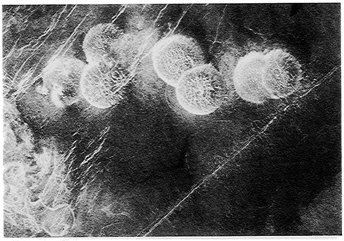
FIGURE 5.3 Pancake-like volcanic domes, each roughly 25 kilometers across, pepper the surface on the eastern edge of Alpha Regio. Thousands of volcanic features, ranging from gigantic shield volcanoes to tiny cinder cones, have been spotted in Magellan's images. (Courtesy of the Jet Propulsion Laboratory, NASA.)
scientists if for no other reason than that 80 percent of the surface contains volcanic landforms. As James Head explains, "It would be incredibly presumptuous of us, with all this evidence of volcanic activity, to say, 'Oh, the damn thing shut off, just as [Magellan] went into orbit.' I mean, we're talking about 4 1/2 billion years of evolution dominated by volcanism" (see Figure 5.3).
And yet, according to Head, Venus' current yearly volcanic output is far lower than many scientists expected. To account for the scarcity of craters invaded by lava flows (a mere 4 percent, by Schaber's count), Head estimates that between 0.1 and 0.5 cubic kilometers of lava is brought to the surface each year, as compared with the 20 cubic kilometers per year produced on Earth, mostly on the ocean floors. This suggests that volcanism has not played a major role in erasing Venus' craters in recent geologic history. If Roger Phillips is right—if something is eating craters on Venus—scientists must look for another explanation.
THE TECTONIC ALTERNATIVE
Michael Malin, a San Diego-based geologist who formed his own space science firm, is a veteran of planetary missions going back to the Viking Mars landings in 1976. He too is puzzled by the idea of a planet-wide
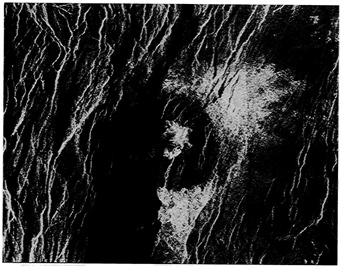
FIGURE 5.4 Disappearing act: In Beta Regio a crater caught in the act of being destroyed by fractures attests to Venus's history of tectonic activity. (Courtesy of the Jet Propulsion Laboratory, NASA.)
catastrophe in recent geologic time, an event that would make Venus unique among the terrestrial planets. Malin asks, "How do you resurface a planet?" With volcanism apparently not a viable mechanism, he suspects tectonic activity. "The only way to answer this," says Malin, "is to look at the craters themselves."
Even then, it is not an easy question to answer. Something as simple as the number of craters cut by faults or fractures is a matter of considerable debate; Schaber's team has estimated 34 percent, while Phillips and his colleagues count half as many (see Figure 5.4). In any case, tectonically altered craters far outnumber the 4 percent of craters that appear to have been flooded by lava. Ultimately, Malin and collaborator Robert Grimm would like to conduct a detailed study to see how many craters are found within tectonically disturbed regions. For now, the pair have conducted a "quick and dirty" analysis using a parameter called RMS (root mean square) slope, which is a component of Magellan's radar data. Simply put, the RMS slope is a measure of the roughness of the surface. The higher the mean slope value, the rougher the surface. And you would expect blocky surfaces in such tectonically altered regions as rift valleys, coronae, and ridge belts, Malin says. Thus, a map showing values of RMS slope ought to serve as a rough tectonic map of Venus.
According to Malin's RMS slope map, Venus is dominated by tectonic activity; some 60 percent of the surface is folded, fractured, faulted, or otherwise tectonically disturbed. Perhaps, he says, Venus is much more tectonically active than Earth. Or maybe it just seems that way: perhaps the difference is that on Earth so many other forces conspire to alter the landscape—vegetation, erosion by water and wind, burial by sediments—that tectonic features seem lost in the shuffle.
Having made this finding, Malin compared the map to the crater locations and found that tectonically deformed areas are somewhat deficient: they contain only 40 percent of known craters. The remaining 60 percent of the craters are found on the 40 percent of the planet that hasn't been tectonically altered. A close look at the tortured regions known as tesserae shows that they have fewer craters than the surrounding plains; the enormous fracture belts that girdle the planet's equator have even fewer craters. To Malin, the implication is clear: craters on Venus meet their doom not by burial under boiling lava but by the slow, steady disintegration of the very ground on which they lie. But not too slow: the fact that geologists see very few severely faulted craters means that the process acts relatively quickly, perhaps within a few million years. Some yet-unknown tectonic process, Malin says, has been erasing Venus' craters. While he considers this an important result, Malin stresses that it is preliminary; more definitive answers will have to wait for detailed mapping. In any case, he says, one of the most important implications is that craters on Venus are not randomly distributed, if one considers the type of geologic terrain they appear on.
For now the puzzle of exactly how tectonic activity has destroyed craters is part of the much larger question about the origin of Venus' tectonic features. Until scientists can explain how these features formed and developed, the nature and intensity of Venus' tectonic activity will be unknown. But there is evidence that Venus remains tectonically active today. The Maxwell Montes, the planet's highest mountain range, tower some 12 kilometers above the surrounding plains. If Maxwell Montes seem like Venus' answer to the Himalayas, the comparison is not unwarranted. How these mountains formed is highly controversial; one of many suggestions is that they formed from a block of crust that was thrust upward by compressive forces within the lithosphere. To some scientists the wonder is that they are there at all. Sue Smrekar believes Maxwell Montes offer the most compelling evidence of all that Venus is geologically alive. She notes that the extreme slopes of these mountains, 30 degrees in some places, are astonishing, considering the fact that the surface temperature is halfway to the melting point of basalt. Such
inclines would also experience tremendous pressure from the millions of tons of rock contained in these mountains. Weakened by the blast-furnace heat at the surface, Smrekar says, a slope that steep "wants to flow away like crazy" over a span of tens of million years. Had Maxwell Montes stopped forming 500 million years ago, Smrekar says, those slopes would not exist today. "The only possible way to retain these awesome mountain fronts (they are steeper than any mountain range on Earth) for half a billion years is to make Venus incredibly cold—about as cold as we think Mars is." Obviously that is not the case, but there is still some uncertainty about the true strength of Venus' rocks because of the fact that they contain no water. But Smrekar believes that even on a very dry Venus "slopes of 30 degrees are still not going to hang around for 500 million years." She estimates the age of Maxwell Montes at 10 million years or less.
But as if to emphasize the ambiguity with which Venus confronts planetary scientists, the crater Cleopatra, 100 kilometers across, sits on the high slopes of Maxwell Montes (see Figure 5.5). The crater shows no signs of deformation, indicating that it formed after the mountains did. The problem is simple: Craters that big just don't come along very often, on Venus or Earth. When they do, they are significant events; a 300-kilometer-wide crater in the Yucatan is believed to be the scar from the
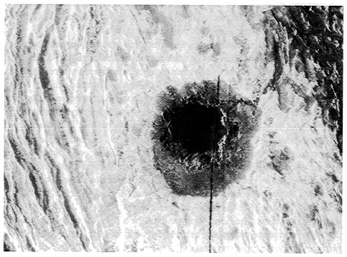
FIGURE 5.5 Cleopatra crater, 105 kilometers across, lies on the high slopes of Venus' Maxwell Montes. Its very presence is a dilemma for scientists who claim these mountains formed in recent geological time. (Courtesy of the Jet Propulsion Laboratory, NASA.)
impact that ended the reign of the dinosaurs 65 million years ago. Even if Maxwell's present slopes are 50 million years old, as estimated by MIT geologist Noriyuki Namiki, Cleopatra's presence is problematic. Namiki estimates that there is only an 8 percent chance that a 100-kilometer crater would form on an area the size of Maxwell within a span of 50 million years. Namiki's former adviser, geophysicist Sean Solomon, now at the Carnegie Institute of Washington, D.C., says, "[Cleopatra] is an embarrassment to the hypothesis that Maxwell is a very young feature." On the other hand, if the mountains are ancient, scientists may cast their votes with Turcotte, who says that on Venus the only way to maintain such extreme relief for aeons is to have a very thick (and therefore strong) lithosphere. Smrekar counters by noting that it would be much harder to fracture and compress a thick lithosphere to produce such enormous mountains.
Another intriguing tectonic feature of Magellan's Venus is the existence of landslides inside the planet's large canyons. Mike Malin believes these landslides were triggered by Venusquakes; some of the canyon slopes are so steep, he says, that landslides there appear inevitable. Before Magellan arrived at Venus, Malin predicted that if Venus were as seismically active as Earth at least one major landslide ought to occur during the projected mission. However, Magellan's third mapping period was cut short, and the "smoking landslide" has not been found.
MEANWHILE, IN THE UPPER MANTLE
For Smrekar the question remains: Why does tectonic activity seem to have overshadowed volcanism in recent Venusian history? Smrekar is developing a hypothesis to explain the formation of Venus' hot spots that considers not only the physics involved but also the chemistry. First, consider the fact that rocks deep within mantle stay solid despite their high temperatures; this is because of the tremendous pressure at great depths. When a hot plume of mantle rock rises toward the surface, Smrekar says, it encounters steadily decreasing pressure; this allows it to succumb to the high temperatures. It does not melt completely, however. The liquid produced is basaltic in composition, rich in iron and magnesium. If it can rise to the surface, it will erupt as lava. The rock that remains behind, called residuum, is deficient in iron and magnesium and thus is less dense than the surrounding mantle rocks. On Earth much of this low-density residuum is carried back into the mantle. But on Venus geophysicists have proposed a different scenario, first suggested by Roger Phillips and Bob Grimm, and fully developed by Brown
University's Marc Parmentier and Paul Hess. In this scenario the absence of an asthenosphere may allow the low-density residuum to collect immediately beneath the lithosphere. Over time this buoyant material would spread out into a layer of fairly even thickness.
Smrekar is studying in particular what would happen if a hot spot formed beneath this residuum layer. Because of this layer, a hot plume of mantle material would not be able to reach the lithosphere, thus reducing the amount of volcanic activity. However, the presence of the residuum layer beneath a relatively thin lithosphere would not inhibit tectonic activity. And the high ADC values would be explained by the fact that buoyant mantle plumes would be stalled at depth. Thus, Smrekar believes, this hypothesis can explain not only the crater statistics but also the gravity signatures. Over the life of an individual hot spot, she notes, its ADC value would gradually decline as the hot mantle plume comes closer to the surface and finally dissipates. Smrekar and three colleagues are studying Venus' hot spots in the hope of determining their stage of evolution.
RETHINKING THE CRATERING RECORD
In the summer of 1992 Roger Phillips and geologists Ray Arvidson and Noam Izenberg went back to the work of studying the Magellan images and, once again, found evidence that the ''clumpiness" of the crater distribution is not simply random chance. Areas that are bright in the radar images have fewer craters than average. The craters that are present have been cut by fractures or are partly covered by lava flows. The prime example is the belt of tectonic and volcanic features that extends through the Aphrodite highlands and eastward toward the highland region called Beta. It is no surprise that craters should be missing here; as Jerry Schaber and others had pointed out earlier, this appears to be a region where the surface has been rifted apart and volcanism has taken place. These regions, Phillips believes, may be some of the youngest surfaces on Venus.
Conversely, as Phillips and his colleagues found, regions that appear radar dark have more craters than average. The most prominent dark areas lie in Venus' northern hemisphere, such as those north of Aphrodite. A closer look showed that the craters in these areas were surrounded by halos of radar-dark ground, each of which extends for many tens of kilometers. The halos are probably dark because they are places where the ground is covered with fine-grained dust, which scatters radar waves poorly. Specialists who study impact craters
mention two possible origins for the radar-dark halos. In one theory the shock wave generated by the plummeting meteoroid pulverized the region around the impact site. In the other, fine dust produced during the impact was carried into the atmosphere, then settled on to the ground.
When Phillips studied the dark areas north of Aphrodite, he found that they were dark because they were covered with craters whose dark halos nearly coalesce. Some dark regions have twice as many craters as average, implying ages of 1 billion years; Phillips believes they are the planet's oldest regions. Furthermore, they show no sign of having been altered by subsequent geologic activity that would have disturbed the dark halos. In general, Phillips says, terrains on Venus are not the same age but fall into three basic groups:
-
heavily cratered, and thus ancient, radar-dark regions; based on Phillips's rough estimate, these occupy 20 to 30 percent of the planet;
-
young (crater-poor) radar-bright areas, including the Aphrodite upland region; these also cover perhaps 20 percent of the globe; and
-
the rest of the planet, perhaps 50 percent, could contain a variety of different ages, Phillips says; more detailed studies are needed to be more certain. For now, however, Phillips believes this assortment of terrains, with sharply different crater ages, shows that Venus' history cannot be explained in terms of one major resurfacing event. Phillips's finding seems to challenge the premise that is the foundation of the global resurfacing model, that Venus' craters are simply a result of half a billion years in the cosmic shooting gallery.
THE GEOLOGIC LINK: DISTRIBUTED DEFORMATION
It remains to forge a link between the observations that Venus' terrains differ in age and that tectonic activity appears to be the primary agent for removing craters and the geophysical premise that Venus' interior is like Earth's. That link is offered by Grimm in the form of a hypothesis he calls distributed deformation. He believes that what is going on in Eistla Regio and, by implication, the other highland areas is telling us how Venus' geology works. On Grimm's deformation map of Eistla, stresses seem to be evenly distributed; the transitions between regions of tension and compression appear to be smooth. But this is just what we would expect if, as the ADCs suggest, Venus' lithosphere is strongly coupled to the interior. Imagine for a moment that Venus
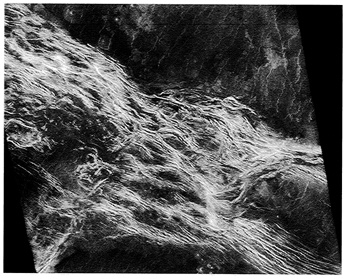
FIGURE 5.6 Belts of ridges and rifts cross Lavinia Planitia. Do they represent the boundaries of Venusian "miniplates"? Width of image is 430 kilometers. (Courtesy of the Jet Propulsion Laboratory, NASA.)
started out with large moving plates like Earth's. With no asthenosphere to act as a buffer, the plates would bear the brunt of the vigorously convecting mantle. Like scum on a pot of boiling water, a large plate would break apart into smaller pieces. At that point, Grimm says, plate tectonics would no longer exist.
This, Grimm believes, is just what we see on Venus today. If a global network of tectonic features ever existed on Venus, there is no trace of it in Magellan's images. Instead, Grimm says, tectonic features are widely distributed across the planet. In some areas we see tectonic belts encircling "islands" of undeformed terrain (see Figure 5.6). A picture emerges of a Venus whose lithosphere is divided into a series of blocks, each on the order of a few hundred kilometers across. (Notably, this is roughly equivalent to the average spacing between craters on Venus.) There may be tectonic activity or volcanism at the margins of these blocks, but the blocks themselves are too tightly packed to undergo significant lateral motion. Nevertheless, Grimm says, such a configuration would not limit the extent of Venus' geologic activity. Over a span of tens or hundreds of millions of years the pattern of mantle convection would change and with it the location of geologic activity. Grimm and
Phillips believe that if you could view a time-lapse movie of Venus' evolution you would see different parts of the planet wink on and off, erupting with lava flows or suffering a spasm of mountain building or being rifted apart by hidden stresses in the interior. At any given moment, much of the planet would be quiescent; over a span of a billion years, however, the whole planet would be affected.
Not surprisingly, the hypothesis has already generated controversy; Jerry Schaber questions the likelihood of a Venus "conveniently divided into a series of blocks, each of which is just the right size" to avoid disrupting a spatially random crater distribution. Grimm admits that there is a long way to go before the distributed deformation model is on solid ground. Roger Phillips points out that geophysical models are so sensitive to slight changes in the assumed parameters that almost any answer is obtainable just by twiddling the knobs, so to speak. Having a model that explains a hypothesis, he says, doesn't prove the hypothesis, whether it is global resurfacing or a competing theory.
"I think the story is very complex," Phillip says. "I certainly do not claim to know all the answers at this point. I probably never will. But I don't think a model as simple as [global] resurfacing can be right. There's enough evidence to rule out that model, or models close to it, as far as I'm concerned."
That said, geologists may be edging toward consensus. Turcotte says, "The uniform age is obviously just a first approximation, and one has to look at variations on that. … But there do not seem to be large [masses] of very old rock on Venus. And I think that is significant."
TOO SOON FOR CERTAINTY
No matter which hypothesis you mention, Venus maddeningly seems to offer both support and contradiction. For example, Donald Turcotte says his "hibernating Venus" hypothesis leaves plenty of room for mantle convection to support upland regions like Eistla Regio, just as Grimm suggests. The reason for this, he says, is that Venus' lithosphere varies greatly in thickness, just as it does on Earth. For example, the lithosphere under the eastern United States reaches a thickness of 175 kilometers, while in the western portion of the continent the lithosphere is less than 30 kilometers thick and consists only of crustal rocks; consequently, the western United States is a site of volcanic and tectonic activity. On Venus, Turcotte says, the thickest lithosphere could be 300 or even 400 kilometers thick; the thinnest, at the center of some active highland regions, could be only 12 kilometers thick.
But for Smrekar the very existence of Maxwell Montes is enough to demonstrate that Venus is tectonically, as well as volcanically, alive. That, she says, is the reason the lithosphere of Venus cannot be several hundred kilometers thick, as Don Turcotte maintains. "I can't prove to you that there's not a thick lithosphere," Smrekar says. "But if there is, it's extremely difficult to have ongoing volcanism and tectonism. That's really the heart of the argument."
Every one of the scientists mentioned here has stressed that it is too soon to draw firm conclusions from Magellan's wealth of data. Detailed studies, like the geologic mapping that Michael Malin plans, should help pin down the details of Venus' evolution. And scientists are eager to see NASA, the National Aeronautics and Space Administration, approve a special seismic lander to touch down on the Venusian surface to probe the planet's interior. For now, they are hopeful that Magellan will provide a critical key to the puzzle in the form of new, high-resolution data on the gravity field. These data, they say, would help answer detailed questions about the structure of the lithosphere and the nature of the interior. At this writing, they were still hopeful that the space-craft—many of its systems malfunctioning, threatened with termination by NASA—would achieve that longed-for goal. But it is safe to say that in the years to come scientists will continue to reap the fruits of Magellan's rich scientific harvest. And the cloud-hidden world that shines so brightly in our skies will grow less and less mysterious.
NOTES
BIBLIOGRAPHY
Beatty, J. K., and A. Chaikin (eds.). 1990. The New Solar System. 3rd Edition. Sky Publishing Corp., Cambridge, Mass.
Cooper, H. S. F., Jr. 1993. The Evening Star. Farrar, Strauss, and Giroux, New York.
Grinspoon, D. H. 1993. Venus unveiled: Has the Magellan spacecraft detected plate tectonics on Earth's twin? The Sciences (July/August):20–26.
Magellan at Venus. Special issues of the Journal of Geophysical Research. Part 1, vol. 97 #E8, 13063–13689 (August 25, 1992). Part 2, vol. 97 #E10, 15921–16382 (October 25, 1992). Research papers written by Magellan scientists.
Morrison, D. 1993. Exploring Planetary Worlds (Scientific American Library). W. H. Freeman and Company, New York.
National Aeronautics and Space Administration (NASA). 1984. The Geology of the Terrestrial Planets. NASA SP-469. U.S. Government Printing Office, Washington, D.C.
Newcott, W. 1993. Venus revealed. National Geographic (Feb):36–59.
Pasachoff, J. M. 1990. Astronomy: From the Earth to the Universe, 4th ed. Saunders College Publishing, Philadelphia.
Press, F., and R. Siever. 1974. Earth. W. H. Freeman and Company, San Francisco.
Solomon, S. 1993. The geophysics of Venus. Physics Today (July):48–55.


