
8
Cancer
Cancer is the second leading cause of death in the United States. There has been a gradual rise in the proportion of deaths from cancer in the United States during the twentieth century, due in large part to increased tobacco use. At present, more than 30 percent of Americans will develop a malignancy at some time in their lives, and approximately half of them will die from it (Seidman et al., 1985). As a result of the high incidence of cancer, the often disfiguring and uncomfortable approaches to treatment, and the general lack of success in treating many types of cancer, it has become a particularly dreaded disease.
Many types of cancers are thought to be related to herbicides and/or 2,3,7,8-tetrachlorodibenzo-p-dioxin (TCDD), but the evidence for the associations is uneven. Following this introduction about cancer and its epidemiology, the committee summarizes and reaches conclusions about the strength of the evidence in epidemiologic studies regarding associations between exposure to herbicides and TCDD and each type of cancer. The cancer types are discussed in the order in which they are listed in the International Classification of Diseases (U.S. DHHS, 1991). A summary at the end of the chapter compares the cancer types for which the strength of the epidemiologic evidence is similar, and discusses the nature of the evidence that led the committee to its conclusion.
Cancer is a disease of the cell. Cancer cells are malignant: that is, they lack normal growth control, and have the ability to invade and metastasize into surrounding tissues and other organs. These properties are inherent in the cells themselves, so that, for example, a cancer cell could be transplanted
into a normal host and a new malignant tumor would arise. This implies that the underlying abnormality that led to the transformation of a normal cell into a malignant cell is present in the genetic material of the cell itself or in the way the genetic information is expressed.
It is now well accepted that a malignant tumor develops from a single cell that has passed through a series of steps or stages of transformation. The initial stage of transformation, or "initiation," is thought to involve a mutation—that is, damage to DNA. The initiated cell and its progeny, most of which are destroyed by the body, then must pass through one or more additional stages (progression) before a clone of fully transformed malignant cells will acquire the essential properties of a malignant tumor. These generally include loss of normal specialization, faster than normal rates of cell division, and loss of normal limits on cell division.
Many carcinogens that have been identified thus far are initiators and are believed to interact directly with DNA. It is also known, however, that certain substances may promote tumor formation by initiated cells, even though they are not capable of the initial cell mutation. Based on its effects in animal studies, TCDD is considered a tumor promoter, not a tumor initiator. The potential mechanisms by which TCDD can act as a tumor promoter are discussed in Chapter 4.
It follows from an initiation/promotion model that tumor initiators should act early in the carcinogenic process, often decades before a cancer is diagnosed, while tumor promoters may exert their effect at any time between initiation and clinical diagnosis.
The experimental evidence suggesting that TCDD acts as a tumor promoter comes from studies in laboratory animals. It is possible, though not proven, that TCDD could also promote the formation of cancer in humans after exposure to another potential carcinogen. Understanding the biological mechanism whereby TCDD interacts with the process of cancer production is critical to the committee's analysis of the plausibility of an association between human cancer and exposure to Agent Orange and other herbicides. Although direct evidence may not be available regarding the biologic plausibility of a specific tumor site, this does not preclude examination of epidemiologic data for potential association in a population.
In evaluating the epidemiologic studies, the committee noted that in many studies, insufficient time had passed since exposure for many types of tumors to develop; this is an issue of minimum latency needed for an adequate study. However, if TCDD is acting as a promoter, studies that evaluate health outcomes before the usual minimum latency period has passed may be appropriate since this function may require a shorter latency period for its hypothesized mechanism of action.
CANCER EPIDEMIOLOGY
Cancer is a popular subject for discussion in the lay press and media. Hardly a day goes by without an article trumpeting some chemical or environmental hazard as playing some role in the etiology of some malignancy. In truth, it is difficult to establish causal relationships for cancers. There are several characteristics of cancer that strongly affect and influence the ability to establish etiologic relationships.
The first major characteristic in this regard is the long latency period that is thought to exist between exposure and onset of disease in most instances. Also, most etiologic agents (except cigarette smoking) probably contribute to only a relatively small fraction of cases. Furthermore, although cancer overall is relatively common, the term "cancer" actually represents a rubric of more than 100 different subtypes, categorized by anatomic site and histology, as well as by stage and other factors. Any specific subtype of cancer is a relatively rare event, and this makes its study difficult. For example, to study the impact of hypertension on the incidence of a relatively common outcome, such as coronary artery disease, an appropriately selected cohort of 1,000 to 2,000 people, followed for five to ten years, might suffice. A similar attempt to relate a risk factor to even a relatively common malignancy, such as lung cancer, would require a cohort of 10,000 to 20,000 individuals followed for five to ten years. For a less common cancer, such as non-Hodgkin's lymphoma, it would be even more difficult, requiring substantially more people.
Another characteristic—cancer's relatively high case fatality rate—is an additional complication for analysis. As a consequence, many studies rely on cancer mortality rather than cancer incidence as an outcome. Depending on the specific malignancy under study and the time period being explored, this is often a reasonable approach. However, improvements in the early detection and treatment of cancer have led to improved survival rates for several types of cancer (testicular cancer, childhood leukemia, Hodgkin's disease, for example). To the degree that it is true for a given malignancy, fatality rates have declined, and conclusions derived from the use of mortality data must be viewed cautiously.
Another aspect of cancer epidemiology that it is important to understand is the wide availability of tumor registries since the 1970s. For various reasons, many cities, states, countries, and other political and geographical regions have kept population-based data regarding the reporting of cancer incidence—usually by subtype, and often with survival and follow-up data—within their boundaries. These data are usually available to epidemiologists and greatly facilitate the practice of their science.
Finally, an important aspect of cancer epidemiology is precision of diagnosis by pathologic criteria. Compared to diagnosis of many other
types of disease, which may involve only patient-described symptoms, a cancer diagnosis is usually definitive only when based on pathologic review. In addition, histologic and other subtyping can also be defined fairly accurately. In the review and critique of any study, great attention must be paid to the efforts utilized by the investigators in establishing the pathologic diagnosis. Particularly when population-based registry data are utilized, or when data are collected from less sophisticated regions or hospitals, difficulties may arise in the accuracy of the study. When death certificate diagnoses are used, accuracy may suffer as well (see Chapter 5).
There are a large number of different types of cancer as defined by site and histology. In situations in which many studies have been conducted on a certain exposure, and multiple analyses conducted within each study, there is a risk of finding occasional statistical associations purely on the basis of chance. Thus, one must beware of overinterpreting an isolated finding of excess risk for a given tumor type within a single study. Consistency across studies, with consideration of dose-response relationships and use of other statistical methods that evaluate plausibility, should be assessed before reaching any conclusions regarding associations between exposures and cancer. Additionally, the confidence intervals around the estimate of association will provide guidance as to the degree of precision and study size. Wide intervals indicate that the sample size, on which the estimate was based, was relatively small, and therefore the degree of precision attributed to that estimate is more variable. These considerations are outlined more fully in Chapter 5.
SPECIFIC ISSUES WITH REGARD TO HERBICIDE EXPOSURE IN VIETNAM
Aside from the issues discussed above, there are also several general problems with regard to relating herbicide exposure in Vietnam to the incidence of cancer overall or to specific malignancies. As a whole, the cohort in Vietnam consisted primarily of young males and a far smaller number of females who were potentially exposed to herbicides between 1965 and 1975. A veteran who was 20 years old in 1965 is 48 years old in 1993, still very young with respect to developing cancer. Because the incidence of most malignancies is strongly age dependent, the cohort under discussion, for the most part, has not yet reached the age range of highest risk, making the incidence of cancer, and certainly of cancer subtypes, rare within most studies of veterans. The two specific types of cancer most closely linked to herbicide exposure in the scientific literature, soft tissue sarcoma (STS) and non-Hodgkin's lymphomas, are noteworthy in that their incidence is relatively high in younger age groups even in the absence of any harmful exposures. Thus, it may well be that for the most common cancer types, such as
lung, colon, and prostate cancers, the length of follow-up since the Vietnam conflict remains too short to adequately evaluate possible associations with exposure.
The age-specific incidence rates for the cancer types of special significance for the Vietnam veteran population are shown in Figure 8-1 for men and in Figure 8-2 for women. For most cancers (illustrated as a ''typical cancer"), the incidence rates increase with age (note that the vertical axis of the graph uses a logarithmic scale), but for some cancers, such as brain cancer, acute lymphocytic and all leukemias, and non-Hodgkin's lymphoma, the rate of increase with age is more gradual than the rest; thus the incidence rates under age 40 (compared to those over age 40) are relatively high. Hodgkin's disease, soft tissue sarcoma, testicular cancer for men, and
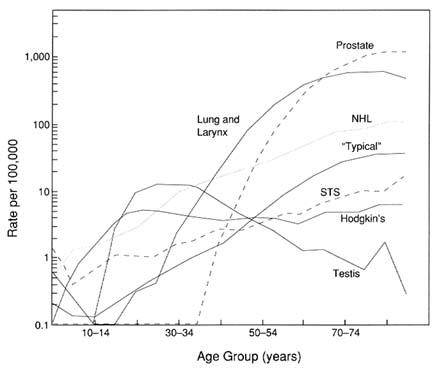
FIGURE 8-1 Average age-specific incidence rates for selected cancers in men for the period 1985-1989. The "typical" cancer illustrates a common pattern of age-specific rates seen in cancers not included in the figure; age-specific rates for all cancers combined have been rescaled (1:100) to construct the typical cancer. Rates are for 5 year age groups and are presented on a logarithmic scale. SOURCE: Miller et al., 1992.
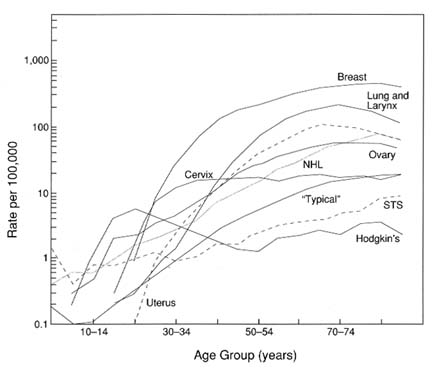
FIGURE 8-2 Average age-specific incidence rates for selected cancers in women for the period 1985-1989. The "typical" cancer illustrates a common pattern of age-specific rates seen in cancers not included in the figure; age-specific rates for all cancers combined have been rescaled (1:100) to construct the typical cancer. Rates are for 5 year age groups and are presented on a logarithmic scale. SOURCE: Miller et al., 1992.
cancer of the cervix for women are unique among the cancers under study in that their age-specific incidence rates peak below age 40.
EXPOSURE
It should be emphasized that for most of the studies reviewed for association between cancer outcomes and herbicide exposure, the actual exposure of each individual is in fact unknown. Some studies develop an index to approximate a scale of degrees of exposure; some studies use a surrogate measure of exposure, such as veterans service in Vietnam. The effect of this inadequate exposure measurement is a dilution of the statistical measure of the magnitude of the association. For example, if the odds ratio for a particular cancer and poor exposure measure to herbicides is 1.5, this risk
estimate is lower than what would be expected if good individual exposure data were available. The effects of misclassification of those who are exposed and unexposed are discussed in Chapter 6. Thus, studies with weak or no association should be considered in conjunction with the way in which exposure was measured.
PLAUSIBILITY DATA
Cancers of a variety of types have been identified in studies of animals exposed to TCDD, as described in detail in Chapter 4. These include liver, lung, and skin tumors in rats and mice. TCDD is not considered a genotoxic carcinogen, and in multistage models of carcinogenesis, TCDD acts as a tumor promoter and has little, if any, tumor-initiating activity. TCDD mediates carcinogenesis through a variety of biochemical effects that are dependent on the presence of a cellular receptor protein referred to as the Ah receptor. This receptor has been identified in both laboratory animals and humans, and appears to play a role in regulating cell proliferation and differentiation. The multiple site specificity of TCDD is likely to reflect its multiple mechanisms of action.
In contrast to TCDD, the experimental data supporting the carcinogenic activity of the herbicides used in Vietnam are considerably weaker. Only 2,4-D (2,4-dichlorophenoxyacetic acid) has produced positive results in an animal bioassay, and these are of controversial validity. The herbicides have not been adequately tested, however, so conclusions regarding their carcinogenicity in animals must be drawn with caution.
EXPECTED NUMBER OF CANCER CASES AMONG VIETNAM VETERANS
To provide some background for the consideration of cancer risks in Vietnam veterans, and to evaluate the possibilities for future epidemiologic studies of cancer in this group, the committee estimated the number of cancer cases that could be expected to occur in Vietnam veterans in the absence of any increase in risk due specifically to herbicide exposure, as follows. First, all Vietnam veterans were assumed to be born between 1946 and 1950, which corresponds to the largest five year age cohort. Second, the committee assumed that the most recent available national annual cancer incidence rates, those for 1985-1989 estimated by the National Cancer Institute's Surveillance, Epidemiology, and End Results (SEER) program (Miller et al., 1992) would apply to Vietnam veterans. Further, if one assumes that 2,600,000 men and 7,000 women served in Vietnam (see Chapter 3), the expected number of specific cancers among Vietnam veterans in 1995 was estimated by applying the sex-specific SEER rates for ages 45-49
to male and female populations of the size given. SEER incidence rates for ages 50-54 were used to construct similar estimates for the year 2000. The incidence rates of most cancers increase with age, and some Vietnam veterans are older than the assumptions in this calculation, so the numbers given are perhaps underestimated. Also, 2.6 million is the minimum estimate of the number of Vietnam veterans. Furthermore, these calculations make no assumption of any higher risk among veterans because of exposure to herbicides in Vietnam or other aspects of the Vietnam experience. Because of these biases, the figures presented in the following section of this report should be interpreted as providing only order-of-magnitude estimates, not precise predictions for the Vietnam veteran cohort.
The results of the committee's calculations of the number of expected cancer cases in the Vietnam cohort are shown in Table 8-1. Based on rates in the general U.S. population, the expected numbers of new cancer cases per year in male veterans are relatively small. Overall, about 0.3 percent of male veterans and 0.4 percent of female veterans are expected to be diagnosed with cancer in 1995. In 2000, new cancers are expected in 0.5 percent of male and 0.6 percent of female veterans. The estimates range from as few as 21 cases for acute lymphocytic leukemia in 1995 to as many as 494 for non-Hodgkin's lymphoma. The exceptions to this pattern are cancers of the prostate, colon, and lung, for which the expected numbers of new cases among male veterans in 2000 are 855, 931, and 2,860, respectively. The number of cancers of each type expected among female veterans is very much smaller, owing to the smaller number of women (compared to men) who served in Vietnam; only for breast cancer is the expected number higher than ten new cases per year, and for many of the cancers under study, the expected number of new cases is less than one.
The estimates in Table 8-1, which are based on cancer incidence rates in the general population, show that each year, regardless of the effect that herbicides might have on cancer incidence, many veterans can be expected to be diagnosed with cancer. However, two factors make it difficult to conduct the epidemiologic studies needed to detect any increased risk for specific cancers that herbicide exposure might cause among veterans. First, only some of those who served in Vietnam were exposed to herbicides (see Chapter 6); therefore, any added risk for a specific cancer would best be studied in the smaller exposed population with a more limited number of cases. Second, some cancers are sufficiently rare that even among all Vietnam veterans there will be too few cases for reliable epidemiologic studies. This problem of inadequate numbers of cancer cases was also seen in the Centers for Disease Control's (CDC) Selected Cancers Study; even with a network of cancer registries that covered 10 percent of the U.S. male population, born between 1921 and 1953, the statistical power to detect an association between some of the cancers under study and Vietnam service was low.
TABLE 8-1 Number of Cancer Cases Expected Among Vietnam Veterans in 1995 and in 2000
OVERALL CANCER
Background
The American Cancer Society estimated that 1,130,000 Americans were diagnosed with cancer in 1992, and approximately 520,000 people died from it (ACS, 1992). Overall, cancer mortality increased from 162 per 100,000 in 1973 to 173 per 100,000 in 1989 (Miller et al., 1992) (these rates are age-adjusted to the 1970 population). According to the committee's calculations, approximately 6,690 new cases of cancers of all types are expected among male Vietnam veterans in 1995 and approximately 29 among female veterans. In 2000, the expected numbers are approximately 12,126 new cases in male veterans and 40 in female veterans.
Doll and Peto (1981), in their now classic monograph, studied attributable risks for cancer (the proportion of all cancer cases that can be attributed to a particular cause). The most important overall risk factor was tobacco exposure, which was estimated to account for about 30 percent of all cancer incidence. This reflects the strong carcinogenic effect of tobacco smoke, the numerous anatomic sites that are affected, and the prevalence of smoking in the population. Diet, which represents a large number of different types of exposure, was found to have an impact of similar magnitude, although the confidence intervals on this risk estimate were extremely wide.
Occupational and environmental exposures to carcinogens, the closest analogues to Agent Orange exposure, were found by Doll and Peto to have a smaller attributable risk for cancer overall (i.e., only a small proportion of cancer of all sites combined could be attributed to these exposures). Nevertheless, these environmental agents may be highly carcinogenic. For instance, only a fraction of the overall population is exposed to asbestos, and only a fraction of the work force is exposed to a particular carcinogen such as benzene or polycyclic hydrocarbons. Nonetheless, individuals exposed to these chemicals may have a high risk of developing cancer. Therefore, identifying environmental and occupational carcinogenic exposures, and developing preventive measures for them, are of great public health importance.
Epidemiologists and cancer specialists generally do not study risk factors for all cancers combined. The causal associations and other characteristics for anatomically and histologically defined subtypes of cancer are so variable that general statements regarding "cancer" are of little use. The usefulness of studying overall cancer would be evident if a slight increase in risk occurred for many different cancers. The small relative increase for a given site might, however, not be detectable because of low statistical power resulting from the small number of cases. An apparent increase in risk of "all cancers" in a given study might actually stem from an increase
in a single type of cancer. Nonetheless, a variety of attempts at defining cancer risk among veterans exposed to Agent Orange, other herbicides, and TCDD have been reported and deserve description and analysis.
Epidemiologic Studies
Occupational Studies
Many studies have examined cancer mortality among a number of different occupational groups. One occupational group of interest for the association between cancer and exposures to herbicides is agricultural workers and farmers. A study of agricultural extension agents in the cooperative extension service of the U.S. Department of Agriculture (USDA) found no excess of overall cancer mortality (Alavanja et al., 1988). No excess overall cancer was observed in a study conducted among Danish gardeners (Hansen et al., 1992) or among herbicide applicators in Finland (Riihimaki et al., 1982, 1983). The overall proportionate mortality ratio (PMR) was decreased among Iowa farmers (Burmeister, 1981) and Swedish agricultural workers (Wiklund, 1983). A study among licensed herbicide applicators in the Netherlands (Swaen et al., 1992) found no significant increase in cancer mortality. A possible decrease in overall cancer mortality among farmers might be due to healthier life-styles overall, with decreased tobacco usage (Sterling and Weinkam, 1976), or to increased physical activity.
Other occupational groups potentially exposed to herbicides and dioxins are forestry and paper workers. No excess cancer mortality has been found in several studies of these workers conducted in Canada (Green, 1991), Finland (Jappinen and Pukkala, 1991), or the United States (Robinson et al., 1986; Henneberger et al., 1989). One study of 201 deceased white men who had been employed in pulp and paper production did find a statistically significant PMR of 1.3 [confidence interval (CI) 1.0-1.7] for all malignant neoplasms (Solet et al., 1989), which reflected an excess risk of lung cancer.
The National Institute for Occupational Safety and Health (NIOSH) study (Fingerhut et al., 1991) of workers in 12 plants in the United States that produced chemicals contaminated with TCDD found a standardized mortality ratio (SMR) of 1.2 for all cancers (CI 1.0-1.3). The SMR was higher in the subcohort with more than one year of exposure and more than 20 years latency (SMR = 1.5, CI 1.2-1.8). A study among German production workers exposed to TCDD (Manz et al., 1991) found an SMR for total cancer mortality of 1.2 (CI 1.0-1.5) compared to the total population, with increased cancer mortality among men having 20 or more years of employment. Saracci and coworkers (1991) found no overall increase in cancer mortality in their international study of workers exposed to phenoxy herbicides
and chlorophenols. Studies among workers involved in the production of 2-methyl-4-chlorophenoxyacetic acid (MCPA), phenoxy herbicides and chlorophenols in the United Kingdom found no excess overall cancer (Coggon et al., 1986, 1991). A study among MCPA workers in Denmark did not show an excess incidence of cancer (Lynge, 1985).
No excess cancer mortality has been found among workers exposed in a flavor and fragrance chemical plant (Thomas, 1987), or in highway maintenance (Bender et al., 1989). A study of Swedish railroad workers (Axelson and Sundell, 1974; Axelson et al., 1980) did find an excess tumor mortality, especially linked to amitrole and the category of all other herbicides.
Zober and colleagues (1990) looked at the 34 year mortality of 247 workers who were partially or heavily exposed to TCDD following an accident at a BASF plant in Germany. No consistent statistically significant overall excess in cancer mortality was observed. Following an accident in a trichlorophenol process plant at Monsanto that resulted in TCDD exposure, the SMR for malignant neoplasms was 1.0 (Zack and Suskind, 1980). After an electrical transformer fire in a Binghamton, New York, office building, no excess in cancer incidence was noted after four years among those potentially exposed to polychlorinated biphenyls (PCBs) and dioxins (Fitzgerald et al., 1989).
Environmental Studies
Other studies have looked at overall cancer mortality in people exposed to herbicides through environmental accidents or other environmental contamination of water and soil. The overall cancer mortality and incidence in the Seveso population has not been shown to be increased (Bertazzi et al., 1989a,b, 1992; Pesatori et al., 1992). In a Missouri community exposed to TCDD in sludge waste from a chemical production facility, the sample size was too small to evaluate overall cancer mortality (Hoffman et al., 1986). A study of a community in Southern Finland (Lampi et al., 1992) exposed to chlorophenols in contaminated drinking water also did not show an excess risk of overall cancer incidence.
Vietnam Veterans Studies
Many of the studies of Vietnam veterans have reported total cancer mortality. A follow-up study of 19,205 Australian Vietnam veterans found no excess of overall mortality or overall cancer mortality compared to 25,677 Vietnam era veterans who served in Australia (Fett et al., 1987a,b). There was no difference in mortality by period of service during the Vietnam conflict (Forcier et al., 1987). A similar study of U.S. Vietnam veterans, the CDC Vietnam Experience Study, also showed no excess overall cancer mortality
(Boyle et al., 1987; CDC, 1987a), nor have studies of the more highly exposed Ranch Hands (Michalek et al., 1990); however, the sample size for the Ranch Hand study was too small to evaluate even overall cancer outcomes.
Studies in Wisconsin (Anderson et al., 1986a,b) and Massachusetts (Kogan and Clapp, 1985) showed no excess of overall cancer mortality among white Vietnam veterans compared to Vietnam era veterans.
Studies conducted by the Department of Veterans Affairs (DVA; formerly the Veterans Administration), have also explored total cancer mortality. A study conducted among ground troop veterans (Breslin et al., 1988) found no excess of cancer in Vietnam veterans compared to 26,685 Vietnam era veterans who served in areas other than Southeast Asia; no excess overall cancer mortality was shown in Army I Corps veterans (Bullman et al., 1990). A study conducted by the DVA (Watanabe et al., 1991) found an elevated PMR for cancer overall for Army Vietnam veterans compared to U.S. men and for Marines compared to Vietnam era Marines. Among female veterans who served in Vietnam (Thomas et al., 1991), results showed no excess overall cancer mortality, although this study was fairly small to evaluate overall cancer.
Summary
Because every cancer has a unique set of multifactorial risk factors, epidemiologists focusing on etiology and prevention of cancer do not usually study mortality from all cancers as a single outcome. Such studies would be weak, and the results difficult to interpret. Two studies of TCDD-exposed workers (Fingerhut et al., 1991; Manz et al., 1991), however, did show significant excesses with consistent dose-response relationships, and these were the only worker studies that had relatively large, highly exposed cohorts to investigate. Studies conducted among Vietnam veterans themselves were, for the most part, negative with regard to overall cancer mortality. Exposure measures are diluted because individual measures of exposure are lacking, which results in misclassification of individuals; however, important increases among specific cancer types are certainly possible.
GASTROINTESTINAL TRACT TUMORS
Background
As a group, this category includes the major cancers in the United States as well as in the world. Within this group, the committee reviewed the data on colon cancer (ICD-9 153.0-153.9), rectal cancer (ICD-9 154.0-154.1), stomach cancer (ICD-9 151.0-151.9), and pancreatic cancer (ICD-9 157.0-157.9). According to the American Cancer Society, 208,700 new
cases of cancers of these types were diagnosed in the United States in 1992, and some 96,600 men and women died of these cancers (ACS, 1992). These cases are divided approximately equally between men and women. According to the committee's calculations, 1,110 cases of these cancers are expected among male Vietnam veterans and 2.3 among female veterans in 1995. In 2000, the expected numbers are 2,184 cases in male veterans and 4.3 in female veterans.
Although incidence and mortality have been declining for stomach cancer for many years, the incidence of colorectal cancer has increased and pancreatic cancer has shown only a slight decline. Because all of these cancers occur primarily at older ages, the Vietnam veteran cohort is, as a whole, too young to have yet moved into the high incidence period for these malignancies. Malignancies of the upper and lower gastrointestinal tracts have frequently been associated with dietary practices.
Colorectal cancer appears to develop from malignant transformation of benign adenomas that grow on the inner surface of the large bowel. Risk factors include family history of the disease, a history of inflammatory bowel disease, and diet (Page and Asire, 1985). High dietary intake of fats has been linked to increased risk of colon cancer, whereas high intake of dietary fiber is linked to decreased risk (Page and Asire, 1985; Prentice and Sheppard, 1990; Weisburger, 1991).
Most stomach cancers are ulcerated adenocarcinomas arising from the cells that produce gastric acid and digestive enzymes (Mayer and Garnick, 1986a). The causes of stomach cancer are not clearly understood, but large differences among countries in incidence of the disease suggest that environmental and life-style factors may be important. Studies have consistently shown that immigrants and their offspring tend to assume the stomach cancer risk of their host country (Nomura, 1982). Associations have also been reported with low socioeconomic status, radiation exposure, and intake of nitrites and related compounds (Nomura, 1982).
There are about 28,000 new pancreatic cancer cases per year with a very high mortality rate. It is a "silent" cancer with no signs or symptoms until it is in advanced stages. The majority of pancreatic cancers are adenocarcinomas. Many risk factors have been suggested but most have proven false on further study. No preventive measures are known and treatment is usually ineffective. Only 3 percent of patients survive for five years.
Epidemiologic Studies
Studies included in this section on the gastrointestinal (GI) tract specifically involve cancer outcomes in the colon, rectum, pancreas, and stomach; hepatobiliary cancers are considered later in this chapter. Esophageal cancer and small bowel cancers were not considered in this group because they have not been the target of most epidemiologic studies that the committee
reviewed. Where studies have focused on cancer in one of the organs included in the GI system, it is noted in the text discussion.
A case-control study was conducted among white male Iowans over age 30 who died of stomach cancer between 1964 and 1978 (Burmeister et al., 1983). A statistically elevated increased risk of stomach cancer was observed for farmers (OR = 1.3). The odds ratio remained significantly increased when the association between birth cohort and age at death was examined. Deaths before 1970 also showed an association (OR = 1.4) with stomach cancer.
A case-control study in Sweden (Hardell, 1981) looked at risk for colon cancer and found no excess risk for agricultural workers or others exposed to phenoxy herbicides. Likewise, a case-control study of colon cancer, following a PMR analysis (PMR = 1.5, CI 1.1-2.0) among forest and soil conservationists (Alavanja et al., 1989) found no elevated risk of colon cancer associated with being a forest (OR = 1.4, CI 0.7-2.8) or soil (OR = 1.2, CI 0.7-2.0) conservationist.
There were many studies that examined one or more gastrointestinal tract cancers where no consistent associations were found. These included studies of chemical production workers in the U.S. and other countries (Lynge, 1985; Coggon et al., 1986; Thomas, 1987; Bond et al., 1988; Zober et al., 1990; Fingerhut et al., 1991; Manz et al., 1991; Saracci et al., 1991), agricultural workers (Burmeister, 1981; Wiklund, 1983; Hoar et al., 1986; Alavanja et al., 1988; Wigle et al., 1990; Hansen et al., 1992; Ronco et al., 1992), pesticide applicators (Axelson et al., 1980; Blair et al., 1983; Swaen et al., 1992), paper and pulp workers (Robinson et al., 1986; Henneberger et al., 1989; Solet et al., 1989), the Seveso population (Bertazzi et al., 1989a,b; Pesatori et al., 1992), other environmental exposure (Lampi et al., 1992), and Vietnam veterans (Kogan and Clapp, 1985; Lawrence et al., 1985; Anderson et al., 1986a,b; Boyle et al., 1987; Breslin et al., 1988).
Summary
Results for these cancers are summarized in Tables 8-2 through 8-5. The epidemiologic studies examining stomach cancer, pancreatic cancer, rectal cancer, and colon cancer were evenly distributed around the null. Estimated relative risks were usually near 1.0, and only the rare study in this group found a statistically significant elevated relative risk.
Conclusions
Strength of Evidence in Epidemiologic Studies
There is limited/suggestive evidence of no association between exposure to herbicides* (2,4-D; 2,4,5-T and its contaminant TCDD; cacodylic
TABLE 8-2 Selected Epidemiologic Studies—Stomach Cancer
|
Reference |
Study Population |
Exposed Casesa |
Estimated Relative Risk (95% CI)a |
|
Occupational |
|||
|
Cohort studies |
|||
|
Fingerhut et al., 1991 |
NIOSH cohort |
10 |
1.0 (0.5-1.9) |
|
Bond et al., 1988 |
Dow 2,4-D production workers |
0 |
—(0.0-3.7) |
|
Manz et al., 1991 |
German production workers |
12 |
1.2 (0.6-2.1) |
|
Zober et al., 1990 |
BASF production workers—basic cohort |
3 |
3.0 (0.8-11.8) |
|
Coggon et al., 1986 |
British MCPA production workers |
26 |
0.9 (0.6-1.3) |
|
Lynge, 1985 |
Danish male production workers |
12 |
1.3 |
|
Saracci et al., 1991 |
IARC cohort |
40 |
0.9 (0.6-1.2) |
|
Thomas, 1987 |
Flavor and fragrance chemical production workers |
|
1.4 |
|
Burmeister, 1981 |
Farmers in Iowa |
338 |
1.1 (p < .01) |
|
Wiklund, 1983 |
Swedish agricultural workers |
2,599 |
1.1 (1.0-1.2)b |
|
Wigle et al., 1990 |
Canadian farmers |
246 |
0.9 (0.8-1.0) |
|
Ronco et al., 1992 |
Danish male self-employed farm workers |
286 |
0.9 |
|
Alavanja et al., 1988 |
USDA agricultural extension agents |
10 |
0.7 (0.4-1.4) |
|
Alavanja et al., 1989 |
USDA forest/soil conservationists |
9 |
0.7 (0.3-1.3) |
|
Blair et al., 1983 |
Florida pesticide applicators |
4 |
1.2 |
|
Swaen et al., 1992 |
Dutch herbicide applicators |
1 |
0.5 (0-2.7)c |
|
Axelson et al., 1980 |
Swedish railroad workers—total exposure |
3 |
2.2 |
|
Henneberger et al., 1989 |
Paper and pulp workers |
5 |
1.2 (0.4-2.8) |
|
Robinson et al., 1986 |
Paper and pulp workers |
17 |
1.2 (0.7-2.1) |
|
Solet et al., 1989 |
Paper and pulp workers |
1 |
0.5 (0.1-3.0) |
|
Case-control studies |
|||
|
Burmeister et al., 1983 |
Iowa residents—farming exposures |
|
1.3 (p < .05) |
|
Environmental |
|||
|
Bertazzi et al., 1989a |
Seveso male residents—zones A, B, R |
40 |
0.8 (0.6-1.2) |
|
|
Female residents—zones A, B, R |
22 |
1.0 (0.6-1.5) |
|
Bertazzi et al., 1989b |
Seveso male residents—zone B |
7 |
1.2 (0.6-2.6) |
|
Pesatori et al., 1992 |
Seveso male residents—zones A and B |
7 |
0.9 (0.4-1.8) |
|
|
Female residents—zones A and B |
3 |
0.8 (0.3-2.5) |
|
Vietnam veterans |
|||
|
Breslin et al., 1988 |
Army Vietnam veterans |
88 |
1.1 (0.9-1.5) |
|
|
Marine Vietnam veterans |
17 |
0.8 (0.4-1.6) |
|
Anderson et al., 1986a |
Wisconsin Vietnam veterans |
3 |
— |
|
Anderson et al., 1986b |
Wisconsin Vietnam veterans |
1 |
— |
|
a Given when available. b 99% CI. c Risk estimate is for stomach and small intestine. |
|||
TABLE 8-3 Selected Epidemiologic Studies—Pancreatic Cancer
|
Reference |
Study Population |
Exposed Casesa |
Estimated Relative Risk (95% CI)a |
|
Occupational |
|||
|
Fingerhut et al., 1991 |
NIOSH cohort |
10 |
0.8 (0.4-1.6) |
|
Coggon et al., 1986 |
British MCPA production workers |
9 |
0.7 (0.3-1.4) |
|
Lynge, 1985 |
Danish male production workers |
3 |
0.6 |
|
Ronco et al., 1992 |
Danish self-employed male farm workers |
137 |
0.6 (p < .05) |
|
Sara cci et al., 1991 |
NIOSH cohort |
26 |
1.1 (0.7-1.6) |
|
Thomas, 1987 |
Flavor and fragrance chemical production workers |
|
1.4 |
|
Burmeister, 1981 |
Farmers in Iowa |
416 |
1.1 |
|
Wiklund, 1983 |
Swedish agricultural workers |
777 |
0.8 (0.8-0.9)b |
|
Alavanja et al., 1988 |
USDA agricultural extension agents |
21 |
1.3 (0.8-1.9) |
|
Alavanja et al., 1989 |
USDA forest conservationists |
|
1.2 (0.4-3.4) |
|
|
USDA soil conservationists |
|
1.1 (0.5-2.2) |
|
Blair et al., 1983 |
Florida pesticide applicators |
4 |
1.0 |
|
Swaen et al., 1992 |
Dutch herbicide applicators |
3 |
2.2 (0.4-6.4) |
|
Robinson et al., 1986 |
Paper and pulp workers |
4 |
0.3 (0.1-1.1) |
|
Henneberger et al., 1989 |
Paper and pulp workers |
9 |
1.9 (0.9-3.6) |
|
Solet et al., 1989 |
Paper and pulp workers |
1 |
0.4 (0.0-2.1) |
|
Environmental |
|||
|
Bertazzi et al., 1989b |
Seveso male residents—zone B |
2 |
1.1 (0.3-4.5) |
|
Bertazzi et al., 1989a |
Seveso male residents—zones A, B, R |
9 |
0.6 (0.3-1.2) |
|
|
Female residents—zones A, B, R |
4 |
1.0 (0.3-2.7) |
|
Pesatori et al., 1992 |
Seveso male residents—zones A and B |
2 |
1.0 (0.3-4.2) |
|
|
Female residents—zones A and B |
1 |
1.6 (0.2-12.0) |
|
Vietnam veterans |
|||
|
Breslin et al., 1988 |
Army Vietnam veterans |
82 |
0.9 (0.6-1.2) |
|
|
Marine Vietnam veterans |
18 |
1.6 (0.5-5.8) |
|
Thomas et al., 1991 |
Women Vietnam veterans |
5 |
2.7 (0.9-6.2) |
|
Anderson et al., 1986a |
Wisconsin Vietnam veterans |
6 |
5.5 (2.8-10.9) |
|
Anderson et al., 1986b |
Wisconsin Vietnam veterans |
4 |
— |
|
a Given when available. b 99% CI. |
|||
TABLE 8-4 Selected Epidemiologic Studies—Colon Cancer
|
Reference |
Study Population |
Exposed Casesa |
Estimated Relative Risk (95% CI)a |
|
Occupational |
|||
|
Cohort studies |
|||
|
Fingerhut et al., 1991 |
NIOSH cohort |
25 |
1.2 (0.8-1.8) |
|
Bond et al., 1988 |
Dow 2,4-D production workers |
4 |
2.1 (0.6-5.4) |
|
Manz et al., 1991 |
German production workers |
8 |
0.9 (0.4-1.8) |
|
Thiess et al., 1982 |
BASF production workers |
|
0.4 |
|
Zober et al., 1990 |
BASF production workers—basic cohort |
2 |
2.5 (0.4-14.1)b |
|
Coggon et al., 1986 |
British MCPA production workers |
19 |
1.0 (0.6-1.6) |
|
Lynge, 1985 |
Danish production workers—men |
10 |
1.0 |
|
Saracci et al., 1991 |
IARC cohort |
41 |
1.1 (0.8-1.5) |
|
Thomas, 1987 |
Flavor and fragrance chemical production workers |
|
0.6 |
|
Burmeister, 1981 |
Farmers in Iowa |
1,064 |
1.0 (NS) |
|
Ronco et al., 1992 |
Danish male self-employed farm workers |
277 |
0.7 (p 8 .05) |
|
Wiklund, 1983 |
Swedish agricultural workers |
1,332 |
0.8 (0.7-0.8)c |
|
Alavanja et al., 1988 |
USDA agricultural extension agents |
|
1.0 (0.7-1.5) |
|
Alavanja et al., 1989 |
USDA forest conservationists |
|
1.4 (0.7-2.8) |
|
|
USDA soil conservationists |
|
1.2 (0.7-2.0) |
|
Blair et al., 1983 |
Florida pesticide applicators |
5 |
0.8 |
|
Swaen et al., 1992 |
Dutch herbicide applicators |
4 |
2.6 (0.7-6.5) |
|
Henneberger et al., 1989 |
Paper and pulp workers |
9 |
1.0 (0.5-2.0) |
|
Robinson et al., 1986 |
Paper and pulp workers |
7 |
0.4 (0.2-0.9) |
|
Solet et al., 1989 |
Paper and pulp workers |
7 |
1.5 (0.6-3.0) |
|
Case-control studies |
|||
|
Hoar et al., 1986 |
Kansas residents |
|
|
|
|
No herbicide use |
|
1.6 (0.8-3.6) |
|
|
Herbicide use |
|
1.5 (0.6-4.0) |
|
Hardell, 1981 |
Residents of Sweden |
|
|
|
|
Exposed to phenoxy acids |
11 |
1.3 (0.6-2.8) |
|
|
Exposed to chlorophenols |
6 |
1.8 (0.6-5.3) |
|
Environmental |
|||
|
Bertazzi et al., 1989a |
Seveso male residents—zones A, B, R |
20 |
1.0 (0.6-1.5) |
|
|
Female residents—zones A, B, R |
12 |
0.7 (0.4-2.2) |
|
Pesatori et al., 1992 |
Seveso male residents—zones A and B |
3 |
0.6 (0.2-1.9) |
|
|
Female residents—zones A and B |
3 |
0.7 (0.2-2.2) |
|
Lampi et al., 1992 |
Finnish community exposed to chlorophenol contamination |
9 |
1.1 (0.7-1.8) |
|
Vietnam veterans |
|||
|
Breslin et al. 1988 |
Army Vietnam veterans |
209 |
1.0 (0.7-1.3)d |
|
|
Marine Vietnam veterans |
33 |
1.3 (0.7-2.2)d |
|
Anderson et al., 1986a |
Wisconsin Vietnam veterans |
4 |
— |
|
Anderson et al., 1986b |
Wisconsin Vietnam veterans |
6 |
1.0 (0.4-2.2) |
|
a Given when available. b Colon and rectal cancer results are combined in this study. c 99% CI. d Intestinal and other GI cancer results are combined in this study. |
|||
TABLE 8-5 Selected Epidemiologic Studies—Rectal Cancer
|
Reference |
Study Population |
Exposed Casesa |
Estimated Relative Risk (95% CI)a |
|
Occupational |
|||
|
Fingerhut et al., 1991 |
NIOSH cohort |
5 |
0.9 (0.3-2.1) |
|
Bond et al., 1988 |
Dow 2,4-D production workers |
1 |
1.7 (0.0-9.3) |
|
Coggon et al., 1986 |
British MCPA chemical workers |
8 |
0.6 (0.3-1.2) |
|
Lynge, 1985 |
Danish production workers—men |
14 |
1.5 |
|
Saracci et al., 1991 |
IARC cohort |
24 |
1.1 (0.7-1.6) |
|
Thomas, 1987 |
Flavor and fragrance chemical production workers |
|
2.5 |
|
Wiklund, 1983 |
Swedish agricultural workers |
1,083 |
0.9 (0.9-1.0)b |
|
Ronco et al., 1992 |
Danish male self-employed farmers |
309 |
0.8 (p < .05) |
|
Alavanja et al., 1988 |
USDA agricultural extension agents |
5 |
0.6 (0.2-1.3) |
|
Alavanja et al., 1989 |
USDA forest/soil conservationists |
9 |
1.0 (0.5-1.9) |
|
Blair et al., 1983 |
Florida pesticide applicators |
2 |
1.0 |
|
Henneberger et al., 1989 |
Paper and pulp workers |
1 |
0.4 (0-2.1) |
|
Environmental |
|||
|
Bertazzi et al., 1989a |
Seveso male residents—zones A, B, R |
10 |
1.0 (0.5-2.0) |
|
|
Female residents—zones A, B, R |
7 |
1.2 (0.5-2.7) |
|
Bertazzi et al., 1989b |
Seveso male residents—zone B |
2 |
1.7 (0.4-7.0) |
|
Pesatori et al., 1992 |
Seveso male residents—zones A and B |
3 |
1.2 (0.4-3.8) |
|
|
Female residents—zones A and B |
2 |
1.2 (0.3-4.7) |
|
Vietnam veterans |
|||
|
Anderson et al., 1986a |
Wisconsin Vietnam veterans |
1 |
— |
|
Anderson et al., 1986b |
Wisconsin Vietnam veterans |
1 |
— |
|
a Given when available. b 99% CI. |
|||
acid; and picloram) and gastrointestinal cancers (stomach, pancreatic, rectal, and colon cancers).
Biologic Plausibility
TCDD has been shown to have a wide range of effects in laboratory animals on growth regulation, hormone systems, and other factors associated with the regulation of activities in normal cells. In addition, TCDD has been shown to cause cancer in laboratory animals at a variety of sites. If TCDD has similar effects on cell regulation in humans, it is plausible that it could have an effect on human cancer incidence. In contrast to TCDD, there is no convincing evidence of, or mechanistic basis for, the carcinogenicity in animals of any of the herbicides, although they have not been studied as extensively as TCDD.
Increased Risk of Disease Among Vietnam Veterans
Given the large uncertainties that remain about the magnitude of potential risk from exposure to herbicides in the occupational, environmental, and veterans studies that have been reviewed, inadequate control for important confounders in these studies, and the lack of information needed to extrapolate from the level of exposure in the studies reviewed to that of individual Vietnam veterans, it is not possible for the committee to quantify the degree of risk likely to have been experienced by Vietnam veterans because of their exposure to herbicides in Vietnam.
HEPATOBILIARY CANCERS
Background
According to the American Cancer Society, 15,400 new cases of hepatobiliary cancer (ICD-9 155.0-155.2) were diagnosed in the United States in 1992, and some 12,300 men and women died of cancer of the liver and the biliary passages (ACS, 1992). Similar numbers of cases are seen in men and women. According to the committee's calculations, 70 cases of cancers of the liver and the biliary passages are expected among male Vietnam veterans and 0.1 among female veterans in 1995, and 151 in male veterans and 0.1 in female veterans in 2000.
In the United States, liver cancers account for only about 1.4 percent of new cancer cases and 2.4 percent of cancer deaths. Misclassification of metastatic cancers as primary liver cancer can, however, lead to over-reporting of deaths due to liver cancer (Percy et al., 1990a). In developing countries, especially sub-Saharan Africa and Southeast Asia, liver cancers are common and are among the leading causes of death.
About 90 percent of primary liver cancers are hepatocellular carcinomas; tumors of the intrahepatic bile ducts (cholangiocarcinomas) represent approximately 7 percent of malignant tumors of the liver (Mayer and Garnick, 1986b). Each is a separate histological appearance of differentiated cells derived from a common progenitor in the early embryo derived from the foregut epithelium. As such, both forms have many of the same characteristics and can be rationally grouped together for epidemiologic studies. Often an individual tumor will have areas that resemble both bile duct and hepatic cells. Other liver malignancies, such as angiosarcomas, are extremely rare.
The plausibility of an association of TCDD with liver malignancy follows from the finding of increased risk of liver cancer or liver and biliary cancer among individuals exposed to similar compounds that also act through the Ah locus. Kuratsune and colleagues (1986) found a substantial increase
of liver cancer deaths among Yusho patients exposed to dibenzofurans. Nine deaths from liver cancer were observed among males and two among females. The expected numbers of deaths, based on rates of the Fukuoka and Nagasaki prefectures, were 2.3 and 0.8, respectively. A review by Nicholson (1987) of all data on the mortality of capacitor manufacturing workers exposed to PCBs showed 7 deaths to have occurred from cancer of the liver, biliary passages, and gallbladder, compared with 2.54 expected. Thus there is evidence that very high exposures to other compounds that interact with the Ah receptor increase hepatobiliary cancer risk.
Epidemiologists have established hepatitis B virus (HBV) infection as a major risk factor for primary liver cancer (Beasley and Hwang, 1984). HBV is endemic in the regions where liver cancer is most common but is also a factor in Western countries. Recent evidence also links primary liver cancer to the hepatitis C virus (Yu et al., 1990). Alcohol consumption, with or without cirrhosis, appears to be a principal risk factor for liver cancer in Western countries (Yu et al., 1991). Other risk factors include disease-induced cirrhosis (Mayer and Garnick, 1986b), oral contraceptives (Palmer et al., 1989), and smoking. Primary liver cancer has also been linked to exposure to aflatoxin (a toxin contaminating poorly stored peanuts) (Yeh et al., 1989). Cancer of the intrahepatic bile duct has been attributed to liver flukes (Clonorchis and Opisthorchis), which are ingested by humans through uncooked fish and then reside primarily in the intrahepatic bile duct where they cause chronic damage (Belamaric, 1973). Hepatic angiosarcomas have been associated with exposure to arsenicals, thorotrast, and vinyl chloride (Greenwald and Greenwald, 1983). Animal experiments have shown aflatoxin to be a potent liver carcinogen, but its role in human hepatic carcinoma with or without concurrent HBV infection remains to be defined.
Epidemiologic Studies
Occupational Studies
Production Workers In combined data on production workers at 12 plants in the United States that produced chemicals contaminated with TCDD, reported by Fingerhut and colleagues (1991), six deaths were observed due to cancer of the liver and biliary tract, and the SMR was 1.2 (CI 0.4-2.5). When the exposure was limited to those who had more than 20 years of latency, only 1 death was observed due to liver cancer, somewhat lower than expected (1.7) giving an SMR of 0.6 (CI 0.01-3.3).
In the other combined cohort of workers exposed to herbicides, Saracci and colleagues (1991) identified four deaths due to liver cancer among those who were exposed, giving an SMR of 0.4 (CI 0.1-1.1). These reduced rates of liver cancer may reflect the contribution of the healthy worker
effect to the onset of this cancer; chance or differences in life-styles may also explain the results.
In the study of workers from Denmark involved in the manufacture of phenoxy herbicides, Lynge (1985) observed three cases of liver cancer among men, and none in women. Given that the expected number of cases was 3.1, the relative risk of liver cancer among men was 1.0, showing no elevation. Zack and Suskind (1980) studied 121 plant workers who developed chloracne following an accident; no cases of liver cancer were observed, 0.2 case was expected.
Agricultural/Forestry Workers A study of farmers in Denmark and Italy by Ronco and colleagues (1992) observed no evidence of increased liver cancer in the cohort from Denmark; the group included in this study from Italy was too small to be informative. Among the self-employed Danish men, 23 were diagnosed with liver cancer, giving a relative risk estimate of 0.4, compared to the Danish population. Among Danish men classified as farm employees, nine liver cancers were observed, giving a relative risk estimate of 0.8. Among self-employed women and employees, no cases of liver cancer were observed, but among those women classified as family workers (i.e., those who were actively involved in the work of the farm owned by their husbands), five cases of liver cancer were observed, giving an estimated relative risk of 0.5. In the study by Wiklund (1983), 103 cases of liver cancer were observed among agricultural workers. This was significantly lower than the expected number (306) giving an incidence ratio of 0.3 (99% CI 0.3-0.4).
In a case-control study in Sweden, Hardell and colleagues (1984) observed a positive relationship between exposure to phenoxy or dichlorophenoxy herbicides and risk of liver cancer. Based on 102 cases, these authors observed an odds ratio of 1.8 (CI 0.9-4.0).
Paper/Pulp Workers In a study of mortality among pulp and paper workers, Solet and colleagues (1989) observed two deaths due to liver cancer when one was expected. Based on this small number of cases the confidence interval was broad, ranging from 0.2 to 7.3 (PMR = 2.0).
Environmental Studies
Follow-up of the population involved in the Seveso incident (Bertazzi et al., 1989b) showed that during 10 years, only three deaths among males due to liver cancer occurred in the population of zone B, no higher than expected. Among those in zone R, only seven deaths due to liver cancer were recorded, giving a mortality ratio of 0.4 (CI 0.2-0.8). Additional data for this population-based on incident cases of liver cancer include these
same cases and show similar results (Pesatori et al., 1992). Data from U.S. populations living in contaminated areas do not add any useful information. The residents of the Quail Run trailer park were free from diagnosed liver cancer, whereas 1.5 cases were expected (Hoffman et al., 1986; Stehr-Green et al., 1987).
Vietnam Veterans Studies
Studies of liver cancer among veterans are also hampered by small study size. For example, in the study of Wisconsin Vietnam veterans (Anderson et al., 1986a,b), no men were observed to have died from liver cancer. In the mortality component of the Vietnam Experience Study (VES; Boyle et al., 1987) only one death from liver cancer among Vietnam veterans was observed. In the larger mortality study among U.S. Army and Marine Corps Vietnam veterans, Breslin and colleagues (1988) identified 34 liver cancer deaths among the Army veterans; the PMR was 1.0 (CI 0.8-1.4). With fewer deaths, the data from the Marines are consistent with this result. Based on six deaths from cancer of the liver or bile ducts, the PMR was 1.2 (CI 0.5-2.8).
The Selected Cancers Study (CDC, 1990c) included a pathologic review of studies to confirm the diagnosis of 130 men with primary liver cancer. Only 6 percent (N = 8) of the men with primary liver cancer served in Vietnam, compared to 7.5 percent of the control subjects. After adjusting for design and a range of established risk factors, the relative risk (RR) was 1.2 (CI 0.5-2.7). Of the eight Vietnam veterans with primary liver cancer, four were in the Navy and three were in the Army (for one, the proxy respondent did not know the branch of service). The risk for Vietnam veterans was slightly lower than for men who served elsewhere in the military.
Summary
There are relatively few occupational, environmental, or veterans studies of liver cancer (Table 8-6), and most of these are small in size and have not controlled for life-style-related risk factors. One of the largest studies (Hardell et al., 1984) indicates an increased risk for liver cancer and exposure to herbicides, but another study of Swedish agricultural workers (Wiklund, 1983) estimates a relative risk that is significantly less than 1.0. The estimated relative risks from other studies are both positive and negative. As a whole, given the methodological difficulties associated with most of the few existing studies, the evidence regarding liver cancer is not convincing with regard to either an association with herbicides/TCDD or the lack of an association.
TABLE 8-6 Selected Epidemiologic Studies—Hepatobiliary Cancer
|
Reference |
Study Population |
Exposed Casesa |
Estimated Relative Risk (95% CI)a |
|
Occupational |
|||
|
Cohort studies |
|||
|
Zack and Suskind, 1980 |
Monsanto production workers |
0 |
— |
|
Bond et al., 1988 |
Dow 2,4-D production workers |
|
1.2 |
|
Fingerhut et al., 1991 |
NIOSH cohort |
6 |
1.2 (0.4-2.5) |
|
|
20 years latency |
1 |
0.6 (0.01-3.3) |
|
Lynge, 1985 |
Danish production workers |
3 |
1.0 |
|
Saracci et al., 1991 |
IARC cohort |
4 |
0.4 (0.1-1.1) |
|
Wiklund, 1983 |
Swedish agricultural workers |
103 |
0.3 (0.3-0.4)b |
|
Ronco et al., 1992 |
Danish and Italian farm workers |
|
|
|
|
Danish male self-employed farmers |
23 |
0.4 |
|
|
Employees of Danish farmers |
9 |
0.8 |
|
|
Female family workers |
5 |
0.5 |
|
Solet et al., 1989 |
Paper and pulp workers |
2 |
2.0 (0.2-7.3) |
|
Case-control studies |
|||
|
Hardell et al., 1984 |
Male residents of northern Sweden |
102 |
1.8 (0.9-4.0) |
|
Environmental |
|||
|
Bertazzi et al., 1989b |
Seveso male residents—zone B |
3 |
1.2 (0.4-3.8) |
|
|
Male zone R residents |
7 |
0.4 (0.2-0.8) |
|
Pesatori et al., 1992 |
Seveso male residents—zones A and B |
4 |
1.5 (0.5-4.0) |
|
|
Female residents—zones A and B |
1 |
1.2 (0.2-9.1) |
|
Stehr et al., 1986 |
Missouri residents |
0 |
— |
|
Hoffman et al., 1986 |
Residents of Quail Run |
|
|
|
|
Mobile Home Park |
0 |
— |
|
Vietnam veterans |
|||
|
Cohort studies |
|||
|
Breslin et al., 1988 |
Army Vietnam veterans |
34 |
1.0 (0.8-1.4) |
|
|
Marine Vietnam veterans |
6 |
1.2 (0.5-2.8) |
|
Anderson et al., 1986a,b |
Wisconsin Vietnam veterans |
0 |
— |
|
Case-control studies |
|||
|
CDC, 1990 |
U.S. men born between 1921 and 1953 |
8 |
1.2 (0.5-2.7) |
|
a Given when available. b 99% CI. |
|||
Conclusions
Strength of Evidence in Epidemiologic Studies
There is inadequate or insufficient evidence to determine whether an association exists between exposure to herbicides* (2,4-D; 2,4,5-T and its contaminant TCDD; cacodylic acid; and picloram) and hepatobiliary cancer.
Biologic Plausibility
When laboratory animals are administered TCDD, it interacts with an intracellular protein called the Ah receptor. Interaction between TCDD and the Ah receptor appears to play a role in susceptibility to carcinogenesis among laboratory animals. Humans also have intracellular proteins that have been identified as Ah receptors, so it is plausible that interactions between TCDD and Ah receptors could play a role in human health effects.
TCDD has been shown to have a wide range of effects in laboratory animals on growth regulation, hormone systems, and other factors associated with the regulation of activities in normal cells. In addition, TCDD has been shown to cause cancer in laboratory animals at a variety of sites, especially the liver. If TCDD has similar effects on cell regulation in humans, it is plausible that it could have an effect on human cancer incidence. In contrast to TCDD, there is no convincing evidence of, or mechanistic basis for, the carcinogenicity in animals of any of the herbicides, although they have not been studied as extensively as TCDD. More than 120 chemicals have been identified as liver carcinogens in laboratory rodents.
Increased Risk of Disease Among Vietnam Veterans
Given the large uncertainties that remain about the magnitude of potential risk from exposure to herbicides in the occupational, environmental, and veterans studies that have been reviewed, inadequate control for important confounders in these studies, and the lack of information needed to extrapolate from the level of exposure in the studies reviewed to that of individual Vietnam veterans, it is not possible for the committee to quantify the degree of risk likely to have been experienced by Vietnam veterans because of their exposure to herbicides in Vietnam.
NASAL/NASOPHARYNGEAL CANCER
Background
Nasal and nasopharyngeal cancers (ICD-9 147.0-147.9, 160.0-160.9) can develop from any of the cell types present in any of these organs. The
epithelium of the nasal and nasopharyngeal cavities is partly squamous, partly columnar and ciliated pseudostratified columnar. Precise distribution is variable. Also, there are serous and mucous glands and lymphoid aggregates in close association with the epithelium. Several types of adenomas may develop in the nasal cavity (''nasal polyps" papillomas). Squamous cell carcinomas may develop in dysplastic epithelium at any surface site and are the most common type. They tend to spread locally, eroding into adjacent structures (orbit, cranial cavity, oral cavity) and may metastasize to cervical lymph nodes. Malignant mesenchymal tumors, especially rhabdomyosarcomas, are relatively frequent in this region and are derived from underlying connective tissues. Nasopharyngeal cancers occur in three histological variants: keratinizing squamous cell, nonkeratinizing squamous cell, and undifferentiated. Also, sarcomas and lymphomas (both Hodgkin's and non-Hodgkin's) are frequently seen in this region.
Surgery, radiation, and chemotherapy are used individually or in combination for treatment of these neoplasms. Because of the proximity of vital anatomic structures, success of treatment is limited unless the tumor is diagnosed early in the evolution of the tumor cells.
Associations have been found between nasal cancers and occupational exposure to nickel (Doll et al., 1977) and to chromates (Higginson and Muir, 1973). Exposure to wood dust is also a risk factor for nasal cancer (Anderson et al., 1977); smoking (Elwood, 1981) or exposure to formaldehyde (Luce et al., 1993) may increase the risk associated with wood dust. There is also evidence that leather workers have an increased risk for nasal cancers (Luce et al., 1993). A study in Shanghai, China, demonstrated an association between chronic nasal diseases and consumption of salt-preserved foods (Zheng et al., 1992b).
Although nasopharyngeal cancers are relatively uncommon, higher incidence is seen in southern China and Southeast Asia. Even among Chinese living in the United States, rates are higher than for whites or blacks (Burt et al., 1992). Dietary factors, including consumption of salt-preserved foods containing nitrosamines, appear to contribute to increased risk (Ablashi, 1978). A study in Shanghai of occupational risk factors found excess risks for workers in a variety of settings including textile weaving, baking, and metal smelting, forging, and grinding (Zheng et al., 1992a). Nasopharyngeal cancer has also been associated with the Epstein-Barr virus, but the role of the virus is not yet clear (Henle and Henle, 1981). A genetic risk has been suggested as well (Gajwani et al., 1980).
Incidence of nasopharyngeal cancer in the United States is highest among the Chinese population and lowest among whites (Burt et al., 1992). Rates are generally twice as high in men as in women. Incidence remained stable between 1973 and 1986, but survival appears to have improved (Burt et al.,
1992). Age, sex, and histologic type of the tumor each independently influence survival.
Epidemiologic Studies
The study by Saracci and colleagues (1991) of production workers and sprayers showed a relative risk of 2.9 for these cancers based on three cases. In addition, the study of MCPA chemical workers (Coggon et al., 1986) also showed an elevated risk of 4.9, based on the same three cases. A case-control study by Hardell and colleagues (1982) found an OR = 2.1 (CI 0.9-4.7) for those exposed to phenoxy acids, based on eight exposed cases. In the CDC Selected Cancers Study of Vietnam veterans (CDC, 1990c), there were 48 cases of nasal cancer and 80 cases of nasopharyngeal cancer with 2 and 3, respectively, having service in Vietnam. No significant associations for Vietnam service and these cancers were found.
Other studies showing inconclusive results included studies of agricultural workers (Wiklund, 1983; Ronco et al., 1992) and paper and pulp workers (Robinson et al., 1986). Results are summarized in Table 8-7.
TABLE 8-7 Selected Epidemiologic Studies—Nasal/Nasopharyngeal Cancer
|
Reference |
Study Population |
Exposed Casesa |
Estimated Relative Risk (95% CI)a |
|
Occupational |
|||
|
Cohort studies |
|||
|
Coggon et al., 1986 |
British MCPA production workers |
3 |
4.9 (1.0-14.4) |
|
Saracci et al., 1991 |
IARC cohort |
3 |
2.9 (0.6-8.5) |
|
Wiklund, 1983 |
Swedish agricultural workers |
|
0.8 (0.6-1.2) |
|
Ronco et al., 1992 |
Danish and Italian farm workers |
|
0.6 (NS) |
|
Robinson et al., 1986 |
Paper and pulp workers |
0 |
— |
|
Case-control studies |
|||
|
Hardell et al., 1982 |
Residents of northern Sweden |
|
|
|
|
Phenoxy acid exposure |
8 |
2.1 (0.9-4.7) |
|
|
Chlorophenol exposure |
9 |
6.7 (2.8-16.2) |
|
Vietnam veterans |
|||
|
CDC, 1990 |
U.S. men born between 1921 and 1953 Vietnam veterans |
2 |
0.7 (0.1-3.0) |
|
NOTE: NS = not significant. a Given when available. |
|||
Conclusions
Strength of Evidence in Epidemiologic Studies
There is inadequate or insufficient evidence to determine whether an association exists between exposure to herbicides* (2,4-D; 2,4,5-T and its contaminant TCDD; cacodylic acid; and picloram) and nasal/nasopharyngeal cancer.
Biologic Plausibility
TCDD has been shown to have a wide range of effects in laboratory animals on growth regulation, hormone systems, and other factors associated with the regulation of activities in normal cells. In addition, TCDD has been shown to cause cancer in laboratory animals at a variety of sites. If TCDD has similar effects on cell regulation in humans, it is plausible that it could have an effect on human cancer incidence. Pharmacokinetic studies indicate that TCDD accumulates in the nasopharyngeal area of animals. In contrast to TCDD, there is no convincing evidence of, or mechanistic basis for, the carcinogenicity in animals of any of the herbicides, although they have not been studied as extensively as TCDD.
Increased Risk of Disease Among Vietnam Veterans
Given the large uncertainties that remain about the magnitude of potential risk from exposure to herbicides in the occupational, environmental, and veterans studies that have been reviewed, inadequate control for important confounders in these studies, and the lack of information needed to extrapolate from the level of exposure in the studies reviewed to that of individual Vietnam veterans, it is not possible for the committee to quantify the degree of risk likely to have been experienced by Vietnam veterans because of their exposure to herbicides in Vietnam.
RESPIRATORY CANCERS
Background
Carcinomas of the lung and bronchus (ICD-9 162.2-162.9) are now the leading causes of cancer death in the United States. According to the American Cancer Society, 168,000 new cases were diagnosed in the United States in 1992, and some 146,000 men and women died from respiratory cancers (ACS, 1992). Substantially more men (102,000) than women (66,000) were diagnosed with these cancers. According to the committee's calculations, 1,266 cases of cancer of the lung and bronchus are expected to be diagnosed among male Vietnam veterans and 2.3 among female veterans in
1995. For the year 2000, the expected numbers are 2,860 cases in male veterans and 4.6 in female veterans. The committee's calculations indicate that 166 cases of cancer of the larynx (ICD-9 161.0-161.9) are expected to be diagnosed among male Vietnam veterans and 0.1 among female veterans in 1995. For the year 2000, the expected numbers are 364 cases of cancer of the larynx in male veterans and 0.3 in female veterans.
The incidence and mortality rates for lung cancers have increased markedly during the last half century, reflecting the earlier patterns of adoption and continuation of smoking in the population. Decreases in recent years in the prevalence of smoking among men are now leading to small reductions in the incidence of lung cancer and will result in reductions in mortality. Incidence and mortality rates for women began increasing more recently than those for men. In 1987, women's lung cancer deaths exceeded those for breast cancer for the first time (ACS, 1992). For men and women, the incidence of lung cancer increases rapidly beginning at about age 40.
The principal types of lung neoplasms are identified collectively as bronchogenic carcinoma or carcinoma of the lung. Of these, squamous cell carcinoma accounts for 50-70 percent of lung tumors, adenocarcinoma for 10-25 percent, small-cell (oat cell) carcinomas for about 5 percent, and large-cell carcinomas for about 5 percent (McGee et al., 1992). Often a neoplasm may be made up of mixtures of these cell types. These different types of lung tumors are often combined in epidemiologic studies for several reasons: (1) there are frequently mixed patterns of a variety of different cell types; (2) there is abundant evidence that these tumors arise from a common stem cell that differentiates along one or more of these pathways; and (3) they often arise in a similar location near the hilum of the lung in the first- or second-order bronchi.
Cigarette smoking is the major risk factor for lung cancer, estimated by the American Cancer Society (1992) to be responsible for about 87 percent of lung cancer deaths in the United States. The risk increases with length of time and number of cigarettes smoked (U.S. DHHS, 1987). Tobacco smoke may include both tumor initiators and promoters. Other important epidemiologically identified risk factors include exposure to radon, arsenic, asbestos, chromium, nickel, and aromatic hydrocarbons. Asbestos and radon interact with cigarette smoking, increasing the risk of lung cancer beyond that predicted from the sum of the individual risks (ACS, 1992).
Epidemiologic Studies
Occupational Studies
Production Workers In a study of Dow Chemical Company workers involved in the production of 2,4-D (Bond et al., 1988), the SMR for lung
cancer was 1.0 (8 observed versus 7.7 expected deaths, CI 0.5-2.0). When other Dow workers are used as a comparison group, the effect estimate is slightly higher, as one might expect from a more comparable, relatively healthy comparison group (i.e., less bias from the healthy worker effect). The SMR for all respiratory cancers (lung alone is not given) is 1.2 (9 observed versus 7.4 expected deaths, CI 0.6-2.3). The authors estimated lifetime cumulative exposure to 2,4-D, and when the cohort was divided into three groups with 15 year exposure lag with respect to this estimate, the SMRs were low exposure, 0.7; medium exposure, 1.0; high exposure, 1.7. These subgroup SMRs were based on one, two, and five deaths, respectively; a test of the null hypothesis that there is no trend evidenced in these data has a p-value of .1.
Lung cancer mortality in a cohort employed in the production and spraying of MCPA and other phenoxy herbicides (Coggon et al., 1986) was close to that expected, with the national comparison population yielding a slight deficit in risk and the rural comparison a slight excess in risk (with national comparison: SMR = 0.9, CI 0.8-1.1; with rural comparison: SMR = 1.2, CI 1.0-1.4).
When the cohort was subdivided by estimated level of exposure to phenoxy acids, weak evidence of an increase in risk with increase in exposure was observed [background exposure: SMR = 1.0 (CI 0.7-1.4); low exposure: SMR = 1.1 (CI 0.8-1.6); high exposure: SMR = 1.3 (CI 1.0-1.8)]. These figures, based on the rural comparison population, may suffer from the problem of noncomparability of indirectly standardized rates, but the authors do not provide the data with which to perform the more appropriate internal analysis. Nevertheless, because these three categories are distinguished on "grade" or intensity of exposure and not exposure duration, they most likely do not differ dramatically in underlying age distribution, so comparisons of the three SMRs are probably appropriate. When the cohort was subdivided by duration of potential exposure into three categories, less than one month, one to six months, and more than six months, the first of these groups contained only seven lung cancer deaths, and unstable risk estimates. When the 8 1 month and 1-6 month groups are combined into "short" duration, SMR = 1.2 (CI 0.8-1.6); for the "long" duration (> 6 months), SMR = 1.3, (CI 1.0-1.7). The study included workers employed over a 29 year period, but maximum length of employment of individual workers was not reported. Note however that employment for more than six months does not necessarily imply substantial exposure and that this comparison may be affected by noncomparability of underlying age distributions, as just discussed.
Using very similar methods, Coggon and colleagues (1991) have recently reported on the mortality experience of the employees of four different British factories where phenoxy herbicides and other chemicals were
manufactured. When compared to either national or rural population, there was a slight excess of lung cancer mortality (SMR = 1.3, CI 0.8-2.1 with national rates; rural rates yield nearly identical results). However, when the analysis was restricted to those with any exposure above "background" levels, the risk dropped slightly (SMR = 1.2, CI 0.7-2.1), which is the opposite of what one would expect were this a true association because it would be expected that the overall association would be diluted by those with low exposure in the background group.
Among Danish phenoxy herbicide manufacturing workers (Lynge, 1985) the lung cancer incidence of the entire work force was about that expected (SMR for males = 1.2 based on 38 observed cases, SMR for females = 2.2 based on only 6 observed cases). However, when the cohort was restricted to those actually engaged in the manufacturing or packaging of phenoxy herbicides the risk in men increased (SMR = 2.1, CI 1.0-3.7, based on 11 observed cases). There was only one female lung cancer case in these areas of the plant. These results were obtained without application of a latency period, but the authors report that the results were the same when a 10 year latency period was used.
Lynge reports that the excess lung cancer risk was present in both plants studied and that the workers were generally recruited from the countryside where tobacco consumption was lower than the national average in the 1950s. No direct information on the smoking habits of the cohort was available, however. A review of the other occupational information for the lung cancer cases did not identify any known risk factors likely to explain the observed excess.
In a retrospective cohort mortality study of a population of chemical workers potentially exposed to TCDD in the production of hexachlorophene at a flavor and fragrance plant (Thomas, 1987) the SMR for lung cancer in white males was 1.2 (29 observed versus 25.1 expected deaths, CI 0.8-1.7). Because of the complex exposures of this cohort and the likelihood that only a small unidentifiable fraction was exposed to TCDD, these results are of very limited usefulness in evaluating the associations under consideration.
After an industrial accident involving the release of TCDD (Zober et al., 1990), 78 deaths were observed in a 34 year period. With the small number of total deaths, the results concerning lung cancer (six deaths due to trachea, bronchus, or lung cancer) are inconclusive. In the most heavily exposed subgroup, there were 4 deaths from lung cancer, compared to 2.0 expected from national mortality rates (SMR = 2.0, CI 0.6-5.2). Among those with chloracne, lung cancer appeared somewhat elevated, although the sample size (3,589 person-years) precludes a precise estimate of this effect. Among those with chloracne, there were 6 deaths from lung cancer and 3.3 expected (SMR = 1.8 CI 0.7-4.0).
The workers in a Hamburg, Germany, herbicide production facility heavily contaminated with TCDD were studied by Manz and colleagues (1991) in the first few years of its operation. The risk estimate for lung cancer was elevated compared to gas company workers (SMR = 1.7 based on 26 observed and 15.6 expected deaths, CI 1.1-2.4). Two comparison groups were available for this study, the general population and a cohort of gas workers previously studied by the authors. The gas worker comparison group yielded a somewhat higher risk estimate (shown above) probably because of the healthy worker effect. Smoking data were not available for all subjects, but in a subsample of 361 workers, 73 percent were self-reported smokers, compared to 76 percent of 2,860 gas workers who reported smoking. It is thus unlikely that smoking differentials could explain the observed excess of lung cancer.
Saracci and colleagues (1991) have reported on the mortality experience of a large international cohort, including both production workers and herbicide sprayers. The degree of exposure to TCDD is more uncertain than that of the large U.S. study by Fingerhut and colleagues (1991) described below, in that some of the cohorts included in the Saracci study are of individuals either spraying or producing compounds, such as 2,4-D, MCPA, or 2-(4-chloro-2-methylphenoxy) propanoic acid (MCPP), which are unlikely to contain significant quantities of TCDD. Mortality from cancer of the respiratory tract was normal, based on 173 observed deaths (SMR = 1.0, CI 0.9-1.2).
The workers in two British herbicide production plants were not included in the above calculations because job history information was not available. Nevertheless the authors are confident that the majority of the subjects in these two plants were indeed exposed to phenoxy herbicides to some degree. An excess lung cancer mortality risk was observed (SMR = 2.2, CI 1.1-4.0, based on 11 observed cases). No smoking information is available (Saracci et al., 1991).
A cohort of production workers in the Netherlands (Bueno de Mesquita et al., 1993) showed no excess lung cancer deaths. Where results from two factories were combined, factory A, where 2,4,5-trichlorophenoxyacetic acid (2,4,5-T) was produced, was the only source of the lung cancers that were reported.
In the NIOSH cohort (Fingerhut et al., 1991) of TCDD-exposed workers, an elevated risk of lung cancer was observed in those with more than one year of exposure (SMR = 1.3, CI 1.0-1.7, based on 59 observed deaths). An analysis of mortality according to duration of exposure in processes involving TCDD contamination shows increasing standardized rate ratios (SRRs) with increasing duration of exposure for cancer of the trachea, bronchus, and lung (<1 year: SRR = 1.0; 1-5 years: SRR = 1.1; 5-15 years: SRR = 1.7; > 15 years: SRR = 1.4; test for trend, p = .2). The increased risk for
cancer of the lung is unlikely to be the result of excess cigarette smoking in the cohort. Workers from two of the plants were interviewed in 1987 and their smoking histories ascertained.
Summary of Production Worker Studies The studies of Coggon and Lynge are largely subsumed under the European registry of Saracci and colleagues, and so should not be viewed as independent measurements of effect. Note, however, that certain findings in these two studies that are suggestive of an association with lung cancer are lost when the combined cohort of Saracci is presented. In the Coggon study (1986), weak evidence of a trend of increasing risk with increasing category of exposure was observed (see above). In the study by Lynge (1985) of Danish herbicide production workers, an elevated risk of lung cancer is observed, and this elevation is consistent over the two plants studied. In addition, the rural population from which the work force was derived would be expected to have lower than average smoking rates, thus indirectly reducing the likelihood that the lung cancer excess could be explained by smoking.
One might derive a pooled estimate of the lung cancer risk among production workers from the following studies (Table 8-8): Bond et al. (1988), Zober et al. (1990), Manz et al. (1991), Saracci et al. (1991), and Fingerhut et al. (1991). Of the six cohorts in these studies, there are three in which the committee is fairly confident that there was a substantial level of exposure to TCDD: those of Zober et al., (1990), Manz et al. (1991), and the high exposure group of Fingerhut et al. (1991). When just those three studies are combined, the pooled SMR is somewhat elevated: 1.4 (CI 1.2-1.8).
Because many of the workers smoked and were exposed to other chemicals it is not possible to rule out alternative explanations for this small excess risk. It is unlikely, however, that smoking explains the entire effect, since
TABLE 8-8 Selected Epidemiologic Studies of Production Workers—Lung Cancer
|
Reference |
Study Population |
Exposed Cases |
Estimated Relative Risk (95% CI) |
|
Bond et al., 1988 |
Dow 2,4-D production workers |
8 |
1.0 (0.5-2.0) |
|
Zober et al., 1990 |
BASF production workers |
4 |
2.0 (0.6-5.2) |
|
Manz et al., 1991 |
German production workers |
26 |
1.7 (1.1-2.4) |
|
Saracci et al., 1991 |
IARC cohort |
173 |
1.0 (0.9-1.2) |
|
|
Probably exposed |
11 |
2.2 (1.1-4.0) |
|
Fingerhut et al., 1991 |
NIOSH cohort |
|
|
|
|
Exposed > 1 year |
59 |
1.3 (1.0-1.7) |
the studies of Fingerhut and Manz both found that smoking rates were only slightly different in samples of their study populations than in the comparison populations. Chemical production workers are often exposed to asbestos, which until recently was widely used wherever an industrial process involved high-temperature. This well-known lung carcinogen might confound the observed association with herbicide and TCDD exposure in many of these studies. But it is also unlikely that asbestos could fully explain these findings because the lung cancer risk from asbestos among chemical workers in general (as distinct from those whose occupations brought them into frequent and direct contact with the substance) is not elevated (Wong and Raabe, 1989). Thus, although tobacco and asbestos cannot be ruled out, the more likely explanation for the observed elevations in risk is one or more agents associated with the production of phenoxy herbicides and related compounds.
Agricultural/Forestry Workers Studies that compare the lung cancer experience of farmers as a group to that of other occupations or the general population show a consistent deficit of lung cancer among farmers. For example, studies by Burmeister (1981) and by Wigle and colleagues (1990) in North America, and by Wiklund (1983) in Sweden, all provide strong evidence for a reduced risk of lung or respiratory cancer in farmers. A cohort study of Danish gardeners (Hansen et al., 1992) observed neither a deficit nor an excess of lung cancer.
Several authors have attributed the deficit in lung cancer among men to decreased smoking among farmers, and there is evidence to support this supposition, at least in the United States (Sterling and Weinkam, 1976) and Sweden (Rylander, 1990). Another causal hypothesis that has been proposed is that farmers are exposed to high levels of bacterial endotoxins in a wide variety of organic dusts (Rylander, 1990). These biologically active compounds have been shown to retard cancer growth in laboratory animals and have been proposed as anticancer drugs (Engelhardt et al., 1991).
Several studies of cohorts whose members were engaged in agriculture-related activities have examined lung cancer risk, but the connection to herbicides is tenuous and does not add to the evidence of an association (Alavanja et al., 1988, 1989).
Herbicide Pesticide Applicators Studies of herbicide and pesticide applicators are more relevant than those just discussed because it can be presumed that applicators had more sustained exposures to herbicides, and the types of pesticides and durations of exposure can often be quantified generally. There are several weaknesses in many of these studies, however, including the lack of individual estimates of exposure in most studies, the fact that many different kinds of pesticides were often used, and the limited sample size.
Axelson and Sundell (1974) conducted a cohort study of railroad right-of-way herbicide sprayers in Sweden, initially covering the period 1957-1972, and then extended until 1978 (Axelson et al., 1980). Based on follow-up through 1978, the results for lung cancer were ambiguous because of the very small numbers of both observed and expected cancers; for example, the SMR for lung cancer was 1.4 (CI 0.3-4.0), based on three observed cases for all types of exposure.
A cohort of Finnish workers who sprayed the herbicides 2,4-D and 2,4,5-T was followed by Riihimaki and colleagues (1982). Good employment records were available, and follow-up through 1980 was nearly complete. Additional strengths of this study include the apparent lack of confounding by other chemical exposures (although the authors do not explore what the cohort members did when not spraying) and the relatively high exposures that the subjects probably experienced during spraying seasons. Follow-up beyond 1980 has not yet been reported, and as of that date, the numbers of observed and expected cancers were still small. No information on smoking habits for the cohort is available. By applying a 10 year latency period (the shortest latency for which data were provided), 12 lung cancer deaths were observed compared to 11.1 expected (SMR = 1.1, CI 0.6-1.9). Lung cancer incidence for the period 1972-1978 with 10 year latency applied, resulted in the SMR = 1.4 (9 cases observed versus 6.6 expected, CI 0.6-2.6; Riihimaki et al., 1983).
In a study of licensed pesticide applicators in Florida (Blair et al., 1983), the overall lung cancer SMR was 1.4 (34 observed deaths versus 25.1 expected, CI 0.9-1.9). The risk estimate rose with the number of years licensed from 1.0 for less than 10 years licensed, to 1.6 for 10-19 years, to 2.9 for 20 years or more (in a test for trend, p = .13). Increased lung cancer SMRs were found for workers licensed to apply pesticides for termites and other wood-infesting organisms, general household pests, rodents, and lawn and ornamental pests, and to apply fumigants. In a small group of firms that were licensed only to treat lawns and ornamentals, the SMR was not elevated (SMR = 0.9), but the numbers were small (observed deaths 7 versus 7.6 expected, CI 0.4-1.9). However, workers were exposed to a multiplicity of chemicals, some known carcinogens; individual exposure to phenoxy herbicides or to any TCDD-contaminated compound cannot be determined. It is unlikely that the elevated lung cancer risk in the entire cohort can be entirely attributable to smoking. The SMRs for other smoking-related diseases were depressed, the risk was related to duration of pesticide use, and implausibly high smoking prevalences would be necessary among this cohort to explain a lung cancer risk of this magnitude.
Green's (1991) cohort study of right-of-way sprayers in Ontario was based on records of spraying activities, but the number of subjects was small. Lung cancer mortality was essentially normal (5 deaths versus 4.6
expected, RR = 1.1, CI 0.4-2.5), but the small numbers of observed deaths preclude strong conclusions. Minnesota highway workers (Bender et al., 1989) were at reduced risk of lung cancer (SMR = 0.7, CI 0.5-0.9), as were Swedish pesticide applicators (Wiklund et al., 1989a); the standardized incidence ratio (SIR) was 0.5 (CI 0.4-0.7), with 38 observed cases. No association with lung cancer was found when the cohort was subdivided by years since license or by year of birth.
Licensed herbicide applicators in the Netherlands were studied by Swaen and colleagues (1992). The study is about the same size as that of Riihimaki and colleagues (1982) in Finland and yielded similar results for lung cancer: 12 deaths observed compared to 11.2 expected (SMR = 1.1, CI 0.6-1.9).
Summary of Pesticide Applicator Studies If the cohorts of Axelson (at second follow-up), Riihimaki (with minimum 10 year latency—all others have no latency restriction), Blair (lawn and ornamental sprayers only), and Green are considered roughly comparable studies of workers with likely exposure to phenoxy herbicides through manual spraying, the observed and expected deaths could be combined to yield a more precise estimate of risk. This yields 27 observed and 25.5 expected deaths and an SMR = 1.1 (CI 0.8-1.5) (Table 8-9).
Paper/Pulp Workers Unlike the studies of farmers, the reports of paper workers are not consistent with respect to their estimates of lung cancer risk. Some studies do report an excess (usually without adequate control for potential confounding by smoking) (Solet et al., 1989; Jappinen and Pukkala, 1991), while others do not (Robinson et al., 1986; Henneberger et al., 1989).
TABLE 8-9 Selected Epidemiologic Studies of Herbicide/Pesticide Applicators—Lung Cancer
|
Reference |
Study Population |
Exposed Cases |
Estimated Relative Risk (95% CI) |
|
Axelson et al., 1980 |
Swedish railroad workers |
3 |
1.4 (0.3-4.0) |
|
Riihimaki et al., 1982a |
Finnish herbicides applicators 10 year latency |
12 |
1.1 (0.6-1.9) |
|
Blair et al., 1983 |
Florida pesticide applicators |
|
|
|
|
Licensed to spray herbicides on lawn and ornamentals only |
7 |
0.9 (0.4-1.9) |
|
Green, 1991 |
Canadian forestry workers |
5 |
1.1 (0.4-2.5) |
|
a Minimum 10 year latency restriction. |
|||
Environmental Studies
Studies of the population exposed by the industrial accident in Seveso in northern Italy to TCDD include estimates of lung cancer risk (Bertazzi et al., 1989b; Pesatori et al., 1992). Ten years of follow-up for mortality and cancer incidence demonstrate an inconsistent pattern of lung cancer rates in the different exposed groups, as well as between males and females. Those most heavily exposed from the accident itself (those living in zone A at the time of the accident, but subsequently permanently evacuated) are too few in number (two observed lung cancer deaths in 10 years) to provide any information. When those living in zone A are combined with those in zone B, the lung cancer incidence in males was slightly elevated, based on 20 observed cases (RR = 1.1, CI 0.7-1.7), while there were no observed cases among women (expected number not given). The largest and least contaminated area, zone R, was not found to have elevated lung cancer incidence rates in males (99 observed cases, RR = 0.9, CI 0.7-1.1), whereas a slight excess was observed in females (16 observed cases, RR = 1.3, CI 0.8-2.3). Lung cancer incidence in men was not different from what was expected either in zones A and B (RR = 1.1, CI 0.7-1.7) or in zone R (RR = 0.9, CI 0.7-1.1) (Pesatori et al., 1992).
Smoking is not likely to explain differences in lung cancer rates between exposed zones around Seveso and the comparison population because the latter consists of the residents of nearby towns that are economically and culturally similar to the contaminated region.
The studies of the Seveso population follow them only until 10 years after the accident. If the TCDD released in 1976 did increase the risk for cancers in the lung, this is not sufficient time for all these tumors to come to clinical attention. At least another 10 years is needed before the impact of the accident on cancer incidence can be meaningfully assessed.
Vietnam Veterans Studies
Ranch Hands The follow-up study of Ranch Hand veterans is too small to evaluate excess cancer risks (Michalek et al., 1990). Lung cancer mortality was similar in Ranch Hands and the comparison group, although based on only five Ranch Hand lung cancer deaths (incidence density ratio = 0.9, CI 0.3-2.1).
CDC The Vietnam Experience Study (Boyle et al., 1987) was too small to consider lung cancer risk; only one lung cancer death occurred in the comparison group of Vietnam era veterans.
DVA Studies Breslin and colleagues (1988) and Watanabe and colleagues (1991) have studied Army and Marine Vietnam veterans and Vietnam
era veterans; there was a small increase in lung cancer risk in Army and Marine Corps veterans who served in Vietnam. For both groups combined the PMR is 1.1 (CI 1.0-1.2), and the risk is only slightly higher in Marine than in Army veterans. No smoking data are available on this cohort, but other studies have suggested that the smoking habits of Vietnam and Vietnam era veterans were not significantly different from each other.
Investigators at the Department of Veterans Affairs designed an additional PMR study based on deceased Army veterans who served in Military Region I (I Corps), where the majority of Marines were stationed (Bullman et al., 1990). Lung cancer risk was comparable in Army I Corps veterans and Army Vietnam era veterans (PMR = 0.9, CI 0.8-1.1, based on 187 observed deaths).
The mortality experience of women who served in Vietnam has been studied by DVA investigators (Thomas et al., 1991). Lung cancer mortality was comparable or perhaps somewhat reduced in Vietnam veterans, although based on only eight lung cancer deaths in the exposed group (after adjusting for potential confounding factors, the relative risk was 0.6, CI 0.3-1.5).
Twenty-two U.S. Army Chemical Corps units assigned to South Vietnam between 1966 and 1971 have been followed for vital status through 1987 (Thomas and Kang, 1990). In the final cohort of 894 men there were only 2 deaths from lung cancer, against 1.8 expected based on the entire U.S. male population (SMR = 1.1, CI 0.1-4.0).
State Studies Studies of Vietnam veterans in four different states have examined lung cancer mortality rates: Wisconsin (Anderson et al., 1986a,b), Massachusetts (Kogan and Clapp, 1985, 1988), New York (Lawrence et al., 1985), and West Virginia (Holmes et al., 1986). In each case, lung cancer mortality rates were comparable between Vietnam veterans and Vietnam era veterans.
Australian Vietnam Veterans Among Australian Vietnam veterans compared to Vietnam era veterans serving in Australia, the relative risk was 2.7 (CI 0.2-30.0) for lung cancer (Fett et al., 1987b). This association is based on only two cases among the Vietnam veterans.
The studies of lung cancer risk performed to date in veterans are of limited usefulness for the evaluation of herbicide exposure, either because they are too small or because it is not possible to identify those soldiers who were likely to have been exposed to herbicides.
Epidemiologic Studies of Laryngeal Cancer
In nearly all studies analyzing respiratory cancers, the authors either group all of the different types of cancer in this broad group together (ICD codes 161 to 165 include trachea, bronchus, lung, larynx), or present data
TABLE 8-10 Selected Epidemiologic Studies of Production Workers—Laryngeal Cancer
|
Reference |
Study Population |
Exposed Cases |
Estimated Relative Risk (95% CI) |
|
Fingerhut et al., 1991 |
NIOSH cohort ≥1 year exposure, ≥20 years latency |
3 |
2.7 (0.6-7.8) |
|
Bond et al., 1988 |
Dow 2,4-D production workers |
1 |
3.0 (0.4-16.8) |
|
Coggon et al., 1986a |
British MCPA production workers |
4 |
2.3 (0.5-4.5) |
|
Manz et al., 1991 |
German production workers |
2 |
2.0 (0.2-7.1) |
|
Saracci et al., 1991 |
IARC cohort |
|
|
|
|
Exposed subcohort |
8 |
1.5 (0.6-2.9) |
|
a These workers are included in the European cohort of Saracci et al. (1991). |
|||
for the largest category within this—ICD code 162—trachea, bronchus, and lung. Cancers of these last three sites are often simply called ''lung cancer." In only a few cases are the data broken out to allow assessment of any other respiratory sites. Of note are five studies of production workers in which data for laryngeal cancer (ICD 161) are presented separately (Table 8-10). Although the numbers are too small to draw strong conclusions, the consistency of a mild elevation in relative risk is suggestive of an association for laryngeal cancer. Pooling all but the Coggon data (Coggon et al., 1986, 1991) yields an odds ratio (OR) of 1.8 (CI 1.0-3.2). Potential confounders of an occupational risk for this cancer include tobacco and alcohol consumption. As noted previously, these studies did not directly control for potential confounding by smoking, although its magnitude in the Manz et al. (1991) and Fingerhut et al. (1991) studies is not likely to be large. There is no information on alcohol consumption in any of the studies.
Summary
Among the many epidemiologic studies of respiratory cancers (specifically cancers of the lung, larynx, and trachea), positive associations were found consistently only in those studies in which TCDD or herbicide exposures were probably high and prolonged, especially the largest, most heavily exposed cohorts of chemical production workers exposed to TCDD (Zober et al., 1990; Fingerhut et al., 1991; Manz et al., 1991; Saracci et al., 1991) (see Table 8-8) and herbicide applicators (Axelson and Sundell, 1974; Riihimaki et al., 1982; Blair et al., 1983; and Green, 1991). Studies of farmers tended to show a decreased risk of respiratory cancers (perhaps due to lower smoking rates), and studies of Vietnam veterans are inconclusive. The committee felt that the evidence for this association was limited/suggestive rather
than sufficient because of the inconsistent pattern of positive findings across populations with various degrees of exposure and because the most important risk factor for respiratory cancers—cigarette smoking—was not fully controlled for or evaluated in all studies.
Conclusions
Strength of Evidence in Epidemiologic Studies
There is limited/suggestive evidence of an association between exposure to herbicides* (2,4-D; 2,4,5-T and its contaminant TCDD; cacodylic acid; and picloram) and respiratory cancers (lung, larynx, trachea).
Biologic Plausibility
TCDD has been shown to have a wide range of effects in laboratory animals on growth regulation, hormone systems, and other factors associated with the regulation of activities in normal cells. In addition, TCDD has been shown to cause cancer in laboratory animals at a variety of sites. If TCDD has similar effects on cell regulation in humans, it is plausible that it could have an effect on human cancer incidence. Lung cancer has been shown to be associated with TCDD exposure in male and ovariectomized female rats, which suggests a hormonal interaction. In contrast to TCDD, there is no convincing evidence of, or mechanistic basis for, the carcinogenicity in animals of any of the herbicides, although they have not been studied as extensively as TCDD.
Increased Risk of Disease Among Vietnam Veterans
Given the large uncertainties that remain about the magnitude of potential risk from exposure to herbicides in the occupational, environmental, and veterans studies that have been reviewed, inadequate control for important confounders in these studies, and the lack of information needed to extrapolate from the level of exposure in the studies reviewed to that of individual Vietnam veterans, it is not possible for the committee to quantify the degree of risk likely to have been experienced by Vietnam veterans because of their exposure to herbicides in Vietnam.
BONE CANCER
Background
According to the American Cancer Society, 2,000 new cases of bone and joint cancer (ICD-9 170.0-170.9) were diagnosed in the United States
in 1992, and some 1,050 men and women died of this cancer (ACS, 1992). These cases are divided approximately equally between men and women. According to the committee's calculations, 10 cases of bone cancers are expected among male Vietnam veterans and 0.1 among female veterans in 1995. In 2000, the expected numbers are 21 in male veterans and less than 0.05 in female veterans.
Malignant sarcomas arise in various kinds of skeletal tissues. Osteosarcoma develops in the bone itself, Ewing's sarcoma in the bone marrow, and chondrosarcoma in the cartilage cells. Sometimes osteosarcoma and chondrosarcoma are considered among the sarcomas for classification. Primary bone cancers are among the least common malignancies. The bones are, however, a frequent site for secondary tumors of other cancers that have metastasized. Only the primary cancers are considered here. Although bone cancers are seen at all ages, they are concentrated among young people under the age of 20 and among the elderly. Osteosarcoma and Ewing's sarcoma occur primarily at young ages, whereas chondrosarcoma occurs at older ages. The principal known risk factors for osteosarcoma are exposure to radiation and, at older ages, Paget's disease.
Epidemiologic Studies
Bone and joint cancers are relatively uncommon. As a result, a small number of cases may give an apparent excess in risk because of the low number expected, although the sizes of the cohorts generally studied in the investigations reviewed by the committee have been too small to detect a statistically significant risk, even if that should be present. The studies included studies of chemical production workers in the United States and other countries (Coggon et al., 1986; Bond et al., 1988; Zober et al., 1990; Fingerhut et al., 1991), agricultural workers (Burmeister, 1981; Wiklund, 1983; Ronco et al., 1992), and Vietnam veterans (Lawrence et al., 1985; Anderson et al., 1986a,b; Breslin et al., 1988). There has generally not been a consistent finding of excess bone cancer observed in the various exposure groups that have been investigated, as indicated in Table 8-11.
On the whole, the studies regarding bone cancer are evenly distributed in both a positive and a negative direction. Nonetheless, because of its rarity, very few of the studies are of sufficient size to have much statistical power, and the confidence limits are typically large.
Conclusions
Strength of Evidence in Epidemiologic Studies
There is inadequate or insufficient evidence to determine whether an
TABLE 8-11 Selected Epidemiologic Studies—Bone Cancer
|
Reference |
Study Population |
Exposed Casesa |
Estimated Relative Risk (95% CI)a |
|
Occupational |
|||
|
Fingerhut et al., 1991 |
NIOSH cohort |
2 |
2.3 (0.3-8.2) |
|
Bond et al., 1988 |
Dow 2,4-D production workers |
0 |
—(0-31.1) |
|
Zober et al., 1990 |
BASF production workers |
0 |
—(0-70.0) |
|
Coggon et al., 1986 |
British MCPA production workers |
1 |
0.9 (0.0-5.0) |
|
Burmeister, 1981 |
Farmers in Iowa |
56 |
1.1 (NS) |
|
Wiklund, 1983 |
Swedish agricultural workers |
44 |
1.0 (0.6-1.4)b |
|
Ronco et al., 1992 |
Danish male self-employed farm workers |
9 |
0.9 |
|
Vietnam veterans |
|||
|
Breslin et al., 1988 |
Army Vietnam veterans |
27 |
0.8 (0.4-1.7) |
|
|
Marine Vietnam veterans |
11 |
1.4 (0.1-21.5) |
|
Lawrence et al., 1985 |
New York Vietnam veterans |
8 |
1.0 (0.3-3.0) |
|
Anderson et al., 1986a |
Wisconsin Vietnam veterans |
1 |
— |
|
Anderson et al., 1986b |
Wisconsin Vietnam veterans |
1 |
— |
|
NOTE: NS = not significant. a Given when available. b 99% CI. |
|||
association exists between exposure to herbicides* (2,4-D; 2,4,5-T and its contaminant TCDD; cacodylic acid; and picloram) and bone cancer.
Biologic Plausibility
TCDD has been shown to have a wide range of effects in laboratory animals on growth regulation, hormone systems, and other factors associated with the regulation of activities in normal cells. In addition, TCDD has been shown to cause cancer in laboratory animals at a variety of sites. If TCDD has similar effects on cell regulation in humans, it is plausible that it could have an effect on human cancer incidence. In contrast to TCDD, there is no convincing evidence of, or mechanistic basis for, the carcinogenicity in animals of any of the herbicides, although they have not been studied as extensively as TCDD.
Increased Risk of Disease Among Vietnam Veterans
Given the large uncertainties that remain about the magnitude of potential risk from exposure to herbicides in the occupational, environmental,
and veterans studies that have been reviewed, inadequate control for important confounders in these studies, and the lack of information needed to extrapolate from the level of exposure in the studies reviewed to that of individual Vietnam veterans, it is not possible for the committee to quantify the degree of risk likely to have been experienced by Vietnam veterans because of their exposure to herbicides in Vietnam.
SOFT TISSUE SARCOMAS
Background
According to the American Cancer Society, 5,900 new cases of soft tissue sarcomas (ICD-9 171.0-171.9, 164.1) were diagnosed in the United States in 1992, and some 3,300 men and women died of these cancers (ACS, 1992). New cases were slightly more common in men than in women, but similar numbers of deaths occurred. According to the committee's calculations, 65 cases of STS are expected among male Vietnam veterans and 0.1 among female veterans in 1995. In 2000, the expected numbers are 86 cases in male veterans and 0.2 in female veterans.
STSs arise in the soft somatic tissues that occur within and between organs. These tissues are derived from the primitive mesenchyme of the mesodermal layer of the embryo; they account for about 50 percent of the adult body weight. STSs appear in as many as 28 histological types with 14 subtypes (Sobin, 1978). These tumors, which can arise anywhere in the body, include fibrosarcoma and malignant fibrous histiocytoma, leiomyosarcoma (smooth muscle), rhabdomyosarcoma (striated muscle), liposarcoma (fat cells), synovial cell sarcoma (synovial and tendon cells), and angiosarcoma (blood vessels). Most occur de novo rather than from transformation of the much more common benign tumors of the soft tissues.
Three of the most common types of STS—liposarcoma, fibrosarcoma, and rhabdomyosarcoma—occur in similar numbers in men and women. A fourth common form, leiomyosarcoma, is much more frequent in women (often arising in the uterus). Among men, the gastrointestinal tract is the predominant site for leiomyosarcomas. These sarcomas are also found more often in blacks than in whites. The age pattern for incidence of STS is strongly dependent on cell type. Often the distribution is bimodal, with a peak incidence in infancy and childhood and another peak in adult life. For example, rhabdomyosarcoma has a peak incidence between ages 1 and 7, and another peak at 18 years. Based on Connecticut Tumor Registry data, the incidence of STS has shown an upward trend for both sexes since 1935. The slope was gradual until 1950-1954 after which there was a sharp increase to double the 1935 level. Whether this represents an actual increase or an artifact of case histologic definition, case finding, or reporting is uncertain.
Because of the diverse characteristics of STS described above, accurate diagnosis can be difficult. Diagnosis is usually based on the discovery of a mass followed by biopsy. The size of the mass may affect whether the tumor is perceived as being intraorgan or primarily within the soft tissue. Classification of STS by routine histological stains is often difficult. Because of the diversity and rarity of STSs, the average pathologist may not have detailed knowledge of the differential criteria, and even specialists in STS pathology disagree on some types. Overall, there is no clear histogenetic basis for registry classification of soft tissue sarcomas. Convention is based on arbitrary pathologic appearances. DVA conventions currently do not consider chondrosarcomas, osteosarcomas, mesothelioma, and Kaposi's sarcoma among those related to herbicide exposure for compensation. Accuracy of death certificates is another classification problem. At least half of the STSs are deep in body cavities or within organs; unless an autopsy and/or tissue biopsy is done, many are apt to be overlooked. An evaluation of the difficulty of diagnosis and classification of STS from death certificates has been published (Suruda et al., 1993).
A major difficulty in the epidemiologic study of STS has been the failure of the ICD-Oncology (Percy et al., 1990b) to categorize these tumors in a systematic way. The site organ-oriented code is well suited for organ-specific neoplasms—usually carcinomas; however, the "connective tissue cancers" exclude mesenchymal tumors arising in parenchymatous organs (approximately half the mesenchymal tissue is located within organs). The classification also fails to recognize the heterogeneity of cell types.
Although practices vary, many studies exclude malignancies that might be classified as STS: tumors of hematopoietic tissues (leukemia, Hodgkin's disease, lymphomas); osteosarcomas; and STSs of major visceral organs (heart, lung, kidney, liver, intestine). Mesotheliomas are sometimes included but are more often considered with lung cancer. In the studies reviewed here, mesothelioma was generally excluded from the category of STS. No specific evidence was uncovered, however, bearing on a possible link between this rare tumor and herbicide or TCDD exposure. Different investigators have used different conventions in identifying STS cases for inclusion in epidemiologic studies. As noted below, this adds further complexity to the interpretation of the epidemiologic data.
In dealing with STS, the epidemiologist is faced with two difficult choices: (1) lump all STSs together and deal with the data as a group, or (2) subdivide STS into its individual histopathologic subgroups. Because of their diverse origins, locations, behaviors, etc., the interpretation of a study using the first approach may be difficult. The second approach would result in very few cases per type, probably insufficient for reliable statistical analysis. Studies evaluated here use the first approach; no results are given for individual subtypes.
TCDD caused fibrosarcomas in at least two animal bioassays in both rats and mice (NTP, 1982a,b). TCDD is also known to suppress immune function in animals (see Chapter 4), and at least one sarcoma, Kaposi's, and several other types of cancer as well, are more frequent in humans suffering from chronic immune suppression, especially AIDS (Williams, 1991).
For the vast majority of STSs, risk factors have not been described. Of the few that are known, the associations are diverse. Familial and genetic factors have been associated with Gardner's syndrome (including fibromatosis, fibrosarcomas, and multiple skeletal tumors), neurofibromatosis (including von Recklinghausen's disease), schwannomas, lipomas, lymphangiomas, hemangiomas, acoustic neuromas, and Kaposi's sarcoma. A small fraction of STSs of all types can be induced by exposure to external radiation, including therapeutic exposure. Radium clock dial painters, for example, had an increased incidence of fibrosarcomas (Polednak et al., 1978).
Some animal risk factors do not appear to produce the same results in humans. Viral particles have been isolated from several animal sarcomas, but only indirect evidence of viral factors has been identified in human sarcomas. Fibrosarcomas have been attributed to plastic implants in rats, but there is no evidence that foreign bodies—metals, plastics, bullets, or heterologous tissue transplants—result in the development of sarcomas in humans.
Polycyclic aromatic hydrocarbons produce sarcomas in rats, mice, and guinea pigs. Although there is no direct evidence of a similar response in humans, it is well established that human exposure to polyvinyl chloride is associated with the development of hepatic angiosarcoma.
Epidemiologic Studies
Occupational Studies
Production Workers A cohort of German production workers (Zober et al., 1990) involved 247 persons, among whom no STS cases have occurred in the 34 years of follow-up. Other cohorts of production workers with no STS deaths observed and less than one death expected are those of Coggon et al. (1991) in the United Kingdom; Bond et al. (1988) in the United States; Manz et al. (1991) in Germany; and Bueno de Mesquita et al. (1993) in the Netherlands. Another study by Coggon and colleagues (1986) observed one STS death against 0.9 expected.
One study of phenoxy herbicide production workers in two Danish factories (Lynge, 1985) identified 5 cases of STS (all male), while 1.8 were expected (SMR = 2.7, CI 0.9-6.3). If a 10 year latency is applied, the relative risk increases slightly to 3.7 (CI 1.0-9.4). When analysis is restricted to workers engaged specifically in manufacturing jobs, only 1 observed
case remains versus 0.3 expected. However the author believes that workers elsewhere in the factory were probably exposed to the herbicides. No exposure data are available for the cohort, but the fact that these were phenoxy herbicide production facilities means that a presumption of substantial exposure is reasonable for some fraction of the cohort.
In the International Agency for Research on Cancer (IARC) cohort (Saracci et al., 1991), which includes both production workers and herbicide sprayers, four deaths from STS occurred in the exposed and probably exposed group compared to two expected (SMR = 2.0, CI 0.6-5.2). When an analysis was performed by years since first exposure, all 4 deaths occurred between 10 and 19 years, while the number expected was 0.7 (SMR = 6.1, CI 1.7-15.5).
The finding of an increased risk of soft tissue sarcoma in the IARC analysis is in accord with that of the NIOSH cohort (Fingerhut et al., 1991) described below. The addition of five cases among cohort members, but not included in the mortality analysis, gives increased credence to the mortality finding.
The NIOSH cohort includes exposure assessment, both environmental and biological (Fingerhut et al., 1991). For STS, 4 deaths were observed, while 1.2 were expected (SMR = 3.4, CI 0.9-8.7). Among those with at least 20 years of latency and one year of exposure, there were 3 STS deaths and 0.3 expected (SMR = 9.2, CI 1.9-27.0).
This evidence for an association between TCDD and STS is tempered by the difficult diagnosis of this rare class of tumors (Suruda et al., 1993). Because this was a cohort mortality study using national mortality rates as the standard, the authors had no choice but to define cases as those with an underlying cause of death by STS (ICD 171) listed on the death certificate, despite the frequent errors in diagnosis that doubtless arise from this approach. To use additional data to refine the case definition would have made the case series not comparable to the comparison population (based solely on death certificates), and introduced a potentially serious bias. The authors did in fact review tissue specimens and hospital records, although this supplementary information was not used in the mortality analyses. Two of the four deaths attributed to ICD 171 were found not to be STS at all. Hospital record review identified two additional cases of STS that were coded on death certificates as dying from other causes, although one of these was not considered a true STS when subjected to independent histologic review. A seventh STS death occurred in a small group of exposed workers who were not included in the cohort because they did not meet certain entry criteria. Thus studies of STS based on death certificates suffer because of the particular problems of diagnosis and classification of these tumors (see earlier discussion of STS diagnosis) and because they are so rare that even relatively large cohort studies such as the NIOSH study (Fingerhut et al., 1991) yield very small numbers of deaths.
Collins and his colleagues (1993) from Monsanto have recently hypothesized that heavy exposure to 4-aminobiphenyl alone or in combination with TCDD may explain the observed STS excess. A substantial body of evidence, however, points toward an association of STS with exposure to phenoxy herbicides and related compounds, whereas the possibility of a link to 4-aminobiphenyl has not previously been reported.
Summary of Production Worker Studies The production workers studied in pesticide and related industries have exposures that are likely to have been fairly high and sustained for long periods. The cohort assembled by NIOSH is particularly important because of its size and documented exposures (Fingerhut et al., 1991). An elevated risk of STS was found in this study, although based on few cases. The SMR for workers with more than a year of exposure 20 years or more before death was 9.2 (CI 1.9-27.0), although based on only three cases.
The IARC cohort also experienced an excess STS risk, but does not have consistent exposure documentation (Saracci et al., 1991); the cohort of Danish herbicide production workers studied by Lynge makes up a large fraction of the Saracci cohort and is responsible for the elevation in risk for STS observed in the larger IARC study (Lynge, 1985).
Agricultural/Forestry Workers Data from England were used to investigate association between work in agriculture or forestry—and thus possible exposure to TCDD as a contaminant of herbicides—and STS (Balarajan and Acheson, 1984). Current occupation in one of six broad classes of agricultural and forestry workers yielded a relative risk for STS of 1.2 (CI 0.8-1.6). This risk was restricted to just one of these six classes, that of farmers, farm managers, and market gardeners, who experienced a relative risk of 1.7 (CI 1.0-2.9). A limitation of the study, which would tend to diminish estimates of risk, is that the only exposure information was occupation at the time of cancer diagnosis. Nine of the 42 cases of STS among farmers occurred in those over 75 years of age, which the authors felt made phenoxy herbicide exposure unlikely. Therefore the relative risk among those under age 75 was calculated to be 1.4 (CI 0.8-2.6).
A unique record linkage system in Sweden permitted the calculation of risks of STS for large numbers of workers in agriculture and forestry (Wiklund and Holm, 1986). Between 1961 and 1979, 331 cases of STS occurred in the agriculture and forestry group—an incidence essentially identical to that observed in the comparison group (RR = 0.9, CI 0.8-1.0). None of the subgroups showed elevated risks, nor was there any evidence of a trend over time in STS risk among these groups. When the STS cases were subdivided by histologic type, there was no evidence of an elevation in risk for any particular type.
The authors discuss the discrepancy between their findings and those
from the Hardell case-control studies discussed below. They note that if the true relative risk of STS for exposed workers is about 6 (as observed in the first two case-control studies), and if approximately 15 percent of agriculture and forestry workers are so exposed (based on Swedish data), then they would have expected to find a relative risk of about 1.5 in this study.
Two limitations of this registry-based study noted by the authors seem particularly relevant for the present discussion. First, Swedish agricultural workers utilize medical services less frequently than other sectors of society and so may be subject to a general problem of underdiagnosis. Second, STS is a an especially difficult cancer to diagnosis, and registry-based studies without confirmatory histopathologic review probably involve numerous inaccuracies in tumor classification. As many as 20 percent of the cases initially called STS may be eliminated from a case series upon review (Woods et al., 1987).
A study of forest or soil conservationists (Alavanja et al., 1989) showed no increase in mortality from STS, although only two deaths were observed (PMR = 1.0, CI 0.1-3.6). A weakness of the study is that no data exist on potential exposure to phenoxy herbicides, either individually or as a group. A similar study of agricultural extension agents found no deaths from STS (Alavanja et al., 1988).
Danish gardeners (859 females, 3, 156 males) exposed to a variety of pesticides were followed for cancer incidence by Hansen and colleagues (1992). Male gardeners had an excess risk of STS [standardized morbidity ratio (SMbR) = 5.3, CI 1.1-15.4)], based however on only three cases. No cases of STS were observed among female gardeners. It is difficult to link the elevated risk in men to phenoxy herbicides with any confidence because of the diversity of exposures in gardeners, but the finding is nevertheless suggestive of an association.
Summary of Agricultural Worker Studies The studies of agricultural workers are largely uninformative for STS because workers with substantial exposure to herbicides are probably interspersed among large numbers of subjects without herbicide exposure, which would dilute measures of association. Also, herbicide exposures are inseparable from exposures to many other potentially toxic agents. Nevertheless two findings from these studies are suggestive:
-
A broad class of British farm workers (farmers, farm managers, and market gardeners) was found to have a slightly elevated risk of STS in a study by Balarajan and Acheson (1984), compared to those with other cancers (RR = 1.7, CI 1.0-2.9). There was no measurement of individual exposure in this study.
-
Danish gardeners experienced an elevated risk of STS (Hansen et al., 1992), with a standardized morbidity ratio of 5.3 (CI 1.1-15.4). Individual
-
estimates of the level of herbicide exposure in the cohort were not available.
Case-Control Studies The first strong evidence for a carcinogenic effect of phenoxy acids in humans came from a case-control study conducted by Hardell and Sandstrom in 1979. This and four other STS case-control studies by Hardell and colleagues make a substantial contribution to the existing knowledge about soft tissue sarcoma and herbicides. These five studies used very similar methods and collectively address many of the weaknesses of case-control studies.
In the fall of 1976, three patients with soft tissue sarcoma were admitted to the Department of Oncology of the University Hospital in Umea, Sweden. Clinical observation suggested significant histories of phenoxy herbicide exposure in each case. A case-control study was conducted to pursue this hypothesis of association between phenoxy herbicide or chlorophenol exposure and soft tissue sarcoma (see Chapter 7). Phenoxy herbicides and chlorophenols have been shown to be contaminated with TCDD. Of histologically confirmed but not typed soft tissue sarcomas, 21 living and 31 deceased male cases were included in the matched-pairs analysis, and an odds ratio of 6.2 was observed for soft tissue sarcoma and exposure to either phenoxy herbicides or chlorophenols. When the analysis was conducted without regard to match status of the matched-pairs, the OR was similar, 5.7 (CI 2.9-11.3), so the unmatched analysis was used for all further investigations. Only two patients and two controls were exposed to compounds not containing dioxins. There was some difference in risk estimate among living versus dead subjects, although the numbers available for analysis were small in each group: living OR = 9.9, dead OR = 3.8. For phenoxy herbicide exposure alone, the OR was 5.3 (CI 2.4-11.5). For chlorophenol exposure, the OR was 6.6 (CI 1.8-25.1). When the three index cases were removed from the study, the OR for phenoxyacetic acid exposure fell slightly to 4.7 (CI 2.0-10.7).
Those reporting phenoxy herbicide and chlorophenol exposure tended to come from certain jobs in forestry and the paper industry. It was possible that another exposure in those jobs was actually responsible for some or all of the effect attributed to phenoxy acids and chlorophenols. Therefore the investigators estimated the risk of STS for those with no evidence of exposure, but who had reported work in jobs frequently associated with exposure; the odds ratio for such jobs was 0.6. Chain sawing, a common activity among those employed in forestry and one with an easily remembered exposure to fumes, also did not appear to carry an elevated risk; the odds ratio was 0.8. These latter two findings suggest that a general problem of over-reporting of all kinds of jobs or exposures was unlikely to have occurred in this study.
A second case-control study was conducted in the south of Sweden using almost identical methods (Eriksson et al., 1979, 1981). Results were similar to the previous study; with exposure to either phenoxy herbicides or chlorophenols, the odds ratio from the matched analysis was 5.1, and from the unmatched, 4.7 (CI 2.2-10.2). Further analyses used the unmatched method. For phenoxy exposure excluding those with chlorophenol exposure, the odds ratio was 6.8 (CI 2.6-17.3). When stratified by duration of exposure to phenoxy herbicides, the results listed in Table 8-12 were obtained.
The investigators excluded exposure to 2,4,5-T and found an odds ratio of 4.2 (CI 1.3-13.4) for exposure to all other types of phenoxy herbicides. Chlorophenol exposure excluding phenoxy herbicide exposure yielded an odds ratio of 3.3 (CI 1.3-8.1). No excess risk was observed for exposure to solvents, chain saws, DDT, mercury, or asbestos. The lack of association with the last exposure is noteworthy because at the time of the studies there was much public debate and concern over the carcinogenic risks of asbestos in Sweden. Thus one might have expected a recall bias to lead to an excess risk estimate for asbestos and STS.
Concern about potential recall and interviewer bias in the first two case-control studies led Hardell to gather additional data for further analyses of the earlier studies (Hardell, 1981). Although the telephone interviewers were blind to the case or control status of the subjects, it seemed possible that cases might have revealed their illness during the interview, raising the possibility that interviewers may have probed more fully for recollections of past exposure in cases than in controls. Hardell therefore reanalyzed the original case-control study results, using only the information on exposure obtained from mail questionnaires and found similar results.
It is important in case-control studies to avoid leading questions or a line of questioning that allows the subject to recognize the prior hypothesis of the investigators. In the Hardell studies the standard exposure questionnaire contained some 130 questions, of which only 10 were related to herbicide use, while for example 16 others asked about solvent use. It thus did not seem likely that the subjects would have noticed that the prime hypothesis
TABLE 8-12 Results of a Case-Control Study of STS by Eriksson and Colleagues (1979, 1981)
of the investigators was directed toward phenoxy herbicides and chlorophenols.
Despite these precautions, the considerable public debate in Sweden about the possible health risks of exposure to phenoxy herbicides still raised the possibility that cases might have selectively recalled exposures that controls might have failed to remember. As a further investigation of this possibility, Hardell selected a series of incident male colon cancer cases (Hardell, 1981) from the same region as the STS cases and gathered exposure information for them with methods identical to those used in the previous studies. These cases were studied simultaneously with the subjects, cases and controls, in a study of a nasopharyngeal cancer (Hardell et al., 1982). The investigators who conducted the telephone interviews to clarify exposure information did not know whether the subject was a colon cancer or nasopharyngeal cancer case or a control. After observing that colon cancer was not associated with exposure to phenoxy herbicides (OR = 1.3, CI 0.6-2.8) or chlorophenol (OR = 1.8, CI 0.6-5.3), Hardell reanalyzed the first case-control study, using the colon cancers as the control series. The results were quite similar to those in the original analysis of STS data: for phenoxy herbicide exposure, the odds ratio for STS was 5.5 (CI 2.2-13.8), and for chlorophenol exposure the OR was 5.4 (CI 1.3-22.5) (Hardell, 1981).
These additional analyses provide convincing evidence that recall bias and interviewer bias are unlikely to explain the observed associations in the first Swedish case-control studies.
Hardell and colleagues then conducted a third case-control study of STS in northern Sweden (Hardell and Eriksson, 1988). The most common histological types of STS were malignant fibrous histiocytoma (29 percent) and leiomyosarcoma (13 percent). No other type accounted for more than 10 percent of the cases.
The same exposure assessment procedure was performed with one exception. By the time of this study, Dr. Hardell's name had become associated with research on phenoxy herbicides, and it was suggested that perhaps his name on the return envelope for the mailed questionnaire might have biased the responses. Therefore one-half of the living population controls received an envelope with his name on it and the other half received the same questionnaire but with the return address listed as an independent statistical research center. The frequency of phenoxy herbicide use in the two halves was nearly identical (8.5 versus 8.8 percent).
The odds ratio for STS and exposure to phenoxy herbicides for at least one day more than five years before diagnosis was 3.3 (CI 1.4-8.1) by using the population controls. When the cancer controls were used, the odds ratio decreased somewhat to 2.2 (CI 0.9-5.3) (Hardell and Eriksson, 1988). This suggests either that some recall bias may have occurred or that an effect of herbicide exposure on some other cancer site increased the exposure prevalence
among controls. Based on results presented elsewhere in this chapter, the latter should be considered in interpreting the results. Unlike previous studies, no effect of chlorophenol exposure was observed, although the authors note that the prevalence of chlorophenol exposure was lower in this study than in previous ones.
In both of these studies (Hardell, 1981; Hardell and Eriksson, 1988), no increase in risk of STS was observed when exposure was defined by job titles thought to be linked to herbicide use. The authors argue that their exposure assessment allowed more precise identification of those exposed and not exposed than a procedure relying solely on job title information.
Hardell and colleagues conducted a fourth case-control study much like the previous three in an area of central Sweden around the city of Uppsala (Eriksson et al., 1990). Leiomyosarcoma accounted for 35 percent of the cases, malignant fibrous histiocytoma for 12 percent, and liposarcoma for another 12 percent. No other type occurred in more than 10 percent of the cases. There was again an elevated risk for exposure to phenoxy herbicides and chlorophenols, although not as strong as in previous studies. For phenoxy herbicide exposure of at least one day more than five years before diagnosis, or chlorophenol exposure for one week or more continuously or for a total of one month in all, the odds ratio was 1.8 (CI 1.0-3.2). For phenoxy herbicide exposure without chlorophenol exposure, the odds ratio was 1.4 (CI 0.7-2.6). This study was large enough that the investigators could separately estimate risks for those beginning exposure early (in the 1950s) and those with later dates of first exposure. For those with phenoxy herbicide exposure beginning before 1960, the OR was 2.4 (CI 1.0-5.4), whereas those with later first exposures had a lower risk (OR = 0.7, CI 0.2-2.3). Exposure to chlorophenols without phenoxy herbicides carried an OR of 5.3 (CI 1.7-16.3), a figure quite similar to the first two studies.
Viewed as a group, the four case-control studies of Hardell and colleagues on STS provide strong evidence for an association with phenoxy herbicide exposure and chlorophenol exposure (Figure 8-3). The pooled odds ratio for phenoxy herbicide exposure is 2.7 (CI 1.8-4.1). There is some suggestion of a diminution of the strength of the association as the studies progressed over time, although because the four studies were conducted in three different regions of Sweden, local variations in agricultural and industrial practices might also explain the pattern observed. It is also possible that varying levels of TCDD contamination of the chemicals studied might explain the apparent decrease in risk over time.
Collectively, these four studies include 435 cases of STS—a very large number for such a rare cancer. Nevertheless the published data on these cases provide only limited evidence with which to investigate the hypothesis that certain histologic types may be more or less associated with phenoxy herbicide exposure. Half of the cases come from a single study (Eriksson et
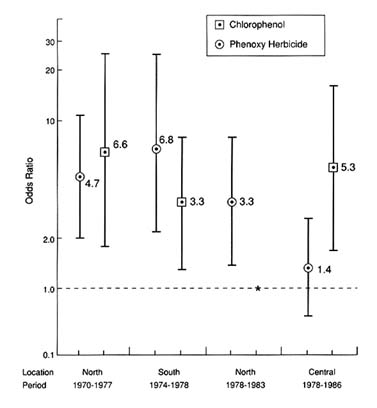
FIGURE 8-3 Odds ratios and confidence intervals for the four case-control studies of STS done by Hardell and colleagues done in different geographical regions of Sweden. References: North (1970-1977) Hardell and Sandstrom, 1979 (note: index cases excluded); South (1974-1978) Eriksson et al., 1981; North (1978-1983) Hardell and Eriksson, 1988; Central (1978-1986) Eriksson et al., 1990.
al., 1990), and the authors of this report note that they failed to find any evidence of association with any specific histologic types in that study population.
A fifth case-control study was conducted in southern Sweden by an essentially different group of investigators, with methods that seem to differ somewhat from those of the Hardell studies (Wingren et al., 1990). For cases of STS reported to the regional cancer registry, no separate histologic confirmation of the diagnoses was done, nor were the histologic types listed in the paper. Follow-up was through a somewhat different questionnaire assessment, with only 74 percent of the original cases and controls included in the final analyses because of the various exclusions and refusals.
The authors did not attempt to develop estimates of phenoxy herbicide and chlorophenol exposure as Hardell and colleagues did, but instead calculated risks for various occupations likely to entail exposure to these substances. For example, they found that gardeners and railroad workers were at increased risk of STS: by using population controls, the odds ratio for gardeners was 4.1 (CI 1.1-14.6), and for railroad workers 3.1 (CI 0.6-13.3). The differences in methods of this last study make it difficult to compare to the other four Swedish case-control studies.
A team of investigators in New Zealand conducted a case-control study of STS as a response to reports by Hardell and colleagues, with a subsequent update including two more years of cases (Smith et al., 1983, 1984; Smith and Pearce, 1986). For those reporting more than one day of exposure to herbicides (''probable or definite"), not during the five years prior to diagnosis, the odds ratio was 1.6 (CI 0.7-3.8; Smith et al., 1984). For those with a similar degree of exposure to chlorophenols, the odds ratio was also 1.5 (CI 0.4-8.0). Many of these exposures came from work in the pelt department of the "meat works" or in a pelt department in a tannery where chlorophenol exposure is quite likely in the process of treating sheepskin. An odds ratio for STS of 7.2 was associated with the latter processes. However, this estimate is based on six exposed cases and one exposed control, and so yields an exact CI of 0.8-334. The authors do not report a combined odds ratio for either chlorophenol or herbicide exposure, nor can one be estimated from the separate tables because of the possibility that some subjects may have reported both types of exposure. If there were no overlap in those reporting the two different types of exposures (for more than one day, more than five years before diagnosis), the odds ratio would be 1.7 (CI 0.8-3.6). The authors note that none of their exposed cases were commercial herbicide applicators; they tended to be farmers and other agricultural workers with some herbicide exposure. Thus exposure levels may have been fairly low compared to those in studies of workers with sustained and regular exposure.
When 51 additional cases were included with the previous series (Smith and Pearce, 1986), the risk of STS for those reporting herbicide spraying for more than one day not in the five years before diagnosis was not elevated: OR = 0.7 (CI 0.3-2.0). Again, there were no commercial herbicide applicators in the case series, and most of those judged to have been exposed were farmers with only occasional exposure.
An Italian case-control study on STS focused on exposures to phenoxy herbicides during rice weeding (Vineis et al., 1986). This population-based case-control study covered three rice-growing provinces and included all STS diagnosed in residents over the age of 19 years from 1981-1983. The final case series included 44 living and 24 deceased cases. Controls for living and dead cases were selected separately: living controls were chosen
from provincial electoral rosters, with a distribution of municipalities representative of the provincial populations from which the cases came, while dead controls were chosen from the municipalities of the deceased cases. "Certain exposure," which occurred almost entirely among rice weeders, was restricted primarily to women. Among all living women, the odds ratio for certain or possible exposure was 2.4 (CI 0.4-16.1), but was based on five cases and seven controls so that confidence intervals are quite wide and do not exclude the null. When living and dead women are combined in the analysis, the odds ratio for certain or possible exposure is 2.3 (CI 0.6-6.1). Restricting analyses to certain exposure does not materially increase the point estimate, but does increase the width of the confidence interval.
No single histologic type dominated the case series. The most common was Kaposi's sarcoma (21 percent of cases), and no other type represented more than 12 percent of cases. There was also no clear difference in the distribution of histological types between cases judged to have been exposed and those unexposed. The authors point out that 1981-1983 may have been a little late to observe an increase in STS from exposure to herbicides in the period 1950-1955, given a median latency in other studies of about 15 years.
Hoar and colleagues (1986) conducted a population-based case-control study of soft tissue sarcoma, non-Hodgkin's lymphoma, and Hodgkin's disease in the state of Kansas, focusing on herbicide use. The authors observed no increase in risk of STS with increasing use of herbicides, when the latter was classified as "ever/never," or with either frequency or duration of use. For example, the odds ratio for STS comparing those reporting any farm use of herbicides was 0.9 (CI 0.5-1.6). There was, however, a weak elevation of risk in the category with the longest duration of herbicide use, 16 years or more (OR = 1.4, CI 0.6-3.1). Despite this, however, there was no clear evidence of a trend with increasing duration of use. This study started with specific hypotheses, based on the earlier Swedish studies, and used a large population base for identification of cases. Kansas has extensive wheat farming, which commonly involves herbicide use. Although uncertainties arising from multiple exposure and uncertainties of actual individual exposure levels exist, the study obtained more individual exposure information than many others. It should be noted that the phenoxy herbicide most used was 2,4-D, whereas 2,4,5-T use was less frequent.
A population-based case-control study was conducted in western Washington State where phenoxyacetic acid herbicides and chlorophenols are widely utilized by agricultural, forestry, and wood product industries (Woods et al., 1987). Independent histologic confirmation of the diagnosis of STS was performed by a single pathologist. There was generally good agreement when occupational exposures from self-reports were confirmed with employers. When all subjects were classified into high, medium, low, or no
exposure to phenoxy herbicides or chlorophenols, no association with STS was observed. For example, the odds ratio for high phenoxy exposure was 0.9 (CI 0.4-1.9) and for high chlorophenol exposure also 0.9 (CI 0.5-1.8). For jobs determined a priori to have chlorophenol exposure, those reporting work as "log-lumber inspectors" showed an odds ratio for STS of 4.8 (CI 0.6-38.2), and for "lumber grader" the odds ratio was 2.7 (CI 1.1-6.4). No such elevated risks of STS were found among jobs identified as being exposed to phenoxy herbicides. Further analyses either using duration of exposure or incorporating latency periods between exposure and diagnosis failed to identify any important trends. Those with self-reported chloracne had an elevated risk of STS (OR = 3.3, CI 0.8-14.0).
The authors use a pharmacokinetic model to estimate the dose of 2,4,5-T received by an herbicide applicator and predicted that in Sweden the dose might have been substantially higher than that in Washington State because of the shorter, more intense application season in Sweden. They also suggest that general environmental contamination with phenoxy acids and their contaminants in the study region may have biased any true exposure-risk association toward the null.
The authors also identify preliminary evidence suggesting that there may be important heterogeneity in human susceptibility to STS from phenoxy herbicides and chlorophenols. Because of the relatively high proportion of the population of the study area that was of Scandinavian heritage, the authors were able to separate the study group (blind to case or control status) into those with and without Scandinavian surnames. This distinction was found to have no direct association with STS risk, but among those with Scandinavian surnames, the risk of STS in those reporting high phenoxy herbicide or chlorophenol exposure was elevated. For high phenoxy exposure the odds ratio was 2.8 (CI 0.5-15.6), and for high chlorophenol exposure the odds ratio was 7.2 (CI 2.1-24.7). Among those without Scandinavian surnames there was no elevation in the risk estimates. If it is true that there is a heterogeneity in human susceptibility to STS risk from phenoxy herbicides and chlorophenols, the risk may not be limited to Scandinavians per se; some as yet unidentified metabolic trait may be more prevalent in this ethnic group. As noted in Chapter 4, there is ample evidence from laboratory animals to suggest genetic variability in the metabolism of TCDD.
A case-control study (30 cases) of STS and exposure to herbicides and chlorophenols was also conducted in Australia (Smith and Christophers, 1992). Of the cases studied, 30 percent were malignant fibrous histiocytomas, 17 percent were leiomyosarcomas, and the rest were distributed among many other types. For each case, one population control and one control with another type of cancer were selected. A five year latency period prior to diagnosis of the cases was applied when identifying exposures. There were no major differences between the population controls and the cancer controls
with respect to definite exposure or possible exposure; hence the two control groups were combined. No evidence of an association between exposure to phenoxy acids and STS was observed, but the sample size of the study was small, and hence there was little power to detect an association if one existed. The odds ratio for STS following at least one day of exposure to phenoxy herbicides or chlorophenols more than five years before diagnosis was 1.0 (CI 0.3-3.1). For more than 30 days of exposure, the risk estimate was 2.0, but based on very small numbers, yielding a CI from 0.5 to 8.0.
A case-control study of STS (N = 14) was conducted by investigators from the Dow Chemical Company among workers at the Midland, Michigan, facility (Sobel et al., 1987). This study failed to find an association between STS and any chemical exposure, although the paper describes the subject selection and exposure assessment procedures in insufficient detail to judge the validity of the study confidently. Fortunately, the study of Fingerhut and colleagues (1991) incorporates the TCDD-exposed workers at this facility and, as discussed previously, combines them with other production worker groups to improve study power.
Summary of Case-Control Studies The case-control studies are quite disparate in their results, but are particularly important because of their size. The first study, conducted by Hardell, involved 52 cases; in contrast, the large cohort of licensed pesticide applicators studied by Wiklund contained only 7 cases of STS. The detailed exposure data gathered in many of the case-control studies are both a strength and a weakness; if these data are accurate, better estimates of risk are possible than in many of the cohort studies, but at the same time these data may introduce biases into the study results through inaccurate recall by subjects.
The four case-control studies by Hardell and colleagues in Sweden (Hardell and Sandstrom, 1979; Eriksson et al., 1981; Hardell and Eriksson, 1988; Eriksson et al., 1990) show an association between STS and exposure to phenoxy herbicides, chlorophenols, or both (Figure 8-3). In the second study conducted in the south of Sweden, the relative risk rose strongly with increasing duration of exposure (Table 8-12) (Eriksson et al., 1979, 1981).
Because of the importance of these studies in judging the effects of herbicides on STS, certain key methodologic points common to the studies bear emphasis:
-
The questionnaire methods of exposure assessment used in these studies are well accepted in occupational epidemiology. Care was taken to avoid biases. Recall bias was a potentially serious problem but was exhaustively investigated by the authors (see below).
-
Control selection was excellent. The methods used are standard and well accepted. Follow-up by phone was appropriately blinded.
-
Similar methods were used in three different parts of Sweden and in two nonoverlapping time periods.
-
An identical study on colon cancer found no association with herbicides, and in using the colon cancer series as an alternative referent group to reanalyze the previous case series (STS, lymphoma), similar results were found. This makes serious recall bias unlikely, because it would have to be acting for certain cancers and not for others.
-
To investigate the possibility that recall could be influenced by Dr. Hardell's name on return envelopes, a study was done with identical methods, but 50 percent of the subjects received a letter with his name and 50 percent with no name. The results were identical in the two subgroups.
-
The strength of association with STS is higher in the earlier studies and tends to decrease over the series, but it remains positive overall. This may be because of a bias in the first studies, which was eliminated, or it could be explained by TCDD being a "true causal agent" and its concentration in herbicides having decreased over time; alternatively, the statistical bias called "regression to the mean" may cause the first study of an agent to result in a higher risk estimate than subsequent studies.
The study by Wingren and colleagues (1990), also in Sweden, does not show as strong an association, although it is difficult to compare with studies of Hardell and Eriksson because of different exposure assessment methods. It is not however without suggestions of phenoxy herbicide or chlorophenol effects: both gardeners and railroad workers have elevated risks of STS.
The two case-control studies from New Zealand (Smith et al., 1983, 1984; Smith and Pearce, 1986) show a suggestion of an effect of exposure to both phenoxy herbicides and chlorophenols, as also shown for those likely exposed to phenoxy herbicides during rice weeding in northern Italy in a case-control study of Vineis and colleagues (1986).
The large case-control study conducted in Kansas by Hoar and colleagues (1986) at the National Cancer Institute does not support the hypothesis of an association between exposure to phenoxy herbicides and STS. The odds ratio for ever having farm use of herbicides was 0.9 (CI 0.5-1.6). The large study size is reflected in the relatively narrow confidence interval around this estimate. Because the study results indicated 2,4-D was the primary herbicide used, rather than 2,4,5-T, the difference between these findings and the more positive results in production workers and other occupational cohorts suggest that TCDD, which is a contaminant of 2,4,5-T but not 2,4-D, may be responsible for the association with STS seen in this group of studies.
Another large American case-control study, conducted in western Washington State, is also generally supportive of no association, although several findings point in the direction of some herbicide-STS association (Woods et al., 1987). The overall odds ratio for high phenoxy herbicide use and risk
of STS was similar to that found by Hoar: 0.9 (CI 0.4-1.9); for estimated high chlorophenol exposure, the odds ratio was similar. However, the authors calculate that the likely body dose of 2,4,5-T for a typical herbicide sprayer in Sweden would be higher than for the same occupation in western Washington State because of differences in spraying practices. Spraying in Sweden is described as daily over a period of several weeks, but in western Washington, periods of a few days of spraying are separated by several weeks without spraying.
Herbicide Pesticide Applicators Most of the cohort studies of pesticide applicators are too small to be useful in studying risk of as rare a cancer as STS. The following studies observed no cases of STS, but because of their small size, considerably less than one case of STS was expected based on mortality rates in the comparison populations: Axelson and Sundell (1974); Axelson et al. (1980); Riihimaki et al. (1982, 1983); Blair et al. (1983); Green (1991); and Swaen et al. (1992). Bender and colleagues' (1989) study was slightly larger, with 1.4 expected deaths and none observed. Green (1991) notes that her study of Ontario forestry workers spraying utility rights of way had 80 percent power to detect a relative risk of 27, which means there would be almost no chance of detecting relative risks of the order of 4 or 5.
In a study of 20,245 Swedish pesticide applicators (Wiklund et al., 1988b, 1989a,b), 7 cases of STS were identified with no latency from the Swedish Cancer Registry, compared to 7.7 expected, based on total population rates (SIR = 0.9, CI 0.4-1.9). There was no effect of introducing latency times of 5 and 10 years. Individual exposure estimates were not available, but data from two surveys suggest that 72 percent of applicators used phenoxy herbicides for at least one day compared to 16 percent of forestry and agricultural workers.
Summary of Pesticide Applicator Studies Most of the pesticide applicator studies are too small to individually have power to detect STS, although presumably the degree of exposure for the average study subject was much higher in these studies than in, for example, the agricultural worker studies. The study by Wiklund (1988b, 1989a,b) was rather large and did detect 7 cases of STS, compared to 7.7 expected (SIR = 0.9, CI 0.4-1.9). There was no individual assessment of exposure for members of this cohort, and most of the members were agricultural workers who sprayed herbicides only occasionally, so that heavy or regular exposure cannot be assumed.
Environmental Studies
Studies of both morbidity and mortality in the 10 years following the accident at Seveso, Italy, have been published (Bertazzi et al., 1989a,b; Pesatori et al., 1992). Ten years after the accident, no cases of STS had been
observed in zones A and B, and less than one case was expected based on regional incidence rates. In the larger, but less exposed area, zone R, six incident cases and two deaths from STS were observed among males, and two incident cases and no deaths among females. These numbers exceed those expected based on regional rates: the relative risk for STS incidence in zone R males was 2.8 (CI 1.1-7.4) and in zone R females 1.4 (CI 0.3-6.6). The standardized mortality ratio in males corroborates this observation: SMR = 6.3 (CI 0.9-45.0). There were no deaths from STS in females (Bertazzi et al., 1989a,b; Pesatori et al., 1992).
A cohort incidence study of lymphomas and STS was conducted by Vineis and colleagues (1991) in the rice-growing Italian provinces of Novara and Vercelli, where no patterns of association were observed for STS.
A Finnish town found to have been exposed to high levels of chlorophenols through contamination of the drinking water supply (Lampi et al., 1992) was compared to two nearby towns. Six observed STS cases were found, which was more than expected (RR = 8.9, CI 1.8-44.0). When compared to the larger reference region, the risk was only moderately elevated (RR = 1.6, CI 0.7-3.5). The authors were unable to explain this large discrepancy. A nested case-control study was conducted to try to link the excess risk to particular sources of exposure (drinking water contamination, fish consumption, work in the sawmill that caused the contamination), but no individual risk factors could be identified. Despite the uncertainties in this study, it is difficult to fully discount the excess STS risk. Exposure to chlorophenols was fairly substantial—for example, levels of 70 to 140 µg/liter in drinking water, and 175 to 925 µg/kg in fish.
Summary of Environmental Studies The environmental contamination studies include two important findings. First, the incidence of STS in zone R in Seveso, Italy, was elevated for the 10 years following the accident; the smaller and more highly exposed zones A and B have experienced no cases, but less than one was expected.
The study of a Finnish town (Lampi et al., 1992) exposed to chlorophenols in drinking water and fish found an elevated incidence of STS. Despite uncertainties about the magnitude of the increased risk, which stem from differences among comparison populations, the increase cannot be ignored.
Vietnam Veterans Studies
Ranch Hand Study The Ranch Hand study is described in Chapter 7. In approximately 20 years of follow-up (through 1987), one Ranch Hand had died of STS. This case is noted by Michalek et al. (1990) without description or comment. A single death from STS also occurred in the approximately 15 times larger comparison cohort of other Air Force personnel
serving in Vietnam. Although it is impossible to draw conclusions based on only two cases, the incidence rate in the comparison population is roughly what would be expected based on national data. One case in the small Ranch Hand population is more than expected (the relative risk is about 15, with obviously very wide confidence limits—the paper does not provide this information or the data with which to make the calculations).
CDC The CDC Selected Cancers Study (1990b) was designed with service in or off the coast of Vietnam as the primary exposure variable, so it provides little information on exposure to herbicides. Case-control analysis for STS found no overall effect of service in Vietnam (OR = 1.0, CI 0.6-1.6). However, there are several suggestive findings that would seem to warrant further investigation. The authors report that a higher proportion of cases than controls had occupational exposure to chlorophenols (p < .05), and a higher proportion also reported work in a meat-packing or processing plant, where chlorophenol exposure sometimes occurs (p < .05). Odds ratios for these associations are not provided, but it is possible to calculate crude (i.e., without adjustment for age or other factors) odds ratios of 1.5 for each of these two exposures (CI 1.0-2.0 for the former and 0.9-2.3 for the latter). Other indicators of occupational exposure to phenoxy herbicides and chlorophenols show weaker associations.
When risk estimates are calculated for selected characteristics of Vietnam service, those who served in I Corps had an elevated risk of STS, although based on small numbers (OR = 1.6, CI 0.7-3.8). This was not the area of heaviest spraying (III Corps, near Saigon, received the heaviest aerial spraying, see Chapter 3) but was nevertheless subject to considerable amounts. All subjects reporting service in and off the coast of Vietnam were asked about possible contact with Agent Orange, and those who reported passing through a defoliated area had a slightly higher risk of STS than those not reporting such an event (OR = 1.6, CI 0.6-4.1).
DVA Studies As described elsewhere in this report, the Department of Veterans Affairs has conducted a proportionate mortality study among deceased veterans of the Vietnam era (Breslin et al., 1988; Watanabe et al., 1991). No evidence of an elevated risk of STS among either Army or Marine veterans serving in Vietnam is found in these studies, which are based on fairly large numbers of observed deaths. For example, the PMR comparing Army Vietnam veterans to all Vietnam era veterans was 1.0, based on 30 observed STS deaths. For the Marines the comparable PMR was 1.1 based on 8 observed STS deaths.
A related study focusing on Army veterans who served in the northernmost region of Vietnam (I Corps) used the same data base supplemented with additional deaths from Army veterans (Bullman et al., 1990). There
were 10 observed deaths from STS among Army veterans serving in I Corps, compared to 11.4 expected (PMR = 0.9, CI 0.4-1.6).
The DVA conducted analyses for the veterans from states in which state studies had already been performed (Breslin et al., 1986); individual state studies are discussed below. These were conducted in the same manner as the nationwide study, but were simply limited to veterans resident in a particular state. Interestingly, elevated PMRs for Wisconsin, Massachusetts, and West Virginia were observed, while no such excess was seen among New York State veterans. These findings are consistent with those reported from the individual states, in which quite different methods and data bases were used.
Two case-control studies of soft tissue sarcoma were conducted by DVA investigators (Kang et al., 1986, 1987), but it is likely that cases from the two studies overlapped. The first used data from DVA hospitals and found an odds ratio for STS comparing those serving in Vietnam to those without such service of 0.8 (CI 0.6-1.1) (Kang et al., 1986).
There are several weaknesses in this study. First, the period of case ascertainment was early for detecting STS, which probably has a latency of 15 to 20 years. The study relies on cases reported by 1983. This allows for a latency period of 15 years or less for personnel with service in Vietnam in the late 1960s or early 1970s. The authors note that 80 percent of the available cases were diagnosed within the first 10 years of exposure. Second, it seems possible that Veterans Administration (VA) hospitals do not treat a representative fraction of all veterans (Constable et al., 1987). Third, there is no individual measure of potential exposure to herbicides in this study.
The second case-control study (Kang et al., 1987) drew cases from the Armed Forces Institute of Pathology. It also found that occupational exposures to herbicides or chlorophenols did not appear to be more frequent among cases than among controls. The study was limited to cases diagnosed between 1975 and 1980. Thus, the maximum latency period from the beginning of herbicide spraying in 1962 is 18 years. The latency period is no more than 9 years for individuals with service in 1971 when spraying was ended. Service in Vietnam was similarly evenly distributed among cases and controls (OR = 0.8, CI 0.6-1.2). There was a weak positive association between combat and risk of STS. Among Army veterans who served in Vietnam, the risk of STS for those in combat occupations was 2.6 times the risk for those not in combat occupations (CI 0.7-9.4). When this analysis is restricted to those serving in Military Region III, where the bulk of aerial herbicide spraying occurred, the risk is higher, although less precise because of small numbers (OR = 8.6, CI 0.8-111.8). For Marine veterans, the relative risk for those in combat was not as high (OR = 1.3, CI 0.1-7.9).
The second study also has several important limitations. First, the choice of an appropriate control series for cases drawn from a highly specialized national referral center like the Armed Forces Institute of Pathology is a very difficult matter. Controls should be individuals who, had they developed the disease of interest, would have been eligible to enter the case series. A significant fraction (32 percent) of the hospitals from which the controls were chosen did not cooperate, and in those that did, it is not clear exactly what criteria guided the choice of controls. It is not clear, for example, whether veteran status was considered in this choice. There are also no reliable measures of exposure, and the few comparisons that might have a bearing on herbicide exposure (combat/noncombat, military region) are made with inadequate power to detect reasonable effects. For example, the authors calculated that the study had only a 23 percent chance of detecting a twofold excess risk of STS among combat versus noncombat Army veterans.
State Studies A case-control study of STS in New York State (Greenwald et al., 1984) showed that Vietnam service was not associated with an increased risk of STS (OR = 0.5, CI 0.2-1.3), nor was self-reported exposure to TCDD, Agent Orange, or 2,4,5-T (OR = 0.7, CI 0.2-2.9). Work in chemical manufacturing carried a slightly increased risk (OR = 1.8, CI 0.8-3.7).
Because of the timing of this study, there was little opportunity to detect an effect of any Vietnam-related activity. The maximum latency (time from first exposure to diagnosis) was 18 years, and for some cases it could have been less than a year. The age at diagnosis ranged from 27 to 47 years, and 66 percent were under age 45. In the Hardell case-control studies, the median latencies were 15 to 20 years and the mean age of cases was about 57 years (Hardell and Sandstrom, 1979; Eriksson et al., 1981). It was thus too early to expect to detect an effect of the sort seen in the Swedish studies, because a minimum latent period had not been covered.
Another New York State study had a short latency for detection of an STS risk (Lawrence et al., 1985). Of the 59 deaths coded as STS (ICD 171) in the entire study, 12 were among veterans, yielding an age- and race-adjusted mortality odds ratio of 1.2 (CI 0.6-2.2) compared to nonveterans. The adjusted mortality odds ratio for STS comparing Vietnam veterans to other veterans of the Vietnam era was 1.1 (CI 0.2-6.7).
The DVA study calculated a PMR of 0.7, based on one death, for STS among New York State veterans, using all U.S. veterans who did not serve in Vietnam as the comparison population (Breslin et al., 1986).
A report prepared for the Iowa State Department of Health (Wendt, 1985) showed among respondents (24 percent) two self-reported soft tissue cancers. The study does not make an attempt to calculate the expected number of cancer cases.
In the Wisconsin State studies of veterans mortality, weak evidence for an increase in STS among Vietnam veterans is shown, although again the latency may be insufficient, and no direct estimates of herbicide exposure for individuals were available (Anderson et al., 1986a,b). Five deaths from STS occurred among Wisconsin Vietnam veterans. There are several comparisons that can be made, including 2.8 deaths expected based on the experience of nonveterans (PMR = 1.8, CI 0.8-4.3) and 3.4 expected deaths based on Vietnam era veterans (PMR = 1.5, CI 0.6-3.5) (Anderson et al., 1986a).
The DVA study also calculated a PMR for STS among Wisconsin veterans and found an elevated risk compared to all U.S. non-Vietnam veterans, based on three observed deaths (PMR = 5.1, CI 1.1-14.9) (Breslin et al., 1986).
Studies in Massachusetts veterans found excess STS risk among those who served in Vietnam (Kogan and Clapp, 1988; Clapp et al., 1991). The age-standardized mortality odds ratio for STS comparing Vietnam veterans to non-Vietnam veterans was 5.2, based on nine deaths (CI 2.4-11.1). Using nonveterans as the comparison yielded a slightly higher risk estimate (Kogan and Clapp, 1988). Confirmation of the diagnosis of STS was obtained for eight of the nine cases from hospital or physician records.
As a follow-up (Clapp et al., 1991), eight incident cases of STS among Vietnam veterans and nine among other veterans of the Vietnam era were reported. The authors calculated an odds ratio as an estimate of the relative risk of STS among these two groups, using all other subjects in the Massachusetts Cancer Registry with cancers other than STS, non-Hodgkin's lymphoma (NHL), or kidney cancer as the comparison population. The risk of STS among Vietnam veterans was 3.1 times that among veterans who did not serve in Vietnam (CI 1.1-8.7).
In neither of these two studies was information available about the details of service in Vietnam or about other possible sources of chemical exposure. Thus various explanations for the observed association with Vietnam service are possible.
The DVA study (Breslin et al., 1986) provided an independent confirmation of this observation. The PMR for STS among Massachusetts veterans compared to all U.S. non-Vietnam veterans was 3.8, based on two observed cases (CI 0.5-13.8).
Holmes and colleagues (1986) report a slight elevation in STS risk among West Virginia Vietnam veterans based on only three cases (SMR = 4.3, CI 0.9-12.5). The DVA study found a PMR of 2.0 based on only one observed case.
Australian Vietnam Veteran Studies In the cohort study of Australian Vietnam veterans, the mortality experience of those who served in Vietnam was compared to that of veterans of the same era who did not leave Australia (Fett et al., 1987b). The interpretation of the study is made more difficult
by an unusual method of classifying causes of death in the cohort. Rather than using just death certificates, comprehensive cause of death data were reviewed by a panel of experienced physicians to produce a ''mock death certificate," which was used for this study. In contrast, the comparison population mortality experience was drawn from published national statistics relying solely on the standard death certificate. There was one death from STS found among Vietnam veterans and one among the Vietnam era group, yielding an age-adjusted relative mortality rate of 1.3 (CI 0.1-20.0).
Summary of Veterans Studies The studies of Vietnam veterans are largely uninformative for STS because of the lack of exposure data. As discussed elsewhere in this volume, it is difficult to detect an increase in the incidence of a rare cancer among all Vietnam veterans because of exposure to herbicides in some fraction of them. Yet several studies hint at such a pattern for STS. The state studies comparing Vietnam veteran incidence or mortality to that expected based on veterans who did not go to Vietnam, do sometimes show an excess risk (Table 8-13). The DVA largely confirmed this pattern with its own, independent data. However, the large PMR study
TABLE 8-13 State Vietnam Veteran Studies of STS Mortality
|
Reference |
Exposed Casesa |
Estimated Relative Risk (95% CI)a |
|
Massachusetts |
||
|
Kogan and Clapp, 1988 |
9 |
5.2 (2.4-11.1) |
|
Breslin et al., 1986 |
2 |
3.8 (0.5-13.8) |
|
New York |
||
|
Lawrence et al., 1985 |
2 |
1.1 (0.2-6.7) |
|
Breslin et al., 1986 |
1 |
0.7 |
|
West Virginia |
||
|
Holmes et al., 1986b |
3 |
4.3 (0.9-12.7) |
|
Breslin et al., 1986 |
1 |
2.0 (0.1-10.9) |
|
Wisconsin |
||
|
Anderson et al., 1986a |
5 |
1.5 (0.6-3.5) |
|
Breslin et al., 1986 |
3 |
5.1 (1.1-14.9) |
|
NOTE: Each state's veterans were studied twice: once by investigators in the state and once by investigators from the U.S. Department of Veterans Affairs. a Given when available. b Comparison group is nonveterans. |
||
from which the state-specific relative risks in Table 8-13 have been extracted fails to find an overall excess risk of STS among Vietnam veterans, compared to either nonveterans or veterans who did not serve in Vietnam (Watanabe et al., 1991).
Two possibly overlapping case-control studies by investigators at the DVA do not demonstrate adequate exposure measures for herbicides in Vietnam (Kang et al., 1986, 1987). There is a suggestion that Army veterans in combat occupations are at higher risk of STS than those in other occupations in Vietnam, and this tendency is particularly strong in Military Region III, where the bulk of the aerial herbicide spraying occurred.
The CDC (1990b) Selected Cancers Study was designed with service in or off the coast of Vietnam as the primary exposure variable, so it provides little information on exposure to herbicides per se. There is no increase in risk of STS for those serving in and off the coast of Vietnam versus those serving elsewhere during the same era. Those reporting an occupational (nonmilitary) history of chlorophenol exposure had a 50 percent excess risk of STS (OR = 1.5, CI 1.0-2.0), whereas Vietnam veterans who reported walking through a defoliated area had a 60 percent excess risk compared to Vietnam veterans who did not report this experience (OR = 1.6, CI 0.6-4.1).
Finally, the Ranch Hand study is of insufficient size to detect excess risk of STS (Michalek et al., 1990). One case of STS occurred in this heavily exposed group, while less than one-tenth of one case would have been expected based on the experience of the non-herbicide-exposed Air Force comparison population being followed.
Summary
There are at least three fundamental problems that make the interpretation of epidemiologic studies on soft tissue sarcoma and exposure to phenoxy herbicides and related compounds especially difficult. First, if there are several potential causative agents present in a particular environment, it may be difficult to determine which is associated with STS. This problem is, of course, not limited to STS studies. Using a job title as indicative of exposure to herbicides is not sufficient as a measure of exposure; the presence and level of contamination with TCDD may have varied over time. Given uncertainty about whether TCDD or herbicides themselves are associated with STS, even full knowledge of which herbicides were contaminated with TCDD will not clarify whether TCDD or the herbicides are the causative factor.
A second difficulty peculiar to soft tissue sarcomas is the diagnosis and classification of these cancers in a consistent and reliable manner. The available epidemiologic evidence for an association of STS risk with herbicides
and dioxins comes from studies including a wide variety of different histologic types. Each set of investigators chose to include or exclude various histologic types of this diverse class of tumors with various justifications. Consequently, the committee was unable to identify and particular types of soft tissue sarcoma as more or less likely to be associated with herbicide exposure. If certain tumors in the general category of STS are caused by exposure to herbicides, whereas others are not, a wide range of results is to be expected. The problems of the existing classification schemes have been discussed above, without clear conclusions about what may be the "correct" classification system. Additional refinement of the clinical and pathological definitions of soft tissue sarcomas in epidemiologic studies would also help to determine which of the specific cancers in this class are associated with herbicides and/or TCDD.
A third difficulty presented by soft tissue sarcomas is their rarity. This has been mentioned several times, but it cannot be overemphasized. The task of unequivocally detecting a positive association between STS and environmental exposure to (the worst case) a variable contaminant in an herbicide stretches the limits of the epidemiologic method. In a cohort of 10,000 middle-aged men not exposed to an agent that causes STS, followed for 10 years, one would not expect to observe a single death from STS. Even a sixfold elevation in risk due to some exposure (as first reported by Hardell and Sandstrom, 1979) would result in only a handful of cases. If, in addition, there is some misclassification of exposure and some misclassification of disease diagnosis, both of which are more than likely in these sorts of studies, then a serious elevation in risk could easily be missed even in a large study.
The strongest evidence for an association between STS and exposure to phenoxy herbicides comes from a series of case-control studies involving a total of 506 cases conducted by Hardell and colleagues in Sweden (Hardell and Sandstrom, 1979; Eriksson et al., 1981, 1990; Hardell and Eriksson, 1988; Wingren et al., 1990) that show an association between STS and exposure to phenoxy herbicides, chlorophenols, or both. Although these studies have been criticized, the committee feels that there is insufficient justification to discount the consistent pattern of elevated risks, and the clearly described and sound methods employed. These findings are supported by a significantly increased risk in the NIOSH study (SMR = 9.2, CI 1.9-27.0) for the production workers most highly exposed to TCDD (Fingerhut et al., 1991), and a similar increased risk in the IARC cohort (SMR = 6.1, CI 1.7-15.5) for deaths that occurred between 10 and 19 years after the first exposure (Saracci et al., 1991). These are the two largest, as well as the most highly exposed occupational cohorts. Some studies in other occupational, environmental, and veterans groups showed an increased risk for STS, but the results were commonly nonsignificant possibly because of
small sample sizes related to the relative rarity of STS in the population, except for males in zone R of Seveso. The risk in this group was significantly elevated and is consistent with the findings supporting an association.
Because of difficulties in diagnosing this group of tumors, the epidemiologic studies reviewed by the committee were inconsistent with regard to the specific types of tumors included in the analyses. The available data did not permit the committee to determine whether specific forms of STS were or were not associated with TCDD and/or herbicides. Therefore, the committee's findings relate to the class as a whole.
Conclusions
Strength of Evidence in Epidemiologic Studies
Evidence is sufficient to conclude that there is a positive association between exposure to herbicides* (2,4-D; 2,4,5-T and its contaminant TCDD; cacodylic acid; and picloram) and soft tissue sarcoma.
Biologic Plausibility
TCDD has been shown to have a wide range of effects in laboratory animals on growth regulation, hormone systems, and other factors associated with the regulation of activities in normal cells. In addition, TCDD has been shown to cause cancer in laboratory animals at a variety of sites. If TCDD has similar effects on cell regulation in humans, it is plausible that it could have an effect on human cancer incidence. TCDD administration increased fibrosarcoma formation in both rats and mice. In contrast to TCDD, there is no convincing evidence of, or mechanistic basis for, the carcinogenicity in animals of any of the herbicides, although they have not been studied as extensively as TCDD.
Increased Risk of Disease Among Vietnam Veterans
Given the large uncertainties that remain about the magnitude of potential risk from exposure to herbicides in the occupational, environmental, and veterans studies that have been reviewed, inadequate control for important confounders in these studies, and the lack of information needed to extrapolate from the level of exposure in the studies reviewed to that of individual Vietnam veterans, it is not possible for the committee to quantify the degree of risk likely to have been experienced by Vietnam veterans because of their exposure to herbicides in Vietnam.
SKIN CANCERS
Background
Skin cancers are generally divided into two broad categories, malignant melanomas and nonmelanotic skin cancers. According to the American Cancer Society, 32,000 new cases of melanoma (ICD-9 172.0-172.9) were diagnosed in the United States in 1992, and some 6,700 men and women died of this cancer (ACS, 1992). The incidence is similar in men and women, but men account for about 60 percent of deaths. Other skin cancers (basal cell and squamous cell carcinomas) led to about 600,000 new cases and 2,100 deaths. According to the committee's calculations, 486 cases of melanoma are expected among male Vietnam veterans and 1.1 among female veterans in the year 1995. In the year 2000, the expected numbers are 632 cases in male veterans and 1.3 in female veterans. No calculations were made for the very common and highly curable nonmelanotic skin cancers.
Malignant melanoma arises in melanocytes that are located throughout the skin and in other areas of the body, including the eye and nervous system. Regardless of location, these cells all derive from the embryonic neural crest. Four pathologic types of melanoma are recognized: superficial spreading (70 percent), nodular (15 percent), acral lentiginous (10 percent), and lentigo maligna (5 percent) (Sober and Koh, 1991). The preponderance of superficial spreading melanomas and their occurrence in middle years make them the most common lesion for epidemiologic study. More advanced melanomas are much more likely to be fatal than those identified at earlier stages. In contrast, nearly all nonmelanotic skin cancers are treatable, which means that mortality studies can provide little information about them.
The incidence of malignant melanoma in both males and females has increased steadily during the past three decades; between 1973 and 1989, the rate of increase was higher than for any other cancer (Miller et al., 1992). Mortality has increased as well. During 1985-1989, however, the incidence rates stabilized. In contrast to incidence, mortality is continuing to increase, although at a slower rate than in the 1970s. Increases in both incidence and mortality have been greatest for white males age 65 and older. Improved case finding, including those treated in physicians' offices, contributed to an increase in incidence of more than 10 percent between 1984 and 1985. Clinical diagnostic criteria have, however, remained generally consistent over investigators and over the time period (van der Esch et al., 1991). The change in case-finding procedures can explain only a small part of the increased incidence.
Because of the apparent association between melanoma and exposure to
ultraviolet (UV) light, increases in voluntary sun exposure (Armstrong, 1988; Glass and Hoover, 1989), the use of artificial tanning devices (Walters et al., 1990; Husain et al., 1991), and migration to southern states may be contributors to the increased incidence of melanoma. Certain skin types (those that sunburn easily with little tanning) may be especially vulnerable (Fitzpatrick, 1986). Higher melanoma rates among Caucasian populations living nearer the equator than among those living at higher latitudes seem to support the association with UV exposure. A small percentage of these cancers are hereditary.
The recent stabilization of the incidence of melanoma may be due in part to missed cases among those diagnosed and treated in nonhospital settings (Karagas et al., 1991; Koh et al., 1991), but this factor cannot account for the similar stabilization of mortality rates. Although some may think it is too soon to see a significant effect, the slower increase in melanoma incidence may also be related to greater use of sunscreen or other protective behaviors. Adult use of sunscreens may be beneficial if ultraviolet light acts as a promoter of melanoma, as has been suggested by recent work (Husain et al., 1991).
Basal cell carcinomas are the more common nonmelanoma skin cancers. They arise in the layer of cells between the epidermis and dermis. They generally grow slowly and rarely prove invasive. Squamous cell carcinomas develop in the outermost layer of skin. They grow somewhat faster than basal cell cancers and are more likely to become invasive. Both of these cancers are found most frequently (but not exclusively) in older whites and on parts of the body most frequently exposed to the sun (face, ears, scalp). More frequent basal cell cancers among younger people may reflect greater recreational sun exposure. In addition to sun exposure, risk factors may include chronic irritation and scarring (Emmett, 1975) and exposures to polycyclic hydrocarbons and arsenic (Everall and Dowd, 1978).
Epidemiologic Studies
Skin cancers are of particular interest with regard to TCDD exposure because of its known association with chloracne, a dermatologic condition (see Chapter 11).
On the whole, most of the epidemiologic studies reviewed by the committee did not find an excess risk of skin cancer among TCDD-exposed workers or veterans. These included studies of chemical production workers in the United States and other countries (Suskind and Hertzberg, 1984; Lynge, 1985; Coggon et al., 1986; Bond et al., 1988; Zober et al., 1990; Fingerhut et al., 1991; Manz et al., 1991; Saracci et al., 1991), agricultural workers (Burmeister, 1981; Alavanja et al., 1988; Wigle et al., 1990; Hansen et al., 1992; Ronco et al., 1992), pesticide applicators (Blair et al., 1983;
Swaen et al., 1992), Seveso residents (Pesatori et al., 1992), and Vietnam veterans (Lawrence et al., 1985; Boyle et al., 1987; Breslin et al., 1988; CDC, 1988; Anderson et al., 1986a,b). The lack of association includes a study in which the cohort observed consisted of those with chloracne (Moses et al., 1984). One exception is melanoma mortality following the Seveso accident. Bertazzi and colleagues (1989a,b) found an elevated risk in males from zones B and R, but this was based on one and two melanoma deaths, respectively. In addition, the Ranch Hand study (Wolfe et al., 1990) found a relative risk of 1.5 (CI 1.1-2.0) for nonmelanomic skin cancer. One study of agricultural workers in Sweden (Wiklund, 1983) found an elevated risk for skin cancer excluding melanoma (RR = 1.1, 99% CI 1.0-1.2), but these results may be confounded by sun exposure in these groups.
Summary
Some of the studies have utilized melanoma as the end point of interest, whereas others have utilized skin cancer, which primarily reflects melanoma. On the whole, the studies are fairly evenly distributed around the null and, for a number of studies, the confidence intervals were relatively narrow. The only study with a significant excess risk is from the Seveso area, which found an SMR of 3.3 for men, based on only three cases. Results are summarized in Table 8-14.
Conclusions
Strength of Evidence in Epidemiologic Studies
There is limited/suggestive evidence of no association between exposure to herbicides* (2,4-D; 2,4,5-T and its contaminant TCDD; cacodylic acid; and picloram) and skin cancer.
Biologic Plausibility
TCDD has been shown to have a wide range of effects in laboratory animals on growth regulation, hormone systems, and other factors associated with the regulation of activities in normal cells. In addition, TCDD has been shown to cause cancer in laboratory animals at a variety of sites. If TCDD has similar effects on cell regulation in humans, it is plausible that it could have an effect on human cancer incidence. In contrast to TCDD, there is no convincing evidence of, or mechanistic basis for, the carcinogenicity in animals of any of the herbicides, although they have not been studied as extensively as TCDD.
TABLE 8-14 Selected Epidemiologic Studies—Skin Cancer
|
Reference |
Study Population |
Exposed Casesa |
Estimated Relative Risk (95% CI)a |
|
Occupational |
|||
|
Fingerhut et al., 1991 |
NIOSH cohort |
4 |
0.8 (0.2-2.1) |
|
Bond et al., 1988 |
Dow 2,4-D production workers |
0 |
0.0 (0-6.8) |
|
Suskind and Hertzberg, 1984 |
Monsanto production workers |
8 |
1.6 |
|
Coggon et al., 1986 |
British MCPA chemical workers— |
|
3.1 (0.6-9.0) |
|
|
other skin cancers |
3 |
|
|
|
Melanoma |
1 |
0.5 (0.0-2.8) |
|
Lynge, 1985 |
Danish production workers—men |
14 |
0.7 |
|
Saracci et al., 1991 |
IARC cohort |
3 |
0.3 (0.1-0.9) |
|
Zober et al., 1990 |
BASF production workers |
0 |
0 (0-42.0) |
|
Burmeister, 1981 |
Farmers in Iowa |
105 |
1.1 (NS) |
|
Wiklund, 1983 |
Swedish agricultural workers |
708 |
1.1 (1.0-1.2)b |
|
|
Melanoma |
268 |
0.8 (0.7-1.0)b |
|
Swaen et al., 1992 |
Dutch herbicide applicators |
2 |
4.8 (0.5-17.4) |
|
Hansen et al., 1992 |
Danish gardeners—melanoma |
32 |
1.1 (0.8-1.6) |
|
Ronco et al., 1992 |
Danish self-employed farmers— |
|
|
|
|
other skin cancers |
493 |
0.7 (p < .05) |
|
|
Melanoma |
72 |
0.7 (p < .05) |
|
Alavanja et al., 1988 |
USDA agricultural extension agents |
5 |
1.1 (0.5-2.6) |
|
Blair et al., 1983 |
Florida pesticide applicators |
2 |
1.3 |
|
Wigle et al., 1990 |
Saskatchewan farmers |
24 |
1.1 (0.7-1.6) |
|
Environmental |
|||
|
Bertazzi et al., 1989 |
Seveso residents—zones A, B, R |
3 |
3.3 (0.8-13.9) |
|
Pesatori et al., 1992 |
Seveso male residents—zones A and B |
1 |
2.1 (0.3-16.0) |
|
|
Female residents—zones A and B |
0 |
— |
|
Vietnam veterans |
|||
|
Wolfe et al., 1990 |
Air Force Ranch Hand veterans |
|
|
|
|
Sun exposure-related skin cancers |
88 |
1.5 (1.1-2.0) |
|
|
Melanoma |
4 |
1.3 (0.3-5.2) |
|
CDC, 1988 |
Army enlisted Vietnam veterans |
15 |
0.8 (0.4-1.7) |
|
Breslin et al., 1988 |
Army Vietnam veterans—melanoma |
145 |
1.0 (0.9-1.1) |
|
|
Marine Vietnam veterans—melanoma |
36 |
0.9 (0.6-1.5) |
|
Lawrence et al., 1985 |
New York Vietnam veterans—melanoma |
2 |
0.7 (0.1-3.5) |
|
Anderson et al., 1986a |
Wisconsin Vietnam veterans |
6 |
0.9 (0.4-2.0) |
|
Anderson et al., 1986b |
Wisconsin Vietnam veterans |
5 |
1.3 (0.4-3.1) |
|
NOTE: NS = not significant. a Given when available. b 99% CI. |
|||
Increased Risk of Disease Among Vietnam Veterans
Given the large uncertainties that remain about the magnitude of potential risk from exposure to herbicides in the occupational, environmental, and veterans studies that have been reviewed, inadequate control for important confounders in these studies, and the lack of information needed to extrapolate from the level of exposure in the studies reviewed to that of individual Vietnam veterans, it is not possible for the committee to quantify the degree of risk likely to have been experienced by Vietnam veterans because of their exposure to herbicides in Vietnam.
CANCERS OF THE FEMALE REPRODUCTIVE SYSTEM AND BREAST
Background
Considered as a group, cancers of the reproductive organs, including the breast (ICD-9 174.0-174.9), the ovary (ICD-9 183.0), and the uterus (cervix and endometrium; ICD-9 179, 180.0-180.9, 182.0-182.1, 182.8), account for 45 percent of new cases and 29 percent of cancer deaths in women. According to the American Cancer Society, new cases and deaths in 1992 for each of these cancers were as follows (ACS, 1992):
|
Site |
New Cases |
Deaths |
|
Breast |
181,000* |
46,300 |
|
Cervix |
13,500* |
4,400 |
|
Corpus uteri |
32,000 |
5,600 |
|
Ovary |
21,000 |
13,000 |
|
Other genital |
5,000 |
1,000 |
|
* Excludes carcinoma in situ (about 20,000 cases for breast cancer and 55,000 cases for cervical cancer). |
||
According to the committee's calculations, 13.2 cases of breast cancer and 1.6 cases of uterine cancer are expected among female Vietnam veterans in 1995. In 2000, the expected numbers are 15.5 and 2.8 cases, respectively.
Histopathology
Breast By far the most common histological type of breast cancer is adenocarcinoma, derived from the epithelium of breast ducts. Lobular carcinoma derived from gland lobule epithelium is a separate category (less than 5 percent of breast cancer). Lobular cancers are usually bilateral and grow very aggressively. Other malignant, although somewhat less invasive,
cancers include medullary, mucinous, and tubular carcinomas. Noninvasive carcinomas are found in breast ducts (e.g., comedocarcinoma) and lobules. Intraductal papillomas, another histological variant, are nearly always benign and do not appreciably alter the overall statistics.
Ovary Carcinomas of the ovary, although most commonly derived from the ovarian epithelium or stroma, are morphologically and clinically heterogeneous. Three major groups can be identified. The largest group is the epithelial tumors, which constitute more than half of ovarian tumors. They appear to originate from the surface epithelium, and nearly all are malignant. Sex cord or stromal tumors are probably derived from ovarian mesenchyme (theca cells, granulosa cells, etc.). Tumors derived from germ cells form a small but diverse group including dysgerminoma (resembling testicular seminoma), choriocarcinomas (resembling placental tissue), and teratomas (resembling embryonic tissue). Other ovarian cancers include tumors of nonspecialized tissues of the ovary, unclassified tumors, and metastatic tumors, which are rare. This diverse array of forms has tended to impede the study of risk factors. However, the predominance of epithelial tumors, their relative uniformity, and their malignancy have enabled epidemiologists to gather useful data.
Uterus Epidermoid carcinoma of the uterine cervix is very uniform in appearance and site (epithelial junction) and represents a well-defined group for epidemiologic studies. Other malignancies of the cervix and endocervical canal are rare. Uterine cancers usually appear in the form of adenocarcinoma of the endometrium. Although there are some endometrial carcinoma variants, the overwhelming majority of uterine cancers are endometrial adenocarcinoma.
Epidemiology
Common Risk Factors Except for cervical cancer, the risk of these reproductive cancers is dominated by markers of cumulative hormonal exposure. Early age at menarche and late age at menopause are associated with increased risk as are late or no childbearing.
Breast Cancer Among U.S. women, 40-55 years of age, breast cancer is the leading cause of death (U.S. DHHS, 1987). Rates of breast cancer increase rapidly up to the time of menopause. After menopause, incidence rates continue to increase with age but more slowly than before. Long-term increases in incidence rates have been observed. An analysis of SEER data indicates that the incidence of breast cancer increased 4-6 percent annually between 1980 and 1987. Only some of the increase can be attributed to more extensive screening and earlier diagnosis (Miller et al., 1991; Harris et
al., 1992). Mortality patterns vary by age and race, with decreases seen among white women under age 65 and increases among older white women and black women of all ages (Miller et al., 1992). Earlier detection of tumors and improved treatments have kept increases in mortality lower than increases in incidence.
Risk factors for breast cancer include early age at menarche, late age at first birth and low parity (or nulliparity), late age at menopause, and in addition, family history of breast cancer and personal history of benign cystic breast disease (Henney and DeVita, 1987). Women living in the United States who are of northern European heritage have four to five times more breast cancer than women of Asian heritage living in Asian countries. Dietary factors have been postulated to modify risk, but only alcohol intake is consistently related to increased risk of breast cancer (Henderson, 1991). Investigations into the relationship between stress and breast cancer have not been conclusive. Age is an important modifier of risk such that exposure to radiation between the onset of menses and first pregnancy creates a greater risk than a similar exposure at older ages.
Ovarian Cancer New cases of ovarian cancer account for 4 percent of all cancers among women. Although only half as many ovarian cancers as uterine cancers are diagnosed, a greater number of deaths are caused by ovarian cancer. The relatively high mortality rate is generally due to late diagnosis. The risk of ovarian cancer increases with age, with the highest rates for women over 60. Over the past 20 years, incidence has shown little change; small declines in mortality have been seen primarily in women under age 50. Women who have never had children are twice as likely to develop ovarian cancer as those who have had children. Risk of ovarian cancer is also higher among women who have had breast or endometrial cancer. Early age at first pregnancy, early menopause, and the use of oral contraceptives, which reduces the frequency of ovulation, are protective against ovarian cancer.
Uterine Cancer The incidence of invasive cervical cancer and mortality from cervical cancer have dramatically decreased during the past 50 years with the development of screening methods and improved therapy. Endometrial cancer of the uterus, once less common than cervical cancer, is now the most common invasive reproductive cancer in women. It occurs most often in mature women and diagnosis is usually made after age 50. Following an earlier increase, the incidence and mortality of uterine cancer have declined over the past 20 years. Mortality has declined more among younger women (under age 50) than older women. The more recent decreases in the incidence of uterine cancer may reflect more limited postmenopausal use of estrogens following warnings in the mid-1970s of their association with endometrial cancer.
Factors increasing the risk for cervical cancer include early sexual activity, multiple sex partners, and some sexually transmitted diseases. Because the risk of cervical cancer is higher among women of low socioeconomic status, apparent racial differences in incidence and mortality may, in fact, reflect socioeconomic factors (Brinton and Fraumeni, 1986). Low socioeconomic status has been associated with various sexual, behavioral, and dietary practices that have been either documented or postulated as risk factors for cancer of the cervix (Brinton and Fraumeni, 1986).
Risk for uterine (i.e., endometrial) cancer has been related to excessive exposure to estrogen, to which nulliparity, early age at menarche, and late age at menopause contribute (Elwood et al., 1977), as does estrogen replacement therapy. High socioeconomic status (Elwood et al., 1977) and obesity (McDonald et al., 1977) have been associated with increased risk as well. Use of oral contraceptives, however, appears to confer a protective effect (CDC, 1987b).
Epidemiologic Studies
The data relating exposure to herbicides to cancer among women are extremely limited. The committee attempted to examine cancer among women separately from men; however, compared with the sparse data available for men, data for women are almost non-existent. Therefore, the focus of the epidemiologic studies in this section is on breast and reproductive cancers (Table 8-15), as these cancers are examined in most studies which do in fact include women, whereas not all other tumor sites are consistently evaluated. Cancers of other organs in women are noted and discussed elsewhere in the chapter along with studies of the tumors occurring in men.
Occupational Studies
Production Workers Many studies have excluded women from analysis because of their small numbers in the groups under study. For example, Fingerhut and colleagues (1991) in their follow-up of workers from 12 companies, identified 67 women who were then excluded from the report of the follow-up study. Likewise, Moses and colleagues (1984) excluded three women from analysis of their follow-up of workers, and Zack and Suskind (1980) excluded the one woman who was living at the end of the study. Among the studies that were based on follow-up of workers, women contribute a minor portion of the data, and the results are accordingly even less stable than those reported for men.
Manz and colleagues (1991) describe a retrospective cohort of chemical workers employed in an herbicide plant in Hamburg, Germany. The standardized
TABLE 8-15 Selected Epidemiologic Studies—Female Reproductive Cancers and Breast Cancer
|
Reference |
Study Population |
Exposed Casesa |
Estimated Relative Risk (95% CI)a |
|
Occupational |
|||
|
Cohort studies |
|||
|
Ronco et al., 1992 |
Danish family farm workers |
429 breast |
0.8 (p < .05) |
|
Wiklund, 1983 |
Swedish economically active agricultural workers |
444 breast |
0.8 (0.7-0.9)b |
|
Case-control studies |
|||
|
Donna et al., 1984 |
Female residents near Alessandria, Italy |
18 ovarian |
4.4 (1.9-16.1) |
|
Lynge, 1985 |
Danish production workers |
13 breast |
0.9 |
|
|
|
9 cervical |
1.3 |
|
|
|
2 endometrial |
0.7 |
|
Manz et al., 1991 |
German production workers |
9 breast |
2.2 (1.0-4.1) |
|
Saracci et al., 1991 |
IARC cohort |
1 breast |
0.3 (0.01-1.7) |
|
|
|
3 female genital organs |
0.9 (0.2-2.7) |
|
Environmental |
|||
|
Bertazzi et al., 1989b |
Seveso residents—zone B |
5 breast |
0.9 (0.4-2.1) |
|
Vietnam Veterans |
|||
|
Thomas et al., 1991 |
Women Vietnam veterans |
17 breast |
1.2 (0.6-2.5) |
|
|
|
4 uterine |
0.9 |
|
a Given when available. b 99% CI. |
|||
mortality ratio for breast cancer was elevated at 2.2 (CI 1.0-4.1). This SMR, however, was based on only nine deaths. Only 7 percent of the women in this study worked in high-exposure departments, and the small number of women precluded separate examination of those with high exposure.
In a study focusing on all persons employed in the manufacture of phenoxy herbicides in Denmark before 1982, Lynge (1985) linked employment records for 1,069 women with the National Cancer Register contributing 17,624 person-years of follow-up: 13 cases of breast cancer were diagnosed, giving an SMR of 0.9; 9 cases of cervical cancer, SMR = 1.3; and 2 cases of cancer of the endometrium, SMR = 0.7.
As described elsewhere in this report, Saracci and colleagues (1991)
have established a study population comprised of members of 20 cohorts from nine countries other than the United States who were likely to have had exposure to phenoxy herbicides or TCDD. Among the more than 18,000 workers included in this cohort, 1,527 were women. Follow-up continued for an average of 17 years. It is assumed that the follow-up rates were similar for women and for men, although details are not reported. Among the exposed women there were one death from breast cancer and three from cancers of the genital organs (ovary and uterus). For both of these groups the mortality was lower than expected. Among nonexposed women, four deaths were observed due to breast cancer and three due to ovarian and uterine cancer combined. This mortality was not significantly different from that expected. Overall, the relatively small number of women and the apparent lack of exposure among these women result in little information from this study.
Agricultural/Forestry Workers Among women farm workers in Denmark the standardized incidence ratios for breast cancer, ovarian cancer, and uterine cancer were all less than 1 (Ronco et al., 1992). There were 429 cases of breast cancer diagnosed among Danish family workers, and the standardized incidence ratio of 0.8 was significantly less than unity. In this group, the standardized ratios for cervical cancer, uterine cancer, and ovarian cancer were all based on 100 or more cases, and all were significantly less than 1.
The results from Italy in the Ronco et al. study (1992) are based on far fewer cases but parallel those from Denmark. The mortality ratios for breast cancer, uterine cancer, and ovarian cancer were less than 1, but only breast cancer among self-employed women was based on more than 10 cases. It is of note that the actual level of exposure of these women to herbicides is not defined, and it remains possible that the reduced incidence of reproductive cancers reflects general patterns of female cancers seen elsewhere, in which rates are lower for rural than for urban populations.
In a similar occupational study based on census data including economically active women from Sweden (Wiklund, 1983), the standardized incidence ratio was 0.8 for breast cancer, 0.6 for cervical cancer, 0.9 for uterine cancer. These results, comparable to those reported by Ronco, are not adjusted for reproductive risk factors for these cancers, and the actual exposures of interest are not defined.
In a study specifically designed to address the relation between herbicide exposure and risk of ovarian cancer, Donna and colleagues (1984) compared exposure histories among 60 women with ovarian cancer to controls (women with cancers at other sites including breast, endometrium, cervix, and other organs). Exposure information is detailed in Chapter 7. Overall, 18 women with ovarian cancer were classified as definitely and probably exposed compared to 14 controls, giving an odds ratio of 4.4 (CI
1.9-16.1). These data provide the most direct evidence of an association between herbicides and ovarian cancer.
Environmental Studies
In Seveso, one study includes cancer mortality among women (Bertazzi et al., 1989b). The 10 year mortality follow-up provides limited information for women in the high- and medium-exposure groups. Person-years of follow-up were 2,490 in zone A (high exposure), 16,707 in zone B, 114,558 in zone R, and 726,014 in the reference area. There were only three deaths due to any cancer in females in zone A; therefore, no conclusions regarding reproductive cancers are possible. Among the 14 deaths of zone B women, 5 were due to breast cancer, resulting in a mortality ratio of 0.9 (CI 0.4-2.1). In zone R, 28 women died from breast cancer, giving a significantly reduced estimated relative risk of 0.6 (CI 0.4-0.9). There were six deaths due to ovarian cancer and four due to cancer of the uterus. Cancer incidence for breast and uterus among those in zones A and B was not significantly elevated (Pesatori et al., 1992).
The Bertazzi et al. (1989b) study follows the Seveso population until 10 years after the accident. If the TCDD released in 1976 did initiate cancers of female reproductive organs, this time is insufficient for these tumors to have come to clinical attention. In particular, women exposed to TCDD at a young age, during adolescence, may be at increased risk for cancers that could not be detected for 20 years or more after the exposure. Thus, additional follow-up is needed before the impact of the accident on female cancer incidence can be assessed with confidence.
Vietnam Veterans Studies
Thomas and colleagues (1991) assembled a list of female Vietnam veterans and followed them from 1973 to 1987. Cause-specific estimates of mortality risk among women Vietnam veterans relative to that among Vietnam era veterans were derived from proportional hazards multivariate models adjusted for rank (officer, enlisted), military occupation (nurse, non-nurse), duration of military service (at least 10 years), age at entry to follow-up, and race. Of these women, 80 percent were classified as officers/nurses, and the majority served between 3 and 19 years.
Slightly more than one-fourth of the cancer deaths were due to breast cancer among the Vietnam veterans; compared to the other Vietnam era veterans, the relative risk was not significantly elevated (RR = 1.2, CI 0.6-2.5). The small numbers of deaths within the cohort of women who served in Vietnam preclude conclusions at this time regarding Vietnam experience and cause-specific mortality; additional follow-up is essential to determine whether
risk of cancer at any specific site is truly different from that expected. Additional details on reproductive factors would facilitate this comparison.
Conclusions
Strength of Evidence in Epidemiologic Studies
There is inadequate or insufficient evidence to determine whether an association exists between exposure to herbicides* (2,4-D; 2,4,5-T and its contaminant TCDD; cacodylic acid; and picloram) and female reproductive (cervical, uterine, ovarian, and breast) cancers.
Biologic Plausibility
TCDD has been shown to have a wide range of effects in laboratory animals on growth regulation, hormone systems, and other factors associated with the regulation of activities in normal cells. In addition, TCDD has been shown to cause cancer in laboratory animals at a variety of sites. If TCDD has similar effects on cell regulation in humans, it is plausible that it could have an effect on human cancer incidence. In contrast to TCDD, there is no convincing evidence of, or mechanistic basis for, the carcinogenicity in animals of any of the herbicides.
While animal data suggest TCDD may act as an antiestrogen, and it has been shown to inhibit growth of breast cancer cell lines in tissue culture, the extrapolation to prevention of reproductive cancers is plausible but has not been demonstrated.
Increased Risk of Disease Among Vietnam Veterans
Given the large uncertainties that remain about the magnitude of potential risk from exposure to herbicides in the occupational, environmental, and veterans studies that have been reviewed, inadequate control for important confounders in these studies, and the lack of information needed to extrapolate from the level of exposure in the studies reviewed to that of individual Vietnam veterans, it is not possible for the committee to quantify the degree of risk likely to have been experienced by Vietnam veterans because of their exposure to herbicides in Vietnam.
GENITOURINARY CANCERS
Background
Genitourinary cancers include renal (kidney), bladder, prostate, and testicular cancer. Cancers of the female reproductive organs are discussed in the section on female reproductive cancers.
According to the American Cancer Society, 51,600 new cases of bladder cancer (ICD-9 188.0-188.9) and 26,500 new cases of kidney and other urinary cancers (ICD-9 189.0, 189.1) were diagnosed in the United States in 1992, and some 9,500 men and 10,700 women, died of these cancers (ACS, 1992). These cases are slightly more common in men than in women. Unlike other cancers, in situ bladder cancers are included in these numbers (Miller et al., 1992). According to the committee's calculations, 374 cases of bladder cancer and 307 cases of renal cancer are expected among male Vietnam veterans and 0.4 and 0.3, respectively, among female veterans in 1995. In 2000, the expected numbers are 777 bladder cancers and 497 renal cancers in male veterans and 0.7 and 0.6, respectively, in female veterans.
The American Cancer Society figures for 1992 also showed 132,000 new cases of prostate cancer (ICD-9 185) and 7,600 cases of testicular (ICD-9 186.0-186.9) and other male genital cancers diagnosed, and 34,000 and 550 deaths, respectively, due to these cancers. According to the committee's calculations, 179 cases of prostate cancer and 117 cases of testicular cancer are expected among male Vietnam veterans in 1995. In 2000, the expected numbers are 855 and 86 cases, respectively.
Histopathology
Most tumors of the kidney take the form of adenocarcinoma, which arises from the interior parenchymal tissue. Cancer of the bladder originates in the cells lining the interior of the bladder. Bladder cancer generally involves transitional cell carcinomas, histologically similar to squamous cells.
Generally, prostate cancer has an adenocarcinoma histology. Onset is associated with nonspecific changes in urine flow similar to benign conditions. Testicular cancers generally arise in sperm-producing cells. They are grouped into seminomas and nonseminomas, depending on cell histology. This is a very heterogeneous group of neoplasms ranging from placental type cells to diverse endocrine and germinal cells and mixtures of cell types. The various nonseminomatous tumors are generally more aggressive than the seminomas, and some occur at younger ages.
Epidemiology
Bladder cancer accounts for about 3 percent of all cancer deaths and has a strong male predominance. The last characteristic presumably reflects two of its known etiologic factors, cigarette smoking and occupational exposure. Smoking doubles the risk for bladder cancer (ACS, 1992), and occupational exposures to dyes, rubber, leather, paint, and specific chemicals
have been shown to increase the risk of bladder cancer. The sensitivity of the bladder mucosa to occupational carcinogens is known, perhaps reflecting their concentration in the urinary excretory system.
Leather tanners, shoe workers, and those occupationally exposed to asbestos appear to have an increased risk for cancer of the kidney. Exposure to cadmium, thorosate, and petroleum products is also associated with increased mortality from kidney cancer (Linehan et al., 1989). In addition, smoking, obesity (particularly in women) (Yu et al., 1986), and high doses of analgesics (particularly those containing phenacetin) (McLaughlin et al., 1984) increase the risk, as does cystic disease among hemodialysis patients (MacDougal et al., 1987). Cancer of the renal pelvis has been linked to analgesics (especially those with phenacetin), phenazone, and caffeine (IARC, 1987), and workers in the aniline dye, textile, plastics, and rubber industries appear to be at greater risk (Linehan et al., 1989).
The incidence of cancers of the kidney and renal pelvis increased at an average rate of 2 percent per year from 1973 to 1989, with a somewhat higher rate among women than men. Mortality rates have increased more slowly. These cancers commonly occur in middle-aged adults. Separate from these are a much smaller number of carcinomas of the renal pelvis, which are found most often after age 60. Also seen at older ages are tumors of the ureter. The incidence rates peak among 75 to 79 year olds. Bladder cancer increased at less than 1 percent per year between 1973 and 1989, but mortality rates declined by nearly 2 percent per year during that period. After age 40, incidence increases rapidly with age.
One in every 11 men develops prostate cancer, and it is the most common cancer in men (excluding skin cancers) and the second leading cause of death (Pienta and Esper, 1993). Increased age is the major risk factor; more than 80 percent occurs in men over 65. The incidence of prostate cancer increases sharply at about age 40. Among men age 65 and older, it occurs at higher rates than any other cancer. With advancing age the incidence of noninvasive prostate cancer increases. The percentage of these that undergo invasive transformation remains unknown. Prostate cancer occurs with about double the incidence in black as compared to white men. Incidence has increased since 1973 at an annual rate of about 3 percent for whites and about 2 percent for blacks. In the period 1985-1989, the rate of increase for whites had reached 6 percent per year. Specific causes of prostate cancer are unknown, but associations have been observed with family history of prostate cancer, having had a vasectomy, hormonal factors, a high-fat diet, a history of untreated venereal diseases, multiple sex partners, cigarette smoking, some occupations, and possibly exposure to ionizing radiation or cadmium (Nomura and Kolonel, 1991; Pienta and Esper, 1993). Improved detection accounts for some of the increase in incidence, but mortality rates are increasing as well. Early detection is the most important
consideration for a cure. Hormonal treatment, radiation, and/or surgery remain the methods of choice.
One major risk factor for testicular cancer is cryptorchidism (undescended testis). About 10 percent of new cases are associated with this condition (Schottenfeld and Warshauer, 1982). Other risk factors include high socioeconomic status, gonadal dysgenesis, genetic abnormalities, and specific exogenous factors that produce testicular atrophy and dysfunction (Schottenfeld and Warshauer, 1982).
Cancer of the testis is of particular interest in studying the Vietnam veterans because the cohort is mostly male and they have had an opportunity to pass through the period of peak incidence, between the ages of 20 and 45. The incidence of testicular cancer is much lower for black men than white, and between 1973 and 1989, it increased by 3 percent per year among whites but showed little change among blacks.
Epidemiologic Studies of Renal Cancer
For renal cancer, Alavanja and colleagues (1988, 1989) found excess mortality in studies of both USDA agricultural extension agents (PMR = 2.0, CI 1.2-3.3) and USDA forest and soil conservationists (PMR = 2.1, CI 1.2-3.3). Subsequent case-control studies of excess renal cancer mortality were conducted among the extension agents and forest and soil conservationists. Comparing ever versus never being an extension agent resulted in an OR of 1.7 (CI 0.9-3.3). The relative risk for being a soil conservationist was 2.4 (CI 1.0-5.9), and for being a forest conservationist RR = 1.7 (CI 0.5-5.5). Other studies of renal cancer have generally produced inconclusive results, in some cases because of small sample sizes. These include studies of chemical production workers in the United States and other countries (Lynge, 1985; Coggon et al., 1986; Bond et al., 1988; Fingerhut et al., 1991; Manz et al., 1991; Saracci et al., 1991), agricultural workers (Burmeister, 1981; Wiklund, 1983; Ronco et al., 1992), pesticide applicators (Blair et al., 1983), paper and pulp workers (Robinson et al., 1986; Henneberger et al., 1989), the Seveso population (Pesatori et al., 1992), and Vietnam veterans (Anderson et al., 1986a,b; Breslin et al., 1988; Kogan and Clapp, 1985, 1988; Clapp et al., 1991). Results are summarized in Table 8-16.
Epidemiologic Studies of Bladder Cancer
For bladder cancer, Fingerhut and colleagues found an excess mortality in studies of TCDD production workers. In the total cohort of 5,172 workers there was an SMR = 1.6 (CI 0.7-3.0) based on 9 cases. In workers with at least 1 year of employment and 20 years latency there were 4 cases (SMR = 1.9, CI 0.5-4.8).
TABLE 8-16 Selected Epidemiologic Studies—Renal Cancer
|
Reference |
Study Population |
Exposed Casesa |
Estimated Relative Risk (95% CI)a |
|
Occupational |
|||
|
Fingerhut et al., 1991 |
NIOSH cohort |
8 |
1.4 (0.6-2.8) |
|
Bond et al., 1988 |
Dow 2,4-D production workers |
0 |
—(0-6.2) |
|
Lynge, 1985 |
Danish production workers—men |
3 |
0.6 |
|
Coggon et al., 1986 |
British MCPA production workers |
5 |
1.0 (0.3-2.3) |
|
Manz et al., 1991 |
German production workers |
3 |
1.6 (0.3-4.6) |
|
Saracci et al., 1991 |
IARC cohort |
11 |
1.0 (0.5-1.7) |
|
Burmeister, 1981 |
Farmers in Iowa |
178 |
1.1 (NS) |
|
Wiklund, 1983 |
Swedish agricultural workers |
775 |
0.8 (0.7-0.9)b |
|
Ronco et al., 1992 |
Danish male self-employed farm workers |
141 |
0.6 (p 8 .05) |
|
Alavanja et al., 1988 |
USDA agricultural extension agents |
|
1.7 (0.9-3.3) |
|
Alavanja et al., 1989 |
USDA forest conservationists |
|
1.7 (0.5-5.5) |
|
|
Soil conservationists |
|
2.4 (1.0-5.9) |
|
Blair et al., 1983 |
Florida pesticide applicators |
1 |
0.5 |
|
Robinson et al., 1986 |
Paper and pulp workers |
6 |
1.2 (0.5-3.0) |
|
Henneberger et al., 1989 |
Paper and pulp workers |
3 |
1.5 (0.3-4.4) |
|
Environmental |
|||
|
Pesatori et al., 1992 |
Seveso male residents zones A and B |
0 |
— |
|
|
Female residents zones A and B |
1 |
1.1 (0.2-8.1) |
|
Vietnam veterans |
|||
|
Breslin et al., 1988 |
Army Vietnam veterans |
55 |
0.9 (0.5-1.5) |
|
|
Marine Vietnam veterans |
13 |
0.9 (0.5-1.5) |
|
Anderson et al., 1986a |
Wisconsin Vietnam veterans |
1 |
— |
|
Anderson et al, 1986b |
Wisconsin Vietnam veterans |
2 |
— |
|
Kogan and Clapp, 1988 |
Massachusetts Vietnam veterans |
9 |
1.8 (1.0-3.5) |
|
NOTE: NS = not significant. a Given when available. b 99% CI. |
|||
Other studies of bladder cancer have produced inconclusive results. Occupational studies include studies of chemical production workers in the United States and other countries (Lynge, 1985; Coggon et al., 1986; Bond et al., 1988; Zober et al., 1990; Saracci et al., 1991), agricultural and forestry workers (Burmeister, 1981; Alavanja et al., 1988, 1989; Green, 1991; Ronco et al., 1992), pesticide applicators (Blair et al., 1983), and paper and pulp workers (Robinson et al., 1986; Henneberger et al., 1989). Environmental
TABLE 8-17 Selected Epidemiologic Studies—Bladder Cancer
|
Reference |
Study Population |
Exposed Casesa |
Estimated Relative Risk (95% CI)a |
|
Occupational |
|||
|
Fingerhut et al., 1991 |
NIOSH cohort |
9 |
1.6 (0.7-3.0) |
|
|
20 year latency, ≥ 1 year exposure |
4 |
1.9 (0.5-4.8) |
|
Saracci et al., 1991 |
IARC cohort |
13 |
0.8 (0.2-1.4) |
|
Bond et al., 1988 |
Dow 2,4-D production workers |
0 |
—(0-7.2) |
|
Lynge, 1985 |
Danish production workers—men |
11 |
0.8 |
|
Coggon et al., 1986 |
British MCPA production workers |
8 |
0.9 (0.4-1.7) |
|
Zober et al., 1990 |
BASF production workers |
0 |
—(0.0-15.0) |
|
Burmeister, 1981 |
Farmers in Iowa |
274 |
0.9 (NS) |
|
Ronco et al., 1992 |
Danish male self-employed farmers |
300 |
0.6 (p < .05) |
|
Green, 1991 |
Canadian forestry workers |
1 |
1.0 (0.01-5.6) |
|
Alavanja et al., 1988 |
USDA agricultural extension agents |
8 |
0.7 (0.4-1.4) |
|
Alavanja et al., 1989 |
USDA forest/soil conservationists |
8 |
0.8 (0.3-1.6) |
|
Blair et al., 1983 |
Florida pesticide applicators |
3 |
1.6 |
|
Robinson et al., 1986 |
Paper and pulp workers |
8 |
1.2 (0.6-2.6) |
|
Henneberger et al., 1989 |
Mortality amg paper and pulp workers |
4 |
1.2 (0.3-3.2) |
|
Environmental |
|||
|
Pesatori et al., 1992 |
Seveso male residents—zones A and B |
10 |
1.6 (0.9-3.1) |
|
|
Female residents—zones A and B |
1 |
0.9 (0.1-6.8) |
|
Lampi et al., 1992 |
Finnish community exposed to chlorophenols |
|
1.0 (0.6-1.9) |
|
Vietnam veterans |
|||
|
Breslin et al., 1988 |
Army Vietnam veterans |
9 |
0.6 (0.3-1.2) |
|
|
Marine Vietnam veterans |
4 |
2.4 (0.1-66.4) |
|
Anderson et al., 1986a |
Wisconsin Vietnam veterans |
0 |
— |
|
Anderson et al., 1986b |
Wisconsin Vietnam veterans |
1 |
— |
|
NOTE: NS = not significant. a Given when available. |
|||
studies of bladder cancer and herbicide or TCDD exposure include the Pesatori et al. (1992) study of Seveso residents and the Lampi et al. (1992) study of a Finnish community exposed to chlorophenols. Studies in Vietnam veterans examining bladder cancer include the Breslin et al. (1988) study of Army and Marine Corps Vietnam veterans and the Wisconsin State study (Anderson et al., 1986a,b). Results are summarized in Table 8-17.
Epidemiologic Studies of Prostate Cancer
For prostate cancer, several studies have shown elevated risk in agricultural or forestry workers. Mortality was raised in studies of USDA agricultural extension agents (PMR = 1.5, CI 1.1-2.0) and forest and soil conservationists (PMR = 1.6, CI 1.1-2.0) (Alavanja et al., 1988, 1989). However, subsequent case-control analysis of these deaths showed no increased risk of prostate cancer for ever being an extension agent (OR = 1.0, CI 0.7-1.5) or a soil conservationist (OR = 1.0, CI 0.6-1.8). The risk was elevated for forest conservationists (OR = 1.6, CI 0.9-3.0). A case-control study of white male Iowans who died of prostate cancer (Burmeister et al., 1983) found a significant association (OR = 1.2) with farming, which was not connected to a specific agricultural exposure.
In a large cohort study of Canadian farmers, Morrison et al. (1993) found that an increased risk of prostate cancer was associated with herbicide spraying, and increasing risk was shown with increasing number of acres sprayed. For the entire cohort, the relative risk for prostate cancer and spraying at least 250 acres was 1.2 (CI 1.0-1.5). Adjustment for potential confounders in the analysis showed no evidence of confounding for the association. Additionally, the analysis was restricted to a one-third sample of farmers most likely to be exposed to phenoxy herbicides or other herbicides (RR = 1.3, CI 1.0-1.8 for > 250 acres sprayed) and was further restricted for analysis by those with no employees (RR = 1.4, CI 1.0-1.9 for > 250 acres sprayed), no custom expenses for assisting in work and which may include spraying (RR = 1.6, CI 1.1-2.2 for > 250 acres sprayed), age between 45-69 years (RR = 1.7, CI 1.1-2.8 for > 250 acres sprayed), and a combination of the three restrictions (RR = 2.2, CI 1.3-3.8 for > 250 acres sprayed). For each of these restricted comparisons, a statistical test for trend over increasing number of acres sprayed was significant.
Other occupational and environmental studies of prostate cancer generally have been consistent. These include studies of chemical production workers in the United States and other countries (Bond et al., 1988; Lynge, 1985; Coggon et al., 1986; Zober et al., 1990), agricultural workers (Burmeister, 1981; Wiklund, 1983; Ronco et al., 1992), pesticide applicators (Blair et al., 1983; Swaen et al., 1992), paper and pulp workers (Robinson et al., 1986; Henneberger et al., 1989; Solet et al., 1989), the Seveso population (Bertazzi et al., 1989a,b; Pesatori et al., 1992), and Vietnam veterans (Anderson et al., 1986a,b; Breslin et al., 1988).
Studies of prostate cancer among Vietnam veterans or following environmental exposures have not consistently shown an association. However, prostate cancer is generally a disease of older men, and the risk among Vietnam veterans would not yet be detectable in currently published epidemiologic studies.
Summary for Prostate Cancer
Most of the agricultural studies indicate some elevation in risk of prostate cancer. One large well-done study in farmers showed an increased risk, and subanalyses in this study indicate that the increased risk is specifically associated with herbicide exposure (OR = 2.2, CI 1.3-3.8; Morrison et al., 1993). The three major production worker studies (Fingerhut et al., 1991; Manz et al., 1991; Saracci et al., 1991) all show a small, but not statistically significant, elevation in risk. In the subcohort with at least 20 years latency and at least 1 year of exposure, the SMR increased slightly in the NIOSH cohort (SMR = 1.5, CI 0.7-2.9). Most of the studies use mortality as an outcome, so detection bias is not likely to explain these results. It should be noted, however, that most of the associations are relatively weak (<1.5). Vietnam veterans have not yet reached the age when this cancer tends to appear. Results are summarized in Table 8-18.
Epidemiologic Studies of Testicular Cancer
A case-control study of 137 testicular cancer cases and 130 hospital controls (Tarone et al., 1991) found an odds ratio of 2.3 (CI 1.0-5.5) for service in Vietnam. Risk was not significantly elevated for testicular cancer by service branch. In general, the other veteran studies and all the occupational and environmental studies have shown no association between exposure and outcome, but the sample size of some of these studies may have been too small to detect an elevated risk. Other studies of testicular cancer have generally been inconsistent. These include studies of chemical production workers in the United States and other countries (Coggon et al., 1986; Bond et al., 1988; Saracci et al., 1991), agricultural workers (Wiklund, 1983; Ronco et al., 1992), residents of Seveso (Pesatori et al., 1992), and Vietnam veterans (Anderson et al., 1986a,b; Breslin et al., 1988; Watanabe et al., 1991).
Summary for Testicular Cancer
One case-control study showed a significant elevation in risk of testicular cancer for Vietnam service, but there is no information regarding herbicide exposure in Vietnam. The Saracci study also showed an elevated risk for production workers, based on seven cases, while the study of Dow workers (Bond et al., 1988) showed an elevated risk based on only one case. Results are summarized in Table 8-19.
Conclusions
Strength of Evidence in Epidemiologic Studies
There is limited/suggestive evidence of an association between exposure
TABLE 8-18 Selected Epidemiologic Studies—Prostate Cancer
|
Reference |
Study Population |
Exposed Casesa |
Estimated Relative Risk (95% CI)a |
|
Occupational |
|||
|
Cohort studies |
|||
|
Fingerhut et al., 1991 |
NIOSH cohort |
17 |
1.2 (0.7-2.0) |
|
|
≥20 year latency, ≥1 year exposure |
9 |
1.5 (0.7-2.9) |
|
Bond et al., 1988 |
Dow 2,4-D production workers |
1 |
1.0 (0.0-5.8) |
|
Coggon et al., 1986 |
British MCPA production workers |
18 |
1.3 (0.8-2.1) |
|
Lynge, 1985 |
Danish production workers |
9 |
0.8 |
|
Manz et al., 1991 |
German production workers |
7 |
1.4 (0.6-2.9) |
|
Zober et al., 1990 |
BASF production workers |
0 |
—(0-7.5) |
|
Saracci et al., 1991 |
IARC cohort |
30 |
1.1 (0.8-1.6) |
|
Burmeister, 1981 |
Iowa farmers |
1,138 |
1.1 (p < .01) |
|
Morrison et al., 1993 |
Canadian farmers |
|
|
|
|
Age 45-69 years, no employees or custom workers, sprayed > 250 acres |
20 |
2.2 (1.3-3.8) |
|
Ronco et al., 1992 |
Danish self-employed farm workers |
399 |
0.9 (p < .05) |
|
Wiklund, 1983 |
Swedish agricultural workers |
3,890 |
1.0 (0.9-1.0)b |
|
Blair et al., 1983 |
Florida pesticide applicators |
2 |
0.5 |
|
Swaen et al., 1992 |
Dutch herbicide applicators |
1 |
1.3 (0.0-7.3) |
|
Solet et al., 1989 |
Paper and pulp workers |
4 |
1.1 (0.3-2.9) |
|
Robinson et al., 1986 |
Paper and pulp workers |
17 |
1.2 (0.7-2.0) |
|
Henneberger et al., 1989 |
Paper and pulp workers |
9 |
1.0 (0.7-2.0) |
|
Case-control studies |
|||
|
Burmeister et al., 1983 |
Iowa residents |
|
1.2 (p < .05) |
|
Alavanja et al., 1988 |
USDA agricultural extension agents |
|
1.0 (0.7-1.5) |
|
Alavanja et al., 1989 |
USDA forest conservationists |
|
1.6 (0.9-3.0) |
|
|
Soil conservationists |
|
1.0 (0.6-1.8) |
|
Environmental |
|||
|
Bertazzi et al., 1989a |
Seveso male residents—zones A, B, R |
19 |
1.6 (1.0-2.7) |
|
Bertazzi et al., 1989b |
Seveso male residents—zone B |
3 |
2.2 (0.7-6.9) |
|
Pesatori et al., 1992 |
Seveso residents—zones A and B |
4 |
1.4 (0.5-3.9) |
|
|
Zone R |
17 |
0.9 (0.6-1.5) |
|
Vietnam veterans |
|||
|
Breslin et al., 1988 |
Army Vietnam veterans |
30 |
0.9 (0.6-1.2) |
|
|
Marine Vietnam veterans |
5 |
1.3 (0.2-10.3) |
|
Anderson et al., 1986b |
Wisconsin Vietnam veterans |
2 |
— |
|
a Given when available. b 99% CI. |
|||
TABLE 8-19 Selected Epidemiologic Studies—Testicular Cancer
|
Reference |
Study Population |
Exposed Casesa |
Estimated Relative Risk (95% CI)a |
|
Occupational |
|||
|
Bond et al., 1988 |
Dow 2,4-D production workers |
1 |
4.6 (0.0-25.7) |
|
Coggon et al., 1986 |
British MCPA production workers |
4 |
2.2 (0.6-5.7) |
|
Saracci et al., 1991 |
IARC cohort |
7 |
2.3 (0.9-4.6) |
|
Wiklund, 1983 |
Swedish agricultural workers |
101 |
1.0 (0.7-1.2)b |
|
Ronco et al., 1992 |
Danish self-employed farm workers |
74 |
0.9 |
|
Environmental |
|||
|
Pesatori et al., 1992 |
Seveso residents—zones A and B |
1 |
0.9 (0.1-6.7) |
|
|
Residents—zone R |
9 |
1.5 (0.7-3.0) |
|
Vietnam veterans |
|||
|
Cohort studies |
|||
|
Breslin et al., 1988 |
Army Vietnam veterans |
90 |
1.1 (0.8-1.5) |
|
|
Marine Vietnam veterans |
26 |
1.3 (0.5-3.6) |
|
Watanabe et al., 1991 |
Army Vietnam veterans |
109 |
1.2 |
|
|
Marine Vietnam veterans |
28 |
0.8 |
|
Anderson et al., 1986b |
Wisconsin Vietnam veterans |
9 |
1.0 (0.5-1.9) |
|
Anderson et al., 1986a |
Wisconsin Vietnam veterans |
11 |
1.0 (0.5-1.7) |
|
Case-control studies |
|||
|
Tarone et al., 1991 |
Patients at three Washington, D.C., area hospitals |
|
2.3 (1.0-5.5) |
|
a Given when available. b 99% CI. |
|||
to herbicides* (2,4-D; 2,4,5-T and its contaminant TCDD; cacodylic acid; and picloram) and prostate cancer.
There is inadequate or insufficient evidence to determine whether an association exists between exposure to herbicides* and renal cancer or testicular cancer.
There is limited/suggestive evidence of no association between exposure to herbicides* and urinary bladder cancer.
Biologic Plausibility
TCDD has been shown to have a wide range of effects in laboratory animals on growth regulation, hormone systems, and other factors associated with the regulation of activities in normal cells. In addition, TCDD
has been shown to cause cancer in laboratory animals at a variety of sites. If TCDD has similar effects on cell regulation in humans, it is plausible that it could have an effect on human cancer incidence. In contrast to TCDD, there is no convincing evidence of, or mechanistic basis for, the carcinogenicity in animals of any of the herbicides, although they have not been studied as extensively as TCDD.
Increased Risk of Disease Among Vietnam Veterans
Given the large uncertainties that remain about the magnitude of potential risk from exposure to herbicides in the occupational, environmental, and veterans studies that have been reviewed, inadequate control for important confounders in these studies, and the lack of information needed to extrapolate from the level of exposure in the studies reviewed to that of individual Vietnam veterans, it is not possible for the committee to quantify the degree of risk likely to have been experienced by Vietnam veterans because of their exposure to herbicides in Vietnam.
BRAIN TUMORS
Background
According to the American Cancer Society, 16,900 new cases of brain and other nervous system cancers (ICD-9 191.0-191.9, 192.0-192.3, 192.8-192.9) were diagnosed in the United States in 1992, and some 11,800 men and women died of these cancers (ACS, 1992). These cases are slightly more common in men than in women. According to the committee's calculations, 226 cases of cancers of brain and nervous system are expected among male Vietnam veterans and 0.4 among female veterans in 1995. In 2000, the expected numbers are 268 cases in male veterans and 0.4 in female veterans.
The most common cancer arising in the brain is known as a glioma. Several subtypes have been established on the basis of cellular origin and clinical characteristics; these include glioblastoma multiforme (generally the most invasive), astrocytomas, ependymoma, medulloblastoma, and oligodendrocytoma (Shapiro, 1986). Malignant tumors may also involve the spinal cord. Brain cancers also occur as metastases of cancers elsewhere in the body, but only primary brain cancers are considered here.
Compared to other cancers, brain and nervous system cancers occur at relatively high rates among the young; incidence increases only moderately at older ages. The incidence of brain and nervous system cancers has been increasing steadily since 1973, particularly among those over age 65. Mortality has increased at older ages as well but has declined slightly among
those under age 65. Some of the increase in incidence may be due to improved diagnostic abilities with the development of noninvasive scanning technologies, but the continued increase after widespread adoption of these techniques suggests that improved diagnosis does not account for all of the change.
Little is known about the causes of primary brain tumors. Epidemiologic studies in the past have occasionally suggested an excess risk for chemical workers exposed to glues and other types of chemicals.
Epidemiologic Studies
A case-control study of gliomas and occupational exposure to chemical carcinogens was conducted in Italy (Musicco et al., 1988). It was found that farmers had an increased risk of gliomas (RR = 1.6, CI 1.1-2.4) compared to all controls; this was found to be associated with the use of chemicals by these farmers, including insecticides and herbicides. Another occupational study (Alavanja et al., 1988) found a PMR of 2.1 (CI 1.2-3.7) among USDA agricultural extension agents. A subsequent case-control analysis comparing ever versus never being an extension agent resulted in an OR = 1.0 (CI 0.4-2.4). A study of Wisconsin veterans (Anderson et la., 1986a) showed an excess risk (RR = 1.6, CI 0.9-2.7).
On the other hand, no excess risk of central nervous system (CNS) tumors has been found among other occupational groups or in other studies. Other than the study of Wisconsin veterans, other studies have not shown a consistent increase in CNS tumors (see Table 8-20).
The studies that had inconsistent findings with regard to brain cancers included studies of chemical production workers in the United States and other countries (Lynge, 1985; Coggon et al., 1986; Bond et al., 1988; Fingerhut et al., 1991; Saracci et al., 1991), agricultural workers (Burmeister, 1981; Wigle et al., 1990; Morrison et al., 1992; Ronco et al., 1992), pesticide applicators (Blair et al., 1983; Swaen et al., 1992), paper and pulp workers (Robinson et al., 1986; Henneberger et al., 1989), the Seveso population (Bertazzi et al., 1989a; Pesatori et al., 1992), and Vietnam veterans (Lawrence et al., 1985; Anderson et al., 1986a,b; Breslin et al., 1988; Thomas and Kang, 1990).
Summary
Although the number of cases of brain tumors is small in many studies, it is apparent that the risks associated with herbicide exposure are fairly evenly distributed around the null, and the confidence intervals are relatively narrow. Table 8-20 summarizes the results.
TABLE 8-20 Selected Epidemiologic Studies—Brain Tumors
|
Reference |
Study Population |
Exposed Casesa |
Estimated Relative Risk (95% CI)a |
|
Occupational |
|||
|
Cohort studies |
|||
|
Fingerhut et al., 1991 |
NIOSH cohort |
5 |
0.7 (0.2-1.6) |
|
Bond et al., 1988 |
Dow 2,4-D production workers |
0 |
—(0-4.1) |
|
Coggon et al., 1986 |
British MCPA production workers |
11 |
1.2 (0.6-2.2) |
|
Saracci et al., 1991 |
IARC cohort |
6 |
0.4 (0.1-0.8) |
|
Lynge, 1985 |
Danish production workers—men |
4 |
0.7 |
|
Burmeister, 1981 |
Farmers in Iowa |
111 |
1.1 (NS) |
|
Wigle et al., 1990 |
Saskatchewan farmers |
96 |
1.0 (0.8-1.3) |
|
Morrison et al., 1992 |
Canadian prairie farmers 250+ acres sprayed with herbicides |
24 |
0.8 (0.5-1.2) |
|
Ronco et al., 1992 |
Danish male self-employed farm workers |
194 |
1.1 |
|
Blair et al., 1983 |
Florida pesticide applicators |
5 |
2.0 |
|
Swaen et al., 1992 |
Dutch herbicide applicators |
3 |
3.2 (0.6-9.3) |
|
Robinson et al., 1986 |
Paper and pulp workers |
4 |
0.6 (0.2-2.1) |
|
Henneberger et al., 1989 |
Paper and pulp workers |
2 |
1.2 (0.1-4.2) |
|
Case-control studies |
|||
|
Musicco et al., 1988 |
Men and women in the Milan, Italy, area |
61 |
1.6 (1.1-2.4) |
|
Alavanja et al., 1988 |
USDA agricultural extension agents |
|
1.0 (0.4-2.4) |
|
Alavanja et al., 1989 |
USDA forest/soil conservationists |
6 |
1.7 (0.6-3.7) |
|
Environmental |
|||
|
Bertazzi et al., 1989a |
Seveso male residents—zones A, B, R |
5 |
1.2 (0.4-3.1) |
|
|
Female residents—zones A, B, R |
5 |
2.1 (0.8-5.9) |
|
Pesatori et al., 1992 |
Seveso male residents—zones A and B |
0 |
— |
|
|
Female residents—zones A and B |
1 |
1.5 (0.2-11.3) |
|
Vietnam veterans |
|||
|
Breslin et al., 1988 |
Army Vietnam veterans |
116 |
1.0 (0.3-3.2) |
|
|
Marine Vietnam veterans |
25 |
1.1 (0.2-7.1) |
|
Thomas and Kang, 1990 |
Army Chemical Corps Vietnam veterans |
2 |
5.0 |
|
Anderson et al., 1986a |
Wisconsin Vietnam veterans |
13 |
1.6 (0.9-2.7) |
|
Anderson et al., 1986b |
Wisconsin Vietnam veterans |
8 |
0.8 (0.3-1.5) |
|
Lawrence et al., 1985 |
New York Vietnam veterans |
4 |
0.5 (0.2-1.5) |
|
NOTE: NS = not significant. a Given when available. b 99% CI. |
|||
Conclusions
Strength of Evidence in Epidemiologic Studies
There is limited/suggestive evidence of no association between exposure to herbicides* (2,4-D; 2,4,5-T and its contaminant TCDD; cacodylic acid; and picloram) and brain tumors.
Biologic Plausibility
TCDD has been shown to have a wide range of effects in laboratory animals on growth regulation, hormone systems, and other factors associated with the regulation of activities in normal cells. In addition, TCDD has been shown to cause cancer in laboratory animals at a variety of sites. if TCDD has similar effects on cell regulation in humans, it is plausible that it could have an effect on human cancer incidence. In contrast to TCDD, there is no convincing evidence of, or mechanistic basis for, the carcinogenicity in animals of any of the herbicides, although they have not been studied as extensively as TCDD.
Increased Risk of Disease Among Vietnam Veterans
Given the large uncertainties that remain about the magnitude of potential risk from exposure to herbicides in the occupational, environmental, and veterans studies that have been reviewed, inadequate control for important confounders in these studies, and the lack of information needed to extrapolate from the level of exposure in the studies reviewed to that of individual Vietnam veterans, it is not possible for the committee to quantity the degree of risk likely to have been experienced by Vietnam veterans because of their exposure to herbicides in Vietnam.
MALIGNANT LYMPHOMAS
Background
According to the American Cancer Society, 60,900 new cases of lymphomas and myelomas were diagnosed in the United States in 1992, and some 30,100 men and women died from these cancers (ACS, 1992). These diseases are slightly more common in men than in women.
The malignant lymphomas are a group of morphologically related neoplasms derived from lymphoreticular cells in lymph nodes, bone marrow, spleen, liver, or other sites in the body such as the skin, intestine, and lung. The common stem cell origin in lymphoreticular tissue in lymph nodes and
extranodular tissues underscores their unity despite a plethora of histologic and immunologic cell subtypes. Significant microscopic characteristics important for treatment and prognosis are the basis for separating the lymphomas into Hodgkin's disease (HD; ICD 201.0-201.9), non-Hodgkin's lymphomas (NHL; ICD-9 200.0-200.8, 202.0-202.2, 202.8-202.9), and multiple myeloma (MM; ICD-9 203.0, 203.2-203.8).
In 1992, the annual incidence and deaths for each cancer were as follows:
|
|
Males |
Females |
||
|
Cancer |
New Cases |
Deaths |
New Cases |
Deaths |
|
Hodgkin's disease |
4,200 |
900 |
3,200 |
600 |
|
Non-Hodgkin's lymphomas |
23,000 |
10,000 |
18,000 |
9,400 |
|
Multiple myeloma |
6,300 |
4,700 |
6,200 |
4,500 |
According to the committee's calculations, 94 new cases of Hodgkin's disease, 380 new cases of non-Hodgkin's lymphoma, and 57 new cases of multiple myeloma are expected among male Vietnam veterans and a total of 0.8 of all of these cancers among female veterans in 1995. In the year 2000, the expected numbers are 109, 494, and 133 cases, respectively, in male veterans and a total of 1.1 cases in female veterans.
Histopathology
Non-Hodgkin's Lymphoma About 60 percent of lymphomas in Europe and North America are NHL. Although NHL and HD show similarities in clinical and pathological features, they are sufficiently distinct to warrant the subclassification. There are at least 10 subgroups of NHL, the majority being derived from B cells. The widely used Rappaport (McGee et al., 1992) classification identifies five types, which in turn are described as nodular or diffuse: (1) lymphocytic, well differentiated; (2) lymphocytic, poorly differentiated; (3) mixed lymphocytic-histiocytic; (4) histiocytic; and (5) undifferentiated. The best prognosis occurs with a follicular structure and small lymphocytes. The more recent Kiel (McGee et al., 1992) classification divides NHL into 9 types and 19 subtypes on the basis of morphology.
Hodgkin's Disease The presence of Reed-Sternberg cells in biopsied lymph nodes distinguishes HD from other lymphomas (Lacher, 1986). The nodes also show characteristic structural abnormalities. Four types of HD have been identified: lymphocyte predominant, nodular sclerosis, mixed cellularity, and lymphocyte depleted. Prognosis shows some relationship to type but more to the stage of the disease.
Multiple Myeloma Multiple myeloma is characterized by proliferation of bone marrow stem cells resulting in an excess of neoplastic plasma cells with the production of excess abnormal proteins, usually immunoglobulins. Identification of these proteins in the blood or urine (Bence-Jones protein) represents the best diagnostic feature of this disease. Multifocal aggregates of plasma cells in bone result in destructive ''punched-out" bone lesions. Renal deposits of myeloma cells (interstitial infiltrates) occur in about 75 percent of cases.
Epidemiology
Both viral infections and chemical exposures have been postulated as risk factors for this group of diseases, but the cause(s) remain unknown. The incidence of NHL has increased by more than 3 percent per year since 1973. Among men under age 65, the increase has been 4 percent per year and may reflect an association of NHL with human immunodeficiency virus (HIV) infection and AIDS. Mortality rates have also increased, particularly at older ages. The incidence of NHL begins increasing at younger ages than many cancers and generally shows a steady increase with age. NHL has been associated with the Epstein-Barr virus (EBV) and with altered immune system function as observed in HIV infection or from medications administered to organ transplant patients (Fraumeni and Hoover, 1977). Exposure to industrial solvents, vinyl chloride, or herbicides (Zahm et al., 1990) has also been linked to NHL (Hartge and Devesa, 1991).
The immunodeficiency associated with AIDS has led to substantial increases in the incidence of NHL, particularly among single males, aged 20-49, in metropolitan areas (Gail et al., 1991; Rabkin et al., 1991). However, the increase has been evident in U.S. cancer registries only since 1983, when the disease increased rapidly and when treatments increased the survival of patients with AIDS (Gail et al., 1991). The Selected Cancers Study of the CDC excluded individuals with AIDS or a related illness. This was not done in other studies. However, virtually all studies of agricultural or forestry use of herbicides covered periods prior to the AIDS-related increase in NHL. This was especially true for those studies in Sweden and the United States showing strong positive effects. Of four case-control studies with a high percentage of cases after 1983, three obtained information on and took account of AIDS. Finally, the agricultural/forestry groups are populations not known to be at high risk for AIDS. Thus, AIDS will not play an important role in the following analyses relating NHL to herbicide usage.
A decrease over the past 20 years in the incidence of HD has been greatest at older ages. The decline in the mortality rate during that period has been similar at younger and older ages. Unlike many cancers, incidence
rates show two peaks: among 20 to 24 year olds of both sexes and among men age 80 to 84. Individuals with infectious mononucleosis infections, caused by the Epstein-Barr virus (EBV), have three times the risk of developing HD as the nonexposed population. Patients with HD also have an increased incidence and titer of antibodies to EBV (Herbst et al., 1992). No significant environmental risk factors have been identified for HD (Page and Asire, 1985), but studies indicate that exposure to wood dust might increase the risk for HD (Grufferman and Delzell, 1984). Some studies have reported a clustering or aggregation of HD cases, suggesting person-to-person transmission (Vianna and Polan, 1973), but such clustering has not been observed in other studies (Grufferman et al., 1979). HD appears to occur more frequently among the well educated and has been associated with ataxia telangiectasia, a rare genetic immune deficiency disease (Miller et al., 1992).
The incidence of MM has changed little since 1973 and has shown no consistent trend upward or downward during that period. The incidence of MM is very low at ages under 40 years. Incidence reaches a peak at age 70 and older. Mortality rates have shown a small but steady increase of about 1.5 percent per year. Rates for blacks are about twice those for whites. Risk factors for MM remain unclear. Links to exposure to ionizing radiation have been suggested by studies of Japanese atomic bomb survivors (Higami et al., 1990), U.S. radiologists (Matanoski et al., 1975), and radium dial workers (Stebbings et al., 1984). Increases in multiple myeloma deaths have also been seen in those engaged in farming and agricultural work and for nonspecific occupational exposure to metals, rubber, leather, paint, and petroleum (Riedel et al., 1991). The evidence for an association with immune suppressive diseases is mixed. Some studies indicate an increased risk in association with such conditions as allergies, rheumatoid arthritis, and rheumatic fever (Riedel et al., 1991). New research suggests the possibility of genetic factors as well (Riedel et al., 1991).
Epidemiologic Studies of Non-Hodgkin's Lymphoma
Several classes of epidemiologic studies provide information concerning the association of non-Hodgkin's lymphoma with herbicide exposure or exposure to TCDD. Concern that herbicide or TCDD exposure may be associated with NHL dates from the study of Hardell in 1979. Stimulated by having a patient with a histiocytic lymphoma and heavy exposure to phenoxyacetic acids, Hardell (1979) collected information on subsequent cases of non-Hodgkin's lymphoma of the histiocytic type admitted to the University Hospital in Umea, Sweden. Of 17 cases identified over a nine month period, 14 had occupations compatible with possible exposure to phenoxy herbicides or chlorophenols, and 11 cases reported such exposures.
A later case-control analysis was published by Hardell and colleagues (Hardell et al., 1981) of 168 cases of NHL and HD that suggested an association with herbicide exposure. As with Hardell and Sandstrom's (1979) earlier work in Sweden suggesting a similar association of soft tissue sarcoma with herbicide exposure, many of the exposed workers were in forestry and agriculture industries using 2,4,5-T, which contains trace amounts of TCDD. It was noted early, however, that some herbicides used extensively in Sweden (2,4-D and MCPA) were highly unlikely to contain TCDD. These Swedish findings prompted further studies in Sweden and many studies of the health effects of herbicide use in other countries, including the United States.
Occupational Studies
Production Workers Two studies dominate the evidence relating exposure to TCDD and a risk of NHL, in that their results include virtually all studies providing exposure information in plants producing phenoxy herbicides or chemicals potentially contaminated with TCDD. Thus, the focus is mainly on these two studies, and reference to information from studies of individual plants is made only as needed.
The study by Fingerhut and colleagues (1991) is one of the two comprehensive mortality studies of production workers published: 10 non-Hodgkin's lymphoma deaths occurred and 7.3 were expected (SMR = 1.4, CI 0.7-2.5). Those with unknown vital status were assumed to be alive, which may slightly dilute some of the observed SMRs. No SMR for any specific site was significantly elevated. An analysis of mortality according to duration of exposure was unrevealing with respect to NHL. It is noteworthy that among employees of one of the companies, Dow Chemical Company, 6 cases of NHL were seen, compared to 2.9 expected (Bond et al., 1989). This implies an SMR of 0.9 for the remaining 11 companies, comprising 58 percent of the study population. For the group with 20 year latency there were 4 deaths, 3.6 expected.
Bond and colleagues (1988) have published data on the mortality experience of 878 employees of the Dow Chemical Company involved in the production of 2,4-D: 2 deaths from lymphosarcoma and reticulosarcoma occurred; 0.5 was expected.
A study by Saracci and colleagues (1991) assembled multinational cohorts in a manner similar to Fingerhut et al. (1991). In contrast to the U.S. study, exposed workers included both production workers and herbicide sprayers, and some cohort members may have had little, if any, exposure to TCDD. Among the non-Hodgkin's lymphomas, the overall number of deaths for exposed and probably exposed was similar to that expected (11 observed versus 11.6 expected). There was an excess among production workers
(SMR = 1.5, eight deaths) and a deficit among sprayers (SMR = 0.5, three deaths). It is likely that most workers in this latter group were not exposed to compounds with TCDD contamination. There was no evident trend in analysis by years since first exposure.
Additional workers exposed to TCDD in production accidents have been reported separately. Zober and colleagues (1990) studies 247 employees of BASF who were exposed during and after an accident in 1953. Of 78 deaths that occurred through 1987, none were from NHL (less than 0.5 were expected).
A cohort mortality study was conducted (Manz et al., 1991) of the work force of a plant in Hamburg, Germany, "heavily contaminated with TCDD" during trichlorophenol (TCP) and 2,4,5-T production. Based on measured TCDD levels in 48 workers, an average TCDD level of 150 parts per trillion (ppt) can be estimated for the group. In comparison with gas workers, cancers of the lymphatic and hematopoietic system (9 observed, 3.4 expected) were significantly increased (SMR = 2.7, CI 1.2-5.0). Three of the nine were non-Hodgkin's lymphoma, but expected numbers for NHL were not available.
Summary of Production Worker Studies The production studies suggest an increased risk of NHL from exposure to TCDD-contaminated chemicals, but not of a degree that would allow a definitive statement to be made. The data on NHL deaths among 2,4-D manufacturing workers were too limited for estimation of a risk because of the few deaths that occurred. One conclusion from these studies is that exposure to phenoxy herbicides per se is a more important risk factor than is any TCDD contaminant.
Agricultural/Forestry Workers The first epidemiologic study of NHL and HD in relation to occupation and exposures to various chemicals, including phenoxy acids and chlorophenols, was a case-control study by Hardell and colleagues (1980, 1981). Results of Swedish studies are shown in Table 8-21. An odds ratio of 6.0 (CI 3.7-9.7) was found for exposure to phenoxy acids or chlorophenols. By considering only exposure to phenoxy acids and dissolving explicit case-control matching, odds ratios of 7.0 and 4.3 were found for exposure to phenoxy acids for 90 or more days and less than 90 days, respectively. Only exposures five or more years prior to case or control identification were considered. The odds ratios were 4.8 (CI 2.9-8.1) for any exposure to phenoxy acids and 4.3 (CI 2.7-6.9) for any exposure to chlorophenols. Although no data were given, it was stated that there was no noticeable difference between NHL and HD in the excess risks from exposures to phenoxy acids or chlorophenols (Hardell et al., 1981).
A later study by Hardell (Hardell, 1981) investigated the validity of exposure assessment in the above study and the possibility of bias contributing to the findings. The results of case-control analyses, using questionnaire
TABLE 8-21 Non-Hodgkin's Lymphoma Results From Swedish Studies
|
Reference |
Study Population |
Exposed Casesa |
Estimated Relative Risk (95% CI)a |
|
Case-control studies |
|||
|
Hardell et al., 1980 |
Umea Hospital patients |
|
|
|
|
Exposed to phenoxy acids |
41 |
4.8 (2.9-8.1)b |
|
|
Exposed to chlorophenols |
50 |
4.3 (2.7-6.9)b |
|
Persson et al., 1989 |
Orebro Hospital |
|
|
|
|
Exposed to phenoxy acids |
6 |
4.9 (1.0-27.0) |
|
Olsson and Brandt, 1988 |
Lund Hospital patients |
|
|
|
|
Exposed to herbicides |
|
1.3 (0.8-2.1) |
|
|
Exposed to chlorophenols |
|
1.2 (0.7-2.0) |
|
Cancer registry studies |
|||
|
Wiklund, 1983 |
Swedish agricultural workers |
|
1.1 (0.9-1.2) |
|
Wiklund et al., 1989b |
Swedish pesticide applicators |
27 |
1.1 (0.7-1.6) |
|
Wiklund et al., 1988a |
Swedish agricultural and forestry workers |
|
|
|
|
Workers in land/animal husbandry |
|
1.0 (0.9-1.1) |
|
|
Timber cutters |
|
0.9 (0.7-1.1) |
|
a Given when available. b Includes both non-Hodgkin's lymphoma and Hodgkin's disease. |
|||
response exposure data, indicated a risk ratio of 4.1 for exposure to phenoxy acids within five years prior to diagnosis, versus 4.8 when both questionnaire and interview data were used (Hardell et al., 1980), which suggests that interview data introduced little bias. Analyses within forestry or agricultural worker groups, according to continuous or limited employment since 1950, showed, respectively, odds ratios of 0.8 and 1.0 for workers unexposed to phenoxy acids versus 5.1 and 2.4, respectively, for continuous and limited forestry/agriculture employment with exposure to phenoxy acids. The odds ratios of about 1.0 for unexposed individuals suggest that inappropriate attribution of unexposed cases to an exposed category was unlikely to have occurred.
A more recent study (Eriksson et al., 1992) investigated the incidence of NHL in relation to specific occupations using cases from the Swedish Cancer Registry. A significant increased SIR of 1.2 for carpenters, but not for farmers, forestry workers, or horticultural workers, was found. Specific exposures of individuals to phenoxy acids or TCDD were not elicited in this study.
Another Swedish study (Persson et al., 1989) investigated the relationship
of NHL to occupational exposure among 106 cases from the register of the Department of Oncology of the Orebro Hospital. By using logistic regression, an OR of 4.9 (CI 1.0-27.0) was found for exposure to phenoxy acids. Other chemicals showing significantly increased risks of disease included solvents and creosote. Despite the high odds ratio for herbicide exposure, the study showed a significantly reduced OR = 0.3 (CI 0.1-1.0) for farming, based on seven cases.
One study by Olsson and Brandt (1988) investigated the relationship between exposure to phenoxy herbicides, chlorophenols, or solvents and NHL among 167 cases admitted to the University Hospital in Lund. The adjusted odd ratios for all cases compared to controls were 2.0 (CI 1.5-2.6), 1.3 (CI 0.8-2.1), and 1.2 (CI 0.7-2.0) for exposures to solvents, herbicides, and chlorophenols, respectively. For NHL the odds ratios were 3.4 (CI 2.3-5.2) and 1.7 (CI 0.7-4.2) for exposure to solvents and chlorophenols, respectively; these estimates were adjusted for age and other risk factors. No important interactions were found between risk factors. A weakness of the study was that one of two control groups came from all of Sweden rather than the catchment area of the hospital. The second group, which was geographically similar to cases, was on average 10 years younger and might involve different activities, and interviewers were aware of the case-control status of the subject, which may have biased the interview.
In contrast to the studies of Hardell and colleagues, those of Wiklund (1983) and Wiklund et al. (1988a) used disease data from the Swedish Cancer Registry and employment data from the decennial census, and do not demonstrate a relation of NHL with occupations that might have involved exposure to phenoxy acids. An initial study (Wiklund, 1983) focusing on agricultural workers showed an SIR of 1.1 for NHL from 1961 to 1973. No information on the degree or frequency of exposure to agricultural chemicals was obtained.
NHL incidence was further investigated (Wiklund et al., 1987, 1989a) in a cohort of 20,245 pesticide applicators licensed between 1965 and 1976, and followed through 1982; the SIR = 1.0 (CI 0.6-1.5) for NHL (Wiklund et al., 1987). Results from a mail questionnaire of 273 cohort members indicated that 72 percent of the respondents had exposure to phenoxy acids for 1 day or more per year and 10 percent had exposure for more than 20 days per year. An extension of this study through 1984 (Wiklund et al., 1989b) did not significantly change the overall SIR, although a nonsignificant trend according to years since license was observed.
A cohort study (Wiklund et al., 1988a) of agricultural and forestry workers also showed no increased risk of NHL compared to other employed Swedish males during the years 1961-1979. The relative risk for NHL was not significantly increased in any occupational subcohort, did not differ significantly between subcohorts, and showed no trends with calendar year
in any group. However, it was mentioned in the Wiklund et al. (1989b) study that only 16 percent of forestry workers ever used phenoxy acid herbicides.
After the publications by Hardell and his colleagues, a number of studies were undertaken in the United States, most under the aegis of the National Cancer Institute (NCI), to assess the association of NHL in agricultural circumstances in the United States with actual or potential exposure to phenoxy acids (Table 8-22).
Some studies provide information on NHL odds ratios only in relation to farm employment but had hypothesized that herbicide exposure was a risk factor of interest. A case-control study for NHL deaths in relation to farming for 1958-1983 in Hancock County, Ohio, found an overall odds
TABLE 8-22 Non-Hodgkin's Lymphoma Results from U.S. Case-Control Studies
|
Reference |
Study Population |
Exposed Casesa |
Estimated Relative Risk (95% CI)a |
|
Alavanja et al., 1988 |
USDA extension agents |
|
1.2 (0.7-2.3) |
|
Alavanja et al., 1989 |
USDA soil conservationists |
|
1.8 (0.7-4.1) |
|
|
USDA forest conservationists |
|
2.5 (1.0-6.3) |
|
Burmeister et al., 1983 |
Iowa residents |
|
|
|
|
Farmers |
|
1.3 |
|
|
Farmers in 33 counties with highest herbicide use |
|
|
|
|
Born before 1890 |
|
3.4 |
|
|
Born 1890-1900 |
|
2.2 |
|
|
Born after 1900 |
|
1.3 |
|
Cantor, 1982 |
Wisconsin residents |
175 |
1.2 (1.0-1.5) |
|
Dubrow et al., 1988 |
Ohio residents |
15 |
1.6 (0.8-3.4) |
|
Hoar et al., 1986 |
Kansas residents |
|
|
|
|
Farmers compared to nonfarmers |
133 |
1.4 (0.9-2.1) |
|
|
Farmers using herbicides > 20 days/year |
7 |
6.0 (1.9-19.5) |
|
Woods et al., 1987 |
Male residents of Washington State |
|
|
|
|
Phenoxy herbicide use |
|
1.1 (0.8-1.4) |
|
|
Chlorophenol use |
|
1.0 (0.8-1.2) |
|
|
Farming occupations |
|
1.3 (1.0-1.7) |
|
|
Forestry herbicide applicators |
|
4.8 (1.2-19.4) |
|
Zahm et al., 1990 |
White male residents of Nebraska |
|
|
|
|
Ever done farm work |
147 |
0.9 (0.6-1.4) |
|
|
Ever mixed or applied 2,4-D |
43 |
1.5 (0.9-2.5) |
|
a Given when available. |
|||
ratio of 1.6 (CI 0.8-3.4) (Dubrow et al., 1988). No specific analysis with respect to herbicide usage was undertaken.
A mortality study of Iowa farmers, using death certificate classification of occupation, was conducted by Burmeister (1981) for 1971-1978. An SMR of 1.3 and a PMR of 1.1 were found for NHL among farmers or farm workers. The SMR was significantly elevated at the 99 percent level. This study was followed by a case-control study of selected cancers, including NHL, conducted by Burmeister and colleagues (1983) for the years 1964-1978. This later study, however, took into account various farm practices, including herbicide use. An overall significantly elevated OR = 1.3 for NHL in relation to farming was found. The odds ratio was strongly related to birth cohort, and consequently to calendar year and age of death. The odds ratios for farm work were 3.4, 2.2, and 1.3, respectively, for those born before 1890, from 1890 to 1900, and after 1900, and farming in the 33 counties with highest herbicide use. For deaths over age 65, the odds ratio was 1.8, compared to 0.7 for farmers' deaths at age 65 or less. Highly significant elevations in odds ratios were found for herbicide usage, but also for other farm characteristics unassociated with herbicide usage, such as presence of egg-laying chickens, amount of milk products sold, and hog production.
A study by Cantor (1982) of NHL mortality in Wisconsin found an odds ratio of 1.2 for NHL in farmers (CI 1.0-1.5) compared to nonfarmers. In contrast to Burmeister et al., Cantor found a higher odds ratio (1.7, CI 1.1-2.5) for deaths under age 65, versus OR = 1.0 (CI 0.8-1.4) for those 65 and over. Recent birth cohorts had an increasing odds ratio. Among the types of NHL, reticulum cell sarcoma was found to have the highest OR = 1.4 (CI 1.0-2.0) in farmers, which was consistent in subsequent analyses. Elevated odds ratios, especially for reticulum cell sarcoma, were found for herbicide use according to acres treated (OR = 2.9, CI 1.0-8.2), insecticide use (OR = 4.6, CI 1.6-13.1), and especially residence in a county with high small-grain acreage. In this last category, the reticulum cell sarcoma odds ratios for farmers in the 15 highest counties with respect to small-grain acreage was 5.0 (CI 2.1-11.7).
A well-conducted study, particularly with respect to herbicide use, was that by Hoar and colleagues (1986). One hundred and seventy interviewed cases of NHL were studied in relation to potential herbicide exposure. An odds ratio of 1.6 (CI 0.9-2.6) was found for any farm use of herbicides. Detailed analyses in terms of frequency of use (days per year) showed a significant trend with number of days; the odds ratio rose to 6.0 (CI 1.9-19.5) for more than 20 days per year. Similarly, an important trend was found for years of herbicide use, but in this analysis the highest odds ratio was 2.0 (CI 1.0-4.0) for more than 15 years of use. An important feature of this study was that the researchers sought information on the herbicides
used on a particular farm not only from the owner, but also from the suppliers of 110 subjects. The most commonly used herbicides were phenoxy acids, with uracils second. In a hierarchical analysis, odds ratios of 2.2 (CI 1.2-4.1) were found for phenoxy acids, 1.0 (CI 0.5-2.1) for uracil usage and no use of phenoxy acids, and 2.2 (CI 0.4-9.1) for triazines, based on three cases. The phenoxy herbicide was usually 2,4-D; only three patients and 18 controls had used 2,4,5-T. Analyses by 2,4-D usage show odd ratios increasing with duration and frequency of use. There was no association with increasing years of insecticide use, but an inconsistently increased risk was seen with days per year of insecticide use.
To further investigate the specific relationship between NHL and exposure to 2,4-D, Zahm and colleagues (1990) conducted a case-control study in Nebraska. An OR = 1.5 (CI 0.9-2.5) was found for men who mixed or applied 2,4-D, which increased to 3.3 (CI 0.5-22.1) for those exposed 21 or more days per year. Excluding 2,4,5-T users did not change the odd ratios. An analysis for organophosphate use, adjusted for 2,4-D use, showed an odds ratio of 2.4. This is an independent association with NHL. The risks of 2,4-D were little affected by deletion of cases and controls who had used organophosphates. The authors concluded that the various possible confounding exposures in this group could not explain the 2,4-D-associated odds ratios. There was no consistent increase in risk with the number of years of 2,4-D usage or with the first year of 2,4-D use.
A case-control study of NHL in Washington State (Woods et al., 1987; Woods and Polissar, 1989) estimated that risks were 1.3 (CI 1.0-1.7) for farmers and 4.8 (CI 1.2-19.4) for forestry herbicide applicators. A limited analysis according to latency was undertaken, in which odds ratios were calculated for groups having 15 or more years of potential exposure prior to a specified latency period. The odds ratios were 1.3, 1.7, and 2.5, respectively, for latency periods of 5, 15, and 25 years. In this analysis, exposures that may have occurred in a latency period received no consideration. However, there was no increased risk of NHL among farmers who reported using 2,4-D, 2,4,5-T, or phenoxy herbicides per se. The overall odds ratios for any past occupational exposure to phenoxy herbicides were 1.1 (CI 0.8-1.4) and 1.0 (CI 0.8-1.2) for exposure to chlorophenols. This anomaly led the authors to suggest that herbicide exposure in combination with other cancer risk factors may contribute to an elevated NHL risk.
The principal results of additional case-control studies of effects from exposure to phenoxy acids or TCDD in agriculture or forestry conducted in other countries are listed in Table 8-23. The exposure circumstances and study protocols are more varied than among the above U.S. studies.
One of the earliest sets of studies following the Swedish series is that of Pearce and colleagues (1985, 1986b, 1987) in New Zealand. In the first study (Pearce et al., 1985) for all lymphomas, including Hodgkin's disease,
TABLE 8-23 Non-Hodgkin's Lymphoma Results from Non-U.S. Case-Control Studies
|
Reference |
Study Population |
Exposed Casesa |
Estimated Relative Risk (95% CI)a |
|
LaVecchia et al., 1989 |
Residents of the Milan, Italy, area |
|
|
|
|
Agricultural occupations |
|
2.1 (1.3-3.4) |
|
Pearce et al., 1985 |
Male residents of New Zealand |
|
|
|
|
Agricultural occupations, ages 20-64 |
|
1.4 (0.9-2.0) |
|
Pearce et al., 1987 |
Male residents of New Zealand |
|
|
|
|
Farming occupations |
|
1.0 (0.7-1.5) |
|
|
Fencing work |
|
1.4 (0.9-2.2) |
|
Pearce et al., 1986b |
Male residents of New Zealand |
|
|
|
|
Agricultural sprayers |
19b |
1.5 (0.7-3.3) |
|
Smith and Christophers, 1992 |
Male residents of Australia |
|
|
|
|
Exposure > 1 day |
15 |
1.5 (0.6-3.7) |
|
|
Exposure > 30 days |
7 |
2.7 (0.7-9.6) |
|
a Given when available. b Only cases of non-Hodgkin's lymphoma other than lymphosarcoma and reticulosarcoma (ICD 202). |
|||
multiple myeloma, and NHL, an OR = 1.3 (CI 1.0-1.6) was found for the occupational classification of agriculture/forestry/fishing, adjusting for age. When social class and age were controlled, the odds ratio decreased to 1.2 (CI 0.9-1.6). The occupations of 95 of 118 cases in this category were general or unspecified farm work, with little information on specific exposure. The odds ratio for NHL for the agriculture category was 1.4 (CI 0.9-2.0) in the age group 20-64 years, which was largely influenced by a significant odds ratio of 1.8 (CI 1.0-3.0) for ICD 202, NHL other than reticulosarcoma or lymphosarcoma. Analyses of incidence and mortality rates in New Zealand for the years 1955-1979 indicate a relatively flat trend for ICD 200, but a steeply rising trend for ICD 202.
A follow-up to the above study (Pearce et al., 1986b) resulted in odds ratios, based on cancer controls, of 1.5 (CI 0.7-3.3) and 1.3 (CI 0.6-3.2), respectively, for any use of agricultural spray and for likely use of phenoxy herbicides. An odds ratio of 1.9 (CI 1.0-3.6) was obtained for farmers who did fence work, and for meat workers the OR = 1.9 (CI 0.9-4.1); both groups may have been exposed to chlorophenols. The excess associated with fencing among farmers is sufficient to account for any excess cases in this group. A further analysis (Pearce et al., 1987) combined ICD 200 and 202; the odds ratios were 1.4 (CI 0.9-2.2) for fencing work and 1.8 (CI 1.1-2.9)
for employment at meat works. It was noted that many individuals employed at meat works did prior or subsequent fencing work with potential exposure to chlorophenols.
A case-control study conducted in the Australian state of Victoria by Smith and Christophers (1992) showed no significant association for NHL and exposures to phenoxy herbicides or chlorophenols. The odds ratios increased from 1.5 (CI 0.6-3.7) for exposures of 1 day or more to 2.7 (CI 0.7-9.6) for exposures of more than 30 days. One interesting feature of the study was an analysis of NHL risk in relation to smoking habits. They found an odds ratio of 2.2 (CI 0.7-7.0) for both current and ex-smokers.
A case-control study in Italy by LaVecchia and colleagues (1989) found an odds ratio for NHL, adjusted for age and gender, of 2.1 (CI 1.3-3.4) associated with agricultural occupations. A multivariate regression analysis with statistical adjustment for age, gender, area of residence, and smoking gave a relative risk of 1.9 (CI 1.2-3.0) for agriculture.
A very limited study of NHL was undertaken in Yorkshire, England (Cartwright et al., 1988). A crude odds ratio for fertilizer/herbicide use was 1.3 (CI 1.0-1.8); however, two-thirds of diagnosed cases from 1979 to 1984 were unable to be interviewed.
Four studies of European agriculture workers considered groups likely to have used herbicides, but did not elicit direct information on herbicide exposure (Table 8-24).
A study of Danish gardeners (Hansen et al., 1992) found an SMbR of 1.7 (CI 0.6-3.8) for male gardeners who are likely to work outside and use herbicides; the SMbR for women who work in greenhouses and do not use herbicides was 3.6 (CI 0.4-13.1), based on two cases. A study of Danish and Italian farmers (Ronco et al., 1992) found no increase in cancer incidence among Danish workers, but a nonsignificant increased mortality (OR = 1.3) among Italian men who were self-employed or farm employees. It was noted that herbicides are usually sprayed by professionals in Denmark and by the farmers themselves in Italy. A study of 19,481 hospitalized licensed pesticide users and nonusers in the Piedmont region of Italy (Corrao et al., 1989) had an incidence rate for lymphomas 1.4 times expected (CI 1.0-1.9; 45 cases, 31.8 expected). The data for men from villages situated within predominantly arable land had the highest SIR (1.8, CI 1.2-2.5), based on 31 cases.
A study of the population in two northern, rice-growing provinces of Italy by Vineis and colleagues (1991) showed a significant association of NHL with 2,4-D and 2,4,5-T concentrations in community water 10 years previously. The ratio of standardized incidence rates for NHL in males between the 30 highest communities and the 199 communities with levels below the detection limit was 2.2 (CI 1.4-3.5).
A cohort mortality study in Canada (Wigle et al., 1990) utilized a detailed
TABLE 8-24 Non-Hodgkin's Lymphoma Results From Non-U.S. Cohort Studies
|
Reference |
Study Population |
Exposed Casesa |
Estimated Relative Risk (95% CI)a |
|
Corrao et al., 1989 |
Italian farmers licensed to apply pesticides |
|
|
|
|
Licensed pesticide users and nonusers |
45b |
1.4 (1.0-1.9) |
|
|
Farmers in arable land areas |
31 |
1.8 (1.2-2.5) |
|
Hansen et al., 1992 |
Danish gardeners—men and women |
8 |
2.0 (0.9-3.9) |
|
Riihimiki et al., 1983 |
Finnish herbicide applicators |
0 |
— |
|
Ronco et al., 1992 |
Danish farm workers—self-employed and employees |
147 |
1.0 |
|
|
Italian farm workers— self-employed and employees |
14 |
1.3 |
|
Swaen et al., 1992 |
Dutch herbicide applicators |
0 |
— |
|
Vineis et al., 1991 |
Residents of selected Italian provinces |
|
|
|
|
Male residents of contaminated areas |
|
2.2 (1.4-3.5) |
|
Wigle et al., 1990 |
Canadian farmers |
|
|
|
|
All farmers |
103 |
0.9 (0.8-1.1) |
|
|
Farmers spraying herbicides on > 250 acres |
10 |
2.2 (1.0-4.6) |
|
a Given when available. b Includes cases of both non-Hodgkin's lymphoma and Hodgkin's disease. |
|||
multivariate analysis of the risk of death from non-Hodgkin's lymphoma; results showed an increasing relative risk according to acres sprayed with herbicides and dollars spent on herbicides. The increase in non-Hodgkin's lymphoma was found to be largely confined to farms of less than 1,000 acres. On such farms it is likely that the farmer would be directly involved in herbicide application, whereas the application on large farms might be done more often by aircraft. For farms of less than 1,000 acres, the RRs for NHL are 1.0, 1.3, 1.9, and 2.2 for 0, 1-99, 100-249, and ≥ 250 acres sprayed, respectively. In these analyses, other variables including the expenditure on fuel were controlled. 2,4-D constituted 90 percent and 75 percent by weight of all agricultural herbicide use in the 1960s and 1970s, respectively. The herbicide 2,4,5-T was used infrequently, although it was in regular use for brush control on noncrop land. Use of insecticide was uncommon; only two lymphoma deaths occurred in the group reporting spraying of insecticides.
Three small studies showing no association between exposure and NHL were conducted in Canada and Finland. A Canadian study by Green (1991)
was of 1,222 forest workers at a public utility who routinely sprayed 2,4-D and 2,4,5-T for brush control. No lymphoma deaths were observed, but very few deaths of any type occurred during the follow-up period. A similar study in Finland (Riihimaki et al., 1983) found no deaths from lymphoma in 105 deaths, nor did a Dutch study (Swaen et al., 1992) among 63 deaths of herbicide applicators.
Summary of Agricultural/Forestry Worker Studies Hardell's data appear to have been carefully collected, and the effects of possible biases and confounding factors were seriously considered. This study demonstrates a high risk among individuals who have sprayed phenoxy herbicides for 90 or more days, the risk being related to the degree of exposure. The risk in unexposed individuals was not increased, which suggests an absence of exposure misclassification. Finally, the risk for a disease, colon cancer, unassociated with herbicide exposure increased with asbestos exposure, but not with phenoxy acid exposure. The study must be given strong weight in the consideration of whether an association exists between the development of NHL and phenoxy acid exposure. Studies of Persson et al. (1989) and Olsson and Brandt (1988) also showed large positive odds ratios for herbicide exposures, although each of these studies had methodological limitations.
The lack of association in cohort studies of Wiklund and colleagues, using the Swedish Cancer Registry data base, must be considered with reference to potential exposure. Exposure was elicited by Wiklund et al. only among a small sample of pesticide applicators in one study. The SIR of NHL could not be analyzed separately by degree or fact of exposure. Absence of control for smoking in these registry studies may have affected NHL risk estimates.
Overall, the Swedish studies demonstrate an association between NHL and exposure to phenoxy herbicides.
Of eight U.S. case-control studies of NHL in relation to farming, all show an increased risk of NHL in relation to some aspect of farming, forestry, or herbicide use. Several of the studies show increased odds ratios that are significant at the 95 percent level forming highly exposed population subgroups. The evidence is very strong that an increased NHL risk is associated with farming. This risk would appear to be associated with several factors in the farm work environment, including exposure to herbicides, particularly 2,4-D. Increasing odds ratios were usually found in analyses where there was likelihood of herbicide exposure. In studies that controlled for other possible NHL risk factors the herbicide-related risk generally remained. To the extent that NHL is related to smoking, studies of farmers that do not control for smoking, such as those using population data files, could seriously underestimate NHL risks. A notable feature of the studies of production workers exposed to TCDD-contaminated chemicals
is the much lower relative risk observed, compared to individuals spraying phenoxy acids in agriculture or forestry, despite the likelihood of many production groups having had much higher exposure to TCDD. Much agricultural spraying involved herbicides other than 2,4,5-T, and TCDD exposures would have been low.
Studies other than in the United States and Sweden are more limited, but significantly increased risks for NHL in relation to herbicide use are seen, adding strong support to the conclusions of the Swedish and U.S. studies. Thus, taken as a group, the studies of agricultural and forestry workers suggest that there is an association between exposure to herbicides (including 2,4-D) and NHL.
Paper/Pulp Workers Exposures in pulp and paper mills include chlorophenols used in wood preservation and dioxins produced during the pulp bleaching process. Robinson and colleagues (1986) studied five pulp and paper mills on the West Coast of the U.S.. Among 3,572 study subjects with at least one year of work, 915 deaths occurred, 10 of which were of lymphosarcoma or reticulosarcoma (5.9 expected, SMR = 1.7, CI 0.8-3.5). A higher SMR (2.1, CI 0.9-5.4) was observed among the three sulfate mill employees than among workers at sulfite mills (1.3, CI 0.4-4.2). Among members of the United Paperworkers International Union studied by Solet and colleagues (1989), 201 deaths occurred in white men, of which 3 were lymphosarcoma or reticulosarcoma (0.7 expected). The members of this union work largely in the eastern, southern, and midwestern United States. Finally, a study of Henneberger and colleagues (1989) of a New Hampshire pulp and paper mill had one lymphosarcoma or reticulosarcoma death, with 1.5 expected. Neither of the above increased SMRs is significant, nor is an SMR combining the results of all three studies.
Environmental Studies
Two environmental studies are based on the experience of residents of Seveso, Italy, during the 10 years following contamination of the community with TCDD. Bertazzi and colleagues (1989b) examined cancer mortality, and Pesatori and colleagues (1992) investigated the incidence of cancer. Bertazzi and colleagues (1989b) provide limited data on NHL deaths. Among women in zone B, 2 lymphatic cancers were found against an expected 1.9 cases. Among residents of zone R, 3 lymphomas (ICD 202) were reported for men; 2.9 were expected. Among women, 4 cases were found with 2.5 expected. Pesatori and colleagues (1992), who reported on the incidence of cancer, found 3 cases of NHL among men in zones A and B compared to an expected 1.6 cases. Among women in zones A and B, there was 1 case when 1.6 were expected. In zone R, they found 13 cases of NHL among
men when 9.6 were expected. There were 10 observed cases in women compared to 8.8 cases expected. Both studies are limited by the short time of follow-up since the contamination incident.
A second environmental study is that of Lampi and colleagues (1992) who investigated the mortality of residents of a community in Finland whose water became contaminated by chlorophenols from a nearby sawmill. Relative risks for NHL in the contaminated village were 2.8 (CI 1.4-5.6) compared to two uncontaminated neighboring municipalities and 2.1 (CI 1.3-3.4) compared to the larger cancer control region. A case-control regression analysis showed increased risks associated with contamination of drinking water and fish.
Summary of Environmental Studies The time of follow-up of the study of most interest, the cancer morbidity and mortality follow-up among Seveso residents, is too short to draw any conclusion. Data on NHL are only suggestive of an increased risk, but further follow-up must continue. The other studies are consistent with a TCDD-related increased risk of NHL in pulp and paper work or from chlorophenol contamination of drinking water. However, the number of deaths is small, and only the water contamination study achieves statistical significance.
Vietnam Veterans Studies
Ranch Hands The mortality experience of the Air Force veterans of Operation Ranch Hand has been observed by Michalek and colleagues (1990) in conjunction with a 20 year health study. No deaths from NHL have occurred among 74 deaths of 1,261 members of this group. However, during the conduct of the morbidity study described by Wolfe and colleagues (1990), one case of NHL was found among the Ranch Hands versus none in the comparison examination group of Air Force veterans primarily involved in air cargo operations in Southeast Asia.
CDC The Selected Cancers Study (CDC, 1990a) included NHL in one of the case-control studies. There was virtually no overlap with cases or deaths in the various DVA studies described below since case accrual was after 1984. The adjusted odds ratio for NHL compared to male veterans who did not serve in Vietnam was 1.5 (CI 1.1-2.0); compared to Vietnam era veterans with no service in Vietnam, the odds ratio was also 1.5 (CI 1.0-2.3). Various confounders were considered in regression analyses, including registry, age, race, ethnicity, education and potential exposure to herbicides, pesticides, or chlorophenols outside Vietnam. Cases with AIDS or that could reasonably be thought to have HIV infection were not included in the analysis because of the relationship between AIDS and NHL. The overall odds ratio was little affected by any of these other variables. The
odds ratios for specific service branches were 1.2, 1.8, 1.0, and 1.9, respectively, for Army, Marines, Air Force, and Navy, compared to men with no military service. No cases occurred among naval personnel stationed on river and near-shore ships, and only four among shore personnel. No explanation is known for the high blue water Navy odds ratio (OR = 2.2, CI 1.2-3.9). The study's authors feel that it is unlikely to be the result of occupational exposures aboard ship. Of interest here is a study of NHL incidence among Navy enlisted personnel (Garland et al., 1988) during 1974-1983. Vietnam service was not considered in the study, but the NHL standardized incidence ratio of active duty enlisted naval personnel, compared with SEER, was 0.7.
Of these results, it is notable that the NHL odds ratios for Marines was higher than that for Army troops, as was observed in the DVA study (see below). On the other hand, this study showed lower odds ratios for combat (OR = 1.3) than for support forces (OR = 1.5), and no association with self-reported exposure to Agent Orange (OR = 1.1). I Corps personnel had a high odds ratio (2.3), some but not all of which could be attributed to the high risk among Marines; odds ratios for the other military regions were 0.9 for III Corps, 1.2 for II Corps, and 0.9 for IV Corps.
Overall the study shows a statistically significant risk of NHL among Vietnam veterans. Great care was taken in this study to control for confounders, and their role was found to be minimal. Further, it is unlikely that bias is an explanation of the elevated risks since six other cancers considered showed no elevated odds ratios. The authors conclude that Vietnam veterans have approximately a 50 percent increased risk of developing NHL, but state that Agent Orange or dioxin would appear not to be responsible for the increase, based on the above negative associations of service in sprayed areas and the low levels of TCDD found among 646 Vietnam veterans with service in III Corps (CDC, 1989).
A cohort mortality analysis was conducted by Boyle and colleagues (1987) of Vietnam veterans enrolled in the Vietnam Experience Study. From 1965 through 1983, 12 deaths of cancer occurred among 9,324 Vietnam veterans. Of these, one was certified as NHL, but two additional deaths were found to be from NHL, based on a review of hospital records. In a comparison cohort of 8,989 Vietnam era veterans who served elsewhere, one NHL death occurred. Based on U.S. population rates, one would expect 0.6 NHL death to have occurred in the Vietnam cohort. A later publication by O'Brien and colleagues (1991) mentions that four individuals still alive in the cohort had NHL, bringing the total cases to seven, although one of the three deaths listed by Boyle and colleagues (1987) above may have been an acute lymphoblastic leukemia. Only one case of NHL was found in the non-Vietnam veterans. The expected number of cases of NHL in the Vietnam cohort was calculated to be 3.9.
TABLE 8-25 Non-Hodgkin's Lymphoma Results from Centers for Disease Control Studies
|
Reference |
Study Population |
Exposed Casesa |
Estimated Relative Risk (95% CI) |
|
Selected Cancers Study |
|||
|
CDC, 1990a |
U.S. men born between 1921 and 1953 |
|
|
|
|
Vietnam veterans |
99 |
1.5 (1.1-2.0) |
|
|
Army Vietnam veterans |
45 |
1.2 (0.8-1.8) |
|
|
Marine Vietnam veterans |
10 |
1.8 (0.8-4.3) |
|
|
Air Force Vietnam veterans |
12 |
1.0 (0.5-2.2) |
|
|
Navy Vietnam veterans |
32 |
1.9 (1.1-3.2) |
|
|
Blue-water Navy Vietnam veterans |
28 |
2.2 (1.2-3.9) |
|
Vietnam Experience Study |
|||
|
O'Brien et al., 1991 |
Army enlisted Vietnam veterans |
7b |
1.8 |
|
a Given when available. b NHL, 4 living cases and 3 deaths listed by Boyle et al., 1987. |
|||
Results for the Selected Cancers Study and the Vietnam Experience Study are summarized in Table 8-25.
DVA Studies The largest and most comprehensive group of veterans studies on NHL are those of the Department of Veterans Affairs (Burt et al., 1987; Breslin et al., 1988; Bullman et al., 1990; Dalager et al., 1991; Thomas et al., 1991; Watanabe et al., 1991), which analyzed the causes of death of 24,235 Vietnam veterans compared with 26,685 Vietnam era veterans who served between 1965 and 1974. Summary data from these studies are presented in Table 8-26.
The first DVA study (Breslin et al., 1988) yielded a PMR of 1.0 for NHL for all Vietnam Army and Marine veterans (143 NHL cases). However, the PMR for Marines largely stationed in I Corps area was 2.1 (CI 1.2-3.8) compared with 0.8 (0.6-1.0) for Army personnel stationed throughout Vietnam. It was noted that the most intense spraying of Agent Orange was not in I Corps area but in the III Corps area near Saigon (Kang et al., 1987). An analysis by Bullman and colleagues (1990) using deaths from two additional years showed a PMR for Army personnel in I Corps of 0.8 (CI 0.6-1.1), based on 35 cases, no different from that of Army personnel throughout Vietnam in the Breslin study. The data for Army ground troops do not
TABLE 8-26 Non-Hodgkin's Lymphoma Results From Department of Veterans Affairs Studies
|
Reference |
Study Population |
Exposed Casesa |
Estimated Relative Risk (95% CI)a |
|
Proportionate mortality studies |
|||
|
Breslin et al., 1988 |
Army Vietnam veterans compared to Army Vietnam era veterans |
108 |
0.8 (0.6-1.0) |
|
|
Marine Vietnam veterans compared to Marine Vietnam era veterans |
35 |
2.1 (1.2-3.8) |
|
Watanabe et al., 1991 |
Army Vietnam veterans compared to Army Vietnam era veterans |
140 |
0.8 |
|
|
Army Vietnam veterans compared to combined Army and Marine Vietnam era veterans |
140 |
0.9 |
|
|
Marine Vietnam veterans compared to Vietnam era veterans |
42 |
1.8 |
|
|
Marine Vietnam veterans compared to combined Army and Marine Vietnam era veterans |
42 |
1.2 |
|
Case-control mortality studies |
|||
|
Burt et al., 1987 |
Army combat Vietnam veterans compared to Army Vietnam era veterans |
39 |
1.1 (0.7-1.5) |
|
|
Marine combat Vietnam veterans compared to Marine Vietnam era veterans |
17 |
3.2 (1.4-7.4) |
|
|
Army Vietnam veterans (service 1967-1969) compared to Army Vietnam era veterans |
64 |
0.9 (0.7-1.3) |
|
|
Marine Vietnam veterans (service 1967-1969) compared to Marine Vietnam era veterans |
17 |
2.5 (1.1-5.8) |
|
Dalager et al., 1991 |
Vietnam era veterans diagnosed with NHL |
100 |
1.0 (0.7-1.8) |
|
Cohort mortality and morbidity studies |
|||
|
Thomas et al., 1991 |
Women Vietnam veterans |
3 |
1.3 (0.3-1.8) |
|
a Given when available. |
|||
suggest any association with the amount of Agent Orange sprayed in an area or the presence of a unique situation for I Corps Army personnel. However, descriptions of active duty procedures given to the committee indicated that Marines tended to stay in the countryside for long periods (weeks to months), in contrast to Army personnel who were stationed at bases from which forays would be made and to which the troops would shortly return. Thus, Marines may have had more opportunity for contact with herbicides, even though less was sprayed in the area.
Case-control analyses according to combat status by Burt and colleagues (1987) showed that men with combat specialties had higher mortality odds ratios (MORs) for NHL than men in support specialties. In the Army, the OR was 1.1 for combat troops versus 0.8 and 0.8, respectively, for direct and indirect support troops; in the Marines the OR was 3.2 for combat veterans versus 1.6 and 1.4, respectively, for direct and indirect support personnel. Additionally, somewhat higher mortality odd ratios were seen for service during the years 1967-1969, during which the spraying of herbicides was the most intense: OR = 0.9 for Army and 2.5 for Marines versus 0.7 and 1.7, respectively, for all other years. Although both of these findings and the high PMR for Marines are suggestive of an herbicide contribution to the risk of death from NHL, a later DVA analysis weakens the association.
In this later analysis, Watanabe et al. (1991) included deaths through 1984. They calculated PMRs for Army and Marine Vietnam veterans using as comparison groups same service Vietnam era veterans and combined Army and Marine Vietnam era veterans. Comparisons were also made with the U.S. male population. But unlike Burt et al. (1987), they did no analyses according to potential combat status or specific calendar year. For Marine Vietnam veterans the PMR for NHL was 1.8 in comparison to Marines without Vietnam service; it dropped to 1.2 when the comparison group was changed to the combined Army and Marine Vietnam era veterans and to 1.1 for the comparison with U.S. males. They also found that the Marine Vietnam era comparison group had a particularly low PMR (0.5) for NHL, in comparison to U.S. males. The reason for the low-risk for NHL among Marines without Vietnam service is unknown at this time. It may have occurred by chance, but this group showed a similarly low PMR (0.5) for Hodgkin's disease.
A hospital-based case-control study for 1969-1985 (Dalager et al., 1991) showed no relation of NHL to Vietnam service. An OR = 1.0 (CI 0.7-1.8) for ever being in Vietnam, adjusted for branch of service, was found for NHL among Vietnam era veterans.
Thomas and colleagues (1991) studied all female military personnel who could be identified with service in Vietnam. Three deaths occurred from NHL, compared with 2.3 expected, based on rates for U.S. women.
Although these various DVA studies do not indicate a statistically significant increased risk in relation to herbicide spraying in Vietnam, the pattern is consistent with an increased risk related to herbicides. The higher PMR for Marines compared to Army veterans in the I Corps area, higher PMRs for combat versus support troops PMRs for both Army and Marine personnel, and higher PMRs for both Army and Marine personnel who served in Vietnam during 1967-1969, coupled with the numerous civilian studies suggesting an association of NHL with herbicide exposure, must be considered.
State Studies Personnel of state departments of health have conducted studies of Vietnam veterans in their respective jurisdictions. Their principal outcomes are summarized in Table 8-27. The largest and most thorough of the state studies is that by Anderson and colleagues (1986a,b) of Wisconsin veterans. The proportionate mortality analyses of 923 deaths of Vietnam veterans, through 1979, yielded a PMR = 1.0 for NHL (13 cases) compared with other Wisconsin Vietnam era veterans and a PMR = 0.7 compared to Wisconsin nonveterans. In the cohort mortality study (Anderson et al., 1986b), which extended through 1984, the SMRs from NHL were 1.1 and 0.8 when using comparison rates derived, respectively, from Wisconsin Vietnam era veterans and Wisconsin general population data.
Three other state studies have been conducted (Lawrence et al., 1985; Holmes et al., 1986; Clapp et al., 1991). Two are case-control studies and involve fewer cases than the Wisconsin studies. The results are presented in Table 8-27, and none suggest any significant risk of NHL associated with Vietnam service. The third is a proportionate mortality study of West Virginia Vietnam veterans (Holmes et al., 1986). It demonstrates a significant increase in all lymphomas (7 observed, 2.5 expected) in Vietnam veterans compared to Vietnam era veterans who did not serve in Vietnam. Five of the seven lymphomas were Hodgkin's disease. The two remaining lymphomas are to be compared with 1.9 expected.
Australian Vietnam Veterans Fett and colleagues (1987b) have conducted a study of 19,205 Australian Vietnam veterans and 25,677 Vietnam era veterans. Four NHL deaths occurred among the Vietnam veterans and three among the Vietnam era veterans, for a relative death rate for NHL of 1.8 (CI 0.4-8.0).
Summary of Veterans Studies The two most significant groups of studies are those of the Department of Veterans Affairs and the Centers for Disease Control. The DVA studies investigated several different potential exposure circumstances. A high odds ratio was found for Marines who served in the I Corps area, but was attributed to a low-risk in the control population. This attribution can be questioned. Although associations of
TABLE 8-27 Non-Hodgkin's Lymphoma Results From State Veterans Studies
|
Reference |
Study Population |
Exposed Casesa |
Estimated Relative Risk (95% CI)a |
|
Proportionate mortality studies |
|||
|
Anderson et al., 1986a |
Wisconsin Vietnam veterans |
|
|
|
|
Wisconsin Vietnam veterans |
|
|
|
|
Wisconsin nonveterans |
13 |
0.7 |
|
|
Wisconsin Vietnam veterans compared to non-Vietnam era veterans |
13 |
0.6 |
|
|
Wisconsin Vietnam veterans compared to Vietnam era veterans |
13 |
1.0 |
|
Holmes et al., 1986 |
West Virginia Vietnam veterans compared to West Virginia Vietnam era veterans |
2 |
1.1 |
|
Case-control mortality studies |
|||
|
Clapp et al., 1991 |
Massachusetts Vietnam veterans compared to Vietnam era veterans |
|
1.2 (0.6-2.4) |
|
Lawrence et al., 1985 |
New York Vietnam veterans |
10b |
1.0 (0.4-2.2) |
|
Cohort mortality and morbidity studies |
|||
|
Anderson et al., 1986b |
Wisconsin Vietnam veterans compared to general population |
24 |
0.8 |
|
|
Wisconsin Vietnam veterans compared to Wisconsin Vietnam era veterans |
24 |
1.1 |
|
a Given when available. b Includes both non-Hodgkin's lymphoma and Hodgkin's disease. |
|||
NHL risks with exposure to herbicides could not be made, the risks of Marine troops were greater among combat forces compared to support troops and during the time of highest herbicide use compared to other years. Further, in CDC studies, a high risk was also found for a different population of Marines and using a general population control. Both the DVA and the CDC studies generally found only small nonsignificant increases in odds ratios for Army personnel. The remaining studies, generally by state agencies, were largely negative. All, however, had few cases of NHL, and there
was no attempt to group the study subjects by any measure of potential exposure to herbicides.
Although no single study shows definite associations between NHL and exposure to herbicides since individual exposures were not determined except for Ranch Hands, none rules out the possibility that an herbicide-related risk of NHL existed for some military personnel during service in Vietnam.
Summary for Non-Hodgkin's Lymphoma
One large, well-conducted case-control study in Sweden by Hardell and colleagues (1981) examined NHL and Hodgkin's disease together and found an odds ratio of 6.0 (CI 3.7-9.7) based on 105 cases for exposure to phenoxy acids or chlorophenols, and these results were replicated under further investigation of the validity of exposure assessment and other potential biases (Hardell, 1981). A more recent case-control study by Persson and colleagues (1989) showed increased risk for NHL in those exposed to phenoxy acids (OR = 4.9, CI 1.0-27.0), based on a logistic regression analysis of 106 cases, and other studies of farmers and agricultural workers (Tables 8-22, 8-23, 8-24) are generally positive for an association between NHL and herbicides or TCDD; however, only some are statistically significant. All of the studies of U.S. agricultural workers reviewed showed elevated relative risks (although none were statistically significant), and two NCI studies of farmers in Kansas and Nebraska (Hoar et al., 1986; Zahm et al., 1990) show patterns of increased risk linked to use of 2,4-D. The CDC Selected Cancers Study (CDC, 1990a) found an increased risk of NHL in association with service in Vietnam; other studies of veterans, largely with small sample sizes, are consistent with an association (Tables 8-25, 8-26, 8-27). In contrast, studies of production workers, including the largest, most heavily exposed cohorts (Zober et al., 1990; Fingerhut et al., 1991; Manz et al., 1991; Saracci et al., 1991) indicate no increased risk. Thus, unlike most of the other cancers studied by the committee for which the data do not distinguish between the effects of herbicides and TCDD, the available epidemiologic data suggest that the phenoxy herbicides, including 2,4-D, rather than TCDD may be associated with non-Hodgkin's lymphomas.
Conclusions for Non-Hodgkin's Lymphoma
Strength of Evidence in Epidemiologic Studies
Evidence is sufficient to conclude that there is a positive association between exposure to herbicides* (2,4-D; 2,4,5-T and its contaminant TCDD; cacodylic acid; and picloram) and non-Hodgkin's lymphoma.
Biologic Plausibility
TCDD has been shown to have a wide range of effects in laboratory animals on growth regulation, hormone systems, and other factors associated with the regulation of activities in normal cells. In addition, TCDD has been shown to cause cancer in laboratory animals at a variety of sites. If TCDD has similar effects on cell regulation in humans, it is plausible that it could have an effect on human cancer incidence. In contrast to TCDD, there is no convincing evidence of, or mechanistic basis for, the carcinogenicity in animals of any of the herbicides, although they have not been studied as extensively as TCDD.
Increased Risk of Disease Among Vietnam Veterans
Given the large uncertainties that remain about the magnitude of potential risk from exposure to herbicides in the occupational, environmental, and veterans studies that have been reviewed, inadequate control for important confounders in these studies, and the lack of information needed to extrapolate from the level of exposure in the studies reviewed to that of individual Vietnam veterans, it is not possible for the committee to quantify the degree of risk likely to have been experienced by Vietnam veterans because of their exposure to herbicides in Vietnam.
Epidemiologic Studies of Hodgkin's Disease
Occupational Studies
Production Workers In the study of Fingerhut and colleagues (1991), three deaths from HD occurred, with 2.5 expected (SMR = 1.2, CI 0.3-3.5); of those in the group observed 20 years or more from onset of exposure there was one death from HD and 0.4 expected. The few deaths at this time limit the significance of an otherwise well-conducted study of all U.S. plants producing chemicals with potential TCDD contamination. Indeed, serum TCDD measurements on a sample of 253 workers demonstrate a current average lipid-based exposure of 233 ppt (range 2-3,400), levels much higher than those present in workers spraying herbicides, most of which did not contain TCDD. One relevant study not included in that of Fingerhut is the study of Bond and colleagues (1988) of 878 2,4-D production workers at the Dow Chemical Corporation. One HD death occurred; 0.4 was expected.
The study by Saracci and colleagues (1991) included workers engaged in the production and spraying of both phenoxy herbicides and compounds contaminated with TCDD. In this study of 18,390 workers, 1,870 deaths
occurred in persons classified as exposed, 2 from HD; 5 deaths were expected, resulting in an SMR of 0.4 (CI 0.1-1.4). An additional study cohort, not included in the Saracci review, was that of 247 workers of a BASF plant in which TCDD exposure occurred following an accident during trichlorophenol production. No HD cases occurred, approximately 0.1 was expected over the follow-up period, 1954-1987 (Zober et al., 1990).
Agricultural/Forestry Workers Table 8-28 summarizes the principal results of the studies undertaken to assess the association between HD and actual or potential agricultural exposures to phenoxy herbicides in the United States.
Of the four studies using only occupation as an indication of potential exposure, one is the study by Alavanja and colleagues (1988) of U.S. Department of Agriculture extension agents in which preliminary analysis gave a significantly elevated PMR for HD of 2.7 (CI 1.2-6.3), based on six deaths. To reduce possible effects of selection bias in the study population, a case-control analysis of significant findings including HD was undertaken using non-extension agent deaths as controls. An odds ratio of 1.1 (CI 0.3-3.5) was obtained for ever versus never an extension agent and having HD. A similar analysis was conducted by Alavanja and colleagues (1989) among forest and soil conservationists, demonstrating a PMR = 2.2 (CI 0.6-5.6) for HD, based on four deaths. Since this PMR was not significant, a case-control analysis was not undertaken.
A study was conducted by Dubrow and colleagues (1988) of HD deaths in relation to farming for the years 1958-1983 in Hancock County, Ohio. An odds ratio of 2.7 was found, based on three cases among farmers that occurred in a cluster during 1960-1962. No analysis was made in relation to herbicide use. A study of deaths in Iowa by Burmeister (1981) showed a
TABLE 8-28 Hodgkin's Disease Results From U.S. Case-Control Studies
|
Reference |
Study Population |
Exposed Casesa |
Estimated Relative Risk (95% CI)a |
|
Burmeister et al., 1983 |
Iowa residents |
|
1.4 |
|
Dubrow et al., 1988 |
Ohio residents |
3 |
2.7 |
|
Hoar et al., 1986 |
Kansas residents |
|
|
|
|
All farmers |
71 |
0.8 (0.5-1.2) |
|
|
Farmers using herbicides |
|
|
|
|
> 20 days/year |
3 |
1.0 (0.2-4.1) |
|
Alavanja et al., 1988 |
USDA agricultural extension agents |
|
1.1 (0.3-3.5) |
|
a Given when available. |
|||
nonsignificant PMR of 1.2 for HD. In neither of the above two studies was a specific analysis undertaken with respect to herbicide usage.
The final U.S. agriculture study was that by Hoar and colleagues (1986) who investigated herbicide use by individual study subjects in Kansas. An overall odds ratio of 0.9 (CI 0.5-1.5) was found for any farm use of herbicides (phenoxy acids and others) and an odds ratio of 1.2 (CI 0.5-2.6) for farmers who used herbicides for more than 15 years. This study is one of the best with respect to exposure information; the researchers sought information on the herbicides used on a particular farm not only from the owner, but also from the suppliers of study subjects. This negative result for HD is to be contrasted with a positive finding in the same study for NHL in relation to herbicide use, particularly 2,4-D. It also contrasts with a very strong positive study of Hardell and Bengtsson (1983) in Sweden (see below).
Table 8-29 lists the principal results of the non-U.S. case-control studies of HD in relation to exposure to phenoxy herbicides or TCDD.
Studies from Sweden provide the most comprehensive information on the association between HD and exposure to phenoxy herbicides (2,4-D, 2,4,5-T) and picloram or chlorophenols. The first study to do so was by Hardell and colleagues (1980, 1981) in which NHL and HD were considered together. Later Hardell and Bengtsson (1983) considered the HD cases separately. In this latter study, 60 HD cases from the University Hospital in Umea and 335 general population controls were utilized in multiple analyses.
TABLE 8-29 Hodgkin's Disease Results From Non-U.S. Case-Control Studies
|
Reference |
Study Population |
Exposed Casesa |
Estimated Relative Risk (95% CI)a |
|
Hardell and Bengtsson, 1983 |
Umea Hospital patients |
|
|
|
|
Exposed to phenoxy acids |
6 |
5.0 (2.4-10.2) |
|
|
Exposed to high-grade chlorophenols |
9 |
6.5 (2.7-19.0) |
|
Persson et al., 1989 |
Orebro Hospital patients |
|
|
|
|
Exposed to phenoxy acids |
4 |
3.8 (0.5-35.2) |
|
LaVecchia et al., 1989 |
Residents of the Milan, Italy, area |
|
|
|
|
Agricultural occupations |
|
2.1 (1.0-3.8) |
|
Pearce et al., 1985 |
Male residents of New Zealand |
|
|
|
|
Agricultural occupations, ages 20-64 |
|
1.0 (0.6-2.0) |
|
a Given when available. |
|||
An OR = 5.0 (CI 2.4-10.2) was found for exposure to phenoxy acids after excluding those with exposure to chlorophenols. Odds ratios of 2.4 (CI 0.9-6.5) and 6.5 (CI 2.7-19.0) were found, respectively, for low-grade and high-grade exposures to chlorophenols. Great care was taken in establishing exposure by questionnaire and interview, and avoiding bias as previously discussed.
A study by Persson and colleagues (1989) investigated the relation of phenoxy acid exposures to HD among 54 cases from the register of the Department of Oncology of the Orebro Hospital in southern Sweden. An odds ratio of 3.8 (CI 0.5-35.2) was found for exposure to phenoxy acids by using logistic regression to control for other variables. Other exposures showing significantly increased risks of HD included welding and creosote. Despite the high odds ratio for herbicide exposure, the study showed only a slightly increased odds ratio of 1.2 (CI 0.4-3.5) for farming, based on six cases.
A case-control study of the Milan area in Italy by LaVecchia and colleagues (1989), using multivariate regression analysis with terms for age, gender, area of residence, and smoking, gave a relative risk of 2.1 (CI 1.0-3.8) for HD among those with agricultural employment. An analysis in relation to chemical industry employment also showed an odds ratio of 4.3 (CI 1.4-10.2).
In New Zealand, Pearce and colleagues (1985) utilized cancer registry cases to investigate the association of HD and other malignancies with exposure to phenoxy acids or TCDD-contaminated chemicals. The overall odds ratio for HD was less than 1.0 for agricultural occupations; it was 1.0 (CI 0.6-2.0) for cases identified between ages 20 and 64 and 0.2 (CI 0.0-1.4) for cases identified at older ages. No detailed exposure information was provided.
Wiklund and colleagues (1983, 1988a) used data from the Swedish Cancer Registry and employment data from the decennial census to study the relation between HD and occupations that might have involved exposure to phenoxy acids. An initial study (Wiklund, 1983), focused on agricultural workers, showed an SIR of 1.0 (99% CI 0.9-1.2) for HD during the years 1961-1973. No information on degree or frequency of exposure to agricultural chemicals was obtained.
HD incidence was investigated further by Wiklund and colleagues (1989b) in a cohort of 20,245 pesticide applicators; an SIR of 1.5 (CI 0.8-2.4) was found, based on 15 cases. From a mail questionnaire of 273 cohort members, it was estimated that 72 percent of the cohort had exposure to phenoxy acids for one day or more per year; 10 percent had exposure for more than 20 days a year. A further study (Wiklund et al., 1988a) of agricultural and forestry workers also showed no increased risk of HD during 1961-1979.
The relative risk, compared with Swedish males in other occupations, was significantly elevated only in the subgroups engaged in silviculture, where the odds ratio was 2.3 (CI 1.3-3.7), or in ''other agricultural occupations," where the odds ratio was 1.7 (CI 1.1-2.6). Exposure to phenoxy herbicides is likely in silviculture, but uncertain in the other agricultural category, which consisted largely of animal husbandry other than livestock.
Eriksson and colleagues (1992) also investigated the incidence of HD in relation to specific occupations using cases from the Swedish Cancer Registry. They found a significantly increased SIR of 2.2 for sawmill workers, based on 10 cases, and a nonsignificant increase in SIR of 1.2 for farmers, forestry workers, and horticultural workers. Specific exposures of individuals to phenoxy acids or TCDD were not elicited in this study.
A study by Ronco and colleagues (1992) found an SIR for HD of 0.6 for Danish male, self-employed farmers based on 27 cases. In a study of male Italian farmers, an odds ratio of 2.9 was found, based on 10 cases, for self-employed farmers, and an odds ratio of 0.4, based on 1 case, for farm employees. The odds ratio of 1.9 for self-employed Italian women farmers was based on 1 case. A Dutch study by Swaen and colleagues (1992) observed 1 death due to HD among 63 deaths of herbicide applicators. Two small studies with negative results were conducted in Canada and Finland. In a Canadian study by Green (1991) of 1,222 electrical workers who routinely sprayed 2,4-D and 2,4,5-T for brush control no lymphoma deaths were observed, but only 80 deaths overall occurred during the follow-up period. A similar study in Finland (Riihimaki et al., 1983) with 105 deaths had no deaths from any lymphoma.
Table 8-30 summarizes the results of studies conducted outside the United States.
Summary of Agricultural Worker Studies The data of Hardell are noteworthy. They appear to have been carefully collected, and the effects of possible biases and confounding factors were considered seriously. Their studies demonstrate a high, significant risk among individuals who have sprayed phenoxy herbicides. These studies must be given strong weight in the consideration of whether an association exists between the development of HD and phenoxy acid exposure. The study of Persson and colleagues (1989) also showed a large positive odds ratio for herbicide exposures, although not statistically significant. On the other hand, an equally carefully conducted study in the United States by Hoar and colleagues (1986), with good exposure information, did not show any increased risk of HD in relation to herbicide exposure. Other studies were generally positive, although not statistically significantly; however, explicit herbicide exposure information was not obtained.
TABLE 8-30 Hodgkin's Disease Results From Cancer Registry or Cohort Mortality and Morbidity Studies
|
Reference |
Study Population |
Exposed Casesa |
Estimated Relative Risk (95% CI)a |
|
Wiklund, 1983 |
Swedish agricultural workers |
226 |
1.0 (0.9-1.2)b |
|
Wiklund et al., 1989b |
Swedish pesticide applicators |
15 |
1.5 (0.8-2.4) |
|
Wiklund et al., 1988a |
Swedish agricultural and forestry workers |
|
|
|
|
Workers in land/animal husbandry |
242 |
1.0 (0.9-1.2) |
|
|
Workers in silviculture |
15 |
2.3 (1.3-3.7) |
|
Ronco et al., 1992 |
Danish and Italian farm workers |
|
|
|
|
Male Danish farmers—self-employed |
27 |
0.6 |
|
|
Male Italian farmers—self-employed and employees |
11 |
1.9 |
|
Swaen et al., 1992 |
Dutch herbicide applicators |
1 |
3.3 |
|
a Given when available. b 99% CI. |
|||
Vietnam Veterans Studies
In contrast to the extensive studies of NHL and soft tissue sarcoma among U.S. veterans by both federal and state agencies, there are relatively few studies of HD among Vietnam veterans. The major findings are shown in Table 8-31 for the data available.
The proportionate mortality study by Breslin and colleagues (1988) yielded HD PMRs of 1.2 (CI 0.7-1.9) for Army veterans and 1.3 (0.7-2.6) for Marine veterans. Vietnam era veteran rates served as the comparison.
A study of the same groups with two additional years of follow-up (Watanabe et al., 1991) found PMRs of 1.0 and 1.9, respectively, for Army and Marine Vietnam veterans in comparison with Vietnam era veterans. The value for the Marine veterans is significant at the 95 percent confidence level. However, in a comparison with all Vietnam era veterans and the U.S. male general population, the Marine veteran PMRs drop to 1.0 and 0.8, respectively. This is the same phenomenon that occurred with the DVA analysis of NHL; the comparison rates of HD mortality for Vietnam era Marines are unusually low, approximately 50 percent that of the U. S. male population. Such a finding for two diseases suggests that chance is an unlikely explanation and that either bias or causal factors may be playing a role.
The Selected Cancers Study (CDC, 1990c) shows odds ratios for HD among Vietnam veterans in comparison to other men in eight U.S. cancer registries during 1984-1988. The odds ratios for association with HD and service during Vietnam were 1.2 (CI 0.7-2.4) compared to Vietnam era
TABLE 8-31 Principal Hodgkin's Disease Results From Vietnam Veteran Studies
|
Reference |
Study Population |
Exposed Casesa |
Estimated Relative Risk (95% CI)a |
|
DVA proportionate mortality studies |
|||
|
Breslin et al., 1988 |
Army Vietnam veterans compared to Army Vietnam era veterans |
92 |
1.2 (0.7-1.9) |
|
|
Marine Vietnam veterans compared to Marine Vietnam era veterans |
22 |
1.3 (0.7-2.6) |
|
Watanabe et al., 1991 |
Army Vietnam veterans compared to Army Vietnam era veterans |
116 |
1.0 |
|
|
Marine Vietnam veterans compared to Vietnam era veterans |
25 |
1.9 |
|
|
Army Vietnam veterans compared to Vietnam era veterans |
116 |
1.1 |
|
|
Marine Vietnam veterans compared to Vietnam era veterans |
25 |
1.0 |
|
CDC case-control mortality studies |
|||
|
CDC, 1990c |
U.S. men born between 1921 and 1953 Vietnam veterans |
28 |
1.2 (0.7-2.4) |
|
|
Army Vietnam veterans |
12 |
1.0 (0.5-2.0) |
|
|
Marine Vietnam veterans |
4 |
1.7 (0.5-5.9) |
|
|
Air Force Vietnam veterans |
5 |
1.7 (0.6-4.9) |
|
|
Navy Vietnam veterans |
7 |
1.1 (0.4-2.6) |
|
State proportionate mortality studies |
|||
|
Anderson et al., 1986a |
Wisconsin Vietnam veterans compared to Wisconsin nonveterans |
6 |
0.5 (0.2-1.2) |
|
|
Wisconsin Vietnam veterans compared to non-Vietnam era veterans |
6 |
1.0 (0.4-2.2) |
|
|
Wisconsin Vietnam veterans compared to Vietnam era veterans |
6 |
1.0 (0.4-2.1) |
|
Holmes et al., 1986 |
West Virginia Vietnam veterans compared to West Virginia Vietnam era veterans |
5 |
8.3 (2.7-19.5) |
|
Lawrence et al., 1985 |
New York Vietnam veterans compared to New York Vietnam era veterans |
10b |
1.0 (0.4-2.2) |
|
a Given when available. b Includes both non-Hodgkin's lymphoma and Hodgkin's disease. |
|||
service, and 1.2 (CI 0.7-1.9) compared to men with no military service. The odds ratios for HD according to service branch, compared to men with no military service, are 1.0 (CI 0.5-2.0), 1.7 (CI 0.6-4.9), 1.7 (CI 0.5-5.9), and 1.1 (CI 0.4-2.6), for Army, Air Force, Marine, and Navy Vietnam veterans, respectively. The large confidence limits are the result of very few HD cases in each category.
Six cases of HD were observed in a proportionate mortality study of Wisconsin Vietnam veterans by Anderson and colleagues (1986a). This led to the calculation of proportionate mortality ratios comparing Wisconsin Vietnam veterans to Wisconsin nonveterans, Vietnam era veterans and other veterans, respectively. A cohort mortality study by Anderson and colleagues (1986b) had only four deaths, and expected numbers of deaths were not reported.
No deaths from HD have occurred among the 9,324 Vietnam veterans enrolled in the VES (Boyle et al., 1987), where approximately 0.2 might be expected. Similarly no cases or deaths of HD have been reported among Ranch Hand veterans observed in Air Force studies (Michalek et al., 1990; Wolfe et al., 1990), or among Australian veterans studied by Fett and colleagues (1987b). In each of these last two studies, the expected number of HD deaths would appear to be less than one.
Summary for Hodgkin's Disease
Fewer studies have been conducted of HD in relation to exposure to herbicides or TCDD than have been conducted of STS or NHL, but the pattern of results is notably consistent. The 60 HD cases in the study by Hardell and colleagues (1981) were later examined by Hardell and Bengtsson (1983) who found odds ratios of 2.4 (CI 0.9-6.5) for low-grade exposure to chlorophenols and 6.5 (CI 2.7-19.0) for high-grade exposures. A more recent study by Persson and colleagues (1989) of 54 HD cases showed a large, but not statistically significant OR = 3.8 (CI 0.5-35.2) for exposure to phenoxy acids. Furthermore, nearly all of the 13 case-control and occupational cohort studies summarized in Tables 8-28, 8-29, and 8-30 show increased risk for HD, although only a few of these results are statistically significant. As with NHL, even the largest studies of production workers exposed to TCDD do not indicate an increased risk. The few studies of HD in Vietnam veterans tend to show elevated risks, all but one are not statistically significant (Table 8-31).
Conclusions for Hodgkin's Disease
Strength of Evidence in Epidemiologic Studies
Evidence is sufficient to conclude that there is a positive association
between exposure to herbicides* (2,4-D; 2,4,5-T and its contaminant TCDD; cacodylic acid; and picloram) and Hodgkin's disease.
Biologic Plausibility
TCDD has been shown to have a wide range of effects in laboratory animals on growth regulation, hormone systems, and other factors associated with the regulation of activities in normal cells. In addition, TCDD has been shown to cause cancer in laboratory animals at a variety of sites. If TCDD has similar effects on cell regulation in humans, it is plausible that it could have an effect on human cancer incidence. In contrast to TCDD, there is no convincing evidence of, or mechanistic basis for, the carcinogenicity in animals of any of the herbicides, although they have not been studied as extensively as TCDD.
Increased Risk of Disease Among Vietnam Veterans
Given the large uncertainties that remain about the magnitude of potential risk from exposure to herbicides in the occupational, environmental, and veterans studies that have been reviewed, inadequate control for important confounders in these studies, and the lack of information needed to extrapolate from the level of exposure in the studies reviewed to that of individual Vietnam veterans, it is not possible for the committee to quantify the degree of risk likely to have been experienced by Vietnam veterans because of their exposure to herbicides in Vietnam.
Epidemiologic Studies of Multiple Myeloma
A substantial number of studies have investigated associations between multiple myeloma and occupation or exposure to specific agents. A consistent general finding from many studies is an association with farming. Unfortunately, most such studies did not further investigate specific farm exposures. Among those studies that did, an association with herbicide use, exceeding that of the category of farming, was found in some, but not all cases. Other farm-related associations were also found. These findings, some of which are mentioned below, preclude ascribing an observed increased risk of MM among farmers to phenoxy herbicide use. Thus, studies of farmers that do not provide further information on specific exposures to herbicides, or pesticides/herbicides, are not considered in this section.
Occupational Studies
Production Workers Two studies dominate the data on the effects of
production worker exposures to phenoxy acids and TCDD, those of Fingerhut and colleagues (1991) in the United States and of Saracci and colleagues (1991) elsewhere. In the U.S. cohort (Fingerhut et al., 1991), 1,052 deaths occurred, 5 from MM; 3.0 were expected (SMR = 1.6, CI 0.5-3.9). Three occurred in the group with 20 years or more latency and with more than one year of exposure, yielding an SMR of 2.6 (CI 0.5-7.7). No MM deaths occurred in a separate study by Bond et al. (1988) of 878 2,4-D production workers at Dow Chemical Corporation. The expected number of MM deaths, however, would have been less than 0.4.
Four MM deaths were reported in the Saracci et al. (1991) analysis of non-U.S. cohorts of workers engaged in the production and spraying of phenoxy herbicides or of compounds contaminated with TCDD. The SMR was 0.7 (CI 0.2-1.8). However, data on two of the 20 cohorts, comprising 3,544 of the 13,482 workers studied by Saracci et al., were published separately by Coggon et al. (1986). For this work force that manufactured or sprayed the phenoxy herbicide MCPA, Coggon and colleagues listed 5 deaths from MM, compared to 3.1 expected. One of these deaths was for an individual with only background exposure. The overall SMR was 1.6 (CI 0.5-3.8). The SMR for greater than 10 years latency was 2.3 and for the longest duration category, more than six months exposure, the SMR was 2.7. The apparent absence of MM deaths in the remainder of the Saracci group has no immediate explanation but may reflect a long latency for a cancer that occurs most commonly among the elderly (age 70 or older).
No MM deaths were observed in a group of workers exposed to TCDD from an accident that occurred in a BASF plant (Zober et al., 1990). However, fewer than 0.2 would be expected. A group of phenoxy herbicide production workers in the Netherlands was studied by Bueno de Mesquita et al. (1993) No MM deaths were observed; 0.8 was expected.
Summary of Production Worker Studies There is some limited evidence in the Fingerhut and colleagues (1991) study of a relationship between exposure to TCDD and development of MM, which is not present in the Saracci et al. (1991) study. However, only seven or eight deaths from MM are known to have occurred among all U.S. and foreign chemical production workers. Further, uncertainties regarding exposure to TCDD exist in the study of Saracci and colleagues.
Agricultural/Forestry Workers Table 8-32 summarizes the principal results of studies of agricultural and forestry workers. Multiple myeloma was investigated in analyses of the mortality of U.S. Department of Agriculture forest and soil conservationists by Alavanja and colleagues (1989). The analyses gave a PMR of 1.3 (CI 0.5-2.8). There was a nonsignificant trend in increased risk of MM associated with duration of work as a conservationist. A similar analysis was conducted by Alavanja and colleagues
TABLE 8-32 Selected Epidemiologic Studies—Multiple Myeloma
|
Reference |
Study Population |
Exposed Casesa |
Estimated Relative Risk (95% CI)a |
|
Agricultural/forestry workers |
|||
|
Cohort studies |
|||
|
Alavanja et al., 1989 |
USDA forest/soil conservationists |
|
1.3 (0.5-2.8) |
|
Swaen et al., 1992 |
Dutch herbicide applicators |
3 |
8.2 (1.6-23.8) |
|
Riihimaki et al., 1983 |
Finnish herbicide applicators |
1 |
2.5 (0.3-14.0) |
|
Case-control studies |
|||
|
Boffetta et al., 1989 |
ACS Prevention Study II subjects |
12 |
2.1 (1.0-4.2) |
|
|
Farmers using herbicides or pesticides |
8 |
4.3 (1.7-10.9) |
|
Burmeister et al., 1983 |
Iowa residents |
|
|
|
|
Farmers in counties with highest herbicide usage |
|
|
|
|
Born 1890-1900 |
|
2.7 (p < .05) |
|
|
Born after 1900 |
|
2.4 (p < .05) |
|
Cantor and Blair, 1984 |
Wisconsin residents |
|
|
|
|
Farmers in counties with highest herbicide usage |
|
1.4 (0.8-2.3) |
|
Morris et al., 1986a |
Residents of four SEER areas |
|
2.9 (1.5-5.5) |
|
Eriksson and Karlsson, 1992 |
Residents of northern Sweden |
20 |
2.2 (1.0-5.7) |
|
Pearce et al., 1986a |
Male residents of New Zealand |
|
|
|
|
Use of agricultural spray |
16 |
1.3 (0.7-2.5) |
|
|
Likely sprayed 2,4,5-T |
14 |
1.6 (0.8-3.1) |
|
LaVecchia et al., 1989 |
Residents of the Milan, Italy, area |
|
|
|
|
Agricultural employment |
|
2.0 (1.1-3.5) |
|
a Given when available. |
|||
(1988) of extension agents, but the uncertainty introduced by other possible MM farm-related risk factors would apply; other potentially confounding risk factors are less likely with the forestry/soil conservationists.
Among studies of farming populations with information on potential herbicide use was a nested case-control analysis of MM among subjects enrolled in the prospective, nationwide Cancer Prevention Study of the American Cancer Society (Boffetta et al., 1989). From an analysis of 282 MM cases and 1,128 controls, an odds ratio of 2.1 (CI 1.0-4.2) was obtained for any exposure to pesticides and herbicides. For pesticide or herbicide use among farmers, the odds ratio was 4.3 (CI 1.7-10.9); farmers reporting no exposure to pesticides or herbicides had an odds ratio of 1.7 (CI 0.8-4.0). A
logistic regression analysis with six occupations and 15 risk factors gave an odds ratio of 1.6 (CI 0.7-3.7) for pesticides/herbicides.
Burmeister (1981) found an increased SMR of 1.5 (p < .01) and an increased PMR of 1.3 (p < .01) among white male farmers in Iowa. The PMR for deaths under age 65 was substantially greater than for those 65 or older (1.7 versus 1.2). Potential contributions to this difference could include a greater exposure of younger farmers to carcinogenic agents and a "healthy worker effect" for nonmalignant deaths among younger farmers. A case-control analysis was then undertaken (Burmeister et al., 1983), by overall odds ratio for farmers with MM was 1.5. The results showed odds ratios of 1.8, 2.7, and 2.4, respectively, for deaths of farmers born before 1890, from 1890 to 1900, and after 1900 in the 33 counties with highest herbicide use. The odds ratios for birth cohorts 1890-1900 and after 1900 were statistically significant and lend support to an herbicide-related association because younger farmers are more likely to have used herbicides than older farmers. Analyses also showed significantly increased odds ratios for counties high in egg-laying chickens, hog production, and insecticide use.
Cantor and Blair (1984) investigated the association of MM with farming and herbicide use in Wisconsin. Farmers had an odds ratio of 1.4 (CI 1.0-1.8) compared to nonfarmers. Among the 15 counties with greatest acreage use of herbicides, the odds ratio for farmers was also 1.4 (CI 0.8-2.3), suggesting no special herbicide-related risk.
A final U.S. study relating farm use of herbicides to the risk of cancer was that of Morris et al. (1986) who used data from cancer registries in Washington, Utah, metropolitan Detroit, and metropolitan Atlanta. Results indicated an adjusted odds ratio of 2.6 (CI 1.5-4.6) for exposure to pesticides when data from all cases and controls were used. When only self-respondent interviews were used, the adjusted odds ratio was 2.9 (CI 1.5-5.5); the only other exposures with odds ratios in which the confidence intervals did not include 1.0 were to paints or solvents, metals, and carbon monoxide. The odds ratio for having lived on a farm was 1.3 (CI 1.0-1.6). Explicit exposure to herbicides gave an odds ratio of 4.8 but was based on only four cases.
In New Zealand, two studies by Pearce and colleagues (1985, 1986a) did not provide evidence of an association between MM and herbicide exposure. In the initial study (Pearce et al., 1985), odds ratios for agricultural employment were 2.2 (CI 1.3-3.8) for MM cases identified at 20-64 years of age and 1.3 (CI 0.8-2.0) for cases identified over age 64 and compared with correspondingly aged cases of other cancer in the New Zealand cancer registry during the period 1977-1981. These odds ratios were the highest found in this study, which also considered NHL and HD, but no individual
data on exposure to herbicides were given. However, in a follow-up case-control study (Pearce et al., 1986a), interviews and a detailed questionnaire on use of herbicides were completed. An odds ratio of 1.7 (CI 1.0-2.9) was obtained for MM in relation to farming, an odds ratio of 1.3 (CI 0.7-2.5) for any agricultural use of chemical spray, and an odds ratio of 1.6 (CI 0.8-3.1) for spraying of specific plants with which phenoxy herbicides (specifically 2,4,5-T) are generally used. Potential exposure to chlorophenols found in wood preservatives used in fencing work gave an odds ratio of 1.6 (CI 0.9-2.7), and potential exposure in a sawmill gave an odds ratio of 1.4 (CI 0.5-3.9) for sawmill workers or timber merchants, although the odds ratio for explicit exposure to chlorophenols was 1.1 (CI 0.4-2.7) based on six cases.
Eriksson and Karlsson (1992) undertook a case-control study of MM in relation to occupation and exposures in northern Sweden during 1982-1986. An odds ratio of 1.7 (CI 1.2-2.6) was found for farmers and an odds ratio of 2.2 (CI 1.0-5.7) for exposure to phenoxy herbicides. An analysis by days of phenoxyacetic acid use showed no clear trend with exposure; the odds ratio for each of three exposure categories was 2.0 or greater. In a multivariate analysis involving 22 exposure factors, the odds ratio for phenoxyacetic acids was 1.9 (0.7-5.7). The multivariate analysis eliminated sheep, hogs, and poultry as risk factors and decreased those of horses, cattle, and goats.
A case-control study of MM was undertaken in the region surrounding Milan, Italy, by LaVecchia et al. (1989). A multivariate regression analysis with terms for age, gender, area of residence, and smoking gave a relative risk of 2.0 (CI 1.1-3.5) for MM among those with agricultural employment.
A Dutch study by Swaen et al. (1992) observed 3 deaths from MM among licensed herbicide applicators, 0.4 was expected, yielding an SMR of 8.2 (CI 1.6-23.8). A small study of herbicide applicators in Finland by Riihimaki et al. (1983) reported 1 death from MM, with 0.2 expected allowing for a 10 year latency period; one incident case of MM with 0.4 expected was identified. Another small study of herbicide applicators, with no deaths from MM, was conducted in Canada by Green (1991). However, only about 0.3 would have been expected.
Summary of Agricultural/Forestry Worker Studies Ten studies of agricultural and forestry workers provide information on MM risk in relation to herbicide or pesticide exposure. All demonstrated an odds ratio or SMR greater than 1.0, seven did so at a statistically significant level. Additional information linking this increased risk to herbicide exposure can be found in four of the case-control studies (Burmeister et al., 1983; Cantor and Blair, 1984; Alavanja et al., 1989; Boffetta et al., 1989) and is implicit in the positive findings in herbicide applicators (Riihimaki et al., 1983; Swaen et al., 1992).
Paper/Pulp Workers Three studies of pulp and paper workers mentioned that some cohort members may have had exposure to low levels of
dioxins (Robinson et al., 1986; Henneberger et al., 1989; Solet et al., 1989). Grouped cases of MM from these studies with lymphomas other than lymphosarcoma, reticulum cell sarcoma, and Hodgkin's disease resulted in a combined number of cases (N = 4); 4.4 were expected.
Environmental Studies
A report of the cancer morbidity of the population exposed to TCDD after the Seveso accident has been published by Pesatori et al. (1992). In a 10 year follow-up of males, there were two cases among residents of zones A and B and one among residents of zone R. The respective RRs were 2.7 (CI 0.6-11.3) and 0.2 (CI 0.0-1.5). The corresponding data for females were two observed in zones A and B and three in zone R, with RRs, respectively, of 4.4 (CI 1.0-18.7) and 0.9 (CI 0.3-3.1). The combined male and female RRs were 3.3 (CI 0.8-8.5) in zones A and B and 0.5 (CI 0.1-1.3) in zone R.
Vietnam Veterans Studies
The major study of multiple myeloma among veterans is the proportionate mortality study of Breslin et al. (1988) of the Department of Veterans Affairs. They found a PMR of 0.8 (CI 0.2-2.5) for Army Vietnam veterans and a PMR of 0.5 (CI 0.0-17.1) for Marine veterans, the latter based on two cases. Each group was compared to Vietnam era veterans of the same service. No MMs were noted in studies describing observations of the CDC Vietnam Experience Study (Boyle et al., 1987) or the Air Force Ranch Hand study (Wolfe et al., 1990). Goun and Kuller (1986) reported that the odds ratio for MM among Pennsylvania Vietnam veterans was less than 1.0. The veteran studies are particularly limited, first, because of the small numbers of MM deaths in the few analyses that have been conducted, and second, because of a broad exposure category, service in Vietnam. With the exception of the Ranch Hands, no definitively exposed groups were categorized.
Summary for Multiple Myeloma
Multiple myeloma has been less extensively studied than other lymphomas, but a consistent pattern of elevated risks appears in the studies that have been conducted, as can be seen in Table 8-32. Ten studies of agricultural and forestry workers provide information on MM risk in relation to herbicide or pesticide exposure. All demonstrated an odds ratio or SMR greater than 1.0; seven did so at a statistically significant level. However, two did not demonstrate an increase over the odds ratio for farming when specification
of herbicide or pesticide use was added, and two demonstrated a relatively flat exposure-response relation. Such limitations in some studies are to be expected, however, given the small number of MM cases with herbicide exposure. The committee determined that the evidence for this association was limited/suggestive because the individuals in the existing studies—mostly farmers—have, by the nature of their occupation, probably been exposed to a range of potentially carcinogenic agents other than herbicides and TCDD.
Conclusions for Multiple Myeloma
Strength of Evidence in Epidemiologic Studies
There is limited/suggestive evidence of an association between exposure to herbicides* (2,4-D; 2,4,5-T and its contaminant TCDD; cacodylic acid; and picloram) and multiple myeloma.
Biologic Plausibility
TCDD has been shown to have a wide range of effects in laboratory animals on growth regulation, hormone systems, and other factors associated with the regulation of activities in normal cells. In addition, TCDD has been shown to cause cancer in laboratory animals at a variety of sites. If TCDD has similar effects on cell regulation in humans, it is plausible that it could have an effect on human cancer incidence. In contrast to TCDD, there is no convincing evidence of, or mechanistic basis for, the carcinogenicity in animals of any of the herbicides, although they have not been studied as extensively as TCDD.
The finding of an association between exposure to phenoxy acids or TCDD and Hodgkin's disease and non-Hodgkin's lymphoma in humans strengthens the suggestive evidence for an association between multiple myeloma and exposure to phenoxy acids.
Increased Risk of Disease Among Vietnam Veterans
Given the large uncertainties that remain about the magnitude of potential risk from exposure to herbicides in the occupational, environmental, and veterans studies that have been reviewed, inadequate control for important confounders in these studies, and the lack of information needed to extrapolate from the level of exposure in the studies reviewed to that of individual Vietnam veterans, it is not possible for the committee to quantify the degree of risk likely to have been experienced by Vietnam veterans because of their exposure to herbicides in Vietnam.
LEUKEMIA
Background
According to the American Cancer Society, 28,200 new cases of leukemia (ICD-9 202.4, 203.1, 204.0-204.9, 205.0-205.9, 206.0-206.9, 207.0-207.2, 207.8, 208.0-208.9) were diagnosed in the United States in 1992, and some 18,200 men and women died of this cancer (ACS, 1992). It is somewhat more common among men than women. According to the committee's calculations, 205 cases of leukemia are expected among male Vietnam veterans and 0.4 among female veterans in 1995. In 2000, the expected numbers are 359 cases among male and 0.5 among female veterans.
Leukemia encompasses several malignant disorders of the blood-forming cells in the bone marrow and lymph system. The two principal types of leukemia—lymphocytic and myeloid (or granulocytic)—each occur in acute and chronic forms. Acute myeloid leukemia (AML) accounts for about 45 percent of cases, chronic lymphocytic (CLL) for 30 percent, chronic myeloid (CML) for 15 percent, and acute lymphocytic (ALL) for 10 percent. Misclassification of subtypes of acute leukemia has been noted, particularly for the rarer forms.
CLL occurs largely in adults over the age of 60. The other leukemias are seen in children and adults. The incidence rates of AML and CML increase with age; ALL is concentrated among very young children and the incidence rates increase again among adults over age 65. For leukemias as a group, incidence has declined at less than 1 percent per year since 1973, with most of the decline at older ages. Mortality, however, has declined at younger ages due to treatment, while rising slightly at older ages.
Major epidemiologic studies of atomic bomb survivors and chemical workers have found dose-response related increases in leukemia from radiation and chemical exposures. Chemicals such as benzene and other aromatic hydrocarbons have been shown to be associated with development of AML (Champlin and Golde, 1987). Other specific compounds common to occupational and environmental exposures that have been implicated, but not proven, as human leukemogens include ethylene oxide, styrene, 1,3-butadiene, and vinyl chloride. Paints and nitrites may also be causal agents. Chemotherapeutic agents and immunosuppression have been linked to increased risk of leukemia, and genetic factors may play a role as well.
Epidemiologic Studies
Occupational Studies
Production Workers The NIOSH cohort study (Fingerhut et al., 1991) found no increase in leukemia deaths (N = 6), SMR = 0.7 (CI 0.2-1.5).
Workers with a 20 year latency period did not exhibit a significantly elevated SMR for leukemia whether they had less than one year of exposure (SMR = 1.3, CI 0.2-4.6) or more than one year of exposure (SMR = 0.8, CI 0.1-2.8).
Studies have been undertaken at several facilities that produced 2,4-D and 2,4,5-T. Zober and colleagues (1990) examined German workers exposed to TCDD in a chemical accident in 1953. A single death due to leukemia was reported among the three subcohorts studied, with 0.2 expected. A Dow study (Bond et al., 1988) of 878 workers who manufactured 2,4-D between 1945 and 1983, identified two cases of leukemia/aleukemia with at least 15 years latency (SMR = 3.6, CI 0.4-13.0).
Lynge (1985) examined 3,390 male and 1,069 female Danish workers who were employed in the manufacture of phenoxy herbicides. The main herbicide produced was not 2,4,5-T, although some 2,4,5-T production did exist. Nonsignificantly elevated relative risks of 2.1 were found for all female employees with no latency (two cases) and 4.0 for females involved in the manufacturing or packaging of phenoxy herbicides. Results for 10 year latency in this latter comparison were the same, based on one observed case. For male workers, the RR values were 1.1 with no latency (5 cases) and 1.4 for men involved in the manufacturing or packaging of phenoxy herbicides. Results for 10 year latency in this latter comparison were the same, based on one case. Bueno de Mesquita and colleagues (1993) examined a cohort of workers exposed to phenoxy herbicides and observed a nonsignificant elevation of leukemia in two factories, with an SMR = 2.2 (CI 0.3-7.9) in the exposed group.
The IARC study, which included the Lynge and Bueno de Mesquita studies, found no significant elevation of the SMR for leukemia in any of four exposure categories assigned based on questionnaires and job classifications (Saracci et al., 1991). The period studied was 10-19 years after the first exposure in the cohort. The four groups and their associated SMRs for leukemia were exposed, 1.2 (CI 0.7-1.9, N = 18); probably exposed, no cases; unknown exposure, no cases; and among those not exposed, the SMR = 0.9 (CI 0.2-2.6, N = 3).
Another of the cohorts contributing to the larger cohort of Saracci consisted of 5,784 chemical workers in the United Kingdom involved in the production of MCPA (Coggon et al., 1986). Fourteen deaths from leukemia were observed (SMR = 1.8, CI 1.0-3.0). A suggestion of a dose-response relationship to phenoxy herbicides was reported for three exposed groups: background exposure (SMR = 1.8, N = 5), low potential exposure (SMR = 1.3, N = 3), and high exposure (SMR = 2.1, N = 6). No relationship was identified with duration of exposure for three categories: < 1 month (SMR = 5.9, N = 3), 1-6 months (SMR = 1.1, N = 2), and > 6 months (SMR = 1.4, N = 4). Risk was not elevated with increasing latency period to 10 years from
TABLE 8-33 Selected Epidemiologic Studies of Production Workers—Leukemia
|
Reference |
Study Population |
Exposed Casesa |
Estimated Relative Risk (95% CI)a |
|
Bond et al., 1988 |
Dow workers with chloracne |
2 |
3.6 (0.4-13.0) |
|
Fingerhut et al., 1991 |
U.S. chemical workers |
6 |
0.7 (0.2-1.5) |
|
Saracci et al., 1991 |
Chemical workers |
|
|
|
|
Exposed |
18 |
1.2 (0.7-1.9) |
|
|
Probably exposed |
0 |
— |
|
|
Nonexposed |
3 |
0.9 (0.2-2.6) |
|
|
Unknown exposure |
0 |
— |
|
Zober et al., 1990 |
BASF production workers |
|
|
|
|
Second additional cohort |
1 |
5.2 (0.4-63.1) |
|
Bueno de Mesquita et al., 1993 |
Netherlands production workers Workers exposed to phenoxy herbicides |
2 |
2.2 (0.3-7.9) |
|
a Given when available. |
|||
first exposure. The leukemia results of the production worker studies are summarized in Table 8-33.
Agricultural/Forestry Workers Agricultural studies have focused primarily on farmers. Many of these studies have not attempted to quantify the intensity or duration of individual herbicide exposure (Burmeister, 1981; Blair et al., 1983; Wiklund, 1983; Blair and White, 1985; Zahm et al., 1990). Some studies of agricultural workers have attempted to categorize workers' exposure either by self-reported herbicide use or by job description. No association with elevated risk of leukemia was found among farmers licensed to apply pesticides in Italy (Corrao et al., 1989). Although many of these studies found a statistically significant elevation of mortality due to leukemia, interpretation of the association must be qualified, since other exposures, such as to pesticides or animals as vectors of viruses (Brownson et al., 1989; Brown et al., 1990), could have been the causal agent.
Brown and colleagues (1990) conducted a case-control study of leukemia for association with herbicide use. They identified an OR = 1.4 (CI 1.1-1.9) for chronic lymphocytic leukemia, based on 156 cases who were farmers. The remaining classifications of leukemia had odds ratios not statistically different from 1. They further classified exposure based on type of herbicide used. For those who used phenoxy herbicides, the odds ratio for all types of leukemia combined was 1.2 (CI 0.9-1.6); for those who used 2,4-D the odds ratio for all leukemias was 1.2 (CI 0.9-1.6); and for those who used 2,4,5-T the odds ratio for all leukemias was 1.3 (CI 0.7-2.2).
An excess of AML among those who used 2,4,5-T was reported, based on eight cases (OR = 2.1, CI 0.9-4.9). An excess of CLL was found among those who used 2,4,5-T (OR = 1.6, CI 0.7-3.4 for 10 cases). For those handling 2,4,5-T at least 20 years before interview, this excess for CLL was significant (OR = 3.3, CI 1.2-8.9). No dose-response relationship between number of years farmed and leukemia risk was identified.
Alavanja and colleagues (1988) studied cases of leukemia for association with being an agricultural extension agent and calculated an OR = 1.9 (CI 1.0-3.5) for all types of leukemia. The risk for myeloid leukemia was elevated (OR = 2.8, CI 1.1-7.2). However, they reported that ''the association between mortality from cancers of lymphatic and hematopoietic systems, especially leukemia, suggests an occupational origin other than exposure to 2,4-D," since the OR for extension workers was higher for extension agents without prior farm experience than for agents with prior employment as farmers, and was also higher for those associated with chicken farming rather than with growing wheat or corn, yet the latter was more likely to involve herbicides.
In a case-control study using death certificates, Burmeister and colleagues (1982) found an elevated odds ratio (OR = 1.9, CI 1.2-3.1) for chronic lymphatic leukemia in farmers residing in Iowa counties that had higher use of herbicides.
Hansen and colleagues (1992) examined the prevalence of leukemia in a cohort of Danish gardeners (N = 4,015). They assumed that males work outdoors and therefore are exposed to herbicides, whereas females work indoors and are not exposed. The standardized morbidity ratio for chronic lymphatic leukemia was elevated among the 3,156 male gardeners (SMbR = 2.8, CI 1.0-6.0). However, pesticide and insecticide exposures were also reported by the outdoor workers, confounding the interpretation between herbicide exposure and elevated chronic lymphatic leukemia morbidity.
Ronco and colleagues (1992) calculated the standardized incidence ratio for male and female owners and employees at farms in Denmark and mortality odds ratios in Italy. Typically, the farmers in Italy applied their own herbicides, whereas professionals applied herbicides in Denmark rather than farmers. Statistically elevated SIRs were identified only for females who operated their own farms in Denmark, who were more likely to be raising animals and less likely to be exposed to herbicides. Wigle and colleagues (1990) stratified Canadian male farmers by the number of acres of herbicides sprayed in a region and observed no positive association with leukemia (OR = 0.9, CI 0.7-1.0).
Herbicides have been used by outdoor workers to clear heavy vegetative undergrowth. Bender and colleagues (1989) studied mortality among 4,849 male highway workers who used herbicides to clear roads, but did not stratify the workers by type or level of exposure. Leukemia was identified
in 17 workers; the overall SMR for leukemia was 1.1 (CI 0.6-1.7). However, when duration of employment was examined, the SMR for seven workers with 30-39 years experience was 4.3 (CI 1.7-8.8), whereas no deaths were noted for workers with less than 5 years experience, with 3.3 expected. Green (1991) compared death from leukemia as reported on death certificates with the number of years employed as a forestry worker. These workers were presumably exposed to phenoxy herbicides for more than six months. No positive association between years employed and leukemia was observed. Only a single death, out of a total of 80, was attributed to leukemia among the 1,222 men in the study. The author indicated that 96 percent of the workers were younger than 55 years; thus the cohort should be followed longer to determine disease incidence. The maximum latency period reported in the study was 30 years from the onset of exposure.
Results of the agricultural worker studies for leukemia are summarized in Table 8-34.
Pulp/Paper Workers To study the health effects of dioxins produced during the bleaching of pulp and paper, Solet and colleagues (1989) collected data on 201 deceased white male members of the United Paperworkers Union and identified a nonsignificant elevated PMR of 2.3 (CI 0.6-6.0) for leukemia and aleukemia combined. However, the job category of the workers was not indicated; therefore, exposure could not be assessed. Other risk factors were not controlled for in the analysis. Robinson and colleagues (1986) also did not determine individual exposure in their study of a cohort of 3,572 pulp and paper workers. An SMR of 0.5 (CI 0.2-1.5) was calculated for leukemia, based on four observed deaths. Henneberger and colleagues (1989) segregated the 883 employees within a pulp and paper mill by location, with those working in the chlorination section presumably having the highest exposure to dioxins. A nonsignificant elevated SMR was identified for leukemia in some subgroups, with a positive increase in SMR with consideration of a more than 20 year latency period. The total number of cases in each subgroup was small; for example, among 376 men who worked for at least a year in the paper mill, the SMR was 2.4 (CI 0.5-7.1).
Environmental Studies
Three papers have examined mortality from leukemia following exposure to TCDD that occurred during the 1976 accident at Seveso (Bertazzi et al., 1989a, 1992; Pesatori et al., 1992). However, since the longest latency period reported in any of these studies was 10 years, the length of follow-up may be insufficient to reach a final conclusion. An elevated RR = 2.5 (CI 0.9-7.3) for mortality from myeloid leukemia was observed in males from zones A, B, and R (Bertazzi et al., 1989a). The RR was also observed to increase with an increase in time since exposure; the RR for cases dying
TABLE 8-34 Selected Epidemiologic Studies of Agricultural Workers—Leukemia
|
Reference |
Study Population |
Exposed Casesa |
Estimated Relative Risk (95% CI)a |
|
Cohort studies |
|||
|
Hansen et al., 1992 |
Danish gardeners |
|
|
|
|
All gardeners—CLL |
6 |
2.5 (0.9-5.5) |
|
|
All gardeners—all other types of leukemia |
3 |
1.2 (0.3-3.6) |
|
|
Male gardeners—CLL |
6 |
2.8 (1.0-6.0) |
|
|
Male gardeners—all other types of leukemia |
3 |
1.4 (0.3-4.2) |
|
Ronco et al., 1992 |
Danish and Italian farm workers |
|
|
|
|
Danish self-employed farmers |
|
0.9 |
|
|
Danish male farmers |
|
1.0 |
|
|
Italian self-employed farmers |
|
0.7 |
|
|
Italian male farmers |
|
0.9 |
|
Wigle et al., 1990 |
Saskatchewan farmers |
138 |
0.9 (0.7-1.0) |
|
Case-control studies |
|||
|
Brown et al., 1990 |
Residents of Iowa and Minnesota |
|
|
|
|
All types of leukemia, ever farmed |
|
1.2 (1.0-1.5) |
|
|
CLL, ever farmed |
|
1.4 (1.1-1.9) |
|
|
All types of leukemia, any herbicide use |
|
1.2 (0.9-1.6) |
|
|
CLL, any herbicide use |
|
1.4 (1.0-2.0) |
|
|
Herbicide users, phenoxy acid use |
|
1.2 (0.9-1.6) |
|
|
All types of leukemia, 2,4-D use |
|
1.2 (0.9-1.6) |
|
|
All types of leukemia, 2,4,5-T use |
|
1.3 (0.7-2.2) |
|
Alavanja et al., 1988 |
USDA agricultural extension agents |
|
1.9 (1.0-3.5) |
|
Blair and White, 1985 |
Residents of Nebraska |
|
|
|
|
All cases, all leukemia—farming |
|
1.3 |
|
Burmeister et al., 1982 |
Residents of Iowa |
|
|
|
|
CLL in white, male farmers |
|
1.9 (1.2-3.1) |
|
a Given when available. |
|||
between 1976 and 1981 was 1.6 (CI 0.3-7.5), whereas for 1982-1986 it was 4.2 (CI 0.9-19.0) (Bertazzi et al., 1989a). No excess for other types of leukemia among males or for any leukemia among females was found.
A separate study (Bertazzi et al., 1992) examined mortality among individuals who were between 1 and 19 years old at the time of the accident. Again, a nonsignificant but elevated relative risk was calculated for lymphatic leukemia for males (RR = 9.6, CI 0.9-106.0). The relative risk for overall leukemia among males was 2.1 (CI 0.7-6.9), and for overall leukemia
for females 2.5 (CI 0.2-27.0), but these estimates were based on four male cases and a single female case.
In a cancer morbidity study of men and women found in zones A and B, there were two leukemia cases for males (RR = 1.4, CI 0.3-5.5), and two cases for females (RR = 1.5, CI 0.4-6.2) (Pesatori et al., 1992). One of the male cases and both of the female cases were myeloid leukemia, yielding relative risks of 1.6 (CI 0.2-11.9) and 3.3 (CI 0.8-13.9), respectively.
Vietnam Veterans Studies
Epidemiologic studies of Vietnam veterans have been conducted by several states, the DVA, the CDC, the Australian government, the Air Force, and others. None of these studies found an elevated risk for leukemia among Vietnam veterans (Anderson et al., 1986a,b; Boyle et al., 1987; Fett et al., 1987b; Breslin et al., 1988). In contrast to NHL and HD, the DVA studies (e.g., Breslin et al., 1988; Watanabe et al., 1991) did not report any unexpected deficit of leukemia cases among the Vietnam era comparison group. However, since none of these studies specifically defined an individual's exposure to herbicides, any potential association between herbicide exposure and leukemia incidence would have been greatly diluted.
Thomas and Kang (1990) studied mortality among members of the U.S. Army Chemical Corps, which served in Vietnam between 1966 and 1971. This group was responsible for the storage, preparation, and application of herbicides and other chemicals. Two deaths from leukemia were found with only 0.5 expected; this increase was not statistically significant. The authors note that since this group was in contact with chemicals other than herbicides in Vietnam, and since postwar exposures were not documented, the increase in leukemia deaths could not be attributed to military herbicide use alone. No cases of leukemia were reported for the Ranch Hand cohort (Michalek et al., 1990), the group responsible for the U.S. military aerial spraying of herbicides in Vietnam and having documented exposures to herbicides.
Summary
The epidemiologic evidence for an association between exposure to herbicides and leukemia comes primarily from studies of farmers and residents of Seveso, Italy. A number of studies of farmers show a consistently elevated risk of leukemia. These results are not necessarily due to herbicide use, however, since other confounding exposures exist and were not adequately controlled for in the analyses of these studies. Furthermore, when farmers are stratified by suspected use of herbicide, the incidence of leukemia is generally not elevated. Some studies of chemical workers found an
increased risk of leukemia, but the number of cases was small in all of these studies.
In the accident that occurred at Seveso, the observed overall relative risk for leukemia mortality and incidence were elevated, but not significantly. The increase was significant, however, for cases who died five to ten years after the accident and were in the most highly exposed zone. Since only 10 years of follow-up are currently available, the follow-up studies through 1996 should provide further evidence of whether the suggested association is real.
The available data on Vietnam veterans are generally not conclusive because the exposure data are inadequate for the cohort being studied. For example, exposure estimates based on region of service are inadequate for differentiating levels of exposure, and possible alternative exposures exist within the Army Chemical Corps. Small sample sizes weaken the studies of the Ranch Hands or Chemical Corps, where excesses are not likely to be detected.
Since no study has adequately differentiated between exposure solely to either herbicides or TCDD, or demonstrated a dose-response for any subtype of leukemia, it is not possible to attribute any symptom or subtype of leukemia as a result of exposure.
Conclusions
Strength of Evidence in Epidemiologic Studies
There is inadequate or insufficient evidence to determine whether an association exists between exposure to herbicides* (2,4-D; 2,4,5-T and its contaminant TCDD; cacodylic acid; and picloram) and leukemia.
Biologic Plausibility
TCDD has been shown to have a wide range of effects in laboratory animals on growth regulation, hormone systems, and other factors associated with the regulation of activities in normal cells. In addition, TCDD has been shown to cause cancer in laboratory animals at a variety of sites. If TCDD has similar effects on cell regulation in humans, it is plausible that it could have an effect on human cancer incidence. In contrast to TCDD, there is no convincing evidence of, or mechanistic basis for, the carcinogenicity in animals of any of the herbicides.
Increased Risk of Disease in Vietnam Veterans
Given the large uncertainties that remain about the magnitude of potential
risk from exposure to herbicides in the occupational, environmental, and veterans studies that have been reviewed, inadequate control for important confounders in these studies, and the lack of information needed to extrapolate from the level of exposure in the studies reviewed to that of individual Vietnam veterans, it is not possible for the committee to quantify the degree of risk likely to have been experienced by Vietnam veterans because of their exposure to herbicides in Vietnam.
SUMMARY
Based on the occupational, environmental, and veterans studies that it has reviewed, the committee has reached one of four standard conclusions about the strength of the epidemiological evidence regarding association between exposure to herbicides and/or TCDD and each of the cancers under study. As explained in Chapter 5, these distinctions—leading to four categories—reflect the committee's judgment that if an association between exposure and an outcome were "real," it would be found in a large, well-designed epidemiologic study in which exposure to herbicides or dioxin was sufficiently high, well-characterized, and appropriately measured on an individual basis. Consistent with the charge to the Secretary of Veterans Affairs in Public Law 102-4, the distinctions between these standard conclusions are based on statistical association, not on causality as is common in scientific reviews. To summarize the committee's conclusions, the data are reviewed here by category, with emphasis on the factors that led the committee to assign the cancer to this category and not some other.
Cancers with Sufficient Evidence of an Association
The committee found sufficient evidence of an association with herbicides and/or TCDD for three cancers: soft tissue sarcoma, non-Hodgkin's lymphoma, and Hodgkin's disease. For cancers in this category, a positive association between herbicides and the outcome must be observed in studies in which chance, bias, and confounding can be ruled out with reasonable confidence. The committee regards evidence from several small studies that are free from bias and confounding, and show an association that is consistent in magnitude and direction, as sufficient evidence for an association.
Soft tissue sarcomas are a rare but diverse group of tumors that share a common International Classification of Diseases code but have a wide variety of forms and causes. The strongest evidence for an association between STS and exposure to phenoxy herbicides comes from a series of case-control studies involving a total of 506 cases conducted by Hardell and colleagues in Sweden (Hardell and Sandstrom, 1979; Eriksson et al., 1981;
Hardell and Eriksson, 1988; Eriksson et al., 1990; Wingren et al., 1990) that show an association between STS and exposure to phenoxy herbicides, chlorophenols, or both. Although these studies have been criticized, the committee feels that there is insufficient justification to discount the consistent pattern of elevated risks, and the clearly described and sound methods employed. These findings are supported by a significantly increased risk in the NIOSH study (SMR = 9.2, CI 1.9-27.0) for the production workers most highly exposed to TCDD (Fingerhut et al., 1991), and a similar increased risk in the IARC cohort (SMR = 6.1, CI 1.7-15.5) for deaths that occurred between 10 and 19 years after the first exposure (Saracci et al., 1991). These are the two largest, as well as the most highly exposed occupational cohorts. Some studies in other occupational, environmental, and veterans groups showed an increased risk for STS, but the results were commonly nonsignificant possibly because of small sample sizes related to the relative rarity of STS in the population. Because of difficulties in diagnosing this group of tumors, the epidemiologic studies reviewed by the committee were inconsistent with regard to the specific types of tumors included in the analyses. The available data did not permit the committee to determine whether specific forms of STS were or were not associated with TCDD and/or herbicides. Therefore, the committee's findings relate to the class as a whole.
Non-Hodgkin's lymphoma includes a group of malignant lymphomas, that is, neoplasms derived from lymphoreticular cells in lymph nodes, bone marrow, spleen, liver, or other sites in the body. One large, well-conducted case-control study in Sweden by Hardell and colleagues (1981) examined NHL and Hodgkin's disease together and found an odds ratio of 6.0 (CI 3.7-9.7) based on 105 cases for exposure to phenoxy acids or chlorophenols, and these results held up under further investigation of the validity of exposure assessment and other potential biases (Hardell, 1981). A more recent case-control study by Persson and colleagues (1989) showed increased risk for NHL in those exposed to phenoxy acids (OR = 4.9, CI 1.0-27.0), based on a logistic regression analysis of 106 cases. Other studies of farmers and agricultural workers (Tables 8-22, 8-23, 8-24) are generally positive for an association between NHL and herbicides/TCDD; however, only some are significant. All of the studies of U.S. agricultural workers reviewed showed elevated relative risks (although none were significant), and two NCI studies of farmers in Kansas and Nebraska (Hoar et al., 1986; Zahm et al., 1990) show patterns of increased risk linked to use of 2,4-D. The CDC Selected Cancers Study found an increased risk of NHL in association with service in Vietnam; other studies of veterans, generally with small sample sizes, are consistent with an association (Tables 8-26 and 8-27). In contrast, studies of production workers, including the largest, most heavily exposed cohorts (Fingerhut et al., 1991; Saracci et al., 1991; Zober et al., 1990;
Manz et al., 1991) indicate no increased risk. Thus, unlike most of the other cancers studied by the committee for which the data do not distinguish between the effects of herbicides and TCDD, the available epidemiologic data suggest that the phenoxy herbicides, including 2,4-D, rather than TCDD may be associated with non-Hodgkin's lymphomas.
Hodgkin's disease, also a malignant lymphoma, is a neoplastic disease characterized by progressive anemia and enlargement of lymph nodes, spleen, and liver. Fewer studies have been conducted of HD in relation to exposure to herbicides or TCDD than have been conducted of STS or NHL, but the pattern of results is strikingly consistent. The 60 HD cases in the study by Hardell and colleagues (1981) were later examined by Hardell and Bengtsson (1983), who found odds ratios of 2.4 (CI 0.9-6.5) for low-grade exposure to chlorophenols and 6.5 (CI 2.7-19.0) for high-grade exposures. Persson and colleagues' study (1989) of 54 HD cases showed a large, but not statistically significant, OR = 3.8 (CI 0.5-35.2) for exposure to phenoxy acids. Furthermore, nearly all of the 13 case-control and occupational cohort studies summarized in Tables 8-28, 8-29, and 8-30 show increased risk for HD, although only a few of these results are statistically significant. As with NHL, even the largest studies of production workers exposed to TCDD do not indicate an increased risk. The few studies of HD in Vietnam veterans tend to show elevated risks, but all but one are not statistically significant (Table 8-31).
When these three cancers (STS, NHL, and HD) are considered as a whole, it is noteworthy that the strongest evidence for an association with exposure to phenoxy herbicides is the series of case-control studies conducted by Hardell and colleagues and the cohort studies of herbicide applicators and agricultural workers. Studies in other countries are sometimes positive, but not as consistently. Whether this reflects higher typical exposure levels in workers in the countries studied, genetic differences in susceptibility to these diseases, the fact that more intensive studies have taken place, or other risk factors is not known. With regard to STS, the study of Woods and colleagues (1987) suggests that both exposure levels and genetic differences are at play. However, although there may be differences from population to population in the increased risk associated with exposure to herbicides and TCDD, the committee regards the available evidence as sufficient to indicate that there is a statistical association between the herbicides used in Vietnam and STS, NHL, and HD.
Cancers with Limited/Suggestive Evidence of An Association
The committee found limited/suggestive evidence of an association for three other cancers: respiratory cancers, prostate cancer, and multiple myeloma. For outcomes in this category, the evidence must be suggestive of an association
between herbicides and the outcome, but may be limited because chance, bias, or confounding could not be ruled out with confidence. Typically, at least one high-quality study indicates a positive association, but the results of other studies may be inconsistent.
Among the many epidemiologic studies of respiratory cancers (specifically cancers of the lung, larynx, and trachea), positive associations were found consistently only in those studies in which TCDD or herbicide exposures were probably high and prolonged, especially the largest, most heavily exposed cohorts of chemical production workers exposed to TCDD (Zober et al., 1990; Fingerhut et al., 1991; Manz et al., 1991; Saracci et al., 1991) (see Table 8-8) and herbicide applicators (Axelson and Sundell, 1974; Riihimaki et al., 1982; Blair et al., 1983; Green, 1991). Studies of farmers tended to show a decreased risk of respiratory cancers (perhaps due to lower smoking rates), and studies of Vietnam veterans are inconclusive. The committee felt that the evidence for this association was limited/suggestive rather than sufficient because of the inconsistent pattern of positive findings across populations with various degrees of exposure and because the most important risk factor for respiratory cancers—cigarette smoking—was not fully controlled for or evaluated in all studies.
Several studies have shown elevated risk for prostate cancer in agricultural or forestry workers. In a large cohort study of Canadian farmers (Morrison et al., 1993), an increased risk of prostate cancer was associated with herbicide spraying, and increasing risk was shown with increasing number of acres sprayed. For the entire cohort, the relative risk for prostate cancer and spraying at least 250 acres was 1.2 (CI 1.0-1.5). When the analysis was restricted to the farmers most likely to be exposed to phenoxy herbicides or other herbicides, and those with no employees, no custom workers to do the spraying for them, age between 45-69 years, and sprayed > 250 acres RR = 2.2 (CI 1.3-3.8); the test for trend over increasing number of acres sprayed was significant. The risk was elevated in a study of USDA forest conservationists (PMR = 1.6, CI 0.9-3.0) (Alavanja et al., 1989), and a case-control study of white male Iowans who died of prostate cancer (Burmeister et al., 1983) found a significant association (OR = 1.2) that was not associated with any particular agricultural practice. These results are strengthened by a consistent pattern of nonsignificant elevated risks in studies of chemical production workers in the United States and other countries, agricultural workers, pesticide applicators, paper and pulp workers, and the Seveso population (see Table 8-18). Studies of prostate cancer among Vietnam veterans or following environmental exposures have not consistently shown an association. However, prostate cancer is generally a disease of older men, and the risk among Vietnam veterans would not be detectable in published epidemiologic studies. Because there was a strong indication of a dose-response relationship in one study and a consistent positive association
in a number of others, the committee felt that the evidence for association with herbicide exposure was limited/suggestive for prostate cancer.
Multiple myeloma, a cancer of specific bone marrow cells, has been less extensively studied than other lymphomas, but a consistent pattern of elevated risks appears in the studies that have been conducted, as can be seen in Table 8-32. Ten studies of agricultural and forestry workers provide information on MM risk in relation to herbicide or pesticide exposure. All demonstrated an odds ratio or SMR greater than 1.0; seven did so at a statistically significant level. This finding is made more specific for herbicide exposure by subanalyses in four of these studies (Burmeister et al., 1983; Cantor and Blair, 1984; Alavanja et al., 1989; Boffetta et al., 1989) that suggest higher risks for those exposed to herbicides, and higher risks for the studies of herbicide applicators summarized in Table 8-32 (Riikimaki et al., 1983; Swaen et al., 1992). The committee determined that the evidence for this association was limited/suggestive because the individuals in the existing studies—mostly farmers—have, by the nature of their occupation, probably been exposed to a range of potentially carcinogenic agents other than herbicides and TCDD. Multiple myeloma, like non-Hodgkin's lymphoma and Hodgkin's disease for which there is stronger epidemiologic evidence of an association, is derived from lymphoreticular cells, which adds to the biologic plausibility of an association.
Cancers with Limited/Suggestive Evidence of No Association
For a small group of cancers the committee found a sufficient number and variety of well-designed studies to conclude that there is limited/suggestive evidence of no association between these cancers and TCDD or the herbicides under study. This group includes gastrointestinal tumors (colon, rectal, stomach, and pancreatic), skin cancer, brain tumors, and bladder cancer. For outcomes in this category, several adequate studies covering the full range of levels of exposure that human beings are known to encounter are mutually consistent in not showing a positive association between exposure to herbicides and the outcome at any level of exposure and which have relatively narrow confidence intervals. A conclusion of "no association" is inevitably limited to the conditions, level of exposure, and length of observation covered by the available studies. In addition, the possibility of a very small elevation in risk at the levels of exposure studied can never be excluded.
The data on colon cancer exemplify the situation that led the committee to say that there was evidence of no association between a cancer and exposure to herbicides and/or TCDD. Colon cancer is relatively common, so an increase in the risk of these cancers would be relatively easy to detect in occupational studies. Table 8-4 summarizes the epidemiologic studies
reviewed by the committee that address colon cancer; they include a mixture of occupational studies of various types, environmental studies, and studies of Vietnam veterans. Some of the studies such as the NIOSH (Fingerhut et al., 1991) and IARC (Saracci et al., 1991) cohorts are large and have relatively high exposures. The number of studies with estimated relative risks above and below 1.0 are roughly evenly distributed, and a number of studies have tight confidence intervals that include 1.0. The NIOSH study, for instance, based on 25 exposed cases, finds an odds ratio of 1.2 with a 95 percent confidence interval of 0.8 to 1.8. The IARC study finds an odds ratio of 1.1 (CI 0.8-1.5) based on 41 cases. Thus, this pattern suggests that there is no association between herbicides/TCDD and colon cancer, at least in the situations represented in the available studies.
Cancers with Inadequate/Insufficient Evidence to Determine Whether an Association Exists
The scientific data for the remainder of the cancers reviewed by the committee were inadequate or insufficient to determine whether an association exists. For cancers in this category, the available studies are of insufficient quality, consistency, or statistical power to permit a conclusion regarding the presence or absence of an association. For example, studies fail to control for confounding or have inadequate exposure assessment. This group of cancers includes hepatobiliary cancers, nasal/nasopharyngeal cancer, bone cancer, female reproductive cancers (breast, cervical, uterine, ovarian), renal cancer, testicular cancer, and leukemia.
For example, there are relatively few occupational, environmental, or veterans studies of liver cancer, and most of these are small in size and have not controlled for life-style-related risk factors. One of the largest studies (Hardell et al., 1984) indicates an increased risk for liver cancer and exposure to herbicides, but another study of Swedish agricultural workers (Wiklund, 1983) estimates a relative risk that is significantly less than 1.0. The estimated relative risks from other studies are both positive and negative. As a whole, when bearing in mind the methodological difficulties associated with most of the few existing studies, the evidence regarding liver cancer is not convincing about either an association with herbicides/TCDD or the lack of an association.
The epidemiologic evidence for an association between exposure to herbicides and leukemia comes primarily from studies of farmers and residents of Seveso, Italy. The observed overall relative risk for leukemia mortality and incidence in Seveso was elevated, but not significantly. A number of studies of farmers that the committee found convincing for NHL, HD, or MM also show a consistently elevated risk of leukemia (see Table 8-34), but these results are not necessarily due to herbicide use because confounding
exposures were not controlled for adequately in the analyses of these studies and because when farmers are stratified by suspected use of herbicide, the incidence of leukemia is generally not elevated. Some studies of chemical workers found an increased risk of leukemia, but the number of cases was small in all of these studies. The available data on Vietnam veterans are generally not conclusive because the exposure data are inadequate for the cohort being studies. Small sample sizes weaken the studies of the Ranch Hands or Chemical Corps, where excesses are not likely to be detected.
Increased Risk in Vietnam Veterans
Although there have been numerous health studies of Vietnam veterans, most have been hampered by relatively poor or non-existent measures of exposure to herbicides or TCDD, in addition to other methodologic problems. Most of the evidence on which the conclusions in this chapter are based comes from studies of people exposed to dioxin or herbicides in occupational and environmental settings, rather than from studies of Vietnam veterans. The committee found this body of evidence adequate for reaching the conclusions about statistical associations between herbicides and health outcomes in this chapter. However, the lack of adequate data on Vietnam veterans per se complicates the determination of the increased risk of disease among individuals exposed to herbicides during service in Vietnam. To estimate the magnitude of risk for a particular health outcome among herbicide-exposed Vietnam veterans, quantitative information about the dose-time-response relationship for each health outcome in humans, information on the extent of herbicide exposure among Vietnam veterans, and estimates of individual exposure are needed. Given the large uncertainties that remain about the magnitude of potential risk from exposure to herbicides in the studies that have been reviewed, the inadequate control for important confounders, and the uncertainty about the nature and magnitude of exposure to herbicides in Vietnam (as discussed in Chapter 6), none of the ingredients necessary for a quantitative risk assessment are available. Thus, it is not possible for the committee to quantify the degree of risk likely to be experienced by veterans because of their exposure to herbicides in Vietnam.
NOTE
REFERENCES
Ablashi DV. 1978. Meeting report: international symposium on etiology and control of nasopharyngeal carcinoma. Cancer Research 38:3114-3115.
Alavanja MC, Blair A, Merkle S, Teske J. Eaton B. 1988. Mortality among agricultural extension agents. American Journal of Industrial Medicine 14:167-176.
Alavanja MC, Merkle S, Teske J, Eaton B, Reed B. 1989. Mortality among forest and soil conservationists. Archives of Environmental Health 44:94-101.
American Cancer Society (ACS). 1992. Cancer Facts and Figures: 1992. Atlanta: American Cancer Society.
Andersen HC, Andersen I, Selgaard J. 1997. Nasal cancers, symptoms, and upper airway function in woodworkers. British Journal of Industrial Medicine 34:201-207.
Anderson HA, Hanrahan LP, Jensen M, Laurin D, Yick W-Y, Wiegman P. 1986a. Wisconsin Vietnam Veteran Mortality Study: Proportionate Mortality Ratio Study Results. Madison: Wisconsin Division of Health.
Anderson HA, Hanrahan LP, Jensen M, Laurin D, Yick W-Y, Wiegman P. 1986b. Wisconsin Vietnam Veteran Mortality Study: Final Report. Madison: Wisconsin Division of Health.
Armstrong BK. 1988. Epidemiology of malignant melanoma: intermittent or total accumulated exposure to the sun? Journal of Dermatologic Surgery and Oncology 14:835-849.
Axelson O, Sundell L. 1974. Herbicide exposure, mortality and tumor incidence. An epidemiological investigation on Swedish railroad workers. Scandinavian Journal of Work, Environment, and Health 11:21-28.
Axelson O, Sundell L, Andersson K, Edling C, Hogstedt C, Kling H. 1980. Herbicide exposure and tumor mortality: an updated epidemiologic investigation on Swedish railroad workers. Scandinavian Journal of Work, Environment, and Health 6:73-79.
Balarajan R, Acheson ED. 1984. Soft tissue sarcomas in agriculture and forestry workers. Journal of Epidemiology and Community Health 38:113-116.
Barthel E. 1981. Increased risk of lung cancer in pesticide-exposed male agricultural workers. Journal of Toxicology and Environmental Health 8:1027-1040.
Beasley RP, Hwang LY. 1984. Epidemiology of hepatocellular carcinoma. In: Vyas GN, Dienstag JL, Hoofnagle JH, eds. Viral Hepatitis and Liver Disease. New York: Grune & Stratton.
Belamaric J. 1973. Intrahepatic bile duct carcinoma and C. sinensis infection in Hong Kong. Cancer 31:468-473.
Bender AP, Parker DL, Johnson RA, Scharber WK, Williams AN, Marbury MC, Mandel JS. 1989. Minnesota highway maintenance worker study: cancer mortality. American Journal of Industrial Medicine 15:545-556.
Bertazzi PA, Zocchetti C, Pesatori AC, Guercilena S, Sanarico M, Radice L. 1989a. Mortality in an area contaminated by TCDD following an industrial incident. Medicina del Lavoro 80:316-329.
Bertazzi PA, Zocchetti C, Pesatori AC, Guercilena S, Sanarico M, Radice L. 1989b. Ten year mortality study of the population involved in the Seveso incident in 1976. American Journal of Epidemiology 129:1187-1200.
Bertazzi PA, Zocchetti C, Pesatori AC, Guercilena S, Consonni D, Tironi A, Landi MT. 1992. Mortality of a young population after accidental exposure to 2,3,7,8-tetrachlorodibenzodioxin. International Journal of Epidemiology 21:118-123.
Bisanti L, Bonetti F, Caramaschi F, Del Corno G, Favaretti C, Giambelluca SE , Marni E, Montesarchio E, Puccinelli V, Remotti G, Volpato C, Zambrelli E, Fara GM. 1980. Experiences from the accident of Seveso. Acta Morphologica Academiae Scientarum Hungaricae 28:139-157.
Blair A, Grauman DJ, Lubin JH, Fraumeni JF Jr. 1983. Lung cancer and other causes of death among licensed pesticide applicators. Journal of the National Cancer Institute 71:31-37.
Blair A, White DW. 1985. Leukemia cell types and agricultural practices in Nebraska. Archives of Environmental Health 40:211-214.
Boffetta P, Stellman SD, Garfinkel L. 1989. A case-control study of multiple myeloma nested in the American Cancer Society prospective study. International Journal of Cancer 43:554-559.
Bond GG, Cook RR, Brenner FE, McLaren EA. 1987. Evaluation of mortality patterns among chemical workers with chloracne. Chemosphere 16:2117-2121.
Bond GG, Ott MG, Brenner FE, Cook RR. 1983. Medical and morbidity surveillance findings among employees potentially exposed to TCDD. British Journal of Industrial Medicine 40:318-324.
Bond GG, Wetterstroem NH, Roush GJ, McLaren EA, Lipps TE, Cook RR. 1988. Cause specific mortality among employees engaged in the manufacture, formulation, or packaging of 2,4-dichlorophenoxyacetic acid and related salts. British Journal of Industrial Medicine 45:98-105.
Bond GG, McLaren EA, Lipps TE, Cook RR. 1989. Update of mortality among chemical workers with potential exposure to the higher chlorinated dioxins. Journal of Occupational Medicine 31:121-123.
Boyle C, Decoufle P, Delaney RJ, DeStefano F, Flock ML, Hunter MI, Joesoef MR, Karon JM, Kirk ML, Layde PM, McGee DL, Moyer LA, Pollock DA, Rhodes P, Scally MJ, Worth RM. 1987. Postservice Mortality Among Vietnam Veterans . Atlanta: Centers for Disease Control. 143 pp. CHE 86-0076.
Breslin P, Lee Y, Kang H, Burt V, Shepard BM. 1986. A Preliminary Report: The Vietnam Veterans Mortality Study. Washington, DC: Veterans Administration, Office of Environmental Epidemiology.
Breslin P, Kang H, Lee Y, Burt V, Shepard BM. 1988. Proportionate mortality study of U.S. Army and U.S. Marine Corps veterans of the Vietnam War. Journal of Occupational Medicine 30:412-419.
Brinton LA, Fraumeni JF Jr. 1986. Epidemiology of uterine cervical cancer. Journal of Chronic Diseases 39:1051-1065.
Brown LM, Blair A, Gibson R, Everett GD, Cantor KP, Schuman LM, Burmeister LF, Van Lier SF, Dick F. 1990. Pesticide exposures and other agricultural risk factors for leukemia among men in Iowa and Minnesota. Cancer Research 50:6585-6591.
Brownson RC, Reif JS, Chang JC, Davis JR. 1989. Cancer risk among Missouri farmers. Cancer 64:2381-2385.
Bueno de Mesquita HB, Doornbos G, van der Kuip DA, Kogevinas M, Winkelmann R. 1993. Occupational exposure to phenoxy herbicides and chlorophenols and cancer mortality in the Netherlands. American Journal of Industrial Medicine 23:289-300.
Bullman TA, Kang HK, Watanabe KK. 1990. Proportionate mortality among U.S. Army Vietnam veterans who served in Military Region I. American Journal of Epidemiology 132:670-674.
Burmeister LF. 1981. Cancer mortality in Iowa farmers: 1971-1978. Journal of the National Cancer Institute 66:461-464.
Burmeister LF, Van Lier SF, Isacson P. 1982. Leukemia and farm practices in Iowa. American Journal of Epidemiology 115:720-728.
Burmeister LF, Everett GD, Van Lier SF, Isacson P. 1983. Selected cancer mortality and farm practices in Iowa. American Journal of Epidemiology 118:72-77.
Burt RD, Vaughan TL, McKnight B. 1992. Descriptive epidemiology and survival analysis of nasopharyngeal carcinoma in the United States. International Journal of Cancer 52:549-556.
Burt VL, Breslin PP, Kang HK, Lee Y. 1987. Non-Hodgkin's Lymphoma in Vietnam Veterans. Department of Medicine and Surgery, Veterans Administration, 33 pp.
Cantor KP. 1982. Farming and mortality from non-Hodgkin's lymphoma: a case-control study. International Journal of Cancer 29:239-247.
Cantor KP, Blair A. 1984. Farming and mortality from multiple myeloma: a case-control study with the use of death certificates. Journal of the National Cancer Institute 72:251-255.
Cartwright RA, McKinney PA, O'Brien C, Richards IDG, Roberts B, Lauder I, Darwin CM, Bernard SM, Bird CC. 1988. Non-Hodgkin's lymphoma: case-control epidemiological study in Yorkshire. Leukemia Research 12:81-88.
Centers for Disease Control (CDC). 1987a. Postservice mortality among Vietnam veterans. Journal of the American Medical Association 257:790-795.
Centers for Disease Control. Cancer and Steroid Hormone Study of the Centers for Disease Control and the National Institute of Child Health and Human Development. 1987b. Combination oral contraceptive use and the risk of endometrial cancer. Journal of the American Medical Association 257:796-800.
Centers for Disease Control. 1988. Health status of Vietnam veterans. II. Physical health. Journal of the American Medical Association 259:2708-2714.
Centers for Disease Control. 1989. Comparison of Serum Levels of 2,3,7,8-Tetrachlorodibenzo-p-dioxin with Indirect Estimates of Agent Orange Exposure Among Vietnam Veterans: Final Report. Atlanta: U.S. Department of Health and Human Services.
Centers for Disease Control. 1990a. The association of selected cancers with service in the U.S. military in Vietnam. I. Non-Hodgkin's lymphoma. Archives of Internal Medicine 150:2473-2483.
Centers for Disease Control. 1990b. The association of selected cancers with service in the U.S. military in Vietnam. II. Soft tissue and other sarcomas. Archives of Internal Medicine 150:2485-2492.
Centers for Disease Control. 1990c. The association of selected cancers with service in the U.S. military in Vietnam. III. Hodgkin's disease, nasal cancer, nasopharyngeal cancer, and primary liver cancer . Archives of Internal Medicine 150:2495-2505.
Champlin R, Golde DW. 1987. Leukemias. In: Braunwald E, Isselbacher KJ, Petersdorf RG, Wilson JD, Martin JB, Fauci AS, eds. Harrison's Principles of Internal Medicine. 11th ed. New York: McGraw-Hill.
Clapp RW, Cupples LA, Colton T, Ozonoff DM. 1991. Cancer surveillance of veterans in Massachusetts, 1982-1988. International Journal of Epidemiology 20:7-12.
Coggon D, Pannett B, Winter PD, Acheson ED, Bonsall J. 1986. Mortality of workers exposed to 2 methyl-4-chlorophenoxyacetic acid. Scandinavian Journal of Work, Environment, and Health 12:448-454.
Coggon D, Pannett B, Winter PD. 1991. Mortality and incidence of cancer at four factories making phenoxy herbicides. British Journal of Industrial Medicine 48:173-178.
Collins JJ, Strauss ME, Levinskas GJ, Conner PR. 1993. The mortality experience of workers exposed to 2,3,7,8-tetrachlorodibenzo-p-dioxin in a trichlorophenol process accident. Epidemiology 4:7-13.
Constable JD, Timperi R, Clapp R, Antman K, Boynton B. 1987. Vietnam veterans and soft tissue sarcoma (letter). Journal of Occupational Medicine 29:726.
Cook RR, Townsend JC, Ott MG, Silverstein LG. 1980. Mortality experience of employees exposed to 2,3,7,8-tetrachlorodibenzo-p-dioxin (TCDD). Journal of Occupational Medicine 22:530-532.
Cook RR, Bond GG, Olson RA. 1986. Evaluation of the mortality experience of workers exposed to the chlorinated dioxins. Chemosphere 15:1769-1776.
Cook RR, Bond GG, Olson RA, Ott MG. 1987. Update of the mortality experience of workers exposed to chlorinated dioxins. Chemosphere 16:2111-2116.
Cooper CL, Cooper R, Faragher EB. 1989. Incidence and perception of psychosocial stress, the relationship with breast cancer. Psychological Medicine 19:415-422.
Corrao G, Caller M, Carle F, Russo R, Bosia S, Piccioni P. 1989. Cancer risk in a cohort of licensed pesticide users. Scandinavian Journal of Work, Environment, and Health 15:203-209.
Cox T, Mackay C. 1982. Psychosocial factors and psychophysiological mechanisms in the etiology and development of cancers. Social Science and Medicine 16:381-396.
Dalager NA, Kang HK, Burt VL, Weatherbee L. 1991. Non-Hodgkin's lymphoma among Vietnam veterans. Journal of Occupational Medicine 33:774-779.
Doll R, Peto R. 1981. The Causes of Cancer. Oxford: Oxford University Press.
Doll R, Matthews JD, Morgan LG. 1977. Cancers of the lung and nasal sinuses in nickel workers: a reassessment of the period risk. British Journal of Industrial Medicine 34:102-105.
Donna A, Betta P-G, Robutti F, Crosignani P, Berrino F, Bellingeri D. 1984. Ovarian mesothelial tumors and herbicides: a case-control study. Carcinogenesis 5:941-942.
Dubrow R, Paulson JO, Indian RW. 1988. Farming and malignant lymphoma in Hancock County, Ohio. British Journal of Industrial Medicine 45:25-28.
Elwood MJ. 1981. Wood exposure and smoking: association with cancer of the nasal cavity and paranasal sinuses in British Columbia. Canadian Medical Association Journal 124:1573-1577.
Elwood JM, Cole P, Rothman KJ, Kaplan SC. 1977. Epidemiology of endometrial cancer. Journal of the National Cancer Institute 59:1055-1060.
Emmett E. 1975. Occupational skin cancer: a review. Journal of Occupational Medicine 17:44-49.
Engelhardt R, Mackensen A, Galanos C. 1991. Phase I trial of intravenously administered endotoxin (Salmonella abortus equi) in cancer patients . Cancer Research 51:2524-2530.
Enterline PE, Sykora JL, Keleti G, Lange JH. 1985. Endotoxins, cotton dust, and cancer. Lancet 2(8461):934-935.
Eriksson M, Karlsson M. 1992. Occupational and other environmental factors and multiple myeloma: a population-based case-control study. British Journal of Industrial Medicine 49:95-103.
Eriksson M, Hardell L, Berg NO, Moller T, Axelson O. 1979. Case-control study on malignant mesenchymal tumor of the soft tissue and exposure to chemical substances. Lakartidningen 76:3872-3875.
Eriksson M, Hardell L, Berg NO, Moller T, Axelson O. 1981. Soft tissue sarcomas and exposure to chemical substances: a case-referent study. British Journal of Industrial Medicine 38:27-33.
Eriksson M, Hardell L, Adami HO. 1990. Exposure to dioxins as a risk factor for soft tissue sarcoma: a population-based case-control study. Journal of the National Cancer Institute 82:486-490.
Eriksson M, Hardell L, Malker H, Weiner J. 1992. Malignant lymphoproliferative diseases in occupations with potential exposure to phenoxyacetic acids or dioxins: a register-based study. American Journal of Industrial Medicine 22:305-312.
Everall J, Dowd PM. 1978. Influence of environmental factors excluding ultraviolet radiation in the incidence of skin cancer. Bulletin du Cancer 65:241-248.
Fett MJ, Adena MA, Cobbin DM, Dunn M. 1987a. Mortality among Australian conscripts of the Vietnam conflict era. I. Death from all causes. American Journal of Epidemiology 125:869-877.
Fett MJ, Nairn JR, Cobbin DM, Adena MA. 1987b. Mortality among Australian conscripts of the Vietnam conflict era. II. Causes of death. American Journal of Epidemiology 125:878-884.
Fingerhut MA, Halperin WE, Marlow DA, Piacitelli LA, Honchar PA, Sweeney MH, Greife
AL, Dill PA, Steenland K, Suruda AJ. 1991. Cancer mortality in workers exposed to 2,3,7,8-tetrachlorodibenzo-p-dioxin. New England Journal of Medicine 324:212-218.
Fitzgerald EF, Weinstein AL, Youngblood LG, Standfast SJ, Melius JM. 1989. Health effects three years after potential exposure to the toxic contaminants of an electrical transformer fire. Archives of Environmental Health 44:214-221.
Fitzpatrick TB. 1986. Skin cancer. In: Holleb AI, ed. The American Cancer Society Cancer Book. Garden City, NY: Doubleday. 532-547.
Forcier L, Hudson HM, Cobbin DM, Jones MP, Adena MA, Fett MJ. 1987. Mortality of Australian veterans of the Vietnam conflict and the period and location of their Vietnam service. Military Medicine 152:9-15.
Fraumeni JF Jr, Hoover F. 1977. Immunosurveillance and cancer: epidemiologic observations. National Cancer Institute Monographs 47:121-126.
Gail MH, Pluda JM, Rabkin CS, Bigger RJ, Goedert JJ, Horm JW, Sondik EJ, Yarchoan R, Broder S. 1991. Projections of the incidence of non-Hodgkin's lymphoma related to acquired immunodeficiency syndrome. Journal of the National Cancer Institute 83:695-701.
Gajwani BW, Devereaux JM, Beg JA. 1980. Familial clustering of nasopharyngeal carcinoma. Cancer 47:2325-2327.
Gallagher RP, Spinelli JJ, Elwood JM, Skippen DH. 1983. Allergies and agricultural exposure as risk factors for multiple myeloma. British Journal of Cancer 48:853-857.
Garland FC, Gorham ED, Garland CF, Ferns JA. 1988. Non-Hodgkin's lymphoma in U.S. Navy personnel. Archives of Environmental Health 43:425-429.
Glass AG, Hoover RN. 1989. The emerging epidemic of melanoma and squamous cell skin cancer. Journal of the American Medical Association 262:2097-2100.
Goun BD, Kuller LH. 1986. Final Report: A Case-Control Mortality Study on the Association of Soft Tissue Sarcomas, Non-Hodgkin's Lymphomas, and Other Selected Cancers and Vietnam Military Service in Pennsylvania Males. Pittsburgh, PA: University of Pittsburgh.
Green LM. 1991. A cohort mortality study of forestry workers exposed to phenoxy acid herbicides. British Journal of Industrial Medicine 48:234-238.
Greenwald ED, Greenwald ES. 1983. Cancer Epidemiology. New Hyde Park, NY: Medical Examination Publishing.
Greenwald P, Kovasznay B, Collins DN, Therriault G. 1984. Sarcomas of soft tissues after Vietnam service. Journal of the National Cancer Institute 73:1107-1109.
Grufferman S, Cole P, Levitan TR. 1979. Evidence against transmission of Hodgkin's disease in high schools. New England Journal of Medicine 300:1006-1011.
Grufferman S, Delzell E. 1984. Epidemiology of Hodgkin's disease. Epidemiologic Reviews 6:76-106.
Hansen ES, Hasle H, Lander F. 1992. A cohort study on cancer incidence among Danish gardeners. American Journal of Industrial Medicine 21:651-660.
Hardell L. 1979. Malignant lymphoma of histiocytic type and exposure to phenoxyacetic acids or chlorophenols. Lancet 1:55-56.
Hardell L. 1981. Relation of soft tissue sarcoma, malignant lymphoma and colon cancer to phenoxy acids, chlorophenols and other agents. Scandinavian Journal of Work, Environment, and Health 7:119-130.
Hardell L, Bengtsson NO. 1983. Epidemiological study of socioeconomic factors and clinical findings in Hodgkin's disease, and reanalysis of previous data regarding chemical exposure. British Journal of Cancer 48:217-225.
Hardell L, Eriksson M. 1988. The association between soft tissue sarcomas and exposure to phenoxyacetic acids: a new case-referent study. Cancer 62:652-656.
Hardell L, Sandstrom A. 1979. Case-control study: soft tissue sarcomas and exposure to phenoxyacetic acids or chlorophenols. British Journal of Cancer 39:711-717.
Hardell L, Eriksson M, Lenner P. 1980. Malignant lymphoma and exposure to chemical substances, especially organic solvents, chlorophenols and phenoxy acids. Lakartidningen 77:208-210.
Hardell L, Eriksson M, Lenner P, Lundgren E. 1981. Malignant lymphoma and exposure to chemicals, especially organic solvents, chlorophenols and phenoxy acids: a case-control study. British Journal of Cancer 43:169-176.
Hardell L, Johansson B, Axelson O. 1982. Epidemiological study of nasal and nasopharyngeal cancer and their relation to phenoxy acid or chlorophenol exposure. American Journal of Industrial Medicine 3:247-257.
Hardell L, Bengtsson NO, Jonsson U, Eriksson S, Larsson LG. 1984. Aetiological aspects on primary liver cancer with special regard to alcohol, organic solvents and acute intermittent porphyria: an epidemiological investigation. British Journal of Cancer 50:389-397.
Harris JR, Lippman ME, Veronesi U, Willett W. 1992. Breast cancer (first of three parts). New England Journal of Medicine 327:319-328.
Hartge P, Devesa S. 1991. Quantification of the impact of known risk factors on time trends in NHL incidence. Workshop on Time Trends in Non-Hodgkin's Lymphoma, October 22-23, 1991, Bethesda, MD.
Hayes HM, Tarone RE, Casey HW, Huxsoll DL. 1990. Excess of seminomas observed in Vietnam service U.S. military working dogs. Journal of the National Cancer Institute 82:1042-1046.
Henderson C. 1991. Breast cancer. In: Wilson JD, Braunwald E, Isselbacher KJ, Petersdorf RG, Martin JB, Fauci AS, Root RK, eds. Harrison's Principles of Internal Medicine. 12th ed. New York: McGraw-Hill.
Henle W, Henle G. 1981. The Epstein-Barr virus, its relation to Burkitt's lymphoma and nasopharyngeal carcinoma. In: Burchenal JH, Oettgen HF, eds. Cancer: Achievements, Challenges, and Prospects for the 1980s. Vol I. New York: Grune & Stratton.
Henneberger PK, Ferris BG Jr, Monson RR. 1989. Mortality among pulp and paper workers in Berlin, New Hampshire. British Journal of Industrial Medicine 46:658-664.
Henney JE, DeVita VT. 1987. Breast cancer. In: Braunwald E, Isselbacher KJ, Petersdorf RG, Wilson JD, Martin JB, Fauci AS, eds. Harrison's Principles of Internal Medicine. 11th ed. New York: McGraw-Hill.
Higami Y, Shimokawa I, Iwasaki K, Matsuo T, Ikeda T, Mine M, Mori H. 1990. Incidence of multiple myeloma in Nagasaki City, with special reference to those subjected to atomic bomb exposure. Gan No Rinsho 36:157-162.
Higginson J, Muir C. 1973. Epidemiology. In: Holland JF, Frei E, eds. Cancer Medicine. Philadelphia: Lea and Febiger.
Hoar SK, Blair A, Holmes FF, Boysen CD, Robel RJ, Hoover R, Fraumeni JF. 1986. Agricultural herbicide use and risk of lymphoma and soft tissue sarcoma. Journal of the American Medical Association 256:1141-1147.
Hoffman RE, Stehr-Green PA, Webb KB, Evans RG, Knutsen AP, Schramm WF, Staake JL, Gibson BB, Steinberg KK. 1986. Health effects of long-term exposure to 2,3,7,8-tetrachlorodibenzo-p-dioxin. Journal of the American Medical Association 255:2031-2038.
Holmes AP, Bailey C, Baron RC, Bosanac E, Brough J, Conroy C, Haddy L. 1986. West Virginia Department of Health Vietnam-Era Veterans Mortality Study, Preliminary Report. Charleston: West Virginia Health Department.
Husain Z, Pathak MA, Flotte T, Wick MM. 1991. Role of ultraviolet radiation in the induction of melanocytic tumors in hairless mice following 7,12-dimethylbenz(a)anthracene application and ultraviolet irradiation. Cancer Research 51:4964-4970.
International Agency for Research on Cancer (IARC). 1987. Overall Evaluations on Carcinogenicity: An Updating of IARC Monographs Volumes 1 to 42. Supplement 7. Lyon:IARC.
Jappinen P, Pukkala E. 1991. Cancer incidence among pulp and paper workers exposed to organic chlorinated compounds formed during chlorine pulp bleaching. Scandinavian Journal of Work, Environment, and Health 17:356-359.
Kang HK, Weatherbee L, Breslin PP, Lee Y, Shepard BM. 1986. Soft tissue sarcomas and military service in Vietnam: a case comparison group analysis of hospital patients. Journal of Occupational Medicine 28:1215-1218.
Kang HK, Enzinger FM, Breslin P, Feil M, Lee Y, Shepard B. 1987. Soft tissue sarcoma and military service in Vietnam: a case-control study. Journal of the National Cancer Institute 79:693-699 (published erratum appears in Journal of the National Cancer Institute 1987, 79:117).
Karagas MR, Thomas DB, Roth GJ, Johnson LK, Weiss NS. 1991. The effects of changes in health care delivery on the reported incidence of cutaneous melanoma in western Washington State. Journal of the American Academy of Dermatology 133:58-62.
Kogan MD, Clapp RW. 1985. Mortality among Vietnam Veterans in Massachusetts, 1972-1983. Massachusetts Office of the Commissioner of Veterans Services, Agent Orange Program.
Kogan MD, Clapp RW. 1988. Soft tissue sarcoma mortality among Vietnam veterans in Massachusetts, 1972 to 1983. International Journal of Epidemiology 17:39-43.
Koh HK, Clapp RW, Barnett JM, Nannery WM, Tahan SR, Geller AC, Bhawan J , Harrist TJ, Kwan T, Stadecker M. 1991. Systematic underreporting of cutaneous malignant melanoma in Massachusetts. Possible implications for national incidence figures. Journal of the American Academy of Dermatology 24:545-550.
Kuratsune M, Nakamura K, Ikeda M, Hirohata T. 1986. Analysis of deaths seen among patients with Yusho. Dioxin '86 Symposium Abstracts. Fukuoka, Japan.
Lacher MJ. 1986. Hodgkin's disease and other lymphomas. In: Holleb AI, ed. The American Cancer Society Cancer Book. Garden City, NY: Doubleday. 429-443.
Lampi P, Hakulinen T, Luostarinen T, Pukkala E, Teppo L. 1992. Cancer incidence following chlorophenol exposure in a community in southern Finland. Archives of Environmental Health 47:167-175.
LaVecchia C, Negri E, D'Avanzo B, Franceschi S. 1989. Occupation and lymphoid neoplasms. British Journal of Cancer 60:385-358.
Lawrence CE, Reilly AA, Quickenton P, Greenwald P, Page WF, Kuntz AJ. 1985. Mortality patterns of New York State Vietnam veterans. American Journal of Public Health 75:277-279.
Linehan WM, Shipley WU, Longo DL. 1989. Cancer of the kidney and ureter. In: DeVita VT, Hellman S, Rosenberg, SA, eds. Cancer: Practice and Principals. Vol. 1, 3rd ed. Philadelphia: JB Lippincott. 979-1007.
Luce D, Gerin M, Leclerc A, Morcet JF, Brugere J, Goldberg M. 1993. Sinonasal cancer and occupational exposure to formaldehyde and other substances. International Journal of Cancer 53:224-231.
Lynge E. 1985. A follow-up study of cancer incidence among workers in manufacture of phenoxy herbicides in Denmark. British Journal of Cancer 52:259-270.
MacDougal ML, Welling LW, Weigman TB. 1987. Renal adenocarcinoma and acquired cystic disease in chronic hemodialysis patients. American Journal of Kidney Diseases 9:166-171.
Mack TM. 1982. Pancreas. In: Shottenfeld D, Fraumeni JF Jr, eds. Cancer Epidemiology and Prevention. Philadelphia: W.B. Saunders. 638-663.
Manz A, Berger J, Dwyer JH, Flesch-Janys D, Nagel S, Waltsgott H. 1991. Cancer mortality among workers in chemical plant contaminated with dioxin. Lancet 338:959-964.
Matanoski GM, Seltser R, Sartwell PE, Diamond EL, Elliott EA. 1975. The current mortality rates of radiologists and other physician specialists: specific causes of death. American Journal of Epidemiology 101:199-210.
Mayer RJ, Garnick MB. 1986a. Cancer of the stomach and small intestine. In: Holleb AI, ed. The American Cancer Society Cancer Book. Garden City, NY: Doubleday. 548-554.
Mayer RJ, Garnick MB. 1986b. Liver cancer. In: Holleb AI, ed. The American Cancer Society Cancer Book . Garden City, NY: Doubleday. 393-400.
McDonald TW, Annegers JF, O'Fallon WM, Dockerty MB. 1977. Exogenous estrogen and endometrial carcinoma: case-control and incidence study. American Journal of Obstetrics and Gynecology 127:572-580.
McGee JOD, Isaacson PG, Wright NA, eds. 1992. Oxford Textbook of Pathology. Oxford: Oxford Medical.
McLaughlin JK, Mandel JS, Blot WJ, Schuman LM, Mehl ES, Fraumeni JF Jr. 1984. A population-based case-control study of renal cell carcinoma. Journal of the National Cancer Institute 72:274-284.
Mettler CC, Mettler FA. 1947. History of Medicine. Philadelphia: Blackiston.
Michalek JE, Wolfe WH, Miner JC. 1990. Health status of Air Force veterans occupationally exposed to herbicides in Vietnam. II. Mortality. Journal of the American Medical Association 264:1832-1836.
Miller BA, Feuer EJ, Hankey BF. 1991. The increasing incidence of breast cancer: relevance of early detection. Cancer Causes and Control 2:67-74.
Miller BA, Ries LAG, Hankey BF, Kosary CL, Edwards BK, eds. 1992. Cancer Statistics Review: 1973-1989. Bethesda, MD: National Cancer Institute. NIH Pub. No. 92-2789.
Morris PD, Koepsell TD, Daling JR, Taylor JW, Lyon JL, Swanson GM, Child M, Weiss NS. 1986. Toxic substance exposure and multiple myeloma: a case-control study. Journal of the National Cancer Institute 76:987-994.
Morrison HI, Semenciw RM, Morison D, Magwood S, Mao Y. 1992. Brain cancer and farming in western Canada. Neuroepidemiology 11: 267-276.
Morrison H, Savitz D, Semenciw R, Hulka B, Mao Y, Morison D, Wigle D. 1993. Farming and prostate cancer mortality. American Journal of Epidemiology 137:270-280.
Moses M, Lilis R, Crow KD, Thornton J, Fischbein A, Anderson HA, Selikoff IJ. 1984. Health status of workers with past exposure to 2,3,7,8-tetrachlorodibenzo-p-dioxin in the manufacture of 2,4,5-trichlorophenoxyacetic acid: comparison of findings with and without chloracne. American Journal of Industrial Medicine 5:161-182.
Musicco M, Sant M, Molinari S, Filippini G, Gatta G, Berrino F. 1988. A case-control study of brain gliomas and occupational exposure to chemical carcinogens: the risks to farmers. American Journal of Epidemiology 128:778-785.
National Toxicology Program (NTP). 1982a. Carcinogenesis Bioassay of 2,3,7,8-Tetrachlorodibenzo-p-dioxin (CAS No. 1746-01-6) in Osborne-Mendel Rats and B6C3F1 Mice (Gavage Study). Research Triangle Park, NC. NTP-80-31; NIH/PUB-82-1765 1746-01-6. 197 pp.
National Toxicology Program. 1982b. Carcinogenesis Bioassay of 2,3,7,8-Tetrachlorodibenzo-p-dioxin (CAS No. 1746-01-6) in Swiss-Webster Mice (Dermal Study). Research Triangle Park, NC. NTP-80-32; NIH/PUB-82-1757. 115 pp.
Nicholson WJ. 1987. Report to the Workers' Compensation Board on Occupational Exposure to PCBs and Various Cancers. Industrial Disease Standards Panel Report No. 2. Toronto: Ontario Ministry of Labor.
Nomura A. 1982. Stomach. In: Shottenfeld D, Fraumeni JF Jr, eds. Cancer Epidemiology and Prevention. Philadelphia: W.B. Saunders. 837-852.
Nomura AMY, Kolonel LN. 1991. Prostate cancer: a current perspective. American Journal of Epidemiology 13:200-227.
O'Brien TR, Decoufle P, Boyle CA. 1991. Non-Hodgkin's lymphoma in a cohort of Vietnam veterans. American Journal of Public Health 81:758-760.
Olsson H, Brandt L. 1988. Risk of non-Hodgkin's lymphoma among men occupationally exposed to organic solvents. Scandinavian Journal of Work, Environment, and Health 14:246-251.
Ott MG, Holder BB, Olson RD. 1980. A mortality analysis of employees engaged in the manufacture of 2,4,5-trichlorophenoxyacetic acid. Journal of Occupational Medicine 22:47-50.
Ott MG, Olson RA, Cook RR, Bond GG. 1987. Cohort mortality study of chemical workers with potential exposure to the higher chlorinated dioxins. Journal of Occupational Medicine 29:422-429.
Page HS, Asire AJ. 1985. Cancer Rates and Risks. 3rd ed. Bethesda, MD: U.S. Department of Health and Human Services. NIH Publication No. 85-691.
Palmer JR, Rosenberg L, Kaufman DW, Warshauer ME, Stolley P, Shapiro S. 1989. Oral contraceptive use and liver cancer. American Journal of Epidemiology 59:878-882.
Pearce NE, Smith AH, Fisher DO. 1985. Malignant lymphoma and multiple myeloma linked with agricultural occupations in a New Zealand cancer registry-based study. American Journal of Epidemiology 121:225-237.
Pearce NE, Smith AH, Howard JK, Sheppard RA, Giles HJ, Teague CA. 1986a. Case-control study of multiple myeloma and farming. British Journal of Cancer 54:493-500.
Pearce NE, Smith AH, Howard JK, Sheppard RA, Giles HJ, Teague CA. 1986b. Non-Hodgkin's lymphoma and exposure to phenoxyherbicides, chlorophenols, fencing work, and meat works employment: a case-control study. British Journal of Industrial Medicine 43:75-83.
Pearce NE, Sheppard RA, Smith AH, Teague CA. 1987. Non-Hodgkin's lymphoma and farming: an expanded case-control study. International Journal of Cancer. 39:155-161.
Percy C, Ries GL, Van Holten VD. 1990a. The accuracy of liver cancer as the underlying cause of death on death certificates. Public Health Reports 105:361-368.
Percy C, Van Holten V, Muir C, eds. 1990b. International Classification of Disease for Oncology. 2nd ed. Geneva: World Health Organization.
Persson B, Dahlander A-M, Fredriksson M, Brage HN, Ohlson C-G, Axelson O. 1989. Malignant lymphomas and occupational exposures. British Journal of Industrial Medicine 46:516-520.
Pesatori AC, Consonni D, Tironi A, Landi MT, Zocchetti C, Bertazzi PA. 1992. Cancer morbidity in the Seveso area, 1976-1986. Chemosphere 25: 209-212.
Pienta KJ, Esper PS. 1993. Risk factors for prostate cancer. Annals of Internal Medicine 118:793-803.
Polednak AP, Stehney AF, Rowland RE. 1978. Mortality among women first employed before 1930 in the United States radium dial-painting industry: a group ascertained from employment lists. American Journal of Epidemiology 107:179-195.
Prentice RL, Sheppard L. 1990. Dietary fat and cancer: consistency of the epidemiologic data, and disease prevention that may follow from a practical reduction in fat consumption. Cancer Causes and Control 1:81-87.
Rabkin CS, Bigger RJ, Horm JW. 1991. Increasing incidence of cancers associated with the human immunodeficiency virus epidemic. International Journal of Cancer 47:692-696.
Riedel D, Pottern LM, Blattner WA. 1991. Etiology and epidemiology of multiple myeloma. In: Wiernick PH, Camellos G, Kyle RA, Schiffer CA , eds. Neoplastic Disease of the Blood and Blood-forming Organs. New York: Churchill Livingstone.
Riihimaki V, Asp S, Hernberg S. 1982. Mortality of 2,4-dichlorophenoxyacetic acid and 2,4,5-trichlorophenoxyacetic acid herbicide applicators in Finland: first report of an ongoing prospective cohort study. Scandinavian Journal of Work, Environment, and Health 8:37-42.
Riihimaki V, Asp S, Pukkala E, Hernberg S. 1983. Mortality and cancer morbidity among chlorinated phenoxyacid applicators in Finland. Chemosphere 12:779-784.
Robinson CF, Waxweiler RJ, Fowler DP. 1986. Mortality among production workers in pulp and paper mills. Scandinavian Journal of Work, Environment, and Health 12:552-560.
Ronco G, Costa G, Lynge E. 1992. Cancer risk among Danish and Italian farmers. British Journal of Industrial Medicine 49:220-225.
Rothman KJ. 1986. Modern Epidemiology. Boston: Little, Brown.
Rylander R. 1990. Environmental exposure with decreased risks for lung cancer? International Journal of Epidemiology 19 (Suppl 1):S67-S72.
Saracci R, Kogevinas M, Bertazzi PA, Bueno De Mesquita BH, Coggon D, Green LM, Kauppinen T, L'Abbe KA, Littorin M, Lynge E, Mathews JD, Neuberger M, Osman J, Pearce N, Winkelmann R. 1991. Cancer mortality in workers exposed to chlorophenoxy herbicides and chlorophenols. Lancet 338:1027-1032.
Seidman H, Mushinski MH, Gelb SK, Silverberg E. 1985. Probabilities of eventually developing or dying of cancer: United States, 1985. Cancer 35:36-56.
Shapiro WR. 1986. Tumors of the brain. In: Holleb AI, ed. The American Cancer Society Cancer Book. Garden City, NY: Doubleday. 277-296.
Schottenfeld D, Warshauer ME. 1982. Testis. In: Schottenfeld D, Fraumeni JF Jr, eds. Cancer Epidemiology and Prevention. Philadelphia: WB Saunders. 703-727.
Smith AH, Pearce NE, 1986. Update on soft tissue sarcoma and phenoxyherbicides in New Zealand. Chemosphere 15:1795-1798.
Smith AH, Fisher DO, Giles HJ, Pearce NE. 1983. The New Zealand soft tissue sarcoma case-control study: interview findings concerning phenoxyacetic acid exposure. Chemosphere 12:565-571.
Smith AH, Pearce NE, Fisher DO, Giles HJ, Teague CA, Howard JK. 1984. Soft tissue sarcoma and exposure to phenoxyherbicides and chlorophenols in New Zealand. Journal of the National Cancer Institute 73:1111-1117.
Smith JG, Christophers AJ. 1992. Phenoxy herbicides and chlorophenols: a case-control study on soft tissue sarcoma and malignant lymphoma. British Journal of Cancer 65:442-448.
Sobel W, Bond GG, Skowronski BJ, Brownson PJ, Cook RR. 1987. A soft tissue sarcoma case-control study in a large multi-chemical manufacturing facility. Chemosphere 16:2095-2099.
Sober AJ, Koh HK. 1991. Melanoma and Other Pigmented Skin Lesions. In: Wilson JD, Braunwald E, Isselbacher KJ, Petersdorf RG, Martin JB, Fauci AS, Root RK, eds. Harrison's Principles of Internal Medicine. 12th ed. New York: McGraw-Hill.
Sobin LH, ed. 1978. Histological Classification of Soft Tissue Tumors. A Coded Compendium of the International Histological Classification of Tumors. Geneva: World Health Organization.
Solet D, Zoloth SR, Sullivan C, Jewett J, Michaels DM. 1989. Patterns of mortality in pulp and paper workers. Journal of Occupational Medicine 31:627-630.
Stebbings JK, Lucas HF, Stehney AF. 1984. Mortality from cancers of major sites in female radium dial workers. American Journal of Industrial Medicine 5:435.
Stehr PA, Stein G, Webb K, Schramm W, Gedney WB, Donnell HD, Ayres S, Falk H, Sampson E, Smith SJ. 1986. A pilot epidemiologic study of possible health effects associated with 2,3,7,8-tetrachlorodibenzo-p-dioxin contaminations in Missouri. Archives of Environmental Health 41:16-22.
Stehr-Green P, Hoffman R, Webb K, Evans RG, Knutsen A, Schramm W, Staake J, Gibson B, Steinberg K. 1987. Health effects of long-term exposure to 2,3,7,8-tetrachlorodibenzo-p-dioxin. Chemosphere 16:2089-2094.
Sterling TD, Weinkam JJ. 1976. Smoking characteristics by type of employment. Journal of Occupational Medicine 18:743-754.
Suruda AJ, Ward EM, Fingerhut MA. 1993. Identification of soft tissue sarcoma deaths in cohorts exposed to dioxin and to chlorinated naphthalenes. Epidemiology 4:14-19.
Suskind RR, Hertzberg VS. 1984. Human health effects of 2,4,5-T and its toxic contaminants. Journal of the American Medical Association 251:2372-2380.
Swaen GMH, van Vliet C, Slangen JJM, Sturmans F. 1992. Cancer mortality among licensed herbicide applicators. Scandinavian Journal of Work, Environment, and Health 18:201-204.
Tarone RE, Hayes HM, Hoover RN, Rosenthal JF, Brown LM, Pottern LM, Javadpour N, O'Connell KJ, Stutzman RE. 1991. Service in Vietnam and risk of testicular cancer. Journal of the National Cancer Institute 83:1497-1499.
Thomas TL. 1987. Mortality among flavor and fragrance chemical plant workers in the United States. British Journal of Industrial Medicine 44:733-737.
Thomas TL, Kang HK. 1990. Mortality and morbidity among Army Chemical Corps Vietnam veterans: a preliminary report. American Journal of Industrial Medicine 18:665-673.
Thomas TL, Kang H, Dalager N. 1991. Mortality among women Vietnam veterans, 1973-1987. American Journal of Epidemiology 134:973-980.
U.S. Department of Health and Human Services (DHHS). 1987. Vital Statistics of the United States. Washington, DC: DHHS, National Center for Health Statistics.
U.S. Department of Health and Human Services. 1991. International Classification of Diseases, 9th revision, Clinical Modification. 4th ed. Washington, DC: DHHS.
van der Esch EP, Muir CS, Nectoux J, Macfarlane G, Maisonneuve P, Bharucha H, Briggs J, Cooke RA, Dempster AG, Essex WB. 1991. Temporal change in diagnostic criteria as a cause of the increase of malignant melanoma over time is unlikely. International Journal of Cancer 47:483-489.
Vianna NJ, Polan AK. 1973. Epidemiologic evidence for transmission of Hodgkin's disease. New England Journal of Medicine 289:499-502.
Vineis P, Terracini B, Ciccone G, Cignetti A, Colombo E, Donna A, Maffi L, Pisa R, Ricci P, Zanini E, Comba P. 1986. Phenoxy herbicides and soft tissue sarcomas in female rice weeders. A population-based case-referent study. Scandinavian Journal of Work, Environment, and Health 13:9-17.
Vineis P, Faggiano F, Tedeschi M, Ciccone G. 1991. Incidence rates of lymphomas and soft tissue sarcomas and environmental measurements of phenoxy herbicides. Journal of the National Cancer Institute 83:362-363.
Walters SD, Marrett LD, From L, Hertzman C, Shannon HS, Roy P. 1990. The association of cutaneous malignant melanoma with the use of sun-beds and sun-lamps. American Journal of Epidemiology 131:232-243.
Watanabe KK, Kang HK, Thomas TL. 1991. Mortality among Vietnam veterans: with methodological considerations. Journal of Occupational Medicine 33:780-785.
Weisburger JH. 1991. Causes, relevant mechanisms, and prevention of large bowel cancer. Seminars in Oncology 18:316-336.
Wendt AS. 1985. Iowa Agent Orange survey of Vietnam Veterans. Iowa State Department of Health.
Wigle DT, Semenciw RB, Wilkins K, Riedel D, Ritter L, Morrison HI, Mao Y. 1990. Mortality study of Canadian male farm operators: Non-Hodgkin's lymphoma mortality and agricultural practices in Saskatchewan. Journal of the National Cancer Institute 82:575-582.
Wiklund K. 1983. Swedish agricultural workers: a group with a decreased risk of cancer. Cancer 51:566-568.
Wiklund K, Holm L-E. 1986. Soft tissue sarcoma risk in Swedish agricultural and forestry workers. Journal of the National Cancer Institute 76:229-234.
Wiklund K, Dich J, Holm L-E. 1987. Risk of malignant lymphoma in Swedish pesticide appliers. British Journal of Cancer 56:505-508.
Wiklund K, Lindefors BM, Holm L-E. 1988a. Risk of malignant lymphoma in Swedish agricultural and forestry workers. British Journal of Industrial Medicine 45:19-24.
Wiklund K, Dich J, Holm L-E. 1988b. Soft tissue sarcoma risk in Swedish licensed pesticide applicators. Journal of Occupational Medicine 30:801-804.
Wiklund K, Dich J, Holm L-E, Eklund G. 1989a. Risk of cancer in pesticide applicators in Swedish agriculture. British Journal of Industrial Medicine 46:809-814.
Wiklund K, Dich J, Holm L-E. 1989b. Risk of soft tissue sarcoma, Hodgkin's disease and non-Hodgkin lymphoma among Swedish licensed pesticide applicators. Chemosphere 18:395-400.
Williams FLR. 1991. Is dioxin carcinogenic? (letter). Lancet 338:1592.
Wingren G, Fredrikson M, Brage HN, Nordenskjold B, Axelson O. 1990. Soft tissue sarcoma and occupational exposures. Cancer 66:806-811.
Wolfe WH, Michalek JE, Miner JC, Rahe A, Silva J, Thomas WF, Grubbs WD, Lustik MB, Karrison TG, Roegner RH, Williams DE. 1990. Health status of Air Force veterans occupationally exposed to herbicides in Vietnam. I. Physical health. Journal of the American Medical Association 264:1824-1831.
Wong O, Raabe GK. 1989. Critical review of cancer epidemiology in petroleum industry employees, with a quantitative meta-analysis by cancer site. American Journal of Industrial Medicine 15:283-310.
Woods JS, Polissar L. 1989. Non-Hodgkin's lymphoma among phenoxy herbicide-exposed farm workers in western Washington state. Chemosphere 18:401-406.
Woods JS, Polissar L, Severson RK, Heuser LS, Kulander BG. 1987. Soft tissue sarcoma and non-Hodgkin's lymphoma in relation to phenoxy herbicide and chlorinated phenol exposure in western Washington. Journal of the National Cancer Institute 78:899-910.
Yeh FS, Yu MC, Mo CC, Luo S, Tong MJ, Henderson BE. 1989. Hepatitis B virus, aflatoxins, and hepatocellular carcinoma in Southern Guangxi, China. Cancer Research 49:2506-2509.
Yu MC, Mack TM, Hanisch R, Ciconi C, Henderson BE. 1986. Cigarette smoking, obesity, diuretic use, and coffee consumption as risk factors for renal cell carcinoma. Journal of the National Cancer Institute 351-356.
Yu MC, Tong MJ, Coursaget P, Ross RK, Govindarajan S, Henderson BE. 1990. Prevalence of hepatitis B and C viral markers in black and white patients with hepatocellular carcinoma in the United States. Journal of the National Cancer Institute 82:1038-1041.
Yu MC, Tong MJ, Govindarajan S, Henderson BE. 1991. Nonviral risk factors for hepatocellular carcinoma in a low-risk population, the non-Asians of Los Angeles, California. Journal of the National Cancer Institute 83:1820-1826.
Zack JA, Suskind RR. 1980. The mortality experience of workers exposed to tetrachlorodibenzodioxin in a trichlorophenol process accident. Journal of Occupational Medicine 22:11-14.
Zahm SH, Weisenburger DD, Babbitt PA, Saal RC, Vaught JB, Cantor KP, Blair A. 1990. A case-control study of non-Hodgkin's lymphoma and the herbicide 2,4-dichlorophenoxyacetic acid (2,4-D) in eastern Nebraska. Epidemiology 1:349-356.
Zheng W, McLaughlin JK, Gao YT, Gao RN, Blot WJ. 1992a. Occupational risks for nasopharyngeal cancer in Shanghai. Journal of Occupational Medicine 34:1004-1007.
Zheng W, Blot WJ, Shu XO, Diamond EL, Gao YT, Ji BT, Fraumeni JF Jr. 1992b. A population-based case-control study of cancers of the nasal cavity and paranasal sinuses in Shanghai. International Journal of Cancer 52:557-561.
Zober A, Messerer P, Huber P. 1990. Thirty four year mortality follow-up of BASF employees exposed to 2,3,7,8-TCDD after the 1953 accident. International Archives of Occupational and Environmental Health 62:139-157.


