




Below is the uncorrected machine-read text of this chapter, intended to provide our own search engines and external engines with highly rich, chapter-representative searchable text of each book. Because it is UNCORRECTED material, please consider the following text as a useful but insufficient proxy for the authoritative book pages.
A. M. PEARSON The Consumer's Desire for Animal Products INTRODUCTION By inference the title of this paper suggests that the desires of the con- sumer are known, which may not be a correct assumption. Consumption data may express consumer preferences within certain limitations, but they can be misleading in that consumption of any product is the result of supply and demand; thus, many factors enter into the balance that determines actual consumption. There are two major approaches to ascertaining consumer desires: ~ 1 ~ consumption data and patterns and (2) consumer-acceptance studies. The former offer a history of past happenings, but overall reflect general consumer desires under certain specific conditions that may never occur again. Consumer-acceptance studies are also limited and often conflicting within different segments of the consuming public. Even more confusing is the fact that the con- sumer may indicate a preference for a certain product but under actual market conditions purchase a different one. A large number of sources discussing the shortcomings and results of such studies on animal products are available (Rhodes et al., 1955; Brady, 1957; King, 1959; Klasing, 1957; Naumann et al., 1957; Lane and Walters, 1958; Rhodes, 1958a, 1958b, 1962; Mountney et al., 1959; Naumann, 1959; Kiehl and Rhodes, 1960; Doty and Pierce, 1961; Courtenay and Branson, 1962; Swope, 19701. The purpose of this chapter is not to discuss the diffi- culties of conducting and interpreting consumer-acceptance studies; rather, it is to indicate consumer desires as rehected in consumption, trends and in consumer studies. 45
46 THE PROBLEM OF FATNESS OF ANIMAL PRODUCTS A. M. PEARSON Although it is frequently assumed that the problem of excessive fat content in animal products is of recent origin, Moulton (1928) stated more than 45 years ago: But the average consumer does know when meat is too fat for him, for there is a very marked tendency for him to select the leaner meats and cuts from the lighter carcasses.... Generally those animals which rate high on the hoof rate low on the hook. But a more serious indictment must be made against-the present prac- tice of unduly emphasizing fatness. This is the indictment that the consumer makes. He is not so greatly interested in fat meats. When served such meats, all but the connoisseur will trim off and refuse to eat the fat. In fact many consumers show a deplorable preference for all-lean meats, ignoring the better flavor and tenderness of meats with more fat on them. The customer may even demand that his butcher trim off the extra fat and not charge him for it. It would appear justifiable to state that undue emphasis has been placed upon fat; that the turning of corn into lard and beef fat is a process that may become less and less desirable. This is partly on account of lowered consumer demand and partly on account of the poor economy of the process.... The most unique and characteristic product of the livestock industry is protein and not fat. A few years later Watkins ~ 1936 ~ concluded: come persons think that the fatter the beef iS9 the more desirable' but that is erroneous.... Some consumers will not buy well finished beef even though they have the money. They do not like fat in meat.... The consumer does not want beef fat in itself. In fact' he generally wants the smallest amount that will produce the most palatable beef. Fat is not an end in itself. It is a means to an end. These two quotations clearly show that there has been marked con- cern for over-fat beef for nearly 50 years. It is interesting to note that 30-40 years ahead of the practice of using the large, so-called exotic beef breeds to produce leaner meat, Moulton (1928) concluded: This problem of producing tenderness and flavor in meat without excess fatness has been met in a fairly good fashion by the French animal husbandman. They use a very rapidly growing, big framed type of animal resembling but little our typical beef breeds.... The Charolais is a good representative of this type, while the Limousin, Fribourgeois and Contentin breeds are also good beef producers.... These French cattle are not fattened as we fatten cattle. The French are not so interested in well fattened cattle. The problem of excess fatness has been more realistically attacked by the pork industry, where consumer studies have shown a definite preference for lean pork (Birmingham et al., 1954; Gaarder and Kline, 1956; Kline 1956; Hendrix et al., 19631. The swine industry responded by greatly reducing the backfat thickness of the average market-weight Pig.
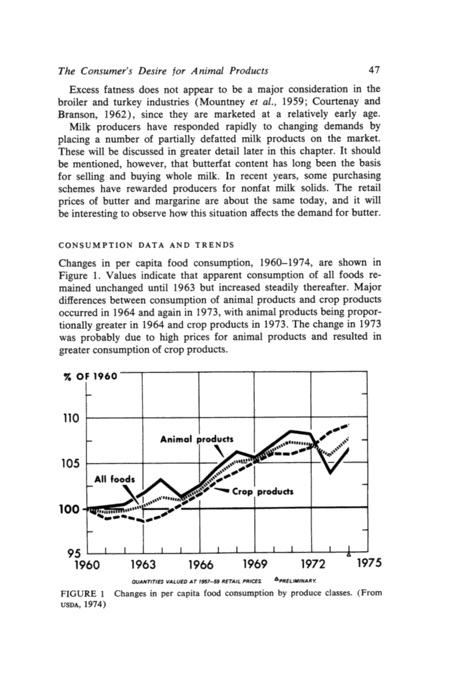
The Consumer's Desire for Animal Products 47 Excess fatness does not appear to be a major consideration in the broiler and turkey industries (Mountney et al., 1959; Courtenay and Branson, 1962), since they are marketed at a relatively early age. Milk producers have responded rapidly to changing demands by placing a number of partially defatted milk products on the market. These will be discussed in greater detail later in this chapter. It should be mentioned, however, that butterfat content has long been the basis for selling and buying whole milk. In recent years, some purchasing schemes have rewarded producers for nonfat milk solids. The retail prices of butter and margarine are about the same today, and it will be interesting to observe how this situation affects the demand for butter. CONSUMPTION DATA AND TRENDS Changes in per capita food consumption, 1960-1974, are shown in Figure 1. Values indicate that apparent consumption of all foods re- mained unchanged until 1963 but increased steadily thereafter. Major differences between consumption of animal products and crop products occurred in 1964 and again in 1973, with animal products being propor- tionally greater in 1964 and crop products in 1973. The change in 1973 was probably due to high prices for animal products and resulted in greater consumption of crop products. ~ OF1960 110 105 100 Animal products 1 ~ _ _ at_ %~` ~..~l2=~ - - ~-rig __ 1 1 1 95 L 1960 1963 1966 1969 1972 1975 11 1 1 1 1 1 QUANTITIES VALUED AT 1957 - 59 RETAIL PRICES PRELIMINARY ' 1 FIGURE 1 Changes in per capita food consumption by produce classes. (From USDA, 1974 )
48 A. M. PEARSON Figure 2 shows the costs (calculated for June 1974) of various meats and meat alternatives in amounts needed to supply one third of the daily protein requirement of a 20-year-old man. The wide differences in costs show that consumers have the opportunity to adjust consumption to their budgets. Epect of Income on Consumption Figure 3 shows the effect of income elasticity on the demand for food. It depicts the impact of a 1% change in income on the consumption of animal protein foods all foods on a farm value basis, all foods on a calorie basis, and cereals. The chart is best explained by an illustration. If income per capita is $500 (see horizontal scale), an increase of 1% in income would lead to an increase in consumption of about 0.9% in animal protein foods and to a decrease of about 0.1% in cereals. This chart portrays the desire of consumers for animal protein foods, which has been emphasized by recent purchases of feed grains by the USSR and China. Figure 4 shows the increases in food prices in 17 countries during the period 1963-1973. Only if real wages increased at an equal rate would we expect consumption to be unchanged, because elasticity of income affects patterns of purchasing foods. Even if the aveage increase in price and the average increase in real wages should coincide, many inequities Meats anal Meat Alternates, June 7974 PEANUT BUTTER EGGS, LARGE CHICKEN, FRYER DRY BEANS BEEF LIVER HAMBURGER TURKEY TUNA FISH HAM, WHOLE AMERICAN CH EESE PORK ROAST RO UN D STEAK BEEF CHUCK ROAST FRANKFURTERS SIRLOIN STEAK BEEF RIB ROAST HADDOCK, FILLET BOLOGNA BACON, SLICED 344 38c 3sc 5sc FIGURE 2 Costs of various meats and meat alternatives for amount needed to supply one-third of daily protein of a 20-year-old man. (From USDA, 1974)
The Consumer's Desire for Animal Products 49 1.5 _ 1.4 - 1.2 _ 1.0- 0.8- 0.6- 0.4- 0.2- 0.0 -0.2- -0.4- -0.5- ALL FOOD 5 \:MAL PROTE I NS ALL FOOD S WARM VALUE \ ALL FOR _ _ rAl n~TFc - ALL FOOD: AN ~ CAL PROM I NS ALL FOOD: ~ FARM VALUE - ALL FOOD: CALOR I ES CEREALS 1 1 1 1 1 1 1 1 50 250 500 750 1 ,000 1 ,500 2,000 INCOME ($) PER CAPITA-1955 PRICES FIGURE 3 Effect of income elasticity on demand for food in relation to income levels. Data represent a composite value for available world statistics and are based on 1955 prices. (Source: FAG, 1970) would result; some would lose real purchasing power and others would gain. As inflation occurs, the inequities would generally become greater. Nevertheless, Figure 4 suggests that we are relatively well off in the United States, with only Switzerland and the Federal Republic of Ger- many showing smaller percentage increases in food prices. Trends in Selected Livestock Products Figure 5 shows changes in per capita consumption of selected animal products during 1960-1974. Consumption of poultry increased by about 45% and consumption of beef and veal by about 22%. Except for sporadic cycles, pork consumption remained essentially the same. Consumption of dairy products, including butter, declined 6%-7%, and egg consumption dropped about 17%. These data suggest that con- sumers prefer poultry and beef, but are using less dairy products and eggs.
so DENMARK IRELAND ISRAEL · - -............ SPAIN ................ JAPAN · ~ ~ ~ ~ · .. ....... UNITED KINGDOM SWEDEN NETHERLANDS · FRANcE .............. GREECE............... AUSTRALIA- - - - - - - - - UNITED STALEST CANADA.............. ITALy ............... BELGIUM - - - - - - - - - - - - - GERMANY, F.R. SWITZERLAND · A. M. P EARSON . 105% 95% .. ~__~93% . ~93% 88% 86% . ~ 74% . ~ 65% . ~61~. . ~ 597: . en 567: 54% ~53% ~53% 35% ~255: FIGURE 4 Percentage increases in food prices in 17 countries during the period 1963 - 1973. (From USDA, 1974) Poultry and Eggs Figure 6 depicts changes in per capita consumption of poultry and eggs during the period 1965-1974. Consumption of broilers increased from about 29 lb per capita to 37 lb, accounting for most of the increase in consumption of poultry meat. OF1960 1 60 140 120 00 ~ ~Beef and veal .... . Poric Poultry · Eggs ~~~~ Dairy * - 1 ... 80 I I I I 1 960 965 1970 ITEMS COMBINED IN TERMS Of 1957 - 59 RETAIL PRICES. *INCLUDESBUTTfR. ~PRELIMINARY. 1975 FIGURE 5 Changes in per capita consumption of selected livestock products, 1960-1974. Changes are percentages of 1960 base. (From USDA, 1974)
The Consumer's Desire for Animal Products 50 40 30 20 0 n POt I N DS. l - POULTRY MEAT ,,,~ ~ ~ a,,, - ,, an, ,,,,,,,,,,,,, ~, ~ In,,,, ~ ~ ', ,,,, - _~'!URKEYS:,,', ~,,,,,,,,,,,~ ~ ~ ~ at, ~ ~ a,, art,/' ~7,,,,,,,,,,,,,, ,,,,_,,, ,,,,,,,,,,,,,,,,, me: :.~ ~\~i~= - 1965 1970 51 NUMBER 500 400 300 200 100 - EGGS _ ~HELL).. I, O- ~ \\\\\ 1 1975 1965 1970 1975 *READY TO COOK WEIGHT. ~ FORECAST. OCONVERTED TO SHELL EO(/I VALENT. FIGURE 6 Changes in per capita consumption of poultry and eggs, 1965-1974. ( From USDA, 1974 ) Figure 6 also reveals that yearly per capita egg consumption has dropped to a new low of about 290 eggs. The number of processed eggs has remained at about the same level per capita. This suggests that the renumber of shell eggs consumed at home or in public eating places has dropped, perhaps because of the emphasis on reducing the dietary intake of cholesterol. On the other hand, there has been little change in consumption of processed eggs, which are used in products such as baked goods and which most consumers do not think of as containing an appreciable number of eggs. Figure 7 depicts the changes in production of broilers, turkeys, and eggs in relation to changes in the population. Broiler and turkey pro- duction has gained in relation to growth of the population and egg pro- duction has decreased. Red Meats Figure 8 presents data on per capita meat consumption during the period from 1950 to 1974. In 1950, beef consumption was about 70 lb per capita, which was about the same as pork consumption; but since 1952, beef consumption has steadily increased with 1975 projections of about 1 14 lb per capita. Pork consumption has fluctuated downward, with 1975 projections of about 65 lb per capita. Lamb and
52 ID A. M. PEARSON 130r 120 110 100 90 80 _ Broilers ,~' Population I\ ~Eggs Turkeys 70 I I 1965 1967 1969 I ~ I I I I I I 1 1 1971 1973 ~ 1975 1977 /` FORECAST FIGURE 7 Changes in production of broilers, turkeys, and eggs in relation to changes in population, 1965-1974. The year 1967 was used as the base year and was assigned a value of 100%. (From USDA, 1974) mutton consumption is low and now comprises less than 3 lb per capita. Thus, consumers prefer beef but do eat considerable amounts of pork. Dairy Products Table l shows long-range trends in consumption of dairy products expressed in milk equivalents. The data reflect a steady decline in per capita consumption of dairy products. In 1940, con POUNDS * 1 100 75 50 25 1 Beef and veal ~/% ! , ! \ ~ 1 %, , ~ ~ ~ i 1 lamb and mutton .! 1 0~ ""'!""!'U'!""""~"""""!""""""", ; . """"".""'!""'!""!""!"""""~""~"''teest 1950 1955 1960 1965 1970 1975 *CANCASSWflONJBAS/S. ~ 1974 fORECASr. FIGURE 8 Meat consumption per capita, 19501974. (From USDA, 1974)
The Consumer's Desire for Animal Products TABLE 1 Per Capita Consumption of Dairy Products a 53 Year Pounds ( Milk Equivalents ) 1940 1945 1950 1955 1960 1965 1970 1973 818 788 740 706 653 620 561 556 a SOURCE: Milk Industry Foundation (1974) . gumption amounted to 818 lb per capita, but by 1973 had declined to 556 lb a decline of about 32% or 0.72% per year. Since dairy products are high in calcium, this decline may be of great importance nutritionally. Figure 9 shows percentage changes in per capita sales of dairy products during the period 196~1974. Note that sales of low-fat milk increased about 439% and that sales of cheese increased by about 55%. There were also substantial increases in sales of sour cream and dips, ice milk, flavored milks and drinks, and skim milk. Fluid whole milk and butter declined by about 25%, cream and mixtures by slightly less. Evaporated and condensed milk declined by about 50%. In general, the data reflect an increase in demand for products containing little or no fat and a decrease in demand for products containing full fat milk and those made from cream (i.e., butter). Table 2 summarizes the results of a consumer milk-evaluation survey conducted in 14 Michigan cities. Some 2,227 panelists were asked to indicate the percentage of fat that they believed to be present in whole milk, 2% low-fat milk, skim milk, and nonfat dry milk. They were offered the following choices: none, lYo, 2%, 3%-4%, 5~o-19%, 20%-49%, and 50%-100%. As the table shows, many of the panelists had mistaken ideas about the percentage of fat in milk. The dairy industry could help correct these false concepts by more descriptive labeling, which would help to correct the idea that milk is extremely high in fat. Fat Intake from Animal Products Figure 10 shows the sources of nutrient fat consumed in the United States from 1909-1913 to 1973. During the period of 1909-1913, total consumption amounted to 125 g per capita per day but in 1972
54 A. M. PEARSON Yogurt Fluid low-fat milk Eggnog Cheese Sour cream and dips Ice milk Flavored milk and drinks Fluid skim milk Sherbet I:,.:.:::.:::: , .. I.:.::.::. .~ t -. :. .. Em:. :.:.:..-:: :* lo: ::::::::. r..:.::-:::::::. [:::::::::::::::::::::::. I.... :.:.:.:.:.: .:: ...:...:.:.:.: . :.. l -80 - 0 0 PE RCENT +448 [.::::. :. ::.:::'.:::-.::-.-.-.-.-::.-.:-::.-.-.-.-.-.-.- .-.:-:.-.-.:-:.-.::-.' 1 ::: ::: ::: ::::::: ::: ::: : : : ::. :.: ::: . , .... ..... ....... ................... ; . +439 . ~:,: ,: ::.:::.:: :.: :.: :.:.:.:.:.:.:.:.:.:. ~ ] ....;;; ..;; .;;;; ;....;;;;;;; ....; ..; ....;;;;; ; -. ;...;. ......... _ _ :: : a. . ..... ;; .; .; . .- . - . .- .- . :...::.:.. :::.:: A: :: :: ·. . _-_:::-.-_-_- _:-_-_:-::_-:_-:_::-:_-.::-:.-, , .................. .::: :.. F_ ,... . , .:: .: :.: ...... Cottage cheese Ice cream Buttermilk Nonfat dry milk Cream and mixtures Butter Fluid whole milk Evaporated and condensed milk 1 1 1 +40 +80 +120 FIGURE 9 Percentage changes in per capita sales of dairy products, 1 964-l 974. ( From Milk Industry Foundation, l 974) and 1973 had increased to 156 g. Thus, the increase amounted to 31 g per day. Only 21 g of vegetable fat were used per capita during the 1909-1913 base period, or 16.8% of the total fat came from vegetable sources. By 1973, the amount of vegetable fat had increased to 63 g per capita per day, or comprised 40.4% of the total fat intake. Thus, the amount of vegetable fat consumed increased threefold, whereas the consumption of animal fat had declined by 11 g per day. Even though animal fats have frequently been blamed for the in- creased incidence of heart disease, it is obvious that consumption of animal fats has declined. However, there has been a concurrent in- crease in consumption of vegetable fats and heart disease, which would
The Consumer's Desire for Animal Products 55 TABLE 2 Panelists' Responses to Question about Percentage of Fat in Milk a,b Panelists' Responses ( % ) Choices Nonfat Offered to Whole No Low- Low-Fat Dry Panelists Milk Fat Milk Milk Skim Milk Milk (% Fat) (3.5%) (2%) (0.5-2.0%) (~0.5%) (<0.5%) None 1 c 3 30 43 1 1 1 24 30 18 2 2 85 35 13 16 3-4 29 2 12 5 5 5-19 35 3 13 10 8 20-49 12 3 5 3 2 50-100 1 1 2 2 2 1 No response 9 4 6 7 7 Mean 17.8 4.4 5.2 3.7 3 a SOURCE: Zehner (1974). b Number of panelists: 2,227. Panelists were offered the choices listed in Column 1. They were asked to assign one of the percentage figures to each of the five products. The data in the other columns show the percentage of panelists who responded with each of the choices. Thus, the data in the Whole Milk column show that 1% of the panelists believed that whole milk contains no fat, 1% believed that it contains 1% of fat, 2% believed that it contains 2% of fat, and so on. The correct percentages are given in parentheses under the names of the products. For example, whole milk contains 3.5% of fat. c <o.s%. suggest the necessity of some reevaluation of the relationship between fat consumption patterns and coronary disease. CONSUMER ACCEPTANCE STUDIES Numerous consumer studies have been conducted on the factors in- fluencing the acceptability of animal products. These investigations have made use of either consumer panels or trained (expert) panels. In some instances, the panels have actually tested the products; in others, they have been asked about their preferences but have not tested the products. In the discussion that follows, an attempt is made to dis- tinguish between types of panels. For greater detail on panels and their advantages and disadvantages, see Gardner and Adams (1926), Seltzer (1955), King and Butler (1956), Birmingham (1957), Brady (1957), Klasing ~ 1 957 ), Naumann et al. ~ 1 957, 1 96 1 ), Dunsing ~ l 959a,b,c), Kauffman ~ 1959 ), Naumann ~ 1959 ), Kiehl and Rhodes ~ 1960), Rhodes (1962), Ramsey et al. (1963), Weidenhamer et al. (1969) and Hutchinson (19701.
56 1909-1 3 G33~ ............ ...... . 2i: i935-39 it. 36 i ~/~/////////////////,9,,7~/////,/////////////~ 133 1947-49 , ~d ~ _ ~ i ~ ~/////////////////////,,,t,///////////////////~ 14 965 ..... .......... ~ ~ 145 972 (Grams) ~///////////////~/////,1/,0,/4'~/~///~/~//~/~/~ 1 2 s A. M . P EARSON . ~ ~ ~1s6 97 3^ I_ ~ ////////~,,9,/,3~/,/~ ////// 1 5 6 Vegetable animal PER CAPI rA PER DA Y. ~ PREL /MI NA R Y. FIGURE 10 Changes in sources (vegetable and animal) and amounts of fat con- sumed, 1909-1913, 1935-1939, 1947-1949, 1965, 1972, and 1973. (From USDA, 1974) Beef Color of Fat Meyer and Ensminger (1952) found that consumers preferred yellow fat over white when shown pictures containing yellow or white fat. VanSyckle and Brough ( 1958 ) studied the effect of various fat characteristics on the acceptability of beef. In a study in which color photographs of beefsteaks were used, Seltzer (1955) found that con- sumers in Phoenix, Arizona, preferred white fat. Stevens et al. (1956), using a similar procedure, reported that most Denver consumers pre- ferred white fat over yellow fat. Since most of these studies indicate a preference for white over yellow fat, Malphrus ~ 1957) attempted to determine whether consumers could detect a difference between the taste of beef having white or yellow fat. A consumer-type panel composed of 189 different members was used. It was found that the consumers could significantly differenti- ate between the taste of white and yellow fat, but they were divided about equally in expressing a preference for one color over the other.
The Consumer's Desire for Animal Products 57 Color of Lean Numerous studies have shown a preference for a bright red color of lean in beef (Hostetler et al., 1936; Ashby et al., 1941; Bull and Rusk, 1942; Ramsbottom et al., 1949; Jacobson and Fenton, 1956b; Roubicek et al., 1956; Stevens et al., 19561. The problem of dark-cutting beef has been discussed by Ramsbottom et al. (1949) and shown to be characterized by low acidity, low glycogen, low reducing sugar, and a low oxidation-reduction potential. These investigators concluded that withholding feed during a time of increased energy re- quirements tended to lower the sugar content and increase the incidence of dark-cutting beef. Hedrick et al. (1959) were able to produce dark-cutting beef ex- perimentally by injecting epinephrine over an extended period of time. This confirmed that dark-cutting beef was due to unusual stress and led to some recommendations for reducing its incidence. Marbling Marbling (the admixture of intramuscular fat with lean) has been a major consideration in determination of meat grades. Several consumer surveys using photographs of cuts differing in amount of marbling have suggested that most consumers prefer the appearance of the meat with the least marbling (Seltzer, 1955; Stevens et al., 1956; Branson, 19571. On the other hand, Simone et al. (1958) reported that a laboratory panel consistently preferred meat from carcasses with the most marbling. Blumer ( 1963 ) in an extensive review on the relationship of marbling to palatability of beef concluded that on the average marbling accounts for only about 5% of the variation in tenderness and for about 16% of the variation in juiciness. Wellington and Stouffer (1959) reported similar relationships. Although these relationships are disappointingly low, fortunately for the meat-grading service, marbling was related to both juiciness and tenderness. Carcass Grades Carcass grades have been widely used as a basis for trading in beef carcasses and cuts. However, Hutchinson (1970) re- ported consumers frequently confuse grading and inspection of meat. Table 3 shows the percentage of the total production of beef that was graded in selected years and the distribution by grade. Beef grading was mandatory during World War II, which accounts for the high percentage of beef graded in 1945. Optional grading resulted in about 58% of all beef produced being graded. Since 18%-20% of all beef slaughtered would fall in the lower grades (Commercial or lower), in effect the proportion of higher grades (Good or above) is greater than shown in the table. There has been a steady increase in the percentage of beef
58 TABLE 3 Percentage of Beef Graded in Selected Years A. M. P EARSON Grades 1940 1945 1956 1965 1973 Prime 5.7 5.9 6.1 Choice 41.7 13.9 57.1 73.6 80.5 Good 40.5 30.8 26.4 15.5 12.3 Standard 2.2 1.8 0.2 Commercial 12.0 26.7 3.6 0.6 0.1 Utility 4.3 16.6 4.3 1.9 0.7 Cutter and Canner 1.5 12.0 0.7 0.7 0.1 Percentage of pro duction graded 8.3 92.4 49.6 57.3 57.7 a SOURCE: Pierce (1974) ~ falling in the Choice grade; about 80.5% of all beef quality graded was placed in this grade in 1973. Jacobson and Fenton (1956a,b,c) have shown that grade is closely related to level of feeding and age of the animal. However, the iron and vitamin By content of the lean tissues was frequently higher in the leaner carcasses. Thus, unless one considers energy content, the leaner carcasses tended to have a greater nutritional value per unit of meat. Kidwell et al. (1959) showed that carcass grade is largely a function of fatness and that there is little association between tenderness and fatness. Lasley et al. (1955) reported that consumers generally found beef roasts of the commercial (Standard) grade to be about as ac- ceptable as those of the higher grades. Pearson (1966) has reviewed some of the factors influencing desirability of beef, and Ramsey et al. 1963 ~ have reported on breed differences. Several survey-type studies of beef grades using photographs of cuts of meat have suggested that consumers prefer the lower and leaner grades of beef (Seltzer, 1955; Stevens et al., 1956; Branson, 1957; Fielder et al., 19631. However, Rhodes et al. (1955), using actual cuts of meat, found that a consumer panel in St. Louis tended to choose steaks in this order: Prime, Choice, Good, and Commercial (now Standard). When preferences were expressed by either consumer or trained panels, Choice steaks were usually preferred over Good or Commercial (Standard) grades (Cole and Badenhop, 1958; Cover et al., 1958; Kiehl et al., 1958; Rhodes et al., 1958a,b; Naumann et al., 1961; Juillerat et al., 1972), but there was considerable overlap between grades. This shows that even though beef graded higher tends to be more tender, many of the lower-graded carcasses produce steaks that are more tender than many from the Choice grade.
The Consumer's Desire for Animal Products 59 Doty and Pierce (1961) reported an extensive investigation on the effects of carcass grade, carcass weight, and degree of aging on the char- acteristics of beef muscle. Results indicated that grading sorted the carcasses into groups differing in average acceptability, but considerable variation was still apparent between grades. Naumann et al. ~ 1961 ~ summarized the grading problem as follows: "It is now apparent that eating quality of beef depends on different and probably more complicated factors than those involved in the grading standards' definition of 'quality'." Fat Content of Ground Beef When consumers are asked to state their preferences for ground beef on the basis of fat content, the responses vary considerably. Cole et al. (1960) reported that consumers pre- ferred broiled ground beef containing at least one third fat and gave the lowest score to beef containing 15% fat. However, Mize (1972) reported that a 600-household consumer panel preferred ground beef containing 15% fat over 25% or 35% fat, while Glover (1968) re- ported a similar household panel preferred 20% over 16% or 30% fat. The addition of soya protein (soy bits) at 2% improved panel scores at all three levels of fat. The results of a study by Law et al. (1965) re- ported a preference for ground beef containing 15% fat over beef con- taining 25% or 35% fat. Yeo and Wellington (1974) reported that soy curd added to ground beef patties produced a highly acceptable product. Judge et al. (1974) found that addition of soy protein to beef patties containing 20% and 30% fat decreased cooking losses. Glover (1968) and Huffman and Powell (1970) obtained similar results by adding soy protein to ground beef. This suggests that somewhat higher levels of fat may be preferred in ground beef-soya mixtures. Table 4 gives unpublished data provided by A. F. Anglemier of Oregon State University. Samples for the first trial were obtained from three markets and analyzed for fat content. Percentages of raw fat varied as shown in the table, being approximately 41%, 34~o, and 24%. The samples that were highest, intermediate, and lowest in fat were ranked first, second, and third by both the student and trained panels. All differences were statistically significant (p < 0.05 ~ . The results were somewhat surprising, because the samples containing the higher levels of fat came from shops having questionable sanitary prac- tices (as well as high fat levels) while the low fat sample came from a national food chain with good sanitation. The second trial (Table 4) was run on samples in which the sources of lean and fat were identical and differed only in the proportion of fat
60 A. M. P EARSON TABLE 4 Effect of Levels of Fat on Acceptability of Ground Beef a Percentage of Fat Panel Scores b Student Panel Trained Panel Raw Cooked (N= 155) (N=35) FIRST TRIAL 40.9 24.2 7.llc 6.80 c 33.5 22.8 6.77 ~5.38 24.0 20.3 6.43 e 5.05 e SECOND TRIAL 37.6 24.2 6.87 c 6.07 21.9 19.1 7.26 c 6.59 c 10.9 10.6 6.82& 5.73 c a SOURCE: Unpublished data provided by A. F. Anglemier (1974) of Oregon State University. b N~ne-point hedonic scale. c,~,e Scores having the same superscript in the same column were not significantly different (P ~ 0~05). and lean. In this trial the intermediate fat (22% ~ level was preferred by both panels, while the high fat (37% ~ level was next and the low fat level (11%) was rated lowest. Both the trained and untrained panels preferred about 22% fat over 11% or 37%. Figure 1 1 from Ford ~ 1974) shows the preferences of husbands and wives for different fat levels in ground beef. The husbands preferred the sample containing 25% fat; but the wives gave about the same ratings to 16%, 25%, 30%, and 35% fat. Both husbands and wives gave the lowest rating to the sample containing 45%. Figure 12 shows the effect of income level on consumer preferences for different fat levels of ground beef (Ford, 19741. High-income families preferred the 25% fat level, whereas low-income families gave about the same rating to samples containing 16%, 25%, and 30%. Both income groups gave the lowest rating to the sample containing 45%. Figure 13 indicates that a trained laboratory panel preferred the 45% fat level in broiled ground beef. The 16% and 25% fat levels followed in order, with 35% being rated least acceptable. It is difficult to reconcile these results with one another or with those obtained from the consumer panels (Figures 11 and 12) . Figure 14 shows the preferences of a trained taste panel for different levels of fat in fried ground beef. Again the panel preferred the 45% fat level, although it was closely followed by the 16% fat level. The sample containing 30% fat received the lowest scores. These results suggest about an equal number of trained panel members preferred the
The Consumer's Desire for Animal Products % 100 70 60 50 40 ~ 30 20 10 o 61 I Husband Wife 47.7 63.8 // 52.2 16 25 /// 53.3 35 38.9 45 77] 36.1 30 FAT (%) FIGURE 11 Preferences for different levels of fat in ground beef as expressed by household panels in Knoxville, Tenn. Values are given separately for husbands and wives. (From Ford, 1974) high fat (45% ~ samples, while an almost equal number preferred the low fat (judo) samples. This indicates that some panel members pre- ferred the juiciness of the high fat (45~o ~ level, and that others preferred the flavor of the low fat level. Kendall et al. (1974) found that ground beef containing 10%-20% lipid had lower cooking losses than the same product with 20%-30% fat. However, the low-fat product cost more per 100 g of cooked meat than the high-fat product. These workers observed that low-fat ground beef was less juicy, more mealy in texture, and less desirable in flavor than the high-fat product. Pork Results with pork are less extensive and definitive than those with beef. However, several investigators have shown that consumers prefer lean pork (Birmingham et al., 1954; Birmingham, 1956; Gaarder and Kline, 1956; Larzelere and Gibbs, 1956; Naumann et al., 1959 ~ . More re- cently, Hendrix et al. (1963) have suggested that factors other than leanness may be important in determining preferences for pork chops. Kauffman (1960) discussed the possible role of marbling in pork car
62 a n, 100 90 80 - 70 60 50 40 - 30 _ 20 10 ~ A. M. P EARSON O H igh I ncome ~3 Low I ncome NN 53.9 \\ \\ 59.4 25 51.7 30 35 FAT (%) 47.2 ~\N \N 35.0 45 40.0 it. FIGURE 12 Effect of income level on preferences of household panels in Knox- ville, Tenn., for different levels of fat in ground beef. (From Ford, 1974) Gasses and its influence on acceptability. Considerable evidence is ac- cumulating that leanness is only one of a number of factors that influ- ence the acceptability of pork (Zobrisky et al., 1960~. Lamb and Mutton The low acceptability of lamb by consumers in the United States is indicated by a consumption rate of only 2.5 lb per capita per year. Levine and Hunter (1956) pointed out some of the basic problems in marketing lamb. Barton (1968) discussed some of the reasons for the low demand for lamb, which include excessive fatness and off-flavors induced by various feeds. Cramer and Marchello ( 1964) suggested that many consumers find lamb fat may be too firm for their tastes. Marchello et al. (1967) demonstrated that lower environmental temperatures pro- duce softer body fats with lower melting points and higher iodine numbers.
The Consumer'.s Desire for Animal Products % 100 - 90 ~ 80 - 60 - 40 30 20 ~ 10 63 _ 70~ _ _ 56.5 50~ _ 1 _ ~ 1 1 _ _ 60.2 54.6 45.4 33.3 16 25 30 35 45 FAT (%) FIGURE 13 Preferences of trained taste panel for different levels of fat in broiled ground beef. (From Ford, 1974)
64 A. M. PEARSON % 100 90- _ 80 - 70 - 50 -_ 40 -_ 30-_ 20 ~ _ 10 -_ 60 - 68.5 65.7 45.4 38.0 31.5 16 25 30 35 FAT (%) FIGURE 14 Preferences of trained taste panel for different levels of fat in fried ground beef. (From Ford, 1974)
The Consumer's Desire for Animal Products 65 The chief objection of most consumers to lamb seems to be the flavor. Weller et al. (1962) found that tenderness appeared to be unrelated to age, but flavor scores were higher for lambs over 6 months of age than for younger lambs. Wasserman and Talley (1968) found that only one third of a consumer panel could correctly identify cooked lean beef, lamb, pork, and veal; however, adding 105to of fat greatly improved the number of correct identifications. Hofstrand and Jacobson (1960) suggested that the factors contributing the characteristic "lambiness" are extremely volatile, and results reported by Pearson et al. (1973) support this viewpoint. Processed Meats This discussion will be concerned only with the influence of fat levels on the acceptability of processed meats. Obviously, many other factors influence the acceptability of processed meats, but they are of little importance in the context of this symposium. R. W. Mandigo (1974), of the University of Nebraska, in a personal communication on the influence of fat levels on restructured pork products, indicated that taste panels preferred products containing 22%-27% fat. Products containing fat levels of 15% or lower were rejected for being tough, lacking juiciness, and having a crumbly texture. W. E. Kramlich in a personal communication (1974) described the unsuccessful attempt of one company to market a low-fat frankfurter in hopes of taking advantage of consumerism. Although this product had a fat content of less than 20% in contrast to the legal limit of 30%, it failed at the marketplace. The failure may have been due to its having been released in early 1973, when meat prices were unusually high, making it very high priced (10¢-20¢ higher) in relation to other meat products, especially to high-fat (30% ~ frankfurters. Other factors that are not germane to this discussion may also have contributed to the failure. A letter from Harry C. Mussman, Deputy Administrator, Scientific and Technical Services, of the U.S. Department of Agriculture gave the following information on the composition of frankfurters (DeGrafT, 19731: "A number of references in the news during the past few years have indicated frankfurters made during the 1930's were considerably superior in nutritional value when compared to the present-day products. We are unable to agree with such contentions mainly be- cause the information upon which to base such comparisons is very meager and lacks reliability. We cannot locate substantive information upon which to base nutritional comparisons between sausage products
66 A. M. PEARSON as made today and such items produced in the thirties and, also, the forties." Mussman then said that the USDA began extensive analysis of frankfurters in 1955 and has continued these analyses since that time. Results of analyses made in 1955 and 1972 are shown in Table 5. It is obvious that there has been little change in composition. However, it should be pointed out that the USDA issued regulations limiting the fat content to a maximum of 30~o in 1969, when an industry trend toward increased fat levels was noted. Tauber and Lloyd (1946) reported that frankfurters ranged from 47.6% to 65.4% in moisture, from 10.5% to 15.7% in protein, and from 14.2% to 28.9% in fat. Hoagland (1932) reported similar ranges in 10 samples of so-called first grade frankfurters with 49.4 % to 68.5% in moisture, from 12.5% to 14.6% in protein, and from 13.8% to 24.4% in fat. Carpenter et al. (1966) found that flavor and overall acceptability of frankfurters were not highly correlated with percentage of moisture or percentage of fat in finished frankfurters that ranged from 50.9% to 56.4% in moisture and 18.8% to 27.3% in fat. F. W. Tauber, of Union Carbide Corp., Chicago, reported in a per- sonal communication ~ 1974) that a consumer panel scored high- protein-low-fat (20% protein-20% fat) frankfurters lower than con- ventional all-meat frankfurters containing approximately 12% protein and 28% fat. Frankfurters with either 15% added turkey meat or 10% added soy protein concentrate were also scored significantly lower than conventional all-meat frankfurters. Dairy Products Hillman et al. (1962) demonstrated that consumers can differentiate between milk and milk beverages varying in content of fat and solids- not-fat. Addition of loo solids-not-fat significantly improved the ac- ceptance of whole, low-fat, and nonfat milk beverages. Eccles (1968) TABLE 5 Comparison of Analyses of Frankfurters in 1955 and 1972 a Percentage Composition Year No. Samples Protein Fat Water 1955 160 12.5 28.3 55.0 1972 800 12.2 28.0 54.4 a SOURCE: DeGraff (1973).
The Consumer's Desire for Animal Products 67 outlined some new uses for nonfat dry milk, and Dunham (1968) discussed some possible uses for foam spray-dried whole milk. Man- chester (1967) has considered the possible role of milk concentrates and dairy substitutes in consumption of dairy products. Kaitz (1970) reported good acceptance of dry whole-milk powder by 300 home- makers in Alexandria, Virginia. Sills (1970) reported similar success with acceptance of dry whole milk in Pennsylvania. The American Dairy Association (1970) in a survey on the con- sumer uses of dairy sour cream found that 60% of all shoppers some- times used this product, although many used it less than once a month. Magleby et al. (1967) traced the growth of the market for 2% fat milk in Pittsburgh and studied the factors motivating its use. They found the consumers to be uncertain about its fat content. In this respect, their results were like those of Zehner ( 1974~. Poultry Products Courtenay and Branson ( 1962) discussed consumers' images of broilers, and Mountney et al. (1959) reported on consumers' preferences with respect to chicken. Acceptance of different skill colors in poultry has been determined by several workers (Mountney et al., 1959; Courtenay and Branson, 1962), as it can readily be altered by diet. A medium yellow skin for broilers was preferred by 36% of all consumers, white skins by 27%, moderate yellow by 18%, and light yellow by 16% (Courtenay and Branson, 1962~. Thus, there is considerable variation in preference for skin color. Eggshell color ranges from white to dark brown (Stadelman and Cotterill, 1973 ). Different markets show different color preferences. Stadelman (1973) indicated the advisability of grouping eggs by color for the convenience of shoppers with a color preference. Egg yolks also differ in color; but since the yolks cannot be seen until the eggs are broken, the differences do not affect acceptability of shell eggs (Stadelman and Cotterill, 19731. RELATIONSHIP OF FATNESS TO TENDERNESS Locker (1960), working in New Zealand, first observed a relationship between tenderness and muscle shortening in beef. Soon afterwards, Locker and Hagyard (1963) noted that exposure to cold while the muscle was still in the prerigor state resulted in extensive muscle shortening and simultaneous toughening of meat. They called this phenomenon "cold-shortening." Prior to that time, New Zealand lamb
68 A. M. PEARSON had met marked resistance on the American markets because of extreme toughness. It then became a simple matter to show that cold-shortening was responsible for toughness in lamb carcasses frozen immediately off the slaughter line (Marsh and Leet, 19661. Recommendations were made for holding the carcasses at elevated temperatures (15° C) until they passed into rigor mortis and became sufficiently tender for Ameri- can markets (Marsh and Leet, 1966; Marsh, et al., 1966, 1968; McCrae et al., 1971~. Merkel and Pearson (1973) showed in a preliminary study that fat beef carcasses were chilled more slowly and were more tender than thinly covered carcasses. The toughening effects of cold temperatures on lean beef largely disappeared when the carcasses were chilled more slowly. Examination of other data in our laboratory showed that fat thickness is definitely related to tenderness. This would suggest that the relationship of marbling to tenderness is due to the fact that highly marbled cattle tend to have a thicker covering of fat and are more resistant to cold shortening, whereas thin cattle are subject to cold- shortening because of a faster rate of chilling. Support for this viewpoint can be found in a recent report by Smith et al. (1974), which shows that there was a relationship between sub- cutaneous fat thickness of lamb carcasses and tenderness. Carcasses with thick, intermediate, and thin subcutaneous coverings of fat gave respective shear-force readings of 4.6, 6.1, and 7.5 kg for loin chops and 7.8, 8.6, and 10.8 kg for rib chops. A 1.3-cm core was used for making the readings on carcasses held for 72 h at 1° C. The authors concluded that "an increased quantity of subcutaneous fat insulates the longissimus muscle during chilling, decreases the rate of temperature decline, partially attenuates the effect of cold shock and thereby en- hances tenderness of the lamb longissimus muscle." A paper by Huffman (1974) provides further support for the view that fat thickness slows chilling rates and produces more tender meat. This is illustrated by Figure 15, which shows a plot of taste panel tenderness against quality grade. According to taste panel scores, about 87% of the 193 cattle in this study were acceptable (scored above 5.0) in tenderness. On the basis of USDA quality grades, however, cor- rect judgments were made on 59% of the carcasses and incorrect judg- ments on 41 % . Figure 16 shows the same type of data for Warner-Bratzler shear and quality grades. Assuming that a Warner-Bratzler shear value of less than 8.1 kg is acceptable, quality grades correctly identified only 55% of the carcasses, although 73% of the carcasses were actually acceptable.
The Consumer's Desire for Animal Products 10.0 9.C 8.C z a ~ 6.C fir: o IL In S.C o cow at 7.C - ~ 3.0 Is 4.C 2.0 1.0 ; , 0 17 16 i ~ . 69 o o O O o o o o o o o 0A8 oo 08D ooQ ° 8 °oo~§ oo °o o ° 8§o 8 oo8 o 8 0 0 0 0 0 oo0 0 °R too o o oo0 8 °8o o o8°° 8 0 so0 0 °0 ° 0 0 0 0 0 g o o o 1 1 15 1 14 13 12 8 o o l 11 10 9 8 Prime Choice Good Standard QUALITY GRADE FIGURE 15 Tenderness as judged by taste panel plotted against quality grades assigned to beef carcasses. (From Huffman, 1974 ) Figure 17 shows marbling plotted against taste panel scores. A total of 88% of the carcasses were acceptable, which is in close agreement with the 87% acceptable shown in Figure 15 (tenderness scores plotted against quality grades ~ . Marbling scores were correct that is, in harmony with taste panel scores- for 64% of the carcasses. Thus, marbling scores were only 5% higher than those provided by quality grades (Figure 15 ~ . Even marbling failed to classify 36% of the carcasses correctly, and this fact supports the view that fat thickness slows cooling rates in the fatter cattle. Corroborative data are seen in Figure 18, in which marbling is plotted against Warner-Bratzler shear values. In this case, marbling correctly identified 60% of the carcasses but was unsuccessful for 40%. Table 6 shows the relation between grades of beef and tenderness scores. Taste panel tenderness scores were not significantly different for the Prime, Choice, and Good grades. However, the Standard grade carcasses were significantly less tender. Warner-Bratzler shear values
70 A. M. PEARSON 17.2 15.4 13.6 11.8 100 8. 6.3 4.5 0 17 16 o o o o 1 ~ o o o o o o o O O o o o ~O A o o O O 8 8 -8 ~ ~ 00 o o o o o o o o 8 O a 00 . . . . . 15 ~14 13 12 o ._ , . v O o O O 9 0 80 8 o 1 1 9 8 7 6 11 10 Prime | Choice QUALITY GRADES Good Standard FIGURE 16 Tenderness as measured with Warner-Bratzler shear plotted against quality grades assigned to beef carcasses. (From Huffman, 1974) followed the same trend, but only the Choice grade differed significantly from the Standard grade in shear values. These results show that the three top grades were about the same in tenderness, but Standard was significantly less tender. Table 7 shows taste panel tenderness scores and Warner-Bratzler shear values by marbling categories. No significant differences between marbling categories are shown until one reaches the "traces" and TABLE 6 Effect of Grade on Tenderness of Beef a Mean Tenderness Quality Grade No. Carcasses Panel Shear (kg) Prime 17 6.88 b 17.08 b, C Choice 100 6.71 b 15.08 b Good 66 6.18 b 16.42 Standard 10 4.15 19.79 c a SOURCE: Huffman (1974). b,C Scores having the same superscript in the same column were not statistically significant (P<O-OS) l
The Consumer's Desire for Animal Products 10.0 8 O 9.0 . O 00 8.0 7.0 A it: ~ 6.0 cr o ,,, 5.0 al o In ~ 4.0 z ~ 3.0 o Go 0 O 0 00 o 0°oo ~oO OoOO ooOo 0 oo to oO° o$0 1 80t ~ P-- o 0 Oo° o~e ~Oo° 0 o oo o Oo 8 00 2.0 00 ° O 1 0 10,9,8 7 6 5 0 0 4 3,2,1 MARBLING SCORES FIGURE 17 Tenderness as judged by taste panel plotted against marbling scores assigned to beef carcasses. (From Huff- man, 1974) 71 "practically devoid" categories. Thus, marbling alone does not ac- curately indicate tenderness. Table 8 shows the effect of marbling and internal cooking tempera- tures on palatability. These data show that degree of marbling had virtually no effect on flavor, tenderness, juiciness, overall acceptability, or Warner-Bratzler shear values. As might have been expected, the degree of marbling did influence cooking losses, with greater losses oc- curring with larger degrees of marbling. Final internal cooking tempera- ture had a marked effect on all palatability measurements, with poorer palatability in all cases for higher internal cooking temperatures. In addition, cooking losses were also higher at the higher temperatures of cooking. These results indicate that marbling did not influence meat palatability within the limits of this study, although cooking temperature had a marked effect on acceptability.
72 A. M. PEARSON 17.2 15.4 13.6 11.8 10.0 8.' 6.3 4.5 o o o o o St cL o o oo o oo o o c,O o ~880 8 ~ ~o a~ o o o ooo o - ~B ~0 8 ~ o g o 8 co oo oo go ~o g o o o oo o 0 0 8 o o co 0 - 8 ~o o 8° o o o o 0 . I · · r · · · 10 9 8 7 6 5 4 3 2 o MARBLING SCORES FIGURE 18 Tenderness as measured with Warner-Bratzler shear plotted against marbling scores assigned to beef carcasses. (From Huffman, 1974) TABLE 7 Effect of Marbling Levels on Tenderness a Mean Tenderness Marbling No. Carcasses Panel Shear (kg) Abundant 5 7.3 b 16.6 b, c Moderately abundant 6 6.6 b 18.8 b, c Slightly abundant 6 6.8 b 15.8 b Moderate 19 6.8 b 15.3 b Modest 42 6.6 b 16.3 b, C Small 39 6.7 b 15.3 b Slight 51 6.1 b, C 16.1 b, C Traces 15 5.8 b, C 17.6 Practically devoid 8 4.0 c 21.7 c Devoid 2 5.6 15.7 b a SOURCE: Huffman (1974). b,c Scores having the same superscript in the same column were not significantly different (P < 0 05)
The Consumer's Desire for Animal Products 73 TABLE 8 Effect of Marbling and Internal Cooking Temperatures on Palatability a Marbling Degree Broiling Temperature Moderately Slight Modest Abundant 60° C 70° C 80° C Flavor 6.0 6.1 6.1 6.3 6.1 5.8 Tenderness 5.2 5.3 5.3 5.9 5.2 4.7 Juiciness 5.2 5.3 5.3 6.3 5.3 4.1 Overall acceptance 5.5 5.5 5.6 6.1 5.5 5.0 Warner-Bratzler shear (lb) 7.63 7.65 7.70 7.42 7.41 8.15 % Cookingloss 19.78 19.94 21.38 15.87 19.66 25.56 a SOURCE: Parrish et al. (1973). These studies clearly suggest that the primary advantage of marbling may be its association with increased carcass fat covering, which may in turn slow chilling rates and produce more tender meat indirectly rather than directly. Thus, the use of higher temperatures (about 15° C) immediately after slaughter until rigor is completed may be useful in producing more tender meat, especially from the leaner, more thinly covered carcasses. This could be even more important if leaner carcasses become more common in market channels. SUMMARY The desires of consumers for animal products were followed by use of consumption trends and consumer preference studies. Examination of the literature reveals that the demand for reduced fatness of animal products is not new but has existed for at least 50 years. Both con- sumption trends and consumer studies indicate a definite desire on the part of most consumers for lower fat levels in most animal products. This was shown to be the case for not only the red meats but also for poultry and dairy products. In general, results suggest that fat levels in a range of 20%-30% are necessary for the acceptability of ground beef, frankfurters, and restructured pork products. Although consumers prefer leaner beef cuts, the reduction in fat content has been complicated by a desire for tenderness. Data are presented indicating that young, lean beef may be acceptable in tenderness if cold-shortening is avoided by chilling the carcasses at about 15° C until the onset of rigor mortis. This may offer a method for reducing the fat content of beef carcasses without adversely affecting tenderness.
74 ACKNOWLEDGMENTS A. M. P EARSON The author acknowledges the assistance of R. A. Merkel, A. E. Reynolds, Jr., L. E. Dawson, and A. L. Rippen of the Department of Food Science and Human Nutrition, Michigan State University, for assisting him in locating certain material on red meats, poultry, and dairy products. He also expresses appreciation to Mary Zehner and J. Roy Black of the Department of Agricultural Economics, Michigan State University, for aiding him in locating much of the data and many of the charts used in this presentation. He is grateful to C. C. Melton, Department of Food Science, University of Tennessee, for lending him the M.S. thesis of J. R. Ford, and to the following for providing information: W. J. Aunan, Meat Industry Technical Services, Chicago; F. W. Tauber, Union Carbide Corp., Chicago; O. E. Kolari, Armour Food Laboratory, Oak Brook, Illinois; A. F. Anglemier, Depart- ment of Food Technology, Oregon State University; R. W. Mandigo, Department of Animal Science, University of Nebraska; J. C. Pierce, U.S. Department of Agri- culture, Washington, D.C.; G. T. King, Department of Animal Science, Texas A & M University; and W. E. Kramlich, Hillshire Farm Company, New London, Wisconsin. REFERENCES American Dairy Association. 1970. The Household Market for Sour Cream. A Study of Usage and Attitudes. American Dairy Association, Chicago, Ill. Anglemier, A. F. 1974. Letter dated Oct. 17, 1974. Oregon State University, Cor- vallis. Ashby, R. C., R. J. Webb, E. C. Hedlund, and S. Bull. 1941. Retailer and con- sumer reaction to graded and branded beef. Ill. Agric. Exp. Stn. Res. Bull. 479. Barton, R. A. 1968. The future of the lamb industry: the world outlook. Proc. Recip. Meat Conf. 21: 152. Birmingham, E. 1956. Pork quality as related to consumer acceptability. Proc. Recip. Meat Conf. 9:89. Birmingham, E. 1957. Projects and results of consumer preference for meat and meat products. Proc. Recip. Meat Conf. 10:86. Birmingham, E., D. E. Brady, S. M. Hunter, J. C. Grady, and E. R. Kiehl. 1954. Fatness of pork in relation to consumer preference. Mo. Agric. Exp. Stn. Res. Bull. 549. Blumer, T. N. 1963. Relationship of marbling to the palatability of beef. J. Anim. Sci. 22:771. Brady, D. E. 1957. Results of consumer preference studies. J. Anim. Sci. 16:233. Branson. R. E. 1957. The consumer market for beef. Tex. Agric. Exp. Stn. Bull. 856. Bull, S., and H. P. Rusk. 1942. Effect of exercise on quality of beef. Ill. Agric. Exp. Stn. Bull. 488. Carpenter, J. A., R. L. Saffle, and J. A. Christian. 1966. The effect of type of meat and levels of fat on organoleptic and other qualities of frankfurters. Food Tech- nol. 20:693. Cole, J. W., and M. B. Badenhop. 1958. What do consumers prefer in steaks? Tenn. Farm Home Sci. Prog. Rep. 25. Cole, J. W., C. B. Ramsey, and L. O. Odom. 1960. What effect does fat content
The Consumer's Desire for Animal Products 75 have on palatability of broiled ground beef? Tenn. Farm Home Sci. Prog. Rep. 36. Courtenay, H. V., and R. E. Branson. 1962. Consumers' image of broilers. Tex. Agric. Exp. Stn. Bull. 989. Cover, S., G. T. King, and O. D. Butler. 1958. Effect of carcass grade and fatness on tenderness of meat from steers of known history. Tex. Agric. Exp. Stn. Bull. 889. Cramer, D. An and J. A. Marchello. 1964. Seasonal and sex patterns in fat com- position of growing lambs. J. Anim. Sci. 26:683. DeGraff, H. 1973. USDA says evidence is lacking to support allegation that hot dogs have declined nutritionally since 1930's. Am. Meat. Inst. Spec. Bull. No. 78. Doty, D. M., and J. C. Pierce. 1961. Beef muscle characteristics as related to car- cass grade, carcass weight and degree of aging. USDA Tech. Bull. 1231. Dunham, D. F. 1968. Market possibilities for foam spray-dried whole milk. Univ. Ill. Dep. Agric. Econ. Bull. 17:20. Dunsing, M. 1959a. Visual and eating preferences of consumer household panel for beef of different grades. Food Res. 24:434. Dunsing, M. 1959b. Visual and eating preferences of consumer household panel for beef from graham-Hereford crossbreds and from Herefords. Food Technol. 13:451. Dunsing, M. 1959c. Consumer preferences for beef of different breeds related to carcass and to quality grades. Food Technol. 13:516. Eccles, W. C. 1968. New uses for nonfat dry milk. Univ. Ill. Dep. Agric. Econ. Bull. 17:15. FAO. 1970. Agricultural Commodities Projections for 1970. FAO Commodity Re- view 1962. Food and Agriculture Organization of the United Nations, Rome. Fielder, M. M., A. M. Mullins, M. M. Skellenger, R. Whitehead, and D. S. Moschette. 1963. Subjective and objective evaluations of prefabricated cuts of beef. Food Technol. 17:213. Ford, J. R. 1974. The relationship of fat content to the palatability of ground beef. M.S. Thesis. University of Tennessee, Knoxville. Gaarder, R. O., and E. A. Kline. 1956. What do consumers want from pork? Iowa FarmSci.11(6):6. Gardner, K., and L. Adams. 1926. Consumer habits and preference in the purchase and consumption of meat. USDA Bull. 1443. Glover, R. S. 1968. Consumer acceptance of ground beef. Proc. Recip. Meat Conf. 21:353. Hedrick, H. B., J. B. Boillot, D. E. Brady, and H. D. Naumann. 1959. Etiology of dark-cutting beef. Mo. Agric. Exp. Stn. Res. Bull. 717. Hendrix, J., R. Baldwin, V. J. Rhodes, W. C. Stringer, and H. D. Naumann. 1963. Consumer acceptance of pork chops. Mo. Agric. Exp. Stn. Res. Bull. 834. Hillman, J. S., J. W. Stull, and R. C. Angus. 1962. Consumer preference and acceptance for milk varying in fat and in solids-not-fat. Ariz. Agric. Exp. Stn. Tech. Bull. 153. Hoagland, R. 1932. Chemical composition of certain kinds of sausage and other meat foods products. USDA Circ. 230. Hofstrand, J., and M. Jacobson. 1960. The role of fat in the flavor of lamb and mutton as tested with broths and depot fats. Food Res. 25:706. Hostetler, E. H., J. E. Foster, and O. G. Hankins. 1936. Production and quality of meat from native and grade yearling cattle. N.C. Agric. Exp. Stn. Bull. 307.
76 A. M. PEARSON Huffman, D. L. 1974. An evaluation of the tenderometer for measuring beef tenderness. J. Anim. Sci. 38:287. Huffman, D. L., and W. E. Powell. 1970. Fat content and soya level effect on tenderness of ground beef patties. Food Technol. 24: 1418. Hutchinson, T. Q. 1970. Consumers' knowledge and use of government grades for selected food items. USDA Econ. Res. Serv. Mark. Res. Rep. 876. Jacobson, M., and F. Fenton. 1956a. Effects of three levels of nutrition and age of animal on the quality of beef. I. Palatability, cooking data, moisture, fat and nitrogen. Food Res. 21 :415. Jacobson, M., and F. Fenton. 1956b. Effects of three levels of nutrition and age of animal on the quality of beef. II. Color, total iron content and pH. Food Res. 21:427. Jacobson, M., and F. Fenton. 1956c. Effect of three levels of nutrition and age of animal on the quality of beef. III. Vitamin BE content. Food Res. 21 :436. Judge, M. D., C. G. Haugh, G. L. Zachariah, and C. E. Parmelee. 1974. Soya additives in beef patties. J. Food Sci. 39:137. Juillerat, M. E., R. F. Kelly, D. L. Harris, C. Y. Kramer, and P. P. Graham. 1972. Consumer preference for beef as associated with selected characteristics of the meat. Va. Polytech. Inst. State Univ. Res. Div. Bull. 72. Kaitz, E. F. 1970. Household consumers' acceptance of an experimental dry whole milk. USDA Mark. Res. Rep. 880. Kauffman, R. G. 1959. Special techniques in sales preference studies. Proc. Recip. Meat Conf.. 12:4. Kauffman, R. G. 1960. Pork marbling. Proc. Recip. Meat Conf. 13:31. Kendall, P. A., D. L. Harrison, and A. D. Dayton. 1974. Quality attributes of ground beef on the retail market. J. Food Sci. 39:610. Kidwell, J. F., J. E. Hunter, P. R. Ternan, J. E. Harper, C. E. Shelby, and R. T. Clark. 1959. Relation of production factors to conformation scores and body measurements, associations among production factors and the relation of carcass grade and fatness to consumer preferences in yearling steers. J. Anim. Sci. 18:894. Kiehl, E. R., and V. J. Rhodes. 1960. Historical development of beef quality and grading standards. Mo. Agric. Exp. Stn. Res. Bull. 728. Kiehl, E. R., V. J. Rhodes, D. E. Brady, and H. D. Naumann. 1958. St. Louis consumers' eating preferences for beef loin steaks. Mo. Agric. Exp. Stn. Res. Bull. 652. King, G. T. 1959. Recent findings and current investigations in consumer research of meats. Proc. Recip. Meat Conf. 12: 13. King, G. T., and O. D. Butler. 1956. Methodology and results of consumer prefer- ence studies of steaks and roasts from cattle of known history in Texas. Proc. Recip. Meat Conf. 9:72. Klasing, F. C. 1957. Means of strengthening consumer preference studies. Proc. Recip. Meat Conf. 10:92. Kline, E. A. 1956. Consumer work at Iowa State University. Proc. Recip. Meat Conf. 9:75. Kramlich, W. E. 1974. Telephone conversation in October, 1974. Hillshire Farm Co., New London, Wis. Lane, J. P., and L. E. Walters. 1958. Acceptability studies in beef. Okla. Agric. Exp. Stn. Processed Ser. P-305.
The Consumer's Desire for Animal Products 77 Larzelere, H. E., and R. D. Gibbs. 1956. Consumers opinions of quality in pork chops. Mich. State Univ. Quart. Bull. 39(2) :25. Lasley, F. G., E. R. Kiehl, and D. E. Brady. 1955. Consumer preference for beef in relation to finish. Mo. Agric. Exp. Stn. Res. Bull. 580. Law, H. M., M. S. Beeson, A. B. Clark, A. M. Mullins, and G. E. Murra. 1965. Consumer acceptance studies. II. Ground beef of varying fat composition. La. Agric. Exp. Stn. Bull. 597. Levine, D. B., and J. S. Hunter. 1956. Homemakers' preference for selected cuts of lamb in Cleveland, Ohio. USDA Mark. Res. Rep. 113. Locker, R. H. 1960. Degree of muscular contraction as a factor in tenderness of beef. Food Res. 25:304. Locker, R. H., and C. J. Hagyard. 1963. A cold shortening effect in beef muscles. J. Sci. Food Agric. 14:787. Magleby, R. S., C. W. Pierce, and P. D. Hummer. 1967. Two-per-cent milk. Its image and use among Pittsburgh households. Pa. Agric. Exp. Stn. Bull. 738. Malphrus, L. D. 1957. Effect of color of beef fat on flavor of steaks and roasts. Food Res. 22:342. Manchester, A. C. 1967. Milk concentrates and dairy substitutes. Dairy Mark. Facts, Univ. Ill., Dep. Agric. Econ., p. 13. Mandigo, R. W. 1974. Letter dated Nov. 21, 1974. University of Nebraska, Lincoln. Marchello, J. A., D. A. Cramer, and L. J. Miller. 1967. Effects of ambient tem- perature on certain ovine fat characteristics. J. Anim. Sci. 26:294. Marsh, B. B., and N. G. Leet. 1966. Studies in meat tenderness. III. The effects of cold shortening on tenderness. J. Food Sci. 3 1 :450. Marsh, B. B., P. R. Woodhams, and N. G. Leet. 1966. Studies in meat tenderness. I. Sensory and objective assessments of tenderness. J. Food Sci. 31:262. Marsh, B. B., P. R. Woodhams, and N. G. Leet. 1968. Studies in meat tenderness. V. Effects of carcass cooling and freezing before the completion of rigor mortis. J. Food Sci. 33:12. McCrae, S. E., C. G. Seccombe, B. B. Marsh, and W. A. Carse. 1971. Studies in meat tenderness. IX. The tenderness of various lamb muscles in relation to their skeletal restraint and delay before freezing. J. Food Sci. 36:566. Merkel, R. A., and A. M. Pearson. 1973. Unpublished data on effect of fat thick- ness on chilling rates and tenderness of beef. Michigan State University, East . Lansing. Meyer, T. O., and M. E. Ensminger. 1952. Consumer preference and knowledge of quality in retail beef cuts. Wash. Agric. Exp. Stn. Circ. 1681. Milk Industry Foundation. 1974. Milk Facts. Milk Industry Foundation, Wash- ington, D.C. Mize, J. J. 1972. Factors affecting meat purchases and consumer acceptance of ground beef at three fat levels with and without soya-bits. South. Coop. Ser. Bull. 173. Moulton, C. R. 1928. The show ring, the prize carcass contest, and the butchers block as measures of quality in meats. Proc. Am. Soc. Anim. Prod. 21:122. Mountney, G. L., R. E. Branson, and H. V. Courtney. 1959. References of chain food store shoppers in buying chicken. Tex. Agric. Exp. Stn. Misc. Publ. 348. Naumann, H. D. 1959. Special techniques in preference studies-composite meat samples. Proc. Recip. Meat Conf. 12:1 1.
78 A. M. PEARSON Naumann, H. D., V. J. Rhodes, D. E. Brady, and E. R. Kiehl. 1957. Discrimina- tion techniques in meat acceptance studies. Food Technol. 11: 123. Naumann, H. D., E. A. Jaenke, V. J. Rhodes, E. R. Kiehl, and D. E. Brady. 1959. A large merchandising experiment with selected pork cuts. Mo. Agric. Exp. Stn. Res. Bull. 711. Naumann, H. D., C. Braschler, M. Mangel, and V. J. Rhodes. 1961. Consumer and laboratory panel evaluation of Good and Choice beef loins. Mo. Agric. Exp. Stn. Res. Bull. 777. Parrish, F. C., Jr., D. G. Olson, B. E. Miner, and R. E. Rust. 1973. Effect of degree of marbling and internal temperature of doneness on beef rib steaks. J. Anim. Sci. 37:430. Pearson, A. M. 1966. Desirability of beef its characteristics and their measure- ment. J. Anim. Sci. 25:843. Pearson, A. M., L. M. Wenham, W. A. Carse, K. McLeod, C. L. Davey, and A. H. Kirton. 1973. Observations on the contribution of fat and lean to the aroma of cooked beef and lamb. J. Anim. Sci. 36:511. Pierce, J. C. 1974. Personal communication with author. Letter dated Oct. 9, 1974. U.S. Department of Agriculture, Washington, D.C. Ramsbottom, J. M., E. J. Czarnetsky, H. R. Kraybill, B. M. Shinn, A. I. Cuombes, and D. H. LaVoi. 1949. Dark Cutting Beef. Factors Affecting the Color of Beef. National Live Stock and Meat Board, Chicago, Ill. Ramsey, C. B., J. W. Cole, B. H. Meyer, and R. S. Temple. i963. Effects of type and breed of British, Zebu and Dairy cattle on production, palatability and com- position. II. Palatability differences and cooking losses as determined by labora- tory and family panels. J. Anim. Sci. 22: 1001. Rhodes, V. J. 1958a. Predicting consumer acceptance of beef loin steaks. Mo. Agric. Exp. Stn. Res. Bull. 651. Rhodes, V. J. 1958b. The Missouri conference on consumer studies and meat quality: the economists viewpoint. Proc. Recip. Meat Conf. 11: 141. Rhodes, V. J. 1962. The interpretation and implications of consumer research. Proc. Recip. Meat Conf. 15: 163. Rhodes, V. J., E. R. Kiehl, and D. E. Brady. 1955. Visual preferences for grades of retail beef cuts. Mo. Agric. Exp. Stn. Res. Bull. 583. Rhodes, V. J., E. R. Kiehl, D. E. Brady, and H. D. Naumann. 1958a. Predicting consumer acceptance of beef loin steaks. Mo. Agric. Exp. Stn. Res. Bull. 651. Rhodes, V. J., M. F. Jordan, H. D. Naumann, E. R. Kiehl, and M. Mangel. 1958b. The effect of continued testing upon consumer evaluation of beef loin steaks. Mo. Agric. Exp. Stn. Res. Bull. 676. Roubicek, C. B., R. T. Clark, and O. F. Pahnish. 1956. Range cattle production. 5. Carcass and meat studies. Ariz. Agric. Exp. Stn. Rep. 143. Seltzer, R. E. 1955. Consumer preferences for beef. Ariz. Agric. Exp. Stn. Bull. 267. Sills, M. W. 1970. Market test of dry whole milk: nine supermarkets, Lansdale, Pa., area. USDA Econ. Res. Serv. 433. Simone, M., F. Carroll, and M. T. Clegg. 1958. Effect of degree of finish on dif- ferences in quality factors of beef. Food Res. 23:32. Smith, G. C., T. R. Dutson, R. L. Hostetler, and Z. L. Carpenter. 1974. Subcu- taneous fat thickness and tenderness of lamb. J. Anim. Sci. 39: 174. (A) Stadelman, W. J. 1973. Quality identification of shell eggs. Page 26 in W. J. Stadel
The Consumer's Desire for Animal Products 79 man and O. J. Cotterill, eds. Egg Science and Technology. Avi Publishing Co., Westport, Conn. Stadelman, W. J., and O. J. Cotterill. 1973. Egg Science and Technology. Avi Publ. Co., Westport, Conn. Stevens, I. M., F. O. Sargent, E. J. Thiessen, C. Schoonover, and I. Payne. 1956. Beef-consumer use and preferences. Cola. Agric. Exp. Stn. Bull. 495-S. Swope, D. A. 1970. Trends in food consumption and their nutritional significance. Proc. Recip. Meat Conf. 23: 154. Tauber, F. W. 1974. Letter dated Nov. 14, 1974. Union Carbide Corp., Chicago, Ill. Tauber, F. W., and J. H. Lloyd. 1946. Variation in the composition of frankfurters with special reference to cooking changes. Food Res. 11: 158. USDA. 1974. Handbook of Agricultural Charts. Agriculture Handbook No. 477. U.S. Department of Agriculture, Washington, D.C. VanSyckle, C., and O. L. Brough. 1958. Customer acceptance of fat characteristics of beef. Wash. Agric. Exp. Stn. Tech. Bull. 27. Wasserman, A. E., and F. Talley. 1968. Organoleptic identification of roasted beef, veal, lamb and pork as affected by fat. J. Food Sci. 33 :219. Watkins, R. 1936. Finish in beef cattle from the standpoint of the consumer. Proc. Am. Soc. Anim. Prod. 29:67. Weidenhamer, M., E. M. Knott, and L. R. Sherman. 1969. Homemakers' opinions about selected meats: a nationwide survey. USDA Mark. Res. Rep. 854. Weller, M., M. W. Galgan, and M. Jacobson. 1962. Flavor and tenderness of lamb as influenced by age. J. Anim. Sci. 21:927. Wellington, G. H., and J. R. Stouffer. 1959. Beef marbling. Its estimation and influence on tenderness and juiciness. Cornell Univ. Agric. Exp. Stn. Bull. 941. Yea, V., and G. H. Wellington. 1974. Effects of soy curd on the acceptability and characteristics of beef patties. J. Food Sci. 39:288. Zehner, M. 1974. Milk evaluation. 1974 consumer preference panel. Mimeo. Rep., Dep. Agric. Econ., Mich. State Univ. Zobrisky, S. E., H. Leach, V. J. Rhodes, and H. D. Naumann. 1960. Carcass char- acteristics and consumer acceptance of light weight hogs. Mo. Agric. Exp. Stn. Res. Bull. 739.
