
B11
Primate Models for the Study of Antiprogestins in Reproductive Medicine
GARY D. HODGEN, Ph.D.
The Howard and Georgeanna Jones Professor and President, The Jones Institute for Reproductive Medicine
Department of Obstetrics and Gynecology, Eastern Virginia Medical School
PART I: ACTIVITY EXPRESSIONS OF ANTIPROGESTINS
Progesterone Antagonists
The new class of hormonal compounds called antiprogestins are so named because, whether they are steroids or nonsteroids, they bind to the progesterone receptor, thereby competitively inhibiting the binding of progesterone itself (Figure B11.1). In turn, such progesterone antagonists deny the metabolic actions of progesterone within tissues having progesterone receptors. In the virtual absence of progesterone or its potent analogues, the antiprogestins themselves are very weak agonists,
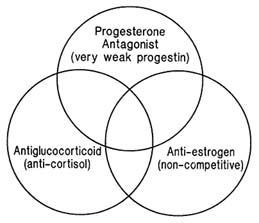
FIGURE B11.1 Competitive displacement of progesterone due to higher affinity of the antagonist and its long metabolic half-life in circulation.
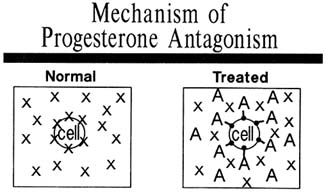
FIGURE B11.2 Multiple actions of antiprogestins.
expressing progestin activity (Figure B11.2), albeit less than 1/1,000 that of levo-norgestrel, a synthetic progestin (Gravanis et al., 1985; Koering et al., 1986; Wolf et al., 1989a) (Figure B11.3).
Antiglucocorticoid Activity
In addition, certain antiprogestins are known to exert antiglucocorticoid activity upon the adrenocorticotropic hormone (ACTH)/adrenal cortex axis, therein elevating ACTH and cortisol secretion. The degree of this effect is both dose and compound specific, as well as being more pronounced during nighttime hours, when there are inherent diurnal rises in circulating ACTH and cortisol (Healy et al., 1983; Kettel et al., 1991; Chwalisz et al., 1992).
Noncompetitive Antiestrogenic (Antiproliferative) Activity
In the context of estrogen-induced mitogenesis, as it occurs in proliferative endometrium, antiprogestins can also be antiestrogens (Figure B11.4). However, since such antiproliferative actions do not arise through competitive binding of antiprogestins to the estrogen receptor (apparently postreceptor binding mechanisms intervene), the inhibition of tissue growth is called a noncompetitive antiestrogenic activity. This is very different from that achieved by tamoxifen or clomiphene (van Uem et al., 1989; Wolf et al., 1989b; Chwalisz et al., 1991). Moreover, this antiproliferative action of antiprogestins is not a manifestation of a progestin-like agonist activity. As revealed by the concentration of estrogen receptors in endometrial tissue, antiprogestins elevate the estrogen-receptor concentration by about sixfold (Neulen et al., 1990), yet paradoxically mitogenesis due to estrogen-induced growth is strik-
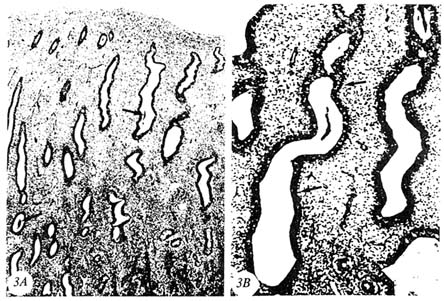
FIGURE B11.3 (A) Section of endometrium and myometrium (M) from an E2treated castrate monkey that was given mifepristone for three days. Most of the glands have an irregular-shaped wall and a wider lumen. Secretory product(s) is present in some glands (arrows) (magnification, × 45). (B) Greater magnification of the same endometrium. The glands are dilated, and epithelium has mainly subnuclear vacuoles (arrows). Areas between the stromal elements are filled with collagen (magnification, × 130).
ingly curtailed (Figure B11.5). In contrast, progestins are known to inhibit endometrial proliferation in association with a marked suppression of estrogen-receptor levels.
Sources of Antiprogestins
It is important to appreciate the limited research and clinical experience to date using antiprogestins. For example, although more than 400 chemical structures of antiprogestins have been devised, and many patented as unique chemical entities, the biological data base from which the above remarks derive largely reflects research on only two antiprogestins. Of the almost 1000 scientific manuscripts and abstracts worldwide, perhaps as much as two-thirds of these reports are on the Roussel-Uclaf (Paris) compound mifepristone (RU 486), with the bulk of the remainder from studies of the Shering AG (Berlin) compound onapristone (ZK 299).
There are substantial additional data on other antiprogestins. Both Organon AKZO (Oss, Netherlands) and Research Triangle Institute
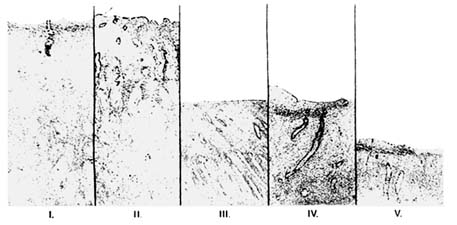
FIGURE B11.4 Sections of the endometrium resting on its myometrium from the five groups (magnification, × 40). After E2 treatment, the endometrium is thick, the stroma dense, and the glands tubular (panel I). With progesterone stimulation, glands became tortuous and the stroma edematous (panel II). Association of P with mifepristone resulted in a midproliferative endometrium (panel III), whereas mifepristone induced a dosedependent inhibition of glandular development and endometrium growth (panels IV and V).

FIGURE B11.5 Endometrial estradiol-receptor concentrations measured after different treatment regimens (estradiol implants versus estradiol implants plus 11 µM progesterone, or estradiol implants plus 2.2 µM or 11 µM mifepristone).
(North Carolina) have made genuine contributions to antiprogestin research and reported preliminarily on their findings (Hodgen et al., 1993). However, a larger body of more recent data on additional antiprogestins is cloaked by proprietary interests. Hopefully, these
findings will be reported publicly soon. A Chinese version of mifepristone is also being produced for abortifacient use in that country.
PART II: NONCOMPETITIVE ANTIESTROGENIC ACTIVITY OF PROGESTERONE ANTAGONISTS
That some progesterone antagonists express other biological activities, besides being antiprogestins, was revealed by the antiglucocorticoid functions of mifepristone (Healy et al., 1983, 1985). More recently, we reported that mifepristone has a noncompetitive antiestrogenic activity that blocks estrogen-induced endometrial proliferation in primates (van Uem et al., 1989). This action of the antiprogestin was later found to be dose dependent in the presence of physiologic estradiol (Wolf et al., 1989b). Paradoxically, we found that mifepristone elevates the concentration of estrogen receptors in monkey endometrium, yet the mitogenic (proliferative) impact of estrogen on endometrial growth was negated (Neulen et al., 1990).
These observations are consistent with other monkey and human data that may substantiate this antiproliferative activity of mifepristone on primate endometrium (Kettel et al., 1991; Murphy et al., 1991; Batista et al., 1992). Apparently, other progesterone antagonists may also possess this property. For example, Chwalisz and coworkers recently reported that onapristone curtails endometrial growth (Chwalisz et al., 1991). Based on this report, we wonder how general this activity may be among a wider spectrum of antiprogestin compounds.
Below, some basic biological studies are summarized that suggest potential therapeutic uses of the antiproliferative activity of antiprogestins on uterine tissues.
Initial Evidence of Noncompetitive Antiestrogenic Activity of Mifepristone
In previous studies, mifepristone administration arrested spontaneous folliculogenesis (van Uem et al., 1989). To investigate the central versus peripheral effects of mifepristone on the ovarian/menstrual cycle, including endometrial proliferation, mifepristone was administered daily [10 mg/kg per day, intramuscular (IM)] from menstrual cycle day 3 or 7 to day 25 in six normal adult cynomolgus monkeys receiving human menopausal gonadotropin (hMG) treatment [37.5 IU (international units) per day] from days 3 to 8. Mifepristone administration with hMG/human chorionic gonadotropin (hCG) therapy did not inhibit ovarian response, as evidenced by steroidogenesis and ovulation. Nine of 23 oocytes retrieved by lavage or follicular aspiration at laparotomy after ovulation induction were morphologically classified as mature
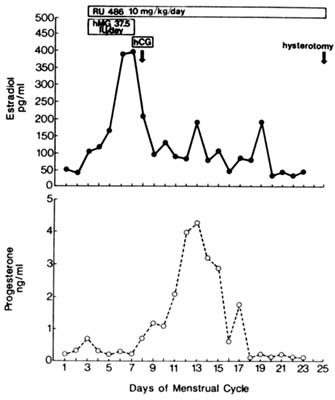
FIGURE B11.6 Representative ovarian response during the coadministration of mifepristone and hMG/human chorionic gonadotropin in a monkey. Similar hormonal patterns for estradiol and progesterone in serum were observed in all other five mifepristone-treated monkeys, as well as in both control females.
preovulatory status. Whereas endometrial biopsies performed on cycle day 25 in control monkeys revealed an in-phase mature secretory endometrium, histologic sections from mifepristone plus hMG/hCG-treated females uniformly demonstrated atrophic to weakly proliferative endometrium on cycle day 25. This was despite serum estradiol levels of > 300 pg/ml during hMG/hCG treatment (Figure B11.6). Three months after the initial 25-day study, endometrial biopsies revealed persistent atrophic endometrium even though repeated ovulation induction with hMG/hCG therapy resulted in elevated serum estrogen concentrations. The findings were observed whether mifepristone treatment began on cycle day 3 or 7. The intermenstrual interval was significantly lengthened by mifepristone treatments (28.5 ± 2.0 days for controls versus
131.3 ± 11.5 days for mifepristone treatment; P < .01).
In summary, mifepristone consistently blocked ovulation unless hMG/hCG was provided. It elicited a persistent retardation of early proliferative endometrium when administered daily beginning in early or midfollicular phase. The normal mitogenic effects of elevated ovarian estrogen secretion on endometrial tissue were quelled, which uniformly resulted in amenorrhea (Figure B11.3). The long-lasting action of mifepristone in these studies—causing ovulation inhibition and atrophic endometrium—may be due to the depot effect of IM injection. In addition, mifepristone did not prevent ovarian steroidogenesis, ovulation, or oocyte maturation when an ovulation induction regimen of hMG/hCG was given. These findings show that mifepristone alone prevents ovulation by diminishing pituitary gonadotropin secretion, rather than by direct effects on ovarian folliculogenesis. It induces amenorrhea by inhibiting estrogen-induced endometrial proliferation.
Dose-Dependent Blockade of the Proliferative Action of Estradiol Endometrium by Mifepristone
The noncompetitive antiestrogenic effects of mifepristone were examined using estradiol (E2)-treated ovariectomized monkeys given mifepristone, progesterone (P), or both. The E2-induced luteinizing hormone surge of control animals was abrogated by P, mifepristone, or both. Secretory transformation by P was inhibited by mifepristone coadministration. Mifepristone alone at a dose of 1 mg/kg induced endometrial secretory transformation, but higher doses (5 mg/kg) inhibited proliferation and secretory activity (Table B11.1). Thus, in the presence of P, mifepristone is antagonistic, but in the absence of P, it exhibits endometrial progestational effects at low doses and an antiproliferative (antiestrogenic) effect at higher doses (Figure B11.4). These data are encouraging and suggest that mifepristone should continue to be evaluated as a potential contraceptive agent acting at the pituitary or endometrial level or both.
Mifepristone-Induced Elevations of Estrogen Receptor in Primate Endometrium
We have conducted a study to investigate the effect of the antiprogestin mifepristone on estradiol-receptor concentrations in the endometrium of monkeys given physiologic estrogen replacement therapy. Estradiol-17ß (E2) silastic implants were inserted infrascapularly into 12 long-term ovariectomized cynomolgus monkeys (Macaca fascicularis), resulting in an average peripheral serum level of approximately 100
TABLE B11.1 Effect of RU 486 and Progesterone on Ovariectomized Monkeys
pg/ml E2. On day 6 of E2 treatment, four treatment groups were initiated:
Group I: E2 implants only;
Group II: E2 implants plus 11 µmol progesterone/kg body weight in sesame oil, IM, on days 6, 7, and 8;
Group III: E2 implants plus 2.2 µmol mifepristone/kg in sesame oil, IM, on days 6, 7, and 8;
Group IV: E2 implants plus 11 µmol mifepristone/kg, IM, on days 6, 7, and 8.
On treatment day 9, endometrial biopsies were removed by hysterotomies. Cytosolic and nuclear E2-receptor contents of tissues were estimated by the charcoal method (Figure B11.5). In group I, the tissue contained 376 ± 123 pmol bound [3H]E2 per gram of protein; the nuclear portion of binding was about 16 percent. In group II, the tissue contained 216 ± 64 pmol bound [3H]E2 per gram of protein; the nuclear binding portion was only 8 percent. In group III, tissue contained 654 ± 47 pmol bound [3H]E2 per gram of protein; the nuclear binding portion was about 22 percent. In group IV, the tissue contained 1198 ± 172 pmol bound [3H]E2 per gram of protein; the nuclear binding portion was about 17 percent. Scatchard plot analysis indicated that the Kd app of the estrogen receptor (1.04 × 10⁻⁹ M) was not altered by mifepristone. This study demonstrates that after physiologic E2-replacement, antiprogestin treatment will cause E2 receptor concentrations to rise dramatically; this effect was dose dependent.
Whether this noncompetitive antiestrogenic (antiproliferative) property of certain antiprogestins extends to breast cancers that are estrogen or estrogen-progestin dependent is not known. In addition, the effects of mifepristone, onapristone, and other progesterone antagonists on estrogen-dependent physiological functions, such as bone density and lipid-related cardiovascular health, remain to be evaluated, especially in the context of long-term regimens.
REFERENCES
Batista, M.C., Cartledge, T.P., Zellmer, A.W., et al. Delayed endometrial maturation induced by daily administration of the anti-progestin RU 486: A potential new contraceptive strategy. American Journal of Obstetrics and Gynecology 167:60–65, 1992
Chwalisz, K., Hegele-Hartung, C., Fritzemeier, K.H., et al. Inhibition of the estradiol
mediated endometrial gland formation by the anti-gestagen onapristone in rabbits: Relationship to uterine estrogen receptors. Endocrinology 129:312–322, 1991.
Chwalisz, K., Hsiu, J.G., Williams, R.F., et al. Evaluation of the anti-proliferative actions of the progesterone antagonists mifepristone (RU 486) and onapristone (ZK98299) on primate endometrium. [Abstract] Presented at the 39th Annual Meeting of the Society for Gynecologic Investigation, San Antonio, Texas, March 18–23, 1992.
Gravanis, A., Schaison, G., George, M., et al. Endometrial and pituitary responses to the steroidal antiprogestin RU 486 in postmenopausal women. Journal of Clinical Endocrinology and Metabolism 60:156–163, 1985.
Haluska, G.J., West, N.B., Novy, M.J., et al. Uterine estrogen receptors are increased by RU 486 in late pregnant rhesus macaques but not after spontaneous labor. Journal of Clinical Endocrinology and Metabolism 70:181–186, 1990.
Healy, D.L., Schulte, H.M., Chrousos, G.O., et al. Pituitary and adrenal hormone profiles in response to the anti-progesterone and anti-glucocorticoid steroid RU 486 in primates. Journal of Clinical Endocrinology Metabolism 57:863–865, 1983.
Healy, D.L., Chrousos, G.P., Schulte, H.M., et al. Increased ACTH, cortisol and arginine vasopressin secretion in primates following the anti-glucocorticoid steroid RU 486. Journal of Clinical Endocrinology and Metabolism 60:1–4, 1985.
Hodgen, G.D. Anti-progestins: The political chemistry of RU 486. Fertility and Sterility 56:394–396, 1991.
Hodgen, G.D., van Uem, J.F.H.M., Chillik, C.F., et al. Noncompetitive anti-estrogenic activity of progesterone antagonists in primate models. Presented at the Terra Symposium, Mohonk Mountain, New York, May 1992. Human Reproduction 1993 (in press).
Kettel, L.M., Murphy, A.A., Mortola, J.P., et al. Endocrine responses to long-term administration of the antiprogesterone RU 486 in patients with pelvic endometriosis. Fertility and Sterility 56:402–407, 1991.
Koering, M.J., Healy, D.L., and Hodgen, G.D. Morphological response of endometrium to a progesterone receptor antagonist, RU 486, in monkeys. Fertility and Sterility 45:280–287, 1986.
Murphy, A.A., Kettel, L.M., Morales, A., et al. Response of uterine fibroids to the antiprogesterone RU 486: A pilot study. (Abstract 0–071). Presented at the 47th Annual Meeting of the American Fertility Society, Orlando, Florida, 1991.
Neulen, J., Williams, R.F., and Hodgen, G.D. RU 486 (Mifepristone): Induction of dose-dependent elevations of estradiol receptor in endometrium from ovariectomized monkeys. Journal of Clinical Endocrinology and Metabolism 71:1074–1075, 1990.
van Uem, J.F., Hsiu, J.G., Chillik, C.F., et al. Contraceptive potential of RU 486 by ovulation inhibition: I. Pituitary vs ovarian action and blockade of estrogen-induced endometrial proliferation. Contraception 40:171–184, 1989.
Wolf, J.P., Danforth, D.R., Ulmann, A., et al. Contraceptive potential of RU 486 by ovulation inhibition: II. Suppression of pituitary gonadotropin secretion in vitro. Contraception 40:185–193, 1989a.
Wolf, J.P., Hsiu, J.G., Anderson, T.L., et al. Noncompetitive anti-estrogenic effect of RU 486 in blocking the estrogen-stimulated luteinizing hormone surge and the proliferative action of estradiol on endometrium in castrate monkeys. Fertility and Sterility 52:1055–1060, 1989b.


