
9
Population Growth, Environmental Change, and Innovation: Implications for Sustainable Growth in Agriculture
Vernon W. Ruttan
In this paper I explore a number of agricultural, resource, and environmental concerns that will condition the capacity of the agricultural sector to respond to the demands that population and income growth will place on the sector—particularly in the developing countries of Latin America, Asia, and Africa.
CONCERNS ABOUT RESOURCES AND THE ENVIRONMENT
I first place these concerns about the implications of natural resource availability and environmental change within a broader historical and theoretical context. We are now in the midst of the third wave of social concern since World War II about the implications of natural resource availability and environmental change for the sustainability of improvements in human well-being.
The Three Waves of Concern
The first wave of concern, in the late 1940s and early 1950s, focused primarily on the quantitative relationships between resource availability and economic growth—the adequacy of land, water, energy, and other natural resources to sustain growth. The reports of the President's Water Resources Policy Commission (1950) and the President's Materials Policy Commission (1952) were the landmarks of the early postwar resource assessment
studies generated in response to this wave of concern. The primary response to this first wave of concern was technical change. In retrospect it appears that a stretch of high prices has not yet failed to induce the new knowledge and new technologies needed to locate new deposits of natural resources, promote substitution, and enhance productivity. If the Materials Policy Commission were writing today, it would have to conclude that there has been abundant evidence of the nonevident becoming evident; the expensive cheap; and the inaccessible accessible (Barnett and Morse, 1963; Ausubel and Sladovich, 1989).
The second wave of concern occurred in the late 1960s and early 1970s. The earlier concern with the potential ''limits to growth'' imposed by natural resource scarcity was supplemented by concern about the capacity of the environment to assimilate the multiple forms of pollution generated by growth. An intense conflict was emerging between the two major sources of demand for environmental services. One was the rising demand for environmental assimilations of residuals derived from growth in commodity production and consumption—asbestos in our insulation, pesticides in our food, smog in the air, and radioactive wastes in the biosphere. The second was the rapid growth in consumer demand for environmental amenities—for direct consumption of environmental services—arising out of rapid growth in per capita income and high-income elasticity of demand for such environmental services as access to natural environments and freedom from pollution and congestion (Ruttan, 1971). The response to these concerns, still incomplete, was the creation of local and regional institutions designed to force individual firms and other organizations to bear the costs arising from the externalities generated by commodity production.
Since the mid-1980s these two earlier concerns have been supplemented by a third. These newer concerns center around the implications for environmental quality, food production, and human health of a series of environmental changes that are occurring on a transnational scale—issues such as global warming, ozone depletion, acid rain, and others (National Research Council, 1990, 1991). The institutional innovations needed to respond to these concerns will be more difficult to design. They will, like the sources of change, need to be transnational or international. Experience with attempts to design incentive-compatible transnational regimes, such as the Law of the Sea Convention, or even the somewhat more successful Montreal Protocol on reduction of CFC emissions, suggests that the difficulty of resolving free rider and distributional equity issues imposes a severe constraint on how rapidly effective transnational regimes to overcome these new environmental concerns can be put in place.
It is of interest that, with each new wave of concern, the issues that dominated the earlier wave were recycled. The result is that while the intensity of earlier concerns has receded, in part due to the induced technical and institutional changes, the concerns about the relationships between
resource and environmental change and sustainable growth in agricultural production has broadened (Graham-Tomasi, 1991). Terms that had initially been introduced by the populist critics of agricultural research—such as alternative, low-input, regenerative, and sustainable agriculture—began to enter the vocabulary of those responsible for agricultural research resource allocation.
The Agricultural Transformation
In the closing years of the twentieth century we are completing one of the most remarkable transitions in the history of agriculture. Prior to this century almost all the increase in food production was obtained by bringing new land into production. There were only a few exceptions to this generalization—in limited areas of East Asia, the Middle East, and Western Europe (Hayami and Ruttan, 1985).
By the first decade of the next century, almost all of the increases in world food production must come from higher yields—fr om increased output per hectare. In most of the world the transition from a resource-based to a science-based system of agriculture is occurring within a single century. Most of the countries of the developing world have been caught up in the transition only since midcentury. Among developing countries those countries of East, Southeast, and South Asia have proceeded further in this transition than have most countries in Latin America or Africa.
Recent historical trends in production and consumption of the major food grains could easily be taken as evidence that one should not be excessively concerned about the capacity of the world's farmers to meet future food demands. World wheat prices, corrected for inflation, have declined since the middle of the last century. Rice prices have declined since the middle of this century (Edwards, 1988; Pingali, 1988). These trends suggest that productivity growth has been able to more than compensate for the rapid growth in demand, particularly during the decades since World War II.
As we look toward the future, however, the sources of productivity growth are not as apparent as they were a quarter century ago. The demands that the developing economies will place on their agricultural producers from population growth and growth in per capita consumption arising out of higher income will be exceedingly high. Population growth rates are expected to decline substantially in most countries during the first quarter of the next century. But the absolute increases in population size will be large and increases in per capita incomes will add substantially to food demand. The effect of growth in per capita income will be more rapid growth in demand for animal proteins and for maize and other feed crops. During the next several decades growth in food and feed demand rising from growth in population and income will run upwards of 4.0 percent per
year in many countries. Many will experience more than a doubling of food demand before the end of the second decade of the next century.
CHANGES INDUCED BY POPULATION GROWTH1
In the theory of induced innovation, changes in relative resource endowments, such as shifts in the ratio of agricultural labor to land, are viewed as directing technical change along a path that permits the substitution of relatively more abundant factors for the relatively scarce factors of production. Institutional changes are also viewed as induced by changes in relative resource endowments, by changes in cultural endowments, and by changes in technology.
Induced Technical Change2
The process by which technical change is generated has traditionally been treated as exogenous to the economic system—as a product of autonomous advances in scientific and technical knowledge. Over the last several decades, advances in economic theory and the accumulation of empirical evidence have tended to confirm that the rate and direction of technical change can be interpreted as largely endogenous to the economic system—as induced by differences or changes in the conditions of factor supply and product demand. In agriculture, the constraints imposed on development by an inelastic supply of land may be offset by advances in biological technology; the constraints imposed by an inelastic supply of labor may be offset by advances in mechanical technology.
In the dynamic process of economic development, changes in product demand and relative factor prices are inseparably related. For example, when food demand rises because of growth in population or per capita income, or both, the demand for factor inputs in food production increases more or less proportionally. When increases in factor demands are confronted with different elasticities in the supply of production factors, the effect is a change in relative factor prices. The different rates of change in factor prices result, in turn, in changes in the level of income and income distribution among factor owners, thereby affecting the aggregate product demand.
The significance of the induced technical change hypothesis for economic development is that multiple paths of technical change are available to society. The ability of a society to achieve rapid growth in agricultural productivity and output seems to hinge on its ability to make efficient choices among alternative paths. There is substantial evidence that the direction of technical changes has been responsive to relative resource endowments in both the agricultural and nonagricultural sectors, in both traditional and modern societies (Thirtle and Ruttan, 1987).
The initial tests of the induced-innovation hypothesis were against the experience of the United States and Japan for the period 1880–1960. Additional tests have been conducted against the experience of other developed and developing countries. The Japan-U.S. tests have now been extended from 1880–1960 to 1880–1980 (Hayami and Ruttan, 1985). In 1880, Japan and the United States were characterized by extreme differences in relative endowments of land and labor. These differences have widened over time. By 1980, total agricultural land area per male worker was more than 100 times as large and arable land area per male worker about 50 times as large in the United States as in Japan.
The relative prices of land and labor also differed sharply in the two countries. In 1880, to buy a hectare of arable land, a Japanese hired farm worker would have had to work 8 times as many days as a U.S. farm worker. By 1960, a Japanese farm worker would have had to work 30 times as many days as a U.S. farm worker to buy one hectare of arable land. This gap was reduced after 1960, partly because of extremely rapid increases in wage rates in Japan. In the United States, land prices rose sharply in the postwar period. Yet in 1980, a Japanese farm worker still would have had to work 11 times as many days as a U.S. worker to buy one hectare of land.
The relationships between relative factor prices and factor use portrayed in Figures 1.A and 1.B are clearly consistent with the hypothesis that the alternative paths of technical change followed by Japan and the United States have been induced by relative resource endowments interpreted through relative factor prices. When simple relationships emerge as powerfully as they do in Figures 1.A and 1.B, one is tempted to forego more formal tests. The intuitive implications of the data presented in these two figures have, however, been confirmed by more formal tests.3
The question is frequently raised as to whether advances in indigenous
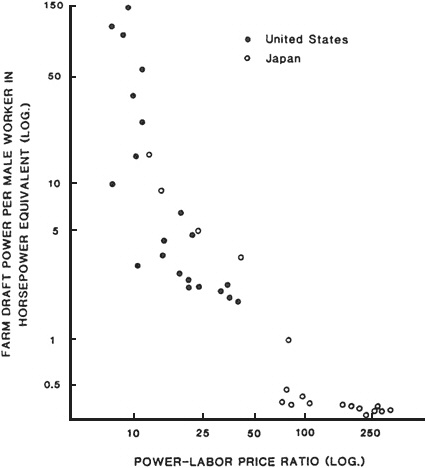
Figure 1.A Relationship between farm draft power per male worker and power-labor price ratio, the United States and Japan: quinquennial observations for 1880–1980.
NOTE: Equals number of workdays that can be purchased by one horsepower of tractor or draft animal. SOURCE: Hayami and Ruttan (1985). Reprinted with permission.
technology induced by population density, along the lines outlined by Boserup (1965) and more recently by Binswanger and several colleagues (Pingali et al., 1987) would be sufficient to sustain rising levels of per capita income and consumption (Robinson and Schutjer, 1984). A positive response would be excessively romantic. We agree with Boserup that in preindustrial societies, agricultural production often responded "far more generously to addi-
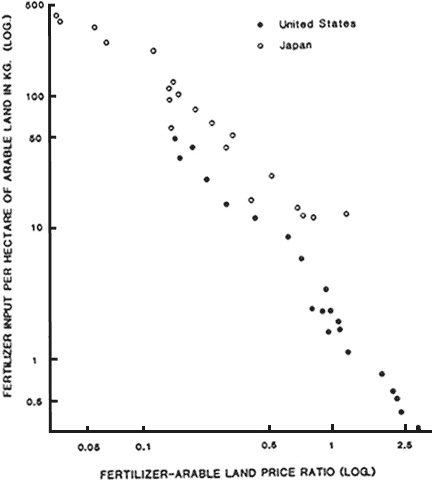
Figure 1.B Relationship between fertilizer input per hectare of arable and the fertilizer-arable land price ratio, the United States and Japan: quinquennial observations for 1880– 1980. NOTE: Equals hectares of arable land that can be purchased by one ton of N + P2Ot + K2O contained in commercial fertilizers. SOURCE: Hayami and Ruttan (1985). Reprinted with permission.
tional inputs of labor than assumed by Neo-Malthusian authors" (Boserup, 1965:15). But Boserup herself argued that the transition to more intensive cultivation would be accompanied by a rise in the number of days worked per year and a decline in output per hour worked (1965:30). And we should not ignore the findings of Ronald Lee that in preindustrial England, annual
population growth rates beyond 0.4 percent had "dramatic consequences." The effect of more rapid population growth rates was to raise rents and turn the domestic terms of trade against the agricultural sector (Lee, 1980:547).4 Under preindustrial conditions, growth in output per hectare was typically accompanied by reductions in output per unit of labor input. However, a decline in labor productivity, measured in terms of output per hour or per day, if accompanied by an increase in the number of hours or days worked per year, is not incompatible with a rise in annual output or income per worker. This is the classic pattern followed on the wet rice cultivation areas of East Asia during the shift from upland to rainfed rice production, and then from rainfed to irrigated rice production. It is the pattern described by Binswanger and his colleagues in the transition in farming systems and technology from forest fallow to multiple cropping. In the long run, however, even with relatively slow growth in population or labor force, output per worker per year tends to stagnate or decline as the response of indigenous technical change to population growth declines.
The higher rates of growth in agricultural production, and in output per hectare and per worker, that are consistent with modern population and income growth rates, have required institutionalization of capacity to supplement indigenous knowledge with science-based knowledge and craft-generated technology with industrial inputs that embody advances in scientific and technical knowledge. It also requires institutionalization of the capacity to deliver the new knowledge and the new technology to farm people and higher levels of investment in human capital in rural areas if the new technical opportunities are to be effectively exploited.
Induced Institutional Change
In the previous section, a model was outlined in which technical change was treated as largely endogenous to the economic system. But the success of the theory of induced technical change gives rise to the need for a more adequate understanding of the sources of institutional change. Institutions are the rules of society, or of organizations, that facilitate coordination among people by helping them form expectations that each person can reasonably hold in dealing with others. They reflect the conventions that have evolved in different societies regarding the behavior of individuals and groups relative to their own behavior and the behavior of others. In the area of economic relations, they have a crucial role in establishing expectations about the rights to use resources in economic activities and about the parti-
tioning of the income streams resulting from economic activity (Runge, 1981a:xvi, 1981b; Sen, 1967).5
The sources of demand for technical and institutional change can be viewed as being essentially similar. A rise in the price of land (or natural resources) in relation to the price of labor induces technical changes that release the constraints on production from an inelastic supply of land, and, at the same time, induces institutional change that leads to greater precision in the definition and allocation of property rights in land. A rise in the price of labor relative to land (or natural resources) induces technical changes that permit the substitution of capital for labor and at the same time induces institutional changes that enhance the productivity of the human agent and increase workers' control over the conditions of employment. The new income streams generated by technical change and by institutional efficiency induce changes in the relative demand for products and open up new and more profitable opportunities for product innovations.
Shifts in the supply of technical and institutional change may also be generated by similar forces. Advances in knowledge in science and technology reduce the cost of the new income streams that are generated by technical change. Advances in knowledge in the social sciences and related professions reduce the cost of the new income streams that are generated by gains in institutional innovation and improvements in institutional performance. Collective action leading to changes in the supply of institutional innovations often involves severe stress among the interest groups and communities that stand to gain or lose from the changes. The rate and direction of institutional change depends critically on cultural traditions and ideology that influence the cost or acceptability of changes in institutional arrangements and on the power balance among interest groups. Education, both general and technical, that facilitates a better understanding among people of their common interests can reduce the cost of institutional innovation.
We illustrate, in Figure 2, the elements of a model that maps the general equilibrium relationships among resource endowments, cultural endowments, technologies, and institutions. The model goes beyond the conven-
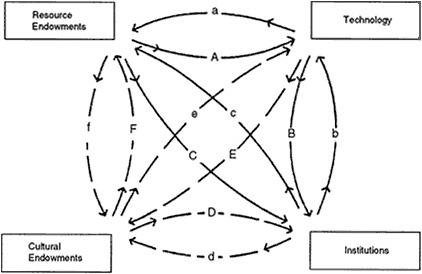
Figure 2 Interrelationships between changes in resource endowments, cultural endowments, technology, and institutions. SOURCE: Hayami and Ruttan (1985). Reprinted with permission.
tional general equilibrium model in which resource endowments, technologies, institutions, and culture (conventionally designated as tastes) are given.6 In the study of long-term social and economic change, the relationships among the several variables must be treated as recursive. The formal microeconomic models that are employed to analyze the supply and demand for technical and institutional change can be thought of as "nested" within the general equilibrium framework of Figure 2.
One advantage of the "pattern model" outlined in Figure 2 is that it helps to identify areas of ignorance. Our capacity to model and test the relationships between resource endowments and technical change is relatively strong. Our capacity to model and test the relationships between cultural endowments and either technical or institutional change is relatively weak. A second advantage of the model is that it is useful in identifying the components that enter into other attempts to account for secular
economic and social change. Failure to analyze historical change in a general equilibrium context tends to result in a unidimensional perspective on the relationships bearing on technical and institutional change.
For example, historians working within the Marxist tradition often tend to view technical change as dominating both institutional and cultural change. In his book Oriental Despotism, Karl Wittfogel views the irrigation technology used in wet rice cultivation in East Asia as determining as political organization (Wittfogel, 1957). As applied to Figure 2, his primary emphasis was on the impact of resources and technology on institutions (B) and (C). A serious misunderstanding can be observed in neo-Marxian critiques of the green revolution. These criticisms have focused attention almost entirely on the impact of technical change on labor and land tenure relations. Both the radical and populist critics have emphasized relation (B). But they have tended to ignore relationships (A) and (C). This bias has led to repeated failure to identify effectively the separate effects of population growth and technical change on the growth and distribution of income (Cleaver, 1972; Griffin, 1974).
Armen Alchian and Harold Demsetz identify a primary function of property rights as guiding incentives to achieve greater internalization of externalities (Alchian and Demsetz, 1973; Demsetz, 1967). They consider that the clear specifications of property rights reduces transaction costs in the face of growing competition for the use of scarce resources as a result of population growth and/or growth in production demand. North and Thomas (1970), building on the Alchian-Demsetz paradigm, attempted to explain the economic growth of western Europe between 00 and 1700 primarily in terms of changes in property institutions.7 During the eleventh and thirteenth centuries the pressure of population against increasingly scarce land resources induced innovations in property rights that in turn created profitable opportunities for the generation and adoption of labor-intensive technical changes in agriculture (line C).
In a more recent work, Mancur Olson has emphasized the proliferation of institutions as a source of economic decline (Olson, 1982).8 He also
regards broad-based encompassing organizations as having incentives to generate growth and redistribute incomes to their members with little excess burden. For example, a broadly based coalition that encompasses the majority of agricultural producers is more likely to exert political pressure for growth-oriented policies that will enable its members to obtain a larger share of a larger national product than a smaller organization that represents the interests of the producers of a single commodity. But large groups, in Olson's view, are inherently unstable because rational individuals will not incur the costs of contributing to the realization of a large group program—they have strong incentives to act as free riders. As a result, organizational ''space'' in a stable society will be increasingly occupied by special interest "distributional coalitions." These distributional coalitions make political life divisive. They slow down the adoption of new technologies (line b) and limit the capacity to reallocate resources (line c). The effect is to slow down economic growth or in some cases initiate a period of economic decline.
In some cases the demand for institutional innovation can be satisfied by the development of new forms of property rights, more efficient market institutions, or evolutionary changes arising out of direct contracting by individuals at the level of the community or the firm. In other cases, in which externalities are involved, substantial political resources may have to be brought to bear to organize nonmarket institutions to provide for the supply of public goods.
Research conducted by Hayami and Kikuchi (Kikuchi and Hayami, 1978; Hayami and Kikuchi, 1981) in the Philippines in the late 1970s enables us to examine a contemporary example of the interrelated effects of technical change and population growth on the demand for institutional change in land tenure and labor relations. In the Philippines case they studied, the induced-innovation process leading toward the establishment of equilibrium in factor markets occurred rather rapidly even though many of the transactions—between landlords, tenants, and laborers—were less than fully monetized. Informal contractual arrangements or agreements were used. The subleasing and the gamma labor contract evolved without the mobilization of substantial political activity or bureaucratic effort because the contracting parties shared common cultural endowments.
The development and introduction of new institutions in larger populations characterized by considerable cultural heterogeneity would require the mobilization of substantial bureaucratic and political resources. A richer model is needed in environments in which (a) institutional change involves the redistribution of existing resources or income shares rather than the partitioning of growth dividends or (b) inequities in the distribution of economic and political resources preclude the kind of simple recontracting that
characterized the Philippine village case of Hayami and Kikuchi.9 Its value is that it exhibits so clearly the interaction of population pressure, change in agricultural technology, and change in agrarian institutions.
Induced Innovation and the Environment
We are, as noted in the introduction, now in the third post-World War II wave of concern about the implications of natural resource availability and environmental change for the sustainability of improvements in human well-being. Over this period we have seen a transition from primary concern with the material basis for agricultural and industrial development to the impact of the intensification of agricultural and industrial activity on the environment—from a concern about the material basis of production to the "sink" capacity of the environment. One effect of this transition has been to weaken the signals provided by market forces on the rate and direction of technical and institutional change.
Under present institutional arrangements substantial components of the physical and social environments continue to be undervalued for purposes of market transactions, even though they have become common property resources of great and increasing value. The effect has been to bias the rate and direction of technical change toward excessive production of a wide range of residual and spillover effects and away from increased efficiency in the supply of resource amenities (Ruttan, 1971).
In this view the environmental stress resulting from pollution and from the transformation of land use in fragile environments is not simply a byproduct of the autonomous forces of population and income growth or of technical change. The system of legal and economic institutions that govern the use of common property resources has failed to evolve in a manner consistent with (a) the rising demand for capacity to receive and assimilate the residuals associated with commodity production and consumption and
(b) the shift to the right in the demand for resource amenities associated with high and rising per capita incomes.
Traditional production theory implies that if the price of a factor input is zero (or close to zero) that factor will be used until the value of its marginal product approaches zero. This will occur even though the marginal social product may be negative. In an environment characterized by rapid economic growth, technical changes induced by changes in relative factor prices will bias the direction of technical change. The demand for a resource that is priced below its social cost will grow more rapidly than it would in a situation in which substitution possibilities can occur only along a "given" production surface. The effect is to accelerate the widening gap between the private and social costs of environmental services.
The situation in which we find ourselves—in which there is a widening gap between the inducements provided by markets and the shadow prices for resource and environmental amenities—comes at a time when the political resources that will be necessary to bring about the needed institutional innovations have been eroding. The implicit demand for market and nonmarket institutional innovations to deal with the spillover effects of agricultural and industrial intensification is clearly rising. The development of effective market institutions, to achieve more efficient use of water resources for example, will require public intervention in market design. New regulatory regimes will be required when market factors continue to represent a constraint on effective resource use. But we are caught in a "time warp" in which ideological currents are running in a direction that has weakened the capacity for public sector institutional design and information.
CONSTRAINTS ON FUTURE AGRICULTURAL PRODUCTION
In this section I discuss some of the (a) scientific and technical constraints and (b) the resource and environmental constraints that can be expected to impinge on sustainable growth in agricultural production as we move into the early decades of the next century. These constraints were identified in a series of consultations held during 1989 and 1990 with the support of the Rockefeller Foundation (Ruttan, 1989, 1992).
Scientific and Technical Constraints
It seems apparent that the gains in agricultural production required over the next quarter century will be achieved with much greater difficulty than in the immediate past. Difficulty is currently being experienced in raising yield ceilings for the cereal crops that have experienced rapid yield gains in the recent past. The incremental response to increases in fertilizer use has declined. Expansion of irrigated area has become more costly. Mainte-
nance research, the research required to prevent yields from declining, is rising as a share of research effort (Plucknett and Smith, 1986). The institutional capacity to respond to these concerns is limited, even in the countries with the most effective national research and extension systems. Indeed, there has been considerable difficulty in many countries during the 1980s in maintaining the agricultural research capacity that had been established during the 1960s and 1970s (Cummings, 1989).
It is possible that within another decade, advances in basic knowledge will create new opportunities for advancing agricultural technology that will reverse the urgency of some of the above-mentioned concerns. The institutionalization of private sector agricultural research capacity in some developing countries is beginning to complement public sector capacity (Pray, 1983). Advances in molecular biology and genetic engineering are occurring rapidly. But the date when these promising advances will be translated into productive technology seems to be receding. The limits arising out of scientific and technical constraints have important implications for agricultural research agendas.
Advances in conventional technology will remain the primary source of growth in crop and animal production over the next quarter century. Almost all increases in agricultural production over the next several decades must continue to come from further intensification of agricultural production on land that is presently devoted to crop and livestock production. Until well into the second decade of the next century the necessary gains in crop and animal productivity will be generated by improvements from conventional plant and animal breeding and from more intensive and efficient use of technical inputs including chemical fertilizers, pesticides and more effective animal nutrition. The productivity gains from conventional sources are likely to come in smaller increments than in the past. If they are to be realized, higher plant populations per unit area, new tillage practices, improved pest and disease control, more precise application of plant nutrients, and advances in soil and water management will be required. Gains from these sources will be crop, animal, and location specific. They will require closer articulation between the suppliers and users of new knowledge and new technology. These sources of yield gains will be extremely knowledge and information intensive. If they are to be realized, research and technology transfer efforts in the areas of information and management technology must become increasingly important sources of growth in crop and animal productivity.
Advances in conventional technology will be inadequate to sustain the demands that will be placed on agriculture as we move into the second decade of the next century and beyond. Advances in crop yields have come about primarily by increasing the plant populations per hectare and by increasing the ratio of grain to straw in individual plants. Advances in animal
feed efficiency have come largely by decreasing the proportion of feed consumed that is devoted to animal maintenance and increasing the proportion used to produce usable animal products. There are severe physiological constraints to continued improvement along these conventional paths. These constraints are most severe in those areas that have already achieved the highest levels of productivity—as in Western Europe, North America, and parts of East Asia. The impact of these constraints can be measured in terms of declining incremental response to energy inputs—both in the form of a reduction in the incremental yield increases from higher levels of fertilizer application, and a reduction in the incremental savings in labor inputs from the use of larger and more powerful mechanical equipment. If the incremental returns to agricultural research should also decline, it will impose a higher priority on efficiency in the organization of research and on the allocation of research resources.
A reorientation of the way we organize agricultural research will be necessary to realize the opportunities for technical change being opened up by advances in microbiology and biochemistry. Advances in basic science, particularly in molecular biology and biochemistry, have and are continuing to open up new possibilities for supplementing traditional sources of plant and animal productivity growth. A wide range of possibilities were discussed at the consultation—ranging from the transfer of growth hormones into fish to conversion of lignocellulose into edible plant and animal products. The realization of these possibilities will require a reorganization of agricultural research systems. An increasing share of the new knowledge generated by research will reach producers in the form of proprietary products or services. This means that incentives must be created to draw substantially more private sector resources into agricultural research. Within the public sector, research will have to move increasingly from a "little science" to a "big science" mode of organization. Examples include the Rockefeller Foundation-sponsored collaborative research program on the biotechnology of rice and the University of Minnesota's program on the biotechnology of maize. In the absence of more focused research efforts, it seems likely that the promised gains in agricultural productivity from biotechnology will continue to recede.
Efforts to institutionalize agricultural research capacity in developing countries must be intensified. Crop and animal productivity levels in most developing countries remain well below the levels that are potentially feasible. Access to the conventional sources of productivity growth—from advances in plant breeding, agronomy, and soil and water management will require the institutionalization of substantial agricultural research capacity for each crop or animal species of economic significance in each agroclimatic region. In a large number of developing countries this capacity is just beginning to be put in place. A number of countries that experienced
substantial growth in capacity during the 1960s and 1970s have experienced an erosion of capacity in the 1980s. Even a relatively small country, producing a limited range of commodities under a limited range of agroclimatic conditions, will require a cadre of about 250–300 agricultural scientists. Countries that do not acquire adequate agricultural research capacity will not be able to meet the demands that they will place on their farmers as a result of growth in population and income.
There are substantial possibilities for developing sustainable agricultural production systems in a number of fragile resource areas. Research underway in the tropical rain forest areas of Latin America and in the semiarid tropics of Africa and Asia suggest the possibility of developing sustainable agricultural systems with substantially enhanced productivity even in unfavorable environments. It is unlikely, and perhaps undesirable, that all of these areas should become important components of the global food supply system. But enhanced productivity is important to those who reside in these areas—now and in the future. It is important that the research investment in the areas of soil and water management and in farming systems be intensified in these areas.
There is a need for the establishment of substantial basic biological research and training capacity in the tropical developing countries. There are a series of basic biological research agendas that are important for applied research and technology development for agriculture in the tropics that receive, and are likely to continue to receive, inadequate attention in the temperate region developed countries. There is also a need for closer articulation between training in applied science and technology and training in basic biology. When such institutes are established they will need to be more closely linked with existing academic centers of research and training than the series of agricultural research institutes established by the Rockefeller and Ford Foundations and the Consultative Group on International Agricultural Research.
Resource and Environmental Constraints on Sustainable Growth
As we look even further into the next century, there is a growing concern about the impact of a series of resource and environmental constraints that may seriously impinge on the capacity to sustain growth in agricultural production.
One set of concerns is about the impact of agricultural production practices that will be employed in those areas that have made the most progress in moving toward highly intensive systems of agriculture production. These include loss of soil resources due to erosion, water-logging, and salinization; groundwater contamination from plant nutrients and pesticides; and
growing resistance of insects, weeds, and pathogens to present methods of control.
A second set of concerns stem from the impact of industrialization on global climate and other environmental changes (Reilly and Bucklin, 1989; Parry, 1990). There can no longer be much doubt that the accumulation of carbon dioxide (CO2) and other greenhouse gases—principally methane (CH4), nitrous oxide (N2O), and chlorofluorocarbons (CFCs)—has set in motion a process that will result in a rise in global average surface temperatures over the next 30–60 years. The resource and environmental constraints also have important implications for research agendas.
A serious effort to develop alternative land use, farming systems, and food systems scenarios for the twenty-first century should be initiated. A clearer picture of the demands that are likely to be placed on agriculture over the next century and of the ways in which agricultural systems might be able to meet such demands has yet to be produced. Past studies of potential climate change effects on agriculture have given insufficient attention to adaptive change in nonclimate parameters. But application of advances in biological and chemical technology, which substitute knowledge for land, and advances in mechanical and engineering technology, which substitute knowledge for labor, have in the past been driven by increasingly favorable access to energy resources—by declining prices of energy. There will be strong incentive, by the early decades of the next century, to improve energy efficiency in agricultural production and utilization. Particular attention should be given to alternative and competing uses of land. Conversion of low-intensity agricultural systems to forest has been proposed as a method of absorbing CO2. There will also be increasing demands on land use for watershed protection and biomass energy production.
The capacity to monitor the agricultural sources and impacts of environmental change should be strengthened. It is a matter of serious concern that only in the last decade and a half has it been possible to estimate the magnitude and productivity effects of soil loss even in the United States. Even rudimentary data on productivity effects of soil loss are almost completely unavailable in most developing countries. The same point holds, with even greater force, for groundwater pollution, salinization, species loss, and other topics.
The design of technologies and institutions to achieve more efficient management of surface and groundwater resources will become increasingly important. The development and introduction of technologies and management systems that enhance water use efficiency represents a high priority both because of short-and intermediate-term constraints on water availability and the longer-term possibility of seasonal and geographical shifts in water availability. The identification, breeding, and introduction
of water-efficient crops for dryland and saline environments is potentially an important aspect of achieving greater water use efficiency.
Research on environmentally compatible farming systems should be intensified. In agriculture, as in the energy field, a number of technical and institutional innovations could have both economic and environmental benefits. Among the technical possibilities is the design of a new "third-" or "fourth-" generation chemical, biorational, and biological pest management technologies. Another is the design of land use technologies and institutions that will contribute to reduction of erosion, salinization, and groundwater pollution.
Immediate efforts should be made to reform agricultural commodity and income support policies. In both developed and developing countries producers' decisions on land management, farming systems, and use of technical inputs (e.g., fertilizers and pesticides) are influenced by government interventions such as price supports and subsidies, programs to promote or limit production, and tax incentives and penalties. It is increasingly important that such interventions be designed to take into account the environmental consequences of decisions by land owners and producers induced by the interventions.
The agricultural science community should be prepared, by the second quarter of the next century, to contribute to the design of alternative food systems. A food-system perspective should become an organizing principle for improvements in the performance of existing systems and for the design of new systems. Many of these alternatives will include the use of plants other than the grain crops that now account for a major share of world feed and food production. Some of these alternatives will involve radical changes in food sources. Rogoff and Rawlins (1987) have described one such system based on lignocellulose—both for animal feed and human consumption.
A major research program on incentive-compatible institutional design should be initiated. The first research priority is to initiate a large-scale program of research on the design of institutions capable of implementing incentive-compatible resource management policies and programs. By incentive-compatible institutions I mean institutions capable of achieving compatibility between individual, organizational, and social objectives in resource management. A major source of the global warming and environmental pollution problem is the direct result of the operation of institutions which induce behavior by individuals, and public agencies that are not compatible with societal development—some might say survival—goals. In the absence of more efficient incentive compatible institutional design, the transaction costs involved in ad hoc approaches are likely to be enormous.
Generic Issues
Many of the problems discussed are international in scope. Many of the institutions that will be needed to enable societies to respond to the constraints on sustainable increases in agricultural production must involve international collaboration or transnational organization.
Our limited capacity to design the institutional infrastructure that will be needed to sustain the required rates of growth in agricultural production as we move through the first decades of the next century must be strengthened. We are going to have to build institutional infrastructures that facilitate more effective collaboration among engineers, agronomists and health scientists—to deal with issues of production, environmental change, and the health of food producers and consumers.
The inadequacy of our capacity to monitor changes in the sources of productivity change, environmental change, and the insults to health must be overcome. We know very little about either the levels or the trajectories of these changes. We talk about soil erosion but we do not have the monitoring capacity to know the extent to which it is weakening our capacity to produce. We are fighting a defensive battle against the health effects of the contamination of our food supply rather than anticipating the sources. One of the puzzling aspects of the data that have become available so far is that the health effects of increased use of fertilizer are less than expected despite high levels of nitrate in surface and groundwater. Neither the developed or developing countries have in place adequate surveillance systems for disease.
SUSTAINABLE GROWTH
In the discussion of the constraints on sustainable growth in agricultural production in the previous section no attempt was made to confront the full implications of the concept of sustainable growth. The concept has emerged as an umbrella under which movements with widely disparate reform agendas have been able to march while avoiding conflicts over their often inconsistent agendas.
Defining Sustainable Growth
Despite the advantages of avoiding defining a term that has apparently been adopted precisely because of its ambiguity, it is useful to trace the evolution of the concept of sustainable growth (Batie, 1989).
Writing in the early 1980s, Gordon K. Douglass identified three alternative conceptual approaches to the definition of agricultural sustainability (Douglass, 1984:3–29). One group defined sustainability primarily in tech-
nical and economic terms—in terms of the capacity to supply the expanding demand for agricultural commodities on increasingly favorable terms. For this group, primarily mainstream agricultural and resource economists, the long-term decline in the real prices of agricultural commodities was evidence that the growth of agricultural production has been following a sustainable path.
Douglass identified a second group that regards agricultural sustainability primarily as an ecological question—"an agricultural system which needlessly depletes, pollutes, or disrupts the ecological balance of natural systems is unsustainable" (Douglass, 1984:2). Among those advancing the ecological sustainability agenda there is a pervasive view that population levels are already too large to be sustained at present levels of per capita consumption (Goodland, 1991).
A third group traveling under the banner of "alternative agriculture" places its primary emphasis on sustaining not just the physical resource base but a broad set of community values (National Research Council, 1989). Its adherents take as a major objective the strengthening or revitalization of rural culture and rural communities guided by a holistic approach to the physical and cultural dimensions of production and consumption.
By the mid-1980s the sustainability concept was diffusing rapidly from the confines of its agroecological origins. The definition that has achieved the widest currency was that adopted by the Bruntland Commission: "Sustainable development is development that meets the needs of the present without compromising the ability of future generations to meet their own needs" (World Commission on Environment and Development, 1987:43). The Bruntland Commission definition raises the possibility that it may be necessary for those of us who are alive today, particularly those of us living in the more affluent societies, to curb our level of material consumption to avoid an even more drastic decline in the consumption levels of future generations. Our historical experience, at least in the West, often causes us to be skeptical about our obligations to future generations. It was less than a generation ago that Robert Solow, one of our leading growth theorists, noted in his Richard T. Ely address to the American Economic Association: "We have actually done quite well at the hands of our ancestors. Given how poor they were and how rich we are, they might properly have saved less and consumed more" (Solow, 1974:9). In most of the world the ancestors have not been so kind!
It is hard to avoid a conclusion that the popularity of the Bruntland Commission definition is due, at least in part, to the fact that the definition is so broad that it is almost devoid of operational significance. The sustainability concept is now undergoing what has been referred to as "establishment appropriation" (Buttel, 1998).
Historically Sustainable Agricultural Systems
We are able to draw on several historical examples of systems that proved capable of meeting the challenge of achieving sustainable increases in agricultural production. One example are the forest and bush fallow (or shifting cultivation) systems practiced in most areas of the world in premodern times and today in many tropical areas (Pingali et al., 1987). At low levels of population density, these systems were sustainable over long periods of time. As population density increased, short fallow systems emerged. Where the shift to short fallow systems occurred slowly, as in Western Europe and East Asia, systems of farming that permitted sustained growth in agricultural production emerged. Where the transition to short fallow has been forced by rapid population growth, the consequence has often been soil degradation and declining productivity.
A second example can be drawn from the agricultural history of East Asian wet rice cultivation (Hayami and Ruttan, 1985). Traditional wet rice cultivation resembled farming in an aquarium. The rice grew tall and rank; it had a low grain-to-straw ratio. Most of what was produced, straw and grain, was recycled in the form of human and animal manures. Mineral nutrients and organic matter were carried into and deposited in the fields with the irrigation water. Rice yields rose continuously, though slowly, even under a monoculture system.
A third example of sustainable agriculture was the system of integrated crop-animal husbandry that emerged in Western Europe in the late middle ages to replace the medieval two-and three-field systems (van Bath, 1963; Boserup, 1965). The ''new husbandry'' system emerged with the introduction and intensive use of new forage and green manure crops. These in turn permitted an increase in the availability and use of animal manures. This permitted the emergence of intensive crop-livestock systems of production through the recycling of plant nutrients in the form of animal manures to maintain and improve soil fertility.10
The three systems that I have described, along with other similar systems based on indigenous technology, have provided an inspiration for the emerging field of agroecology. But none of the traditional systems, while
sustainable under conditions of slow growth in demand, has the capacity to respond to modern rates of growth in demand generated by some combination of rapid increase in population and in growth of income. Some traditional systems were able to sustain rates of growth in the 0.5–1.0 percent per year range. But modern rates of growth in demand are in the range of 1.0–2.0 percent per year in the developed countries. They often rise to the range of 3.0–5.0 percent per year in the less developed and newly industrializing countries. Rates of growth in demand in this range lie outside of the historical experience of the presently developed countries!
In the presently developed countries the capacity to sustain the necessary increases in agricultural production will depend largely on our capacity for institutional innovation. If our capacity to sustain growth in agricultural production is lost, it will be a result of political and economic failures. It is quite clear, however, that the scientific and technical knowledge is not yet available that will enable farmers in most tropical countries to meet the current demand their societies are placing upon them nor to sustain the increases that are currently being achieved. Further, the research capacity has not yet been established that will be necessary to provide the knowledge and the technology needed to sustain and increase farm production. In these countries, achievement of sustainable agricultural surpluses is dependent on advances in scientific knowledge and on technical and institutional innovation (TAC/CGIAR, 1989).
In attempting to design technologies and institutions that are capable of responding to contemporary concerns about sustainability we are confronted with three issues in which our lack of knowledge is fundamental.
The Issue of Substitutability
One area in which our knowledge is inadequate concerns the role of technology in widening the substitutability among natural resources and between natural resources and reproducible capital. Economists and technologists have traditionally viewed technical change as widening the possibility of substitution among resources—of fertilizer for land, for example (Solow, 1974; Goeller and Weinberg, 1976). The sustainability community rejects the "age of substitutability" argument. The loss of plant genetic resources is viewed as a permanent loss of capacity. The elasticity of substitution among natural factors and between natural and manmade factors is viewed as exceedingly low (James et al., 1989; Daly, 1991). This is an argument, in economists' language, over the form of the production function. While the argument is often cast in philosophical terms, empirical research should lead toward a convergence. If a combination of capital investment and technical change widens the opportunity for substitution, imposing constraints on present resource use could leave subsequent gen-
erations less well off. If on the other hand real output per unit of natural resource input is narrowly bounded—i.e., cannot exceed some upper limit that is not too far from where we are now—then catastrophe is unavoidable.
Obligations Toward the Future
The second issue is one that has divided traditional resource economists and the sustainability community. That is the issue of how to deal analytically with the obligations of the present generation toward future generations. The issue of intergenerational equity is at the center of the sustainability debate (Pearce et al., 1990; Solow, 1991). Environmentalists have been particularly critical of the approach used by resource and other economists in valuing future benefit and cost streams. The conventional approach involves the calculation of the "present value" of a resource development or protection project by discounting the cost and benefit stream by some "real" rate of interest—an interest rate adjusted to reflect the costs of inflation. It is World Bank policy (but not always the practice) to require a 10–15 percent rate of return on projects. These higher rates are set well above long-term real rates of interest (historically less than 4 percent) to reflect the effect of unanticipated inflation and other risks associated with project development and implementation. An attempt is made in this way to avoid unproductive projects.
The critics insist that this approach results in a "dictatorship of the present" over the future. At conventional rates of interest the present value of a dollar of benefits 50 years into the future approaches zero. "Discounting can make molehills out of even the biggest mountain" (Batie, 1989:1092). If the marginal profit—marginal revenue less marginal cost—to resource owners rises slower than the rate of interest production is pushed nearer in time and the resource would be exhausted quickly (Solow, 1974:3; Lipton, 1991). As a result of the adoption of a widely held sustainability "ethic,'' one question has not been adequately answered: would market-determined discount rates decline toward the rate preferred by those advancing the sustainability agenda?11 Or will it be necessary to impose sumptuary regu-
lations. in an effort to induce society to shift the income distribution more strongly toward future generations? It is clear, at least to me, that in most countries efforts to achieve sustainable growth in agricultural production must involve some combination of (a) higher contemporary rates of saving—that is deferring present in favor of future consumption—and (b) more rapid technical change—particularly the technical changes that will enhance resource productivity and widen the range of substitutability among resources.
Incentive Compatible Institutional Design
A third area in which knowledge needs to be advanced is on the design of institutions that are capable of internalizing—within individual households, private firms, and public organizations—the costs of actions that generate the negative spillover effects—the residuals—that are the source of environmental stress. Under present institutional arrangements important elements of the physical and social environment continue to be undervalued for purposes of both market and nonmarket transactions.
The dynamic consequence of failure to internalize these costs are even more severe. In an environment characterized by rapid population and economic growth and changing relative factor prices, failure to internalize resource costs will bias the direction of technical change. The demand for a resource that is priced below its social cost will grow more rapidly than it would in a situation in which substitution possibilities are constrained by existing technology (Ruttan, 1971). As a result "open access" resources will undergo stress or depletion more rapidly than they would in a world characterized by a static technology or even by neutral (unbiased) technical change.
The design of incentive-compatible institutions—institutions capable of achieving compatibility among individual, organizational, and social objectives—remains at this stage an art rather than a science. The incentive-compatibility problem has not been solved even at the most abstract theoretical level.12 This deficiency in institutional design capacity is evident in
our failure to design institutions capable of achieving contemporary distributional equity, either within countries or among rich and poor countries. It impinges with even greater force on our capacity to design institutions capable of achieving intergenerational equity.
AN UNCERTAIN FUTURE
In closing I would like to emphasize how far we are from being able to design either an adequate technological or institutional response to the issue of how to achieve sustainable growth in agricultural production—or in the sustainable growth of both the sustenance and the amenity components of consumption.
At present there is no package of technology available to transfer to producers that can assure the sustainability of growth in agricultural production at a rate that will enable agriculture, particularly in the developing countries, to meet the demands that are being placed on it by rapid growth of population and income. Sustainability is appropriately viewed as a guide to future agricultural research agendas rather than as a guide to practice (Ruttan, 1988b; Graham-Tomasi, 1991). As a guide to research it seems useful to adhere to a definition that would include: (a) the development of technology and practices that maintain and/or advance the quality of land and water resources, and (b) improvement in the performance of plants and animals and advances in production practices that will facilitate the substitution of biological technology for chemical technology. The research agenda on sustainable agriculture needs to explore what is biologically feasible without being excessively limited by present economic constraints.
At present the sustainability community has not been able to advance a program of institutional innovation or reform that can provide a credible guide to the organization of sustainable societies. We have yet to design the institutions that can assure intergenerational equity. Few would challenge the assertion that future generations have rights to levels of sustenance and amenities that are at least equal to those enjoyed (or suffered) by the present generation. They also should expect to inherit improvements in institutional capital—including scientific and cultural knowledge—needed to design more productive and healthy environments.
My conclusion with respect to institutional design is similar to that which I have advanced for technology. Economists and other social scientists have made a good deal of progress in contributing the analysis needed
for "course correction." But capacity to contribute to institutional design remains limited. The fact that the problem of designing incentive-compatible institutions has not been solved at even the most abstract theoretical level means that institutional design proceeds in an ad hoc trial and error basis—and that the errors continue to be expensive. Institutional innovation and reform should represent a high-priority research agenda.
Despite this litany of constraints, my own perspective on agricultural futures is cautiously optimistic. The challenges posed by the constraints on crop and animal productivity and by the resource, environmental, and health constraints on sustainability should not be interpreted as a completely pessimistic assessment. The global agricultural research system, the technology supply industry, and farmers are much better equipped to confront the challenges of the future than they were when confronted with the food crises of the past.
It cannot be emphasized too strongly, however, that the challenges are both technical and institutional. The great institutional innovation of the nineteenth century was "the invention of the method of invention" (Whitehead, 1925:96). The modern industrial research laboratory, the agricultural experiment station, and the research university were a product of this institutional innovation. But it was not until well after midcentury that national and international agricultural research institutions became firmly established in most developing countries. The challenge to institutional innovation in the next century will be to design institutions that can ameliorate the negative spillover into the soil, the water, and the atmosphere of the residuals from agricultural and industrial intensification.
The capacity to achieve sustainable growth in agricultural production and income will also depend on the changes that occur in the economic environment in which farmers in developing countries find themselves. The most favorable economic environment for releasing the constraints on crop and animal productivity and for achieving sustainable adaptation to the resource and environmental constraints that will impinge on agriculture in developing countries is one characterized by slow growth of population and by rapid growth of income and employment in the nonagricultural sector. Failure to achieve sustainable growth in the nonfarm sector could result in farmers in developing countries being able to make adequate food and fiber available to the nonfarm sector only at higher and higher prices—reversing the long-term trend—but with inadequate supplies of the resources needed to generate the investments in resource and technology development necessary to sustain growth.
The importance of favorable growth in the nonfarm economy is particularly important for the landless and near-landless workers in the rainfed upland areas that have been left behind by the advances associated with the seed-fertilizer-water technology of the last quarter century. Rapid growth
in demand arising out of higher incomes, rather than from rapid population growth, can generate patterns of demand that permit farmers in these areas to diversify out of staple cereal production and into higher value crop and animal products. It may also permit the release of some of the more fragile lands from crop production to less intensive forms of land use.
REFERENCES
Alchain, A.A., and H. Demsetz 1973 The property rights paradigm. Journal of Economic History 33:16–77.
Ausubet, J., and H.E. Sladovich, eds. 1989 Technology and the Environment. Washington, D.C.: National Academy Press.
Barnett, H.J., and C. Morse 1963 Scarcity and Growth: The Economics of Natural Resource Availability. Baltimore: Johns Hopkins Press.
Batie, S. 1989 Sustainable development: challenges to the profession of agricultural economics. American Journal of Agricultural Economics (December): 1085–1101.
Binswanger, H. 1974 A microeconomic approach to induced innovation. Economic Journal 84(December):940–958.
1978 Induced technical change: evolution of thought. Pp. 13–43 in H.P. Binswanger and V.W. Ruttan, eds., Induced Innovation: Technology Institutions and Development. Baltimore: Johns Hopkins University Press.
Binswanger, H., and V.W. Ruttan, eds. 1978 Induced Innovation: Technology Institutions and Development. Baltimore: Johns Hopkins University Press.
Boserup, E. 1965 The Conditions of Agricultural Growth: The Economics of Agrarian Change Under Population Pressure. Chicago: Aldine.
Boyce, J.K. 1987 Agrarian Impasse in Bengal: Institutional Constraints to Technological Change. Oxford: Oxford University Press.
Bromley, D.W. 1989 Economic Interests and Institutions: The Conceptual Foundations of Public Policy. New York: Basil Blackwell.
Burmeister, L.L. 1987 The South Korean green revolution: induced or directed innovation? Economic Development and Cultural Change 35:767–790.
Buttel, F.H. 1988 Agricultural Research and Development and the Appropriation of Progressive Symbols: Some Observations on the Politics of Ecological Agriculture. Rural Sociology Bulletin No. 151. Ithaca, N.Y.: Cornell University.
Cleaver, H.M., Jr. 1972 The contradiction of the green revolution. American Economic Review 62:177–186.
Commons, J.R. 1950 The Economics of Collective Action. New York: MacMillan.
Cummings, R.W. 1989 Modernizing Asia and the Near East: Agricultural Research in the 1990s. Mimeo.
Bureau for Science and Technology, U.S. Agency for International Development, Washington, D.C.
Daly, H.E. 1991 From empty world economics to full world economics: recognizing an historical turning point in economic development. Pp. 18–26 in R. Goodland, H. Daly, and S. El Serafy, eds., Environmentally Sustainable Economic Development: Building on Bruntland. Environment Working Paper No. 46. Washington, D.C.: World Bank.
Davis, L., and D.C. North 1971 Institutional Change and American Economic Growth. Cambridge, England: Cambridge University Press.
de Janvry, A. 1973 A socioeconomic model of induced innovation for Argentine agricultural development. Quarterly Journal of Economics 87(August):410–435.
Demsetz, H. 1967 Toward a theory of property rights. American Economic Review 57:347–359.
Douglass, G.K., ed. 1984 Agricultural Sustainability in a Changing World Order. Boulder, Colo.: Westview Press.
Edwards, C. 1988 Real prices received by farmers keep falling. Choices Fourth Quarter:22–23.
Feeny, D. 1982 The Political Economy of Productivity: Thai Agricultural Development: 1880–1975. Vancouver: University of British Columbia Press.
Field, A.J. 1981 The problem with neoclassical institutional economics: a critique with special reference to the North/Thomas model of pre-1500 Europe . Explorations in Economic History 18:174–198.
Goeller, H.E., and A.M. Weinberg 1976 The age of substitutability. Science 191(February 20): 683–689.
Goodland, R. 1991 The case that the world has reached limits. Pp. 5–17 in R. Goodland, H. Daly, and S. El Serafy, eds., Environmentally Sustainable Economic Development: Building on Bruntland. Environmental Working Paper No. 46. Washington, D.C.: World Bank.
Graham-Tomasi, T. 1991 Sustainability: concepts and implications for agricultural research policy. Pp. 81–102 in P.G. Pardey, J. Roseboom, and J.R. Anderson, eds., Agricultural Research Policy: International Quantitative Perspectives. New York: Cambridge University Press.
Griffin, K. 1974 The Political Economy of Agrarian Change: An Essay on the Green Revolution. Cambridge, Mass.: Harvard University Press.
Groves, T., R. Radner, and S. Reiter, eds. 1987 Information, Incentives and Economic Mechanisms. Minneapolis: University of Minnesota Press.
Hayami, Y., and M. Kikuchi 1981 Asian Village Economy at the Crossroads: An Economic Approach to Institutional Change . Baltimore: Johns Hopkins University Press.
Hayami, Y., and V.W. Ruttan 1971 Agricultural Development: An International Perspective. Baltimore: Johns Hopkins University Press.
1985 Agricultural Development: An International Perspective, 2nd ed. Baltimore: Johns Hopkins University Press.
1987 Population growth and agricultural productivity. Pp. 57–104 in D. G. Johnson and R.D. Lee, eds., Population Growth and Economic Development: Issues and Evidence. Madison: University of Wisconsin Press.
1991 Rapid population growth and technical and institutional change. Pp. 127–157 in G. Tapinos, D. Blancher, and D.E. Horlacher, eds., Consequences of Rapid Population Growth in Developing Countries. New York: Taylor and Francis.
Hurwicz, L. 1972 An informationally decentralized system. Pp. 297–333 in C.B. McGuire and R. Radner, eds., Decision and Organization. Amsterdam: North-Holland.
James, D.E., P. Nijkamp, and J.B. Opschoor 1989 Ecological sustainability in economic development. Pp. 27–48 in F. Archibugi and P. Nijkamp, eds., Economy and Ecology: Toward Sustainable Development. Dordrecht, The Netherlands: Kluwer Academic Publishers.
Kako, T. 1978 Decomposition analysis of derived demand for factor inputs: the case of rice production in Japan. American Journal of Agricultural Economics 60(November):628–635.
Kawagoe, T., K. Otsuka, and Y. Hayami 1986 Induced bias of technical change in agriculture: the United States and Japan, 1880–1990. Journal of Political Economy 3:523–544.
Kikuchi, M., and Y. Hayami 1978 Agricultural growth against a land resource constraint: a comparative history of Japan, Taiwan, Korea, and the Philippines. Journal of Economic History 38:839–864.
Knight, F.H. 1952 Institutionalism and empiricism in economics. American Economic Review 42(May): 1951.
Koppel, B., and E. Oasa 1987 Induced innovation theory and Asian green revolution: a case study of ideology and neutrality. Development and Change 18:29–67.
Lee, R.D. 1980 A historical perspective on economic aspects of the population explosion: the case of pre-industrial England. Pp. 517–566 in R.H. Easterlin, ed., Population and Economic Change in Developing Countries. Chicago: University of Chicago Press.
Lipton, M. 1991 Accelerated Resource Degradation by Third World Agriculture: Created in the Commons, in the West, or in Bed. Paper presented at the Seminar on Agricultural Sustainability and Poverty Alleviation: Issues and Polices, Feldafing, Germany, Sept. 23–27.
Mikesell, R.F. 1991 Project evaluation and sustainable development. Pp. 54–60 in R. Goodland, H. Daly, and S. El Serafy, eds., Environmentally Sustainable Economic Development: Building on Bruntland. Environmental Working Paper 46. Washington, D.C.: World Bank.
National Research Council 1989 Alternative Agriculture. Committee on the Role of Alternative Farming Methods in Modern Production Agriculture, Board on Agriculture. Washington, D.C.: National Academy Press.
1990 Research Strategies for the U.S. Global Change Research Program. Committee on Global Change of the Commission on Geoscience, Environment and Resources. Washington, D.C.: National Academy Press.
1991 Policy Implications of Greenhouse Warming. Committee on Science, Engineering, and Public Policy. Washington, D.C.: National Academy Press.
Nghiep, L. 1979 The structure and changes of technology in pre-war Japanese agriculture. American Journal of Agricultural Economics 61 (4):687–693.
Norgaard, R.B. 1991 Sustainability as Intergenerational Equity: The Challenge to Economic Thought and Practice. Washington, D.C.: World Bank.
North, D.C. 1983 A theory of economic change. Science 219(January 14):163–164.
North, D.C., and R.P. Thomas 1970 An economic theory of the rise of the western world. Economic History, Review 23:1–17.
Olson, M. 1982 The Rise and Decline of Nations: Economic Growth, Stagflation, and Social Rigidities. New Haven: Yale University Press.
Parry, M. 1990 Climate Change and World Agriculture. London: Earthscan Publications.
Pearce, D.W., E. Barbier, and A. Makrandaya 1990 Sustainable Development: Economics and Environment in the Third World. Brookfield, V.T.: Gower.
Pingali, P. 1988 Intensification and Diversification of Asian Rice Farming Systems. Agricultural Economics Paper RR-41. Los Baños, Laguna, Philippines: International Rice Research Institute.
Pingali, P., Y. Bigot, and H. P. Binswanger 1987 Agricultural Mechanization and the Evolution of Farming Systems in Sub-Saharan Africa. Baltimore: Johns Hopkins University Press.
Plucknett, D.H., and N.J.H. Smith 1986 Sustaining agricultural yields. BioScience 36:40–45.
Pray, C.E. 1983 Private agricultural research in Asia. Food Policy (May): 131–140.
President's Materials Policy Commission 1952 Resources for Freedom. Washington, D.C.: U.S. Government Printing Office.
President's Water Resources Policy Commission 1950 A Water Policy for the American People, Vol. 1. Washington, D.C.; U.S. Government Printing Office.
Pretty, J.N. 1990 Sustainable agriculture in the Middle Ages: the English manor. Agricultural History Review 3(1):1–19.
Price, C. 1991 Do high discount rates destroy tropical forests? Journal of Agricultural Economics 42(January):77–85.
Reilly, J., and R. Bucklin 1989 Climate change and agriculture. World Agriculture Situation and Outlook Report. Washington, D.C.: USDA/ARS, WAS-55:43–46.
Robinson, W.C., and W. Schutjer 1984 Agricultural development and demographic change: a generalization of the Boserup model. Economic Development and Cultural Change 32:355–366.
Rogoff, M.H., and S.L. Rawlins 1987 Food security: a technological alternative. BioScience 37(December):800–807.
Runge, C.F. 1981a Institutions and Common Property Externalities: The Assurance Problem in Economic Development. Unpublished Ph.D. dissertation, University of Wisconsin, Madison.
1981b Common property externalities: isolation assurance and resource depletion in a traditional grazing context. American Journal of Agricultural Economics 63:595–606.
Ruttan, V.W. 1971 Technology and the environment. American Journal of Agricultural Economics 53(December):707–717.
1988a Cultural endowments and economic development: what can we learn from anthropology? Economic Development and Cultural Change 36(April):247–271.
1988b Sustainability is not enough. American Journal of Alternative Agriculture 3(Spring/Summer): 128–130.
Ruttan, V.W., ed. 1989 Biological and Technical Constraints on Crop and Animal Productivity: Report on a Dialogue. St. Paul: University of Minnesota Department of Agricultural and Applied Economics.
1992 Sustainable Agriculture and the Environment: Perspectives on Growth and Constraints. Boulder, Colo.: Westview Press.
Ruttan, V.W., and Y. Hayami 1984 Toward a theory of induced institutional innovation. Journal of Development Studies 20(July):203–223.
Sanders, J.H., and V.W. Ruttan 1978 Biased choice of technology in Brazilian agriculture. Pp. 276–296 in H.P. Binswanger and V.W. Ruttan, eds., Induced Innovation: Technology, Institutions and Development. Baltimore: Johns Hopkins University Press.
Sen, A.K. 1967 Isolation, assurance and the social rate of discount. Quarterly Journal of Economics 81:112–124.
Solow, R.M. 1974 The economics of resources or the resources of economics. American Economic Review 64(May): 1–14.
1991 Sustainability: Economists Perspective. Marine Policy Center, J. Seeward Johnson Lecture, Woods Hole Oceanographic Institution, Woods Hole, Mass., June 14.
Technical Advisory Committee/Consultative Group on International Agricultural Research (TAC/ CGIAR) 1989 Sustainable Agricultural Production: Implications for International Research. Rome: Food and Agriculture Organization of the United Nations.
Thirtle, C.G., and V.W. Ruttan 1987 The Role of Demand and Supply in the Generation and Diffusion of Technical Change. London: Harwood Academic Publishers.
van Bath, S.H.S. 1963 The Agrarian History of Western Europe, A.D. 500–1850. London: Edward Arnold.
Weir, D. 1991 An historical perspective on the economic consequences of rapid population growth. Pp. 41–66 in G. Tapinos, D. Blanchet, and D.E. Horlacher, eds., Consequences of Rapid Population Growth in Developing Countries. New York: Taylor and Francis.
White, L.A. 1974 Human culture. Encyclopedia Brittanica, Vol. 8, 15th ed. Chicago: Benton.
Whitehead, A.N. 1925 Science and the Modern World. New York: Macmillan.
Wittfogel, K.A. 1957 Oriental Despotism: A Comparative Study of Total Power. New Haven: Yale University Press.
World Commission on Environment and Development 1987 Our Common Future. New York: Oxford University Press for The Bruntland Commission.


