
5
RECOMMENDATIONS
The committee reached two fundamental conclusions–that cultural changes must be made in the nation's environmental research programs, regardless of how these programs are organized, and that organizational changes would facilitate the implementation of the cultural changes. The committee uses the term culture to refer to the institutionalized beliefs, values, policies, and practices that characterize the administration of an agency's environmental research program and the nation's overall effort. For example, it refers to an agency's use of intramural research versus extramural research and to an agency's focus on mission-oriented research, rather than on research with potentially broader applications. With respect to a national environmental research program, it refers to the development of agency research programs with minimal reference to the cognate work in other agencies and with minimal consideration of the fit of the research in a coordinated national effort to address environmental problems.
We believe that our recommendations for changes can improve the effectiveness of our environmental research effort, no matter what new organizational arrangements might be made. Implementation of the cultural changes should be systemic, that is, they should used throughout the government environmental research system.
The committee presents its recommended cultural changes and four organizational frameworks to implement them. Framework A, current agency structure with enhancements, preserves in large part the identity and functions of existing agencies, but adds some new offices that are essential if the desirable characteristics stated in Chapter 4 are to be put into effect and the critical cultural changes implemented. Framework B is the proposal of the Committee for the National Institute for the Environment that our committee considered as part of our charge. Framework C is a different institute as visualized by our committee–a National Institute for Environmental Research. Framework D is a Department of the Environment.
In describing the cultural and organizational changes, we have avoided details because the legislative and executive branches that have the responsibility and authority to act on the suggestions for change should decide on the details. We have tried to convey the reasoning process that began with an examination of current federal environmental research, proceeded to a description of the desirable characteristics of a program, and concluded with recommended cultural and organizational changes required to achieve the desirable characteristics. We hope that the reasoning will inform the national discussions about how parts of the federal government could be organized to address the aggregate environmental issues facing the nation today. A concluding section of this chapter describes the advantages and disadvantages of the organizational frameworks.
The following are the committee's two chief recommendations:
The cultural changes in the nation's environmental program described below must be implemented if today's and tomorrow's environmental problems are to be addressed. The cultural changes are required, regardless of which organizational structure is decided on.
At a minimum, Framework A (current agency structure with enhancements) should be implemented. If the nation is to make marked improvements in the quality and strength of its environmental research and policy, we urge that the Department of the Environment described in Framework D be established.
CULTURAL CHANGES
The cultural changes we recommend will strengthen the nation's environmental research, correct specific weaknesses, and recognize that research should enlarge our comprehension of and ability to observe the components of the environment, deepen our understanding of how transfers of energy and materials occur among components, and improve our knowledge of the interactions among components. Fundamental advances in knowledge and understanding are needed to grasp and solve urgent environmental problems.
Chapter 4 describes the desirable characteristics of an effective national environmental research program. These desirable characteristics were used by the committee as it defined the necessary cultural changes. Among the most important expectations are a focus on protection, restoration, and management of natural resources as the critical directions for environmental
research; improvements in how environmental research is approached, for example, through an understanding of fundamental processes and multidisciplinary and multiscale research strategies; high-level commitment to and coordination of federal environmental research; a national agenda or plan for environmental research; a data-collection and data-management system supporting a continuous and integrated program to measure status and trends in the nation's and world's environmental condition; a strong linkage between environmental research and policy; and a mechanism to make environmental information easily and widely available.
RESEARCH DIRECTED TO PROTECTION, RESTORATION, AND MANAGEMENT
Our recommendations for environmental research are predicated on the goal of sustainable environmental and economic systems. We can achieve this goal through protection of resources so that they will not be damaged and become unavailable for use, through restoration of resources that have been mismanaged and damaged, and by taking responsibility for management of resources, including natural, economic, cultural, and human resources. Reliable information must be obtained if we are to make the best decisions about how to protect, restore, and manage resources, and this information can be obtained from an environmental research program that meets the recommendations in this report.
The committee recommends that environmental research advance the social goals of protecting the environment for present and future generations, restoring damaged environmental functions so that they are once more ecologically productive, and managing our natural, economic, cultural, and human resources in ways that encourage the sustainable use of the environment.
In advancing those three goals, environmental research should, first, collect and analyze information needed in and outside government to pursue the goals; second, improve our knowledge of the fundamental processes that shape the natural world and the human behavior that affects that world; and, third, apply the knowledge to solving environmental problems with a comprehensive management strategy in the context of economic and social needs.
The terms protection, restoration, and management refer to directions in which environmental action should proceed; they should not be taken to imply absolute goals.
NATIONAL-LEVEL LEADERSHIP AND COORDINATION
Setting the directions for environmental research and coordinating responsibilities among various federal agencies must be done at the executive level because it is of national importance. This setting of national directions must include not only the presence of an official at the highest level of the administration, because it is a national priority, but also the participation of those who are responsible for the agencies that will be conducting the federal program. Because the federal program will operate within the context of the entire national environmental research program, which must include the efforts of state governments and the private sector, and because the program must be ultimately accountable to and responsive to the public, there should also be linkages to these communities, perhaps through a system of advisory committees.
The committee recommends the establishment of a National Environmental Council in the executive office of the president to be chaired by the vice president. It should be composed of the heads of the federal environmental agencies. Advisory committees for the council should be established to represent the scientific community, the public, state government and the private sector. The council should provide national leadership and coordination among the federal agencies for environmental research and oversee implementation of the National Environmental Plan.
NATIONAL ENVIRONMENTAL PLAN FOR RESEARCH
There are many potential demands on the nation's resources and many competing ideas about relative priorities for a program of environmental research. Duplication of effort or omissions in a research program can occur in an effort as important and complex as environmental research. A number of constituencies have a right and deserve to play a role in setting the priorities. We believe it is essential to have a comprehensive national plan for environmental research.
The committee recommends the development of a National Environmental Research Plan that will form the basis for coordinating environmental research responsibilities of federal agencies. The plan, which identifies the nation's environmental research agenda and the responsibilities of the individual agencies, should be updated every 2 years and comprehensively reconsidered every 5 years in the expectation that it will evolve. The National Environmental Council should take primary responsibility for ensuring that the plan is developed. In doing so, it should reach out, through the use of appropriate advisory committees, to the states, the private sector, nongovernment organizations, and the academic research community to ensure their participation in developing the plan and thereby to encourage them to participate in implementing it.
Our plan differs from the National Environmental Strategy recommended by the National Commission on the Environment (NCE, 1993) in that the latter focuses on policy issues, such as economic incentives to improve the environment, whereas our plan concentrates solely on research. The two might be used to complement one another.
LINKAGE OF ENVIRONMENTAL RESEARCH AND POLICY
Among the most important roles of environmental research is creation of a foundation of sound information on which to base the policies that are necessary to protect, restore, and manage the nation's environmental resources. However, the link between environmental data and information and their use in decision-making is now weak within agencies and almost absent when larger issues that cross agency boundaries are in question. Linkages between science and decisions need to be strengthened at both levels. It would be highly advantageous to establish a two-part effort to ensure that the best scientific information is translated into strong and defensible policies for protection, restoration, and management. The two-part effort would be in addition to the present case, in which each federal agency assesses environmental data to develop policy applicable to its own mission needs.
We recommend the establishment of an Environmental Assessment Center in which large environmental issues that cross
agency mission boundaries can be assessed and policy options developed.
We recommend that an official (and staff) of this center serve as an environmental ''intelligence officer" whose task will be to convey the policy options to decision-makers in the National Environmental Council, to Congress, and to other involved parties. It would be advantageous if the center were represented also on the president's National Security Council and Economic Council, in recognition that decisions on environmental issues strongly influence national security and the national economy.
PERFORMANCE OF ENVIRONMENTAL RESEARCH
Fundamental changes must be made in how environmental research is conducted and used within the federal research enterprise.
We recommend the following essential changes to strengthen the nation's environmental research:
-
Fundamental advances in understanding and in factual knowledge are needed if we are to grasp and to solve urgent environmental problems. Research should enlarge our comprehension of and ability to observe the components of the environment, deepen our understanding of how transfers of energy and materials occur among those components, and improve our knowledge of the interactions among components.
-
The current strength of disciplinary research must be maintained, but more research must be multiscale and multidisciplinary to match the characteristics of the phenomena that we seek to understand. Research must cross the boundaries of mission agencies for the same reason. It must be international in scope, foster collaboration between public and private sectors, and include the valuable contributions of state environmental organizations and nongovernment organizations.
-
Research must be economical. It must be of high quality. It must have stable funding bases. It should be pluralistic in approach and be supported by multiple funding strategies with proper regard for balance between intramural and peer-reviewed extramural support. It must provide for the support and training of the next generation of scientists while providing for appropriate
-
development of instrumentation and facilities for research. Only in that way can the nation's environmental research be efficient in solving problems and effective in contributing to international competitiveness and economic strength.
DISCIPLINARY BALANCE
As environmental research has evolved, substantial imbalance in emphasis has developed. Physical-science research has been emphasized to a greater degree than biology, and both the physical sciences and biology have fared better than the social sciences and engineering. We believe that a more balanced program will be important in the future. Although imbalance in funding patterns is evident, we are concerned primarily about asymmetry in program emphasis and in intellectual leadership.
The case for more emphasis on biology is clear. We have a modest understanding of the physical environmental world, but we are only beginning to understand the fragile biological world and our interactions with it. The role of biodiversity and the potentially serious consequences of its loss are only beginning to be perceived. Loss of species that we depend on for the flow of environmental goods to feed, clothe, and warm us has the potential to threaten human life itself. We must do more to understand these problems.
The case for the social sciences is also clear. It is humans who damage the environment, and it is humans whose reactions determine the success or failure of laws and regulations designed to protect the environment. Until we understand human actions and interactions sufficiently to guarantee the success of environmental protection and restoration measures, we will not know how to design these measures. Furthermore, the overwhelmingly complex problems of designing sustainable economic-development policies must be solved before the developing world can enjoy our standard of living without destroying the environment the world over.
The case for environmental engineering is evident in the economics of environmental remediation and restoration, if nowhere else. With chemical and radiological hazardous-waste cleanup estimated to cost many billions of dollars, with inadequate technologies available for that cleanup, and with inadequate research seeking better technology, the need for attention to environmental engineering is obvious.
The committee recommends that all relevant environmental disciplines be supported and that additional emphasis be placed on the biological and social sciences and on engineering.
MULTIDISCIPLINARY BALANCE
Research on environmental phenomena has depended heavily on disciplinary research to study individual components of the phenomena with well-established disciplinary methods. The clear value of this approach is well appreciated, and it must certainly be continued. However, biological and physical processes and functions within environmental systems often depend on separate but interacting phenomena that work across disciplinary boundaries and across different spatial scales–from the molecular and cellular to the environmental landscape–and varied time scales from rapid chemical reactions to long-term biotic and abiotic effects. A more complete understanding of environmental processes will depend on examining the interactions of myriad biological, physical, and social events. Often that will require knowledge from different disciplines. For example, the physical phenomena of variations in ion transport and balance in porous media, such as soil, influence the physiological characteristics of a microorganism; understanding of bacterial ecology will depend on understanding of the physical factors that influence the bacteria. In many cases of environmental research, multidisciplinary studies are essential for addressing problems that extend across disciplines and across different spatial and temporal scales.
The committee recommends continued emphasis on disciplinary research supporting the protection, restoration, and management of ecological systems resources and increased emphasis on interdisciplinary and multidisciplinary research with the same goals.
MISSION-AGENCY BALANCE AND USE OF EXTRAMURAL FUNDING MECHANISMS
Mission and sector agencies that have environmental responsibilities should themselves carry out environmental research of sufficient quality, amount, and kind to support their agency goals, to permit them to collaborate with other agencies that have environmental responsibilities, and to keep the agencies alert to and applying the findings of environmental research from all sources. Some agencies conduct research largely intramurally. Some (for example, the Department of Defense, the Department of Energy, and the Environmental Protection Agency) contract extensively with extramural institutions other than colleges, universities, and research institutions. The committee believes that there would be major advantages of placing additional
emphasis on support of extramural research at the nation's academic research institutions. They have shown themselves to be exceptionally productive partners in conducting research. More advantage should be taken of the nation's academic researchers in performing environmental research. The effective and proven procedures used by the National Institutes of Health and the National Science Foundation are models for how awards to these investigators might be decided on.
The committee recommends that mission and sector agencies substantially expand their extramurally funded research programs, creating such programs where appropriate. These should provide maximal opportunity for the nation's academic and other nonfederal researchers to avail themselves of national environmental research opportunities. The principles of competitively awarded, peer-reviewed, investigator-initiated awards should be applied.
CONTINUOUS MONITORING OF THE NATION'S ENVIRONMENTAL STATUS
The United States has a wealth of natural resources. Although this wealth must be used to support the quality of human life, the use of the resources must be managed in a way that they are sustained for future generations. It is therefore necessary that we know the status of and changes in the resources if we are to protect, restore, and manage them. Many agencies have legal responsibility for different components of the resources, so it is necessary to have a coordinated program among the agencies for measuring the status and trends of the resources.
We recommend the initiation of the National Environmental Status and Trends Program to be coordinated by the National Environmental Council to function as an integrated cooperative program among the federal agencies to inventory and monitor the status and trends of the nation's natural resources. A national biological survey of appropriate scope would be a valuable addition to the existing programs and an important component of the status and trends program.
ORGANIZING ENVIRONMENTAL INFORMATION AND MAKING IT AVAILABLE
Information is the currency of a strong environmental research program that will inform the best policies and practices for protecting, restoring, and managing the nation's resources. Increasing technological developments have increased our ability both to collect information and to manage it. Many agencies, individuals, and institutions contribute to the ever-increasing amount of information. There must be a system to organize and manage this information and make it available for the integrated use of the biological, physical, social, and engineering sciences. The details of such a system are in Chapter 4.
We recommend the establishment of a National Environmental Data and Information System to be coordinated by the National Environmental Council and conducted by the federal agencies with the best available technology to collect and make available and easily accessible a wide range of environmental data from the biological, physical, social, and engineering sciences.
ENVIRONMENTAL EDUCATION AND INFORMATION
The importance of developing sustainable environmental systems for future generations–and thus for making the best decisions for protecting, restoring, and managing these resources–is so great that both this generation and the coming ones must be informed. Educational opportunities must be provided at every level from kindergarten to graduate school. Citizens who know more about the environment can play a more useful role in solving environmental problems. Moreover, environmental research that will provide the base for the decisions requires sophisticated scientists with expertise in disciplinary and interdisciplinary science.
We recommend that programs be established, and present ones expanded, for educating the next generation of environmental scientists and engineers and developing increased understanding of environmental issues in the general population and that information about environmental matters be built into educational programs at all levels.
ORGANIZATIONAL CHANGES
Implementation of the cultural-change recommendations listed above is imperative, regardless of which organizational changes are made in the federal structure for the administration of environmental research. The cultural changes will go far toward improving protection, restoration, and management of our resources. Organizational changes can enhance the implementation of the cultural changes. Framework A conserves the current configuration and structure of federal agencies and adds offices to enhance the ability to implement the cultural changes, but it does not meet all the needs for the future. Framework D is a Department of the Environment that does meet those needs. Frameworks B and C are included in this discussion to show the spectrum of alternatives considered by the committee.
FRAMEWORK A: CURRENT AGENCY STRUCTURE WITH ENHANCEMENTS
Description
The object of Framework A is to conserve the identity and placement of federal agencies; that is, no far-reaching organizational change in federal-agency organization is called for. Nevertheless, the cultural changes recommended above must be instituted if the nation is to improve its ability to address pressing environmental problems, and several essential new offices are recommended in Framework A to perform functions required to implement the cultural changes. With refinement and strengthening of the individual federal agencies' programs, full implementation of the cultural changes will lead to substantial improvements in the nation's environmental research program.
Agencies Incorporated
By definition, Framework A conserves the current organizational structure of the federal agencies. No major organizational alterations are required.

Relationships Among the Agencies
Framework A, to a greater extent than any of the other frameworks, requires the existence of a National Environmental Plan (NEP) and a National Environmental Council (NEC). The success of this framework depends on coordination of effort among agencies; no new agency with a single focus on the environment is created. It would be the responsibility of the NEC to ensure that the agencies cooperate and coordinate their efforts so that they have the following characteristics.
The offices within the U.S. Department of Agriculture (USDA), the National Aeronautics and Space Administration (NASA), the Department of Defense (DOD), the Department of Energy (DOE), the Department of Health and Human Services, and the Department of the Interior (DOI) that are involved in environmental research would be encouraged, under the direction of the NEC, to focus on the environment to a greater degree and to adopt the cultural changes that we have recommended. The National Oceanic and Atmospheric Administration (NOAA) and the Environmental Protection Agency (EPA), whose programs are already focused on the environment, would continue to play a large role in the coordinated program.
Many missions overlap among current agency assignments for environmental research. There are also gaps–subjects not adequately addressed–and cases where agencies are not properly staffed or supported to meet their environmental responsibilities. The NEC should seek to eliminate duplication of effort among the various sector and mission agencies and, where work along similar lines is necessary for the individual missions, to ensure that work is well coordinated. Monitoring activities–such as EPA's Environmental Monitoring and Assessment Program, the National Science Foundation's (NSF's) Long-Term Ecological Research program, and DOI's Gap Analysis Program and U.S. Geological Survey (USGS) programs–could be better coordinated to increase their combined value for understanding environmental status. Environmental-engineering research and remediation and restoration activities are distributed among DOE, DOD, DOI, EPA, and NSF; far greater integration of their efforts should be achieved.
Basic-Research Emphasis
Each agency would be expected to increase funding for investigator-initiated extramural research projects relevant to its mission. Some agencies, such as NSF, would have increased resources for supporting and leading the basic-research effort at the national level and for developing infrastructural
elements, such as education, training, and facilities. The NSF effort is critical to basic research, especially in biology, social sciences, and engineering applications.
Monitoring
Each relevant federal agency should recognize that monitoring the status and trends of natural resources is of such a high priority that programs to accomplish that should be planned and supported. Under the guidance of the NEC, the agencies could devise mechanisms for ensuring that the results of their individual research programs were shared to construct a set of national cumulative databases available for use and interpretation by all agencies. The National Environmental Data and Information System and the National Status and Trends Program described in Chapter 4 could serve as foci for individual agency efforts for the collection and standardization of data relevant to monitoring the status and trends of environmental resources.
Education and Training
Each federal agency should take seriously its responsibility to provide environmental education and training programs. In developing these programs, interagency mechanisms would be established for coordination among and between the agencies and the Department of Education and the NSF Education Directorate. Each federal agency involved with environmental research would be expected to assess the support structure and services provided for environmental research within it and for collaborative research programs with the academic, industrial, and international research communities. Useful models of support for training are the graduate-student support, postdoctoral-fellowship, and career-development programs of the National Institutes of Health that have been so successful in producing highly skilled biomedical scientists.
Education programs at the precollege and undergraduate levels are important to educate an informed populace that can understand and participate in making decisions on complex environmental issues. Each agency must initiate or expand current education programs.
Linkages of Agency Programs to Nonfederal Parties
Environmental research today often depends on sophisticated analytical technologies and techniques for managing complex databases. In many instances, these technologies can be shared and the analyses improved with the participation of nonfederal parties, such as state and local governments and industry. Each agency should be expected to develop programs for involving the academic, industrial, and international research communities in cooperative and integrated environmental research programs.
National Science Foundation
NSF would continue to provide the primary support for basic environmental research. Given a substantially increased budget and responsibility to identify gaps in the programs of departments and agencies, it could help to fill the gaps by initiating programs on its own or by reporting the gaps to the NEC and suggesting actions to remedy them.
National Oceanic and Atmospheric Administration
It has been suggested that NOAA could be a more effective performer of environmental research and be in a better position to defend its budget requests before Congress if it were an independent agency. The proposal has merit, but the committee believes that the advantages of making NOAA an independent agency would be only marginal in Framework A because NOAA would still be one of many agencies with relatively small parts of the responsibility for environmental research. Nevertheless, NOAA's contribution to environmental science is substantial, and the agency should be given the resources to continue to be an important partner in the overall environmental research enterprise.
Environmental Protection Agency
EPA must be encouraged and receive the resources to support a strong research program to develop and provide the information necessary for promulgating rational and defensible environmental regulations. If EPA is to play a more central role, it must be successful in implementing changes suggested in the report Safeguarding the Future: Credible Science, Credible
Decisions (EPA, 1992a). Implementation of that report's recommendations would substantially improve the science base at the agency and increase its credibility. The committee believes that the many laws enforced and regulations promulgated by EPA dominate the attention and budgetary decisions of the agency's personnel and make the development of high-quality research programs difficult. Steps should be taken to separate the research and regulatory functions within EPA, so that the research program can grow to provide the necessary science base on which to justify rules and regulations. If the legislation to elevate EPA to department status now being considered by Congress is enacted, it will be particularly important that the new department seriously consider how it might change its approach in accord with the above suggestions.
Other Agencies
As an example of the participation of other agencies, the National Park Service, because of its unique environmental resources for research, would participate in the nation's research program while continuing to develop strong research-based management programs for protecting the integrity of the parks. All agencies would work to reduce intra-agency conflicts that result from mixing concerns for environmental use with concern for protection, for example, in timber harvests of the Forest Service and mining and drilling leases by the Bureau of Mining and Mineral Services.
Mission agencies are important to the success of any federal environmental research program because of the research related to their missions and because they support environmental research programs. In practical terms, that means that agencies should organize their research programs to contain a reasonable balance between directly mission-oriented research and research that meets the criteria of research support in keeping with the recommended cultural changes. A major goal of the NEC should be the encouragement of mission-oriented agencies to develop research programs that both serve their mission goals and add to the store of knowledge about the environment in general.
This country has several hundred federal laboratories, including DOE's contractor-operated national laboratories and laboratories with strong relevance to environmental research that are managed by DOI, USDA, and EPA. Coordination efforts should be directed to using the talents and expertise in these laboratories as part of a system to improve environmental research. Several bills have been considered in Congress to create environmental technology centers at the DOE national laboratories. Those and other
creative uses should be encouraged under the direction of the NEC as it implements the National Environmental Plan. Use of the DOE national laboratories to create and develop technologies that contribute to innovations for management of natural resources is an especially attractive possibility.
Implementation of the Cultural Changes
Research on Protection, Restoration, and Management
It must be clearly understood that every agency, as it fulfills its mission imperatives, needs to direct its research also to protection, restoration, and management for sustainability. Each agency must approach the research with the aim of gaining understanding through the study of the fundamental components of the environmental systems that it studies, the flows of material and energy between the components, and how components interact. Every agency must try to implement the cultural changes we have recommended.
National Environmental Council
The creation of the NEC is essential. Because of its high-level leadership, its membership of department secretaries, and especially its single focus on the environment, the NEC should be more effective in broadly coordinating federal environmental research than the Federal Coordinating Council on Science, Engineering, and Technology, which has many interests to attend to while the NEC has one–the environment.
One of the NEC's functions would be to coordinate priority-setting for programs and, later, priorities for expenditures among agencies. It would also recommend expenditure levels for environmental research programs. Once high-priority research topics were identified, a process similar to the submission of the current cross-cut budget for the Global Change Research Program to the Office of Management and Budget would be implemented. Advisory mechanisms would need to be used to involve the broader scientific community in developing the details of the environmental research program.
National Environmental Plan
The NEP will provide a map of routes toward goals to which all involved agencies will dedicate some part of their efforts; the NEC will be the driving
force to achieve those goals. Without an agency assigned to be the primary focus for environmental research, there is no natural home for programs on environmental status and trends or for data management. Therefore, the NEC must encourage coordination of the work of many individual agencies in these fields to ensure that the cultural changes come into being.
Environmental Status and Trends Program
The NEC will coordinate an Environmental Status and Trends Program, as included in the cultural changes needed in the nation's environmental program.
National Environmental Data and Information System
The NEC would ensure that the National Environmental Data and Information System is created. Programs now conducted by NOAA, NASA, USGS, DOI, EPA, and the Smithsonian Institution might be the beginning points for creation of the system. Success of the system would depend on the ability of agencies to work together under the direction of the NEC. The identification of a lead agency would enhance the chances that the program would be successful.
Environmental Assessment Center
The connection between research results and policy decisions would continue to be a responsibility within each agency in Framework A. Agencies would focus on improving their mechanisms for collecting information relevant to developing policies within their missions, for assessing the consequences of policy frameworks in keeping with the information base, and for providing information and the associated policy analyses to the appropriate decision-makers.
The Environmental Assessment Center (EAC) would play an important role as the assessor of data on large issues that cross agency boundaries. The EAC would be responsible for communicating the results of its assessments to the NEC and Congress.
FRAMEWORK B: THE NATIONAL INSTITUTE FOR THE ENVIRONMENT AS PROPOSED BY THE COMMITTEE FOR THE NATIONAL INSTITUTE FOR THE ENVIRONMENT
Description
Framework B is a paraphrase of the proposal of the group of independent scientists who formed the Committee for the National Institute for the Environment (CNIE). The following description of the CNIE proposal is abstracted from the latest information available to the present committee at its last meeting and dated December 8, 1992. The full contents of the December 8, 1992, CNIE letter to this committee (with organizational charts) is in Appendix C to this report. The CNIE proposal continues to evolve; a later version received in January 1993, after this committee's last meeting, contains ideas not reflected below. Consideration of the CNIE proposal was a basic element of the charge to our committee.
The CNIE proposal calls for the establishment of a federal science agency, the National Institute for the Environment (NIE), focused exclusively on environmental research, assessment, information management, and higher education and training. The CNIE believes that NIE is needed because existing agencies and organizations are not meeting critical environmental needs and that NIE would complement and strengthen the existing efforts.
The mission of NIE ''would be to improve the scientific basis for making decisions on environmental issues." To fulfill this mission, the agency would have the goals of
-
Research to increase understanding of environmental issues by supporting credible, problem-focused interdisciplinary research.
-
Comprehensive assessment of current environmental knowledge to enhance decision-making.
-
Enlarging access to environmental information and improving communication of scientific and technological results.
-
Education and training to strengthen the capacity to address environmental challenges by sponsoring higher education and training in environmental sciences.
It would fund research organized in three broad categories: environmental resources, environmental systems, and environmental sustainability. Extramural-research awards would be made by a variety of mechanisms and based on peer review and competition. The CNIE believes that NIE should
not duplicate existing agency prerogatives with large, in-house research laboratories.
Agencies Involved
NIE would be a new and independent agency and would not incorporate parts or all of any existing federal agency. It is intended to complement, not replace, the research of federal regulatory and resource-management agencies.
Relationship to Other Parties
The CNIE states that NIE's research and training mission would be guided by a governing body that is representative of major stakeholders, including government and nongovernment organizations, academe, and business. NIE would foster cooperation among those sectors in research, education, and training.
NIE would cooperate with international research and training organizations to assist in taking a comprehensive approach to cross-national and global environmental issues.
NIE, as conceived by the CNIE, would have no regulatory or resource-management responsibilities.
Agreement with Cultural Changes Recommended by our Committee
The CNIE's call for better integration of basic and applied science, more extramural research and training, interdisciplinary problem-solving, a comprehensive environmental information program, and an international component to address global changes parallels the recommendations of this committee.
The CNIE plan includes an NIE Office of Assessment and Evaluation to provide continuing assessments of environmental knowledge on particular issues to ensure that decision-makers have access to "user-friendly" alternative interpretations of the implications of results of environmental research.
The CNIE also proposes the establishment of a National Library for the Environment that would cooperate with other groups concerned with environmental information systems and with evaluating the quality of environmental data in databases. The NIE system appears similar in intent to that of the
National Environmental Data and Information System that our committee has described.
No provision is made for the development of a National Environmental Plan to coordinate the efforts of the various parts of the federal government, nor is there a clear indication of a provision for national leadership of the environmental effort.
FRAMEWORK C: A NATIONAL INSTITUTE FOR ENVIRONMENTAL RESEARCH
Description
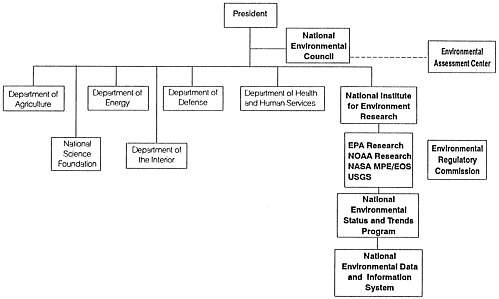
Framework C is a research institute as defined by this committee. The major organizational innovation in this National Institute for Environmental Research (NIER) is a coherent research program that addresses protection, restoration, and management of resources, as defined in Chapter 4. The institute we suggest is different from the institute proposed by the Committee for the National Institute for the Environment in some fundamental ways. In particular, creation of this committee's NIER would be coupled with the reduction or incorporation of some other federal agencies' functions. As mentioned above (Framework B), the CNIE proposes a new agency that would complement existing agencies, but not encompass them.
Because no agency focuses on environmental research to the exclusion of other missions, such as land management or regulation, there is no institutional home, comparable with the National Institutes of Health for human health research, for the nurturing of environmental science. NIER would provide such a home. It would also attend to such issues as training of graduate students and postdoctoral fellows, development of young investigators, research support for environmental scientists, information management, large-scale programs for monitoring the environment, and formation of relationships among academe, industry, and government for the performance of research.
The institute would be a new, nonregulatory, federal granting agency organized around the mission of understanding the elements of our environment and its processes and fostering research on protection, restoration, and management of resources. It would be the only U.S. agency with a primary objective of sponsoring a coherent program of mission-oriented fundamental and applied environmental research, education, and training directed to protection, restoration, and management of resources. The existing agencies would continue to have major land-management responsibilities,
and they would benefit from the information gained from the environmental research program undertaken through the institute.
Present government agencies, such as the National Science Foundation (NSF), support research that seeks basic knowledge. Subject-specific agencies, such as the U.S. Department of Agriculture (USDA) and the Department of Energy (DOE), support research that applies to problems of the environment, but they are not centered on the environment. In contrast, research sponsored by NIER would seek to understand environmental processes and the interactions of people and the environment so that lasting solutions could be developed.
Agencies Incorporated
The research functions of several existing agencies with missions and responsibilities in protection, restoration, and management of resources would be combined in NIER. At its creation, the institute would encompass almost all the National Oceanic and Atmospheric Administration (NOAA) and U.S. Geological Survey (USGS) research; the part of the National Aeronautics and Space Administration involved in environmental research, in particular the Earth Observing Satellite/Mission to Planet Earth program; and the research component of the Environmental Protection Agency (EPA), but not EPA's regulatory functions. The activities of those individual agencies in monitoring, protecting, and providing the fundamental knowledge about means to restore environmental resources should be enhanced by their association in an integrated research institute. The combination of the agencies allows coverage of atmospheric, oceanographic, terrestrial, engineering, and to a smaller extent social aspects of the environmental sciences. The monitoring and data-handling expertise of NOAA and USGS would eminently qualify the institute to be the focus of efforts to follow status and trends in the environment. EPA's monitoring programs would provide an added dimension. National laboratories could be associated with NIER (especially EPA laboratories involved in environmental engineering and DOE national laboratories) to create strong foci for approaching environmental technology questions.
Relationship to Other Agencies
Because of the uneven distribution of disciplinary environmental research across the various federal agencies and the concentration of biological research in the land-management agencies and USDA–which are not part of
the institute described here–the National Environmental Council must coordinate the work of NIER and the excluded agencies to ensure that there are opportunities for interdisciplinary research.
NSF would expand its support of basic research related to the environment. Additional funds provided in the NSF budget for support of all environmental fields–but especially biology, environmental engineering, and social sciences–would lead to the production of data of immediate and long-term use by NIER.
Mission-oriented agencies would continue their traditional work but, under the National Environmental Plan (NEP) and the NEC, would be encouraged to focus to a greater extent on research that would enlarge general knowledge about the environment, as well as satisfying their mission needs.
Land-management agencies must continue to measure environmental status and trends; however, these agencies could provide a broader array of measurements that, with coordination among other agencies, would increase completeness of a database and diminish unnecessary duplication. It would be the responsibility of the NEC to ensure that the land-management agencies participate in the status and trends activities in a coordinated approach.
The large number of regulatory functions of EPA and the few regulatory functions assigned to NOAA might be combined in an Environmental Regulatory Commission that would be independent, not part of NIER. A model for such an entity is the Nuclear Regulatory Commission.
Implementation of the Cultural Changes
Research Focus on Protection, Restoration, and Management of Resources and Research Performance Characteristics
The focus on protection, restoration, and management of resources addresses a set of critically important and broad scientific, social, and economic issues concerning the environment. Such sites as wetlands and coastal borders must be protected or restored to ensure their role in providing life-support systems for economically and ecologically important resources. Remediating toxic-waste sites, nuclear facilities, and military sites might cost as much as $2 thousand billion. Public concern about exposure to toxic substances emphasizes the important role proposed for the institute in risk assessment, communication of results of risk assessment, and education. Addressing those issues requires the involvement of the full range of environmental disciplines, including the physical, biological, social, human health, and engineering sciences. Addressing resource-management issues will require
close attention to the integration of the natural, biological, engineering, and social sciences.
Specific Research Fields
Several fields of research warrant special attention. Among them is human-factors research. Because human behavior and institutions are major agents of environmental stress, the study of behavioral factors would be an integral function of the institute and would have to be organized along the general lines set forth in our recommended cultural changes. Also worthy of special note is environmental protection and restoration research, which includes research in waste remediation and other large-scale engineering issues and has received insufficient attention. Such engineering research holds the promise of large economic benefits. Estimates of costs to clean up contaminated environments with currently available technologies run into many billions of dollars. That highlights the value of research designed to reduce further pollution and the need for more efficient and less expensive methods to restore contaminated environments. Furthermore, few methods are available to restore degraded wetlands and grasslands to their former productive states.
National Environmental Council and National Environmental Plan
The NEC and NEP are critical for the successful operation of Framework C. NIER would play a central role in environmental research, but many subjects in the environmental sciences would not be within its domain, and coordination among the institute and other federal agencies would be essential. The NEP would recognize the role of the institute in the overall national and international framework, and the NEC would have a major role in influencing coordination efforts among NIER and other agencies involved in the overall NEP.
National Status and Trends Program and National Environmental Data and Information System
The creation of NIER would facilitate the integration of the National Status and Trends Program and the National Environmental Data and Information System (described in Chapter 4 and included among the essential
cultural changes required) as components of a complete program for environmental study and policy-setting. The institute is a natural home for both these entities.
Environmental Assessment Center
The Environmental Assessment Center, performing the functions described previously, would be established as a separate entity.
FRAMEWORK D: A DEPARTMENT OF THE ENVIRONMENT
Description
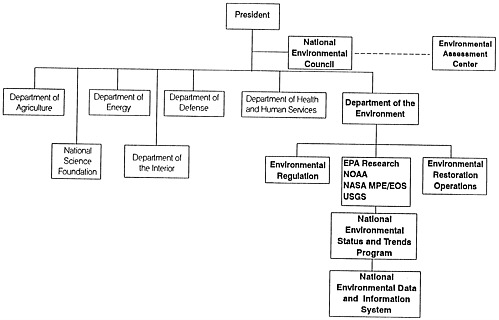
Framework D is a Department of the Environment. The department we recommend would include the Environmental Protection Agency (EPA) but is not created by the elevation of EPA to cabinet status. Rather, the recommended department would have a character that derives from the research orientation of the National Oceanic and Atmospheric Administration (NOAA) and the strong and varied research and data-management programs of the other agencies to be included in the department. Furthermore, although the department would have a regulatory function, this activity would be clearly separated from the research and operational functions. The entity would be a fully functional department with research, regulatory, and operational arms and would have wide-ranging responsibilities in protection, restoration, and innovation for management of resources. It would be the focal point for initiating and performing international research projects and for developing U.S. positions for international agreements.
The department would have a research arm that incorporated the National Institute for Environmental Research (NIER) described in Framework C, a regulatory branch separate from NIER, and an operational part that would manage remediation and restoration activities for the nation and coordinate and facilitate a major program to promote innovation for management of natural resources. It would be responsible for identifying and setting priorities for protection and restoration needs, including waste sites, degraded habitats, and problems of global change ranging from greenhouse gas accumulation to biodiversity.
The research program would consist of a comprehensive approach to issues requiring integrated study of atmospheric, oceanographic, aquatic, and terrestrial processes and the expertise of physical, biological, and social
scientists and engineers. Global change and biodiversity are both major concerns of the environmental disciplines in the physical, biological, and social sciences and engineering and could be the initial major interests of the research program of the department in the rubric of protection, restoration, and management of resources.
As in Framework C, special attention to human-factors research, biology, and engineering research is appropriate. The department, perhaps in association with the Department of Energy (DOE) national laboratories, would be responsible for research and development in environmental engineering appropriate to the problems of protection, restoration, and research relevant to management of resources. The department would also be charged with forming linkages with industry.
With coordination overseen by the National Environmental Council (NEC) and as a major implementer of the National Environmental Plan (NEP), the Department of the Environmental would be the leader in such matters as support of training and facilities for environmental research and for public information and education.
As head of a cabinet-level department, the secretary would be in a position to influence national policy and to serve as a senior member of NEC coordinating activities.
Agencies Incorporated
Because the department would manage the research programs described for the National Institute for Environmental Research (NIER) in Framework C, it would include all the research of the agencies specified for inclusion in NIER: NOAA; the U.S. Geological Survey, (USGS); and environmental research parts of EPA and the National Aeronautics and Space Administration). Service functions of such agencies as the weather service of NOAA and research and mapping services of USGS would be included in the department.
All nonresearch activities of EPA would be incorporated into the department. The regulatory functions of EPA and NOAA would be a part of the department, and those responsible for regulatory decisions would be able to draw on the knowledge derived from the research, monitoring, and assessment activities of the department to inform their decisions. The regulatory branch, the Environmental Regulatory Commission (ERC), would advise the department about necessary research and improve its regulatory role, but the ERC would be administratively separated from the research functions of the department.
Relationship to Other Agencies
Although the department would have a large and important role in environmental matters, its focus on protection, restoration, and management of resources would not encompass all environmental issues. In particular, the full range of resources management as administered by the Department of the Interior (DOI) would not be part of the department's mission. It would be essential for the department to coordinate its activities with those of other agencies to ensure that the nation's environmental programs is complete. For example, the National Science Foundation (NSF) must expand its support of basic environmental science, and the mission-oriented agencies must perform research that serves their missions and increases general knowledge about the environment.
The department would need to maintain close liaison with many other departments and agencies, including DOE, the Department of Defense (DOD), DOI, and the U.S. Department of Agriculture (USDA). The linkages and coordination could be effected through the NEC, but could also benefit from a focus on protection and restoration in the Office of Science and Technology Policy's Federal Coordinating Council on Science, Engineering, and Technology. Protection and restoration responsibilities are now spread among a number of agencies, many of which are not proposed for inclusion in this department. EPA is responsible for a broad array of activities, especially in preventing and cleaning up pollution, and these functions would be integrated into the department.
Each of the resource-management agencies not proposed for incorporation into the department engages in protection and restoration activities, including research. These include the Bureau of Land Management, the Forest Service, the Fish and Wildlife Service, the National Park Service, and DOD. The programs of those agencies need to be coordinated with the work of the Department of the Environment. Agencies with responsibility for resource management would maintain intramural programs of research and operations in protection and restoration for specific needs on the resources they managed. For example, DOD would continue to be responsible for cleanup of defense installations. Agencies with functions related to management of resources would continue to perform these functions but would coordinate their work with that of the Department of the Environment.
Agencies that engage in research on environmental engineering–such as DOE, NSF, and DOD–can increase the impact of their work by closer coordination of their efforts with those of this department, which already encompasses the engineering research of EPA.
Other agencies already have programs that contribute to our knowledge of how to enhance our ability to manage our natural resources. USDA has produced substantial improvements in agricultural productivity throughout its history and recently has been moving toward emphasis on long-term sustainable agricultural practice. DOI has focused on the management of public lands for economic production, e.g., grazing; the Tennessee Valley Authority, on regional economic development; the Bonneville Power Administration, on energy conservation and salmon rehabilitation; and the Department of Housing and Urban Development, on urban infrastructure, mass transportation, and other major public investments that represent environmentally responsible economic development. It is essential that those programs be coordinated with the work of the department.
Mechanisms must be put in place for the methods and technologies developed by federal programs (in association with the private sector) to be made available to industry; federal, state, and local agencies; and the general public. For example, techniques for habitat restoration will need to be made available to land-management agencies, such as the Forest Service and the National Park Service. Close cooperation must exist between research programs for the development of innovative approaches to managing natural resources and the industries that have common interests in this goal. Potential models exist in biomedicine (the National Institutes of Health technology-transfer program), agriculture (the USDA extension service), and technology (Sematech and the National Institute of Standards and Technology). Ideally, the model adopted would involve communication in both directions, providing information from users on issues in need of research and development.
Implementation of the Cultural Changes
Research Focus on Protection, Restoration, and Management of Resources and Research Performance Characteristics
The department would include the mission and functions described in Framework C for the National Institute for Environmental Research. Accordingly, it would have the same focus on protection, restoration, and management of resources and the same research performance characteristics as detailed in Chapter 4 and in the section of this chapter on cultural changes. We emphasize the need for a properly balanced program of support of intramural and extramural research that will guarantee a close association of the department with universities and other research performers.
National Environmental Council
The NEC would ensure coordination of research programs between the Department of the Environment and other agencies.
National Environmental Plan
The department, as a focal point for environmental programs, could serve as the developer of the NEP.
National Environmental Status and Trends Program and National Environmental Data and Information System
The National Environmental Data and Information System and the National Environmental Status and Trends Program described in Chapter 4 would be housed in the department. Most of the agencies now involved in gathering and managing environmental information would be incorporated into the department, and their location in one department might facilitate the missions of preparing status and trends reports and providing for an information and data network that enhances research, regulation, resource management, and policy formation. A national biological survey could be a major interest for the department and might be a cooperative effort between the department and the agencies, proposed for inclusion, such as USGS, and agencies not proposed for inclusion, such as DOI.
Environmental Assessment Center
The Environmental Assessment Center described earlier would not be part of the department. Rather, it would be so situated as to be able to draw on the information resources of the department and other agencies, such as those involved with human-health aspects of the environmental sciences, so that assessments and policy formation could take into account all information from the various centers of environmental science, regulation, and management. Effective assessments and policy formation can be performed only when they consider human-health, economic, and behavioral aspects of the focal issue with the natural-science and engineering aspects.
DISCUSSION OF THE FRAMEWORKS FOR ORGANIZATIONAL CHANGE
Because all the frameworks described above call for the implementation of the cultural changes recommended by the committee, we believe that any of them would improve environmental research and decision-making in the federal government. All frameworks would improve the use of existing research capabilities and would provide a focus for a national research effort on protection, restoration, and management of resources. The more ambitious and comprehensive alternatives entail substantial institutional and budgetary costs and are likely to encounter fiscal limitations, desires by interest groups and Congress to maintain jurisdictional authority and patterns of influence, and other barriers to adoption. The committee is also mindful of the hazards and transitional costs of government reorganizations–confusion, costs of changeover that will undercut government-agency effectiveness for some time, risks that long-term monitoring and other unfinished business will be lost, and strife within organizations as responsibilities are reapportioned and established organizational cultures are disrupted. If the more thorough rearrangements are judged to be worthy of investment–as the committee believes–Congress and the executive branch must provide clear mandates, adequate budgets, and political leadership, not only at the outset but for at least a decade.
CURRENT AGENCY STRUCTURE WITH ENHANCEMENTS (FRAMEWORK A)
Continuation of the current structure for managing the nation's environmental research program, with enhancements (creation of new offices and functions) that provide for the implementation of the cultural changes recommended by the committee, addresses some of the needs for a strong program in environmental protection, restoration, and management of resources. This framework is the least expensive to implement, would minimize disruption of existing agencies, and would create minimal political tension. It would also maintain the current diverse and pluralistic base of support for environmental research. For those practical reasons, the committee considers Framework A to be one of its primary recommendations for implementation.
The national environmental research program would be coordinated by the National Environmental Council (NEC), which would oversee the development of the National Environmental Plan and coordinate the research program of the agencies and a program shared by the federal agencies for assessing our natural resources through the status and trends program.
Environmental data and information would be managed more efficiently in the National Environmental Data and Information System (NEDIS). Connections between environmental research and policy would be made by enhanced mechanisms within each agency and by the establishment of the Environmental Assessment Center.
The success of this approach would depend completely on good-faith participation by the agencies and the effectiveness of the NEC in coordinating the activities of a large number of individual agencies. The council could create cross-cut budgets, following the model used by the Office of Science and Technology Policy in the Global Change Research Program. This process could be effective for selected, high-profile programs but might not suffice as a general mechanism for obtaining coordinated support for a wide variety of large and small research projects.
Expanded linkages with the business sector and enhanced education and training programs would remain the responsibility of individual agencies. The only provision for developing a comprehensive program of environmental protection, restoration, and management of resources would be the coordinating effort of the NEC, which could make recommendations to the agencies to focus their efforts on these research directions.
Among the existing agencies, the National Oceanic and Atmospheric Administration (NOAA), the Environmental Protection Agency (EPA), and the U.S. Geological Survey (USGS) are the most likely candidates under Framework A to serve as the home of the new Environmental Status and Trends Program and the NEDIS–two parts of the cultural changes recommended by the committee. Again, it would be the responsibility of the NEC to determine whether the lead for these two programs would be assigned to an individual agency or be a distributed responsibility among the agencies that is coordinated by the NEC. The figure representing the organizational arrangements for Framework A shows the two programs as free-standing to imply that they would not be assigned to a single agency, but would be operated by all the agencies under the coordination of the NEC.
Unless the NEC guides the program with a firm hand, it would be difficult under Framework A to implement the cultural changes related to improvements in how environmental research is performed and supported by the agencies, for example, encouraging each agency to support graduate training or to increase the amount of money awarded in extramural grants.
NATIONAL INSTITUTE FOR THE ENVIRONMENT (FRAMEWORK B)
The committee accepted that its central charge required a thorough analysis of federal environmental research from first principles. We began with that task, and only when we had a firm grasp on the current status of environmental research and the necessary elements of an environmental research program and had developed a series of hypothetical frameworks of our own did we include the National Institute for the Environment in the context of our broad review. Because the Committee for the National Institute for the Environment (CNIE) was going through a similar learning experience, testing its initial proposal against new ideas in an evolving political climate, the NIE proposal has changed greatly from the one that was presented to use at the beginning of our work. It is interesting to see the extent to which our Committee and the CNIE have converged on common themes.
We are favorably impressed with many aspects of the NIE proposal as it appeared at the end of 1992. The plan is a credible and effective view of a means to organize environmental research. It would enhance the nation's capability to perform environmental research and increase knowledge that will contribute to the solution of environmental problems. In particular, the NIE's recasting of its original five research institutes, which seemed arbitrary and overlapping to many, into three broadly functional questions–''What do we have? How does it work? How can we maintain it?"–is straightforward and focused. The NIE research components fit our proposed research directions: comprehension of the components of the environment, deepening of our understanding of transfers of energy and materials, and advancement of social goals of protecting and restoring the environment.
We agree with the CNIE that it is often wise to isolate the research process, especially the long-term exploratory research phase, from regulatory and management decisions, but we believe that specific research to solve immediate regulatory and management problems also has a place. NIE could focus needed attention on research that bridges the gap between the National Science Foundation's (NSF's) style of investigator-initiated fundamental research and other federal agency research directed at specific regulatory and management problems.
The NIE proposal attempts to structure environmental research in a way that will incorporate the skills of all pertinent disciplines and sectors: business, academe, nongovernment organizations, the states, and the federal government. Its emphasis on quality through the merit-review process is to be commended. Perhaps NIE's greatest service would be its focusing of the nation's environmental effort to capture the talents of nonfederal researchers by providing
incentives for them to perform policy-relevant environmental research. That would be done through a significant extramural, multidisciplinary funding program for research on subjects selected by an advisory committee consisting of persons of diverse interests drawn from a variety of communities.
The NIE proposal is predicated on the view that the niche to be filled in federal programs for environmental research is extramural research. The CNIE believes that it would be less difficult to have a new NIE that focused on merit-reviewed extramural research, policy assessment, and information management than to rearrange the existing mission-oriented agencies and change their cultures for these tasks, especially because their own tasks must continue to be addressed.
NIE is proposed as a new agency that does not encompass or replace existing ones. The committee believes that NIE, if not carefully monitored, could duplicate the roles and missions of existing agencies and engender "turf battles" as it competed for funds and programs with existing agencies. For example, NIE's first aim, basic understanding of the components of the environment, might overlap with the Department of the Interior's planned National Biological Survey and EPA's Environmental Monitoring and Assessment Program, unless the roles of extramural and intramural research were understood. The differences between exploratory research versus management research, regulatory research, and monitoring would have to be explored and carefully delineated. To be successful, NIE would have to be seen as a resource for EPA, DOI, and others.
Although a strength of the NIE research-management plan is its attempt to bring many constituencies into research-planning and priority-setting through its advisory process, how this will work in practice within a federal agency is not clear. The various constituencies will have very different agendas. However, the NSF model of the National Science Board for priority-setting suggests that success could be achieved.
The committee believes that the proposed NIE would improve the nation's environmental research effort but does not go far enough to solve all the problems in environmental research that we have identified.
NATIONAL INSTITUTE FOR ENVIRONMENTAL RESEARCH (FRAMEWORK C)
The National Institute for Environmental Research (NIER) that we have described establishes an identifiable central focus for the organization of the nation's environmental research. Its mission would be to conduct a comprehensive environmental research program on protection, restoration, and
management of resources, thus addressing critical national needs. Such a program would encompass most aspects of global change (stratospheric ozone depletion, loss of biological diversity, and atmospheric carbon dioxide accumulation), toxic-site cleanup, risk assessment, wetland preservation, and other problems at the forefront of public concern.
NIER would administer the Environmental Status and Trends Program and the National Environmental Data and Information System. As an organization directed specifically toward environmental research, the institute would have the identity and coherence to strengthen links with the private sector, universities, and research institutes. Peer-reviewed science programs would infuse environmental research with creativity and lead to a better science product. The institute would also develop education and training programs to increase the human resources necessary for addressing environmental problems. The research mission of the institute and the products of the research program are directly related to many important policy decisions. Thus, the institute would provide valuable information for setting national environmental policies.
To accomplish its mission, NIER would be composed of EPA (except its regulatory parts), the research components of NOAA, the parts of the National Aeronautics and Space Administration (NASA) that are directed toward environmental research (Earth Observing Satellite/Mission to Planet Earth), and USGS. By providing a single organization, the institute would bring coherence and coordination to a substantial portion of the nation's environmental research program. However, forming the institute would require changes in the current structure of four federal agencies and would separate parts of NOAA and NASA. These changes would create political tension and administrative and implementation costs. As an independent agency, NIER would have the flexibility to set its own priorities within its Congressional mandate. Nevertheless, the institute would be headed by a director, who would have to negotiate with department secretaries in establishing the National Environmental Plan (NEP) and in arguing for funding and assigned responsibilities. The mission of the institute omits important environmental interests, such as land management and environmental regulation. The institute would not include important elements of environmental research related to biological diversity, land management, and global change. Most notable is the absence of programs and offices drawn from DOI, including the Fish and Wildlife Service. The success of the institute in improving federal research and policy would rest to a large extent on the effectiveness of the NEC and its ability to coordinate the activities of the institute with those of other agencies.
Because the institute suggested in this framework is focused on research, it would be necessary to separate the research and service functions of agencies from which a research part is moved. For example, NOAA research might be separated from NOAA weather and climate prediction or NASA's Mission to Planet Earth research from other NASA environmental research. The committee believes that such separations are inadvisable and counterproductive.
The committee believes that NIER would improve the nation's environmental research effort but does not go far enough to solve all the problems in environmental research that we have identified.
DEPARTMENT OF THE ENVIRONMENT (FRAMEWORK D)
The Department of the Environment would include the mission and responsibilities of the National Institute for Environmental Research but also include explicit regulatory functions organized in the Environmental Regulatory Commission. As an administrative unit with research and regulatory responsibilities, the department would provide leadership in the nation's programs for protection, restoration, and management of resources. With its extensive responsibilities, the department would operate at the cabinet level and be headed by a secretary. Environmental issues would thus be elevated to the same level as other national issues.
Forming the Department of the Environment would involve transferring the research and regulatory responsibilities of EPA and NOAA and their research programs. Although the department would have responsibilities for research and regulation, there would be clear administrative separation of regulation and research. Nevertheless, this combined arrangement in one agency is designed to ensure that the nation has a strong environmental research program to support its regulatory decisions and policies.
The Department of the Environment would easily accommodate most of the cultural changes recommended in this report. With the NEC, the department could lead in the setting and implementation of a national research agenda through the NEP. Because most environmental research would be the responsibility of the department, there would be better coordination among many pieces that are now distributed among different agencies. The mission agencies would continue to support their own environmental research programs, such as natural-resource management. These programs would be coordinated with the Department of the Environment through the NEC. The department's coherent environmental research program would assist in
ensuring that there are no inadvertent omissions in the nation's research program and would serve as a focal point for expanded linkages with the private sector, academic institutions, and other research performers and clients. The department, with its comprehensive program in research and regulation, would provide a strong infrastructure for environmental research and serve as a catalyst for education and training and for communication with the public about environmental issues and the federal programs related to those issues.
Having departmental status, the Department of the Environment would play a strong role in formulating national policy on all relevant topics. The department would not include land-management research programs, but, given its cabinet status, its research programs would contribute to the effectiveness of other departments as they participate in a program coordinated by the NEC. Moreover, the department would coordinate the nation's activities in international programs.
Although there would be political tension because of the changes in the organization of federal environmental research, the tension might be mitigated because departmental status would elevate the current administrative level of these programs. Similarly, although costs would be associated with the reorganization, these would be repaid by the increase in efficiency, by the reduction in unnecessary duplication of environmental research programs, and potentially by the savings that could result from solving environmental problems. These problems would require enormous amounts to remedy if research were not successful in ameliorating the cost.
The committee cautions, however, that simply elevating EPA to cabinet status without redefining its research responsibilities could be counterproductive. Regulatory agencies have often encountered difficulty in carrying out long-term research (NRC, 1985; EPA, 1992a). If environmental research is to meet the requirements identified in this report, it is crucial that any new cabinet-level agency be designed to take the cultural changes called for into account so that the necessary reorganization improves the quality of research.
ELEVATING THE ENVIRONMENTAL PROTECTION AGENCY TO CABINET STATUS
As this report is being completed, Congress is considering legislation to elevate the Environmental Protection Agency (EPA) to cabinet rank. We believe that the creation of a Department of the Environment is an appropriate and long-overdue move, but we believe that, at least from the
standpoint of environmental research, more should be done than simply elevating EPA to cabinet level. If EPA is elevated, its research mission and organization must be redefined.
The difficulties with EPA's research program administered by its Office of Research and Development are well analyzed in EPA's own report Safeguarding the Future: Credible Science, Credible Decisions (EPA, 1992a). We concur with the general thrust of the report, and we applaud the agency's moves to implement its recommendations. But serious structural and programmatic difficulties remain.
EPA's mission is regulation, largely to protect human health. This is a large and important mission, and EPA's research, for the most part, is necessarily directed to support of the regulatory function. As a result, there is never adequate time or money to undertake the long-range, multidisciplinary research on fundamental environmental problems and processes that we think is essential to secure our future.
EPA's regulations are often, or usually, responses to perceived emergencies, such as the Love Canal toxic-waste problem in New York state or the Times Beach, Missouri, dioxin problem. In such emergencies, there is usually an inadequate research base for reliable policy-setting and all the agency's resources are consumed to provide even a minimal level of scientific understanding. Even when further research illuminates a problem, legislation and regulations are often so narrowly drawn that it is difficult to modify the law or the rule, and that undermines the usefulness of research and scientific information. Finally, given the seriousness of environmental hazards, policy-setters must act in "better safe than sorry" ways, producing policy so rigidly established that it is difficult to sponsor further research that might change the scientific base.
For all those reasons, we believe it essential to separate the fundamental research on environmental processes and problems from the short-term, regulation-focused research that EPA necessarily pursues. We doubt that that is possible within the existing EPA structure. Without such separation, we believe it unlikely that EPA can recruit adequate numbers of the best-qualified scientists to pursue the high-quality, peer-reviewed, science that must have high priority at EPA.
In the Department of the Environment we have described in Framework D, we have provided for a fundamental research organization dedicated to performance, and support, of basic research and other features of a successful environmental research program we believe must be added. We have laid these out in what we have called "cultural" changes. They include creation of a high-level leadership body (we suggest at the vice presidential level), including the heads of the federal agencies charged with environmental
responsibility, to set the agenda for the environmental research program. They also include development of a National Environmental Plan, whose research component is our concern here. Most important, the cultural changes include different ways of thinking about environmental research– ways that have not been part of EPA's culture and that we believe EPA cannot incorporate if it is simply elevated to departmental status. In our Framework D, we incorporate the National Oceanic and Atmospheric Administration, the U.S. Geological Survey, and parts of other agencies with research cultures that would be different from those of EPA.
We see establishment of a broadly based, continuing monitoring program as essential. Although EPA has undertaken this task in its Environmental Monitoring and Assessment Program, we believe a more comprehensive effort is needed.
We think it unlikely that these cultural changes in our environmental research effort can be accomplished by simply raising EPA to cabinet level unless the implementation of the essential cultural changes can be ensured. A broader, more comprehensive organization that included other parts of the federal environmental research enterprise, such as that suggested in our Framework D, would be more likely to get the job done. The EPA functions would be included, but other important functions should also be included, both within the department and as separate bodies.
The elevation of EPA to cabinet level and the efforts of the Department of the Interior to play a greater role in research on the environment (as evidenced by Secretary Babbitt's initiative for a National Biological Survey) can be steps forward. If the cultural changes that we suggest in this report are integrated into the plans and actions of the Department of the Environment (created by elevation of EPA) and the Department of the Interior, we believe the nation's environmental research program will be enhanced vastly.
COST
Our recommendations can be fully evaluated only if one considers what the costs of the different features and the different frameworks might be. The basic importance of our report, however, is not about money, much as we believe that more money is desirable. It is about raising environmental research to new levels of organizational structure and providing it with goals intended to address some large problems of national security more effectively. We believe that if these objectives are achieved, the money issues, in the long run, will sort themselves out.
There is no way to obtain a reliable estimate of the cost of adopting all our recommendations, but we can draw some general conclusions.
Obviously, a move as large as the creation of the new department of Framework D would be expensive, but it is impossible to make even a precise estimate of how expensive. The department would embrace a number of existing agencies, such as the Environmental Protection Agency (EPA), the National Oceanic and Atmospheric Administration and the U.S. Geological Survey (USGS), and their present budgets can be incorporated in the budget of the new operation. Furthermore, there is duplication in the present decentralized mission-agency organization, and elimination of that duplication could save money. But new functions would add costs.
How much the new department would cost in the beginning would depend on how ambitious it would be. When the National Science Foundation (NSF) began its life in 1950, its budget was hardly noticeable. It grew slowly as NSF's mission was defined and its opportunities developed. Even the most important operations can begin gradually. Starting a new Department of the Environment slowly and with care seems to be in order–restructuring existing functions, making the recommended cultural changes, and eliminating as much duplication as possible.
To get an idea of necessary added costs, we can examine Framework A, which keeps existing mission agencies and adds several functions, including the National Environmental Council (NEC), the Environmental Assessment Center, the National Environmental Status and Trends Program, and the National Environmental Data and Information System. The NEC is an important innovation, and could be created at little dollar cost–only that for a relatively small staff. Large pieces of the National Environmental Data and Information System already exist, and a skeletal coordinated operation could be put into place at relatively small cost. As means were developed not only to collect data and information in a coherent and consistent way, but also to make them readily available with the latest and most effective technology, the cost would become larger.
The National Environmental Status and Trends Program, in the beginning, could be put together with monitoring programs already in place in EPA, USGS, and other agencies. As the gaps were identified and filled, the costs would begin to accumulate.
The Environmental Assessment Center would add a function not available for incorporation from existing agencies to any great degree. It would build from the ground up for the most part but would start relatively small and feel its way.
One can get a rough idea of what a specified amount of money might buy by comparison with existing programs. If one were to add 10% of the
budgets for existing federal environmental research programs, one would be adding about $500 million a year–about what EPA's annual research costs are. That is a great deal of new research.
If reorganization of the federal environmental research programs were undertaken with the aim of achieving as many of the desirable goals as possible, through either Framework A or Framework D recommendations, and eliminating as much duplication as possible, and if there were a commitment to begin by adding 10% of the present research budget, it could be achieved. If the objectives were more ambitious, through expansion of the NSF budget to cover fields of research not now covered (for example, through rapid expansion of the monitoring program or through markedly expanded international cooperation), the increased budgets would be much larger.
We believe that there are compelling reasons for spending more money on environmental research than is now being spent. Almost any amount of money–from the 10% increase suggested above to the tripling of the federal investment in environmental research suggested by the National Commission on the Environment–could be wisely invested, provided that the recommended cultural and organizational changes were adopted.
In thinking about costs, one must keep in mind the costs of doing nothing. Many environmental matters have been driven into the courts when scientific uncertainty has made it difficult to establish agreed-on standards of environmental quality and methods of attaining them. Use of the courts will always be part of the problem-solving machinery, but the costs of litigation are large.
Estimates of the cost of present and future efforts to protect and restore the environment are staggering. We have heard $50 billion quoted as the cost of cleaning up the Hanford nuclear site alone. We have a total backlog of toxic-waste remediation that might cost as much as $2 thousand billion (William Reilly, EPA, Congressional testimony, March 1992). We have no adequate technology for that waste cleanup, and we will not have it until we invest in much more research to learn how to do it effectively. Who can estimate the cost to the nation occasioned by loss of biological diversity and extinction of species, if that threat proves as great as biologists predict?
Our national security is at issue. Ensuring that security by spending money to understand the problems that we now see only dimly must have a very high priority.


