
I.
The Representation of Women Scientists and Engineers in Industry
In this chapter we introduce a statistical base for the descriptions of the industrial environment confronted by women scientists and engineers that appear in subsequent chapters. It summarizes the relatively low rate of participation by these women in industrial settings and examines the origins of this rate. Subsequent chapters enrich this statistical summary by illuminating through personal experiences one of the possible reasons for the low rate of participation—a perception that the work environment in industry is particularly inhospitable to female scientists and engineers.
Although women comprised 16 percent of the U.S. scientific and engineering (S&E) labor force in 1988, they represented only 12.3 percent (or roughly 400,000) of the scientists and engineers employed in industry that year.1 The relatively low representation of women scientists and engineers in industry, as well as the fact that more quantitative data are available on academic rather than industrial employment in the United States, motivated the conference held by the National Research Council's Committee on Women in Science and Engineering (CWSE) in January 1993.2 The statistics underlying the question "Why so few?" are examined in this chapter. They focus on three aspects of the education and employment of women during the past few decades:
|
(1) |
the lower percentage of women earning S&E3 degrees, at all levels; |
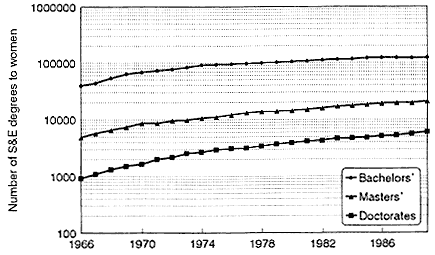
NOTE: The ordinate is a logarithmic scale.
SOURCE: National Science Foundation, Science and Engineering Degrees: 1966–89 (A Source Book) (NSF 91–314), Washington, DC: NSF, 1991.
Figure I-1. Number of science and engineering (S&E) degrees awarded to women, by degree level, 1966–1989.
-
(2)
the specific S&E disciplines in which women tend to earn degrees being less important, on average, for industrial employment; and
-
(3)
the lower likelihood for women in a given field to choose industrial employment.
In large part, the small number of women scientists and engineers employed in industry reflects the small total number of women scientists and engineers in the employed work force. In 1986 only 15 percent (or roughly 700,000) of the employed S&E labor force was female.4 Thus, a large part
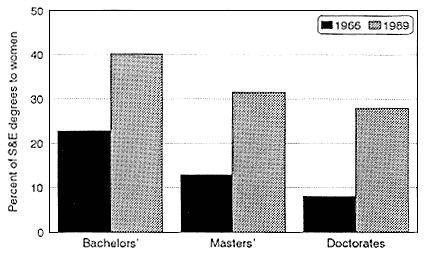
SOURCE: National Science Foundation, Science and Engineering Degrees: 1966–89 (A Source Book) (NSF 91-314), Washington, DC: NSF, 1991.
Figure I-2. Percentage of science and engineering (S&E) degrees awarded to women, by degree level, 1966 and 1989.
of the answer to the question "Why so few?" originates in the lower participation in the past of women in the S&E education pipeline and, subsequently, in careers.
This part of the answer to "Why so few?" can be expected to become less important in the future, however, since women have been increasing their representation in S&E education. Figure I-1 illustrates this trend. At the bachelor's and master's degree levels, the number increased by more than fourfold; at the doctorate level, the increase was more than sixfold from 1966 levels.
The net result of these dramatic increases has been that the percentage of female degree recipients as a share of all S&E degree recipients increased significantly (Figure I-2). In 1966 women constituted less than 24 percent of the S&E bachelor's degree recipients, less than 14 percent of the S&E master's degree recipients, and 8 percent of the S&E doctorate recipients. By 1989 the percentage of S&E degrees awarded to women had increased dramatically at all degree levels—to 40 percent, 31 percent, and
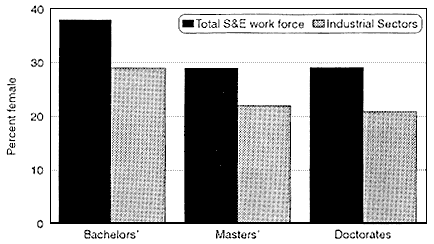
SOURCES: National Science Foundation, Characteristics of Recent Science and Engineering Graduates: 1990 (NSF 92-316), Washington, DC: NSF, 1992; Delores H. Thurgood and Joanne M. Weinman, Summary Report 1990: Doctorate Recipients from United States Universities, Washington, DC: National Academy Press, 1991.
Figure I-3. Women as a percentage of the total science and engineering (S&E) and industrial S&E employment pools, by degree level, 1990.
28 percent, respectively, indicating also an increase in relative probability for receiving advanced degrees.5
Despite this growth, however, female scientists and engineers remain underrepresented in industry, partly because of their choice of S&E field and partly because of their choice of employment sector. Figure I-3 shows that, at all degree levels (B.S., M.S., and Ph.D.), the percentage of female S&E degree recipients entering the total S&E work force (38 percent B.S., 28 percent M.S., and 28 percent Ph.D.) was significantly higher than the corresponding percentages of female S&E degree recipients entering industrial positions (28 percent B.S., 22 percent M.S., 21 percent Ph.D.).
In part this is because women tend less to enter S&E fields likely to lead to industrial employment, but even after taking into account field preference, there is evidence that for most fields the share of women in industry is still below the comparable share for men. At the baccalaureate level the industrial share of employment was lower for women in five out of eight broad fields: mathematical, computer, life, behavioral, and social sciences. These five fields represented about three-fourths of the 1990 female S&E employment (Table I-1). Similar findings result at the master's degree level, where the share for women was less in six fields representing almost 90 percent of 1990 female S&E employment (Table I-2).
The findings for doctorates (Table I-3) is even more striking. Except for environmental sciences, a relatively small field, the industrial share of employment was small for women in all fields.
These findings indicate that part of the answer to the question "Why so few?" must come from factors other than the simple scarcity of women from S&E careers.
As noted earlier, one of these factors is the tendency for female scientists and engineers to choose careers in life sciences, behavioral sciences, and social sciences, fields in which industry is a less likely source of employment than academe or government (Figure I-4). In 1989 three-fourths of the S&E bachelor's degrees awarded to women were in these three fields. In contrast, only about 46 percent of the S&E bachelor's degrees awarded to men were in these fields. Similar patterns are observed among the S&E degree recipients at the master's and doctorate levels.
The degree to which industry is a relatively less important source of employment for these fields than for the physical sciences and engineering is shown in Tables I-1 to I-3 and in Figure I-5. Sixty-two percent of the 1988 and 1989 employed S&E bachelor's degree recipients had jobs in industry in 1990. In contrast, only 46 percent of the degree recipients in the life sciences had such jobs. The share was 44 percent in the behavioral sciences and 59 percent in the social sciences. Again, the S&E degree recipients at the master's and doctorate levels show similar patterns, although the absolute numbers and percentages employed in industry are smaller than at the bachelor's level.
The fact that women tend to prefer jobs in other sectors is consistent with a perception that working conditions for women are less favorable in industry. It may also be consistent with a number of other hypotheses, however, some of which involve decisions based on factors other than the nature of working conditions in industry.
TABLE I-1: 1988 and 1989 Science and Engineering (S&E) Bachelor's Degree Recipientsa Employed in Industryb in 1990 (as a percentage of recent graduates in all sectors): All employed graduates and female and male graduates, by field
|
|
All S&E Workers |
Female S&E Workers |
Male S&E Workers |
|||
|
Selected Fields |
Number in Thousands |
Percent in Industry |
Number in Thousands |
Percent in Industry |
Number in Thousands |
Percent in Industry |
|
All S&E fieldsc |
484.6 |
62.1 |
186.4 |
49.0 |
298.2 |
70.3 |
|
All sciences: |
|
|
|
|
|
|
|
Physical sciences |
16.5 |
60.6 |
5.3 |
64.2 |
11.2 |
56.3 |
|
Mathematical sciences |
26.6 |
53.4 |
13.0 |
48.5 |
13.6 |
58.1 |
|
Computer sciences |
62.1 |
78.8 |
16.7 |
77.8 |
45.4 |
79.1 |
|
Environmental sciences |
4.7 |
61.7 |
1.2 |
66.7 |
3.5 |
60.0 |
|
Life sciences |
69.2 |
46.0 |
34.7 |
42.3 |
34.5 |
49.6 |
|
Behavioral sciences |
63.3 |
43.6 |
44.0 |
37.3 |
19.3 |
58.0 |
|
Social sciences |
115.8 |
58.8 |
52.7 |
55.0 |
63.1 |
62.0 |
|
All engineering |
126.6 |
76.7 |
18.7 |
77.5 |
107.9 |
76.6 |
|
a Considered "recent graduates" in 1990. b Excluding from industrial employment those S&E recipients who reported self-employment. c Numbers may not add due to rounding. SOURCE: National Science Foundation (NSF), Characteristics of Recent S&E Graduates: 1990 (NSF 92-316), Washington, DC: NSF, 1990, Tables B-6 and B-26. |
||||||
TABLE I-2: 1988 and 1989 Science and Engineering (S&E) Master's Degree Recipientsa Employed in Industryb in 1990 (as a percentage of the recent S&E graduates in all sectors): All employed graduates and female and male graduates, by field
|
|
All S&E Workers |
Female S&E Workers |
Male S&E Workers |
|||
|
Selected Fields |
Number in Thousands |
Percent in Industry |
Number in Thousands |
Percent in Industry |
Number in Thousands |
Percent in Industry |
|
All S&E fieldsc |
100.4 |
57.7 |
29.6 |
42.4 |
70.8 |
64.0 |
|
All sciences: |
|
|
|
|
|
|
|
Physical sciences |
5.1 |
54.9 |
1.4 |
57.1 |
3.7 |
54.1 |
|
Mathematical sciences |
8.4 |
40.5 |
3.4 |
35.3 |
5.0 |
44.0 |
|
Computer sciences |
19.4 |
75.3 |
5.1 |
78.4 |
14.3 |
74.8 |
|
Environmental sciences |
4.0 |
57.5 |
1.1 |
54.5 |
2.9 |
58.6 |
|
Life sciences |
11.7 |
27.4 |
5.7 |
17.5 |
6.0 |
36.7 |
|
Behavioral sciences |
4.5 |
33.3 |
2.8 |
32.1 |
1.7 |
35.3 |
|
Social sciences |
13.4 |
30.6 |
5.8 |
24.1 |
7.6 |
35.5 |
|
All engineering |
33.8 |
77.2 |
4.2 |
69.0 |
29.6 |
78.4 |
|
a Considered "recent graduates" in 1990. b Excluding from industrial employment those S&E recipients who reported self-employment. c Numbers may not add due to rounding. SOURCE: National Science Foundation (NSF), Characteristics of Recent S&E Graduates: 1990 (NSF 92-316), Washington, DC: NSF, 1990, Tables B-6 and B-26. |
||||||
TABLE I-3: 1988 and 1989 Science and Engineering (S&E) Ph.D. Recipients Employed in Industrya in 1990 (as a percentage of recent S&E Ph.D.s in all sectors): All employed Ph.D.s and female and male Ph.D.s, by field
|
|
All S&E Workers |
Female S&E Workers |
Male S&E Workers |
|||
|
Selected Fields |
Number in Thousands |
Percent in Industry |
Number in Thousands |
Percent in Industry |
Number in Thousands |
Percent in Industry |
|
All S&E fieldsb |
37.7 |
24.4 |
11.7 |
15.0 |
26.0 |
28.7 |
|
All sciences: |
30.7 |
18.2 |
11.0 |
13.3 |
19.7 |
20.9 |
|
Physical sciences |
5.7 |
42.9 |
1.1 |
53.2 |
4.6 |
40.4 |
|
Mathematical sciences |
1.4 |
14.7 |
0.3 |
4.9 |
1.0 |
17.7 |
|
Computer sciences |
1.1 |
26.7 |
0.2 |
22.9 |
0.9 |
27.5 |
|
Environmental sciences |
1.2 |
15.8 |
0.2 |
22.3 |
1.0 |
14.3 |
|
Life sciences |
10.2 |
13.6 |
4.0 |
9.9 |
6.1 |
16.0 |
|
Behavioral sciences |
5.7 |
9.3 |
3.2 |
6.2 |
2.5 |
13.3 |
|
Social sciences |
5.5 |
10.1 |
2.0 |
9.1 |
3.5 |
10.6 |
|
All engineering |
7.0 |
52.0 |
0.7 |
42.8 |
6.3 |
53.0 |
|
a Excluding from industrial employment those recipients who reported self-employment. b Numbers may not add due to rounding. SOURCE: Unpublished data, National Research Council, 1991 Survey of Doctorate Recipients. |
||||||
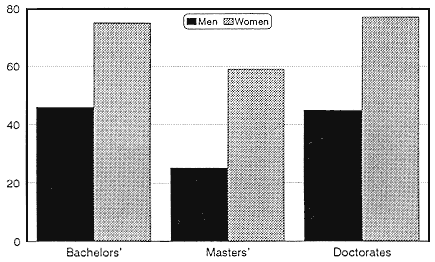
SOURCE: National Science Foundation, Science and Engineering Degrees: 1966–89 (A Source Book) (NSF 91-314), Washington, DC: NSF, 1991.
Figure I-4. Percentage of women and men receiving degrees in life, behavioral, and social sciences, by degree level, 1989.
Another fact consistent with the working conditions explanation is the greater exit rate of women than men from S&E positions in industry. Here again, the results may be consistent with other hypotheses. Using survey data from the National Science Foundation (NSF) and with support from NSF and the Alfred P. Sloan Foundation, Anne Preston of the State University of New York at Stony Brook has been investigating the exit rate of women from the natural sciences and engineering after they have been educated and employed in those fields. The results of this survey6 showed
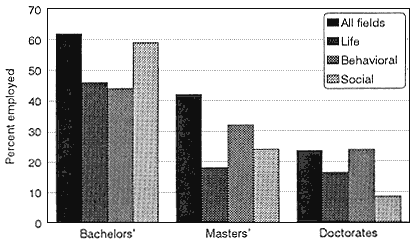
SOURCES: National Science Foundation, Characteristics of Recent Science and Engineering Graduates: 1990 (NSF 92-316), Washington, DC: NSF, 1992; Delores H. Thurgood and Joanne M. Weinman, Summary Report 1990: Doctorate Recipients from United States Universities, Washington, DC: National Academy Press, 1991.
Figure I-5. Percentage of 1988 and 1989 science and engineering (S&E) degree recipients employed in industry, by degree level, total and selected fields, 1990.
that over the 7-year period, 1982 to 1989, women's exit rates from S&E jobs were roughly twice as high as men's exit rates. In addition, of the women employed in science and engineering in 1982, 20 percent had left by 1989. Interestingly, as shown in Figure I-6, there was also a big difference in the exit rates of women in industry and women in the public and nonprofit
|
|
scientists and engineers between 1982 and 1989. The second set of data was obtained from a survey of 1,450 women and men—all degreed graduates in either math, science, or engineering—at a public university in the Northeast. Third, from the survey responses, 50 women—paired on the basis of similarities in terms of age, education, field of study, and family characteristics—participated in in-depth interviews; the difference between the two women within each pair was that one had left science and one had stayed. |
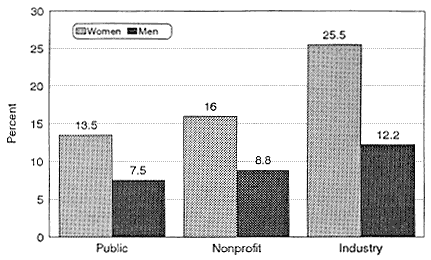
SOURCES: Anne Preston, "A Study of Occupational Departure of Employees in the Natural Sciences and Engineering," CWSE conference, Irvine, CA, January 17, 1993.
Figure I-6. Male and female exit rate, by sector (percentage of scientists and engineers employed in 1982 who had left S&E employment by 1989).
employment sectors. Over the 7-year period, the exit rate of women in industry was almost twice the exit rate of women in government.
With reference to the data for men, the Preston study revealed that 7.5 percent of male scientists and engineers employed by the government, 8.8 percent of those employed in the nonprofit sector, and 12.2 percent of those employed in private industry in 1982 had left S&E jobs by 1989. As with women, of the three sectors, the rate of exit of men was largest in private industry. However, while women in private industry were almost twice as likely as women in government to leave S&E jobs, men in industry were roughly 1.6 times more likely than men in government to leave S&E employment.
It is noteworthy that exit rates for Ph.D. women from all employment sectors were smaller, in fact comparable to the rates for men. Further results from this study will be given in Chapter II.
Organization of the Report
In summary, although the major factor that determines the size of the industrial S&E work force is an individual's selection of a particular degree field, gender differences persist even after field choice is controlled for. One possible explanation for these residual differences is the perception of a less favorable climate for women in industry. The profound implications of this possible perception led the Committee on Women in Science and Engineering to hold a conference to examine the relevant issues. The report of the conference follows. Chapter II addresses aspects of the corporate culture that may create perceptions of an inhospitable work environment in industry for women scientists and engineers. Subsequent chapters describe actions taken by both corporate employers (Chapter III) and women scientists and engineers themselves (Chapter IV) to facilitate the entry and retention of women in the nation's technological work force. Finally, the Committee's conclusions are summarized in Chapter V.


