5
Pearl Millet: Subsistence Types
Pearl millet is the staple of what is perhaps the harshest of the world's major farming areas: the arid and semiarid region stretching over 7,000 km from Senegal to Somalia (almost one-sixth of the way around the globe at that latitude). There, on the hot, dry, sandy soils, farmers produce some 40 percent of the world's pearl millet grain.
How to help these farmers—who live in the often drought-devastated zone on the edge of the world's biggest desert and who have no access to irrigation, fertilizer, pesticides, or other purchased inputs—is perhaps the greatest agricultural challenge facing the world. The answer may lie in their age-old staple, pearl millet.
Indeed, there is probably no better cereal to relieve the underlying threat of starvation in the Sahel, the Sudan, Somalia, and the other drylands surrounding the Sahara. Millions entrust their lives to this single species every day, and, of all the peoples on the planet, they are the ones most needing help. Yet, at the moment, pearl millet suffers from neglect and misunderstanding—in part because the crop grows in some of the poorest countries and regions and in some of the least hospitable habitats for humans (including research workers). People have thus unjustly stigmatized it as a poor crop, fit only for interim support while something better is located.
This chapter's purpose is to counter that misguided notion.
SUBSISTENCE MILLETS
Most pearl millets grown in Africa are necessarily oriented toward survival under harsh conditions rather than high yields.1 For want of a better name, we have called them "subsistence types."
To any outsider used to the robust look of wheat, rice, or maize, subsistence pearl millets may seem puny, unproductive, and downright unworthy of consideration. To an agronomist or cereal breeder, they
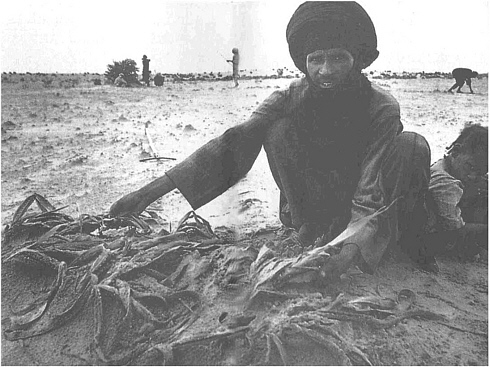
The pain of growing crops on the desert fringe. Pearl millet underpins millions of desperate lives, including this Fulani farmer in Niger. "I will not plant again," he told the photographer after a rainstorm flattened his seventh millet planting that year. Even his resilient subsistence-type pearl millet has succumbed. Most plantings in this region are lost to drought or sandstorm; this one, ironically, to a flash flood. (Steve McCurry)
|
Farming on the Fringe Pearl millet is the last cereal crop of arable farming on the edge of the desert—beyond it there is only pasturing and open grazing. There is not a more drought-tolerant cereal crop to relieve the threat of starvation. When it fails, nothing else can be substituted. Thus, millions are forced to entrust their lives to this plant. It is not an easy bargain to make. Most of Africa's pearl millet is grown where the danger of drought is ever present; where the landscape abruptly changes between the wet and dry seasons; where the rains are sometimes limited to only a month or two or three; and where utter aridity prevails the rest of the time. It seems a cruel irony that the most destitute of people are forced to depend upon foods that they must produce for themselves in the harshest lands. But pearl millet has "rusticité," a French term implying that it will produce something no matter what. Droughts, floods, locusts, diseases, and other hazards may hurt, but the plant produces food nonetheless. All other grains, on the other hand, are more vulnerable and more subject to complete collapse. It is remarkable that any crop can cope with the sites where pearl millet is grown. Local cloudbursts can dump the year's precipitation in a few hours. On crusted and hard soils, such deluges result in massive rushing runoff, heavy erosion, and the nearly complete loss of desperately needed moisture. Early season rains are preceded by severe dust storms that damage, bury, and desiccate tender emerging seedlings. Scorching heat can kill an entire crop before it becomes established. Because of problems like these, the threat of crop failure is omnipresent. Farmers must repeat their sowings, often two or three times. Most sow more area—and in widely separated sites-than they anticipate getting a harvest from. During the planting period they may scatter seeds continually wherever their herds trample the soil, and thereby give the seeds a chance to survive. To farmers elsewhere, tossing a few seeds in cow tracks may seem futile, but to those of the Sahel it can mean life itself. |
look particularly terrible. The plants perform poorly even when they are unstressed. They are tall and top-heavy; they are generally photosensitive; they exhibit low rates of fertilizer response; they have low harvest indexes; and they are localized in adaptation so that even the best of them cannot be easily moved around for use in other places. Above all, they are low yielding—averaging only around 500 kg per hectare.
In reality, though, subsistence pearl millets are some of the most remarkable food plants to be found anywhere. In the area of West Africa where pearl millet is paramount, the droughts can be fierce, the heat searing, and the rainstorms terrible. The sandstorms are even worse. Early in the growing season, the ever-present winds increase in intensity and often swirl the soil so powerfully that it literally sandblasts the tender seedlings. Then, heated by the Sahara sun, the new-blown sand may "cook" the seedlings before they can grow tall enough to shade and cool the land around their roots. Finally, as the soil dries out, its surface often hardens into a crust so impenetrable that any surviving seeds cannot break through.
Because of conditions like these, crop failure is omnipresent and Sahelian farmers must repeat their sowings, often several times. But of all food crops, subsistence pearl millets tend to survive best—they sometimes survive even in bare Sahara sand dunes.2 They are cereals for "base-line food security" and give the farmer the best chance of staying alive.
By and large, subsistence pearl millets can:
-
Germinate at high soil temperatures;
-
Germinate in crusted soil;
-
Tolerate some sand blasting in the seedling stage;
-
Yield grain at low levels of soil fertility;
-
Resist downy mildew;
-
Tolerate stem borer and head caterpillar; and
-
Hold up reasonably well against the parasitic weed striga.
Few of the scientists' varieties could be relied upon to produce food under conditions of such uncompromising hostility.3 Some of the "faults" perceived by outsiders are actually of great local importance, as the following examples show.
Late Maturation
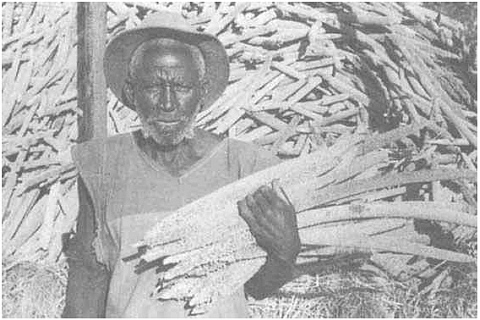
Elsewhere in the world, plant breeders have tried to speed up their cereals—to make them mature quickly so that more than one crop can be grown per year; so that weeds, pests, and diseases have less chance of causing destruction; and so that food can be produced where growing seasons are short. This is one reason why subsistence pearl millets look bad: many tend to mature very slowly.
The long growing season certainly leads to problems. Since flowering generally takes place after the rains end, even a brief early drought can hit the plants before there is any chance of forming seed and thereby bringing on total crop failure.
However, to Sahelian farmers the delay is all important. They want the grains to ripen after the rains have ceased. Although agronomically inefficient, it eliminates many drying and storage problems. (The grains can be easily dried, and they do not grow molds.) It probably also reduces problems caused by grain diseases and insects, both of which need moisture to thrive.
For the same reason, some subsistence pearl millets are "open-headed." This, too, is inefficient, and plant breeders elsewhere try to replace loose seedheads with compact ones. For the farmer in much of Africa, however, the open form eliminates many of the drying and storage problems encountered with tight-headed varieties.
The long vegetative growth phase is probably also a major adaptive advantage in this region where the soils are lacking in both moisture and fertility: it gives the roots a chance to explore larger soil volumes. For one thing, this probably contributes to the plant's drought tolerance. For another, it probably helps the plant amass the nutrients necessary to grow a good head of grain. This may take considerable time, because roots grow slowly and because in those depleted soils the release of any remaining mineral nutrients is itself often slow.
A related, subtle feature is that the traditional crop varieties usually mature at the same time. This means that only one generation of birds, insects, and diseases gets a chance to attack the flowers and seeds. Adding a mixture of types that mature successively is a disaster: it provides a "rolling nursery" that builds up multiple generations of pests and diseases that then wipe out all late-maturing types.
Daylength Sensitivity
Many of the world's wild plants (as well as most traditional landraces) are sensitive to the length of day. Modern plant breeders try to eliminate this restrictive trait so the plants they produce can be grown in different latitudes and seasons. But, for the subsistence pearl millets of West Africa, daylength sensitivity is what ensures that grain will
be ready to harvest just at the right time in the dry season. It is the length of day that triggers the plant to flower, not the age of the plants. The yield may be poor if the season has been difficult, but the plant will at least flower and mature whatever grain it can.
By-Products
Traditional rustic varieties tend to be big, tall, leafy plants that perform best when spaced far apart. While these varieties produce massive amounts of greenery (6-12 tons per hectare even under the prevailing circumstances), the harvest index is often less than 20 percent. This means that less than 20 percent of the plant (above ground) is grain and more than 80 percent is stalk and leaves, as compared to 30 percent or more for improved high-yield-potential varieties.
But farmers who must produce almost every necessity right on their own land look at these cereals in totality. To them, there is no such thing as excessive stalk. For anyone who cannot buy fencing, roofing, or fuel, stalks are as valuable as grains. And for those who have a cow or some goats, the leaves are what keep the animals alive during the dry season.4
Consumer Preferences
To a subsistence pearl-millet farmer, the kernel characteristics—shape, color, processing qualities, and endosperm texture—can be more important than the absolute yield. A grain is almost worthless if it doesn't have the right (and often very subtle) properties for the type of foods the family eats. Subsistence growers choose among the varieties mainly on grounds of suitability for preparing such dishes as:
-
Toh. The principal food, served at least once a day in the northern Sahel, toh is a stiff porridge prepared by adding pearl millet to boiling water while stirring.
-
Koko. This is prepared by mixing pearl millet flour with water into a fine paste, which is then put aside in a warm place for a day or two to ferment. The resulting sourdough is then dropped into boiling water to form a thin porridge of creamy consistency.
-
Marsa. This favorite snack of Ghanaians is a deep-fried pancake, prepared from the leavened batter of pearl-millet flour.
Genetic Diversity
Pearl millets grown under truly marginal conditions are usually heterogeneous enough to ensure stable production over seasons with widely differing weather patterns. In a sense, the African farmers for centuries have been performing ''population breeding," a technique that is only now becoming popular in science. With this technique, a cluster of genotypes acts as a "cohort" able (collectively) to make the best of varying conditions. The genetically different plants in the "swarm" help create a successful harvest, no matter what hazards the season may bring. Should one type be depressed by weather, pests, disease, or mismanagement, others carry the brunt.
Advancing the qualities of a plant along a broad genetic front helps ensure a reliable—although not maximum—yield. And when your life depends on what you can grow, reliability is the most fundamental need.
WHAT TO DO?
Supporting greater production of subsistence pearl millets is one of the world's most humane endeavors. But improving the plants in this case is probably of secondary importance. Given the already remarkable qualities of these time-tested survival crops, given the infertile soils and harsh climates, and given the resources at the farmer's disposal, it would be difficult to come up with a better plant than he has already.
More important is research to make the farming methods easier, more reliable, and more effective; research to make storing and handling the harvest better and safer; and research to ease the daily drudgery of processing the raw grain into edible forms.
This book is of course designed to highlight promising plants rather than farming, storage, or processing methods. However, during the course of this study we came across some innovative ideas that may help boost the performance and reliability of subsistence pearl millets. We mention them here briefly. In the appendixes can be found ideas on potential breakthroughs in pest control, grain storage, milling, and other pertinent aspects.
REDUCING VULNERABILITY TO CLIMATE
Helping farmers to deal with the uncertainties of the early rains—not to mention the droughts, sandstorms, and high soil temperatures—are perhaps the most valuable interventions that can be made. These
|
The Dual Track In this report we have given equal weight to species for both subsistence and commercial production. This is certainly an uncommon approach: in recent years polarization and even rancor have prevailed between the proponents of each viewpoint. However, in a broad sense, subsistence and commercial farming, although separate, are parallel and equally worthy—a fact not widely recognized by the public and one that sometimes befuddles even the best-intentioned scientific minds. Subsistence farming is vital to the lives of millions, of course, and strengthening it is perhaps the most humanitarian contribution that can be made to African agriculture. But it is often operationally impossible to reach the neediest in the way they want. To create a new variety—even of a well-understood crop such as wheat—can easily take a decade of dedication and perhaps a million in money. It is therefore clearly impractical to reach, individually, the thousands of subsistence regions, each with its likes and dislikes, needs and desires, climates and conditions. Although technical farming is not inimical to traditional farming, it is often much criticized by those most motivated to helping the neediest farmers. Everybody wants to help the most poverty stricken, of course. However, there is probably not a single subsistence farmer who doesn't dream of producing a surplus for sale. And that surplus is much more than a way to pay for a daughter's dowry or a transistor radio; it is, after all, the way out of poverty. For this reason, then, those who are developing modern cultivars and hybrids for use in even the poorest nations are not wrongheaded or misguided. Subsistence farmers may be in the overwhelming majority, but the other farmers are the ones who, producing more than they can eat, feed the nonfarming public—the city dwellers, businessmen, doctors, teachers, tourists, and, yes, even the visiting researchers. Nor is there any reason to deny subsistence farmers a route to prosperity by withholding from them the means for producing commercially desirable varieties. Any nation, to survive and prosper, must help its farmers feed more than themselves. Commercial farming has different requirements and goals from subsistence farming, but it poses no threat. This can be seen in many parts of the world. Throughout the Middle East, for example, farmers grow rustic and advanced wheats side by side—one for family use, the other for market day. Also, in the highlands of |
|
Peru, Indians commonly grow traditional potatoes for themselves and modern potatoes for the cities. Some have pointed out that the Green Revolution wheats in India and Pakistan were grown largely for sale. They conclude (rightly or wrongly) that commerce was the main motivation and that no quantum leap in food production can occur in Africa until similar commercial opportunities are available. Thus, despite the current polarized approaches, subsistence farming and commercial farming in the Third World are inextricably linked. Improvements in one can benefit the other. Traditional Farmers Are Superb, But . . . Subsistence farmers are to be admired and even emulated. Their techniques have been honed in the uncompromising harshness of an unforgiving climate as well as in the ever-present knowledge that failure means hunger or even death. However, no one should get carried away with the romantic notion that peasants always know best. In the 1860s, when the United States proposed putting an agricultural university in every state, there was much opposition and many claims that American farmers needed no technical help—that professors in universities could not possibly teach the people of the soil how to farm better. But it proved otherwise—the so-called "land grant colleges" provided the engine of basic knowledge that has driven U.S. agriculture to its current heights. It was through those universities and similar research facilities that the life cycles of many farm pests were worked out, the effects of fertilizer demonstrated, crop genetics illuminated, soil types and soil micronutrients identified, and myriad other basic facts underlying any farming operation brought to light. With this knowledge, even the most stubborn traditionalists were able to coax more from their land, with less effort and more consistency. All in all, there are many ways in which a basic biological understanding can benefit the subsistence farmers of the hungry nations. Even the best of those farmers can, in this way, be helped to grow their crops more easily, more reliably, and with higher returns. In the past, scientific findings were applied mostly to commercial agriculture, but that was because larger scale farmers are usually easier to reach and more susceptible to change. Knowledge is not detrimental to subsistence farming, and the polarization that now pervades rhetoric and thinking worldwide is deplorable. |
would provide more secure environments early in the planting season and would do much to reduce a farmer's vulnerability to total crop failure before the crop is even started. Following are six possibilities.
Tillering
The pearl millets grown in the Sahel tend to be nontillering—each seed puts up only a single stem. This adds a major vulnerability because if that stem dies in a drought or sandstorm, for example, the plant is lost.
But certain pearl millets put up as many as five heads—not all of them at once. In this case, then, the destruction of a stem still leaves the plant alive and with a chance to rebound.
Other things being equal, adding some tillering types would dramatically reduce the severity of crop losses in the bad years and it would reduce the need to replant damaged fields. And in the good years when the rains are plentiful and timely, two or three (or perhaps more) stems would all emerge and survive, thereby doubling or tripling the yield.
Deep Planting
In the United States, researchers are studying how different types of pearl millet perform while in the seedling stage. They have found that the seedlings show large differences in the length and in the speed with which they lengthen.5 By selecting types that produce tall seedlings and rapid elongation they have been able to plant the crop as deep as 10 cm.6 This gives the newly germinated and highly vulnerable seedling a better chance at surviving: it can reach deeper moisture; it is less likely to be killed if the soil surface dries out; and, if it is a fast grower, it can perhaps get through to the air before the soil crusts over.
Although the tests were done in germinators and greenhouses in the United States, they successfully identified lines possessing improved stand-establishment capabilities of high potential value for the subsistence farmers facing the elements a world away.
Water Harvesting
There are many possible ways to help concentrate moisture at the base of seedlings. A companion report identifies a considerable number.7 That these are likely to have significant value is suggested
by a recent paper on the use of soil imprinting and tied ridges.8 Both techniques produce little "basins" around the plants where water collects.
In the trials (conducted in an area of West Africa where annual rainfall is 600-900 mm), tied ridges captured 85-100 percent of the rainfall received on the site during the season. Normal ridging or flat planting captured only 55-80 percent—the rest was lost as runoff. Tied ridging also reduced the soil's surface bulk density, maintained soil fertility (by reducing losses of soil nutrients), and improved the soil's water-holding capacity. In the case of the pearl millet crop, tied ridging increased the depth of rooting, the root density, the vegetative growth, and the yields—and it did it in both wet and dry years.
Transplanting
The use of nurseries is one of the oldest strategies to avoid water stress in the seedling stage. For centuries, Asians have transplanted rice seedlings and West Africans have transplanted sorghum seedlings (see page 184). Now farmers in parts of Asia are transplanting maize in the same way. Direct sowing is of course much easier, but wherever catastrophic failure is a probability, transplanting provides added security.9
In this process, the seeds are planted not in the fields, but in small irrigated nurseries; they are taken to the fields only after the rains have commenced in earnest. This technique seems particularly promising with subsistence pearl millet (not to mention other crops in this book) because the crop must be established during the least favorable season, the time available is often short, the water supply limited, and the weather unpredictable. On top of all that, the farmer feels pressure to plant early because the family needs food and because the growing season is all too brief.
Transplanting not only overcomes the hazards of the unreliable early rains, but compared with a seeded crop, the transplanted crop is in the field for a much shorter time. It also needs far less water for an equivalent yield, and its resistance to the elements is greater. Growing
the seedlings in a nursery also allows the farmer to cull diseased plants and thereby reduce the intensity of infection.
Although transplanting is so far associated mainly with other crops, there seems to be no reason why it couldn't prove most beneficial with subsistence pearl millets. Indeed, in a few parts of India and Africa this is already practiced, and with considerable success.
Mulching
As we have noted, burning-hot soil is one of the major hazards to the newly planted subsistence millets. Anything that could cool the surface of the land would help. Apparently, little or no innovation has yet been applied to this problem, although some tests using shade have resulted in a tenfold increase in survival and yield.10
Windbreaks
The "sand-blasting" effect can surely be overcome by various kinds of barriers around (or at least on the windward sides of) the fields. One suggestion is the use of vetiver (Vetiveria zizanioides) hedges. This tall, extremely rugged grass would probably be unaffected by the blasting sand as its stems are enclosed in tough sheaths. When the time for planting crops arrives—even at the end of the driest of seasons—this perennial should still be standing stiff and straight and able to battle the wind.11
IMPROVING CROP MANAGEMENT
Ideas on helping subsistence farmers handle their crops with less work or higher returns can be found in various books, journals, research-station reports, and PVO newsletters, for example. We have included a few ideas in the appendixes to this volume. It is thus not our intention here to belabor such fairly well-recognized issues as the use of fertilizers, optimum levels of tillage, optimum crop population size, and the use of less-laborious cultivation practices such as hoes, plows, and draft animals.
There are, however, some promising lines of research that fit in with the spirit of innovation that lies at the heart of this book. Following are three examples.
Cropping Systems
Subsistence pearl millets are essential components of traditional agricultural systems. They are usually intercropped with cereals such as sorghum and maize or with legumes such as cowpea or peanut. To most farmers, the combined production is more important than the yield from either crop by itself. This mixed cropping is difficult for today's researchers to deal with, but there are some interesting developments. One is dwarfing.
To reduce the size of a cereal plant is a common strategy (see next chapter). It provides a compact plant that is more resilient, easier to handle, and higher yielding. In the case of subsistence pearl millets, however, dwarfing is done not for such a yield advantage. Researchers have found that simply reducing the plant height can contribute greatly to the associated cowpea and other low-growing legumes.12 The millet no longer shades its shorter companion, which, with the increased photosynthesis, results in better yields. Initial results in Niger are quite encouraging. Farmers there have adopted dwarf millets eagerly.
Building Tilth
The soil under subsistence pearl millet is usually coarse textured, containing at least 65 percent sand. Such porous sites are not only poor in fertility, they are very poor at holding water. Any rain that does fall tends to drain away below the reach of the roots. Ways to keep it in the root zone would bring marked benefits, both in the crop's yield and its reliability.
It has been found, for example, that leaving crop residues in the field dramatically raises pearl millet yields in West Africa's deteriorating semiarid areas. In three recent trials, grain yields rose by 300, 450, and 550 percent, respectively. The residues not only increased the sandy soil's moisture-holding capacity, they also lowered soil temperatures and boosted fertility.13
Biological Fertilization
The areas where subsistence pearl millet is prevalent are usually so remote and so poverty stricken that despite the soil's barrenness commercial fertilizer can seldom, if ever, be used. But all plants, even those as robust as subsistence pearl millets, need food in the form of nitrogen, phosphorus, potassium, and a few so-called "micronutrients." How to provide plant foods under subsistence conditions is one of the
|
Pearl Millet Helps Namibia Namibia's farming lands are among the driest and most unpredictable to be found. Perhaps for that reason, its farmers rely on mahangu (pearl millet) to provide the basic foods to keep their families fed. In the north of the country, where two-thirds of the population live, it is the staple. In the past, Namibia's farmers could hope to obtain only about 300 kg of grain per hectare—a pitifully small amount. Indeed, production was so low that the country had to import maize to feed its people. In 1986, however, the country asked ICRISAT for help, and 50 highly productive varieties were brought in and planted out for testing. In March 1987, at the new nation's first "Farmers' Field Day," approximately 100 farmers came to see the results. The variety Okashana 1 proved particularly impressive even though the rainfall that season had been only 170 mm (but well distributed). Namibia then requested 200 kg of Okashana 1 seed for multiplication, large-scale testing, and demonstration to farmers. At the March 1988 Farmers' Field Day, 250 visitors showed up to buy Okashana seed. A year later, more than 500 farmers came, and they bought about 4 tons of the seed. Since this new variety's arrival, Namibia's farmers have reaped bumper harvests. Even using traditional cultivation practices, they doubled their yields. But those who employed better methods obtained yields of 2.4 tons per hectare, about eight times the traditional amount. Okashana 1 results from intensive plant breeding at ICRISAT, but it still retains its rustic resilience and is especially suited to subsistence farmers' needs. Among its characteristics are high grain yield, large seed size, early maturity, resistance to downy mildew, and ability to mature grain even when end-of-season droughts rob the plants of moisture. According to Wolfgang Lechner, of the Mahanene Research Station at Oshkati, more than half of Namibia's pearl-millet farmers now grow the new variety. "Okashana 1 gives a light-colored flour that is highly acceptable," Lechner explains. "With this and the increased yields, within a couple of years the country may not have to rely on maize imports any more. That will save us a lot of valuable foreign exchange.'' |
greatest of all agronomic challenges—not just for Africa and not just for pearl millet.
In certain places, deposits of rock phosphate have been located. This almost insoluble phosphorus-containing mineral has seldom been tapped for fertilizer in the past. But it is potentially a major source of phosphate for regions in extremity. Unlike standard soluble fertilizers, it doesn't provide an instant jolt of good nutrition, but it is nonetheless a most valuable source of a prime nutrient that plants need to remain healthy, robust, and high yielding. Certain parts of West Africa have deposits of rock phosphate that could be tapped for this purpose.
For providing nitrogen to a subsistence farmer's crops, probably nothing is more practical than biological sources. Nitrogen can be obtained in this way by:
-
Incorporating crop residues or animal manures into the soil;
-
Using leguminous food plants (such as cowpea or peanuts) in crop rotations;
-
Intercropping with herbaceous soil-building legumes such as stylosanthes or macroptilium; or
-
Incorporating nitrogen-fixing tree species such as Acacia albida into the fields.14
With pearl millet there is also the potential to get nitrogen directly from a beneficial microorganism that can live on its roots. Such nitrogen-fixing symbioses between a plant and a microbe are characteristic of many legumes, but of only a few grasses. Pearl millet is one of those few. It benefits from a nitrogen-fixing bacterium called azospirillum. Recent trials in Maharashtra, India, have shown that when pearl millet plants were inoculated with azospirillum, the yield of both grain and fodder was significantly increased.15