6
Pearl Millet: Commercial Types
Although it is one of the best means for sustaining life in the most desolate and difficult parts of the farming world, pearl millet also grows well under pampered conditions—under irrigation and in equable climes, for example. Because this fact is not widely known, most people dismiss pearl millet as a crop for good lands, pointing out that its low yield, low harvest index, and generally low fertilizer response mean that it cannot match the better known cereals under high-tech management.
However, it is far too early to dismiss pearl millet as a crop for regions that now grow modern maize and wheat and rice. The plant, as we have said earlier, has remarkable qualities, and some of its environmental resilience happens to be of the type that Latin America, North America, Australia, Europe, and others may soon need desperately. Moreover, pearl millet is no longer a rustic relic. Hybrids and other advanced forms are coming available for worldwide use. The old impressions no longer hold.
In fact, a new vision of this ancient crop's potential is becoming clearer from research in the United States, where pearl millet is already exciting increasing interest (see box, page 114). Indeed, fast-maturing types that ripen grain in as few as 90 days after planting and can be harvested by giant combines are now viewed as important resources for a vast belt spanning the nation from the Carolinas to Colorado.
This recognition is starting a new era in pearl millet production. For almost the first time the crop is being seriously investigated with sophisticated methods in the world's finest research facilities. Male-sterile forms, dwarfs, hybrids, and even some very unusual hybrids that produce fertile seed, have all recently been created. So far (at least in the United States), the emphasis has been on producing pearl millet as a feed grain—and with excellent reason: in U.S. Department of Agriculture trials, beef cattle, young pigs, and poultry fed pearl millet grain have grown as well as (or better than) those eating maize (see box).
More and more, however, America's pearl millet proponents are
realizing that they have in their hands a potential new food grain for the nation and for the world.
There are good reasons for that assumption. Despite the current widespread notion that pearl millet is a second-rate cereal, the plant actually has a high potential growth rate—higher even than sorghum. Like maize and sorghum, it has the super-efficient C4 photosynthesis. Some types mature very fast and can produce two or even three generations a year if conditions permit. And there are other advantages as well. Pearl millet is, for example, "a plant-breeder's dream" and can be developed quickly into numerous and widely different forms (see box, page 122). It is a cross-pollinating species on which several different breeding methods can be successfully employed. And, by a strange twist of genetic luck, it can also be easily inbred.
In terms of large-scale commercial production, therefore, this crop is poised for revolutionary advances. It stands at about the point maize did in the 1930s. Hybrids are known but are not in widespread use; yields are only a fraction of what they might be; and although the basic understanding of the crop's physiology and genetics is still rudimentary, it is beginning to become clear. Seizing the opportunity now could propel pearl millet (like maize since the 1930s) to far higher levels of productivity by using the best of modern techniques. Indeed, pearl millet might well result in a similar leap in food production in many new areas.1
Reasons for thinking this are not hard to find. The world's drylands are faced with an increasingly serious food crisis. Already this is becoming clear in the Middle East. For example, in 1989 Syria's parliamentary speaker announced at a meeting called to discuss Arab development and population problems that, unless the Arab world produces more food, one-third of its people will face starvation.2 In such places the world's most drought- and heat-tolerant cereal obviously has vital promise.
All in all, then, this plant's adaptability to both good and bad conditions makes it a potentially outstanding food crop for vast areas of a "greenhouse-afflicted" world where climates may change wildly from decade to decade or even from year to year, and where more and more people must obtain food from hot, dry soils.
The chances for boosting pearl millet's productivity and usefulness are good, but the improvements may not come rapidly. To make the
crop a modern and globally useful food resource, varieties with large, dense, spherical, light-colored kernels that taste good are needed. In addition, improved dehulling characteristics are vital if pearl millet is going to be employed in human foods on a truly wide scale.
Eventually, all of these and more seem likely to come about, as can be seen from the following promising lines of development.
HIGH-GRAIN TYPES
The worldwide cereal-breeding advances of the last 100 years have increased rice, wheat, and maize yields dramatically, but, contrary to popular perception, the plants still produce about the same amount of growth (that is, their overall dry matter is largely unchanged). Yields have risen because the plants were reconfigured to reduce the proportion of stems and leaves and increase the proportion of seeds. Usually, this meant reducing the plant height, but sometimes it also meant increasing the number of seedheads per plant.
Such rearranged plants have been the key to the remarkable jump in cereal yields that have occurred in most parts of the world. They respond well to good management; they make it possible to use fertilizer and other inputs profitably; and they create an upward spiral of yield and income that goes far beyond food production alone. For example, they help farmers to rest part of their land to restore its physical condition and fertility.
As of now, however, Africa's pearl millets are not of the rearranged type. After centuries of trying to stretch their heads above the rampant weeds, they are too tall for maximum grain production. In creating excess stalk, they are consuming energy and moisture that could be used to develop more grain.3 Also, they cannot fully enjoy the benefits of fertilizer because it makes the plants top-heavy so that rain or wind can easily topple them into the dirt. Paradoxically, more fertilizer can mean less yield.
This was the situation of Mexico's wheats before the 1950s when genes from Japanese dwarf varieties helped create short, strong-stemmed plants that could hold their heavy heads up during lashing winds and pounding storms. Strengthening the plant's architecture allowed fertilizer to work to the fullest benefit and was a prime component of the wheats that generated the Green Revolution.
A similar transformation is now occurring with pearl millet. Strong-stemmed dwarf types are being put to use for the first time. Such types have already been developed in the United States, for example. Yields of 4,480 kg per hectare have been achieved on research stations, and demonstration plots on farms in 1991 yielded 3,024 kg per hectare.
|
Millet in the USA Although pearl millet has long been grown in the United States, few Americans have ever heard of it. That may soon change, however. A number of pioneering researchers see this crop as a valuable grain for the nation. High-yielding cultivars are being selected and bred; even hybrids have been created (see page 119). However, owing to an oversupply of food, pearl millet is currently being developed mainly as a way to feed animals. Recent results have indicated that it has exceptional promise for the American livestock industry. Part of the research has been done in Nebraska and Kansas, where the plant's tolerance of drought and acid soils, its resistance to pests, as well as its low requirements for nitrogen fertilizer, make it a potential boon to farmers. The experiments showed the plant could fit into multiple cropping systems for the Great Plains region. Pearl millet might be used as a quality-protein grain for many livestock-feeding purposes. Compared with maize, it had higher crude protein and ether-extract concentrations, as well as higher concentrations of all essential amino acids. Already, it is showing promise for feeding both poultry and cattle. Poultry Trials in different parts of Georgia have shown that pearl millet grain can fully replace maize in chick rations. It neither reduced the feed-conversion efficiency nor the rate of weight gain. Indeed, chickens eating pearl millet actually grew faster and healthier than those eating maize, sorghum, triticale, or wheat. This was an important discovery because although maize is the Southeast's main poultry feed, it grows poorly there and the local poultry industry has to import maize from the Midwestern states. Some observers now conclude that as transportation costs increase, locally grown pearl millet could soon replace the imported maize as the poultry feed of choice. Several other areas of the country where maize is difficult to grow seem likely to switch over as well. Cattle Metabolism and feedlot trials in both the Midwest and the Southeast have shown that pearl millet is also good for feeding |
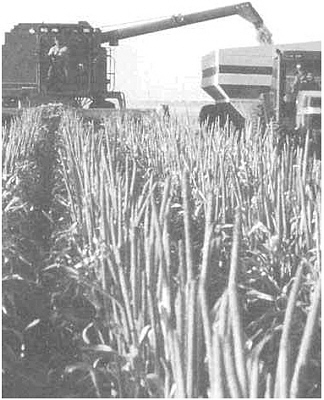 Plainview, Texas, 1992. Hybrid pearl millet being harvested. In both the Southeast (mainly Georgia) and Midwest (Kansas and Nebraska) hybrid pearl millets have been created. At about I m tall, they are half the normal height and can be harvested by combine. Big improvements in production have been achieved; grain yields of 3,000 kg per hectare are not uncommon. Commercial varieties, like the one shown, have been released for farm use. (M. Marley) cattle. The grain's oil content, which is more than twice that of maize or sorghum, gives it a relatively high energy density. Pearl millet has also proved potentially useful as a source of protein.* Compared with maize, it had higher concentrations of both crude protein (about 14 percent of the dry matter) and essential amino acids. |
TEMPERATE-ZONE TYPES
Traditionally, pearl millet has been grown within about 30° of the equator, but these days certain types are already growing each year in various parts of the United States—in Georgia, Kansas, and Missouri, for example—that are far from the equator. Moreover, although the plant is almost synonymous with drought and deserts, it is also growing well in mild and humid locations such as the sandy coastal plains of south Georgia and Alabama.
In these temperate areas of America, pearl millet is potentially invaluable as a summer annual grain crop. Maize is poorly adapted to this region where its own shallow roots (blocked by the acid subsoils) and the common summer droughts result in low yields. Hybrid pearl millet develops deep root systems in these acid soils, resulting in much more dependable yields. Pearl millet also resists midges and the lesser cornstalk borer, two insects that severely affect sorghum. Moreover, no aflatoxin problems have been observed with pearl millet.
In addition, pearl millet is giving the farmers in the Southeast undreamed of flexibility. Whereas maize must be planted within a two-week window in April, pearl millet can be planted at any time between April and July. This means that it can skirt the hazards of summer and still mature a crop before winter chills cut off all growth.
EARLY TYPES
A driving force behind U.S. pearl millet research is the chance that pearl millet might make double-cropping possible. This is now approaching reality. Rapidly maturing cultivars are soon to be released, and these are the types now seen as promising for the belt stretching from the Carolinas to Colorado. Planted in spring, just after the winter wheat has been harvested, they can ripen a crop before autumn, when the next winter-wheat crop needs to be planted. Key to this rotation is pearl millet's inherent ability to tolerate heat as well as drought. The plant survives and yields grain even during the sweltering summer and on the (often meager) moisture left unused in the soil by the preceding wheat crop. No other cereal can do that.
The global value of such precocious pearl millets could be substantial.
TROPICAL TYPES
Although pearl millet is the quintessential dryland cereal, it is also found in some of Africa's wet and humid tropical zones. Much pearl
millet is grown, for example, in relatively high rainfall areas of Ghana. The types there are entirely different from those of West Africa's nearby dry zone. In general, they have seedheads (spikes) that are shorter and fatter; grains that are bigger, rounder, and whiter; and plants that mature much earlier. These differences are so conspicuous that the plants were previously classified as a separate species.4
Such types there have been little studied or appreciated by the world at large. Yet they appear to be promising in their own right and are good sources of genes for earliness and large grain size.5
The potential of pearl millet for the tropics can be seen in Ghana, where early millet is extremely important to rural people. The type grown there normally matures at the peak of the rainy season, a time when farmers have exhausted their food stocks from the previous harvest. At first, they gather pearl millet when the grains are in the dough stage and are soft and sweet. Usually, the freshly harvested heads are steamed, threshed, and dried. This process—the exact reverse of normal practice—probably makes it possible to recover the immature grains that would otherwise turn to mush when threshed.6
SUGARY TYPES
In India, as in Ghana (see above), pearl millet is sometimes roasted and consumed like sweet corn. Here, too, the grain is harvested in the milk or dough stage. This is a facet of pearl millet that has received little (if any) investigation. Yet it is reminiscent of the situation with maize a century or so ago. At that time the practice of eating maize grain in the soft, sweet, doughy stage was known only to a few Indian children and perhaps some adventurous farmers.7 Today, "sweet corn" is a major food of North America, and a huge research effort has been expended on selecting strains whose grains convert sugar to starch only slowly so that they stay sweet. Canned sweet corn is in fact America's favorite preserved vegetable and has been outselling all the others since World War I.
Pearl millet, too, should have a big future as a sweet treat to be eaten more like a vegetable than a cereal.
POPPING TYPES
In India pearl millet is commonly popped. Dry grains sprinkled onto hot sand burst like popcorn. The pops are sometimes eaten with powdered sugar or brown sugar (jaggery).
The types that pop best have been given little or no special study. But popping is a promising method for bettering this crop (see Appendix C, page 297) and should be investigated further. Select types with round grains and impervious seed coats (so that the steam building up inside can reach the explosive levels necessary for good popping) will probably prove best.
LIGHT-COLORED TYPES
Although most of the pearl millets so far grown are tan or brown, white-grained types for the large-scale commercial production of food for people are now under development. These are attractive to look at and are sweet to the taste. Some have high protein contents. Also known are some yellow-grained pearl millets that are rich in carotene, the precursor of vitamin A. So far, however, they have been little appreciated.
EASY-PROCESSING TYPES
As noted earlier, pearl millet is among the more difficult grains to prepare. For one thing, the whole grain (caryopsis) contains a high proportion of germ. But more important, the germ is embedded inside the kernel and is difficult to remove. It is for this reason that traditional hand decortication often produces low yields of flour (not to mention its tendency to go rancid during storage).
The need for cultivars with improved dehulling properties is critical. Indeed, varieties with large, spherical, uniform, hard kernels that produce high milling yields already exist, but have not been documented systematically or brought into large-scale commercial production.
When pearl millets are processed into food products, there will be a need for larger supplies of more uniform grain with desirable milling properties and acceptable flavor, color, and keeping properties.
CUISINE-SPECIFIC TYPES
Most of the world's cereal breeding is done with foods such as bread, cakes, cookies, crackers, canelloni, or various breakfast
concoctions in mind. But for pearl millet to sell in a big way in Africa it must be good for very different foods. In Africa (as well as in India), the major pearl millet foods are unfermented bread, fermented breads, thick and thin porridges, steam-cooked products, beverages, and snacks. Little or no information is currently available on which pearl millets have the best properties for each of these foods. This is a handicap. Undoubtedly, superior types exist and collections and investigations should be made in the houses of the users themselves. As we have said in the previous chapter, however, it is difficult to quantify, let alone breed for, the organoleptic properties of certain foodstuffs.
QUALITY-NUTRITION TYPES
Contrary to general opinion and oft-repeated statements in textbooks, pearl millet is one of the more nutritious of the common cereals. As has been noted, its grain has more fat than most, and its level of food energy (784 kilocalories per kg) is among the highest for whole-grain cereals. It also has more protein, and its level of the essential amino acid lysine is better than in most cereals.
However, some pearl millet grain may suffer (nutritionally speaking) because it is low in threonine and the sulfur-containing amino acids. Also, its lysine level could still be improved. Of course, the other major grains have the same defect, but in the last few decades high-lysine types have been found in maize, sorghum, and barley. It seems likely that a diligent search through the world's pearl millets with an amino-acid analyzer could disclose something similar.
HYBRIDS
As already mentioned, the development of maize hybrids in the 1930s led to a quadrupling of yields. A similar breakthrough, allowing the practical production of pearl millet hybrids, came in the late 1960s, when the first hybrids were created.8 High-yielding, hybrids have been in use in India since 1966. Heterosis (hybrid vigor) in pearl millet can be substantial.9 Indian scientists have succeeded in developing hybrids that can almost double the yield of local cultivars.10
Today, hybrid pearl millets are being planted in Kansas and Georgia. They are half the normal height—only a meter or so tall—and are capable of producing more than 3,000 kg grain per hectare. Their short stature and uniform growth make them amenable to harvest by combine. Commercial varieties are now being released to farmers.11
APOMICTIC TYPES
As is well known, hybrids have the limitation that farmers must buy new seed every year or so. Although in many countries this is now a routine part of farming and is seldom constraining, the farmer must be able to buy the seed and the suppliers must be able to produce enough and deliver it on time for the planting season. In rural Africa that can be a problem.
Forms of hybrids that maintain their production potential from generation to generation are being developed in pearl millet (see box, page 123). These forms, known as apomictic types, are on the verge of being perfected.
TOP-CROSS HYBRIDS
Crop varieties sometimes come to disastrous ends when circumstances change or a new disease arrives. In the case of hybrids, the disaster can be particularly severe because creating a replacement is a long and uncertain process that must start afresh with new genetic material. The whole operation might well take 10 years or more of diligent and dedicated effort. But plant breeders at the International Crops Research Institute for the Semi-Arid Tropics (ICRISAT) in India have developed a strategy to keep pearl millet hybrids going indefinitely, even when new diseases arise or conditions change.12
Normally, hybrids are developed using two inbred parents of known and uniform qualities. ICRISAT's strategy is to replace one parent with an open-pollinated variety of broad genetic background.
The resulting products, called ''top-cross" hybrids, are now being tested. So far they have yielded as well as the best of the old hybrids and yet have shown greater resistance to disease (presumably because they have a wider range of genes).
This is all well and good, but it is in the prevention of future difficulties that top-cross hybrids really shine. Should one of them ever succumb to disease, plant breeders can introduce resistance through the open-pollinated parent in just a generation or two (in, say, not more than 2 years). It is possible, therefore, to keep a hybrid strong and secure by performing parallel breeding on the open-pollinated parent as a sort of ongoing genetic preventive maintenance.
The ICRISAT plant breeders are now taking the strategy a stage further and replacing even the sole remaining inbred parent with a hybrid of broad genetic background. This means that the resulting hybrid has even more genetic variability within it. This method helps, too, in reducing the cost of seed production.
WIDE CROSSES
Pearl millet (that is, Pennisetum glaucum) will hybridize with a few wild Pennisetum species, some of them very distantly related. Crosses with close relatives produce fertile hybrids, thus permitting extensive modifications to the genomes of both. Some hybridization work has already been done involving napier grass (Pennisetum purpureum ). Pearl millet x napier grass hybrids have been released for perennial fodder supplies in India. the United States, and various other nations.
Two wild and weedy subspecies (Pennisetum glaucum subspecies monodii and Pennisetum glaucum subspecies stenostachyum) also readily cross with pearl millet. The useful characteristics they can confer include disease- and insect resistance, genes for fertility restoration of the A1 cytoplasm, cytoplasmic diversity, high yield under adverse conditions, apomixis, early maturity, and many inflorescence and plant morphological characteristics.
Among other possibly useful wild species are Pennisetum squamulatum, Pennisetum orientale, Pennisetum faccidum, and Pennisetum setaceum.
Pearl millet has also been crossed with species of completely different genera, including buffel grass (Cenchrus ciliaris).13
In an approach that turns normal practice on its head, at least one researcher is using pearl millet to "improve" its wild relatives. The resulting tough, resilient, almost-wild Pennisetum hybrids appear useful for stabilizing desertifying environments, while giving those who live there a chance to get some food.14
|
Genetic Jewels Pearl millet is not now used as a genetic-research organism, but potentially it could be one of the best plants for illuminating details of both traditional and molecular genetics. A by-product from such fundamental science is likely to be new forms that increase the crop's value for meeting food needs. THE PLANT WORLD'S DROSOPHILA As a tool for investigating genetic interactions, pearl millet has the promise to rival drosophila, the fruit fly with which researchers have plumbed the details of animal genetics since the 1930s. Consider the following.
|
|
FATHERLESS GRAINS Like most plants, pearl millet produces seeds that have the characteristics of both parents. Certain of its relatives, however, produce seeds with only their mother's genes. For them, each new generation is identical to the last. This situation is known as apomixis. It is not unusual in wild grasses, but to introduce it into crops has been considered too complicated, too expensive, or just too far-out. However, all that is now changing. Within the genus Pennisetum, apomictic types have been located in a number of species. If their trait for self-replication can be transferred to pearl millet, profound benefits would result. For one thing, with apomictic pearl millet the farmer's fields would be safe from genetic drift. No longer would pollen blowing in from wild and weedy relatives downgrade the elite varieties. For another, seed from different apomictic varieties could be mixed, and the farmer would retain the security of natural diversity as well as the productivity of man-made varieties. For a third, apomictic pearl millet hybrids could be propagated by seeds for an unlimited number of generations without losing their genetic edge. Farmers would no longer have to buy fresh seed every year to enjoy the benefits of a hybrid. The apomictic types of the wild Pennisetum species are not themselves promising as crops. They produce few seeds and have many weedy characteristics. But their gene for apomixis can be transferred to the pearl millet plant. Indeed, significant progress has already been made transferring this gene from the wild African grass Pennisetum squamulatum to cultivated pearl millet.* This development could catapult pearl millet into being a leader in high-tech agriculture. Progress is being made in finding molecular markers associated with apomixis. This association will allow researchers in the future to isolate the gene(s) controlling apomixis and possibly use them to produce true-breeding hybrids in many crops. Indeed, in this way pearl millet's genes have the potential to revolutionize food production around the world.
|
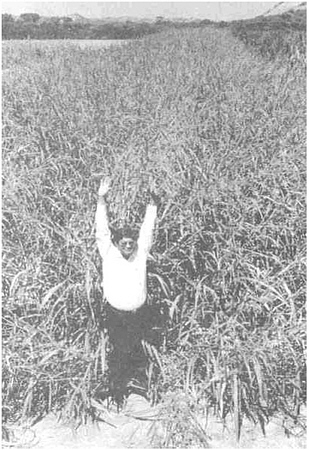
Recently, researchers in Zimbabwe have crossed pearl millet with 49 different accessions of napier grass (Pennisetum purpureum). In doing so, they generated over 200 hybrids between the two near relatives. This was done not to improve the pearl millet, but to raise the yield and protein content of the napier grass, a widely used forage. The new hybrids yield 30-40 percent more dry matter but also 20-40 percent (9 percent versus 11-13 percent) more protein than the forms presently cultivated by local farmers. (ICRISAT)
SWEET-STALK TYPES
At least two grasses—sugarcane and sweet sorghum (see page 198) produce stems filled with sugar. Apparently, nobody thought to look for this trait in pearl millet until the 1980s, when some Indian scientists stumbled on some during a germplasm-collecting expedition in the southern state of Tamil Nadu.15 In the area around Coimbatore and Madurai, they found types that at maturity contained more than twice the normal amount of soluble sugars.
These sweet-stalk types had long narrow leaf blades, profuse nodal tillering (with asynchronous maturity), short, thin spikes, and very small grains. They could be easily identified by chewing them at the dough stage.
The sweet-stalk pearl millet is used as a fodder that is usually harvested in September, and a subsequent ratoon crop can be taken for grain and straw. The farmers consider them to be superior feedstuffs because livestock love the sweet stalks.
TYPES OF THE FUTURE
As can be seen from the above, pearl millet contains a wealth of genetic strengths and offers almost countless opportunities for innovation and advancement. Eventually, biotechnology could have a huge impact on such a diverse crop. It could, for example, be used routinely to transfer pieces of DNA from variety to variety or from the large numbers of wild Pennisetum relatives (or even from other genera). Probably, it is only a matter of time before techniques for this (by using vectors or electrophoration, for example) are developed.
Such transfers are most effective when the crop's protoplasts (wall-less cells) can be regenerated into whole plants. Although it is not yet possible to regenerate protoplasts in pearl millet, it is possible to regenerate suspension cultures (including those of pearl millet x napier grass hybrids) into whole plants.16
Perhaps the best way to codify the enormous diversity of this crop is to create a chromosome map (see box, page 34). This is likely to help make possible all sorts of advances in pearl millet. The task should be easier than with many crops. Pearl millet is a diploid with seven fairly large chromosomes and a large number of genes that are already known and definitively mapped.