7
Sorghum
To include sorghum in a book on "lost" crops, on the face of it, seems like a gross mistake. After all, the plant is Africa's contribution to the world's top crops.1 Indeed, it belongs to the elite handful of plants that collectively provide more than 85 percent of all human energy. Globally, it produces approximately 70 million metric tons of grain from about 50 million hectares of land. Today, it is the dietary staple of more than 500 million people in more than 30 countries. Only rice, wheat, maize, and potatoes surpass it in feeding the human race.
For all that, however, sorghum now receives merely a fraction of the attention it warrants and produces merely a fraction of what it could. Not only is it inadequately supported for the world's fifth major crop, it is under-supported considering its vast and untapped potential. Viewed in this light it is indeed "lost."
But this situation may not continue much longer. A few researchers already see that a new and enlightened era is just around the corner. Accorded research support at a level comparable to that devoted worldwide to wheat or rice or maize, sorghum could contribute a great deal more to food supplies than it does at present. And it would contribute most to those regions and peoples in greatest need. Indeed, if the twentieth century has been the century of wheat, rice, and maize, the twenty-first could become the century of sorghum.
First, sorghum is a physiological marvel. It can grow in both temperate and tropical zones. It is among the most photosynthetically efficient plants.2 It has one of the highest dry matter accumulation rates. It is one of the quickest maturing food plants (certain types can mature in as little as 75 days and can provide three harvests a year).
It also has the highest production of food energy per unit of human or mechanical energy expended.3
Second, sorghum thrives on many marginal sites. Its remarkable physiology makes it one of the toughest of all cereals. It withstands high rainfall—even some waterlogging.4 Recent research in Israel has shown that it also has some tolerance to salt—an increasingly useful feature for any crop these days.5 But most importantly, it can endure hot and dry conditions. Indeed, it can produce on sites so burning and arid that no other major grain-with the exception of pearl millet—can be consistently grown.6 Its massive and deep-penetrating roots are mainly responsible for this drought tolerance, but the plant has other drought-defying mechanisms as well. For instance, it apparently conserves moisture by reducing its transpiration when stressed (by rolling its leaves and possibly by closing the stomata to reduce evaporation) and it can turn down its metabolic processes and retreat into near dormancy until the return of the rains.
Third, sorghum is perhaps the world's most versatile crop. Some types are boiled like rice, some cracked like oats for porridge, some "malted" like barley for beer, some baked like wheat into flatbreads, and some popped like popcorn for snacks. A few types have sugary grains and are boiled in the green stage like sweet corn. The whole plant is often used as forage, hay, or silage. The stems of some types are used for building, fencing, weaving, broom-making, and firewood. The stems of other types yield sugar, syrup, and even liquid fuels for powering vehicles or cooking meals. The living plants are used for windbreaks, for cover crops, and for staking yams and other heavy climbers. The seeds are fed to poultry, cattle, and swine. On top of all that, sorghum promises to be a "living factory." Industrial alcohol, vegetable oil, adhesives, waxes, dyes, sizing for paper and cloth, and starches for lubricating oil-well drills are just some of the products that could be obtained.
Fourth, sorghum can be grown in innumerable ways. Most is produced under rain-fed conditions, some is irrigated, a little is grown by transplanting seedlings as is done with rice. Like sugarcane, it can also be ratooned (cut down and allowed to resprout from the roots) to
provide crop after crop without replanting. It is ideal for subsistence farmers on the one hand and can be completely mechanized and produced on a vast commercial scale on the other.
Finally, sorghum is relatively undeveloped. It has a remarkable array of untapped variability in grain type, plant type, adaptability, and productive capacity.7 Indeed, sorghum probably has more undeveloped and underutilized genetic potential than any other major food crop.
With all these qualities and potentials, it is small wonder that certain scientists regard sorghum as a crop with a great future. Undoubtedly, as the world moves towards the time when its supplies of food will be insufficient for its supplies of people, this plant will increasingly contribute to the happiness of the human race. This will happen sooner rather than later. Population is projected to almost double within most of our lifetimes. How to feed billions of newcomers on diminishing amounts of prime cropland will likely be the overwhelming global issue of the period just ahead. Obviously, vast amounts of the less fertile and more difficult lands must be forced to produce food. Moreover, if the much feared greenhouse effect warms up the world, sorghum could become the crop of choice over large parts of the areas that are today renowned as breadbaskets, rice lands, or corn belts.
In sum, it seems certain that no matter what happens sorghum will assume greater importance, especially to backstop the increasingly beleaguered food supplies of the tropics and subtropics. For a hot, dry, and overcrowded planet, this crop will be an ever-more-vital resource.
This is in fact already starting. Despite only modest international support, sorghum even now seems to be verging on a global breakout. In the United States, its yield improvements have outstripped those of all other major cereals.8 In India, it is increasingly employed. And in Mexico, Central America, and the Caribbean—a most unexpected part of the world for this African plant—the most rapid growth of all is occurring.
Indeed, the rapidity with which Mexico has embraced sorghum is little short of spectacular. Before 1953, the crop was so little used in Mexico that, as far as international statistics were concerned, it didn't exist there. However, by 1970 it was being planted on nearly I million hectares, and by 1980 on nearly 1.5 million hectares. The reason is a pragmatic one: sorghum is not only cheaper to produce, it yields about twice as much grain as maize in Mexico (2,924 kg per hectare versus 1,508 kg per hectare in one recent test). Also, where rainfall is unreliable, sorghum is proving the more dependable of the two.
Mexico uses most of its sorghum grain for animal feed, but it is increasingly relying on new, food-quality sorghums. These produce grains suitable for making tortillas, the round flat bread that is Latin America's staple food. In addition, sorghum is also being used to make breakfast cereals, snacks, starch, sugars, and other products that currently come from maize. It is even the basis for some (European-type) beers in Mexico, a country renowned for its brewing skills.
Although these developments demonstrate sorghum's capabilities and almost certainly portend a coming boom in production throughout much of the world, much remains to be done before this crop can truly fulfill its international potential. At present, it has several drawbacks, including the following:
-
Lack of status. In global terms, sorghum is being held back by the mistaken prejudice that it is a ''coarse" grain, "animal feed," and "food of the peasant classes."
-
Low food value. In its overall nutrient composition—about 12 percent protein, 3 percent fat, and 70 percent carbohydrate—sorghum grain hardly differs from maize or wheat. However, sorghum has two problems as far as food quality is concerned. One is tannins, which occur in the seed coats of brown sorghum grains. When eaten, tannins depress the body's ability to absorb and use nutritional ingredients such as proteins. Unless the brown seeds are carefully processed, some tannins remain, and this reduces their nutritional effectiveness.
The other problem is protein quality, which affects all sorghums, both brown and white. A large proportion of the protein is prolamine, an alcohol-soluble protein that has low digestibility in humans.9
-
Difficulty in processing. Sorghum is harder to process into an edible form than wheat, rice, or maize.
Ultimately, none of these drawbacks is a serious barrier to sorghum's grander future, but each is a drag that—like a sea anchor in the tide of progress—is holding the crop from its destiny. Moreover, all of them can be overcome, as the following chapters demonstrate.
This plant's potential is so great that we have devoted the following four chapters to its various types. The next chapter highlights sorghum's promise for subsistence farmers—the millions in Africa and Asia (not to mention Latin America) to whom the plant means life itself. The subsequent chapter highlights commercial sorghums—the types that are increasingly grown by farmers who produce a surplus. The chapter that follows highlights specialty sorghums—unusually promising food
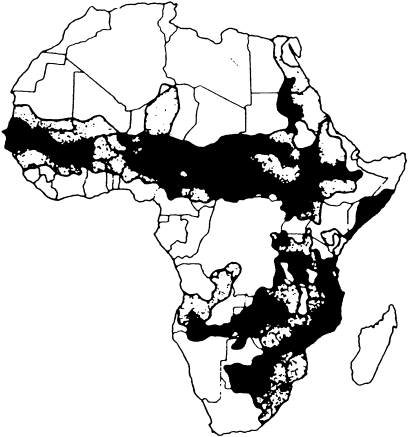
The extent to which Africa stands to benefit from sorghum research can be seen from this map. The crop is perhaps the continent's most widespread and important staple. Beyond the fact that yields can be raised far above the present average, sorghum's adaptation to a wide range of ecological conditions is an enormous asset.
Over the millennia, this ancient food was probably domesticated several times. At least four major types arose in different places. These are shown. One of the oldest, the durra (crook-necked) variety, was eaten in Egypt more than 4,000 years ago. Ethiopia is its center of diversity, and durra sorghum is still the staple food for most of the populace of the Horn of Africa. The region from eastern Nigeria through Chad and western Sudan is a center of diversity for the caudatum race. The region from western Nigeria to Senegal gave rise to the guinea race. The area from Tanzania to South Africa is the center for the kafir race. All of these separate sorghums have fed countless generations.
|
Africa's Gift to Mexico The rise of sorghum in Mexico has been so spectacular that it has been called "the country's second Green Revolution." The crop has become the third largest in terms of area (after maize and beans) as well as in terms of value (after maize and cotton). Between 1958 and 1980, the number of hectares sown expanded by almost 1,300 percent and the amount of sorghum production increased 2,772 percent. More than 1.5 million hectares of sorghum were sown in 1980—more than double the amount of land planted to wheat, Mexico's first Green Revolution crop. Mexico has become the sixth largest sorghum-producing country in the world; only the United States and China used more of this originally African grain. The fact that sorghum requires less water than maize or wheat is a significant advantage in Mexico, which has large areas of arid land. This has been true even in irrigated areas because the government has sometimes had to limit irrigation water owing to depleted reservoirs. Also, sorghum is now grown in some areas where irrigation has salinized the soil. It requires between two and four irrigations per year, compared to wheat's six or seven. Although average yields per hectare are not as great as those of wheat, they are substantially higher than those of maize. At the beginning, most of Mexico's sorghum was grown for animal feed. Already, this grain forms a substantial part of the diet of all the chickens, pigs, cattle, sheep, and goats that are raised in the country. Although the animal feed industry also uses |
types that are now little known in a global sense but that have outstanding merits for the future. Finally, there is a chapter on sorghum's promise as a source of energy as well as on other special qualities that can benefit farms and farmers.
These divisions are of course arbitrary. They are simply a convenient way to present the vast range of this plant's possibilities. There are many areas that overlap and much common ground between the different types, different purposes, and different users. In addition, major advances specifically in Africa's sorghum production are likely to come from methods and technologies that are beyond the scope of the following chapters: from controlling birds, locusts, and parasitic weeds to new approaches to milling, grain storage, and erosion control. These are discussed in appendixes A and B.
NUTRITION
Like other cereal grains, sorghum is composed of three main parts: seed coat (pericarp), germ (embryo), and endosperm (storage tissue). The relative proportions vary, but most sorghum kernels are made up of 6 percent seed coat, 10 percent germ, and 84 percent endosperm.
In its chemical composition, the kernel (in its whole-grain form) is about 70 percent carbohydrate, 12 percent protein, 3 percent fat, 2 percent fiber, and 1.5 percent ash. In other words, it hardly differs from whole-grain maize or wheat. When the seed coat and germ are separated to leave a stable flour (from the starchy endosperm), the chemical composition is about 83 percent carbohydrate, 12 percent protein, 0.6 percent fat, 1 percent fiber, and 0.4 percent ash.
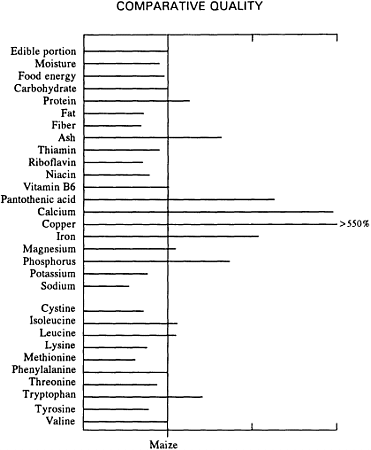
The nutritional components are given in the tables and charts (next page), but some of the details are discussed below.
NUTRITIONAL PROMISE
|
Main Components |
|
Essential Amino Acids |
|
|
Edible portion (g) |
100 |
Cystine |
1.3 |
|
Moisture (g) |
9 |
Isoleucine |
4.0 |
|
Food energy (Kc) |
356 |
Leucine |
13.5 |
|
Carbohydrate (g) |
71 |
Lysine |
2.1 |
|
Protein (g) |
12.0 |
Methionine |
1.3 |
|
Fat (g) |
3.4 |
Phenylalanine |
4.9 |
|
Fiber (g) |
2.0 |
Threonine |
3.3 |
|
Dietary Fiber (g) |
8.3 |
Tryptophan |
1.0 |
|
Ash (g) |
2.0 |
Tyrosine |
3.1 |
|
Vitamin A (RE) |
21 |
Valine |
5.0 |
|
Thiamin (mg) |
0.35 |
|
|
|
Riboflavin (mg) |
0.14 |
|
|
|
Niacin (mg) |
2.8 |
|
|
|
Vitamin B6 (mg) |
0.5 |
|
|
|
Biotin (μg) |
7 |
|
|
|
Pantothenic acid (mg) |
1.0 |
|
|
|
Vitamin C (mg) |
0 |
|
|
|
Calcium (mg) |
21 |
|
|
|
Chloride (mg) |
57 |
|
|
|
Copper (mg) |
1.8 |
|
|
|
Iodine (μg) |
29 |
|
|
|
Iron (mg) |
5.7 |
|
|
|
Magnesium (mg) |
140 |
|
|
|
Phosphorus (mg) |
368 |
|
|
|
Potassium (mg) |
220 |
|
|
|
Sodium (mg) |
19 |
|
|
|
In composition sorghum is similar to maize. Starch is the major component followed by protein, fat, and fiber. Compared with maize, however, sorghum generally contains 1 percent less fat and more waxes. Its complex carbohydrates have properties similar to those from maize. |
|||
|
The protein content is quite variable. The American literature reports several instances of levels ranging from 8.3 to 15.3 (these were measured on the milo sorghum that is grown throughout the Midwest). Most samples fall in the 9 percent protein category and are almost always 1 or 2 percent higher than in maize. |
Carbohydrates
Carbohydrate is the grain's major component, with starch making up from 32 to 79 percent of its weight. The remaining carbohydrates are largely sugars, which can be quite high in certain rare varieties of sorghum grains.
The starches in most sorghums occur in both polygonal and spherical granules, ranging in diameter from about 5μ to 25μ (average 15μ). Chemically, the starch is normally made up of 70-80 percent branched amylopectin (a nongelling type) and 20-30 percent amylose (a gelforming type). However, some sorghum starches contain as much as 100 percent amylopectin; others, as much as 62 percent amylose.
In its properties, sorghum starch resembles maize starch, and the two can be used interchangeably in many industrial and feed applications. When boiled with water, the starch forms an opaque paste of medium viscosity. On cooling, this paste sets to a rigid, nonreversible gel. The gelatinization temperature ranges from 68° to 75°.
Protein
Sorghum's protein content is more variable than that in maize and can range from 7 to 15 percent.10 In most common cultivars, as mentioned above, the kernel contains about 12 percent, which is 1-2 percentage points higher than maize.
The protein's amino-acid composition is much like that of maize protein. Lysine is the first limiting amino acid, followed by threonine.11 Tryptophan and some other amino acids are a little higher than in maize.
The protein contains no gluten. A large proportion of it is prolamine, a cross-linked form that humans cannot easily digest. In fact, prolamine makes up about 59 percent of the total protein in normal sorghum. This is higher than in other major cereals, and it lowers the food value considerably.
In the long term, sorghums that have less prolamine may come available for routine use. A few of these more nutritious types have already been found: two in Ethiopia (see page 181) and one in the Sudan (page 183), for instance. Until such quality-protein sorghums are perfected, however, sorghum grain needs to be processed if its full protein value is to be realized.
Fat
Generally, sorghum contains about I percent less fat than maize. Free lipids make up 2-4 percent of the grain and bound lipids 0.1-0.5 percent. The oil's properties are similar to those of maize oil. In other words, the fatty acids are highly unsaturated. Oleic and linoleic acids account for 76 percent of the total.
Vitamins
Compared to maize, sorghum contains higher levels of the B vitamins pantothenic acid, niacin, folate, and biotin; similar levels of riboflavin and pyridoxine; and lower levels of vitamin A (carotene). Most B vitamins are located in the germ.
Pellagra—a disease caused by too little niacin in the diet—is endemic among certain sorghum eaters (as it is among some maize eaters).
Minerals
The grain's ash content ranges from about I to 2 percent. As in most cereals, potassium and phosphorus are the major minerals. The calcium and zinc levels tend to be low. Sorghum has been reported to be a good source of more than 20 micronutrients.
Nutritional Concerns
Recently, the status of sorghum's future as a global food was thrown into disarray by nutritional experiments conducted on malnourished children in Peru. The conclusion was reached that sorghum was "unfit for human consumption."
Part of the problem was due to the fact that the samples used in Peru came from milled flour (comprising only the grain's endosperm) and they were merely boiled into porridge and fed directly. In Africa, by contrast, the whole grain is ground up (so that the protein- and vitamin-rich germ is also included) and often some form of fermentation is also employed.
At the heart of the issue of sorghum's nutritive effectiveness is the above-mentioned fact that almost 60 percent of the protein is in the highly cross-linked form called prolamine. Human digestive enzymes are unable to break up this indigestible protein. Even bodies desperately in need of more muscle, enzymes, blood, and brain continue passing prolamine that might otherwise provide the necessary amino acids.
However, sorghum has a second problem as far as food quality is concerned. Tannins, which occur in the seed coats of dark-colored sorghum grains, block the human body's ability to absorb and use
proteins and other nutritional ingredients. Unless the grain is a low-tannin (yellow or white) type or unless brown seed coats are carefully removed, some tannins remain, and this reduces sorghum's nutritional effectiveness.
Yet a third problem is that when sorghum grain is germinated, a cyanogenic glucoside is formed. In the shoots, enzymes act on this to produce cyanide. This is a potential hazard only with germinated sorghum, and not with the grain itself.
SPECIES INFORMATION
Botanical Name
Sorghum bicolor (L.) Moench
Synonyms
Sorghum vulgare Pers., S. drummondii, S. guineense, S. roxburghii, S. nervosum, S. dochna, S. caffrorum, S. nigricans, S. caudatum, S. durra, S. cernuum, S. subglabrescens.
Common Names
China: kaoliang
Burma: shallu
East Africa: mtama, shallu, feterita
Egypt: durra
English: chicken corn, guinea corn
India: jola, jowar, jawa, cholam, durra, shallu, bisinga
South Africa: Kafir corn
Sudan: durra, feterita
United States: sorghum, milo, sorgo, sudangrass
West Africa: great millet, guinea corn, feterita
Middle East: milo
Description
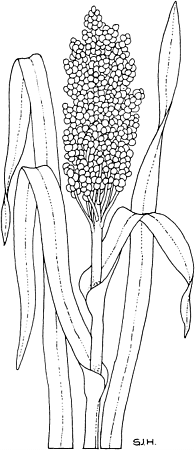
Sorghum comes in many types. All, however, are canelike grasses between 50 cm and 6 m tall. Most are annuals; a few are perennials. Their stems are usually erect and may be dry or juicy. The juice may be either insipid or sweet. Most have a single stem, but some varieties tiller profusely, sometimes putting up more than a dozen stems. These extra stems may be produced early or late in the season. Plants that tiller after the harvest has occurred can be cut back, allowed to resprout, and grown without replanting (like sugarcane).
Soil permitting, the plant produces a deep tap root (see picture, opposite). However, a large number of multibranched lateral roots
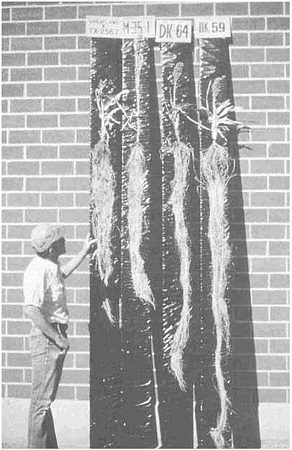
For a plant with such a modest leaf area, sorghum's roots are huge. This underground "survival tool" seeks out moisture deep in the soil, equipping the crop for good growth in semiarid climates. The resulting ability to yield grain under dry conditions makes sorghum a crucial tool in the fight against world hunger. (A.B. Maunder, courtesy DeKalb Plant Genetics)
occupy the upper soil levels, particularly the top meter. They can spread laterally up to 1.5 m.
The leaves look much like those of maize. A single plant may have as few as 7 or as many as 24 leaves, according to cultivar. At first they are erect, but later curve downward. During drought they roll their edges together. Rows of ''motor cells" in the leaves cause the rolling action and provide this unusual method of reducing desiccation.
The flower head is usually a compact panicle. Each carries two types of flowers: one type has no stalk (sessile) and has both male and female parts (perfect); the other is stalked (pedicellate) and is usually male (staminate).
Pollination is by wind, but self-pollination is the rule. The degree of cross-pollination depends on both the amount of wind and the panicle type, open heads being more liable to cross-pollination than compact ones.
Grains are smaller than those of maize but have a similar starchy endosperm. Most are partially covered by husks (glumes). The seed coat varies in color from pale yellow through purple-brown. Dark-colored types generally taste bitter because of the tannins in the seed coat. The endosperm is usually white and floury as in normal maize, but in some types the outer portion is hard and corneous, as in popcorn.
The crop is always grown from seed. Some seeds show dormancy and will not germinate for a month or so after harvesting. It is a little-known fact that the plant can also be propagated by stem cuttings: nodes along the stem have tissues (primordia) that can produce both roots and sprouts and thereby grow a new plant.
Sorghum is a diploid (2n = 20).
Distribution
This African crop is now known almost worldwide. Dhows, which have been crossing the Indian Ocean for some 3,000 years, probably first carried it away from Africa and took it to India more than 2,000 years ago. It was almost certainly put on board as seamen's provisions. The sorghums of India are related to those of the African coast between Somalia and Mozambique.
Sorghum probably traveled overland from India and reached China along the silk route about 2,000 years ago. It might also have gone by sea directly from Africa: Chinese seamen reached Africa's east coast more than about 1,000 years ago (probably in the eighth century AD), and they may well have carried some seeds home. Cross-pollination with a wild Chinese sorghum12 seems the most likely reason why the
|
Jowar For perhaps 20 centuries, sorghum has been a staple of South Asia. Today, for example, it occupies at least 20 million hectares in India, more area than any other food crop except rice. In monetary terms "jowar," as it is locally called, is perhaps India's third most valuable food plant, exceeded only by rice and wheat. Outsiders have often dubbed this African grain "the great millet of India." And no wonder. Jowar is an important food over much of the country, and especially in the dry areas of the central and southern states. Millions of Indians eat it. Some use it like rice, but most jowar is milled into flour. More or less white in color, this flour is used especially for making traditional unleavened breads (chapatis ). Usually the whole-grain flour is employed, but some jowar is also polished to remove the germ and create a flour with a long shelf life. This can be blended with wheat flour (up to 25 percent) for preparing even Western-style raised breads. Jowar grain is also malted (germinated), and in this form it finds its way into various processed products, including beer and baby foods. The grains of certain varieties pop like popcorn when heated. Indians eat the light and tasty product directly or as a flavoring in baked goods. And sorghum feeds more than just India's people: its stalks are a major source of fodder. According to some reports, nothing can match its combination of high yield and nutritional quality. Varieties with juicy, sweet stalks have been developed. Cattle find those particularly delicious. Perhaps 80 percent of India's cultivated sorghums are those (known as "durras") that are the dominant type in Ethiopia, North Africa, and along the Sahara's southern fringes. Many improved strains have been developed. They are grown mainly in the plains and rely on the summer rains, although some are grown under irrigation. Jowar is notably important on the black-cotton soils, which are notoriously difficult to farm. It is one of the few crops that withstands the wildly fluctuating water tables that produce bottomless mud in the wet season and something resembling cracked concrete in the dry. An ability to extract moisture from deep in the heavy vertisol clay is among the crop's greatest qualities for India. |
sorghum now found in China (the kaoliang group) has its own distinctive character.
Broomcorn was first grown in Italy in the 1600s and later spread elsewhere in southern Europe. This form of sorghum has produced most of the Western world's brooms and brushes ever since. Today, Mexico is a major producer.
Horticultural Varieties
This crop comes in such an array of widely different types that various botanists have previously recognized 31 species, 157 varieties, and 571 cultivated forms. However, these all cross readily and without barriers of sterility or differences in genetic balance, so it seems preferable to group them into a single species, Sorghum bicolor. Some botanical authorities also include certain wild sorghums, designating them as varieties within the species.
The ease with which cultivated sorghums cross with wild species (such as S. arundinaceum) may be a headache for the taxonomist, but it provides great scope for the plant breeder. Indeed, to synthesize new cultivars, a vast range of genetic characters can be brought together in bewildering numbers of combinations. As a result, many cultivars are recognized in Africa, India, the United States, and elsewhere, and new ones are being continually produced (see later chapters and notably page 191).
Environmental Requirements
Sorghum is adapted to a wider range of ecological conditions than perhaps any other food crop. It is essentially a plant of hot, dry regions but takes cool weather in stride and may also be grown where rainfall is high and even where temporary waterlogging can occur.
Daylength
Although many cultivars are insensitive to photoperiod, sorghum is basically a short-day species. Most traditional varieties differentiate from vegetative to reproductive growth when daylengths shorten to 12 hours. This switch to flowering often happens just when the rains diminish, and the crop matures in the dry season that follows, a feature that greatly helps the farmer. Some of these traditional forms are extremely susceptible to photoperiod and reach impossible heights if not planted as daylengths shorten. On the other hand, the dwarf sorghums of the temperate zone are unaffected by daylength and can be planted year-round where climates permit.
Rainfall
Although part of the crop is grown in rainy regions, sorghum is remarkably drought-resistant and is vitally important where the climate is just too dry for maize.
Altitude
Sorghum is grown from sea level to above 3,000 m.
Low Temperature
The plant is killed by frost. Optimum growth occurs at about 30°C.
High Temperature
It is essentially a plant of the tropics or subtropics, roughly between 40° of the equator. However, in the United States it is being pushed ever farther into the cooler latitudes.
Soil Type
Sorghum tolerates an amazing array of soils. It can grow well on heavy clays, especially the deep-cracking and black cotton soils of the tropics. It is equally productive on light and sandy soils. It can withstand a range of soil acidities (from pH 5.0-8.5) and tolerates salinity better than maize.
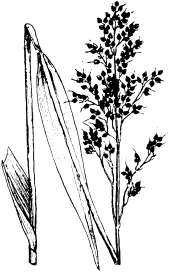
Sweet Sorghum