8
Sorghum: Subsistence Types
Of all Africa's cereal grains, sorghum is the most important. It shares top billing with pearl millet in the drier zones and with maize in the wetter ones. In fact, Africa devotes more hectares to sorghum and millet than to all other food crops combined.
And sorghum is more important than the bald figures indicate. It is crucial to a substantial portion of the millions who coax from their meager and often declining lands barely enough to sustain life. Many—perhaps most—of those who grow it could hardly survive without this plant. For them, it provides the dietary energy and nutrients that make the difference between health and hunger.
Sorghum is vital in this way for the majority of the most poverty-stricken people in two huge belts that together look like the number 7 superimposed on the map of sub-Saharan Africa. One belt—spanning some 8 degrees of latitude (from approximately 7° to 15°N)—stretches like a giant sash across West Africa from Senegal to Chad. The other, equally huge, runs north to south covering the drier areas of eastern and southern Africa from the Sudan to South Africa (see map, page 131).
The recent past has not been kind to these two vast regions—especially the first. To many observers the picture is already bleak and getting bleaker. The sorghums that provide the subsistence for tens of millions yield on average less than 700 kg per hectare—sometimes much less. Yields have improved little or not at all in decades. Some observers question whether technology can ever make a difference.
The reasons are not unclear. Africa's farmers face a formidable web of interlocking constraints. There are constraints imposed by nature, which seems to take special delight in bedeviling Africa. There are constraints imposed by society and tradition. There are constraints imposed by poverty. And there are constraints imposed by politics, incompetent government, poor roads, and other infrastructural impediments. Subsistence farmers must somehow survive and produce their crops within all of them.
If the constraints were the same throughout Africa, they might be manageable; but th ey differ in degree and kind from farmer to farmer, village to village, valley to valley, and nation to nation. With all these localized and varying limitations, some people conclude that unified advances of the Green Revolution type that swept across India and Pakistan in the 1960s are inapplicable. Perhaps a different approach is needed.
Actually, that approach might come from Africa's own subsistence sorghums. During thousands of years, farmers have selected varieties to match their local conditions and food preferences. These traditional types are already remarkable for their diversity. In Sukumaland in Tanzania, for instance, a single researcher once counted 109 named cultivars—all of them in common use. In Samaru, Nigeria, more than 100 local types have been identified. And in the Lake Turkana area of Kenya there is such a variety of distinctly colored sorghums that just by looking at a grain, farmers claim that they can identify who grew it—a form of "natural bar-coding" that is said to ensure against theft.1 For Africa as a whole, the number of distinct sorghums must range into the many thousands. Some have been reverently handed down from generation to generation.2
These traditional sorghums are not only varied, they can have remarkable qualities. Perhaps centuries of careful observation have gone into their selection. They incorporate features such as:
-
Good seedling emergence and strong early root development (to compensate for the normal brevity of the early rains);
-
Good tillering (to compensate for erratic early rains as well as shoot-fly attack);
-
Long growing cycles (to make best use of infertile soils);
-
Resistance to insects (particularly headbugs);
-
Resistance to molds; and
-
Tolerance of bird pests and striga, a parasitic plant that is an impossible pest in certain regions.3
In addition to the agronomic qualities mentioned above, subsistence sorghums have been carefully selected for features that affect the appearance, texture, taste, preparation, or shelf life of traditional foodstuffs. They are mostly grown by women, and are used primarily in the home to prepare local foods.
Traditionally, people consume the grain as a stiff porridge (toh or ugali), a thin porridge (uji), or in a range of fermented beverages.
|
1 |
Information from D.J. Lowe. |
|
2 |
All this is made possible because sorghum is predominantly self-fertilizing and a given variety retains its distinctive qualities when it is planted year after year. |
|
3 |
Both of these troublesome organisms are described in Appendix A. |
Ethiopians form sorghum flour into dough balls that are boiled to form a staple food (dawa). In Nigeria, a similar type of dumpling as well as a flaked, dried sorghum-based food are staples. Many people cook the dehulled grain like rice, or grind it into flour like wheat and make biscuits, cakes, or unleavened breads. Some make couscous out of it. Sorghum is also important for brewing native beer or pombe.
As has been noted, Africa has two vast sorghum belts. Surprisingly, the conditions in each are so different that varieties perfected in one are seldom useful in the other.
The following conditions prevail in East and southern Africa:4
-
Most of the crop is planted as a monoculture and laid out in rows.
-
The rainy seasons tend to be short and (in most places) to come once a year.
-
The plant varieties tend to have shorter stems, tight seedheads (panicles), and relatively high harvest indexes (the ratio of grain to other tissues).
-
Birds are often such serious pests that they alone determine what variety is planted, how it is managed, and what level of inputs is applied (see Appendix A).
-
The main striga species (notably in southern Africa) is the Asian type (Striga asiatica), so that plant breeders can use genes from striga-resistant Indian sorghums.
-
Sorghums for brewing and for animal feed are increasingly important.
-
Both modern varieties and hybrids have been used, at least on a modest scale, and some types introduced from India have proved extremely successful.5
In West Africa, on the other hand, the following conditions apply:
-
Little of the sorghum is grown in monoculture; most is planted in mixtures with cowpea, pigeonpea, roselle, and other crops.
-
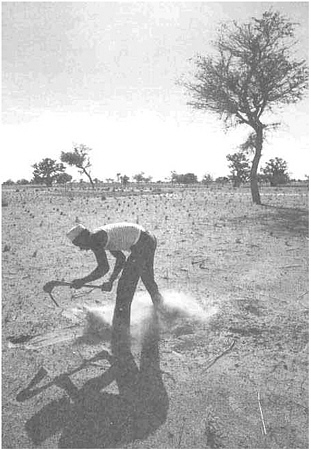
The plants are seldom grown in rows, but are scattered randomly and are often far apart. In the drier parts of this zone the land is neither plowed nor otherwise prepared before planting, except that it is sometimes weeded or burned.
-
The plants tend to be tall and lanky and have a low harvest index.6
-
The plants flower toward the end of the rains, thereby helping the grains escape fungi and sucking bugs, which are prevalent while the rains persist but disappear during the dry months that follow.
-
The rainfall can be very erratic.
-
Local sorghums are able to produce grains even when severely stressed by drought. (The types grown in higher rainfall areas produce dense, vitreous grains; those grown in dry areas produce floury grains.)
-
The seeds are borne in open panicles—a feature generally inimical to high grain yields but one that helps avoid grain molds.
-
The main striga is Striga hermonthica, a native species. Most of the striga-resistant sorghums from India or even from eastern Africa are susceptible to this parasitic pest.
NEXT STEPS
Actions to open the vast and promising future of subsistence sorghums include those discussed below.
Sharing Varieties7
As noted earlier, truly outstanding sorghums can be found throughout Africa. Many are exquisitely fitted to specific niches for subsistence farmers. Much good could be done merely by making these more widely available. Most are now unknown beyond the valley or village where they are treasured.
Local types are well proven, and moving them within ecological zones could be a powerful way to improve the long-term stability of farm production. Even moving them across ecological zones could become important because there may be increasing climatic change and uncertainty in the future. Farmers now plant cultivars suited to the existing rainfall pattern. However, if the pattern changes (as it did in West Africa in the 1970s) then all local cultivars may become inappropriate. Materials from another area may be the only way to stave off disaster.
Strengthening Farming Methods
To improve sorghum in subsistence production, research on farming methods seems likely to yield quicker benefits than research on breeding plants for higher yield.8 Some improvements seem simple, obvious, and uncomplicated. For example:
-
Watering. Studies conducted over the last 20 years in Burkina Faso, for instance, suggest that a little extra water applied when the grains are filling profoundly increases grain yield.
-
Fertilization. In some areas, dramatic rises in sorghum grain yields can come from providing nutrients to the soil.9
-
Legume rotations. Many lands where sorghum grows were infertile to begin with or are now worn out. Nitrogen-fixing leguminous plants could well be the key to rejuvenating most such sites.10
-
Weed control.
-
Water-harvesting and other water-conserving techniques.11
-
Managing the fields to reduce devastating outbreaks of striga.
Tampering with tradition must be done with caution, however. Some seemingly obvious improvements can prove detrimental in the long run. For example, it is not for nothing that West African farmers grow sorghum plants wide apart. The crop is an excellent scavenger of nutrients and will grow successfully in soils in which maize fails completely, but it must then have room to develop large root systems. Typically, agricultural advisers recommend closer plantings, but where soil fertility is the limiting factor this can reduce the yield. (Of course, if fertility levels are increased, plant populations can be too.)
Another trap for the unwary is the preparation of the land. There is a strong interaction between the choice of variety and how the land has been prepared. In the moister areas, land is cultivated and ridged before planting; elsewhere, however, the seeds are broadcast onto unprepared ground. ''Improved" varieties will usually outperform local material only where land is cultivated. Local varieties, on the other hand, show little response and cultivating the land before planting can be a waste of time.
Breeding Better Plants
Certain sorghums that yield almost as much as the best grain crops in the world are known (see next chapter). But for helping the subsistence farmer, an 8,000-kg-per-hectare crop is not a suitable target at the present time. Maximum yield is usually not the primary
|
A "Cure" for Sorghum Borers It is often hard to see how to improve on crops and methods that subsistence farmers have honed to their needs for hundreds or even thousands of years. However, modern ability to probe deeply into genetics, entomology, soil science, plant physiology, and other sciences can provide insights of great potential value. Here is a recent example. Subsistence farmers value their sorghum stalks so highly that the grains are sometimes almost a secondary consideration. The stalks are vital for building houses, for fencing, and for firewood (see page 195). But there is a risk in employing them. Larvae of the sorghum stem borer (Busseola fusca) shelter inside. Thus, a farmer who keeps lots of stalks around is providing a haven for his worst enemy; eventually, the larvae will turn into adults that will come out in swarms to devastate the next crop. A Nigerian researcher, A.A. Adesiyun,* has recently been looking into this long-standing problem. By monitoring the popula |
requirement. Reliability is more important. A yield that can be relied upon year after year is the primary goal of those whose life depends on their harvests. Thus, the immediate need is to improve the yield stability, together with whatever yield increase is compatible with that stability. Average yields of only 1,500 kg per hectare would double production in Africa (not to mention India).
Crop-breeding objectives for stabilizing yields for resource-poor farmers in Africa include:
-
Raising pest and disease resistance (see below).
-
Boosting tolerance to drought, humidity, and other changeable environmental stresses. (These tolerances, however, are pretty high already. In many locations it would be better to breed for higher yield at the existing tolerance levels.)
-
Improving grain quality, especially those qualities that are important in storage and processing.
Some of these resistances and tolerances can be bred for outside the local area. "Hot spots" have been identified for many traits of economic importance. Midge, for example, is constantly severe at Sierra Talhada in northeast Brazil; Busseola fusca is severe at Samaru in northern Nigeria. An appropriate network of national or regional stations in similar areas could provide a powerful method for screening
|
tion inside the stalks he has come to appreciate the features that affect the pest and can thereby guide farmers on how to keep their stalks and have good harvests as well. Naturally, farmers stack the stalks out of weather during the off-season. Adesiyun has found that this is good for the bugs: in the shade only 20 percent die, and all the rest eventually emerge, eager for more sorghum to bore into. However, Adesiyun then found that just stacking the stalks out in the open doubled the number of insects that succumbed. And this was nothing compared to warming the stalks over a fire or spreading them out thinly to bake in the sun for 3 days. This killed a whopping 95 percent of the larvae sheltering inside. The stalks could then be stored safely, even in the traditional stacks in the shade. Moreover, the "cured" stalks could be used around the house or the farm with little risk of infecting the fields with hordes of hungry hoppers. |
and mobilizing masses of useful local germplasm far more rapidly than at present.12
For subsistence use in Africa, it is usually important to breed multipurpose sorghums. Tall plants may be anathema to a cereal breeder, but to many small-scale farmers long stalks are resources vital for fencing, thatching, firewood, and other utilitarian purposes. Those farmers will not switch to a short-stalked type no matter how high-yielding.
Raising Pest Resistance
Among the traditional sorghums of the tropics are some with good resistance to foliar diseases and excellent tolerance to most of the indigenous insect pests. However, to maintain this happy position, research must be continued, especially on the use of systemic insecticides against borers and shoot-fly.13 Unfortunately, the natural resistance is closely related to the amount of phenolic compounds (particu-
|
The Dilemma of Daylength It has been a tenet of modern crop breeding that eliminating sensitivity to daylength is a good thing—the resulting varieties can be grown at many latitudes and in different seasons. But West African subsistence farmers use daylength-sensitive sorghums in an ingenious and sophisticated manner that helps ensure a harvest even in the shortest and most erratic of seasons. The actual week when the rains will start in the Sahel is unpredictable. The rains may be early, late, or sporadic. However, when the rains will cease is much more consistent. Unfortunately, though, once the rains have stopped, the ground rapidly dries out, leaving little chance for more growth. Thus, although the start of the planting season can vary, the crop must complete its cycle by the given time when the rains come to an end. Traditional cultivars in West Africa have been selected to flower a little before the rains end, no matter whether the rains began early, late, or on time. The length of day triggers the flowering, not the age of the plant nor the status of the rains. Local sorghums have evolved over centuries under those austere and fluctuating conditions. They fill out quality grains even under the stress of drought and the boom-and-bust cycles caused by sporadic showers. Introduced varieties and hybrids, by contrast, are "shocked" by the sudden onset and extreme stress of a Sahelian dry season. They seem to collapse physiologically and set floury grains that are useless as food.* |
larly the condensed tannins), and these compounds make it harder for people to digest the sorghum grain (see page 179).
Breeders can also help stabilize yields dramatically by breeding genotypes tolerant of striga. In fact, this is vital. Any "improved" materials lacking striga tolerance could be catastrophic to farmers in areas where this parasite is serious. A striga plant produces tens of thousands of seeds, each of which can remain viable for a decade or more. If susceptible sorghums are introduced, this terrible pest could quickly get out of hand and fill the soil with seeds that act like 10-year time bombs. Luckily, there now seem to be good possibilities for identifying and breeding striga-resistant types (see Appendix A).
Improving Bird Resistance
As noted elsewhere, birds prevent farmers from cultivating the most palatable sorghums in many parts of Africa. Today's bird-resistant types have seed coats containing tannins, which are both bitter and difficult to digest. If a more satisfactory solution can be found, it could be an outstanding contribution to Africa's future, and it would certainly help boost the production of sorghum. New possibilities have recently been discovered (see Appendix A).
Increasing Mold Resistance
In many parts of Africa, molds that destroy grain in the head (panicle) are holding sorghum back. If cultivars more resistant to such damage can be found, then earlier, fast-maturing types could be grown regardless of the humidity during the harvest period. Also, types with dense panicles (a better yielding and more efficient form) could be planted where now only quick-drying open-panicle types are practical. Some strains are inherently resistant to mold regardless of panicle type; these deserve much greater research attention.
Another, relatively easy, intervention is the treatment of seeds against smuts that affect the crop in the seedling stage.
Easing the Burden of Handling
The amount of hand labor needed to prepare the land, control the weeds, and scare away the birds is a serious limit to sorghum production in African subsistence farming. These are significant barriers to increased production. Thus, a major issue raised by any innovation is how much hand labor it demands. This is important to any farmer who has to work the fields by hand. In hoe agriculture one can literally "work oneself to death" by expending more energy than he or she gets out of the harvest.
End Use
As already noted, subsistence sorghums are able to meet the complex array of local requirements. The storage life, processing characteristics, and taste of toh, ugali, uji, dawa, and other traditional sorghum-based foods are paramount—more important than the absolute level of yield in the field.
Features that affect traditional foods are hard for scientists to quantify and breed for, especially when the research must be done in centralized research facilities. Subsistence-sorghum breeding is made
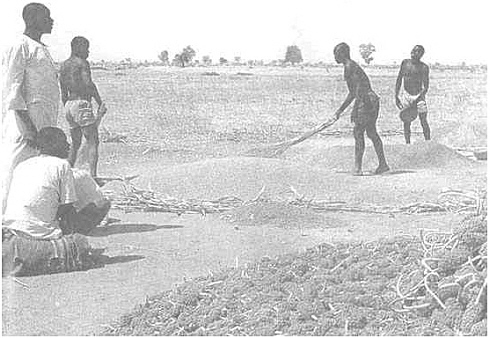
even more difficult by the fact that Africa may have as many sorghum dishes as it has cooks.
Already, sorghums improved with exotic germplasm have been rejected because the toh they produced didn't keep its texture long enough. (The starch gel collapsed overnight.) The sorghum program in Niger, Burkina Faso, and Mali currently uses small diagnostic tests to evaluate advanced breeding materials for toh keeping quality. This approach, by which the plant breeders are directed as much by food technologists and home economists as by yield in the field, is a refreshing and much-needed innovation.