9
Sorghum: Commercial Types
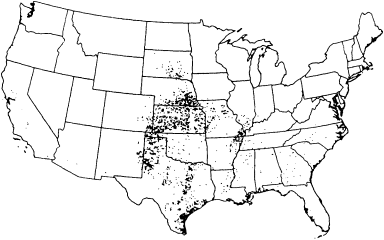
Today in Africa, sorghum is grown mostly for subsistence (see previous chapter). It feeds farmers and families who seldom, if ever, have any surplus to sell. But beyond Africa sorghum production is rising, mainly due to farmers who sell their grain so that others can eat. The United States, Mexico, Honduras, and Argentina are just some of the nations now taking advantage of this crop's powerful performance under pampered conditions. Indeed, it is paradoxical that while Mexico's maize is replacing Africa's sorghum in Africa, in Mexico itself the opposite is happening: sorghum is replacing maize in many areas (see box, page 133).
The commercial approach will eventually assist Africa as well. Growing sorghum the way commercial wheat and maize are grown can produce harvests of 3,000 rather than 700 kg per hectare. Indeed, the fact that sorghum has vast untapped commercial potential is important to the future of much of the world. Large areas in Central Asia, northern and central China, South America, and Australia have the potential for expanding the production of sorghum as a large-scale, high-tech competitor of the world's top three grains: wheat, rice, and maize.
Part of the problem in Africa is that so far sorghum has never been developed as a major food for urban areas. Lacking markets, it remains a crop of the small cultivator, consumed largely on the land where it is produced. But this need not—indeed should not—continue as the sole method of sorghum production. As with other crops, sorghum deserves the attention that governments give to any basic food commodity: stockpiling, purchase of surpluses, price supports, research, and policy support, for instance.
One particular restraint on sorghum has been the lack of processed foods—flour, meal, breads, or other materials—for use by those who are not farmers and are not prepared to devote hours of every day making flour from raw grain. The development of a sorghum-based food-processing industry would do much to offset Africa's shift in demand toward imported rice and wheat.
There are good reasons for thinking that this may come about. And soon. For example, recent research has shown that sorghum grain can be parboiled to create a fast-cooking, convenient food just as has been done with rice. Also, various projects are under way to produce sorghum flour for sale in stores. In fact, in Botswana sorghum meal is already commercially available.1 Nigeria, too, is pioneering the processing of locally grown sorghum to replace imported grains (see box).
By and large, the actions needed to boost commercial farming differ dramatically from those needed by subsistence farming. Whereas subsistence farmers may be tied (for reasons of precedent, poverty, environment, or fear of the unknown) to local varieties, commercial farmers are not. They can use newly created sorghum varieties, including hybrids and the best of research-facility results. Their grain is to be sold, probably to markets where the products of perhaps thousands of other farmers are pooled. In this case, the standard varieties demanded by the mass market take precedence, and the cash earned by selling them may pay for fertilizers and other inputs that are beyond the meager means of subsistence growers.
The evidence is persuasive that—just as in the cases of wheat, maize, and rice—sorghum responds dramatically to modern technology. For instance, although subsistence-sorghum yields have remained static at or below 700 kg per hectare, those of commercial sorghums have jumped like those of the Green Revolution crops in Asia. In the 1970s for instance, yields from India's rainfed sorghum increased 50 percent (from 484 to 734 kg per hectare) and Argentina's rose 55 percent. Irrigated yields are considerably higher: in India, about 1,800 kg per hectare is common. Hybrid sorghums can achieve even more: 4,5006,500 kg per hectare are now not unusual yields in the United States, Europe, China, and on commercial farms in Zimbabwe.2
In a few cases, sorghum's yield ceiling has been raised to dazzling heights. For example, yields of 13,000 kg per hectare are being reported under special conditions in Mexico.3 In Argentina and the United States 12,000 kg per hectare have been measured. Farmers in China are said to average 10,000 kg per hectare in certain areas.
Given such advances, sorghum's total global production may eventually match that of maize. And perhaps more important, much of the production will be at sites where maize can barely survive. This will greatly increase the food available in the world.
|
1 |
For information on both parboiling and flour production, see Appendix B. |
|
2 |
Mean grain yields in the United States—around 1,200 kg per hectare before the release of hybrids—are now 4,200 kg per hectare. |
|
3 |
Vega, 1984. |
The rest of this chapter highlights certain forms of sorghum that could help this plant reach its ultimate performance outside the confines and constraints of subsistence farming.
TYPES FOR ALL SEASONS
Sorghum's ultimate promise is perhaps best glimpsed in a research program in Texas and Puerto Rico. The Sorghum Conversion Project, as it is called, is a concentrated research effort that has catalyzed much of the present improvement in sorghum. It changes tall, late, or nonflowering varieties that produce well only in the tropics into short, early-maturing forms that can be used in many parts of the world, including the temperate zones. Its materials are already opening new horizons in sorghum production. Indeed, it is these materials that have led to the big jump in sorghum production in the United States, Mexico, Central America, parts of South America, and elsewhere. All in all, the result of this project could be one of the most significant advances in food production of this era.
In essence, the conversion program has vastly enhanced the source material available to sorghum breeders. It provides seeds of hundreds of types that are not only productive and adaptable, but also contain genetic resistance to insects and diseases and have desirable food qualities. Of the 1,300 lines in the program, more than 400 have been ''converted" as of 1991.4 These select lines are being used to develop gene pools from which breeders can draw genotypes that best fit their local needs and environments.
This development is described in more detail in the box (see page172).
HYBRIDS
In the 1930s, America's maize yields were static. With the advent of hybrids, however, yields doubled and redoubled in just two decades. Maize quickly became not only a food but a "living factory," yielding feeds, sweeteners, starch, oil, and myriad industrial raw materials. It rose to such importance that today the U.S. economy would collapse without it.
Sorghum hybrids have much the same inherent potential, as their brief history shows. The first was produced only in 1957, but the effect was electric. Within 4 years, almost all American sorghum growers had switched, and the mean yield nationwide more than doubled from
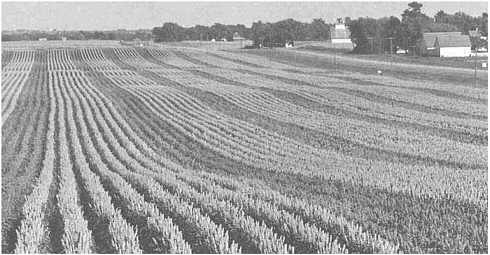
1,280 kg per hectare to 2,750 kg per hectare. Within 10 years, as the hybrids improved, the yield had more than tripled to reach 3,810 kg per hectare. In a little over 20 years it had almost quadrupled to reach 4,190 kg per hectare. Seldom has there been such a rapid increase in grain yields in a cereal crop.
The hybrids were developed by crossing sorghums from southern Africa (the so-called kafir type) with others from Central Africa (caudatum types). The benefits come both from the hybrid vigor (which results when widely divergent strains of an organism are crossbred) and from the fact that the plant's heightened potentials and profits encouraged farmers to apply fertilizers and pesticides.
Hybrids have produced quantum jumps in production in India and Latin America as well, but so far, except in the Sudan, Zimbabwe, and South Africa, they are uncommon in Africa itself. In most of East Africa, for instance, only 5-10 percent of the crop is in the form of hybrids or other improved varieties, and in West Africa the percentage is even lower. This is not unexpected. Occasional U.S. hybrids, such as NK 300, prove productive over a wide range of conditions in Africa, but most do not. Also, most U.S. hybrids were developed for stock-feed and their grains make poor-quality foods. In addition, they lack the necessary resistance to striga, a parasitic plant unknown in most sorghum-growing areas of the United States.
These days, however, hybrids that produce food-quality grain are coming available. Moreover, it would appear that the problems of poor adaptability and striga resistance will be overcome. On the face of it, then, hybrid sorghums produced for sale rather than for subsistence should play a big role in Africa's future agriculture.
Of course, hybrids are not without drawbacks. They perform best under good production conditions and good quality control. They are suited only to sites where seeds and other materials can be readily delivered. (Farmers must purchase fresh seed for each planting.) Further, it has been found in Nigeria that during the rainy season the male-sterile plants used in making the hybrid seed are vulnerable to ergot.5
Some observers believe that problems such as these make hybrid sorghum appropriate for only a small part of Africa. This may be true, but as the following sections show, there are reasons for thinking that large-scale, efficient, productive, and very profitable sorghum production can indeed become a major part of Africa's agriculture mix.
Honduran Hybrids
The fact that sorghum hybrids can eventually benefit Africa and other regions is suggested by recent experiences in Central America, where a special kind of hybrid has been developed for peasant farmers.
Farmers in Honduras have in recent decades planted more than 60,000 hectares of sorghum, but harvested less than 1,000 kg of grain per hectare—the lowest yield in Central America. This may not be surprising considering that more than 90 percent is grown on marginal land and the varieties are nondescript landraces (locally called maicillos criollos).
These "mixed-breed" strains of unknown ancestry are low yielding, monstrously tall (3-5 m), and late maturing. On face value they should be replaced. However, the farmers resist. As with peasants everywhere, yield is not their top priority. The diverse "mongrels" are preferred because they are dependable. Also, they mature later than maize so that farmers growing the two crops together have time to harvest both conveniently.
But now a big change is beginning. Now researchers have crossbred maicillos criollos with elite germplasm from overseas.6 This has produced new, souped-up forms of the traditional types, called maicillos mejorados (improved indigenous varieties) or maicillos enanos (dwarf indigenous varieties). They are still basically the dependable, convenient types of old, but the new genes have reduced their height, improved their disease resistance, and increased their yields.
These slightly renovated rustic relicts, still retaining the qualities that farmers value, have broken through the yield plateau that for years strangled greater sorghum production. Improved maicillos (the word means "little maize" and reflects the fact that sorghum and maize are not too distantly related) yield 24-58 percent more than their ancestors, even when little or no fertilizer is applied.
A second phase is now beginning. It involves hybrids made by crossing two local landraces. Although hybrid sorghums have been known for four decades, they have previously been made by crossing only elite parents. Honduras is unique in using the local "mongrels" as parents. For purposes of producing the necessary hybrid seed to sell to farmers, researchers there have created dwarf lines that can be mechanically harvested using combines. In trials throughout Honduras the resulting maicillos hybrids have outyielded the traditional landraces by 100 percent. Some have produced 6,000 kg per hectare under dryland conditions. The plants are taller than their dwarfed parents
(because of complementary height genes), and they can still be used in the traditional maize/sorghum intercropping system.7
Unlike other new technologies that tend to benefit the affluent and progressive farmers most,8 hybrid maicillos are targeted for the poor and less venturesome. They provide an alternative that may increase yields on perhaps 235,000 hectares throughout Central America. Cost to the farmer? Negligible, according to the researchers involved. The seed needed to plant a hectare (when cropped with maize) costs no more than a chicken or two, or about a third of the cost of a bag of fertilizer.
"Vybrids"
The criticism most commonly aimed at any hybrid crop proposed for poor farmers is that its seed is worthless for replanting. The fact that farmers must purchase new seed each year is often seen as a disastrous financial burden. Much of the criticism has been overemphasized.9 However, in many developing countries logistical logjams and supply bottlenecks do make it difficult to produce hybrid seed and get it to the farmers on time and in good condition.10
With sorghums, however, there is a distant possibility of having the best of both worlds—to grow hybrids that also produce seed that can be planted. These so-called "viable hybrids" or "vybrids" are not yet available, but a few sorghum researchers are hot on their trail.
Vybrids are made possible by the fact that certain rare sorghums are apomictic—they produce offspring without the male and female gametes fusing. In other words, their seed arises from a nonfertilized nucleus, and for this reason each plant produces progeny genetically identical to itself. This special clonal propagation through seed retains the benefits of hybrid performance while not requiring a highly developed industry to produce and distribute seed each year.
The theoretical possibility of producing viable hybrids in crops was discussed as early as the 1930s. Nearly 60 years later, the various
|
Sorghum Beer In Africa, as in many parts of the world, brewing uses vast amounts of grain. However, in Africa the raw materials are sorghum, maize, pearl millet, and finger millet, not barley, rice, or wheat. Also, the basic process is unique. African brewing includes a lactic-acid fermentation, known as souring. And the resulting beverage is something like a fermenting gruel and has the consistency of malted milk. Normally called "sorghum beer" or "opaque beer," this drink already constitutes a considerable part of the diet in many areas, and it will likely become an ever bigger commodity. With so many people moving into the cities, it is even now shifting from an exclusively family enterprise to an industrialized one. In South Africa, for instance, sorghum-beer brewing is already a highly specialized industry. Annual production is about one billion liters. Malting is the first step in brewing this or any type of beer. The grain is soaked and left to germinate. This activates amylases and other enzymes that hydrolyze the grain's starch and proteins to sugars and amino acids. After several days, when germination is complete, the sprouted grains are dried, ground to a coarse powder, mixed with cold water, and added to a preparation of ground-up grain that previously has been steeped in boiling water.* The enzymes continue working, this time turning the new source of starch into sugar. The souring process also takes place as bacteria act on part of the sugars to form lactic acid. The product—a thin gruel called "sweet wort"—may be drunk after less than a day. Its alcoholic content is negligible, but it contains some B vitamins and it is often given to children. If the brewing is continued, various yeasts multiply, and within a day or so fermentation begins. This produces alcohol, B vitamins, new proteins, and more lactic acid. The resulting brew is normally drunk after 4 or 5 days. Suspended particles of starch, yeast, grain, and malt give it the characteristic milky body. High acidity (resulting from the lactic acid) prevents the growth of pathogenic microorganisms. Brewing raises the nutritional value of sorghum. It adds vitamins, neutralizes most of the tannins, hydrolyzes the starch to more digestible forms, and increases the availability of minerals and vitamins. South African studies indicate that iron is 12 times more available in sorghum beer than in a boiled sorghum gruel; riboflavin may be almost twice and thiamine almost a third more available; niacin's availability remains unchanged. In principle, 2 liters of |


attempts at producing them have resulted in some progress. One notable success has been in breeding buffel grass (Cenchrus ciliaris)—a native African species, distantly related to sorghum, that is used as a forage throughout the tropics. Another has been with forage grasses of the genus Dichanthium (Bothriochloa).
Work on sorghum apomixis has now reached the stage where apomicts and vybrids from crosses between them have been formed in research facilities. The scientists are confident that the vybrids can now be developed for farm use.
Vybrids will benefit more than farmers. For sorghum breeders of all stripes, vybrids offer exciting potential. Sexual types can be used in the normal way to develop hybrids with superior characteristics and then induced into apomictic forms that will retain the new qualities, generation after generation, from then on.
STRIGA-RESISTANT TYPES
One of the tragedies facing Africa is that a parasitic plant is cutting it off from the wealth of sorghums that have been, or are being, developed in a score of countries overseas. Indeed, striga is probably the greatest constraint to the production of foreign sorghums in Africa itself.
Recently, however, researchers have discovered a striga-resistant gene in sorghum. This could be a big breakthrough. For Africa, it will help open the door to the truly remarkable types developed in the Americas and China, for instance.
This topic is treated in Appendix A. It is made suddenly more relevant because a new test has been developed that can determine, within a few days, whether a certain sorghum (or other species) is resistant to striga. Tests in laboratories and greenhouses have been most encouraging. Should these results also prove practical in the field, it could open the way for overcoming the depredations of this vegetative parasite that victimizes desperately needed food plants. For the first time the crops will have the means to defend themselves.
DWARFS
The last 40 years have seen dramatic increases in the yields of wheat, rice, maize, and some other cereals. This has come not from boosting the plants' overall growth (as most people may think), but from rearranging their architectures so that the plants are shorter. With less energy going into stalk, more is left for growing grain. In
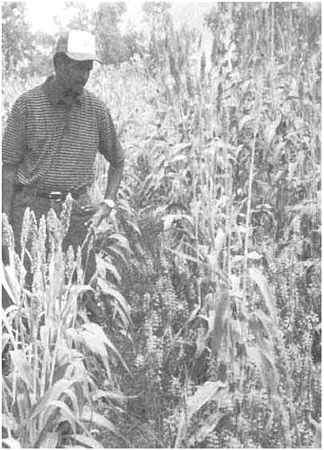
Sorghum researcher, Gebisa Ejeta, examines experimental plots of strigatolerant cultivar SRN-39 (left) and local cultivars in Niger. The pernicious parasite occurs only among the striga-susceptible local type (right). Striga-tolerance has been known in India and East Africa, but SRN-39 is one of the first examples of a sorghum that can withstand the West African striga species. For more information on striga and the problems it causes, see Appendix A. page 276. (D. Rosenow)
|
Sorghum's Miraculous Conversion At first glance, sorghum seems almost impossibly diverse. Seed banks hold more than 25,000 samples, all distinct and all able to produce fertile intercrosses. How to extract from the myriad combinations the particular ones most useful worldwide is a monumental problem that might seem beyond the realm of reason. However, remarkable progress is already being made, thanks to a project that exemplifies how many of the cereals in this book might be advanced in the future. In the 1950s, U.S. Department of Agriculture scientist Joseph Stevens developed a "blueprint" for systematically enhancing the genetic base of the world's sorghum crop. Along with several colleagues in the United States and India, he began assembling, evaluating, characterizing, and classifying a base collection of sorghum samples. This collaborative effort was carried out in India and continued into the early 1960s. The Indian government, as well as dozens of African and Asian countries, contributed their germplasm and support. Eventually, about 11,000 different sorghums were on hand. As a first step in sorting useful genetic materials out of the vast sorghum collection, a unique "shuttle-breeding" procedure was devised. The breeders produced and grew a first generation of random crossbreeds in the tropics (mainly at Mayagüez, Puerto Rico) where the days are short. They collected seeds from a wide range of the most desirable looking progeny and took them to a temperate zone (Texas) where days are long during the growing season. There, the seeds were grown out and a new generation of seeds were gathered again from the most promising specimens. This dual-latitude screening ensured that the resulting seeds (and their subsequent generations) could grow and produce grain under both tropical and temperate conditions. The next step was to partially refine these genetically diverse populations. Again, a wide array of different specimens were grown and the most desirable selected, this time emphasizing short stature and early maturity. The final result was a cornucopia of various sorghums—all broadly adaptable to various daylengths, all short in stature, and all early maturing. Out of the myriad tall, slow, and sensitive types, suitable only for small farms in the tropics, have come universally useful types for use throughout the world, on any scale. Although the resulting plants were selected for basic qualities, |
|
they were deliberately kept diverse. Now, that welter of gene types is being fine-tuned to meet the specialized demands of dozens of different localities. Specific characteristics now being ''custom-designed" include:
Materials from the sorghum conversion program are already helping transform this formerly obscure and often scorned grain into a major contributor to world food supplies. Indeed, their seeds have become cornerstones for much of the present rise in sorghum production worldwide. All in all, the Sorghum Conversion Program has become one of the most successful plant-breeding programs ever; a model of achievement for crop scientists everywhere and with every crop. It provides populations that are reservoirs of genes, rather than a single, highly inbred variety. |
technical terms, this is called raising the "harvest index." Thus, 50 years ago wheat had a harvest index of 32 percent; now it can be as much as 48 percent in some cultivars. In other words, almost half of the weight of the plant (above ground) is now grain.
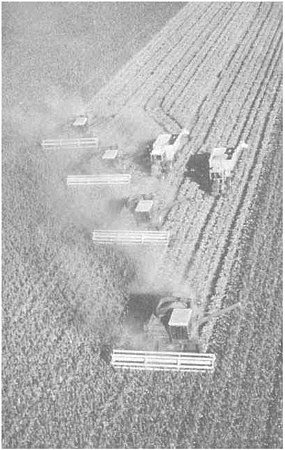
Moreover, reducing the height makes the plants less likely to get top-heavy and blow over in a summer storm. In addition, the squat, strong plants are more able to benefit from fertilizer, which otherwise would make them spindly and top-heavy. And dwarfing not only boosts yields: wherever mechanical harvesting is practiced, short stature means that the seedheads can be efficiently captured by combine harvesters so that larger areas can be planted.
So far, only a few of the world's sorghums have had their architecture refashioned in this way. Nonetheless, an increasing number of short-stalked sorghums that mature at an even height and can be harvested by combine are becoming available. Most have been created in North America. Indeed, all of America's commercial grain types are now dwarfs.
Initially, sorghums in the United States were tall and had a harvest index of 21 or 22 percent (about the same as in the spindly subsistence types now grown in West Africa), but careful selection, followed by intensive breeding, has reduced the internode length. Now the harvest index for many improved types used in the United States, Mexico, and Argentina is 48-52 percent, as high as that of wheat.
Dwarf sorghums have also been created at research stations in Zambia. These local dwarfs, as well as those from overseas, could eventually usher in a new era for the continent.11
Convenience Foods
As has been noted, commercial sorghum's major problem in Africa is that markets for flour and foods are undeveloped. If this were overcome, a large and healthy trade between a country's own sorghum farmers and its cities could operate to everyone's benefit. Today, ever-increasing numbers of city folk are being weaned onto wheat-flour bread and white rice, and any resulting economic benefits go mostly to farmers and traders a world away. The tragedy is that many of the city dwellers, especially newcomers, are accustomed to sorghum foods and would continue to purchase them if they could.
It is not inconceivable that Africa could produce vast amounts of sorghum flour and sorghum-based processed foods for sale in the cities
and towns (see Appendix B). This could result in opportunities for much innovation.
More than 30 years ago, for example, South African researchers developed a precooked sorghum product. They slurried raw sorghum flour with water and passed it through a hot roller that both cooked and dried it. The product proved very palatable and would keep for at least 3 months without deteriorating. Whole milk or skim milk could be used in place of water, producing a tasty flour rich in protein, calcium, and phosphorus. Processing costs reportedly were low.12
This is just one of many approaches by which sorghum might be produced for urbanized peoples. Many recipes using milled sorghum grits or flour have already been developed and tested by several universities.13 And the recent development of parboiled products from sorghum could open up even more markets that could benefit millions of Africa's farmers (see Appendix B).