11
Sorghum: Fuel and Utility Types
Few people heretofore have paid much attention to the idea of growing sorghum to burn. Cereal scientists, quite naturally, have regarded the plant exclusively as a food. But these days, feeding the fire can be as hard as feeding the people. Certain sorghums might help, and they warrant research.
Moreover, fuel is fundamental to many other parts of modern living. Indeed, most of the human race is so hooked on flammable liquids for running factories and powering trains, trucks, cars, and buses—not to mention providing electricity—that life would be impossible, or at least intolerable, without them.
For all that, however, the prime liquid fuel, crude petroleum oil, is in jeopardy. Perhaps the greatest challenge of the coming century will be the development of sustainable alternatives. Surprisingly, sorghum might be one of them. Indeed, sorghum could well bring many countries a giant step toward the renewable-energy future everyone is hoping will eventuate to keep life livable in the post-petroleum era.
This chapter highlights sorghum's potential to produce both solid fuels and liquid fuels, to yield industrial products, and to help maintain the overall sustainability of agricultural production.
FIREWOOD
Although food is fundamental, fuel is almost as basic to the modern diet. Without it food cannot be cooked, and today's main grains, pulses, roots, and tubers, as well as many vegetables, must be cooked to be edible.
These days, millions cook over open fires. Indeed, for more than a third of the world's people, the real energy crisis is a frantic scramble for firewood. In the poorest countries, up to 90 percent of the population depend on wood to cook their meals. In parts of Africa and Southeast Asia, an average user may burn well over a ton a year.1
Although the search for food soaks up a major part of the daily lives of billions, the search for fuel to cook it with is becoming equally time-consuming. Firewood is more and more difficult to find. In an increasing number of places, gathering fuel now takes more time than growing food. There is a saying in Africa that it costs more to heat the pot than to fill it.
Although in recent years much effort has been expended on developing firewood crops, few advisers or administrators have ever thought of developing sorghum for the fire. It is a fact, however, that certain types have woody stems that put out surprising amounts of heat. They could well become part of the mix of the firewood crops of the future.
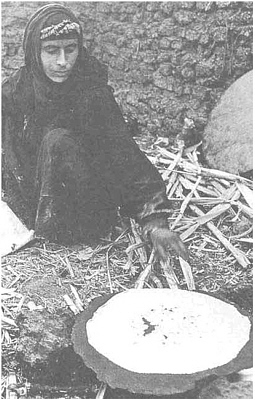
Although these solid-stemmed sorghums have received almost no study as fuel resources, one type has been tested in a preliminary way. It comes from Egypt, where its stalks are more valued than its grains. Egyptians use them as fuel. Called Giza 114, it has solid lignified stalks that burn at an especially high temperature for the stem of a grass.
Little is known about Giza sorghum but, based on results from preliminary trials, it could have a glowing future. It has shown promise in Peru, for example, where it was produced to fuel cookstoves and brick kilns. It is now being tested in Haiti, where it also seems to have good potential as fuel.2
It is not inconceivable that sorghums like this could become a standard part of farming in fuel-short nations. Their annual biomass yield is likely to equal or better that from trees. The yield of sorghum stalks has been measured in China as 75 tons per hectare, probably representing more than 10 tons per hectare of dry biomass. This would be a respectable annual production for even the fastest growing trees. The overall yield in fuel-calories per hectare may also be comparable, although even the densest sorghum stem will not equal the caloric output of a wood sample of equal volume. Perhaps, too, a modest harvest of grain can also be achieved.
Compared with trees, sorghums have the advantage in that they produce fuel within months—even weeks, Several crops a year may be possible in appropriate locations. This may help relieve not only the frenzied foraging for firewood that goes on today, but also the destruction of woodlands and forests that seems to end only when desert or degraded soils remain. People who can find fuel in fields close at hand will not hike to far-off forests and haul bulky wood all the way back. Their need is not for large-diameter tree trunks but for small stems that can be easily cut, carried, and fed into the space beneath a pot perched on rocks. For such a purpose, solid-stalked sorghums could become vital resources of the future.
LIQUID FUELS
For the economic stability and expansion of nations, liquid petroleum fuels—kerosene, gasoline, and diesel, for instance—have become essential. As noted, these liquids not only power factories, trains, trucks, and buses, they also generate electricity and produce thousands of items from machines to medicines. Moreover, maintaining mobility is critical to the public welfare: police, fire fighters, ambulances, mass transit, and construction fleets all depend on liquids that will explode in the cylinders of internal combustion engines.
For these and other reasons, the growing dilemma over future petroleum supplies makes it imperative to investigate renewable fuels, especially those suited for use in existing engine types. Of all the nonpetroleum possibilities, ethanol is the only one now significantly used in motor transport.3
At present, ethanol is made from either sugarcane or maize. In the future, however, sorghum is likely to also be a prime supplier. The stalks of certain sorghums are just as packed with sugar as are sugarcane's. Their juice contains 13-20 percent total fermentable sugars. They can yield about 6 percent alcohol.
Sweet-stalk types are sparingly distributed across sorghum-growing areas of Africa and India, where people chew the green and tender stems like sugarcane or make syrups, molasses, sugar, or confections from them. They were once a major source of sweeteners in the southern United States. Now, however, they have a rising potential as sources of fuel.
All in all, sweet sorghums are important for future ethanol production because they have:
-
High biomass yield;
-
High percentage of fermentable sugars;
-
High percentage of combustible materials (for fueling the processing);
-
Comparatively short growth period;
-
Tolerance to drought stress; and
-
Relatively low fertilizer requirement.
Moreover, sweet sorghums may produce some grain for food or feed. Indeed, as sorghum is one of the most efficient plants, and as it produces fermentable sugars as well as grain, it seems almost ideal for
producing both energy and food. Technologies used in the sugarcane industry can be applied virtually without modification.
Sweet sorghum has a number of potential advantages over sugarcane. For example, it is adapted to many growing conditions, unlike sugarcane, which is restricted to tropical climates. It requires less water and fertilizer. It can be planted more easily (from seeds not stems). And it also has a potential for low unit costs because it can be fully mechanized and the fields need not be burned (unlike sugarcane fields).
Sorghum's advantage over maize (in which the grain is converted to alcohol) is that it produces sugar rather than starch. As a result, sorghum juice can be directly fermented without the expense or delay of an initial hydrolysis.
Recently, researchers in at least three countries have begun to appreciate the potential of sorghum as a fuel as the following examples show.
India
In southern India, the potential of sorghum varieties that yield both grain and sugar-filled stems is being explored.4 Engineers at the Nimbkar Agricultural Research Institute (NARI) have found that these dual-purpose varieties solve three problems: they yield food, the fuel to cook it with, and the fodder to feed the farm animals that help produce it. From the top of the plant comes grain for food; from the stalk comes sugar (and hence alcohol) for fuel; and from the pulp remaining after the sugar is extracted comes animal fodder.
In the past, multipurpose sorghums were dismissed or at least overlooked, probably in the expectation that the individual yields of the various products would be low. But the NARI researchers are showing that this may not be the case. Indeed, they claim that I hectare of their sorghums can annually yield 2-4 tons of grain, 2,000—4,000 liters of alcohol, and enough crushed stalk to feed from three to five cattle year-round.5
The idea of ''growing" fuel alcohol is of course not new. However, most other programs have faltered because the cost of the fuel needed to distill the alcohol rendered them economically unattractive. NARI engineers circumvented this by designing a solar-powered still, incorporating a solar collector and a distillation column that can run at 5070°C—temperatures that the solar collector can easily provide.6 Also,
they have developed pressurized and unpressurized lanterns as well as a wickless stove that will run on aqueous alcohol taken directly from the still.
NARI suggests that this combination of multipurpose sorghum and appropriate technology could, in theory, meet all the automotive fuel requirements in India by the year 2000, completely replace the kerosene now used in Maharashtra, and supply 80 percent of the fodder for all the cattle in Maharashtra. Although such levels will never be approached in practice and it seems axiomatic that grain yields will tumble when sugar is also produced, the NARI concept is a powerful one that could be a big breakthrough that boosts sorghum into an energy resource worldwide. And perhaps, after all, it is not too far-fetched to envisage sorghum producing both high contents of sugar in the stem and high yields of grain.7
United States
A large sorghum-for-alcohol project was carried out across the United States between 1978 and 1984. As part of this project, the University of Nebraska developed a demonstration farm based entirely on renewable fuels. Sweet sorghum was the principal crop for alcohol production. Hybrids that grew rapidly and produced large amounts of sugar were created.8
A major constraint of sweet sorghum in the temperate zone is the harvest period. Wherever the potential of a freeze exists, the harvest period is greatly reduced because the crop must be gathered before any freezing weather. Sugar in the damaged stalks begins to ferment.
Brazil
Of all the nations in the world, Brazil is the ethanol-fuel pioneer. It already has fuel alcohol in large-scale nationwide use. So far, however, this has come almost entirely from sugarcane. Now, Brazil's scientists are exploring the use of sweet sorghum. The two crops, it has been found, supplement one another: sorghum can provide alcohol during the season in which sugarcane is unavailable.9 Therefore, using the two together increases the period of production, decreases the unit cost, and increases the total amount of alcohol that a distillery can
|
Will Brazil's Cars Run on Sorghum? Brazil leads the world in the use of fuel alcohol. In 1993, about 4.3 million vehicles—one-third of the country's total fleet and about 40 percent of its car population—operate on ethanol. Almost all that alcohol now comes from sugarcane, but in the future it may come from sorghum as well. Brazilian researchers have shown that sweet sorghum can yield from 22 to 45 tons of raw biomass per hectare in 110 days. Fermentable solids (80 percent sugars and 20 percent starch) in the stalks amount to 2.5-5 tons per hectare. To optimize the output, enzymes are added so that the starch in the stems is also converted to alcohol. Research has shown that in this way 1 ton of sweet-sorghum stalks has the potential to yield 74 liters of 200-proof alcohol. Such discoveries have implications for countries everywhere. In that distant but inevitable day when the world's petroleum runs out, maybe people will turn to sorghum to keep civilization humming. Brazil is showing us yet another way this remarkable plant will be important in our future. |
produce each year. The same equipment is used to process both sugarcane stalks and sweet-sorghum stalks.
The Brazilian scientists are also extending their studies to incorporate sorghum into an integrated system in which the by-products are used as food, feed, fertilizer, and fiber. Further, they are adapting this technology to a microscale to allow the economical production of fuel in a decentralized industry. This reduces transportation costs and may perhaps allow the farmers to generate their own energy.
SORGHUM IN SUPPORTING ROLES
Around the world, sorghum is mostly grown for food or feed and (as just mentioned) a little is being grown for fuel. However, there are several interesting uses in which sorghum is grown not for its own sake but for the benefit of other crops. Below are three examples.
Soil Reclamation
Saline Soils
It has recently been found that crosses between sorghum and sudangrass (a special race of sorghum), have the capacity to repair saline soils made crusty by sodium compounds. David L. Carter, director of soil and water management research at the U.S. Department
of Agriculture station in Kimberly, Idaho, predicts that "they are going to produce some good forage on these marginal lands and at the same time will reclaim some of these soils for crops for human consumption."
Acids released by the sordan roots dissolve calcium carbonate or lime, and in so doing they release calcium. The calcium then displaces sodium in the soil. The newly released sodium reacts with carbon dioxide to form sodium bicarbonate, a soluble salt that is less injurious to plants and mostly washes away in the rain.
After growing sordan on sodic lands for about 2 years, farmers can often re-use the soil for conventional crops.10
Reclaiming Toxic Soils
U.S. Department of Agriculture scientists in Lincoln, Nebraska, have found that sorghum has an exceptional ability to absorb pollutants out of soil. According to their research, sorghum strips excess nitrogen out of soils with such efficiency that it may solve waste disposal problems for cities and livestock operations (such as feedlots) that generate nitrogen-laden wastes. "We've been able to capitalize on sorghum's natural ability to act as a scavenger," says Kenneth J. Moore. "Sorghum thrives in toxic soils that kill less resilient plants and its penetrating roots can capture the nitrogen in a vast volume of soil."
Moore, an agronomist, and his colleague Jeffrey F. Pedersen, a plant geneticist, are now developing a system in which nitrogen is not only removed but is returned to use safely and economically. They plant sorghum in highly contaminated soils, cut the crop several times through the growing season, and feed the foliage to livestock. The key to the process is sorghum's robust growth and extensive root system.
Such an environmental tool could be very valuable these days. In Nebraska, for instance, municipal and livestock wastes are commonly disposed of by applying them to fallow cropland. An excessive buildup of nitrogen is one of the resulting hazards. "By planting forage sorghum in well-managed cropping system, producers can safely recycle that nitrogen," says Moore.
Two years ago, Moore and Pedersen began their project at a sewage sludge disposal site by planting several types of sorghum: grain types, forage types, tropical types, sweet sorghums, and sorghum-sudangrass hybrids. Soils there contained 400 kg per hectare of nitrogen. The tropical sorghums and hybrids absorbed the most nitrogen from the soil, removing an average of 200 kg and yielding more than 20 metric tons of dry matter per hectare in one season.
"We hoped for more, but the first year's growing season proved to be short and cool," says Moore. "Under normal conditions, some
|
New Life for Salty Soil Over the last few decades, irrigation has saved the world's food supply from catastrophe. But irrigation has a fundamental flaw: in the drylands where it is most used, evaporation leaves the site with a surplus of soda and salt. In their worst forms such "sodic" soils become self-sealing: their internal structure collapses so that water just sits uselessly on the surface. Sorghum, it turns out, can help. Sorghum roots ooze large amounts of sugars. Ordinarily, soil microbes gobble these up, but sodic soils tend to be anaerobic and lack the right organisms. Instead, chemical processes break down the sugars in a way that releases carbon dioxide. A weak natural acid carbon dioxide reacts with the soluble alkalis (sodium carbonate and sodium bicarbonate) to form acetic acid and a little formic acid. These stronger acids, in turn, react with the insoluble alkalis such as calcium carbonate. Sorghum's overall effect is therefore to reduce the alkalinity and convert minerals into more soluble forms. When those wash away, the soil's natural porosity is reopened. This process occurs with amazing efficiency. Researchers at the U.S. Department of Agriculture have reclaimed marginal sodium-affected soils using sorghum (mainly the forage types called sordan and sudangrass) after just one season. In fields so toxic that crops would not grow, they get respectable stands of barley and alfalfa after just one season of sorghum. Beans, a highly salt-sensitive plant, can be grown after two or three seasons of sorghum. Within one season it not uncommon for the alkalinity to drop a full pH unit and the calcium solubility to increase tenfold. At first, however, the plants come up scraggly, stunted, and yellow. This has been traced to iron deficiency, to which sorghums are very sensitive. But when the "acidification mechanism" kicks in, the iron concentration in the plant shoots up, they turn green and grow rapidly. The process is much more than a way to reclaim soils. The researchers are also getting some of the highest dry-matter production recorded in feed-sorghum, especially during the hottest of the summer months. Dry weight up to 67 tons per hectare.* |
tropical sorghums absorb as much as 300 kg of nitrogen and yield 25 tons of dry matter per hectare."
Sorghum is so efficient a scavenger that nitrogen levels in the foliage can actually build up to levels harmful to livestock. To address this possibility of nitrate toxicity, the researchers rated their sorghums for nitrate content. Most were at or near toxic levels, but the ensiling process (a lactic-acid fermentation; see Appendix C) removes any threat to the animals.
With further refinement, this process could prove to be a method for continuously stripping nitrogen (and perhaps other pollutants, both useful and hazardous) out of the wastes from cities and industries. "Sorghum-sudangrass hybrids are very popular now in Nebraska and other Central Plains and Midwest states," says Pedersen. "They could be put immediately to work consuming organic wastes."
WIND EROSION
Researchers the world over are working hard to keep sorghum alive, but James D. Bilbro, Jr., is more interested in sorghum dead. He wants to foil the winter winds that pick up soil from Texas farmland and whirl it away across the American landscape. Dead sorghum, it seems, is an answer.
Bilbro, a U.S. Department of Agriculture agronomist in Big Spring, Texas, is exploring ways to protect farmland during a long, cold, blustery winter when the crops have been harvested and the land is bare. Today, farmers in his part of the country normally put in a special crop to cover the land and keep the soil pinned down. The plants survive under the snow, and to get the land back for planting the main crops again, the farmers must eventually kill them with herbicides.
Bilbro asks: Why spend money on herbicides and risk the environment when nature could do the work? In late summer or fall he plants warm-weather crops and finds that they serve very well. Although dead by December, they cover at least 60 percent of the ground, thereby eliminating wind erosion.
Of the 16 crops Bilbro has tested, forage sorghum is the most promising. He thinks that farmers will soon start using it to protect soil because it will save them money, help the environment, and (because the sorghum plants live such a short time before the frost arrives) leave more moisture behind for the subsequent crops.
The technique is being developed in the Texas High Plains, but it may prove useful wherever wind erosion is a problem in the cold-weather zones.
This may seem like a minor use for a major food crop, but the potential is actually vast. Wind damaged 1.74 million hectares of
cropland and rangeland in the 10-state Great Plains area during the last wind-erosion season (November 1991 to May 1992). And more than 6 million hectares were reported to be vulnerable to losing their topsoil to the wind. And that was just in the United States.11
Weed Control
In previous times, farmers used many plants in crop rotations to control weeds. With the advent of modern herbicides, this practice was dropped in favor of continuous cultivation of the most profitable cash crop. Science is now documenting what these farmers knew—and perhaps too often have forgotten. One example from the United States involves sorghum.
Despite the fact that U.S. farmers apply nearly 200 million kg of herbicides every year, they lose $10 billion worth of crops to weeds. But one Nebraska farmer, Gary Young, doesn't buy any herbicides and his 100 hectares of crops are doing just fine. About 10 years ago, Young noticed that his fields produced fewer than normal weeds the year after he grew sorghum. Since then he has relied on sorghum, not chemicals.
Now there is increasing proof that sorghum is a weed killer that works. Frank Einhellig, a biologist at the University of South Dakota, and James Rasmussen, an ecologist at Mount Marty College of Yankton, South Dakota, recently completed 3 years of field trials on Young's farm. On test plots covering 6 hectares, they had Young plant strips of sorghum, maize, and soybeans, and they measured the number of weeds that came up in the following year's crop. The strips that had been planted with sorghum produced only one-third as many weed seedlings at crop-planting time. Even in midsummer—without herbicides or cultivation—the total weed biomass was still 40 percent less than that on the plots that had been planted to maize and soybeans the previous year.
The surprise is that sorghum suppressed broad-leaved weeds without affecting grasses. It is a selective "herbicide" and thus has special importance for cereal farmers. (It is also well known that broad-leafed crops following sorghum are likely to give poor yields.)
The active ingredients are thought to be phenolic acids and cyanogenic glycosides given off by sorghum's roots. Phenolic acids affect plant-cell membranes and thus reduce a plant's ability to absorb water. They also disturb cell division and hormonal activity, and seem to inhibit seed germination as well as the seedling's early growth and
|
Sorghum Saves the Season As this book shows, sorghum is a remarkable crop, but even we were surprised to learn of the following recent experience. In the area around Lubbock, Texas, cotton has long been king. The rains there fall in the spring (as well as fall) and the cotton thrives in the hot, dry months that follow. But in the spring of 1992, the rains and record low temperatures came during the planting season. Throughout the region, more than 800,000 hectares were lost because of the unusual conditions. The cool and damp released the soil diseases and pests that had built up over the years and the cotton seedlings quickly succumbed. The Federal government declared the crop a total loss and authorized disaster payments for the farmers. The farmers, however, faced an unexpected problem: their land was bare and could blow away in the summer winds or wash away in later rains. They needed a ground cover. In desperation they decided to sow nearly 600,000 hectares to sorghum. Even in this seemingly simple task there was a difficulty. The cotton fields had been treated with a weed killer that is both persistent and designed to kill grasses. Sorghum obviously could not survive. Then someone suggested that an old-fashioned farm implement called a "lister-planter" might work. Fifty years before, farmers used these double-moldboard plows but had since given them up as too old fashioned and too energy consuming. Now, however, in the 1992 emergency, the countryside was scoured for any of the old plows that were still lying about. Some were found quietly rusting away behind various barns. Instead of planting sorghum seed in the normal way on the ridges left by the lister, the farmers planted it in the furrows. There, the roots had better access to the soil moisture, but more importantly the toxic topsoil had been scraped aside. Nothing more was done. The sandy land had already been treated with nitrogen for the cotton crop and—although most observers believed that the rains had probably already leached the fertilizer below root depth—everyone hoped that the combination of furrow-planting and sorghum's deep roots would ensure at least a solid stand to cover the land. A few went beyond that and hoped for a modest harvest of sorghum grain. The crop was harvested in the fall of 1992. Even with the late planting, minimum preparation, and no inputs, it was a record for that parched area. The figure—4,500 kg per hectare—actually matched the national average for sorghum. Elevators overflowed |

development. Cyanogenic glycosides are known to break down into secondary substances that include cyanide. "Cyanide," Einhellig notes, "is a pretty strong inhibitor of any growth system."
In his latest technique, Gary Young plants sorghum in the fall and allows it to freeze during the winter. The dead sorghum almost completely suppressed weeds, particularly broad-leaved weeds, throughout the year. Snap beans and other crops planted in the residue the following season required almost no weed control.
Now, many of Young's neighbors also plant sorghum and are finding reasonable weed control without herbicides.
In Africa, these effects may be especially important. Today, weeding is perhaps the greatest of all drudgeries in African farming. Most is done by hand—some of it on hands and knees. Returning to the old ways might just solve the problem.
With the new findings in mind, it is possible that the ongoing switch from sorghum to maize may be exacerbating Africa's weed problems. In the future, though, sorghum may become the maize farmer's best friend. Rotations of the two may benefit both.
Crop Support
West African farmers use sorghum for supporting yam plants. They employ a special kind that has stalks like ramrods. The yam plants are extremely heavy so the fact that sorghum can hold them up is graphic evidence of its strength.12
Actually, it is even more remarkable than it appears at first. The sorghums support the crushing weight of yams even 8 months after their grain has matured and they have died. Farmers bend the sorghum stalks over to create an intertwined "trellis" about 1.2 m high. The yams are grown on this woven wall of dead stalks from the previous season's sorghum crop.
Few plants could withstand such treatment. The tentlike canopy of clambering yam plants entraps heat and moisture and fosters molds, mildews, and rots of many kinds. These sorghums, therefore must be very fungus-resistant, even when dead.
Little attention has ever been given to yam-staking sorghums. Latin America's traditional use of maize plants to hold up climbing beans has been extolled, but Africa's even more remarkable counterpart is little known.
These strong-stalk sorghums might be excellent for use with many climbing annuals, including, for example:
-
Macroptilium—an extremely promising tropical forage legume
-
whose yields rise dramatically if it can be kept off the ground, where it becomes affected by mildew.
-
Winged bean—a climbing bean that could become a major crop of the tropics if cheap ways to support it can be found.
-
The viny types of lima beans, common beans, common peas, and runner beans that tend to be the highest yielding varieties but are seldom grown because of the expense of staking them or the lack of poles.
-
Beans, squash, or other climbing plants traditionally grown on maize. Switching to sorghum might extend this useful practice to locations too dry for maize.
SORGHUM IN INDUSTRIAL PRODUCTS
Strictly speaking, this book is about plants that produce food, but we cannot resist rounding out the sorghum story with a glimpse at this plant's actual and potential utility as a source of everyday items for industry and for people in their homes.
Fiber Resources
In the rural regions of Africa and Asia, people have devised many uses for sorghum stems. These include:
-
Roof thatching;
-
Sleeping mats and baskets (made from the peeled stems); and
-
Strings in traditional musical instruments (in Nigeria, for example, the peeled bark is used this way13).
In China, a particularly strong type has been developed for its pliable, dense stalks. Usually known as galiang sorghum, it is used for constructing fences, walls, and many household items, including grain bins bigger than the beds of pick-up trucks.
Brooms
Broomcorn belongs to this special galiang group of sorghums. It is a special sorghum that is grown not for food, forage, or fuel but for the bristles that rise from its flower head (inflorescence). These stiff, very strong, strawlike projections can be up to 60 cm long. For several centuries, people have used them to make brooms and brushes.
Broomcorn was apparently developed in the Mediterranean region during the Middle Ages. (The original sorghums are thought to have come from Africa or India.) It was growing in Italy before the year 1596, and soon thereafter it was being cultivated in Spain, France, Austria, and southern Germany.
Before this sorghum's arrival, Europe's houses, warehouses, front steps, streets, and other places that accumulate dust, dirt, leaves, and horse manure were swept with loose bundles of straw. These not only fell apart quickly, they lacked the strength and springiness to properly flick dust and dirt out of cracks and crevices. Broomcorn, therefore, may well have been one of the most beneficial advances in European public health.
In the United States broomcorn became, if anything, even more important than in Europe. Benjamin Franklin is credited with introducing this strange sorghum. He apparently brought the seed from England in 1725 (when he was only 19) and grew the first broomcorn in North America. It took hold, however. In 1781, Thomas Jefferson listed broomcorn among six important agricultural crops of Virginia. It has been the basis for billions of long-lasting brushes and brooms ever since.
In the competition with man-made fibers and the vacuum cleaner—both of which should in theory have swept it aside—broomcorn is holding its own in the United States. Today, products made of this sorghum are used in millions of American households, warehouses, stores, factories, steel mills, smelters, cotton mills, and barns. They range from whisk brooms to yard brooms for rough sweeping and special purposes.
Considerable development of broomcorn subsequently took place in the United States, but apparently few (if any) other countries have given the crop much attention. This is certainly surprising and should be investigated. Dozens of countries—from Rwanda to Russia—still sweep with bundles of straw. For them, too, this sorghum with the wiry flowers might be a boon.
The broomcorn plant is unlike other sorghums. The stem is dry and hard. The kernels are small and are often enclosed in long ellipsoid husklike coverings (glumes).
The plant has been typecast as a source of brooms and brushes, but it could very well have other equally important uses. For instance, broomcorn stalks are used for paper in France. Reportedly, excellent yields of fiber are obtained by planting the crop very densely. The pulp is used to manufacture kraft paper, newsprint, and fiberboard.
Danish scientists have also made a good paneling using the chips from internodes. Similar products are beginning to be explored in Zimbabwe as well. However, insufficient work has been done to really know the possibilities.
Chinese researchers are using tall sorghums for making plywood. The process apparently works well and gives a product stronger than wood.14
Dyes
Moroccan leather is said to get its color from red dye extracted from special sorghums. These red-seeded varieties were raised in sub-Saharan Africa and in the old days were sent across the Sahara to Fez or elsewhere by caravan. Natural dyes (especially red ones) are increasingly in demand these days, so perhaps these types could be commercially produced once more (see box, next page).
Resins
There is a black-grain sorghum from Africa called ''shawya" that shows promise in producing industrial resins.15
ANIMAL FEED
The United States probably leads the world in developing sorghum as a feedstuff. The plant is now a vital animal feed throughout the nation's warmer regions (see page 160).
Although it has been in the United States since the earliest days (see page 186), grain sorghum first became a major American crop in the 1930s, when dwarf cultivars were bred. These lent themselves to large-scale operations and combine harvesting, and the acreage began increasing. The grains were used exclusively for feeding livestock and became so valuable for this purpose that by shortly after World War II, sorghum had become the most important cash crop in Texas and was a valuable resource in several other states as well.
Then in the late 1950s male sterility was discovered in sorghum (see page 163). This made hybrids possible. Sorghums that had originated in South Africa, Ethiopia, and the Sudan were bred together to create hybrids, and yields jumped as much as 40 percent. This led, in turn, to vastly more plantings and even more American animals were soon living off sorghum grain.16
Today, the country produces about 19 million tons of sorghum grain each year, and millions of American cattle, pigs, chickens, and turkeys
|
Red Sorghum Rising In parts of West Africa people grow a form of sorghum that is inedible (and may even be poisonous). The plant provides a windbreak around huts and along the edges of fields, but more importantly it provides masses of leaf sheaths. These rusty-colored, parchment-like wrappings, which surround the leaf stems, provide pigments that are traditionally used to color leather goods. Millions of suitcases, shoes, hats, baskets, book covers, and other products get their brilliant red hues this way. The scarlet flame of the famous "Moroccan leather" and of the fez have their origins in this particular sorghum plant (race caudatum). Traditionally, bundles of leaf sheaths were extracted in a difficult and laborious cottage-industry process. Now, however, this time-consuming and uncertain technique is being updated. In Burkina Faso, Mouhoussine Nacro, head of the Organic Chemistry Laboratory at Ouagadougou University, has been developing a new and more versatile version since 1989. Indeed, he is opening up the potential for producing sorghum dyes on a massive scale. Nacro's dye-extraction process uses simple techniques but modern materials. Basically, he and his colleagues crush the sorghum sheaths, add a solvent, separate the liquid emulsion, and centrifuge the result. This produces the pure pigment as a burgundy-red powder that is ready for use and can be safely stored. The pigment, Professor Nacro has discovered, is a mixture of anthocyanins. The main component, apigenin, is the same natural coloring used by food industries in many parts of the world. Moreover, it is increasingly sought these days because synthetic food dyes are suspected of causing harm. Red-sorghum leaf sheaths contain over 20 percent of the apigenin and are said to be the only known source of such large concentrations. They contain more than four times the amount in the skin of the red grape, currently the most common source. Burkina Faso's new process can easily be reproduced on an industrial scale, and commercial production of dyes could result in a new and valuable use for sorghum—one that has widespread application throughout the developing world, but especially in West Africa. |
are fattened on it. Production is centered in the Great Plains, and extends over a vast area from the Gulf of Mexico to the Dakotas (see map, page 160).
But the crop is a more important feedstuff even than that. Only about two-thirds of America's sorghum plants are harvested for grains, and most of the rest also goes for animal feed. They, however, are turned into forage or silage or are left in the fields for grazing. This use of foliage rather than grain developed after sudangrass was introduced in about 1909. This grass sorghum has since been hybridized with grain sorghums to yield the "sorghum-sudan" hybrids. These crossbreeds are now widely used in the dry regions of the Plains states as well as in the Southeast, where other forages are sometimes hit hard by midsummer droughts and pests.
Although sorghum has advanced rapidly during the last 50 years, the fact that Americans developed it mainly as a livestock feed is in some ways unfortunate: the varieties typically had brown or red seed coats and are only peripherally relevant to food production. Moreover, in the public mind the crop became stigmatized as "animal food." Only now is there a nationwide glimmering of appreciation for sorghum as something people can eat. Today, American farmers are growing more and more of these food-grain sorghums, abandoning the brown and red types and switching to those with yellow or white seeds.17

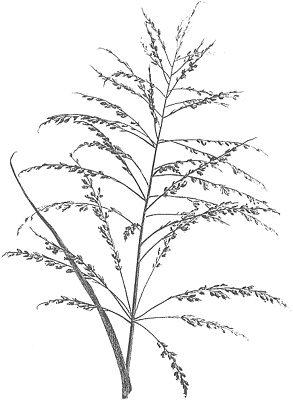
Broom Corn