13
Other Cultivated Grains
Some of the neglected cereals described previously—sorghum, finger millet, and pearl millet, for example—are not, strictly speaking, "lost." But there are a number of African food grains that are indeed truly overlooked by all of modern science. Most of these come from wild grasses (see next chapter), but some are from plants cultivated by farmers on at least a small scale. These last, Africa's least known grain crops, are discussed here.
GUINEA MILLET
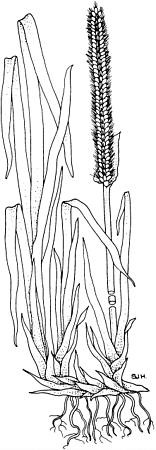
Guinea millet (Brachiaria deflexa) is perhaps the world's most obscure cereal crop. It is cultivated by farmers only in the Fouta Djallon plateau, a rather remote region of northwestern Guinea. Little, if anything, has been done to improve this crop, yet where it is grown the people value it highly. They grind its soft seeds into a flour, which is used for cakes and fritters.
Although this domesticated plant is grown only in this one area of the Guinea highlands, the wild form is spread throughout the Sahelian zone from Senegal to the Horn of Africa as well as in coastal savannas from Ivory Coast to Cameroon. This wild form is also harvested for food.1 The main difference between the two is that the cultivated type has much larger grains and is nonshattering (holds its seeds).
This plant grows to about I m tall, and looks so much like fonio (see Chapter 3) that for decades it was classified as just a special fonio variety.2 However, it has botanical differences and bears larger grains.
Although unstudied by agronomists, guinea millet appears to have useful characteristics. For instance, some types mature so quickly
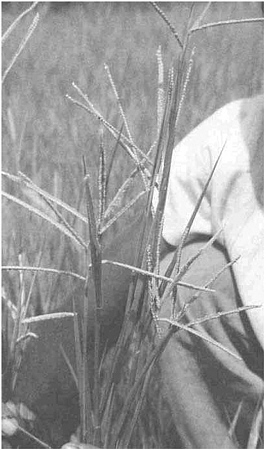
they take only 70-75 days from planting to harvest (most, however, require 90-130 days). Commonly, farmers use these fast-maturing guinea millets to fill in any gaps in their fields of sorghum, maize, or other grains. This allows them to get a full harvest from those fields.3 To achieve truly quick growth, however, a rich and well-drained soil is required.
Guinea millet deserves recognition and attention from scientists and others interested in helping food production and agriculture across West Africa. Despite its current obscurity, it just might have a big future both there and in other regions.
EMMER
Emmer (Triticum dicoccum) is not strictly African; it is a wheat that originated in the Near East. Indeed, it was one of the first cereals ever domesticated4 and was part of the early agriculture of the Fertile Crescent. Farmers had it in fields perhaps as far back as 10,000 years ago. For several thousand years it remained a major cereal throughout the Middle East and North Africa. Then people switched to durum wheat—the type now used worldwide to make spaghetti, macaroni, and other pastas. In fact, durum wheat (Triticum turgidum var. durum) probably originated from emmer by mutation. Farmers preferred it because its grain was free-threshing (the seed fell out of its husk quite easily), and during the past 2,000 years or so the older form, emmer, became an abandoned waif.
Despite its Middle Eastern origin, emmer nonetheless has an ancient African heritage. It reached Ethiopia probably 5,000 years ago, perhaps more, and it survives there to this day.5 Whereas it virtually disappeared elsewhere, emmer comprises almost 7 percent of Ethiopia's entire wheat production. Even in what is a major, modern, wheat-growing region, it remains important. Indeed, far from abandoning it, farmers in Ethiopia's highlands have over the last 40 years increased the percentage of emmer that they grow.6
Emmer, locally known as aja, is used in various ways. Some is ground into a flour and baked into a special bread (kita). Some is crushed and cooked with milk or water to make a porridge (genfo). And some is mixed with boiling water and butter to produce a gruel. With emmer's high protein content and smooth, easily digested starch, the gruel is especially favored by invalids and nursing mothers.
|
Resurrecting Biblical Wheats Emmer (see previous page) is just one of several ancient wheats that could help the modern world. Two others are being rescued in Europe. The efforts summarized below could be the spur for similar endeavors to bring emmer back as a major crop as well. Einkorn Until recently everyone thought that einkorn, perhaps the earliest of all cultivated wheats, was essentially extinct. But in 1989, botanist Jacques Barrau reported the following experience in the south of France. "In 1971, I decided to look at all the food plants in the mountains of Vaucluse, where my father's family had its origin. From childhood memories, I knew that a kind of porridge was a popular peasant dish there in winter. I started looking for the cereal used for that purpose and found to my surprise that it was the neolithic [Stone Age] einkorn, Triticum monococcum. The crop was still being grown there, as well as in some localities in the Southern Alps, as a subsistence cereal of which the unground grain was used to prepare this special porridge. This was unknown to my learned friends in French agricultural research. "Today, this relict prehistoric wheat is beginning to find markets as a 'natural health-food,' and it sells at a price rather satisfying for the stubborn traditional growers who, through generations, had kept it in cultivation, just to satisfy their lasting taste for this porridge." Spelt For the Stone Age inhabitants of what is now south Germany, spelt (Triticum spelta) was the main food source. Later, however, this primitive winter cereal was abandoned—not because of inferiority but because farmers found other wheats easier to grow. For one thing, spelt's grain had a close-fitting husk that made it harder to thresh, and its very long straw meant that summer winds could blow the plants down. Now, spelt (or dinkel as it is usually called in Germany) is coming back as a crop. In this case, the driving forces behind its return are modern consumer preferences—notably the rising appreciation for good nutrition and for protecting the environment. Nutritionally speaking, spelt is very exciting. Breadmaking wheats in northern Europe generally contain around 11 percent |
|
protein. Spelt averages between 14 and 15 percent; some types have even exceeded 17 percent. The grain also has greater concentrations of minerals and vitamins. Even with its lower yield, spelt can produce more protein per hectare than modern breadwheat. And a growing number of consumers are acclaiming the ''nutty" taste of products baked from spelt flour. Spelt's environmental advantages are proving even more important. "The kernel is protected against fungi or insects by the close-fitting husk," explains Christof Kling, head of wheat breeding at Hohenheim University in Stuttgart. "This means the crop is very appropriate for use in environmentally sensitive areas or where farmers want to use less pesticide, or even none at all." In the old days, when people had to thresh grain by hand, the very attribute that helps to protect the grain against pests and diseases—the close-fitting husk—was an overwhelming disadvantage. But in our mechanized era it is inconsequential. Like einkorn and emmer, spelt never disappeared entirely, but until recently it was grown in only a few isolated pockets in Germany, Belgium, Switzerland, and Austria. Now all that has changed. In fact, enthusiasm for this long-lost grain is so high that spelt in the early 1990s is being cultivated on over 6,000 hectares in Germany alone. Indeed, a special organization (the Dinkelacker Foundation) has been established to help foster this prodigal son's return from the Stone Age. Emmer Recently, researchers in Syria have become excited over emmer. Samples gathered from different parts of the country grew surprisingly well when planted at two ecologically different locations (Tel Hadya and Breda). A wealth of qualities soon became apparent. The researchers concluded that their samples were: "an important genetic reservoir of variability for useful characters such as earliness, short stem, high number of fertile tillers [see picture overpage], long spikes, dense spikes, high number of seeds per spike, weight of kernels per spike, and protein content." They also noted that most of the emmers exhibited traits suitable for cultivation in the arid areas. "Tolerance to drought is also one of [the] traits, which could be used in breeding wheat for the dry areas," they said. |
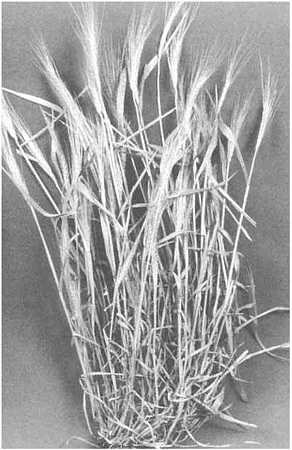
Emmer. This sample, with its remarkable number of separate seedheads (tillers), was discovered by researchers in Syria when a small collection of emmer seeds was planted at two ecologically different locations (see previous page). In addition to having more than 20 seedheads, this plant tolerates drought and its grain has a protein content of 18-21 percent. (A.B. Damania)
This "cereal that refuses to die" deserves better treatment from science and commerce. Its economic importance in Ethiopia alone makes it worthy of research attention. However, there might also be worldwide interest. Already, small projects to restore it to widespread modern use are under way in the United States and France (see box). The plant grows in a wide range of environments and can be produced in many parts of the world. The fact that it is the wheat family's "living fossil," little changed from wheat eaten in the times of the Bible and the Koran could give it special consumer appeal. But it can also stand on its own culinary merits. Pliny the Elder (AD 23-79) wrote that emmer wheat makes the "sweetest bread," and even today its virtues are hailed with similar plaudits.
On the face of it, emmer might also benefit the world's wheat-breeding programs. Already, its genes have conferred on the American wheat crop resistance to rust, a virulent fungal disease that in earlier times periodically devastated the nation's food supply.7 Its other desirable characteristics include early maturity, drought resistance, and a high protein content.
BARLEY
Although barley (Hordeum vulgare) is probably not a native of Africa either, it also has been used in Ethiopia for at least 5,000 years. Indeed, Ethiopian barleys have been isolated so long that two of them, irregular barley and deficient barley, were for a time considered distinct species.
Among these two genotypes, as well as among the rest of the diversity of barley forms, can be found a wealth of promising types in addition to genes for use in the world's barley crop. In fact, Ethiopia's assorted barleys are said to be a vital part of its cultural heritage. Under normal circumstances each family sticks tenaciously to its own seed stock. Thus, over thousands of years, each family's stocks have evolved along separate and divergent lines and a vast diversity has resulted. Today, the fields are amazingly rich in different types. In fact, each farmer usually cultivates complex mixtures or even separate plots of quite distinct barleys.
Barley ranks third in terms of area (after tef and sorghum) in Ethiopia. However, its value goes far beyond just economics and nutrition. It is, in fact, deeply rooted in the cultural life. The Oromo people, for instance, consider it the holiest of crops. Their songs and
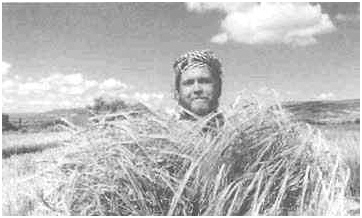
sayings often feature this "king of grains." Everyone in the highlands encourages children to consume lots of barley. It makes them brave and courageous, they say.8
Ethiopians turn barley into bread, porridge, soup, beer, and many other foods. A favorite snack is roasted unripe barley seed. Several types are made into various barley-water drinks, most of them nonalcoholic.9 These beverages (made of water infusions of roasted and ground grains) are highly valued. Also, some intoxicating liquors (areuie ) are home brewed from barley grains.
Ethiopians draw clear associations between each grain type and its use. The white large-grained forms are preferred for porridges. The white, black, or purple large-grained types are made into bread and other baked foods. Partially naked grains are usually roasted or fried. Small-grained types (mainly black and purple) are used for beverages.
Barley is also important to the country's livestock. The grain itself is sometimes fed. (Wealthy farmers, for instance, use it to fatten horses and mules before and after long journeys or to strengthen cattle before the plowing season or going to market.) But more commonly, the animals end up eating the straw. Finely broken barley straw is also employed in constructing mud walls.
For all its importance, however, Ethiopia's barley production can be strengthened. A vast store of indigenous germplasm has yet to be tapped. Indeed, some of it is being lost. (This genetic erosion is happening mainly as farmers switch to crops such a bread wheat, tef, and recently, oats.)
Some of Ethiopia's barley could be made more useful by genes of the barleys developed elsewhere in the world. But the multitude of local types offer great opportunities on their own accounts. Many are unique. Even the number of rows of grains on the seedhead (spike) can be unique. Everywhere else in the world, barleys have exactly two rows or six rows. However, Ethiopia's irregular barley has two full rows as well as parts of other rows. And its deficient barley has two full rows, but the lateral spikelets are greatly reduced or are wanting entirely.
Although essentially unknown elsewhere, irregular barley10 ranks fourth among Ethiopia's crops, both in quantity produced and area planted.11 At altitudes above 2,500 m it is usually the only cereal that
|
Thoroughly Modern Millets Whereas today's most reliable approach to advancing little-known grains is conventional plant breeding, biotechnology might soon be able to leapfrog much of the tedious and time-consuming toil traditionally involved in creating new varieties. Here we identify a few possibilities. Because they are well known in scientifically advanced countries, wheat, rice, maize, and (to a lesser extent) sorghum have benefited from high-tech research. Millets, however, remain almost exclusively resources of countries with little or no basic research capacity. Millets have therefore barely benefited from the latest instruments and techniques. Given such attention, it seems likely that they can be leapfrogged into the twenty-first century using biotechnology. This is especially important to Africa, where the needs are so vast and diverse, the resources so few, the time so pressing, the conditions so changeable, and the priorities so uncertain that conventional plant breeding, which can take 10-12 years to perfect a new variety, may not be up to the task. Certainly, its ability to breed for genetically complex attributes such as drought tolerance is limited. Moreover, in environments such as the Sahel, where climatic variables far outweigh genetic ones, plant breeding is all but impossible to do in the normal way in field trials. When it comes to Africa, then, biotechnology could have a huge impact. For example, breeding can be done more quickly, it can be done indoors in controlled environments, and it can be done with greater precision. Increasingly, biotechnology can deal with genetically complex traits. In sum, technologies such as tissue culture, anther culture, embryo rescue, protoplast fusion, and genetic markers are likely to bring undreamed of breakthroughs that will transform Africa's native grains. The key to this gene revolution is to develop tissue-culture techniques for each of Africa's grains. If scientists can grow mature, fertile plants from tissues of pearl millet, finger millet, fonio, irregular barley, and tef, they will open doors to the more rapid development of these cereals. Grasses are difficult to culture—so difficult, in fact, that not long ago they were considered impossible—but rice, maize, sorghum, and vetiver have already succumbed and can be grown routinely in tissue culture. Now it seems likely that the right conditions can be discovered for the others. |
|
Once tissue culture has been established, a major challenge will be to "map" the chromosomes using genetic "markers." Knowing the physical location of particular genes will result in many shortcuts to improved strains. This is particularly because thousands of young seedlings can be tested for the presence of specific genes, rather than waiting for the genes to express themselves in the mature plant. It will also allow desirable genes to be more easily transferred, and undesirable ones to be eliminated. The markers could be provided by the restriction-fragment length polymorphism (RFLP) technique (see box, page 34), a process already being applied to maize, barley, and rice. Following are examples of the gains to be achieved: Drought Resistance. Breeding drought-resistant varieties has always been difficult because researchers had no way to determine genetic influences on the basic mechanisms of drought injury and tolerance. In basic studies, biotechnology is now helping to show how water stress affects the physiological, biochemical, and molecular organization of plants during their various life stages. In future, the new techniques could target the genes that govern rooting depth, water extraction, and root penetration of compacted soil layers. Once identified and mapped, the genes for these characteristics (which are extremely difficult to evaluate in the field) could be readily tracked in breeding programs. This would lead to crops with much higher drought tolerance. Striga. An ability to manipulate the genes that attract or repel the striga parasite could boost cereal yields continent-wide. Hybrids. Biotechnology would make it much easier to make hybrids within and between species. This might be brought about through chemical hybridizing agents, through clonally propagating sterile seed, or through embryo rescue. As work progresses on the major crops in the world's most sophisticated laboratories, millets should not be overlooked. Pioneers pushing the frontiers of gene manipulation in wheat, maize, and rice, for example, should not leave the millets trailing so far behind that they will be abandoned willy-nilly. Actually, the high-tech equipment and powerful genetic tools could likely help make major advances in millets and thereby bring more humanitarian benefits than in all the rest of the work. |
can be cultivated satisfactorily. It is very important throughout most of the upper highlands, for example, where it accounts for about 60 percent of the population's total plant food. Farmers in that area rely on fast-maturing types to save their families from starving during food shortages.
This is just one example of the genetic wealth to be found among Ethiopia's barleys. Other traits include:
-
High yields. Some Ethiopian barleys have big and heavy kernels, some plants tiller (send up multiple shoots and seedheads) very well, and others mature quickly.
-
High nutrition. Some have high levels of protein and a few are high in lysine and are thus exceptionally nutritious. They are the only known source of quality-protein barley.12
-
Disease resistance. Several have resistance to diseases such as powdery mildew, leaf rust, net blotch, Septoria, scald, spot blotch, loose smut, barley yellow dwarf virus, and barley stripe mosaic virus.
-
Drought resistance. Many have the ability to grow under dry conditions—a feature apparently related to deep and efficient root types.
-
Tolerance to marginal soils.
-
Resistance to barley shoot fly and aphids.
-
Vigorous seedling establishment.
On the other hand, Ethiopia's barleys tend to blow down easily due to weak straw and tall, spindly growth. Some specimens suffer from the condition known as "fragile rachis," in which the seed spike breaks apart and spills the seeds on the ground.
The outside world's barley breeders have not neglected Ethiopia's materials. For example, they employ the accession called Jet (jetblack seeds) to obtain resistance to loose smut, a severe fungal disease. In the United States and several other countries they have employed the genes for resistance to the extremely damaging barley yellow dwarf virus, leading to great savings in grain yields. But many more useful types remain to be employed both at home and abroad.
ETHIOPIAN OATS
Ethiopia also has a native oats, Avena abyssinica. Partially domesticated in the distant past, this species is largely nonshattering—that is, it retains most of its grain so farmers can harvest them conveniently.
It has long been used in Ethiopia and is well adapted to the high elevations and other conditions there. It is, however, unknown elsewhere. With a rising international interest in oats this little-known species deserves research attention.
Unlike common oats (Avena sativa), which is a hexaploid, Ethiopian oats is a tetraploid. It is seldom grown as a solitary crop; it is almost always sown in a mixture with barley. Agriculturists may classify it as a weak-stemmed "weed," but not the farmers. They harvest the two grains together and use them mainly in mixtures. These mixtures generally end up in injera (the flat national bread; see last chapter), local beer (tala), and other products. Some are roasted and eaten as snacks.
However, some people don't appreciate Ethiopian oats because the plant is not fully domesticated and does shatter somewhat. It is also fully fertile with the weed Avena vaviloviana, which creates swarms of weedy hybrids that shatter a lot.13
Nonetheless, Ethiopian native oats deserves research attention and a chance to prove itself.
KODO MILLET
Although wild forms of kodo millet (Paspalum scrobiculatum) occur in Africa, the plant is not grown as a crop there. However, domesticated forms have been developed in southern India, where they are planted quite widely. This is therefore a plant in the very process of domestication, and the cultivated forms could have an important future in Africa as well.
The wild form is common across tropical Africa (as well as across wetter parts of the Asian tropics from Indonesia to Japan). It is often abundant along paths, ditches, and low spots, especially where the ground is disturbed (which accounts for the reason it is sometimes called ditch millet).
Although kodo millet frequently infests rice fields in West Africa, it is tolerated even there. Many farmers actually take pleasure in seeing it in their plots. Should the rice crop fail or do poorly, they will not have lost everything ... the field will likely end up choked with kodo millet, which can then be harvested for food. In this sense, the weed becomes a lifesaver for a subsistence-farming family.
All in all, this is another obscure cereal deserving greater modern research and recognition. Two technical problems to evaluate are an ergotlike fungal disease and the probable presence of antinutritional compounds.