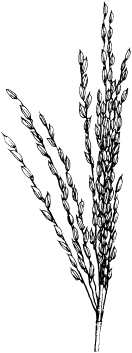
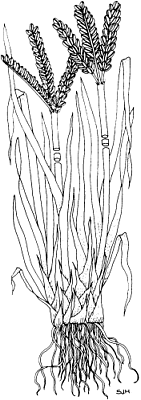
1
African Rice
To most of the world, rice connotes Asia and the vast agriculture of Far Eastern river deltas. Indeed, humanity's second major crop is from Asia, and 90 percent of it—the main source of calories for 2.7 billion people—is grown there.
But rice is also African. A different species has been cultivated in West Africa for at least 1,500 years. Some West African countries have, since ancient times, been just as rice-oriented as any Asian one. For all that, however, almost no one else has ever heard of their species.1
Asia's rice is so advanced, so productive, and so well known that its rustic relative has been relegated to obscurity even in Africa itself. Today, most of the rice cultivated in Africa is of the Asian species. In fact, the "great red rice of the hook of the Niger" is declining so rapidly in importance and area that in most locations it lingers only as a weed in fields of its foreign relative. Soon it may be gone.
This should not be allowed to happen. The rice of Africa (Oryza glaberrima ) has a long and noteworthy history. It was selected and established in West Africa centuries before any organized expeditions could have introduced its Asian cousin (Oryza sativa). It probably arose in the flood basin of the central Niger and prehistoric Africans carried it westward to Senegal, southward to the Guinea coast, and eastward as far as Lake Chad. In these new homes, diligent people developed it further.
Like their counterparts in the Far East, Africa's ancient rice farmers selected a remarkable range of cultivars suited to many types of habitats. They produced "floating" varieties (for growing in deep
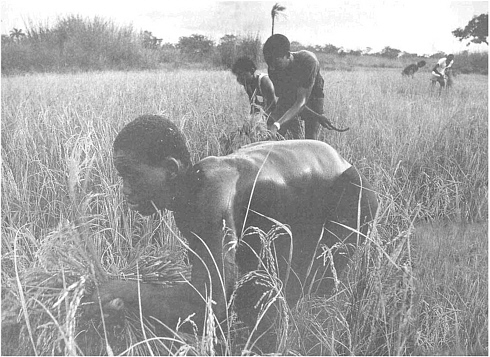
Rice growers in Sierra Leone harvesting their crop. For millennia. farmers in this area have grown African rice. Possibly it was slaves from here who introduced rice growing to the United States. For a century or more. the colony and state of South Carolina was a main rice grower. Whether African rice reached there along with the Asian species is not known. However, given the West African attachment to it, it seems likely. (M. Steber)
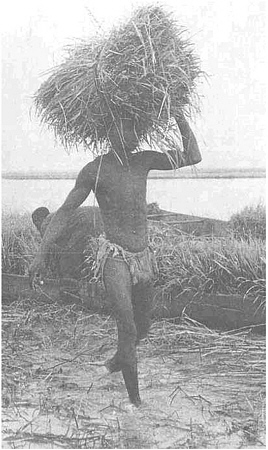
For hundreds, if not thousands, of years, "floating" versions of African rice have been cultivated beside the Niger River, especially here between Timbuktu and Gao. Farmers along this 600-km stretch count on the Niger to overflow its banks and flood the lowlands where they've sowed their seeds. The rice plants can survive in rising floodwater up to several meters deep. When drought reduced the Niger's flow in the 1970s, the full crop could not be planted and a million lives were put at risk. (J. Gallais. courtesy Flammarion et cie, Paris)
water), weakly and strongly photoperiod-sensitive types (for growing in different latitudes and seasons), swamp and upland cultivars (for growing under irrigated and rainfed conditions, respectively), and early and late-maturing types. And, for all of these, they selected forms with various seed characteristics.
Although modern efforts to expand rice production in Africa have largely ignored this indigenous heritage, African rice is still cultivated in West Africa—especially in remote districts. There, until recently, much of it was reserved as a special luxury food for chiefs and religious rituals. Today, however, farms that grow substantial stands of African rice are few. The area of most intense cultivation is the "floating fields" on the Sokoto fadamas (floodplains) of Nigeria and the Niger River's inland delta in Mali. However, the crop is also widely, if thinly, spread in Sierra Leone (see box, page 28) and neighboring areas, as well as in the hills that straddle the Ghana-Togo border.
From one point of view, there seem to be good reasons for abandoning this food of the forebears. In most locations farmers prefer the foreign rice because it yields better and scatters less of its seed on the ground. Millers prefer it because its grain is less brittle and therefore easier to mill. Shippers prefer it as well. For them, African rice is hardly worth a minute's consideration because it is not a trade commodity and most types are red-skinned and therefore unsuitable for mixing with conventional rice in bulk handling.
But these are concerns almost entirely of commercial farming. The situation is quite different where rice is grown strictly for localized, subsistence, or specialty use. There, yield, brittleness, color, or international interest can be unimportant. Indeed, small-scale farmers often prefer African rice. They like the grain's taste and aroma, and even its reddish appearance. They find the plant easy to produce: its rambunctious growth and spreading canopy help suppress weeds and it generally resists local diseases and pests by itself. Also, to some people traditional rituals are meaningless unless the ancient grain is employed.
Moreover, these are not the only advantages. Compared to its Asian cousin, African rice is better at tolerating fluctuating water depths, excessive iron, low levels of management, infertile soils, harsh climates, and late planting (a valued feature because in West Africa's erratic
climate the rains are often tardy). Also, there are some types that mature much more quickly than common rice. Planted out in emergencies when food stocks are getting low, these can save lives.
PROSPECTS
What actually happens in the future to this interesting African crop will depend on individual initiatives, most of them within Africa itself. Part of the problem is its lack of prestige. Everywhere, consumers have fallen in love with processed Asian rice. If someone now makes a processed (that is, parboiled) product out of African rice, that alone may return it to high favor. Indeed, it may rise to become a gourmet food of particular interest because of its ancient and historic heritage.
Part of the problem, also, is lack of supply. Thus, if such specialty markets develop, it seems likely that African rice will survive as a commercial crop. Then, with selection and breeding, its various cultivars can almost certainly be made to compete with Asian rice in most African locations. There is evidence, for example, that certain types already match the productivity of Asian rice, and in the yield figures there is considerable overlap between the best African and the poorer Asian ones. This is remarkable considering the 5,000 years of intense effort that has been invested in improving Asian rice.
Even if the local rice never thrives as a commercial crop, it will likely continue as a subsistence crop in West Africa. However, whether this is a lingering decline for a few more decades or a robust return to massive use depends on the responses of scientists, administrators, and others. Even in its current neglected form the plant has something to offer, but just a small amount of support, promotion, and practical research seems likely to bring dramatic improvements.
The problems of shattering and brittle grain can undoubtedly be overcome by careful scrutiny of the types already spread across West Africa. A small cash prize might well produce appropriate genotypes almost overnight. The same could happen for white-skin types, which many people would find more appealing than the main type of today. Even now, not all the varieties are red-skinned. In Guinea, Senegal, and the Gambia, for example, white types are said to be already available.
Africa
Although no one can be certain of what will happen with this crop in the coming decades, the prospects for doubling its production and overcoming its various technical limitations are good. Technical
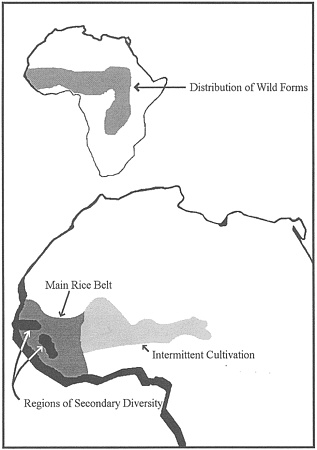
Rice was cultivated in Africa long before any navigator from Java or Arabia could have introduced their kind of rice to Madagascar or the East African coast. The native rice was grown first in the central Niger delta, and later in the Gambia, Casamance, and Sokoto basins. African rice is now utilized particularly in the central Niger floodplain, the coastal zone between Senegal and Sierra Leone, and the mountainous areas of Guinea and the Ghana/Togo border.
The primary center (small map) shows the distribution of the wild form. The secondary centers are where notable arrays of cultivated types occur. The main rice belt is the zone where African rice is cultivated the most.
improvements, such as those just mentioned, could give it a solid future. It is now known only in West Africa, but eventually it might also find a place elsewhere. Although only a few African countries grow even Asian rice in a major way, it is the continent's fourth biggest cereal (after maize, pearl millet, and sorghum) in terms of area planted. And demand is ever rising as population, standards of living, urbanization, international travel (with its exposure to new cuisines), and the search for easy-to-prepare foods increase. At present, West Africa absorbs a quarter of the world's rice exports.
Humid Areas
On the face of it, African rice is at its biggest disadvantage in the humid lowlands. This is prime country for growing Asian paddy rice, whose current competitive edge makes it clearly the crop of choice. In addition, in this zone farmers and governments often invest in irrigation facilities, and to recoup their vast expenditures they must grow the highest yielding, highest selling crop. As a result, it is in this zone that African rice has suffered its most precipitous decline.
On the other hand, even here there seems to be a small but vital place for African rice. A recent survey in southern Sierra Leone, for example, found that even where Asian rice predominates farmers still retain one or two ultra-quick traditional types as ''hunger-breakers." And, faced with a worsening hungry season caused by economic recession or other factors, many farmers say they would revert to the short-duration African-rice varieties, if only they could find sources of seed.2
Dry Areas
For the truly arid zones African rice is not a suitable crop, but on moderately watered sites (for example, where annual rainfall is at least 760 mm) or seasonally flooded sites its prospects seem good. The fact that some varieties mature 10-20 days before their principal Asian-rice rivals is significant in drylands where precipitation is often erratic. In northern Sierra Leone, for example, the rainy season in recent decades has been terminating early and with unusual abruptness. For this reason alone, farmers are cultivating African rice on at least some portion of their land.3 With it, they are assured of a harvest.
Upland Areas
In West Africa's highlands4 where this type of rice is still an important grain producer, it will continue to be important as
a subsistence crop. The upland varieties are notably useful in shifting agriculture. They also have a place in crop rotations because their root systems and susceptibility to soilborne diseases differ from those of the major crops. Planting them for a season or so tends to "sanitize" the site.
Other Regions
For lands beyond Africa, prospects are slight. There, African rice offers few benefits over the Asian species and may not adapt well.5 Although it might have a future as a small specialty crop, more likely it will become an accursed weed, especially in rice fields.
USES
African rice can be used for all the same purposes as Asian rice. It is thus extremely versatile. There are, however, some specialized local uses. West Africa's Mandingo and Susu people, for instance, use rice flour and honey to make a sweet-tasting bread, so special that it is the centerpiece of ceremonial rituals. Rice beer is popular throughout West Africa, and in Nigeria a special beer (called betso or buza) is made from rice and honey. Also, in Ivory Coast there is a project to use African rice as a component of baby foods.
NUTRITION
Both rices are principally carbohydrate sources. However, in practice African rice's nutritional quality is greater than that of Asian rice.6 This seems to be not because of any inherent difference but because it is more difficult to polish. Asian rice is invariably polished to a greater degree, and therefore more of its nutrients (especially the important vitamin, thiamine) are lost.
AGRONOMY
As with Asian rice, African rice is grown in three major ways: dryland (or upland), paddy, and "floating."
Dryland
About 40 percent of the rice production in Africa's 15 major rice-producing countries relies on rain as the only source of water. Almost all of that area employs the Asian species, but West Africa still grows a small but significant amount of dryland African rice. Indeed, in certain parts of Ghana and Togo it is the chief staple.
The dryland form thrives in light soils wherever there is a rainy season of at least 4 months and minimum rainfall of 760 mm. It is often interplanted with millets, maize, sorghum, beniseed, roselle, cowpea, cassava, or cotton. Today's varieties mature in 90-170 days. Yields average 450-900 kg per hectare, but can go as high as 1,680 kg per hectare.
Paddy
Only about one-sixth of Africa's rice is produced using irrigation and 60 percent of that is in just one country—Madagascar. Swamp rice, however, is being increasingly cultivated in former mangrove areas of the Gambia, Guinea-Bissau, Guinea, and Sierra Leone. Essentially all of it at present is the Asian species.
African rice can also be grown in the same way. It can be seeded into damp soil or transplanted to fields under water. These types mature in 140-220 days. The yield ranges from 1,000 to 3,000 kg per hectare.7
Floating
In the River Niger's inland delta in Mali, farmers grow various forms of floating African rice. These plants lengthen prodigiously to keep their heads at the surface of the floodwaters, where they flower and set seed. One type (songhai tomo) can grow in water more than 3 m deep.
Floating varieties can utilize deeply inundated basins where nothing else can be raised. They are often harvested from canoes. They ripen in 180-250 days. Yields range from 1,000 to 3,000 kg per hectare, depending on the amount of rainfall early in the growing season and on the eventual depth of the subsequent floods.
HARVESTING AND HANDLING
African rice is handled like its more famous Asian cousin, but (as noted) its grains tend to split, and so greater care must be taken. Also, it is more difficult to hull.
As is to be expected with such a neglected crop, yields are variable and uncertain. However, there are hints that they are not as low as
NUTRITIONAL PROMISE
|
Main Components |
|
Essential Amino Acids |
|
|
Moisture (g) |
5 |
Cystine |
2.6 |
|
Food energy (Kc) |
358 |
Isoleucine |
4.7 |
|
Protein (g) |
7.6 |
Leucine |
8.8 |
|
Carbohydrate (g) |
81 |
Lysine |
4.1 |
|
Fat (g) |
1.9 |
Methionine |
3.1 |
|
Fiber (g) |
0.5 |
Phenylalanine |
5.1 |
|
Ash (g) |
3.8 |
Threonine |
3.7 |
|
Thiamin (mg) |
0.39 |
Tyrosine |
4.6 |
|
Niacin (mg) |
5.0 |
Valine |
6.4 |
|
Calcium (mg) |
25 |
|
|
|
Iron (mg) |
2.0 |
|
|
|
Phosphorus (mg) |
263 |
|
|
COMPARATIVE QUALITY
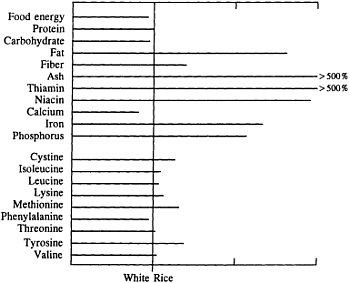
A glance at this chart shows that whole-grain African rice is at least as rich as white (i.e., Asian) rice in most nutrients. In some vitamins and minerals it is far superior.
|
Rice in Sierra Leone Recently, researchers surveyed the distribution and use of rice in Sierra Leone. Following is their account of their findings. It is probably indicative of the situation throughout much of West Africa. In visits to just over 500 farmers in all parts of Sierra Leone, we found that 245 types ("varieties") of rice were in use. Of these, 24 were African rice. Although it generally yields less than Asian rice, African rice survives—and may even be making a modest comeback in some areas, especially in the drier northwest. There are a number of reasons for this. Compared with Asian rice, African rice:
|
commonly claimed. For example, five years of experiments at two sites in Ivory Coast found that 16 populations of African rice (selected for their productivity) compared favorably with three top varieties of Asian rice. Despite their natural lodging and spontaneous shattering, the best African rice varieties (BG 141 and BG 187) gave average and remarkably stable yields of 1,500-1,800 kg per hectare (depending on the site) as did their Asian counterpart (Moroberekan), the traditional upland variety promoted in Ivory Coast.8
|
than the average Asian rice. Also, they often told us that it tastes "sweeter." And they said it keeps well after cooking. This is particularly important because many people prepare food only once a day, but members of the family drop by to eat at any time. In northwestern Sierra Leone, however, Asian rice is preferred. People in this area complained that African rice is difficult to husk and that cleaning off its tough red bran takes a lot of work. Women in particular complained of the extra workload it imposes. On the other hand, in other parts of the country redness was an important advantage. For example, Mende people in the south and east look on the red tinge (found on incompletely milled grains) as a guarantee that the sample is not a foreign rice. Rice soaked in palm oil plays a major part in their rituals, and it is unthinkable for them to use an Asian wetland variety. In their fields, Sierra Leone farmers draw no distinction between Asian and African rices. Both species go by the same name: mba (Mende) or pa (Temne). The fields are very mixed from a genetic point of view. The farmers prefer it that way and, seemingly, they deliberately foster diversity because most of them know how to rogue out undesirable types and would do so if they wanted to. We noticed that the African and Asian species appear to have hybridized in many places. A number of the most popular Temne rices, for example, are in fact intermediate types (judged by ligule form, grain shape, and panicle type). Certain named landraces seemed to be neither Asian nor African rice and may be assigned to either or both species. Paul Richards, Serrie Kamara, Osman Bah, Joseph Amara, Malcolm Jusu |
LIMITATIONS
In its present state, African rice certainly has limitations, including those listed below:
-
Lodging. The plants tend to have weak stalks, and late-season windstorms can sometimes topple them.
-
Shattering. Today's plants tend to drop the seed as it matures.
-
Splitting. The seed tends to break in half if handled roughly.
-
Color. Although the grain itself is always white, most types have red husks.
-
Processing. To remove the husk is laborious.
-
Weediness. In West Africa, extensive genetic interaction occurs between African rice's wild and cultivated races. The mixed populations that build up can be extremely complex. The weedy results infest the rice fields and can be serious pests.9
-
Diseases. Compared to Asian rice, it can be more susceptible to numerous fungi as well as to the parasitic plant striga and to a brown spot of unknown cause.
Although these limitations collectively add up to a fearsome combination, they mainly reflect the neglect this crop suffers from. All are now circumvented by people who grow and use African rice; research can undoubtedly reduce their severity if not overcome them entirely. Moreover, several of these limitations are also characteristic of competing grains.
NEXT STEPS
African rice must be kept from dying out as a crop. It deserves research, development, greater promotion, and support. At the very least it has genes of potential value to its near relation, the world's second biggest food crop. Actions to be taken include the following:
Friends of African Rice
A good start could be made by an organization of volunteers—both professionals and amateurs—who join together in a cooperative spirit to explore, protect, promote, and provide samples of this millennia-old resource. They might also collect the legends that come with the various types before they, too, die.
Information Exchange
Researchers are now working on rice in Senegal, Mali, Ghana, Ivory Coast, Burkina Faso, Cameroon, Liberia, Nigeria, Sierra Leone, and other countries. An international center, the West African Rice Development Association, specializes in the crop. And two French institutes, Office de la Recherche Scientifique et Technique Outre-Mer (ORSTOM) and Institut de Recherches Agronomiques Tropicales et des Cultures Vivrières-Centre de Coopération Internationale en Recherche Agronomique pour le Développement (IRAT-CIRAD), also have rice programs in Africa. All but one of these organizations work almost exclusively on Asian rice, but the presence of their expertise means that there are good opportunities to advance the development of its African relative.10 One way to stimulate
|
9 |
Such a gene flow between wild and cultivated species is also of long-term benefit to the crop. It maintains a broad genetic base and enhances its ability to resist drought, pests, diseases, and other hazards. But to a farmer faced with the need for high yields of uniform grain, it can be a curse. |
|
10 |
Research contacts for these and other programs are listed in Appendix G. |
interest within the international scientific community is to collect all available research data and publish a detailed monograph on African rice.
Food Processing
As noted earlier, the availability of precooked products made from African rice might do much to halt its decline and, indeed, to turn it around. Innovation, ingenuity, and marketing skill could be employed to return this food to prominence. It might well start out as a specialty product, selling at a premium to hotels for tourists and to those people dedicated to African traditions.
Seed Supply
In many areas the amount of seed in circulation is so low as to render the species nonviable. It is important to keep up a supply of seed. Then, at least, the farmers who want to keep growing African rice won't be excluded as is now apparently happening in Sierra Leone.
Germplasm
Samples of African rice have been gathered by various organizations, notably the International Plant Genetic Resources Institute (IPGRI), ORSTOM, and IRAT-CIRAD. This has been stored for purposes of conservation and possible plant breeding.11
For all that, however, many interesting types undoubtedly remain to be collected across the vastness of West Africa.
Agronomic Studies
Since little hard data on this crop exists, it would be useful for students of agronomy to take up the many challenges of "filling in the map." Examples include the following:
-
Selecting nonshattering genotypes or developing techniques to overcome shattering.
-
Testing strains for salt tolerance.
-
Locating types for drought avoidance.
-
Measuring cell sap osmotic adjustment.
-
Testing the plant's storage capacity and dormancy requirements.
-
Reducing broken grains. Certain strains of Asian rice also suffer this problem and recent research has shown that providing adequate nitrogen fertilizer largely overcomes it.12
-
Research in deep-water rice is vital and long overdue. The resources available—climate, water, and growing area—along with
-
proper research could perhaps triple production of deep-water rice in the Niger's inland delta. This is one area of research that can do something toward reducing hunger in one of the regions of Africa most in need of help.
Genetic Improvement
Although the current African types shed grain more readily than the Asian ones, some improvements have been bred into dryland varieties. Additional research emphasizing seed shattering could make a big difference. Because the gene for nonshattering is recessive, the selection of nonshattering types should be rapid, and true breeding should be immediate. Other improvements might include selection for resistance to disease. This resistance exists in the various genotypes, and the major problem is not to lose these local types as Asian rice spreads even further. For the uplands, any form of rice must resist blast and sheath blight. All types must also resist rice yellow-mottle virus; some local cultivars already do.
For areas dependent on seasonal flooding, varieties must resist lodging and respond to fertilizer; the transplant types must tolerate widely varying periods of growth in the nursery (while farmers await the onset of the unpredictable natural flooding).
Researchers are at present "mapping" the chromosomes of both African and Asian rice, identifying the portions that control various features of the plant.13 This powerful modern technique will "jumpstart" the genetic improvement of African rice (see box, page 34). Perhaps it could also facilitate the transfer of useful genetic material between the two.
SPECIES INFORMATION
Botanical Name
Oryza glaberrima Steudel
Synonym
Oryza barthii ssp. glaberrima
Common Names
English: African rice, glaberrima rice
French: riz pluvial africain, vieux riz, riz africain, riz flottant
Cameroon: erisi (Banyong)
Guinea: Baga-malé, malé, riz des Baga
Mali: Issa-mo (river rice), mou-bér (great rice)
Sierra Leone: kebelei, mba, mbei (Mende), mala (Kissi), Kono, pa (Temne)
Description
African rice is an annual grass that grows generally between 66 and 120 cm tall. It is highly variable. The dryland types have smooth, simple culms that can form roots at the lower nodes and are simply branched up to the panicle (flower cluster). The floating types can form branches and even roots at the upper nodes. The panicles are stiff, smooth, and compact. The flowers are self-fertilizing; however, some inter- and intraspecific cross-pollination occurs.
From a distance, Asian rice and African rice are similar in appearance. However, African rice has diminutive ligules (small, thin membranes found at the base of the leaf where it joins the stem). Its compact panicles have less branching. Its spikelets lack lawns. It is completely annual and dies after setting seed. Asian rice, on the other hand, continues growing so that late in the season the two can look strikingly different.
Distribution
African rice is important mainly throughout the southwestern region of West Africa, but it can be found as far east as Lake Chad, especially in the lands of the Sahel that are seasonally flooded by the Niger, Volta, and other rivers.
It has apparently been introduced to India. Also, it may have been taken to Brazil by seventeenth-century Portuguese explorers. Somehow it has also reached El Salvador and Costa Rica.14
Cultivated Varieties
Many cultivars of African rice have been obtained by natural crossings and inbreeding, giving forms with compact panicles and heavy grains. In particular, there are numerous swamp varieties suited to different soil and drainage conditions.15 In northern Mali alone are found about 30 cultivars of the floating type.16 Examples of upland varieties of African rice are ITA 208, IRAT 112, Mutant 18, IRAT 104, and ISA 6.17
In Upper Gambia, Guinea, and Senegal (Casamance) can be found a special group of African-rice genotypes with enhanced recessive
|
Could African Rice Go High-Tech? The world's rice research is overwhelmingly focused on Asian rice, but the remarkable developments now emerging from laboratories may bring big advances to African rice, on the side. Following are examples. Gene Mapping. Molecular biologists have recently ''marked" the locations on rice chromosomes where genes for certain genetic attributes are carried. These markers can be used to track the genes for those traits. The ability to determine whether a desired gene is present or absent in any sample bestows enormous power. It can, for instance, help find a desired gene in wild as well as cultivated species, it can find a "hidden" gene in a given plant where the gene's outward effects are masked, and it vastly simplifies the sorting of thousands of crossbred specimens—something that formerly could take a lifetime of tedious effort. Gene markers based on restriction-fragment length polymorphisms (RFLPs) are being developed for both Asian and African rices. For instance, in 1988 a team at Cornell University found markers for various traits on the set of 12 chromosomes that (in both species) carries all the genetic characteristics. That first map had 135 genetic landmarks; later versions have more than 300. A particular strength of this new work is that breeders can now work with very young seedlings. In other words, they can tell whether a certain gene is present without waiting months for the plant to mature. This can cut the time needed to breed a new variety—usually 10-12 seasons—in half. Although the genomes (chromosome sets) of both African and Asian rice have been mapped, the rest of the effort has so far been solely on Asian rice. Nonetheless, most results from Asian rice are likely to be easily transferable. The genome is relatively small, containing only a tenth as much DNA as maize. Test-Tube Reproduction. Although until recently no grass had been cloned using tissue culture, today Asian rice, maize, sorghum, and vetiver have succumbed. African rice has so far not been cultured in the test tube but, given the new insights, it seems a likely candidate for this powerful procedure. Several teams have managed to regenerate fertile rice plants from protoplasts—cells from which the wall has been removed. This makes it even easier to fiddle with rice genes. Already, DNA from bacteria has been transferred into rice protoplasts. Mature plants, grown from these protoplasts, have transmitted the implanted DNA to their offspring. |
|
High-Lysine Forms. In the early 1990s, U.S. Department of Agriculture researchers discovered Asian rice plants with both high protein quality and high protein levels. This has raised hopes that extremely nutritious varieties can be bred for the first time. To find these new forms, Gideon W. Schaeffer, Francis T. Sharpe, Jr., and John Dudley gave small clumps of rice cells a lethal dose of lysine (an amino acid vital for good health) in a laboratory dish. Only a tiny fraction survived the treatment. Those few cells, however, could allow more lysine than normal to be made. The scientists grew them into whole rice plants and found that the resulting high-lysine plants are true genetic mutants and therefore suitable for breeding new commercial varieties. Some of the crossbreeds have succeeded in producing seed of near-normal weights and good fertility but with greatly enhanced nutritional quality. The high-lysine trait is apparently controlled by a single recessive gene. The scientists have begun isolating this gene so as to provide it to genetic engineers for incorporation into the world's Asian-rice crop. The work would likely be easily transferable to create high-lysine forms of its African cousin. Hybrids. Both the male and female parts on rice flowers are normally fertile, but researcher J. Neil Rutger of the U.S. Department of Agriculture has found that growing certain rice plants in 15-hour daylight makes them essentially female. The plants never develop fertile pollen. This may provide a cheap and easy way to boost rice yields to a much higher level than at present. Because the modified plants cannot pollinate themselves, they are ready-made for pollination by other plants. Any pollination, therefore, produces hybrids, which are often known to produce robust and high-yielding plants. This process has not yet been tested on African rice, but Rutger believes that it might well work. Asaf Hybrids. Recent decades have seen several dozen research papers on the genetic and morphological results of crossing Asian rice with African rice. Most have emerged from laboratories in Japan, Taiwan, and China. The driving force behind them appears to be the attempt to raise the yield of Asian rice by forming hybrids. At least in principle, crosses between African rice and Asian rice might improve the yield of either or both. Although the botanical literature stresses their incompatibility, the two are genetically close. Both are self-pollinating diploids (2n = 24) and possess the same genome, which rice geneticists call AA. |
characters such as white husks, spikelets persisting to maturity, and vegetative and floral organs without anthocyanins. These seem to indicate a secondary region of diversity and may be particularly valuable genetic resources.
Environmental Requirements
Daylength
Varies from neutral to strongly sensitive, depending on variety. However, most dryland types now in use are sensitive to photoperiod. They flower with the advent of the dry season. On the other hand, most floating types (at least in northern Mali) show little sensitivity to daylength.
Rainfall
Some upland varieties can produce adequately with precipitation as low as about 700 mm.
Altitude
From sea level to 1,700 m.
Low Temperature
Average temperatures below about 25°C retard growth and reduce yields. Below about 20°C these effects are pronounced.
High Temperature
African rice does well at temperatures above 30°C. Above about 35°C, however, spikelet fertility drops off noticeably.
Soil Type
Some cultivars apparently can outperform Asian rice on alkaline sites as well as on phosphorus-deficient sites. Not unexpectedly, however, the crop performs best on alluvial soils.
Related Species
At least two of African rice's close relatives are regularly gathered for food, often in sufficient abundance to appear in the markets.
Orza barthii (Oryza breviligulata)18 is an annual that commonly occurs in seasonally flooded areas from Mauritania to Tanzania and from the Sudan to Botswana. It is the wild progenitor of cultivated
African rice. It can form meadows in inundated areas. Its grain falls off so easily that it must be carefully collected by hand. (People use a basket or calabash, and sometimes they tie the stalks in knots to make harvesting easier.) It tastes good and is sometimes sold in markets. However, wherever rice is cultivated, this plant is regarded mostly as a weed to be eradicated. Certain strains of this species are immune to bacterial blight of rice (Xanthomonas), which could give them a valuable future as genetic resources.19
Oryza longistaminata is a common wild rice found throughout tropical Africa as far south as Namibia and Transvaal, as well as Madagascar. Unlike the other species, it is a perennial with rhizomes. It is tall and outcrossing. It usually grows in creeks and drainage canals and reproduces by suckers, often setting few seeds. Nonetheless, these meager grains are sought in times of shortage.
|
19 |
S. Devadath. 1983. A strain of Oryza barthii an African wild rice immune to bacterial blight of rice. Current Science (Bangalore) 52(1): 27-28. |