4
Pearl Millet
Of all the world's cereals, pearl millet (Pennisetum glaucum)1 is the sixth most important. Descended from a wild West African grass, it was domesticated more than 4,000 years ago, probably in what is now the heart of the Sahara Desert (see map, page 80). Long ago it spread from its homeland to East Africa and thence to India. Both places adopted it eagerly and it became a staple.
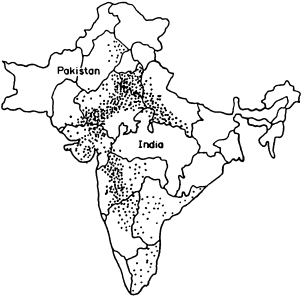
Today, pearl millet is so important that it is planted on some 14 million hectares in Africa and 14 million hectares in Asia. Global production of its grain probably exceeds 10 million tons a year,2 to which India contributes nearly half. At least 500 million people depend on pearl millet for their lives.
Despite its importance, however, pearl millet can be considered a "lost" crop because its untapped potential is still vast. Currently, this grain is an "orphan" among the significant cereals. It is poorly supported by both science and politics. In fact, few people outside of India and parts of Africa have ever heard of it. As a result, it lags behind sorghum and far behind the other major grains in its genetic development. For instance, its average yields are barely 600 kg per hectare and it is almost entirely a subsistence crop; perhaps for this last reason alone pearl millet has attracted little research or industrial support.
Indeed, largely due to neglect, pearl millet is actually slipping backwards. Production in West Africa during the last two decades has increased by only 0.7 percent a year—the lowest growth rate of any food crop in the region and far less than the population's growth rate. Furthermore, even this meager increase has been mainly due to expanding the area cultivated rather than to boosting yields. Elsewhere in Africa the decline has been even more dramatic. Just 50 years ago,
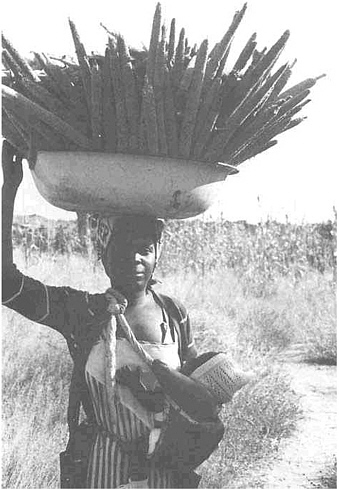
pearl millet was of almost incalculable value to millions of rural people in eastern and southern Africa. But over the decades, more and more farmers—especially in southern Africa—have abandoned it and switched to maize.
There are several reasons for this. For one thing, international research efforts have made maize more productive than pearl millet; for another, government incentives have given maize an added financial advantage; and for a third, easier processing has made maize more convenient to use. The momentum for change has now gone so far that maize is often pushed into pearl millet areas to which it is poorly suited and where it cannot perform reliably.
Now, however, a new era may be dawning. Pearl millet is supremely adapted to heat and aridity and, for all its current decline, seems likely to spring back as the world gets hotter and drier. Perhaps the best of all ''life-support" grains, pearl millet thrives where habitats are harsh. Of all the major cereals, it is the one most able to tolerate extremes of heat and drought. It yields reliably in regions too hot and too dry to consistently support good yields of maize (or even sorghum). These happen to be the regions most desperately in need of help. It is there that the famines of recent decades have brought mass devastation and death. It is there that expanding deserts are destroying the productivity of perhaps 25 million hectares every year. And it is there that agricultural development could have its greatest humanitarian benefits.
These reasons alone should be sufficient to make pearl millet the target of a global initiative. But this crop has even more promise. Rising climatic temperatures are starting to concern almost all countries. And water is shaping up as the most limiting resource for dozens of the world's nations—including some of the most advanced. Agriculture is usually a country's biggest user of water, so that crops that sip, rather than gulp, moisture are likely to be in ever greater demand. Thus, even for economies that until now never heard of it, pearl millet could quickly become a vital resource.
Agronomically, there is no reason why pearl millet could not (like sorghum) become used worldwide. Indeed, recent research in the United States is showing that its prospects are much higher than most people now think. Already, the crop is showing promise for the heartland of America. It might also become widely used in the hotter and drier parts of Latin America, Central Asia, and the Middle East.3 It could have a bright future in dry areas of Australia and other countries as well.
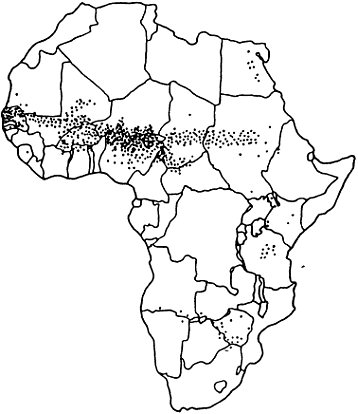
Pearl-millet-growing areas in Africa. There are an estimated 14 million hectares of millet in this zone, making it the third most widely grown crop in sub-Saharan Africa. The plant was probably domesticated some 4,000-5,000 years ago along the southern margins of the central highlands of the Sahara. It has since become widely distributed across the semiarid tropics of Africa and Asia. Today, approximately one-third of the world's millet is grown in Africa; about 70 percent of it in West Africa. Africa's major pearl-millet producing countries include Nigeria, Niger, Burkina Faso, Chad, Mali, Mauritania, and Senegal in the west; Sudan and Uganda in the east. In southern Africa, the commercialization of agriculture has resulted in maize partially or completely displacing this traditional food crop. (ICRISAT, 1987; each dot represents 20,000 hectares)
Pearl millet is easy to grow. It suffers less from diseases than sorghum, maize, or other grains. Also, it has fewer insect pests.
The widespread impression that pearl millet grain is essentially an animal feed, unpalatable to all but the desperately hungry, is wrong. The grain is actually a superior foodstuff, containing at least 9 percent protein and a good balance of amino acids. It has more oil than maize and is a "high-energy" cereal. It has neither the tannins nor the other compounds that reduce digestibility in sorghum.
Pearl millet is also a versatile foodstuff. It is used mainly as a whole, cracked, or ground flour; a dough; or a grain like rice. These are made into unfermented breads (roti), fermented foods (kisra and gallettes), thin and thick porridges (toh), steam-cooked dishes (couscous); nonalcoholic beverages, and snacks.
Grain from certain cultivars is roasted whole and consumed directly. The staple food of the mountainous regions in Niger is millet flour mixed with dried dates and dried goat cheese. This nutritious mixture is taken on long journeys across the Sahara and eaten mixed with water—no cooking required.
Grain from other types is used to make traditional beer. In Nigeria, it is fermented, like maize or sorghum, to produce ogi—a traditional weaning food that is still common.
In future, pearl millet may be used in many more types of foods. The fact that it can be made into products resembling those normally produced from wheat or rice should make it acceptable to many more people.4 With new technology, there seem to be possibilities of using it even to make raised breads (see Appendix C).
All this is not to say that pearl millet is perfect. Indeed, the crop has several serious problems. For one, the raw grain is difficult to process. Many consumers decorticate (dehull) the grain before grinding it into various particle sizes for use in different products. Dehulling by traditional hand pounding produces low yields of flour (around 75 percent) and the product has poor storage stability.5
Despite these impediments, this plant's promise is so great that we have devoted the following two chapters to its various types. The next chapter highlights its promise for subsistence farmers—the millions in Africa and Asia to whom pearl millet means life itself. The subsequent chapter highlights commercial pearl millets—the types that are increasingly grown by farmers who produce a surplus to sell.
|
4 |
Information H.S.R. Desikachar. |
|
5 |
For a probable solution to this problem, see Appendix C. Semi-wet milling and parboiling are two techniques that have recently been shown capable of overcoming the storage stability problem. (Information from D.E. Blyth, ICRISAT). |
|
Let Them Eat Millet Bread Millet once played a greater role in the world of cereals for many rural people in eastern and southern Africa, but it has declined in importance over the last 30-50 years because of a preference for maize. The decline has been compounded by increased research on maize leading to greater productivity of the crop and by the incentives given to maize production through government policies. Maize has been grown, as a result, in dry conditions to which it is not adapted and it has failed too often in these conditions. Governments have come to realize this as well as the farmers themselves. So it is now necessary to reestablish the importance of millet and sorghum in these drier areas and to do so we must make the production of these crops attractive enough so that they can compete with maize, not only in the worst and most severe droughts but in at least a majority of years. Here is work for the scientists in millet. But in the long run, even in Africa, maize is not the problem at all. The problem is wheat, or more correctly, bread. Politicians are going to give the people bread. They have been saying this for a long, long time, and they mean it. Technocrats may decry this trend, particularly in tropical areas where wheat cannot be grown satisfactorily, but I can assure you that the protestations will be to little avail. They may slow the process down but they will not stop it. The people of the cities want bread, and the elected officials will ensure that they get it. The people are already exposed to bread and they will ask for it, they will insist upon it, and they will get it. In many tropical countries it will be very expensive to satisfy this demand unless millet can become bread. And this, too, the politicians recognize and they will support this demand whether efforts can be made to decrease the cost of giving people the food that they demand. So here is something else for the millet scientists to do. Don't ask me how you do it. You know far better than I do. I am just telling you it's got to be done. From an address by L.D. Swindale Former Director-General, ICRISAT |
NUTRITION
Pearl millet's average composition is given in the tables on the following pages. Some highlights are summarized below.
Carbohydrates usually make up about 70 percent of the dry grain, and they consist almost exclusively of starch. The starch itself is composed of about two-thirds amylopectin (the insoluble component that forms a paste in water at room temperature) and one-third amylose (the soluble component that forms a gel in aqueous solution).
Measurements made on several hundred types have shown that the protein ranges from 9 to 21 percent, with a mean of 16 percent. However, the varieties now used in farm practice have an average of about II or 12 percent. Of the different protein types, prolamine constitutes 40 percent and globulins 20 percent; the presence of an albumin has been also reported, but no gluten. The protein's biological value and digestibility coefficient have been measured as 83 percent and 89 percent, respectively.6 The protein efficiency ratio has been found to be 1.43, which is even better than that of wheat (1.2).7
The grain has about 5 percent fat, roughly twice the amount found in the standard cereals. It is composed of about 75 percent unsaturated and 24 percent saturated fatty acids.
The vitamin values of pearl millet grain are generally somewhat lower than those of maize, although the level of vitamin A is quite good. The carotene value is also good—for a cereal.8
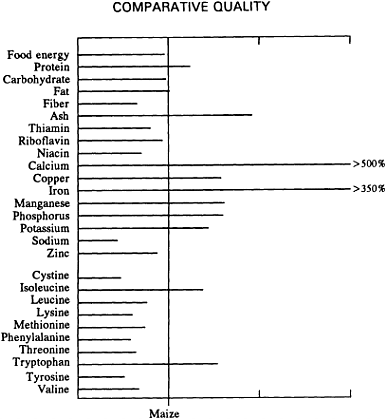
Of the grain's edible portion, ash comprises about 3 percent, an amount somewhat higher than in wheat, rice, or maize. The various mineral constituents, accordingly, tend to occur in greater quantities as well. Compared with maize, phosphorus (average 339 mg) is half again as much, iron (average 9.8 mg) is more than three times, and calcium (average 37 mg) is more than five times as much. Traces of barium, chromium, cobalt, copper, lead, manganese, molybdenum, nickel, silver, strontium, tin, titanium, vanadium, zinc, and iodine have also been noted.
In feeding trials, pearl millet has proved nutritionally superior to rice and wheat. A review of research in India9 states that a diet based on pearl millet and pulses is somewhat better at promoting human growth than a similar diet based on wheat. In one trial, for instance, researchers made up vegetarian diets typical of those eaten by the
NUTRITIONAL PROMISE
|
Main Components |
|
Essential Amino Acids |
|
|
Moisture (g) |
10 |
Cystine |
1.8 |
|
Food energy (Kc) |
353 |
Isoleucine |
3.9 |
|
Protein (g) |
11.8 |
Leucine |
9.5 |
|
Carbohydrate (g) |
70 |
Lysine |
3.2 |
|
Fat (g) |
4.8 |
Methionine |
1.8 |
|
Fiber (g) |
1.9 |
Phenylalanine |
4.1 |
|
Ash (g) |
2.3 |
Threonine |
3.3 |
|
Vitamin A (RE) |
22 |
Tryptophan |
1.4 |
|
Thiamin (mg) |
0.31 |
Tyrosine |
3.0 |
|
Riboflavin (mg) |
0.19 |
Valine |
4.9 |
|
Niacin (mg) |
2.6 |
|
|
|
Calcium (mg) |
37 |
|
|
|
Chloride (mg) |
43 |
|
|
|
Copper (mg) |
0.5 |
|
|
|
Iron (mg)a |
9.8 |
|
|
|
Magnesium (mg) |
114 |
|
|
|
Manganese (mg) |
0.8 |
|
|
|
Molybdenum (μg) |
190 |
|
|
|
Phosphorus (mg) |
339 |
|
|
|
Potassium (mg) |
418 |
|
|
|
Sodium (mg) |
15 |
|
|
|
Zinc (mg) |
2.0 |
|
|
|
a Values range from 1.0-20.7 mg. |
|||
|
The pearl millet grain is nutritious. It has no husk, no tannin, contains 5-7 percent oil, and has higher protein and energy levels than maize or sorghum. The unsaturated fatty acids making up the oil are oleic(20-31 percent), linoleic (40-52 percent), and linolenic (2-5 percent). The saturated fatty acids are palmitic (18-25 percent) and stearic (28 percent).* In general, pearl millet has a higher protein content than other cereals grown under similar conditions. In 180 pearl millet lines tested |
poor. When pearl millet partially or completely replaced rice, the nutritive value increased appreciably.
Studies conducted on children showed that all the subjects fed diets based on pearl millet maintained positive balance with respect to nitrogen, calcium, and phosphorus. The protein's apparent digestibility was about 53 percent, an amount close to that for finger millet and sorghum proteins, but less than that of rice protein (65 percent). It was also found that pearl millet could replace 25 percent of the rice in a child's diet without reducing the amount of nitrogen, calcium, or phosphorus its body absorbed.
SPECIES INFORMATION
Botanical Name
Pennisetum glaucum (L.) R. Br.10
Synonyms
Pennisetum typhoides (Burm.f.) Stapf and Hubbard, P. americanum (L.) Leeke, P. spicatum Roem and Schult.
Common Names
Angola: massango
Arabic: duhun, dukhon
English: pearl millet, bulrush millet, cattail millet, candle millet
Ethiopia: bultuk (Oromo), dagusa (Amharic)
French: mil du Soudan, petite mil, mil
India: bajra, bajri, cumbu, sajje
Kenya: mi/mawele, mwere (Kikuyu)
Mali: sanyò, nyò, gawri
Malawi: machewere (Ngoni), muzundi (Yao), uchewere, nyauti (Tumbuka)
Niger: hegni (Djerma), gaouri (Peul), hatchi (Haussa)
Nigeria: gero (Hausa), dauro, maiwa, emeye (Yoruba)
Shona: mhunga, mhungu
Sotho: nyalothi
Sudan: dukhon
Swahili: uwele, mawele
Swati: ntweka
Zambia: mawele, nyauti, uchewele (Nyanja), bubele, kapelembe, isansa, mpyoli (Bemba)
Zimbabwe: mhunga (Chewa), u/inyawuthi (Ndebele)
Zulu: amabele, unyaluthi, unyawoti, unyawothi
Description
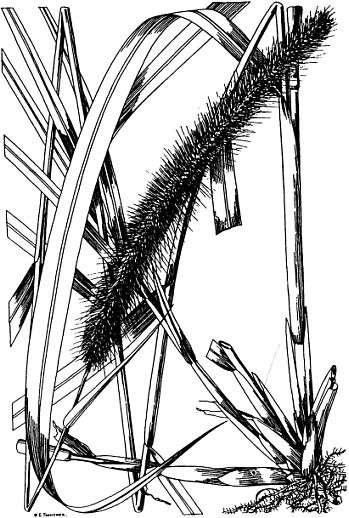
Pearl millet is an erect annual, usually between 50 cm and 4 m tall. Tillering and branching are not uncommon and are sometimes profuse. The straw is coarse and pithy.
The numerous flowers are tucked tightly around a cylindrical spike (rachis) that can range in length from 15 to 140 cm. This inflorescence is usually greenish yellow, and it may be cylindrical throughout its length or may taper at one or both ends.
The flowers can be either cross-pollinated or self-pollinated. The female part (stigma) emerges before the male part is ready to shed its pollen.11 As a result, cross-pollination normally occurs. However, where the timing overlaps, some self-pollination can occur.
Grain begins developing as soon as fertilization occurs and is fully developed 20-30 days later. The whole process, from fertilization to ripening, takes only about 40 days.
The seeds range in color from white to brown, blue, or almost purple. Most are slate gray. They are generally tear shaped and smaller than those of wheat. The average weight is about 8 mg. Some thresh free from glumes, while others require husking.
The seeds are quick to germinate. If conditions are favorable, they sprout in about 5 days. Freshly harvested seed may not germinate immediately; however, a dormancy of several weeks after harvesting has been reported.
Pearl millet is a diploid (2n = 14).
Distribution
The two vast areas of West and East Africa where pearl millet is prominent have already been mentioned (see page 80).
Soon after its domestication, the crop became widely distributed across the semiarid tropics of both Africa (15 million hectares) and Asia (14 million hectares). Pearl millet first became known in Europe about 1566 when plants were raised in Belgium from seed said to have been received from India. This form, sometimes known as Pennisetum spicatum, is still grown in Spain and North Africa. Pearl millet was introduced into the United States at least as long ago as the 1850s.
Cultivated Varieties
There are vast numbers of types, differentiated by features such as the following:
|
Double Dip Pearl millet's extremely deep roots can reach down into soil layers untapped by other plants. Tests in the southeastern United States have revealed that it can pull up nutrients from residues that have accumulated below the root zones of the previous farm crops. This finding, should it prove more widely true, has profound implications. Much of the fertilizer now put on crops leaches past their roots where it is not only lost but becomes a pollutant. Having an annual crop that can scavenge the lower layers gives farmers a second shot at the (expensive) fertilizer as well as a tool for cleaning the environment. They might even make a profit from it by selling the pearl millet. |
-
Quick maturity (about 80 days), medium maturity (100 days or so), or slow maturity (180 days or more)
-
Height
-
Amount of tillering
-
Stem thickness and branching
-
Leaf size and hairiness
-
Seedhead size, shape, and ''tightness"
-
Number, length, rigidity, brittleness, and hairiness of bristles
-
Size, shape, and color of grain
-
The degree to which the glume adheres to the grain.
For pearl millet, the bulk of the systematic breeding has been done in India, but substantial contributions have also come from several African countries, France, and the United States. Most yield improvements have resulted from incorporating genes from African varieties into Indian breeder stocks. However, a breakthrough came in the late 1950s when plants carrying cytoplasmic male sterility were discovered. This genetic trait made hybrids a practical possibility. Today, single-cross pearl-millet hybrids, using male-sterile seed parents, are the basis of vigorous private and semi-public seed industries, especially in India (see chapter 6, page 111).
Environmental Requirements
Daylength
Pearl millet is usually a short-day plant (see next chapter), but some varieties are daylength neutral.
Rainfall
Although the crop is grown where rainfall ranges from 200 to 1,500 mm, most occurs in areas receiving 250-700 mm. The lowest rainfall areas rely mainly on early-maturing cultivars. Although very drought resistant,12 pearl millet requires its rainfall to be evenly distributed during the growing season. (Unlike sorghum, it cannot retreat into dormancy during droughts.) On the other hand, too much rain at flowering can also cause a crop failure.
Altitude
Pearl millet is seldom found above 1,200 m in Africa, but occurs at much higher altitudes elsewhere (for instance, in western North America).
Low Temperature
The plant is generally sensitive to low temperatures at the seedling stage and at flowering.
High Temperature
High daytime temperatures are needed for the grain to mature. In Africa's pearl millet zone, temperatures are typically above 30°C.
Soil Type
Like most plants, pearl millet does best in light, well-drained loams. It performs poorly in clay soils and cannot tolerate waterlogging. It is tolerant of subsoils that are acid (even those as low as pH 4-5) and high in aluminum content.
Related Species
Pearl millet has many relatives. A number are quite troublesome. In much of Africa, for instance, wild Pennisetum species manage to get their pollen in, and this cross-pollination quickly reduces the crop's productive capacity. The hybrid swarms of weedy "half-breeds" (called shibras in West Africa) are common contaminants in the farmer's crop. Whereas the cultivated races have broad-tipped persistent spikelets and large, mostly protruding grains, the wild species have narrower, pointed spikelets. Also, their grains are smaller, entirely enclosed by husks, and prone to fall out (shatter). Luckily, the weedy species did not accompany the crop to India.
Although hybridization and introgression between the crop plants and the wild relatives is a problem for farmers, it can be a blessing for plant breeders, giving rise to new forms both of the crop and of the weed. (see page 121).